Romans 15:8

Greek (Tischendorf 8th ed.) Romans 15:8 appears in the Greek New Testament. The text above is from the Tischendorf 8th edition. Each word links to its Strong’s number and a concise gloss. Click any word for its full Thayer’s Greek Lexicon entry.
Download image
Cite this verse

Romans 15:8 (World English Bible). Public Domain. Lemma interlinear Bible study tool, https://lemma.gebible.app/v/romans/15/8.

Show BibTeX & RIS
BibTeX
RIS
English Translation
Now I say that Christ has been made a minister of the circumcision for the truth of God, that he might confirm the promises given to the fathers,
World English Bible · Public Domain
Download a study sheet

One document with this verse’s original text, its word-by-word gloss line, the meaning frame, cross-references with their text, attributed commentary, and full source and license credits — printable, and it pastes into notes with its structure intact.

This verse Autodidact and up

Study sheet (.html) Plain text (.txt)

A passage Seminary Student

Up to 50 verses in one chapter. A passage sheet keeps up to 6 commentary sources and 12 cross-references per verse, in the order this page ranks them, and says so on the sheet whenever that leaves anything out. Ask for a single verse and you get the Autodidact verse sheet above.

Everything on this page stays free to read, with no account — the sheet is a download of what is already on screen, not access to it.

Want to remove ads? Support Godless Engineer
Compare translations 3

The same verse in 3 English versions, stacked beneath the original-language interlinear above. Click any original word for its lexicon entry.

Each is an independent rendering of the whole verse — the interlinear is not word-aligned to these translations.

Highlighted words mark where these versions differ — a whole-verse word diff, not a word-by-word alignment.

  • World English Bible Public Domain
    Now I say that Christ has been made a minister of the circumcision for the truth of God, that he might confirm the promises given to the fathers,
  • King James Version Public Domain
    Now I say that Jesus Christ was a minister of the circumcision for the truth of God, to confirm the promises made unto the fathers:
  • unfoldingWord Literal Text CC BY-SA 4.0
    For I say that Christ has become a servant of the circumcision because of the truth of God, to confirm the promises of the fathers,

unfoldingWord Literal Text — © unfoldingWord, licensed CC BY-SA 4.0. Word-aligned USFM3 via Door43 (git.door43.org/unfoldingWord/en_ult).

Versions to compare (up to 4)

3 of 4 selected

Show all 19 translations

Every available English version of this verse, each an independent rendering of the whole verse.

  • World English Bible Public Domain
    Now I say that Christ has been made a minister of the circumcision for the truth of God, that he might confirm the promises given to the fathers,
  • Berean Standard Bible Public Domain
    For I tell you that Christ has become a servant of the circumcised on behalf of God’s truth, to confirm the promises made to the patriarchs,
  • Majority Standard Bible Public Domain
    Now I tell you that Christ Jesus has become a servant of the circumcised on behalf of God’s truth, to confirm the promises made to the patriarchs,
  • King James Version Public Domain
    Now I say that Jesus Christ was a minister of the circumcision for the truth of God, to confirm the promises made unto the fathers:
  • American Standard Version (1901) Public Domain
    For I say that Christ hath been made a minister of the circumcision for the truth of God, that he might confirm the promises `given' unto the fathers,
  • Revised Version (1885) Public Domain
    For I say that Christ hath been made a minister of the circumcision for the truth of God, that he might confirm the promises given unto the fathers,
  • Geneva Bible (1599) Public Domain
    Nowe I say, that Iesus Christ was a minister of the circumcision, for the trueth of God, to confirme the promises made vnto the fathers.
  • Douay-Rheims (1899) Public Domain
    For I say that Christ Jesus was minister of the circumcision for the truth of God, to confirm the promises made unto the fathers.
  • Young's Literal Translation Public Domain
    And I say Jesus Christ to have become a ministrant of circumcision for the truth of God, to confirm the promises to the fathers,
  • Literal Standard Version CC BY-SA 4.0
    And I say Jesus Christ to have become a servant of circumcision for the truth of God, to confirm the promises to the fathers,
  • Unlocked Literal Bible CC BY-SA 4.0
    For I say that Christ has been made a servant of the circumcision on behalf of God's truth, in order to confirm the promises given to the fathers,
  • unfoldingWord Literal Text CC BY-SA 4.0
    For I say that Christ has become a servant of the circumcision because of the truth of God, to confirm the promises of the fathers,
  • Darby Bible Public Domain
    For I say that Jesus Christ became a minister of [the] circumcision for [the] truth of God, to confirm the promises of the fathers;
  • World Messianic Bible Public Domain
    Now I say that Messiah has been made a servant of the circumcision for the truth of God, that he might confirm the promises given to the fathers,
  • Webster's Bible Public Domain
    Now I say that Jesus Christ was a minister of the circumcision for the truth of God, to confirm the promises made to the fathers:
  • Free Bible Version CC BY-SA 4.0
    I maintain that Christ came as a servant to the Jews to show God tells the truth, keeping the promises he made to their forefathers.
  • Bible in Basic English Public Domain
    Now I say that Christ has been made a servant of the circumcision to give effect to the undertakings given by God to the fathers,
  • Text-Critical English NT CC BY 4.0
    Now I say that Christ Jesus has become a servant to the circumcised on behalf of the truth of God in order to confirm the promises that were made to the fathers,
  • Tyndale New Testament (1534) Public Domain
    And I saye that Iesus Christ was a minister of the circumcision for the trueth of god to conferme the promyses made vnto the fathers.

Literal Standard Version (2020), Covenant Press — licensed CC BY-SA 4.0. Text via the HelloAO Bible API (eBible.org). Unlocked Literal Bible (unfoldingWord) — licensed CC BY-SA 4.0. Text via the HelloAO Bible API (eBible.org). unfoldingWord Literal Text — © unfoldingWord, licensed CC BY-SA 4.0. Word-aligned USFM3 via Door43 (git.door43.org/unfoldingWord/en_ult). Free Bible Version, Dr. Jonathan Gallagher — licensed CC BY-SA 4.0. Text via the HelloAO Bible API (eBible.org).

Word by word

More ways to search: Search by grammar → Find every occurrence → Compare this word →

Practice this passage: Drill this verse → Learn its vocabulary →

βεβαιῶσαι
bebaióō
G950
“to confirm”
Verb, Aorist, Active, Infinitive
Part of Speech
Verb
Tense
Aorist
Voice
Active
Mood
Infinitive
Full Thayer's Definition

Origin: from G949

TDNT: 11:00,1

1. to make firm, establish, confirm, make sure
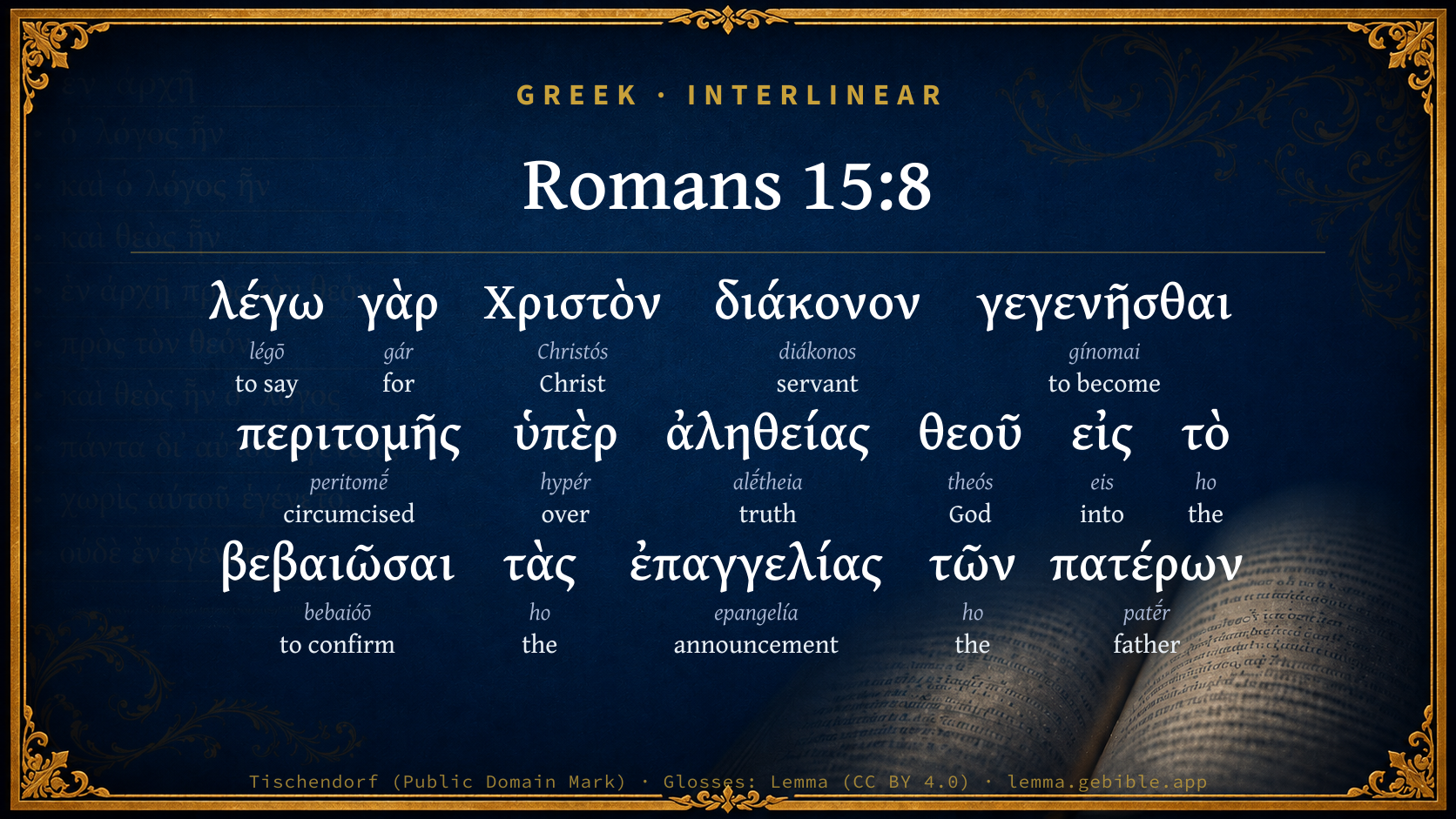
  1. λέγω légō G3004 “to say” Verb, Present, Active, Indicative, 1st person, Singular
  2. γὰρ gár G1063 “for” Conjunction
  3. Χριστὸν Christós G5547 “Christ” Noun, Accusative, Singular, Masculine
  4. διάκονον diákonos G1249 “servant” Noun, Accusative, Singular, Masculine
  5. γεγενῆσθαι gínomai G1096 “to become” Verb, Perfect, Passive, Infinitive
  6. περιτομῆς peritomḗ G4061 “circumcised” Noun, Genitive, Singular, Feminine
  7. ὑπὲρ hypér G5228 “over” Preposition
  8. ἀληθείας alḗtheia G225 “truth” Noun, Genitive, Singular, Feminine
  9. θεοῦ theós G2316 “God” Noun, Genitive, Singular, Masculine
  10. εἰς eis G1519 “into” Preposition
  11. τὸ ho G3588 “the” Article, Accusative, Singular, Neuter
  12. τὰς ho G3588 “the” Article, Accusative, Plural, Feminine
  13. ἐπαγγελίας epangelía G1860 “announcement” Noun, Accusative, Plural, Feminine
  14. τῶν ho G3588 “the” Article, Genitive, Plural, Masculine
  15. πατέρων patḗr G3962 “father” Noun, Genitive, Plural, Masculine

About this verse

These counts appear in no published source. They are computed here, from the morphology-tagged text and Lemma’s own curated glosses. What Lemma adds →

16
words
14
distinct lemmas
Pauline Epistles
section

Notable vocabulary

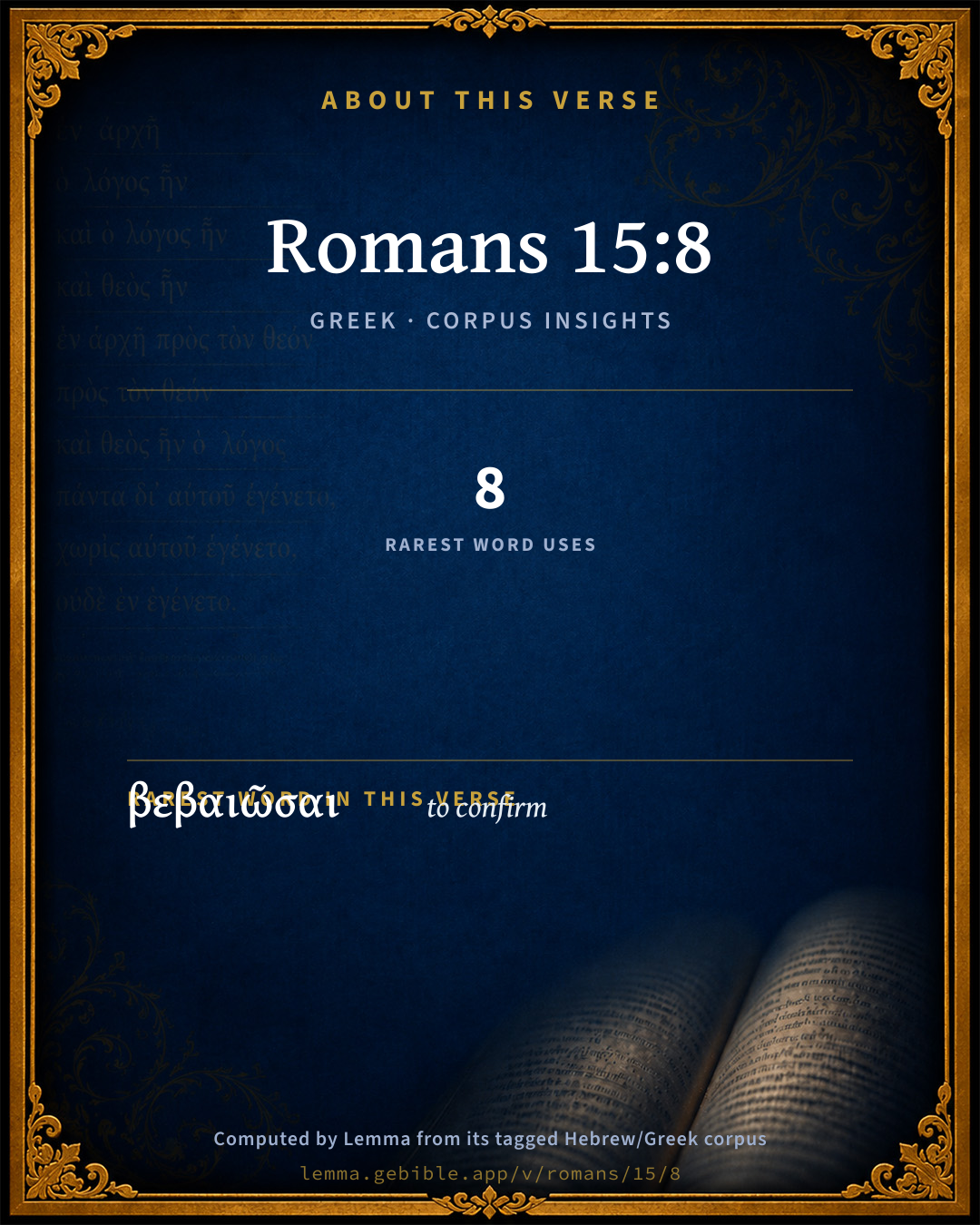
The rarest word here is βεβαιῶσαι to confirm G950 — appearing just 8 times in the whole Greek New Testament.

Shared distinctive vocabulary

βεβαιῶσαι to confirm G950 occurs in 8 verses of the Greek New Testament. Also found in:

Repetition

A word recurs within this verse:

Cross-references

27

Topical passages linked to Romans 15:8 in the Treasury of Scripture Knowledge — connected by theme and wording, ordered by reader-vote popularity; previews shown in the World English Bible.

  • Matthew 15:24 But he answered, "I wasn't sent to anyone but the lost sheep of the house of Israel."
  • Galatians 4:4–5 But when the fullness of the time came, God sent out his Son, born to a woman, born under the law,
  • John 1:11 He came to his own, and those who were his own didn't receive him.
  • 2 Corinthians 1:20 For however many are the promises of God, in him is the "Yes." Therefore also through him is the "Amen," to the glory of God through us.
  • Acts 3:25–26 You are the children of the prophets, and of the covenant which God made with our fathers, saying to Abraham, 'In your seed will all the families of the earth be blessed.'
  • John 10:16 I have other sheep, which are not of this fold. I must bring them also, and they will hear my voice. They will become one flock with one shepherd.
  • Romans 3:3 For what if some were without faith? Will their lack of faith nullify the faithfulness of God?
  • Romans 9:4–5 who are Israelites; whose is the adoption, the glory, the covenants, the giving of the law, the service, and the promises;
  • Romans 15:16 that I should be a servant of Christ Jesus to the Gentiles, ministering as a priest the Gospel of God, that the offering up of the Gentiles might be made acceptable, sanctified by the Holy Spirit.
  • Luke 1:70–73 (As he spoke by the mouth of his holy prophets who have been from of old),
  • Romans 4:16 For this cause it is of faith, that it may be according to grace, to the end that the promise may be sure to all the seed, not to that only which is of the law, but to that also which is of the faith of Abraham, who is the father of us all.
  • Romans 9:23–24 and that he might make known the riches of his glory on vessels of mercy, which he prepared beforehand for glory,
  • Romans 11:22 See then the goodness and severity of God. Toward those who fell, severity; but toward you, goodness, if you continue in his goodness; otherwise you also will be cut off.
  • Romans 11:30 For as you in time past were disobedient to God, but now have obtained mercy by their disobedience,
  • Ephesians 2:12–3:8 that you were at that time separate from Christ, alienated from the commonwealth of Israel, and strangers from the covenants of the promise, having no hope and without God in the world.
  • Psalms 98:2–3 Yahweh has made known his salvation. He has openly shown his righteousness in the sight of the nations.
  • Isaiah 24:15–16 Therefore glorify Yahweh in the east, even the name of Yahweh, the God of Israel, in the isles of the sea!
  • Micah 7:20 You will give truth to Jacob, and mercy to Abraham, As you have sworn to our fathers from the days of old.
  • Luke 1:54–56 He has given help to Israel, his servant, that he might remember mercy,
  • Acts 13:46 Paul and Barnabas spoke out boldly, and said, "It was necessary that God's word should be spoken to you first. Since indeed you thrust it from you, and judge yourselves unworthy of eternal life, behold, we turn to the Gentiles.
  • Romans 3:26 to demonstrate his righteousness at this present time; that he might himself be just, and the justifier of him who has faith in Jesus.
  • 1 Peter 2:9–10 But you are a chosen race, a royal priesthood, a holy nation, a people for God's own possession, that you may show forth the excellencies of him who called you out of darkness into his marvelous light:
  • Matthew 20:28 even as the Son of Man came not to be served, but to serve, and to give his life as a ransom for many."
  • 1 Corinthians 1:12 Now I mean this, that each one of you says, "I follow Paul," "I follow Apollos," "I follow Cephas," and, "I follow Christ."
  • 1 Corinthians 10:19 What am I saying then? That a thing sacrificed to idols is anything, or that an idol is anything?
  • 1 Corinthians 10:29 Conscience, I say, not your own, but the other's conscience. For why is my liberty judged by another conscience?
  • 1 Corinthians 15:50 Now I say this, brothers, that flesh and blood can't inherit the Kingdom of God; neither does corruption inherit incorruption.

Cross-references courtesy of OpenBible.info (CC BY 4.0).

Where the printed editions differ

1 variant

Places in this verse where the major printed Greek editions disagree on the wording in a way that affects the translation — a comparison of editions, not a manuscript-by-manuscript collation. The editions are the modern critical texts (Nestlé-Aland 28/27, SBL, Westcott-Hort, Tregelles, Tyndale House) and the traditional texts behind the KJV (the Textus Receptus and the Byzantine/Majority text). It is not a claim about which reading is original.

  1. Extra text
    Ἰησοῦν

    “Jesus”

    In TRByz Not in NA28NA27TynSBLWHTreg

    Ἰησοῦν (Iēsoun) 'Jesus' is only in traditional manuscripts (TR+Byz)

Textual data: Translators Amalgamated Greek New Testament (STEPBible TAGNT) · CC BY 4.0.

Commentary

Notes on Romans 15:8 from classic Christian and Jewish commentators (each source and its license shown beneath its notes). The classic Christian expositions comment on the surrounding passage and are grouped to its opening verse, so a note may address several verses; the Jewish commentaries on the Tanakh (Rashi and others) are per-verse, so they appear only where the commentator wrote on this verse.

Lemma curates 59 commentaries, every one of them public domain or Creative Commons licensed, each selected and text-cleaned for this edition rather than reprinted as found. About our sources →

The Biblical Illustrator

Joseph S. Exell

Rom_15:8-13

Now … Jesus Christ was a minister of the circumcision.

Christ a minister of the Old Testament

I. He ministered under it.

1. As a Jew.

2. In conformity with the law.

3. To the Jews.

II. Unfolded its meaning. As the truth of God.

III. Confirmed its promises, (J. Lyth, D.D.)

Christ the bond of union between

1. Old and New Testaments.

2. Jew and Gentile.

3. God and man. (J. Lyth, D. D.)

What is Christ?

I. To the jew.

1. The example of perfect righteousness.

2. The witness of the truth of God.

3. The Fulfiller of the Old Testament.

II. To the gentile.

1. The personal manifestation of Gods mercy.

2. The reconciler of Jew and Gentile in one brotherhood.

3. The Mediator of the New Covenant.

III. To all mankind.

1. The source of hope.

2. The Prince of joy and peace.

3. The dispenser of the Holy Ghost. (J. Lyth, D. D.)

That the Gentiles might glorify God for His mercy.

Gods mercy to the Gentiles

1. Part of Gods original purpose.

2. Predicted by the prophets.

3. Accomplished in Christ. (J. Lyth, D. D.)

Mercy

I. Wherein it consists.

II. For whom it is designed.

III. How must it be made known?

IV. What is its effect?

1. Glory to God.

2. Joy among men. (J. Lyth, D. D.)

The praises of the Gentiles

1. Respect the mercy of God.

2. Are elicited by its proclamation.

3. Shall be universal--rising from many hearts--in many tongues.

4. Are especially due to Christ. (J. Lyth, D. D.)

Rejoice, ye Gentiles, with His people.--

Rejoice, ye Gentiles

In certain circumstances it is necessary to commit particular privileges to the custody of the few, in order that when the fulness of time shall have come such advantages may be the heritage of the many. It is not in human nature, however, to desire to share great blessings with the multitude. The spirit of monopoly is more or less natural to us all. It is one of the many ugly forms of selfishness showing itself wherever there is an advantage, say--power, territory, wealth, position, fame, knowledge--which the hand of man can grasp. Now, the extraordinary privileges which the children of Abraham possessed during many centuries made them selfish and exclusive. They did not desire that the Gentiles should be fellow-heirs. It was reserved to the Son of God to make that common which had been exclusive and that universal which had been local. Referring to this the apostle saith in our text, quoting from one of the prophets, Rejoice, ye Gentiles, with His people. The day upon which the angels sang, Peace on earth and goodwill amongst men, the day upon which Gods Son said, God so loved the world that He gave His only begotten Son, the day on which He charged the apostles to go into all the world, the day when Philip met the eunuch, and Peter visited Cornelius, and Paul turned his steps towards the Gentiles, were as early spring days in the history of the nations, giving promise that the dark and barren times of ignorance were well nigh gone, and that the desert should rejoice and blossom as the rose.

I. The duty of Christian exaltation. What are our characteristic advantages as Christians?

1. To live under no ban or system of exclusion, as far as Gods providence is concerned, is cause for rejoicing. Jerusalem is no longer the place where men ought to worship. Palestine is no longer the chosen land. All the earth is hallowed ground.

2. To be turned from idols to the one true and living God is cause for rejoicing. He who worships the God who is Light becomes light. He who worships the Holy becomes holy. He who worships the God who is Love becomes love.

3. To have God speaking to us is cause for rejoicing. And God doth speak to us, Christians, by His Holy Spirit and by His Word.

4. To have a sin-offering which we may appropriate as for our sins is also cause for rejoicing.

5. To have God not only permit our worship, but seek it, is also cause for joy.

6. Moreover, not less should we rejoice in this, that Gentiles as well as Jews have become the people of God.

II. This position involves certain obligations. What are they? All men need the power and the riches of the Christian dispensation. No man is above the need of Christianity. No man is below its reach. Civilisation cannot take the place of the Christian dispensation. No being can make the Gentile rejoice but Jesus Christ. It strikes me that before we can pray more, give more, do more, we must rejoice more in our own privileges. Our advantages, as Christians, must be more real to us. There is great danger, not only of our underrating our own Christian advantages, but of our selfishly resting in the enjoyment of our privileges. Oh! exorcise the Jewish exclusive spirit. Exclusiveness and Christianity are as inconsistent as any two things can be. Say to others, Rejoice with me. (S. Martin.)

And again Esaias saith, There shall be a root of Jesse … in Him shall the Gentiles trust.--

Jesus Christ the proper object of trust to the Gentiles

The Messiah, in prophecy, was to have dominion over the whole earth. In the preceding sentences the apostle quotes several passages relative to the admission of the Gentiles, with a view to conciliate the Jews. God, as he had previously argued, is the God, not of the Jews only, but of the Gentiles also; and Isaiah had distinctly predicted the Messiah as a root of Jesse, which, though it might appear as a root in a dry ground, spoiled of its branches, and without appearance of its vegetating, should yet stand for an ensign to the people. He that shall rise to reign over the Gentiles, in Him shall the Gentiles trust. Consider--

I. The principle of trust.

1. This is necessary to the existence of society. The evidence of character is not the cause of our confidence in others: the first instance of trust cannot be accounted for, but as the result of Divinely implanted instinct. Children instinctively confide in their parents. All our information concerning external objects is matter of trust. The patient trusts his physician, the subject his governor; all are always trusting each other. Nothing can be more anti-social or mischievous than the violation of trust.

2. Trust supposes our own inferiority. We trust, for instruction or protection, in one whom we regard as our superior in respect to each: our reliance on him is the measure of our self-distrust.

3. What, then, is it for which the Gentiles trust the Messiah? Not for any present interest, but for our eternal destiny: it is that we may escape an evil and attain a good, not otherwise possible.

II. The qualifications that justify our trust. Three things are required as the basis of our confidence in any being: his voluntary engagement? his probity and goodness; and his ability to fulfil the promised undertaking. Each of these exists perfect in Christ.

1. He has entered into a voluntary engagement; He has held Himself forth as the object of our trust. I give unto My sheep, He says, eternal life. Every one that believeth in Me, I will raise him up at the last day.

2. His probity and goodness cannot be questioned. He bears all the marks of perfect ingenuousness; as when we find Him entreating His hearers to count the cost of becoming His disciples; or when He says, If it were not so, I would have told you. He looked upon our race with a Divine compassion, put on our flesh, toiled, agonised, bled, and died. He was free to have left such a work alone; but He engaged in it that God might be just and sinners justified. We cannot question His sincerity or benignity.

3. Nor can we distrust His power. Can He who calmed the winds, walked the waves, raised the dead, etc., be supposed insufficient here? He who foretold the destruction of Jerusalem, the sufferings of His people, the triumph of His cause, must Himself be King of kings and Lord of lords. By rising from the dead, He proves that He has all power in earth and heaven.

III. Some leading properties of this trust in Jesus. To be valid and saving it must be--

1. A solemn, deliberate act; the effect of seeing the Son, recognising in Him those qualities which justify unlimited confidence. You should know whom you have believed, etc.

2. Exclusive, centred in Christ alone (Jer_17:5). Trust not in any qualities or works of your own. He will never divide His glory with another. It was the ruin of the Jews, that they went about to establish their own righteousness, while the Gentiles, ignorant of the whole business, found Him whom they sought not.

3. Humble and penitential. We must acknowledge and feel our utter unworthiness; otherwise we contradict our profession. Humility and confidence dwell together in perfect harmony.

4. Submissive and obedient. They are the foremost to fulfil the law of Christ, who place their entire affiance in Him: constrained by His love, which constrained Him to die for them, they bind His precepts on their hearts. It is a practical trust, that sets in motion all the springs of action, purifies all the powers and affections: for Christ saves by His merit those only whom He rules by His authority. (R. Hall, M.A.)

The world trusting in Christ

I. The grand tendency of the races. To trust.

1. What creature is more dependent on nature than man? Birds, beasts, and fishes can do without him, but he is dependent upon them.

2. What creature is more dependent upon his own species? Man comes into the world the most helpless of all creatures. For years he lives by the help of others. No one is independent of his fellow.

3. What creature is more dependent on God? All live in and by Him; but man requires more from Him than any other creature, viz., spiritual illumination, strength, salvation. No wonder, then, that a being so dependent should crave for objects on which to rely. This tendency to trust explains--

(1) The reign of imposture. The power of Mahomet, Confucius, the Pope, and priestcraft is begotten and nourished by mans tendency to trust.

(2) The prevalence of disappointments. Why otherwise is every heart the grave of so many frustrated hopes, broken plans, and wrecked friendships? The great need of the world, therefore, is a trustworthy object.

II. The evangelic provision for the race.

1. What attributes ought He to have to make all happy who trust in Him?

(1) He should be all perfect in excellence. If we trust our being and destiny to the keeping of one in whom we discover moral imperfections, we shall soon grow wretched in the exercise of such trust.

(2) He should be all-sufficient in resources. If we trust unboundingly in one who is not capable of taking care of us, our trust will end in agony.

(3) He should be unalterable in being, character, and capacity. If we trust one who is given to change, there will be constant misgiving.

2. Now, where is the being who answers these conditions? Only in the gospel.

(1) Is not Christ all-perfect, the incarnation of virtue itself?

(2) Has He not all-sufficient resources? He is all-wise to guide, all-powerful to guard, all-good to bless. He is able to do exceedingly abundant, etc.

(3) Is He not unchangeable, the same yesterday, to-day, and for ever?

III. The blessed future of the race. In Him shall the Gentiles trust. This prediction has been partially fulfilled. Since Peters sermon in the house of Cornelius down to this hour Gentiles have been trusting in Him. The partial fulfilment is a pledge that all men shall trust in Him. What harvests have already sprung from the one grain. When all men trust in Him, three things will be secured.

1. Spiritual peace. He will keep them in perfect peace, etc.

2. Social unity. All men will be united to each other by being thus united to Christ. No more domestic broils, social animosities, national conflicts, or ecclesiastical strifes.

3. Moral elevation. All men being thus vitally connected with Christ, will become more and more assimilated to His moral attributes.

Conclusion: Learn--

1. The worlds need of the gospel. If mens destiny depends upon the object of their trust and Christ is the only object of trust that can render them happy, then is not the gospel a necessity?

2. The way to preach the gospel. It is to hold Him forth, not yourself, nor your notions and theologies, hut Christ as the object of the worlds trust. The hungry world does not want your analysis of bread, but the bread of life itself. Humanity does not want our speculation about Christ, but Christ Himself. (D. Thomas, D.D.)

Trusting in Christ

1. Man must have an object of trust.

2. Christ is the only ground of trust.

3. Shall become the trust of the world. (J. Lyth, D.D.)

The Biblical Illustrator, edited by Joseph S. Exell (c. 1880s–1900s) — public domain. Text from a community e-Sword module.

Joseph Benson's Commentary

Rom 15:8-12. Now — To show more fully what I mean in saying Christ received us, I observe, that Jesus Christ was a minister of the circumcision — Or vouchsafed to be a servant of the Jews, in preaching the gospel among them; for the truth of God — To demonstrate his faithfulness in fulfilling the promises made unto the fathers — Of sending them the Messiah; and therefore, 1st, The believing Jews, though weak, ought not to be despised by the believing Gentiles, though stronger. And, 2d, It is no objection to Christ’s receiving the Gentiles, that he never preached to them, for he became a minister of the circumcision, not only in order to the salvation of the Jews, but also that, by converting them, and sending them to preach to the Gentiles, he might accomplish the promises made to the fathers concerning the blessing of all nations. And that the Gentiles might glorify God for his mercy, as it is written, Psa 18:49; where the Gentiles and Jews are spoken of as joining in the worship of the true God, the God of Israel. To explain this more fully, “Jesus Christ was born a Jew, and exercised his ministry among the Jews, in order that the truth of God’s promises to the fathers, concerning the blessing of the nations in Abraham’s seed, might be confirmed by the conversion of the Jews and Gentiles. For as the Jews were the only people on earth who worshipped the true God, and had his revelations in their hands, it was absolutely necessary that the gospel, in which all the former revelations terminated, should be first preached to them; that a sufficient number of them receiving it, might preach it to the Gentiles, as the fulfilment of the former revelations, of which their nation were the keepers. The gospel being thus offered to the Gentiles, as the word of the same God who anciently spoke to the fathers of the Jewish nation by the prophets; that circumstance, with the miracles which accompanied the first preaching of it, so powerfully demonstrated it to be from God, that multitudes of the Gentiles, receiving it, turned from idols to worship the living and true God; whereby the truth of God’s promise to the fathers, concerning the blessing of the nations in Christ, was illustriously confirmed, and the Gentiles had an opportunity of glorifying God for his mercy in their conversion.” It may be proper to observe further here, that “conversion to the true God being the mercy, or blessing, which God promised to bestow on the Gentiles, it is particularly mentioned here, not only to make the Gentiles sensible that they ought not to despise the Jews, through whom they had received so great a blessing, but also to persuade the Jews to acknowledge the Gentiles as the people of God, equally with themselves.” — Macknight. And again Moses saith, (Deu 32:43,) Rejoice, ye Gentiles, with his people — Implying that the time would come when the Gentiles should become the people of God as well as the Jews, and should join with them in the worship of God, and rejoice in a sense of his goodness to them. And again, (Psa 117:1,) Praise the Lord, all ye Gentiles, for the mercy vouchsafed to you; therefore they shall know God, and obtain mercy; and Esaias saith, There shall be a root of Jesse — See note on Isa 11:10. The apostle here follows the translation of the LXX., because, though it differs in expression from the Hebrew, it represents the prophet’s meaning with sufficient exactness to prove the point for which he quotes it, which was to show that the Gentiles should become the people of God by believing, and confiding in the Messiah, and therefore should be united in the same church with the believing Jews. And the apostle’s design in this part of his epistle being to persuade the Jewish and Gentile converts to a cordial union in the public worship of God, it was of great importance to show the Jews that this coalition was foretold in their own Scriptures; for which purpose the apostle, with great propriety, quotes the various passages here adduced.

Joseph Benson's Commentary on the Old and New Testaments (1811–1818) — public domain. Text from a community e-Sword module.

Whedon's Commentary on the Bible

Daniel D. Whedon

Unity of Gentile with Jew in the Church, Rom_15:8-14.

The unity of the Church, derived from mutual forbearance, leads the apostle to touch finally upon that unity which forms the main argument of the epistle—the fusion of the Gentiles into the Abrahamic Church through Christ. This he confirms with a few quotations from the prophets and psalmists of old.

8. Minister of the circumcision—Born of the Abrahamic line, circumcised the eighth day, and limiting his ministry within the holy land, Christ was eminently a minister of the circumcision.

For the truth of God—His ministry was to establish the great truth of God that all nations should be gathered into the fold of the Church.

To confirm—That is, to make sure the promises of which the apostle will now adduce a few specimens.

Daniel D. Whedon (gen. ed.), Commentary on the Old and New Testaments (1874–1909) — public domain. Text from a community e-Sword module.

The Preacher's Complete Homiletical Commentary

Joseph S. Exell (gen. ed.)

CRITICAL NOTES

Rom_15:8.—A minister of the circumcision—that is, of the Jewish nation. Christ, the Gentile Saviour, was and is the minister of the Jew. We are all brethren; one class must not despise the other.

Rom_15:10.—-Both Jews and Gentiles to rejoice together in God’s salvation.

Rom_15:12.—Christ is here compared to a standard around which the nations should assemble. Jacob’s prediction is to be thus fulfilled.

MAIN HOMILETICS OF THE PARAGRAPH.—Rom_15:8-12

Praise follows prayer.—The late Matthew Arnold strives to get rid of the words “predestination,” “justification,” “sanctification,” as having any of the meaning attached to them by theologians, which they suppose is derived from St. Paul himself. Matthew Arnold teaches us to follow the eternal law of the moral order, which is righteousness. St. Paul seems thus only to be following in the steps of the ancient moral philosophers, tinctured with a little Jewish thought. We find Paul hard to be understood; but we find his latest interpreter harder to understand. St. Paul and Protestantism will not make men in “harmony with the eternal order and at peace with God”; while the epistles of St. Paul have done vastly more for the production of righteousness among men than any books which have been written. But if Matthew Arnold is to be our guide, we must reject St. Paul, for we read: “A Jew himself, he, Paul, uses the Jewish Scriptures in a Jew’s arbitrary and uncritical fashion, as if they had a talismanic character, as if for a doctrine, however true in itself, their confirmation was still necessary, and as if their confirmation was to be got from their words alone, however detached from the sense of their context, and however violently allegorised or otherwise molested.” The man who quotes uncritically is to be rejected on intellectual grounds. If St. Paul have one point pre-eminent, it is that he possesses and uses the critical faculty. To wrest is to turn from truth; and the man who wrested the Jewish Scriptures is to be rejected on moral grounds. But we are not aware of any such wresting; the four quotations made in this paragraph do not appear to us to be either used uncritically or wrested from their context. The aptness of St. Paul’s quotations is self-evident, and is itself a refutation of a mere Judaistic or Oriental use of passages. It is an easy but not quite fair way of getting rid of a difficulty by using the words “Hebraise,” “Orientalise.” There is, however, no need to use long and unusual words in reading these four quotations. Whether we read the texts in Hebrew, in Greek, or in our English translation, they all bear the construction put upon them by St. Paul. And we think as much may be said for all the other quotations. The sense of harmony with the universal order, the desire for and the possession of righteousness, are to come, not from psychology, not from philosophy, not from either deductive or inductive methods, but from faith in that Root of Jesse in whom the Gentiles shall trust. Here is foretold universal harmony with the eternal law of divine order. Jews and Gentiles shall blend in one song of praise to the King of righteousness. The Weak and the strong shall be of one mind and one mouth when they are inspired by love to the Incarnation of righteousness. Notice in this paragraph:—

I. A twofold purpose of Christ’s mission.—To vindicate God’s faithfulness and to manifest God’s mercy. Jesus Christ was the minister of the circumcision; made under the law; a Jew confirming unto the Jews the faithfulness of God; by His life conforming to the law in its spiritual and essential aspect; by His death redeeming those who were under the curse of the law. Christian ministers are sometimes taunted with propagating the worship of a dead Jew. We are not abashed by the aspersion. It is said that a living dog is better than a dead lion; but the dead Lion of the tribe of Judah has brought forth more sweetness for the refreshment of the race than any of the living assailants of Christianity from the time of its establishment to the present hour.

“In the cross of Christ I glory,

Towering o’er the wrecks of time;

All the light of sacred story

Gathers round its head sublime.”

It is wonderful what the Minister of the circumcision, by His earthly life, by His sacrificial death, and by His mediatorial reign, has accomplished. There is vastly more to come; for Jews shall extol God’s faithfulness, and Gentiles from all quarters shall rejoice in God’s mercy. The cross of Christ shall tower over the wrecks of human theories. Christ, by His cross, by His divine efficacy, shall reign over the Gentiles all over the round globe of the earth.

II. A blessed result of Christ’s mission.—The establishment of a kingdom amongst the Gentiles which is righteousness, peace, and joy in the Holy Ghost. A Root of Jesse shall rise to reign. God begins at the root; God’s root forces are strong and ever developing. Out of the Root of Jesse has sprung the wide spreading tree of Christianity. The Root of Jesse did not look like a regnant power when He was crucified between two thieves. The Root appeared to be killed when it was trying to send itself above the ground. But the Root gathered to itself power from the strokes of the adversaries. Jesus reigns from His sepulchre. Other men cease to reign when death hurls down the sceptre. Jesus began to reign in fuller measure when death touched the physical form. He shall rise to reign. He is rising through all time. His utmost elevation will not be reached till in Him the Gentiles trust. He is rising, though some say He is falling. He is rising, though men say that the kingdom of Christianity is a failure. In Him shall the Gentiles trust. His kingdom is founded on trust. Holy confidence is the foundation of His divine sovereignty.

III. The united song of praise inspired by Christ’s mission.—“Sing,” “rejoice,” “praise,” “laud,” are the words employed to set forth the exuberant nature of the feelings of those who feel and seek to glorify God for His mercy. One mind of gratitude and one mouth of praise shall be characteristic of the ransomed Gentile world. A grateful mind must be the motive force of a praising mouth. The spiritual revelation of divine mercy to the inmost soul works gratitude, and this expresses itself in hymns of praise. The singing of the grateful chorister may not to critical human ears be so correct as the singing of some who are prompted by the prospect of remuneration, but the former touches the heart of true men and blends with the upper harmonies. Let us open our souls to the incoming streams of divine mercy. Let gratitude attend the spirit, and then we shall sing with lip and with life; our daily steps will beat divine music; our days will march to heavenly harmonies; our very nights will be cheered with spirit songs. Angels will hear the strains and join to swell the melody; earth and heaven will unite, and the sound will be as the sweet notes of many skilful harpers harping with their harps.

SUGGESTIVE COMMENTS ON Rom_15:8-12

Rejoice in the Lord, a privilege and a command.—There is in man by nature such an inordinate portion of self-love, that his regards are almost exclusively confined to those who coincide with him in sentiment and contribute to his comfort. The smallest difference of opinion in things either political or religious shall be sufficient to produce, not only indifference, but in many alienation and aversion. We do not much wonder at a want of mutual affection between the Jews and Gentiles, because they imbibed from their very infancy the most inveterate prejudices against each other, and had all their principles and habits as opposite as can be conceived. But, unhappily for the Christian Church, the same disposition to despise or condemn each other remained amongst them after they were incorporated in one body and united under one head, the Lord Jesus Christ. To counteract this unhallowed temper, and to promote a cordial union amongst all the members of Christ’s mystical body, was the incessant labour of St. Paul. In the whole of the preceding context he insists on this subject, recommending mutual forbearance and affection from the example of Christ, who showed the same regard both to Jews and Gentiles, both to strong and weak. The ministry of our blessed Lord had respect, primarily, to the Jews. Jesus was Himself born a Jew, and He submitted to circumcision, which was the initiatory rite whereby the Jews were received into covenant with God. When He entered upon His ministerial office, He addressed Himself exclusively to those of the circumcision; when solicited to confer His blessings on a Syrophenician woman, He refused, saying that He was “sent only to the lost sheep of the house of Israel,” and that “He could not take the children’s bread and cast it unto dogs,” though, for the encouragement of all future suppliants, of whatever nation or character, He afterwards granted her request. In all this the Lord Jesus consulted “the truth of God, and confirmed the promises made to the fathers”; which, though they comprehended all the spiritual seed of Abraham, had doubtless respect to those in the first place who should also be found among His lineal descendants. Ultimately, to the Gentiles also in the very promises made to Abraham, the Gentile nations were expressly included. But, to confirm this truth, St. Paul brings passages out of all the different parts of the Old Testament, “the law of Moses, the Prophets, and the Psalms,” to prove his point. These testimonies unequivocally prove that, however Jesus, for the accomplishing of the promises, ministered to the circumcision chiefly, yet He did not confine His regards to them, but ordained that all, of whatever nation, should equally be admitted to His covenant and be made partakers of His salvation. To whomsoever our Lord communicated His salvation, it was His invariable purpose that they who partook of it should “glorify God for His mercy.” The manner in which this is to be done may be gathered from the passages that are cited. The duty of every member of Christ’s Church is to submit to Him—Christ is “risen to reign over the Gentiles.” Now, where there is government, there must be subjection; and consequently all who would belong to Christ must “take His yoke upon them.” Their submission too must be willing and unreserved. To trust in Him—Christ comes, not only as a Lord, but as a Saviour, through whom we are to find deliverance from the wrath to come. Now it is said that “in Him shall the Gentiles trust.” Our duty towards Him is to believe that He is equal to the task which He has undertaken, that in Him there is a fulness of wisdom to instruct the ignorant, of righteousness to justify the guilty, and of grace to sanctify the polluted. Rejoice in Him—to “rejoice in the Lord alway” is not merely permitted as a privilege, but commanded as a duty. We dishonour Him when we do not rejoice in Him; we evidently show that we have a low apprehension of His excellency, and of the benefits which He confers. What they are doing in the Church above, that we should be doing in the Church below. Our obligations are the same, and so should also our occupations be. Are the glorified saints incessantly admiring and adoring Him who is the author of all their happiness? We also should ever be contemplating the incomprehensible wonders of His love, and rejoicing in Him with joy unspeakable and glorified. Walk in His steps—this is the particular scope of the text, the intent for which all these quotations are introduced. Our blessed Saviour has shown a gracious and merciful regard for all the human race; nor has He permitted any diversity in their habits or conduct to exclude them from His kingdom, provided they repent and obey His gospel. Now our hearts should be enlarged after His example. We should not suffer little circumstantial differences to alienate us from each other. While we claim a right to follow our own judgment, we should cheerfully concede the same liberty to others. A difference of conduct may be proper for different persons, or for the same persons under different circumstances. This is evident from Paul refusing to suffer Titus to receive circumcision, when he had already administered that rite to Timothy; as also from his performing at Jerusalem the vows of a Nazarite, after he had for twenty years renounced the authority of the ceremonial law. It is therefore by no means necessary that we all conform precisely to the same rule in indifferent matters; but it is necessary that we cultivate charity, and maintain “the unity of the Spirit in the bond of peace.” If we be not perfectly agreed in sentiment respecting things that are non-essentials, we must at least agree in this, to leave every one to the exercise of his own judgment: the weak must not judge the strong, nor the strong despise the weak, but all follow after “the things which make for peace, and things wherewith one may edify another.”—Simeon.

ILLUSTRATIONS TO CHAPTER 15

Rom_15:11. The cheer of praise.—Much of our work for Christ is too barren of all joy and enthusiasm, and we need the cheer of praise. The English ploughboy sings as he drives his team; the Scotch Highlander sings as he labours in glen or moor; the fisherman of Naples sings as he rows; and the vintager of Sicily has his evening hymn. When Napoleon came to a pass in the Alps where the rocks seemed impassable for the ammunition waggons, he bade the leader of the bands strike up an inspiring march, and over the rocks on a wave of enthusiasm went the heavy waggons. Earthly battle-fields have resounded with praises from bleeding Christian soldiers, and pain has been forgotten as the lips of the dying have sung, “When I can read my title clear,” and “How sweet the name of Jesus sounds.” Martin Luther has well said, “The devil cannot sing”; and we know that David’s harp drove the evil spirit out of King Saul.

The Preacher's Complete Homiletical Commentary (gen. ed. Joseph S. Exell; Funk & Wagnalls, c. 1892) — public domain (pre-1929). A full-Bible homiletical/sermon-outline anthology covering 65 of 66 books (2 John is absent from the source module). Text from a community e-Sword module.

F. W. Grant's Numerical Bible

Subdivision 4. (Rom 15:8-33.)

The human appeal and apology of the apostle of the Gentiles.

There follows now what in some sense is supplementary to the whole epistle while it is, no doubt, in special relationship to those questions which we have just had discussed, and which are clearly such as would be most likely to affect the harmony of a mixed assembly of Jews and Gentiles, as that at Rome perhaps in an especial manner was. It reminds them of what the Old Testament had declared as to the acceptance of the Gentiles, an object for which, while minister of the circumcision to confirm the promises made to the fathers, Christ had no less wrought. And this leads the apostle into a brief reference to his own labors to the same end, as the apostle of the Gentiles, and to declare once more his unfeigned desire to see the saints at Rome, of which he had spoken at the beginning of the epistle. It is a human appeal which could not fail to have from one like Paul its moral effect in the same direction as what precedes it. At the same time, the comparative slightness of treatment, compared, for instance, with his defence of his ministry in the epistle to the Galatians, answers to its supplementary place here as compared with its foremost one in that which is distinctly controversial.

1. He owns the place that Christ primarily occupied as minister of the circumcision for the truth of God. It was in this character that Israel rejected Him, although the testimony as to it did not end with the Cross, but was continued in that of the Spirit afterward. But the promises which He thus confirmed themselves contemplated the blessing of the nations, and the apostles were distinctly commissioned to bear witness to Him in the whole world. The psalmist had joined with the prophets and with Israel’s own law-giver, as the quotations show here, in expanding these promises in fuller and more definite statements. There could, of coarse, be in these no announcement of the Church, the body of Christ, which was a secret hid in God till Israel refused the grace which had first of all been offered to her; but of this the apostle is not here speaking, nor is the doctrine of it in the epistle at all. The nations were to rejoice with His special people, and the root of Jesse to be their Ruler and confidence. The branches of the wild olive were, in fact, being grafted into Israel’s olive-tree, though this did not mean the relinquishment on God’s part of promises which were to be fulfilled to the nation in due time. The Old Testament bore witness that God had the Gentiles in remembrance; Israel’s blindness in part might change the character of things for the time being, it being impossible to recognize them in this blindness of unbelief. Gentiles and Jews would thus of necessity be brought together in a way beyond that which the prophets contemplated; but this was almost necessarily the result of the Jews’ own exceptional position through their sin. God’s purpose of blessing to the Gentiles could not wait for this.

The apostle does not enter into all this, but it is in the strict line of his argument and easily to be understood. It was better left, perhaps, to be worked out by themselves. He closes this with an earnest prayer in behalf of the Roman saints. In the revelation God had made of Himself, whether to the disheartened adherents of the dying paganism, or to the remnant of Israel disappointed of their national expectations, He had indeed approved Himself as the God of hope. In the realization of the blessings which were now become their own, they could afford to bury their dead past, and forget it. He prays that they may be filled with all joy and peace in believing, so as to abound in hope through the power of the Holy Spirit. How good to make full proof of the possibilities that are in our hands! and how do we possess ourselves of what is our possession! This is for a lamentation, and must be for a lamentation.

2. Paul speaks out the confidence of his heart in these Roman brethren whom as yet he had not seen. He credits them in the frankness of Christian love with the due moral effect of their faith, and with the enlightenment proceeding from it. But he had written to them in the boldness belonging to his position as apostle of the Gentiles, a position the gift of God’s grace alone, to put them in mind of all that was their own. The ministration of the gospel of God was for him in the fruit God gave him of it, a priestly service which presented the Gentiles in whom the Spirit wrought as a sanctified and acceptable offering to Him. The words, in their perfect simplicity and intelligibility, yield no cover to the ritualistic confusion which confounds ministry with priesthood -approach to God with the message of peace and reconciliation for men. Paul does not stand between the Gentiles and God, to offer anything to Him on their behalf, who in the place which Christianity had given them were themselves all a holy priesthood (1Pe 2:5), all in equal nearness to Him, through the grace that had brought them nigh. But it was themselves, as the fruit of the work in them of which God had made him the instrument, who became thus an offering -his offering -to God. Thus he had matter of glorying through grace in what God had done through him to make the Gentiles obedient in faith to Christ, God also accompanying his word with signs and wonders, in demonstration of whose work in fact this work of his was. He had not been slothful or negligent either in this joyful work, but from Jerusalem in a wide circuit to Illyricum, he had fully preached the gospel of Christ.

Here he explains to them what had hindered him, with all this activity, from coming to a place so central and important as Rome was. It had been, he says, his earnest desire to follow the Scripture principle, to bring those to see who had yet had no tidings brought to them, and those understand who never yet had heard. Rome, therefore, with its assembly already gathered, could not claim him in view of the unoccupied places round. But now be found no more room, as he counted this, in the regions where he had been, and there was the far western country of Spain beckoning him by its need. Here would be his opportunity to visit by the way those whom he had long desired to see. This he contemplated therefore, but not immediately; for now Jerusalem claimed him, for the ministry of the contribution of the Gentiles to the need of those in whose spiritual blessings they had been made partakers. After this, Rome would come next, on his way to Spain. We have learned elsewhere how differently this was to be fulfilled to him from the way in which he now imagined. The fear of something, however, that might come to him at the hands of the disobedient in Judea, he frankly confesses, asking their prayers for his deliverance, and the accomplishment of his purpose as he had declared it to them. It is at least probable that he may have, after all, gone on to Spain; but there is no Scripture account of it, and no real certainty. There was, as we know, a long and unwilling delay, and years in a Roman prison, whether in Judea or at Rome. Our prayers are often answered in ways we know not, and so it was in this case as to the apostle himself; but who shall say that they were not answered? or that they were not answered in a way better in the sight of God -better for the gospel itself, than had all taken place according to his thought? Nor would this be irreconcilable with a certain effect of his own failure at this time to interpret aright his Lord’s mind for him. We need not go into this here, but the mistakes of those most earnest and devoted may have, just in this very way, the most important lessons for us. We are to follow no merely human leader without personal exercise, and a grave, wise reserve which the apostle here would be the first to press upon us; "Be ye followers of me," he could say indeed, but not without the reservation implied, if not directly stated, "even as I also am of Christ." How beautiful the prayer with which he closes here, -the more as we think upon the difficulties of the way for him whose the the prayer was, -"the God of peace be with you all."

F. W. Grant, The Numerical Bible (4th ed., 1903) — public domain. Text from a community e-Sword module.

Tyndale Open Study Notes

Tyndale Open Resources

15:8-9 Through Christ, God made it possible for Jews and Gentiles to join together to give glory to him in the new covenant people of God (see chs 9–11). The issue of Jewish–Gentile relationships was fundamental to the dispute in the Roman church (14:1–15:7).

Tyndale Open Study Notes — © Tyndale Open Resources, licensed CC BY-SA 4.0. Text via the HelloAO Bible API.

Bengel's Gnomon

Johann Albrecht Bengel

Rom 15:8. Λέγω δὲ, Now I say) By this verse the preceding clause concerning Christ is explained.—Χριστὸν Ιησοῦν.) Others say, Ιησοῦν Χριστὸν.[154] Those, who have omitted the name Jesus in this passage, seem to have had respect to Rom 15:3; Rom 15:7. The nomenclature, Jesus Christ, and Christ Jesus, ought not to be considered as promiscuously used. Jesus is the name, Christ the surname. The former was first made known to the Jews, the latter to the Gentiles. Therefore he is called Jesus Christ according to the natural and common order of the words; but when He is called Christ Jesus, by inverting the order of the words, peculiar reference is made to the office of Christ, with somewhat of a more solemn design. And this is especially suitable to the present passage. Sometimes in one place, both arrangements of the words prevail, Rom 15:5-6; Gal 2:16, note; 1Ti 1:15-16; 1Ti 6:13-14; 2Ti 1:9-10. See also 1Co 3:11; with which comp. 1Ti 2:5.—διάκονον, a minister) a suitable appellation; comp. Rom 15:3; Mat 20:28. [Remarkable humiliation! Here indeed there was need of patience, Rom 15:4-5.—V. g.]—Moreover, Jesus Christ became the minister of the Father for the salvation of the circumcision. Christ was subservient to the will of the Father: the Father devoted Him for the salvation of many, whence the Genitive, of circumcision, has the same meaning as in Gal 2:7-8. Presently after, reigning is ascribed to this minister, Rom 15:12. But this appellation (minister) is not repeated in the next verse, for the calling of the Gentiles coheres with His state of exaltation;—it is accordingly said there, that they might glorify, for greater thanksgiving is rendered by the Gentiles,[155] than by the circumcision.—περιτομῆς, of the circumcision) that is, of Israel.—πατέρων, of the fathers) The Genitive here contains the emphasis of the sentence, Mat 15:26.

[154] ABC read Χριστὸν only. But D(Λ)Gfg and both Syr. Versions and Rec. Text Ἰησοῦν Χριστὸν.—ED.

[155] Naturally so: Because they have received grace extraordinarily, they being but as the wild olive graffed in on the elect stock, Israel.—ED.

Bengel's Gnomon of the New Testament — English translation (T&T Clark, Edinburgh, 1860) — public domain. Text from a community e-Sword module.

Meyer's Critical & Exegetical Commentary

Heinrich August Wilhelm Meyer

Rom_15:8-9. A more precise explanationwhich furnishes a still more definite motive for compliance with the προσλαμβ. ἀλλ.respecting ὁ Χριστὸς προσελάβ. ὑμ. εἰς δόξ. Θεοῦ, first in respect of Jewish-Christians (Rom_15:8), and then of Gentile-Christians (Rom_15:9), and that in such a manner that the connection of the former with Christ appears as the fulfilment of their theocratic claim, but that of the latter as the enjoyment of grace;a distinction so set forth, not from the Jewish-Christian narrowness of the author (Lucht), but designedly and ingeniously (comp. Rom_11:28-29), in order to suggest to the Gentile-Christians greater esteem for their weaker Jewish brethren,[15] and humility.

ΛΈΓΩ ΓΆΡ] I mean, namely, in order more particularly to explain myself respecting the προσελάβετο ὑμᾶς κ.τ.λ.; otherwise in Rom_12:3. But comp. 1Co_1:12; Gal_4:1; Gal_5:16. Frequently thus in the Greek writers.

ΔΙΆΚΟΝΟΝ ΓΕΓΕΝ. ΠΕΡΙΤ.] ΔΙΆΚ. has emphasis, in order to bring out the original theocratic dignity of the Jewish-Christians. Christ has become minister of the circumcised; for to devote His activity to the welfare of the Jewish nation was, according to promise, the duty of His Messianic office. Comp. Mat_20:28; Mat_15:24.

ὑπὼρ ἀληθ. Θεοῦ] more particularly explained at once by what follows; hence: for the sake of the truthfulness of God, in order to justify and to demonstrate it through the realization of the hallowed promise given to the fathers; comp. 2Co_1:20. Thus the προσελάβετο ὑμᾶς in respect of the Jewish-Christians redounded εἰς δόξαν Θεοῦ; but it redounded to this quite otherwise in respect of the Gentile-Christians, Rom_15:9.

ὑπὲρ ἐλέους] contrast to ὙΠῈΡ ἈΛΗΘ. ΘΕΟῦ, Rom_15:8 : on behalf of mercy, i.e. for mercy, which God has evinced towards them by His making them joint partakers in redemption. The references of ὑπέρ in the two cases are thus not alike.

ΔΟΞΆΣΑΙ, ordinarily understood as dependent on ΛΈΓΩ, may neither denote: have praised (namely, at their adoption), as Reiche, Rückert, de Wette, Bisping would explain it, which not merely introduces an irrelevant idea, but also runs counter to the usage of the aorist infinitive (even 2Co_6:1, see in loc.); nor: have to praise (Tholuck, Philippi, and most), for there is no mention of a duty according to the parallelism of the two verses, since λέγω γάρ has not here the sense of commanding (see on Rom_12:3, Rom_2:22); nor, finally, is it an infinitive without reference to time (I say, that the Gentiles praise), as Winer, p. 311 f. [E. T. p. 417], and Fritzsche, after the Vulgate, Luther, and others, take it, which would have required the present infinitive, because λέγω does not here express the notion of willing, hoping, and the like (see Lobeck, ad Phryn. p. 749), but simply that of affirming with statement of the object. Moreover, the aorist infinitive necessarily leads to this, that δοξάσαι is parallel to the preceding ΒΕΒΑΙῶΣΑΙ, and consequently is not governed by ΛΈΓΩ at all, but is connected with ΕἸς ΤῸ, as Castalio and Beza have rightly perceived; comp. also Bengel (glorificarent) and van Hengel. Hence: in order that He might ratify the promises of the fathers, but that the Gentiles, on behalf of mercy, might praise God. The former, namely, ὑπὲρ ἀληθείας Θεοῦ εἰς τὸ βεβαιῶσαι κ.τ.λ., was the proximate design of Christs having become minister of the circumcised; and the more remote design, which was to be attained through the passing of salvation from the Jews to the Gentiles (comp. Gal_3:14), consisted in this, that on the other hand the Gentiles should praise God on account of mercy. Incorrectly, Hofmann takes δοξάσαι as optative: Paul wishes that the Gentiles, etc. In this way the εἰς δόξαν Θεοῦ, Rom_15:7, would be something which was still only to set in, although it had set in long ago (comp. Rom_9:24-25, and see Rom_15:16-24). Without ground, Hofmann imports into the simple τὰ ἔθνη the idea of the Gentile world as a whole; it can in fact according to the context denote only the Gentile portion of those, whom Christ προσελάβετο εἰς δόξαν Θεοῦ.

Observe, moreover, how logically correct is the contrast of ὙΠῈΡ ἈΛΗΘ. and ὙΠῈΡ ἘΛΈΟΥς (in opposition to Olshausen, Fritzsche); for although God had promised the future ΠΡΌΣΛΗΨΙς of the Gentiles also (in the prophets), He nevertheless cannot have promised it to the Gentiles themselves, as He has given the Messianic promise to the Jews themselves and chosen them for His people, in accordance with which, He, by virtue of His truthfulness, was bound to His word, and consequently the Jews, not the Gentiles, were de jure the children in terms of the covenant and heirs of the kingdom; comp. Rom_9:4-5; Act_3:25; see also Weiss, bibl. Theol. p. 397.

καθὼς γέγρ.] This praising by the Gentiles takes place in conformity with (as a fulfilment of) Psa_18:50, which passage is quoted after the LXX. The historical subject of the passage, David, is a type of Christ; hence neither the Gentile-Christian (Fritzsche), nor the apostle of the Gentiles as the organ of Christ (Hofmann, comp. Reiche), nor any messenger of salvation generally to the Gentile world (Philippi), is in the sense of the apostle the subject of the fulfilment of the prophecy, but only Christ can be so. The latter says to God that He, as present among the Gentiles (whom He has made His own through their conversion), will magnify Him. This, however, is a plastic representation of the praise of the Gentiles themselves, which in fact takes place ἐν ὀνόματι κυρίου Ἰησοῦ and ΔΙʼ ΑὐΤΟῦ (Col_3:17). Comp. already Augustine: tibi per me confitebantur gentes. Bengel aptly says: Quod in psalmo Christus dicit se facturum, id Paulus gentes ait facere; nempe Christus facit in gentibus, Heb_2:12.

διὰ τοῦτο] included as a constituent part of the citation, but without reference to the matter in hand in Pauls text.

ἘΝ ἜΘΝΕΣΙ] to whom He, through the Spirit, by means of the preaching of the gospel has come, and has placed them in communion with Himself.

As to ἘΞΟΜΟΛΟΓ. with the dative, comp. on Rom_14:11. It presupposes, as well as ΨΑΛῶ and the corresponding verbs, Rom_15:10-11, the divine ἜΛΕΟς, which had been vouchsafed to the Gentiles, as motive.

[15] The contrast of Jewish and Gentile Christianity is so essentially and radically connected with the difference respecting the use of food, that it is wholly groundless to ascribe the treatment of that contrast in our passage to the supposed editor of the epistle (Lucht), who has worked up the Pauline portion of the letter, following Rom_14:23, into conformity with a later, entirely altered state of things.

Meyer — Critical and Exegetical Commentary on the New Testament — English translation by Peter Christie, edited by Frederick Crombie (T&T Clark, 1880) — public domain. Text from a community e-Sword module.

Expositor's Greek Testament

ed. W. Robertson Nicoll

Rom 15:8 . λέγω γὰρ Χριστὸν διάκονον γεγενῆσθαι περιτομῆς = what I mean is this Christ has been made, etc. διάκονον περιτομῆς is usually understood as “a minister to the Jews, to circumcised people” ( cf. Rom 3:30 , Rom 4:9 ), and this seems to me the only intelligible explanation. In exercising this ministry (and He exercised directly no other: Mat 15:24 ) Christ was of course circumcised Himself and set from His birth (Gal 4:4 f.) in the same relation to the law as all who belonged to the old covenant; but though this is involved in the fact that Christ was sent to the Jews, it is not what is meant by calling Him διάκονον περιτομῆς . ὑπὲρ ἀληθείας θεοῦ : in the interest of God’s truth ( cf. Rom 1:5 : ὑπὲρ τοῦ ὀνόματος αὐτοῦ ). The truth of God, as the giver of the promises to the fathers, was vindicated by Christ’s ministry; for in Him they were all fulfilled, 2Co 1:20 . τὰς ἐπαγγ . τῶν πατέρων : the promises belonged to the fathers, because they were originally made to them.

The Expositor's Greek Testament, edited by W. Robertson Nicoll (1897–1910) — public domain. Text from a community e-Sword module.

Hodge's Commentary on Romans, Ephesians & First Corinthians

Charles Hodge

Rom_15:8

Now I say that Jesus Christ was a minister of the circumcision for the truth of God, to confirm the promises made unto the fathers. This verse follows as a confirmation or illustration of the preceding. Now I say, i.e. this I mean. The apostle intends to show how it was that Christ had received those to whom he wrote. He had come to minister to the Jews, Rom_15:8, and also to cause the Gentiles to glorify God, Rom_15:9. The expression, minister, or servant, of the circumcision, means a minister sent to the Jews, as apostle of the Gentiles, means an apostle sent to the Gentiles. For the truth of God, i.e. to maintain the truth of God in the accomplishment of the promises made to the fathers, as is immediately added. The truth of God is his veracity or fidelity. Christ had exhibited the greatest condescension and kindness in coming, not as a Lord or ruler, but as an humble minister to the Jews, to accomplish the gracious promises of God. As this kindness was not confined to them, but as the Gentiles also were received into his kingdom, and united with the Jews on equal terms, this example of Christ furnishes the strongest motives for the cultivation of mutual affection and unanimity.

Charles Hodge — Commentary on Romans (1835), First Corinthians (1857), and Ephesians (1856) — public domain. Text from a community e-Sword module.

Geneva Bible (1599)

Geneva Bible translators

An applying of the example of Christ to the Jews, whom he vouchsafed this honor for the promises which he made unto their fathers, although they were never so unworthy, that he executed the office of a minister amongst them with marvelous patience. Therefore much less ought the Gentiles despise them for certain faults, whom the Son of God so much esteemed.

Of the circumcised Jews, for as long as he lived, he never went out of their quarters.

That God might be seen to be true.

Geneva Bible (1599) marginal notes — public domain. Text via Bolls.life.

Jamieson, Fausset & Brown

Robert Jamieson, A. R. Fausset & David Brown

Now--"For" is the true reading: the apostle is merely assigning an additional motive to Christian forbearance.

I say that Jesus Christ was--"hath become"

a minister of the circumcision--a remarkable expression, meaning "the Father's Servant for the salvation of the circumcision (or, of Israel)."

for the truth of God--to make good the veracity of God towards His ancient people.

to confirm the--Messianic

promises made unto the fathers--To cheer the Jewish believers, whom he might seem to have been disparaging, and to keep down Gentile pride, the apostle holds up Israel's salvation as the primary end of Christ's mission. But next after this, Christ was sent.

Jamieson, Fausset & Brown — Commentary Critical and Explanatory on the Whole Bible (1871) — public domain (CC PDM 1.0). Text via the HelloAO Bible API.

Adam Clarke's Commentary

Verse 8. Jesus Christ was a minister of the circumcision] To show the Gentiles the propriety of bearing with the scrupulous Jews, he shows them here that they were under the greatest obligations to this people; to whom, in the days of his flesh, Jesus Christ confined his ministry; giving the world to see that he allowed the claim of the Jews as having the first right to the blessings of the Gospel. And he confined his ministry thus to the Jews, to confirm the truth of God, contained in the promises made unto the patriarchs; for God had declared that thus it should be; and Jesus Christ, by coming according to the promise, has fulfilled this truth, by making good the promises: therefore, salvation is of the Jews, as a kind of right conveyed to them through the promises made to their fathers. But this salvation was not exclusively designed for the Jewish people; as God by his prophets had repeatedly declared.

Adam Clarke's Commentary on the Bible (1810–1826) — public domain. Text from a community e-Sword/MySword module.

John Calvin's Commentaries

8. Now I say, that Jesus Christ, etc. He now shows that Christ has embraced us all, so that he leaves no difference between the Jews and the Gentiles, except that in the first place he was promised to the Jewish nation, and was in a manner peculiarly destined for them, before he was revealed to the Gentiles. But he shows, that with respect to that which was the seed of all contentions, there was no difference between them; for he had gathered them both from a miserable dispersion, and brought them, when gathered, into the Father’s kingdom, that they might be one flock, in one sheepfold, under one shepherd. It is hence right, he declares, that they should continue united together, and not despise one another; for Christ despised neither of them.

He then speaks first of the Jews, and says, that Christ was sent to them, in order to accomplish the truth of God by performing the promises given to the Fathers: and it was no common honor, that Christ, the Lord of heaven and earth, put on flesh, that he might procure salvation for them; for the more he humbled himself for their sake, the greater was the honor he conferred on them. But this point he evidently assumes as a thing indubitable. The more strange it is, that there is such effrontery in some fanatical heads, that they hesitate not to regard the promises of the Old Testament as temporal, and to confine them to the present world. And lest the Gentiles should claim any excellency above the Jews, Paul expressly declares, that the salvation which Christ has brought belonged by covenant to the Jews; for by his coming he fulfilled what the Father had formerly promised to Abraham, and thus he became the minister of that people. It hence follows that the old covenant was in reality spiritual, though it was annexed to earthly types; for the fulfillment, of which Paul now speaks, must necessarily relate to eternal salvation. And further, lest any one should cavil, and say, that so great a salvation was promised to posterity, when the covenant was deposited in the hand of Abraham, he expressly declares that the promises were made to the Fathers. Either then the benefits of Christ must be confined to temporal things, or the covenant made with Abraham must be extended beyond the things of this world.

John Calvin's Commentaries (1540-1563) — public domain. Text from the Calvin Translation Society English edition (1840s-50s) via the Christian Classics Ethereal Library (ccel.org). Calvin's coverage is partial (roughly two-thirds of the Bible); uncommented books and verses are honest gaps, never fabricated. The 19th-century editor's footnotes and remarks are omitted so the notes are faithfully Calvin's own voice.

Ellicott's Commentary for English Readers

(8) Now I say. . . .—Rather, For I say. My doctrine is that Christ came with a two-fold purpose: on the one hand, with a mission to the Jews, the chosen circumcised race, to vindicate to them the truthfulness of God in respect to His promises, by Himself confirming and fulfilling those promises; and, on the other hand, with the object to exhibit the mercy of God in rescuing the Gentiles from their state of condemnation, and giving them cause to glorify God’s name.

Was. . . .—This is the reading of the Vatican MS. and Paris rescript; the Sinaitic and Alexandrine have, “hath been made.”

For the truth of God—i.e., to make good the truthfulness of God in keeping His promises.

A Bible Commentary for English Readers, edited by Charles John Ellicott (1878–1897) — public domain. Text from a community e-Sword module.

The Cambridge Bible for Schools and Colleges

gen. ed. J. J. S. Perowne

8. Now I say] Better, on documentary evidence, For I say. St Paul here expounds the words “Christ received you,” by shewing the bearing of the Lord’s Work on the salvation alike of Jewish and Gentile believers. And in so doing he reminds the two Sections of the holy Bond in which they stood united.

Jesus Christ] Better, simply, Christ.

a minister of the circumcision] i.e. One who came to serve the circumcision; to labour for Israel. See His own words, Mat_15:24.

St Paul mentions first the Lord’s work for Israel, then His work for the Gentiles. Cp. Rom_1:16.

for the truth of God] for the sake of it; to secure its vindication. “The Truth” had foretold that the Redeemer should be of the seed of Abraham, Judah, David.

to confirm] By being their Fulfilment.

8–13. The Lord’s example enforced by a view of the equal bearing of His work on Jewish and Gentile believers

The Cambridge Bible for Schools and Colleges (gen. ed. J. J. S. Perowne; Cambridge University Press, 1878–1918) — public domain. Text from a community e-Sword module.

John Gill's Exposition

And that the Gentiles might glorify God for his mercy,.... In choosing them in Christ as vessels of mercy, and in redeeming them by Christ as well as the Jews, and in regenerating and calling them by his abundant grace; and which as they clearly show that Christ has received them, and therefore are not to be censured and judged as irreligious persons, because of the use of their Christian liberty; so these things lay them under obligations to glorify God, to show forth his praise both by lip and life, since what they enjoy is not by promise, as the Jews, but of mere mercy; not but that promises arise from grace and mercy, though the accomplishment of them is owing to truth and faithfulness; but the Gentiles had no promises made to them, and yet obtained mercy, though there were many promises made concerning them, and many oracles and predictions in favour of them stood on divine record; some of which the apostle here produces to prove what he had asserted, that Christ had received them, and they were bound to glorify God on that account:

as it is written, in Psa 18:49;

for this cause I will confess to thee among the Gentiles, and sing unto thy name; which words are not spoken unto God by David, literally, considered, but as representing the Messiah; for David when he penned this Psalm, was in the decline of life; the next account after this is of his last dying words, Sa2 23:1; nor could he hope to praise God among the Gentiles, nor did he in person, but in his Son the Messiah. These words are the words of Christ unto his Father, who in the title of the psalm is called "the servant of God", he being the Mediator eminently; he is represented as encompassed with the sorrows and snares of death and the grave, which agree with Jesus when in the garden, and on the cross. God is all along in it spoken as his helper and deliverer, as he was to Christ in his human nature, having promised to be so, and on which he depended; and the person, the subject of the psalm, is a victorious person, one that has got the conquest over all enemies, which is in the fullest sense true of the Messiah, who has overcome the world, made an end of sin, destroyed Satan, spoiled principalities and powers, and abolished death; and particularly is said to be the head of the Heathen, and they to be voluntary subjects to him, Psa 18:43, which is expressed in much the same language as the like things are in Isa 55:4; which is so manifest a prophecy of the Messiah; add to all which, that the Lord's anointed, the King Messiah, and who is called David, is expressly mentioned in the words following these that are cited, and which are applied by the Jews (x) themselves to the Messiah; as is Psa 18:32 paraphrased of him, by the Targumist upon it: what is here said by the Messiah to God, is that he would "confess to him among the Gentiles"; which is to be understood not of confession of sin, or of a confession of faith in him; but of praise and thanksgiving, a celebration of his perfections, particularly his, race, mercy, and goodness; ascribing honour and glory to him, either for the conversion of the Gentiles, as he did in the believing Jews, Act 11:18, or by the mouth of the Gentiles, for what God had done in bringing the Gospel to them, Act 13:48, or among them, by his apostles and ministers of the Gospel being made very successful among them, and made to triumph in Christ, whilst they diffused the savour of his knowledge in every place. The word "Lord" is omitted in this citation, though it appears in the Vulgate Latin and Arabic versions, and in the Complutensian edition, and two of Stephens's copies: "and sing unto thy name"; psalms, hymns, and spiritual songs to the glory of his grace, as in all the churches of the Gentiles, to which they are directed by the Spirit of Christ, Eph 5:19.

(x) Echa Rabbati, fol. 50. 2. Midrash Tillim in Tzeror Hammor, fol. 47. 3.

John Gill's Exposition of the Whole Bible (1746–1763) — public domain (CC PDM 1.0). Text via the HelloAO Bible API.

Trapp's Complete Commentary

John Trapp

8 Now I say that Jesus Christ was a minister of the circumcision for the truth of God, to confirm the promises made unto the fathers:

Ver. 8. Now I say that Jesus] Paul proveth particularly in this and the following verses that Christ hath taken both Jews and Gentiles to his glory.

John Trapp, A Commentary or Exposition upon All the Books of the Old and New Testament (1647–1656) — public domain. Text from a community e-Sword module.

Albert Barnes' Notes on the Bible

Now I say - I affirm, or maintain. I, a “Jew,” admit that his work had reference to the Jews; I affirm also that it had reference to the Gentiles.

That Jesus Christ - That “the Messiah.” The force of the apostle’s reasoning would often be more striking if he would retain the word “Messiah,” and not regard the word “Christ” as a mere surname. It is the name of his “office;” and to “a Jew” the name “Messiah” would convey much more than the idea of a mere proper name.

Was a minister of the circumcision - Exercized his office - the office of the Messiah - among the Jews, or with respect to the Jews, for the purposes which he immediately specifies. He was born a Jew; was circumcised; came “to” that nation; and died in their midst, without having gone himself to any other people.

For the truth of God - To confirm or establish the truth of the promises of God. He remained among them in the exercise of his ministry, to show that God was “true,” who had said that the Messiah should come to them.

To confirm the promises ... - To “establish,” or to show that the promises were true; see the note at Act 3:25-26. The “promises” referred to here, are those particularly which related to the coming of the Messiah. By thus admitting that the Messiah was the minister of the circumcision, the apostle conceded all that the Jew could ask, that he was to be peculiarly “their” Messiah; see the note at Luk 24:47.

Albert Barnes' Notes on the Bible (1834–1885) — public domain. Text from a community e-Sword/MySword module.

Haydock's Catholic Bible Commentary

Christ Jesus was minister of the circumcision, who came both for the salvation of the Jews, and of the Gentiles, who preached and would have his gospel first preached to the Jews, for the truth of God to confirm the promises made to the fathers, that he, the Messias, should be sent for their salvation; but at the same time also for the salvation and conversion of the Gentiles, which he confirms by divers evident testimonies of the holy Scriptures. (Witham) --- He calls our Saviour the minister of circumcision, that is, of the Jews, because he appeared amongst them, dwelt amongst them, and himself preached amongst them. This was a privilege which the Gentiles did no enjoy, having never seen, nor heard Jesus Christ, since he confined his preaching to the strayed sheep of the house of Israel; and this, to accomplish the promises made to their fathers. (Calmet)

George Leo Haydock (1774–1849), Haydock's Catholic Family Bible and Commentary, 1859 edition — public domain. Excludes Psalms (Douay-Rheims chapter numbering differs from Protestant) and Deuterocanonical books (Catholic canon only).

Matthew Poole's English Annotations

He explains himself, and declares more at large, how Christ received both Jews and Gentiles, thereby to admonish them to receive one another. As for the Jews, whom he calls here the circumcision, see Rom 3:30; 4:9,12, he saith, Christ became a minister unto them; see Mat 20:28. He exercised his ministry in the days of his flesh amongst them only, Mat 15:24. He went indeed now and then into the coasts of Samaria to make way for the calling of the Gentiles, but his chief abode was in Jewry.

For the truth of God; or, because of the truth of God, that his truth or faithfulness might not fail.

To confirm the promises made to the fathers; i.e. the promises of the Messiah, made first to Adam, then to Abraham and to David, that the Messiah should come of their loins, that in their seed all the nations of the earth should be blessed.

Matthew Poole's English Annotations on the Holy Bible (1683–1685) — public domain. Text from a community e-Sword/MySword module.

The Pulpit Commentary

Vers. 8, 9. For (the reading gar is much better supported than de . The essential meaning, however, of legw gar is the same as of legw de) I say (i.e. what I mean to say is this; cf. 1Co_1:12 Gal_4:1:5:16) that Jesus Christ was (rather, has been made, gegenhsyai being the more probable reading than genesyai) a minister of the circumcision (i.e. of the Jews) for the truth of God, to confirm the promises made unto the fathers (literally, the promises of the fathers): and that the Gentiles might glorify God for his mercy. Observe the expressions, upeav Yeou , etc., and upeouv , with reference respectively to the Jews and Gentiles. Christ"s primary ministry was to "the house of Israel", (cf. Mat_15:24) in vindication of God"s truth, or faithfulness to his promises made through the patriarchs to the chosen race: his taking in of the Gentiles was an extension of the Divine mercy, to his greater glory. The infinitive doxasai , in ver. 9, seems best taken in the same construction with bebaiwsai in ver. 8, both being dependent on eiv to . As it is written, For this cause I will confess to thee among the Gentiles, and sing unto thy Name. This quotation from Psa_18:49 or 2Sa_22:50, with those that follow, are for scriptural confirmation of God"s purpose, which has just been spoken of, to include the Gentiles in his covenanted mercies to Israel, so that they too might glorify him. St. Paul, after a manner usual with him; follows cut a thought suggested in the course of his argument, so as to interrupt the latter for a while, but to return to it in ver. 13. All, in fact, from the beginning of ver. 8 to the end of ver. 12, is parenthetical, suggested by "even as Christ received you,." at the end of ver. 7. All this, it may be observed, is confirmatory of Pauline authorship. The first quotation introduces David, the theocratic king, confessing and praising God, not apart from the Gentiles, but among them. The second, from Deu_32:43, calls on the Gentiles themselves to join in Israel"s rejoicing; the third, from Psa_117:1, does the same; the last, from Isa_11:10, foretells definitely the reign of the Messiah over Gentiles as well as Jews, and the hope also of the Gentiles in him.

The Pulpit Commentary (1880–1919), ed. H.D.M. Spence-Jones & Joseph S. Exell — public domain. Text from a community e-Sword module.

John Wesley's Explanatory Notes

Now I say - The apostle here shows how Christ received us. Christ Jesus-Jesus is the name, Christ the surname. The latter was first known to the Jews; the former, to the gentiles. Therefore he is styled Jesus Christ, when the words stand in the common, natural order. When the order is inverted, as here, the office of Christ is more solemnly considered. Was a servant - Of his Father. Of the circumcision - For the salvation of the circumcised, the Jews. For the truth of God - To manifest the truth and fidelity of God.

John Wesley, Explanatory Notes Upon the Whole Bible (1754–1765) — public domain. Text via the GEBible commentary corpus.

Burkitt's Expository Notes on the New Testament

William Burkitt

The apostle had, in the foregoing verse, propounded the example of Christ in receiving both Jew and Gentile to his grace and favour, as an argument to persuade all Christians to receive one another: now in the verses before us, he declares how and after what manner Christ received both Jews and Gentiles. As for the Jews, first, whom he calls the circumcision, the apostle telleth us, that Jesus was their minister; that is, he was circumcised like them, conversed generally with them, and exercised his ministry among them, according to the many promises which God had made to the Jewish patriarchs; and thus he showed his love and mercy towards the Jews in the days of his flesh.

Then, secondly, As to the Gentiles; he affirms, that according to the several prophecies and promises in the Old Testament, they were called and received to mercy by our Lord Jesus Christ, the partition-wall being by him broken down, and Jew and Gentile become one sheepfold under one Shepherd.

Now from the truth and faithfulness of Christ towards the Jews; and from his love and tenderness, mercy and compassion, towards the Gentiles; and from his divine indulgence towards both; the apostle very fitly draws this inference and conclusion, That all Christians, how differing soever from one another in their judgments and opinions as to lesser things, ought to receive one another into fellowship and Christian communion; and instead of biting and devouring one another, be once at length so wise and happy as to hold the unity of the spirit in the bond of peace.

William Burkitt's Expository Notes on the New Testament (1700–1703) — public domain. Text from a community e-Sword module.

McGarvey & Pendleton's Commentaries

J. W. McGarvey

For ["for" introduces the explanation as to how Christ's coming and ministry was for the purpose of glorifying God by receiving each party, Jew or Gentile] I say that Christ hath been made a minister of the circumcision for the truth of God, that he might confirm the promises given unto the fathers ,

J. W. McGarvey (with Philip Y. Pendleton), Commentaries on the New Testament (The Fourfold Gospel, 1914; Acts; and the epistles) — public domain. Text from a community e-Sword/MySword module.

The People's New Testament

B. W. Johnson

8. Now I say. Rather, “For I say.” The work of Christ is given to show the spirit we ought to have. A minister of the circumcision. Christ became a minister of the circumcision; that is, a Jew, of the seed of Abraham, for the truth of God. The Scriptures had declared that he would be of the seed of Abraham. To confirm the promises. Had he not been of the circumcision, the promises would not have applied to him.

B. W. Johnson's The People's New Testament with Notes (1889–1891) — public domain. Electronic text from the Christian Classics Ethereal Library (CCEL) ThML edition.

unfoldingWord translationNotes

Door43 World Missions Community

For I say

The word "I" refers to Paul.

Christ has been made a servant of the circumcision

Here "the circumcision" is a metonym that refers to the Jews. You can translate this in an active form. AT: "Jesus Christ has become a servant of the Jews" (See: Metonymy and Active or Passive)

in order to confirm the promises ... and for the Gentiles to glorify God for his mercy

These are the two purposes for which Christ became a servant of the circumcision. AT: "in order to confirm the promises ... and in order that the Gentiles might glorify God for his mercy"

the promises given to the fathers

Here "the fathers" refers to the ancestors of the Jewish people. You can translate this in active form. AT: "the promises that God gave to the ancestors of the Jews" (See: Assumed Knowledge and Implicit Information and Active or Passive)

As it is written

You can translate this in an active form. AT: "as someone has written in the Scriptures" (See: Active or Passive)

sing praise to your name

Here "your name" is a metonym that refers to God. AT: "sing praise to you" (See: Metonymy)

translationWords

Christ

servant

circumcise

true

God

promise

Gentile

glory

mercy

written

raise

praise

unfoldingWord translationNotes — © Distant Shores Media and the Door43 World Missions Community, licensed CC BY-SA 4.0. Source: git.door43.org/Door43/en_tn.

Cambridge Greek Testament for Schools and Colleges

8. λέγω γὰρ explains and justifies the statement ὁ Χρ. προσελ. ἡμᾶς, by showing that the call of Jew and Gentile alike was a true instance of service rendered by Christ to GOD in bearing the burdens of the weak.

διάκονον γ. περιτομῆς. A very remarkable phrase, n. (1) the order throws emphasis on διάκονον, the natural order being γεγενῆσθαι διάκονον περιτομῆς (Blass, p. 287–8). (2) then by διάκονον so placed is emphasised that aspect of the work of Christ which specially affords an example of service to others, and so it clinches the appeal to the strong to bear the burdens of the weak. The fundamental use of διάκονος for menial service to a master makes the word especially appropriate to this purpose. (cf. Hort, Chr. Eccles., p. 202 f.; cf. Luk 12:37; Mat 20:28, |[293] Mk and n. Joh 13:13-16.) (3) περιτομῆς will in this case define the burden which the διάκονος took up, and stand for the whole order of preparatory law which is summed up in the fundamental requisite of circumcision: an exact parallel to this conception is given in Gal 4:4; cf. 1Co 9:20. The gen. is objective, |[294] 2Co 3:6 καινῆς διαθήκης; Eph 3:7 εὐαγγελίου. He has so taken up the burden of circumcision and used it in the interests of GOD’s truth as to etc. (4) γεγενῆσθαι, a strong perfect (γεγονέναι might have been ambiguous, as it is sometimes aoristic; cf. Moulton, p. 146) implying the whole process of Christ’s διακονία as completed by Him and realised in the experience of S. Paul and the Church in its final purpose and result, the common call of Jew and Gentile alike, so ‘has proved to be …’ (the form here only in N.T., part. Joh 2:9 only. For LXX[295] cf. Thackeray § 24: for papyri Mayser, p. 391).

[293] | parallel to

[294] | parallel to

[295] LXX. the Septuagint Version of the Old Testament

ὑπὲρ ἀληθείας θεοῦ names the object of the διακονία, but, instead of the personal object (τῷ θεῷ), the character of GOD which this service vindicates, and so explains εἰς δόξαν τοῦ θεοῦ = in the interests of GOD’s truth, i.e. truthfulness; cf. Rom 3:4; Rom 3:7; cf. Psalms 30 (31):6; Briggs, Psa 15:2 (Internat. Com. I. p. 115) = ‘faithfulness, reliableness’; Kirkpatrick, Psa 85:10. The faithfulness is vindicated by the fulfilment of the promises made under the covenant in all their comprehensive inclusion of Jew and Gentile together.

εἰς τὸ κ.τ.λ. With both βεβαιῶσαι and δοξάσαι (cf. Blass, p. 236): the aor. marks the result of the διακ. γ. as done once for all:= so that He established the promises and the Gentiles glorified GOD. Both Jew and Gentile received the full benefit of the service—the one in the fulfilment of the promises, their special treasure (Rom 9:4; Eph 2:12) and the other in the call of GOD’s mercy.

βεβαιῶσαι. Here simply ‘confirmed,’ ‘established’ by fulfilling; cf. Rom 4:16; Heb 2:2. Peril, in all other places in N.T. the meaning ‘warrant’ or ‘guarantee’ is to be preferred.

τὰς ἐπ. τῶν πατέρων. Cf. Act 13:32; Act 16:6. No other instance of this gen. w. ἐπαγγ.: obj. gen. ‘made to …’ It might be ‘possessive’; for the whole thought cf. 2Co 1:20.

τῶν πατέρων, Rom 9:5 n.

Cambridge Greek Testament for Schools and Colleges (Cambridge University Press, 1896; 21 vols, various authors incl. Carr, Maclear, Plummer, Farrar, Lumby, Moule, M. R. James, Simcox) — public domain. Text from a community e-Sword module.

Alford’s Greek Testament

Henry Alford

8.] For (reason for the above exhortation. This not having been seen, it has been altered to δέ) I say, that Christ hath been made (has come as: the effects still enduring. It can hardly be that the usual historical aorist γενέσθαι (see var. readd.) was altered to the unusual perfect γεγενῆσθαι. The tendency of correction was entirely the other way) a minister (He came διακονῆσαι, Mat 20:28) of the circumcision (an expression no where else found, and doubtless here used by Paul to humble the pride of the strong, the Gentile Christians, by exalting God’s covenant people to their true dignity) on account of the truth of God (i.e. for the fulfilment of the Divine pledges given under the covenant of circumcision) to confirm the promises of (made to, gen. obj.; cf. ἡ εὐλογία τοῦ Ἀβραάμ, Gal 3:14) the fathers (i.e. Christ came to the Jews in virtue of a long-sealed compact, to the fulfilment of which God’s truth was pledged): but (I say) that the Gentiles glorified God (or ‘should glorify God:’ Winer, in his former editions, § 45. 8, took it as a perfect, and co-ordinate with γεγενῆσθαι: I would regard it (and so, apparently, Winer now, edn. 6, § 44. 7. c) as the historic aorist, and understand ‘each man at his conversion.’ Least of all can it be subordinated to εἰς τό, as is done in E. V.) on account of (His) mercy (the emphasis is on ὑπὲρ ἐλέους: the Gentiles have no covenant promise to claim,—they have nothing but the pure mercy of God in grafting them in to allege—therefore the Jew has an advantage), &c.

The citations are from the Law, the Prophets, and the Psalms. The first, originally spoken by David of his joy after his deliverances and triumphs, is prophetically said of Christ in His own Person. It is adduced to shew that among the Gentiles Christ’s triumphs were to take place, as well as among the Jews.

Henry Alford, The Greek Testament (1849–1861) — public domain. Text from a community e-Sword module.

International Critical Commentary

8. St. Paul has a double object. He writes to remind the Gentiles that it is through the Jews that they are called, the Jews that the aim and purpose of their existence is the calling of the Gentiles. The Gentiles must remember that Christ became a Jew to save them; the Jew that Christ came among them in order that all the families of the earth might be blessed: both must realize that the aim of the whole is to proclaim God’s glory.

This passage is connected by undoubted links (διό ver. 7; λέγω γάρ ver. 8) with what precedes, and forms the conclusion of the argument after the manner of the concluding verses of ch. 8. and ch. 11. This connexion makes it probable that ‘the relations of Jew and Gentile were directly or indirectly involved in the relations of the weak and the strong.’ (Hort, Rom. and Eph. p. 29.)

διάκονον … περιτομῆς: not ‘a minister of the circumcised,’ still less a ‘minister of the true circumcision of the spirit,’ which would be introducing an idea quite alien to the context, but ‘a minister of circumcision’ (so Gifford, who has an excellent note), i. e. to carry out the promises implied in that covenant the seal of which was circumcision; so 2Co 3:6 διακόνους καινῆς διαθήκης. In the Ep. to the Galatians (4:4, 5) St. Paul had said that Christ was ‘born of a woman, born under the law, that He might redeem them which were under the law, that we might receive the adoption of sons.’ On the Promise and Circumcision see Gen 12:1-3,Gen 17:1-14.

The privileges of the Jews which St. Paul dwells on are as follows: (1) Christ has Himself fulfilled the condition of being circumcised: the circumcised therefore must not be condemned. (2) The primary object of this was to fulfil the promises made to the Jews (cf. Rom 2:9, Rom 2:10). (3) It was only as a secondary result of this Messiahship that the Gentiles glorified God. (4) While the blessing came to the Jews ὑπὲρ ἀληθείας to preserve God’s consistency, it came to the Gentiles ὑπὲρ ἐλέους for God’s loving-kindness.

γεγενῆσθαι, which should be read with א A E L P ב (γεγεννῆσθε); it was altered into the more usual aorist γενέσθαι (B C D F G), perhaps because it was supposed to be co-ordinated with δοξάσαι.

τὰς ἐπαγγελίας τῶν πατέρων: cf. 9:4,5.

International Critical Commentary — older volumes (1896–1929), various authors — public domain. Text from a community e-Sword module.

Vincent's Word Studies in the New Testament

Marvin R. Vincent

Of the circumcision. Of those circumcised See on the election, ch. 11 7.

Marvin R. Vincent, Word Studies in the New Testament (1887–1900) — public domain. Text from a community e-Sword/MySword module.

Godet's Commentaries

Frédéric Louis Godet

Vv. 8, 9a. “Now I say that Christ was made a minister of the circumcision for the truth of God, to confirm the promises made unto the fathers, but that the Gentiles glorify God for His mercy;”

The gracious acceptance which Jesus Christ has given to men has taken place in two principal ways. In His relation to the Jews, God has above all displayed His truth, His fidelity to His ancient promises; in His relation to the Gentiles, He has more particularly manifested His mercy; for, without having promised them anything directly, He has given everything to them as well as to the Jews. And hence it is, that with the voice which rises from the people of Israel to celebrate God’s faithfulness, there should henceforth be joined that of the Gentile world magnifying His grace. Such is the meaning of this admirable passage, which extends to Rom 15:13.

The reading γάρ, for, would introduce the demonstration of the προσελάβετο, He received us. But what follows is rather an explanation than a proof; the latter would have been superfluous. We must therefore read λέγω δέ: “Now, here is my whole thought regarding this receiving on the part of Christ, and the duty of union arising from it.”

What attracts the Jew to Christ is not exactly the same as that which gains for Him the heart of the Gentile. The Jew is struck with the fulfilment of the prophecies in His person (comp. the Gospel of St. Matthew); the heart of the Gentile is taken by the view of His mercy (comp. the Gospel of Luke).

Bauer has thought that the expression: minister of the circumcision, could not be ascribed to the apostle, and that it betrayed a writer disposed to carry concessions to Judaism much further than St. Paul could have done. But what is there in this expression which goes beyond the contents of Gal 4:4-5 : “Born of a woman, born under the law, to redeem them that are under the law”? All the Gospels prove that Jesus submitted to the strictest observance of the law, and that from His circumcision to His death He enveloped Himself as it were in the national form of Israelitish life. It is a gratuitous error of commentators to think that he ever violated the Sabbath, even in His works of healing. He simply freed it from the Pharisaical prescriptions which had greatly exaggerated Sabbatical strictness. And when Paul says, Php 2:8 : “He became obedient, even to the death of the cross,” he exactly expresses the idea contained in the term with which Baur finds fault. Hilgenfeld himself acknowledges the error of the master of his school on this point: “This passage,” says he, “contains nothing more than was already contained in chap. 11 of our Epistle.”

Several MSS. substitute the aorist γένεσθαι for the perfect γεγενῆσθαι; erroneously, without doubt, for the fact in question is one which remains forever in its results, as is proved in the sequel.

To establish a promise is to confirm by fulfilling it. Comp. 2Co 1:19-20, a passage which is, as it were, the exegesis of ours.

Rom 15:9 a The Gentiles, indeed, occupied a place in the prophecies committed to Israel; but God had never promised them anything directly. This circumstance gave to the salvation which was granted to them as well as to the Jews a more marked character of freeness.

The verb δοξάσαι, to glorify, is not an optative, as Hofmann thinks; the change of construction would be too abrupt. It is the aorist infinitive; and this infinitive is not to be regarded as parallel to βεβαιῶσαι, to establish, and consequently as dependent on εἰς, in order to: “in order to confirm the promises..., and in order that the Gentiles might glorify”..., as Meyer thinks. For the work of God for the Gentiles would thus be made dependent on the act by which Jesus became a minister of the law in behalf of the Jews, which, in this passage at least, would have no meaning. The simple construction is to make this infinitive, as well as the preceding γεγενῆσθαι, the object of λέγω, I say: “Now, I say that Jesus became a minister...for the truth of God...; and that the Gentiles glorify [have in Him a cause for glorifying] God for His mercy.” Thus is formed the sublime duet in which there is uttered henceforth the thanksgiving of the entire race.

In support of this idea Paul now quotes a series of O. T. passages which announced the future participation of the Gentiles in the eternal hallelujah.

Vv. 9b, 10. “According as it is written, For this cause I will praise Thee among the Gentiles, and sing unto Thy name. And again He saith, Rejoice, ye Gentiles, with His people.”

The first passage quoted is Psa 18:49 : David, victorious over all his enemies, declares that he will make his hymn of thanksgiving resound even in the heathen countries subject to his seeptre, in order to associate these nations in celebrating the work of Jehovah. In the application, Paul starts from the idea that what was accomplished in David’s person must be more magnificently realized in that of his antitype the Messiah.

The second passage (Rom 15:10) is found in Deu 32:43. Moses, in his final hymn, describes Israel’s future deliverance and the judgment of their adversaries; then he invites the Gentiles who have escaped punishment to join their song of rejoicing with that of Israel glorified. The apostle follows the version of the LXX. The latter translates from a form of the text which is not that of our Masoretic text, but which has been proved by Kennicott as a variant. According to this reading, the preposition eth (with) stands before ammo (His people), which leads to the meaning of the LXX. and of the apostle: “Rejoice, ye Gentiles, with His people.” If this eth be rejected, as in the ordinary text, we may translate: “Rejoice, ye nations, His people,” either, with De Wette, applying the term nations (gojim) to the twelve tribes of Israel, or holding, with Aquilas, Theodotion, Ostervald, Hofmann, that it is the Gentiles themselves who are here designated as the people of God. In the sense of De Wette, the application Paul makes of this saying would have no connection with the thought which is really expressed. But this meaning is not admissible, for Moses could not designate the people of Israel as gojim, Gentiles, especially in a song which turns throughout on the antagonism between Israel and the heathen. The second explanation would be possible; it would be in harmony with the object of the apostolic quotation. Only it must be confessed that the idea of the transformation of the Gentiles into God’s people has not been so much as hinted by the rest of the song.

Again, it may be translated, as by the Vulgate and Segond: “Nations, praise His people,” or, “Sing the praises of His people.” But is it natural to direct praise to Israel rather than to Jehovah? Besides, Meyer rightly observes that the Hiphil hirenin, to sing, either has no regimen (Psa 32:11), or it is construed with the dative (Psa 81:1).

Lange and others hold yet a different translation: “Gentiles, make His people sing with joy (by turning to the Lord).” Hirenin has really this causative sense, Psa 65:8. But there is no question here of making Israel rejoice, but of celebrating the glory of Jehovah. If the meaning defended by Hofmann (see above) is inadmissible, it only remains to follow the reading adopted by the LXX., and which has passed into the text of the apostle. The idea of these two quotations, as well as of the two following, is the announcement of the great fact: that a day will come when the Gentiles shall celebrate Jehovah in concert with Israel.

Frédéric Louis Godet — Commentaries on Luke, John, Romans, and 1 Corinthians — English translation (T&T Clark, Edinburgh, 1870s–1890s) — public domain. Text from a community e-Sword module.

Lesson kit

Teaching starters — assembled from the data on this page, not authored interpretation. Every prompt links to the verse data it draws on. Edit before teaching.

Romans, in the Pauline Epistles, opens this verse with 16 words (14 distinct Greek lemmas). Its most distinctive word is bebaióō (“to confirm”). A historical commentator’s framing appears above. Read the whole chapter for the surrounding context.

Discussion questions

  1. The word bebaióō carries the sense “to confirm.” How does it shape the verse?
  2. Mark 16:20 shares the word «to confirm» with this verse. How do the two illuminate each other?
  3. “the” occurs 3× in this one verse. What is the effect of the repetition?
  4. These translations render this verse differently. What is at stake in choosing one wording over another?
  5. Reading how The Biblical Illustrator and Joseph Benson's Commentary read this verse, where do the two commentators agree and where do they part?

Things to notice

Reading settings

Reading text

Shown beneath each verse's original-language words.

Old Testament
Old Testament edition

Read the OT as the Masoretic Hebrew (MT) or the Greek Septuagint (LXX).

English shown for the Greek Septuagint (in the Hebrew ↔ Greek comparison).

Comparing translations? Open the Compare panel on any verse page to stack up to four side by side.