
Romans 1:25

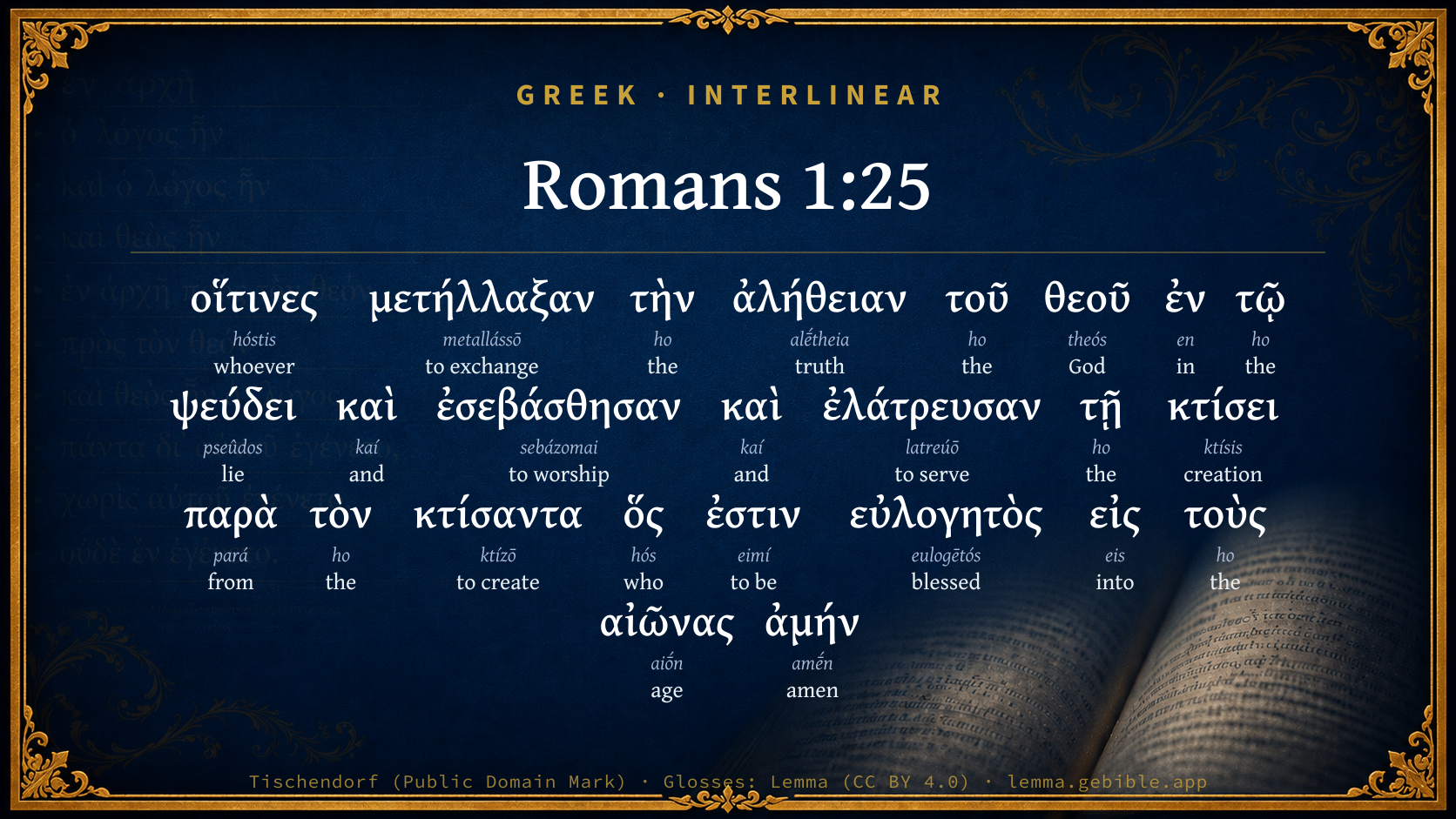
Greek (Tischendorf 8th ed.) Romans 1:25 appears in the Greek New Testament. The text above is from the Tischendorf 8th edition. Each word links to its Strong’s number and a concise gloss. Click any word for its full Thayer’s Greek Lexicon entry.
Download image
Cite this verse

Romans 1:25 (World English Bible). Public Domain. Lemma interlinear Bible study tool, https://lemma.gebible.app/v/romans/1/25.

Show BibTeX & RIS
BibTeX
RIS
English Translation
who exchanged the truth of God for a lie, and worshiped and served the creature rather than the Creator, who is blessed forever. Amen.
World English Bible · Public Domain
Highlights
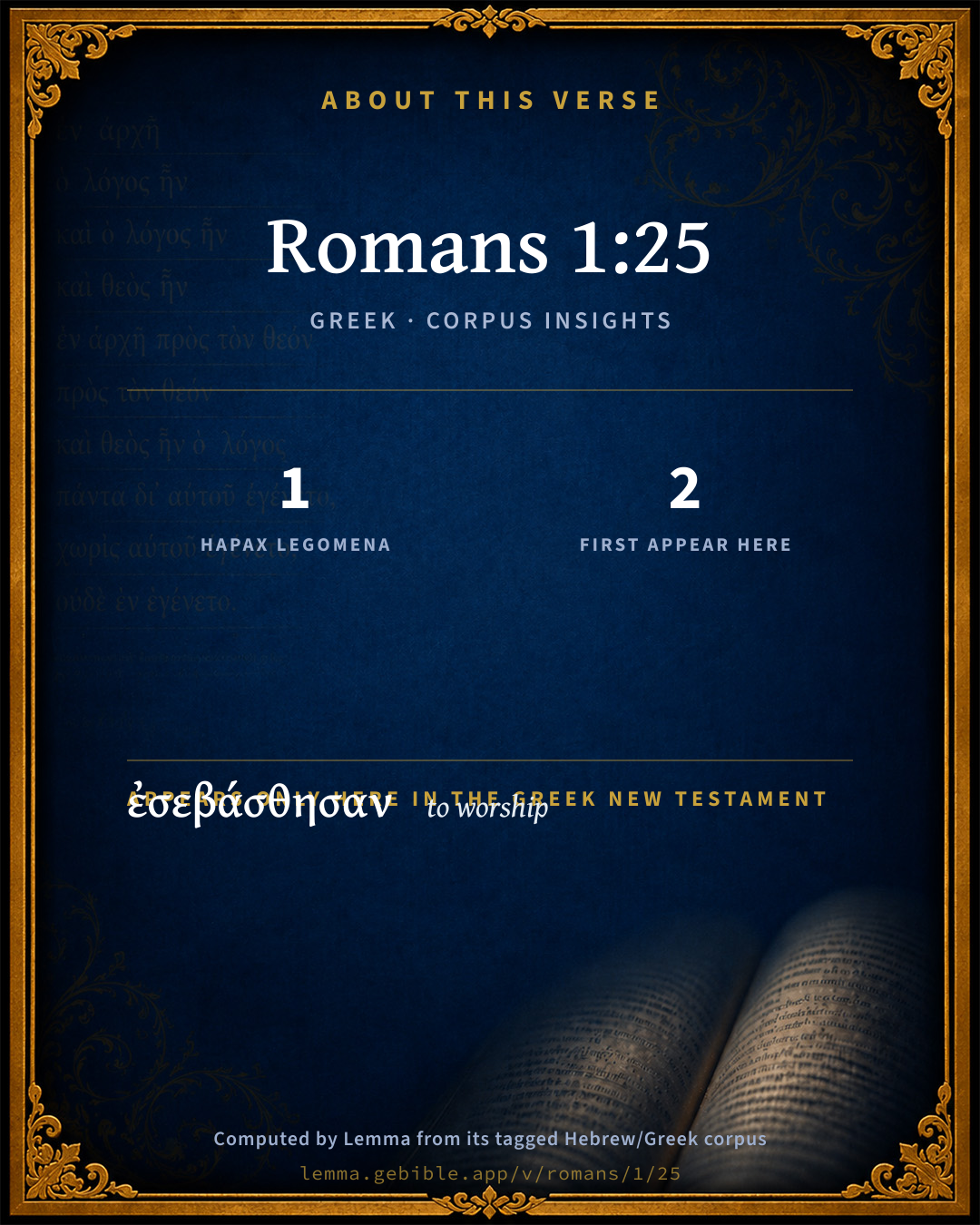
  • 1 hapax legomenon — only here in the Greek New Testament
  • 2 first appearances in the Greek New Testament
Full analysis ↓
Download a study sheet

One document with this verse’s original text, its word-by-word gloss line, the meaning frame, cross-references with their text, attributed commentary, and full source and license credits — printable, and it pastes into notes with its structure intact.

This verse Autodidact and up

Study sheet (.html) Plain text (.txt)

A passage Seminary Student

Up to 50 verses in one chapter. A passage sheet keeps up to 6 commentary sources and 12 cross-references per verse, in the order this page ranks them, and says so on the sheet whenever that leaves anything out. Ask for a single verse and you get the Autodidact verse sheet above.

Everything on this page stays free to read, with no account — the sheet is a download of what is already on screen, not access to it.

Want to remove ads? Support Godless Engineer
Compare translations 3

The same verse in 3 English versions, stacked beneath the original-language interlinear above. Click any original word for its lexicon entry.

Each is an independent rendering of the whole verse — the interlinear is not word-aligned to these translations.

Highlighted words mark where these versions differ — a whole-verse word diff, not a word-by-word alignment.

  • World English Bible Public Domain
    who exchanged the truth of God for a lie, and worshiped and served the creature rather than the Creator, who is blessed forever. Amen.
  • King James Version Public Domain
    Who changed the truth of God into a lie, and worshipped and served the creature more than the Creator, who is blessed for ever. Amen.
  • unfoldingWord Literal Text CC BY-SA 4.0
    who exchanged the truth of God for the lie and worshiped and served the creation instead of the Creator, who is blessed to eternity. Amen.

unfoldingWord Literal Text — © unfoldingWord, licensed CC BY-SA 4.0. Word-aligned USFM3 via Door43 (git.door43.org/unfoldingWord/en_ult).

Versions to compare (up to 4)

3 of 4 selected

Show all 19 translations

Every available English version of this verse, each an independent rendering of the whole verse.

  • World English Bible Public Domain
    who exchanged the truth of God for a lie, and worshiped and served the creature rather than the Creator, who is blessed forever. Amen.
  • Berean Standard Bible Public Domain
    They exchanged the truth of God for a lie, and worshiped and served the creature rather than the Creator, who is forever worthy of praise! Amen.
  • Majority Standard Bible Public Domain
    They exchanged the truth of God for a lie, and worshiped and served the creature rather than the Creator, who is forever worthy of praise! Amen.
  • King James Version Public Domain
    Who changed the truth of God into a lie, and worshipped and served the creature more than the Creator, who is blessed for ever. Amen.
  • American Standard Version (1901) Public Domain
    for that they exchanged the truth of God for a lie, and worshipped and served the creature rather than the Creator, who is blessed for ever. Amen.
  • Revised Version (1885) Public Domain
    for that they exchanged the truth of God for a lie, and worshipped and served the creature rather than the Creator, who is blessed for ever. Amen.
  • Geneva Bible (1599) Public Domain
    Which turned the trueth of God vnto a lie, and worshipped and serued the creature, forsaking the Creator, which is blessed for euer, Amen.
  • Douay-Rheims (1899) Public Domain
    Who changed the truth of God into a lie; and worshipped and served the creature rather than the Creator, who is blessed for ever. Amen.
  • Young's Literal Translation Public Domain
    who did change the truth of God into a falsehood, and did honour and serve the creature rather than the Creator, who is blessed to the ages. Amen.
  • Literal Standard Version CC BY-SA 4.0
    who changed the truth of God into the lie, and honored and served the creature rather than the Creator, who is blessed for all ages. Amen.
  • Unlocked Literal Bible CC BY-SA 4.0
    It is they who exchanged the truth of God for a lie, and who worshiped and served the creation instead of the Creator, who is praised forever. Amen.
  • unfoldingWord Literal Text CC BY-SA 4.0
    who exchanged the truth of God for the lie and worshiped and served the creation instead of the Creator, who is blessed to eternity. Amen.
  • Darby Bible Public Domain
    who changed the truth of God into falsehood, and honoured and served the creature more than him who had created [it], who is blessed for ever. Amen.
  • World Messianic Bible Public Domain
    who exchanged the truth of God for a lie, and worshiped and served the creature rather than the Creator, who is blessed forever. Amen.
  • Webster's Bible Public Domain
    Who changed the truth of God into a lie, and worshiped and served the creature more than the Creator, who is blessed for ever. Amen.
  • Free Bible Version CC BY-SA 4.0
    They exchanged God's truth for a lie, worshiping and serving creatures instead of the Creator, who deserves praise forever. Amen.
  • Bible in Basic English Public Domain
    Because by them the true word of God was changed into that which is false, and they gave worship and honour to the thing which is made, and not to him who made it, to whom be blessing for ever. So be it.
  • Text-Critical English NT CC BY 4.0
    because they exchanged the truth of God for falsehood and worshiped and served the creature rather than the Creator, who is blessed forever. Amen.
  • Tyndale New Testament (1534) Public Domain
    which tourned his truthe vnto a lye and worshipped and served the creatures more then the maker which is blessed for ever. Amen.

Literal Standard Version (2020), Covenant Press — licensed CC BY-SA 4.0. Text via the HelloAO Bible API (eBible.org). Unlocked Literal Bible (unfoldingWord) — licensed CC BY-SA 4.0. Text via the HelloAO Bible API (eBible.org). unfoldingWord Literal Text — © unfoldingWord, licensed CC BY-SA 4.0. Word-aligned USFM3 via Door43 (git.door43.org/unfoldingWord/en_ult). Free Bible Version, Dr. Jonathan Gallagher — licensed CC BY-SA 4.0. Text via the HelloAO Bible API (eBible.org).

Word by word

More ways to search: Search by grammar → Find every occurrence → Compare this word →

Practice this passage: Drill this verse → Learn its vocabulary →

ἐσεβάσθησαν
sebázomai
G4573
“to worship”
Verb, Aorist, Middle deponent, Indicative, 3rd person, Plural
Part of Speech
Verb
Tense
Aorist
Voice
Middle deponent
Mood
Indicative
Person
3rd person
Number
Plural
Full Thayer's Definition

Origin: middle voice from a derivative of G4576

TDNT: 09:52,1

1. to fear, be afraid 2. to honour religiously, to worship
  1. οἵτινες hóstis G3748 “whoever” Relative pronoun, Nominative, Plural, Masculine
  2. μετήλλαξαν metallássō G3337 “to exchange” Verb, Aorist, Active, Indicative, 3rd person, Plural
  3. τὴν ho G3588 “the” Article, Accusative, Singular, Feminine
  4. ἀλήθειαν alḗtheia G225 “truth” Noun, Accusative, Singular, Feminine
  5. τοῦ ho G3588 “the” Article, Genitive, Singular, Masculine
  6. θεοῦ theós G2316 “God” Noun, Genitive, Singular, Masculine
  7. ἐν en G1722 “in” Preposition
  8. τῷ ho G3588 “the” Article, Dative, Singular, Neuter
  9. ψεύδει pseûdos G5579 “lie” Noun, Dative, Singular, Neuter
  10. καὶ kaí G2532 “and” Conjunction
  11. καὶ kaí G2532 “and” Conjunction
  12. ἐλάτρευσαν latreúō G3000 “to serve” Verb, Aorist, Active, Indicative, 3rd person, Plural
  13. τῇ ho G3588 “the” Article, Dative, Singular, Feminine
  14. κτίσει ktísis G2937 “creation” Noun, Dative, Singular, Feminine
  15. παρὰ pará G3844 “from” Preposition
  16. τὸν ho G3588 “the” Article, Accusative, Singular, Masculine
  17. κτίσαντα ktízō G2936 “to create” Verb, Aorist, Active, Participle, Accusative, Singular, Masculine
  18. ὅς hós G3739 “who” Relative pronoun, Nominative, Singular, Masculine
  19. ἐστιν eimí G1510 “to be” Verb, Present, Active, Indicative, 3rd person, Singular
  20. εὐλογητὸς eulogētós G2128 “blessed” Adjective, Nominative, Singular, Masculine
  21. εἰς eis G1519 “into” Preposition
  22. τοὺς ho G3588 “the” Article, Accusative, Plural, Masculine
  23. αἰῶνας aiṓn G165 “age” Noun, Accusative, Plural, Masculine
  24. ἀμήν amḗn G281 “amen” Hebrew transliteration

About this verse

These counts appear in no published source. They are computed here, from the morphology-tagged text and Lemma’s own curated glosses. What Lemma adds →

25
words
19
distinct lemmas
Pauline Epistles
section

Notable vocabulary

1 hapax legomenon — a word that appears only here in the entire Greek New Testament:

  • ἐσεβάσθησαν to worship G4573

First appearance in Scripture

These words make their first canonical appearance in the Greek New Testament here:

  • μετήλλαξαν to exchange G3337
  • ἐσεβάσθησαν to worship G4573

Shared distinctive vocabulary

μετήλλαξαν to exchange G3337 occurs in 2 verses of the Greek New Testament. Also found in:
Repetition

Words recur within this verse:

Cross-references

20

Topical passages linked to Romans 1:25 in the Treasury of Scripture Knowledge — connected by theme and wording, ordered by reader-vote popularity; previews shown in the World English Bible.

  • Habakkuk 2:18 "What value does the engraved image have, that its maker has engraved it; the molten image, even the teacher of lies, that he who fashions its form trusts in it, to make mute idols?
  • Jeremiah 13:25 This is your lot, the portion measured to you from me, says Yahweh; because you have forgotten me, and trusted in falsehood.
  • 1 John 2:15–16 Don't love the world, neither the things that are in the world. If anyone loves the world, the Father's love isn't in him.
  • Isaiah 44:20 He feeds on ashes; a deceived heart has turned him aside; and he can't deliver his soul, nor say, Is there not a lie in my right hand?
  • Amos 2:4 Thus says Yahweh: "For three transgressions of Judah, yes, for four, I will not turn away its punishment; Because they have rejected Yahweh's law, And have not kept his statutes, And their lies have led them astray, After which their fathers walked;
  • 2 Corinthians 11:31 The God and Father of the Lord Jesus Christ, he who is blessed forevermore, knows that I don't lie.
  • Jeremiah 10:14–15 Every man is become brutish [and is] without knowledge; every goldsmith is disappointed by his engraved image; for his molten image is falsehood, and there is no breath in them.
  • Romans 9:5 of whom are the fathers, and from whom is Christ as concerning the flesh, who is over all, God, blessed forever. Amen.
  • Romans 1:23 and traded the glory of the incorruptible God for the likeness of an image of corruptible man, and of birds, and four-footed animals, and creeping things.
  • 1 John 5:20 We know that the Son of God has come, and has given us an understanding, that we know him who is true, and we are in him who is true, in his Son Jesus Christ. This is the true God, and eternal life.
  • 2 Timothy 3:4 traitors, headstrong, conceited, lovers of pleasure rather than lovers of God;
  • Matthew 6:24 "No one can serve two masters, for either he will hate the one and love the other; or else he will be devoted to one and despise the other. You can't serve both God and Mammon.
  • Romans 1:18 For the wrath of God is revealed from heaven against all ungodliness and unrighteousness of men, who suppress the truth in unrighteousness,
  • 1 Thessalonians 1:9 For they themselves report concerning us what kind of a reception we had from you; and how you turned to God from idols, to serve a living and true God,
  • Psalms 145:1–2 I will exalt you, my God, the King. I will praise your name forever and ever.
  • Jeremiah 16:19 Yahweh, my strength, and my stronghold, and my refuge in the day of affliction, to you shall the nations come from the ends of the earth, and shall say, Our fathers have inherited nothing but lies, [even] vanity and things in which there is no profit.
  • Matthew 10:37 He who loves father or mother more than me is not worthy of me; and he who loves son or daughter more than me isn't worthy of me.
  • Ephesians 3:21 to him be the glory in the assembly and in Christ Jesus to all generations forever and ever. Amen.
  • 1 Timothy 1:11 according to the Gospel of the glory of the blessed God, which was committed to my trust.
  • 1 Timothy 1:17 Now to the King eternal, immortal, invisible, to God who alone is wise, be honor and glory forever and ever. Amen.

Cross-references courtesy of OpenBible.info (CC BY 4.0).

Commentary

Notes on Romans 1:25 from classic Christian and Jewish commentators (each source and its license shown beneath its notes). The classic Christian expositions comment on the surrounding passage and are grouped to its opening verse, so a note may address several verses; the Jewish commentaries on the Tanakh (Rashi and others) are per-verse, so they appear only where the commentator wrote on this verse.

Lemma curates 59 commentaries, every one of them public domain or Creative Commons licensed, each selected and text-cleaned for this edition rather than reprinted as found. About our sources →

Bengel's Gnomon

Johann Albrecht Bengel

Rom 1:25. Την ἀλήθειαν, the truth) which commands us to worship God AS God.—ἐν τῳ ψεύδει [into a lie—Engl. vers.] (exchanged) for a lie) the price paid for [mythology] idol worship; ἐν, the Lat. cum.—ἐσεβάσθησαν, they worshipped) implying internal worship.—ἐλάτρευσαν, they served) implying external worship.—παρὰ) in preference to, more than, ch. Rom 14:5 [ἡμέραν παρʼ ἡμέραν].

Bengel's Gnomon of the New Testament — English translation (T&T Clark, Edinburgh, 1860) — public domain. Text from a community e-Sword module.

Meyer's Critical & Exegetical Commentary

Heinrich August Wilhelm Meyer

Rom_1:25. Οἵτινες μετήλλαξαν κ.τ.λ[497]] as those who exchanged, etc. In this description of the character of those who are given up, attached to Rom_1:24, Paul makes once more apparent the motive which determined God to give them up. The words are a renewed tragic commentary (comp Rom_1:22-23) on the ΔΙΌ, Rom_1:24. On ὍΣΤΙς, quippe qui, which brings up the class to which one belongs, and thereby includes the specification of the reason, see Hermann, a[499] Soph. Oed. R. 688; Matthiae, p. 1073. Hofmann erroneously makes a relative protasis begin with ΟἽΤΙΝΕς, with which then ΔΙᾺ ΤΟῦΤΟ Κ.Τ.Λ[500], Rom_1:26, would be connected by way of apodosis: them, who exchanged etc., God has therefore given up. This would not be inconsistent with αὐτούς in Rom_1:26, which would then be resumptive; but the very praise of God, in which Rom_1:25 terminates, and still more the concluding ἀμήν, which can only indicate the end of the sentence (comp Rom_9:5, Rom_11:36; Gal_1:5; Eph_3:21), ought to have decidedly precluded such a forced intermixture of sentences, which is not to be justified by subtleties.

The compound μετήλλ. (exchanged) is more significant than ἤλλαξαν (changed) in Rom_1:23.

τὴν ἀλήθ. τοῦ Θεοῦ] to be taken entirely in harmony with the expression τὴν δόξαν τοῦ Θεοῦ in Rom_1:23; therefore τοῦ Θεοῦ is to be taken as genitive of the subject: the truth of God, the true divine reality,[502] so as to make it in point of actual meaning, though not in the abstract form of the conception, identical with: true God (Luther, and most expositors, including Rückert, de Wette, Tholuck, Fritzsche, Philippi, van Hengel). It is differently rendered by Wolf, whom Köllner follows: the truth revealed to the Gentiles by God. Reiche and Mehring (following Pareus, Camerarius, Estius, Seb. Schmid, and Cramer) take it as the true knowledge of God, so that Θεοῦ would be genitive of the object. Compare Piscator, Usteri and Glöckler, who understand by it the original consciousness of God. Opposed to these views is the exact parallel in which Rom_1:25 stands to Rom_1:23, so that τοῦ Θεοῦ ought not to be taken without necessity as having a different reference in the two verses. ΤῊΝ ἈΛΉΘ. Τ. ΘΕΟῦ is explained concretely by ΤῸΝ ΚΤΊΣΑΝΤΑ in the second half of the verse.

ἘΝ Τῷ ΨΕΎΔΕΙ] with the lie; ἐν as in Rom_1:23. By this Paul means, in contrast to ΤῊΝ ἈΛΉΘ. Τ. ΘΕΟῦ (but otherwise than in Rom_3:7), the false gods, which are κατʼ ἑξοχὴν the ΨΕῦΔΟς in concreto, the negation of the truth of God. Comp on 1Co_8:4 f., 1Co_10:20. Grotius has aptly said: pro Deo vero sumserunt imaginarios. Comp Isa_44:20; Jer_3:10; Jer_13:25; Jer_16:19, al[505]; Philo, vit. Mos. p. 678 C, p. 679 A.

καὶ ἐσεβάσθησαν.… κτίσαντα] more precise explanation of the first clause of the verse.

ἘΣΕΒ. Κ. ἘΛΆΤΡ.] The former is general (coluerunt), the latter took place through sacrifices, and other definite rites and services; hence Paul designates his own specific service of God in Rom_1:8 by λατρεύω. σεβάζομαι, in Homer: to be afraid of (Il. vi. 167, 417), is employed in the later Greek like σέβομαι in the sense to revere, Orph. Arg. 550, Aq. Hos. x. 5. In the N. T. it only occurs here.

τῇ κτίσει] Corresponding with the verb standing next to it, so that the accusative is to be supplied with ἘΣΕΒ. See Matthiae, § 428, 2.

ΠΑΡᾺ Τ. ΚΤΊΣΑΝΤΑ] in the sense of comparison: prae creatore, in which case the context alone decides whether the preference of the one before the other is only relative, or whether it excludes the latter altogether (see on Luk_18:14; and van Hengel on our passage). The second case is that which occurs here, in accordance both with the nature of the case, seeing that the Gentiles did not worship the Creator at all, and with the immediate connection (μετήλλαξαν.… ἐν τῷ ψεύδει). The sense therefore substantially amounts to praeterito creatore (Hilary), or relicto creatore (Cyprian), i.e. they honoured the creature and not the Creator, whom they ought to have honoured. Theophylact says aptly, with reference to the comparative παρά: ἐκ τῆς συγκρίσεως τὸ ἔγκλημα ἐπαίρων. So in substance also Beza, Estius, and others, including Reiche, Tholuck, Olshausen, de Wette, Baumgarten-Crusius, Krehl, Reithmayr, Maier, Philippi, van Hengel. The relative interpretation: more than the Creator (Vulgate, Erasmus, Luther, Castalio, Grotius, Ammon, Rückert, and others), is therefore in point of fact erroneous. The contra creatorem, which Hammond, Koppe, Flatt, Fritzsche and Mehring find here, may likewise be traced to the sense of comparison (see Bernhardy, p. 259; Winer, p. 377 [E. T. 504]; and the passages from Plato in Ast. Lex. III. p. 28), but has against it the fact, that in the whole context Paul presents the matter in the light of a μετάλλαξις, of an exchanging the true for the false, not of hostility to the true. From that point of view the Gentiles have worshipped the creature, and not the Creator. Quite parallel is παρʼ ἐκεῖνον in Luke, Luk_18:14, Lachm.

The doxology: who is praised, בָּרוּךְ, not: celebrandus (comp on Eph_1:3; 2Co_11:31; Mar_14:61), for ever! Amen,is a natural effusion of deeply-moved piety, called forth by the detestable contrast of the Gentile abominations just described, without any further special design (Koppe: ne ipse in majestatem divinam injurius videri possit; comp Tholuck).

[497] .τ.λ. καὶ τὰ λοιπά.

[499] d refers to the note of the commentator or editor named on the particular passage.

[500] .τ.λ. καὶ τὰ λοιπά.

[502] Not the truth, which God Himself is (Hofmann); but that, which God is in true reality. That is just the adequate substance of His δόξα.

[505] l. and others; and other passages; and other editions.

Meyer — Critical and Exegetical Commentary on the New Testament — English translation by Peter Christie, edited by Frederick Crombie (T&T Clark, 1880) — public domain. Text from a community e-Sword module.

Expositor's Greek Testament

ed. W. Robertson Nicoll

Rom 1:25 . οἵτινες μετήλλαξαν κ . τ . λ .: being as they were persons who exchanged the truth of God for the lie. “The truth of God” ( cf. Rom 1:23 , “the glory of God”) is the same thing as God in His truth, or the true God as He had actually revealed Himself to man. τὸ ψεῦδος , abstract for concrete, is the idol or false God. The ἐν ( cf. Rom 1:23 ) answers to Hebrew בְּ . παρὰ τὸν κτίσαντα : to the passing by, i.e. , disregard or contempt of the Creator. For this use of παρὰ , see Winer, 503 f. ὅς ἐστιν εὐλογητός : the doxology relieves the writer’s feelings as he contemplates such horrors.

The Expositor's Greek Testament, edited by W. Robertson Nicoll (1897–1910) — public domain. Text from a community e-Sword module.

Hodge's Commentary on Romans, Ephesians & First Corinthians

Charles Hodge

Rom_1:25

Who change (οἳτινεϚ). The pronoun has a causal sense, being such as those who, i.e., because they exchanged the, truth of God for a lie. The construction is the same as in Rom_1:23, μετήλλαχαν ἐν, they exchanged for, not they changed into. The truth of God, either a periphrase for the true God, or the truth concerning God, i.e., right conceptions of God. For a lie, that is, either a false God, or falsehood, i.e., false views of God. The former is the better explanation. The glory of God is God himself as glorious, and the truth of God, in this connection, is God himself as true; that is, the true God. In the Old Testament, as in Jer_13:25; Jer_16:19 the gods of the heathen are spoken of as lies. Anything which is not what it pretends to be, or what it is supposed to be, is in the Scriptures called a lie. The proof of this apostasy is, that they worshipped (ἐσεβάσθησαν) and served (ἐλάτρευσαν). These words are often synonymous, both being used to express inward reverence and outward worship; although the former properly expresses the feeling, and the latter the outward service. The creature (κτίσει), not the creation, but any particular created thing. This noun belongs, in sense, to both the preceding verbs, although the first by itself would require the accusative. More than the Creator, παρὰ τὸν κτίσαντα, i.e., beyond, in the sense of more than, or in the sense of passing by, neglecting; praeterito Creatore, as Beza translates. The latter suits best. Who is blessed for ever: Amen. Who, notwithstanding the neglect of the heathen, is the ever-blessed God. This is the natural tribute of reverence toward the God whom men dishonored by their idolatry. The word ἐυλογντός is by Harless, Eph_1:3 and by Meyer, made to mean praised, as the Hebrew בָרוּך, to which it so constantly answers; not, therefore, worthy of praise, but who is in fact the object of praise to all holy beings. Bretschneider (Lexicon), Tholuck, and others, render it celebrandus, venerandus. Amen is properly a Hebrew adjective, signifying true or faithful. At the beginning of a sentence it is often used adverbially, verily, assuredly; at the end of a sentence it is used to express assent, it is true, so let it be. Paul says Amen to the declaration that God is the ever-blessed.

Charles Hodge — Commentary on Romans (1835), First Corinthians (1857), and Ephesians (1856) — public domain. Text from a community e-Sword module.

Jamieson, Fausset & Brown

Robert Jamieson, A. R. Fausset & David Brown

Who changed the truth of God into a lie--that is, the truth concerning God into idol falsehood.

and worshipped and served the creature more than the Creator--Professing merely to worship the Creator by means of the creature, they soon came to lose sight of the Creator in the creature. How aggravated is the guilt of the Church of Rome, which, under the same flimsy pretext, does shamelessly what the heathen are here condemned for doing, and with light which the heathen never had!

who is blessed for ever! Amen--By this doxology the apostle instinctively relieves the horror which the penning of such things excited within his breast; an example to such as are called to expose like dishonor done to the blessed God.

Jamieson, Fausset & Brown — Commentary Critical and Explanatory on the Whole Bible (1871) — public domain (CC PDM 1.0). Text via the HelloAO Bible API.

Adam Clarke's Commentary

Verse 25. Changed the truth of God into a lie] In the place of the true worship of God, they established idolatry. In various places of Scripture idols are termed lies. Isa 44:20; Jer 10:14; Jer 13:25. The true God was known among the primitive inhabitants of the earth, those who first became idolaters literally changed the truth of God into a lie: they did know the true God, but they put idols in his place.

Adam Clarke's Commentary on the Bible (1810–1826) — public domain. Text from a community e-Sword/MySword module.

John Calvin's Commentaries

25. Who changed, etc. He repeats what he had said before, though in different words, in order to fix it deeper in our minds. When the truth of God is turned to a lie, his glory is obliterated. It is then but just, that they should be besprinkled with every kind of infamy, who strive to take away from God his honor, and also to reproach his name. —

And worshipped, etc. That I might include two words in one, I have given this rendering. He points out especially the sin of idolatry; for religious honor cannot be given to a creature, without taking it away, in a disgraceful and sacrilegious manner, from God: and vain is the excuse that images are worshipped on God’s account, since God acknowledges no such worship, nor regards it as acceptable; and the true God is not then worshipped at all, but a fictitious God, whom the flesh has devised for itself. What is added, Who is blessed for ever, I explain as having been said for the purpose of exposing idolaters to greater reproach, and in this way, “He is one whom they ought alone to have honored and worshipped, and from whom it was not right to take away any thing, no, not even the least.”

John Calvin's Commentaries (1540-1563) — public domain. Text from the Calvin Translation Society English edition (1840s-50s) via the Christian Classics Ethereal Library (ccel.org). Calvin's coverage is partial (roughly two-thirds of the Bible); uncommented books and verses are honest gaps, never fabricated. The 19th-century editor's footnotes and remarks are omitted so the notes are faithfully Calvin's own voice.

Ellicott's Commentary for English Readers

(25) Who changed the truth of God into a lie.—They ceased to worship God as He is—in His own true essential nature, and worshipped false gods instead. The phrase “into a lie,” is literally, with a lie, the “lie” being regarded as the instrument by which the substitution is made. By “a lie” is meant here “false gods,” who are the supreme embodiment of falsehood. (Comp. Isa_44:20; Jer_13:25; Jer_16:19, &c.)

The introduction of the doxology in this verse is due to an impulse of reverential feeling. Shocked at the language which he finds himself using, and at the connection in which the most Holy Name has been mentioned, the Apostle turns aside for a moment to testify to his own humble adoration.

A Bible Commentary for English Readers, edited by Charles John Ellicott (1878–1897) — public domain. Text from a community e-Sword module.

The Cambridge Bible for Schools and Colleges

gen. ed. J. J. S. Perowne

25. who changed] The Greek relative pronoun implies that this was the cause of the special turn taken by the judicial hardening: seeing they had changed, &c.

the truth of God] i.e. that which is true of Him alone, and revealed by Him; Omnipotence and Deity. Cp. Rom_1:18.

into a lie] Lit. in falsehood; they degraded it so that it was lost in falsehood; falsehood took its place. This “falsehood” is, of course, the grand error—Idolatry.

more than the Creator] Lit. Him that created [it]. The idolater reverenced and did ritual service to his idol “more,” or “rather” than to the Creator, whether he wholly ignored the Eternal, or recognized Him as a shadow or mystery in the background only.

who is blessed] Benedictus here, not Beatus. The glorious epithet indicates the Creature’s right attitude toward the Creator; that of adoring praise and love. (The same phrase occurs Rom_9:5; an important doctrinal parallel.)

The Cambridge Bible for Schools and Colleges (gen. ed. J. J. S. Perowne; Cambridge University Press, 1878–1918) — public domain. Text from a community e-Sword module.

John Gill's Exposition

Who changed the truth of God into a lie,.... Not the truth of the Gospel, which they were unacquainted with; but that which might be known of God as true, and was known of them by the light of nature; or the true God himself, whom they "changed into a lie"; by ascribing to false deities, which were lying vanities, those things which were known of God; and by worshipping them instead of him: for they

worshipped and served the creature more than the Creator; or "above him" or "against him", in opposition to him, or "besides him", others along with him; or neglecting him, and not worshipping him at all; which is aggravated in that what they worshipped was a creature, either of their own, or of God's making, and whom they neglected was the Creator of them:

who is blessed for ever, Amen; is blessed in himself, and the fountain of all blessedness to his creatures; which is so glaring a truth, that everyone ought to say and set his "Amen" to it.

John Gill's Exposition of the Whole Bible (1746–1763) — public domain (CC PDM 1.0). Text via the HelloAO Bible API.

Trapp's Complete Commentary

John Trapp

25 Who changed the truth of God into a lie, and worshipped and served the creature more than the Creator, who is blessed for ever. Amen.

Ver. 25. Who changed] They tare out their natural principles and turned atheists, as Diagoras, who yet was an atheist more with his tongue than with his heart; for having cried down a deity in a famous oration, he yet suffered himself to be deified by the people for his eloquence. Qua ornari ab eo Diabolus quaerebat, as Austin writeth to a learned but lewd person of his times. See my Common Place of Atheism. Epicurus verbis reliquit Deos re sustulit, saith Cicero (De Nat. Deor.).

John Trapp, A Commentary or Exposition upon All the Books of the Old and New Testament (1647–1656) — public domain. Text from a community e-Sword module.

Albert Barnes' Notes on the Bible

Who changed the truth of God - This is a repetition of the declaration in Rom 1:23, in another form. The phrase, “the truth of God” is a Hebrew phrase, meaning “the true God.” In such a case, where two nouns come together, one is employed as an adjective to qualify the other. Most commonly the latter of two nouns is used as the adjective, but sometimes it is the former, as in this case. God is called “the true God” in opposition to idols, which are called false gods. There is but one real or true God, and all others are false.

Into a lie - Into idols, or false gods. Idols are not infrequently called falsehood and lies, because they are not true representations of God; Jer 13:25; Isa 28:15; Jer 10:14; Psa 40:4.

The creature - Created things, as the sun, moon, animals, etc.

Who is blessed forever - It was not uncommon to add a doxology, or ascription of praise to God, when his name was mentioned; see Rom 9:5; 2Co 11:31; Gal 1:5. The Jews also usually did it. In this way they preserved veneration for the name of God, and accustomed themselves to speak of him with reverence. “The Muslims also borrowed this custom from the Jews, and practice it to a great extent. Tholuck mentions an Arabic manuscript in the library at Berlin which contains an account of heresies in respect to Islamism, and as often as the writer has occasion to mention the name of a new heretical sect, he adds, ‘God be exalted above all which they say’” (Stuart).

Amen - This is a Hebrew word denoting strong affirmation. So let it be. It implies here the solemn assent of the writer to what was just said; or his strong wish that what he had said might be - that the name of God might be esteemed and be blessed forever. The mention of the degrading idolatry of the pagans was strongly calculated to impress on his mind the superior excellency and glory of the one living God. It is mentioned respecting the honorable Robert Boyle, that he never mentioned the name of God without a solemn pause, denoting his profound reverence. Such a practice would tend eminently to prevent an unholy familiarity and irreverence in regard to the sacred name of the Most High; compare Exo 20:7.

Albert Barnes' Notes on the Bible (1834–1885) — public domain. Text from a community e-Sword/MySword module.

Matthew Poole's English Annotations

Who changed the truth of God into a lie; i.e. the God of truth, or the true God, into an idol, which is a lie, which seems to be that which it is not: or else, by the truth of God, understand those true sentiments and notions that they had of God, and were taught them, as before, by the light of nature, and the book of the creatures; these they changed into lying imaginations and conceits.

And worshipped and served the creature more than the Creator; or, besides the Creator: some understand it comparatively, they worshipped one more than the other; others exclusively, they worshipped one and not the other. They were guilty of two great errors; one was in their minds, they changed the truth of God into a lie; the other in their wills, they served the creature more than the Creator.

Who is blessed for ever. Amen: when the Hebrews of old made mention of the true God, they were wont to add these words: Let him be blessed for ever.

Matthew Poole's English Annotations on the Holy Bible (1683–1685) — public domain. Text from a community e-Sword/MySword module.

Whedon's Commentary on the Bible

Daniel D. Whedon

25. Changed—The apostle again refers to the primal cause of their deep plunges in unnatural animalism, their apostasy from God. They first dishonoured their Maker and then debased themselves.

Truth of God… lie—So the Hebrew writers called an idol preeminently a lie, as basely falsifying the glorious truth of the Divine nature.

The creature—The created object, whether deified animal or inanimate substance shaped into an idol.

More than—Rather than, instead of.

Blessed—A doxology asserting the Divine over all created nature.

Daniel D. Whedon (gen. ed.), Commentary on the Old and New Testaments (1874–1909) — public domain. Text from a community e-Sword module.

The Pulpit Commentary

Who (rather, being such as, the word is oitinev , equivalent to quippequi) changed the truth of God into a lie, and worshipped and served the creature more than the Creator, who is blessed for ever. Amen. This verse repeats the source and cause of the moral degradation spoken of, which is described without reserve in what follows. "In peccatis arguendis saepe scapha debet scapha dict. Gravitas et ardor stilt judicialis proprietate verborum non violat verceundiam" (Bengel).

The Pulpit Commentary (1880–1919), ed. H.D.M. Spence-Jones & Joseph S. Exell — public domain. Text from a community e-Sword module.

John Wesley's Explanatory Notes

Who changed the truth - The true worship of God. Into a lie - False, abominable idolatries. And worshipped - Inwardly. And served - Outwardly.

John Wesley, Explanatory Notes Upon the Whole Bible (1754–1765) — public domain. Text via the GEBible commentary corpus.

Burkitt's Expository Notes on the New Testament

William Burkitt

Here our apostle proceeds to give a particular and distinct account of the abominable idolatry and unnatural filthiness, which he had charged the Heathens with in the foregoing verses.

As to their idolatry, he had told us at the 23rd verse, that they had made false and unworthy representations of the ever-blessed God: worshipping God in and by the creatures. In the 25th verse, they are charged with a false object of their worship, giving divine honour to a creature: They changed the truth of God into a lie; that is, the true God into an idol, called a lie, because it deceives men as a lie doth by seeming to be that which indeed it is not; it seems in the idolater’s fancy, to have something of divinity in it, when, in reality, it is but wood or stone. Every image of God is a false and lying representation of God.

Secondly, As to their uncleanness, he shews that they were so given up to the ravings of lust for sinning against the light of nature, that they forsook the order of nature, and were more brutish than the very brutes.

Learn hence, That when men provoke God finally to forsake them, and judicially to give them up to their own heart’s lusts, they will not stick to commit such monstrous and unnatural uncleanness, as the very brute beasts abhor. Here men and women burnt in worse than beastly lusts towards those of their own sex.

Lord, if we are not more vile than the vilest of thy creatures, we owe it all to thy sanctifying, or, a least, to thy restraining grace. As by the grace of God we are what we are; so by his grace it is that we are not what we are not.

William Burkitt's Expository Notes on the New Testament (1700–1703) — public domain. Text from a community e-Sword module.

Godbey's Commentary on the New Testament

William B. Godbey

25. “Who changed the truth of God into a lie, worshipped and served the creature more than the Creator, who is blessed for evermore. Amen.” Here we see the fatal downward trend of humanity, alienated from God; like a ship loosed from her moorings, adrift on the sea, the sport of the billows and the caprice of the storm, till wounded or wrecked. Hence when people get away from the personal indwelling Holy Spirit, they float on hellwardly whether through churches or outside. Creature worship is idolatry, whether it be a fine house, a pipe-organ, an old creed, water baptism or an elegant, learned preacher. It is creature worship instead of the heart cry after God.

William B. Godbey, Commentary on the New Testament (1896–1900) — public domain. Text from a community e-Sword module.

McGarvey & Pendleton's Commentaries

J. W. McGarvey

for that they exchanged the truth of God for a lie, and worshipped and served the creature rather than the Creator, who is blessed for ever. Amen . [Wherefore, finding them living in lust, God ceased to restrain or protect them from evil ( Gen_6:3 ), and abandoned them to the uncleanness toward which their lust incited them, that they might dishonor their bodies among themselves to the limit of their lustfulness, as a punishment for dishonoring and abandoning him. He did this because they had exchanged the truth of God (which from the start they had hindered in unrighteousness, Rom_1:18 ), i. e., the truth respecting God and his law and worship, for the sham of idolatry and the false worship pertaining thereto, and because they had given to the creature that inward reverence and outward service which was due to the Creator, thus preferring the creature to the Creator, who is blessed for ever. Amen. "'Blessed' is not the word signifying happy, rendered blessed in Mat_5:3-11 ; 1Ti_1:11 ; 1Ti_6:15 ; but the word signifying praised, adored, extolled; i. e., worthy to be praised, etc. In the New Testament this word is applied to none but to God only; though the cognate verb is used to express the good wishes and hearty prayers of one creature for another, as well as praise to God--comp. Heb_11:20-21 ; Jam_3:9 "--Plumer.]

J. W. McGarvey (with Philip Y. Pendleton), Commentaries on the New Testament (The Fourfold Gospel, 1914; Acts; and the epistles) — public domain. Text from a community e-Sword/MySword module.

The People's New Testament

B. W. Johnson

25. Who changed the truth of God into a lie. By giving up the worship of the great unseen God to worship an idol; a creature, rather than the Creator. At first, idols were probably designed as only representations, but they finally became objects of worship. Just so, the images in Roman Catholic churches were intended at first as helps in worship, but have become to great multitudes really idols.

B. W. Johnson's The People's New Testament with Notes (1889–1891) — public domain. Electronic text from the Christian Classics Ethereal Library (CCEL) ThML edition.

Cambridge Greek Testament for Schools and Colleges

25. οἵτινες. Quippe qui, “seeing that they,” repeats Rom 1:23 with amplification.

τὴν ἀλήθειαν τοῦ θεοῦ. Quite comprehensive = the truth about God and themselves and their relation to Him; so τῷ ψεύδει the false theory or statement of man and GOD which they adopted; cf. 2Th 2:11, 1Jn 2:27.

ἐσεβάσθησαν. Here only in N.T., and O.T. only Hos 10:5 Aq. = they made their objects of worship.

ἐλάτρευσαν. Of full religious service. See Westcott, Hebr. ref. above, Rom 1:9.

παρὰ τὸν κτ., to the neglect of. Winer-M., p. 504; n. the tragic irony of the antithesis.

ὅς ἐστιν εὐλ. κ.τ.λ. Cf. Rom 9:5, 2Co 11:31, in each case a mark of deep emotion.

Cambridge Greek Testament for Schools and Colleges (Cambridge University Press, 1896; 21 vols, various authors incl. Carr, Maclear, Plummer, Farrar, Lumby, Moule, M. R. James, Simcox) — public domain. Text from a community e-Sword module.

Alford’s Greek Testament

Henry Alford

25.] This verse casts light on the τὴν ἀλήθ. ἐν ἀδικίᾳ κατεχόντων of ver. 18. The truth of God (the true notion of Him as the Creator) which they professed, they changed into (see on ἐν, ver. 23) a lie (ψεῦδος = שֶׁקֶר, used of idols, Jer 16:19), thus counteracting its legitimate agency and depriving it of all power for good.

σεβάζομαι, of the honour of respect and observance and reverence,—λατρεύω, of formal worship with sacrifice and offering. Both verbs belong to τῇ κτίσει; though σεβάζομαι would require an accusative, λατρεύω, the nearest, takes the government.

τῇ κτ.] the thing made, the creature—a general term for all objects of idolatrous worship.

παρά, beyond—which would amount to the exclusion of the Creator.

The doxology expresses the horror of the Apostle at this dishonour, and puts their sin in a more striking light. But we need not supply εἰ καὶ οὗτοι ὕβρισαν, as Chrys.

εὐλογητός is Blessed, κατʼ ἐξοχήν: the LXX put for it the perf. part., Ps. 117:24. The adjective is usually of God: the participle, of man.

Henry Alford, The Greek Testament (1849–1861) — public domain. Text from a community e-Sword module.

International Critical Commentary

25. οἵτινες: ὅστις, often called ‘rel. of quality,’ (i) denotes a single object with reference to its kind, its nature, its capacities, its character (‘one who,’ ‘being of such a kind as that’); and thus (ii) it frequently makes the adjectival sentence assign a cause for the main sentence: it is used like qui, or quippe qui, with subj.

τὴν ἀλήθειαν … τῷ ψεύδει: abstr. for concrete, for τὸν ἀληθινὸν Θεόν … τοῖς ψεύδεσι θεοῖς, cf. 1Th 1:9.

ἐσεβάσθησαν. This use of σεβάζεσθαι is an ἅπαξ λεγόμενον; the common form is σέβεσθαι (see Va.).

παρὰ τὸν κτίσαντα = not merely ‘more than the Creator’ (a force which the preposition might bear), but ‘passing by the Creator altogether,’ ‘to the neglect of the Creator.’

Cf. Philo, De Mund. Opif. 2 (Mangey, i. 2) τινὲς γὰρ τὸν κόσμον μᾶλλον ἢ τὸν κοσμοποιὸν θαυμάσαντες (Loesner).

ὅς ἐστιν εὐλογητός. Doxologies like this are of constant occurrence in the Talmud, and are a spontaneous expression of devout feeling called forth either by the thought of God’s adorable perfections or sometimes (as here) by the forced mention of that which reverence would rather hide.

25. οἵτινες μετήλλαξαν τὴν ἀλήθειαν τοῦ Θεοῦ ἐν τῷ ψεύδει, καὶ ἐσεβάσθησαν καὶ ἐλάτρευσαν τῇ κτίσει παρὰ τὸν κτίσαντα. 13:17 sqq. οὐκ αἰσχύνεται τῷ ἀψύχῳ προσλαλῶν· καὶ περὶ μὲν ὑγιείας τὸ ἀσθενὲς ἐπικαλεῖται, περὶ δὲ ζωῆς τὸ νεκρον ἀξιοῖ κ. τ. λ.

14:11. διὰ τοῦτο καὶ ἐν εἰδώλοις ἐθνῶν ἐπισκοπὴ ἔσται, ὅτι ἐν κτίσματι Θεοῦ εἰς βδέλυγμα ἐγενήθησαν.

14:21. τὸ ἀκοινώνητον ὄνομα λίθοις καὶ ξύλοις περιέθεσαν.

International Critical Commentary — older volumes (1896–1929), various authors — public domain. Text from a community e-Sword module.

Godet's Commentaries

Frédéric Louis Godet

Vv. 25 was an interruption extorted from Paul by the need which his outraged heart felt to justify once more the severity of such a punishment. He now resumes his exposition of the punishment, begun in Rom 1:24; and this time he proceeds to the end. He does not shrink from any detail fitted to bring out the vengeance which God has taken on the offence offered to His outraged majesty.

Frédéric Louis Godet — Commentaries on Luke, John, Romans, and 1 Corinthians — English translation (T&T Clark, Edinburgh, 1870s–1890s) — public domain. Text from a community e-Sword module.

Lesson kit

Teaching starters — assembled from the data on this page, not authored interpretation. Every prompt links to the verse data it draws on. Edit before teaching.

Romans, in the Pauline Epistles, opens this verse with 25 words (19 distinct Greek lemmas). Its most distinctive word is sebázomai (“to worship”). A historical commentator’s framing appears above. Read the whole chapter for the surrounding context.

Discussion questions

  1. How does “to worship” (sebázomai) shape what this verse is saying?
  2. This verse holds 1 word here found nowhere else in the Greek New Testament. What might the rare word draw attention to?
  3. 2 words here appear for the first time in Scripture. What is being introduced at this debut?
  4. Romans 1:26 shares the word «to exchange» with this verse. How do the two illuminate each other?
  5. “the” occurs 6× in this one verse. What is the effect of the repetition?
  6. These translations render this verse differently. What is at stake in choosing one wording over another?
  7. Reading how Bengel's Gnomon and Meyer's Critical & Exegetical Commentary read this verse, where do the two commentators agree and where do they part?

Things to notice

  • 1 word in this verse appears nowhere else in the Greek New Testament.
  • 2 words make their first canonical appearance in Scripture here.
  • These translations choose different wording for 13 words in this verse.
  • “the” occurs 6× in this single verse.
  • 19 distinct Greek lemmas span 25 words in this verse.

Reading settings

Reading text

Shown beneath each verse's original-language words.

Old Testament
Old Testament edition

Read the OT as the Masoretic Hebrew (MT) or the Greek Septuagint (LXX).

English shown for the Greek Septuagint (in the Hebrew ↔ Greek comparison).

Comparing translations? Open the Compare panel on any verse page to stack up to four side by side.