Galatians 1:4

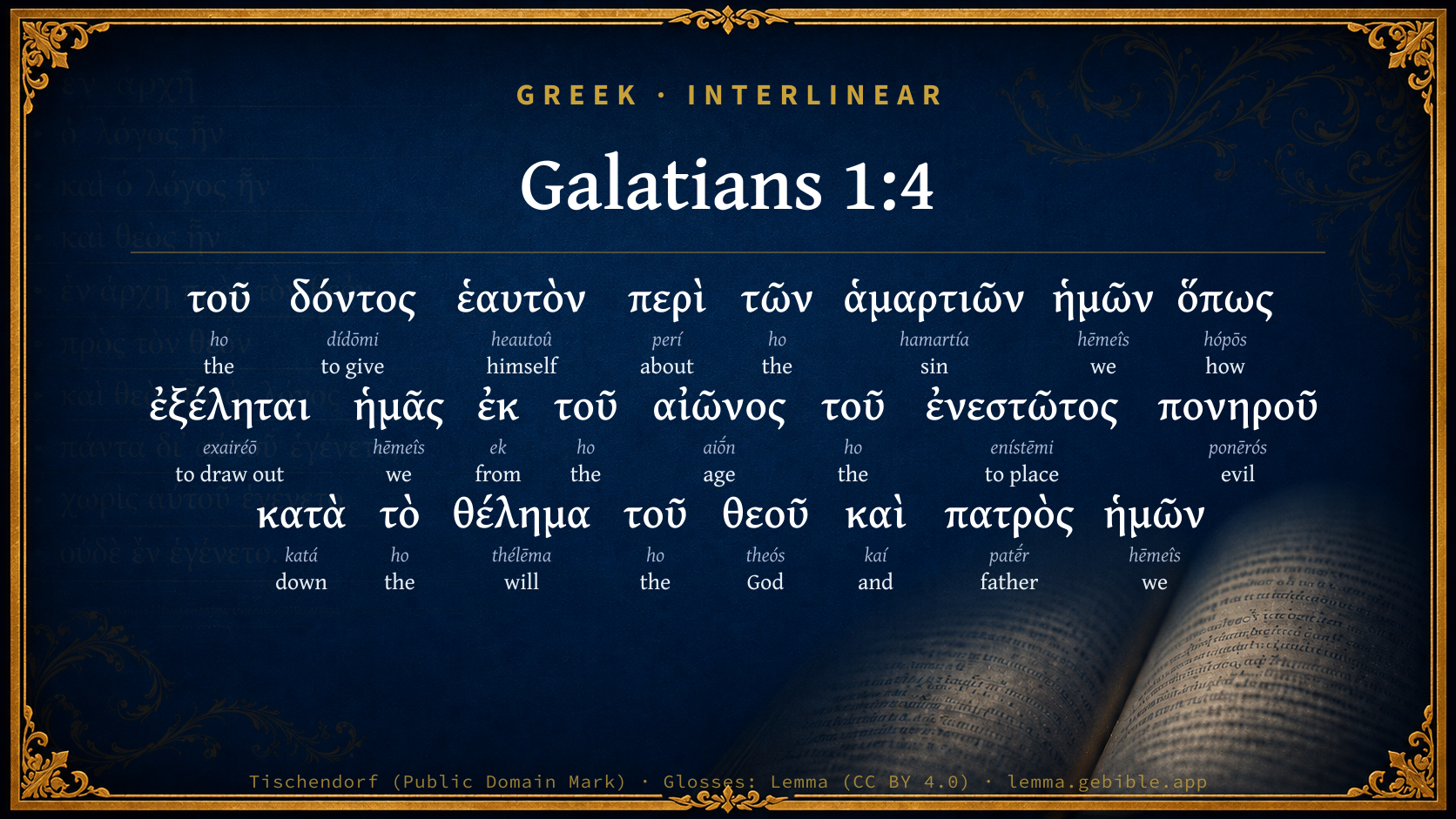
Greek (Tischendorf 8th ed.) Galatians 1:4 appears in the Greek New Testament. The text above is from the Tischendorf 8th edition. Each word links to its Strong’s number and a concise gloss. Click any word for its full Thayer’s Greek Lexicon entry.
Download image
Cite this verse

Galatians 1:4 (World English Bible). Public Domain. Lemma interlinear Bible study tool, https://lemma.gebible.app/v/galatians/1/4.

Show BibTeX & RIS
BibTeX
RIS
English Translation
who gave himself for our sins, that he might deliver us out of this present evil age, according to the will of our God and Father--
World English Bible · Public Domain
Download a study sheet

One document with this verse’s original text, its word-by-word gloss line, the meaning frame, cross-references with their text, attributed commentary, and full source and license credits — printable, and it pastes into notes with its structure intact.

This verse Autodidact and up

Study sheet (.html) Plain text (.txt)

A passage Seminary Student

Up to 50 verses in one chapter. A passage sheet keeps up to 6 commentary sources and 12 cross-references per verse, in the order this page ranks them, and says so on the sheet whenever that leaves anything out. Ask for a single verse and you get the Autodidact verse sheet above.

Everything on this page stays free to read, with no account — the sheet is a download of what is already on screen, not access to it.

Want to remove ads? Support Godless Engineer
Compare translations 3

The same verse in 3 English versions, stacked beneath the original-language interlinear above. Click any original word for its lexicon entry.

Each is an independent rendering of the whole verse — the interlinear is not word-aligned to these translations.

Highlighted words mark where these versions differ — a whole-verse word diff, not a word-by-word alignment.

  • World English Bible Public Domain
    who gave himself for our sins, that he might deliver us out of this present evil age, according to the will of our God and Father--
  • King James Version Public Domain
    Who gave himself for our sins, that he might deliver us from this present evil world, according to the will of God and our Father:
  • unfoldingWord Literal Text CC BY-SA 4.0
    the one having given himself for our sins so that he might deliver us from the present evil age, according to the will of our God and Father,

unfoldingWord Literal Text — © unfoldingWord, licensed CC BY-SA 4.0. Word-aligned USFM3 via Door43 (git.door43.org/unfoldingWord/en_ult).

Versions to compare (up to 4)

3 of 4 selected

Show all 19 translations

Every available English version of this verse, each an independent rendering of the whole verse.

  • World English Bible Public Domain
    who gave himself for our sins, that he might deliver us out of this present evil age, according to the will of our God and Father--
  • Berean Standard Bible Public Domain
    who gave Himself for our sins to rescue us from the present evil age, according to the will of our God and Father,
  • Majority Standard Bible Public Domain
    who gave Himself for our sins to rescue us from the present evil age, according to the will of our God and Father,
  • King James Version Public Domain
    Who gave himself for our sins, that he might deliver us from this present evil world, according to the will of God and our Father:
  • American Standard Version (1901) Public Domain
    who gave himself for our sins, that he might deliver us out of this present evil world, according to the will of our God and Father:
  • Revised Version (1885) Public Domain
    who gave himself for our sins, that he might deliver us out of this present evil world, according to the will of our God and Father:
  • Geneva Bible (1599) Public Domain
    Which gaue himself for our sinnes, that he might deliuer vs from this present euill world according to the will of God euen our Father,
  • Douay-Rheims (1899) Public Domain
    Who gave himself for our sins, that he might deliver us from this present wicked world, according to the will of God and our Father:
  • Young's Literal Translation Public Domain
    who did give himself for our sins, that he might deliver us out of the present evil age, according to the will of God even our Father,
  • Literal Standard Version CC BY-SA 4.0
    who gave Himself for our sins, that He might deliver us out of the present evil age, according to the will of our God and Father,
  • Unlocked Literal Bible CC BY-SA 4.0
    who gave himself for our sins so that he might deliver us from this present evil age, according to the will of our God and Father,
  • unfoldingWord Literal Text CC BY-SA 4.0
    the one having given himself for our sins so that he might deliver us from the present evil age, according to the will of our God and Father,
  • Darby Bible Public Domain
    who gave himself for our sins, so that he should deliver us out of the present evil world, according to the will of our God and Father;
  • World Messianic Bible Public Domain
    who gave himself for our sins, that he might deliver us out of this present evil age, according to the will of our God and Father—
  • Webster's Bible Public Domain
    Who gave himself for our sins, that he might deliver us from this present evil world, according to the will of God and our Father:
  • Free Bible Version CC BY-SA 4.0
    Jesus gave himself for our sins to set us free from this current world of evil, following the will of our God and Father.
  • Bible in Basic English Public Domain
    Who gave himself for our sins, so that he might make us free from this present evil world, after the purpose of our God and Father:
  • Text-Critical English NT CC BY 4.0
    who gave himself for our sins to deliver us from the present evil age, according to the will of our God and Father.
  • Tyndale New Testament (1534) Public Domain
    which gave him selfe for oure synnes to deliver vs from this present evyll worlde thorow the will of God oure father

Literal Standard Version (2020), Covenant Press — licensed CC BY-SA 4.0. Text via the HelloAO Bible API (eBible.org). Unlocked Literal Bible (unfoldingWord) — licensed CC BY-SA 4.0. Text via the HelloAO Bible API (eBible.org). unfoldingWord Literal Text — © unfoldingWord, licensed CC BY-SA 4.0. Word-aligned USFM3 via Door43 (git.door43.org/unfoldingWord/en_ult). Free Bible Version, Dr. Jonathan Gallagher — licensed CC BY-SA 4.0. Text via the HelloAO Bible API (eBible.org).

Word by word

More ways to search: Search by grammar → Find every occurrence → Compare this word →

Practice this passage: Drill this verse → Learn its vocabulary →

ἐνεστῶτος
enístēmi
G1764
“to place”
Verb, Perfect, Active, Participle, Genitive, Singular, Masculine
Part of Speech
Verb
Tense
Perfect
Voice
Active
Mood
Participle
Case
Genitive
Number
Singular
Gender
Masculine
Full Thayer's Definition

Origin: from G1722 and G2476

TDNT: 11:03,2

1. to place in or among, to put in 2. to be upon, impend, threaten 3. close at hand 4. present
  1. τοῦ ho G3588 “the” Article, Genitive, Singular, Masculine
  2. δόντος dídōmi G1325 “to give” Verb, Aorist, Active, Participle, Genitive, Singular, Masculine
  3. ἑαυτὸν heautoû G1438 “himself” Reflexive pronoun, 3rd person, Accusative, Singular, Masculine
  4. περὶ perí G4012 “about” Preposition
  5. τῶν ho G3588 “the” Article, Genitive, Plural, Feminine
  6. ἁμαρτιῶν hamartía G266 “sin” Noun, Genitive, Plural, Feminine
  7. ἡμῶν hēmeîs G2249 “we” Personal pronoun, 1st person, Genitive, Plural
  8. ὅπως hópōs G3704 “how” Adverb
  9. ἐξέληται exairéō G1807 “to draw out” Verb, Aorist, Middle, Subjunctive, 3rd person, Singular
  10. ἡμᾶς hēmeîs G2249 “we” Personal pronoun, 1st person, Accusative, Plural
  11. ἐκ ek G1537 “from” Preposition
  12. τοῦ ho G3588 “the” Article, Genitive, Singular, Masculine
  13. αἰῶνος aiṓn G165 “age” Noun, Genitive, Singular, Masculine
  14. τοῦ ho G3588 “the” Article, Genitive, Singular, Masculine
  15. πονηροῦ ponērós G4190 “evil” Adjective, Genitive, Singular, Masculine
  16. κατὰ katá G2596 “down” Preposition
  17. τὸ ho G3588 “the” Article, Accusative, Singular, Neuter
  18. θέλημα thélēma G2307 “will” Noun, Accusative, Singular, Neuter
  19. τοῦ ho G3588 “the” Article, Genitive, Singular, Masculine
  20. θεοῦ theós G2316 “God” Noun, Genitive, Singular, Masculine
  21. καὶ kaí G2532 “and” Conjunction
  22. πατρὸς patḗr G3962 “father” Noun, Genitive, Singular, Masculine
  23. ἡμῶν hēmeîs G2249 “we” Personal pronoun, 1st person, Genitive, Plural

About this verse

These counts appear in no published source. They are computed here, from the morphology-tagged text and Lemma’s own curated glosses. What Lemma adds →

24
words
17
distinct lemmas
Pauline Epistles
section

Notable vocabulary

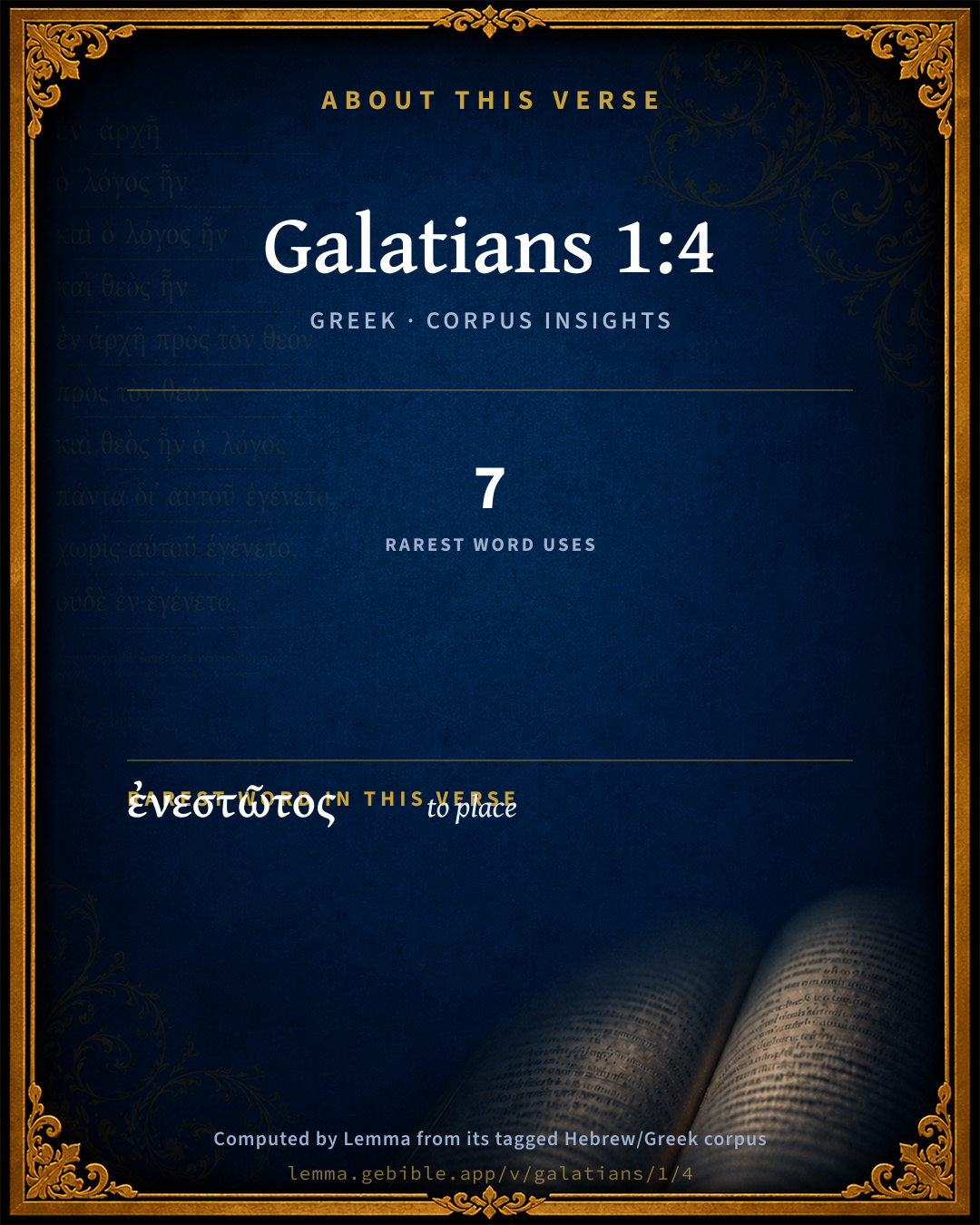
The rarest word here is ἐνεστῶτος to place G1764 — appearing just 7 times in the whole Greek New Testament.

Shared distinctive vocabulary

ἐνεστῶτος to place G1764 occurs in 7 verses of the Greek New Testament. Also found in:

Repetition

Words recur within this verse:

Cross-references

52

Topical passages linked to Galatians 1:4 in the Treasury of Scripture Knowledge — connected by theme and wording, ordered by reader-vote popularity; previews shown in the World English Bible.

  • Matthew 20:28 even as the Son of Man came not to be served, but to serve, and to give his life as a ransom for many."
  • Romans 4:25 who was delivered up for our trespasses, and was raised for our justification.
  • Galatians 2:20 I have been crucified with Christ, and it is no longer I that live, but Christ living in me. That life which I now live in the flesh, I live by faith in the Son of God, who loved me, and gave himself up for me.
  • 1 Peter 2:24 who his own self bore our sins in his body on the tree, that we, having died to sins, might live to righteousness; by whose stripes you were healed.
  • 1 John 2:15–17 Don't love the world, neither the things that are in the world. If anyone loves the world, the Father's love isn't in him.
  • 1 John 5:19–20 We know that we are of God, and the whole world lies in the power of the evil one.
  • 2 Corinthians 4:4 in whom the god of this world has blinded the minds of the unbelieving, that the light of the Gospel of the glory of Christ, who is the image of God, should not dawn on them.
  • Titus 2:14 who gave himself for us, that he might redeem us from all iniquity, and purify for himself a people for his own possession, zealous for good works.
  • 1 Timothy 2:6 who gave himself as a ransom for all; the testimony in its own times;
  • Ephesians 2:2 in which you once walked according to the course of this world, according to the prince of the powers of the air, the spirit who now works in the children of disobedience;
  • Romans 12:2 Don't be conformed to this world, but be transformed by the renewing of your mind, so that you may prove what is the good, well-pleasing, and perfect will of God.
  • 1 John 5:4–5 For whatever is born of God overcomes the world. This is the victory that has overcome the world: your faith.
  • Ephesians 5:2 Walk in love, even as Christ also loved you, and gave himself up for us, an offering and a sacrifice to God for a sweet-smelling fragrance.
  • Philippians 4:20 Now to our God and Father be the glory forever and ever! Amen.
  • 1 Thessalonians 3:13 to the end he may establish your hearts blameless in holiness before our God and Father, at the coming of our Lord Jesus with all his saints.
  • Matthew 26:28 for this is my blood of the new covenant, which is poured out for many for the remission of sins.
  • John 12:31 Now is the judgment of this world. Now the prince of this world will be cast out.
  • John 14:30–31 I will no more speak much with you, for the prince of the world comes, and he has nothing in me.
  • Revelation 1:5 and from Jesus Christ, the faithful witness, the firstborn of the dead, and the ruler of the kings of the earth. To him who loves us, and washed us from our sins by his blood;
  • Isaiah 65:17 For, behold, I create new heavens and a new earth; and the former things shall not be remembered, nor come into mind.
  • 2 Thessalonians 2:16 Now our Lord Jesus Christ himself, and God our Father, who loved us and gave us eternal comfort and good hope through grace,
  • Hebrews 6:5 and tasted the good word of God, and the powers of the age to come,
  • James 4:4 You adulterers and adulteresses, don't you know that friendship with the world is enmity with God? Whoever therefore wants to be a friend of the world makes himself an enemy of God.
  • 1 Peter 3:18 Because Christ also suffered for sins once, the righteous for the unrighteous, that he might bring you to God; being put to death in the flesh, but made alive in the spirit;
  • 1 John 2:2 And he is the atoning sacrifice for our sins, and not for ours only, but also for the whole world.
  • 1 John 3:16 By this we know love, because he laid down his life for us. And we ought to lay down our lives for the brothers.
  • Revelation 5:9 They sang a new song, saying, "You are worthy to take the book, And to open its seals: For you were killed, And bought us for God with your blood, Out of every tribe, language, people, and nation,
  • Psalms 40:8 I delight to do your will, my God. Yes, your law is within my heart."
  • Matthew 6:9 Pray like this: 'Our Father in heaven, may your name be kept holy.
  • Matthew 26:42 Again, a second time he went away, and prayed, saying, "My Father, if this cup can't pass away from me unless I drink it, your desire be done."
  • Mark 10:45 For the Son of Man also came not to be served, but to serve, and to give his life as a ransom for many."
  • Luke 22:42 saying, "Father, if you are willing, remove this cup from me. Nevertheless, not my will, but yours, be done."
  • John 5:30 I can of myself do nothing. As I hear, I judge, and my judgment is righteous; because I don't seek my own will, but the will of my Father who sent me.
  • John 6:38 For I have come down from heaven, not to do my own will, but the will of him who sent me.
  • John 10:11 I am the good shepherd. The good shepherd lays down his life for the sheep.
  • John 10:17–18 Therefore the Father loves me, because I lay down my life, that I may take it again.
  • John 15:18–19 If the world hates you, you know that it has hated me before it hated you.
  • John 17:14–15 I have given them your word. The world hated them, because they are not of the world, even as I am not of the world.
  • Romans 1:7 to all who are in Rome, beloved of God, called to be saints: Grace to you and peace from God our Father and the Lord Jesus Christ.
  • Romans 8:3 For what the law couldn't do, in that it was weak through the flesh, God did, sending his own Son in the likeness of sinful flesh and for sin, he condemned sin in the flesh;
  • Romans 8:32 He who didn't spare his own Son, but delivered him up for us all, how would he not also with him freely give us all things?
  • Galatians 6:14 But far be it from me to boast, except in the cross of our Lord Jesus Christ, through which the world has been crucified to me, and I to the world.
  • Ephesians 1:2–3 Grace to you and peace from God our Father and the Lord Jesus Christ.
  • Ephesians 1:11 in whom also we were assigned an inheritance, having been foreordained according to the purpose of him who works all things after the counsel of his will;
  • Ephesians 6:12 For our wrestling is not against flesh and blood, but against the principalities, against the powers, against the world's rulers of the darkness of this age, and against the spiritual hosts of wickedness in the heavenly places.
  • 1 Thessalonians 3:11 Now may our God and Father himself, and our Lord Jesus Christ, direct our way to you;
  • Hebrews 2:5 For he didn't subject the world to come, of which we speak, to angels.
  • Hebrews 9:14 how much more will the blood of Christ, who through the eternal Spirit offered himself without blemish to God, cleanse your conscience from dead works to serve the living God?
  • Hebrews 10:4–10 For it is impossible that the blood of bulls and goats should take away sins.
  • Luke 22:19 He took bread, and when he had given thanks, he broke it, and gave to them, saying, "This is my body which is given for you. Do this in memory of me."
  • Romans 8:27 He who searches the hearts knows what is on the Spirit's mind, because he makes intercession for the saints according to God.
  • Revelation 7:9 After these things I looked, and behold, a great multitude, which no man could number, out of every nation and of all tribes, peoples, and languages, standing before the throne and before the Lamb, dressed in white robes, with palm branches in their hands.

Cross-references courtesy of OpenBible.info (CC BY 4.0).

Commentary

Notes on Galatians 1:4 from classic Christian and Jewish commentators (each source and its license shown beneath its notes). The classic Christian expositions comment on the surrounding passage and are grouped to its opening verse, so a note may address several verses; the Jewish commentaries on the Tanakh (Rashi and others) are per-verse, so they appear only where the commentator wrote on this verse.

Lemma curates 59 commentaries, every one of them public domain or Creative Commons licensed, each selected and text-cleaned for this edition rather than reprinted as found. About our sources →

Matthew Poole's English Annotations

Which Christ, though he was put to death by Pilate and the Jews, yet he was not compelled to die; for he laid down his life, no man took it from him, Joh 10:17,18. Sometimes it is said, he died for our sins, as Rom 5:8; sometimes, that he gave himself, ( meaning, to death), as in Eph 5:2,25; 1Ti 2:6; Tit 2:14; he was given by his Father, and he gave himself by his own free and spontaneous act.

For our sins, must be interpreted by other scriptures: here is the defect of a word here, which the Socinians would have to be remission; others, expiation (of which remission is a consequent). Both, doubtless, are to be understood, and something more also, which is expressed in the following words of the verse. Remission of sins is granted to be the effect of the death of Christ, but not the primary and sole effect thereof; but consequential to the propitiation, mentioned Rom 3:25; the redemption, Eph 1:7; the sacrifice, Heb 10:12; both which texts show the absurdity of the Socinians, in quoting those texts to favour their notion of Christ’s dying for the remission of our sins, without giving the justice of God satisfaction. And though some other texts mention Christ’s dying for our sins, without mention of such expiation, propitiation, redemption, or satisfaction; yet they must be interpreted by the latitude of the end of Christ’s death (expressed in other scriptures) relating to sin. Which is not only expiation, and remission, but the delivery of us from the lusts and corruptions of

this present evil world. The apostle here deciphers this world, by calling it present and evil: by the first, he hinteth to us, that there is a world to come; by the latter, he showeth the sinful practices of the greatest part of men, (for by world he means the corruption of persons living in the world), they are evil; and this was one end of Christ’s death, to deliver his saints from their evil practices and examples; thus, 1Pe 1:18, we are said to be by the blood of Christ redeemed from a vain conversation received by tradition from our fathers. This (he saith) was done according to the will of God; the Greek word is θελημα, not διαθηκην: the will of God is his decree, purpose, or good pleasure, so as it signifieth both his eternal purpose, (according to Eph 1:4), and his present pleasure or consent. I see no ground for the Socinian criticism, who would have us understand by it, God’s testament, or present will for things to be done after death; the word importeth no more than God’s eternal purpose, as to the redemption of man by the blood of Christ, and his well pleasedness with his undertaking and performance of that work; this God he calleth our Father, not with respect to creation so much as adoption.

Matthew Poole's English Annotations on the Holy Bible (1683–1685) — public domain. Text from a community e-Sword/MySword module.

The Biblical Illustrator

Joseph S. Exell

Gal_1:4-5

Who gave Himself for our sins.

Christs giving Himself to death

1. Its occasion: our sins.

2. Its purpose: our deliverance therefrom.

Or--

1. The strongest testimony against us.

2. The mightiest consolation for us. (J. P. Lange, D. D.)

The atonement

1. Its great effect: to deliver us from this evil world.

2. Whence it has this effect: as being a satisfying and bearing, and thereby a taking away of the Divine wrath.

3. In whom it is thus effectual: only in those who are His in faith. (J. P. Lange, D. D.)

The appropriation of Christs merits

1. Every one needs it on account of his sins.

2. The sinner needs it precisely as sinner. (J. P. Lange, D. D.)

The Christians surrender

If Christ has for our sakes given His all, ah! should not we surrender ourselves, with all that in us is, to Him? Man! keep thyself from sin, on account of which Christ hath endured so much lest thou thyself bring to nought for Him this great work for which He came. (Starke.)

The Christians treatment of this world

The character of this world is evil:

1. Therefore the Christian in this world longs for the world to come.

2. He must, however, be delivered from this present world, in order to enter the world to come. (J. P. Lange, D. D.)

Redemption through Christ rests upon the will of God

1. This is a rich consolation against all doubts.

2. At the same time it conveys an earnest admonition; for, whoever lightly esteems the redemption accomplished through Christ, sins thereby against the will of God Himself. (J. P. Lange, D. D.)

The power of the Cross

Christ by His death introduced a new power into the world: a power by means of which man is rescued from the tyranny of sin, the captive is set free.

I. The redemptive act of Christ.

1. It was voluntary. He gave Himself. No opposition of will between the Father and the Son. Gods mercy is just, and His justice is merciful.

2. It was vicarious. He gave Himself for our sins. His life was sacrificed in place of ours. Suffering was endured by Him which must otherwise have fallen upon us.

II. The design of Christ in thus giving himself for our sins. To deliver us from this present evil world. To free us from the condemnation and from the power of sin.

1. The Cross of Christ declares to man the will of a righteous and loving Father. It is at once a witness to His righteousness, and a pledge of His mercy.

2. The Cross reveals sin put away by the sacrifice of Christ.

3. The Cross reveals to man the love of Christ. (Emilius Bayley, B. D.)

Particular application of Christs merits

Mark diligently the word our, for therein lies all the virtue, viz., that all which is said concerning us in Holy Scriptures, in such passages as for me, for us, for our sin, and the like, we should know how to take well in mind, and apply particularly to ourselves, and hold fast thereto by faith. (Luther.)

Our Fathers redemptive purposes

I. The will of God concerning us.

1. Distinguish between the desire of a

(1) king concerning his subjects--to suppress their rebellion;

(2) a master concerning his servants--to enforce their obedience;

(3) a father concerning his children--to win their liberty, rectitude, and love.

2. So our heavenly Father desires to win us from the bondage of sin to Himself.

(1) He only can estimate this bondage aright.

(2) His purpose is to deliver us from it.

II. The gracious way in which our Father works out His will.

1. Jesus is the liberator.

2. He has gained the liberating power.

3. He uses this power in His self-sacrifice.

4. He liberates by

(1) training our trustful love;

(2) gaining entrance into our lives. (R. Tuck, B. A.)

The grand in Christianity

I. In its history. The grand fact of Christianity, its corner stone, the key-note of all its melodies, is Who gave Himself (1Ti_2:6; Tit_2:14; Gal_2:20).

1. The greatest gift of love.

2. The model gift of love. Self-sacrifice should be

(1) systematic;

(2) spiritual.

II. In its purpose. World, not nature, but the carnal, selfish, and devilish ἀίων. Christ came to deliver us from sin.

1. Its guilt.

2. Its pollution.

3. Its dominion.

III. In its spring. The will of God--

1. Originated the mission of Christ.

2. Met with the hearty concurrence of Christ (Heb_10:7-9).

IV. In its issue (verse 5).

1. This doxology is usual after the mention of Gods wonderful love (Rom_11:6; Eph_3:21; 1Ti_1:17).

2. The great end of redemption is

(1) the right,

(2) the unceasing worship of the infinite Father. (D. Thomas, D. D.)

The present evil world

This is not the beautiful universe, not humanity with its burden of sorrows and capacities for greatness; but the spirit of the age as far as it is a thing apart from God. It is not a thing of yesterday: it is a tradition of many ages and civilizations, to which each generation adds something of force, refinement, intellectual or social power, and the world is protean in its capacity for taking new forms. Sometimes it is gross idol worship; sometimes military empire; sometimes a cynical school of philosophy; sometimes the indifference of a blase society. The Church conquered it in the form of the old pagan empire; but the world had a terrible revenge when it could point to such Popes as Julius II., Alexander VI., or Leo X., and to such courts as those of Louis XIV., and Charles II. It had thrown itself at the heart of the Church, and now between it and Christendom there is no hard and fast line of demarcation. The world is within the sanctuary, within the heart, as well as without, and sweeps around each soul like a torrent of hot air, and makes itself felt at every pore of the moral system. It penetrates like a subtle atmosphere in Christendom, while in heathendom it is organized into various systems; but it is the same thing at bottom. It is the essential spirit of corrupt human life, taking no serious account of God, either forgetting Him altogether or putting something in His place, or striking a balance between His claims and those of His antagonists: and thus it is at enmity with God, and thus Christ came to deliver us from it, and thus the first duty of His servants is to free themselves from its power. (Canon Liddon.)

Pauls gospel

A great statesman has no policy; he accepts a few leading principles, his wisdom being to show how these principles apply to the various occasions of human life. And, similarly, the leading rules of St. Pauls gospel were a few inductions, the application of which is universal. These are the redemption of man by the sacrifice of Christ, the four facts of which are of enormous extent and are exhibited under a multitude of phases,--redemption, the nature of man, sacrifice, the nature of Christ. Can any conception be more vast? Can any interest be more absorbing? (Paul of Tarsus.)

Redemption by the life of Christ

We are familiar with the expression that Christ gave His life for man, and I would not take away anything from the meaning and magnitude of the act of dying. But I should be glad to give more emphasis to the facts that Christ gave His life as much while He was living as when He was dying, and that to give life may mean either to use it or lay it down. He gave Himself--in dying indeed, but also in living. All His life was a giving. Although comprehensively viewed it was a single gift, yet it was also a continuous gift, developing in every direction, and for the redemption of lost souls. (H. W. Beecher.)

Redemption by the substitutionary death of Christ

In one of the back courts of Paris a fire broke out in the dead of night. The houses were built so that the higher stories overhung the foundation. A father, who was sleeping with his children in the top garret, was suddenly awakened by the flames and smoke. The man sprang out of bed and vaulted to the window of the opposite house. Then placing his feet firmly against the window sill, he launched his body forward and grasped the window of the burning house, and shouting to his eldest boy he said, Now, my boy, make haste; crawl over my body. This was done. The second and third followed. The fourth, a little fellow, would only do so after much persuasion: but as he was passing on he heard his father say, Quick! quick! quick! I cannot hold out much longer, and as the voices of friends were heard announcing his safety, the hold of the strong man relaxed, and with a heavy crash fell a lifeless corpse into the court below. So Jesus in His own sacred body provides a bridge whereby we may cross the chasm between us and God. The way home is through the rent veil, tile crucified flesh, of our Immanuel. (W. H. M. H. Aitken.)

Loves delight

Love delights in the contemplation of the glory of its object, in the recollection of benefits enjoyed, and in every fit opportunity of renewing the mention of the one beloved name. Our Lord is here presented:

I. As the greatest of all benefactors. Christ gave.

II. As actually conferring the most precious and costly donation--He gave Himself. In creation Christ gave the creatures to man; in redemption He gave Himself.

III. As contemplating, in the gift, the highest moral object--For our sins.

IV. As securing the highest revenue of glory to the Divine character and administration. It was according to the will of God, the love of the Father being the originating cause of salvation: to whom be glory for ever,--a devout ascription in which all the redeemed family, and all assembled worlds, will unite. But these topics are not more impressive in themselves than they are applicable to the scope and bearing of the apostles argument, which was designed to convict the Galatians, and especially the Hebrew converts among them, of criminal folly in undervaluing the truth and grace of the gospel dispensation. For if Christ, whom they owned us Messiah, gave Himself for them, then were they guilty of the deepest ingratitude in deserting the standard of such a benefactor. If Christ came to rescue them from sin, and from the rigid discipline of the legal ceremonies, and from the servitude of this present evil world, then how ineffably absurd was it to go back again to the hard bondage whence they had been delivered! If this new and wonderful economy had been introduced according to the will of God and our Father, then how inconsistent and unfilial a line of conduct must it be, for adopted sons thus to oppose the Divine designs. (The Evangelist.)

Who gave Himself

I. The gift conferred--He gave Himself. The Lord Jesus Christ.

1. Look at the relation He sustains to God. Compared with Christ all the angels are infinitely less, than to you is the minutest mote that floats in the sunbeam.

2. Though God He is also man--The man Christ Jesus.

3. Although God, and although man, remember He was also incarnate God; God and man in one Person.

4. While He lived on earth He was emphatically the Holy One. This was the Being who gave Himself.

II. The purpose for which he gave himself--For our sins. This assertion throws light upon the doctrine of atonement. That doctrine is based upon two incontrovertable positions first, that God is a perfect Governor; second, that man is a rebel against Gods perfect government. How shall the Governor, without departing from the inherent perfection of His administration for good, admit the rebel man to His favour? Jesus gave Himself to this end. (A. B. Jack.)

Jesus Himself the redemptive gift

For three and thirty years He bore the penalty of sin, an endurance which was consummated when He suffered for us on Calvary. And if you say His sufferings were temporary, and ours should have been eternal, I pray you to remember that His Godhead--and there is the power of His divinity, without which I believe no atonement could be made--that His Godhead gave these services and sufferings a value in the eye of justice far greater than all the services and all the sufferings of all Gods creatures. And it is easy to understand this. Just as the death of the Prince Royal of England, the heir apparent to the British throne, the oldest son of Victoria, would more honour the law of England, were he to die to-morrow on the scaffold, than the deaths of all the felons imprisoned in her jails--and you can fancy such a things; it needs fancy, for it was never shown on earth, the court and the country mourning, the palace plunged in grief, every cottage pale with astonishment, the news of it travelling on the wings of lightning from city to city, and travelling on the wings of the wind across the wave, a mighty multitude assembled, women weeping, and mens hearts beating, every eye in that sea of heads suffused with tears, while he who was born for a palace, born for a throne, steps forth from the prison to the gallows, to die in the room of the guilty--I say, brethren, just- as the death of that Prince would more honour the law of England than the death of ten hundred victims drawn from the lowest and vilest haunts of society, so the death of Jesus Christ hath honoured the law of God, and now in virtue of what Christ did, and in virtue of what Christ suffered, God stands forth by the cross, not only just, but the justifier of every one who believeth in Jesus. (A. B. Jack.)

Jesus giving Himself for our sins

A friend of mine who, in the days of slavery, was accustomed to visit an old coloured man in his cabin, to read the Bible to him, and to converse with him about good things, mentioned a little circumstance to me, which can best be told in his own words. Upon such occasions, I would sometimes request him to say what part of the Bible I should read; but this he would never willingly do. Any part, master, for its all good. His reason for this unwillingness he never gave. I divined, however, that he thought it irreverent to give a preference to any portion of the message, the whole of which was from God Himself. After coaxing him in vain, I would say, Well, if you cant tell me what you would like to hear, I may as well go back to the house. Then would come the ready answer, and unvarying: If it pleases you, sir, Id rather hear about the sufferings of our Lord and Saviour, Jesus Christ. From the moment the reading began, his whole being and consciousness seemed to be absorbed by it; and though no articulate word escaped him, the groans and sighs that accompanied the reading throughout, giving emphasis and expression to the words as they fell from my lips, bespoke unutterable fellowship of the sufferings of Jesus. Never before had I begun to enter into the unfathomable depths of that amazing tragedy as I then did. Never before or since have I heard anything from the pulpit that approached this in force and clearness of exposition. Such was the effect upon each of us that I was compelled to pause at intervals to recover a sufficient degree of composure to admit of my proceeding. There was preaching indeed; for the Holy Ghost Himself was the Preacher; preaching to my dear old friend through me, and to me through him, and to both of us through the written Word. (J. H. Norton.)

Deliverance through sacrifice

On the 10th of June, 1770, the town of Port-au-Prince, in Hayti, was utterly overthrown by a dreadful earthquake. From one of the fallen houses the inmates had fled, except a negro woman, the nurse of her masters infant child. She would not desert her charge, though the walls were even then giving way. Rushing to its bed-side, she stretched forth her arms to enfold it. The building rocked to its foundation; the roof fell in. Did it crush the hapless pair? The heavy fragments fell indeed upon the woman, but the infant escaped unharmed: for its noble protectress extended her bended form across the body, and, at the sacrifice of her own life, preserved her charge from destruction.

Christ gave Himself up for us

When the Birkenhead, with five hundred soldiers on board, was sinking, the soldiers were drawn up in their ranks on the deck of the ship while the women and children were quietly put into one of the boats. Every one of them did as he was directed, and there was not a murmur or a cry among them till the vessel made her final plunge. Even so, silently and uncomplainingly, did Christ give Himself up (Rev. Ver.) for our salvation. (R. Brewin.)

What shall we do then for Christ

Did Simon start from his couch, deeming it beneath his Masters dignity to stoop to a menial office, and wash his servants feet? And can we contemplate the Son of God, not stooping to wash us with water, but dying to wash us with His own precious blood, without these words bursting from our lips, Lord, what is man that Thou art mindful of him? Nay rather, should not, and shall not this be our language, That Thou hast done for me, what shall I do for Thee? What? but fondly embrace Thee with all my affections, love Thee with all my heart, serve Thee with all my powers, and, denying myself, but never Thee, say, What shall I render to the Lord for all His benefits? I will take the cup of salvation, and pay my vows to the Lord, now in the presence of all His people. (Dr. Guthrie.)

Here is--

I. A great fact.

II. A glorious purpose.

III. An adequate power.

IV. A grand consummation. (J. Lyth.)

The sacrifice of Christ is

I. Voluntary.

II. Vicarious.

III. Worthy.

IV. Divinely appointed.

V. Efficient. (J. Lyth.)

An evil world

I. The principal fact of the gospel is, that Jesus Christ gave Himself for our sins.

1. For our sins--there was the occasion for this act. Did you ever reflect, my brethren, on the peculiar nature of this property, which is here said to belong to us--our sins? They are the only thing which we can truly call our own. Everything else that we possess, is given--nay, it is but lent to us; it came, in many instances, without our seeking, and we must quickly part with it again. But our sins are our own. The possession of them is of our own making and acquiring. We may, indeed, have had partners, prompters, assistants--each of whom has thereby added to his own accumulation of this property. But our share remains undiminished--there is none to divide it with us. And, what is worse, it is a property which, when once acquired, cannot be alienated or put away. Need I say, that it is a most worthless, most injurious, nay, ruinous possession? There is indeed good reason for all this anxiety: for our sins both deprive us of many present blessings, and entail upon us many future woes.

2. Our text, my brethren, while it names the great fact of the gospel, answers this difficult question. Christ gave Himself for our sins--and that in such a manner, as to leave the fatal property just what it was, hateful, and condemned by God and man, while its owner is set free from its curse. Take Me, He exclaimed, instead of those sins. True, they are still our sins, and we must be humbled for them, and repent of them; but, by faith casting them afresh on the atoning Saviour, we shall find that they can no more interrupt our intercourse with God as a friend, than if they had never been committed.

II. Its intended effect. Christ gave Himself for our sins, that He might deliver us from this present evil world

1. This present world is evil, because it is a rebellious world. It has apostatized from the service of its true and rightful Master--of Him who made it.

2. This present world is evil, because it is a corrupting world. When sinners have been reclaimed from it, they are still liable to be again entangled therein and overcome.

3. This present world, is evil, for it is a doomed world. It bears upon every part of it the sentence of condemnation. (J. Jowett, M. A.)

Christ delivering believers from this present evil world

Let us now look at this rescue or deliverance as the principal subject of thought in the verse of our text. The world spoken of is the present world; it is called evil, and so, if this word evil has any force, the deliverance is a moral and spiritual deliverance, A commentator of great name translates, instead of the present world, the impending world or age--that is, the age of apostasy and of the second coming of Christ as a Judge. But this is unnecessary and improbable. The word rendered present is the same which occurs in the passage, Things present and things to come; it is used by the grammarians to denote the present tense as contrasted with the future; and it is a truly Christian idea, that escape from present sin and present corruption was offered by our Lord in His gospel and made possible for us by His death. But what is meant by the world, and in what sense is it an evil world? There are two words used in the New Testament where we find world in our translation. One (κόμος) makes prominent the order or system of things as it exists in space, the other (αἰών) the course or flow of events in time. The two words, as denoting men, the inhabitants of the earth or world, in their present condition of estrangement from God as to their feelings, habits, character, in the world and in the ages of time, are used indiscriminately. In one or two instances the word αἰών is made to signify the material creation; κόσμος, just as our word world, which at first denoted an age of men, has come steadily to have the signification of the material earth or universe. We see from this exposition how and why the world is called evil. If Christ or His apostles have taught that in the order of created things evil is inherent, that this visible world is essentially a vile and corrupt place, owing to its material elements, they would have given sanction to the Gnostic doctrine that God, the supreme and the pure, is not the maker of heaven and earth, but that some other being made them, who is essentially imperfect. Thus Christian morality would have coincided with that ascetical system that has done so much mischief in the world, by teaching that escape from evil consists in extinction of desire, in abstinence from all that gratifies the senses, seclusion from society and absorption in contemplation of the Godhead. In this way we should have had a Christianity which was unfit for the mass of mankind, and which had the seeds of death in itself. Certainly, this was not the view of the world which He took who said, I pray not that Thou shouldest take them out of the world, but that Thou shouldest keep them from evil. To the follower of Christ, then, the world, as continued by its Great Maker, in its structure, its sights and sounds, its influences on the soul, cannot appear to be evil. The present creation, though it may have fallen, with man, from a more perfect beauty that once belonged to it, is only good, just as it was at the first, when God saw everything that He had made and, behold, it was very good. The sky and clouds are good, although sometimes monotonous rain-clouds cover the face of the heavens. Nor can I see what can possibly make a Christian look on the outer world without joy, when, besides having the same sources of pleasure in it which others find, he sees a God and a Father reflected from the whole universe. It has been sometimes said that the great seriousness which Christianity throws into life, the pressure upon the Christian mind of an unseen world and of the great thoughts of trial and of duty, ought naturally to call him away from things outward and visible. He may be compared to the soldier just before battle. What leisure has he for the music of the birds and the sweet forms of flowers, when victory and death are close at hand? Or he may be compared to the man just ready to embark on a vessel, whose thoughts are turned away from the beautiful outline of the coast, or the floating clouds, and fastened on the great, immeasurable ocean. And so it is said that the culture springing from the world and from life, the refinement of the taste and sensibility to things beautiful, are not encouraged by Christianity. Its influences are one-sidedly moral: it is imperfect, when alone, as a discipline for man. Some of the early Christians showed this defect; the stricter religionists since have shown it. They have looked on the world as evil. In my apprehension this charge has no true foundation. The gospel aims to cultivate our nature, not to turn it into another nature. And this it tries to effect by bringing the most inspiring, elevating motives to bear on our life and character. But, setting the differences of men aside, the gospel has often awakened the slumbering seeds of feeling, the love of beauty or power of thought which lay dormant before, and it puts the soul in the best position to receive all the good, all the softening influences which God appointed for it in its education in this present world. How unlike Christs gospel is, in its view of the present evil world, to the religions which have swayed and pressed upon the souls of the great Hindoo race. To them the world was filled with illusions; personal existence was an evil; the soul was on an almost endless transit from one form of life to another; the great goal afar off was absorption in the supreme essence; and self-torture was a means to this consummation. So dreary did this religion of Brahminism become, that the atheism and extinction promised by Buddhism became a positive blessing. This present evil world, then, is such as man has made it, not such as God made it. The very essential doctrine of Christianity is, that God made His revelation and sent His Son to stem and abridge this evil. Here we may see two thoughts in the text. First, it is a present evil world as contrasted with a future and an unseen world. The presence of evil in a visible form, in a society of men whom we cannot avoid and from good whom we ought not to withdraw, if we would, gives to it its principal power. The which resists this evil, on the other hand, is spiritual and distant; there is a conflict between forces that draw their power from unseen realities and forces that have the senses and our temporal state and human opinion on their side. Let us next, for a moment, look at the nature of the evil of the world. It is, first, evil mixed with good, founded on desires and principles which, but for sin in the world, would lead only to good. Hence, it is insidious. We scarce know what excess is, where we must stop, how far we may venture. We have for all this no exact rules, and can have none. Herein lies a great part of our danger, that the judge within is blinded and misguided by the evil without, so that the decisions in the court of conscience are iniquitous. Again, there is an unrighteous sway, even a terror, over us, wielded by the evil or defective opinions of society. If the apostles opposed a false religion, they who wanted just that kind of religion which appeases the conscience and suits a feeble religious sense, became their enemies, Or it may he that a peculiarity of an age of the world consists in a decay of faith, an atmosphere of doubt which seems to act on the minds of men without their being conscious of it. In the light of Scripture this is, indeed, present evil, for it destroys the power of motives and deadens the religious nature. I will speak of but one other characteristic of the evil that may be in the world; it is the accumulation of objects to gratify the desires, and even those desires which may be called voluptuous. In a simple condition of society, where there is little wealth and little division of labour, this is not the predominant evil. Thus, early Rome--and the same is true of almost all simple societies--was outwardly virtuous, reverential, law-abiding, for some generations, only to fall into the grossest condition, at the decline of the Republic and through the Empire, when all the vices in a mingled stream seemed to be overflowing mankind. The apostle saw this; he saw the same decay of good habits in the Greek countries which he traversed; he might, if alive now, see it at Paris; he might see the inroads of thoroughly worldly enjoyment among us. Society ruins itself in such a decline, and needs frightful judgments, wide-sweeping changes, to make it endurable. All this enervating, voluptuous influence must act on every member of society, unless he fights against it and forms himself, by the conflict, into a heroic character. All this philosophers have felt, as well as Christians. There is a celebrated passage in one of Platos works, where he uses language something like the apostles: Evil, says Socrates (in Theaetetus, 176, a.b.), can never perish; for there must always remain something which is antagonistic to good. Of necessity they hover around this mortal sphere and the earthly nature, having no place among the gods in heaven. Wherefore, also, we ought to fly away thither; and to fly thither is to become like God, as far as this is possible; and to become like Him is to become holy, just, and wise. Plato saw the evil, and longed for a deliverance, and looked to wisdom and to the inspiration of moral beauty as the best means which he could offer. We look on him as one of the noblest of men, but we have a better guide--even Him who said, I pray not that Thou shouldest take them out of the world, but that Thou shouldest keep them from the evil. His prayer was fulfilled. God has rescued many from the power of darkness and brought them into the kingdom of His dear Son. This rescue was accomplished by Christ, says the apostle, in His giving Himself for us. The first step is the offer of forgiveness of sins, which is procured, according to the uniform testimony of Scripture, by the death of Christ. Without this assurance of receiving pardon and help the sense of sin would be a paralysis of the souls active powers; and there would be, after a few fruitless efforts, a despair of making progress toward a holy and a perfect life. Christs disclosure of the evil of sin would then have been only a ministry of wrath and of death. Secondly, the soul is thus opened to all the genial motives which must act upon it in order that it may be delivered from the evil that is in the world. Once more, the evil of the world is, to a considerable extent, an excess of good. Desire may not be bad in itself, yet a large amount of the corruption in the world comes from inordinate desire, Finally, the closing words of our text assure us that all this which we have considered is no plan for the improvement of mankind as merely living on the earth, but for the renewal of the world and as an ultimate deliverance of men from sin, through Christ. And Christs giving of Himself for our sins, and His purpose, in so doing, to deliver us from the present evil world, took place according to the will of God and our Father. We do not owe our salvation to an impulse, a temporary movement in the mind of Christ, or to circumstances which awoke in a benevolent heart an opposition to the hypocrisy and covetousness of His day. We are taught by this high example, that a life thought out beforehand, carried through to the end according to one plan, is a life nearest to the life of God. (T. D. Woolsey.)

To whom be glory for ever.

Ascription of praise to God

The Hebrews are wont in their writings to intermingle praise and giving of thanks. This custom the apostles themselves observe. Which thing may be very often seen in Paul. For the name of the Lord ought to be had in great reverence, and never to be named without praise and thanksgiving. And thus to do, is a certain kind of worship and service to God. So in worldly matters, when we mention the names of kings or princes, we are wont to do it with some comely gesture, reverence, and bowing of the knee, much more ought we when we speak of God, and to name the name of God with thankfulness and great reverence. (Luther.)

The duty of ascribing glory to God

Here is the close of the salutation, in which, by holding forth His own practice for an example, He comprehends the duty of the redeemed. They are to ascribe lasting glory and praise to God the Father for His goodwill to this work of our redemption by Jesus Christ.

1. As God, in this great work of our redemption, has made the glory of almost all His attributes, especially of His justice, mercy, and wisdom, to shine forth, so it is the duty of the redeemed to acknowledge that glory, and to wish that it may be set forth more and more both in ourselves and others.

2. This duty can never be sufficiently discharged. There is required the leisure of eternity to ascribe glory to God.

3. The glory of the Redeemer, and of God, who sent His son to do that work, shall be the long-lasting and never-ending song of the redeemed.

4. Our praise and thanksgiving must not be formal or verbal only, but fervent and serious, proceeding from the most intimate affection of the heart. (James Fergusson.)

The honour which is due to God for the redemption in Christ

The praise of God--

1. A fruit of the redeemed state.

2. A proof of the same. (J. P. Lange, D. D.)

The praise which the redeemed bring to God--

(1) begins in time;

(2) continues into eternity. (J. P. Lange, D. D.)

Praise will go on for ever

Praise is the only part of duty in which we at present engage, which is lasting. We pray; but there shall be a time when prayer shall offer its last litany: we believe; but there shall be a time when faith shall be lost in sight: we hope, and hope maketh not ashamed; but there shall be a time when hope lies down and dies, lost in the splendour of the fruition that God shall reveal. But praise goes singing into heaven, and is ready, without a teacher, to strike the harp that is waiting for it, to transmit along the echoes of eternity the song of the Lamb. (W. M. Punshon.)

The praise of God

1. Its nature.

2. Its source.

3. Its duration.

4. Its diffusion. (J. Lyth.)

The Biblical Illustrator, edited by Joseph S. Exell (c. 1880s–1900s) — public domain. Text from a community e-Sword module.

Joseph Benson's Commentary

Gal 1:4-5. Who gave himself for our sins — See on 1Co 15:3; that he might deliver us from this present evil world — From the ignorance and folly, sinfulness and guilt, corruption and misery, wherein it is involved, and from its vain and foolish customs and pleasures, that friendship and society with worldly men, and that inordinate desire after, and attachment to worldly things, which is enmity against God, Rom 8:7; Jas 4:4; according to the will of God — Without any merit of ours. St. Paul begins most of his epistles with thanksgiving, but writing to the Galatians, who had generally departed from the truth, he alters his style, and first sets down his main proposition, that we are saved by the merits of Christ alone: neither does he term them, as he does others, either saints, elect, or churches of God. To whom be glory — For this his gracious will.

Joseph Benson's Commentary on the Old and New Testaments (1811–1818) — public domain. Text from a community e-Sword module.

The Pulpit Commentary

Who gave himself (tou dontov eJauton). This is the strongest imaginable description of what Christ did to redeem us. The phrase occurs in RAPC 1Ma 6:44, with reference to the Eleazar who rushed upon certain death to kill the elephant which was carrying the king, Antiochus: "He gave himself (edwken eJauton) to save his people." It is applied to Christ also in Tit_2:14," Who gave himself for us;" and 1Ti_2:6, "Who gave himself a ransom for all." In the next chapter, ver. 20, the apostle writes, "Who loved me, and gave himself up (puradontov eJauton) for me." Similarly, St. Paul writes in Rom_8:32, "He that spared not i.e. "kept not back" his own Son, but gave him up (paredwken aujton) for us all." The addition, in Mat_26:45, of the words, "into the hands of sinners," and our Lord"s utterance in Luk_22:53, "This is your hour, and the power of darkness," help to illustrate the exceedingly pregnant expression now before us. For our sins (uJpe) twn aJmartiwn hJmwn). This is the reading of the Textus Receptus, retained by the Revisers. On the other hand, L. T. Tr., for uJper, substitute peri. These two prepositions uJper and peri are, in this relation as well as in some others, used indifferently. If we follow the reading of Rec. L. T. Tr. Rev. (for very often the manuscripts oscillate between the two), we have uJper in 1Co_15:3, "Died for our sins;" Heb_7:27, "To offer up sacrifices, first for his own sins, and then for the sins of the people;" Heb_9:7, "Blood, which he offereth for himself, and for the ignorances of the people." On the other hand, we find in the same authorities peri in Rom_8:3, "Sending his own Son in the likeness of sinful flesh and for sin;"; Heb_5:3, "As for the people, so also for himself, to offer for sins" where, however, the Receptus has uJper in the last clause, ("for sins") Heb_10:6, "Whole burnt offerings, and sacrifices for sin;" Heb_10:18, "No more offering for sin;" 1Jn_2:2, 1Jn_2:10, "Propitiation for our sins;" 1Pe_3:16, ("Died or, "suffered") for (peri) sins, the righteous for (uJper) the unrighteous." The last passage (1Pe_3:18) suggests the remark that uJper is the more appropriate word before persons, and peri before "sins." We find, however, that, in the Septuagint, in the Pentateuch peri is used also before persons as it is in Heb_5:3; thus: Lev_5:18, "The priest shall make atonement for peri him concerning (peri) his ignorance;" in both cases rendering the Hebrew "al. So Lev_4:20, Lev_4:26, Lev_4:31, Lev_4:35; Num_8:12. On the other hand, in Exo_32:30 we have "I will go up unto the Lord, that I may make atonement for (peri b"ad) your sin." The truth seems to be that uJper, which is more properly "on behalf of" often denotes "for," equivalent to "on account of;" as e.g. Psa_39:11, Septuagint, "rebukes for sin;" Eph_5:20, "Giving thanks always for all things;" Rom_15:9, "Glorify God for his mercy." And this sense passes into "concerning," "with reference to;" as 2Co_1:8, "I would not have you ignorant concerning our affliction;", 2Co_8:23, "Whether any inquire about Titus." On the other hand, peri which more properly denotes "concerning," "with reference to," passes into the sense of "on account of;" as Luk_19:37, "Praise God for all the mighty works;" Joh_10:33, "For a good work we stonethee not, but for blasphemy;" 1Co_1:4, "I thank my God... concerning you;" 1Th_1:2, "We give thanks to God for you Rom_1:8, "I thank my God for Receptus, uJper you all." The use of peri in the verse before us, and in the similar passages above cited, no doubt followed its use in the phrase periav, which in the LXX so commonly describes the "sin offering" of the Levitical institute.This phrase sometimes represents what in the Hebrew text is the simple noun (chattath) "sin," put for "sin offering;" as e.g. ," Lev_7:37, "This is the law ofthe burnt offering, of the meat offering, and of the sin offering (chattath) etc. (outov oJ nomov twn oJlokautwmatwn kaiav kai periav, etc.). Sometimes it represents the same Hebrew noun preceded by the preposition "al, for: "For the sin of such or such a one (periav tou deina);" as e.g. setai Lev_5:3-5, where the LXX has, "The priest shall make atonement for him for the sin which he hath sinned (ejxila) peri aujtou oJ iJereuv periav h hmarte)." The precise force of peri in this phrase was probably "on account of sin," or "having reference to sin;" senses of peri which, as has been seen, are borne by uJper as well. This view of the force of these two prepositions, as employed in this relation, seems to the present writer more satisfactory than that which refers it to the notion of protection, "on behalf of" or "for the good of" some one; though it must unquestionably be allowed that this is a notion which they both of them frequently convey. To this latter notion, indeed, we must in all probability refer the use of uJper in Gal_2:20, "Gave himself up for me," as well as in 1Pe_3:18, 1Pe_3:6, for the unrighteous;" Luk_22:19, Luk_22:20, "Given for you," "Poured out for you," and the like; and also that of peri Mat_26:28, "Shed for many;" Joh_17:9, I pray for them;" Col_4:3, "Praying for us." The result of this inquiry into the usus loquendi with reference to these prepositions appears to be this: in what manner the death of Christ affected our condition in those respects in which that condition was antecedently qualified by our sins, neither uJper nor peri as prefixed to the noun "sins" enables us precisely to determine, further than as it recalls for illustration the "sin offering" of the Law. For the more complete development of the idea intended to be conveyed, we must look to other references made in Scripture to the subject, such as e.g. 2Co_5:21; Gal_3:13; 1Pe_1:19. Thus much, however, we may confidently assume: both uJper and peri as so applied do alike warrant us in concluding, not only that it was because of our sins that Christ behoved to die, but also that his death is efficacious for the complete removal of those evils which accrue to us from our sins. That he might deliver us from this present evil world (opwv ejxelhtai hJmav ejk tou aijwnov tou ejnestwtov ponhrou. Such is the reading of L. T. Tr. Rev.; while the Textus Receptus has opwv ejxelhtai hJmav ejk tou ejnestwtov aijwnov ponhrou); that he might deliver us out of the present world, evil that it is. The verb ejxaireomai, originally "take out," renders the Hebrew hitztzil in 1Sa_4:8 and Jer_1:8 in the sense of "deliver;" it points to "the present state" as one of helpless misery or danger. Compare the use of the verb,esqai, Act_7:10, 34 12:11; it is equivalent to rJu as found in Col_1:13 and, Luk_1:74. The participle "present" or "subsisting," ejnestw is found in explicit contrast with the participle "to come," mellwn, Rom_8:38," Nor things present nor things to come;" and 1Co_3:22. We are, therefore, naturally led to suppose that the apostle means to contrast the "world" here referred to with a "world to come;" which latter is mentioned Heb_6:5, and seems synonymous with the "world literally, "inhabited earth" to come," oijkoumenh mellousa, of Heb_2:5. Compare our Lord"s words in Mat_12:32, "Neither in this world nor in that which is to come," and his contrast of "this world" with "that world" in Luk_20:34, Luk_20:35. The Greek word here employed, aion, like kosmos, is used with varying shades of meaning. The two nouns, used interchangeably in 1Co_3:18, 19 are, however, not altogether equivalent. The former originally denotes a mode of time; the latter, a mode of space. In particular, aion is never used in the Greek Testament to denote "mankind," as kosmos not unfrequently is by all its writers. In the Syriac Version, "olmo represents both aion and kosmos in all their senses, with a slight variation in its form to represent aion in Eph_2:2, "The course (aida) of this world (kosmos)," as if it were "The worldliness of this world." Probably the same word "olmo, in the Chaldean-Hebrew language current amongst the Palestinian Jews, was the term employed by them in all those connections in which either aion or kosmos would have been used by them if speaking in Hellenistic Greek; for it is to the Hellenistic dialect of the Greek language that both words as so employed belong. We never find aion at all in any of St. John"s writings, except in the phrases, eijv ton aijwna or eijv touv aijwnav, denoting "for ever." In other significations, when other writers of the New Testament might have used aion, St. John always puts kosmos. The word aion, denoting a cycle of time, is used also to signify a material world, as Heb_1:2; and, in particular, the state of things found existing in that cycle of time; and this as viewed in various aspects. in Luk_20:34, 35 "this aida" contrasts the present state, as one of mortality and successive reproduction, with "that aion," viewed as one of immortality, in which processes of reproduction are found no more. But in Luk_16:8 "the children of this aion" are those who live after the world-loving, sinful fashion which characterizes mankind in general in contrast with "the children of light," who have been enlightened to recognize their relation to a spiritual world. In St. Paul, "the present aijwn" denotes the entire moral and spiritual state of mankind viewed in the aspect in which he contemplated it a state wrapped in spiritual "darkness," pervaded by ungodliness and general immorality, and dominated by Satan; as Bengel puts it, "tota oeconomia peceati sub potestate Satanae" (Eph_2:2 Eph_4:18; 2Co_4:4) a state from which Christians ought to study to get wholly weaned in all their moral and spiritual habits (Rom_12:2; Eph_4:22-24) In St. John, the phrases, "the world (kosmos)," or "this world" are frequently employed to express the same idea; as e.g. Joh_12:31; 1Jn_2:15, 1Jo 16:5:19. Out of this "power, empire, of darkness," in which by nature apart from Christ"s grace all men are hopelessly enthralled; out of the grasp, inextricable by any efforts of their own, with which Satan holds them, the apostle recognizes Christ as alone able to "rescue" us; and even him only able to rescue" us by virtue of his atoning sacrifice of himself Thus, in an eminently just application of the verb, he is said to "redeem" (lutrousqai) them from all iniquity, which expression includes, not only the idea of his paying down a ransom for their emancipation, but also the thought that, by the power of his grace, he makes the ransom effectual for the actual moral and spiritual deliverance, one by one, of those who believe in him: "he purifies them a people of his very own, devoted to good works". (Tit_2:14) The position in the Greek of the epithet "evil," standing in a peculiar manner without the article after "this present world" (tou aijwnov tou ejnestwtov ponhrou), is discussed both by Bishop Ellicott and by Bishop) Lightfoot in their respective Commentaries on the Epistle; the latter of whom takes it as equivalent to with all its evils." It seems to the present writer that the syntax of the clause groups it with Eph_2:11, That which is called circumcision, in the flesh, made or, "done" with hands (thv legomenhv peritomhv ejn sarki ceiropoihtou), where ejn sarki ceiropoihtou has no article, because it is a logical adjunct: the circumcision "which is made in the flesh with hands," is of course no real circumcision (cf. Romans 2. fin.), and there-fore is only one so "called." So in the present passage the epithet "evil" is a logical adjunct: the state of the world being an "evil state," craved Christ"s redemption, and this fact should make that redemption welcome to us. Similarly, in, 1Pe_1:18 the epithet handed from your fathers (patroparadotou) added after "your vain manner of life," is a logical adjunct: the fact that it was ancient and traditional gave it so strong a hold upon them as to crave the intervention of a no ordinary ransom to redeem them from it. With the turn of thought, which according to this view is indicated by the epithet ponhrou having been added to the noun without the article, agrees likewise the emphatic position of the verb ejxelhtai at the Lead of the sentence. Christ gave his own very self for this end, that he might deliver us out of this wretched state of things to which we belonged. But the reactionary movement now showing itself among the Galatians would inevitably, the apostle feels, (see Gal_5:4) have the effect of making void this redeeming work of Christ, and of involving them afresh in their original misery. If we adhere to the reading in the Textus Receptus, tou ejnestwtov aijwnov ponhrou, we had best, perhaps, accept Winer"s proposal ("Gram. N. T.," 1 a), and explain the absence of the article by supposing aijwn ponhriov as forming one notion, as in the case of brwma pneumatikon and poma pn. in the Textus Receptus of 1Co_10:3. But this reading, though grammatically it runs more smoothly than the other, is on that very account the less likely to have been the original one, and seems greatly to blunt the significance of the adjective. May we not detect in this epithet "evil" the sound of a sigh, drawn from the apostle"s heart by this flesh worry and disappointment now cropping up for him and for all who cared for the success of the gospel? His feeling seems to be Oh the weary evilness of this present state! When will it be brought to an end by the appearing of that blissful hope? (2Co_5:4) According to the will of God and our Father (kata tolhma tou Qeou kai patrov hJmwn); according to the will of our God and Father. It is, perhaps, of no great consequence whether we understand this clause as pointing to the whole preceding sentence, "Who gave himself world," or to the last clause of it, "That he might deliver world." But the former is the more probable construction:

(1) there is no reason for restricting it to the last words;

(2) it is in perfect accordance with the apostle"s usual reference of Christ"s coming into the world and dying for us to the Father"s appointment, that he should here too be understood as referring to this work of delivering grace also.

The feeling apparently underlies these words of the apostle, that the Judaizing which he has now before his eyes was both setting itself in opposition to the supreme ordering of "our God and his sovereign "will" who of us shall dare to contravene? and also thwarting the operation of his fatherly loving-kindness. For the lack of filial confidence in God"s love to us, and the slavish ceremonialism which characterized Judaical legalism, were both of them adjuncts of the unspiritual mind still in bondage to "the flesh" (cf. Romans 7. and 8.), and therefore part and parcel of "this present world." Comp. Gal_3:3 Gal_4:3, Gal_4:8-10; andntwn Col_2:20," Why, as living in the world, do ye subject yourselves to ordinances, Handle not," etc.? As Professor Jowett observes, in this case as well as in the Epistle to the Romans, "The salutation is the proem of the whole Epistle." The expression, our God and Father," is pathetic; it is an outcome of the deep complacency with which the apostle cherishes the assurance of God"s fatherly love given us in the gospel a sentiment of complacency stimulated into increased fervency by antagonism to the spiritual mischief confronting him. Of our God and Father. So Revised Version. This rendering appears decidedly preferable to that given by the Authorized Version, "of God and our Father," though grammatically this latter is confessedly not inadmissible. The like remark applies to all the other passages in the New Testament in which Qeov kai Pathr is found followed by a genitive; namely, by pa); (Eph_4:6) by hJmwn as in the passage before us. (1Th_1:3 1Th_3:11, 1Th_3:13; Php_4:20) by tou Kuriou hJmwn jIhsou Cristou (Eph_1:3; Col_1:3; 2Co_1:3; 1Pe_1:3) by tou Kuriou jIhsou ou 2Co_11:31 L. T. Tr. Rev.; Receptus has tou Kuri hJmwn jIhsou Cristou; and by aujtou. (Rev_1:6)

Vers. 4, 5.

The sum and substance of the Epistle.

He here declares the true ground of acceptance with God which the Galatians practically ignored by their system of legalism.

I MARK THE SELF-OBLATION OF CHRIST. "Who gave himself for our sins." Our Redeemer was not killed by the hand of violence, though "by lawless hands" he was crucified and slain; he spontaneously offered himself, and his offering was not the impulse of mere excited feeling. The expression, "gave himself," always points to the free surrender of his life (1Ti_2:6; Tit_1:14; Mat_20:28) It accords with his own language, "I lay down my life of myself"; (Joh_10:17) "How am I straitened till it be accomplished!" The Father is elsewhere described as providing the sacrifice, and delivering him up for us all, (Rom_8:32) but the text describes his own priestly act in accordance "with the Father"s will." It is needless to say that the phrase does not point to his incarnation, but to his death.

II THE RELATION BETWEEN HIS DEATH AND OUR SINS. "Who gave himself for our sins." Some divines connect Christ"s death, not with the pardon of sin, but with our deliverance from its power. They regard sin as a disease rather than as an offence, a calamity rather than a crime against God; they represent the difficulty as not on God"s side, but on man"s, so that forgiveness is sure to follow upon spiritual recovery. In other words, they place life first and pardon next, basing our acceptance, not upon Christ"s death, but upon the possession of the Divine life. The Bible sense is that "his blood was shed for the remission of sins." The life is regarded as the effect or reward of the Crucifixion. There is a direct causal connection between Christ"s death and the pardon of our sins. The reason why he gave himself is here assigned. Our sins were the procuring cause of his death. This is the plain teaching of Isa_53:5; Rom_4:25; 1Co_15:3; 1Pe_3:18. Besides, it would be tautology for the apostle to refer here to mere human improvement, since the design of the sacrifice is to accomplish this very improvement, as we see by the terminating clause. It would be absurd to confound the means and the end, the cause with the effect.

III THE ETHICAL RESULT OF THE SACRIFICE. "That he might deliver us from this present evil world." This shows the truly sanctifying result of Christ"s death. This marks out the gospel as an instrument of emancipation from a state of bondage. It strikes the key-note of the Epistle. As the oblation is perfect, so the deliverance secured by it is perfect; there is, therefore, no compatibility between obedience to the Mosaic Law and faith in Jesus Christ. The deliverance is from "this present evil world;" not from the Jewish dispensation, which is nowhere called evil in itself, though it became so through a grave misapplication of its principles besides, the Gentiles had not by Christianity been delivered from it; nor is it deliverance in the sense of an abandonment of our place and duty in the world; but it is the world as it is, without religion, under curse, transitory, corrupt, and doomed. It was deliverance from the corrupt course of this world which was under bondage to gods, (2Co_4:4) from that world which was crucified to Paul and he to it. (Gal_6:14) It is deliverance from the power of that world which has its threefold seductiveness "in the lust of the flesh, the lust of the eye, and the pride of life." Thus provision is made in the atonement for the sanctification as well as the justification of sinners. Christ is become to us "Sanctification" as well as "Righteousness.

IV THE ORIGIN OF THE WHOLE WORK OF CHRIST. "By the will of God the Father." It was the Father"s appointed work. It was an act of obedience on Christ"s part to his Father"s will. "For this cause came I into the world, that I might do the will of my Father." Christ"s sacrifice was thus in no sense a human plan, nor dependent upon man"s obedience; it was the effect of the commanded will of our Father wishing to win back his lost children. Therefore let us not attempt to overturn or neutralize the system of grace by our legal obedience.

V THE DOXOLOGY. "To whom be the glory for ever and ever. Amen.

1. The glory of salvation being due, not to man, but God, for its initiation,for its execution, for its bestowal, it becomes our duty to give him glory in all our worship and in all our duties. (1Co_10:31)

2. The doxology is an implied reproof of the Galatians for attempting todivide the work of salvation between God and man.

3. The praises of the redeemed, though begun on earth, will continuethrough all eternity.

The Pulpit Commentary (1880–1919), ed. H.D.M. Spence-Jones & Joseph S. Exell — public domain. Text from a community e-Sword module.

Tyndale Open Study Notes

Tyndale Open Resources

1:4-5 This summary of the Good News is the basis for the rebuke that follows (1:6-10). This might be a creed or confession of faith that Paul used to remind the Galatians of the message they had earlier embraced.

1:4 Because Jesus completely rescued us from our sins, there is no place for efforts to save ourselves. • Christian faith rescues us from this evil world in which we live (see 4:8-12; 5:13-26).

Tyndale Open Study Notes — © Tyndale Open Resources, licensed CC BY-SA 4.0. Text via the HelloAO Bible API.

Bengel's Gnomon

Johann Albrecht Bengel

Gal 1:4. Τοῦ δόντος, who gave) Paul adds such a periphrasis nowhere else to the prayer for grace and peace: who gave himself, Gal 2:20.—ἁμαρτιῶν, for our sins) which had enslaved us to this evil world.—ἐξέληται, might deliver) Paul describes the whole benefit of redemption on that side, on which the Galatians, carried away by the mischievous influence of Jewish teaching, experienced greatest difficulty.—ἐνεστῶτος, present) This present lasts as long as wickedness prevails.—αἰῶνος πονηροῦ; evil world) A rare mode of speaking by which the whole economy of sin under the authority of Satan is denoted. The ages of ages (for ever and ever) in the following verse are opposed to this world [which is both depraved and unhappy.—V. g.], on which comp. Rom 5:6: and by it the Galatians had been almost entirely led away. The present world obstructs the glory of God, and is under the authority τοῦ πονηροῦ, of the Wicked One. Paul speaks of Satan nowhere more sparingly than in this epistle.—κατὰ, according to) construed with, who gave; Joh 10:18, at the end.—τὸ θέλημα the will) without any merit of ours; comp. Joh 6:38-39.—καὶ, and) See Rom 15:6, note [of Him who is at once God (the Creator) and our Father].

Bengel's Gnomon of the New Testament — English translation (T&T Clark, Edinburgh, 1860) — public domain. Text from a community e-Sword module.

Meyer's Critical & Exegetical Commentary

Heinrich August Wilhelm Meyer

Gal_1:4. This addition prepares the readers thus early for the recognition of their error; for their adhesion to Judaism was indeed entirely opposed to the aim of the atoning death of Jesus. Comp. Gal_2:20, Gal_3:13 ff. See how he directs every word against self-righteousness, Luthers gloss.

τοῦ δόντος ἑαυτόν] that is, who did not withhold (ἐφείσατο, Rom_8:32), but surrendered Himself, namely, to be put to death.[16] This special application of the words was obvious of itself to the Christian consciousness, and is placed beyond doubt by the addition περὶ τ. ἁμαρτ. ἡμ. Comp. Mat_20:28; Eph_5:25; Tit_2:14; 1Ti_2:6; 1Ma_6:44; and Wetstein in loc.

περὶ τῶν ἁμαρτ. ἡμ.] in respect of our sins (Rom_8:3), on account of them, namely, in order to atone for them. See Rom_3:23 ff.; Gal_3:12 ff. In essential sense περί is not different from ὑπέρ (1Pe_3:18; Mat_26:28; Heb_10:26; Heb_13:11; Xen. Mem. i. 1. 17; Eur. Alc. 176, comp. 701; Hom. Il. xii. 243, comp. i. 444; see Buttmann, Ind. ad Mid. p. 188; Schaefer, App. Dem. I. p. 190; Bremi, ad Dem. Ol. p. 188, Goth.), and the idea of satisfaction is implied, not in the signification of the preposition, but in the whole nature of the case. Hom. Il. i. 444: Φοίβῳ … ἑκατόμβην ῥέξαι ὑπὲρ Δαναῶν (for the benefit of the Danai), ὄφρʼ ἱλασόμεσθα ἄνακτα. As to περί and ὑπέρ in respect to the death of Jesus, the latter of which (never περί) is always used by Paul when the reference to persons is expressed, see further on 1Co_1:13; 1Co_15:3.

ὅπως ἐξέληται ἡμᾶς κ.τ.λ.] End, which that self-surrender was to attain. The ἐνεστὼς αἰών is usually understood as equivalent to ὁ αἰὼν οὖτος, ὁ νῦν αἰών. Certainly in practical meaning ἐνεστώς may denote present (hence in the grammarians, ὁ ἐνεστὼς χρόνος, tempus praesens), but always only with the definite reference suggested by the literal signification, setting in, that is, in the course of entrance, that which has already begun. So not merely in passages such as Dem. 255. 9, 1466. 21; Herodian, ii. 2. 3; Polyb. i. 75. 2; 3 Esd. 5:47, 9:6; 3Ma_1:16, but also in Xen. Hell. ii. 1. 5; Plat. Legg. ix. p. 878; Dinarch. i. 93; Polyb. i. 83. 2, i. 60. 9, vii. 5. 4; 2Ma_3:17; 2Ma_6:9; comp. Schweighäuser, Lex. Polyb. p. 219; Dissen, ad Dem. de Cor. p. 350. So also universally in the N.T., Rom_8:38; 1Co_3:22; 1Co_7:26; 2Th_2:2 (comp. 2Ti_3:1; Heb_9:9). Now, as this definite reference of its meaning would be quite unsuitable to designate the αἰὼν οὗτος, because the latter is not an aeon just begun, but one running its course from the beginning and lasting until the παρουσία; and as elsewhere Paul always describes this present αἰών as the αἰὼν οὗτος (Rom_12:2; 1Co_1:20; and frequently: comp. ὁ νῦν αἰών, 1Ti_6:17; 2Ti_4:10; Tit_2:12), we must explain it as the period of time which is already in the act of setting in, the evil time which has already begun, that is, the time immediately preceding the παρουσία, so that the αἰὼν ἐνεστώς is the last part of the αἰὼν οὗτος. This αἰὼν ἐνεστώς is not only very full of sorrow through the dolores Messiae (see on 1Co_7:26), to which, however, the ethical πονηρός in our passage does not refer; but it is also in the highest degree immoral, inasmuch as many fall away from the faith, and the antichristian principle developes great power and audacity (2Th_2:3 ff.; 1Ti_4:1 ff.; 2Ti_3:1 ff.; 2Pe_3:3; Jud_1:18; 1Jn_2:18; Mat_24:10-12). Comp. Usteri, l.c. p. 348 ff.; Lücke and Huther on 1Jn_2:18. On that account this period of time is pre-eminently ὁ αἰὼν πονηρός. With his idea of the nearness of the παρουσία, Paul conceived this period as having then already begun (comp. 2Th_2:7), although its full development was still in reserve (2Th_2:8). Accordingly, the same period is here designated ὁ αἰὼν ἐνεστώς which in other places is called καιρὸς ἔσχατος (1Pe_1:5), ἔσχαται ἡμέραι (Act_2:17; 2Ti_3:1), ἐσχάτη ὥρα (1Jn_2:18), and in Rabbinic קֵץ or סו̇ף or אַחֲרִית הַיָּמִים (Isa_2:2; Jer_23:20; Mic_4:1). See Schoettgen, Hor. ad 2Ti_3:1. Christ, says Paul, desired by means of His atoning death to deliver us out of this wicked period, that is, to place us out of fellowship with it, inasmuch as through His death the guilt of believers was blotted out, and through faith, by virtue of the Holy Spirit, the new moral lifethe life in the Spiritwas brought about in them (Rom_6:8). Christians have become objects of Gods love and holy, and as such are now taken out of that ΑἸῺΝ ΠΟΝΗΡΌς, so that, although living in this ΑἸΏΝ, they yet have nothing in common with its ΠΟΝΗΡΊΑ.[17] Comp. Barnabas, Ep. 10, where the righteous man, walking in this world, τὸν ἅγιον αἰῶνα ἐκδέχεται. The ἘΞΈΛΗΤΑΙ, moreover, has the emphasis and is accordingly prefixed. For how antagonistic to this separation, designed by Christ, was the fellowship with the αἰὼν πονηρός into which the readers had relapsed through their devotion to the false teachers!

Observe, moreover, that the ΑἸῺΝ ΠΟΝΗΡΌς forms one idea, and therefore it was not necessary to repeat the article before ΠΟΝΗΡΟῦ (as Matthias contends); see Krüger, § 57. 2. 3.

ΚΑΤᾺ ΤῸ ΘΈΛΗΜΑ Κ.Τ.Λ.] strengthens the weight of the ὍΠΩς ἘΞΈΛΗΤΑΙ Κ.Τ.Λ., to which it belongs. Comp. Eph_1:4 f.; Col_1:13 f. The salvation was willed by God, to whom Christ was obedient (Php_2:8); the reference of κατὰ τ. θελ. κ.τ.λ. to the whole sentence from ΤΟῦ ΔΌΝΤΟς onwards (Bengel, Wieseler, probably also Hofmann) is less simple, and unnecessary. The connection with ΠΡΟΝΗΡΟῦ (Matthias) would only be possible, if the latter were predicative, and would yield an idea entirely paradoxical.

Τ. ΘΕΟῦ Κ. ΠΑΤΡ. ἩΜ.] of God, who (through Christ) is our Father. Comp. Php_4:20; 1Th_1:3; 1Th_3:11; 1Th_3:13. As to the ΚΑΊ, comp. on 1Co_15:24; Eph_1:3 : from the latter passage it must not be concluded that ἩΜῶΝ belongs also to ΘΕΟῦ (Hofmann). The more definite designation Κ. ΠΑΤΡ. ἩΜῶΝ conveys the motive of the θέλημα, love.

[16] Comp. Clem. Cor. I. 49, τὸ αἷμα αὐτοῦ ἔδωκεν ὑπὲρ ἡμῶν. For instances from Greek authors of ἔδωκεν ἑαυτόν, see Dissen, ad Dem. de Cor. p. 348.

[17] It is therefore self-evident how unjust is the objection taken by Hilgenfeld to our interpretation, that it limits the Redeemers death to this short period of transition. This the apostle in no way does, but he portrays redemption concretely, displaying the whole importance and greatness of its salvation by the force of strongest contrast. This remark also applies to Wieselers objection.

Meyer — Critical and Exegetical Commentary on the New Testament — English translation by Peter Christie, edited by Frederick Crombie (T&T Clark, 1880) — public domain. Text from a community e-Sword module.

Expositor's Greek Testament

ed. W. Robertson Nicoll

Gal 1:4 . περὶ τ . ἁμαρτιῶν . The sin offerings of the Law were designated περὶ ἁμαρτίας ( cf. Heb 10:6 ; Heb 10:8 ), but περί and ὑπέρ were equally applicable with reference to Christ’s offering of Himself for our sins; the former fixing attention on the effect of His sacrifice in doing away sin, the latter on the motive which prompted Him, viz. , love for sinners. The two prepositions are combined in 1Pe 3:18 . It is often difficult to decide which is the genuine reading owing to the variation of MSS.: but here they are greatly in favour of περί , which is also more appropriate to the context: for in this clause a comparison is intended between the sin-offerings of Christ and the typical sin-offerings of the Law; while the next expresses the motive of the Saviour by the addition ὅπως ἐξέληται … αἰῶνος . In early Greek this word denoted the appointed lifetime of man, and so combined the thought of an overruling destiny with the course of human life. From the conception of individual life was developed that of corporate life, whether of families, nations or societies, and the idea of divine appointment was more distinctly fastened on the word in Scripture, so that every successive dispensation of God was designated as an αἰών . In this place αἰῶνος denotes the world which Jesus found existing at the time of His coming, out of which He chose His disciples. World is the nearest English equivalent to αἰών in this sense, if only it be understood to mean a particular phase of human society, as in the phrases religious world, scientific world , etc., and not the material universe. ἐνεστῶτος : existing . This participle is twice elsewhere applied to things existing by way of contrast to things future ( μέλλοντα ), in Rom 8:38 and 1Co 3:22 . A similar contrast is here suggested between ὁ ἐνεστώς and ὁ μέλλων αἰών , i.e. , between the world which Christ found existing on earth and the Messianic world whose coming Hebrew prophets had foretold. πονηροῦ . This sweeping condemnation of the existing world corresponds to the language of the Baptist and to Christ’s own denunciations of the evil generation to which He came. In spite of all that revelation and conscience had done to leaven it, He found the faithful few in number, and evil predominant in the mass. ἐξέληται . Here, as in Act 26:17 , this verb coupled with ἐκ can only denote choice out of the world, not deliverance from it, which would require the addition of ἐκ χειρός , as in Act 12:11 , or some equivalent. The clause describes the process of selection begun by Christ on earth, and still continued by the risen Christ as He calls fresh disciples into His Church continually.

The Expositor's Greek Testament, edited by W. Robertson Nicoll (1897–1910) — public domain. Text from a community e-Sword module.

Geneva Bible (1599)

Geneva Bible translators

Out of that [most] corrupt state which is without Christ.

The sum of the true Gospel is this, that Christ by his only offering, saveth us being chosen out from the world, by the free decree of God the Father.

Geneva Bible (1599) marginal notes — public domain. Text via Bolls.life.

Jamieson, Fausset & Brown

Robert Jamieson, A. R. Fausset & David Brown

gave himself-- (Gal 2:20); unto death, as an offering. Found only in this and the Pastoral Epistles. The Greek is different in Eph 5:25 (see on Eph 5:25).

for our sins--which enslaved us to the present evil world.

deliver us from this--Greek, "out of the," &c. The Father and Son are each said to "deliver us," &c. (Col 1:13): but the Son, not the Father, gave Himself for us in order to do so, and make us citizens of a better world (Phi 3:20). The Galatians in desiring to return to legal bondage are, he implies, renouncing the deliverance which Christ wrought for us. This he more fully repeats in Gal 3:13. "Deliver" is the very word used by the Lord as to His deliverance of Paul himself (Act 26:17): an undesigned coincidence between Paul and Luke.

world--Greek, "age"; system or course of the world, regarded from a religious point of view. The present age opposes the "glory" (Gal 1:5) of God, and is under the authority of the Evil One. The "ages of ages" (Greek, Gal 1:5) are opposed to "the present evil age."

according to the will of God and our Father--Greek, "of Him who is at once God [the sovereign Creator] and our Father" (Joh 6:38-39; Joh 10:18, end). Without merit of ours. His sovereignty as "GOD," and our filial relation to Him as "OUR FATHER," ought to keep us from blending our own legal notions (as the Galatians were doing) with His will and plan. This paves the way for his argument.

Jamieson, Fausset & Brown — Commentary Critical and Explanatory on the Whole Bible (1871) — public domain (CC PDM 1.0). Text via the HelloAO Bible API.

Adam Clarke's Commentary

Verse 4. Who gave himself for our sins] Who became a sin-offering to God in behalf of mankind, that they might be saved from their sins.

Deliver us from this present evil world] These words cannot mean created nature, or the earth and its productions, nor even wicked men. The former we shall need while we live, the latter we cannot avoid; indeed they are those who, when converted, form the Church of God; and, by the successive conversion of sinners is the Church of Christ maintained; and the followers of God must live and labour among them, in order to their conversion. The apostle, therefore, must mean the Jews, and their system of carnal ordinances; statutes which were not good, and judgments by which they could not live; Eze 20:25; and the whole of their ecclesiastical economy, which was a burden neither they nor their fathers were able to bear, Ac 15:10. Schoettgen contends that the word πονηρος, which we translate evil, should be translated laborious or oppressive, as it comes from πονοσ, labour, trouble, c. The apostle takes occasion, in the very commencement of the epistle, to inform the Galatians that it was according to the will and counsel of God that circumcision should cease, and all the other ritual parts of the Mosaic economy and that it was for this express purpose that Jesus Christ gave himself a sacrifice for our sins, because the law could not make the comers thereunto perfect. It had pointed out the sinfulness of sin, in its various ordinances, washings, c. and it had showed forth the guilt of sin in its numerous sacrifices; but the common sense, even of its own votaries, told them that it was impossible that the blood of bulls and goats should take away sin. A higher atonement was necessary; and when God provided that, all its shadows and representations necessarily ceased. See Clarke on Ga 4:3.

Adam Clarke's Commentary on the Bible (1810–1826) — public domain. Text from a community e-Sword/MySword module.

John Calvin's Commentaries

4. Who gave himself for our sins. He begins with commending the grace of Christ, in order to recall and fix on Him the attention of the Galatians; for, if they had justly appreciated this benefit of redemption, they would never have fallen into opposite views of religion. He who knows Christ in a proper manner beholds him earnestly, embraces him with the warmest affection, is absorbed in the contemplation of him, and desires no other object. The best remedy for purifying our minds from any kind of errors or superstitions, is to keep in remembrance our relation to Christ, and the benefits which he has conferred upon us.

These words, who gave himself for our sins, were intended to convey to the Galatians a doctrine of vast importance; that no other satisfactions can lawfully be brought into comparison with that sacrifice of himself which Christ offered to the Father; that in Christ, therefore, and in him alone, atonement for sin, and perfect righteousness, must be sought; and that the manner in which we are redeemed by him ought to excite our highest admiration. What Paul here ascribes to Christ is, with equal propriety, ascribed in other parts of Scripture to God the Father; for, on the one hand, the Father, by an eternal purpose, decreed this atonement, and gave this proof of his love to us, that he “spared not his only-begotten Son, (Romans 8:32,) but delivered him up for us all;” and Christ, on the other hand, offered himself a sacrifice in order to reconcile us to God. Hence it follows, that his death is the satisfaction for sins.

That he might deliver us. He likewise declares the design of our redemption to be, that Christ, by his death, might purchase us to be his own property. This takes place when we are separated from the world; for so long as we are of the world, we do not belong to Christ. The word αιών, (age,) is here put for the corruption which is in the world; in the same manner as in the first Epistle of John, (1 John 5:19) where it is said that “the whole world lieth in the wicked one,” and in his Gospel, (John 17:15,) where the Savior says,

“I pray not that thou shouldst take them out of the world, but that thou shouldst keep them from the evil;”

for there it signifies the present life.

What then is meant by the word “World” in this passage? Men separated from the kingdom of God and the grace of Christ. So long as a man lives to himself, he is altogether condemned. The World is, therefore, contrasted with regeneration, as nature with grace, or the flesh with the spirit. Those who are born of the world have nothing but sin and wickedness, not by creation, but by corruption. Christ, therefore, died for our sins, in order to redeem or separate us from the world.

From the present wicked age. By adding the epithet “wicked”, he intended to shew that he is speaking of the corruption or depravity which proceeds from sin, and not of God’s creatures, or of the bodily life. And yet by this single word, as by a thunderbolt, he lays low all human pride; for he declares, that, apart from that renewal of the nature which is bestowed by the grace of Christ, there is nothing in us but unmixed wickedness. We are of the world; and, till Christ take us out of it, the world reigns in us, and we live to the world. Whatever delight men may take in their fancied excellence, they are worthless and depraved; not indeed in their own opinion, but in the judgment of our Lord, which is here pronounced by the mouth of Paul, and which ought to satisfy our minds.

According to the will. He points out the original fountain of grace, namely, the purpose of God;

“for God so loved the world, that he gave his only-begotten Son.” (John 3:16.)

But it deserves notice, that Paul is accustomed to represent the decree of God as setting aside all compensation or merit on the part of men, and so Will denotes here what is commonly called “good pleasure.” The meaning is, that Christ suffered for us, not because we were worthy, or because anything done by us moved him to the act, but because such was the purpose of God. Of God and our Father is of the same import as if he had said, “Of God who is our Father.”

John Calvin's Commentaries (1540-1563) — public domain. Text from the Calvin Translation Society English edition (1840s-50s) via the Christian Classics Ethereal Library (ccel.org). Calvin's coverage is partial (roughly two-thirds of the Bible); uncommented books and verses are honest gaps, never fabricated. The 19th-century editor's footnotes and remarks are omitted so the notes are faithfully Calvin's own voice.

Ellicott's Commentary for English Readers

(4) Who gave himself.—Surrendered Himself, of His own free act and will, to those who sought His death. The phrase has a parallel in Tit_2:14, and appears in its full and complete form in the Gospel saying (Mat_20:28; Mar_10:45): “The Son of Man came to give His life a ransom for many “; and in 1Ti_2:6 : “Who gave Himself a ransom” (the word is here a compound, which brings out more strongly the sense of vicariousness) “for all.”

For our sins.—In the Greek there are three prepositions, which can only be translated by the single word “for” in English. The first has for its primary sense “concerning,” or “relating to”; it merely marks a connection or relation between two facts. The second has rather the sense “in behalf of,” “in the interests of.” The third means strictly “in place of.” The first, as might be expected, is naturally used in respect of things; the second and third of persons. The death of Christ was a sacrifice for sins, i.e., the sins of mankind stood in a distinct relation to it, which was really that of cause. The sins of mankind it was which set the whole scheme of redemption in motion, and to take away those sins was its main object. The death of Christ was a sacrifice for sinners. It was a sacrifice wrought in their behalf, for their benefit. It was also a sacrifice wrought in their stead. Christ suffered in order that they might not suffer. He gave His life “a ransom for (i.e., in place of) many.” The first of these meanings is represented in Greek by the preposition peri, the second by huper, the third by anti. The distinction, however, is not quite strictly kept up. We not unfrequently find the death of Christ described as a sacrifice for (on behalf of) sins. This would correspond rather to our phrase “for the sake of.” The object was to do away with sins. They were, as it were, the final cause of the atonement.

It is somewhat doubtful which of the first two prepositions is to be read here. By far the majority of MSS. have peri, but the famous Codex Vaticanus, and one of the corrections of the Sinaitic MS., have huper. The two prepositions are not unfrequently confused in the MSS., and the probability in this case is that the numerical majority is right. It will then be simply stated in the text that the sins of men and the sacrifice of Christ have a relation to each other. If there had been no sin there would have been no redemption.

Deliver us.—The deliverance present to the mind of the Apostle appears to be rather (in technical language) that of sanctification than that of justification. The object of redemption is regarded for the moment as being to deliver men from sin, and not so much to deliver them from guilt, the consequence of sin. The Atonement has really both objects, but it is the first that the Apostle has in view in this passage.

This present evil world.—The reading of the three oldest and best MSS. tends rather to emphasise the word “evil”—“this present world, with all its evils.” A question is raised as to the word translated “present,” which might probably mean “impending;” but the Authorised version is probably right. “This present world” is strictly this present age. The Jews divided the history of the world into two great periods—the times antecedent to the coming of the Messiah, and the period of the Messianic reign. The end of the first and the beginning of the second were to be especially attended with troubles; and it was just in this transition period—the close of the older dispensation of things—in which the Apostles regarded themselves as living. The iniquities of the Pagan society around them would naturally give them an intense longing for release; but the release which they seek is moral and spiritual. They do not so much pray that they may be “taken out of the world” as that they may be “kept from the evil.” This the Christian scheme, duly accepted and followed, would do. The Atonement free men from guilt, but its efficacy does not cease there; it sets going a train of motives which hold back the Christian from sin, and constrain him to use his best endeavours after a holy life. The Galatians had lost sight of the power of the Atonement to do this, and had fallen back upon the notion of a legal righteousness, through the vain attempt to keep the commandments of the Law.

According to the will.—The scheme of redemption was willed by God, and therefore all that was done, either on the part of man or of his Redeemer, was a carrying out of His will.

Of God and our Father.—Or, as it might be, of our God and Father. It was the fatherly love of God for His creature, man, that set the work of redemption in motion; hence, in reference to the work of redemption, He is spoken of as “our Father”—i.e., the Father of mankind.

A Bible Commentary for English Readers, edited by Charles John Ellicott (1878–1897) — public domain. Text from a community e-Sword module.

The Cambridge Bible for Schools and Colleges

gen. ed. J. J. S. Perowne

4. who gave himself … our Father] The Apostle here prepares the way for the discussion of his great subject. He cannot think of the Gospel—pardon, justification, acceptance with God, and eternal life—apart from the atoning death of Christ. The efficacy of that “precious death” depends on the voluntary surrender of Himself by our Blessed Lord, “to reconcile His Father to us, and to be a sacrifice, not only for original guilt, but also for all actual sins of men.” (Article 11.)

who gave himself] The Father gave the Son. The Son gave Himself.

for our sins] not merely to denounce sin—Moses and the prophets had done this; not merely to set us a perfect example—this would have been to mock the misery of unpardoned, unsanctified men and women. His death was for our sins. The exact force of the preposition may fall short of asserting the vicarious nature of our Lord’s sacrifice—indeed the reading of the Original is not free from doubt. But the Apostle’s language is in entire accord with his teaching elsewhere, and must be so explained. (Comp. Rom_3:25; 2Co_5:21; Gal_3:13; 1Ti_2:6.)

that he might deliver us] Rescue us from the thraldom of, &c. The same word is used of the deliverance of Joseph (Act_7:10) and by our Lord Himself in reference to St Paul (Act_26:17). Freedom as the result of emancipation is the great blessing of the Gospel. See Gal_5:1; Gal_5:13, and comp. Joh_8:32-36. It is also “the keynote of this Epistle”.

from this present evil world] World, lit. age. The Greek word signifies, the present state of things, the world’s life, regarded in its transitory nature, as a condition of existence, rather than the material creation. Matter is not essentially evil. It becomes an instrument of evil by reason of man’s transgression of the law of God. There is a similar usage in the familiar expression of the Roman historian ‘Corrumpere et corrumpi sæculum vocatur,’ Tac. Germ. 17; compare ‘fecunda culpæ sæcula,’ of Horace. Two other renderings of the phrase are admissible; (1) from the present (or besetting) evil of the world; or (2) from the evil of the present world. Our Lord prayed for His disciples, not that they should be taken out of the world, but that they should be kept from the evil; and He has taught us to pray, ‘Deliver us from the evil.’ There is however a true sense in which Christians are delivered, rescued from this present evil age or dispensation, from its power and its contamination—a dispensation so often contrasted with “that world” (Luk_20:35) into which sin and defilement cannot enter. Satan, who is the god of this present evil world, will then be finally vanquished and “tormented day and night for ever and ever” (Rev_20:10).

according to the will of God and our Father] Better, of God our Father. That ‘will’ is the ultimate cause and law. Redemption is its fulfilment. Hence our Lord declares that He came to do the will of Him that sent Him. Joh_4:34; Joh_5:30, and espec. Joh_6:38-40; comp. Heb_10:7-10, “By which will we have been sanctified through the offering of the body of Jesus Christ once for all.” The will of the Father and the will of the Son are distinct, but in perfect harmony.

The will is Divine, and therefore claims our submission. It is our Father’s will, and therefore appeals to our filial love and confidence. This thought inspires the ascription,

The Cambridge Bible for Schools and Colleges (gen. ed. J. J. S. Perowne; Cambridge University Press, 1878–1918) — public domain. Text from a community e-Sword module.

Trapp's Complete Commentary

John Trapp

4 Who gave himself for our sins, that he might deliver us from this present evil world, according to the will of God and our Father:

Ver. 4. From this present evil world] Bewitched wherewith the Galatians were relapsed from Christ. A subtle and sly enemy it is surely, and hath cast down many wounded; yea, many strong men have been slain by it, as by Solomon’s harlot, Pro 7:26.

John Trapp, A Commentary or Exposition upon All the Books of the Old and New Testament (1647–1656) — public domain. Text from a community e-Sword module.

Albert Barnes' Notes on the Bible

Who gave himself for our sins - The reason why Paul so soon introduces this important doctrine, and makes it here so prominent, probably is, that this was the cardinal doctrine of the Christian religion, the great truth which was ever to be kept before the mind, and because this truth had been in fact lost sight of by them. They had embraced doctrines which tended to obscure it, or to make it void. They had been led into error by the Judaizing teachers, who held that it was necessary to be circumcised, and to conform to the whole Jewish ritual. Yet the tendency of all this was to obscure the doctrines of the gospel, and particularly the great truth that people can be justified only by faith in the blood of Jesus; Gal 5:4; compare Gal 1:6-7. Paul, therefore, wished to make this prominent - the very “starting point” in their religion; a truth never to be forgotten, that Christ gave himself for their sins, that he might deliver them from all the bad influences of this world, and from all the false systems of religion engendered in this world. The expression “who gave” (τοῦ δόντος tou dontos is one that often occurs in relation to the work of the Redeemer, where it is represented as a “gift,” either on the part of God, or on the part of Christ himself; see note on Joh 3:16; compare Joh 4:10; Rom 4:25; 2Co 9:15; Gal 2:20; Eph 5:25; Tit 2:14. This passage proves:

(1) That it was wholly voluntary on the part of the Lord Jesus. No one compelled him to come; no one could compel him. It is not too much to say, that God could not, and would not compel any innocent and holy being to undertake the great work of the atonement, and endure the bitter sorrows which were necessary to redeem man. God will compel the guilty to suffer, but he never will compel the innocent to endure sorrows, even on behalf of others. The whole work of redemption must be voluntary, or it could not be performed.

(2) It evinced great benevolence on the part of the Redeemer. He did not come to take upon himself unknown and unsurveyed woes. He did not go to work in the dark. He knew what was to be done. He knew just what sorrows were to be endured - how long, how keen, how awful. And yet, knowing this, he came resolved and prepared to endure all those woes, and to drink the bitter cup to the dregs.

(3) If there had not been this benevolence in his bosom, man must have perished forever. He could not have saved himself; and he had no power or right to compel another to suffer on his behalf; and even God would not lay this mighty burden on any other, unless he was entirely willing to endure it. How much then do we owe to the Lord Jesus; and how entirely should we devote our lives to him who loved us, and gave himself for us. The word “himself,” is rendered by the Syriac, “his life” (nafsh); and this is in fact the sense of the Greek, that he gave his “life” for our sins, or that he died in our stead. He gave his “life” up to toil, tears, privation, sorrow, and death, that he might redeem us. The phrase, “for our sins” (ὑπὲρ τῶν ἁμαρτιῶν ἡμῶν huper tōn hamartiōn hēmōn), means the same as on account of; meaning, that the cause or reason why he gave himself to death, was our sins; that is, he died because we are sinners, and because we could be saved only by his giving himself up to death. Many mss. instead of (ὑπὲρ huper), here read (περὶ peri), but the sense is not materially varied. The Syriac translates it, “who gave himself instead of,” by a word denoting that there was a “substitution” of the Redeemer in our place. The sense is, that the Lord Jesus became a vicarious offering, and died in the stead of sinners. It is not possible to express this idea more distinctly and unambiguously than Paul has done, in this passage. Sin was the procuring cause of his death; to make expiation for sin was the design of his coming; and sin is pardoned and removed only by his substituted suffering.

That he might deliver us - The word used here (ἐξέληται exelētai) properly means, to pluck out, to tear out; to take out from a number, to select; then to rescue or deliver. This is the sense here. He came and gave himself that he might “rescue or deliver” us from this present evil world. It does not mean to take away by death, or to remove to another world, but that he might effect a separation between us and what the apostle calls here, “this present evil world.” The grand purpose was, to rescue sinners from the dominion of this world, and to separate them unto God.

This present evil world - See Joh 17:15-16. Locke supposes, that by this phrase is intended the Jewish institutions, or the Mosaical age, in contradistinction from the age of the Messiah. Bloomfield supposes, that it means “the present state of being, this life, filled as it is with calamity, sin, and sorrow; or, rather, the sin itself, and the misery consequent upon it.” Rosenmuller understands by it, “the men of this age, Jews, who reject the Messiah; and pagans, who are devoted to idolatry and crime.” The word rendered “world” (αἰὼν aiōn), means properly “age,” an indefinitely long period of time; then eternity, forever. It then comes to mean the world, either present or future; and then the present world, as it is, with its cares, temptations, and desires; the idea of evil, physical and moral, being everywhere implied - Robinson, Lexicon; Mat 13:22; Luk 16:8; Luk 20:34; Rom 12:2. Here it means the world as it is, without religion, a world of bad passions, false opinions, corrupt desires; a world full of ambition, and of the love of pleasure, and of gold; a world where God is not loved or obeyed; a world where people are regardless of right, and truth, and duty; where they live for themselves, and not for God; in short, that great community, which in the Scriptures is called the world, in contradistinction from the kingdom of God. That world, that evil world, is fall of sin; and the object of the Redeemer was to “deliver” us from that; that is, to effect a separation between his followers and that. It follows, therefore, that his followers constitute a unique community, not governed by the prevailing maxims, or influenced by the special feelings of the people of this world. And it follows, also, that if there is not in fact such a separation, then the purpose of the Redeemer’s death, in regard to us, has not been effected, and we are still a part of that great and ungodly community, the world.

According to the will of God ... - Not by the will of man, or by his wisdom, but in accordance with the will of God. It was His purpose that the Lord Jesus should thus give himself; and his doing it was in accordance with His will, and was pleasing in His sight. The whole plan originated in the divine purpose, and has been executed in accordance with the divine will. If in accordance with His will, it is good, and is worthy of universal acceptation.

Albert Barnes' Notes on the Bible (1834–1885) — public domain. Text from a community e-Sword/MySword module.

Whedon's Commentary on the Bible

Daniel D. Whedon

4. Gave himself—He was full owner of his own life: his death was a gift from him to us. So in Mat_20:28; Mar_10:45; he gave his life as a ransom for many. Note, Joh_10:18.

For—The better reading— περι instead of υπερ—is, on account of—concerning our sins. As Paul’s titling of himself asserts his apostleship, so this clause asserts the atonement for which his apostleship existed, and both which circumcision was crowding out.

Present evil world—This aeon, or time-world of sin, error, apostasy, and strife; to the misery of which the Galatic fickleness was adding its element. Where were once faith and peace, now were distrust and quarrel. Present is the same Greek word as at hand, in 2Th_2:2, where see note. It blends the idea of present and setting in, or approach, as of a state already commencing, and as good as here. This inserting and initially present era is the same as the latter times of 1Ti_4:1, where see note, and the last days of 2Ti_3:1. Meyer says, the present world is the last part of the this world mentioned in Rom_12:2, and 1Co_1:20. But it by no means follows, as Meyer infers, that this insetting era was a brief space intervening before the then approaching second advent.

Previous to Christ the Jews used the phrases this aeon, the aeon to come, to designate the ages antecedent to, and subsequent to, the Messiah. In the New Testament the terms slid into the meanings of the periods before and after the second advent.

According to the will of God—Spoken of Christ’s self-giving, and the resultant redemption through him. This, and not perpetual circumcision, is God’s will.

Daniel D. Whedon (gen. ed.), Commentary on the Old and New Testaments (1874–1909) — public domain. Text from a community e-Sword module.

John Wesley's Explanatory Notes

That he might deliver us from the present evil world - From the guilt, wickedness, and misery wherein it is involved, and from its vain and foolish customs and pleasures. According to the will of God - Without any merit of ours. St. Paul begins most of his epistles with thanksgiving; but, writing to the Galatians, he alters his style, and first sets down his main proposition, That by the merits of Christ alone, giving himself for our sins, we are justified: neither does he term them, as he does others, either saints," elect," or churches of God."

John Wesley, Explanatory Notes Upon the Whole Bible (1754–1765) — public domain. Text via the GEBible commentary corpus.

Luther on Galatians

Martin Luther

VERSE 4. Who gave himself for our sins.

Paul sticks to his theme. He never loses sight of the purpose of his epistle. He does not say, "Who received our works," but "who gave." Gave what? Not gold, or silver, or paschal lambs, or an angel, but Himself. What for? Not for a crown, or a kingdom, or our goodness, but for our sins. These words are like so many thunderclaps of protest from heaven against every kind and type of self-merit. Underscore these words, for they are full of comfort for sore consciences.

How may we obtain remission of our sins? Paul answers: "The man who is named Jesus Christ and the Son of God gave himself for our sins." The heavy artillery of these words explodes papacy, works, merits, superstitions. For if our sins could be removed by our own efforts, what need was there for the Son of God to be given for them? Since Christ was given for our sins it stands to reason that they cannot be put away by our own efforts.

This sentence also defines our sins as great, so great, in fact, that the whole world could not make amends for a single sin. The greatness of the ransom, Christ, the Son of God, indicates this. The vicious character of sin is brought out by the words "who gave himself for our sins." So vicious is sin that only the sacrifice of Christ could atone for sin. When we reflect that the one little word "sin" embraces the whole kingdom of Satan, and that it includes everything that is horrible, we have reason to tremble. But we are careless. We make light of sin. We think that by some little work or merit we can dismiss sin.

This passage, then, bears out the fact that all men are sold under sin. Sin is an exacting despot who can be vanquished by no created power, but by the sovereign power of Jesus Christ alone.

All this is of wonderful comfort to a conscience troubled by the enormity of sin. Sin cannot harm those who believe in Christ, because He has overcome sin by His death. Armed with this conviction, we are enlightened and may pass judgment upon the papists, monks, nuns, priests, Mohammedans, Anabaptists, and all who trust in their own merits, as wicked and destructive sects that rob God and Christ of the honor that belongs to them alone.

Note especially the pronoun "our" and its significance. You will readily grant that Christ gave Himself for the sins of Peter, Paul, and others who were worthy of such grace. But feeling low, you find it hard to believe that Christ gave Himself for your sins. Our feelings shy at a personal application of the pronoun "our," and we refuse to have anything to do with God until we have made ourselves worthy by good deeds.

This attitude springs from a false conception of sin, the conception that sin is a small matter, easily taken care of by good works; that we must present ourselves unto God with a good conscience; that we must feel no sin before we may feel that Christ was given for our sins.

This attitude is universal and particularly developed in those who consider themselves better than others. Such readily confess that they are frequent sinners, but they regard their sins as of no such importance that they cannot easily be dissolved by some good action, or that they may not appear before the tribunal of Christ and demand the reward of eternal life for their righteousness. Meantime they pretend great humility and acknowledge a certain degree of sinfulness for which they soulfully join in the publican’s prayer, "God be merciful to me a sinner." But the real significance and comfort of the words "for our sins" is lost upon them.

The genius of Christianity takes the words of Paul "who gave himself for our sins" as true and efficacious. We are not to look upon our sins as insignificant trifles. On the other hand, we are not to regard them as so terrible that we must despair. Learn to believe that Christ was given, not for picayune and imaginary transgressions, but for mountainous sins; not for one or two, but for all; not for sins that can be discarded, but for sins that are stubbornly ingrained.

Practice this knowledge and fortify yourself against despair, particularly in the last hour, when the memory of past sins assails the conscience. Say with confidence: "Christ, the Son of God, was given not for the righteous, but for sinners. If I had no sin I should not need Christ. No, Satan, you cannot delude me into thinking I am holy. The truth is, I am all sin. My sins are not imaginary transgressions, but sins against the first table, unbelief, doubt, despair, contempt, hatred, ignorance of God, ingratitude towards Him, misuse of His name, neglect of His Word, etc.; and sins against the second table, dishonor of parents, disobedience of government, coveting of another’s possessions, etc. Granted that I have not committed murder, adultery, theft, and similar sins in deed, nevertheless I have committed them in the heart, and therefore I am a transgressor of all the commandments of God.

"Because my transgressions are multiplied and my own efforts at self-justification rather a hindrance than a furtherance, therefore Christ the Son of God gave Himself into death for my sins." To believe this is to have eternal life.

Let us equip ourselves against the accusations of Satan with this and similar passages of Holy Scripture. If he says, "Thou shalt be damned," you tell him: "No, for I fly to Christ who gave Himself for my sins. In accusing me of being a damnable sinner, you are cutting your own throat, Satan. You are reminding me of God’s fatherly goodness toward me, that He so loved the world that He gave His only-begotten Son that whosoever believeth in Him should not perish, but have everlasting life. In calling me a sinner, Satan, you really comfort me above measure." With such heavenly cunning we are to meet the devil’s craft and put from us the memory of sin.

St. Paul also presents a true picture of Christ as the virgin-born Son of God, delivered into death for our sins. To entertain a true conception of Christ is important, for the devil describes Christ as an exacting and cruel judge who condemns and punishes men. Tell him that his definition of Christ is wrong, that Christ has given Himself for our sins, that by His sacrifice He has taken away the sins of the whole world.

Make ample use of this pronoun "our." Be assured that Christ has canceled the sins, not of certain persons only, but your sins. Do not permit yourself to be robbed of this lovely conception of Christ. Christ is no Moses, no law-giver, no tyrant, but the Mediator for sins, the Giver of grace and life.

We know this. Yet in the actual conflict with the devil, when he scares us with the Law, when he frightens us with the very person of the Mediator, when he misquotes the words of Christ, and distorts for us our Savior, we so easily lose sight of our sweet High-Priest.

For this reason I am so anxious for you to gain a true picture of Christ out of the words of Paul "who gave himself for our sins." Obviously, Christ is no judge to condemn us, for He gave Himself for our sins. He does not trample the fallen but raises them. He comforts the broken-hearted. Otherwise Paul should lie when he writes "who gave himself for our sins."

I do not bother my head with speculations about the nature of God. I simply attach myself to the human Christ, and I find joy and peace, and the wisdom of God in Him. These are not new truths. I am repeating what the apostles and all teachers of God have taught long ago. Would to God we could impregnate our hearts with these truths.

VERSE 4. That he might deliver us from this present evil world.

Paul calls this present world evil because everything in it is subject to the malice of the devil, who reigns over the whole world as his domain and fills the air with ignorance, contempt, hatred, and disobedience of God. In this devils’s kingdom we live.

As long as a person is in the world he cannot by his own efforts rid himself of sin, because the world is bent upon evil. The people of the world are the slaves of the devil. If we are not in the Kingdom of Christ, it is certain we belong to the kingdom of Satan and we are pressed into his service with every talent we possess.

Take the talents of wisdom and integrity. Without Christ, wisdom is double foolishness and integrity double sin, because they not only fail to perceive the wisdom and righteousness of Christ, but hinder and blaspheme the salvation of Christ. Paul justly calls it the evil or wicked world, for when the world is at its best the world is at its worst. The grossest vices are small faults in comparison with the wisdom and righteousness of the world. These prevent men from accepting the Gospel of the righteousness of Christ. The white devil of spiritual sin is far more dangerous than the black devil of carnal sin because the wiser, the better men are without Christ, the more they are likely to ignore and oppose the Gospel.

With the words, "that he might deliver us," Paul argues that we stand in need of Christ. No other being can possibly deliver us from this present evil world. Do not let the fact disturb you that a great many people enjoy excellent reputations without Christ. Remember what Paul says, that the world with all its wisdom, might, and righteousness is the devil’s own. God alone is able to deliver us from the world.

Let us praise and thank God for His mercy in delivering us from the captivity of Satan, when we were unable to do so by our own strength. Let us confess with Paul that all our work-righteousness is loss and dung. Let us condemn as filthy rags all talk about free will, all religious orders, masses, ceremonies, vows, fastings, and the like.

In branding the world the devil’s kingdom of iniquity, ignorance, error, sin, death, and everlasting despair, Paul at the same time declares the Kingdom of Christ to be a kingdom of equity, light, grace, remission of sin, peace, saving health, and everlasting life into which we are translated by our Lord Jesus Christ, to whom be glory forever.

In this passage Paul contends against the false apostles for the article of Justification. Christ, says Paul, has delivered us from this wicked kingdom of the devil and the world according to the good will, the pleasure and commandment of the Father. Hence we are not delivered by our own will, or shrewdness, or wisdom, but by the mercy and love of God, as it is written, 1Jn 4:10, "Herein is love, not that we loved God, but that he loved us, and sent his Son to be the propitiation for our sins."

Another reason why Paul, like John, emphasizes the Father’s will is Christ’s habit of directing attention to the Father. For Christ came into the world to reconcile God with us and to draw us to the Father.

Not by curious inquiries into the nature of God shall we know God and His purpose for our salvation, but by taking hold of Christ, who according to the will of the Father has given Himself into death for our sins. When we understand this to be the will of the Father in Christ, then shall we know God to be merciful, and not angry. We shall realize that He loved us wretched sinners so much indeed that He gave us His only-begotten Son into death for us.

The pronoun "our" refers to both God and Father. He is our God and our Father. Christ’s Father and our Father are one and the same. Hence Christ said to Mary Magdalene: "Go to my brethren, and say unto them, I ascend unto my Father, and your Father; and to my God, and your God." God is our Father and our God, but only in Christ Jesus.

Martin Luther — Commentary on the Epistle to the Galatians (1535), English translation by Theodore Graebner (Zondervan, 1939) — public domain (U.S. copyright not renewed). Text from a community e-Sword module.

Scofield Reference Notes

C. I. Scofield

sins

Sin. (See Scofield "Rom 3:23").

The Scofield Reference Bible (1917 edition), notes by C. I. Scofield — public domain. Text from a community e-Sword module.

Burkitt's Expository Notes on the New Testament

William Burkitt

That is, "Our Lord Jesus Christ gave himself unto death, for the remission of our sins, that he might deliver us from this evil world; namely, to separate or bring us off from the evil customs and practices of the wicked men in the world, and engage us to live a life of strict holiness according to the will and command of God our Father."

Here note, 1. The priestly office of Christ declared and asserted; He gave himself for our sins: that is, an expiatory sacrifice for our sins. So deadly was the guilt of sin, so exact the justice of God, and so unalterable his faithfulness, in executing the judgment which was denounced against sinners, that there was no hope for guilty sinners pardon, without satisfaction given to the injured justice of God, for sin; and nothing less would satisfy than the blood of God: that is, the blood of Jesus Christ, who is essentially, truly, and really God.

Note, 2. A farther end and design which Christ had in giving himself for us, namely, to deliver us from the rage of our lusts, as well as from the wrath of God, to sanctify our natures for us, and to mortify our corruptions in us, to redeem us from our vain conversation, and deliver us from this present evil world; not totally to remove us out of the world, but morally to oblige us to abandon the wicked courses, the sinful practices of the evil men of the world.

Blessed be God, that Jesus Christ did not only purchase pardon and remission, but holiness and sanctification also for his ransomed and redeemed ones, and is as willing to free us from the dominion, as from the danger of our sins: He gave himself for us, that he might deliver us from this present evil world.

Note, 3. As the final cause of Christ’s death, deliverance from God’s wrath and sin’s rage, so the efficient cause of his death, the will of his Father. He gave himself for us according to the will of God; that is, according to the purpose and appointment of God. Christ, as Mediator, was the Father’s servant; and whatever he did in the work of mediation for us, was by the appointment and with the special approbation of God the Father. Eternal thanks be given, that the Son’s purchase was the Father’s pleasure.

Note, 4. The comfortable relation in which God now stands unto us, since Christ gave himself for us, namely, that of a Father; according to the will of God and our Father; that is, who is now our Father.

Learn hence, that satisfaction being given by Christ so provoked justice for our sins, God, who was before a consuming fire, and a sin-punishing judge, is become our gracious and reconciled Father; our Father by adoption, who before was our Father only by creation; according to the will of God and our Father.

William Burkitt's Expository Notes on the New Testament (1700–1703) — public domain. Text from a community e-Sword module.

McGarvey & Pendleton's Commentaries

J. W. McGarvey

who gave himself for our sins, that he might deliver us out of this present evil world, according to the will of our God and Father

J. W. McGarvey (with Philip Y. Pendleton), Commentaries on the New Testament (The Fourfold Gospel, 1914; Acts; and the epistles) — public domain. Text from a community e-Sword/MySword module.

The People's New Testament

B. W. Johnson

4. Who gave himself for our sins. The name of Christ causes the utterance of a grand truth, of which the heart of Paul was always full, and which needed at this time to be impressed on the Galatian brethren. It was not Moses, but Christ who gave himself for them. This present evil world. The existing state of things, where sin and death reign.

B. W. Johnson's The People's New Testament with Notes (1889–1891) — public domain. Electronic text from the Christian Classics Ethereal Library (CCEL) ThML edition.

Cambridge Greek Testament for Schools and Colleges

4. τοῦ δόντος ἑαντὸν. In this sense Tit 2:14; 1Ti 2:6[43] in each case with ὑπέρ; cf. Act 19:31. So Eleazar, who slew the elephant, ἔδωκεν ἑαντὸν τοῦ σῶσαι τὸν λαὸν αὐτοῦ (1Ma 6:44). In Gal 2:20 παραδόντος ἑαντὸν ὑπὲρ ἐμοῦ, where, as here, there may be an echo of our Lord’s saying recorded in Mar 10:45 and Mat 20:28. Observe how St Paul loses no time in speaking of Christ’s work of deliverance in this epistle which insists so much upon the completeness of the freedom obtained for us.

[43] Is affixed to a word it means that all the passages are mentioned where that word occurs in the New Testament.

ὑπὲρ. See notes on Textual Criticism. It has a sense of “interest in,” which is wanting to περί (Lightfoot). For ὑπὲρ τῶν ἁμαρτιῶν ἡμῶν cf. 1Co 15:3.

ἐξέληται ἡμᾶς. ἐξαιρεῖν here only in St Paul’s epistles. ὀκ with words of this kind suggests that the persons delivered have been within the grasp of the enemy; see Col 1:13 note.

ἐκ τοῦ αἰῶνος τοῦ ἐνεστῶτος πονηροῦ. See notes on Textual Criticism. On this difficult phrase see Bp Chase, The Lord’s Prayer in the Early Church, pp. 115–117. Two interpretations are possible:

(1) “out of the present age, evil as it is,” πονηροῦ being then a kind of tertiary predicate; cf. 1Pe 1:18. On the absence of the article see Winer-Schmiedel, § 20. 6b, and Blass, Gram. § 47. 8, who quotes Herm. Mand. x. 3 ὅτι λυπεῖ τὸ πνεῦμα τὸ ἅγιον τὸ δοθὲν τῷ ἀνθρώπῳ ἱλαρόν. ἐνεστώς however seems to be “used in a strictly temporal sense only when the context … defines the meaning” (Rom 8:38, 1Co 3:22); the primary thought is rather “of imminence, often of some threatening power” (Bp Chase). Moulton and Milligan quote an example of its combination with αἰών (= period of life) from a papyrus of 37 A.D. Expositor, VII. 5, 1908, p. 173.

(2) But more probably the words τοῦ ἐνεστῶτος πον. are a genitive of possession, cf. Barnabas xv. 5 ἐλθὼν ὁ υἱὸς αὐτοῦ καταργήσει τὸν καιρὸν τοῦ ἀνόμου, which suggests that πονηροῦ is here masculine. Cf. 1Jn 5:19. In this case the translation is “to deliver us from the age of the evil one who besetteth us,” and the reference to the Lord’s Prayer appears to be certain.

κατὰ τὸ θέλημα. Probably with both δόντος κ.τ.λ. and ἐξέληται κ.τ.λ., i.e. both Christ’s sacrifice of Himself and the object of that sacrifice were in accordance with God’s will.

τοῦ θεοῦ κ. πατρὸς ἡμῶν, “our God and Father.” Supremacy, suggesting power and worship; Fatherhood, as regards believers (Gal 1:3 note), suggesting their origin and their protection.

Cambridge Greek Testament for Schools and Colleges (Cambridge University Press, 1896; 21 vols, various authors incl. Carr, Maclear, Plummer, Farrar, Lumby, Moule, M. R. James, Simcox) — public domain. Text from a community e-Sword module.

Alford’s Greek Testament

Henry Alford

4.] He thus obiter reminds the Galatians, who wished to return to the bondage of the law, of the great object of the Atonement, which they had forgotten. Ch. 3:13 is but a restatement, in more precise terms, of this.

δόντος ἑαυ.] viz. as an offering, unto death: an expression only found (in N. T.) here and in the Pastoral Epistles. Several such will occur; see the inference, in Prolegomena to Past. Epistles, § i. 32, note.

περί, in this connexion, has much the same sense as ὑπέρ: see reff., and note on Eph 6:19; also Ellic.’s note here.

ὅπ. ἐξέληται] ἐξαιρεῖσθαι is the very word used by the Lord of St. Paul’s own great deliverance, see reff.

τ. αἰῶνος τ. ἐνεστ. πονηροῦ] the present (not, as Mey., ‘coming.’ The word will not bear this meaning in 1Co 7:26, nor apparently (see note) in 2Th 2:2, much less in Rom 8:38) evil age (state of things; i.e. the course of this present evil world;—and, as understood, make us citizens and inheritors of a better αἰῶνος, τοῦ μέλλοντος. So Luther: “vocat hunc totum mundum, qui fuit, est et erit, præsens seculum, ad differentiam futuri et æterni sæculi.” The allusion (Jowett) to the Jewish expressions, “the present age,” “the age to come,” as applying to the periods before and after the Messiah’s coming, is very faint,—indeed hardly traceable, in the change which the terms had undergone as used in a spiritual sense by Christians. See however the rest of his note, which is full of interest).

κατὰ τὸ θέλημα …] And this, (1) not according to our own plan, in proportion to our legal obedience or any quality in us, but according to the Father’s sovereign will, the prime standard of all the process of redemption: and (2) not so that we may trifle with such rescuing purpose of Christ by mixing it with other schemes and fancies, seeing that it is according to a procedure prescribed by Him, who doeth all things after the counsel of His own will. And this, not as the lord merely of His works, but as πατρὸς ἡμῶν, bound to us in the ties of closest love—for our good, as well as to fulfil His own eternal purpose. On the question, whether the genitive ἡμῶν depends on both, or only on the latter of the two nouns θεοῦ κ. πατρός, I agree in Ellicott’s conclusion, that as πατρός is regularly anarthrous, and thus purely grammatical considerations are confounded,—as θεός conveys one absolute idea, while πατήρ might convey many relative ones, it is natural to believe that the Apostle may have added a defining genitive to πατήρ, which he did not intend to be referred to θεός. Render therefore, God and our Father, not ‘our God and Father.’

Henry Alford, The Greek Testament (1849–1861) — public domain. Text from a community e-Sword module.

International Critical Commentary

4. τοῦ δόντος ἑαυτὸν ὑπὲρ τῶν ἁμαρτιῶν ἡμῶν “who gave himself for our sins.” In itself the expression τὸ δοῦναι ἑαυτόν may perfectly well refer to a devotion of one’s self in service, but the general usage of Paul so associates the death of Christ with deliverance from sin as to leave no reasonable doubt that he here refers especially if not exclusively to Jesus’ voluntary surrender of himself in his death. See Rom 5:6, Rom 5:8, 1Co 15:3, Gal 2:20. Similarly ὑπὲρ τ. ἁμ. ἡμ. in itself means (to achieve something) “in relation to our sins.” But Paul’s conception of sin and its effects on men and the relation of Jesus’ death to it, as elsewhere expressed, and the following expression, ὅπως … πονηροῦ, leave no doubt that in his thought deliverance from sins is that which is to be achieved in respect to them. Since the apostle elsewhere associates the death of Jesus with deliverance both from the power of sin over one’s life (Rom 6:1-11) and from the condemnation under which it brings men (chap. 3:13, 14, Rom 3:23-26, Rom 3:5:9, Rom 3:10), either of these aspects of salvation may be in mind here. But as the association of the death with the forensic aspect is somewhat more frequent in Paul, and as it is this phase which is prominent in this epistle, it is probably this that the apostle has chiefly in mind here. On the meaning of ἁμαρτία, see detached note, pp. 436 ff.

On the usage of δοῦναι ἑαυτόν, see Polyb. 8.18:11: οὕτως ἔφη δώσειν ὁ Βῶλις ἑαυτὸν εἰς τὴν χρεῖαν: “So Bolis said he would give himself to the matter”; 10. 6:10: ἐπὶ πράξεις αὑτὸν ἔδωκε τελέως παρὰ τοῖς πολλοῖς ἀπηλπισμένας: “He undertook affairs regarded by most as perfectly hopeless”; 1 Mac. 2:50 f. and exx. from papyri and inscriptions referred to by Nägeli, Wortschatz, p. 50, in none of which does it seem to mean to lay down one’s life. On the other hand, see Jos. Ant. 2. 144 (6:8). For a discussion of δοῦναι τὴν ψυκὴν αὐτοῦ in Mar 10:45, Mat 20:23, and of τὴν ψυκὴν θεῖναι in Joh 10:15, see Burton, Smith, and Smith, Biblical Ideas of Atonement, pp. 114 ff.

The preposition ὑπέρ primarily signifies “over” in a local sense, but it is not so used in N. T. Its common use there is in the sense “on behalf of,” “for the benefit of,” followed by a personal term. See, e. g., chap. 2:20, 1Co 1:13, Rom 5:6 ff. The modification of this meaning which the preposition necessarily undergoes when used with an abstract noun gives it a telic force, “to accomplish something for, or in respect to,” the thing to be accomplished being in each case implied in the nature of the thing which stands as the object of the preposition. With most abstract nouns the meaning is approximately “for the promotion of”: thus in Joh 11:4, ὑπὲρ τῆς δόξης τοῦ θεοῦ, “for the promotion or manifestation of the glory of God”; 2Co 1:6, ὑπὲρ τῆς ἡμῶν παρακλήσεως, “for your comfort, that you may be comforted”; and Php 2:13, καὶ τὸ θέλειν καὶ τὸ ἐνεργεῖν ὑπὲρ τῆς εὐδοκίας. “both the willing and the working for the accomplishment of that which is well pleasing (to God).” Cf. also Joh 6:51, Rom 15:8, Rom 15:16:4, 2Co 13:8, Eph 6:20, 2Th 1:5, Heb 13:17. With ὰμαρτιῶν and words of similar import, the meaning “on behalf of” naturally becomes not “for the promotion of,” but “for the deliverance from,” or with the genitive ἡμῶν following, “to deliver us from our sins.” The possibility that the apostle had in mind a still more definite meaning can for reasons given above neither be excluded nor established.

אcBH 33,424:2 al. read ὑπέρ. א*ADFGKLP al. 50 fere read περί. The latter testimony is apparently Western and Syrian. Cf. Introd. p. lxxx. Intrinsic probability is in favour of ὑπέρ; for though Paul uses both prepositions with both meanings, “concerning” and “on behalf of,” he employs περί much more commonly in the former sense and ὑπέρ in the latter.

ὅπως ἐξέληται ἡμᾶς ἐκ τοῦ αἰῶνος τοῦ ἐνεστῶτος πονηροῦ “that he might deliver us out of the present evil age.” On αἰών and ἐνεστώς see detached notes pp. 426, 432. The phrase ὁ αἰὼν ὁ ἐνεστώς, here only in N. T., but manifestly the equivalent of the more usual ὁ αἰὼν οὗτος, is primarily a phrase of time denoting the (then) present period of the world’s history as distinguished from the coming age, ὁ αἰὼν ὁ μέλλων. Its evil character is implied in 1Co 1:20 and Rom 12:2, and apparently always assumed, but here only is the adjective πονηρός directly attached to αἰών. Its position here gives it special emphasis.* ἐξέληται denotes not a removal from, but a rescue from the power of. Cf. Act 7:10, Act 7:34, Act 7:12:11, Act 7:23:27, Act 7:26:17, in all which cases the emphasis of the word is upon the idea of rescue. It occurs in Paul’s epistles here only. Cf. Joh 17:15. The whole clause expresses the purpose for which the Lord Jesus Christ gave himself for our sins, and thus presents from a different point of view the thought of ὑπὲρ τῶν ἁμαρτιῶν ἡμῶν.

The very presence of these words (v. 4) at this point is itself a significant fact. In all the other Pauline letters the salutation closes with the benediction, though not always in exactly the same form, and the next paragraph is introduced by an expression of thanksgiving or an ascription of praise to God. The addition of this verse with its reference to the death of Christ for the salvation of men is undoubtedly occasioned by the nature of the erroneous teaching which was propagated among the Galatians by the judaising opponents of Paul, and which this letter was written to combat. As in opposition to their personal attack on him he affirmed his independent apostleship (v. 1), so here against their legalistic conception of the value of works of law, he sets forth even in the salutation the divine way of deliverance provided in Christ’s gift of himself for us according to the will of God.

It remains to be considered whether the deliverance here referred to is (a) ethical, having reference to emancipation from the moral influence of this present evil age (cf. Rom 8:2), or (b) present judicial, consisting essentially in justification, through the death of Christ (cf. Rom 5:9 a, Rom 5:10), or (c) eschatological, being deliverance from the wrath of God which will fall upon the wicked at the coming of the Lord (cf. 1Th 5:2, 1Th 5:3, 1Th 5:9, 1Th 5:23, Rom 5:9b). There is no doubt that Paul held the current Jewish doctrine of the two ages (see detached note on Αἰών, p. 426), and though he never definitely places the coming of the Lord in judgment on the wicked and salvation for believers at the boundary-line between the two ages, his language is most naturally understood as implying this, and there is in any case no doubt that in his thought salvation was achieved in the full sense not before but at the coming of the Lord (cf. Rom 5:9, Rom 13:11 Rom 13:1 Thes. loc. cit.). The associations of the phrase are therefore eschatological. Nor can it be urged against the interpretation of the whole expression as eschatological that the thought of the future salvation distinctly as such is usually associated by Paul not with the death of Jesus but with his resurrection (so Zahn; cf. Rom 5:10, Rom 5:6:5, 1Co 15:12ff. Php 3:10). For though this is true, it is also true that in several of the passages the death is closely associated with the resurrection, and in 1Th 5:9, 1Th 5:10, the deliverance from wrath at the coming of the Lord (cf. v. 23) is definitely made to result from the death of Christ. There are, however, two valid objections to the supposition that the reference of the phrase is chiefly eschatological. The first is the use of the word ἐξέληται. The present age is to end at the coming of the Lord. Salvation at that time consists not in deliverance from this age, but from the wrath of God. Had the apostle’s thought at this point been, as it is in Rom 5:10, Rom 5:11, definitely eschatological, he would naturally have written ὅπως ἐξέληται ἡμᾶς ἀπὸ τῆς ὀργῆς τοῦ θεοῦ ἐν τῆ παρουσίᾳ τοῦ κυρίου. The second reason is found in the general atmosphere and purpose of the epistle. Its thought is concentrated on the way of acceptance with God in the present life; eschatological references are few and indirect; it is improbable, therefore, that in the salutation, which bears clear marks of being written under the influence of the controversial situation with which the epistle deals, the idea of the salvation achieved at the coming of the Lord should fill a prominent place. As between the judicial and the ethical conceptions, it is doubtful whether we should exclude either (cf. on ὑπὲρ τ. ἁμ. ἡμ. above).* To limit the reference to the ethical phase would be to exclude that aspect of the significance of Christ’s death which the apostle usually emphasises (see Rom 3:24, Rom 3:25, 5:Rom 3:6-10, Gal 3:13), and which precisely in this epistle, which deals so largely with justification, we should least expect to be forgotten. But, on the other hand, the appropriateness of the words to describe the ethical aspect, and the absence of any phraseology expressly limiting the thought to the judicial aspect (as, e. g., in Rom 8:1 and Gal 3:13), seem to forbid the exclusion of the former. That Paul sometimes associated the morally transforming power of Christ with his death clearly appears from Gal 2:20, Gal 2:21 and Rom 6:10, Rom 6:11 (cf. also a clear expression of this idea in 1Pe 1:18, 1Pe 1:19). Probably, therefore, we must include the judicial aspect, and not exclude the ethical. That the apostle has the law chiefly in mind as an element of the present evil age from which the Christ by his death is to deliver men (see Bous. ad loc.) is improbable, not indeed because the thought itself is un-Pauline (see Rom 10:4), but because the phrase “present evil age” is too general and inclusive to suggest a single element of that age so little characteristic of it as a whole as was the law.

κατὰ τὸ θέλημα τοῦ θεοῦ καὶ πατρὸς ἡμῶν, “according to the will of our God and Father.” Whether these words are to be taken as limiting (a) δόντος or (b) ἐξέληται, or (c), the whole complex idea expressed by τοῦ δόντος … πονηροῦ (πονηροῦ alone is manifestly out of the question), can not be decisively determined. Most probably, however, the third construction is the true one. Twice before in this paragraph the apostle has closely associated together Jesus Christ and God the Father, first as the source of his own apostleship (v. 1) and then as the source of grace and peace to those to whom he is writing. The present phrase emphasises once more essentially the same thought, affirming that in the salvation provided for us (the pronouns ἡμῶν and ἡμᾶς in v. 4 include both the apostle and his readers) through Christ’s gift of himself for us, God our Father also participates, the gift and its purpose being according to his will. Concerning the construction of ἡμῶν and the translation of τοῦ θεοῦ καὶ πατρὸς ἡμῶν, see detached note on Πατήρ as applied to God, pp. 388 f.

International Critical Commentary — older volumes (1896–1929), various authors — public domain. Text from a community e-Sword module.

Vincent's Word Studies in the New Testament

Marvin R. Vincent

Gave himself for our sins. Comp. Mt 20:28; Eph 5:25; 1Ti 2:6; Tit 2:14. Purposely added with reference to the Galatians' falling back on the works of the law as the ground of acceptance with God. For or with reference to sins [περι] expresses the general relation of Christ 's mission to sin. The special relation, to atone for, to destroy, to save and sanctify its victims, is expressed by uJper on behalf of. The general preposition, however, may include the special Out of this present evil world [εκ του αιωνος του ενεστωτος πονηρου] . Lit. out of the world, the present (world which is) evil. For aijwn age or period, see Joh 1:9, and additional note on 2Th 1:9. Here it has an ethical sense, the course and current of this world 's affairs as corrupted by sin. Comp. 2Co 4:4. Enestwtov, present, as contrasted with the world to come. Elsewhere we have oJ nun aijwn the now world (1Ti 6:17); oJ aijwn toukosmou the period of this world (Eph 2:2); oJ aijwn outov= this world or age (Rom 7:2). Enestwtov, not impending, as some expositors, - the period of wickedness and suffering preceding the parousia (2Th 2:3), which would imply a limitation of Christ 's atoning work to that period. Comp. 2Th 2:2; 2Ti 3:1; 1Co 7:26. The sense of present as related to future is clear in Rom 8:38; 1Co 3:22; Heb 9:9. For the evil character of the present world as conceived by Paul, see Rom 12:2; 1Co 2:6; 2Co 4:4; Eph 2:2.

Marvin R. Vincent, Word Studies in the New Testament (1887–1900) — public domain. Text from a community e-Sword/MySword module.

Lesson kit

Teaching starters — assembled from the data on this page, not authored interpretation. Every prompt links to the verse data it draws on. Edit before teaching.

Galatians, in the Pauline Epistles, opens this verse with 24 words (17 distinct Greek lemmas). Its most distinctive word is enístēmi (“to place”). A historical commentator’s framing appears above. Read the whole chapter for the surrounding context.

Discussion questions

  1. What does “to place” (enístēmi) contribute to the verse as a whole?
  2. How does Romans 8:38, which shares the word «to place», read alongside this verse?
  3. What does the repetition of “the” (6× in this one verse) do in this verse?
  4. These translations render this verse differently. What is at stake in choosing one wording over another?
  5. Compare how Matthew Poole's English Annotations and The Biblical Illustrator read this verse. Where do they agree or differ?

Things to notice

Reading settings

Reading text

Shown beneath each verse's original-language words.

Old Testament
Old Testament edition

Read the OT as the Masoretic Hebrew (MT) or the Greek Septuagint (LXX).

English shown for the Greek Septuagint (in the Hebrew ↔ Greek comparison).

Comparing translations? Open the Compare panel on any verse page to stack up to four side by side.