1 Corinthians 11:7

Greek (Tischendorf 8th ed.) 1 Corinthians 11:7 appears in the Greek New Testament. The text above is from the Tischendorf 8th edition. Each word links to its Strong’s number and a concise gloss. Click any word for its full Thayer’s Greek Lexicon entry.
Download image
Cite this verse

1 Corinthians 11:7 (World English Bible). Public Domain. Lemma interlinear Bible study tool, https://lemma.gebible.app/v/1-corinthians/11/7.

Show BibTeX & RIS
BibTeX
RIS
English Translation
For a man indeed ought not to have his head covered, because he is the image and glory of God, but the woman is the glory of the man.
World English Bible · Public Domain
Download a study sheet

One document with this verse’s original text, its word-by-word gloss line, the meaning frame, cross-references with their text, attributed commentary, and full source and license credits — printable, and it pastes into notes with its structure intact.

This verse Autodidact and up

Study sheet (.html) Plain text (.txt)

A passage Seminary Student

Up to 50 verses in one chapter. A passage sheet keeps up to 6 commentary sources and 12 cross-references per verse, in the order this page ranks them, and says so on the sheet whenever that leaves anything out. Ask for a single verse and you get the Autodidact verse sheet above.

Everything on this page stays free to read, with no account — the sheet is a download of what is already on screen, not access to it.

Want to remove ads? Support Godless Engineer
Compare translations 3

The same verse in 3 English versions, stacked beneath the original-language interlinear above. Click any original word for its lexicon entry.

Each is an independent rendering of the whole verse — the interlinear is not word-aligned to these translations.

Highlighted words mark where these versions differ — a whole-verse word diff, not a word-by-word alignment.

  • World English Bible Public Domain
    For a man indeed ought not to have his head covered, because he is the image and glory of God, but the woman is the glory of the man.
  • King James Version Public Domain
    For a man indeed ought not to cover his head, forasmuch as he is the image and glory of God: but the woman is the glory of the man.
  • unfoldingWord Literal Text CC BY-SA 4.0
    For a man ought not to cover his head, being the image and glory of God. But the woman is the glory of man.

unfoldingWord Literal Text — © unfoldingWord, licensed CC BY-SA 4.0. Word-aligned USFM3 via Door43 (git.door43.org/unfoldingWord/en_ult).

Versions to compare (up to 4)

3 of 4 selected

Show all 19 translations

Every available English version of this verse, each an independent rendering of the whole verse.

  • World English Bible Public Domain
    For a man indeed ought not to have his head covered, because he is the image and glory of God, but the woman is the glory of the man.
  • Berean Standard Bible Public Domain
    A man ought not to cover his head, since he is the image and glory of God; but the woman is the glory of man.
  • Majority Standard Bible Public Domain
    A man ought not to cover his head, since he is the image and glory of God; but woman is the glory of man.
  • King James Version Public Domain
    For a man indeed ought not to cover his head, forasmuch as he is the image and glory of God: but the woman is the glory of the man.
  • American Standard Version (1901) Public Domain
    For a man indeed ought not to have his head veiled, forasmuch as he is the image and glory of God: but the woman is the glory of the man.
  • Revised Version (1885) Public Domain
    For a man indeed ought not to have his head veiled, forasmuch as he is the image and glory of God: but the woman is the glory of the man.
  • Geneva Bible (1599) Public Domain
    For a man ought not to couer his head: for as much as he is the image and glory of God: but the woman is the glory of the man.
  • Douay-Rheims (1899) Public Domain
    The man indeed ought not to cover his head, because he is the image and glory of God; but the woman is the glory of the man.
  • Young's Literal Translation Public Domain
    for a man, indeed, ought not to cover the head, being the image and glory of God, and a woman is the glory of a man,
  • Literal Standard Version CC BY-SA 4.0
    for a man, indeed, ought not to cover the head, being the image and glory of God, and a woman is the glory of a man,
  • Unlocked Literal Bible CC BY-SA 4.0
    For a man should not have his head covered, since he is the image and glory of God. But the woman is the glory of the man.
  • unfoldingWord Literal Text CC BY-SA 4.0
    For a man ought not to cover his head, being the image and glory of God. But the woman is the glory of man.
  • Darby Bible Public Domain
    For man indeed ought not to have his head covered, being God's image and glory; but woman is man's glory.
  • World Messianic Bible Public Domain
    For a man indeed ought not to have his head covered, because he is the image and glory of God, but the woman is the glory of the man.
  • Webster's Bible Public Domain
    For a man indeed ought not to cover his head, forasmuch as he is the image and glory of God: but the woman is the glory of the man.
  • Free Bible Version CC BY-SA 4.0
    A man shouldn't cover his head, because he is the image and glory of God, while the woman is the glory of the man.
  • Bible in Basic English Public Domain
    For it is not right for a man to have his head covered, because he is the image and glory of God: but the woman is the glory of the man.
  • Text-Critical English NT CC BY 4.0
    For a man ought not to have his head veiled, since he is the image and glory of God, but woman is the glory of man.
  • Tyndale New Testament (1534) Public Domain
    A man ought not to cover his heed for as moche as he is the image and glory of God. The woman is the glory of the man.

Literal Standard Version (2020), Covenant Press — licensed CC BY-SA 4.0. Text via the HelloAO Bible API (eBible.org). Unlocked Literal Bible (unfoldingWord) — licensed CC BY-SA 4.0. Text via the HelloAO Bible API (eBible.org). unfoldingWord Literal Text — © unfoldingWord, licensed CC BY-SA 4.0. Word-aligned USFM3 via Door43 (git.door43.org/unfoldingWord/en_ult). Free Bible Version, Dr. Jonathan Gallagher — licensed CC BY-SA 4.0. Text via the HelloAO Bible API (eBible.org).

Word by word

More ways to search: Search by grammar → Find every occurrence → Compare this word →

Practice this passage: Drill this verse → Learn its vocabulary →

κατακαλύπτεσθαι
katakalýptō
G2619
“to cover up”
Verb, Present, Passive, Infinitive
Part of Speech
Verb
Tense
Present
Voice
Passive
Mood
Infinitive
Full Thayer's Definition

Origin: from G2596 and G2572

TDNT: 12:21,4

1. to cover up 2. to veil or cover one's self
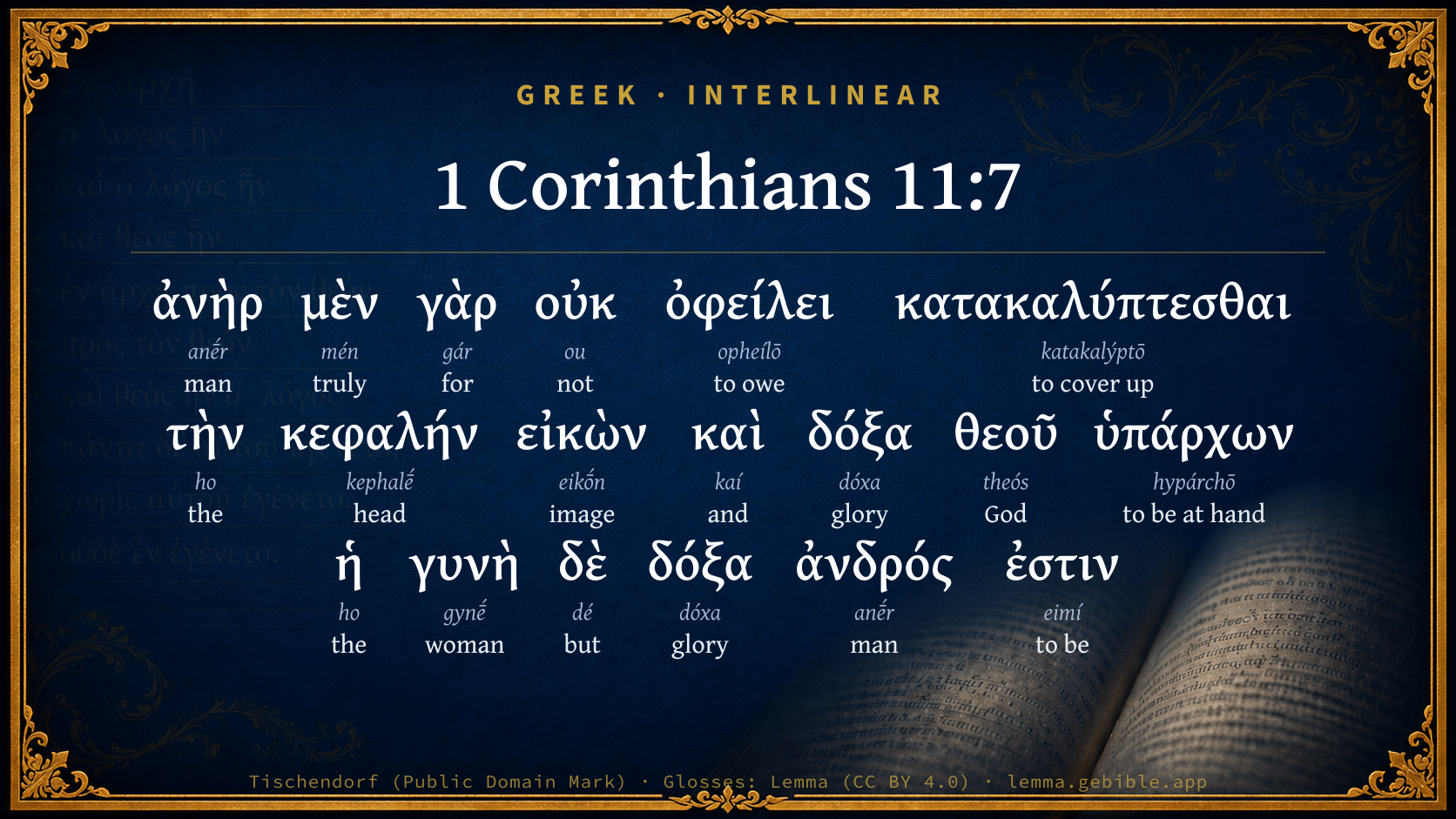
  1. ἀνὴρ anḗr G435 “man” Noun, Nominative, Singular, Masculine
  2. μὲν mén G3303 “truly” Particle
  3. γὰρ gár G1063 “for” Conjunction
  4. οὐκ ou G3756 “not” Particle, Negative
  5. ὀφείλει opheílō G3784 “to owe” Verb, Present, Active, Indicative, 3rd person, Singular
  6. τὴν ho G3588 “the” Article, Accusative, Singular, Feminine
  7. κεφαλήν kephalḗ G2776 “head” Noun, Accusative, Singular, Feminine
  8. εἰκὼν eikṓn G1504 “image” Noun, Nominative, Singular, Feminine
  9. καὶ kaí G2532 “and” Conjunction
  10. δόξα dóxa G1391 “glory” Noun, Nominative, Singular, Feminine
  11. θεοῦ theós G2316 “God” Noun, Genitive, Singular, Masculine
  12. ὑπάρχων hypárchō G5225 “to be at hand” Verb, Present, Active, Participle, Nominative, Singular, Masculine
  13. ἡ ho G3588 “the” Article, Nominative, Singular, Feminine
  14. γυνὴ gynḗ G1135 “woman” Noun, Nominative, Singular, Feminine
  15. δὲ dé G1161 “but” Conjunction
  16. δόξα dóxa G1391 “glory” Noun, Nominative, Singular, Feminine
  17. ἀνδρός anḗr G435 “man” Noun, Genitive, Singular, Masculine
  18. ἐστιν eimí G1510 “to be” Verb, Present, Active, Indicative, 3rd person, Singular

About this verse

These counts appear in no published source. They are computed here, from the morphology-tagged text and Lemma’s own curated glosses. What Lemma adds →

19
words
16
distinct lemmas
Pauline Epistles
section

Notable vocabulary

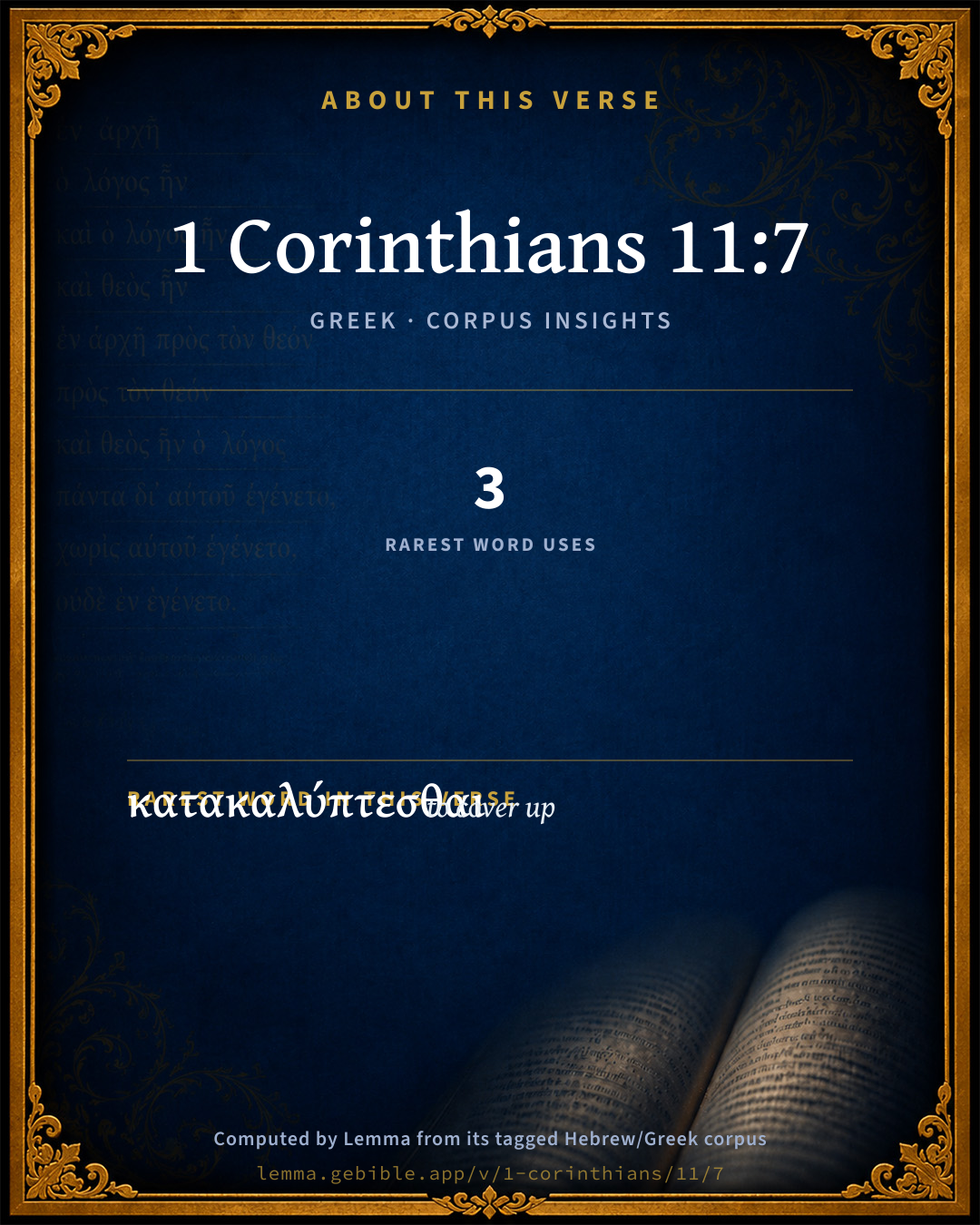
The rarest word here is κατακαλύπτεσθαι to cover up G2619 — appearing just 3 times in the whole Greek New Testament.

Shared distinctive vocabulary

κατακαλύπτεσθαι to cover up G2619 occurs in 2 verses of the Greek New Testament. Also found in:

Repetition

Words recur within this verse:

  • ἀνὴρ man G435 ×2
  • δόξα glory G1391 ×2
  • τὴν the G3588 ×2

Cross-references

7

Topical passages linked to 1 Corinthians 11:7 in the Treasury of Scripture Knowledge — connected by theme and wording, ordered by reader-vote popularity; previews shown in the World English Bible.

  • 1 Corinthians 11:3 But I would have you know that the head of every man is Christ, and the head of the woman is the man, and the head of Christ is God.
  • Genesis 9:6 Whoever sheds man's blood, by man will his blood be shed, for in the image of God made he man.
  • Genesis 1:26–27 God said, "Let us make man in our image, after our likeness: and let them have dominion over the fish of the sea, and over the birds of the sky, and over the cattle, and over all the earth, and over every creeping thing that creeps on the earth."
  • Genesis 5:1 This is the book of the generations of Adam. In the day that God created man, he made him in God's likeness.
  • Psalms 8:6 You make him ruler over the works of your hands. You have put all things under his feet:
  • Genesis 3:16 To the woman he said, "I will greatly multiply your pain in childbirth. In pain you will bring forth children. Your desire will be for your husband, and he will rule over you."
  • James 3:9 With it we bless our God and Father, and with it we curse men, who are made in the image of God.

Cross-references courtesy of OpenBible.info (CC BY 4.0).

Commentary

Notes on 1 Corinthians 11:7 from classic Christian and Jewish commentators (each source and its license shown beneath its notes). The classic Christian expositions comment on the surrounding passage and are grouped to its opening verse, so a note may address several verses; the Jewish commentaries on the Tanakh (Rashi and others) are per-verse, so they appear only where the commentator wrote on this verse.

Lemma curates 59 commentaries, every one of them public domain or Creative Commons licensed, each selected and text-cleaned for this edition rather than reprinted as found. About our sources →

Ellicott's Commentary for English Readers

(7) For a man indeed.—In 1Co_11:4-7 the argument against the woman’s head being uncovered was based upon (a) the woman’s relation to man, and (b) the man’s relation to Christ in the Church. In the three following verses, 1Co_11:7-9, the ground of the argument is changed, and the same conclusion is arrived at from a review of (a) the woman’s relation to man, and (b) man’s relation to God in the physical Creation. The external form of this argument is the same as that adopted previously. The Apostle first states what the man must not do, and then conversely what the woman must do. The Apostle here takes up the order of creation mentioned in Genesis 1, 2, and the argument runs thus:—Man was made in the image of God, and is the glory of God; but woman is the glory of the man (for woman was made out of man, and also man was not created for woman, but woman for—i.e., as a help-meet for—man). Therefore man, as a created being, according to the accepted order of creation, is the direct representative of God, and woman the direct representative of man (and only indirectly and through him of God). The spiritual equality of man and wife does not upset this relationship, and therefore an attempt to destroy the outward expression of it is to be condemned, as it would soon lead to an obliteration of the fact itself.

It is to be remembered all through this passage (and it gives a further emphasis to the allusion to Adam and Eve) that St. Paul is only speaking of married women—it is most unlikely that any case had occurred of an unmarried woman attempting such an outrage upon social feeling and national custom. The Greek women when in public (except those of avowedly bad character) either wore a veil or drew the peplum, or shawl, over their heads.

A Bible Commentary for English Readers, edited by Charles John Ellicott (1878–1897) — public domain. Text from a community e-Sword module.

Joseph Benson's Commentary

1Co 11:7-9. A man indeed ought not to cover, or veil, his head — As a sign of subjection; forasmuch as he is the image and glory of God — Namely, in respect of the dominion over the inferior creatures, with which he is clothed, representing the supreme dominion of God; for in respect of mental qualities, the woman is also the image of God: but the woman is the glory of the man — By being subject to him, and of all creatures coming nearest to him in all the excellences of his nature. For the man is not of the woman — In his first production; but the woman of the man — As we read in the sacred history, Gen 2:21-23. Neither was the man created for the sake of the woman — To accommodate and assist her; but the woman for the man — That he might have a help meet for him, which before he found not in the whole creation, Gen 2:20.

Joseph Benson's Commentary on the Old and New Testaments (1811–1818) — public domain. Text from a community e-Sword module.

Tyndale Open Study Notes

Tyndale Open Resources

11:7 man is made in God’s image: See Gen 1:26-27.

Tyndale Open Study Notes — © Tyndale Open Resources, licensed CC BY-SA 4.0. Text via the HelloAO Bible API.

Bengel's Gnomon

Johann Albrecht Bengel

1Co 11:7-10. Οὐκ ὀφείλει, κ.τ.λ., ought not, etc.) The man has more freedom in regard to his head-dress, especially when he is not engaged in praying or prophesying, than the woman.—κατακαλύπτεσθαι, to cover) verses 7 and 10 have an exact antithesis. Observe, first, he ought not, and she ought: secondly, look at the diagram: The man ought not to be covered; because the man is, A. the image of God, B. and the glory of God: but the woman ought to be covered: C. because she is the glory of the man, D. and on account of the angels. The man, he says, is the image of God; supply, and of Christ from 1Co 11:3 (see 1Co 11:8; comp. 1Co 11:12; ἐκ, of, concerning the man and concerning God; but διὰ, by, concerning the woman): not only on account of his power over the woman itself, but also on account of the causes of that power, viz., because the woman is of the man; but she is of the man, for (γὰρ, 1Co 11:9) she was created for the man. But the man is, in a nearer relation, both of God and under God; and so he represents God. Now because man is the image of God, he is at the same time the glory of God; comp. glory, 2Co 8:23. But the woman is the glory of the man; because the man is the head and lord of the woman. It is not said, the image and glory of the man; but only the glory of the man, as it were suspending the expression. But he proves, that she is the glory of the man, 1Co 11:8-9, as it were in a parenthesis; from which it may also be gathered, why the man is the image and glory of God. Now since the woman is the glory of the man, she might at the same time be called the image of the man; but Paul compensates for this by another expression, and says, for this cause, namely, because the woman is the glory of the man, she ought to be covered because of the angels; for in the diagram which we have just laid down, D is to A, as C to B. The meaning of this gnome-like sentiment[92] [expressed entirely in the same way in the notes to the Germ. Ver.] should be elicited from the very words that are added; let the woman cover herself because of the angels, i.e. because the angels are also covered. As the angels are to God, so the woman is to the man. The face of God is manifested: whereas the angels are covered, Isaiah 6. The face of the man is manifested, [uncovered]; the woman is covered. Nor is the man on that account exalted above the angels; but he is merely considered so far as he represents God in regard to the woman, which cannot be said of the angels. But the woman ought to be covered especially in praying and prophesying; for it belongs to the man, in preference to the woman, to pray and prophesy; when therefore the woman takes upon her those functions, then some open avowal is most necessary on her part, that woman is still properly and willingly inferior to man. Both the outward dress of the body showing humility in the heart, which the angels cannot penetrate, and the external order delight the angels themselves, who also contemplate the order, and look at the conduct of men in the assembly of the Church, 1Co 4:9; Eph 3:10; comp. Ecc 5:6, where LXX. have πρὸ προσώπου Θεοῦ, before the face of God. The conclusion is drawn from angels to the uncreated Angel, as from the less to the greater. Add Psa 138:1. But if not covered, the woman offends the angels by what is unbecoming, Mat 18:10; Mat 18:31. Moreover the woman ought to be the more careful not to offend the angels on this account, that she requires their protection, somewhat more than the man. She needs it more, on account of her own weakness just as children [minors, inferiors] do: comp. note on Greg. Thaum. Paneg. 160; as also demons lay more snares for the woman, 2Pe 2:19. The sentence of the law against the man when seduced and overcome is in proportion to the seduction, and the victory gained over him; but the woman was first overcome; or farther, she is more assailed by those extremely limpure spirits, whom the Greeks, on account of their eagerness to obtain victims, call φιλούλους, lovers of destruction. Comp. Mat 8:31; Mat 12:43. This great superiority of the man over the woman is qualified in 1Co 11:11-12, by way of ἐπιθεραπεία [after-softening of a previous unwelcome truth.—Append.], lest the man should exalt himself, or the woman think herself despised. Jac. Faber Stapulensis says, “Man was immediately made by God, the image and likeness of God, for His glory: but the woman mediately through the man, who was as it were a veil placed between her and God; for the medium is viewed as an interposing object, and a veil. To mark this mystery, when a man turns himself to God, which he mostly does in praying or prophesying, he ought to do so with his head uncovered, having, so to speak, no veil between himself and God, offering thus to God the honour of his creation: but the woman with her head covered acknowledges her creation, and, as it becomes her, offers honour to God, in the second place and through the medium of the glory of the glory of God. The woman is mediate and second, and became immediately the glory of the man, and was made for the sake of the man himself.” The same Stapulensis proceeds, “Both man and the angels were immediately created by God, and therefore man should have no covering, as a symbol of this event, when he is turned to God, any more than the angels; but the woman ought to have it, not only on account of the man, but also on account of the angels; for it would be pride, if she made her creation equal to that of the angels, inasmuch as she has this power [the privilege of creation] by means of the man. For what else is this, that a woman has and ought to have power over her head, but that she has this privilege through the mediation of the man, i.e. through the mediation of her head, who is her husband?” The discreet reader will skilfully qualify these remarks by those made by us above.

[92] See Appendix, under the title Noëma.

Bengel's Gnomon of the New Testament — English translation (T&T Clark, Edinburgh, 1860) — public domain. Text from a community e-Sword module.

Meyer's Critical & Exegetical Commentary

Heinrich August Wilhelm Meyer

1Co_11:7-9. Γάρ] introduces the grounding of the κατακαλυπτέσθω, consequently a second ground for the proposition under discussion (the first being 1Co_11:3-6). The argument sets out again (comp 1Co_11:3) e contrario.

οὐκ ὀφείλει] does not mean: he is not bound, which, as 1Co_11:3 shows, would not be enough; but: he ought not, etc., in contrast to the woman who ought (1Co_11:5; 1Co_11:10). Comp 2Co_12:14.

εἰκὼν κ. δόξα κ.τ.λ[1773]] The obligation to pray, etc., with the head covered would be inconsistent with this high dignity, because to cover the head is a sign of submission to human power, 1Co_11:10. A man as such (ἈΝΉΡ) is the image of God (Gen_1:26 f.), inasmuch as he, being Adams representative, has dominion over the earth. Other elements of what constitutes the image of God are not, according to the context, taken into account here, nor are the ecclesiastical definitions of it. He is also the glory of God, inasmuch as, being the image of God, he, in his appearance as man, practically represents on earth in a human way the majesty of God as a ruler. Rückert, following older interpreters (given in Wolf), holds that δόξα is meant here as the rendering of דְּמוּת, Gen_1:26; as also the LXX., in Num_12:8, Psa_17:15, translates תְּמוּנָה by ΔΌΞΑ. But had Paul wished to convey the meaning of דְּמוּת, a passage so important and so familiar as Gen_1:26 would certainly have suggested to him the word used there by the LXX., ὁμοίωσις. Δόξα corresponds simply to the Hebrew כבוד.

Paul describes only the man as being the image and ΔΌΞΑ of God; for he has in his eye the relation of marriage, in which rule is conferred on the man alone. The woman accordingly has, in harmony with the whole connection of the passage, to appear simply as ΔΌΞΑ ἈΝΔΡΌς, inasmuch, namely, as her whole wedded dignity, the high position of being spouse of the man, proceeds from the man and is held in obedience to him; so that the woman does not carry an independent glory of her own, an ἸΔΊΑ ΔΌΞΑ, but the majesty of the man reflects itself in her, passing over to her mediately and, as it were, by derivation. Grotius compares her happily to the moon as lumen minus sole. This exposition of δόξα ἀνδρός is the only one which suits the context, and corresponds in conception to the preceding δόξα Θεοῦ, without at the same time anticipating what is next said in 1Co_11:8-9. The conception of the δόξα, which is Θεοῦ in case of the man and ἀνδρός in that of the woman, is determined by the idea of the ordo conjugalis, not by that of humanity (Hofmann) originally realized in the man but passing thence into a derivative realization in the woman.

Paul omits εἰκών in the womans case, not because he refused to recognise the divine image in her (except in an immediate sense), but because he felt rightly that, in view of the distinction of sex, the word would be unsuitable (comp de Wette), and would also convey too much, considering the subordinate position of the woman in marriage.1Co_11:8. For there is not such a thing as man from woman, etc., but the relation of the two as respects being is the converse.1Co_11:9. The γάρ here is subordinate to that in 1Co_11:8 : for there was not created a man for the womans sake, but conversely. This is the concrete historical establishment, from the narrative of their creation, of the relation between the two sexes, which had been generally stated in 1Co_11:8; in giving it, Paul, with Gen_2:18 in his view, does not bring in ἐκ again, but ΔΙΆ, which, however, considering how familiar the history was, throws no doubt upon the genuineness of the ἘΚ. In ΚΑῚ ΓΆΡ the ΚΑΊ (which has the force of even indeed, Hartung, I. p. 135) belongs to οὐκ ἐκτίσθη. The present genetic relation of the two sexes, 1Co_11:8, began as early as the creation of the first pair.

[1773] .τ.λ. καὶ τὰ λοιπά.

Meyer — Critical and Exegetical Commentary on the New Testament — English translation by Peter Christie, edited by Frederick Crombie (T&T Clark, 1880) — public domain. Text from a community e-Sword module.

Expositor's Greek Testament

ed. W. Robertson Nicoll

1Co 11:7-16 . § 36. MAN AND WOMAN IN THE LORD. The Ap. has insisted on the woman’s retaining the veil in token of the Divine order pervading the universe, which Christ exhibits in His subordination to the Father. But he has some further observations to make on the relative position of the sexes. In the first place, he bases what he has said of the headship of man on the story of creation , exhibiting man as the direct reflexion of God, woman as derived and auxiliary (1Co 11:7-9 ); in this connexion the ref [1633] to “the angels” must be understood (1Co 11:10 ). At the same time, man and woman are necessary each to the other and derive alike from God (1Co 11:11 f.). Having thus grounded the matter upon Christian principle, P. appeals in confirmation to natural feeling (1Co 11:13-15 ), and finally to the unbroken custom of the Church (1Co 11:16 ).

[1633] reference.

1Co 11:7 . ἀνὴρ (not ὁ ἀνὴρ ) μὲν γὰρ κ . τ . λ .: “For man indeed (being man) ought not to have his head veiled” ( καλύπτεσθαι , pr [1634] inf [1635] of custom ), in contrast with woman who ought (1Co 11:5 ; 1Co 11:10 ) this is as wrong on his part as it is right on hers; οὐκ negatives the whole sentence, as in ver. I. ὀφείλει , like δεῖ (1Co 11:19 ), denotes moral or rational necessity, the former vb [1636] in a more personal, the latter in a more abstract way. For him to veil his head would be to veil the “image and glory of God”; Christ, the image of God, became ἄνθρωπος as ἀνήρ . ὑπάρχων (see parls.), “being constituted” so. To accompany εἰκών , P. substitutes for the ὁμοίωσις ( d’muth ) of Gen. the more expressive δόξα by which the LXX renders the synonymous t’munah of Psa 17:15 God’s “glory” being His likeness in visible splendour; cf. Heb 1:3 . P. conceives Gen 1:26 to apply to Adam as ἀνὴρ primarily, although in 1Co 11:27 it stands, “God created man in His own image … male and female created He them”. ἡ γυνὴ δὲ κ . τ . λ . presents a shortened antithesis to the μὲν clause; logically completed it reads, “But the woman (ought to have her head veiled, for she) is the glory of the man” δόξα ἀνδρός not of the race ( ἀνθρώπου ), but of the stronger sex. Paul omits εἰκών , which does not hold here; she is not man’s reflexion, but his counterpart not “like to like, but like in difference,” wedded as “perfect music unto noble words”; she partakes, through him, in the εἰκὼν Θεοῦ (Gen 1:27 ). That which in our common nature is most admirable faith, purity, beauty man sees more excellently and proportionately shown in hers. It follows that he who degrades a woman sullies his manhood, and is the worst enemy of his race; the respect shown to women is the measure and Safeguard of human dignity.

[1634] present tense.

[1635] infinitive mood.

[1636] verb

The Expositor's Greek Testament, edited by W. Robertson Nicoll (1897–1910) — public domain. Text from a community e-Sword module.

Godet's Commentaries

Frédéric Louis Godet

Vers. 7-12.

Thus far the apostle has been arguing from the parallel between the subordinate position which Christian principle ascribes to the woman (1Co 11:3), and the receptive position of the man relatively to Christ, and of Christ Himself relatively to God. Now he shows that the conclusion he has drawn from this double analogy is confirmed by the mode of the woman’s creation. For in the apostle’s eyes the kingdom of nature does not proceed from another God than that of grace. On the contrary, it is in the sphere of redemption that the Divine thoughts, which are only sketched in the kingdom of nature, reach perfection.

Vv. 7-9. “The man indeed, being the image and glory of God, ought not to cover his head: but the woman is the glory of the Man 1:8. For the man is not taken from the woman; but the woman from the Man 1:9. And the man indeed was not created for the woman; but the woman for the man.”

The γάρ, for, leads us to expect a confirmation drawn from a domain other than the preceding. The omission of the article before the words εἰκών, image, and δόξα, glory, gives these two substantives a qualitative significance.

The meaning of the first is that man, by his sovereignty over the terrestrial creation, visibly reflects the sovereignty of the invisible Creator over all things. We here find the idea of man’s lordly position in nature, as it is expressed Gen 1:26-28, and celebrated in Psalms 8

The second, glory of God, expresses the honour which is shed on God Himself from this visible image which He has formed here below, especially when man, carrying out his destiny, voluntarily renders Him homage for his high position, and adoringly casts at His feet the crown which God has put on his head. Analogous to this is the meaning in 2Co 8:23, where the deputies of the Churches are called the glory of Christ, because they make the Lord’s work, in the Churches they represent, shine before the eyes of those to whom they are delegated.

The man existing in this double character (ὑπάρχων), as image and glory of God, ought not to veil this dignity by covering himself when he acts publicly. This would be in a way to tarnish the reflection of the Divine brightness with which God has adorned him, and which ought at such a time to shine forth in his person. But in virtue of the very same law, the woman ought to act in an opposite way. If, in the discharge of such an office, the veil is opposed to the man’s sovereignty, it is from that very fact in keeping with the woman’s condition. She, indeed, was created as the glory of the man, because, as is said in the following verses, she was taken from him and formed for him (1Co 11:8-9). It is an honour, the highest of all undoubtedly, for one being to become the object of another’s love and devotion; and the more the being who loves and is self-devoted is exalted in talent and beauty, the more is this honour increased. Can there therefore be a greater glory to man than to possess, as a loving and devoted helpmeet, a being so admirably endowed as woman! All the perfection that belongs to her is homage rendered to the man, from whom and for whom she was made, especially when she consecrates herself freely to him in the devotion of love. Critics have been exercised, and justly, about the reason why the apostle has not in the second case repeated the term image. De Wette has thought that had he made woman the image of man, the apostle would have denied to her the possession of God’s image. Meyer thinks that this expression would wrongly imply, on the part of the woman, a certain participation in the sovereignty of the man. The second ground seems to me truer and more in keeping with the context. The image of the husband in the family is not the wife, but the son. It is he who is heir of the paternal sovereignty.

The inference from this relation in regard to the woman’s demeanour will be drawn in 1Co 11:10.

Vers. 8, 9 serve to prove the expression: glory of the man. In 1Co 11:8 the narrative of Genesis (Gen 2:22-23) is referred to, according to which the man did not appear as proceeding from the woman; but inversely. And why so? For a reason (γάρ) which is at the same time a new proof (καί) of the expression: glory of man, in 1Co 11:7. The woman proceeded from the man because she was intended to serve as his helper, and to complete his existence.

The διά, on account of, alludes to the saying of Genesis (Gen 2:18): “It is not good for man to be alone: let us make a helpmeet for him.”

The practical conclusion, 1Co 11:10 :

Frédéric Louis Godet — Commentaries on Luke, John, Romans, and 1 Corinthians — English translation (T&T Clark, Edinburgh, 1870s–1890s) — public domain. Text from a community e-Sword module.

Hodge's Commentary on Romans, Ephesians & First Corinthians

Charles Hodge

1Co_11:7

For a man indeed ought not to cover (his) head, forasmuch as he is the image and glory of God: but the woman is the glory of the man.

The woman, and the woman only, ought to be veiled; for the man ought not to cover his head. This does not mean, he is not bound to do it, but should not do it. The negative belongs not to ὀφείλει, but to καταλαλύπτεσθαι. The reason is that he is the image and glory of God. The only sense in which the man, in distinction from the woman, is the image of God, is that he represents the authority of God. He is invested with dominion. When, in Gen_1:26, Gen_1:27, it is said God created man in his own image, the reference is as much to woman as to man; for it is immediately added, male and female created he them. So far, therefore, as the image of God consists in knowledge, righteousness and holiness, Eve as truly, and as much as Adam, bore the likeness of her Maker. But in the dominion with which man was invested over the earth, Adam was the representative of God. He is the glory of God, because in him the divine majesty is specially manifested. But the woman is the glory of the man. That is, the woman is in this respect subordinate to the man. She is not designed to reflect the glory of God as a ruler. She is the glory of the man. She receives and reveals what there is of majesty in him. She always assumes his station; becomes a queen if he is a king, and manifests to others the wealth and honor which may belong to her husband.

Charles Hodge — Commentary on Romans (1835), First Corinthians (1857), and Ephesians (1856) — public domain. Text from a community e-Sword module.

Geneva Bible (1599)

Geneva Bible translators

The taking away of an objection: Have not men also hair given to them? I grant, saith the Apostle, but there is another matter in it: For man was made to this end and purpose, that the glory of God should appear in his rule and authority: but the woman was made, that by profession of her obedience, she might more honor her husband.

Geneva Bible (1599) marginal notes — public domain. Text via Bolls.life.

Jamieson, Fausset & Brown

Robert Jamieson, A. R. Fausset & David Brown

Argument, also, from man's more immediate relation to God, and the woman's to man.

he is . . . image . . . glory of God--being created in God's "image," first and directly: the woman, subsequently, and indirectly, through the mediation of man. Man is the representative of God's "glory" this ideal of man being realized most fully in the Son of man (Psa 8:4-5; compare Co2 8:23). Man is declared in Scripture to be both the "image," and in the "likeness," of God (compare Jam 3:9). But "image" alone is applied to the Son of God (Col 1:15; compare Heb 1:3). "Express image," Greek, "the impress." The Divine Son is not merely "like" God, He is God of God, "being of one substance (essence) with the Father." [Nicene Creed].

woman . . . glory of . . . man--He does not say, also, "the image of the man." For the sexes differ: moreover, the woman is created in the image of God, as well as the man (Gen 1:26-27). But as the moon in relation to the sun (Gen 37:9), so woman shines not so much with light direct from God, as with light derived from man, that is, in her order in creation; not that she does not in grace come individually into direct communion with God; but even here much of her knowledge is mediately given her through man, on whom she is naturally dependent.

Jamieson, Fausset & Brown — Commentary Critical and Explanatory on the Whole Bible (1871) — public domain (CC PDM 1.0). Text via the HelloAO Bible API.

Adam Clarke's Commentary

Verse 7. A man indeed ought not to cover his head] He should not wear his cap or turban in the public congregation, for this was a badge of servitude, or an indication that he had a conscience overwhelmed with guilt; and besides, it was contrary to the custom that prevailed, both among the Greeks and Romans.

He is the image and glory of God] He is God's vicegerent in this lower world; and, by the authority which he has received from his Master, he is his representative among the creatures, and exhibits, more than any other part of the creation, the glory and perfections of the Creator.

But the woman is the glory of the man.] As the man is, among the creatures, the representative of the glory and perfections of God, so that the fear of him and the dread of him are on every beast of the field, c. so the woman is, in the house and family, the representative of the power and authority of the man. I believe this to be the meaning of the apostle; and that he is speaking here principally concerning power and authority, and skill to use them. It is certainly not the moral image of God, nor his celestial glory, of which he speaks in this verse.

Adam Clarke's Commentary on the Bible (1810–1826) — public domain. Text from a community e-Sword/MySword module.

John Calvin's Commentaries

7. The man ought not to cover his head, because he is the image The same question may now be proposed respecting the image, as formerly respecting the head. For both sexes were created in the image of God, and Paul exhorts women no less than men to be formed anew, according to that image. The image, however, of which he is now speaking, relates to the order of marriage, and hence it belongs to the present life, and is not connected with conscience. The simple solution is this — that he does not treat here of innocence and holiness, which are equally becoming in men and women, but of the distinction, which God has conferred upon the man, so as to have superiority over the woman. In this superior order of dignity the glory of God is seen, as it shines forth in every kind of superiority.

The woman is the glory of the man There is no doubt that the woman is a distinguished ornament of the man; for it is a great honor that God has appointed her to the man as the partner of his life, and a helper to him, and has made her subject to him as the body is to the head. For what Solomon affirms as to a careful wife — that she is a crown to her husband, (Proverbs 12:4,) is true of the whole sex, if we look to the appointment of God, which Paul here commends, showing that the woman was created for this purpose — that she might be a distinguished ornament of the man.

John Calvin's Commentaries (1540-1563) — public domain. Text from the Calvin Translation Society English edition (1840s-50s) via the Christian Classics Ethereal Library (ccel.org). Calvin's coverage is partial (roughly two-thirds of the Bible); uncommented books and verses are honest gaps, never fabricated. The 19th-century editor's footnotes and remarks are omitted so the notes are faithfully Calvin's own voice.

The Cambridge Bible for Schools and Colleges

gen. ed. J. J. S. Perowne

7. For a man indeed ought not to cover his head] The Apostle now gives reasons for what he has just said. His first argument is that to appear uncovered in the congregation denotes the having no visible superior there. But woman has a visible superior, namely, man. To this fact, when she appears in public, her very dress should testify. See also 1Co_11:10.

forasmuch as he is the image and glory of God] Additional reason for the Apostle’s directions. Man is God’s image (Gen_1:26-27; Gen_5:1; Gen_9:2; Gen_9:6), inasmuch as he is the highest of all living beings in the visible world. His glory, i.e. the manifestation or representation of His glory, on account of the dominion over all things in the world committed to him (Gen_1:16; Gen_1:28; Gen_3:16). As he is thus a visible representation of God, he is not to veil his head, the noblest part of his body, in the public worship of the Church.

the woman is the glory of the man] Woman is not the manifestation or representation of the glory of God on earth, inasmuch as she is subject to man, and therefore cannot properly represent Him Who has no superior. But to all inferior beings she represents and is scarcely distinguishable from man, and therefore manifests and shares his superiority; reflects it, as the moon does the light of the sun, to use (and it may be said, to complete) the simile of Grotius here. See Alford’s note.

The Cambridge Bible for Schools and Colleges (gen. ed. J. J. S. Perowne; Cambridge University Press, 1878–1918) — public domain. Text from a community e-Sword module.

John Gill's Exposition

For the man is not of the woman,.... In the present state of things, and according to the ordinary course of generation and propagation of mankind, man is of the woman, though not without the means of man; he is conceived in her, bore by her, and born of her; but the apostle respects the original formation of man, as he was immediately made by God out of the dust of the earth, before the woman was in being, and so not of her:

but the woman of the man; she was made out of his rib, and took both her name and nature from him; God was the author, and man the matter of her being; her original under God, is owing to him; and therefore as he was first in being, he must be superior to her: this serves to prove all that has been as yet said; as that man is the head of the woman, the woman is the glory of man, what he may glory in as being from him; and therefore there should be this difference in their appearance at public worship.

John Gill's Exposition of the Whole Bible (1746–1763) — public domain (CC PDM 1.0). Text via the HelloAO Bible API.

Trapp's Complete Commentary

John Trapp

7 For a man indeed ought not to cover his head, forasmuch as he is the image and glory of God: but the woman is the glory of the man.

Ver. 7. He is the image and glory of God] Even as an image in the glass doth look toward us, from whom it is reflected. So, saith one, doth God’s image in us make the eyes of our minds view him the author of it in us. (Bayn’s Letters.) And as the eye becometh one with that which it seeth, and is after a sort in that light it beholdeth; so are we by the vision of God, which is begun in us, one with him and in him.

The woman is the glory of the man] Either because he may glory in her, if she be good; or because she is to honour him, and give glory to him.

John Trapp, A Commentary or Exposition upon All the Books of the Old and New Testament (1647–1656) — public domain. Text from a community e-Sword module.

Albert Barnes' Notes on the Bible

For a man indeed ought not to cover his head - That is, with a veil; or in public worship; when he approaches God, or when in His name he addresses his fellow man. It is not fit and proper that he should be covered. The reason why it is not proper, the apostle immediately states.

Forasmuch as he is the image and glory of God - The phrase “the image of God” refers to the fact that man was made in the likeness of his Maker Gen 1:27; and proves that, though fallen, there is a sense in which he is still the image of God. It is not because man is truly or pure, and thus resembles his Creator; but it evidently is because he was invested by his Maker with authority and dominion; he was superior to all other creatures; Gen 1:28. This is still retained; and this the apostle evidently refers to in the passage before us, and this he says should be recognized and regarded. If he wore a veil or turban, it would be a mark of servitude or inferiority. It was therefore improper that he should appear in this manner; but he should he so clad as not to obscure or hide the great truth that he was the direct representative of God on the earth, and had a superiority to all other creatures.

And glory of God - The word “glory” in the classic writers means:

Opinion, sentiment, etc.;

(2)Fame, reputation.

Here it means, as it often does, splendor, brightness, or that which stands forth to “represent” God, or by which the glory of God is known. Man was created first; he had dominion given him; by him, therefore, the divine authority and wisdom first shone forth; and this fact should be recognized in the due subordination of rank, and even in the apparel and attire which shall be worn. The impression of his rank and superiority should be everywhere retained.

But the woman is the glory of the man - The honor, the ornament, etc. She was made for him; she was made after he was; she was taken from him, and was “bone of his bone, and flesh of his flesh.” All her comeliness, loveliness, and purity are therefore an expression of his honor and dignity, since all that comeliness and loveliness were made of him and for him. This, therefore, ought to be acknowledged by a suitable manner of attire; and in his presence this sense of her inferiority of rank and subordination should be acknowledged by the customary use of the veil. She should appear with the symbol of modesty and subjection, which are implied by the head being covered This sense is distinctly expressed in the following verse.

Albert Barnes' Notes on the Bible (1834–1885) — public domain. Text from a community e-Sword/MySword module.

Matthew Poole's English Annotations

For a man indeed ought not to cover his head; covering the head being in those countries a token of subjection, a man ought to uphold the power, pre-eminence, and authority with which God hath invested him, and not to cover his head, further than it is naturally covered with hair.

Forasmuch as he is the image and glory, of God; because he hath a peculiar cause of glorying in God, as he to whom alone he is subject, and therefore ought by no habits or postures to show himself in subjection to others: or because God glorieth in him, as a most excellent piece of his workmanship: God is represented in man. Paul useth to call that one’s glory wherein he glorieth, 2Co 1:12,14; 1Th 2:20. So David ealleth God his glory; and Solomon tells us, Pro 17:6, that the glory of children are their fathers. So as the apostle here useth a double argument for the man’s not covering of his head:

1. Because the man is immediately subject to God, and therefore ought not by any habits, or civil rites, to show his natural subjection to men, that are not by nature his superiors (for we must not think, that the apostle by this argument forbiddeth subjection to natural, economical, or political superiors).

2. Because God glorieth in man.

But the woman is the glory of the man, created for the honour of the man, and for his help and assistance, and originally made out of man, so as man may glory of her, as Adam did of Eve, Gen 2:23,

This is now bone of my bone, and flesh of my flesh. The glory of God ought to be revealed and uncovered, manifested to all: the glory of the man ought to be hidden and concealed.

Matthew Poole's English Annotations on the Holy Bible (1683–1685) — public domain. Text from a community e-Sword/MySword module.

Whedon's Commentary on the Bible

Daniel D. Whedon

7. Image and glory of God—As God is Lord of the universe, so man is authorized lord in the earth. Gen_1:27. Hence, as having no visible superior in the world among the creatures of God, modesty never compels him to cover his head before any.

Woman… glory of… man—As emanating from himself, as he emanates from God, and as a beautiful and wonderful second self, just as he is God’s representative or finite second self on earth.

Daniel D. Whedon (gen. ed.), Commentary on the Old and New Testaments (1874–1909) — public domain. Text from a community e-Sword module.

The Pulpit Commentary

He is the image and glory of God. Because he reflects and partakes in the glory of Christ, who is the effulgence of God and the impress of his substance (Gen_1:27; Psa_8:6; Heb_1:2) The woman is the glory of the man. As moonlight is to sunlight, or as the earthshine is to the moonshine. Man reflects God; woman, in her general nature in this earthly and temporal dispensation, reflects the glory of man.

Man the image and glory of God.

The Bible is the book of paradoxes; and, if it were not, it would not correspond with the facts of human nature and history. Nowhere do we find such an exposure of human sin and such denunciations of human guilt as in the Scriptures. And, on the other hand, nowhere do we meet with such majestic representations of man"s grandeur and dignity. There is a depth in this simple but inspiring language which we cannot fathom; but we may remark some particulars in which it is verified by facts.

I MAN IS GOD"S IMAGE AND GLORY IN HIS FORM AND FEATURES. This seems to be asserted in this passage. Why must not man"s head be veiled when in the sacred assembly he draws near to the Father of spirits, the Lord of the universe? Because "he is the image and glory of God." This does not imply that the Divine Being possesses a body as man does. No such anthropomorphism is suggested in the text. But so far as matter can be moulded into a form which shadows forth the Divine majesty, it has been so fashioned in the construction of the human frame and features. High thoughts, noble impulses, pure desires, tender sympathy, these the glory of humanity are written upon the countenance of man.

II IN HIS INTELLECTUAL AND MORAL ENDOWMENTS. This is probably what is meant by the declaration in Genesis that God made man in his own image. In his capacity to apprehend truth, in his recognition of moral excellence, in his power of will, man resembles his Maker. And there is no way by which we can arrive at a knowledge of God in his higher attributes other than by the aid of the nature with which he has endowed us, and which he has declared to be akin to his own.

III IN HIS POSITION OF SUBORDINATE RULE OVER THE CREATION. The psalmist asserts that God crowned man with glory and honour, and set him over the works of his hands, putting all things under his control. Thus did the Lord of all delegate to his vicegerent an authority resembling his own.

IV IN THE BROTHERHOOD OF JESUS CHRIST. The assumption of human nature by the eternal Word was only possible because man was originally made in the Divine image. It is wonderful to find language so similar used concerning man and concerning the Son of God, who is described as "the emanation from the Father"s glory, and the very image of his substance." The Incarnation seems a necessity even to explain the nature of man; it casts a halo of glory and radiance around the human form, the human destiny. For the Incarnation was the condition, not only of a Divine manifestation, but of the redemption of humanity; and Christ"s purpose was to bring many sons unto glory.

V IN HIS FUTURE OF ETERNAL BLESSEDNESS. All things which show forth God"s glory are passing and perishing. Man alone of all that is earthly is appointed for immortality. The mirror that reflects so bright a light shall never be broken; the glory which man receives from heaven and returns to heaven shall never fade. T.

The Pulpit Commentary (1880–1919), ed. H.D.M. Spence-Jones & Joseph S. Exell — public domain. Text from a community e-Sword module.

John Wesley's Explanatory Notes

A man indeed ought not to veil his head, because he is the image of God - In the dominion he bears over the creation, representing the supreme dominion of God, which is his glory. But the woman is only matter of glory to the man, who has a becoming dominion over her. Therefore she ought not to appear, but with her head veiled, as a tacit acknowledgment of it.

John Wesley, Explanatory Notes Upon the Whole Bible (1754–1765) — public domain. Text via the GEBible commentary corpus.

Kretzmann's Popular Commentary

Paul E. Kretzmann

The apostle advances a further argument for the woman’s veiling:

v. 7. For a man indeed ought not to cover his head, forasmuch, as he is the image and glory of God; but the woman is the glory of the man.

v. 8. For the man is not of the woman, but the woman of the man.

v. 9. Neither was the man created for the woman, but the woman for the man.

v. 10. For this cause ought the woman to have power on her head because of the angels.

v. 11. Nevertheless, neither is the man without the woman, neither the woman without the man, in the Lord.

v. 12. For as the woman is of the man, even so is the man also by the woman; but all things of God.

The relative position of the sexes is here based upon the Scripture-account of the creation: For a man indeed should not veil the head, since the image and glory of God he is. See Gen 1:26. He was created in, and therefore represents, the image of God, and in this likeness he also bears the visible splendor of God; he rules in his own sphere by virtue of the power and freedom given him by God, and this conduct redounds to the glory of God. But the wife is the glory of man; she has the dignity of her position from man; in her office in the home she represents the majesty of the man. Note: From this statement it follows that the respect shown to women is the measure and safeguard of human dignity. That the distinction made at the time of the creation is to be observed also in the Christian Church appears, moreover, from the story of the creation of Eve, Gen 2:18-25. For not is man from woman, but woman from man; and not was man created for the sake of woman, but woman for the sake of man. In the case of all other organic creatures the Lord created them in two sexes at once, but Adam was created alone at the beginning, and it was only afterward that the woman originated, being made out of one of his ribs. And in fashioning woman in this way, the Lord aimed to meet the man’s need; she was to be a helpmeet for him. It is a subversion of the order of creation if a woman regards her husband as the servant of her pleasure, as the instrument of her subsistence.

So important does the apostle consider the maintenance and observance of the relation between the sexes as fixed by God that he wants also the external sign of the woman’s auxiliary position retained: For this reason the woman is obliged to have "power on her head"; she should wear the token, or emblem, of her status, the veil, as denoting the power which she derives from the man, and that on account of the angels. The angels, being present in public worship, are offended by irreverence and misconduct. Even if men might, under circumstances, not find it offensive or scandalous for a woman to discard the dignity of her position, the presence of God’s holy angels ought to deter a true woman from unwomanly behavior.

In discussing their position so frankly, Paul has no intention of belittling the state of women or to ascribe inferiority to them: Nevertheless, and yet, neither woman without man, nor man without woman, in the Lord; for even as the woman is out of, derived from, the man, so also the man is through the woman; but everything is from God, who is the Originator of all. The woman is not in the Lord apart from man, she has no claim in a Lord all for herself: the same Christ is the Lord of both, a fact which applies to the man as well. They stand side by side, with equal rights, in the Kingdom of Grace. The woman was taken from man, he’ was the initial cause of being to the woman; but, on the other hand, woman, by the order of God in nature, is the instrumental cause of being to the man. But these facts give neither party a right to boast, since, after all, God is the Source, the Creator, of all things; to Him both must give reverence. This holds true especially in home life. The man should regard himself as living in the Lord for the sake of his wife, and likewise the woman for the sake of her husband. Married people belong together in the house of God, together at the Table of the Lord, together in home devotions, together in all things in which the life in the Lord is fostered; they are heirs together of the grace of life, 1Pe 3:7.

Paul E. Kretzmann, Popular Commentary of the Bible (1921–1924) — public domain. Text from a community e-Sword module.

McGarvey & Pendleton's Commentaries

J. W. McGarvey

For a man indeed ought not to have his head veiled, forasmuch as he is the image and glory of God [Man has no created superior ( Gen_1:27 ; Psa_8:6 ), and, in addition to the glory which is his by reason of the nature of his creation, his estate has been further dignified and glorified by the incarnation of the Son of God ( Heb_1:2-3 ), so that, because of his fellowship with Christ, he may stand unveiled in the presence of the Father. Therefore, by covering his head while at worship, man symbolically forfeits his right to share in the glory of Christ, and thus dishonors himself. We are no longer slaves, but sons ( Gal_4:7 ). "We Christians," says Tertullian, "pray with outspread hands, as harmless; with uncovered heads, as unashamed; without a prompter, as from the heart"]: but the woman is the glory of the man .

J. W. McGarvey (with Philip Y. Pendleton), Commentaries on the New Testament (The Fourfold Gospel, 1914; Acts; and the epistles) — public domain. Text from a community e-Sword/MySword module.

The People's New Testament

B. W. Johnson

7. A man ought not to cover his head, etc. In this whole passage we must keep in mind the Eastern ideas of the relations of the sexes. Paul bases these rules of propriety on the account of their creation. The veil is a sign of subordination to others present. But man, the image and glory of God, has no created superior. The woman, the glory of the man, is subordinate to him, of which the veil is the symbol.

B. W. Johnson's The People's New Testament with Notes (1889–1891) — public domain. Electronic text from the Christian Classics Ethereal Library (CCEL) ThML edition.

unfoldingWord translationNotes

Door43 World Missions Community

should not have his head covered

This can be stated in active form. AT: Possible meanings are 1) "must not cover his head" or 2) "does not need to cover his head" (See: Active or Passive)

glory of the man

Just as man reflects God's greatness, the woman reflects the man's character.

For man was not made from woman. Instead, woman was made from man

God made the woman by taking a bone from the man and making the woman from that bone. This can be stated in active form. AT: "God did not make the man from the woman. Instead, he made the woman from the man" (See: Active or Passive)

translationWords

image of God

God

unfoldingWord translationNotes — © Distant Shores Media and the Door43 World Missions Community, licensed CC BY-SA 4.0. Source: git.door43.org/Door43/en_tn.

Cambridge Greek Testament for Schools and Colleges

7. ἀνὴρ μέν. The Apostle now gives reasons for what he has just said. His first argument is that to appear uncovered in the congregation denotes the having no visible superior there. But woman has a visible superior, namely, man. To this fact, when she appears in public, her very dress should testify. See also 1Co 11:10.

εἰκὼν καὶ δόξα θεοῦ. Additional reason for the Apostle’s directions. Man is God’s image (Gen 1:26-27; Gen 5:1; Gen 9:2; Gen 9:6), inasmuch as he is the highest of all living beings in the visible world. His glory, i.e. the manifestation or representation of His glory, on account of the dominion over all things in the world committed to him (Gen 1:26; Gen 1:28; Gen 3:16). As he is thus a visible representation of God, he is not to veil his head, the noblest part of his body, in the public worship of the Church.

γυνὴ δὲ δόξα ἀνδρός. Woman is not the manifestation or representation of the glory of God on earth, inasmuch as she is subject to man, and therefore cannot properly represent Him Who has no superior. But to all inferior beings she represents and is scarcely distinguishable from man, and therefore manifests and shares his superiority; reflects it, as the moon does the light of the sun, to use (and it may be said, to complete) the simile of Grotius here. See Alford’s note.

Cambridge Greek Testament for Schools and Colleges (Cambridge University Press, 1896; 21 vols, various authors incl. Carr, Maclear, Plummer, Farrar, Lumby, Moule, M. R. James, Simcox) — public domain. Text from a community e-Sword module.

Alford’s Greek Testament

Henry Alford

7-9.] A second reason for the same,—from the dependence of the man on God only, but of the woman on the man.

7.] γάρ refers back to and gives a reason for κατακαλυπτέσθω, the difference between the sexes being assumed,—that one should be and the other should not be veiled. The emphasis is accordingly on ἀνήρ.

οὐκ ὀφείλει, should not, ought not: see reff.

εἰκὼν θεοῦ, ref. Gen. This the man is, having been created first,—directly, and in a special manner: the woman indirectly, only through the man.

κ. δόξα θ.] And the (representative of the) glory of God: on account of his superiority and godlike attributes among other created beings. This is obviously the point here brought out, as in Psa 8:6: not, that he is set to shew forth God’s glory (εἰς γὰρ δόξαν θεοῦ ὀφείλει ὁ ἀνὴρ ὑποτετάχθαι τῷ θεῷ, in Œcum.), however true that may be: nor, as Estius, from Augustine, ‘quia in illo Deus gloriatur:’ nor is δόξα the representative of the Heb. דְּמוּת, Gen 1:26 (ὁμοίωσις), as Rϋckert, al., suppose, because the LXX have rendered תְּמוּנָה, Num 12:8; Psa 17:15, by δόξα: for, as Meyer observes, in so well-known a passage as Gen 1:26, the Apostle could hardly fail to have used the LXX word ὁμοίωσις.

Man is God’s glory: He has put in him His Majesty, and he represents God on earth: woman is man’s glory: taken (ver. 8) from the man, shining (to follow out Grotius’s similitude, “minus aliquid vero, ut luna lumen minus sole”) not with light direct from God, but with light derived from man, “τὸ θῆλυ, ἄῤῥεν ἀτελές, philosophis. Imperat materfamilias suæ familiæ, sed viri nomine.” Grot. This of course is true only as regards her place in creation, and her providential subordination, not in respect of the dependence of every woman’s individual soul directly on God, not on man, for supplies of grace and preparations for glory. The Apostle omits εἰκών, because anthropologically the woman is not the image of the man, on account of the difference of the sexes: and also perhaps because thus he would seem to deny to the woman the being created in the divine image, which she is as well as the man, Gen 1:26, Gen 1:27. The former reason appears the more probable: and so De W. and Meyer. “It may be observed that, whereas in Genesis the general character of man under the Hebrew name answering to ἄνθρωπος is the only one brought forward, here it is merged in the word ἀνήρ, which only expresses his relation to the woman.” Stanley.

Henry Alford, The Greek Testament (1849–1861) — public domain. Text from a community e-Sword module.

International Critical Commentary

7. The connexion between ὀφείλει (v. 10) and οὐκ ὀφείλει here must be marked: the woman is morally bound, the man is not morally bound, to veil his head. But ‘not bound to’ may be an understatement for ‘bound not to’; comp. Act 17:29: St Paul can hardly mean that the man may please himself, while the woman may not—magis liber est viro habitus capitis quam mulieri (Beng.); for he has just said that the man puts his head to shame by covering it, as a woman puts her head to shame by not doing so. Sicut vir professione libertatis caput suum honorat, ita mulier, subjectionis (Calvin). The man ought not to wear a covering, ‘since he is by original constitution (ὑπάρχων) God’s image and glory,’ reflecting the Creator’s will and power, ‘while the wife is her husband’s glory.’ This she is as a matter of fact (ἐστίν, not ὑπάρχει). See Abbott, The Son of Man, p. 674. She also was made κατʼ εἰκόνα Θεοῦ, for in Gen 1:26 ἄνθρωπον includes both sexes, but this fact is omitted here, because it is the relation of woman to man, not of woman to God, that is under consideration; and, as she has a superior, she does not so well represent Him who has no superior. Moreover, it is the son, rather than the wife, who is the εἰκών of the man. Comp. 1Ti 2:13.

International Critical Commentary — older volumes (1896–1929), various authors — public domain. Text from a community e-Sword module.

Vincent's Word Studies in the New Testament

Marvin R. Vincent

Image and glory [εικων και δοξα] For image, see on Revelation 13 14. Man represents God 's authority by his position as the ruler of the woman. In the case of the woman, the word image is omitted, although she, like the man, is the image of God. Paul is expounding the relation of the woman, not to God, but to man.

Marvin R. Vincent, Word Studies in the New Testament (1887–1900) — public domain. Text from a community e-Sword/MySword module.

Lesson kit

Teaching starters — assembled from the data on this page, not authored interpretation. Every prompt links to the verse data it draws on. Edit before teaching.

1 Corinthians, in the Pauline Epistles, opens this verse with 19 words (16 distinct Greek lemmas). Its most distinctive word is katakalýptō (“to cover up”). A historical commentator’s framing appears above. Read the whole chapter for the surrounding context.

Discussion questions

  1. How does “to cover up” (katakalýptō) shape what this verse is saying?
  2. 1 Corinthians 11:6 shares the word «to cover up» with this verse. How do the two illuminate each other?
  3. “man” occurs 2× in this one verse. What is the effect of the repetition?
  4. These translations render this verse differently. What is at stake in choosing one wording over another?
  5. Reading how Ellicott's Commentary for English Readers and Joseph Benson's Commentary read this verse, where do the two commentators agree and where do they part?

Things to notice

Reading settings

Reading text

Shown beneath each verse's original-language words.

Old Testament
Old Testament edition

Read the OT as the Masoretic Hebrew (MT) or the Greek Septuagint (LXX).

English shown for the Greek Septuagint (in the Hebrew ↔ Greek comparison).

Comparing translations? Open the Compare panel on any verse page to stack up to four side by side.