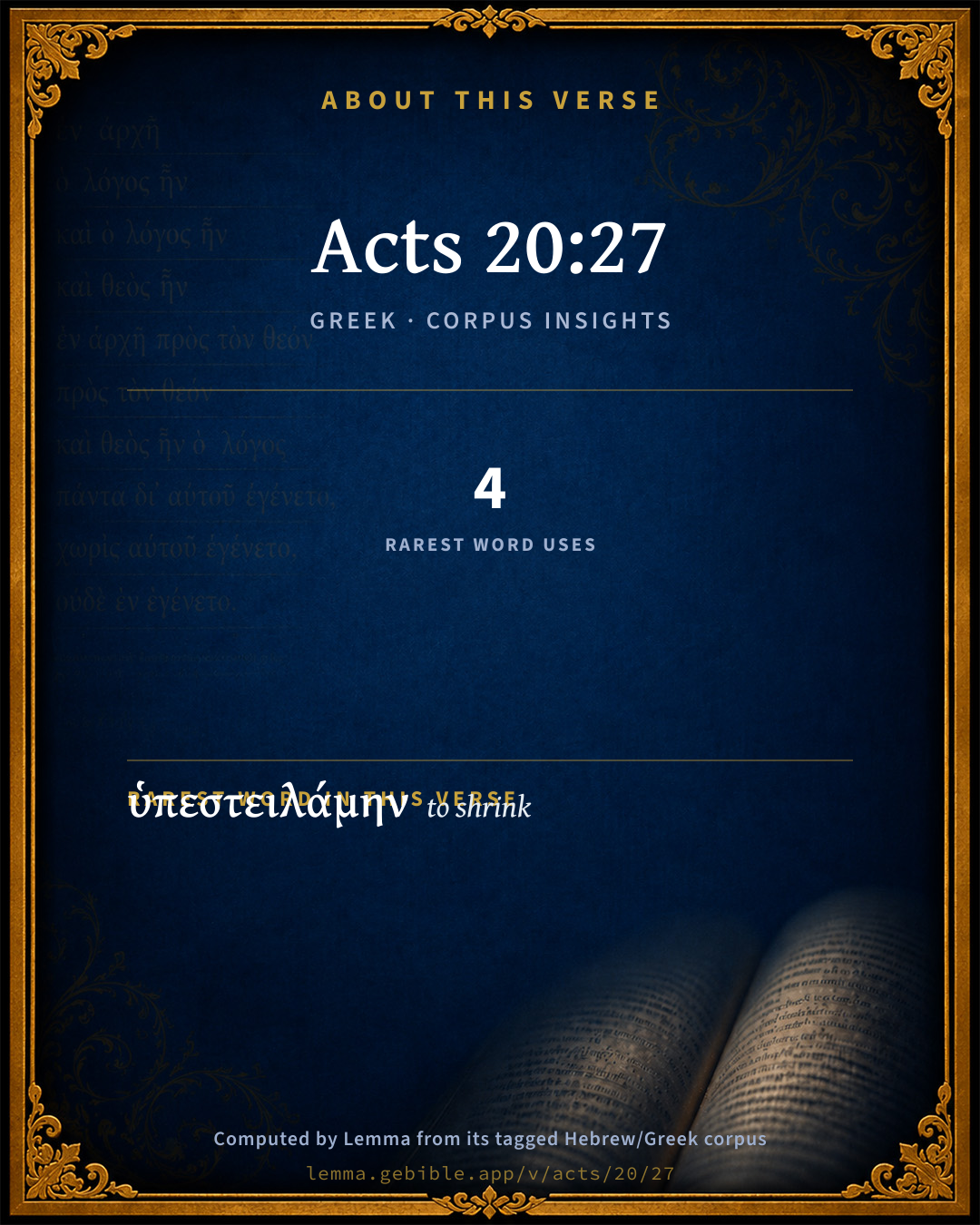
Acts 20:27

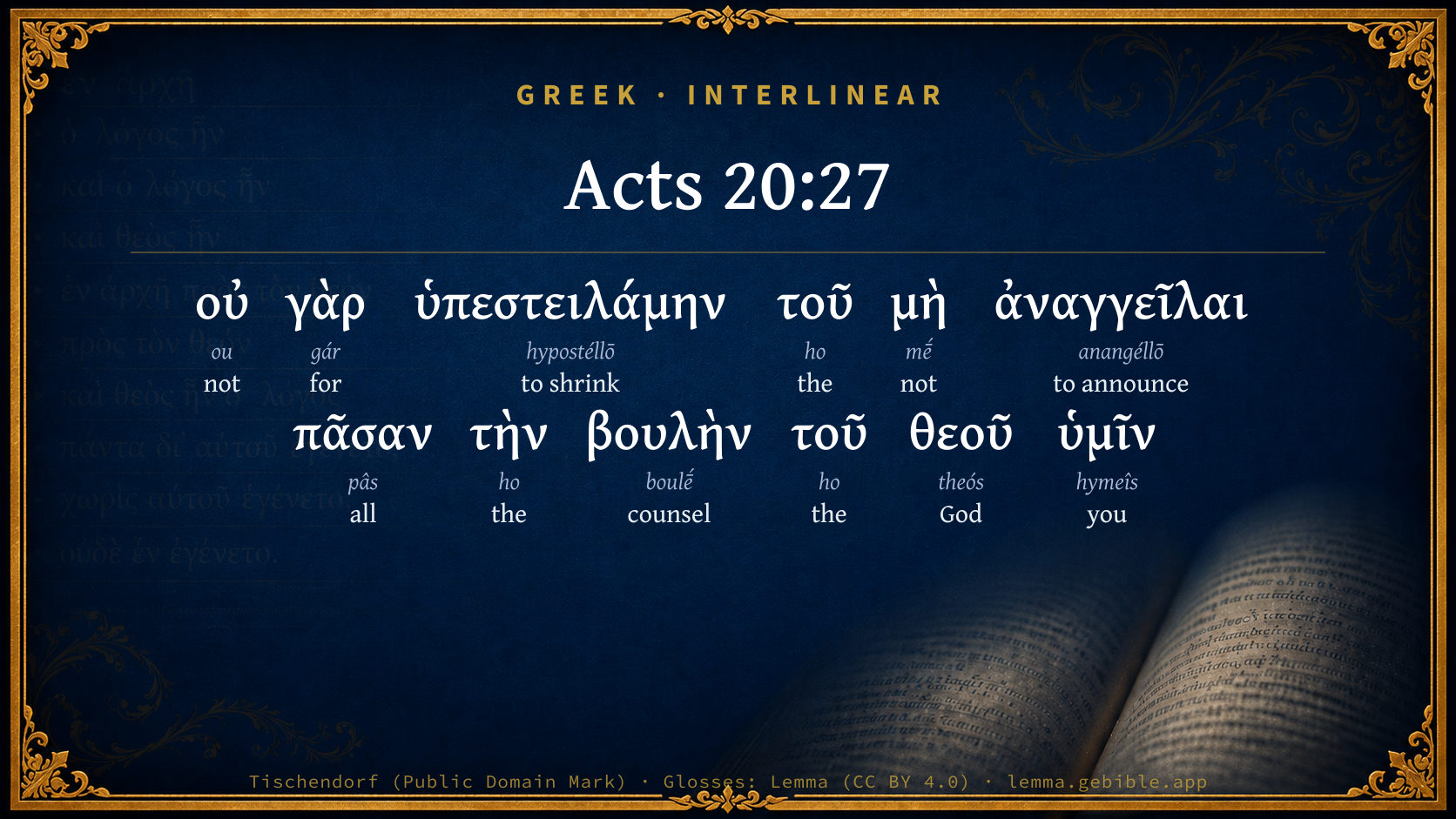
Greek (Tischendorf 8th ed.) Acts 20:27 appears in the Greek New Testament. The text above is from the Tischendorf 8th edition. Each word links to its Strong’s number and a concise gloss. Click any word for its full Thayer’s Greek Lexicon entry.
Download image
Cite this verse

Acts 20:27 (World English Bible). Public Domain. Lemma interlinear Bible study tool, https://lemma.gebible.app/v/acts/20/27.

Show BibTeX & RIS
BibTeX
RIS
English Translation
for I didn't shrink from declaring to you the whole counsel of God.
World English Bible · Public Domain
Download a study sheet

One document with this verse’s original text, its word-by-word gloss line, the meaning frame, cross-references with their text, attributed commentary, and full source and license credits — printable, and it pastes into notes with its structure intact.

This verse Autodidact and up

Study sheet (.html) Plain text (.txt)

A passage Seminary Student

Up to 50 verses in one chapter. A passage sheet keeps up to 6 commentary sources and 12 cross-references per verse, in the order this page ranks them, and says so on the sheet whenever that leaves anything out. Ask for a single verse and you get the Autodidact verse sheet above.

Everything on this page stays free to read, with no account — the sheet is a download of what is already on screen, not access to it.

Want to remove ads? Support Godless Engineer
Compare translations 3

The same verse in 3 English versions, stacked beneath the original-language interlinear above. Click any original word for its lexicon entry.

Each is an independent rendering of the whole verse — the interlinear is not word-aligned to these translations.

Highlighted words mark where these versions differ — a whole-verse word diff, not a word-by-word alignment.

  • World English Bible Public Domain
    for I didn't shrink from declaring to you the whole counsel of God.
  • King James Version Public Domain
    For I have not shunned to declare unto you all the counsel of God.
  • unfoldingWord Literal Text CC BY-SA 4.0
    For I did not hold back in order not to declare to you all the counsel of God.

unfoldingWord Literal Text — © unfoldingWord, licensed CC BY-SA 4.0. Word-aligned USFM3 via Door43 (git.door43.org/unfoldingWord/en_ult).

Versions to compare (up to 4)

3 of 4 selected

Show all 19 translations

Every available English version of this verse, each an independent rendering of the whole verse.

  • World English Bible Public Domain
    for I didn't shrink from declaring to you the whole counsel of God.
  • Berean Standard Bible Public Domain
    For I did not shrink back from declaring to you the whole will of God.
  • Majority Standard Bible Public Domain
    For I did not shrink back from declaring to you the whole will of God.
  • King James Version Public Domain
    For I have not shunned to declare unto you all the counsel of God.
  • American Standard Version (1901) Public Domain
    For I shrank not from declaring unto you the whole counsel of God.
  • Revised Version (1885) Public Domain
    For I shrank not from declaring unto you the whole counsel of God.
  • Geneva Bible (1599) Public Domain
    For I haue kept nothing backe, but haue shewed you all the counsell of God.
  • Douay-Rheims (1899) Public Domain
    For I have not spared to declare unto you all the counsel of God.
  • Young's Literal Translation Public Domain
    for I did not keep back from declaring to you all the counsel of God.
  • Literal Standard Version CC BY-SA 4.0
    for I did not keep back from declaring to you all the counsel of God.
  • Unlocked Literal Bible CC BY-SA 4.0
    For I did not hold back from declaring to you the whole will of God.
  • unfoldingWord Literal Text CC BY-SA 4.0
    For I did not hold back in order not to declare to you all the counsel of God.
  • Darby Bible Public Domain
    for I have not shrunk from announcing to you all the counsel of God.
  • World Messianic Bible Public Domain
    for I didn’t shrink from declaring to you the whole counsel of God.
  • Webster's Bible Public Domain
    For I have not shunned to declare to you all the counsel of God.
  • Free Bible Version CC BY-SA 4.0
    I didn't hesitate to tell you everything God wants you to know.
  • Bible in Basic English Public Domain
    For I have not kept back from you anything of the purpose of God.
  • Text-Critical English NT CC BY 4.0
    For I have not held back from declaring to you the whole counsel of God.
  • Tyndale New Testament (1534) Public Domain
    For I have kepte nothinge backe: but have shewed you all the counsell of God.

Literal Standard Version (2020), Covenant Press — licensed CC BY-SA 4.0. Text via the HelloAO Bible API (eBible.org). Unlocked Literal Bible (unfoldingWord) — licensed CC BY-SA 4.0. Text via the HelloAO Bible API (eBible.org). unfoldingWord Literal Text — © unfoldingWord, licensed CC BY-SA 4.0. Word-aligned USFM3 via Door43 (git.door43.org/unfoldingWord/en_ult). Free Bible Version, Dr. Jonathan Gallagher — licensed CC BY-SA 4.0. Text via the HelloAO Bible API (eBible.org).

Word by word

More ways to search: Search by grammar → Find every occurrence → Compare this word →

Practice this passage: Drill this verse → Learn its vocabulary →

ὑπεστειλάμην
hypostéllō
G5288
“to shrink”
Verb, Aorist, Middle, Indicative, 1st person, Singular
Part of Speech
Verb
Tense
Aorist
Voice
Middle
Mood
Indicative
Person
1st person
Number
Singular
Full Thayer's Definition

Origin: from G5259 and G4724

TDNT: 16:57,1

1. to draw back, let down, lower a. to withdraw: of a timid person 2. to withdraw one's self, i.e. to be timid, to cover, shrink a. of those who from timidity hesitate to avow what they believe b. to be unwilling to utter from fear c. to shrink from declaring, to conceal, dissemble
  1. οὐ ou G3756 “not” Particle, Negative
  2. γὰρ gár G1063 “for” Conjunction
  3. τοῦ ho G3588 “the” Article, Genitive, Singular, Neuter
  4. μὴ mḗ G3361 “not” Particle, Negative
  5. ἀναγγεῖλαι anangéllō G312 “to announce” Verb, Aorist, Active, Infinitive
  6. πᾶσαν pâs G3956 “all” Adjective, Accusative, Singular, Feminine
  7. τὴν ho G3588 “the” Article, Accusative, Singular, Feminine
  8. βουλὴν boulḗ G1012 “counsel” Noun, Accusative, Singular, Feminine
  9. τοῦ ho G3588 “the” Article, Genitive, Singular, Masculine
  10. θεοῦ theós G2316 “God” Noun, Genitive, Singular, Masculine
  11. ὑμῖν hymeîs G5210 “you” Personal pronoun, 2nd person, Dative, Plural

About this verse

These counts appear in no published source. They are computed here, from the morphology-tagged text and Lemma’s own curated glosses. What Lemma adds →

12
words
10
distinct lemmas
Acts
section

Notable vocabulary

The rarest word here is ὑπεστειλάμην to shrink G5288 — appearing just 4 times in the whole Greek New Testament.

Shared distinctive vocabulary

ὑπεστειλάμην to shrink G5288 occurs in 4 verses of the Greek New Testament. Also found in:

Repetition

A word recurs within this verse:

Cross-references

16

Topical passages linked to Acts 20:27 in the Treasury of Scripture Knowledge — connected by theme and wording, ordered by reader-vote popularity; previews shown in the World English Bible.

  • Acts 20:20 how I didn't shrink from declaring to you anything that was profitable, teaching you publicly and from house to house,
  • 1 Thessalonians 2:4 But even as we have been approved by God to be entrusted with the Gospel, so we speak; not as pleasing men, but God, who tests our hearts.
  • 2 Corinthians 4:2 But we have renounced the hidden things of shame, not walking in craftiness, nor handling the word of God deceitfully; but by the manifestation of the truth commending ourselves to every man's conscience in the sight of God.
  • Galatians 1:7–10 and there isn't another gospel. Only there are some who trouble you, and want to pervert the Gospel of Christ.
  • Galatians 4:16 So then, have I become your enemy by telling you the truth?
  • Jeremiah 23:22 But if they had stood in my council, then had they caused my people to hear my words, and had turned them from their evil way, and from the evil of their doings.
  • Psalms 32:11 Be glad in Yahweh, and rejoice, you righteous! Shout for joy, all you who are upright in heart!
  • Luke 7:30 But the Pharisees and the lawyers rejected the counsel of God, not being baptized by him themselves.
  • Acts 2:23 him, being delivered up by the determined counsel and foreknowledge of God, you have taken by the hand of lawless men, crucified and killed;
  • Acts 20:35 In all things I gave you an example, that so laboring you ought to help the weak, and to remember the words of the Lord Jesus, that he himself said, 'It is more blessed to give than to receive.'"
  • 1 Corinthians 11:23 For I received from the Lord that which also I delivered to you, that the Lord Jesus on the night in which he was betrayed took bread.
  • Ephesians 1:11 in whom also we were assigned an inheritance, having been foreordained according to the purpose of him who works all things after the counsel of his will;
  • Isaiah 46:10–11 declaring the end from the beginning, and from ancient times things that are not [yet] done; saying, My counsel shall stand, and I will do all my pleasure;
  • Matthew 28:20 teaching them to observe all things that I commanded you. Behold, I am with you always, even to the end of the age." Amen.
  • John 15:15 No longer do I call you servants, for the servant doesn't know what his lord does. But I have called you friends, for everything that I heard from my Father, I have made known to you.
  • Acts 26:22–23 Having therefore obtained the help that is from God, I stand to this day testifying both to small and great, saying nothing but what the prophets and Moses said would happen,

Cross-references courtesy of OpenBible.info (CC BY 4.0).

Commentary

Notes on Acts 20:27 from classic Christian and Jewish commentators (each source and its license shown beneath its notes). The classic Christian expositions comment on the surrounding passage and are grouped to its opening verse, so a note may address several verses; the Jewish commentaries on the Tanakh (Rashi and others) are per-verse, so they appear only where the commentator wrote on this verse.

Lemma curates 59 commentaries, every one of them public domain or Creative Commons licensed, each selected and text-cleaned for this edition rather than reprinted as found. About our sources →

Bengel's Gnomon

Johann Albrecht Bengel

Act 20:27. Γὰρ, for) Therefore he who kept back what he ought to have announced or showed, is not pure from the blood of his hearers.

Bengel's Gnomon of the New Testament — English translation (T&T Clark, Edinburgh, 1860) — public domain. Text from a community e-Sword module.

Expositor's Greek Testament

ed. W. Robertson Nicoll

Act 20:27 . ὑπεστ ., see above on Act 20:20 . τὴν β . τοῦ Θεοῦ , see on Act 2:23 , and cf. especially Eph 1:11 for the phrase, and Act 3:4 for the thought. No Epistle excels that to the Ephesians in the richness of its thoughts, and in its conception of a divine purpose running through the ages; no Epistle dwells more fully upon the conception of the Church as the Body of Christ, or exhorts more touchingly to diligence in keeping the unity of the Spirit, or insists more practically upon the sanctifying power of the One Spirit, and the sense of a divine membership in every sphere of human life. The rich and full teaching of the Epistle is addressed to men who are able to understand the Apostle’s knowledge of the mystery of Christ; in other words, to those to whom he had announced more fully than to others the counsel of God. The Ephesian Epistle may have been an encyclical letter, but it was addressed principally to the Ephesians as the representatives of the leading Church of the province of Asia. See amongst recent writers Gore, Ephesians , pp. 42, 43; and Lock, “Ephesians,” Hastings’ B.D., p. 718. ὑμῖν : emphatically at the end, W.H [339] ; this revelation had been made to the presbyters before him, and the responsibility would rest with them of communicating it to others when their spiritual father had left them.

[339] Westcott and Hort’s The New Testament in Greek: Critical Text and Notes.

The Expositor's Greek Testament, edited by W. Robertson Nicoll (1897–1910) — public domain. Text from a community e-Sword module.

Geneva Bible (1599)

Geneva Bible translators

The doctrine of the Apostles is most perfect and absolute.

Geneva Bible (1599) marginal notes — public domain. Text via Bolls.life.

Jamieson, Fausset & Brown

Robert Jamieson, A. R. Fausset & David Brown

For I have not shunned to declare . . . all the counsel of God--God's way of salvation, and His kingdom of souls saved by His Son Jesus Christ. See Luk 7:30.

Jamieson, Fausset & Brown — Commentary Critical and Explanatory on the Whole Bible (1871) — public domain (CC PDM 1.0). Text via the HelloAO Bible API.

Adam Clarke's Commentary

Verse 27. I have not shunned to declare] ου υπεστιλαμην, I have not suppressed or concealed any thing, through fear or favour, that might be beneficial to your souls. This is properly the meaning of the original word. See Clarke on Ac 20:20.

All the counsel of God.] All that God has determined and revealed concerning the salvation of man-the whole doctrine of Christ crucified, with repentance towards God, and faith in Jesus as the Messiah and great atoning Priest. In Isa 9:6, Jesus Christ is called the wonderful counsellor, פלא יועץ Pele Poets, which the Septuagint translate μεγαλης βουλης αγγελος The messenger of the great counsel. To this the apostle may have referred, as we well know that this version was constantly under his eye. Declaring therefore to them the whole counsel of God, πασηντην βουληντουθεου, the whole of that counsel or design of God, was, in effect, declaring the whole that concerned the Lord Jesus, who was the messenger of this counsel.

Adam Clarke's Commentary on the Bible (1810–1826) — public domain. Text from a community e-Sword/MySword module.

Ellicott's Commentary for English Readers

(27) I have not shunned to declare unto you all the counsel of God.—The words point to a greater degree of receptivity for Divine truth than had been found elsewhere. So in the Epistle to the Ephesians, which, even on the assumption that it was an encyclical letter, was addressed to them principally, he speaks to them as able to understand his knowledge in the mystery of Christ (Eph_3:4), the universality of His redeeming work, the brotherhood of mankind in the common Fatherhood of God. In “I have not shunned” we have the same word and image as in the “kept back” of Act_20:20.

A Bible Commentary for English Readers, edited by Charles John Ellicott (1878–1897) — public domain. Text from a community e-Sword module.

The Cambridge Bible for Schools and Colleges

gen. ed. J. J. S. Perowne

27. For I have not shunned to declare unto you all the counsel of God] The Rev. Ver. as in Act_20:20, “For I shrank not from declaring unto you the whole, &c.” The “counsel of God” means the whole plan of salvation; what God offers and what he asks of men. This includes the “repentance and faith” as well as the “grace and mercy.”

The Cambridge Bible for Schools and Colleges (gen. ed. J. J. S. Perowne; Cambridge University Press, 1878–1918) — public domain. Text from a community e-Sword module.

John Gill's Exposition

Also of your own selves shall men arise,.... Not only false teachers from abroad should come and enter among them, but some would spring up out of their own communities, such as had been admitted members of them, and of whom they had hoped well; such were Hymenseus, Philetus, Alexander, Hertoogenes, and Phygellus;

speaking perverse things; concerning God, and Christ, and the Gospel; distorted things, wresting the Scriptures to their own destruction, and that of others; things that are disagreeable to the word of God, and pernicious to the souls of men:

to draw away disciples after them; to rend away members from the churches, make schisms and divisions, form parties, set themselves at the head of them, and establish new sects, called after their own names; see Jo1 2:19.

John Gill's Exposition of the Whole Bible (1746–1763) — public domain (CC PDM 1.0). Text via the HelloAO Bible API.

Trapp's Complete Commentary

John Trapp

27 For I have not shunned to declare unto you all the counsel of God.

Ver. 27. All the counsel of God] sc. that concerneth you to know, to your eternal salvation by Christ alone. See Luk 7:30, {See Trapp on "Luk 7:30"}

John Trapp, A Commentary or Exposition upon All the Books of the Old and New Testament (1647–1656) — public domain. Text from a community e-Sword module.

Albert Barnes' Notes on the Bible

For - This verse contains a reason for what had been said in the previous verse. It shows why Paul regarded himself as innocent if they should be lost.

I have not shunned - I have not kept back; I have not been deterred by fear, by the desire of popularity, by the fact that the doctrines of the gospel are unpalatable to people, from declaring them fully. The proper meaning of the word translated here, “I have not shunned” ὑπεστειλάμην hupesteilamēn, is “to disguise any important truth; to withdraw it from public view; to decline publishing it from fear, or an apprehension of the consequences.” Paul means that he had not disguised any truth; he had not withdrawn or kept it from open view, by any apprehension of the effect which it might have on their minds. Truth may be disguised or kept back:

By avoiding the subject altogether from timidity, or from an apprehension of giving offence if it is openly proclaimed; or, By giving it too little prominency, so that it shall be lost in the multitude of other truths; or, By presenting it amidst a web of metaphysical speculations, and entangling it with other subjects; or, By making use of other terms than the Bible does, for the purpose of involving it in a mist, so that it cannot be understood.

People may resort to this course:

Because the truth itself is unpalatable; Because they may apprehend the loss of reputation or support; Because they may not love the truth them selves, and choose to conceal its prominent and offensive points; Because they may be afraid of the rich, the great, and the frivolous, and apprehend that they shall excite their indignation; and, By a love of metaphysical philosophy, and a constant effort to bring everything to the test of their own reason. People often preach a philosophical explanation of a doctrine instead of the doctrine itself They deserve the credit of ingenuity, but not that of being open and bold proclaimers of the truth of God.

All the counsel - πᾶσαν τὴν βουλὴν pasan tēn boulēn. The word “counsel” (βουλὴ boulē) denotes properly “consolation, deliberation,” and then “will or purpose,” Luk 23:51; Act 2:23. It means here the will or purpose of God, as revealed in regard to the salvation of people. Paul had made a full statement of that plan of the guilt of people, of the claims of the Law, of the need of a Saviour, of the provisions of mercy, and of the state of future rewards and punishments. Ministers ought to declare all that counsel, because God commands it; because it is needful for the salvation of people; and because the message is not theirs, but God’s, and they have no right to change, to disguise, or to withhold it. And if it is the duty of ministers to declare that counsel, it is the duty of a people to listen to it with respect and candor, and with a desire to know the truth, and to be saved by it. Declaring the counsel of God will do no good unless it is received into honest and humble hearts, and with a disposition to know what God has revealed for salvation.

Albert Barnes' Notes on the Bible (1834–1885) — public domain. Text from a community e-Sword/MySword module.

Matthew Poole's English Annotations

God’s decree, to save all that believe in Christ; or the whole doctrine of Christianity, as it directs to a holy life; whatsoever God requires of any one in order to a blessed eternity. This is that which the Pharisees rejected, Luk 7:30; and so do all wicked and ungodly men, who refuse to take God’s counsel, or to obey his command.

Matthew Poole's English Annotations on the Holy Bible (1683–1685) — public domain. Text from a community e-Sword/MySword module.

Whedon's Commentary on the Bible

Daniel D. Whedon

27. Counsel of God—Both in the Law and in the Gospel; both as Judge and as Saviour. His counsel was, collectively to cast off impenitent Judaism and to accept penitent Gentilism, and individually to deal with every man according to his works. (See note on Rom_9:19.)

Daniel D. Whedon (gen. ed.), Commentary on the Old and New Testaments (1874–1909) — public domain. Text from a community e-Sword module.

The Pulpit Commentary

Shrank not from declaring for have not shunned to declare, A.V. (see ver. 20, note); the whole for all the, A.V. Counsel of God. His revealed will and purpose concerning man"s salvation (Act_2:23 Act_4:28; Eph_1:11)

God"s whole counsel.

St. Paul is stating a fact which

(1) was to the honor of the Ephesian elders, for they must have been receptive and willing hearers if the apostle found that he might even teach them the mysteries of the gospel; and which

(2) was to the honor of St. Paul as a teacher, who was so skilful in dividing the Word of truth that he could make the very mysteries plain. Compare his language in Eph_3:4, where he speaks of their "being" "able to understand his knowledge, in the mystery of Christ." It is right to declare the whole counsel of God; but it is wise only to declare it to those who are prepared to receive it. Compare St. Peter"s counsel and reference to St. Paul in 2Pe_3:15, 2Pe_3:16. The "whole counsel of God" may be regarded as including

I THE COMPLETE CIRCLE OF REVEALED TRUTH. This embraces

(1) the Divine revelations made in different ages;

(2) in different forms;

(3) to different individuals.

While the complete circle may be regarded as contained in the Old and New Testament Scriptures, we may not absolutely limit Divine revelation to the written Word. The Spirit of God has full and free access to the minds and hearts of men, and can reveal his will directly to them if it shall please him so to do. To this circle there is a center, but the repetition of this cannot be the Divine idea of "preaching the gospel." Every truth within the circle must be held by, and filled with the spirit of, the central truth. Everything within the circle is the gospel. Ministers may not, and they need not, shun to declare to men the very "mysteries" of revelation, since by the consideration of such the higher culture of the soul is gained. Infants take the milk of first principles; strong men need to feed upon strong meat of difficult and advanced truth.

II THE TRUTH IN ITS ANTAGONISTIC PHASES. This side of the truth may not be left untouched by any teacher, but its treatment calls for much care and wisdom. There are times when we are required to show how truth opposes error; but usually it is far better to preach the positive truth, and let it by its own force gradually root out and destroy error. Three points may here be illustrated.

1. Christ"s truth seemed opposed to Judaism. It was not really opposed to the system as given by God to Moses. It was the natural and necessary outgrowth and completion of it. It was opposed to the corrupt Judaism of the rabbis a formal and ceremonial system out of which all spiritual life had gone.

2. Christ"s truth was opposed to paganism, both in its theories, principles, and practices.

3. Christ"s truth is made to appear opposed to science, but only by the undue assumptions and prejudiced bias of some who really misrepresent science.

4. Christ"s truth is always opposed to worldly maxims, because it demands the whole soul for God, while the world wants the whole soul for self.

III THE TRUTH IN ITS PRACTICAL PHASES. Illustrate from the Epistles how directly it bears:

1. On individual habits; teaching us how to possess the vessels of our bodies in sanctification and honor.

2. On family relations; culturing good fatherhood and motherhood, and requiring honorable obedience from children, and service from dependents.

3. On social fellowships; binding man to man in a gracious brotherhood of common helpfulness.

IV THE TRUTH WITH THE PERSONAL STAMP ON IT. When uttered with the force of a man"s own experience, persuasion, and conviction, the truth gains a new power; but we must also recognize that it comes under limitations by getting apprehension and expression only through limited minds limited by capacity and limited by education. Individuality is on one side power, but on the other side weakness. Conclude by fully unfolding what now may be thought of as included in the "whole counsel of God," especially pointing out that, while the field of revelation is the same that St Paul had, the field of speculation has marvelously grown and enlarged. But still, what men have to preach to their fellow-men is not their speculation, but God"s revelation. R.T.

The Pulpit Commentary (1880–1919), ed. H.D.M. Spence-Jones & Joseph S. Exell — public domain. Text from a community e-Sword module.

John Wesley's Explanatory Notes

For I have not shunned - Otherwise if any had perished, their blood would have been on his head.

John Wesley, Explanatory Notes Upon the Whole Bible (1754–1765) — public domain. Text via the GEBible commentary corpus.

McGarvey & Pendleton's Commentaries

J. W. McGarvey

See notes on verse 22

J. W. McGarvey (with Philip Y. Pendleton), Commentaries on the New Testament (The Fourfold Gospel, 1914; Acts; and the epistles) — public domain. Text from a community e-Sword/MySword module.

Cambridge Greek Testament for Schools and Colleges

27. ὑμῖν placed after θεοῦ with אBCD. Vulg. ‘Dei vobis.’

27. οὐ γὰρ ὑπεστειλάνην κ.τ.λ., for I shrank not from declaring, &c. See above on Act 20:20.

By πᾶσα ἡ βουλὴ τοῦ θεοῦ is meant the whole plan of salvation, what God offers and what he asks from men. This includes ‘repentance and faith’ (Act 20:20) as well as the ‘grace and mercy’ (Act 20:24).

Cambridge Greek Testament for Schools and Colleges (Cambridge University Press, 1896; 21 vols, various authors incl. Carr, Maclear, Plummer, Farrar, Lumby, Moule, M. R. James, Simcox) — public domain. Text from a community e-Sword module.

Vincent's Word Studies in the New Testament

Marvin R. Vincent

Shunned. The same word as in verse 20 kept back.

Marvin R. Vincent, Word Studies in the New Testament (1887–1900) — public domain. Text from a community e-Sword/MySword module.

Lesson kit

Teaching starters — assembled from the data on this page, not authored interpretation. Every prompt links to the verse data it draws on. Edit before teaching.

Acts, in the Acts, opens this verse with 12 words (10 distinct Greek lemmas). Its most distinctive word is hypostéllō (“to shrink”). A historical commentator’s framing appears above. Read the whole chapter for the surrounding context.

Discussion questions

  1. How does “to shrink” (hypostéllō) shape what this verse is saying?
  2. Acts 20:20 shares the word «to shrink» with this verse. How do the two illuminate each other?
  3. “the” occurs 3× in this one verse. What is the effect of the repetition?
  4. These translations render this verse differently; the difference is in the English rendering, not the original. What questions does that raise?
  5. Reading how Bengel's Gnomon and Expositor's Greek Testament read this verse, where do the two commentators agree and where do they part?

Things to notice

Reading settings

Reading text

Shown beneath each verse's original-language words.

Old Testament
Old Testament edition

Read the OT as the Masoretic Hebrew (MT) or the Greek Septuagint (LXX).

English shown for the Greek Septuagint (in the Hebrew ↔ Greek comparison).

Comparing translations? Open the Compare panel on any verse page to stack up to four side by side.