2 Corinthians 6:4

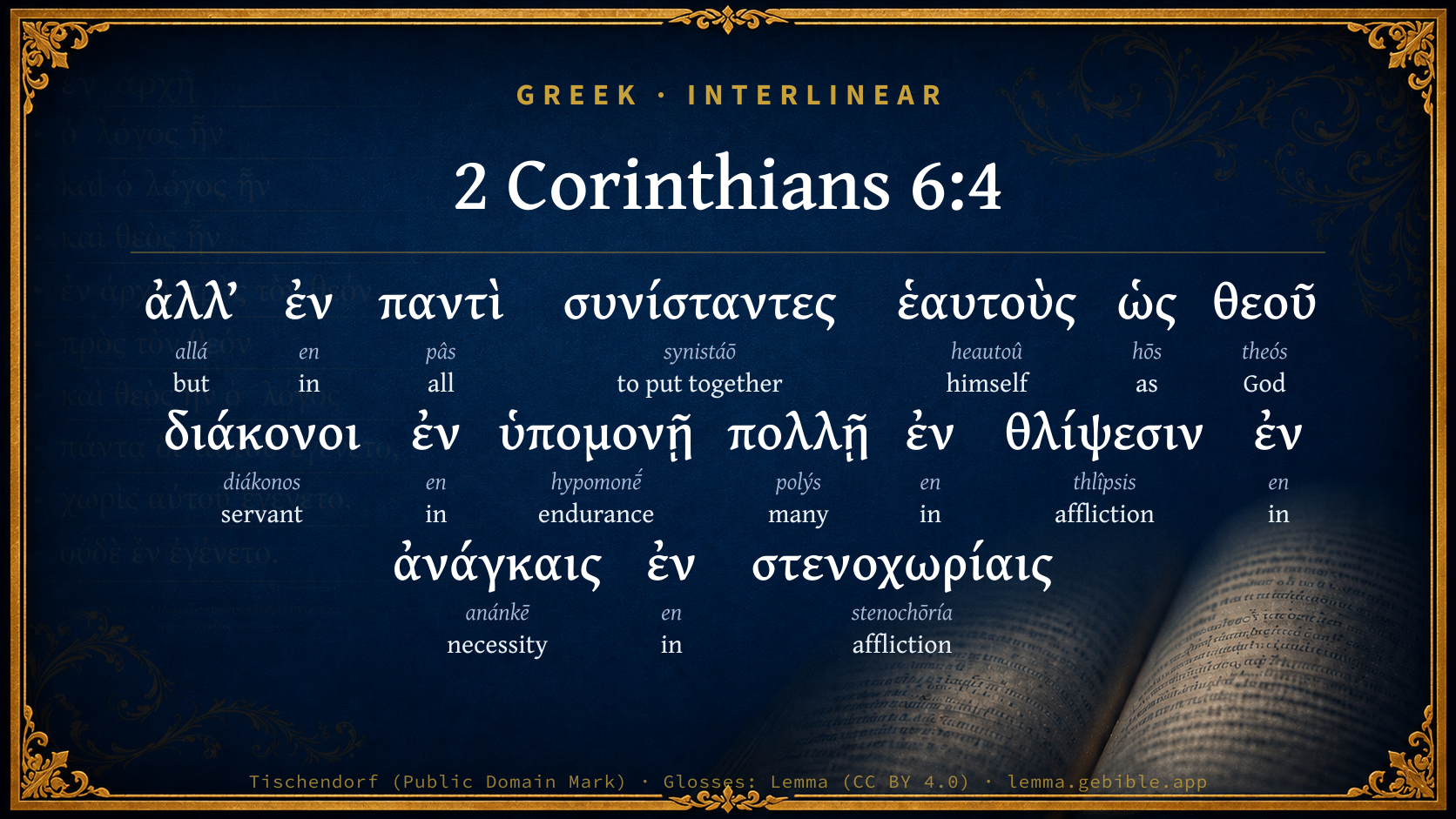
Greek (Tischendorf 8th ed.) 2 Corinthians 6:4 appears in the Greek New Testament. The text above is from the Tischendorf 8th edition. Each word links to its Strong’s number and a concise gloss. Click any word for its full Thayer’s Greek Lexicon entry.
Download image
Cite this verse

2 Corinthians 6:4 (World English Bible). Public Domain. Lemma interlinear Bible study tool, https://lemma.gebible.app/v/2-corinthians/6/4.

Show BibTeX & RIS
BibTeX
RIS
English Translation
but in everything commending ourselves, as servants of God, in great endurance, in afflictions, in hardships, in distresses,
World English Bible · Public Domain
Download a study sheet

One document with this verse’s original text, its word-by-word gloss line, the meaning frame, cross-references with their text, attributed commentary, and full source and license credits — printable, and it pastes into notes with its structure intact.

This verse Autodidact and up

Study sheet (.html) Plain text (.txt)

A passage Seminary Student

Up to 50 verses in one chapter. A passage sheet keeps up to 6 commentary sources and 12 cross-references per verse, in the order this page ranks them, and says so on the sheet whenever that leaves anything out. Ask for a single verse and you get the Autodidact verse sheet above.

Everything on this page stays free to read, with no account — the sheet is a download of what is already on screen, not access to it.

Want to remove ads? Support Godless Engineer
Compare translations 3

The same verse in 3 English versions, stacked beneath the original-language interlinear above. Click any original word for its lexicon entry.

Each is an independent rendering of the whole verse — the interlinear is not word-aligned to these translations.

Highlighted words mark where these versions differ — a whole-verse word diff, not a word-by-word alignment.

  • World English Bible Public Domain
    but in everything commending ourselves, as servants of God, in great endurance, in afflictions, in hardships, in distresses,
  • King James Version Public Domain
    But in all things approving ourselves as the ministers of God, in much patience, in afflictions, in necessities, in distresses,
  • unfoldingWord Literal Text CC BY-SA 4.0
    instead, we commend ourselves in everything as servants of God; in much endurance, in tribulations, in hardships, in distresses,

unfoldingWord Literal Text — © unfoldingWord, licensed CC BY-SA 4.0. Word-aligned USFM3 via Door43 (git.door43.org/unfoldingWord/en_ult).

Versions to compare (up to 4)

3 of 4 selected

Show all 19 translations

Every available English version of this verse, each an independent rendering of the whole verse.

  • World English Bible Public Domain
    but in everything commending ourselves, as servants of God, in great endurance, in afflictions, in hardships, in distresses,
  • Berean Standard Bible Public Domain
    Rather, as servants of God we commend ourselves in every way: in great endurance; in troubles, hardships, and calamities;
  • Majority Standard Bible Public Domain
    Rather, as servants of God we commend ourselves in every way: in great endurance; in troubles, hardships, and calamities;
  • King James Version Public Domain
    But in all things approving ourselves as the ministers of God, in much patience, in afflictions, in necessities, in distresses,
  • American Standard Version (1901) Public Domain
    but in everything commending ourselves, as ministers of God, in much patience, in afflictions, in necessities, in distresses,
  • Revised Version (1885) Public Domain
    but in everything commending ourselves, as ministers of God, in much patience, in afflictions, in necessities, in distresses,
  • Geneva Bible (1599) Public Domain
    But in all things we approue our selues as the ministers of God, in much patience, in afflictions, in necessities, in distresses,
  • Douay-Rheims (1899) Public Domain
    But in all things let us exhibit ourselves as the ministers of God, in much patience, in tribulation, in necessities, in distresses,
  • Young's Literal Translation Public Domain
    but in everything recommending ourselves as God's ministrants; in much patience, in tribulations, in necessities, in distresses,
  • Literal Standard Version CC BY-SA 4.0
    but in everything recommending ourselves as God’s servants; in much patience, in tribulations, in necessities, in distresses,
  • Unlocked Literal Bible CC BY-SA 4.0
    Instead, we prove ourselves by all our actions, that we are God's servants. We are his servants in much endurance, affliction, distress, hardship,
  • unfoldingWord Literal Text CC BY-SA 4.0
    instead, we commend ourselves in everything as servants of God; in much endurance, in tribulations, in hardships, in distresses,
  • Darby Bible Public Domain
    but in everything commending ourselves as God's ministers, in much endurance, in afflictions, in necessities, in straits,
  • World Messianic Bible Public Domain
    but in everything commending ourselves as servants of God: in great endurance, in afflictions, in hardships, in distresses,
  • Webster's Bible Public Domain
    But in all things approving ourselves as the ministers of God, in much patience, in afflictions, in necessities, in distresses,
  • Free Bible Version CC BY-SA 4.0
    Instead we try to demonstrate we are good servants of God in every way we can. With a great deal of patience we put up with all kinds of trouble, hardship, and distress.
  • Bible in Basic English Public Domain
    But in everything making it clear that we are the servants of God, in quiet strength, in troubles, in need, in sorrow,
  • Text-Critical English NT CC BY 4.0
    Rather, as servants of God we commend ourselves in every way: in great endurance, in afflictions, in hardships, in distresses,
  • Tyndale New Testament (1534) Public Domain
    but in all thynges let vs behave oure selves as the ministers of God. In moche pacience in affliccions in necessite in anguysshe

Literal Standard Version (2020), Covenant Press — licensed CC BY-SA 4.0. Text via the HelloAO Bible API (eBible.org). Unlocked Literal Bible (unfoldingWord) — licensed CC BY-SA 4.0. Text via the HelloAO Bible API (eBible.org). unfoldingWord Literal Text — © unfoldingWord, licensed CC BY-SA 4.0. Word-aligned USFM3 via Door43 (git.door43.org/unfoldingWord/en_ult). Free Bible Version, Dr. Jonathan Gallagher — licensed CC BY-SA 4.0. Text via the HelloAO Bible API (eBible.org).

Word by word

More ways to search: Search by grammar → Find every occurrence → Compare this word →

Practice this passage: Drill this verse → Learn its vocabulary →

στενοχωρίαις
stenochōría
G4730
“affliction”
Noun, Dative, Plural, Feminine
Part of Speech
Noun
Case
Dative
Number
Plural
Gender
Feminine
Full Thayer's Definition

Origin: from a compound of G4728 and G5561

TDNT: 17:04,1

1. narrowness of place, a narrow place 2. metaph. dire calamity, extreme affliction
  1. ἀλλ’ allá G235 “but” Conjunction
  2. ἐν en G1722 “in” Preposition
  3. παντὶ pâs G3956 “all” Adjective, Dative, Singular, Neuter
  4. συνίσταντες synistáō G4921 “to put together” Verb, Present, Active, Participle, Nominative, Plural, Masculine
  5. ἑαυτοὺς heautoû G1438 “himself” Reflexive pronoun, 1st person, Accusative, Plural, Masculine
  6. ὡς hōs G5613 “as” Adverb
  7. θεοῦ theós G2316 “God” Noun, Genitive, Singular, Masculine
  8. διάκονοι diákonos G1249 “servant” Noun, Nominative, Plural, Masculine
  9. ἐν en G1722 “in” Preposition
  10. ὑπομονῇ hypomonḗ G5281 “endurance” Noun, Dative, Singular, Feminine
  11. πολλῇ polýs G4183 “many” Adjective, Dative, Singular, Feminine
  12. ἐν en G1722 “in” Preposition
  13. θλίψεσιν thlîpsis G2347 “affliction” Noun, Dative, Plural, Feminine
  14. ἐν en G1722 “in” Preposition
  15. ἀνάγκαις anánkē G318 “necessity” Noun, Dative, Plural, Feminine
  16. ἐν en G1722 “in” Preposition

About this verse

These counts appear in no published source. They are computed here, from the morphology-tagged text and Lemma’s own curated glosses. What Lemma adds →

17
words
13
distinct lemmas
Pauline Epistles
section

Notable vocabulary

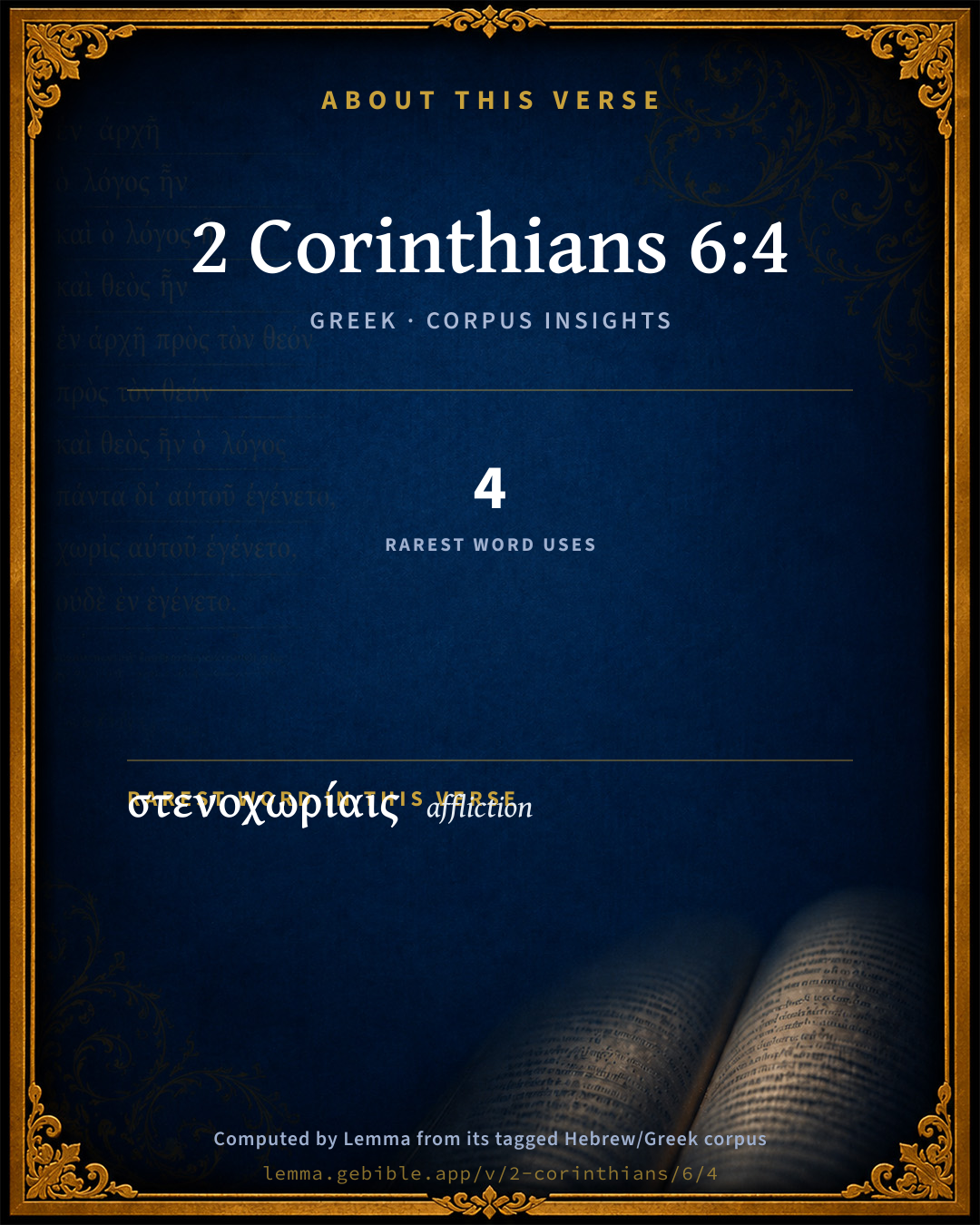
The rarest word here is στενοχωρίαις affliction G4730 — appearing just 4 times in the whole Greek New Testament.

Shared distinctive vocabulary

στενοχωρίαις affliction G4730 occurs in 4 verses of the Greek New Testament. Also found in:

Repetition

A word recurs within this verse:

Cross-references

44

Topical passages linked to 2 Corinthians 6:4 in the Treasury of Scripture Knowledge — connected by theme and wording, ordered by reader-vote popularity; previews shown in the World English Bible.

  • 2 Corinthians 12:10 Therefore I take pleasure in weaknesses, in injuries, in necessities, in persecutions, in distresses, for Christ's sake. For when I am weak, then am I strong.
  • 2 Corinthians 4:8 We are pressed on every side, yet not crushed; perplexed, yet not to despair;
  • 2 Corinthians 11:27 in labor and travail, in watchings often, in hunger and thirst, in fastings often, and in cold and nakedness.
  • 1 Corinthians 4:11–12 Even to this present hour we hunger, thirst, are naked, are beaten, and have no certain dwelling place.
  • Romans 8:35–36 Who shall separate us from the love of Christ? Could oppression, or anguish, or persecution, or famine, or nakedness, or peril, or sword?
  • Romans 5:3–4 Not only this, but we also rejoice in our sufferings, knowing that suffering works perseverance;
  • Philippians 4:11–12 Not that I speak in respect to lack, for I have learned in whatever state I am, to be content in it.
  • Joel 2:17 Let the priests, the ministers of Yahweh, weep between the porch and the altar, And let them say, "Spare your people, Yahweh, And don't give your heritage to reproach, That the nations should rule over them. Why should they say among the peoples, 'Where is their God?'"
  • 1 Corinthians 3:5 Who then is Apollos, and who is Paul, but servants through whom you believed; and each as the Lord gave to him?
  • 2 Corinthians 3:6 who also made us sufficient as servants of a new covenant; not of the letter, but of the Spirit. For the letter kills, but the Spirit gives life.
  • 2 Corinthians 12:12 Truly the signs of an apostle were worked among you in all patience, in signs and wonders and mighty works.
  • Revelation 1:9 I John, your brother and partner with you in oppression, Kingdom, and perseverance in Christ Jesus, was on the isle that is called Patmos because of God's Word and the testimony of Jesus Christ.
  • Revelation 3:10 Because you kept my command to endure, I also will keep you from the hour of testing, which is to come on the whole world, to test those who dwell on the earth.
  • 1 Corinthians 4:1 So let a man think of us as Christ's servants, and stewards of God's mysteries.
  • 2 Timothy 3:10–12 But you did follow my teaching, conduct, purpose, faith, patience, love, steadfastness,
  • James 5:7–10 Be patient therefore, brothers, until the coming of the Lord. Behold, the farmer waits for the precious fruit of the earth, being patient over it, until it receives the early and late rain.
  • Isaiah 61:6 But you shall be named the priests of Yahweh; men shall call you the ministers of our God: you shall eat the wealth of the nations, and in their glory shall you boast yourselves.
  • Joel 1:9 The meal offering and the drink offering are cut off from Yahweh's house. The priests, Yahweh's ministers, mourn.
  • Luke 21:19 By your endurance you will win your lives.
  • Acts 2:22 "Men of Israel, hear these words! Jesus of Nazareth, a man approved by God to you by mighty works and wonders and signs which God did by him in the midst of you, even as you yourselves know,
  • Acts 9:16 For I will show him how many things he must suffer for my name's sake."
  • Acts 20:23–24 except that the Holy Spirit testifies in every city, saying that bonds and afflictions wait for me.
  • Acts 20:34 You yourselves know that these hands ministered to my necessities, and to those who were with me.
  • Romans 5:8 But God commends his own love toward us, in that while we were yet sinners, Christ died for us.
  • Romans 14:18 For he who serves Christ in these things is acceptable to God and approved by men.
  • Romans 16:10 Greet Apelles, the approved in Christ. Greet those who are of the household of Aristobulus.
  • 1 Corinthians 9:11 If we sowed to you spiritual things, is it a great thing if we reap your fleshly things?
  • 2 Corinthians 4:2 But we have renounced the hidden things of shame, not walking in craftiness, nor handling the word of God deceitfully; but by the manifestation of the truth commending ourselves to every man's conscience in the sight of God.
  • 2 Corinthians 4:17 For our light affliction, which is for the moment, works for us more and more exceedingly an eternal weight of glory;
  • 2 Corinthians 7:11 For behold, this same thing, that you were made sorry in a godly way, what earnest care it worked in you. Yes, what defense, indignation, fear, longing, zeal, and vengeance! In everything you demonstrated yourselves to be pure in the matter.
  • 2 Corinthians 11:9 When I was present with you and was in need, I wasn't a burden on anyone, for the brothers, when they came from Macedonia, supplied the measure of my need. In everything I kept myself from being burdensome to you, and I will continue to do so.
  • 2 Corinthians 11:23 Are they servants of Christ? (I speak as one beside himself) I am more so; in labors more abundantly, in prisons more abundantly, in stripes above measure, in deaths often.
  • Colossians 1:11 strengthened with all power, according to the might of his glory, for all endurance and perseverance with joy;
  • Colossians 1:24 Now I rejoice in my sufferings for your sake, and fill up on my part that which is lacking of the afflictions of Christ in my flesh for his body's sake, which is the assembly;
  • 1 Thessalonians 2:3–11 For our exhortation is not of error, nor of uncleanness, nor in deception.
  • 1 Thessalonians 3:2–3 and sent Timothy, our brother and God's servant in the Gospel of Christ, to establish you, and to comfort you concerning your faith;
  • 1 Thessalonians 5:14 We exhort you, brothers, admonish the disorderly, encourage the fainthearted, support the weak, be patient toward all.
  • 1 Timothy 2:15 but she will be saved through her child-bearing, if they continue in faith, love, and sanctification with sobriety.
  • 1 Timothy 4:6 If you instruct the brothers of these things, you will be a good servant of Christ Jesus, nourished in the words of the faith, and of the good doctrine which you have followed.
  • 1 Timothy 6:11 But you, man of God, flee these things, and follow after righteousness, godliness, faith, love, patience, and gentleness.
  • 2 Timothy 1:8 Therefore don't be ashamed of the testimony of our Lord, nor of me his prisoner; but endure hardship for the Gospel according to the power of God,
  • 2 Timothy 2:24 The Lord's servant must not quarrel, but be gentle towards all, able to teach, patient,
  • 2 Timothy 4:5 But you be sober in all things, suffer hardship, do the work of an evangelist, and fulfill your ministry.
  • Hebrews 12:1 Therefore let us also, seeing we are surrounded by so great a cloud of witnesses, lay aside every weight and the sin which so easily entangles us, and let us run with patience the race that is set before us,

Cross-references courtesy of OpenBible.info (CC BY 4.0).

Commentary

Notes on 2 Corinthians 6:4 from classic Christian and Jewish commentators (each source and its license shown beneath its notes). The classic Christian expositions comment on the surrounding passage and are grouped to its opening verse, so a note may address several verses; the Jewish commentaries on the Tanakh (Rashi and others) are per-verse, so they appear only where the commentator wrote on this verse.

Lemma curates 59 commentaries, every one of them public domain or Creative Commons licensed, each selected and text-cleaned for this edition rather than reprinted as found. About our sources →

Whedon's Commentary on the Bible

Daniel D. Whedon

4. Ministers—In the nominative. As ministers approving ourselves. This passage, in parallelism with 2Co_4:8-12, and 2Co_11:23-27, furnishes strikingly detailed pictures of apostolic sufferings, more or less applicable to St. Paul and his personal coadjutors, exhibited either as single points, or still more, doubled in contrasts. Paul’s pre-eminence, as stated in the latest of the three, is his certificate of apostleship. The present list is a fervent climax, beginning in particulars, and rising until it bursts forth in the apostrophe of 2Co_6:11, which becomes a turning point in the epistle. The climax is also a triad. First, a list of external endurances, 2Co_6:4-5; then a series of internal traits and endowments, 2Co_6:6-7; finally, antithetic contrasts of depreciations and excellences meeting in the apostolic characters, 2Co_6:8-10, and rising in fervour of description.

Much patience—Much endurance, much firm undergoing,

Afflictions—By persecution and oppression.

Necessities— Compulsions against will.

Distresses—Compressions into narrownesses and straits. The tenor of this list, thus far, is that of hard pressures. The following are of more active sufferings.

Daniel D. Whedon (gen. ed.), Commentary on the Old and New Testaments (1874–1909) — public domain. Text from a community e-Sword module.

Bengel's Gnomon

Johann Albrecht Bengel

2Co 6:4. Διάκονοι, ministers) This word has greater force, than if it had been written διακόνους.—ὑπομονῇ, in patience) This is put first; ch. 2Co 12:12: chastity, etc., follow in 2Co 6:6. A remarkable gradation.—πολλῇ, in much) Three triplets of trials follow, which must be endured, and in which patience is exercised, afflictions [necessities, distresses]: stripes [imprisonments, tumults]: labours [watchings, fastings]: The first group of three includes the genera; the second, the species of adversities; the third, things voluntarily endured. And the variety of cases of the several classes of trial should be observed, expressed, as it is, by the employment of the plural number.—ἐν θλίψεσιν, ἐν ἀνάγκαις, ἐν στενοχωρίαις, in afflictions, in necessities, in distresses) These words are in close relation, and are variously joined with one another and with the others, ch. 2Co 12:10; 1Th 3:7; Rom 2:9; Rom 8:35; Luk 21:23. In afflictions [θλίψεσιν, the pressure of trials] many ways are open, but they are all difficult; in necessities [ἀνάγχαις], one way is open, though difficult; in distresses [straits, στενοχωρίαις], none is open.

Bengel's Gnomon of the New Testament — English translation (T&T Clark, Edinburgh, 1860) — public domain. Text from a community e-Sword module.

Meyer's Critical & Exegetical Commentary

Heinrich August Wilhelm Meyer

2Co_6:4 f. Συνιστῶντες ἑαυτ.] Here ἑαυτ. is not, as in 2Co_3:1, 2Co_4:12, prefixed, because συνιστ. is the leading ide.

ὡς θεοῦ διάκονοι] different in sense from ὡς θ. διακόνους (Vulg.: ministros). This would mean: we commend ourselves as those (accusative), who appear as Gods servants. The former means: we commend ourselves, as Gods servants commend themselves. Comp. Kühner, § 830, 5. The emphasis is on θεοῦ.

ἐν ὑπομονῇ πολλῇ] This is the first thing, the passive bearing, through which that συνιστ. ἑαυτ. ὡς θ. διάκ. takes place, through much patience; the further, active side of the bearing follows in 2Co_6:6, ἐν ἁγνότητι κ.τ.λ., so that ἐν θλίψεσιν … νηστείαις is that, in which (ἐν) the much patience, the much endurance is shown.

Bengel aptly classifies ἐν θλίψεσιν … νηστείαις: Primus ternarius continet genera, secundus species adversorum, tertius spontanea. Comp. Theodore.

θλίψ., ἀνάγκ., στενοχ.: climactic designation. On στενοχ., comp. 2Co_4:8. It is impracticable, and leads to arbitrariness, to find a climax also in the three points that follow, the more especially as the very first point is worse and more disgraceful than the secon.

ἐν πληγαῖς] Comp. 2Co_11:23-25; Act_16:23.

ἐν ἀκαταστασίαις] in tumults. Comp. e.g. Act_13:50; Act_14:19; Act_16:19 ff; Act_19:28 ff. The explanation: instabilities, i.e. banishments from one place to another (Chrysostom, Theophylact, Oecumenius, Beza, Schulz, Flatt, Olshausen), is in itself possible (comp. ἀστατοῦμεν, 1Co_4:11); but in the whole of the N. T. ἀκαταστ. only means either confusion, disorder (1Co_14:32; 2Co_12:20; Jam_3:16), or in a special sense tumult (Luk_21:9; comp. Sir_26:27). See, regarding the latter signification, the profane passages in Wetstein, Schweighäuser, Lex. Polyb. p. 17.

ἐν ἀγρυπν.] in sleeplessnesses, for the sake of working with his hands, teaching, travelling, meditating, praying, through cares, etc. Comp. 2Co_11:27; Act_20:31. On the plural, comp. Herod. iii. 129.

ἐν κόποις] is not, with Chrysostom, Theophylact, and others, to be understood only of labour with the hands (1Co_4:11; 1Th_2:9; 2Th_3:8), which limitation is not suggested by the context, but of toilsome labours in general, which the conduct of the apostolic ministry entailed. Comp. 2Co_11:23; 2Co_11:27.

ἐν νηστείαις] is generally explained of the endurance of hunger and want (1Co_4:11; Php_4:12). But since νηστεία is never used of compulsory fasting, and since Paul himself (2Co_11:27) distinguishes ἐν νηστείαις from ἐν λιμῷ κ. δίψει, we must, with Chrysostom, Theodoret, and Calvin (comp. also Osiander, Hofmann), explain it of voluntary fasting, which Paul, using with free spirit the time-honoured asceticism, imposed on himself. The objections, that this is at variance with the apostles spirit, or is here irrelevant, are arbitrary. See Mat_6:16; Mat_9:15; Mat_17:21; Act_14:23; comp. 2Co_13:2-3, 2Co_9:9; also 1Co_7:5.

In 2Co_6:6, the series begun with ἐν ὑμομονῇ πολλῇ goes furthe.

ἐν ἁγνότητι] through purity, moral sincerity in general. Comp. ἁγνός, Php_4:8; 1Ti_5:22; 1Jn_3:3. To understand this as meaning abstinentia a venere (Grotius and others), or contempt for money (Theodoret), is a limitation without ground in the context, and presents too low a moral standard for a servant of Go.

ἐν γνώσει] Of the high degree of his evangelical knowledge, in particular of the moral will of God in the gospel, there is evidence in every one of his Epistles and in every one of his speeches in the Book of Acts. Calvin and Moras arbitrarily think that what is meant is recte, et scienter agendi peritia, or (comp. also Rückert and Osiander) true practical prudence.

ἐν μακροθυμίᾳ] amid offence.

ἐν χρηστότητι] through kindness (Tittmann, Synon. p. 140 ff.). The two are likewise associated in 1Co_13:4; Gal_5:22.

ἐν πνεύμ. ἁγίῳ] is not to be limited arbitrarily to the charismata (Grotius and others), but: through the Holy Spirit, of whom testimony is given by our whole working and conduct just as the fruit of the Spirit (comp. Gal_5:22) and walk according to the Spirit (Gal_5:25). The position of this and the following point is determined by the circumstance, that Paul, in addition to the points adduced (ἐν ὑπομονῇ … ἐν ἁγνότητι κ.τ.λ.), now further mentions their objective divine source, which he bears in himself (ἐν πνεύματι ἁγίῳ), as well as the fundamental virtue of the Christian (ἐν ἀγάπῃ ἀνυποκρ., comp. Rom_12:9; 1Pe_1:22 f., 2Co_4:8), which springs from this source, and without which even those elements already named would fail him (1Co_8:1; 1Co_13:1 ff; 1Co_14:1). In this way he brings to completion that portion of his self-attestation which reaches to this point.

Meyer — Critical and Exegetical Commentary on the New Testament — English translation by Peter Christie, edited by Frederick Crombie (T&T Clark, 1880) — public domain. Text from a community e-Sword module.

Expositor's Greek Testament

ed. W. Robertson Nicoll

2Co 6:4-10 . THE CONDITIONS AND THE CHARACTERISTICS OF HIS APOSTOLIC MINISTRY. We have in this noble description of his service a characteristic outburst of impassioned eloquence on a topic in which the Apostle felt an intense personal interest. But its fervour has not been permitted to interfere with the careful choice of words: the balanced antitheses, the rhythmical cadences and assonances, which abound throughout, betray the literary training of the writer, and recall at once such passages as Rom 8:31-39 , 1Co 13:1-13 . Indeed many of the phrases which follow suggest an acquaintance with the Stoic paradoxes expressive of the αὐτάρκεια of the ideal sage. Compare also chap. 2Co 11:22-28 , where he recounts in more detail the trials of his Apostolic ministry.

2Co 6:4 . ἀλλʼ ἐν παντὶ συνιστάντες κ . τ . λ .: but in everything (the details being given in the following verses) commending ourselves (see note on 2Co 3:1 ) as God’s ministers do . We now come to the description of the conditions under which and the means by which God’s minister commends himself to those to whom his message is addressed. The description naturally divides itself into four sections: he commends himself (i.) in outward hardships, 2Co 6:4 b , 2Co 6:5 , (ii.) in inward graces, 2Co 6:6-7 a, (iii.) by the armour of righteousness, whether he be well or evil spoken of, 2Co 6:7 b , 2Co 6:8 ab , (iv.) having indeed a character the reverse of that ascribed to him by his opponents, 2Co 6:8-10 .

(i.) The general description here is ἐν ὑπομονῇ πολλῇ : in much patience (see note on 2Co 1:6 and cf. 2Co 12:12 ); and this is further amplified and explained in the three triplets which follow. ( a ) ἐν θλίψεσιν , ἐν ἀνάγκαις , ἐν στενοχωρίαις : in afflictions, in necessities, in distresses (see reff. and cf. Act 9:16 ), i.e. , such trials as sickness (see 2Co 1:6 , 2Co 12:7 ), or loss of friends (2Ti 4:10 ), or perplexity (2Co 4:8 , where see note), or any of the thousand chances (as we call them) of a troubled and anxious life. “The prevailing idea is that of pressure and confinement: each stage narrower than the one before, so that no room is left for movement or escape” (Stanley).

The Expositor's Greek Testament, edited by W. Robertson Nicoll (1897–1910) — public domain. Text from a community e-Sword module.

Geneva Bible (1599)

Geneva Bible translators

Declare and show indeed.

He first of all reckoneth up those things which are neither always in the ministers, nor without exception, unless it be according to the affection of the mind, patience only except, which also is one of the virtues which ought to be always in a good minister.

Geneva Bible (1599) marginal notes — public domain. Text via Bolls.life.

Jamieson, Fausset & Brown

Robert Jamieson, A. R. Fausset & David Brown

Translate, to mark the true order of the Greek words, "in everything, as God's ministers recommending ourselves," that is, that our hearers may give our message a favorable hearing, through our consistency in every respect, not that they may glorify us. Alluding to Co2 3:1, he implies, We commend ourselves, not like them by word, but by deed.

patience-- (Co2 12:12). Put first. "Pure-minded" follows (Co2 6:6). Three triplets of trials exercising the "patience" (patient endurance) follow: Afflictions (or "tribulations"), necessities, distresses (or "straits"); stripes, imprisonments, tumults; labors, watchings, fastings. The first triplet expresses afflictions generally; the second, those in particular arising from the violence of men; the third, those which he brought on himself directly or indirectly.

Jamieson, Fausset & Brown — Commentary Critical and Explanatory on the Whole Bible (1871) — public domain (CC PDM 1.0). Text via the HelloAO Bible API.

Adam Clarke's Commentary

Verse 4. But in all things approving ourselves] The apostle now proceeds to show how conscientiously himself and his fellow labourers acted, in order to render the ministry of reconciliation effectual to the salvation of men. They not only gave no offence in any thing, but they laboured to manifest themselves to be the genuine ministers of God, in much patience-bearing calmly up under the most painful and oppressive afflictions.

In afflictions] εν φλιψεσιν. This may signify the series of persecutions and distresses in general; the state of cruel suffering in which the Church of God and the apostles then existed.

In necessities] εν αναγκαις. Straits and difficulties; including all that want and affliction which arose from the impoverished state of the Church.

In distresses] εν στενοχωριαις. Such straits and difficulties as were absolutely unavoidable and insurmountable. The word implies, being reduced to a narrow place, driven to a corner, hemmed in on every side, as the Israelites were at the Red Sea; the sea before them, Pharaoh and his host behind them, and Egyptian fortresses on either hand. God alone could bring them out of such difficulties, when their enemies themselves saw that the wilderness had shut them in. So was it often with the apostles; all human help failed, and their deliverance came from God alone.

Adam Clarke's Commentary on the Bible (1810–1826) — public domain. Text from a community e-Sword/MySword module.

John Calvin's Commentaries

4. In much patience. The whole of the enumeration that follows is intended to show, that all the tests by which the Lord is accustomed to try his servants were to be found in Paul, and that there was no kind of test to which he had not been subjected, in order that the faithfulness of his ministry might be more fully established. Among other things that he enumerates, there are some that are under all circumstances required for all the servants of Christ. Of this nature are labors, sincerity, knowledge, watchings, gentleness, love, the word of truth, the Spirit, the power of God, the armor of righteousness. There are other things that are not necessary in all cases; for in order that any one may be a servant of Christ, it is not absolutely necessary, that he be put to the test by means of stripes and imprisonments Hence these things will in some cases be wanting in the experience of the best. It becomes all, however, to be of such a disposition as to present themselves to be tried, as Paul was, with stripes and imprisonments, if the Lord shall see meet.

Patience is the regulation of the mind in adversity, which is an excellence that ought invariably to distinguish a good minister. Afflictions include more than necessities; for by the term necessity here I understand poverty. Now this is common to many ministers, there being few of them that are not in poor circumstances; but at the same time not to all. For why should a moderate amount of riches prevent a man from being reckoned a servant of Christ, who, in other respects, is pious, is of upright mind and honorable deportment, and is distinguished by other excellences. As the man that is poor is not on that account to be straightway accounted a good minister, so the man that is rich is not on that account to be rejected. Nay more, Paul in another passage glories not less in his knowing how to abound, than in knowing how to be in want. (Philippians 4:12.) Hence we must observe the distinction that I have mentioned, between occasional and invariable grounds of commendation.

John Calvin's Commentaries (1540-1563) — public domain. Text from the Calvin Translation Society English edition (1840s-50s) via the Christian Classics Ethereal Library (ccel.org). Calvin's coverage is partial (roughly two-thirds of the Bible); uncommented books and verses are honest gaps, never fabricated. The 19th-century editor's footnotes and remarks are omitted so the notes are faithfully Calvin's own voice.

Ellicott's Commentary for English Readers

(4) But in all things approving ourselves as the ministers of God.—Better, as keeping up the connection with 2Co_3:1; 2Co_5:12, as ministers of God commending ourselves. He harps, as it were, upon that phrase. Yes, he does commend himself; but how? He looks back on his life of labour and sufferings and challenges comparison. Can others, with their letters of commendation, point to anything like this? The word “ministers” in the Greek is in the nominative case, while the English at least suggests that it is in the objective after the verb. What he means is that he, as the minister of God should do, commends himself by acts and not by words. It is obvious that what follows was likely to expose him to a repetition of the cynical sneer, but of this his generous indignation makes him nobly regardless.

In much patience . . .—Better, as elsewhere, endurance. The word has a much stronger meaning than our English “patience.” (See Notes on Luk_8:15; Luk_21:19.) The general term is naturally followed by a specification of details. It is not, perhaps, easy to specify what he refers to under each head. Possibly he used such words, as we habitually use them, without a formal classification. The root-idea of the first word of the triad is that of being pressed upon; of the second, that of a constraint that leaves no choice of action; of the third, that of being so hemmed in that there is no room to move.

A Bible Commentary for English Readers, edited by Charles John Ellicott (1878–1897) — public domain. Text from a community e-Sword module.

The Cambridge Bible for Schools and Colleges

gen. ed. J. J. S. Perowne

4. approving] The word is the same as is translated ‘commend’ in ch. 2Co_3:1, and there is an obvious reference here to 2Co_6:1-3 of that chapter.

as the ministers of God] There is an ambiguity in the A. V. here. The Apostle means ‘we, as ministers of God, recommend ourselves to those to whom we minister’ in the way afterwards mentioned, not that the Apostles prove themselves to be ministers of God by their conduct. Tyndale renders let us behave ourselves as the ministers of God.

in much patience] Dean Stanley divides the means by which the Apostle commended himself into four classes: (1) from patience (or rather endurance) to ‘fastings,’ referring to the bodily sufferings of the Apostle; (2) from ‘pureness’ to ‘love unfeigned,’ referring to the virtues, that is, the manifestations of the Divine presence in St Paul; (3) from ‘by the word of truth’ to ‘by evil report and good report,’ referring to the means whereby he was enabled to prove himself to be a true minister of God; and (4) the remainder, relating to the acceptation in which the Apostles were held, and its contrast with the reality. Bengel also would subdivide the first class into three triplets of sufferings. But this is perhaps somewhat fanciful.

in afflictions] The word thus rendered is translated indifferently by tribulations (Wiclif so renders it here) and afflictions in the A. V. See note on ch. 2Co_4:8.

in distresses] See note on ch. 2Co_4:8.

The Cambridge Bible for Schools and Colleges (gen. ed. J. J. S. Perowne; Cambridge University Press, 1878–1918) — public domain. Text from a community e-Sword module.

John Gill's Exposition

In stripes,.... As the Apostle Paul particularly was, who was thrice beaten with rods, and five times scourged by the Jews with the scourge of forty stripes save one.

In imprisonments; under which are included bonds, in which they often were for the Gospel of Christ:

in tumults; and uproars of the people, when their lives were frequently in imminent danger: or "in tossings to and fro"; being drove from place to place through the fury of their enemies;

in labours; in a laborious ministry of the word, and administration of ordinances; or by labouring with their own hands to supply their necessities:

in watchings; being obliged to work night and day at their hand labour, and in preaching, praying, and singing psalms; which exercises they were often employed in at midnight:

in fastings; by which are meant not voluntary, but involuntary ones, through want of food to eat.

John Gill's Exposition of the Whole Bible (1746–1763) — public domain (CC PDM 1.0). Text via the HelloAO Bible API.

Trapp's Complete Commentary

John Trapp

4 But in all things approving ourselves as the ministers of God, in much patience, in afflictions, in necessities, in distresses,

Ver. 4. In much patience] Or tolerance, suffering hardship, as good soldiers of Jesus Christ.

In afflictions] Out of which there is little or no use of patience; at least she cannot have her perfect work, Jas 1:4.

In necessities] Want of necessaries.

In distresses] Such straits as that we are at a stand, and have not whither to turn us, στενοχωριαις; we are in a little ease, as it were.

John Trapp, A Commentary or Exposition upon All the Books of the Old and New Testament (1647–1656) — public domain. Text from a community e-Sword module.

Albert Barnes' Notes on the Bible

But in all things - In every respect. In all that we do. In every way, both by words and deeds. How this was done, Paul proceeds to state in the following verses.

Approving ourselves as the ministers of God - Margin, “Commending.” Tyndale renders it, “In all things let us behave ourselves as the ministers of God.” The idea is, that Paul and his fellowlaborers endeavored to live as became the ministers of God, and so as to commend the ministry to the confidence and affection of people. They endeavored to live as was appropriate to those who were the ministers of God, and so that the world would be disposed to do honor to the ministry.

In much patience - In the patient endurance of afflictions of all kinds. Some of his trials he proceeds to enumerate. The idea is, that a minister of God, in order to do good and to commend his ministry, should set an example of patience. He preaches this as a duty to others; and if, when he is poor, persecuted, oppressed, calumniated, or imprisoned, he should complain, or be insubmissive, the consequence would be that he would do little good by all his preaching. And no one can doubt, that God often places his ministers in circumstances of special trial, among other reasons, in order that they may illustrate their own precepts by their example, and show to their people with what temper and spirit they may and ought to suffer. Ministers often do a great deal more good by their example in suffering than they do in their preaching. It is easy to preach to others; it is not so easy to manifest just the right spirit in time of persecution and trial. People too can resist preaching, but they cannot resist the effect and power of a good example in times of suffering. In regard to the manner in which Paul says that the ministry may commend itself, it may be observed, that he groups several things together; or mentions several classes of influences or means. In this and the next verse he refers to various kinds of afflictions. In the following verses he groups several things together, pertaining to a holy life, and a pure conversation.

In afflictions - In all our afflictions; referring to all the afflictions and trials which they were called to bear. The following words, in the manner of a climax, specify more particularly the kinds of trials which they were called to endure.

In necessities - This is a stronger term than afflictions, and denotes the distress which arose from want. He everywhere endured adversity. It denotes unavoidable distress and calamity.

In distresses - The word used here (στενοχωρία stenochōria) denotes properly straitness of place, lack of room; then straits, distress, anguish. It is a stronger word than either of those which he had before used. See it explained in the notes on Rom 2:9. Paul means that in all these circumstances he had evinced patience, and had endeavored to act as became a minister of God.

Albert Barnes' Notes on the Bible (1834–1885) — public domain. Text from a community e-Sword/MySword module.

Matthew Poole's English Annotations

But in all things approving ourselves as the ministers of God: ministers of the gospel are in the first place to be considered as the ministers of God; secondarily, as ministers and servants of the church; which they ought to serve so far, as in serving it they do obey Christ. None can approve or commend themselves for ministers of God that live a scandalous life; God hath not sent them to lay stumblingblocks in, but to remove them out of, the way of men.

In much patience; patience signifies an enduring of evils quietly and cheerfully, at the command of God; or when we see it is the will of God, we should patiently submit to put our necks into the heaviest yokes. The apostle goes on reckoning up several species of those evils:

afflictions is a general term, signifying any evils that wear out our bodies.

Necessities signify any bodily wants of food, or raiment, or whatever is for the use of man’s life.

Distresses signify, properly, a man’s being straitened, or thrust up in a place, so as that he knoweth not how to steer himself; and, metaphorically, a want of counsel, not knowing what to do, or which way to turn ourselves.

Matthew Poole's English Annotations on the Holy Bible (1683–1685) — public domain. Text from a community e-Sword/MySword module.

The Pulpit Commentary

Approving ourselves; rather, commending ourselves, He is again referring to the insinuation, which had evidently caused him deep pain, that he was not authorized to preach, as his Judaic opponents were, by "letters of commendation" (2Co_3:1-3) from James or from the ciders at Jerusalem. His credentials came from God, who had enabled him to be so faithful. As the ministers of God. (1Co_4:1) The article should be omitted. In much patience. Christ had forewarned his apostles that they would have much to endure, and had strengthened them by the promise that "he that endureth to the end shall be saved". (Mat_10:22) In afflictions. This word, as we have seen, is one of the haunting words in 2Co_1:4-11. In necessities. St, Paul was poor, and was often in want. (Act_20:34) In distresses. The same word which occurs in 2Co_4:8. It means "extreme pressure" (literally, narrowness of space) and is a climax of the other words.

Ministers of God.

Man is not meant to be a law or an end unto himself. He finds the true secret of his being, who lives, not unto himself, but unto his Lord. To take employment under a wise and holy Master, to engage in a spiritual service, to look up daily for direction and for blessing, to aim at the glory of the Eternal, this is the true vocation and the true happiness of man. Paul found his strength for labour and his consolation in suffering, not in anything personal, but in losing and merging himself in his Lord and King.

I THE MASTER. Our Lord has bidden us call no man master, by which he directs our attention to the fact that we receive our instructions for duty and our revelations of truth, not from human, but from Divine authority. God is, to those who accept service under him, a wise, just, forbearing, considerate, and liberal Master. In him we find one free from all imperfections of knowledge, and all flaws of character, such as must be expected in all human governors.

II THE SERVICE. In its outward aspects this varies in different cases, so that the life work of no two men is quite the same.

How many serve! how many more May to the service come! To tend the vines, the grapes to store, Thou dost appoint for some: Thou hast thy young men at the war, Thy little ones at home.

III THE OBLIGATIONS OF SPIRITUAL SERVANTS.

1. Obedience. This is indispensable. The vow which Christians take is thatthey will be the Lord"s servants to obey him.

2. Fidelity. The allegiance due to the Divine Lord must, upon noconsideration, be transferred to another; his cause must not be betrayed.

3. Readiness to suffer in the path of devotion. The context shows us thatthis was an element in Paul"s conception of true ministry.

IV THE RECOMPENSE.

1. This is entirely of grace; the purest and the best have no claim to it.

2. Success in ministry is the true servant"s best reward.

3. With this is conjoined approval on the Master"s part.

4. And the recompense is imperishable and immortal. T.

The Pulpit Commentary (1880–1919), ed. H.D.M. Spence-Jones & Joseph S. Exell — public domain. Text from a community e-Sword module.

John Wesley's Explanatory Notes

But approving ourselves as the ministers of God - Such as his ministers ought to be. In much patience - Shown,

1. In afflictions, necessities, distresses - All which are general terms.

2. In stripes, imprisonments, tumults - Which are particular sorts of affliction, necessity, distress

3. In labours, watchings, fastings - Voluntarily endured. All these are expressed in the plural number, to denote a variety of them. In afflictions, several ways to escape may appear, though none without difficulty in necessities, one only, and that a difficult one; in distresses, none at all appears.

John Wesley, Explanatory Notes Upon the Whole Bible (1754–1765) — public domain. Text via the GEBible commentary corpus.

Burkitt's Expository Notes on the New Testament

William Burkitt

Observe here, 1. The great care which the holy apostle took to approve himself unto God, in the exercise of his ministry: In all things approving ourselves as the ministers of God.

Observe, 2. What an approved minister must do and endure, in order to the obtaining the ends of his ministry: if he be called to it, he must bear up against all discouragements, and encounter all oppositions; let the way be what it will, fair or foul, a green carpet way, or dirty, poachy way, he must stick at nothing, but go through thick and thin, patiently enduring afflictions of all sorts, and cheerfully undergoing sufferings of all kinds, and exercising all manner of self-denial, for the gospel’s sake.

Behold here, how the ministers of Christ, that will approve themselves unto God, must run all hazards, and venture through all extremities: they must work in heat and cold, in fire and frost, in all sorts of providences from God, in all sorts of aspects from men, fearing neither the face nor frowns of any. For though every gospel minister attains not to St. Paul’s zeal, and holy fortitude and courage, yet he has a truth of zeal, and such a firmness of resolution, as will, according to his measure, carry him through a world of evils and incumbrances, in the doing of that good, which duty and conscience doth oblige him to, and call for: In much patience, in afflictions, in necessities, in distresses, in labours, in watchings, in fastings.

William Burkitt's Expository Notes on the New Testament (1700–1703) — public domain. Text from a community e-Sword module.

McGarvey & Pendleton's Commentaries

J. W. McGarvey

but in everything commending ourselves, as ministers of God, in much patience, in afflictions, in necessities, in distresses ,

J. W. McGarvey (with Philip Y. Pendleton), Commentaries on the New Testament (The Fourfold Gospel, 1914; Acts; and the epistles) — public domain. Text from a community e-Sword/MySword module.

The People's New Testament

B. W. Johnson

4–10. In all things approving ourselves as ministers of God. Living lives that show that we are holy ministers, consecrated to God. Paul next gives some details of the apostolic life. In much patience. Rather, in steadfast constancy and endurance, holding out under trials. Some of these trials are now given. Afflictions. The first three details are general.

B. W. Johnson's The People's New Testament with Notes (1889–1891) — public domain. Electronic text from the Christian Classics Ethereal Library (CCEL) ThML edition.

unfoldingWord translationNotes

Door43 World Missions Community

General Information:

When Paul uses "we" here, he is referring to himself and Timothy. (See: Exclusive and Inclusive "We")

we prove ourselves by all our actions, that we are God's servants

"We prove that we are God's servants by all that we do"

We are his servants in much endurance ... in sleepless nights, in hunger

Paul mentions various difficult situations in which they proved that they are God's servants.

in purity ... in genuine love

Paul lists several moral virtues that they maintained in difficult situations that proved that they are God's servants.

We are his servants in the word of truth, in the power of God

Their dedication to preach the gospel in the power of God proves that they are God's servants.

in the word of truth

"by speaking God's message about truth" or "by speaking God's true message"

in the power of God

"by showing God's power to people"

We have the armor of righteousness for the right hand and for the left

Paul speaks of their righteousness as if it is weapons that they use to fight spiritual battles. (See: Metaphor)

the armor of righteousness

"righteousness as our armor" or "righteousness as our weapons"

for the right hand and for the left

Possible meanings are 1) that there is a weapon in one hand and a shield in the other or 2) that they are completely equipped for battle, able to fend off attacks from any direction.

translationWords

servant

endure

afflicted

prison

pure

know

patient

Holy Spirit

love

word of God

power

armor

righteous

hand

unfoldingWord translationNotes — © Distant Shores Media and the Door43 World Missions Community, licensed CC BY-SA 4.0. Source: git.door43.org/Door43/en_tn.

Cambridge Greek Testament for Schools and Colleges

4. συνιστάνοντες (BP, some cursives) rather than συνιστάντες (אCDFG) or συνιστῶντες (א3D3KL). The evidence in 2Co 4:2 is helpful here.

4. ἀλλʼ ἐν παντὶ συνιστάνοντες ἑαυτοὺς ὡς θ. δ. See critical note. But in everything (2Co 7:11; 2Co 7:16, 2Co 9:8, 2Co 11:9) commending ourselves, as God’s ministers (should do): διάκονοι, not σιακόνους, with emphasis on θεοῦ. Comp. 2Co 3:1. Again (comp. 2Co 4:8-12) he counts up his sufferings.

ἐν ὑπομονῇ πολλῇ κ. τ. λ. The repetition of ἐν eighteen times, διά thrice, ὡς seven times, is impressive. There is a rough grouping in the series. One of the main characteristics of his ministry is placed first, and then we have in three groups the ways in which the ὑπομονή is exhibited. In 2Co 6:6 he returns to the main characteristics, of which he mentions eight more. The changes to διά and to ὡς mark two other groups. Distinguish ὑπομονή from μακροθυμία in 2Co 6:6. The former is endurance of what is adverse, without complaining or losing heart: it is a brave patience (2Co 1:6, 2Co 12:12). The latter is endurance of injuries, without being provoked to anger or retaliation. Trench, Synonyms § liii. See Mayor on Jas 1:3.

ἐν θλίψεσιν, ἐν ἀνάγκαις, ἐν στενοχωρίαις. These are one of the fields in which ὑπομονή is shown. They are troubles which beset his work. For θλίψεις comp. 2Co 1:4; 2Co 1:8, 2Co 2:4, 2Co 4:17. Obviously ἀνάγκαι are worse, as implying either that they cannot be avoided, or that, if they come, there is no escape (2Co 12:10; Job 5:19; Job 30:25; Ps. 24:17). But it is not clear that στενοχωρίαι are worse than ἀνάγκαι. In 2Co 4:8 he speaks of being θλιβόμενος ἀλλʼ αὐ στενοχωρούμενος. Here he speaks of being subject to both degrees of pressure.

Cambridge Greek Testament for Schools and Colleges (Cambridge University Press, 1896; 21 vols, various authors incl. Carr, Maclear, Plummer, Farrar, Lumby, Moule, M. R. James, Simcox) — public domain. Text from a community e-Sword module.

Alford’s Greek Testament

Henry Alford

4.] Meyer well remarks the position of συνιστ. ἑαυτούς. When the words signified ‘to recommend ourselves,’ in a bad sense, ch. 3:1, 5:12,—ἑαυτ. preceded the verb: but here and ch. 4:2, where used in a good sense, and without any stress on ἑαυτούς, it follows the verb. This is only one of continually occurring instances of the importance of the collocation of words with regard to the emphasis.

διάκονοι] not διακόνους: recommending ourselves, as ministers of God should do. The ambiguity of the E. V. might have been avoided by a different arrangement of words: ‘in all things, as the ministers of God, approving ourselves.’

The following datives are a specification of παντί; but not all of the same sort: some signify instruments by which, some, situations in which, some both these. Bengel remarks: “Insignis gradatio. Sequuntur ter tria patienda (i.e. from θλίψεσιν to νηστείαις), quibus patientia (ὑπομονή) exercetur; pressuræ,—plagæ,—labores. Primus ternarius continet genera, secundus, species adversorum: tertia spontanea” (but qu?: see below). So that the ὑπομονὴ πολλή belongs to vv. 4, 5, and ver. 6 goes on to other points.

στενοχ.] See ch. 4:8, note.

Henry Alford, The Greek Testament (1849–1861) — public domain. Text from a community e-Sword module.

International Critical Commentary

4. ἀλλʼ ἐν παντὶ συνιστ. ἑαυτούς. ‘On the contrary, in everything commending ourselves, as God’s ministers should do.’ The comprehensive ἐν παντί, in opposition to ἐν μηδενί, comes first with emphasis; cf. 7:11, 9:8, 11:9. He is glancing at the charge of self-commendation made against him, but here he uses the expression in a good sense, and therefore ἑαυτούς has not the emphatic position which is given to it in 3:1 and 5:12. Vulg. has sed in omnibus exhibeamus nosmet ipsos sicut Dei ministros, which is doubly wrong, making the participle into a finite verb co-ordinate with μωμηθῇ, and making διάκονοιaccusative, which gives a wrong turn to the meaning. Aug. is right with commendantes, but wrong with ministros. St Paul does not say ‘commending ourselves as being God’s ministers,’ but ‘as God’s ministers do commend themselves,’ viz. by rectitude of life. As in 4:8-12 and 11: 23-31, he enumerates his sufferings, and in all three passages we have a lyrical balance of language which gives a triumphant tone to the whole. Both Augustine and Erasmus express detailed admiration for the beauty of this passage. The latter analyses thus; totus hic sermo per contraria, per membra, per comparia, per similiter desinentia, per ἀναδιπλώσεις aliaque schemata, variatur, volvitur et rotatur, ut nihil esse possit vel venustius vel ardentius. Both critics feel the glow that underlies the words.

The Apostle leads off with one of the chief features in his ministry, ἐν ὑπομονῇ πολλῇ, and then mentions three triplets of particulars in which the ὑπομονή is exhibited. Respecting these triplets Chrys. uses his favourite metaphor of snow-showers (νιφάδες); they constitute, he says, a blizzard of troubles. Then come eight other leading features, still under the same preposition (ἐν), the repetition of which (18 times in all) has become monotonous, and is therefore changed to διά. Here the stream, which in the last four of the features introduced with ἐν had begun to swell, reaches its full volume and flows on in more stately clauses. After three with διά, we have a series of seven contrasts, ending with a characteristic three-fold alliteration and an equally characteristic play upon words.

ἐν ὑπομονῇ πολλῇ. See on 1:6; also Lightfoot on Col 1:11 and Mayor on Jas 1:3. The high position given by our Lord to ὑπομονή (Luk 8:15, Luk 21:19) and to ὑπομένειν (Mar 13:13; Mat 10:22, Mat 24:13) accounts for the prominence given to it here and 12:12. It not only stands first, but it is illustrated in detail; huc spectat tota enumeratio quae sequitur (Calv.). The word appears in all four groups of the Pauline Epistles, chiefly in Rom. and 2 Cor., often with the meaning of fortitude and constancy under persecution. This meaning is very freq. in 4 Macc., whereas in Ecclus. and in the Canonical Books of the O.T. it commonly means patient and hopeful expectation. In 1Th 1:3; 1Ti 6:11; 2Ti 3:10; Tit 2:2, it is placed next to ἀγάπη in lists of virtues. Like ἀγάπη, it is a word which, although not originally Biblical, has acquired fuller meaning and much more general use through the influence of the N.T. It is often treated as one of the chief among Christian virtues. Chrys. can scarcely find language strong enough to express his admiration for it. It is “a root of all the goods, mother of piety, fruit that never withers, a fortress that is never taken, a harbour that knows no storms” (Hom. 117). Again, it is “the queen of virtues, the foundation of right actions, peace in war, calm in tempest, security in plots,” which no violence of man, and no powers of the evil one, can injure (Ep. ad Olymp. 7). These and other quotations are given in Suicer, s.v. Clem. Rom. (Cor. 6) places this virtue at the beginning and end of his praise of the Apostle; Παῦλος ὑπομονῆς βραβεῖον ὑπέδειξειν … ὑπομονῆς γενόμενος μέγιστος ὑπογραμμός. Cf. 12:12.

ἐν θλίψεσιν, ἀνάγκαις, ἐν στενοχωρίαις. This triplet consists of troubles which may be independent of human agency, and it is probably intended to form a climax; ‘afflictions’ (1:4, 8, 2:4, 4:7), which might be avoided; ‘necessities’ (12:10), which cannot be avoided; ‘straits,’ angustiae (12:10), out of which there is no way of escape. Like ἀγάπη and ὑπομονή, θλίψις was a word of limited meaning and use in late Greek, which acquired great significance and frequent employment when it became a term with religious associations. In 1Th 3:7, as in Job 15:24; Psa 119:143; Zep 1:15, θλίψις is coupled with ἀνάγκη. In the De Singularitate Clericorum appended to Cyprian’s works, ἐν θλίψεσιν is translated twice, in pressuris, in tribulationibus; see below on ἐν ἀκαταστασίαις.

It is difficult to decide between συνιστάνοντες (B P and some cursives), συνιστάντες (א * C D* FG 17), and συνιστῶντες (א 3 D 3 E K L). In 3:1 the evidence is decisive for συνιστάνειν, and that gives great weight to συνιστάνοντες here. For διάκονοι, D*, f g Vulgt. have διακόνους.

International Critical Commentary — older volumes (1896–1929), various authors — public domain. Text from a community e-Sword module.

Vincent's Word Studies in the New Testament

Marvin R. Vincent

Necessities [αναγκαις] . See on 1Co 7:26.

Distresses [στενοχωριαις] . See on Rom 2:9.

Marvin R. Vincent, Word Studies in the New Testament (1887–1900) — public domain. Text from a community e-Sword/MySword module.

Lesson kit

Teaching starters — assembled from the data on this page, not authored interpretation. Every prompt links to the verse data it draws on. Edit before teaching.

2 Corinthians, in the Pauline Epistles, opens this verse with 17 words (13 distinct Greek lemmas). Its most distinctive word is stenochōría (“affliction”). A historical commentator’s framing appears above. Read the whole chapter for the surrounding context.

Discussion questions

  1. How does “affliction” (stenochōría) shape what this verse is saying?
  2. Romans 2:9 shares the word «affliction» with this verse. How do the two illuminate each other?
  3. “in” occurs 5× in this one verse. What is the effect of the repetition?
  4. These translations render this verse differently; the difference is in the English rendering, not the original. What questions does that raise?
  5. Reading how Whedon's Commentary on the Bible and Bengel's Gnomon read this verse, where do the two commentators agree and where do they part?

Things to notice

Reading settings

Reading text

Shown beneath each verse's original-language words.

Old Testament
Old Testament edition

Read the OT as the Masoretic Hebrew (MT) or the Greek Septuagint (LXX).

English shown for the Greek Septuagint (in the Hebrew ↔ Greek comparison).

Comparing translations? Open the Compare panel on any verse page to stack up to four side by side.