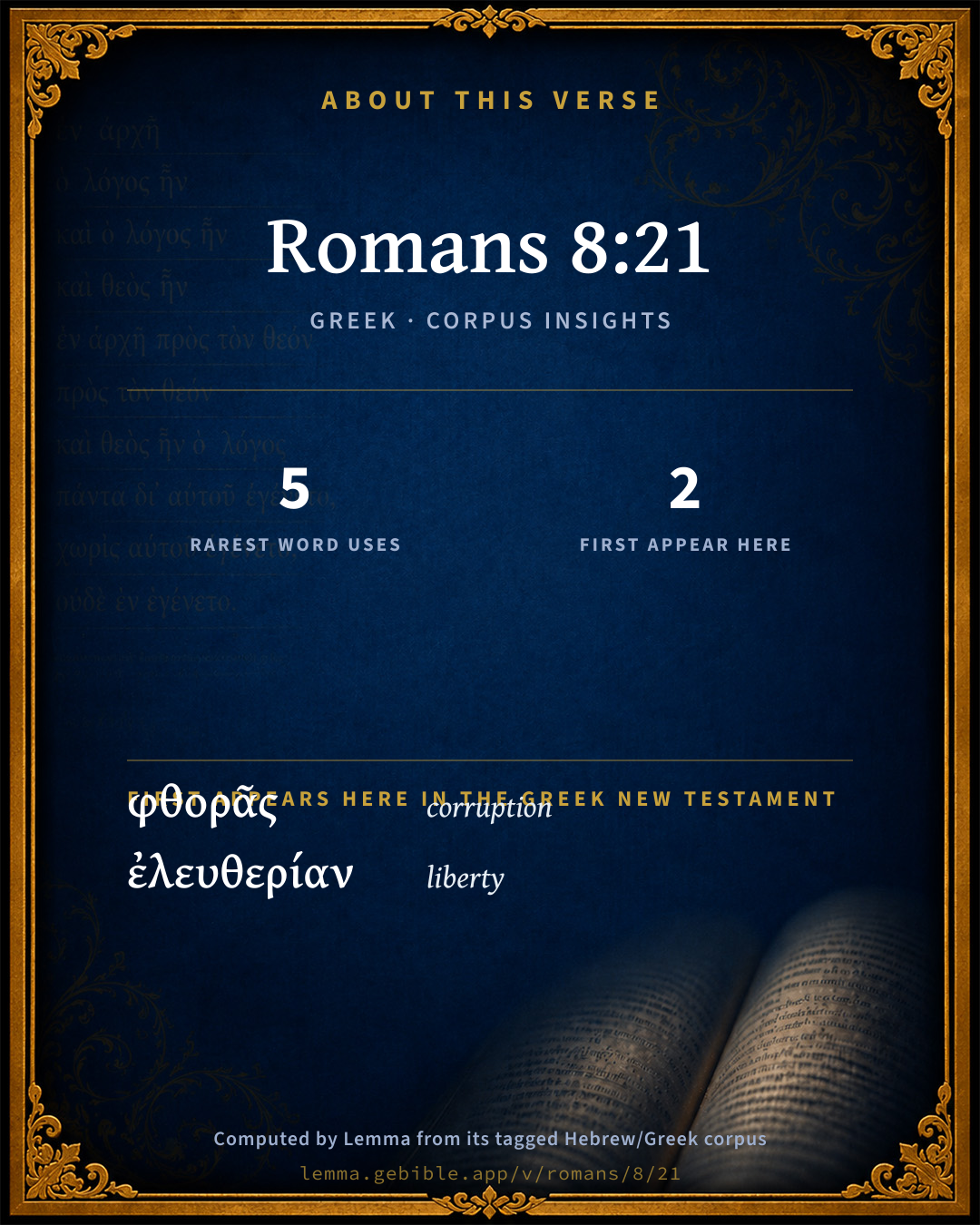
Romans 8:21

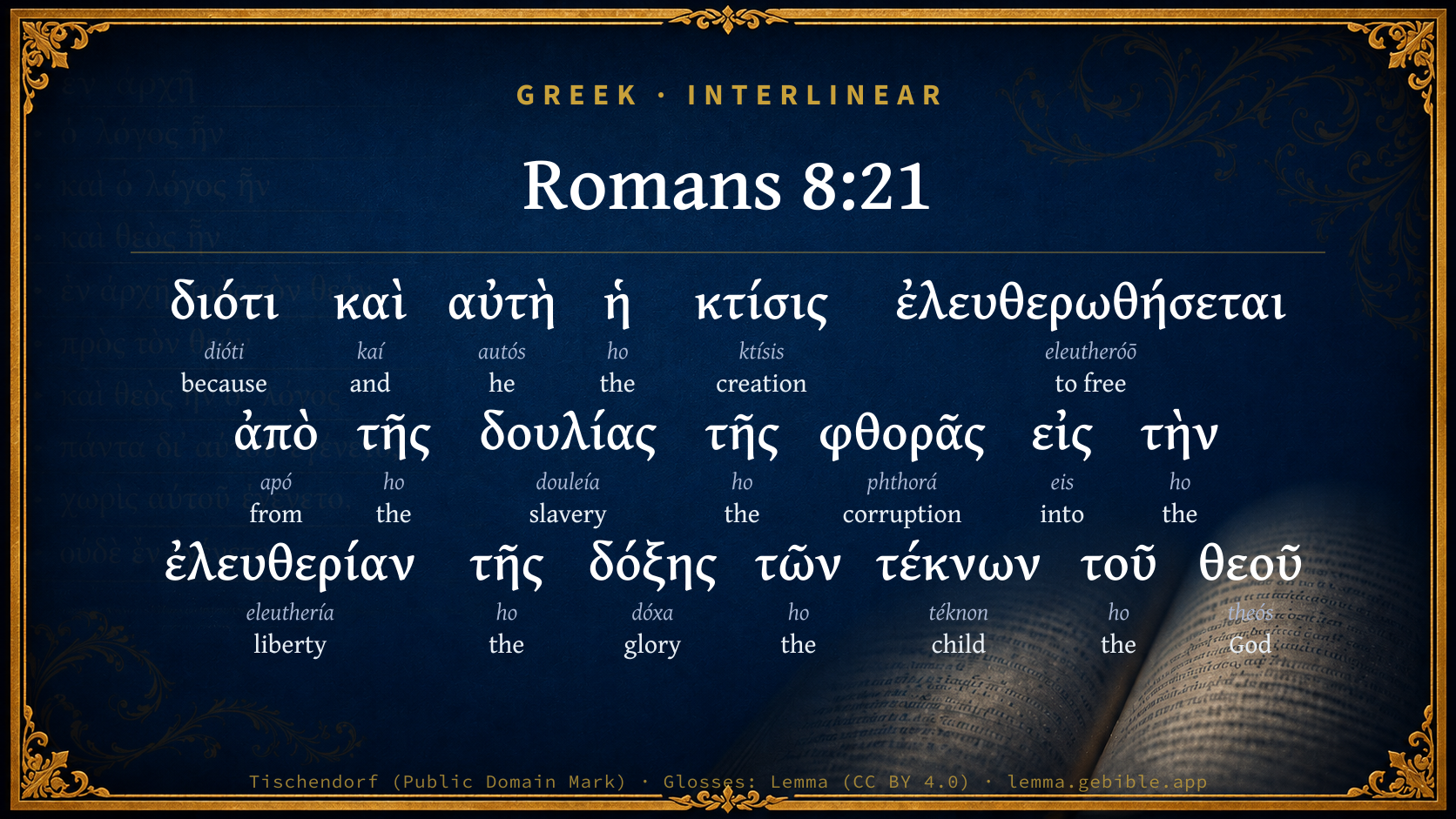
Greek (Tischendorf 8th ed.) Romans 8:21 appears in the Greek New Testament. The text above is from the Tischendorf 8th edition. Each word links to its Strong’s number and a concise gloss. Click any word for its full Thayer’s Greek Lexicon entry.
Download image
Cite this verse

Romans 8:21 (World English Bible). Public Domain. Lemma interlinear Bible study tool, https://lemma.gebible.app/v/romans/8/21.

Show BibTeX & RIS
BibTeX
RIS
English Translation
that the creation itself also will be delivered from the bondage of decay into the liberty of the glory of the children of God.
World English Bible · Public Domain
Highlights
  • 2 first appearances in the Greek New Testament
Full analysis ↓
Download a study sheet

One document with this verse’s original text, its word-by-word gloss line, the meaning frame, cross-references with their text, attributed commentary, and full source and license credits — printable, and it pastes into notes with its structure intact.

This verse Autodidact and up

Study sheet (.html) Plain text (.txt)

A passage Seminary Student

Up to 50 verses in one chapter. A passage sheet keeps up to 6 commentary sources and 12 cross-references per verse, in the order this page ranks them, and says so on the sheet whenever that leaves anything out. Ask for a single verse and you get the Autodidact verse sheet above.

Everything on this page stays free to read, with no account — the sheet is a download of what is already on screen, not access to it.

Want to remove ads? Support Godless Engineer
Compare translations 3

The same verse in 3 English versions, stacked beneath the original-language interlinear above. Click any original word for its lexicon entry.

Each is an independent rendering of the whole verse — the interlinear is not word-aligned to these translations.

Highlighted words mark where these versions differ — a whole-verse word diff, not a word-by-word alignment.

  • World English Bible Public Domain
    that the creation itself also will be delivered from the bondage of decay into the liberty of the glory of the children of God.
  • King James Version Public Domain
    Because the creature itself also shall be delivered from the bondage of corruption into the glorious liberty of the children of God.
  • unfoldingWord Literal Text CC BY-SA 4.0
    that also the creation itself will be freed from the slavery of the decay into the freedom of the glory of the children of God.

unfoldingWord Literal Text — © unfoldingWord, licensed CC BY-SA 4.0. Word-aligned USFM3 via Door43 (git.door43.org/unfoldingWord/en_ult).

Versions to compare (up to 4)

3 of 4 selected

Show all 19 translations

Every available English version of this verse, each an independent rendering of the whole verse.

  • World English Bible Public Domain
    that the creation itself also will be delivered from the bondage of decay into the liberty of the glory of the children of God.
  • Berean Standard Bible Public Domain
    that the creation itself will be set free from its bondage to decay and brought into the glorious freedom of the children of God.
  • Majority Standard Bible Public Domain
    that the creation itself will be set free from its bondage to decay and brought into the glorious freedom of the children of God.
  • King James Version Public Domain
    Because the creature itself also shall be delivered from the bondage of corruption into the glorious liberty of the children of God.
  • American Standard Version (1901) Public Domain
    that the creation itself also shall be delivered from the bondage of corruption into the liberty of the glory of the children of God.
  • Revised Version (1885) Public Domain
    that the creation itself also shall be delivered from the bondage of corruption into the liberty of the glory of the children of God.
  • Geneva Bible (1599) Public Domain
    Because the creature also shall be deliuered from the bondage of corruption into the glorious libertie of the sonnes of God.
  • Douay-Rheims (1899) Public Domain
    Because the creature also itself shall be delivered from the servitude of corruption, into the liberty of the glory of the children of God.
  • Young's Literal Translation Public Domain
    that also the creation itself shall be set free from the servitude of the corruption to the liberty of the glory of the children of God;
  • Literal Standard Version CC BY-SA 4.0
    that also the creation itself will be set free from the servitude of the corruption to the liberty of the glory of the children of God;
  • Unlocked Literal Bible CC BY-SA 4.0
    that the creation itself will be delivered from slavery to decay, and that it will be brought into the freedom of the glory of the children of God.
  • unfoldingWord Literal Text CC BY-SA 4.0
    that also the creation itself will be freed from the slavery of the decay into the freedom of the glory of the children of God.
  • Darby Bible Public Domain
    that the creature itself also shall be set free from the bondage of corruption into the liberty of the glory of the children of God.
  • World Messianic Bible Public Domain
    that the creation itself also will be delivered from the bondage of decay into the liberty of the glory of the children of God.
  • Webster's Bible Public Domain
    Because the creature itself also shall be delivered from the bondage of corruption, into the glorious liberty of the children of God.
  • Free Bible Version CC BY-SA 4.0
    But creation itself waits in hope for the time when it will be set free from the slavery of decay and share the glorious freedom of God's children.
  • Bible in Basic English Public Domain
    That all living things will be made free from the power of death and will have a part with the free children of God in glory.
  • Text-Critical English NT CC BY 4.0
    that the creation itself will also be set free from the slavery of corruption and brought into the freedom of the glory of the children of God.
  • Tyndale New Testament (1534) Public Domain
    For the very creatures shalbe delivered from the bondage of corrupcion into the glorious lybertie of the sonnes of God.

Literal Standard Version (2020), Covenant Press — licensed CC BY-SA 4.0. Text via the HelloAO Bible API (eBible.org). Unlocked Literal Bible (unfoldingWord) — licensed CC BY-SA 4.0. Text via the HelloAO Bible API (eBible.org). unfoldingWord Literal Text — © unfoldingWord, licensed CC BY-SA 4.0. Word-aligned USFM3 via Door43 (git.door43.org/unfoldingWord/en_ult). Free Bible Version, Dr. Jonathan Gallagher — licensed CC BY-SA 4.0. Text via the HelloAO Bible API (eBible.org).

Word by word

More ways to search: Search by grammar → Find every occurrence → Compare this word →

Practice this passage: Drill this verse → Learn its vocabulary →

δουλίας
douleía
G1397
“slavery”
Noun, Genitive, Singular, Feminine
Part of Speech
Noun
Case
Genitive
Number
Singular
Gender
Feminine
Full Thayer's Definition

Origin: from G1398

TDNT: 06:21,2

1. slavery, bondage, the condition of a slave
  1. διότι dióti G1360 “because” Conjunction
  2. καὶ kaí G2532 “and” Conjunction
  3. αὐτὴ autós G846 “he” Personal pronoun, Nominative, Singular, Feminine
  4. ἡ ho G3588 “the” Article, Nominative, Singular, Feminine
  5. κτίσις ktísis G2937 “creation” Noun, Nominative, Singular, Feminine
  6. ἐλευθερωθήσεται eleutheróō G1659 “to free” Verb, Future, Passive, Indicative, 3rd person, Singular
  7. ἀπὸ apó G575 “from” Preposition
  8. τῆς ho G3588 “the” Article, Genitive, Singular, Feminine
  9. τῆς ho G3588 “the” Article, Genitive, Singular, Feminine
  10. φθορᾶς phthorá G5356 “corruption” Noun, Genitive, Singular, Feminine
  11. εἰς eis G1519 “into” Preposition
  12. τὴν ho G3588 “the” Article, Accusative, Singular, Feminine
  13. ἐλευθερίαν eleuthería G1657 “liberty” Noun, Accusative, Singular, Feminine
  14. τῆς ho G3588 “the” Article, Genitive, Singular, Feminine
  15. δόξης dóxa G1391 “glory” Noun, Genitive, Singular, Feminine
  16. τῶν ho G3588 “the” Article, Genitive, Plural, Neuter
  17. τέκνων téknon G5043 “child” Noun, Genitive, Plural, Neuter
  18. τοῦ ho G3588 “the” Article, Genitive, Singular, Masculine
  19. θεοῦ theós G2316 “God” Noun, Genitive, Singular, Masculine

About this verse

These counts appear in no published source. They are computed here, from the morphology-tagged text and Lemma’s own curated glosses. What Lemma adds →

20
words
14
distinct lemmas
Pauline Epistles
section

Notable vocabulary

The rarest word here is δουλίας slavery G1397 — appearing just 5 times in the whole Greek New Testament.

First appearance in Scripture

These words make their first canonical appearance in the Greek New Testament here:

  • φθορᾶς corruption G5356
  • ἐλευθερίαν liberty G1657

Shared distinctive vocabulary

δουλίας slavery G1397 occurs in 5 verses of the Greek New Testament. Also found in:

Repetition

A word recurs within this verse:

Cross-references

5

Topical passages linked to Romans 8:21 in the Treasury of Scripture Knowledge — connected by theme and wording, ordered by reader-vote popularity; previews shown in the World English Bible.

  • Revelation 22:3–5 There will be no curse any more. The throne of God and of the Lamb will be in it, and his servants serve him.
  • Acts 3:21 whom heaven must receive until the times of restoration of all things, which God spoke long ago by the mouth of his holy prophets.
  • 2 Peter 3:13 But, according to his promise, we look for new heavens and a new earth, in which dwells righteousness.
  • Revelation 21:1 I saw a new heaven and a new earth: for the first heaven and the first earth have passed away, and the sea is no more.
  • Romans 8:19 For the creation waits with eager expectation for the children of God to be revealed.

Cross-references courtesy of OpenBible.info (CC BY 4.0).

Commentary

Notes on Romans 8:21 from classic Christian and Jewish commentators (each source and its license shown beneath its notes). The classic Christian expositions comment on the surrounding passage and are grouped to its opening verse, so a note may address several verses; the Jewish commentaries on the Tanakh (Rashi and others) are per-verse, so they appear only where the commentator wrote on this verse.

Lemma curates 59 commentaries, every one of them public domain or Creative Commons licensed, each selected and text-cleaned for this edition rather than reprinted as found. About our sources →

Bengel's Gnomon

Johann Albrecht Bengel

Rom 8:21. Ἐπʼ ἐλπίδι [super spe: resting on hope], in hope) It is construed with, was made subject, so, in hope [super spe], is put absolutely, Act 2:26; and comp. by hope [spe], Rom 8:24.—αὐτὴ ἡ κτίσις) itself, to wit, the creature.—ἐλευθερωθήσεται, shall be delivered [set free]) Deliverance is not accomplished by means of complete destruction; otherwise quadrupeds, when they are butchered, would fall with pleasure.[95]—ἈΠῸ Τῆς ΔΟΥΛΕΊΑς Τῆς ΦΘΟΡᾶς ΕἸς ΤῊΝ ἘΛΕΥΘΕΡΊΑΝ Τῆς ΔΌΞΗς, from the bondage of corruption into the glorious liberty) Ἀπὸ, from, and εἰς, into, are opposed to each other. From denotes the point, from which we set out; into, the point at which we arrive. Bondage and liberty belong to the creature; corruption and glory to men, even believers [the latter, glory to believers alone: the former, corruption, to men in general]. Vanity, Rom 8:20, is something more subtle than φθορὰ, corruption. Not only deliverance, but also liberty, is that goal, to which the creature in its own way is directing its course.—εἰς τὴν ἐλευθερίαν, into the liberty) In order that they may in freedom be subservient to the glory of the sons [of God].—Cluverus.

[95] i.e., were death and annihilation a deliverance. Therefore the coming restoration of the creature and its deliverance will not consist in their destruction and annihilation.—ED.

Bengel's Gnomon of the New Testament — English translation (T&T Clark, Edinburgh, 1860) — public domain. Text from a community e-Sword module.

Expositor's Greek Testament

ed. W. Robertson Nicoll

Rom 8:21 . Contents of the hope. It makes no difference in meaning, whether we read ὅτι or διότι . αὐτὴ ἡ κτίσις : creation as well as man. ἡ δουλεία τῆς φθορᾶς : a system in which nothing continues in one stay, in which death claims everything, in which there is not even an analogy to immortality, is a system of slavery in subjection to “vanity,” with no high eternal worth of its own. From such a condition creation is to be emancipated; it is to share in the liberty which belongs to the glory of the children of God. When man’s redemption is complete, he will find himself in a new world matching with his new condition (Isa 65:17 , 2Pe 3:13 , Rev 21:1 ): this is Paul’s faith, and the sighing of creation attests it.

The Expositor's Greek Testament, edited by W. Robertson Nicoll (1897–1910) — public domain. Text from a community e-Sword module.

Godet's Commentaries

Frédéric Louis Godet

Vv. 21. The conujnction ὅτι (that, or because) may be made directly dependent on the words in hope: “in hope that.” Rom 8:21 would then state wherein the hope itself consists. But we may also take it in the sense of because, and find in Rom 8:21 the reason of the hope: “I say: with hope, because”...This indeed would be the only possible meaning if, with Tischendorf, we adopted the reading of the Sinaït. and the Greco-Latins: διότι, seeing that. In any case it is the natural sense; for why otherwise would the apostle repeat in extenso the subject of the sentence: αὐτὴ ἡ κτίσις, the creation itself? No writer will say: nature was made subject in the hope that Nature herself would be delivered.

The pronoun itself glances at a natural objection: one would not have expected such a fact in a being like Nature. The καί, also, even, refers to the same thought: the unintelligent creation no less than men.

In the expression: the bondage of corruption, the complement may signify: “the bondage which consists of corruption.” But this complement may also be taken as the genitive of the object, subjection to corruption, as a law. This second meaning is undoubtedly better; for the idea of enslavement is thus rendered more emphatic, in opposition to the idea of liberty in what follows.

The term φθορά, corruption, putrescence, is more forcible than the word vanity, and serves to define it more exactly.

Paul does not say that nature will participate in the glory, but only in the liberty of the glory of the children of God. Liberty is one of the elements of their glorious state, and it is the only one to which nature can lay claim. It expresses the unchecked development of the free expansion of all the powers of life, beauty, and perfection, wherewith this new nature will be endowed. There is nothing to show that the apostle has in view the return to life of the individual beings composing the present system of nature. In the domains inferior to man, the individual is merely the temporary manifestation of the species. We have therefore to think here only of a new nature in its totality, differing from the old system in its constitution and laws.

Frédéric Louis Godet — Commentaries on Luke, John, Romans, and 1 Corinthians — English translation (T&T Clark, Edinburgh, 1870s–1890s) — public domain. Text from a community e-Sword module.

Hodge's Commentary on Romans, Ephesians & First Corinthians

Charles Hodge

Rom_8:21

Because the creature itself also shall be delivered from the bondage of corruption, etc. This verse, according to our version, assigns the reason why the subjection of the creature was not hopeless. This reason is, that the creature was to share in the glorious redemption. The particle ὃτι, however, rendered because, may be rendered that, and the verse then indicates the object of the hope just spoken of: The subjection was with the hope that the creature should be delivered. In either way the sense is nearly the same. The creature itself also, is another of the forms of expression which show that Paul speaks of the creation in a sense which does not embrace the children of God. Bondage of corruption, i.e. bondage to corruption the state of frailty and degradation spoken of above.

Delivered, or liberated into the liberty, is an elliptical form of expression for delivered and introduced into the liberty. Liberty of glory, as the words literally mean, or glorious liberty, refer to that liberty which consists in, or is connected with the glory which is the end and consummation of the work of redemption. This word is often used for the whole of the results of the work of Christ, as far as his people are concerned; (see Rom_8:18.) The creature then is to be partaker in some way, according to its nature, of the glories in reserve for the sons of God. Porro non intelligit, consortes ejusdem gloriae fore creaturas cum filiis Dei, sed suo modo melioris status fore socias: quia Deus simul cum humano genere orbem nunc collapsum in integrum restituet. Qualis vero futura sit integritas illa tam in pecudibus quam in plantis et metallis, curiosius inquirere neque expedit, neque fas est. Quia praecipua pars corruptionis est interitus: Quaerunt arguti, sed parum sobrii homines, an immortale futurum sit omne animalium genus: his speculationibus si frenum laxetur, quorsum tandem nos abripient? Hac ergo simplici doctrina contenti simus, tale fore temperamentum, et tam concinnum ordinem, ut nihil vel deforme vel fluxum appareat. Calvin.

Charles Hodge — Commentary on Romans (1835), First Corinthians (1857), and Ephesians (1856) — public domain. Text from a community e-Sword module.

Geneva Bible (1599)

Geneva Bible translators

From the corruption which they are now subject to, they shall be delivered and changed into that blessed state of incorruption, which shall be revealed when the sons of God shall be advanced to glory.

Geneva Bible (1599) marginal notes — public domain. Text via Bolls.life.

Jamieson, Fausset & Brown

Robert Jamieson, A. R. Fausset & David Brown

Because the creature itself also--"even the creation itself."

shall be delivered from the bondage of corruption--its bondage to the principle of decay.

into the glorious liberty--rather, "the liberty of the glory."

of the children of God--that is, the creation itself shall, in a glorious sense, be delivered into that freedom from debility and decay in which the children of God, when raised up in glory, shall expatiate: into this freedom from corruptibility the creation itself shall, in a glorious sense, be delivered (So CALVIN, BEZA, BENGEL, THOLUCK, OLSHAUSEN, DE WETTE, MEYER, PHILIPPI, HODGE, ALFORD, &c.).

Jamieson, Fausset & Brown — Commentary Critical and Explanatory on the Whole Bible (1871) — public domain (CC PDM 1.0). Text via the HelloAO Bible API.

Adam Clarke's Commentary

Verse 21. Because the creature] This and the preceding verse should be thus connected: in hope THAT (οτι) the creature itself also shall be delivered. The word φθορα denotes, very frequently, sinful corruption. So, 2Pe 1:4: Corruption through lust, της εν επιθυμια φθορας. 2Co 11:3: Lest your minds should be corrupted. 1Co 15:33: Evil communications corrupt good manners. The sense, therefore, of the apostle in this place seems to be: the Gentile world shall, in time, be delivered from the bondage of their sinful corruption, i.e. the bondage of their lusts and vile affections; and be brought into such a noble liberty as the sons of God enjoy.

Adam Clarke's Commentary on the Bible (1810–1826) — public domain. Text from a community e-Sword/MySword module.

John Calvin's Commentaries

21. Because the creation itself, etc. He shows how the creation has in hope been made subject to vanity; that is, inasmuch as it shall some time be made free, according to what Isaiah testifies, and what Peter confirms still more clearly. It is then indeed meet for us to consider what a dreadful curse we have deserved, since all created things in themselves blameless, both on earth and in the visible heaven, undergo punishment for our sins; for it has not happened through their own fault, that they are liable to corruption. Thus the condemnation of mankind is imprinted on the heavens, and on the earth, and on all creatures. It hence also appears to what excelling glory the sons of God shall be exalted; for all creatures shall be renewed in order to amplify it, and to render it illustrious.

But he means not that all creatures shall be partakers of the same glory with the sons of God; but that they, according to their nature, shall be participators of a better condition; for God will restore to a perfect state the world, now fallen, together with mankind. But what that perfection will be, as to beasts as well as plants and metals, it is not meet nor right in us to inquire more curiously; for the chief effect of corruption is decay. Some subtle men, but hardly sober-minded, inquire whether all kinds of animals will be immortal; but if reins be given to speculations where will they at length lead us? Let us then be content with this simple doctrine, — that such will be the constitution and the complete order of things, that nothing will be deformed or fading.

John Calvin's Commentaries (1540-1563) — public domain. Text from the Calvin Translation Society English edition (1840s-50s) via the Christian Classics Ethereal Library (ccel.org). Calvin's coverage is partial (roughly two-thirds of the Bible); uncommented books and verses are honest gaps, never fabricated. The 19th-century editor's footnotes and remarks are omitted so the notes are faithfully Calvin's own voice.

Ellicott's Commentary for English Readers

(21) Because the creature.—The reason for the hope which survives through the degradation of nature; what creation is to be.

Because.—Perhaps rather “that,” to be joined on to the end of the last verse, “in hope that creation, also,” &c. So Meyer and Ellicott.

Delivered from the bondage of corruption.—The state of decay and ruin into which the world by nature has fallen, is regarded as a servitude opposed to the state of liberty into which it will be ushered at the Coming of Christ.

Glorious liberty of the children of God.—Translate rather, into the liberty of the glory of the children of God—i.e., into the state of liberty or emancipation which will attend the appearance of the Messiah and His redeemed. Their state will be one of liberty, and in that liberty the whole creation hopes to share.

A Bible Commentary for English Readers, edited by Charles John Ellicott (1878–1897) — public domain. Text from a community e-Sword module.

The Cambridge Bible for Schools and Colleges

gen. ed. J. J. S. Perowne

21. because] Better than “that,” as in some translations. St Paul justifies the “hope,” by stating the fact in which it will be realized.

itself also] As well as the children of God; though in other modes from theirs.

the bondage of corruption] “Corruption” here (as in 1Co_15:42; 1Co_15:50,) is probably decay; physical, not moral, detriment. This, to creation, is “bondage,” in that it represses and foils its fulness of peace and splendour.

the glorious liberty] Lit., and better, the liberty of the glory; i.e. connected with the glory; attendant on it, involved in it. The period of that glory is to be (not only for the saints, but, in another mode, for the new heavens and earth,) a period of “liberty;” of developement in undecaying power and bliss.

The Cambridge Bible for Schools and Colleges (gen. ed. J. J. S. Perowne; Cambridge University Press, 1878–1918) — public domain. Text from a community e-Sword module.

John Gill's Exposition

Because the creature itself also,.... The phrase in hope, which stands in our version, at the end of the preceding verse, should be placed in the beginning of this, and be read in connection with Rom 8:19 being a parenthesis, thus: "the earnest expectation of the creature waiteth for the manifestation of the sons of God, in hope that the creature itself also shall be delivered from the bondage of corruption"; and so it is placed in some copies, and in the Syriac version: that is, "the Gentiles" earnestly wait and expect a larger number of converts among them, in hopes that ere long the whole Gentile world will be freed from

the bondage of corruption, under which it at present groaned; by which is meant, the bondage they were in, not only to their sinful lusts, but to Satan the god of this world; and particularly to their idols, by which they corrupted themselves, and to which they were enslaved: they hope for a deliverance from hence,

into the glorious liberty of the children of God; which designs either the liberty of grace the children of God have here; and which consists in a freedom from the dominion of sin and Satan, from the law and bondage of it, in the free use of Gospel ordinances, in liberty of access to God, and a freedom from the fear of death, and a glorious liberty it is; or the liberty of glory the saints shall enjoy in the other world, which will lies in a freedom from the prison of the flesh, from the body of sin and death, from all sorrows and afflictions, from all reproaches and persecutions, from the temptations of Satan, from doubts, fears, and unbelief, and in the full vision of God through Christ, and in a free conversation with angels and saints.

John Gill's Exposition of the Whole Bible (1746–1763) — public domain (CC PDM 1.0). Text via the HelloAO Bible API.

Trapp's Complete Commentary

John Trapp

21 Because the creature itself also shall be delivered from the bondage of corruption into the glorious liberty of the children of God.

Ver. 21. Because the creature itself] See Mr Wilcox’s discourse upon these words, printed, together with his Exposition of the Psalms, Proverbs, &c., in folio. The creature is said to be subject to vanity and bondage of corruption, 1. As corruptible. 2. As teachers of men, and they will not learn; so that they lose their labour. 3. As they are instruments of man’s punishment. 4. As they are forced to serve wicked men’s turns and uses, who have no peace with the creature, and should have no service from them.

John Trapp, A Commentary or Exposition upon All the Books of the Old and New Testament (1647–1656) — public domain. Text from a community e-Sword module.

Albert Barnes' Notes on the Bible

Because - This is the ground of his hope, and this sustains him now. It is the purpose of God that deliverance shall be granted, and this supports the Christian amidst the trials to which he is subjected here. The hope is, that this same renewed man shall be delivered from all the toils, and cares, and sins of this state.

The creature itself - The very soul that is renewed; the ransomed man without essential change. It will be the same being, though purified; the same man, possessed of the same body and soul, though freed from all the corruptions of humanity, and elevated above all the degradations of the present condition. The idea is everywhere presented, that the identical person shall be admitted to heaven without essential change, 1Co 15:35-38, 1Co 15:42-44. That this is the hope of all Christians, see 2Pe 3:13.

From the bondage of corruption - This does not differ materially from “vanity,” Rom 8:20. It implies that this state is not a willing state, or not a condition of choice, but is one of bondage or servitude (see Rom 7:15-24); and that it is a corrupt, imperfect, perishing condition. It is one that leads to sin, and temptation, and conflict and anxiety. It is a condition often which destroys the peace, mars the happiness, dims the hope, enfeebles the faith, and weakens the love of Christians, and this is called the bondage of corruption. It is also one in which temporal death has dominion, and in the bondage of which, believers as well as unbelievers shall be held. Yet from all this bondage the children of God shall be delivered.

The glorious liberty - Greek, The freedom of the glory of the children of God. This is,

(1) “Liberty.” It is freedom from the bondage under which the Christian groans. It will be freedom from sin; from corruption; from evil desires; from calamity; from death. The highest “freedom “in the universe is that which is enjoyed in heaven, where the redeemed are under the sovereignty and government of their king, but where they do that, and that only, which they desire. All is slavery but the service of God; all is bondage but that law which accords with the supreme wish of the soul, and where commands accord with the perfect desires of the heart.

(2) This is glorious liberty. It is encompassed with majesty; attended with honor; crowned with splendor. The heavenly world is often described as a state of glory; Note, Rom 2:10.

Of the children of God - That the children of God shall enjoy.

Albert Barnes' Notes on the Bible (1834–1885) — public domain. Text from a community e-Sword/MySword module.

Matthew Poole's English Annotations

If this verse be understood of the heavens and the earth, and the things therein, the meaning is, that the creatures, in their kind, and according to their capacity, shall be partakers of that liberty and freedom, which in the children of God is accompanied with unspeakable glory; they shall not partake with the saints in glory, but of that liberty, which in the saints hath great glory attending it, and superadded to it. The creature, at the day of judgment, shall be restored (as before) to that condition of liberty which it had in its first creation; as, when it was made at first, it was free from all vanity, bondage, and corruption, so it shall be again at the time of the general resurrection: see Act 3:19,21; 2Pe 3:13. Those that by the creature would understand the Gentile world, give the sense of this verse: That the very heathens also shall, by the gospel and grace of Christ, be rescued from those courses of sin and corruption, to which they have been long enslaved, into that glorious condition not only of free-men, redeemed by Christ out of their bondage to sin and Satan, but even of the sons of God, to have right to his favour, and that never fading inheritance.

Matthew Poole's English Annotations on the Holy Bible (1683–1685) — public domain. Text from a community e-Sword/MySword module.

Whedon's Commentary on the Bible

Daniel D. Whedon

21. Because—Or, rather, that. In hope that.

The creature itself—Or rather, this same creature, and not merely the successive generations of nature.

Daniel D. Whedon (gen. ed.), Commentary on the Old and New Testaments (1874–1909) — public domain. Text from a community e-Sword module.

John Wesley's Explanatory Notes

The creation itself shall be delivered - Destruction is not deliverance: therefore whatsoever is destroyed, or ceases to be, is not delivered at all. Will, then, any part of the creation be destroyed? Into the glorious liberty - The excellent state wherein they were created.

John Wesley, Explanatory Notes Upon the Whole Bible (1754–1765) — public domain. Text via the GEBible commentary corpus.

Godbey's Commentary on the New Testament

William B. Godbey

21. “Therefore, indeed, pursuant to hope, the creature itself shall be delivered from the bondage of corruption into the liberty of the glory of the children of God.” The plain meaning of this verse is that my body is to be gloriously delivered from all the humiliation and suffering of this mortal life, rendered imponderable So it can fly with angelic velocity, transfigured into the unutterable similitude of my Savior’s glorious body. This is the inspiring hope thrilling my poor, mortal body, and rendering it felicitously oblivious to all my toils, cares and disappointments.

William B. Godbey, Commentary on the New Testament (1896–1900) — public domain. Text from a community e-Sword module.

McGarvey & Pendleton's Commentaries

J. W. McGarvey

that the creation itself also shall be delivered from the bondage of corruption into the liberty of the glory of the children of God .

J. W. McGarvey (with Philip Y. Pendleton), Commentaries on the New Testament (The Fourfold Gospel, 1914; Acts; and the epistles) — public domain. Text from a community e-Sword/MySword module.

The People's New Testament

B. W. Johnson

21. Because the creature itself shall be delivered. The Revision reads, “The creation was subjected … in hope that the creation itself also,” etc. Though “subjected to vanity,” it still retained the hope of final deliverance. Bondage of corruption. Decay and death. Into the glorious liberty. “The liberty of the glory.” The present state is “bondage to corruption.” The hope is deliverance from the bondage into “the liberty,” etc. In the day of the revelation of that glory, “all things shall become new” (Rev. 21:5).

B. W. Johnson's The People's New Testament with Notes (1889–1891) — public domain. Electronic text from the Christian Classics Ethereal Library (CCEL) ThML edition.

Cambridge Greek Testament for Schools and Colleges

21. ὅτι καὶ αὐτὴ ἡ κτ. Not man only but the natural creation with him will be set free.

τῆς δ. τῆς φθ. = τῆς ματαιότητος. N. the echo, but in a different sense, in 2Pe 2:19. φθορά, in St Paul chiefly or always physical, in 2 Pet. generally moral, occurs only in Ro., 1 Co., Gal., Col. and 2 Peter.

ἐλευθερία. Cf. Gal 4:23 f.

τῆς δόξης τ. τ. τ. θ. δόξα almost = ἀποκάλυψις, but describes the character revealed rather than the process of revealing: = the true character manifested fully, )[162] φθορά 1Co 15:42.

[162] )( opposed to

τέκνων, ‘children,’ as one in character with GOD in Christ, of. above 17.

Cambridge Greek Testament for Schools and Colleges (Cambridge University Press, 1896; 21 vols, various authors incl. Carr, Maclear, Plummer, Farrar, Lumby, Moule, M. R. James, Simcox) — public domain. Text from a community e-Sword module.

International Critical Commentary

21. ὅτι. The majority of recent commentators make ὅτι (= ‘that’) define the substance of the hope just mentioned, and not (= ‘because’) give a reason for it. The meaning in any case is much the same, but this is the simpler way to arrive at it.

καὶ αὐτὴ ἡ κτίσις: not only Christians but even the mute creation with them.

ἀπὸ τῆς δουλείας τῆς φθορᾶς δουλείας corresponds to ὑπετάγη, the state of subjection or thraldom to dissolution and decay. The opposite to this is the full and free development of all the powers which attends the state of δόξα. ‘Glorious liberty’ is a poor translation and does not express the idea: δόξα, ‘the glorified state,’ is the leading fact, not a subordinate fact, and ἐλευθερία is its characteristic, ‘the liberty of the glory of the children of God.’

International Critical Commentary — older volumes (1896–1929), various authors — public domain. Text from a community e-Sword module.

Vincent's Word Studies in the New Testament

Marvin R. Vincent

In hope because [επ ελπιδι οτι] , The best texts transfer these words from the preceding verse, and construe with was made subject, rendering oti that instead of because. "The creation was subjected in the hope that," etc. In hope is literally on hope, as a foundation. The hope is that of the subjected, not of the subjector. Nature "possesses in the feeling of her unmerited suffering, a sort of presentiment of her future deliverance" (Godet). Some adopt a very suggestive connection of in hope with waiteth for the manifestation.

Glorious liberty [ελευθεριαν της δοξης] . Better, and more literally, as Rev., liberty of the glory. Liberty is one of the elements of the glorious state and is dependent upon it. The glory is that in ver. 18. The Greek student will note the accumulation of genitives, giving solemnity to the passage.

Marvin R. Vincent, Word Studies in the New Testament (1887–1900) — public domain. Text from a community e-Sword/MySword module.

Lesson kit

Teaching starters — assembled from the data on this page, not authored interpretation. Every prompt links to the verse data it draws on. Edit before teaching.

Romans, in the Pauline Epistles, opens this verse with 20 words (14 distinct Greek lemmas). Its most distinctive word is douleía (“slavery”). A historical commentator’s framing appears above. Read the whole chapter for the surrounding context.

Discussion questions

  1. The word douleía carries the sense “slavery.” How does it shape the verse?
  2. 2 words make their first appearance in Scripture here. What does this debut establish?
  3. How does Romans 8:15, which shares the word «slavery», read alongside this verse?
  4. What does the repetition of “the” (7× in this one verse) do in this verse?
  5. These translations render this verse differently; the difference is in the English rendering, not the original. What questions does that raise?
  6. Compare how Bengel's Gnomon and Expositor's Greek Testament read this verse. Where do they agree or differ?

Things to notice

  • 2 words make their first canonical appearance in Scripture here.
  • These translations choose different wording for 15 words in this verse.
  • “the” occurs 7× in this single verse.
  • 14 distinct Greek lemmas span 20 words in this verse.

Reading settings

Reading text

Shown beneath each verse's original-language words.

Old Testament
Old Testament edition

Read the OT as the Masoretic Hebrew (MT) or the Greek Septuagint (LXX).

English shown for the Greek Septuagint (in the Hebrew ↔ Greek comparison).

Comparing translations? Open the Compare panel on any verse page to stack up to four side by side.