Romans 3:26

Greek (Tischendorf 8th ed.) Romans 3:26 appears in the Greek New Testament. The text above is from the Tischendorf 8th edition. Each word links to its Strong’s number and a concise gloss. Click any word for its full Thayer’s Greek Lexicon entry.
Download image
Cite this verse

Romans 3:26 (World English Bible). Public Domain. Lemma interlinear Bible study tool, https://lemma.gebible.app/v/romans/3/26.

Show BibTeX & RIS
BibTeX
RIS
English Translation
to demonstrate his righteousness at this present time; that he might himself be just, and the justifier of him who has faith in Jesus.
World English Bible · Public Domain
Download a study sheet

One document with this verse’s original text, its word-by-word gloss line, the meaning frame, cross-references with their text, attributed commentary, and full source and license credits — printable, and it pastes into notes with its structure intact.

This verse Autodidact and up

Study sheet (.html) Plain text (.txt)

A passage Seminary Student

Up to 50 verses in one chapter. A passage sheet keeps up to 6 commentary sources and 12 cross-references per verse, in the order this page ranks them, and says so on the sheet whenever that leaves anything out. Ask for a single verse and you get the Autodidact verse sheet above.

Everything on this page stays free to read, with no account — the sheet is a download of what is already on screen, not access to it.

Want to remove ads? Support Godless Engineer
Compare translations 3

The same verse in 3 English versions, stacked beneath the original-language interlinear above. Click any original word for its lexicon entry.

Each is an independent rendering of the whole verse — the interlinear is not word-aligned to these translations.

Highlighted words mark where these versions differ — a whole-verse word diff, not a word-by-word alignment.

  • World English Bible Public Domain
    to demonstrate his righteousness at this present time; that he might himself be just, and the justifier of him who has faith in Jesus.
  • King James Version Public Domain
    To declare, I say, at this time his righteousness: that he might be just, and the justifier of him which believeth in Jesus.
  • unfoldingWord Literal Text CC BY-SA 4.0
    in the forbearance of God, for the demonstration of his righteousness at this present time, so that he could be just and justifying the one who from faith in Jesus.

unfoldingWord Literal Text — © unfoldingWord, licensed CC BY-SA 4.0. Word-aligned USFM3 via Door43 (git.door43.org/unfoldingWord/en_ult).

Versions to compare (up to 4)

3 of 4 selected

Show all 19 translations

Every available English version of this verse, each an independent rendering of the whole verse.

  • World English Bible Public Domain
    to demonstrate his righteousness at this present time; that he might himself be just, and the justifier of him who has faith in Jesus.
  • Berean Standard Bible Public Domain
    He did this to demonstrate His righteousness at the present time, so as to be just and to justify the one who has faith in Jesus.
  • Majority Standard Bible Public Domain
    He did this to demonstrate His righteousness at the present time, so as to be just and to justify the one who has faith in Jesus.
  • King James Version Public Domain
    To declare, I say, at this time his righteousness: that he might be just, and the justifier of him which believeth in Jesus.
  • American Standard Version (1901) Public Domain
    for the showing, `I say', of his righteousness at this present season: that he might himself be just, and the justifier of him that hath faith in Jesus.
  • Revised Version (1885) Public Domain
    for the shewing, I say, of his righteousness at this present season: that he might himself be just, and the justifier of him that hath faith in Jesus.
  • Geneva Bible (1599) Public Domain
    Through the patience of God, to shewe at this time his righteousnesse, that hee might be iust, and a iustifier of him which is of the faith of Iesus.
  • Douay-Rheims (1899) Public Domain
    Through the forbearance of God, for the shewing of his justice in this time; that he himself may be just, and the justifier of him, who is of the faith of Jesus Christ.
  • Young's Literal Translation Public Domain
    for the shewing forth of His righteousness in the present time, for His being righteous, and declaring him righteous who `is' of the faith of Jesus.
  • Literal Standard Version CC BY-SA 4.0
    for the showing forth of His righteousness in the present time, for His being righteous, and declaring him righteous who [is] of the faith of Jesus.
  • Unlocked Literal Bible CC BY-SA 4.0
    in his patience. This all happened for the demonstration of his righteousness at this present time. This was so he could prove himself just, and to show that he justifies anyone because of faith in Jesus.
  • unfoldingWord Literal Text CC BY-SA 4.0
    in the forbearance of God, for the demonstration of his righteousness at this present time, so that he could be just and justifying the one who from faith in Jesus.
  • Darby Bible Public Domain
    for [the] shewing forth of his righteousness in the present time, so that he should be just, and justify him that is of [the] faith of Jesus.
  • World Messianic Bible Public Domain
    to demonstrate his righteousness at this present time, that he might himself be just and the justifier of him who has faith in Yeshua.
  • Webster's Bible Public Domain
    To declare, I say, at this time his righteousness: that he may be just, and the justifier of him who believeth in Jesus.
  • Free Bible Version CC BY-SA 4.0
    but now at this present time God proves he is fair and does what is right, and that he makes right those who trust in Jesus.
  • Bible in Basic English Public Domain
    And to make clear his righteousness now, so that he might himself be upright, and give righteousness to him who has faith in Jesus.
  • Text-Critical English NT CC BY 4.0
    He did so to prove in the present time that he is righteous and that he justifies the one who has faith in Jesus.
  • Tyndale New Testament (1534) Public Domain
    to shewe at this tyme the rightewesnes that is alowed of him that he myght be counted iuste and a iustifiar of him which belevith on Iesus.

Literal Standard Version (2020), Covenant Press — licensed CC BY-SA 4.0. Text via the HelloAO Bible API (eBible.org). Unlocked Literal Bible (unfoldingWord) — licensed CC BY-SA 4.0. Text via the HelloAO Bible API (eBible.org). unfoldingWord Literal Text — © unfoldingWord, licensed CC BY-SA 4.0. Word-aligned USFM3 via Door43 (git.door43.org/unfoldingWord/en_ult). Free Bible Version, Dr. Jonathan Gallagher — licensed CC BY-SA 4.0. Text via the HelloAO Bible API (eBible.org).

Word by word

More ways to search: Search by grammar → Find every occurrence → Compare this word →

Practice this passage: Drill this verse → Learn its vocabulary →

ἀνοχῇ
anochḗ
G463
“forbearance”
Noun, Dative, Singular, Feminine
Part of Speech
Noun
Case
Dative
Number
Singular
Gender
Feminine
Full Thayer's Definition

Origin: from G430

TDNT: 06:59,6

1. toleration, forbearance
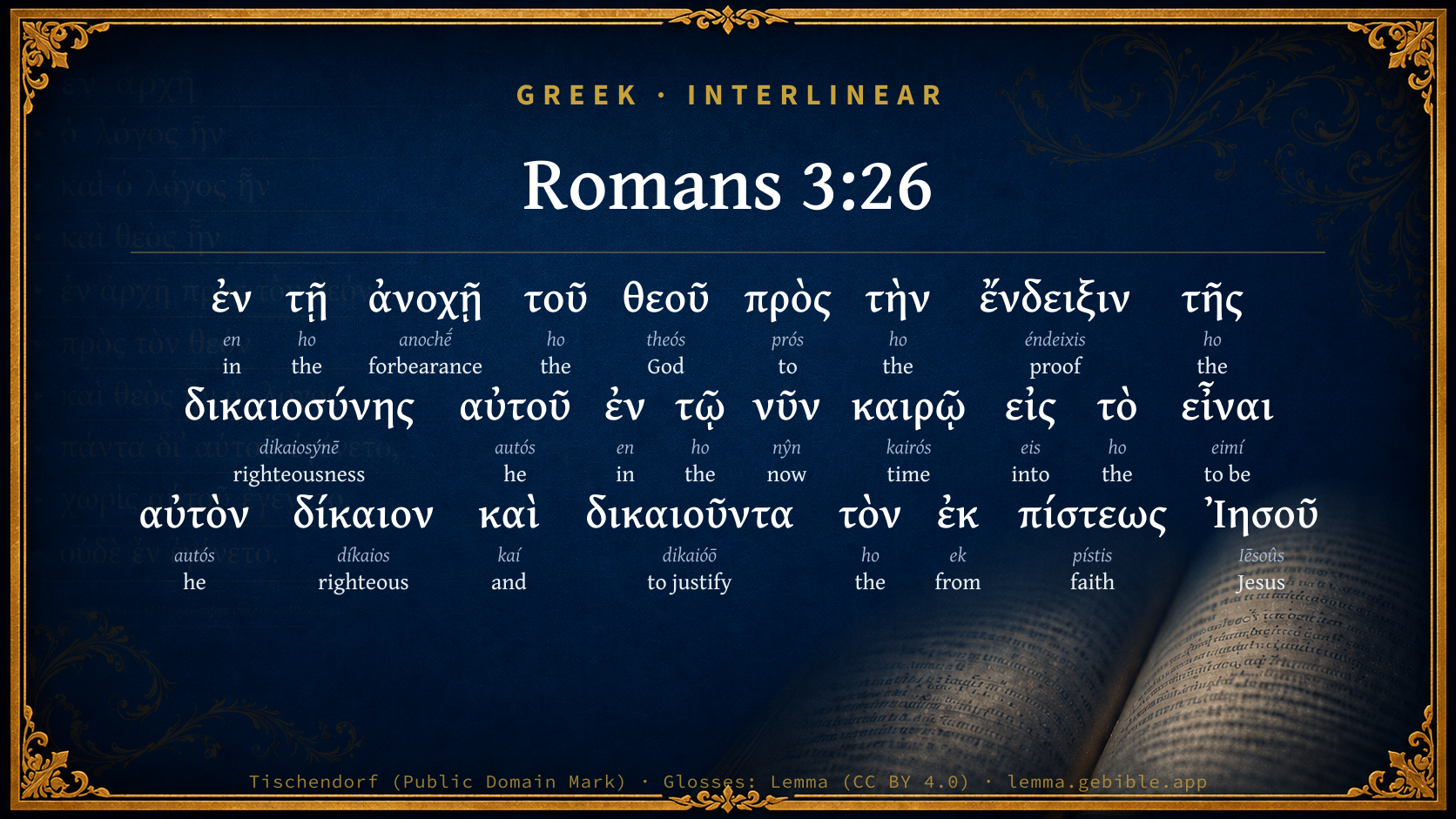
  1. ἐν en G1722 “in” Preposition
  2. τῇ ho G3588 “the” Article, Dative, Singular, Feminine
  3. τοῦ ho G3588 “the” Article, Genitive, Singular, Masculine
  4. θεοῦ theós G2316 “God” Noun, Genitive, Singular, Masculine
  5. πρὸς prós G4314 “to” Preposition
  6. τὴν ho G3588 “the” Article, Accusative, Singular, Feminine
  7. ἔνδειξιν éndeixis G1732 “proof” Noun, Accusative, Singular, Feminine
  8. τῆς ho G3588 “the” Article, Genitive, Singular, Feminine
  9. δικαιοσύνης dikaiosýnē G1343 “righteousness” Noun, Genitive, Singular, Feminine
  10. αὐτοῦ autós G846 “he” Personal pronoun, Genitive, Singular, Masculine
  11. ἐν en G1722 “in” Preposition
  12. τῷ ho G3588 “the” Article, Dative, Singular, Masculine
  13. νῦν nŷn G3568 “now” Adverb
  14. καιρῷ kairós G2540 “time” Noun, Dative, Singular, Masculine
  15. εἰς eis G1519 “into” Preposition
  16. τὸ ho G3588 “the” Article, Accusative, Singular, Neuter
  17. εἶναι eimí G1510 “to be” Verb, Present, Active, Infinitive
  18. αὐτὸν autós G846 “he” Personal pronoun, Accusative, Singular, Masculine
  19. δίκαιον díkaios G1342 “righteous” Adjective, Accusative, Singular, Masculine
  20. καὶ kaí G2532 “and” Conjunction
  21. δικαιοῦντα dikaióō G1344 “to justify” Verb, Present, Active, Participle, Accusative, Singular, Masculine
  22. τὸν ho G3588 “the” Article, Accusative, Singular, Masculine
  23. ἐκ ek G1537 “from” Preposition
  24. πίστεως pístis G4102 “faith” Noun, Genitive, Singular, Feminine
  25. Ἰησοῦ Iēsoûs G2424 “Jesus” Noun, Genitive, Singular, Masculine

About this verse

These counts appear in no published source. They are computed here, from the morphology-tagged text and Lemma’s own curated glosses. What Lemma adds →

26
words
18
distinct lemmas
Pauline Epistles
section

Notable vocabulary

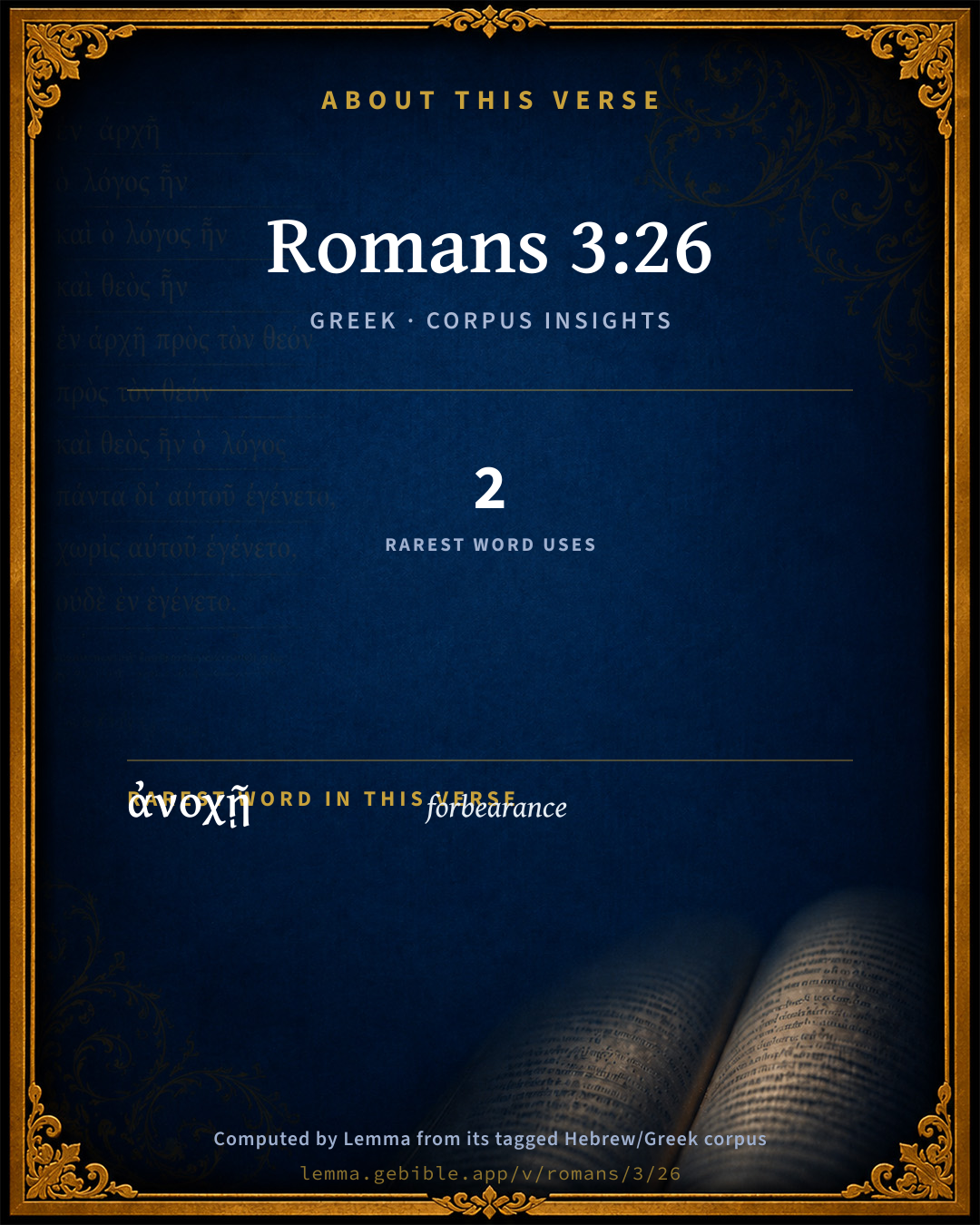
The rarest word here is ἀνοχῇ forbearance G463 — appearing just 2 times in the whole Greek New Testament.

Shared distinctive vocabulary

ἀνοχῇ forbearance G463 occurs in 2 verses of the Greek New Testament. Also found in:

Repetition

Words recur within this verse:

Cross-references

13

Topical passages linked to Romans 3:26 in the Treasury of Scripture Knowledge — connected by theme and wording, ordered by reader-vote popularity; previews shown in the World English Bible.

  • Deuteronomy 32:4 The Rock, his work is perfect; For all his ways are justice: A God of faithfulness and without iniquity, Just and right is he.
  • Romans 4:5 But to him who doesn't work, but believes in him who justifies the ungodly, his faith is accounted for righteousness.
  • Acts 13:38–39 Be it known to you therefore, brothers, that through this man is proclaimed to you remission of sins,
  • Romans 3:30 since indeed there is one God who will justify the circumcised by faith, and the uncircumcised through faith.
  • Psalms 85:10–11 Mercy and truth meet together. Righteousness and peace have kissed each other.
  • Isaiah 42:21 It pleased Yahweh, for his righteousness' sake, to magnify the law, and make it honorable.
  • Zephaniah 3:5 Yahweh, in the midst of her, is righteous. He will do no wrong. Every morning he brings his justice to light. He doesn't fail, but the unjust know no shame.
  • Romans 8:33 Who could bring a charge against God's chosen ones? It is God who justifies.
  • Zephaniah 3:15 Yahweh has taken away your judgments. He has thrown out your enemy. The King of Israel, Yahweh, is in the midst of you. You will not be afraid of evil any more.
  • Revelation 15:3 They sang the song of Moses, the servant of God, and the song of the Lamb, saying, "Great and marvelous are your works, Lord God, the Almighty; Righteous and true are your ways, you King of the nations.
  • Isaiah 45:21 Declare you, and bring [it] forth; yes, let them take counsel together: who has shown this from ancient time? who has declared it of old? Haven't I, Yahweh? and there is no God else besides me, a just God and a Savior; there is no one besides me.
  • Zechariah 9:9 Rejoice greatly, daughter of Zion! Shout, daughter of Jerusalem! Behold, your king comes to you! He is righteous, and having salvation; Lowly, and riding on a donkey, Even on a colt, the foal of a donkey.
  • Galatians 3:8–14 The Scripture, foreseeing that God would justify the Gentiles by faith, preached the Gospel beforehand to Abraham, saying, "In you all the nations will be blessed."

Cross-references courtesy of OpenBible.info (CC BY 4.0).

Commentary

Notes on Romans 3:26 from classic Christian and Jewish commentators (each source and its license shown beneath its notes). The classic Christian expositions comment on the surrounding passage and are grouped to its opening verse, so a note may address several verses; the Jewish commentaries on the Tanakh (Rashi and others) are per-verse, so they appear only where the commentator wrote on this verse.

Lemma curates 59 commentaries, every one of them public domain or Creative Commons licensed, each selected and text-cleaned for this edition rather than reprinted as found. About our sources →

The Biblical Illustrator

Joseph S. Exell

Rom_3:26

To declare, I say, at this time His righteousness.

The Cross a manifestation of the Divine righteousness

I. How. In two ways so closely united that either of them separated would lose its value.

1. By the very fact of Christs sacrifice and bloody death. If Paul does not see in this punishment a quantitative equivalent of the treatment which every sinner had incurred, this is what clearly appears from such sayings as 2Co_5:21; Gal_3:13. Now herein precisely consists the manifestation of the righteousness wrought out by the Cross. God is here revealed as one against whom no sinner can revolt without meriting death; and the sinner is here put in his place in the dust as a malefactor worthy of death. Such is the objective manifestation of righteousness.

2. This demonstration, however, would be incomplete without the subjective or moral manifestation which accompanies it. Every sinner might be called to die on the Cross; but no sinner was in a condition to undergo this punishment as Jesus did, accepting it as undeserved. This is what He alone could do in virtue of His holiness (Joh_17:25), The calm and mute resignation with which He allowed Himself to be led to the slaughter, manifested the idea which He Himself formed of the Majesty of God and the judgment He was passing on the sin of the world; from His Cross there rose the most perfect homage rendered to the righteousness of God. In this death the sin of mankind was therefore doubly judged, and the righteousness of God doubly manifested,--by the external fact of this painful and ignominious punishment, and by the inward act of Christs conscience, which ratified this dealing of which sin was the object in His Person.

II. But what rendered such a demonstration necessary--because of the tolerance of sins past. For four thousand years the spectacle presented by mankind to the whole moral universe (cf. 1Co_4:9)

was, so to speak, a continual scandal. With the exception of some great examples of judgments, Divine righteousness seemed asleep; men sinned and yet they lived. They sinned on, and yet reached in safety a hoary old age. Where were the wages of sin? It was this relative impunity which rendered a solemn manifestation of righteousness necessary. God judged it essential, on account of the impunity so long enjoyed by these myriads of sinners who succeeded one another on the earth, at length to manifest His righteousness by a striking act; and He did so by realising in the death of Jesus the punishment which each of these sinners would have deserved to undergo. But if it be asked why Paul refers only to sins of the past and not to those of the future, the answer is easy: the righteousness of God once revealed in the sacrifice of the Cross this demonstration remains. Whatever happens, nothing can again efface it from the history of the world, nor from the conscience of mankind. Henceforth all sin must be pardoned or judged. (Prof. Godet.)

That He might be Just, and the Justifier of him which believeth in Jesus.

Justice satisfied

(text, and 1Jn_1:9).

I. How has justice been so satisfied that it no longer stands in the way of Gods justifying the sinner? The one answer to that is, through the substitution of Christ. When man sinned the law demanded his punishment. The first offence was committed by Adam, the representative of the race. When God would punish sin, He thought of the blessed expedient, not of punishing His people, but their representative, the second Adam. He died--the just for the unjust, that He might bring us to God. Let us show how fully the law is satisfied. Note--

1. The dignity of the victim. The eternal Son of God condescended to become man; lived a life of suffering, and at last died a death of agony. If you will but think of the wondrous person whom Jesus was, you will see that in His sufferings the law received a greater vindication than it could have done even in the sufferings of the whole race. There is such dignity in the Godhead that all it does is infinite in its merit; and when He stooped to suffer, the law received greater honour than if a whole universe had become a sacrifice.

2. The relationship which Jesus Christ had towards the Great Judge. Brutus was the most inflexible of judges, and knew no distinction of persons. But when he sentenced his own son, we see that he loved his country better than his son, and justice better than either. Now, we say, Brutus is just indeed. Now, if God had condemned each of us one by one, or the whole race in a mass, justice would have been vindicated. But lo! His own Son takes upon Him the sins of the world, and it pleased the Lord to bruise Him. Surely, when God smites His Son, only begotten and well-beloved, then justice has all that it could ask; and this Christ freely gave,

3. The agonies of Christ, which He endured in the place of sinners. All I ought to have suffered has been suffered by my substitute. It cannot be that God can smite me now. Justice itself prevents, for when justice once is satisfied it were injustice if it should ask for more. God can be just, and yet the justifier.

II. It is an act of justice on Gods part to forgive on confession of sin. Not that the sinner deserves forgiveness. Sin can never merit anything but punishment. Not that God is bound from any necessity of His nature to forgive everyone that repents, because repentance has not in itself sufficient to merit forgiveness. Yet it is true that, because God is just, He must forgive every sinner who confesses his sin. Because--

1. He has promised to do so; and a God who could break His promise were unjust. Every word which God utters shall be fulfilled. Go, then, to God with--Lord, Thou hast said, He that confesseth his sin, and forsaketh it, shall find mercy. I confess my sin, and I forsake it; Lord, give me mercy! Dont doubt but that God will give it you. You have His own pledge in your hand.

2. Man has been induced to act upon it; and therefore, this becomes a double bond upon the justice of God. God has said, If we confess our sins and trust in Christ, we shall have mercy. You have done it on the faith of the promise. Do you imagine when God has brought you through much pain of mind to repent and rely on Christ He will afterwards tell you He did not mean what He said? It cannot be. Suppose you said to a man, Give up your situation and take a house near me, and I will employ you. Suppose he does it, and you then say, I am glad for your own sake that you have left your master, still I will not take you. He would reply, I gave up my situation on the faith of your promise, and now you break it. Ah! but this never can be said of God.

3. Christ died on purpose to secure pardon for every seeking soul. And do you suppose that the Father will rob Him of that which He has bought so dearly?

III. The duties taught in the two texts.

1. Confession. Expect not that God will forgive you until you confess. You are not to confess to a man, unless you have offended against him. If you have, leave thy gift upon the altar, and go and make peace with him, and then come and make peace with God. You are to make confession of your sin to God. You cannot mention every offence, but do not hide one.

2. Faith. (C. H. Spurgeon.)

Justice and redemption

What was the main purpose of Christs sufferings?

I. The question is answered in very various ways.

1. There are those who say that they had no purpose, but were brought about by the operation of blind forces, which act sometimes through the working of inanimate nature, sometimes through the malignity of human wills. We need not look beyond them to account for the spectacle of the best of human lives ending as though it had been the worst; for that anomaly, that while Tiberius was enthroned in Rome, Jesus should have been crucified in Jerusalem. To discuss this would be to open the question whether there is any Divine government at all. Suffice it to say, that if there is a Being who is almighty, and has a moral character, then the world is governed by Him. If a great deal is permitted to go on in it which is a contradiction to the moral nature of such a ruler, this only shows that, from certain reasons, He has allowed sin to enter into and to mar His work, and in its train, pain, and death. The sufferings of Christ are thus only an extreme illustration of what we see everywhere around us on a smaller scale, but they afford no ground for the opinion that human lives drift helplessly before forces which are as entirely without moral purpose as the wave or the hurricane is void of intelligence or of sympathy.

2. A more satisfactory account of the sufferings of our Lord is that they were the crowning feature of the testimony He bore to the sacredness of truth. This, it may be truly urged, is His own account of the matter. To this end was I born … that I might bear witness unto the truth. But the question is whether this was the only or the most important object. If it was, then He does not differ from sages, prophets, and martyrs, who have all done this service to truth. There is a more important purpose in the death of our Lord which distinguishes it from every other.

II. The true answer is that Christs death was intended to set forth in action an Attribute of God.

1. This attribute is not, as we might expect, Gods love or mercy, although we know that if God gave His only begotten Son to die, it was because He so loved the world; but the attribute of which St. Paul is thinking is Gods righteousness or justice.

2. When we speak of righteousness we presuppose the existence of a law of right, a law which justice upholds. This law has its witness partly in the structure of society, partly in the conscience of man. If human society is largely unfaithful to this law, it cannot altogether neglect it without going to pieces, sooner or later. And the conscience of every man attests the existence of right, as opposed to wrong. Without doing violence to the mind which God has given us, we cannot conceive of a time when right was not right, and when justice was not a virtue; and if so then right and justice are eternal; and since nothing distinct from God can be conceived of as eternal--for in that case there would be two eternals--it follows that right and justice belong to Gods essential nature. To think of God as unrighteous is only a mode of thinking of Him as not existing at all.

3. This great truth it was a main purpose of the Jewish revelation to teach. From generation to generation its voice is, Righteous art Thou, O Lord, and true is Thy judgment. Its law was a proclamation of righteousness applied to human life; its prophets were preachers of righteousness; its penalties were the sanctions of righteousness; its sacrifices were a perpetual reminder of the Divine righteousness; its promises pointed to One who would make clearer than ever to man the beauty and the power of Divine righteousness. And so when He came He was named the Just One and Jesus Christ the Righteous, and it was but in accordance with these titles that both in His life and in His death He revealed to man the righteousness of God as it had never been revealed before.

III. But how was the death of Christ a declaration of Gods righteousness?

1. Here we must consider that righteousness is an active attribute. There is no such thing as a working distinction between a theoretical and a practical justice. And if this is true in man, much more true is it in God. To conceive of God as just in Himself, but as indifferent to the strict requirements of justice, would, one might think, be impossible for any clear and reverent mind. And yet many a man has said, If I were God, I would forgive the sinner, just as a good-natured man forgives a personal offence, without expecting an equivalent. Here is a confusion between an offence against man and one against God. An offence against us does not necessarily involve an infraction of the eternal law of right. But with the Master of the moral universe it is otherwise. That violations of right must be followed by punishment is as much part of the absolute law of right as is the existence of right itself. If the maxim holds in human law, that the acquittal of the guilty is the condemnation of the judge, it holds true in a higher sense of Him whose passionless rectitude is as incapable of being distorted by a false benevolence as by a prejudiced animosity.

2. The death of our Lord was a proclamation of Gods righteousness in exacting the penalty which is due to sin. If we would take the measure of moral evil, let us not merely track it to the workhouse, the prison, the gallows, not even to the eternal condition of the lost; let us stand in spirit on Mount Calvary, and there look how Christ is made to be sin for us, who knew no sin, that we might be made the righteousness of God in Him.

3. But here it will be asked whether Gods justice is not compromised in the very act of its assertion, whether the penalty paid by the sinless Sufferer is not inconsistent with the rule of justice that the real sinner should be punished for his sins. But consider--

(1) That a vicarious penalty is not unjust, e.g., when the person who pays it has a natural title to represent the criminal. Natural and civil law are agreed in making a father responsible for the sons misconduct, and in exacting from him the payment which the boy himself cannot produce. On the other hand, a parents conduct, good or bad, affects profoundly the destiny of his descendants. Their temperate habits or their loose way of living have a present effect on our lives; and the good or bad name which a parent leaves to his children colours and shapes their lives in a thousand ways. To be the son of David procured for Solomon the delay of the penalty which his own misdeeds had deserved. To be descended from Jeroboam was to ascend a throne which was already forfeited. The Romans welcomed with enthusiasm the worthless son of Marcus Aurelius, though they already knew something of his character. The death of Louis XVI was not wholly due to Jacobin ferocity, nor to his own misconduct, but to the policy of ancestors who had bequeathed the fatal legacy of the disaffection and discontent of a great people. Certainly the application of this principle is modified partly by the gospel doctrine of individual responsibility: but it is not abrogated or forgotten. St. Paul applies this consideration to the relation of our first parent to the whole human family. By one mans disobedience many were made sinners. Adams representative relation made his acts representative, and every child of Adam must consequently say, Behold, I was shapen in wickedness, and in sin hath my mother conceived me. This representative character belonged to our Lord not less truly than to our natural parent Adam. This is the deepest meaning of His name--the Son of Man--and this is why St. Paul calls Him the second Adam. There are, of course, important differences. Adam represents all the descendants who derive their physical life from him; Christ represents all who derive their spiritual life from Him. But the representation is as real in the one case as in the other, and it relieves our Lords vicarious sufferings of the imputation of capricious injustice. He is the Everlasting Father, or the parent of the coming age, who pays the penalty for the misdeeds of His children; and in claiming by faith our share in His work we are falling back on a law of representation which is common to nature and to grace, and which can only be charged with injustice if God is to be debarred on some arbitrary ground from treating His creatures as members of a common body, as well as in their individual capacity. It was Christs good pleasure to take our place upon the Cross. Surely there is no injustice in accepting a satisfaction which is freely offered. When a savage tribe would expiate its offences by the sacrifice of a victim against his will, this destruction of a life against the will of its owner would alone involve the forfeiture of any moral value attaching to the proceedings. If we could conceive any compulsion in our Lords case, it would be impossible to make good a moral basis for the atoning virtue of His death; but No man, He said, taketh My life from Me, but I lay it down of Myself. Christ through the eternal Spirit offered Himself without spot to God; and, therefore, because our Lord took a nature which represented the race, and freely willed the act, and suffered in that nature as its representative, His death has without any slur on the law of justice a propitiatory virtue.

4. But how could the penalty paid by one man be accepted as a penalty sufficient to atone for the sins of millions, the sins of the centuries that may be to come as well as of the ages that are past? Had the life which was offered been only a human life, it could not have made any such atonement. He who died on Calvary was more than man, and it is His higher and Divine nature which imparts to all that Christ did and suffered an infinite value. If we contemplate the infinitude of God, our wonder will be not that the death of Christ should have effected so much, but rather so far as we know it should have effected so little. I say so far as we know, for it may have had relations to other worlds of which we know nothing, although it may have had no effect beyond the redemption won for and offered to man. To achieve that redemption it was plainly more than equal. How large a number of blossoms drop off without bearing fruit; how few seeds fall where they can germinate, and of those which do take root how small a proportion do anything more; how out of all proportion to the lives which actually survive, are the preparations for life in the animal world! These things have led people to ask whether it would not have been better to create only so much life as was wanted. This is the reasoning of a finite creature surveying from his petty point of view the boundless resources and the magnificent profusion of the great Creator. And if, as we may think, He does more than He need do in order to save us without tampering with His own eternal law of right, it is because His resources, and His ungrudging generosity, are alike without limit. At any rate, if the death of our Lord offered more than a satisfaction, there can be no question that the satisfaction which it offered was fully adequate, that the blood of Him, the Son of God, cleanses from all sin. (Canon Liddon.)

The necessity of the atonement

I. The atonement was necessary entirely on Gods account. It is easy to see that it could not be necessary on the account of sinners. When Adam sinned, God might have destroyed him and the race, or He might have saved them in a sovereign manner, without doing injustice to them or any other created beings. But the apostle assures us that an atonement was necessary on Gods account, that He might be just, and the justifier.

II. Why the atonement was necessary on Gods account.

1. If we can only discover why Adam, after he had sinned and incurred the penalty, despaired of pardon, we shall see this. Adam knew that God was good, but he knew, too, that God was just; that it was morally impossible that He should exercise His goodness inconsistently with His justice; and that His perfect justice implied an inflexible disposition to punish the guilty. It is not probable that Adam thought of an atonement; and if he did, he could not see how an atonement could be made. Now as God could not have been just to Himself in forgiving Adam, so He cannot be in forgiving any of His guilty posterity without an atonement. And as God did determine to show mercy to sinners, so it was absolutely necessary that Christ should make an atonement for their sins, and its necessity originated entirely in His immutable justice. There was nothing in men that required an atonement, and there was nothing in God that required an atonement, but His justice.

2. Now there never was any difficulty in Gods doing good to the innocent, nor in His punishing the guilty; but there was a difficulty in forgiving the wicked.

(1) Gods goodness is a disposition to do good to the innocent; His justice a disposition to punish the guilty; and His mercy a disposition to pardon and save the guilty. The great difficulty, therefore, was to reconcile Gods disposition to punish with His disposition to forgive.

(2) This was a difficulty in the Divine character, and a still greater difficulty in the Divine government. For God had revealed His justice in His moral government, There was a clear exhibition of retributive justice in the first law given to man. In the day that thou eatest thereof thou shalt surely die. This law, clothed with all the authority of God, man violated, and involved all his posterity. What now could be done? The fallen angels had been doomed for their first offence. But how could pardoning grace be displayed? This none of the intelligent creation could tell. The angels of light could not tell; for they had seen those who kept not their first estate, excluded from heaven. Man could not tell. This question God alone was able to solve. He know that He could be just to Himself, if His justice were displayed by the sufferings of a proper substitute in the room of sinners. Christ was the only substitute to be found who was competent to the great work. Him, therefore, the Father set forth to be a propitiation, to declare His righteousness for the remission of sins.

III. What follows? If the atonement of Christ was necessary entirely on Gods account, that He might be just in exercising pardoning mercy, then--

1. It was universal, and sufficient for the pardon of all. What can be more unjust than to punish sinners for not accepting a salvation which was never provided for them? And it never was provided for them, if Christ did not, by His sufferings and death, make atonement for them.

2. It did not satisfy justice towards sinners themselves. Nothing which Christ did or suffered altered their characters, obligations, or deserts. His obedience did not free them from their obligation to obey the Divine law, nor did His sufferings free them from their desert of suffering the penalty.

3. Christ did not merit anything at the hand of God for Himself, or for mankind. There is no phrase more misunderstood than the merits of Christ. Though Christ suffered the just for the unjust, yet He did not lay God under the least obligation, in point of justice, to pardon. God is above being bound by any; and He cannot bind Himself otherwise than by a free, gratuitous promise. Gods promise to pardon is an act of grace, and not an act of justice. Accordingly, the apostle says that believers are justified freely by His grace, through the redemption that is in Christ Jesus. And as Christ did not merit pardon for believers by His sufferings, so He did not merit a reward for them by His obedience. It is true, God has promised to reward Him for His obedience unto death, but His promise is a promise of grace, and not of justice. So He has promised to reward every man for the least good he does, even for giving a cup of cold water in sincerity. But His promise is a promise of grace, not of justice, and without the least regard to Christs obedience as the ground of it. By obeying and suffering in the room of sinners, He only rendered it consistent for God to pardon or to reward.

4. God exercises the same free grace in pardoning sinners through the atonement, as if no atonement had been made.

5. It is absurd to suppose that the atonement was merely expedient. There was no other possible way of saving sinners. There is no reason to think that God would have subjected the Son of His love to the Cross if He could have forgiven it without such an infinitely costly atonement.

6. We may safely conclude that the atonement consisted in Christs sufferings, and not in His obedience. His obedience was necessary on His account, to qualify Him for making atonement for the disobedient; but His sufferings were necessary on Gods account, to display His justice.

7. God can consistently pardon any penitent, believing sinners on account of Christs atonement. He can now be just, and be the justifier of everyone that believeth. (N. Emmons, D. D.)

The Biblical Illustrator, edited by Joseph S. Exell (c. 1880s–1900s) — public domain. Text from a community e-Sword module.

Bengel's Gnomon

Johann Albrecht Bengel

Rom 3:26. [Rom 3:25, Engl. Vers.] Ἐν, in marks the time of forbearance [but Engl. Vers., through]. The antithesis [to that, the time of forbearance] is, in the present time [ἐν τῷ νῦν καιρῷ] where also the νῦν, present, corresponds to the προ, before, in προγεγονότων—εἰς τό εἷναι αὐτόν δίκαιον καὶ δικαιοῦντα, that He might be just and the justifier) The justice of God not merely appeared, but really exercised itself in the blood-shedding of Christ. Comp. the notes on the preceding verse, αὐτὸν, He Himself, in antithesis to the person to be justified. We have here the greatest paradox, which the Gospel presents; for, in the law, God is seen as just and condemning; in the Gospel, He is seen as being just Himself, and, at the same time, justifying the sinner.—τὸν ἐκ πίστεως) him who is of faith [who believeth, Engl. Vers.] comp. the ἐκ, ch. Rom 2:8, [ἐξ ἐριθείας, influenced by contention].

Bengel's Gnomon of the New Testament — English translation (T&T Clark, Edinburgh, 1860) — public domain. Text from a community e-Sword module.

Meyer's Critical & Exegetical Commentary

Heinrich August Wilhelm Meyer

Rom_3:26. Πρὸς τὴν ἔνδειξιν] Resumption of the εἰς ἔνδειξιν in Rom_3:25, and that without the δέ, Rom_3:22 (comp on Luk_1:71); while εἰς is exchanged for the equivalent πρός unintentionally, as Paul in Rom_3:30, and also frequently elsewhere (comp on Eph_1:7 and Gal_2:16) changes the prepositions.[901] The article, however (see the critical notes), serves to set forth the definite, historically given ἔνδειξις, which is in accord with the progress of the representation; for Paul desires to add now with corresponding emphasis the historical element ἐν τῷ νῦν καιρῷ not previously mentioned. The resumption is in itself so obvious, and also in such entire harmony with the emphasis laid upon the ἔνδειξις τῆς δικαιοσύνης αὐτοῦ as the chief point, that for this very reason the interpretation of Rückert and Gurlitt (comp Beza), which joins πρὸς τὴν ἔνδειξιν κ.τ.λ[903] with ΔΙᾺ Τ. ΠΆΡΕΣΙΝ.… ΘΕΟῦ, and takes it as the aim of the ΠΆΡΕΣΙς or the ἈΝΟΧΉ (Baumgarten-Crusius; comp Hofmann and Th. Schott), at once falls to the ground. Mehring, rendering ΠΡΌς in reference to or in view of, understands the δικαιοσύνη in Rom_3:26 to mean imputed righteousness, and finds the ἔνδειξις of the latter, Rom_3:26, in the resurrection of Jesus; but a decisive objection to his view is that Paul throughout gives no hint whatever that his expressions in Rom_3:26 are to be taken in any other sense than in Rom_3:25; and a reference to the resurrection in particular is here quite out of place; the passage goes not beyond the atoning death of Christ.

εἰς τὸ εἶναι Κ.Τ.Λ[905] cannot stand in an epexegetical relation to the previous εἰς ἔνδειζιν κ.τ.λ[906] because that ἜΝΔΕΙΖΙς has in fact already been doubly expressed, but now the further element καὶ δικαιοῦντα Κ.Τ.Λ[907] is added, which first brings into full view the teleology of the ἱλαστήριον. εἰς τὸ εἶναι κ.τ.λ[908] is therefore the definition presenting the final aim of the whole affirmation from ὋΝ ΠΡΟΈΘΕΤΟ to ΚΑΙΡῷ. It is its keystone: that He may be just and justifying the believers, which is to be taken as the intended result (comp on Rom_3:4): in order that, through the ἹΛΑΣΤΉΡΙΟΝ of Christ, arranged in this way and for this ἜΝΔΕΙΞΙς, He may manifest Himself as One who is Himself righteous, and who makes the believer righteous (comp ἹΛΑΣΤΉΡ. ΔΙᾺ Τ. ΠΊΣΤΕΩς, Rom_3:25). He desires to be both, the one not without the other. The εἶναι however is the being in the appearance corresponding to it. The estimation of the moral public (Morison) only ensues as the consequence of this. Regarding τὸν ἐκ πίστ. comp on ΟἹ ἘΞ ἘΡΙΘΕΊΑς, Rom_2:8. The ΑὐΤΌΝ however has not the force of ipse or even alone (Luther), seeing it is the subject of the two predications δίκαιον κ. δικαιοῦντα; but it is the simple pronoun of the third person. Were we to render with Matthias and Mehring[912] καὶ δικαιοῦντα: even when He justifies, the καί would be very superfluous and weakening; Paul would have said ΔΊΚΑΙΟΝ ΔΙΚΑΙΟῦΝΤΑ, or would have perhaps expressed himself pointedly by ΔΊΚΑΙΟΝ Κ. ΔΙΚΑΙΟῦΝΤΑ ἈΔΊΚΟΥς ἘΝ ΠΊΣΤΕΩς ʼΙ. Observe further that the justus et justificans, in which lies the summum paradoxon evangelicum as opposed to the O. T. justus et condemnans (according to Bengel), finds its solution and its harmony with the O. T. in τὸν ἐκ πίστεως (see chap. 4, Rom_1:17). The Roman Catholic explanation of inherent righteousness (see especially Reithmayr) is here the more inept. It is also to be remarked that according to Rom_3:24-26 grace was the determining ground in God, that prompted Him to permit the atonement. He purposed thereby indeed the revelation of His righteousness; but to the carrying out of that revelation just thus, and not otherwise, namely through the ἱλαστήριον of Christ, He was moved by His own χάρις. Moreover the ἜΝΔΕΙΞΙς of the divine righteousness which took place through the atoning death of Christ necessarily presupposes the satisfactio vicaria of the ἱλαστήριον. Hofmanns doctrine of atonement (compensation)[913] does not permit the simple andon the basis of the O. T. conception of atoning sacrificehistorically definite ideas of Rom_3:25-26, as well as the unbiassed and clear representation of the ἀπολύτρωσις in Rom_3:24 (comp the ΛΎΤΡΟΝ ἈΝΤΊ, Mat_20:28, and ἈΝΤΊΛΥΤΡΟΝ, 1Ti_2:6) to subsist alone with it. On the other hand these ideas and conceptions given in and homogeneously pervading the entire N. T., and whose meaning can by no means be evaded, exclude the theory of Hofmann, not merely in form but also in substance, as a deviation evading and explaining away the N. T. type of doctrine, with which the point of view of a befalling, the category in which Hofmann invariably places the death of Jesus, is especially at variance. And Faith in the atoning death has not justification merely in its train (Hofmann in loc[915]), but justification takes place subjectively through faith (Rom_3:22; Rom_3:25), and indeed in such a way that the latter is reckoned for righteousness, Rom_4:5, consequently immediately (ἐξαίφνης, Chrysostom).

[901] Comp. Kühner, II. 1, p. 475 f.

[903] .τ.λ. καὶ τὰ λοιπά.

[905] .τ.λ. καὶ τὰ λοιπά.

[906] .τ.λ. καὶ τὰ λοιπά.

[907] .τ.λ. καὶ τὰ λοιπά.

[908] .τ.λ. καὶ τὰ λοιπά.

[912] They are joined by Ernesti, Ethik d. Ap. P. p. 32.

[913] In consequence of mans having allowed himself to be induced through the working of Satan to sin, which made him the object of divine wrath, the Triune God, in order that He might perfect the relation constituted by the act of creation between Himself and humanity into a complete fellowship of love, has had recourse to the most extreme antithesis of Father and Son, which was possible without self-negation on the part of God, namely, the antithesis of the Father angry at humanity on account of sin, and of the Son belonging in sinlessness to that humanity, but approving Himself under all the consequences of its sin even unto the transgressors death that befell Him through Satans agency; so that, after Satan had done on Him the utmost which he was able to do to the sinless One in consequence of sin, without obtaining any other result than His final standing the test, the relation of the Father to the Son was now a relation of God to the humanity beginning anew in the Son,a relation no longer determined by the sin of the race springing from Adam, but by the righteousness of the Son. Hofmann in the Erl. Zeitschr. 1856, p. 179 f. Subsequently (see espec. Schriftb. II. 1, p. 186 ff.) Hofmann has substantially adhered to his position. See the literature of the entire controversy carried on against him, especially by Philippi, Thomasius, Ebrard, Delitzsch, Schneider, Weber, given by the latter, vom Zorne Gottes, p. xliii. ff.; Weizzäcker in the Jahrb. f. Deutsche Theol. 1858, p. 154 ff. It is not to the ecclesiastical doctrine, but to Schleiermachers, and partially also Menckens subjective representation of it, that Hofmanns theory, although in another form, stands most nearly related. Comp. on ver. 24; and for a more detailed account Ritschl, Rechtfertigung und Versöhnung, 1870, I. p. 569 ff., along with his counter-remarks against Hofmann at p. 575 ff. As to keeping the Scriptural notion of imputed righteousness clear of all admixture with the moral change of the justified, see also Köstlin in the Jahrb. für Deutsche Theol. 1856, p. 105 ff., 118 ff., Gess, in the same, 1857, p. 679 ff., 1858, p. 713 ff., 1859, p. 467 ff.; compared however with the observations of Philippi in his Glaubenslehre, IV. 2, p. 237 ff., 2nd edition.

[915] n loc. refers to the note of the commentator or editor named on the particular passage.

Meyer — Critical and Exegetical Commentary on the New Testament — English translation by Peter Christie, edited by Frederick Crombie (T&T Clark, 1880) — public domain. Text from a community e-Sword module.

Godet's Commentaries

Frédéric Louis Godet

Vv. 26. The first words of this verse: during the forbearance of God, depend naturally on the word πάρεσις, tolerance: “the tolerance (shown) during the forbearance of God.” It is less simple to connect this clause with the participle προγεγονότων: “committed formerly during the forbearance of God.” For the principal idea in what precedes, that which needs most to be explained, is that of the tolerance, and not that expressed by this participle. Meyer gives to the preposition ἐν the meaning of by: “the tolerance exercised toward the sins that are passed by the forbearance of God.” But the following antithesis: at this time, imperatively requires the temporal meaning of the clause ἐν τῇ ἀνοχῇ.

At the first glance it seems strange that in a proposition of which God is the subject, the apostle should say, not: “during his forbearance,” but: “during the forbearance of God.” The reason of this apparent incorrectness is not, as has been thought, the remoteness of the subject, nor the fact that Paul is now expressing himself as it were from his own point of view, and not from that of God (Mey.). Rather it is that which is finely given by Matthias: by the word God the apostle brings more into relief the contrast between men’s conduct (their constant sins) and God’s (His long-suffering).

We have seen that Rom 3:26 should begin with the words reproduced from Rom 3:25 : for the demonstration of His justice. To what purpose this repetition? Had not the reason which rendered the demonstration of righteousness necessary been sufficiently explained in Rom 3:25? Why raise this point emphatically once more to explain it anew? This form is surprising, especially in a passage of such extraordinary conciseness. De Wette and Meyer content themselves with saying: Repetition of the εἰς ἔνδειξιν (for the demonstration), Rom 3:25. But again, why the change of preposition: in Rom 3:25, εἰς; here, πρός? We get the answer: a matter of style (Mey.), or of euphony (Gess), wholly indifferent as to meaning. With a writer like Paul—our readers, we hope, are convinced of this—such answers are insufficient. Rückert and Hofmann, to avoid these difficulties, think that the words: for the demonstration...should not be made dependent, like the similar words of Rom 3:25, on the verb προέθετο, had established, but on the substantive forbearance: “during the time of His forbearance, a forbearance which had in view the manifestation of His justice at a later period.” De Wette replies, with reason, that were we to connect these words with so subordinate an idea, the reader’s mind would be diverted from the essential thought of the entire passage. Besides, how can we fail to see in the πρὸς ἔνδειξιν (for the manifestation) of Rom 3:26 the resumption of the similar expression, Rom 3:25? The fact of this repetition is not, as it seems to us, so difficult to explain. The moral necessity of such a manifestation had been demonstrated by the tolerance of God in the past; for it had thrown a veil over the righteousness of God. But the explanation was not complete. The object to be gained in the future by this demonstration must also be indicated. And this is the end served by the repetition of this same expression in Rom 3:26: “for the demonstration, I say, in view of”...Thus at the same time is explained the change of preposition. In Rom 3:25 the demonstration itself was regarded as an end: “whom he set forth beforehand as a propitiation for the demonstration (εἰς, with a view to)”...But in Rom 3:26 this same demonstration becomes a means, with a view to a new and more remote end: “for the demonstration of His justice, that He might be (literally, with a view to being) just, and the justifier”...The demonstration is always the end, no doubt, but now it is only the near and immediate object—such is exactly the meaning of the Greek preposition πρός, which is substituted for the εἰς of Rom 3:25 -compared with a more distant and final end which opens up to view, and for which the apostle now reserves the εἰς (with a view to): “with a view to being just, and the justifier.” Comp. on the relation of these two prepositions, Eph 4:12 : “for (πρός) the perfecting of the saints with a view to a (εἰς) work of ministry.” Here we may have a convincing proof that nothing is accidental in the style of a man like Paul. Never did jeweller chisel his diamonds more carefully than the apostle does the expression of his thoughts. This delicate care of the slightest shades is also shown in the addition of the article τήν before ἔνδειξιν in Rom 3:26, an addition sufficiently attested by the four Alex. Mjj., and by a Mj. from each of the other two families (D P). In Rom 3:25 the notion of demonstration was yet abstract: “in demonstration of righteousness.” In Rom 3:26 it is now known; it is a concrete fact which should conspire to a new end; hence the addition of the article: “for that manifestation of which I speak, with a view to”...The following words: at this time, express one of the gravest thoughts of the passage. They bring out the full solemnity of the present epoch marked by this unexampled appearance, preordained and in a sense awaited by God Himself for so long. For without this prevision the long forbearance of the forty previous centuries would have been morally impossible; comp. Act 17:30 (in regard to the Gentiles), and Heb 9:26 : “But now once in the end of the ages hath He appeared, to put away sin by the sacrifice of Himself” (in regard to Israel).

And what was the end with a view to which this demonstration of righteousness was required at this time? The apostle answers: that he might be just and justifying—that is to say, “that while being and remaining just, God might justify. It was a great problem, a problem worthy of divine wisdom, which the sin of man set before God—to remain just while justifying (declaring just) man who had become unjust. God did not shrink from the task. He had even solved the difficulty beforehand in His eternal counsel, before creating man free; otherwise, would not this creation have merited the charge of imprudence? God had beside Him, in Christ (προέθετο, Rom 3:25; comp. Eph 1:3-4), the means of being at once just and justifying—that is to say, just while justifying, and justifying while remaining just.

The words: that He might be just, are usually understood in the logical sense: “that He might be known to be just.” Gess rightly objects to this attenuation of the word be. The second predicate: and justifying, does not suit this idea of being known. If God did not once show Himself perfectly just, would He be so in reality? Gess rightly says: “A judge who hates evil, but does not judge it, is not just: if the righteousness of God did not show itself, it would not exist.” In not smiting those sinners at once with the thunderbolt of His vengeance, those who had lived during the time of forbearance, God had not shown Himself just; and if He had continued to act thus indefinitely, mankind and the entire moral universe would have had good right to conclude that He was not just. It is obvious that the words: that He might be just, do not, strictly speaking, express a new idea: they reproduce in a different form the reason for the demonstration of righteousness already given in Rom 3:25 in the words: “because of the tolerance exercised toward sins done aforetime.” If this tolerance had not at length issued in a manifestation of justice, justice itself would have been annihilated. The thought is nevertheless of supreme importance here, at the close of this exposition. Men must not imagine, as they might easily do, especially with pardon before them, that the justice of God is somehow completely absorbed in His grace through the act of justifying. There is in the firm and immovable will of God to maintain right and order in the universe

His justice, that is to say—the principle of the justification of believers no doubt, but not less certainly that of the judgment of the impenitent. Now, if God did not show Himself just at the moment when He justifies the unjust, there would be in such a pardon what would plunge sinners into the most dangerous illusion. They could no longer seriously suppose that they were on their way to give in an account; and judgment would burst on them as a terrible surprise. This is what God could not desire, and hence He has exercised the divine privilege of pardon only through means of a striking and solemn manifestation of His justice. He would really have given up His justice if, in this supreme moment of His manifestation, He had not displayed it brightly on the earth.

After having secured His righteousness, He is able to justify the unjust; for He has, in Christ, the means of justifying him justly. We have seen that the cross re-establishes order by putting each in his place, the holy God on His throne, rebellious man in the dust. So long as this homage, making reparation for the past, remains without us, it does not save us; but as soon as we make it ourselves by faith in Jesus, it avails for us, and God can justly absolve us. This is what is expressed by the last words, to which the passage pointed from the first: and justifying him who is of the faith in Jesus. By adhering to this manifestation of divine righteousness accomplished in Jesus, the believer makes it morally his own. He renders homage personally to the right which God has over him. He sees in his own person the malefactor worthy of death, who should have undergone and accepted what Jesus underwent and accepted. He exclaims, like that Bechuana in his simple savage language: Away from that, Christ; that’s my place! Sin is thus judged in his conscience, as it was in that of the dying Jesus—that is to say, as it is by the holiness of God himself, and as it never could have been by the ever imperfect repentance of a sinner. By appropriating to himself the homage rendered to the majesty of God by the Crucified One, the believer is himself crucified as it were in the eyes of God; moral order is re-established, and judgment can take end by an act of absolution. As to the impenitent sinner, who refuses to the divine majesty the homage contained in the act of faith, the demonstration of righteousness given on the cross remains as the proof that he will certainly meet with this divine attribute in the judgment.

The phrase: to be of the faith, has nothing surprising in Paul’s style; comp. the εἶναι ἐκ, Rom 2:8; Gal 3:7; Gal 3:10, etc. It forcibly expresses the new mode of being which becomes the believer’s as soon as he ceases to draw his righteousness from himself and derives it wholly from Jesus.

Three Mjj. read the accusative ᾿Ιησοῦν, which would lead to the impossible sense: “and the justifier of Jesus by faith.” This error probably arises from the abridged form IY in the ancient Mjj., which might easily be read IN. Two MSS. (F G) wholly reject this name (see Meyer). The phrase: “him who is of the faith,” without any indication of the object of faith, would not be impossible. This reading has been accepted by Oltramare. But two MSS. of the ninth century do not suffice to justify it. Nothing could better close this piece than the name of the historical personage to whose unspeakable love mankind owes this eternal blessing.

The Expiation.

We have endeavored to reproduce exactly the meaning of the expressions used by the apostle in this important passage, and to rise to the sum of the ideas which it contains. In what does the apostolical conception, as we have understood it, differ from the current theories on this fundamental subject?

If we compare it first with the doctrine generally received in the church, the point on which the difference seems to us to bear is this: in the ecclesiastical theory God demands the punishment of Christ as a satisfaction to Himself, in so far as His justice ought to have an equivalent for the penalty merited by man, to permit divine love to pardon. From the point of view to which the exposition of the apostle brings us, this equivalent is not intended to satisfy divine justice except by manifesting it, and in re-establishing the normal relation between God and the guilty creature. By sin, in short, God loses His supreme place in the conscience of the creature; by this demonstration of justice He recovers it. In consequence of sin, the creature no longer comprehends and feels the gravity of his rebellion; by this manifestation God makes it palpable to him. On this view it is not necessary that the sacrifice of reparation should be the equivalent of the penalty incurred by the multitude of sinful men, viewed as the sum of the merited sufferings; it is enough that it be so as regards the physical and moral character of the sufferings due to sin in itself.

The defenders of the received theory will no doubt ask if, on this view, the expiation is not pointed simply to the conscience of the creature, instead of being also a reparation offered to God Himself. But if it is true that a holy God cannot pardon, except in so far as the pardon itself establishes the absolute guilt of sin and the inviolability of the divine majesty, and so includes a guarantee for the re-establishment of order in the relation between the sinner and God, and if this condition is found only in the punishment of sin holily undertaken and humbly accepted by Him who alone was able to do so, is not the necessity of expiation in relation to the absolute Good, to God Himself, demonstrated? His holiness would protest against every pardon which did not fulfil the double condition of glorifying His outraged majesty and displaying the condemnation of sin. Now, this double end is gained only by the expiatory sacrifice. But the necessity of this sacrifice arises from His whole divine character, in other words, from his holiness, the principle at once of His love and justice, and not exclusively of His justice. And, in truth, the apostle nowhere expresses the idea of a conflict between justice and love as requiring the expiation. It is grace that saves, and it saves by the demonstration of justice which, in the act of expiation, restores God to His place and man to his. Such is the condition on which divine love can pardon without entailing on the sinner the final degradation of his conscience and the eternal consolidation of his sin.

This view also evades the grand objection which is so generally raised in our day against a satisfaction made to justice by means of the substitution of the innocent for the guilty. No doubt the ordinary theory of expiation may be defended by asking who would be entitled to complain of such a transaction: not God who establishes it, nor the Mediator who voluntarily sacrifices Himself, nor man whose salvation is affected by it. But, in any case, this objection does not apply to the apostolic conception as we have expounded it. For whenever the question ceases to be one of legal satisfaction, and becomes a simple demonstration of God’s right, no ground remains for protesting in the name of justice. Who could accuse God of injustice for having made use of Job and his sufferings to prove to Satan that he can obtain from the children of the dust a disinterested homage, a free submission, which is not that of the mercenary? Similarly, who can arraign the divine justice for having given to sinful man, in the person of Jesus, a convincing demonstration of the judgment which the guilty one deserved at his hand? Deserved, did I say? of the judgment which will visit him without fail if he refuses to join by faith in that homage solemnly rendered to God’s rights, and rejects the reconciliation which God offers him in this form.

It seems to us, then, that the true apostolical conception, while firmly establishing the fact of expiation, which is, historically speaking—as no one can deny—the distinctive feature of Christianity, secures it from the grave objections which in these days have led so many to look on this fundamental dogma with suspicion.

But some would perhaps say: Such a view rests, as much as the so-called orthodox theory, on notions of right and justice, which belong to a lower sphere, to the legal and juridical domain. A noble and generous man will not seek to explain his conduct by reasons taken from so external an order; how much less should we have recourse to them to explain that of God?

Those who speak thus do not sufficiently reflect that we have to do in this question not with God in His essence, but with God in His relation to free man. Now, the latter is not holy to begin with; the use which he makes of his liberty is not yet regulated by love. The attribute of justice (the firm resolution to maintain order, whose existence is latent in the divine holiness) must therefore appear as a necessary safeguard as soon as liberty comes on the stage, and with it the possibility of disorder; and this attribute must remain in exercise as long as the educational period of the life of the creature lasts, that is to say, until he has reached perfection in love. Then all those factors, right, law, justice, will return to their latent state. But till then, God, as the guardian of the normal relations between free beings, must keep by law and check by punishment every being disposed to trample on His authority, or on the liberty of His fellows. Thus it is that the work of righteousness necessarily belongs to God’s educating and redeeming work, without which the world of free beings would soon be no better than a chaos, from which goodness, the end of creation, would be forever banished. Blot out this factor from the government of the world, and the free being becomes Titan, no longer arrested by anything in the execution of any caprice. God’s place is overthrown, and the creatures destroy one another mutually. It is common to regard love as the fundamental feature of the divine character; and in this way it is very difficult to reach the attribute of justice. Most thinkers, indeed, do not reach it at all. This one fact should serve to show the error in which they are entangled. Holy, holy, holy, say the creatures nearest to God, when celebrating His perfection (Isaiah 6), and not good, good, good. Holiness, such is the essence of God; and holiness is the absolute love of the good, the absolute horror of evil. Hence it is not difficult to deduce both love and justice. Love is the goodwill of God toward all free beings who are destined to realize the good. Love goes out to the individuals, as holiness to the good itself which they ought to produce. Justice, on the other hand, is the firm purpose of God to maintain the normal relation between all these beings by his blessings and punishments. It is obvious that justice is included no less necessarily than love itself in the fundamental feature of the divine character, holiness. It is no offence therefore to God to speak of His justice and His rights. The exercise of a right is only a shame when the being who exercises it makes it subservient to the gratification of his egoism. It is, on the contrary, a glory to one who, like God, knows that in preserving His place He is securing the good of all others. For, as Gess admirably expounds it, God, in maintaining His supreme dignity, preserves to the creatures their most precious treasure, a God worthy of their respect and love.

Unjustifiable antipathy to the notions of right and justice, as applied to God, has led contemporary thought to very divergent and insufficient explanations of the death of Christ.

Some see nothing more in this event than an inevitable historical result of the conflict between the holiness of Jesus and the immoral character of his contemporaries. This solution is well answered by Hausrath himself: “Our faith gives to the question: Why did Christ require to die on the cross? another answer than that drawn from the history of His time. For the history of the ideal cannot be an isolated and particular fact; its contents are absolute; it has an eternal value which does not belong to a given moment, but to the whole of mankind. Every man should recognize in such a history a mystery of grace consummated also for him” (Neutest. Zeitgesch. 1:450).

Wherein consists this mystery of grace contained in the Crucified One for every man? In the fact, answer many, that here we find the manifestation of divine love to mankind. “The ray of love,” says Pfleiderer, “such is the true saviour of mankind....And as to Jesus, He is the sun, the focus in whom all the rays of this light scattered elsewhere are concentrated” (Wissensch. Vorträge über religiöse Fragen). On this view, Jesus sacrificed himself only to attest by this act of devotion the full greatness of divine love. But what, then, is a devotion which has no other object than to witness to itself? An exhibition of love, which might be compared to that of the woman who committed suicide, a few years ago, to awake, as she said, the dormant genius of her husband by this token of her love. Besides, how could the sacrifice of his life made by a man for his fellow-men demonstrate the love of God? We may, indeed, see in it the attestation of brotherly love in its most eminent degree, but we do not find the love of the Father.

Others, finally, regard the death of Christ only as the culminating point of His consecration to God and men, of His holiness. “These texts,” says Sabatier, after quoting Romans 6 and 2 Corinthians 5, “place the value of the death of Jesus not in any satisfaction whatever offered to God, but in the annihilation of sin, which this death brings about” (L’ap. Paul, p. 202). To the same effect M. de Pressensé expresses himself thus: “This generous suffering, which Jesus voluntarily accepts, is an act of love and obedience; and hence its restoring and redeeming character....In the name of humanity Christ reverses the rebellion of Eden; He brings back the heart of man to God....In the person of a holy victim, humanity returns to the God who waited for it from the first days of the world” (Vie de Jésus, pp. 642 and 643). Most modern theories (Hofmann, Ritschl), if we mistake not, are substantially the same, to wit, the spiritual resurrection of humanity through Christ. By the holiness he so painfully realized, and of which His bloody death was the crown, Jesus has given birth to a humanity which breaks with sin, and gives itself to God; and God, foreseeing this future holiness of believers, and regarding it as already realized, pardons their sins from love of this expected perfection. But is this the apostle’s view? He speaks of a demonstration of justice, and not only of holiness. Then he ascribes to death, to blood, a peculiar and independent value. So he certainly does in our passage, but more expressly still in the words,Rom 5:10 : “If, when we were enemies, we were reconciled (justified, Rom 3:9) by His death (His blood, Rom 3:9), much more, being reconciled, we shall be saved by His life (through him, Rom 3:9).” It is by His death, accordingly, that Jesus reconciles or justifies, as it is by his life that he sanctifies and perfects salvation. Finally, the serious practical difficulty in the way of this theory lies, as we think, in the fact that, like the Catholic doctrine, it makes justification rest on sanctification (present or future), while the characteristic of gospel doctrine, what, to use Paul’s language, may be called its folly, but what is in reality its divine wisdom, is its founding justification on the atonement perfected by Christ’s blood, to raise afterward on this basis the work of sanctification by the Holy Spirit.

Frédéric Louis Godet — Commentaries on Luke, John, Romans, and 1 Corinthians — English translation (T&T Clark, Edinburgh, 1870s–1890s) — public domain. Text from a community e-Sword module.

Hodge's Commentary on Romans, Ephesians & First Corinthians

Charles Hodge

Rom_3:26

To declare, I say, his righteousness, etc. This clause is a resumption of what was said before, πρὸς ἔνδειξιν being coordinate with the foregoing εἰς ἔνδειξιν, both depending upon προέθετο: He set him forth εἰς and πρός. The two prepositions have the same sense, as both express the design or object for which anything is done: Christ was set forth as a sacrifice for the manifestation of the righteousness of God, on account of the remission of the sins of old for the manifestation of his righteousness at this time. There were two purposes to be answered; the vindication of the character of God in passing by former sins, and in passing them by now. The words ἐν τῷ νῦν καιρῷ, (at this time,) therefore stand opposed to ἐν τῇ ἀνοχῇ, (during the forbearance.) The death of Christ vindicated the justice of God in forgiving sin in all ages of the world, as those sins were by the righteous God as Olshausen says, punished in Christ.

That he might be just, etc., εἰς τὸ εἶναι αὐτὸν δίκαιον, in order that, as expressing the design, and not merely the result of the exhibition of Christ as a propitiatory sacrifice. This clause therefore expresses more definitely what is meant by εἰς ἔνδειξιν δικαιοσύνηv. Christ was set forth as a sacrifice for the manifestation of the righteousness or justice of God, that is, that he might be just, although the justifier of the ungodly. The word just expresses the idea of uprightness generally, of being or doing what the nature of the case demands. But when spoken of the conduct of a judge, and in reference to his treatment of sin, it must mean more specifically that modification of general rectitude, which requires that sin should be treated according to its true nature, that the demands of law or justice should not be disregarded. A judge is unjust when he allows a criminal to be pronounced righteous, and treated accordingly. On the other hand he acts justly when he pronounces the offender guilty, and secures the infliction of the penalty which the law denounces. What the apostle means to say is, that there is no such disregard to the claims of justice in the justification of the sinner who believes in Christ. This is seen and acknowledged, when it is known that he is justified neither on account of his own acts or character, nor by a mere sovereign dispensing with the demands of the law, but on the ground of a complete satisfaction rendered by his substitute, i.e. on the ground of the obedience and death of Christ. The gratuitous nature of this justification is not at all affected by its proceeding on the ground of this perfect satisfaction. It is, to the sinner, still the most undeserved of all favors, to which he not only has not the shadow of a personal claim, but the very reverse of which he has most richly merited. It is thus that justice and mercy are harmoniously united in the sinners justification. Justice is no less justice, although mercy has her perfect work; and mercy is no less mercy, although justice is completely satisfied.

Just and the justifier, etc. In the simple language of the Old Testament, propositions and statements are frequently connected by the copulative conjunction whose logical relation would be more definitely expressed by various particles in other languages; as Mal_2:14, Against whom thou hast dealt treacherously, and she was thy companion, i.e. although she was thy companion. They spake in my name, and (although) I sent them not; see Geseniuss Lexicon. In like manner the corresponding particle in the Greek Testament is used with scarcely less latitude. Mat_12:5, The priests profane the Sabbath, and (and yet) are blameless; Rom_1:13, I purposed to come unto you, and (but) was let hitherto; Heb_3:9, Proved me and (although they) saw my works; see Wahls Lex. and Winers Gram., §53. So in the present instance it may be rendered, That God might be just, and yet, or although the justifier, etc. Him which believeth in Jesus, literally, Him who is of the faith of Jesus; so Gal_3:7, They which are of faith, for believers; Gal_2:12, They of the circumcision, i.e. the circumcised; see Rom_2:8; Rom_4:12, etc. Faith of Jesus, faith of which Jesus is the object; see Rom_3:22. Our version therefore expresses the sense accurately. He whom God is just in justifying, is the man who relies on Jesus as a propitiatory sacrifice. That justification is a forensic act, is of necessity implied in this passage. If to justify was to make subjectively just or righteous, what necessity was there for the sacrifice of Christ? Why should he die, in order that it might be just in God to render men holy? It were an act of mercy to make the vilest malefactor good; but to justify such a malefactor would be to trample justice under foot. The doctrine therefore of subjective justification perverts the whole gospel. It is worthy of remark, that the orthodox interpretation of the meaning of this whole paragraph is acknowledged to be correct, even by those who cannot themselves receive the doctrine which it teaches. Thus Köllner, one of the latest and most candid of the German commentators, says: It is clear that the true sense of this passage entirely agrees with the doctrine of the Church concerning, vicarious satisfaction, as unfolded in the Lutheran symbols. Nevertheless, although it is certain that Paul intended to teach the doctrine of vicarious satisfaction, not merely as a figure, (or in the way of accommodation,) but as a matter of full personal conviction; yet it is easy to see how he was necessarily led to adopt this view, from the current opinions of the age in which he lived. He proceeds to show that as the idea of vicarious punishment was incorporated in the Jewish theology, the guilt of the offender being laid upon the head of the victim offered in sacrifice, Paul was unavoidably led to conceive of the work of Christ under this form. As, however, this theory according to Köllner, arose out of a false view of the nature of God, and of his relation to the world, he cannot regard it as a divine revelation. He proceeds to unfold what he supposes to be the eternal truth contained under these Jewish ideas, (unter der Hülle der Zeitvorstellungen,) and presents very much the governmental view of the atonement introduced by Grotius, and reproduced in this country by the younger Edwards and his followers. Did Paul, says Köllner, merely teach that God made a symbolical exhibition of justice in the sufferings of Christ, we might acquiesce in his teaching, but he says more; he constantly asserts that men are justified or constituted righteous through the blood of Christ, Rom_3:21; Rom_5:19; Eph_1:7; Col_1:14. Such writers are at least free from the guilt of perverting the word of God. They allow the Bible to mean what it says, although they refuse to submit to its teaching. This is better than not only refusing to submit, but forcing the Scriptures to teach our own foregone conclusions. In Germany, the subjection of the Bible to philosophy has come to an end. In this country, it is still struggling for liberty. It is desirable that the separation should here, as there, be made complete, between those who bow to the authority of the word of God, and those who acknowledge some higher rule of faith. Then both parties can agree as to what the Bible really teaches.

Charles Hodge — Commentary on Romans (1835), First Corinthians (1857), and Ephesians (1856) — public domain. Text from a community e-Sword module.

Geneva Bible (1599)

Geneva Bible translators

Of the number of them which by faith lay hold upon Christ: contrary to whom, are they which look to be saved by circumcision, that is, by the Law.

To wit, when Paul wrote this.

That he might be found exceeding true and faithful.

Making him just, and without blame by imputing Christ’s righteousness unto him.

Through his patience, and suffering nature.

Geneva Bible (1599) marginal notes — public domain. Text via Bolls.life.

Jamieson, Fausset & Brown

Robert Jamieson, A. R. Fausset & David Brown

To declare . . . at this time--now for the first time, under the Gospel.

his righteousness: that he might be just, and the justifier of him that believeth in Jesus--Glorious paradox! "Just in punishing," and "merciful in pardoning," men can understand; but "just in justifying the guilty," startles them. But the propitiation through faith in Christ's blood resolves the paradox and harmonizes the discordant elements. For in that "God hath made Him to be sin for us who knew no sin," justice has full satisfaction; and in that "we are made the righteousness of God in Him," mercy has her heart's delight!

Note, (1) One way of a sinner's justification is taught in the Old Testament and in the New alike: only more dimly during the twilight of Revelation; in unclouded light under "its perfect day" (Rom 3:21). (2) As there is no difference in the need, so is there none in the liberty to appropriate the provided salvation. The best need to be saved by faith in Jesus Christ; and the worst only need that. On this common ground all saved sinners meet here, and will stand for ever (Rom 3:22-24). (3) It is on the atoning blood of Christ, as the one propitiatory sacrifice which God hath set forth to the eye of the guilty, that the faith of the convinced and trembling sinner fastens for deliverance from wrath. Though he knows that he is "justified freely, by God's grace," it is only because it is "through the redemption that is in Christ Jesus" that he is able to find peace and rest even in this (Rom 3:25). (4) The strictly accurate view of believers under the Old Testament is not that of a company of pardoned men, but of men whose sins, put up with and passed by in the meantime, awaited a future expiation in the fulness of time (Rom 3:25-26; see on Luk 9:31; Heb 9:15; Heb 11:39-40).

Jamieson, Fausset & Brown — Commentary Critical and Explanatory on the Whole Bible (1871) — public domain (CC PDM 1.0). Text via the HelloAO Bible API.

Adam Clarke's Commentary

Verse 26. To declare, I say, at this time] To manifest now, by the dispensation of the Gospel, his righteousness, his infinite mercy; and to manifest it in such a way, that he might still appear to be the just God, and yet the justifier, the pardoner, of him who believeth in Jesus. Here we learn that God designed to give the most evident displays both of his justice and mercy. Of his justice, in requiring a sacrifice, and absolutely refusing to give salvation to a lost world in any other way; and of his mercy, in providing THE sacrifice which his justice required. Thus, because Jesus was an atonement, a ransom price, for the sin of the world, therefore God can, consistently with his justice, pardon every soul that believeth in Jesus. This is the full discovery of God's righteousness, of his wonderful method of magnifying his law and making it honourable; of showing the infinite purity of his justice, and of saving a lost world.

Hitherto, from the ninth verse, Ro 3:9 the apostle had gone on without interruption, proving that Jew and Gentile were in a state of guilt and condemnation, and that they could be saved only by the redemption that is in Christ Jesus. The Jew, finding his boasted privileges all at stake, interrupts him, and asks:-

Adam Clarke's Commentary on the Bible (1810–1826) — public domain. Text from a community e-Sword/MySword module.

John Calvin's Commentaries

26. For a demonstration, etc. The repetition of this clause is emphatical; and Paul resignedly made it, as it was very needful; for nothing is more difficult than to persuade man that he ought to disclaim all things as his own, and to ascribe them all to God. At the same time mention was intentionally made twice of this demonstration, that the Jews might open their eyes to behold it. — At this time, etc. What had been ever at all times, he applies to the time when Christ was revealed, and not without reason; for what was formerly known in an obscure manner under shadows, God openly manifested in his Son. So the coming of Christ was the time of his good pleasure, and the day of salvation. God had indeed in all ages given some evidence of his righteousness; but it appeared far brighter when the sun of righteousness shone. Noticed, then, ought to be the comparison between the Old and the New Testament; for then only was revealed the righteousness of God when Christ appeared.

That he might be just, etc. This is a definition of that righteousness which he has declared was revealed when Christ was given, and which, as he has taught us in the first chapter, is made known in the gospel: and he affirms that it consists of two parts — The first is, that God is just, not indeed as one among many, but as one who contains within himself all fullness of righteousness; for complete and full praise, such as is due, is not otherwise given to him, but when he alone obtains the name and the honor of being just, while the whole human race is condemned for injustice: and then the other part refers to the communication of righteousness; for God by no means keeps his riches laid up in himself, but pours them forth upon men. Then the righteousness of God shines in us, whenever he justifies us by faith in Christ; for in vain were Christ given us for righteousness, unless there was the fruition of him by faith. It hence follows, that all were unjust and lost in themselves, until a remedy from heaven was offered to them.

John Calvin's Commentaries (1540-1563) — public domain. Text from the Calvin Translation Society English edition (1840s-50s) via the Christian Classics Ethereal Library (ccel.org). Calvin's coverage is partial (roughly two-thirds of the Bible); uncommented books and verses are honest gaps, never fabricated. The 19th-century editor's footnotes and remarks are omitted so the notes are faithfully Calvin's own voice.

Ellicott's Commentary for English Readers

(26) To declare.—The second object of the death of Christ was to remove the misconceptions that might be caused by the apparent condoning of sins committed in times anterior to the Christian revelation. A special word is used to indicate that these sins were not wiped away and dismissed altogether, but rather “passed over” or “overlooked.” This was due to the forbearance of God, who, as it were, suspended the execution of His vengeance. Now the Apostle shows by the death of Christ that justice that had apparently slept was vindicated.

Thus God appeared in a double character, at once as just or righteous Himself, and as producing a state of righteousness in the believer. Under the Old Testament God had been revealed as just; but the justice or righteousness of God was not met by any corresponding righteousness on the part of man, and therefore could only issue in condemnation. Under the New Testament the justice of God remained the same, but it was met by a corresponding state of righteousness in the believer a righteousness, however, not inherent, but superinduced by God Himself through the process of justification by faith. In this way the great Messianic condition of righteousness was fulfilled.

A Bible Commentary for English Readers, edited by Charles John Ellicott (1878–1897) — public domain. Text from a community e-Sword module.

The Cambridge Bible for Schools and Colleges

gen. ed. J. J. S. Perowne

26. at this time] The word translated “time” means usually occasion, “special time,” “due time.” Same word as ch. Rom_5:6. Such a sense is natural here. The “declaration” of God’s righteousness in pardon was made not only “at this time,” as distinct from a previous age (that of the O. T.), but “at this due time,” the crisis fixed by the Divine purpose.

that he might be] i.e., practically, “might be seen to be,” “that He might be in His creatures’ view.”

just] With the justice of a judge; giving full honour to the Law.

and the justifier] “And” here plainly = even whilst. The Cross reconciled two seeming incompatibles—jealousy for the Law, and judicial acquittal of the guilty.

him which believeth] Lit. him who is out of, or from, faith. This Gr. idiom may mean “one who belongs to the class of faith,” i.e. of the faithful, the believing. Nearly the same Gr. occurs Heb_10:39.

in Jesus] Some critics omit these words, but without sufficient reason.

The Cambridge Bible for Schools and Colleges (gen. ed. J. J. S. Perowne; Cambridge University Press, 1878–1918) — public domain. Text from a community e-Sword module.

John Gill's Exposition

Seeing it is one God,.... God is one in nature and essence, though there are three persons in the Godhead, Father, Son, and Holy Ghost; whence it appears, that he that is the God of the Jews, is also the God of the Gentiles, or there would be more gods than one; and that these are justified in one and the same manner, or God must be divided; for God, as he is one in nature, so he is one in will, in his promises, and in the methods of his grace:

which shall justify the circumcision by faith, and uncircumcision through faith. The objects of justification are "the circumcision", the circumcised Jews, and "the uncircumcision", the uncircumcised Gentiles; the circumcision of the one does not forward, and the uncircumcision of the other does not hinder, nor neither of them effect the grace of justification: the justifier of them is one and the same, who is God; and the matter of their justification is the same, which is the righteousness of Christ; and the manner of it, or the means of their comfortable apprehension of it, is the same; for those phrases, "by faith", and "through faith", mean one and the same thing; see Phi 3:9.

John Gill's Exposition of the Whole Bible (1746–1763) — public domain (CC PDM 1.0). Text via the HelloAO Bible API.

Trapp's Complete Commentary

John Trapp

26 To declare, I say, at this time his righteousness: that he might be just, and the justifier of him which believeth in Jesus.

Ver. 26. To declare] Gr. ενδειξις, for a clear demonstration or pointing out with the finger.

John Trapp, A Commentary or Exposition upon All the Books of the Old and New Testament (1647–1656) — public domain. Text from a community e-Sword module.

Albert Barnes' Notes on the Bible

At this time - The time now since the Saviour has come, now is the time when he manifests it.

That he might be just - This verse contains the substance of the gospel. The word “just” here does not mean benevolent, or merciful, though it may sometimes have that meaning; see the Mat 1:19 note, also Joh 17:25 note. But it refers to the fact that God had retained the integrity of his character as a moral governor; that he had shown a due regard to his Law, and to the penalty of the Law by his plan of salvation. Should he forgive sinners without an atonement, justice would be sacrificed and abandoned. The Law would cease to have any terrors for the guilty, and its penalty would be a nullity. In the plan of salvation, therefore, he has shown a regard to the Law by appointing his Son to be a substitute in the place of sinners; not to endure its precise penalty, for his sufferings were not eternal, nor were they attended with remorse of conscience, or by despair, which are the proper penalty of the Law; but he endured so much as to accomplish the same ends as if those who shall be saved by him had been doomed to eternal death.

That is, he showed that the Law could not be violated without introducing suffering; and that it could not be broken with impunity. He showed that he had so great a regard for it, that he would not pardon one sinner without an atonement. And thus he secured the proper honor to his character as a lover of his Law, a hater of sin, and a just God. He has shown that if sinners do not avail themselves of the offer of pardon by Jesus Christ, they must experience in their own souls forever the pains which this substitute for sinners endured in behalf of people on the cross. Thus, no principle of justice has been abandoned; no threatening has been modified; no claim of his Law has been let down; no disposition has been evinced to do injustice to the universe by suffering the guilty to escape. He is, in all this great Transaction, a just moral governor, as just to his Law, to himself, to his Son, to the universe, when he pardons, as he is when he sends the incorrigible sinner down to hell. A full compensation, an equivalent, has been provided by the sufferings of the Saviour in the sinner’s stead, and the sinner may be pardoned.

And the justifier of him ... - Greek, “Even justifying him that believeth, etc.” This is the uniqueness and the wonder of the gospel. Even while pardoning, and treating the ill-deserving as if they were innocent, he can retain his pure and holy character. His treating the guilty with favor does not show that be loves guilt and pollution, for he has expressed his abhorrence of it in the atonement. His admitting them to friendship and heaven does not show that he approves their past conduct and character, for he showed how much he hated even their sins by giving his Son to a shameful death for them. When an executive pardons offenders, there is an abandonment of the principles of justice and law. The sentence is set aside; the threatenings of the law are departed from; and it is done without compensation. It is declared that in certain cases the law may be violated, and its penalty “not” be inflicted. But not so with God. He shows no less regard to his law in pardoning than in punishing. This is the grand, glorious, special feature of the gospel plan of salvation.

Him which believeth in Jesus - Greek, “Him who is of the faith of Jesus;” in contradistinction from him who is of the works of the Law; that is, who depends on his own works for salvation.

Albert Barnes' Notes on the Bible (1834–1885) — public domain. Text from a community e-Sword/MySword module.

Matthew Poole's English Annotations

To declare, I say, at this time his righteousness; he repeats the final cause of justification, viz. the making the after said declaration of the righteousness of God, in the time of the gospel, and dispensation and ministry thereof, 2Co 6:2, which is taken out of Isa 49:8.

That he might be just, and the justifier of him which believeth in Jesus; i.e. that no wrong might be done to the essential purity of his nature, or rectitude of his will; nor yet to his immediate justice, by which he cannot but hate sin, and abhor the sinner as such; though in the mean time he gives a discharge to him that is of the faith of Jesus, (as it is in the original), or of the number of those that believe, and cast themselves upon a Saviour.

Matthew Poole's English Annotations on the Holy Bible (1683–1685) — public domain. Text from a community e-Sword/MySword module.

Whedon's Commentary on the Bible

Daniel D. Whedon

26. At this time—In antithesis with the past time of forbearance.

Just— Affording no pretext for doubting his condemnation of sin. There is a chime of words between just and justifier.

Strictly, St. Paul’s picture of the atonement is now complete. Yet, supplementarily, he next calls attention to three points in the picture, namely, its exclusion of boast, (27, 28,) its impartial universality, (29, 30,) and its true grounding in the Old Testament, (31.) All these three he will illustrate more fully in the future. It is upon the Jew specially that he strongly presses these points.

Daniel D. Whedon (gen. ed.), Commentary on the Old and New Testaments (1874–1909) — public domain. Text from a community e-Sword module.

John Wesley's Explanatory Notes

For a demonstration of his righteousness - Both of his justice and mercy. That he might be just - Showing his justice on his own Son. And yet the merciful justifier of every one that believeth in Jesus. That he might be just - Might evidence himself to be strictly and inviolably righteous in the administration of his government, even while he is the merciful justifier of the sinner that believeth in Jesus. The attribute of justice must be preserved inviolate; and inviolate it is preserved, if there was a real infliction of punishment on our saviour. On this plan all the attributes harmonize; every attribute is glorified, and not one superseded no, nor so much as clouded.

John Wesley, Explanatory Notes Upon the Whole Bible (1754–1765) — public domain. Text via the GEBible commentary corpus.

Scofield Reference Notes

C. I. Scofield

righteousness

"His righteousness" here is God’s consistency with His own law and holiness in freely justifying a sinner who believes in Christ; that is, one in whose behalf Christ has met every demand of the law Rom 10:4.

The Scofield Reference Bible (1917 edition), notes by C. I. Scofield — public domain. Text from a community e-Sword module.

Godbey's Commentary on the New Testament

William B. Godbey

26. “Through the forbearance of God, unto the manifestation of his own righteousness at the present time, that he should be righteous and the one justifying him who is of the faith of Jesus.” What a burning emphasis we have here on the fact that the sinner in justification does not receive his own righteousness, the normal fruit of legal obedience, nor the absolution of an interceding priest, administering church ordinances and ritualistic obligations; but he receives the righteousness of Christ Himself, God’s own righteousness, purchased by the vicarious death of His Son, not at some future period, but now conferred on the humble, believing penitent, the very identical righteousness of Christ Himself, and appropriated through faith without works.

William B. Godbey, Commentary on the New Testament (1896–1900) — public domain. Text from a community e-Sword module.

McGarvey & Pendleton's Commentaries

J. W. McGarvey

for the showing, I say, of his righteousness at this present season: that he might himself be just, and the justifier of him that hath faith in Jesus . [God set forth (or exhibited in his blood on the cross) Jesus Christ to be a propitiatory sacrifice (i. e., a sacrifice which would justify God in pardoning sinners) for the benefit of those who, through faith in him, would present him to God as such. And God thus set him forth as a bloody sacrifice, that he might, in him, show his righteousness (i. e., his retributive justice, his hatred of sin, and firmness in punishing it), for this retributive justice of God had for a long time been obscured by his conduct towards sinners, for he had passed over, or left only partially punished, the sins done aforetime (i. e., all sins committed before Christ's death), for he had neither fully forgiven nor fully punished them, but had passed them over, reserving the full punishment of them to inflict it upon Jesus when suffering upon the cross ( Isa_53:4-6 ); that full forgiveness also might flow from the cross ( Joh_1:29 ; 1Jo_1:7 ; Rev_1:5 ; Rev_7:14 ), God forbearing to punish man because he anticipated this method of pardoning him. Thus God explained, or made clear, his former conduct, by setting forth, in these days, his crucified Son as a propitiatory sacrifice, that he might show himself, not just in condemning, but just and yet the justifier of him that hath faith in Jesus. Thus Paul makes it apparent that the sacrifices of the Old Testament were types, and because of them God showed forbearance, looking forward to Christ, the real propitiatory sacrifice, in whose sufferings on the cross God punished sin, that he might show mercy and grant pardon to the sinner. The propitiatory sacrifice of Christ could only take place with his free and full consent, for it would have else been unjust to punish one being for the sin of another.]

J. W. McGarvey (with Philip Y. Pendleton), Commentaries on the New Testament (The Fourfold Gospel, 1914; Acts; and the epistles) — public domain. Text from a community e-Sword/MySword module.

The People's New Testament

B. W. Johnson

26. That he might be just. Can God be just, and yet justify the sinner? Only, because justice was fully satisfied when the sinless Christ died, not for himself, but for his people. The believer in Christ Jesus, trusting in him, baptized into Christ, into his death, is in Christ, and Christ hath paid the penalty for all who are found in him (Rom. 8:1).

B. W. Johnson's The People's New Testament with Notes (1889–1891) — public domain. Electronic text from the Christian Classics Ethereal Library (CCEL) ThML edition.

Cambridge Greek Testament for Schools and Colleges

26. πρὸς τὴν ἔνδειξιν, the exhibition already referred to, Rom 1:17.

τῆς δικαιοσύνης αὐτοῦ. Here in the wider sense of Rom 1:17, etc., His righteousness in itself and as offered to man.

εἰς τὸ εἰναι κ.τ.λ. sums up both strains. καὶ δικαιοῦντα = even when He justifies.

τὸν ἐκ πίστεως. See Rom 3:30.

πίστεως Ἰησοῦ. Cf. Rev 14:12, the only other place where the exact phrase occurs. The simple name Ἰ. is relatively rare (after Evv. and Acts). In S. Paul, its use always emphasises ‘the Humanity’—generally in reference to the Resurrection (e.g. Rom 8:11), but also in reference to the whole Life and Character exhibited on earth. So the Christian confession is Κύριος Ἰησοῦς and the denial of it ἀνάθεμα Ἰησοῦς (1Co 12:3; 2Co 11:4; Php 2:10); the manner of the Life on earth is a precedent for and vindication of the manner of the Apostles’ lives (2Co 4:5-11; cf. Gal 4:17); truth is there seen as man can see it (Eph 4:21); parallel in thought, though not in expression, are 1Jn 4:3; 1Jn 4:15; Rev 1:9; Joh 14:1. So here = faith in Jesus as, in His human Life and Character, revealing as man can see it the righteousness of GOD.

Cambridge Greek Testament for Schools and Colleges (Cambridge University Press, 1896; 21 vols, various authors incl. Carr, Maclear, Plummer, Farrar, Lumby, Moule, M. R. James, Simcox) — public domain. Text from a community e-Sword module.

Alford’s Greek Testament

Henry Alford

26. πρὸς τὴν ἔνδ. κ.τ.λ.] The art. distinguishes this ἔνδειξις from the former, as the fuller and ultimate object, of which that ἔνδειξις was a subordinate part:—with a view to the (or His) manifestation of his righteousness in this present time. The shewing forth that He was righteous throughout His dealings with the whole world, by means of setting forth an adequate and complete propitiation in the death of Christ, was towards, formed a subsidiary manifestation to, His great manifestation of His righteousness (same sense as before, judicial righteousness, justice) under the Gospel. The joining πρὸς τὴν ἔνδειξ. κ.τ.λ. with ἐν τῇ ἀνοχῇ τ. θεοῦ (Beza, Rückert Exo_2, Thol., al.) would draw off the attention from the leading thought of the sentence to a digression respecting the ἀνοχὴ τ. θ., which is not probable.

εἰς τὸ εἶναι κ.τ.λ.] in order that He may be (shewn to be:—the whole present concern is with ἔνδειξις, the exhibition to men of the righteousness of God) just and (yet, on the other side) justifying him who is of (the) faith in Jesus (τὸν ἐκ πίστ. Ἰης., him who belongs to, stands in, works from as his standing-point, faith in Jesus: see ch. 2:8, note, and reff.).

Henry Alford, The Greek Testament (1849–1861) — public domain. Text from a community e-Sword module.

International Critical Commentary

26. πρὸς τὴν ἔνδειξιν: to be connected closely with the preceding clause: the stop which separates this verse from the last should be wholly removed, and the pause before διὰ τὴν πάρεσιν somewhat lengthened; we should represent it in English by a dash or semicolon. We may represent the various pauses in the passage in some such way as this: ‘Whom God set forth as propitiatory—through faith—in His own blood—for a display of His righteousness; because of the passing-over of foregone sins in the forbearance of God with a view to the display of His righteousness at the present moment, so that He might be at once righteous (Himself) and declaring righteous him who has for his motive faith in Jesus.’ Gif. seems to be successful in proving that this is the true construction: (i) otherwise it is difficult to account for the change of the preposition from εἰς to πρός; (ii) the art. is on this view perfectly accounted for, ‘the same display’ as that just mentioned; (iii) τῶν προγεγονότων ἁμαρτημάτων seems to be contrasted with ἐν τῷ νῦν καιρῷ; (iv) the construction thus most thoroughly agrees with St. Paul’s style elsewhere: see Gifford’s note and compare the passage quoted Eph 3:3-5, also Rom 3:7, Rom 3:8, 2:Rom 3:14-16.

δίκαιον καὶ δικαιοῦντα. This is the key-phrase which establishes the connexion between the δικαιοσύνη Θεοῦ, and the δικαιοσύνη ἐς πίστεως. It is not that ‘God is righteous and yet declares righteous the believer in Jesus,’ but that ‘He is righteous and also, we might almost say and therefore, declares righteous the believer.’ The words indicate no opposition between justice and mercy. Rather that which seems to us and which really is an act of mercy is the direct outcome of the ‘righteousness’ which is a wider and more adequate name than justice. It is the essential righteousness of God which impels Him to set in motion that sequence of events in the sphere above and in the sphere below which leads to the free forgiveness of the believer and starts him on his way with a clean page to his record.

τὸν ἐκ πίστεως: ‘him whose ruling motive is faith’; contrast οἱ ἐξ ἐριθείας ch. 2:8; ὅσοι ἐξ εργων νόμου (‘as many as depend on works of law’) Gal 3:10.

The Death of Christ considered as a Sacrifice

It is impossible to get rid from this passage of the double idea (1) of a sacrifice; (2) of a sacrifice which is propitiatory. In any case the phrase ἐν τῷ αὐτοῦ αἵματι carries with it the idea of sacrificial bloodshedding. And whatever sense we assign to ἱλαστήριον—whether we directly supply θῦμα, or whether we supply ἐπίθεμα and regard it as equivalent to the mercy-seat, or whether we take it as an adj. in agreement with ὅν—the fundamental idea which underlies the word must be that of propitiation. And further, when we ask, Who is propitiated? the answer can only be ‘God.’ Nor is it possible to separate this propitiation from the Death of the Son.

Quite apart from this passage it is not difficult to prove that these two ideas of sacrifice and propitiation lie at the root of the teaching not only of St. Paul but of the New Testament generally. Before considering their significance it may be well first to summarize this evidence briefly.

(1) As in the passage before us, so elsewhere, the stress which is laid on αἷμα is directly connected with the idea of sacrifice. We have it in St. Paul, in Rom 5:9; Eph 1:7, Eph 1:2:13; Col 1:20 (διὰ τοῦ αἵματος τοῦ σταυροῦ). We have it for St. Peter in 1Pe 1:2 (ῥαντισμὸν αἵματος) and 19 (τιμίῳ αἵματι ὡς ἀμνοῦ ἀμώμου καὶ ἀσπίλου). For St. John we have it in 1Jn 1:7, and in 5:6, 8. It also comes out distinctly in several places in the Apocalypse (1:5, 5:9, 7:14, 12:11, 13:8). It is a leading idea very strongly represented in Ep. to Hebrews (especially in capp. 9, 10, 13). There is also the strongest reason to think that this Apostolic teaching was suggested by words of our Lord Himself, who spoke of His approaching death in terms proper to a sacrifice such as that by which the First Covenant had been inaugurated (comp. 1Co 11:25 with Mat 26:28; Mar 14:24 [perhaps not Luk 22:20]).

Many of these passages besides the mention of bloodshedding and the death of the victim (Apoc. v. 6, 12, xiii. 8 ἀρνίου ἐσφαγμένου: cf. v. 9) call attention to other details in the act of sacrifice (e.g. the sprinkling of the blood, ῥαντισμός 1Pe 1:2; Heb 12:24; cf. Heb 9:13, Heb 9:19, Heb 9:21).

We observe also that the Death of Christ is compared not only to one but to several of the leading forms of Levitical sacrifice: to the Passover (Joh 1:29, Joh 1:19:36; 1Co 5:8, and the passages which speak of the ‘lamb’ in 1 Pet. and Apoc.); to the sacrifices of the Day of Atonement (so apparently in the passage from which we start, Rom 3:25, also in Heb 2:17; Heb 9:12, Heb 9:14, Heb 9:15, and perhaps 1Jn 2:2, 1Jn 2:4:10; 1Pe 2:24); to the ratification of the Covenant (Mat 26:28, &c.; Heb 9:15-22); to the sin-offering (Rom 8:3; Heb 13:11; 1Pe 3:18, and possibly if not under the earlier head, 1Jn 2:2, 1Jn 4:10).

(2) In a number of these passages as well as in others, both from the Epistles of St. Paul and from other Apostolic writings, the Death of Christ is directly connected with the forgiveness of sins (e.g. Mat 26:28; Act 5:30 f., apparently; 1Co 15:3; 2Co 5:21; Eph 1:7; Col 1:14 and 20; Tit 2:14; Heb 1:3, Heb 9:28, Heb 10:12 al; 1Pe 2:24, 1Pe 2:3:18; 1Jn 2:2, 1Jn 2:4:10; Apoc. i. 5). The author of Ep. to Hebrews generalizes from the ritual system of the Old Covenant that sacrificial bloodshedding is necessary in every case, or nearly in every case, to place the worshipper in a condition of fitness to approach the Divine Presence (Heb 9:22 καὶ σχεδὸν ἐν αἵματι πάντα καθαρίζεται κατὰ τὸν νόμον, και χωρὶς αἱματεκχυσίας οὐ γίνεται ἄφεσις). The use of the different words denoting ‘propitiation’ is all to the same effect (ίλαστήριον Rom 3:25; ἱλασμός 1Jn 2:2, 1Jn 2:4:10; ἱλάσκεσθαι Heb 2:17).

This strong convergence of Apostolic writings of different and varied character seems to show that the idea of Sacrifice as applied to the Death of Christ cannot be put aside as a merely passing metaphor, but is interwoven with the very weft and warp of primitive Christian thinking, taking its start (if we may trust our traditions) from words of Christ Himself. What it all amounts to is that the religion of the New Testament, like the religion of the Old, has the idea of sacrifice as one of its central conceptions, not however scattered over an elaborate ceremonial system but concentrated in a single many-sided and far-reaching act.

It will be seen that this throws back a light over the Old Testament sacrifices—and indeed not only over them but over the sacrifices of ethnic religion—and shows that they were something more than a system of meaningless butchery, that they had a real spiritual significance, and that they embodied deep principles of religion in forms suited to the apprehension of the age to which they were given and capable of gradual refinement and purification.

In this connexion it may be worth while to quote a striking passage from a writer of great, if intermittent, insight, who approaches the subject from a thoroughly detached and independent stand-point. In his last series of Slade lectures delivered in Oxford (The Art of England, 1884, p. 14 f.), Mr. Ruskin wrote as follows: ‘None of you, who have the least acquaintance with the general tenor of my own teaching, will suspect me of any bias towards the doctrine of vicarious Sacrifice, as it is taught by the modern Evangelical Preacher. But the great mystery of the idea of Sacrifice itself, which has been manifested as one united and solemn instinct by all thoughtful and affectionate races, since the world became peopled, is founded on the secret truth of benevolent energy which all men who have tried to gain it have learned—that you cannot save men from death but by facing it for them, nor from sin but by resisting it for them … Some day or other—probably now very soon—too probably by heavy afflictions of the State, we shall be taught … that all the true good and glory even of this world—not to speak of any that is to come, must be bought still, as it always has been, with our toil, and with our tears.’

After all the writer of this and the Evangelical Preacher whom he repudiates are not so very far apart. It may be hoped that the Preacher too may be willing to purify his own conception and to strip it of some quite unbiblical accretions, and he will then find that the central verity for which he contends is not inadequately stated in the impressive words just quoted.

The idea of Vicarious Suffering is not the whole and not perhaps the culminating point in the conception of Sacrifice, for Dr. Westcott seems to have sufficiently shown that the centre of the symbolism of Sacrifice lies not in the death of the victim but in the offering of its life. This idea of Vicarious Suffering, which is nevertheless in all probability the great difficulty and stumbling-block in the way of the acceptance of Bible teaching on this head, was revealed once and for all time in Isa_53. No one who reads that chapter with attention can fail to see the profound truth which lies behind it—a truth which seems to gather up in one all that is most pathetic in the world’s history, but which when it has done so turns upon it the light of truly prophetic and divine inspiration, gently lifts the veil from the accumulated mass of pain and sorrow, and shows beneath its unspeakable value in the working out of human redemption and regeneration and the sublime consolations by which for those who can enter into them it is accompanied.

I said that this chapter gathers up in one all that is most pathetic in the world’s history. It gathers it up as it were in a single typical Figure. We look at the lineaments of that Figure, and then we transfer our gaze and we recognize them all translated from idea into reality, and embodied in marvellous perfection upon Calvary.

Following the example of St. Paul and St. John and the Epistle to the Hebrews we speak of something in this great Sacrifice, which we call ‘Propitiation.’ We believe that the Holy Spirit spoke through these writers, and that it was His Will that we should use this word. But it is a word which we must leave it to Him to interpret. We drop our plummet into the depth, but the line attached to it is too short, and it does not touch the bottom. The awful processes of the Divine Mind we cannot fathom. Sufficient for us to know that through the virtue of the One Sacrifice our sacrifices are accepted, that the barrier which Sin places between us and God is removed, and that there is a ‘sprinkling’ which makes us free to approach the throne of grace.

This, it may still be objected, is but a ‘fiction of mercy.’ All mercy, all forgiveness, is of the nature of fiction. It consists in treating men better than they deserve. And if we ‘being evil’ exercise the property of mercy towards each other, and exercise it not rarely out of consideration for the merit of someone else than the offender, shall not our Heavenly Father do the same?

CONSEQUENCES OF THE NEW SYSTEM

3:27-31. Hence it follows (1) that no claim can be made on the ground of human merit, for there is no merit in Faith (vv. 27, 28); (2) that Jew and Gentile are on the same footing, for there is but one God, and Faith is the only means of acceptance with Him (vv. 29, 30).

An objector may say that Law is thus abrogated. On the contrary its deeper principles are fulfilled, as the history of Abraham will show (ver. 31).

27 There are two consequences which I draw, and one that an objector may draw, from this. The first is that such a method of obtaining righteousness leaves no room for human claims or merit. Any such thing is once for all shut out. For the Christian system is not one of works—in which there might have been room for merit—but one of Faith. 28 Thus (οὖν, but see Crit. Note) we believe that Faith is the condition on which a man is pronounced righteous, and not a round of acts done in obedience to law.

29 The second consequence [already hinted at in ver. 22] is that Jew and Gentile are on the same footing. If they are not, then God must be God of the Jews in some exclusive sense in which He is not God of the Gentiles. 30 Is that so? Not if I am right in affirming that there is but one God, Who requires but one condition—Faith, on which He is ready to treat as ‘righteous’ alike the circumcised and the uncircumcised—the circumcised with whom Faith is the moving cause, and the uncircumcised with whom the same Faith is both moving cause and sole condition of their acceptance.

31 The objector asks: Does not such a system throw over Law altogether? Far from it. Law itself (speaking through the Pentateuch) lays down principles (Faith and Promise) which find their true fulfilment in Christianity.

International Critical Commentary — older volumes (1896–1929), various authors — public domain. Text from a community e-Sword module.

Lesson kit

Teaching starters — assembled from the data on this page, not authored interpretation. Every prompt links to the verse data it draws on. Edit before teaching.

Romans, in the Pauline Epistles, opens this verse with 26 words (18 distinct Greek lemmas). Its most distinctive word is anochḗ (“forbearance”). A historical commentator’s framing appears above. Read the whole chapter for the surrounding context.

Discussion questions

  1. How does “forbearance” (anochḗ) shape what this verse is saying?
  2. How does Romans 2:4, which shares the word «forbearance», read alongside this verse?
  3. What does the repetition of “the” (7× in this one verse) do in this verse?
  4. These translations render this verse differently; the difference is in the English rendering, not the original. What questions does that raise?
  5. Compare how The Biblical Illustrator and Bengel's Gnomon read this verse. Where do they agree or differ?

Things to notice

Reading settings

Reading text

Shown beneath each verse's original-language words.

Old Testament
Old Testament edition

Read the OT as the Masoretic Hebrew (MT) or the Greek Septuagint (LXX).

English shown for the Greek Septuagint (in the Hebrew ↔ Greek comparison).

Comparing translations? Open the Compare panel on any verse page to stack up to four side by side.