
1 Corinthians 6:11

Greek (Tischendorf 8th ed.) 1 Corinthians 6:11 appears in the Greek New Testament. The text above is from the Tischendorf 8th edition. Each word links to its Strong’s number and a concise gloss. Click any word for its full Thayer’s Greek Lexicon entry.
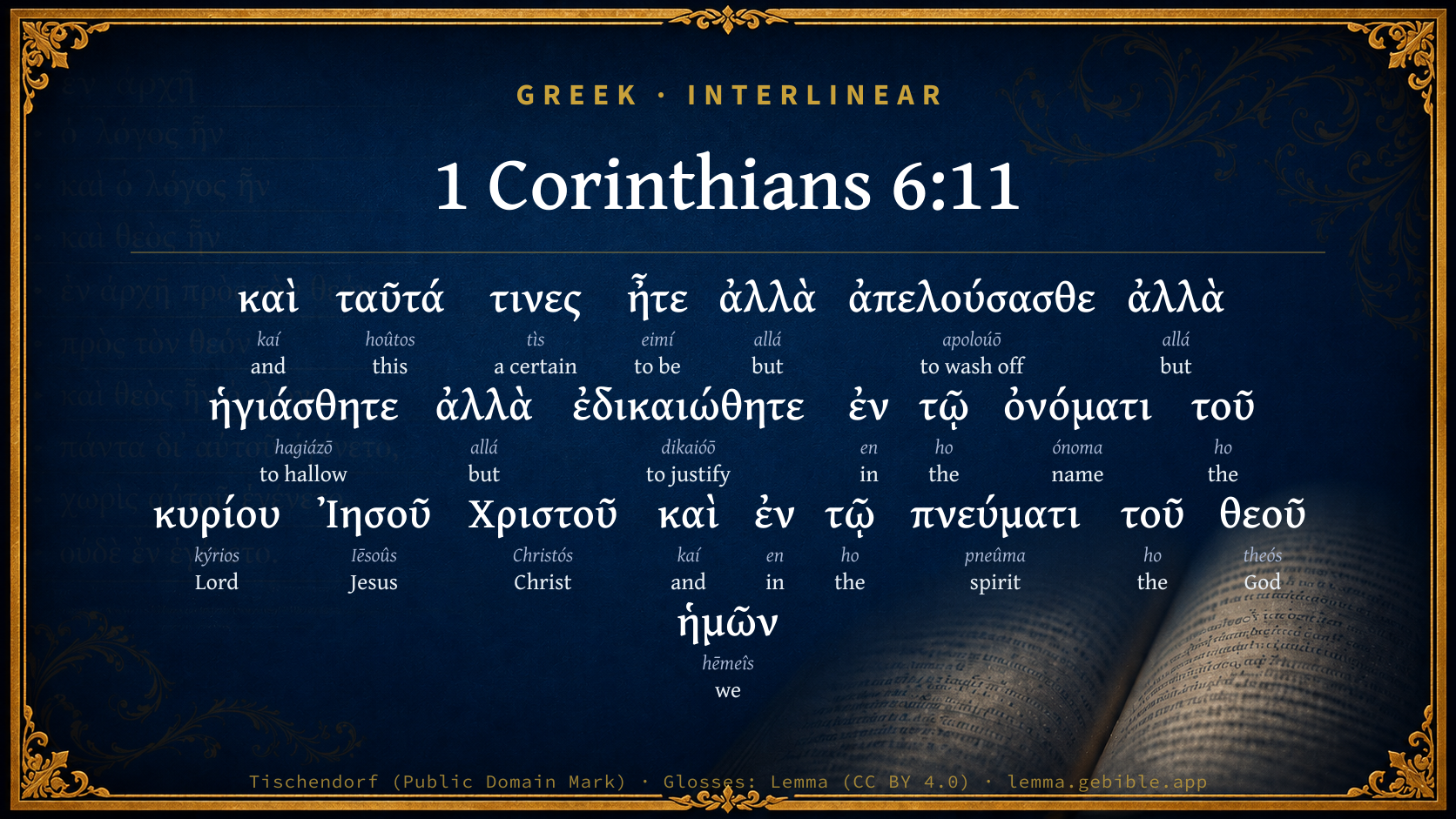
Download image
Cite this verse

1 Corinthians 6:11 (World English Bible). Public Domain. Lemma interlinear Bible study tool, https://lemma.gebible.app/v/1-corinthians/6/11.

Show BibTeX & RIS
BibTeX
RIS
English Translation
Such were some of you, but you were washed. But you were sanctified. But you were justified in the name of the Lord Jesus, and in the Spirit of our God.
World English Bible · Public Domain
Highlights
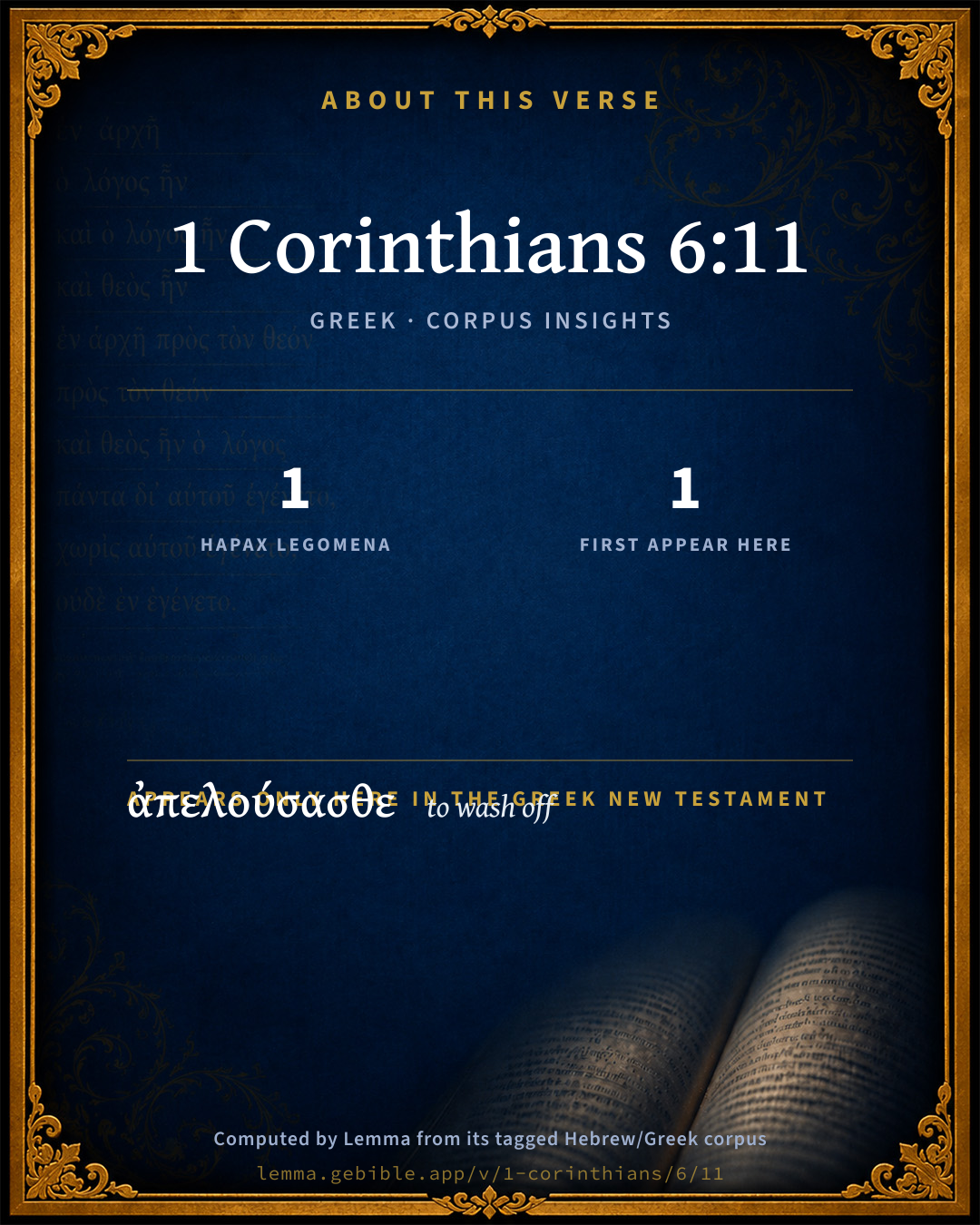
  • 1 hapax legomenon — only here in the Greek New Testament
  • 1 first appearance in the Greek New Testament
Full analysis ↓
Download a study sheet

One document with this verse’s original text, its word-by-word gloss line, the meaning frame, cross-references with their text, attributed commentary, and full source and license credits — printable, and it pastes into notes with its structure intact.

This verse Autodidact and up

Study sheet (.html) Plain text (.txt)

A passage Seminary Student

Up to 50 verses in one chapter. A passage sheet keeps up to 6 commentary sources and 12 cross-references per verse, in the order this page ranks them, and says so on the sheet whenever that leaves anything out. Ask for a single verse and you get the Autodidact verse sheet above.

Everything on this page stays free to read, with no account — the sheet is a download of what is already on screen, not access to it.

Want to remove ads? Support Godless Engineer
Compare translations 3

The same verse in 3 English versions, stacked beneath the original-language interlinear above. Click any original word for its lexicon entry.

Each is an independent rendering of the whole verse — the interlinear is not word-aligned to these translations.

Highlighted words mark where these versions differ — a whole-verse word diff, not a word-by-word alignment.

  • World English Bible Public Domain
    Such were some of you, but you were washed. But you were sanctified. But you were justified in the name of the Lord Jesus, and in the Spirit of our God.
  • King James Version Public Domain
    And such were some of you: but ye are washed, but ye are sanctified, but ye are justified in the name of the Lord Jesus, and by the Spirit of our God.
  • unfoldingWord Literal Text CC BY-SA 4.0
    And that some of you were. But you were washed, but you were sanctified, but you were justified in the name of the Lord Jesus Christ and by the Spirit of our God.

unfoldingWord Literal Text — © unfoldingWord, licensed CC BY-SA 4.0. Word-aligned USFM3 via Door43 (git.door43.org/unfoldingWord/en_ult).

Versions to compare (up to 4)

3 of 4 selected

Show all 19 translations

Every available English version of this verse, each an independent rendering of the whole verse.

  • World English Bible Public Domain
    Such were some of you, but you were washed. But you were sanctified. But you were justified in the name of the Lord Jesus, and in the Spirit of our God.
  • Berean Standard Bible Public Domain
    And that is what some of you were. But you were washed, you were sanctified, you were justified, in the name of the Lord Jesus Christ and by the Spirit of our God.
  • Majority Standard Bible Public Domain
    And that is what some of you were. But you were washed, you were sanctified, you were justified, in the name of the Lord Jesus and by the Spirit of our God.
  • King James Version Public Domain
    And such were some of you: but ye are washed, but ye are sanctified, but ye are justified in the name of the Lord Jesus, and by the Spirit of our God.
  • American Standard Version (1901) Public Domain
    And such were some of you: but ye were washed, but ye were sanctified, but ye were justified in the name of the Lord Jesus Christ, and in the Spirit of our God.
  • Revised Version (1885) Public Domain
    And such were some of you: but ye were washed, but ye were sanctified, but ye were justified in the name of the Lord Jesus Christ, and in the Spirit of our God.
  • Geneva Bible (1599) Public Domain
    And such were some of you: but yee are washed, but yee are sanctified, but yee are iustified in the Name of the Lord Iesus, and by the Spirit of our God.
  • Douay-Rheims (1899) Public Domain
    And such some of you were; but you are washed, but you are sanctified, but you are justified in the name of our Lord Jesus Christ, and the Spirit of our God.
  • Young's Literal Translation Public Domain
    And certain of you were these! but ye were washed, but ye were sanctified, but ye were declared righteous, in the name of the Lord Jesus, and in the Spirit of our God.
  • Literal Standard Version CC BY-SA 4.0
    And certain of you were these! But you were washed, but you were sanctified, but you were declared righteous, in the Name of the Lord Jesus, and in the Spirit of our God.
  • Unlocked Literal Bible CC BY-SA 4.0
    That is what some of you were like. But you have been cleansed, you have been sanctified, you have been made right with God in the name of the Lord Jesus Christ and by the Spirit of our God.
  • unfoldingWord Literal Text CC BY-SA 4.0
    And that some of you were. But you were washed, but you were sanctified, but you were justified in the name of the Lord Jesus Christ and by the Spirit of our God.
  • Darby Bible Public Domain
    And these things were some of you; but ye have been washed, but ye have been sanctified, but ye have been justified in the name of the Lord Jesus, and by the Spirit of our God.
  • World Messianic Bible Public Domain
    Some of you were such, but you were washed. You were sanctified. You were justified in the name of the Lord Yeshua, and in the Spirit of our God.
  • Webster's Bible Public Domain
    And such were some of you: but ye are washed, but ye are sanctified, but ye are justified in the name of the Lord Jesus, and by the Spirit of our God.
  • Free Bible Version CC BY-SA 4.0
    Some of you were once like that, but you have been made clean and holy. You have been made right in the name of the Lord Jesus Christ, and in the Spirit of our God.
  • Bible in Basic English Public Domain
    And such were some of you; but you have been washed, you have been made holy, you have been given righteousness in the name of the Lord Jesus Christ and in the Spirit of our God.
  • Text-Critical English NT CC BY 4.0
    And that is what some of you were. But you were washed, you were sanctified, you were justified in the name of the Lord Jesus and by the Spirit of our God.
  • Tyndale New Testament (1534) Public Domain
    And soche ware ye verely: but ye are wesshed: ye are sanctified: ye are iustified by the name of the Lorde Iesus and by the sprete of oure God.

Literal Standard Version (2020), Covenant Press — licensed CC BY-SA 4.0. Text via the HelloAO Bible API (eBible.org). Unlocked Literal Bible (unfoldingWord) — licensed CC BY-SA 4.0. Text via the HelloAO Bible API (eBible.org). unfoldingWord Literal Text — © unfoldingWord, licensed CC BY-SA 4.0. Word-aligned USFM3 via Door43 (git.door43.org/unfoldingWord/en_ult). Free Bible Version, Dr. Jonathan Gallagher — licensed CC BY-SA 4.0. Text via the HelloAO Bible API (eBible.org).

Word by word

More ways to search: Search by grammar → Find every occurrence → Compare this word →

Practice this passage: Drill this verse → Learn its vocabulary →

ἀπελούσασθε
apoloúō
G628
“to wash off”
Verb, Aorist, Middle, Indicative, 2nd person, Plural
Part of Speech
Verb
Tense
Aorist
Voice
Middle
Mood
Indicative
Person
2nd person
Number
Plural
Full Thayer's Definition

Origin: from G575 and G3068

TDNT: 08:55,5

1. to wash off or away
  1. καὶ kaí G2532 “and” Conjunction
  2. ταῦτά hoûtos G3778 “this” Demonstrative pronoun, Nominative, Plural, Neuter
  3. τινες tìs G5100 “a certain” Indefinite pronoun, Nominative, Plural, Masculine
  4. ἦτε eimí G1510 “to be” Verb, Imperfect, Active, Indicative, 2nd person, Plural
  5. ἀλλὰ allá G235 “but” Conjunction
  6. ἀλλὰ allá G235 “but” Conjunction
  7. ἡγιάσθητε hagiázō G37 “to hallow” Verb, Aorist, Passive, Indicative, 2nd person, Plural
  8. ἀλλὰ allá G235 “but” Conjunction
  9. ἐδικαιώθητε dikaióō G1344 “to justify” Verb, Aorist, Passive, Indicative, 2nd person, Plural
  10. ἐν en G1722 “in” Preposition
  11. τῷ ho G3588 “the” Article, Dative, Singular, Neuter
  12. ὀνόματι ónoma G3686 “name” Noun, Dative, Singular, Neuter
  13. τοῦ ho G3588 “the” Article, Genitive, Singular, Masculine
  14. κυρίου kýrios G2962 “Lord” Noun, Genitive, Singular, Masculine
  15. Ἰησοῦ Iēsoûs G2424 “Jesus” Noun, Genitive, Singular, Masculine
  16. Χριστοῦ Christós G5547 “Christ” Noun, Genitive, Singular, Masculine
  17. καὶ kaí G2532 “and” Conjunction
  18. ἐν en G1722 “in” Preposition
  19. τῷ ho G3588 “the” Article, Dative, Singular, Neuter
  20. πνεύματι pneûma G4151 “spirit” Noun, Dative, Singular, Neuter
  21. τοῦ ho G3588 “the” Article, Genitive, Singular, Masculine
  22. θεοῦ theós G2316 “God” Noun, Genitive, Singular, Masculine
  23. ἡμῶν hēmeîs G2249 “we” Personal pronoun, 1st person, Genitive, Plural

About this verse

These counts appear in no published source. They are computed here, from the morphology-tagged text and Lemma’s own curated glosses. What Lemma adds →

24
words
17
distinct lemmas
Pauline Epistles
section

Notable vocabulary

1 hapax legomenon — a word that appears only here in the entire Greek New Testament:

  • ἀπελούσασθε to wash off G628

First appearance in Scripture

This word makes its first canonical appearance in the Greek New Testament here:

  • ἀπελούσασθε to wash off G628

Shared distinctive vocabulary

ἡγιάσθητε to hallow G37 occurs in 25 verses of the Greek New Testament. Also found in:
Repetition

Words recur within this verse:

Cross-references

45

Topical passages linked to 1 Corinthians 6:11 in the Treasury of Scripture Knowledge — connected by theme and wording, ordered by reader-vote popularity; previews shown in the World English Bible.

  • 1 Corinthians 1:30 But of him, you are in Christ Jesus, who was made to us wisdom from God, and righteousness and sanctification, and redemption:
  • Colossians 3:5–7 Put to death therefore your members which are on the earth: sexual immorality, uncleanness, depraved passion, evil desire, and covetousness, which is idolatry;
  • 1 Corinthians 1:2 to the assembly of God which is at Corinth; those who are sanctified in Christ Jesus, called to be saints, with all who call on the name of our Lord Jesus Christ in every place, both theirs and ours:
  • Romans 6:17–19 But thanks be to God, that, whereas you were bondservants of sin, you became obedient from the heart to that form of teaching whereunto you were delivered.
  • Acts 22:16 Now why do you wait? Arise, be baptized, and wash away your sins, calling on the name of the Lord.'
  • Romans 8:30 Whom he predestined, those he also called. Whom he called, those he also justified. Whom he justified, those he also glorified.
  • 1 Peter 1:2 according to the foreknowledge of God the Father, in sanctification of the Spirit, that you may obey Jesus Christ and be sprinkled in his blood: Grace to you and peace be multiplied.
  • Titus 3:3–7 For we were also once foolish, disobedient, deceived, serving various lusts and pleasures, living in malice and envy, hateful, and hating one another.
  • Ephesians 5:26 that he might sanctify it, having cleansed it by the washing of water with the word,
  • Hebrews 10:22 let's draw near with a true heart in fullness of faith, having our hearts sprinkled from an evil conscience, and having our body washed with pure water,
  • Acts 26:18 to open their eyes, that they may turn from darkness to light and from the power of Satan to God, that they may receive remission of sins and an inheritance among those who are sanctified by faith in me.'
  • Acts 13:39 and by him everyone who believes is justified from all things, from which you could not be justified by the law of Moses.
  • Ephesians 5:8 For you were once darkness, but are now light in the Lord. Walk as children of light,
  • Romans 5:1 Being therefore justified by faith, we have peace with God through our Lord Jesus Christ;
  • Romans 8:33 Who could bring a charge against God's chosen ones? It is God who justifies.
  • Galatians 3:11 Now that no man is justified by the law before God is evident, for, "The righteous will live by faith."
  • 2 Thessalonians 2:13 But we are bound to always give thanks to God for you, brothers loved by the Lord, because God chose you from the beginning for salvation through sanctification of the Spirit and belief in the truth;
  • Isaiah 53:11 He shall see of the travail of his soul, [and] shall be satisfied: by the knowledge of himself shall my righteous servant justify many; and he shall bear their iniquities.
  • Galatians 5:22–23 But the fruit of the Spirit is love, joy, peace, patience, kindness, goodness, faithfulness,
  • Ephesians 2:1–3 You were made alive when you were dead in transgressions and sins,
  • Ephesians 4:17–22 This I say therefore, and testify in the Lord, that you no longer walk as the rest of the Gentiles also walk, in the futility of their mind,
  • Revelation 1:5 and from Jesus Christ, the faithful witness, the firstborn of the dead, and the ruler of the kings of the earth. To him who loves us, and washed us from our sins by his blood;
  • Psalms 51:2 Wash me thoroughly from my iniquity. Cleanse me from my sin.
  • Psalms 51:7 Purify me with hyssop, and I will be clean. Wash me, and I will be whiter than snow.
  • 1 Corinthians 12:2 You know that when you were heathen, you were led away to those mute idols, however you might be led.
  • Galatians 2:16 yet knowing that a man is not justified by the works of the law but through the faith of Jesus Christ, even we believed in Christ Jesus, that we might be justified by faith in Christ, and not by the works of the law, because no flesh will be justified by the works of the law.
  • Revelation 7:14 I told him, "My lord, you know." He said to me, "These are those who came out of the great tribulation. They washed their robes, and made them white in the Lamb's blood.
  • Isaiah 45:25 In Yahweh shall all the seed of Israel be justified, and shall glory.
  • Ezekiel 36:25 I will sprinkle clean water on you, and you shall be clean: from all your filthiness, and from all your idols, will I cleanse you.
  • Romans 3:24 being justified freely by his grace through the redemption that is in Christ Jesus;
  • Romans 3:26–30 to demonstrate his righteousness at this present time; that he might himself be just, and the justifier of him who has faith in Jesus.
  • Romans 5:9 Much more then, being now justified by his blood, we will be saved from God's wrath through him.
  • Galatians 3:8 The Scripture, foreseeing that God would justify the Gentiles by faith, preached the Gospel beforehand to Abraham, saying, "In you all the nations will be blessed."
  • Galatians 3:24 So that the law has become our tutor to bring us to Christ, that we might be justified by faith.
  • Hebrews 2:11 For both he who sanctifies and those who are sanctified are all from one, for which cause he is not ashamed to call them brothers,
  • Proverbs 30:12 There is a generation that is pure in their own eyes, Yet are not washed from their filthiness.
  • Isaiah 1:16 Wash yourselves, make yourself clean. Put away the evil of your doings from before my eyes; Cease to do evil.
  • Romans 4:5 But to him who doesn't work, but believes in him who justifies the ungodly, his faith is accounted for righteousness.
  • James 2:21–26 Wasn't Abraham our father justified by works, in that he offered up Isaac his son on the altar?
  • 1 Peter 1:22 Seeing you have purified your souls in your obedience to the truth through the Spirit in sincere brotherly affection, love one another from the heart fervently:
  • 1 Peter 3:21 This is a symbol of baptism, which now saves you-- not the putting away of the filth of the flesh, but the answer of a good conscience toward God, through the resurrection of Jesus Christ,
  • 1 Peter 4:2–3 that you no longer should live the rest of your time in the flesh for the lusts of men, but for the will of God.
  • Jeremiah 4:14 Jerusalem, wash your heart from wickedness, that you may be saved. How long shall your evil thoughts lodge within you?
  • Luke 18:14 I tell you, this man went down to his house justified rather than the other; for everyone who exalts himself will be humbled, but he who humbles himself will be exalted."
  • John 13:10 Jesus said to him, "Someone who has bathed only needs to have his feet washed, but is completely clean. You are clean, but not all of you."

Cross-references courtesy of OpenBible.info (CC BY 4.0).

Where the printed editions differ

2 variants

Places in this verse where the major printed Greek editions disagree on the wording in a way that affects the translation — a comparison of editions, not a manuscript-by-manuscript collation. The editions are the modern critical texts (Nestlé-Aland 28/27, SBL, Westcott-Hort, Tregelles, Tyndale House) and the traditional texts behind the KJV (the Textus Receptus and the Byzantine/Majority text). It is not a claim about which reading is original.

  1. Extra text
    ἡμῶν

    “of us”

    In TynWH Not in NA28NA27SBLTregTRByz

    ἡμῶν (hēmōn) 'of us' is only in a few manuscripts (Tyn+WH)

  2. Extra text
    Χριστοῦ

    “Christ”

    In NA28NA27TynWHTreg Not in SBLTRByz

    Χριστοῦ (Christou) 'Christ' is only in older manuscripts (NA28+NA27+Tyn+WH+Treg)

Textual data: Translators Amalgamated Greek New Testament (STEPBible TAGNT) · CC BY 4.0.

Commentary

Notes on 1 Corinthians 6:11 from classic Christian and Jewish commentators (each source and its license shown beneath its notes). The classic Christian expositions comment on the surrounding passage and are grouped to its opening verse, so a note may address several verses; the Jewish commentaries on the Tanakh (Rashi and others) are per-verse, so they appear only where the commentator wrote on this verse.

Lemma curates 59 commentaries, every one of them public domain or Creative Commons licensed, each selected and text-cleaned for this edition rather than reprinted as found. About our sources →

The Biblical Illustrator

Joseph S. Exell

1Co_6:11-12

And such were some of you, but ye are washed … sanctified … Justified.

The great contrast

Note--

I. The past state of the redeemed. And such were some of you.

1. They were void of moral rectitude. Their conscience was burdened with guilt.

2. They were subject to impure influences. Their affections were defiled. When conscience loses its authority there is nothing to prevent the soul becoming the slave of the most debasing influences.

3. They were slaves of wrong habits. Their deeds were evil. When both the conscience and affections are wrong, the deeds must be inconsistent with truth and righteousness.

4. They were incapable of spiritual enjoyment. Know ye not that the unrighteous shall not inherit the kingdom of God? The unrighteous have no capacity, taste, or fitness for it.

II. The present state of the redeemed But ye are washed, &c. Note--

1. The change.

(1) An initiatory act. But ye are washed. There is probably an allusion here to baptism, the emblem of moral cleansing. But as the water of baptism cannot wash away sin, the apostle evidently refers to the work of the Holy Spirit on the heart.

(2) A progressive development. But ye are sanctified. This does not imply faultless perfection, but consecration. Christian graces, like living plants, gradually mature.

3. A beautiful completion. But ye are justified. This act, though mentioned last, is generally considered the first. There are three great causes at work in mans justification.

(1) The merits of Christ. Being justified freely by His grace, &c.

(2) The faith of the believer. Man is justified by faith without the deeds of the law.

(3) The influence of the Holy Spirit. And by the Spirit of our God. Think of a man who, having fallen overboard, is carried away by the current. At last a rope is thrown towards him--he eagerly grasps it--and he is thereby rescued. We have here a combination of causes. The kind friend who threw the rope--the rope itself--and the mans own eager grasp. Thus the Saviours merits, the penitents faith, and the influence of the Spirit are necessary to secure the salvation of the soul.

2. The means. In the name of the Lord Jesus. Nothing but that has sufficient power to change the heart.

3. The agency. And by the Spirit of our God. It is He that gives effect to the word preached--moves the heart, destroys the yoke of sin, and creates the man a new creature in Christ Jesus. (J. H. Hughes.)

The power of the gospel in changing the hearts and lives of men

I. The gospel of Christ is abundantly sufficient for saving the greatest sinners.

1. The salvation of a sinner consists in his deliverance from the guilt and punishment of sin; and his recovery to the Divine image, i.e., his justification and his sanctification. Let either of these blessings be wanting, and his salvation would be unfinished. But in both these respects the gospel remedy is abundantly sufficient.

2. The instance in the text is to the point. Surely, if there could have been any sinners, whose case the gospel remedy would not reach, these Corinthians would have been the persons. If you require any more witnesses, look at many celebrated in the Scripture for their piety, and see what they had formerly been. What had the Ephesian converts been? (Eph_2:1; Eph_2:3; Eph_2:12.) What had Matthew, Onesimus, and St. Paul himself been? But for all these the gospel proved sufficient, for the thief upon the cross, for the jailer at Philippi, for thousands among the wicked Jews--for tens of thousands among the idolatrous Gentiles.

3. Let us then apply the truth--

(1) For correcting a common error respecting others. When we see a person notoriously evil, how apt are we to speak of him as being past recovery! But remember that the same grace, which was sufficient for the Corinthians, will be sufficient for him.

(2) For consolation and encouragement to convinced and humbled sinners. Are you filled with anxious fears for your safety? Well, suppose that your former state has been as bad as that of the Corinthians, yet He who saved them can save you. But while the truth speaks comfort to the penitent, it leaves the impenitent without excuse. Is the gospel sufficient for saving the greatest sinners? Then why do any of you continue in the practice of sin? Is it not plain that you love darkness rather than light; that you prefer slavery to freedom; that you will not come to Christ, that you may have life?

II. A mans religion is to be tried, not by what he was, but by what he is.

1. True religion makes a real change in a man. Would we then know whether a man be truly religious or not, we must inquire what is his present conduct.

2. Let this truth then correct a too general practice. When a man begins to take up a serious profession of religion, nothing is more common than to hear all the irregularities of his former life charged against him as proofs of his present hypocrisy.

3. But while we apply this truth for correcting our wrong judgment of others, let us also use it for forming a right judgment of ourselves. Are we still the servants of sin? Or have we been made free from sin? (E. Cooper, M. A.)

Triumphs of the gospel at Corinth

One of the most common and powerful objections against Christianity is that many who profess it are by no means affected with it; that such professors cannot therefore believe it, or if they do, it must be destitute of moral power. But the badness of the copy is no proof of the badness of the original; the baseness of the counterfeit coin is no proof of the baseness of the genuine. Let the religion of Jesus be compared with its own standards; let it be tried by its own rules. With the crimes of religious professors we have nothing to do but to deplore and avoid them. What Corinth was, we know. To this focus of all that is horrible St. Paul went, and he did not preach in vain. What these Corinthians had been, St. Paul tells us in the context: but now they were washed, &c.

I. The fearful state of unconverted men.

1. Nothing can be more clear than the doctrine of universal depravity; but this depravity exhibits itself under various aspects, and in various degrees. These Corinthians had been uncommonly vile. Nor they only. We know of the thief who was pardoned on the tree. This, indeed, is not uniformly the case. For in the characters of multitudes we see much that is pleasing, even the grace of God. There are many who are not far from the kingdom, and who yet appear never to reach it.

2. We ought to regard the depravity of man with deep sorrow and compassion, but not with despair. The very glory of the gospel is that it is a message of pardon and mercy to the guilty, the bankrupt, and the undone. But perhaps some of you may despair, not of the conversion of others, but of your own. Such should remember these Corinthians, and the apostle who converted them.

II. The renewed state of these Corinthians.

1. Ye are washed. Since sanctification and justification are mentioned directly afterwards, perhaps this refers to baptism.

2. Ye are sanctified, i.e., ye are more and more alienated from the world, and conformed to the image and the will of God.

3. Ye are justified, i.e., your sins are pardoned, and you are accepted as righteous before God, through faith in Christ.

III. The Divine method of sanctification and justification here exhibited. In the name of the Lord Jesus means--

1. Doing anything by the authority of Christ. Master, we saw one casting out devils in Thy name.

2. Doing anything for the honour of Christ: thus St. Paul says--Whatsoever ye do in word or deed, do all in the name of the Lord Jesus, &c.

3. Receiving anything from the Father, through His dear Son: thus our Lord says Whatsoever ye shall ask the Father in My name, on account of My merits, He will give it you. The text, then, teaches us that the only method by which we can approach God, the only method by which God can display His grace and love to man, is through Christ. (G. Weight, M. A.)

Cleansed by the Spirit

There is a lonely little pool of water on the mountain side near Tarbet, Loch Lomond, called the Fairy Loch. If you look into it you will see a great many colours in the water, owing to the varied nature of the materials that form its bottom. There is a legend about it which says that the fairies used to dye things for the people round about, if a specimen of the colour wanted was left along with the cloth on the brink of the pool at sunset. One evening a shepherd left beside the Fairy Loch the fleece of a black sheep, and placed upon it a white woollen thread to show that he wished the fleece dyed white. This fairly puzzled the good folk. They could dye a white fleece any colour, but to make a black fleece white was impossible. In despair they threw all their colours into the loch, giving it its present strange look, and disappeared for ever. This may seem a foolish fable, but it has a wise moral. What the fairies could not do beside the Fairy Loch, the Spirit of God can do beside the fountain opened for sin and uncleanness. He can make the blackest soul white. (Hugh Macmillan, D. D.)

The great change

A piece of canvas is of a trifling value. You can buy it for a few pennies. You would scarcely think it worth picking up if you saw it lying in the street. But an artist takes it and draws a few lines and figures on it, and then with his brush touches in certain colours, and the canvas is sold for a large sum. So Godtakes up a ruined, worthless human life which has no beauty, no attractiveness, but is repulsive, blotched, and stained by sin. Then the fingers of His love add touches of beauty, painting the Divine image upon it, and it becomes precious and glorious. (J. R. Miller.)

Moral transformations

There are marvellous transformations in the material as also in the moral world. Look in the material world. The full-fed maggot, that has rioted in filth till its tender skin seems ready to burst with repletion, when the appointed time arrives leaves the offensive matters it was ordained to assist in removing, and gets into some convenient hole or crevice; then its body contracts or shortens, and becomes egg-shaped, while the skin hardens, and turns brown and dry, so that, under this form, the creature appears more like a seed than a living animal; after some time passed in this inactive and equivocal form, during which wonderful changes have taken place within the seed-like shell, one end of the shell is burst off, and from the inside comes forth a buzzing fly, that drops its former filthy habits with its cast-off dress, and now, with a more refined taste, seeks only to lap the solid viands of our tables, or sip the liquid contents of our cups. Look again into the moral world. There you see a transformation as wonderful. The selfish debauchee, whose horrid taste has grubbed in every sort of immoral filth, and become habituated to the harsh, the cruel, and the dishonourable, has been brought into contact with the necessary spiritual conditions for a change, and behold from one stage to another he passes until at last his tastes are entirely altered, his existence is changed, and even he is able to soar in the light and purity of the world. Elsewhere, behold, the miser is transformed to the philanthropist, the coward into a hero. We watch the flys aerial circlings in the sunbeam, and remember with wonder its degraded origin. The preacher looks over his congregation, and he sees those who have become noble and virtuous, he is able to take heart for new work; for as he remembers in their presence the debased and the wicked who are yet to be transformed, he says, And such were some of you; but you are regenerated by the higher Power, and those others may be changed likewise. (Scientific Illustrations and Symbols.)

The Biblical Illustrator, edited by Joseph S. Exell (c. 1880s–1900s) — public domain. Text from a community e-Sword module.

Tyndale Open Study Notes

Tyndale Open Resources

6:11 Following the strong warning of 6:9-10, Paul reaffirms his confidence in the genuineness of his readers’ conversion. • you were cleansed (cp. Acts 22:16): Cleanliness is a metaphor for the righteousness that comes from forgiveness (see Titus 3:5). They were made holy by God himself (see 1 Cor 1:2). • They were made right with God by their identification with the Lord Jesus Christ and by the transforming work of the Spirit of our God. God has forgiven them and views them as righteous (see Rom 1:17; 3:21-26), and their lives have really been changed for the good (see Titus 3:5-7).

Tyndale Open Study Notes — © Tyndale Open Resources, licensed CC BY-SA 4.0. Text via the HelloAO Bible API.

Bengel's Gnomon

Johann Albrecht Bengel

1Co 6:11. Ταῦτα, such) The Nominative neuter for the masculine; or the accusative with κατα understood, as ἶσα, Php 2:6: Even the accusative as an adverb may be construed with the substantive verb to be.—ἀλλὰ ἀπελούσασθε, ἀλλὰ ἡγιάσθητε, ἀλλʼ ἐδικαιώθητε, but ye have been washed, but ye have been sanctified, but ye have been justified) you have been set entirely free from fornication and sins of impurity, in regard to yourselves; from idolatry and impiety against God; from unrighteousness against your neighbour, and that too, in relation both to the guilt and dominion of sin: chap. 1Co 5:7; 1Co 5:10.—ἡγιάσθητε, you have been sanctified) a man is called holy in respect to God.—ἐδικαιώθητε, ye have been justified) corresponds to, the unrighteous, 1Co 6:9. I was formerly unwilling to commit to paper, what emphasis the apostrophe in ἀλλʼ adds to this verb more than to the two preceding (comp. 2Co 7:11), lest some one should hiss me. Consider however the antithesis, the unrighteous. Without an apostrophe, ἀλλὰ is emphatic, but when ἀλλʼ has the apostrophe, the accent and emphasisfall upon the verb, (which stands in opposition to that fault, which is reproved at 1Co 6:7, etc.,) namely, on the word ἐδικαιώθητε, ye are justified, because the discourse here is directed against [injustice] unrighteousness; and so in 2Co 7:11. [ἀλλʼ is apostrophised before] ἐκδικησιν, revenge, for this is a principal part of the zeal, previously spoken of, arising from holy sorrow; add Mar 2:17.—ἐν τῷ ὀνόματι, in the name) From this name we have the forgiveness of sins.—ἐν τῷ Πνεύματι, by the Spirit) From this Spirit, the new life.—ἡμῶν, of our) For these reasons, he shows them, that there is now no longer any hinderance to their becoming heirs of the kingdom of God.

Bengel's Gnomon of the New Testament — English translation (T&T Clark, Edinburgh, 1860) — public domain. Text from a community e-Sword module.

Meyer's Critical & Exegetical Commentary

Heinrich August Wilhelm Meyer

1Co_6:11. How unworthy are such of your new Christian relations!

ταῦτα] of persons in a contemptuous sense: such trash, such a set. See Bernhardy, p. 281.

τινές] more exact definition of the subject of ἦτε, namely, that all are not meant. It is the well-known σχῆμα καθʼ ὅλον καὶ μέρος (Kühner, II. p. 156). Comp Grotius. Valckenaer says well: vocula τινές dictum paulo durius emollit. Billroth is wrong in holding (as Vorstius before him) that ταῦτά τινες belong to each other, and are equivalent to τοιοῦτοι. In that case ταῦτά τινα would be required, or τοῖοί τινες. See Ast, a[935] Plat. Legg. p. 71; Bornemann, a[936] Xen. Cyr. ii. 1. 2; Ellendt, Lex. Soph. II. p. 832.

ἀπελούσ. κ.τ.λ[937]] describes from step to step the new relations established by their reception of Christianity. First of all: ye washed yourselves clean, namely, by your immersion in the waters of baptism, from the moral defilement of the guilt of your sins (you obtained, through means of baptism, the forgiveness of your sins committed before you became Christians). Comp Act_22:16; Act_2:38; Eph_5:26; 1Pe_3:21. Observe the use of the middle, arising from the conception of their self-destination for baptism. Comp ἘΒΑΠΤΊΣΑΝΤΟ, 1Co_10:2. We must not take the middle here for the passive, as most expositors do, following the Vulgate (so Flatt, Pott, Billroth, Olshausen, Ewald), which in part aroseas in the case of Olshausenfrom dogmatical preconceptions; neither is it to be understood, with Usteri (Lehrbegriff, p. 230) and Rückert (comp Loesner, p. 278), of moral purification by laying aside everything sinful, of the putting off the old man (comp Rom_6:2 ff.), against which the same phrase in Act_22:16, and the analogous one, ΚΑΘΑΡΊΣΑς, in Eph_5:26, militate strongly. This moral regeneration exists in connection with baptism (Tit_3:5), but is not designated by ἀπελούσ., although its subjective conditions, ΜΕΤΆΝΟΙΑ and ΠΊΣΤΙς, are presupposed in the latter expression. The producing of regeneration, which is by water and Spirit, is implied in the ἡγιάσθητε which follows: ye became (from being unholy, as ye were before baptism) holy, inasmuch, namely, as by receiving the δωρεὰ τοῦ ἁγίου πνεύματος (Act_2:38) ye were translated into that moral altitude and frame of life which is Christian and consecrated to God (Joh_3:5; Tit_3:5; Eph_5:25, ἉΓΙΆΣῌ). Rückert and Olshausen take it in the theocratic sense: ye became set apart, numbered among the ἍΓΙΟΙ. Comp Osiander, also Hofmann: incorporated in the holy church. But the progression of thought here, which marks its advance towards a climax by the repetition of the ἀλλά, requires, not a threefold description of the transaction involved in baptism (Calvin, Hofmann), but three different characteristic points, dating their commencement from baptism, and forming, as regards their substance, the new moral condition of life from which those who have become Christians ought not again to fall back.

ἐδικαιώθητε] ye were made righteous. This, however, cannot mean the imputative justification of Rom_3:21 (de Wette, Osiander, Hofmann, with older commentators); because, in the first place, this is already given in the ἀπελούσασθε; and secondly, because the ἘΔΙΚΑΙΏΘΗΤΕ, if used in this sense, would have needed not to follow the ἉΓΙΆΣΘΗΤΕ, but to precede it, as in 1Co_1:30; for to suppose a descending climax (Calovius) is out of the question, if only on account of the ἀπελούσ., which so manifestly indicates the beginning of the Christian state. What is meant, and that by way of contrast to the notion of ἀδικία which prevails in 1Co_6:9 f., is the actual moral righteousness of life,[943] which has been brought about as the result of the operation of the Spirit which began with baptism, so that now there is seen in the man the fulfilment of the moral demands or of the δικαίωμα τοῦ νόμου (Rom_8:4), and he himself, being dead unto sin, δεδικαίωται ἀπὸ τῆς ἁμαρτίας (Rom_6:7), and ἐδουλώθη τῇ δικαιοσύνῃ (Rom_6:18), whose instruments his members have now become in the καινότης of the spirit and life (Rom_6:13). This δικαιωθῆναι does not stand related to the ἁγιασθῆναι in any sort of tautological sense, but is the effect and outcome of it, and in so far, certainly, is also the moral continuatio justificationis (comp Calovius), Rev_22:11.

The thrice repeated ἀλλά lays a special emphasis upon each of the three points. Comp Xenophon, Anab. v. 8. 4; Aristophanes, Acharn. 402 ff.; 2Co_2:17; 2Co_7:11; Wyttenbach, a[946] Plat. Phaed. p. 142; Bornemann, a[947] Xen. Symp. iv. 53; Buttmann, neut. Gramm. p. 341 [E. T. 398].

ἐν τῷ ὀνόματι … ἡμῶν] is by most expositors made to refer to all the three points. But since ἐν τῷ πνεύματι κ.τ.λ[948] does not accord with ἈΠΕΛΟΎΣ. (for the Spirit is only received after baptism, Act_2:38; Act_19:5-6; Tit_3:5-6; the case in Act_10:47 is exceptional), it is better, with Rückert, to connect ἐν τῷ ὀνόματι … ἡμῶν simply with ἘΔΙΚΑΙΏΘ., which best harmonizes also with the significant importance of the ἐδικαιώθητε as the crowning point of the whole transformation wrought in the Christian. The name of the Lord Jesus, i.e. what pronouncing the name Κύριος Ἰησοῦς (1Co_12:3) affirms,this, as the contents of the faith and confession, is that in which the becoming morally righteous had its causal basis (ἘΝ), and equally had it its ground in the Spirit of our God, since it was He who established it by His sanctifying agency; through that name its origin was subjectively conditioned, and through that Spirit it was objectively realized. Were we, with Hofmann, to bring ἐν τῷ ὀνόματι … Θεοῦ ἡμῶν into connection with the ΠΆΝΤΑ ΜΟΙ ἜΞΕΣΤΙΝ which follows, the latter would at once become limited and defined in a way with which the antitheses ἈΛΛʼ Κ.Τ.Λ[949] would no longer in that case harmonize. For it is precisely in the absoluteness of the πάντα μοι ἔξεστιν that these antitheses have their ethical correctness and significance, as being the moral limitation of that axiom, which therefore appears again absolutely in 1Co_10:23.

Observe, further, how, notwithstanding of the defective condition of the church in point of fact, the aorists ἡγιάσθ. and ἐδικαιώθ. have their warrant as acts of God, and in accordance with the ideal view of what is the specifically Christian condition, however imperfectly as yet this may have been realized, or whatever backsliding may have taken place. The ideal way of speaking, too, corresponds to the design of the apostle, who is seeking to make his readers feel the contradiction between their conduct and the character which as Christians they assumed at conversion; σφόδρα ἐντρεπτικῶς ἐπήγαγε λέγων· ἐννοήσατε ἡλίκων ὑμᾶς ἐξείλετο κακῶν ὁ Θεός κ.τ.λ[950], Chrysostom. And thereby he seeks morally to raise them.

[935] d refers to the note of the commentator or editor named on the particular passage.

[936] d refers to the note of the commentator or editor named on the particular passage.

[937] .τ.λ. καὶ τὰ λοιπά.

[943] There is therefore no warrant for adducing this passage, as is done on the Roman Catholic side (even by Döllinger), in opposition to the distinction between justification and sanctification. Justification is comprised already in ἀπελούσ. Comp. Weiss, bibl. Theol. pp. 342, 345 ff. Its subjective basis, however, is one with that of sanctification, namely, faith.

[946] d refers to the note of the commentator or editor named on the particular passage.

[947] d refers to the note of the commentator or editor named on the particular passage.

[948] .τ.λ. καὶ τὰ λοιπά.

[949] .τ.λ. καὶ τὰ λοιπά.

[950] .τ.λ. καὶ τὰ λοιπά.

Meyer — Critical and Exegetical Commentary on the New Testament — English translation by Peter Christie, edited by Frederick Crombie (T&T Clark, 1880) — public domain. Text from a community e-Sword module.

Expositor's Greek Testament

ed. W. Robertson Nicoll

1Co 6:11 . καὶ ταῦτά τινες ἦτε : “And these things you were, some (of you)”. The neuter ταῦτα is contemptuous “such abominations!” τινὲς softens the aspersion; the majority of Cor [956] Christians had not been guilty of extreme vice. The stress lies on the tense of ἦτε ; “you were ” a thing of the past, cf. Rom 6:19 , Eph 2:11 f. “But you washed yourselves! but you were sanctified; but you were justified!” ἀλλὰ thrice repeated, with joyful emphasis, as in 2Co 2:17 ; 2Co 7:11 . The first of the three vbs. is mid [957] , the other two pass [958] in voice. ἀπελούσασθε refers to baptism ( cf. Act 22:16 , Col 2:11 f., Eph 5:26 f., 1Pe 3:21 ; see 1Co 1:13 for its signal importance), in its spiritual meaning; the form of the vb [959] calls attention to the initiative of the Cor [960] in getting rid, at the call of God, of the filth of their old life; in baptism their penitent faith took deliberate and formal expression, with this effect. But behind their action in submitting to baptism, there was the action of God , operating to the effect described by the terms ἡγιάσθητε , ἐδικαίωθητε . These twin conceptions of the Christian state in its beginning appear commonly in the reverse order (see 1Co 1:30 , Rom 6:19 , etc.): in Rom 5:6 . they are seen to be related as the resurrection and death of Christ, and in Rom 6 . to be figured respectively in the ἀνάδυσις and κατάδυσις which formed the two movements of baptism; see notes ad locc. , also Tit 3:5 ff. The order of the words does not justify Calovius, Lipsius, and Mr [961] , with Romanist interpreters, in finding here “the ethical continuatio justificationis ,” an explanation contrary to the uniform Pauline signification of δικαιόω ; the Ap. is thinking (in contrast with 1Co 6:9 f.) of the status attained by his readers as ἅγιοι (1Co 1:2 , 1Co 3:17 , 1Co 6:1 ), behind which lay the fundamental fact of their δικαίωσις . The qualifying prpl [962] phrases both belong to the three closely linked vbs. Baptism is received “in the name of our Lord Jesus Christ” (quoted with formal solemnity: cf. note on 1Co 1:2 ): “in the Spirit of our God” it is validated and brings its appropriate blessings ( cf. Joh 3:5-8 : water is the formal, the Sp. the essential source of the new birth).

[956] Corinth, Corinthian or Corinthians.

[957] middle voice.

[958] passive voice.

[959] verb

[960] Corinth, Corinthian or Corinthians.

[961] Meyer’s Critical and Exegetical Commentary (Eng. Trans.).

[962]rpl. prepositional.

Βαπτίζειν ἐν Πν . ἁγίῳ was the distinctive work of Jesus Christ (Mat 3:11 , etc.); to be ἐν Πνεύματι ( Θεοῦ , Χριστοῦ ) is the distinctive state of a Christian, including every element of the new life (1Co 6:19 , 1Co 2:12 , 1Co 3:16 , 2Co 1:21 f., Rom 5:5 ; Rom 8:2 ; Rom 8:9 , etc.). Sanctification esp. is grounded in the Holy Spirit; but He is an agent in justification too, for His witness to sonship implies the assurance of forgiveness (Rom 8:15 ff.). The name of our Lord Jesus Christ sums up the baptismal confession ( cf. Rom 10:8 ff.); the Spirit of our God constitutes the power by which that confession is inspired, and the regeneration effectuated which makes it good: the two factors are identified in 1Co 12:3 (see note). “Our God,” in emphatic distinction from the gods in whose service the Cor [963] had been defiled (see 1Co 8:4 ff., 2Co 4:4 , Eph 2:2 ; cf. Psa 99:9 ).

[963] Corinth, Corinthian or Corinthians.

The Expositor's Greek Testament, edited by W. Robertson Nicoll (1897–1910) — public domain. Text from a community e-Sword module.

Hodge's Commentary on Romans, Ephesians & First Corinthians

Charles Hodge

1Co_6:11

And such were some of you: but ye are washed, but ye are sanctified, but ye are justified in the name of the Lord Jesus, and by the Spirit of our God.

And such were some of you. This is understood by many as equivalent to Such were you. The word (τινές) being redundant, or the idea being, Some were impure, some drunkards, some violent, etc., or ταῦτά τινες being taken together as equivalent to τοιοῦτοι. The natural explanation is, that the apostle designedly avoided charging the gross immoralities just referred to upon all the Corinthian Christians in their previous condition. With regard to the three terms which follow, washed, sanctified, justified, they may be taken, as by Calvin and others, to express the same idea under different aspects. That idea is, that they had been converted, or completely changed. They had put off the old man, and put on the new man. Their sins, considered as filth, had been washed away; considered as pollution, they had been purged or purified; considered as guilt, they had been covered with the righteousness of God, Rom_1:17. The majority of commentators take the several terms separately, each expressing a distinct idea. In what precise sense each of these words is to be understood, becomes, men, somewhat doubtful.

But ye are washed. The word here used (ἀπελούσασθε) is in the middle voice, and therefore may be rendered, ye have washed yourselves, or, permitted yourselves to be washed; or, as the majority of commentators prefer, on account of the following passives, ye were washed. This use of the First Aorist Middle in a passive sense is very unusual, but not unauthorized; see 1Co_10:2. It does not seem to be of much moment whether the word be taken here as active or as passive, for the same thing may be expressed in either form. Men are called upon to wash away their sins, Act_22:16; to put off the old man, etc. and to put on the new man, Eph_4:22, Eph_4:24; although the change expressed by these terms is elsewhere referred to God. The reason of this is, that a human and a divine agency are combined in the effects thus produced. We work our own salvation, while God works in us, Phi_2:12, Phi_2:13. With equal propriety, therefore, Paul might say to the Corinthians, Ye washed yourselves; or, Ye were washed. To wash means to purify, and is frequently used in Scripture to express moral or spiritual purification. Isa_1:16, Wash ye, make you clean. Psa_51:7, Wash me, and I shall be whiter than snow. Jer_4:14. In these and many other passages the word expresses general purification, without exclusive reference to guilt or to pollution. There is no reason why it should not be taken in this general sense here, and the phrase be rendered, either, Ye have purified yourselves, or, Ye are purified. The reference which so many assume to baptism, does not seem to be authorized by any thing in the context.

But ye are sanctified. This clause is either an amplification of the preceding one, expressing one aspect or effect of the washing spoken of, viz., their holiness; or, it is to be understood of their separation and consecration. Ye have not only been purified, but also set apart as a peculiar people. In Scripture, any thing is said to be sanctified that is devoted to the service of God. Thus, God blessed the seventh day and sanctified it, Gen_2:3. Moses sanctified the people, Exo_19:14, etc. etc.

But ye are justified. As to justify in Scripture always means to pronounce righteous, or to declare just in the sight of the law, it must be so understood here. The Corinthians had not only been purified and consecrated, but also justified, i.e. clothed in the righteousness of Christ, and on that account accepted as righteous in the sight of God. They were therefore under the highest possible obligation not to relapse into their former state of pollution and condemnation.

In the name of the Lord Jesus, and by the Spirit of our God. These clauses are not to be restricted to the preceding word, as though the meaning were, Ye have been justified in the name of the Lord Jesus, and by the Spirit of our God. They belong equally to all three of the preceding terms. The believers were indebted for the great change which they had experienced; for their washing, sanctification, and justification, to Christ and to the Holy Ghost. The Spirit had applied to them the redemption purchased by Christ. In the name of the Lord Jesus. The name of God, or of Christ, is often a paraphrase for God or Christ himself. To call upon the name of God is to call on God. To baptize unto the name of Christ, and to baptize unto Christ, are interchanged as synonymous expressions. So here, to be justified or sanctified in the name of Christ, means simply by Christ; see Joh_20:31, That believing ye might have life through his name. Act_10:43, That through his name whoso believeth in him might have remission of sins. Though these forms of expression are substantially the same as to their import, yet the name of God means not strictly God himself, but God as known and worshipped. The Holy Ghost is called the Spirit of our God; that is, the Spirit of our reconciled God and Father, by whom that Spirit is sent in fulfillment of the promise of the Father to the Son. Christ hath redeemed us from the curse of the law in order that we might receive the promise of the Spirit, Gal_3:13, Gal_3:14.

Charles Hodge — Commentary on Romans (1835), First Corinthians (1857), and Ephesians (1856) — public domain. Text from a community e-Sword module.

Geneva Bible (1599)

Geneva Bible translators

In Jesus.

Geneva Bible (1599) marginal notes — public domain. Text via Bolls.life.

Jamieson, Fausset & Brown

Robert Jamieson, A. R. Fausset & David Brown

ye are washed--The Greek middle voice expresses, "Ye have had yourselves washed." This washing implies the admission to the benefits of Christ's salvation generally; of which the parts are; (1) Sanctification, or the setting apart from the world, and adoption into the Church: so "sanctified" is used Co1 7:14; Joh 17:19. Compare Pe1 1:2, where it rather seems to mean the setting apart of one as consecrated by the Spirit in the eternal purpose God. (2) Justification from condemnation through the righteousness of God in Christ by faith (Rom 1:17). So PARÆUS. The order of sanctification before justification shows that it must be so taken, and not in the sense of progressive sanctification. "Washed" precedes both, and so must refer to the Christian's outward new birth of water, the sign of the inward setting apart to the Lord by the inspiration of the Spirit as the seed of new life (Joh 3:5; Eph 5:26; Tit 3:5; Heb 10:22). Paul (compare the Church of England Baptismal Service), in charity, and faith in the ideal of the Church, presumes that baptism realizes its original design, and that those outwardly baptized inwardly enter into vital communion with Christ (Gal 3:27). He presents the grand ideal which those alone realized in whom the inward and the outward baptism coalesced. At the same time he recognizes the fact that this in many cases does not hold good (Co1 6:8-10), leaving it to God to decide who are the really "washed," while he only decides on broad general principles.

in the name of . . . Jesus, and by the Spirit--rather, "in the Spirit," that is, by His in-dwelling. Both clauses belong to the three--"washed, sanctified, justified."

our God--The "our" reminds the that amidst all his reproofs God is still the common God of himself and them.

Jamieson, Fausset & Brown — Commentary Critical and Explanatory on the Whole Bible (1871) — public domain (CC PDM 1.0). Text via the HelloAO Bible API.

Adam Clarke's Commentary

Verse 11. And such were some of you] It was not with the prospect of collecting saints that the apostles went about preaching the Gospel of the kingdom. None but sinners were to be found over the face of the earth; they preached that sinners might be converted unto God, made saints, and constituted into a Church; and this was the effect as well as the object of their preaching.

But ye are washed] Several suppose that the order in which the operations of the grace of God take place in the soul is here inverted; but I am of a very different mind. Every thing will appear here in its order, when we understand the terms used by the apostle.

Ye are washed, απελουσασθε; ye have been baptized into the Christian faith, and ye have promised in this baptism to put off all filthiness of the flesh and spirit: and the washing of your bodies is emblematical of the purification of your souls.

Ye are sanctified] ηγιασθητε; from α, privative, and γη, the earth; ye are separated from earthly things to be connected with spiritual. Ye are separated from time to be connected with eternity. Ye are separated from idols to be joined to the living God. Separation from common, earthly, or sinful uses, to be wholly employed in the service of the true God, is the ideal meaning of this word, both in the Old and New Testaments. It was in consequence of their being separated from the world that they became a Church of God. Ye were formerly workers of iniquity, and associated with workers of iniquity; but now ye are separated from them, and united together to work out your salvation with fear and trembling before God.

Ye are justified] εδικαιωθητε. Ye have been brought into a state of favour with God; your sins having been blotted out through Christ Jesus, the Spirit of God witnessing the same to your conscience, and carrying on by his energy the great work of regeneration in your hearts. The process here is plain and simple:-

1. Paul and his brother apostles preached the Gospel at Corinth, and besought the people to turn from darkness to light-from idol vanities to the living God, and to believe in the Lord Jesus for the remission of sins.

2. The people who heard were convinced of the Divine truths delivered by the apostle, and flocked to baptism.

3. They were baptized in the name of the Lord Jesus, and thus took upon them the public profession of the Gospel.

4. Being now baptized into the Christian faith, they were separated from idols and idolaters, and became incorporated with the Church of God.

5. As penitents, they were led to the Lord Jesus for justification, which they received through faith in his blood.

6. Being justified freely-having their sins forgiven through the redemption that is in Jesus, they received the Spirit of God to attest this glorious work of grace to their consciences; and thus became possessed of that principle of righteousness, that true leaven which was to leaven the whole lump, producing that universal holiness without which none can see the Lord.

Adam Clarke's Commentary on the Bible (1810–1826) — public domain. Text from a community e-Sword/MySword module.

John Calvin's Commentaries

11. And such were ye. Some add a term of speciality: Such were some of you, as in Greek the word τινὲς is added; but I am rather of opinion that the Apostle speaks in a general way. I consider that term to be redundant, in accordance with the practice of the Greeks, who frequently make use of it for the sake of ornament, not by way of restriction. We must not, however, understand him as putting all in one bundle, so as to attribute all these vices to each of them, but he simply means to intimate, that no one is altogether free from these vices, until he has been renewed by the Spirit. For we must hold this, that man’s nature universally contains the seed of all evils, but that some vices prevail and discover themselves more in some than in others, according as the Lord brings out to view the depravity of the flesh by its fruits.

Thus Paul, in the first chapter of his Epistle to the Romans, piles up many different kinds of vices and crimes, which flow from ignorance of God, and that ingratitude, of which he had shown all unbelievers to be guilty, (Romans 1:21-32) — not that every unbeliever is infected with all these vices, but that all are liable to them, and no one is exempt from them all. For he who is not an adulterer, sins in some other way. So also in the third chapter he brings forward as applicable to the sons of Adam universally those declarations —

their throat is an open sepulcher: their feet are swift to shed blood: their tongue is deceitful or poisonous, (Romans 3:13-15)

— not that all are sanguinary and cruel, or that all are treacherous or revilers; but that, previously to our being formed anew by God, one is inclined to cruelty, another to treachery, another to impurity, another to deceit; so that there is no one in whom there does not exist some trace of the corruption common to all; and we are all of us, to a man, by an internal and secret affection of the mind, liable to all diseases, unless in so far as the Lord inwardly restrains them from breaking forth openly. The simple meaning, therefore, is this, that prior to their being regenerated by grace, some of the Corinthians were covetous, others adulterers, others extortioners, others effeminate, others revilers, but now, being made free by Christ, they were such no longer.

The design of the Apostle, however, is to humble them, by calling to their remembrance their former condition; and, farther, to stir them up to acknowledge the grace of God towards them. For the greater the misery is acknowledged to be, from which we have escaped through the Lord’s kindness, so much the more does the magnitude of his grace shine forth. Now the commendation of grace is a fountain of exhortations, because we ought to take diligent heed, that we may not make void the kindness of God, which ought to be so highly esteemed. It is as though he had said: “It is enough that God has drawn you out of that mire in which you were formerly sunk;” as Peter also says,

“The time past is sufficient to have fulfilled the lusts of the Gentiles.” (1 Peter 4:3.)

But ye are washed He makes use of three terms to express one and the same thing, that he may the more effectually deter them from rolling back into the condition from which they had escaped. Hence, though these three terms have the same general meaning, there is, nevertheless, great force in their very variety. For there is an implied contrast between washing and defilement — sanctification and pollution — justification and guilt. His meaning is, that having been once justified, they must not draw down upon themselves a new condemnation — that, having been sanctified, they must not pollute themselves anew — that, having been washed, they must not disgrace themselves with new defilements, but, on the contrary, aim at purity, persevere in true holiness, and abominate their former pollutions. And hence we infer what is the purpose for which God reconciles us to himself by the free pardon of our sins. While I have said that one thing is expressed by three terms, I do not mean that there is no difference whatever in their import, for, properly speaking, God justifies us when he frees us from condemnation, by not imputing to us our sins; he cleanses us, when he blots out the remembrance of our sins. Thus these two terms differ only in this respect, that the one is simple, while the other is figurative; for the term washing is metaphorical, Christ’s blood being likened to water. On the other hand, he sanctifies by renewing our depraved nature by his Spirit. Thus sanctification is connected with regeneration. In this passage, however, the Apostle had simply in view to extol, with many commendations, the grace of God, which has delivered us from the bondage of sin, that we may learn from this how much it becomes us to hold in abhorrence everything that stirs up against us God’s anger and vengeance.

In the name of the Lord Jesus, etc With propriety and elegance he distinguishes between different offices. For the blood of Christ is the procuring cause of our cleansing: righteousness and sanctification come to us through his death and resurrection. But, as the cleansing effected by Christ, and the attainment of righteousness, are of no avail except to those who have been made partakers of those blessings by the influence of the Holy Spirit, it is with propriety that he makes mention of the Spirit in connection with Christ. Christ, then, is the source of all blessings to us from him we obtain all things; but Christ himself, with all his blessings, is communicated to us by the Spirit. For it is by faith that we receive Christ, and have his graces applied to us. The Author of faith is the Spirit.

John Calvin's Commentaries (1540-1563) — public domain. Text from the Calvin Translation Society English edition (1840s-50s) via the Christian Classics Ethereal Library (ccel.org). Calvin's coverage is partial (roughly two-thirds of the Bible); uncommented books and verses are honest gaps, never fabricated. The 19th-century editor's footnotes and remarks are omitted so the notes are faithfully Calvin's own voice.

Ellicott's Commentary for English Readers

(11) Such were some of you.—The Greek for “such” is in the neuter, and implies “of such a description were some of you.”

Ye are washed.—Better, ye washed them off. referring to the fact that their baptism was a voluntary act (Act_22:16). The words “sanctified” and “justified” as used here do not point to those definite stages in the Christian course to which they generally refer in theological language. The sanctification is here mentioned before the justification, which is not the actual sequence, and it must not therefore be taken as signifying a gradual progress in holiness. What the Apostle urges is, that as they washed themselves in the waters of baptism, so they, by the power of Christ’s name and the Holy Spirit, became holy and righteous, thus putting aside, washing off as it were, that impurity and that unrighteousness which once were theirs, and with which they could not enter into the kingdom.

A Bible Commentary for English Readers, edited by Charles John Ellicott (1878–1897) — public domain. Text from a community e-Sword module.

The Cambridge Bible for Schools and Colleges

gen. ed. J. J. S. Perowne

11. but ye are washed, but ye are sanctified, but ye are justified] The past tense is employed in the original—‘ye were washed, sanctified, justified.’ The allusion is to baptism, where by a solemn profession the disciple entered into covenant with—and so put on (see Gal_3:27) Christ. The meaning of ye were washed in the Greek is either ye washed these things from you, or ye washed yourselves clean from them, cf. Act_22:16. There has been much controversy as to the meaning of the words sanctified and justified here, as their position is inverted from the usual order in which they stand. It is best to take sanctified in the sense of dedicated to a holy life (halowed, Wiclif), see note on ch. 1Co_1:2, and justified as referring to the actual moral righteousness of life which is brought about by union with Christ through the operation of the Spirit. See also Rom_1:17.

in the name of the Lord Jesus, and by the Spirit of our God] The name of Christ stands for His power, almost, we might say, for Himself. The original has ‘in the Spirit’ not by the Spirit of our God. Therefore something more is probably conveyed than a mere instrumental agency, though the Greek ἐν is often used in this way (as in 1Co_6:2 of this very chapter). A comparison of this passage with others in which the indwelling of the Spirit is implied, as in 1Co_6:19 and Rom_8:11, teaches us that the Holy Spirit is the instrument of our sanctification and justification by virtue of our dwelling in Him and He in us, making Christ’s death to sin, and His life in righteousness an accomplished fact in our hearts and lives. See also St Joh_3:6.

The Cambridge Bible for Schools and Colleges (gen. ed. J. J. S. Perowne; Cambridge University Press, 1878–1918) — public domain. Text from a community e-Sword module.

John Gill's Exposition

And such were some of you,.... Not all, but some of them; and of these everyone was not guilty of all these crimes; but some had been guilty of one, and others of another; so that they had been all committed by one or another of them. The Corinthians were a people very much given to uncleanness and luxury, without measure (i), which was the ruin of their state: and among these wicked people God had some chosen vessels of salvation; who are put in mind of their former state, partly for their present humiliation, when they considered what they once were, no better than others, but children of wrath, even as others; and partly to observe to them, and the more to illustrate and magnify the grace of God in their conversion, pardon, justification, and salvation; as also to point out to them the obligations that lay upon them to live otherwise now than they formerly did.

But ye are washed; which is not to be understood of external washing, of corporeal ablution, or of their being baptized in water; so they might be, and yet not be cleansed from their filthiness, either by original or actual transgressions; nor of the washing of regeneration, which more properly comes under the next head; but of their being washed from their sins by the blood of Christ, through the application of it to them, for the remission of them; which supposes them to have been polluted, as they were originally, being conceived in sin, and shapen in iniquity; naturally, for who can bring a clean thing out of an unclean? and internally, in heart, mind, and conscience; also universally, both as to persons, and as to the powers and faculties of their souls, and members of their bodies; and that they could not wash and cleanse themselves by any ceremonial purifications, moral duties, or evangelical performances; but that this was a blessing of grace they enjoyed through the blood of Christ, by which they were washed from their sins, both in the sight of God, his justice being satisfied for them, they were all pardoned and done away, so as to be seen no more, and they appeared unblamable and irreprovable in his sight; and also in their own apprehensions, for being convinced of their pollution, and being directed to Christ for cleansing, the Spirit of God took his blood, and sprinkled it on their consciences, to the appeasement of them, the removal of sin from thence, and a non-remembrance of it.

But ye are sanctified; which designs not their sanctification by God the Father, which is no other than the eternal separation of them from himself, or his everlasting choice of them to eternal happiness; nor the sanctification of them, or the expiation of their sins by the blood of Christ, this is meant in the former clause; nor their sanctification in Christ, or the imputation of his holiness with his obedience and death for their justification, which is intended in the following one; but the sanctification of the Spirit, which lies in a principle of spiritual life infused into the soul, in a spiritual light in the understanding, in a flexion of the will to the will of God, both in grace and providence, in a settlement of the affections on divine objects, and in an implantation of every grace; which is a gradual work, as yet not perfect, but will be fulfilled in all in whom it is begun.

But ye are justified; not by the works of the law, but by the righteousness of Christ. Justified they were from all eternity, as soon as Christ became a surety for them; and so they were when he rose from the dead, who were justified as their head and surety, and they in him; but here it is to be understood of their being justified in the court of conscience, under the witnessings of the Spirit of God; who having convinced them of the insufficiency of their own righteousness, and having brought near the righteousness of Christ unto them, and wrought faith in them to lay hold on it, pronounced them justified persons in their own consciences; whence followed joy, peace, and comfort.

In the name of the Lord Jesus; which may refer, as the following clause, to all that is said before: by "the name of the Lord Jesus" may be meant he himself; and the sense be, that they were washed by his blood, sanctified by his Spirit, and justified by his righteousness; or it may intend the merit and efficacy of Christ's blood, sacrifice, and righteousness; as that their sins were pardoned, and they cleansed from them through the merit of the blood of Christ shed for the remission of their sins; and that they were regenerated and sanctified through the efficacy of Christ's resurrection from the dead; and were instilled by the grace of God, through the redemption that is in Christ: or else the name of Christ may design his Gospel, through which they received the knowledge of God's way of pardoning sinners, and justifying them, and the Spirit of God, as a spirit of regeneration and sanctification:

and by the Spirit of our God; who sprinkled the blood of Christ upon them, to the cleansing of them; who sanctified their hearts, and revealed the righteousness of Christ unto them for their justification, and pronounced the sentence of it upon them. It is to be observed, that all the three persons, Father, Son, and Spirit, are here mentioned, as being jointly concerned in those acts of grace.

(i) Aelian. Hist. var. l. 1. c. 19.

John Gill's Exposition of the Whole Bible (1746–1763) — public domain (CC PDM 1.0). Text via the HelloAO Bible API.

Trapp's Complete Commentary

John Trapp

11 And such were some of you: but ye are washed, but ye are sanctified, but ye are justified in the name of the Lord Jesus, and by the Spirit of our God.

Ver. 11. Such were some of you] Oh, the infinite goodness of God, that would once look upon such walking dunghills, such monstrous miscreants!

But ye are washed] In general; as in particular, 1. Ye are sanctified And that by the Spirit of our God. 2. Ye are justified And that in the name, or by the righteousness, of our Lord Jesus Christ. His blood cleanseth us from sins, both guiltiness and filthiness. It is like to those sovereign mundifying waters, which so wash off the corruption of the ulcer, that they cool the heat and stay the spread of the infection, and by degrees heal the same. {See Trapp on "Rom 11:26"} {See Trapp on "Rev 19:8"} God never pays our debts, but he gives us a stock of grace.

John Trapp, A Commentary or Exposition upon All the Books of the Old and New Testament (1647–1656) — public domain. Text from a community e-Sword module.

Albert Barnes' Notes on the Bible

And such - Such drunkards, lascivious, and covetous persons. This shows:

(1) The exceeding grace of God that could recover even such persons from sins so debasing and degrading.

(2) It shows that we are not to despair of reclaiming the most abandoned and wretched people.

(3) It is well for Christians to look back on what they once were. It will produce:

(a)Humility,

(b)Gratitude,

(c)A deep sense of the sovereign mercy of God,

(d)An earnest desire that others may be recovered and saved in like manner; compare Eph 2:1, Eph 2:2; Eph 5:8; Col 3:7; Tit 3:3, Tit 3:6 - The design of this is to remind them of what they were, and to show them that they were now under obligation to lead better lives - by all the mercy which God had shown in recovering them from sins so degrading, and from a condition so dreadful.

But ye are washed - Heb 10:22. Washing is an emblem of purifying. They had been made pure by the Spirit of God. They had been, indeed, baptized, and their baptism was an emblem of purifying, but the thing here particularly referred to is not baptism, but it is something that had been done by the Spirit of God, and must refer to his agency on the heart in cleansing them from these pollutions. Paul here uses three words, “washed, sanctified, justified,” to denote the various agencies of the Holy Spirit by which they had been recovered from sin. The first, that of washing, I understand of that work of the Spirit by which the process of purifying was commenced in the soul, and which was especially signified in baptism - the work of regeneration or conversion to God. By the agency of the Spirit the defilement of these pollutions had been washed away or removed - as filth is removed by ablution - The agency of the Holy Spirit in regeneration is elsewhere represented by washing, Tit 3:5,” The washing of regeneration.” compare Heb 10:22.

Ye are sanctified - This denotes the progressive and advancing process of purifying which succeeds regeneration in the Christian. Regeneration is the commencement of it - its close is the perfect purity of the Christian in heaven; see the note at Joh 17:17. It does not mean that they were perfect - for the reasoning of the apostle shows that this was far from being the case with the Corinthians; but that the work was advancing, and that they were in fact under a process of sanctification.

But ye are justified - Your sins are pardoned, and you are accepted as righteous, and will be treated as such on account of the merits of the Lord Jesus Christ; see the note at Rom 1:17; note at Rom 3:25-26; note at Rom 4:3. The apostle does not say that this was last in the order of time, but simply says that this was done to them. People are justified when they believe, and when the work of sanctification commences in the soul.

In the name of the Lord Jesus - That is, by the Lord Jesus; by his authority, appointment, influence; see the note at Act 3:6. All this had been accomplished through the Lord Jesus; that is, in his name forgiveness of sins had been proclaimed to them Luk 24:47; and by his merits all these favors had been conferred on them.

And by the Spirit of our God - The Holy Spirit. All this had been accomplished by his agency on the heart - This verse brings in the whole subject of redemption, and states in a most emphatic manner the various stages by which a sinner is saved, and by this single passage, a man may obtain all the essential knowledge of the plan of salvation. All is condensed here in few words:

(1) He is by nature a miserable and polluted sinner - without merit, and without hope.

(2) He is renewed by the Holy Spirit, and washed by baptism.

(3) He is justified, pardoned, and accepted as righteous, through the merits of the Lord Jesus alone.

(4) He is made holy - becomes sanctified - and more and more like God, and fit for heaven.

(5) All this is done by the agency of the Holy Spirit.

(6) The obligation thence results that be should lead a holy life, and forsake sin in every form.

Albert Barnes' Notes on the Bible (1834–1885) — public domain. Text from a community e-Sword/MySword module.

Matthew Poole's English Annotations

In the two last verses the apostle had pronounced a terrible sentence, especially to the Corinthians, who, having been heathens lately, had wallowed in a great deal of this guilt; he therefore here, that they might be humbled, and have low thoughts of themselves, and not be puffed up, (as he had before charged them), mindeth them, that some of them had been guilty of some of these enormous sins, some of them of one or some of them, and others of other of them. But, that they might not despair in their reflections upon that guilt, he tells them, they were washed, not only with the baptism of water, but with the baptism of the blood of Christ, and with the baptism of the Holy Ghost, born again of water and of the Spirit, Joh 3:5; yea, and not only washed, but sanctified, filled with new, spiritual habits, through the renewing of the Holy Ghost: having obtained a true righteousness, in which they might stand and appear before God, even the righteousness of Christ, reckoned unto them for righteousness; justified through the merits of the Lord Jesus Christ, and sanctified through the Spirit of holiness. So that the washing, first mentioned in this verse, seemeth to be a generical term, comprehending both justification, remission of sin, and deliverance from the guilt of it; and also regeneration and sanctification, which is the proper effect of the Spirit of grace, creating in the soul new habits and dispositions, by which it is enabled and inclined, as to die unto sin, so to live unto God. This the apostle doth not say of them all, (for it is very probable there were in this church some hypocrites), but of some of them.

Matthew Poole's English Annotations on the Holy Bible (1683–1685) — public domain. Text from a community e-Sword/MySword module.

Whedon's Commentary on the Bible

Daniel D. Whedon

11. Washed—Greek middle voice, Ye have washed yourselves; that is, by regeneration internally, symbolized by baptism, externally.

Sanctified— And, therefore, these sensualities are the opposite of your character.

Justified—And so such practices must forfeit your justification, and exclude you from the kingdom of God.

This paragraph condemns, 1. All idea that the being once justified insures, in spite of relapse into vice, a secured inheritance of God’s glorified kingdom; and, 2. All Antinomianism; that is, the doctrine that a Christian’s professional holiness renders his sin and vice righteous and safe, so that he may transgress with impunity.

Daniel D. Whedon (gen. ed.), Commentary on the Old and New Testaments (1874–1909) — public domain. Text from a community e-Sword module.

The Pulpit Commentary

And such were some of you; literally, and these things some of you were. As Gentiles, many of them had been "dead in trespasses and. (Eph_2:1) (For a similar contrast of the change wrought by the Spirit of God, see Tit_3:3-7) But ye are washed. The voice and tense in the original differ from those of the following words. This cannot be accidental. It is better, therefore, to render, But ye washed away your sins; i.e. ye, by your baptism, washed away those stains. (Act_22:16) The very object of Christ"s death had been that he might cleanse his Church "by the washing of water by the Word." But ye are sanctified, but ye are justified; rather, but ye were sanctified, but y? were justified, namely, at your conversion. By "sanctified" is meant, not the progressive course of sanctification, but the consecration to God by baptism (Wickliffe, "halowed"). (For what St. Paul meant by justification, see Rom_3:24-26) In the Name of the Lord Jesus, etc. This clause and the next belongs to all the three previous verbs. Of our God. In the word "our" is involved that appeal to Christian unity of which he never loses sight throughout the letter.

Past, present, and future.

In the two preceding verses the apostle has described, in terse, plain terms, the awful vices to which the heathen inhabitants of Corinth were addicted. To his enlightened mind the kingdom of Satan and the kingdom of God were diametrically opposed; and the test by which Paul judged them was the test of moral character a test which the reason and conscience cannot but approve. The apostle knew from what a slough some of his Corinthian converts had been delivered, and he points the contrast between the kingdom in their person and history.

I A BLESSING AS RESPECTS THE PAST: THE CHRISTIAN IS WASHED FROM MORAL FOULNESS. The language of this passage must have gone home with power to some hearts: "Such were some of you!" They had indulged in sins of the flesh and of the spirit, in vices which were deemed pardonable, and in vices which were deemed vile, in transgressions against their own nature and against society. Some had been notorious and flagrant, others ordinary, offenders. But all had contracted moral defilement. And what had Christianity done for them? What has it done for all to whom it has come? It has purified them from their old sins. "Ye were washed." The lustration of baptismal waters was a symbol of the purification wrought in the spirit by the redemption of Christ, by the Holy Spirit of God.

II A BLESSING AS RESPECTS THE PRESENT: THE CHRISTIAN IS RENEWED IN HOLINESS. Forgiveness and cleansing from impurity may justly be regarded as the means to an end; i.e. to hallowing or sanctification. This is the positive, to which the other is the negative, side. Set free from vice and crime, the subject of the Divine power of the cross comes under a new and inspiring influence. The Holy Spirit creates the nature afresh. No inferior power is adequate to produce a change so vast. It is a proof of the Divine origin and adaptation of Christianity that it attempts and achieves a task so superhuman. These moral miracles of sanctification constitute an evidence of Christianity which is to many minds the most conclusive of all.

III A BLESSING AS RESPECTS THE FUTURE: THE CHRISTIAN IS JUSTIFIED FROM CONDEMNATION. The expression employed refers to the government of God and our relation to it. Justification is acquittal at the bar of the righteous Judge. By anticipation Scripture represents this acquittal as already pronounced in the case of those who have accepted the terms of salvation. For such the Name of Jesus Christ avails, and in such the Spirit of God graciously works. Justification is conferred now; but the full benefit of it will appear by contrast in the day of judgment.

APPLICATION.

1. The question is suggested to every hearer of the gospel Could the apostle have used this language with reference to me? Are the signs of this mighty change manifest in my life?

2. The reflection is suggested to those who have experienced this moral transformation How wonderful and how effectual is the grace of God! How vast is the debt of gratitude we owe to the Father who loved us, the Saviour who redeemed us, the Holy Spirit who sanctifies us! T.

HOMILIES BY D. FRASER Ver. 11.

Great sinners saved.

It has been alleged that the early Christians were gathered from the mere rabble and offscourings of the ancient world. Gibbon remarks, with his usual sneer, that "the missionaries of the gospel, after the example of their Divine Master, disdained not the society of men, and especially of women, oppressed by the consciousness and very often by the effects of their vices." But it is not the fact, and it is not fair to insinuate, that the Church was formed from the mire of society. The gospel then, as now, influenced in some measure all ranks of society, all aiders of mind, and all grades of moral culture. Yet it is not to be concealed, and indeed it is to the credit of the gospel, that it brought newness of heart and life to some of the most profligate inhabitants of the ancient cities where it was preached. Not only in Judaea had it saved the very harlots; but in the licentious cities of the heathen, as Ephesus, Corinth, and Rome, it had rescued persons who were steeped in sensual vice. "Such were some of you," writes the apostle to the members of" the Church of God at Corinth." He had put down a terrible catalogue of sinners, who were not to inherit the kingdom of God. "Such were some of you; but you are so no longer: I recognize the mighty change.

I THE THREEFOLD CHANGE.

1. Ye were washed. "Ye washed yourselves." A definite fact, as much so as the washing of Naaman in the river which took away his leprosy. Such is the way of Divine grace. The thought of man"s heart is that his sins may be rubbed out, or the traces worn out by lapse of time, or that by repentance and amendment of life they are atoned for. But nothing removes sin except washing. "The blood of Jesus Christ cleanses us from all sin.

2. Ye were sanctified. After the washing comes the anointing with holy oil. They who are cleansed are consecrated and set apart for Divine use. This is sanctification of the Spirit, which is imparted freely and at once to those who receive the gospel, though it is only gradually realized in experience and practice.

3. "Ye were justified. Being defiled, ye were cleansed; being profane, ye were hallowed; and being unrighteous, ye were Justified. You are no longer under condemnation, but being regarded as "in Christ," you are reckoned righteous in him. And this too is an accomplished fact in God"s grace. Know it well, for it is the charter of your acceptance, and the warrant of your peace.

II THE PHILOSOPHY OF THIS CHANGE.

1. In the Name of the Lord Jesus Christ. Warnings of the consequences of vice, expositions of the beauty and advantage of virtue, can do little in such cases as are indicated here. It was not for want of sages to sound the praise and discuss the nature of virtue that the Greeks of Corinth had been so vicious. But no change was wrought upon them till the Name of the Lord Jesus Christ was published. Here was not a sage turning fine sentences, but a Saviour who could save men from themselves, and make them sons of God. In this Name it was, and to this day it is, that the soiled are washed, the unholy sanctified, the guilty justified.

2. And by the Spirit of our God. For it is that Spirit who convinces men of their sins, and who brings and unites them to the Saviour, in whom they are made new creatures. What condescension in that pure and Holy Spirit, to come near to such vile persons as the previous verse describes, and transform such sinners into saints!

III THE LESSONS SUGGESTED.

1. That no sinner"s case is too desperate for the gospel remedy.

Christianity can do more than develop germs of goodness where they exist. It has a new creating energy, and can inspire good motives and feelings where there seemed to be nothing but evil, evil continually. There is no case so sunk and lost as to baffle the power of Christ"s Name and the Holy Spirit"s quickening grace. We do not make light of moral gradations. It is a thing to be thankful for, if one has been preserved from gross sin. It is a thing to be bitterly lamented, if one has committed, even in thought, such sins as the apostle enumerates. But the most moral man has something on his heart to be ashamed of before God. And the immoral have grievous confessions to make. Let the shame and grief be felt; they are wholesome for the soul. But let no one despond or despair. The Divine grace which brings salvation is no perquisite of the higher and middle classes of sinners. It goes down through all degrees to the lowest depth of human sin and misery. The Name of the Lord Jesus Christ is a shield for the most unclean. The Spirit of our God can renew those who are dead in trespasses and sins.

2. That a Christian is to be known by what he is, not what he once was.

Many seem to have no real conception of the transforming power which the Holy Spirit exerts on those who truly receive the gospel; and, accordingly, when one who was known to be a sinner begins to confess the Saviour"s Name, many virtuous persons shake their heads suspiciously, and sometimes wag their heads reproachfully, and relate all that they have heard, however vaguely, of such a person"s faults, as though they must cleave to him forever. Thus the old sins are kept hanging as a perpetual reproach over the head of the new recruit to the Christian army, just as though there were no washing possible, no sanctification, no justification. But how unreasonable is this! Is it not from the ranks of sinners that the ranks of the saints have always been filled up? Is there not a significant "but" in our text, indicating the transition from the old state to the new? And is it not true in life, as well as in Scripture? You tell me what this person was: I bid you see what this person is, and glorify God, whose grace works such blessed changes among the children of men. Make not the conversion of a sinner more difficult than it need be, by your suspicions. Reserve your strictest judgments for yourself. F.

Recalling grace received.

We should be always prepared to make direct personal applications of Holy Scripture; and the skill of applying general principles to particular cases is one of the proper results of Christian culture and experience. This, however, often involves accommodation and modification. Principles which Scripture illustrates in particular instances need adaptation when referred to new and different cases; and we should clearly apprehend that Scripture does not propose to provide mere examples for a bare imitation, but rather principles which are so truly human that they may be applied to the varying conditions and circumstances of every age and clime, so that the sacred Word has really been written "for our sakes, on whom the ends of the world are come." At first sight, the passage now before us does not seem suited to us. The list of sins here given is not ours; it is essentially pagan. We do not even know what some of these words stand for; and to say to us, "Such were some of you," rouses a feeling of indignation and opposition. Yet if we can reach beyond the mere terms to the spirit and principle of the apostle"s appeal, we shall find it bears its message also to us. St. Paul is really dealing with what is consistent for a Christian.; and he puts it in this way, "What is in true harmony with one who is washed, sanctified, and justified?" We can settle every difficult question by asking Is the thing befitting a sanctified man? And to realize our Christianstanding becomes the best resistance of evil.

I RECALL YOUR SELF SEEKING PAST. "Such were some of you." Apply to the Corinthians. Indicate something of the luxury and vice of Corinthian society. For them it was a marvellous change to become pure and sober minded Christians. We think that we have no such review; most of us have no experience of violent and open forms of ungodliness. But if we look a little deeper, may we not see that those Corinthian sins were but the forms for that age of the universal sin and self seeking of mankind? They all mean just this man, asserting his independence of God, throwing off all bondages of authority, and seeking his own will and pleasure. Then we can see that the same root of evil has been in our past; and we must not let the mere refinement of modern terms for sin blind us to the fact that, in us, is the same heart evil. (see Eph_2:1-3) In the light of this fact of depravity review your past, see the stain of self seeking, and then you will feel that St. Paul may say even to you, "And such were some of you.

II ESTIMATE YOUR CHRISTIAN STANDING. "Ye are washed," etc. We need not fear to do this; since it is a standing of grace, our so doing need not nourish any pride or self reliance. Our "standing" is set under three figures.

1. Washed; or perhaps the translation should be, "Ye have got yourselves washed." The figure for putting away old sins and sinful habits.

2. Sanctified. The figure for having consecrated yourselves; being separated unto holy uses; and we are sealed in such consecration, by the gift and abiding presence of the Holy Ghost.

1. Justified. The figure for our being, as washed and consecrated, received into gracious relations of acceptance with God. The order of the terms seems to be singular, but, when rightly understood, it is seen to be correct:

1. put away sin;

2. devote yourself to God;

3. receive the sense of acceptance.

And this is our present Christian standing; we are clean, consecrated, and accepted. And all is through grace.

III RENEW YOUR SENSE OF RESPONSIBILITY. For to such a "standing" something is becoming. The apostle wants us so to feel this that we should not require any telling. We are under obligation to live such a life as would worthily express our thankfulness for grace received; such a life as would manifestly harmonize with our standing. We are called with a holy calling. But we have to find out what precisely is "holy" and "good" in our times. Everything that is pure, true, self denying, good, and kind we may be sure is becoming to our Christian standing. Nay, we may come in from all mere general terms, and we may say, "A life for Christ, and a life like Christ"s, these are the "becoming" for all those who have received his salvation." "What manner of persons ought ye to be in all holy conversation and godliness? R.T.

What we were and what we are.

The early Churches were gathered out from corrupt heathenism, and this was sadly sensual and immoral. This occasioned difficulty in dealing with the Churches. The question had to be met Is moral defilement absolutely incompatible with the Christian profession? Show how this question is answered now, in our day, and by the Apostle Paul in his day. Now the answer is sadly uncertain, especially if moral delinquency happens to be joined with riches. By St. Paul it is answered with a noble firmness and fidelity. Take two topics for consideration.

I OUT OF THE SELF LIFE. Show that the characteristic of a Christian is his deliverance from the slavery of the self rule. Then all yieldings to self and passion must, for him, be wrong.

II INTO THE CHRIST RULED LIFE. This process is conceived under three forms and by two agents.

(1) Washing;

(2) sanctifying;

(3) justifying.

The two agents are

(1) the Lord Jesus;

(2) the Spirit of our God.

Then it follows that an entire yielding to the pure impulses and guidances of God"s indwelling Spirit in all the life and all the relationships and all the conduct is forevery Christian the right and the necessary thing. R.T.

The Pulpit Commentary (1880–1919), ed. H.D.M. Spence-Jones & Joseph S. Exell — public domain. Text from a community e-Sword module.

John Wesley's Explanatory Notes

And such were some of you: but ye are washed - From those gross abominations; nay, and ye are inwardly sanctified; not before, but in consequence of, your being justified in the name - That is, by the merits, of the Lord Jesus, through which your sins are forgiven. And by the Spirit of our God - By whom ye are thus washed and sanctified.

John Wesley, Explanatory Notes Upon the Whole Bible (1754–1765) — public domain. Text via the GEBible commentary corpus.

Scofield Reference Notes

C. I. Scofield

are washed were, and so throughout the verse.

justified Justification. Gal 2:16; Luk 18:14; Rom 3:28.

The Scofield Reference Bible (1917 edition), notes by C. I. Scofield — public domain. Text from a community e-Sword module.

Burkitt's Expository Notes on the New Testament

William Burkitt

Here we have another argument, which our apostle uses to dissuade them from all gross wickedness in general, and from such unchristian behaviour one towards another, as he had before reproved in particular: namely, that great and mighty change which had been wrought upon several of them by means of their conversion to the Christian religion, or the faith of Christ; Such were some of you; but ye are now washed. As if the apostle had said, "You are no longer swine, but sheep, and therefore must not wallow in the mire of sin as you formerly did."

Note here, 1. The black and filthy condition of a sinner, before conversion; the apostle had reckoned up the vilest and worst of sins that could be mentioned, and then says, Such were some of you. The original word is in the neuter, not in the masculine gender; not dtoi, such persons, but tanta, such sins; as emphatically demonstrating their wickedness, that they were not so much peccatores, sinners, as ipsa peccata, the very sins themselves.

Learn hence, That the converting grace of God is sometimes vouchsafed to the vilest and worst of men; and where it is vouchsafed, makes a very great and mighty change.

Note, 2. The particular expressions by which this change is represented: ye are washed, sacramentally washed in baptism; ye are sanctified, purified in your hearts and natures by the sanctifying influences of divine grace; ye are justified, that is, acquitted from guilt, and approved as righteous.

Note, 3. The means by which this change was wrought and effected; in the name of our Lord Jesus, and by the Spirit of God. In the name of our Lord Jesus, that is, through the sanctifying influences of the Holy Spirit.

1. Here we have the defiling nature of sin supposed; all men by nature are polluted and defiled, and stand in need of washing.

2. Our Lord Jesus Christ will not disdain or refuse to justify by his blood, and sanctify by his Spirit, the greatest sinners, and the filthiest souls, that apply unto him, by faith, for pardoning mercy and sanctifying grace: Such were you, but ye are washed.

4. Though justification and sanctification are distinct and different in their nature, yet are they always inseparable in their subject: no person is justified but he that is sanctified: Christ justifies none by his blood, whom he doth not sanctify by his spirit. Though justification and sanctification are not the same thing, yet are they always found in the same person: by the former there is a relative change in our condition; by the latter, a real change in our conversation.

William Burkitt's Expository Notes on the New Testament (1700–1703) — public domain. Text from a community e-Sword module.

Godbey's Commentary on the New Testament

William B. Godbey

11. “And such were some of you.” We see that the grace of God, under Paul’s ministry at that time, those memorable eighteen months, had reached down to the bottom of slumdom and saved all sorts of the most terrible criminals, debauches, libertines and thieves. Neither was it any bogus salvation. While some of them had never reached rock-bottom, and others had fallen, yet the church abounded in noble examples beautifully illustrative of the sovereign mercy and transcendent grace of God. How exceedingly consolatory these Scriptures! Thrillingly inspiring to all soul- savers, and Heaven bells of mercy ringing in the ears of the vilest of the vile. “But ye are washed, but ye are sanctified, but ye are justified in the name of our Lord Jesus Christ, and in the Spirit of our God.” Some have been perplexed over this arrangement, as we see sanctification preceding justification. Such perplexity disappears upon a literal exegesis of the sentence. Here we have three statements:

(a) “Ye are washed,” i. e., regenerated, which includes justification as a necessary and invariable antecedent.

(b) “Ye are sanctified,” here standing as a second work of grace, which is in harmony with the uniform teaching of God’s Word.

(c) “Ye are justified.” This is not primary justification, which is involved in regeneration as a logical antecedent, but it is justification in that ultimate sense in which we all receive it after we have been sanctified not the reversal of the condemnatory sentence which took place when you fell beneath the cross and cried for mercy, recognizing your meekness only for damnation and casting your soul on the commiseration of God in Christ; but there is a broad and final sense in which you are justified from all iniquity, intrinsical and extrinsical, which prepares you to stand before the great white throne. It is in this ultimate and legal sense that all saved people are justified after they get sanctified; primary justification having an expiatory attitude, and, with the sanctification which follows, extirpating inbred sin and thus preparing the way for that legal justification which we ultimately have in Christ, qualifying us to meet the open books of final judgment.

William B. Godbey, Commentary on the New Testament (1896–1900) — public domain. Text from a community e-Sword module.

McGarvey & Pendleton's Commentaries

J. W. McGarvey

And such were some of you [they had been true Corinthians]: but ye were washed [ Act_22:16 ; Eph_5:26 ; Tit_3:5 Heb_10:22 ], but ye were sanctified [set apart to God's uses], but ye were justified in the name of the Lord Jesus Christ [counted righteous after the remission of your sins], and in the Spirit of our God . [The work being consummated by the Holy Spirit-- Act_2:38 ]

J. W. McGarvey (with Philip Y. Pendleton), Commentaries on the New Testament (The Fourfold Gospel, 1914; Acts; and the epistles) — public domain. Text from a community e-Sword/MySword module.

The People's New Testament

B. W. Johnson

11. And such were some of you. Some of the worst classes had been converted. Ye are washed. The rite of baptism is probably referred to. Ye are sanctified. Were sanctified. These verbs are all past tense. See the Revision. To be sanctified is to be set apart to God. Ye were justified. That is, their sins were blotted out and they were counted righteous. Sinners as they were before, the gospel had washed, hallowed, and justified them. By the Spirit. The work was consummated by the gift of the Holy Spirit (Acts 2:38).

B. W. Johnson's The People's New Testament with Notes (1889–1891) — public domain. Electronic text from the Christian Classics Ethereal Library (CCEL) ThML edition.

Cambridge Greek Testament for Schools and Colleges

11. Χριστοῦ אBCDE Vetus Lat. Peshito. Vulg. Rec. omit with A.

11. ἀλλὰ ἀπελούσασθε. The past tense is employed in the original—‘ye were washed, sanctified, justified.’ The allusion is to baptism, where by a solemn profession the disciple entered into covenant with—and so put on (see Gal 3:27) Christ. The meaning of ἀπελούσασθε is either ye washed yourselves clean from them, by a voluntary act, cf. Act 22:16, or ‘ye allowed yourselves to be washed.’ So Winer, Gr. Gram. § 38. 4. b. There has been much controversy as to the meaning of ἡγιάσθητε and ἐδικαιώθητε here, as their position is inverted from the usual order in which they stand. It is best to take ἡγιάσθητε in the sense of dedicated to a holy life (halowed, Wiclif), see note on ch. 1Co 1:2, and ἐδικαιώθητε as referring to the actual righteousness of life which is brought about by union with Christ through the operation of the Spirit. See also Rom 1:17.

ἐν τῷ ὀνόματι. The name of Christ stands for His power, almost, we might say, for Himself. Something more is probably conveyed by ἐν than a mere instrumental agency, though it is often used in this way (as in 1Co 6:2 of this very chapter). A comparison of this passage with others in which the indwelling of the Spirit is implied, as in 1Co 6:19 and Rom 8:11, teaches us that the Holy Spirit is the instrument of our sanctification and justification by virtue of our dwelling in Christ and He in us, making Christ’s death to sin, and His life in righteousness an accomplished fact in our hearts and lives. See also Joh 3:6.

Cambridge Greek Testament for Schools and Colleges (Cambridge University Press, 1896; 21 vols, various authors incl. Carr, Maclear, Plummer, Farrar, Lumby, Moule, M. R. James, Simcox) — public domain. Text from a community e-Sword module.

Alford’s Greek Testament

Henry Alford

11.] ‘These things were the former state of some among you: but ye are now in a far different state.’ These things (I cannot think with Meyer that ταῦτα is used with an implication of contempt, such a horde, or rabble: it is rather ‘of such a kind,’ see Winer, Gr. § 23.5) were some of you (τινες limits the ὑμεῖς which is the suppressed subject of ἦτε): but ye washed them off (viz. at your baptism. The 1 aor. mid. cannot by any possibility be passive in signification, as it is generally, for doctrinal reasons, here rendered. On the other hand the middle sense has no doctrinal import, regarding merely the fact of their having submitted themselves to Christian baptism. See ref. Acts), but (there is in the repetition of ἀλλά, the triumph of one who was under God the instrument of this mighty change) ye were sanctified (not in the dogmatic sense of progressive sanctification, but so that whereas before you were unholy, by the reception of the Holy Ghost you became dedicated to God and holy), but ye were justified (by faith in Christ, you received the δικαιοσύνη θεοῦ, Rom 1:17), in the Name of the Lord Jesus, and in the (working of the) Spirit of our God. These two last clauses must not be fancifully (as Meyer, al.) assigned amongst the preceding. They belong to all, as De Wette rightly maintains. The spiritual washing in baptism, the sanctification of the children of God, the justification of the believer, are all wrought in the Name of the Lord Jesus, and are each and all the work of the Spirit of our God.

By the ἡμῶν again, he binds the Corinthians and himself together in the glorious blessings of the gospel-state, and mingles the oil of joy with the mourning which by his reproof he is reluctantly creating.

Henry Alford, The Greek Testament (1849–1861) — public domain. Text from a community e-Sword module.

International Critical Commentary

11. καὶ ταῦτά τινες ἦτε. ‘And such dreadful things as these some of you were.’ While the neuter indicates a horror of what has been mentioned, the τινες and the tense lighten the sad statement. Not all of them, not even many, but only some, are said to have been guilty; and it is all a thing of the past. Cf. ἦτε in Rom 6:17.

ἀλλά. The threefold ‘But’ emphasizes strongly the contrast between their present state and their past, and the consequent demand which their changed moral condition makes upon them.

ἀπελούσασθε. Neither ‘ye are washed’ (AV.), nor ‘ye were washed’ (RV.), nor ‘ye washed yourselves’ (RV. marg.), but ‘ye washed them away from you,’ ‘ye washed away your sins’; exactly as in Act 22:16, the only other place in N.T. in which the compound verb occurs; ἀναστὰς βάπτισαι καὶ ἀπόλουσαι τὰς ἁμαρτίας σου. Their seeking baptism was their own act, and they entered the water as voluntary agents, just as St Paul did. Cf. 2Ti 2:21.

ἡγιἀσθητε, ἐδικαιώθητε. The repetitions of the aorist show that these verbs refer to the same event as ἀπελούσασθε. The crisis, of which their baptism was the concrete embodiment, had marked their transition from the rule of self to the service of God (consecration), and from the condition of guilty sinners to that of pardoned children of God (justification). Neither of the verbs here is to be taken in the technical theological sense which each of them sometimes bears: cf. ἅγιοι (1:2) and ἡγίασται (7:14). Here ἐδικαιώθητε forms a kind of climax, completing the contrast with ἄδικοι (v. 9). The new life is viewed here as implicit in the first decisive turn to Christ, which again was inseparably connected with their baptism. Cf. Rom 6:7.

ἐν τῷ ὀνόματι τ. κ. Ἰ. Χρ. As in Act 2:38, Act 2:10:48; cf. εἰς τὸ ὀν., Act 8:16, Act 19:5.Mat 28:19 is the only passage in which the Trinitarian form is found. See Hastings, DB. 1. p. 241 f. This passage is remarkable as being an approach to the Trinitarian form, for ἐν τῷ Πνεύματι is coupled with ‘in the Name of the Lord Jesus Christ,’ and τοῦ Θεοῦ is added; so that God, and the Lord Jesus Christ, and the Spirit are all mentioned. But it is doubtful whether this verse can be taken as evidence of a baptismal formula. Godet certainly goes too far in claiming it as implying the use of the threefold Name (see on Mat 28:19). But it is right to take ἐν τῷ ὀνόματι κ.τ.λ. with all three verbs. Cf. “saved in His Name” (Enoch, 48:7).

B C P 17, Vulg. Copt. Arm. Aeth. insert ἡμῶν after τοῦ Κυρίου: א A D E L omit. It is not easy to decide. א B C D* E P, Vulg. Copt. Arm. Aeth. insert Χριστοῦ after Ἰησοῦ: A D3 L omit. The word is probably genuine. In both cases the evidence of C is not clear: there is space for the word, but it is not legible.

6:12-20. THE SUBJECT OF FORNICATION IN THE LIGHT OF FIRST PRINCIPLES

Christian freedom is not licentiousness. Our bodies were not made for unchastity. The body is a temple of the Spirit.

12 Perhaps I may have said to you at some time; In all things I can do as I like. Very possibly. But not all things that I may do do me good. In all things I can do as I like, but I shall never allow anything to do as it likes with me. 13 I am not going to let myself be the slave of appetite. It is true that the stomach and food were made for one another. Yet they were not made to last for ever: the God who made them will put an end to both. But it is not true that the body was made for fornication. The body is there to serve the Lord, and the Lord is there to have the body for His service: 14 and as God raised Him from the dead, so will He also raise us up by His own power. 15 Is it that you do not know that your bodies are members of Christ? Shall I then take away from Christ members which are His and make them members of a harlot? Away with so dreadful a thought! 16 Or is it that you do not know that the union of a man with his harlot makes the two to be one body? I am not exaggerating; for the Scripture says, The two shall become one flesh. 17 But the union of a man with the Lord makes the two to be one spirit. 18 Do not stop to parley with fornication: turn and fly. In the case of no other sin is such grievous injury done to the body as in this case: the fornicator sins against his own body. 19 Does that statement surprise you? Do you not know that your body is a temple of the Holy Spirit, who makes His home in you, being sent for that very purpose from God? And, what is more, you are not your own property, but God’s. He paid a high price for you. Surely you are bound to use to His glory the body which He has bought.

International Critical Commentary — older volumes (1896–1929), various authors — public domain. Text from a community e-Sword module.

Vincent's Word Studies in the New Testament

Marvin R. Vincent

Washed - sanctified - justified. According to fact the order would be justified, washed (baptism), sanctified; but as Ellicott justly remarks, "in this epistle this order is not set forth with any studied precision, since its main purpose is corrective."

Ye were justified [εδικαιωθητε] . Emphasizing the actual moral renewal, which is the true idea of justification. This is shown by the words "by the Spirit," etc., for the Spirit is not concerned in mere forensic justification.

Marvin R. Vincent, Word Studies in the New Testament (1887–1900) — public domain. Text from a community e-Sword/MySword module.

Godet's Commentaries

Frédéric Louis Godet

Vv. 11. “And such were some of you, but ye are washed, but ye are sanctified, but ye are justified in the name of the Lord Jesus Christ, and by the Spirit of our God.”

Paul has been addressing the feeling of fear; he now appeals to the higher motive, that of Christian honour. He thus returns to the feeling which had dictated the first word of the passage, τολμᾷ τις, has any one the courage? — The vices he has just enumerated belong to a past from which a series of Divine facts have separated them for ever. These facts are, first, baptism, then the consecration and reconciliation to God of which baptism is the symbol. Such a fathomless depth of grace is not to be recrossed!

Καί, and it is true.

There is in the verb ἦτε, ye were, more than the recalling of polluting acts; the term identifies their person with the pollutions to which they gave themselves up.

But, by the τινές, some, the apostle restricts the application of his saying, not only in the sense which Reuss ascribes to the words (one who was guilty of one of those vices, another of another), but so as to bring out that there was, after all, among them a goodly number of men who before their conversion had lived exempt from all those external pollutions. Billroth has made τινές an attribute, and connected it as such with ταῦτα in the contemptuous sense, “such a set of men!” This would have needed ταῦτά τινα, or τοῖοὶ τινες (Meyer).

The following verbs denote the three acts which constituted the entrance of believers into their new state. They are joined together by the ἀλλά of gradation: but moreover (2Co 7:11); from which it does not follow that the order in which these acts are placed is necessarily one of chronological succession, it may equally be one of moral gradation. For the apostle’s intention is to bring out by each stroke, with more and more marked emphasis, the contrast between the former state of believers and the new state into which these acts had brought them.

All are at one in applying the first of the three verbs to baptism. In fact, outwardly speaking, it was the act which had transferred them from the state of heathens to that of Christians, from the condition of beings polluted and condemned to that of beings pardoned and purified. The Middle form of the verb ἀπελούσασθε, ye washed yourselves, expresses the freedom and spontaneity with which they had done the deed; comp. the ἐβαπτίσαντο, 1Co 10:2 (in the reading of the Vatic.); Edwards also compares Act 22:16.

The term bathe, wash, is explained by the two following terms. Baptism, when it is done in faith, is not a pure symbol; two purifying graces are connected with it, sanctification and justification. The verbs which express these two facts are in the passive; for they signify two Divine acts, of which the baptized are the subjects. The two verbs in the aorist can only refer both of them to a deed done once for all, and not to a continuous state. This is what prevents us from applying the term sanctify to the growing work of Christian sanctification. This word here can only designate the initial act whereby the believer passed from his previous state of corruption to that of holiness, that is to say, the believer’s consecration to God in consequence of the gift of the Spirit bestowed on him in baptism; comp. Act 2:38; 2Co 1:21-22; Eph 1:13. They entered thereby into the community of saints which is presided over by Jesus Christ, the Holy One of God.

The verb sanctify is placed before justify, because, as Edwards says: “Paul, wishing to contrast the present moral condition of believers with their former state, lays special emphasis on the characteristic of sanctification.” This is also the feature which most directly applies to the passage 1Co 6:7-10.

From the fact that the term justify is placed second, many, even Meyer, have concluded that it could not here have its ordinary Pauline meaning, and that instead of imputed righteousness it must denote exceptionally the internal righteousness which God infuses into the hearts of believers during the course of their life. But this meaning is, whatever Meyer may say, incompatible with the use of the aorist (ye were justified), a tense which necessarily denotes the initial moment of the new state of righteousness, the transition from the state of corruption to that of regeneration. Besides, it would be impossible to distinguish from this point of view the meaning of the two acts sanctifying and justifying, and to understand how they could be joined, or rather contrasted, with one another by an ἀλλά of gradation: but moreover. It is therefore, also, wholly mistaken when Catholic theologians, and even Protestants, like Beck, make use of this passage to deny the notion of justification as the imputation of righteousness in Paul’s writings. When an entire dogmatic view is thus made to rest on the succession of two terms, it should be remembered that the inverse order is given in 1Co 1:30. We have already indicated the reason why Paul emphasizes sanctification in the first place: it is to point out clearly the contrast between the normal state of the Christian and the degrading vices which were invading the Church; comp. 1Co 1:2. But thereafter he feels the need of ascending to the hidden foundation of this sanctifying action of the gospel, to the state of justification in which the believer is put by it. The question at the outset of the passage was whether Christians did not possess in themselves the standard of righteousness, by means of which they might regulate their mutual differences. From this point of view Paul had called the heathen οἱ ἄδικοι, the unrighteous. By closing with the idea of the justification bestowed on believers, he points to them as the true possessors of righteousness, first in their relation to God, and thereby in all the relations of life.

But what is it that gives to baptism such efficacy, that, when it is celebrated with faith, it is accompanied with such graces, and draws a line of demarcation so profound between two states in the believer’s life? The apostle indicates the answer in the last words of the verse: in the name of the Lord Jesus and by the Spirit of our God. It seems to me that there is an unmistakable allusion in these words to the formula of baptism: “In the name of the Father, of the Son, and of the Holy Spirit.” In the two passages we find the three names whose invocation constitutes the peculiar characteristic of this institution.

The construction of the sentence does not allow us to apply the first of these clauses exclusively to the one of the last two verbs, the other to the other (Flatt). It seems to me equally impossible to connect them both with the last verb, as Rückert and Meyer propose. I think that both together apply to the first verb, ἀπελούσασθε, ye were washed, and therefore to the two following verbs, which, as we have seen, are merely epexegetical of the first. As this verb expressly points to the ceremony of baptism, these two subordinate clauses reproduce the formula of invocation which was pronounced when the rite was celebrated. The name of Jesus denotes the revelation of His person and work, which has been granted to the Church. It is because of this knowledge that the Church carries out this act of spiritual purification on those whom it receives as its members.

The Spirit of God is the creative breath which accomplishes the new birth in the heart of the man baptized, and thus separates him from the pollutions of his past life. I cannot possibly understand why Meyer alleges that this second clause cannot apply to the verb ἀπελούσασθε as well as the first. Is not the action of the Spirit in the heart of the baptized, whereby he deposits in it the principle of consecration, the purifying act by way of excellence? (Tit 3:5). By adding of our God, the apostle expresses the idea of the fatherly and filial relation formed by Christ between God and the Church, and in virtue of which He communicates to it His Spirit. The apostle never fails, while paying homage to the two Divine agents, Christ and the Spirit, to ascend to the supreme source of all this salvation, even God, who reveals Himself in Jesus, and gives Himself by the Spirit.

Hofmann has taken the strange fancy to connect these two clauses with 1Co 6:12: “In the name of Christ, and by the Holy Spirit, all things are lawful to me.” But if the maxim, All things are lawful to me, had been qualified from the first in this way, Paul would not have needed to limit its application afterwards, as he does on two successive occasions, and by two different restrictions in 1Co 6:12 (see Meyer).

The formula of baptism in the Apostolic Church.

The idea has often been expressed, that the formula of baptism in the Apostolic Church was not yet that which is mentioned Mat 28:19 : “In the name of the Father, of the Son, and of the Holy Spirit,” and that it was limited to the invocation of the name of Jesus (Act 2:38; Act 8:16; Act 10:48; Act 19:5). The passage which we have been studying does not appear to me to favour this view. For, as we have pointed out, the mention of the three Divine names contained in the formula Mat 28:19, is supposed by the terms used by the Apostle Paul. The idea even of God as Father seems implied in the pronoun ἡμῶν, our God.

There is another fact which seems to me to confirm this result; that which is related Act 19:1-6. Paul asks some disciples who have not yet heard speak of the Holy Spirit: “in what (εἰς τί) then (οὖν) they have been baptized?” The logical relation, expressed by then, between the ignorance of those persons in regard to the Holy Spirit and the apostle’s question regarding the baptism which they have received, would not be intelligible if the mention of the Holy Spirit had not been usual in baptism as it was celebrated by the Apostolic Church. Now if the name of Jesus and that of the Holy Spirit were solemnly pronounced in baptism, that of God could not be wanting. Hence I conclude that the phrase: to baptize in the name of Jesus, frequently used in the Acts, is an abridged form to denote Christian baptism in general. This conclusion is confirmed by the fact that in the Teaching of the Twelve Apostles the Trinitarian formula found in Matthew is used side by side with the abridged form of the Acts; comp. 1Co 7:1 and 1Co 9:5.

Frédéric Louis Godet — Commentaries on Luke, John, Romans, and 1 Corinthians — English translation (T&T Clark, Edinburgh, 1870s–1890s) — public domain. Text from a community e-Sword module.

Lesson kit

Teaching starters — assembled from the data on this page, not authored interpretation. Every prompt links to the verse data it draws on. Edit before teaching.

1 Corinthians, in the Pauline Epistles, opens this verse with 24 words (17 distinct Greek lemmas). Its most distinctive word is apoloúō (“to wash off”). A historical commentator’s framing appears above. Read the whole chapter for the surrounding context.

Discussion questions

  1. What does “to wash off” (apoloúō) contribute to the verse as a whole?
  2. 1 word here appears nowhere else in the Greek New Testament. Why might the author reach for such rare wording?
  3. This is the first place “to wash off” appears in Scripture (first appears here). What does its debut here establish?
  4. How does Matthew 6:9, which shares the word «to hallow», read alongside this verse?
  5. What does the repetition of “the” (4× in this one verse) do in this verse?
  6. These translations render this verse differently; the difference is in the English rendering, not the original. What questions does that raise?
  7. Compare how The Biblical Illustrator and Tyndale Open Study Notes read this verse. Where do they agree or differ?

Things to notice

  • 1 word in this verse appears nowhere else in the Greek New Testament.
  • 1 word makes its first canonical appearance in Scripture here.
  • These translations choose different wording for 2 words in this verse.
  • “the” occurs 4× in this single verse.
  • 17 distinct Greek lemmas span 24 words in this verse.

Reading settings

Reading text

Shown beneath each verse's original-language words.

Old Testament
Old Testament edition

Read the OT as the Masoretic Hebrew (MT) or the Greek Septuagint (LXX).

English shown for the Greek Septuagint (in the Hebrew ↔ Greek comparison).

Comparing translations? Open the Compare panel on any verse page to stack up to four side by side.