Romans 15:7

Greek (Tischendorf 8th ed.) Romans 15:7 appears in the Greek New Testament. The text above is from the Tischendorf 8th edition. Each word links to its Strong’s number and a concise gloss. Click any word for its full Thayer’s Greek Lexicon entry.
Download image
Cite this verse

Romans 15:7 (World English Bible). Public Domain. Lemma interlinear Bible study tool, https://lemma.gebible.app/v/romans/15/7.

Show BibTeX & RIS
BibTeX
RIS
English Translation
Therefore receive one another, even as Christ also received you, to the glory of God.
World English Bible · Public Domain
Download a study sheet

One document with this verse’s original text, its word-by-word gloss line, the meaning frame, cross-references with their text, attributed commentary, and full source and license credits — printable, and it pastes into notes with its structure intact.

This verse Autodidact and up

Study sheet (.html) Plain text (.txt)

A passage Seminary Student

Up to 50 verses in one chapter. A passage sheet keeps up to 6 commentary sources and 12 cross-references per verse, in the order this page ranks them, and says so on the sheet whenever that leaves anything out. Ask for a single verse and you get the Autodidact verse sheet above.

Everything on this page stays free to read, with no account — the sheet is a download of what is already on screen, not access to it.

Want to remove ads? Support Godless Engineer
Compare translations 3

The same verse in 3 English versions, stacked beneath the original-language interlinear above. Click any original word for its lexicon entry.

Each is an independent rendering of the whole verse — the interlinear is not word-aligned to these translations.

Highlighted words mark where these versions differ — a whole-verse word diff, not a word-by-word alignment.

  • World English Bible Public Domain
    Therefore receive one another, even as Christ also received you, to the glory of God.
  • King James Version Public Domain
    Wherefore receive ye one another, as Christ also received us to the glory of God.
  • unfoldingWord Literal Text CC BY-SA 4.0
    Therefore, accept one another, just as Christ also accepted you, to the glory of God.

unfoldingWord Literal Text — © unfoldingWord, licensed CC BY-SA 4.0. Word-aligned USFM3 via Door43 (git.door43.org/unfoldingWord/en_ult).

Versions to compare (up to 4)

3 of 4 selected

Show all 19 translations

Every available English version of this verse, each an independent rendering of the whole verse.

  • World English Bible Public Domain
    Therefore receive one another, even as Christ also received you, to the glory of God.
  • Berean Standard Bible Public Domain
    Accept one another, then, just as Christ accepted you, in order to bring glory to God.
  • Majority Standard Bible Public Domain
    Accept one another, then, just as Christ accepted you, in order to bring glory to God.
  • King James Version Public Domain
    Wherefore receive ye one another, as Christ also received us to the glory of God.
  • American Standard Version (1901) Public Domain
    Wherefore receive ye one another, even as Christ also received you, to the glory of God.
  • Revised Version (1885) Public Domain
    Wherefore receive ye one another, even as Christ also received you, to the glory of God.
  • Geneva Bible (1599) Public Domain
    Wherefore receiue ye one another, as Christ also receiued vs to the glory of God.
  • Douay-Rheims (1899) Public Domain
    Wherefore receive one another, as Christ also hath received you unto the honour of God.
  • Young's Literal Translation Public Domain
    wherefore receive ye one another, according as also the Christ did receive us, to the glory of God.
  • Literal Standard Version CC BY-SA 4.0
    for this reason receive one another, according as also the Christ received us, to the glory of God.
  • Unlocked Literal Bible CC BY-SA 4.0
    Therefore receive one another, even as Christ also received you, to the praise of God.
  • unfoldingWord Literal Text CC BY-SA 4.0
    Therefore, accept one another, just as Christ also accepted you, to the glory of God.
  • Darby Bible Public Domain
    Wherefore receive ye one another, according as the Christ also has received you to [the] glory of God.
  • World Messianic Bible Public Domain
    Therefore accept one another, even as Messiah also accepted you, to the glory of God.
  • Webster's Bible Public Domain
    Wherefore receive ye one another, as Christ also received us to the glory of God.
  • Free Bible Version CC BY-SA 4.0
    So accept one another, just as Christ accepted you, and give God the glory.
  • Bible in Basic English Public Domain
    So then, take one another to your hearts, as Christ took us, to the glory of God.
  • Text-Critical English NT CC BY 4.0
    Therefore receive one another, just as Christ has received you, to the glory of God.
  • Tyndale New Testament (1534) Public Domain
    Wherfore receave ye one another as Christ receaved vs to the prayse of God.

Literal Standard Version (2020), Covenant Press — licensed CC BY-SA 4.0. Text via the HelloAO Bible API (eBible.org). Unlocked Literal Bible (unfoldingWord) — licensed CC BY-SA 4.0. Text via the HelloAO Bible API (eBible.org). unfoldingWord Literal Text — © unfoldingWord, licensed CC BY-SA 4.0. Word-aligned USFM3 via Door43 (git.door43.org/unfoldingWord/en_ult). Free Bible Version, Dr. Jonathan Gallagher — licensed CC BY-SA 4.0. Text via the HelloAO Bible API (eBible.org).

Word by word

More ways to search: Search by grammar → Find every occurrence → Compare this word →

Practice this passage: Drill this verse → Learn its vocabulary →

προσλαμβάνεσθε
proslambánō
G4355
“to receive”
Verb, Present, Middle, Imperative, 2nd person, Plural
Part of Speech
Verb
Tense
Present
Voice
Middle
Mood
Imperative
Person
2nd person
Number
Plural
Full Thayer's Definition

Origin: from G4314 and G2983

TDNT: 04:15,5

1. to take to, take in addition, to take to one's self a. to take as one's companion b. to take by the hand in order to lead aside c. to take or receive into one's home, with the collateral idea of kindness d. to receive, i.e. grant one access to one's heart 1. to take into friendship and intercourse e. to take to one's self, to take: i.e. food
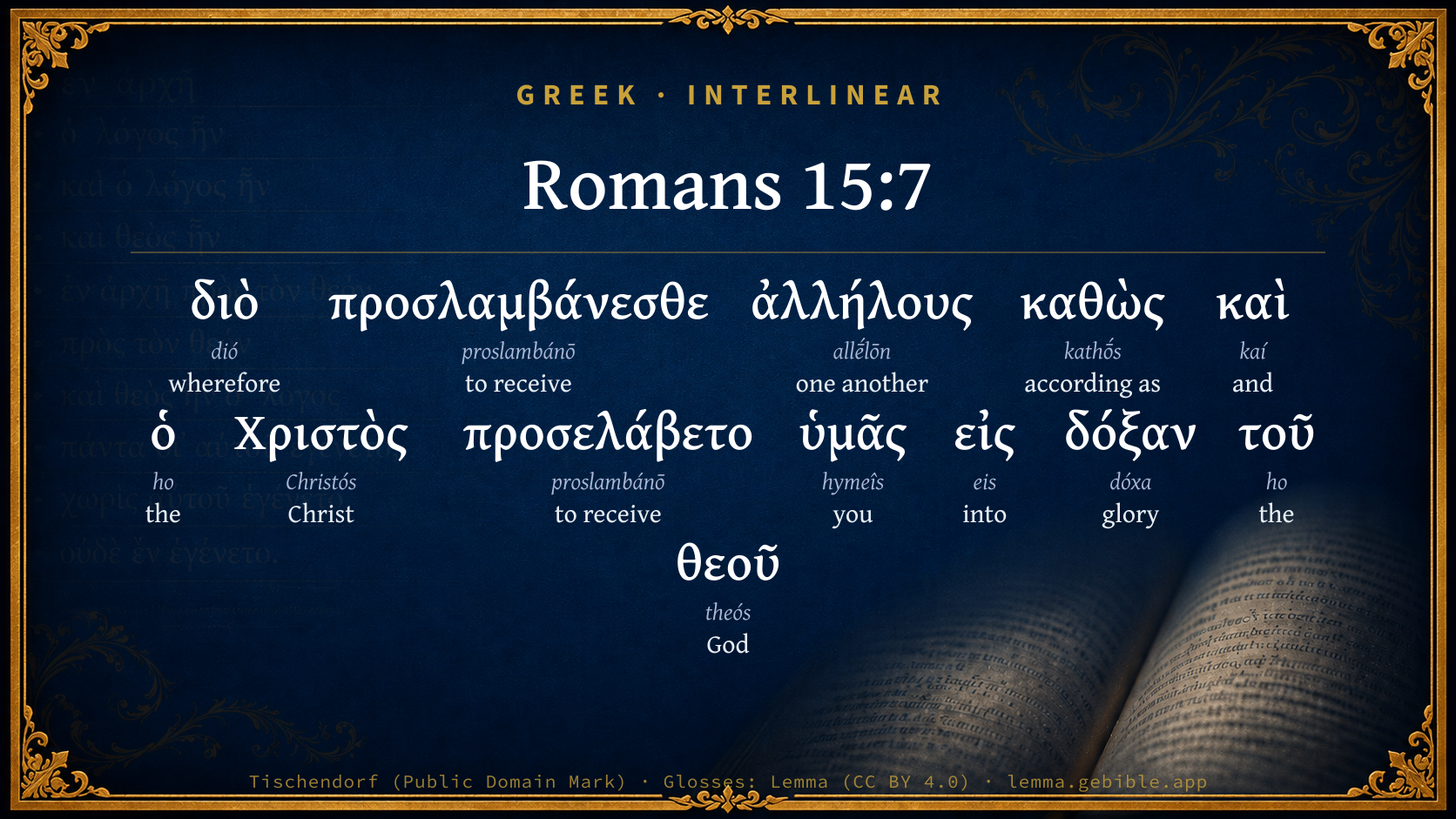
  1. διὸ dió G1352 “wherefore” Conjunction
  2. ἀλλήλους allḗlōn G240 “one another” Reciprocal pronoun, Accusative, Plural, Masculine
  3. καθὼς kathṓs G2531 “according as” Adverb
  4. καὶ kaí G2532 “and” Conjunction
  5. ὁ ho G3588 “the” Article, Nominative, Singular, Masculine
  6. Χριστὸς Christós G5547 “Christ” Noun, Nominative, Singular, Masculine
  7. προσελάβετο proslambánō G4355 “to receive” Verb, Aorist, Middle, Indicative, 3rd person, Singular
  8. ὑμᾶς hymeîs G5210 “you” Personal pronoun, 2nd person, Accusative, Plural
  9. εἰς eis G1519 “into” Preposition
  10. δόξαν dóxa G1391 “glory” Noun, Accusative, Singular, Feminine
  11. τοῦ ho G3588 “the” Article, Genitive, Singular, Masculine
  12. θεοῦ theós G2316 “God” Noun, Genitive, Singular, Masculine

About this verse

These counts appear in no published source. They are computed here, from the morphology-tagged text and Lemma’s own curated glosses. What Lemma adds →

13
words
11
distinct lemmas
Pauline Epistles
section

Notable vocabulary

The rarest word here is προσλαμβάνεσθε to receive G4355 — appearing just 12 times in the whole Greek New Testament.

Shared distinctive vocabulary

προσλαμβάνεσθε to receive G4355 occurs in 11 verses of the Greek New Testament. Also found in:

Repetition

Words recur within this verse:

  • προσλαμβάνεσθε to receive G4355 ×2
  • ὁ the G3588 ×2

Cross-references

14

Topical passages linked to Romans 15:7 in the Treasury of Scripture Knowledge — connected by theme and wording, ordered by reader-vote popularity; previews shown in the World English Bible.

  • Matthew 10:40 He who receives you receives me, and he who receives me receives him who sent me.
  • John 13:34 A new commandment I give to you, that you love one another, just like I have loved you; that you also love one another.
  • Romans 5:2 through whom we also have our access by faith into this grace in which we stand. We rejoice in hope of the glory of God.
  • Romans 14:1–3 Now receive one who is weak in faith, but not for disputes over opinions.
  • Mark 9:37 "Whoever receives one such little child in my name, receives me, and whoever receives me, doesn't receive me, but him who sent me."
  • Luke 9:48 and said to them, "Whoever receives this little child in my name receives me. Whoever receives me receives him who sent me. For whoever is least among you all, this one will be great."
  • Ephesians 1:6–8 to the praise of the glory of his grace, by which he freely bestowed favor on us in the Beloved,
  • Luke 15:2 The Pharisees and the scribes murmured, saying, "This man welcomes sinners, and eats with them."
  • Ephesians 1:18 having the eyes of your hearts enlightened, that you may know what is the hope of his calling, and what are the riches of the glory of his inheritance in the saints,
  • 2 Thessalonians 1:10–12 when he comes to be glorified in his saints, and to be admired among all those who have believed (because our testimony to you was believed) in that day.
  • Matthew 11:28–30 "Come to me, all you who labor and are heavily burdened, and I will give you rest.
  • John 6:37 All those who the Father gives me will come to me. Him who comes to me I will in no way throw out.
  • Ephesians 1:12 to the end that we should be to the praise of his glory, we who had before hoped in Christ:
  • Romans 15:9 and that the Gentiles might glorify God for his mercy. As it is written, "Therefore will I give praise to you among the Gentiles, And sing to your name."

Cross-references courtesy of OpenBible.info (CC BY 4.0).

Where the printed editions differ

1 variant

Places in this verse where the major printed Greek editions disagree on the wording in a way that affects the translation — a comparison of editions, not a manuscript-by-manuscript collation. The editions are the modern critical texts (Nestlé-Aland 28/27, SBL, Westcott-Hort, Tregelles, Tyndale House) and the traditional texts behind the KJV (the Textus Receptus and the Byzantine/Majority text). It is not a claim about which reading is original.

  1. Different wording
    ὑμᾶς

    “you”

    In NA28NA27TynSBLTregByz Not in WHTR

    ἡμᾶς (hēmas) 'us' occurs in traditional manuscripts (WH+TR) instead of ὑμᾶς (humas) 'you' in older manuscripts (NA28+NA27+Tyn+SBL+Treg+Byz)

Textual data: Translators Amalgamated Greek New Testament (STEPBible TAGNT) · CC BY 4.0.

Commentary

Notes on Romans 15:7 from classic Christian and Jewish commentators (each source and its license shown beneath its notes). The classic Christian expositions comment on the surrounding passage and are grouped to its opening verse, so a note may address several verses; the Jewish commentaries on the Tanakh (Rashi and others) are per-verse, so they appear only where the commentator wrote on this verse.

Lemma curates 59 commentaries, every one of them public domain or Creative Commons licensed, each selected and text-cleaned for this edition rather than reprinted as found. About our sources →

Matthew Henry's Commentary

The apostle here returns to his exhortation to Christians. What he says here (Rom 15:7) is to the same purport with the former; but the repetition shows how much the apostle's heart was upon it. "Receive one another into your affection, into your communion, and into your common conversation, as there is occasion." He had exhorted the strong to receive the weak (Rom 14:1), here, Receive one another; for sometimes the prejudices of the weak Christian make him shy of the strong, as much as the pride of the strong Christian makes him shy of the weak, neither of which ought to be. Let there be a mutual embracing among Christians. Those that have received Christ by faith must receive all Christians by brotherly love; though poor in the world, though persecuted and despised, though it may be matter of reproach and danger to you to receive them, though in the less weighty matters of the law they are of different apprehensions, though there may have been occasion for private piques, yet, laying aside these and the like considerations, receive you one another. Now the reason why Christians must receive one another is taken, as before, from the condescending love of Christ to us: As Christ also received us, to the glory of God. Can there be a more cogent argument? Has Christ been so kind to us, and shall we be so unkind to those that are his? Was he so forward to entertain us, and shall we be backward to entertain our brethren? Christ has received us into the nearest and dearest relations to himself: has received us into his fold, into his family, into the adoption of sons, into a covenant of friendship, yea, into a marriage-covenant with himself; he has received us (though we were strangers and enemies, and had played the prodigal) into fellowship and communion with himself. Those words, to the glory of God, may refer both to Christ's receiving us, which is our pattern, and to our receiving one another, which is our practice according to that pattern.

I. Christ hath received us to the glory of God. The end of our reception by Christ is that we might glorify God in this world, and be glorified with him in that to come. It was the glory of God, and our glory in the enjoyment of God, that Christ had in his eye when he condescended to receive us. We are called to an eternal glory by Christ Jesus, Joh 17:24. See to what he received us - to a happiness transcending all comprehension; see for what he received us - for his Father's glory; he had this in his eye in all the instances of his favour to us.

II. We must receive one another to the glory of God. This must be our great end in all our actions, that God may be glorified; and nothing more conduces to this than the mutual love and kindness of those that profess religion; compare Rom 15:6, That you may with one mind and one mouth glorify God. That which was a bone of contention among them was a different apprehension about meats and drinks, which took rise in distinction between Jews and Gentiles. Now, to prevent and make up this different, he shows how Jesus Christ has received both Jews and Gentiles; in him they are both one, one new man, Eph 2:14-16. Now it is a rule, Quae conveniunt in aliquo tertio, inter se conveniunt - Things which agree with a third thing agree with each other. Those that agree in Christ, who is the Alpha and the Omega, the first and the last, and the great centre of unity, may well afford to agree among themselves. This coalescence of the Jews and Gentiles in Christ and Christianity was a thing that filled and affected Paul so much that he could not mention it without some enlargement and illustration.

1. He received the Jews, Rom 15:8. Let not any think hardly or scornfully therefore of those that were originally Jews, and still, through weakness, retain some savour of their old Judaism; for, (1.) Jesus Christ was a minister of the circumcision. That he was a minister, diakonos - a servant, bespeaks his great and exemplary condescension, and puts an honour upon the ministry: but that he was a minister of the circumcision, was himself circumcised and made under the law, and did in his own person preach the gospel to the Jews, who were of the circumcision - this makes the nation of the Jews more considerable than otherwise they appear to be. Christ conversed with the Jews, blessed them, looked upon himself as primarily sent to the lost sheep of the house of Israel, laid hold of the seed of Abraham (Heb 2:16, margin), and by them, as it were, caught at the whole body of mankind. Christ's personal ministry was appropriated to them, though the apostles had their commission enlarged. (2.) He was so for the truth of God. That which he preached to them was the truth; for he came into the world to bear witness to the truth, Joh 18:37. And he is himself the truth, Joh 14:6. Or, for the truth of God, that is, to make good the promises given to the patriarchs concerning the special mercy God had in store for their seed. It was not for the merit of the Jews, but for the truth of God, that they were thus distinguished - that God might approve himself true to this word which he had spoken. - To confirm the promises made unto the fathers. The best confirmation of promises is the performance of them. It was promised that in the seed of Abraham all the nations of the earth should be blessed, that Shiloh should come from between the feet of Judah, that out of Israel should he proceed that should have the dominion, that out of Zion should go forth the law, and many the like. There were many intermediate providences which seemed to weaken those promises, providences which threatened the fatal decay of that people; but when Messiah the Prince appeared in the fulness of time, as a minister of the circumcision, all these promises were confirmed, and the truth of them was made to appear; for in Christ all the promises of God, both those of the Old Testament and those of the New, are Yea, and in him Amen. Understanding by the promises made to the fathers the whole covenant of grace, darkly administered under the Old Testament, and brought to a clearer light now under the gospel, it was Christ's great errand to confirm that covenant, Dan 9:27. He confirmed it by shedding the blood of the covenant.

2. He received the Gentiles likewise. This he shows, Rom 15:9-12.

(1.) Observe Christ's favour to the Gentiles, in taking them in to praise God - the work of the church on earth and the wages of that in heaven. One design of Christ was that the Gentiles likewise might be converted that they might be one with the Jews in Christ's mystical body. A good reason why they should not think the worse of any Christian for his having been formerly a Gentile; for Christ has received him. He invites the Gentiles, and welcomes them. Now observe how their conversion is here expressed: That the Gentiles might glorify God for his mercy. A periphrasis of conversion. [1.] They shall have matter for praise, even the mercy of God. Considering the miserable and deplorable condition that the Gentile world was in, the receiving of them appears more as an act of mercy than the receiving of the Jews. Those that were Lo-ammi - not a people, were Lo-ruhama - not obtaining mercy, Hos 1:6, Hos 1:9; Hos 2:23. The greatest mercy of God to any people is the receiving of them into covenant with himself: and it is good to take notice of God's mercy in receiving us. [2.] They shall have a heart for praise. They shall glorify God for his mercy. Unconverted sinners do nothing to glorify God; but converting grace works in the soul a disposition to speak and do all to the glory of God; God intended to reap a harvest of glory from the Gentiles, who had been so long turning his glory into shame.

(2.) The fulfilling of the scriptures in this. The favour of God to the Gentiles was not only mercy, but truth. Though there were not promises directly given to them, as to the fathers of the Jews, yet there were many prophesies concerning them, which related to the calling of them, and the embodying of them in the church, some of which he mentions because it was a thing that the Jews were hardly persuaded to believe. Thus, by referring them to the Old Testament, he labours to qualify their dislike of the Gentiles, and so to reconcile the parties at variance. [1.] It was foretold that the Gentiles should have the gospel preached to them: "I will confess to thee among the Gentiles (Rom 15:9), that is, thy name shall be known and owned in the Gentile world, there shall gospel grace and love be celebrated." This is quoted from Psa 18:49, I will give thanks unto thee, O Lord, among the heathen. A thankful explication and commemoration of the name of God are an excellent means of drawing others to know and praise God. Christ, in and by his apostles and ministers, whom he sent to disciple all nations, did confess to God among the Gentiles. The exaltation of Christ, as well as the conversion of sinners, is set forth by the praising of God. Christ's declaring God's name to his brethren is called his praising God in the midst of the congregation, Psa 22:22. Taking these words as spoken by David, they were spoken when he was old and dying, and he was not likely to confess to God among the Gentiles; but when David's psalms are read and sung among the Gentiles, to the praise and glory of God, it may be said that David is confessing to God among the Gentiles, and singing to his name. He that was the sweet psalmist of the Gentiles. Converting grace makes people greatly in love with David's psalms. Taking them as spoken by Christ, the Son of David, it may be understood of his spiritual indwelling by faith in the hearts of all the praising saints. If any confess to God among the Gentiles, and sing to his name, it is not they, but Christ and his grace in them. I live, yet not I, but Christ liveth in me; so, I praise, yet not I, but Christ in me. [2.] That the Gentiles should rejoice with his people, Rom 15:10. This is quoted from that song of Moses, Deu 32:43. Observe, Those who were incorporated among his people are said to rejoice with his people. No greater joy can come to any people than the coming of the gospel among them in power. Those Jews that retain a prejudice against the Gentiles will by no means admit them to any of their joyful festivities; for (say they) a stranger intermeddleth not with the joy, Pro 14:10. But, the partition-wall being taken down, the Gentiles are welcome to rejoice with his people. Being brought into the church, they share in its sufferings, are companions in patience and tribulation, to recompense which they share in the joy. [3.] That they should praise God (Rom 15:11): Praise the Lord, all ye Gentiles. This is quoted out of that short psalm, Psa 117:1. Converting grace sets people a praising God, furnishes with the richest matter for praise, and gives a heart to it. The Gentiles had been, for many ages, praising their idols of wood and stone, but now they are brought to praise the Lord; and this David in spirit speaks of. In calling upon all the nations to praise the Lord, it is intimated that they shall have the knowledge of him. [4.] That they should believe in Christ (v. 12), quoted from Isa 11:10, where observe, First, The revelation of Christ, as the Gentiles' king. He is here called the root of Jesse, that is, such a branch from the family of David as is the very life and strength of the family: compare Isa 11:1. Christ was David's Lord, and yet withal he was the Son of David (Mat 22:45), for he was the root and offspring of David, Rev 22:16. Christ, as God, was David's root; Christ, as man, was David's offspring. - And he that shall rise to reign over the Gentiles. This explains the figurative expression of the prophet, he shall stand for an ensign of the people. When Christ rose from the dead, when he ascended on high, it was to reign over the Gentiles. Secondly, The recourse of the Gentiles to him: In him shall the Gentiles trust. Faith is the soul's confidence in Christ and dependence on him. The prophet has it, to him shall the Gentiles seek. The method of faith is first to seek unto Christ, as to one proposed to us for a Saviour; and, finding him able and willing to save, then to trust in him. Those that know him will trust in him. Or, this seeking to him is the effect of a trust in him; seeking him by prayer, and pursuant endeavours. We shall never seek to Christ till we trust in him. Trust is the mother; diligence in the use of means the daughter. Jews and Gentiles being thus united in Christ's love, why should they not be united in one another's love?

Matthew Henry's Commentary on the Whole Bible (1708–1710) — public domain (CC PDM 1.0). Text via the HelloAO Bible API.

Tyndale Open Study Notes

Tyndale Open Resources

15:7 To accept each other means more than grudgingly putting up with each other. We are to welcome other believers, with all their flaws and sins, into our fellowship and treat them as family (see study note on 12:10), just as Christ has accepted us, with all our flaws and sins, into his fellowship and family (5:8-11).

Tyndale Open Study Notes — © Tyndale Open Resources, licensed CC BY-SA 4.0. Text via the HelloAO Bible API.

Bengel's Gnomon

Johann Albrecht Bengel

Rom 15:7. ὑμᾶς, you[153]) who were formerly weak, Jews and Greeks without distinction.—εἰς δόξαν Θεοῦ, to the glory of God) It is construed with received, comp. Rom 15:6; Rom 15:8-9.

[153] ACD corrected later, Gg Vulg. read ὑμᾶς. Rec. Text reads ἡμᾶς with BD early corrected, f.—ED.

Bengel's Gnomon of the New Testament — English translation (T&T Clark, Edinburgh, 1860) — public domain. Text from a community e-Sword module.

Meyer's Critical & Exegetical Commentary

Heinrich August Wilhelm Meyer

Rom_15:7. Διό] in order, namely, that this object, Rom_15:6, may be attained, that its attainment may not be hindered on your part.[14]

προσλαμβ.] See on Rom_14:1. That not the strong alone (Hofmann), but both parties, and thus the readers collectively, are addressed, and that subsequently ὑμᾶς refers to both (not merely or principally to the Gentile-Christians, as Rückert and Reiche think), follows from ἈΛΛΉΛΟΥς; and see Rom_15:8-9.

ΠΡΟΣΕΛΆΒΕΤΟ] sibi sociavit, Grotius. Comp. Rom_14:3.

εἰς ΔΌΞΑΝ ΘΕΟῦ] belongs to ΠΡΟΣΕΛΆΒ. ὙΜᾶς, beside which it stands, and to which, in accordance with Rom_15:8-9 ff., it is alone suitable. Hence it is not to be connected with ΠΡΟΣΛΑΜΒ. ἈΛΛΉΛ. (Chrysostom, Oecumenius, Erasmus, and others); and just as little with the latter immediately, but with προσελάβ. ὑμᾶς only mediately (as Hofmann splits the reference). But it means: that God might be thereby glorified, not: ut aliquando divinae gloriae cum ipso simus (sitis) participes, Grotius (so also Beza, Piscator, Calovius, Klee, Benecke, Glöckler), which is condemned by Rom_15:8-9 ff. as opposed to the context. Comp. Php_2:11; Eph_1:12.

[14] Hofmann incorrectly (in accordance with his incorrect reference of ver. 1 ff. to Rom_16:25-27) renders: for the sake of the hope, which you may learn from Scripture.

Meyer — Critical and Exegetical Commentary on the New Testament — English translation by Peter Christie, edited by Frederick Crombie (T&T Clark, 1880) — public domain. Text from a community e-Sword module.

Expositor's Greek Testament

ed. W. Robertson Nicoll

Rom 15:7 . διὸ προσλαμβάνεσθε ἀλλήλους : διὸ = that such praise may be possible. For προσλαμβ . see Rom 14:1-3 . καθὼς καὶ ὁ Χριστὸς προσελάβετο ὑμᾶς . ὑμᾶς covers both parties in the Church, however they are to be distinguished; if Christ received both, they are bound to receive each other. The last words, εἰς δόξαν τοῦ θεοῦ , are probably to be construed with προσλαμβάνεσθε ἀλλήλους ; they resume the idea of Rom 15:6 ( ἵνα … δοξάζητε ); the διὸ with which Rom 15:7 begins starts from that idea of glorifying God, and looks on to it as the end to be attained when all Christians in love receive each other. But the clause has of course a meaning even if attached to what immediately precedes: ὁ Χριστὸς προσελ . ὑμᾶς . Cf. Phi 2:11 , Eph 1:12-14 . Christ’s reception of the Jews led to God’s being glorified for His faithfulness; His reception of the Gentiles to God’s being glorified for His mercy. So Weiss, who argues that in what follows we have the expansion and proof of the idea that God’s glory (the glory of His faithfulness and of His mercy) is the end contemplated by Christ’s reception alike of Jew and Gentile.

The Expositor's Greek Testament, edited by W. Robertson Nicoll (1897–1910) — public domain. Text from a community e-Sword module.

Hodge's Commentary on Romans, Ephesians & First Corinthians

Charles Hodge

Rom_15:7

Wherefore receive ye one another; as Christ also received us,‹78› to the glory of God. Wherefore, i.e. in order that with one heart they may glorify God. This cannot be done, unless they are united in the bonds of Christian fellowship. The word (προσλαμβάνεσθε) receive, has the same sense here that it has in Rom_14:1 : Take one another to yourselves, treat one another kindly, even as Christ has kindly taken us to himself; προσελάβετο, sibi sociavit. The words, to the glory of God, may be connected with the first or second clause, or with both: Receive ye one another, that God may be glorified; or, as Christ has received us in order that God might be glorified; or, if referred to both clauses, the idea is, as the glory of God was illustrated and promoted by Christs reception of us, so also will it be exhibited by our kind treatment of each other. The first method seems most consistent with the context, as the object of the apostle is to enforce the duty of mutual forbearance among Christians, for which he suggests two motives, the kindness of Christ towards us, and the promotion of the divine glory. If instead of received us, the true reading is, received you, the sense and point of the passage is materially altered. Paul must then be considered as exhorting the Gentile converts to forbearance towards their Jewish brethren, on the ground that Christ had received them, though aliens, into the commonwealth of Israel.

Charles Hodge — Commentary on Romans (1835), First Corinthians (1857), and Ephesians (1856) — public domain. Text from a community e-Sword module.

Geneva Bible (1599)

Geneva Bible translators

He did not disdain us, but received us of his own accord, to make us partakers of God’s glory.

Geneva Bible (1599) marginal notes — public domain. Text via Bolls.life.

Jamieson, Fausset & Brown

Robert Jamieson, A. R. Fausset & David Brown

Wherefore--returning to the point

receive ye one another . . . to the glory of God--If Christ received us, and bears with all our weaknesses, well may we receive and compassionate one with another, and by so doing God will be glorified.

Jamieson, Fausset & Brown — Commentary Critical and Explanatory on the Whole Bible (1871) — public domain (CC PDM 1.0). Text via the HelloAO Bible API.

Adam Clarke's Commentary

Verse 7. Wherefore receive ye one another] Προσλαμβανεσθε. Have the most affectionate regard for each other, and acknowledge each other as the servants and children of God Almighty.

As Christ also received us] Καθως και ὁ Χριστος προσελαβετο ἡμας· In the same manner, and with the same cordial affection, as Christ has received us into communion with himself, and has made us partakers of such inestimable blessings, condescending to be present in all our assemblies. And as Christ has received us thus to the glory of God, so should we, Jews and Gentiles, cordially receive each other, that God's glory may be promoted by our harmony and brotherly love.

Adam Clarke's Commentary on the Bible (1810–1826) — public domain. Text from a community e-Sword/MySword module.

John Calvin's Commentaries

7. Receive ye then, etc. He returns to exhortation; and to strengthen this he still retains the example of Christ. For he, having received, not one or two of us, but all together, has thus connected us, so that we ought to cherish one another, if we would indeed continue in his bosom. Only thus then shall we confirm our calling, that is, if we separate not ourselves from those whom the Lord has bound together.

The words, to the glory of God, may be applied to us only, or to Christ, or to him and us together: of the last I mostly approve, and according to this import, — “As Christ has made known the glory of the Father in receiving us into favor, when we stood in need of mercy; so it behooves us, in order to make known also the glory of the same God, to establish and confirm this union which we have in Christ.”

John Calvin's Commentaries (1540-1563) — public domain. Text from the Calvin Translation Society English edition (1840s-50s) via the Christian Classics Ethereal Library (ccel.org). Calvin's coverage is partial (roughly two-thirds of the Bible); uncommented books and verses are honest gaps, never fabricated. The 19th-century editor's footnotes and remarks are omitted so the notes are faithfully Calvin's own voice.

Ellicott's Commentary for English Readers

(7) Received us.—There is again a division of the best authorities, the Vatican and Claromontane MSS. reading “us,” while the Sinaitic, Alexandrine, Paris rescript, and others, read “you.” The latter is, perhaps, to be preferred, but with no real difference to the sense. The word “received” is the same as that at the beginning of Romans 14, the subject of which chapter is still continued, and is now taken up for the last time. The duty of Christians to show cordiality to each other is now based upon the comprehensiveness of the love of Christ, whose mission was directed with the same impartiality towards Jews and Gentiles. To the Jews He came to confirm and fulfil His promises; to the Gentiles He came to bring joys and hopes from which they had been hitherto excluded.

To the glory of God.—That God might be glorified by the admission into the Church of Gentiles as well as Jews; a parenthetic remark without direct bearing on the argument.

A Bible Commentary for English Readers, edited by Charles John Ellicott (1878–1897) — public domain. Text from a community e-Sword module.

The Cambridge Bible for Schools and Colleges

gen. ed. J. J. S. Perowne

7. receive ye, &c.] See on Rom_14:1. Cp. Col_3:13.

as Christ also received us] “He receiveth sinners,” to be His “brethren.”—Better, perhaps, received you.

to the glory of God] Christ received us “to the praise of the glory of His Father’s grace;” Eph_1:6. But possibly a comma should stand after “received us:” q. d., “receive one another, (as Christ received us;) for this will, by its holy effects, bring praise to God.” This certainly fits the context somewhat more closely; see Rom_15:6.

The Cambridge Bible for Schools and Colleges (gen. ed. J. J. S. Perowne; Cambridge University Press, 1878–1918) — public domain. Text from a community e-Sword module.

John Gill's Exposition

Now I say,.... Or affirm that Christ has received both Jews and Gentiles: that he has received the Jews, and therefore they are not to be despised, though they are weak, appears from hence,

that Jesus Christ was a minister of the circumcision; he is rightly called a minister, for this was the end of his coming into the world, and the whole of his work in it was not to be ministered unto, but to minister to others, Mat 20:28, both in life and at death. This character agrees with him in all his offices; as King he ministers judgment to the people; and as priest he is the minister of the true tabernacle of the human nature, Heb 8:2, in which he offered himself a sacrifice for the sins of his people, and now in it makes intercession for them; but here it is expressive of his prophetic office, in which he is such a minister as never was before, or since, or ever will be; if we consider the dignity of his person, being the Son of God; the greatness of his qualifications, having the Spirit without measure; the nature of his doctrines, which were amazing words of grace and truth; and the manner of his delivery, which was with authority; and that all other ministers receive their mission, qualifications, doctrine and success from him: he is styled a minister of "the circumcision", not literally considered, as if he administered circumcision to any, which he did not; he was indeed subject to it as a son of Abraham, as a Jew by birth, as under the law, and in order to fulfil all righteousness, Mat 3:15, and to show that he was truly man, and that he had regard to the people and ordinances of the Old Testament, as he showed by baptism he had to those of the New, and to signify our cleansing and atonement by his blood; but circumcision is either to be understood in a spiritual sense of circumcision in the Spirit, and not in the flesh, with which the true circumcision, or believers in Christ, are circumcised in him, through his circumcision; or rather the word here is to be taken metonymically, for the uncircumcised Jews, as it often is in this epistle; see Rom 2:26. So that the meaning is, that Christ was their minister and preacher, just as Peter is said to have the apostleship of the circumcision, Gal 2:8, or to be the apostle of the Jews; as Paul was of the Gentiles, Rom 11:13, and to have the Gospel of the circumcision committed to him, it being his province to preach it to them, Gal 2:7, Christ as a minister or preacher in the personal discharge of his prophetic office, was sent only to the Jews; among them he lived, and to them he only preached; nor did he allow his apostles to preach to any other till after his resurrection; and which is a manifest proof that he received the Jews, and took them under his care, and showed a particular regard unto them: the ends of his being a minister to them were,

for the truth of God; to preach the Gospel of salvation, the word of truth unto them, for which he was promised and sent; and in doing of which he declared the righteousness, faithfulness, loving kindness, and truth of God unto them:

and to confirm the promises made unto the fathers; the fathers of the world, Adam, Noah, &c. or rather the Jewish fathers, Abraham, Isaac, Jacob, Moses, David, and others; concerning the Messiah's being the seed of the woman, and of Abraham, and of David; concerning the coming of Shiloh, the raising up of the great prophet among the Jews, &c. all which promises are yea and amen in Christ, ratified and fulfilled in him.

John Gill's Exposition of the Whole Bible (1746–1763) — public domain (CC PDM 1.0). Text via the HelloAO Bible API.

Trapp's Complete Commentary

John Trapp

7 Wherefore receive ye one another, as Christ also received us to the glory of God.

Ver. 7. To the glory of God] That is, of heaven, the joys whereof it is as impossible to comprehend as it is to compass the heaven with a span, or contain the ocean in a nut shell. Such comfort there is in the presence of Christ (though but in the womb), as it made John to spring. What then shall it be in heaven?

John Trapp, A Commentary or Exposition upon All the Books of the Old and New Testament (1647–1656) — public domain. Text from a community e-Sword module.

Albert Barnes' Notes on the Bible

Wherefore - In view of all the considerations tending to produce unity and love, which have been presented. He refers to the various arguments in this and the preceding chapter.

Receive ye one another - Acknowledge one another as Christians, and treat one another as such, though you may differ in opinion about many smaller matters; see Rom 14:3.

As Christ also received us - That is, received us as his friends and followers; see Rom 14:3.

To the glory of God - In order to promote his glory. He has redeemed us, and renewed us, in order to promote the honor of God; compare Eph 1:6. As Christ has received us in order to promote the glory of God, so ought we to treat each other in a similar manner for a similar purpose. The exhortation in tiffs verse is to those who had been divided on various points pertaining to rites and ceremonies; to those who had been converted from among “Gentiles” and “Jews;” and the apostle here says that Christ had received “both.” In order to enforce this, and especially to show the “Jewish” converts that they ought to receive and acknowledge their “Gentile” brethren, he proceeds to show, in the following verses, that Christ had reference to “both” in his work. He shows this in reference to the “Jews” Rom 15:8, and to the “Gentiles” Rom 15:9-12. Thus, he draws all his arguments from the work of Christ.

Albert Barnes' Notes on the Bible (1834–1885) — public domain. Text from a community e-Sword/MySword module.

Haydock's Catholic Bible Commentary

Receive one another, in the spirit of charity, peace, patience, as Christ also hath received you, and bore with your infirmities. (Witham) --- Mutually support each other for the glory of God: learn to practise a grand lesson of Christian morality, to bear and to forbear. (Haydock)

George Leo Haydock (1774–1849), Haydock's Catholic Family Bible and Commentary, 1859 edition — public domain. Excludes Psalms (Douay-Rheims chapter numbering differs from Protestant) and Deuterocanonical books (Catholic canon only).

Matthew Poole's English Annotations

Wherefore receive ye one another: see Rom 14:1,3. He ends this discourse with the same terms in which he began it. Before, the strong only were charged to receive the weak, but here both are charged alike; the strong must receive the weak, and the weak the strong; they must all have communion one with another, continuing in brotherly love, accounting one another for brethren, exercising mutual forbearance and long-suffering.

As Christ also received us; i.e. after the example of Christ, who beareth with the infirmities of his followers, putting no difference betwixt Jews and Gentiles. The particle as noteth quality, not equality; there is no proportion betwixt the infinite love of Christ and the scanty charity of man. See the like, Mat 5:48; Eph 5:2.

To the glory of God; some join this with the former clause, that we should receive one another to the glory of God: God is glorified by that brotherly love and concord that is amongst his people. Others join it with the latter clause, that Christ hath

received us to the glory of God; i.e. to make us partakers of the glory of God, or to declare and manifest the glory of God’s truth to the Jews, and mercy to the Gentiles, as he showeth in the following verses.

Matthew Poole's English Annotations on the Holy Bible (1683–1685) — public domain. Text from a community e-Sword/MySword module.

Whedon's Commentary on the Bible

Daniel D. Whedon

7. Receive ye—Into your Christian communion as Christ received us into communion with the holy Trinity: (Joh_18:23,) “I in them and thou in me, that they may be made perfect in one.”

Daniel D. Whedon (gen. ed.), Commentary on the Old and New Testaments (1874–1909) — public domain. Text from a community e-Sword module.

The Pulpit Commentary

Vers. 7-27. The mutual relationship of Jews and Gentiles.

The apostle tries further to heal any existing differences between the various sections of the Christian community at Rome, and still further to enforce the duties of charity, self-denial, and mutual helpfulness, by reminding them of how much they have in common. This is the true method of uniting Christians. Some Christians think they will succeed in bringing others to their view of the truth by exposing the errors of those who differ from them. Consequently, we have bitter controversies between the various denominations, because Christians will persist in emphasizing the points on which they differ, rather than the points often far more numerous and more important on which they. agree. To draw nearer to Christ, and to draw one another nearer to Christ, this is the true eirenicon.

I THEIR MUTUAL RELATIONSHIP TO CHRIST. "Wherefore receive ye one another, as Christ also received us" (ver. 7). Both have been received by Christ: why not, then, by one another? Why should our views of Episcopacy or Presbytery, Calvinism or Arminianism, interfere with our relationship as brethren in Christ? St. Paul shows that both Jews and Gentiles have a direct personal interest in Christ and relationship to him. "Jesus Christ was a Minister of the circumcision" (ver. 8). Therefore the Jew should not look upon Jesus of Nazareth as an alien, but as his kinsman according to the flesh. He came not to destroy the Law, but to fulfil. But because he is a Jew, he is not, therefore, without an interest in the Gentiles. The apostle shows how even the Jewish writings looked forward to an incorporation of the Gentiles with the people of God, and to their sharing the blessings which the Messiah was to confer (vers. 10-12). "In him shall the Gentiles trust." How precious, then, should be the Name of Jesus to all the children of humanity! How the universal brotherhood of Christians is here enforced!

II THEIR MUTUAL RELATIONSHIP TO THE GOSPEL, Not only was it predicted that both Jews and Gentiles would be joint partakers in the benefits of the Messiah"s kingdom, but in actual fact the gospel has come to both. St. Paul, who was himself a Jew, experienced the blessings of the gospel. He, in his turn, communicated those blessings to the Gentiles. He was "the minister of Jesus Christ to the Gentiles, ministering the gospel of God" (ver. 16). Truly, the gospel is a great reconciler. How it breaks down the prejudices of race and class and caste! Let the gospel only become a real, living power in our own heart and life, and we shall go forth, like St. Paul, to share its blessings with others, winning them by a spirit of love, no matter what our prejudices against them may have been.

III THEIR DUTY OF MUTUAL HELPFULNESS. At the time of writing this Epistle St. Paul was on an errand which gave practical proof of the mutual sympathy between Gentile and Jewish Christians. He was on his way to Jerusalem (ver. 25). He was taking with him a contribution which the Gentile Christians of Macedonia and Achaia had made for their Jewish brethren at Jerusalem, who at this time were in poverty (ver. 26). He takes the occasion to say that this act of generosity, cheerfully performed, was indeed a Christian duty. For if the Gentiles have been partakers of their spiritual things, their duty is also to minister unto them in carnal things" (ver. 27). Here is a reason for missionary efforts among the Jews. They have been the channel through which blessings have flowed to us: shall we not be the channel through which the blessings of the gospel shall flow to them? Here is a reason for the support of the Christian ministry. It is wise and prudent that those who are to be teachers and preachers of the Word, and pastors of the flock, should devote themselves to that work only. How, then, are they to be supported? By the generosity of those to whom they minister. If the latter are "partakers of their spiritual things, their duty is also to minister unto them in carnal things." Such mutual helpfulness all Christians ought to cultivate towards one another. C.H.I.

The Pulpit Commentary (1880–1919), ed. H.D.M. Spence-Jones & Joseph S. Exell — public domain. Text from a community e-Sword module.

John Wesley's Explanatory Notes

Receive ye one another - Weak and strong, with mutual love.

John Wesley, Explanatory Notes Upon the Whole Bible (1754–1765) — public domain. Text via the GEBible commentary corpus.

Kretzmann's Popular Commentary

Paul E. Kretzmann

Brotherly harmony makes the common praise of God possible:

v. 7. Wherefore receive ye one another, as Christ also received us to the glory of God.

v. 8. Now I say that Jesus Christ was a minister of the circumcision for the truth of God to confirm the promises made unto the fathers,

v. 9. and that the Gentiles might glorify God for His mercy, as it is written, For this cause I will confess to Thee among the Gentiles and sing unto thy name.

v. 10. And again he saith, Rejoice, ye Gentiles, with His people.

v. 11. and again, Praise the Lord, all ye Gentiles; and laud Him, all ye people.

v. 12. And again, Esaias saith, There shall be a root of Jesse, and He that shall rise to reign over the Gentiles; in Him shall the Gentiles trust.

v. 13. Now the God of hope fill you with all joy and peace in believing, that ye may abound in hope, through the power of the Holy Ghost!

Therefore, in order that such praise might be possible, and that the object of such harmonious praise be attained, receive, welcome, one another; let both parties show the spirit which is in Christ, according to the will of Christ. And this mutual acceptance and kindly treatment should be according to the measure of Christ’s acceptance of us and should redound to the glory of God, the final end of the Christian’s whole life. We Christians are called to the fellowship of His Son, Jesus Christ, our Lord, 1Co 1:9. The obligation thus rests upon us to cultivate the spirit of harmony. The harmonious life and worship of the believers is now described in detail: For I say that Christ became a servant of the circumcision for the sake of the truth of God, to confirm the promises given to the fathers, v. 8; and that the Gentiles might glorify God for His mercy, v. 9a. When Christ came, His first direct service was in the interest of the circumcised people or nation, the Jews; in His ministry He served principally the Jews, because He was sent to the lost sheep of the house of Israel, Mat 15:24, and out of their midst gathered His own little congregation of disciples. And the apostles took up His work where He had ceased: they preached to the Jews first and established congregations in Judea. This work of His prophetic office Christ carried on in this manner for the sake of the truth of God, in the interest of God’s veracity, namely, in order to confirm the promises made to the fathers. The Messiah had been promised to the patriarchs and then to the children of Israel; out of them, according to the flesh, He was to be born; in their midst He was to live and perform His work. This promise of God was fulfilled; the veracity of God was vindicated. And all the true Israelites that have, by faith, become partakers of Christ’s salvation now praise God and extol His glory for keeping His promises to the fathers. But while the Jews praised God for confirming, for carrying into effect His promises, the heathen glorify His name on account of His mercy, because God out of free grace has given them the same glorious gift and benefit as the children of Israel, to whom the promises were entrusted. Thus Jesus Christ became a minister also to the Gentiles, namely, by sending out His messengers to all nations and gathering His Church out of all the people of the world by the preaching of the Gospel. To the faithfulness of God the Jews and to the mercy of God the Gentiles owe their possession of salvation in Jesus Christ.

This last thought is now substantiated by the apostle by a reference to several passages of the Old Testament in which the conversion of the Gentiles was prophesied, thus indicating that the eternal counsel of God was being put into execution in their case. The first reference is to Psa 18:49: For this reason I will confess to Thee, glorify Thee exceedingly, among the Gentiles and sing hymns to Thy name. The Messiah, speaking through the mouth of David, praises the wondrous things which God has done to the nations, in the midst of the Gentiles, for their salvation. And the message of salvation provokes the praises of the Gentiles, as the following quotations prove: Rejoice, ye Gentiles, with His people, Deu 32:43; All ye Gentiles, praise the Lord; and praise Him highly, all ye people, Psa 117:1. The Gentiles, together with the children of Israel, are urgently invited to sing praises to God for the fullness of His mercy, and thus show their membership in the true, spiritual Israel. The fourth quotation is from Isa 11:10: There will be the Root of Jesse, and He that shall arise to rule over the Gentiles; in Him will the Gentiles hope. Christ, the descendant of Jesse, the offspring of David according to the flesh, will extend His dominion of grace among the Gentiles, through the preaching of the Gospel, and the result will be that the Gentiles will place their hopes in Him as their only Savior and Redeemer. Thus the Church of the New Testament is a communion of believing Jews and regenerated Gentiles, united in the worship of the true God and the Father of Jesus Christ, their Savior. And this harmony shall properly find its expression in the entire relation of the believers toward each other, charitable consideration for the brethren being the motive of all their actions. This ideal, of course, cannot be reached by their own reason and strength; it necessitates the continual assistance of the Holy Spirit. And therefore Paul, in closing this section and the body of the letter, writes: But the God of hope fill you with all joy and peace in believing, to make you abound in hope in the power of the Holy Spirit, v. 13. The God who is able to grant, and does give, hope, who keeps the mind of the believers directed upon the great fulfillment of all their desires, is able also to fill the hearts of His children with the greatest joy, with all possible joy, and with that peace which passes all understanding, since these both rest upon, and flow out of, faith in Jesus the Savior. With this assistance on the part of God, the hope of the Christians will not be a wavering and uncertain opinion, but a divine certainty, making them abound in hope, giving them the joyful confidence in the fulfillment of their salvation, in the realization of future glory. This wonderful gift is made possible in us through the power of the Spirit, who causes joy and peace to grow stronger with hope, and thus leads our hearts and minds forward to the blessed goal of our destination.

Paul E. Kretzmann, Popular Commentary of the Bible (1921–1924) — public domain. Text from a community e-Sword module.

Burkitt's Expository Notes on the New Testament

William Burkitt

Here our apostle concludes the argument which he had hitherto insisted upon, in this and the former chapter, namely, That all Christians, both strong and weak, should mutually forbear one another, and that both Jew and Gentile should receive each other into fellowship and communion, without contention about things of an indifferent nature: Wherefore receive ye one another.

And to enforce his exhortation, he propounds the example of our Lord Jesus Christ, Receive one another as Christ also received us; that is, after the example of Christ, who puts no difference betwixt Jew and Gentile, but receives both, and bears with the infirmities of both; which action in Christ, and the imitation of it in us, will much redound to the glory of God; his declarative and manifestative glory being much promoted by this concord and union with and among all his members, of what denomination soever they are, whether believing Jews or Gentiles.

Learn hence, 1. That the Lord Jesus Christ has given full and ample demonstration of his great and wonderful love unto his church and people.

2. That this love of Christ toward all his children and people ought to be improved by them, as an argument to love one another; Receive one another, as Christ received us.

3. That Christians receiving, embracing, and loving one another, and bearing with one another’s weaknesses and infirmities, according to Christ’s example and command, will contribute exceedingly to the honour and glory of Almighty God, and to the abundant consolation and satisfaction of each other: Wherefore receive ye one another, as Christ also received us, to the glory of God.

William Burkitt's Expository Notes on the New Testament (1700–1703) — public domain. Text from a community e-Sword module.

Godbey's Commentary on the New Testament

William B. Godbey

7. “Therefore receive one another as Christ also received you unto the glory of God.” As the work ultimates in the glorification of both Jews and Gentiles after the similitude of God Himself, so all of His disciples are to focalize all their powers of body, mind, spirit and influence to lead all they possibly can influence so to follow Jesus as to reach this ultimate glorification which Paul and his comrades hailed in constant anticipation, looking out for the glorified Savior to come and take them to heaven.

William B. Godbey, Commentary on the New Testament (1896–1900) — public domain. Text from a community e-Sword module.

McGarvey & Pendleton's Commentaries

J. W. McGarvey

Wherefore receive ye one another, even as Christ also received you, to the glory of God . [Against the trifling, selfish enjoyment of personal liberty, the apostle sets the supreme end and joy of life; viz., the glorification of God ( Mat_22:36-38 ; Joh_4:34 ). As Christ, suppressing all selfish promptings to assert his own rights and liberties, and ignoring all distinctions in his favor, however pronounced or impossible ( Phi_2:5-8 ), received us in all loving compassion to affect that glory; so also should we mutually receive one another in full love and fellowship to that end, excluding all unworthy selfishness, and all social, national or racial antipathies. Unity glorifies God, as the amity of a household reflects honor on its head.]

J. W. McGarvey (with Philip Y. Pendleton), Commentaries on the New Testament (The Fourfold Gospel, 1914; Acts; and the epistles) — public domain. Text from a community e-Sword/MySword module.

The People's New Testament

B. W. Johnson

7–12. Wherefore receive ye one another. Let the strong receive the weak, all receive each other into full fellowship, even as “Christ has received us.” To the glory of God. All must be done so as to glorify God. So Christ hath done.

B. W. Johnson's The People's New Testament with Notes (1889–1891) — public domain. Electronic text from the Christian Classics Ethereal Library (CCEL) ThML edition.

Cambridge Greek Testament for Schools and Colleges

7–13. This is the final stage of the appeal for unity in the new life: and therefore goes to the bottom of the question, the unity of Jew and Gentile. It is not mere toleration that is needed, but full reception, based on the mind and work of Christ.

7. διὸ κ.τ.λ. This verse resumes and restates Rom 15:5-6. προσλ. ἀ. |[290] τὸ αὐτὸ φρονεῖν; καθὼς κ.τ.λ. |[291] κατὰ Χρ. Ἰης.; εἰς δόξαν |[292] ἵνα κ.τ.λ.

[290] | parallel to

[291] | parallel to

[292] | parallel to

διὸ. On all the grounds stated in Rom 14:1 to Rom 15:6.

προσλ. ἀλλ. As in Rom 14:1 but wider—each other, in spite of all the differences which tend to separate man from man; cf. Rom 11:15; Phm 1:12; Phm 1:17; Act 18:26; Act 28:2. Does this connexion involve the conclusion that “the relations of Jew and Gentile were directly or indirectly involved in the relations of strong and weak”? see S. H. qu. Hort.

καθὼς καὶ κ.τ.λ. resumes the whole argument of 1–11 incl. Those chapters show how the Christ brought all men to Himself, with all their differences and all their sins.

ἡμᾶς. Us Christians, including already representatively Jews and Gentiles.

εἰς δόξαν τοῦ οεοῦ. With a view to glorifying GOD; cf. Rom 11:33-36.

Cambridge Greek Testament for Schools and Colleges (Cambridge University Press, 1896; 21 vols, various authors incl. Carr, Maclear, Plummer, Farrar, Lumby, Moule, M. R. James, Simcox) — public domain. Text from a community e-Sword module.

Alford’s Greek Testament

Henry Alford

7.] Wherefore (on which account, viz. that the wish of the last verse may be accomplished) receive (see ch. 14:1) one another, as Christ also received you,—with a view to God’s glory (that this is the meaning of εἰς δόξαν τοῦ θεοῦ, appears by ver. 9, τὰ δὲ ἔθνη ὑπὲρ ἐλέους δοξάσαι τὸν θεόν).

The Apostle does not expressly name Jewish and Gentile converts as those to whom he addresses this exhortation, but it is evident from the next verse that it is so.

Henry Alford, The Greek Testament (1849–1861) — public domain. Text from a community e-Sword module.

International Critical Commentary

7. The principles laid down in this section of the Epistle are now generalized. All whom Christ has received should, without any distinction, be accepted into His Church. This is intended to apply especially to the main division existing at that time in the community, that between Jewish and Gentile Christians.

διὸ προσλαμβάνεσθε ἀλλήλους κ.τ.λ.: the command is no longer to the strong to admit the weak, but to all sections of the community alike to receive and admit those who differ from them; so St. Paul probably said ὑμᾶς, not ἡμᾶς. The latter he uses in ver. 1, where he is identifying himself with the ‘strong,’ the former he uses here, where he is addressing the whole community. On διό cf. Eph 2:11; 1Th 5:11: on προσλαμβάνεσθε see 14:1, 3.

ὑμᾶς is read by א A C E F G L Vulg. Boh. Syrr., Orig.-lat. Chrys. ἡμᾶς by B D P ב. B is again Western, and its authority on the distinction between ἡμᾶς and ὑμᾶς is less trustworthy than on most other points (see WH. ii. pp. 218, 310).

εἰς δόξαν Θεοῦ with προσελάβετο: ‘in order to promote the glory of God.’ As the following verses show, Christ has summoned both Jews and Greeks into His kingdom in order to promote the glory of God, to exhibit in the one case His faithfulness, in the other His mercy. So in Php 2:11 the object of Christ’s glory is to promote the glory of God the Father.

International Critical Commentary — older volumes (1896–1929), various authors — public domain. Text from a community e-Sword module.

Godet's Commentaries

Frédéric Louis Godet

Vv. 7. “Wherefore receive ye one another, as Christ also received us, to the glory of God.”

The compassionate welcome which Christ has given to all the members of the church individually ought to be perpetually reproduced in the welcome of goodwill and tenderness which they give one another in all the relations of life. And if there is some concession to make, some antipathy to surmount, some difference of opinion to allow, some injury to forgive, one thing ought to lift us above all these annoyances—the thought that we are thereby laboring for the glory of God, who received us in grace through Jesus Christ. Mutual love ought to reign supremely in a church wholly composed of the Lord’s well-beloved. We should probably read ἡμᾶς, us, us believers in general, rather than ὑμᾶς you (the Christians of Rome). This latter reading has no doubt arisen from the verb in the second person plural: receive ye. The words: to the glory of God, depend rather on the first than on the second verb; for they are intended to explain the recommendation.

Mangold finds himself led by his peculiar point of view, according to which the strong in this chapter are merely the small number of extreme Paulinists, to give to the word receive a wholly different sense from that which it had Rom 14:1, where the same recommendation was addressed to the entire (according to him, Judeo-Christian) church. The party of the strong mentioned here had, according to this critic, pushed opposition to the weak the length of regarding them as a burden to the life of the church, and of demanding their excommunication. And this is what Paul would prevent. It is very obvious how arbitrary is this difference laid down in the notion of receiving. Not only can the προσλαμβάνεσθαι (receive) signify nothing else than in Rom 14:1, but, moreover, the apostle would never have consented to rank himself, as he would do by the word us (Rom 15:1-2), in a party so violent.

The apostle would seem, by this conclusion, to have reached the end of the whole development begun Rom 14:1. But he has still an explanation to add: If Christ has received us with equal goodness, there has yet been a difference in the mode of this receiving. Unity in the works of God is never uniformity. Rather harmony implies variety. This common adoration, in which all presently existing contrasts in the church are to be fused, does not prevent each group in the new people of God from bringing with it its own experiences, and playing its particular part in the final concert.

Frédéric Louis Godet — Commentaries on Luke, John, Romans, and 1 Corinthians — English translation (T&T Clark, Edinburgh, 1870s–1890s) — public domain. Text from a community e-Sword module.

Lesson kit

Teaching starters — assembled from the data on this page, not authored interpretation. Every prompt links to the verse data it draws on. Edit before teaching.

Romans, in the Pauline Epistles, opens this verse with 13 words (11 distinct Greek lemmas). Its most distinctive word is proslambánō (“to receive”). A historical commentator’s framing appears above. Read the whole chapter for the surrounding context.

Discussion questions

  1. The word proslambánō carries the sense “to receive.” How does it shape the verse?
  2. How does Matthew 16:22, which shares the word «to receive», read alongside this verse?
  3. What does the repetition of “to receive” (2× in this one verse) do in this verse?
  4. These translations render this verse differently. What is at stake in choosing one wording over another?
  5. Compare how Matthew Henry's Commentary and Tyndale Open Study Notes read this verse. Where do they agree or differ?

Things to notice

  • These translations choose different wording for 10 words in this verse.
  • “to receive” occurs 2× in this single verse.
  • 11 distinct Greek lemmas span 13 words in this verse.

Reading settings

Reading text

Shown beneath each verse's original-language words.

Old Testament
Old Testament edition

Read the OT as the Masoretic Hebrew (MT) or the Greek Septuagint (LXX).

English shown for the Greek Septuagint (in the Hebrew ↔ Greek comparison).

Comparing translations? Open the Compare panel on any verse page to stack up to four side by side.