

1 Corinthians 3:9
Greek (Tischendorf 8th ed.) 1 Corinthians 3:9 appears in the Greek New Testament. The text above is from the Tischendorf 8th edition. Each word links to its Strong’s number and a concise gloss. Click any word for its full Thayer’s Greek Lexicon entry.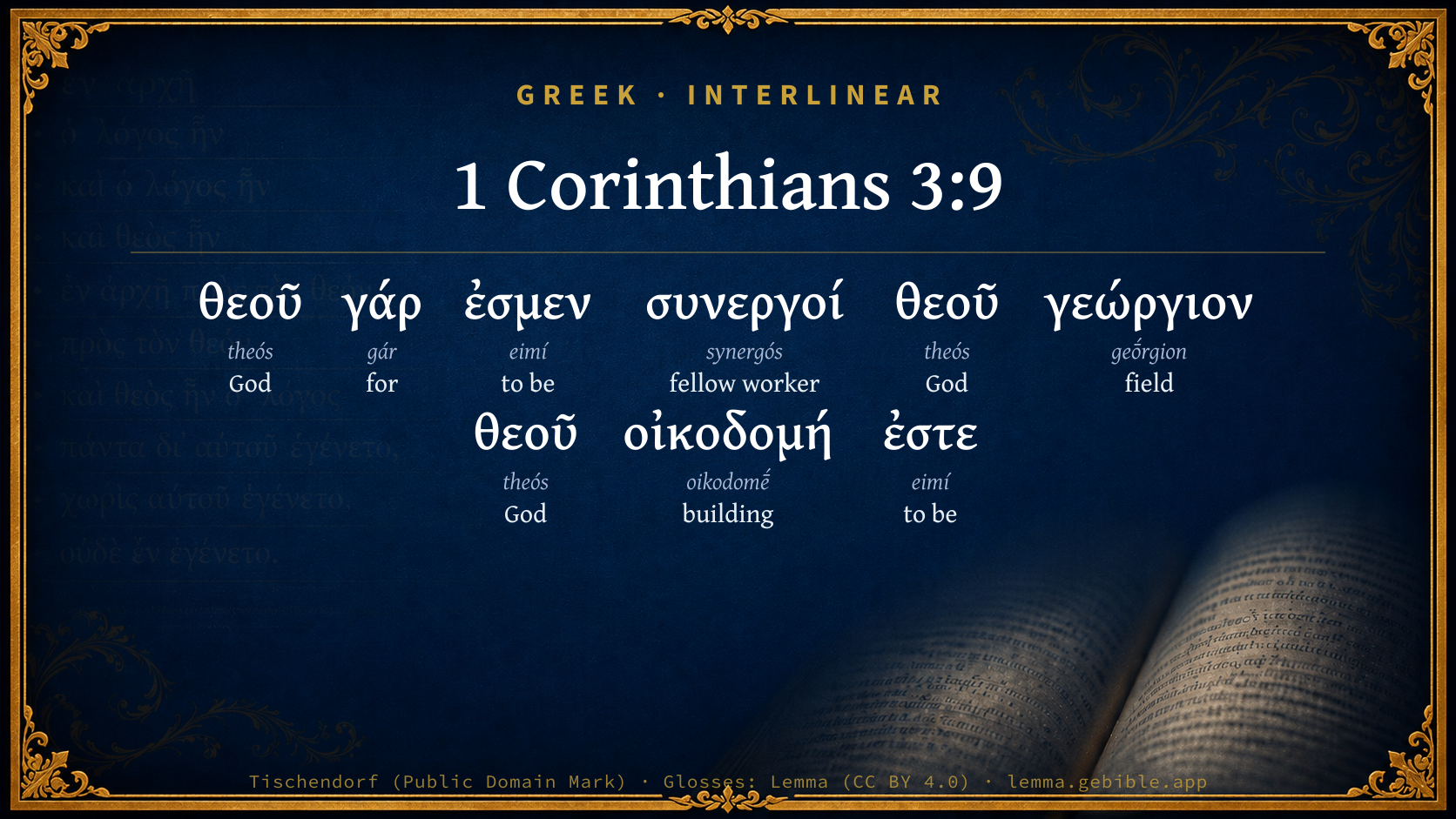
For we are God's fellow workers. You are God's farming, God's building.
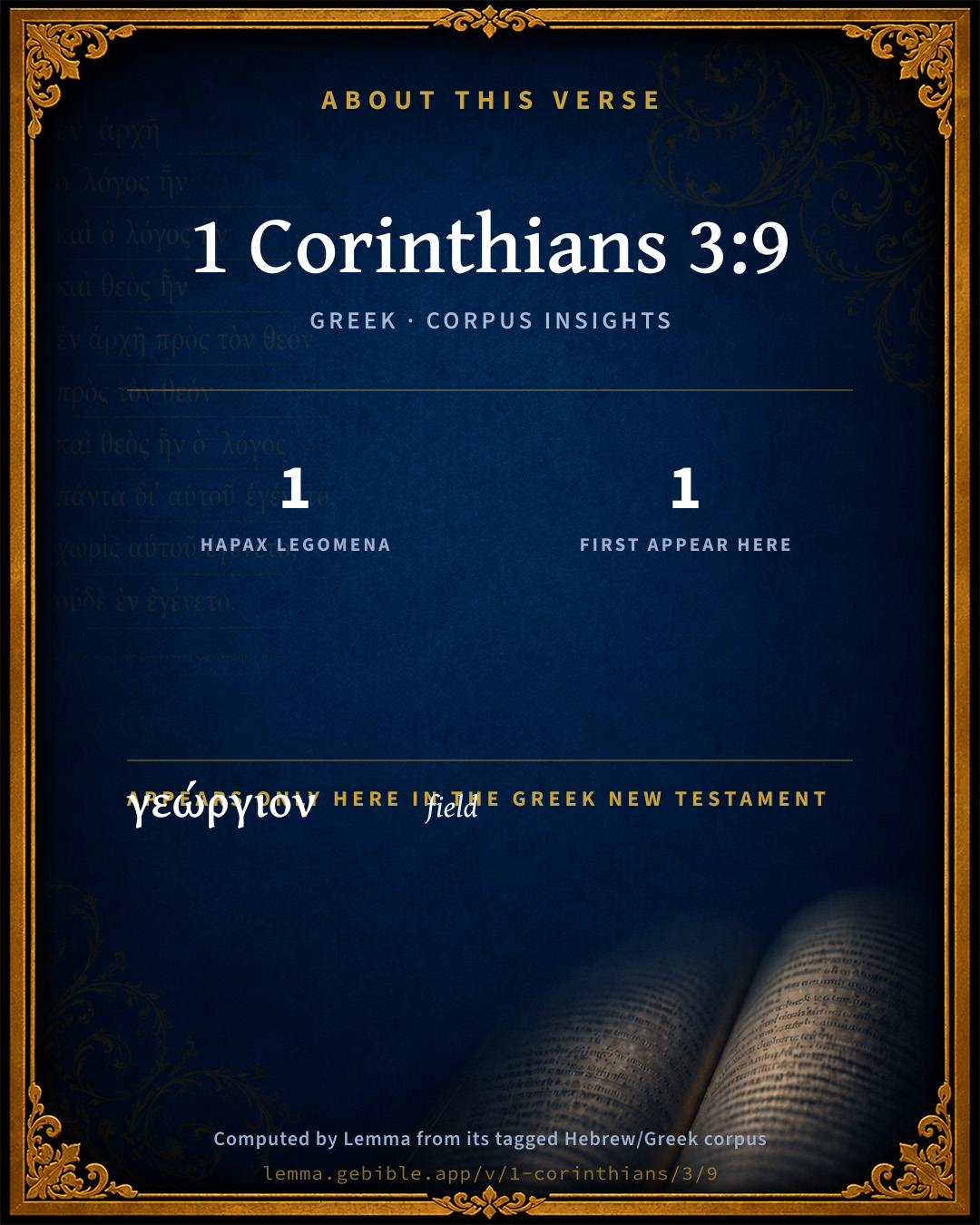
- 1 hapax legomenon — only here in the Greek New Testament
- 1 first appearance in the Greek New Testament
Download a study sheet
One document with this verse’s original text, its word-by-word gloss line, the meaning frame, cross-references with their text, attributed commentary, and full source and license credits — printable, and it pastes into notes with its structure intact.
This verse Autodidact and up
A passage Seminary Student
Up to 50 verses in one chapter. A passage sheet keeps up to 6 commentary sources and 12 cross-references per verse, in the order this page ranks them, and says so on the sheet whenever that leaves anything out. Ask for a single verse and you get the Autodidact verse sheet above.
Everything on this page stays free to read, with no account — the sheet is a download of what is already on screen, not access to it.
Compare translations 3
The same verse in 3 English versions, stacked beneath the original-language interlinear above. Click any original word for its lexicon entry.
Each is an independent rendering of the whole verse — the interlinear is not word-aligned to these translations.
Highlighted words mark where these versions differ — a whole-verse word diff, not a word-by-word alignment.
-
World English Bible Public Domain
For we are God's fellow workers. You are God's farming, God's building.
-
King James Version Public Domain
For we are labourers together with God: ye are God's husbandry, ye are God's building.
-
unfoldingWord Literal Text CC BY-SA 4.0
For we are God’s fellow workers; you are God’s field, God’s building.
unfoldingWord Literal Text — © unfoldingWord, licensed CC BY-SA 4.0. Word-aligned USFM3 via Door43 (git.door43.org/unfoldingWord/en_ult).
Show all 19 translations
Every available English version of this verse, each an independent rendering of the whole verse.
-
World English Bible Public Domain
For we are God's fellow workers. You are God's farming, God's building.
-
Berean Standard Bible Public Domain
For we are God’s fellow workers; you are God’s field, God’s building.
-
Majority Standard Bible Public Domain
For we are God’s fellow workers; you are God’s field, God’s building.
-
King James Version Public Domain
For we are labourers together with God: ye are God's husbandry, ye are God's building.
-
American Standard Version (1901) Public Domain
For we are God's fellow-workers: ye are God's husbandry, God's building.
-
Revised Version (1885) Public Domain
For we are God’s fellow-workers: ye are God’s husbandry, God’s building.
-
Geneva Bible (1599) Public Domain
For we together are Gods labourers: yee are Gods husbandrie, and Gods building.
-
Douay-Rheims (1899) Public Domain
For we are God's coadjutors: you are God's husbandry; you are God's building.
-
Young's Literal Translation Public Domain
for of God we are fellow-workmen; God's tillage, God's building ye are.
-
Literal Standard Version CC BY-SA 4.0
for we are fellow-workmen of God; you are God’s tillage, God’s building.
-
Unlocked Literal Bible CC BY-SA 4.0
For we are God's fellow workers. You are God's garden, God's building.
-
unfoldingWord Literal Text CC BY-SA 4.0
For we are God’s fellow workers; you are God’s field, God’s building.
-
Darby Bible Public Domain
For we are God's fellow-workmen; ye are God's husbandry, God's building.
-
World Messianic Bible Public Domain
For we are God’s fellow workers. You are God’s farming, God’s building.
-
Webster's Bible Public Domain
For we are laborers together with God: ye are God's husbandry, ye are God's building.
-
Free Bible Version CC BY-SA 4.0
We are workers together with God—and you are God's field, his building.
-
Bible in Basic English Public Domain
For we are workers with God: you are God's planting, God's building.
-
Text-Critical English NT CC BY 4.0
For we are fellow workers of God; you are God's field, God's building.
-
Tyndale New Testament (1534) Public Domain
We are goddis labourers ye are goddis husbandrye ye are goddis byldynge.
Literal Standard Version (2020), Covenant Press — licensed CC BY-SA 4.0. Text via the HelloAO Bible API (eBible.org). Unlocked Literal Bible (unfoldingWord) — licensed CC BY-SA 4.0. Text via the HelloAO Bible API (eBible.org). unfoldingWord Literal Text — © unfoldingWord, licensed CC BY-SA 4.0. Word-aligned USFM3 via Door43 (git.door43.org/unfoldingWord/en_ult). Free Bible Version, Dr. Jonathan Gallagher — licensed CC BY-SA 4.0. Text via the HelloAO Bible API (eBible.org).
Word by word
More ways to search: Search by grammar → Find every occurrence → Compare this word →
Practice this passage: Drill this verse → Learn its vocabulary →
- Appears 1× in the Greek New Testament
- First appears here
- Part of Speech
- Noun
- Case
- Nominative
- Number
- Singular
- Gender
- Neuter
Full Thayer's Definition
- θεοῦ theós G2316 “God” Noun, Genitive, Singular, Masculine
- γάρ gár G1063 “for” Conjunction
- ἐσμεν eimí G1510 “to be” Verb, Present, Active, Indicative, 1st person, Plural
- συνεργοί synergós G4904 “fellow worker” Adjective, Nominative, Plural, Masculine
- θεοῦ theós G2316 “God” Noun, Genitive, Singular, Masculine
- γεώργιον geṓrgion G1091 “field” Noun, Nominative, Singular, Neuter
- θεοῦ theós G2316 “God” Noun, Genitive, Singular, Masculine
- οἰκοδομή oikodomḗ G3619 “building” Noun, Nominative, Singular, Feminine
- ἐστε eimí G1510 “to be” Verb, Present, Active, Indicative, 2nd person, Plural
About this verse
These counts appear in no published source. They are computed here, from the morphology-tagged text and Lemma’s own curated glosses. What Lemma adds →
- 9
- words
- 6
- distinct lemmas
- Pauline Epistles
- section
Notable vocabulary
1 hapax legomenon — a word that appears only here in the entire Greek New Testament:
- γεώργιον field G1091
First appearance in Scripture
This word makes its first canonical appearance in the Greek New Testament here:
- γεώργιον field G1091
Shared distinctive vocabulary
συνεργοί fellow worker G4904 occurs in 12 verses of the Greek New Testament. Also found in:
Cross-references
39Topical passages linked to 1 Corinthians 3:9 in the Treasury of Scripture Knowledge — connected by theme and wording, ordered by reader-vote popularity; previews shown in the World English Bible.
- 1 Peter 2:5 You also, as living stones, are built up as a spiritual house, to be a holy priesthood, to offer up spiritual sacrifices, acceptable to God through Jesus Christ.
- Ephesians 2:20–22 being built on the foundation of the apostles and prophets, Christ Jesus himself being the chief cornerstone;
- 2 Corinthians 6:1 Working together, we entreat also that you not receive the grace of God in vain,
- 1 Corinthians 3:16 Don't you know that you are a temple of God, and that God's Spirit lives in you?
- Mark 16:20 They went out, and preached everywhere, the Lord working with them, and confirming the word by the signs that followed. Amen.
- Ephesians 2:10 For we are his workmanship, created in Christ Jesus for good works, which God prepared before that we would walk in them.
- Isaiah 61:11 For as the earth brings forth its bud, and as the garden causes the things that are sown in it to spring forth; so the Lord Yahweh will cause righteousness and praise to spring forth before all the nations.
- Matthew 9:37 Then he said to his disciples, "The harvest indeed is plentiful, but the laborers are few.
- John 4:35–38 Don't you say, 'There are yet four months until the harvest?' Behold, I tell you, lift up your eyes, and look at the fields, that they are white for harvest already.
- John 15:1–8 "I am the true vine, and my Father is the farmer.
- 1 Corinthians 6:19 Or don't you know that your body is a temple of the Holy Spirit which is in you, which you have from God? You are not your own,
- Acts 4:11 He is 'the stone which was regarded as worthless by you, the builders, which has become the head of the corner.'
- 1 Corinthians 3:6 I planted. Apollos watered. But God gave the increase.
- Colossians 2:7 rooted and built up in him, and established in the faith, even as you were taught, abounding in it in thanksgiving.
- 3 John 1:8 We therefore ought to receive such, that we may be fellow workers for the truth.
- Psalms 118:22 The stone which the builders rejected has become the head of the corner.
- Isaiah 61:3 to appoint to those who mourn in Zion, to give to them a garland for ashes, the oil of joy for mourning, the garment of praise for the spirit of heaviness; that they may be called trees of righteousness, the planting of Yahweh, that he may be glorified.
- Matthew 21:23–44 When he had come into the temple, the chief priests and the elders of the people came to him as he was teaching, and said, "By what authority do you do these things? Who gave you this authority?"
- Mark 4:26–29 He said, "The Kingdom of God is as if a man should cast seed on the earth,
- 1 Timothy 3:15 but if I wait long, that you may know how men ought to behave themselves in the house of God, which is the assembly of the living God, the pillar and ground of the truth.
- Psalms 80:8–11 You brought a vine out of Egypt. You drove out the nations, and planted it.
- Zechariah 6:12–13 and speak to him, saying, 'Thus says Yahweh of Hosts, "Behold, the man whose name is the Branch: and he shall grow up out of his place; and he shall build the temple of Yahweh;
- 2 Corinthians 6:16 What agreement has a temple of God with idols? For you are a temple of the living God. Even as God said, "I will dwell in them, and walk in them; and I will be their God, and they will be my people."
- Psalms 65:9–13 You visit the earth, and water it. You greatly enrich it. The river of God is full of water. You provide them grain, for so you have ordained it.
- Psalms 72:16 There shall be abundance of grain throughout the land. Its fruit sways like Lebanon. Let it flourish, thriving like the grass of the field.
- Isaiah 61:5 Strangers shall stand and feed your flocks, and foreigners shall be your plowmen and your vine-dressers.
- Jeremiah 2:21 Yet I had planted you a noble vine, wholly a right seed: how then are you turned into the degenerate branches of a foreign vine to me?
- Amos 9:11–12 In that day I will raise up the tent of David who is fallen, and close up its breaches, and I will raise up its ruins, and I will build it as in the days of old;
- Matthew 13:3–9 He spoke to them many things in parables, saying, "Behold, a farmer went out to sow.
- Matthew 13:18–30 "Hear, then, the parable of the farmer.
- Matthew 13:36–42 Then Jesus sent the multitudes away, and went into the house. His disciples came to him, saying, "Explain to us the parable of the darnel of the field."
- Matthew 16:18 I also tell you that you are Peter, and on this rock I will build my assembly, and the gates of Hades will not prevail against it.
- Matthew 20:1–14 "For the Kingdom of Heaven is like a man who was the master of a household, who went out early in the morning to hire laborers for his vineyard.
- Hebrews 3:3–4 For he has been counted worthy of more glory than Moses, inasmuch as he who built the house has more honor than the house.
- Isaiah 5:1–7 Let me sing for my well beloved a song of my beloved about his vineyard. My beloved had a vineyard on a very fruitful hill.
- Isaiah 27:2–3 In that day: A vineyard of wine, sing you to it.
- Isaiah 28:24–29 Does he who plows to sow plow continually? does he [continually] open and harrow his ground?
- Isaiah 32:20 Blessed are you who sow beside all waters, who send forth the feet of the ox and the donkey.
- Hebrews 3:6 but Christ is faithful as a Son over his house; whose house we are, if we hold fast our confidence and the glorying of our hope firm to the end.
Cross-references courtesy of OpenBible.info (CC BY 4.0).
Lesson kit
Teaching starters — assembled from the data on this page, not authored interpretation. Every prompt links to the verse data it draws on. Edit before teaching.
1 Corinthians, in the Pauline Epistles, opens this verse with 9 words (6 distinct Greek lemmas). Its most distinctive word is geṓrgion (“field”). A historical commentator’s framing appears above. Read the whole chapter for the surrounding context.
Discussion questions
- What does “field” (geṓrgion) contribute to the verse as a whole?
- 1 word here appears nowhere else in the Greek New Testament. Why might the author reach for such rare wording?
- This is the first place “field” appears in Scripture (first appears here). What does its debut here establish?
- How does Romans 16:3, which shares the word «fellow worker», read alongside this verse?
- What does the repetition of “God” (3× in this one verse) do in this verse?
- These translations render this verse differently; the difference is in the English rendering, not the original. What questions does that raise?
- Compare how The Biblical Illustrator and MacLaren's Expositions of Holy Scripture read this verse. Where do they agree or differ?
Things to notice
- 1 word in this verse appears nowhere else in the Greek New Testament.
- 1 word makes its first canonical appearance in Scripture here.
- These translations choose different wording for 11 words in this verse.
- “God” occurs 3× in this single verse.
- 6 distinct Greek lemmas span 9 words in this verse.
Commentary
Notes on 1 Corinthians 3:9 from classic Christian and Jewish commentators (each source and its license shown beneath its notes). The classic Christian expositions comment on the surrounding passage and are grouped to its opening verse, so a note may address several verses; the Jewish commentaries on the Tanakh (Rashi and others) are per-verse, so they appear only where the commentator wrote on this verse.
Lemma curates 59 commentaries, every one of them public domain or Creative Commons licensed, each selected and text-cleaned for this edition rather than reprinted as found. About our sources →
The Biblical Illustrator
Joseph S. Exell
The Biblical Illustrator, edited by Joseph S. Exell (c. 1880s–1900s) — public domain. Text from a community e-Sword module.
MacLaren's Expositions of Holy Scripture
Alexander MacLaren
Alexander MacLaren, Expositions of Holy Scripture (1904–1910) — public domain. Text from a community e-Sword module.
Bengel's Gnomon
Johann Albrecht Bengel
Bengel's Gnomon of the New Testament — English translation (T&T Clark, Edinburgh, 1860) — public domain. Text from a community e-Sword module.
Expositor's Greek Testament
ed. W. Robertson Nicoll
The Expositor's Greek Testament, edited by W. Robertson Nicoll (1897–1910) — public domain. Text from a community e-Sword module.
Hodge's Commentary on Romans, Ephesians & First Corinthians
Charles Hodge
Charles Hodge — Commentary on Romans (1835), First Corinthians (1857), and Ephesians (1856) — public domain. Text from a community e-Sword module.
Geneva Bible (1599)
Geneva Bible translators
Geneva Bible (1599) marginal notes — public domain. Text via Bolls.life.
Jamieson, Fausset & Brown
Robert Jamieson, A. R. Fausset & David Brown
Jamieson, Fausset & Brown — Commentary Critical and Explanatory on the Whole Bible (1871) — public domain (CC PDM 1.0). Text via the HelloAO Bible API.
Adam Clarke's Commentary
Adam Clarke's Commentary on the Bible (1810–1826) — public domain. Text from a community e-Sword/MySword module.
John Calvin's Commentaries
John Calvin's Commentaries (1540-1563) — public domain. Text from the Calvin Translation Society English edition (1840s-50s) via the Christian Classics Ethereal Library (ccel.org). Calvin's coverage is partial (roughly two-thirds of the Bible); uncommented books and verses are honest gaps, never fabricated. The 19th-century editor's footnotes and remarks are omitted so the notes are faithfully Calvin's own voice.
Ellicott's Commentary for English Readers
A Bible Commentary for English Readers, edited by Charles John Ellicott (1878–1897) — public domain. Text from a community e-Sword module.
The Cambridge Bible for Schools and Colleges
gen. ed. J. J. S. Perowne
The Cambridge Bible for Schools and Colleges (gen. ed. J. J. S. Perowne; Cambridge University Press, 1878–1918) — public domain. Text from a community e-Sword module.
John Gill's Exposition
John Gill's Exposition of the Whole Bible (1746–1763) — public domain (CC PDM 1.0). Text via the HelloAO Bible API.
Trapp's Complete Commentary
John Trapp
John Trapp, A Commentary or Exposition upon All the Books of the Old and New Testament (1647–1656) — public domain. Text from a community e-Sword module.
Albert Barnes' Notes on the Bible
Albert Barnes' Notes on the Bible (1834–1885) — public domain. Text from a community e-Sword/MySword module.
Haydock's Catholic Bible Commentary
George Leo Haydock (1774–1849), Haydock's Catholic Family Bible and Commentary, 1859 edition — public domain. Excludes Psalms (Douay-Rheims chapter numbering differs from Protestant) and Deuterocanonical books (Catholic canon only).
Matthew Poole's English Annotations
Matthew Poole's English Annotations on the Holy Bible (1683–1685) — public domain. Text from a community e-Sword/MySword module.
Whedon's Commentary on the Bible
Daniel D. Whedon
Daniel D. Whedon (gen. ed.), Commentary on the Old and New Testaments (1874–1909) — public domain. Text from a community e-Sword module.
The Pulpit Commentary
The Pulpit Commentary (1880–1919), ed. H.D.M. Spence-Jones & Joseph S. Exell — public domain. Text from a community e-Sword module.
John Wesley's Explanatory Notes
John Wesley, Explanatory Notes Upon the Whole Bible (1754–1765) — public domain. Text via the GEBible commentary corpus.
Kretzmann's Popular Commentary
Paul E. Kretzmann
Paul E. Kretzmann, Popular Commentary of the Bible (1921–1924) — public domain. Text from a community e-Sword module.
Burkitt's Expository Notes on the New Testament
William Burkitt
William Burkitt's Expository Notes on the New Testament (1700–1703) — public domain. Text from a community e-Sword module.
Godbey's Commentary on the New Testament
William B. Godbey
William B. Godbey, Commentary on the New Testament (1896–1900) — public domain. Text from a community e-Sword module.
McGarvey & Pendleton's Commentaries
J. W. McGarvey
J. W. McGarvey (with Philip Y. Pendleton), Commentaries on the New Testament (The Fourfold Gospel, 1914; Acts; and the epistles) — public domain. Text from a community e-Sword/MySword module.
The People's New Testament
B. W. Johnson
B. W. Johnson's The People's New Testament with Notes (1889–1891) — public domain. Electronic text from the Christian Classics Ethereal Library (CCEL) ThML edition.
Cambridge Greek Testament for Schools and Colleges
Cambridge Greek Testament for Schools and Colleges (Cambridge University Press, 1896; 21 vols, various authors incl. Carr, Maclear, Plummer, Farrar, Lumby, Moule, M. R. James, Simcox) — public domain. Text from a community e-Sword module.
Alford’s Greek Testament
Henry Alford
Henry Alford, The Greek Testament (1849–1861) — public domain. Text from a community e-Sword module.
International Critical Commentary
International Critical Commentary — older volumes (1896–1929), various authors — public domain. Text from a community e-Sword module.
Vincent's Word Studies in the New Testament
Marvin R. Vincent
Marvin R. Vincent, Word Studies in the New Testament (1887–1900) — public domain. Text from a community e-Sword/MySword module.
Godet's Commentaries
Frédéric Louis Godet
Frédéric Louis Godet — Commentaries on Luke, John, Romans, and 1 Corinthians — English translation (T&T Clark, Edinburgh, 1870s–1890s) — public domain. Text from a community e-Sword module.