
2 Corinthians 2:17

Greek (Tischendorf 8th ed.) 2 Corinthians 2:17 appears in the Greek New Testament. The text above is from the Tischendorf 8th edition. Each word links to its Strong’s number and a concise gloss. Click any word for its full Thayer’s Greek Lexicon entry.
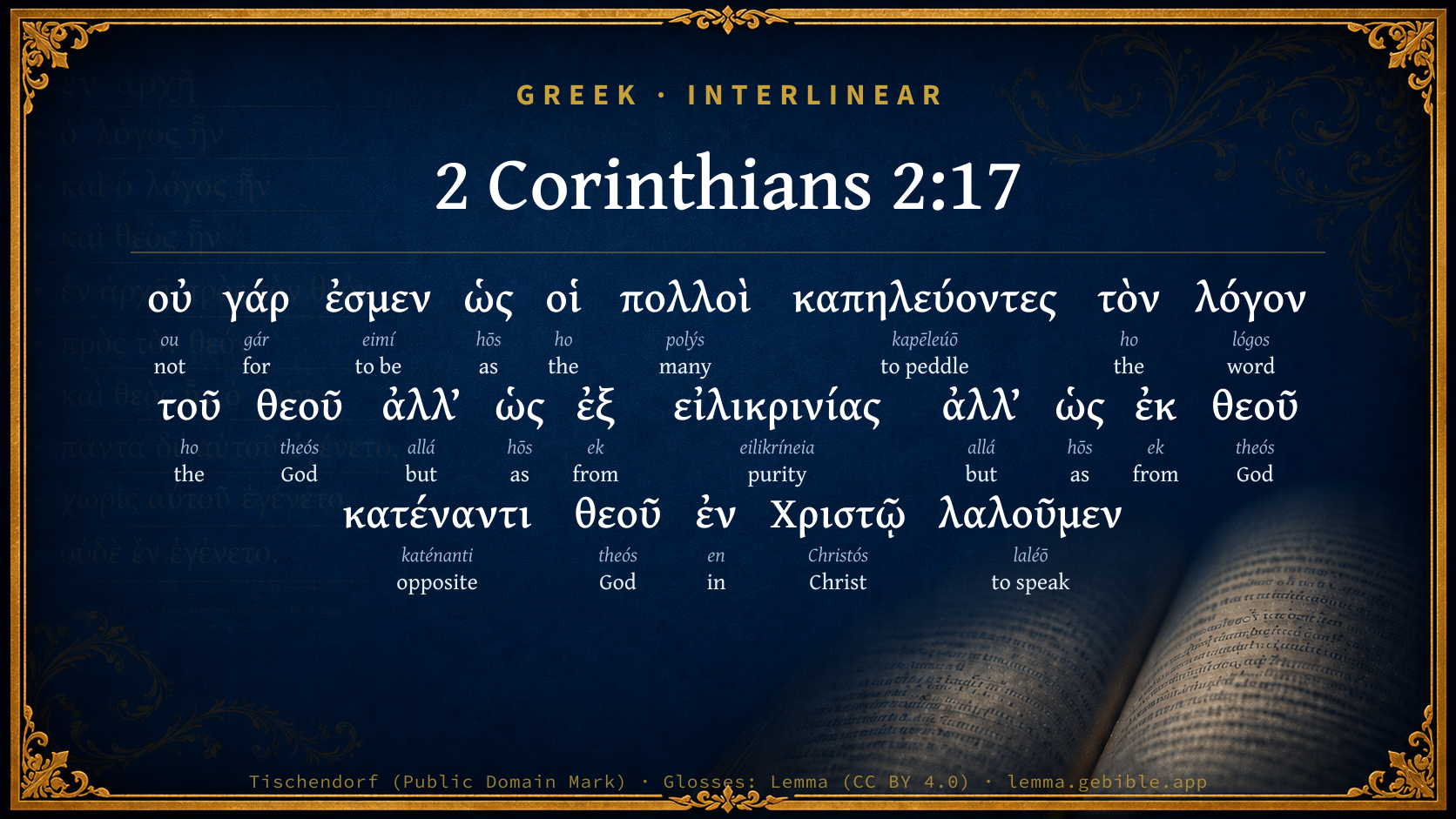
Download image
Cite this verse

2 Corinthians 2:17 (World English Bible). Public Domain. Lemma interlinear Bible study tool, https://lemma.gebible.app/v/2-corinthians/2/17.

Show BibTeX & RIS
BibTeX
RIS
English Translation
For we are not as so many, peddling the word of God. But as of sincerity, but as of God, in the sight of God, we speak in Christ.
World English Bible · Public Domain
Highlights
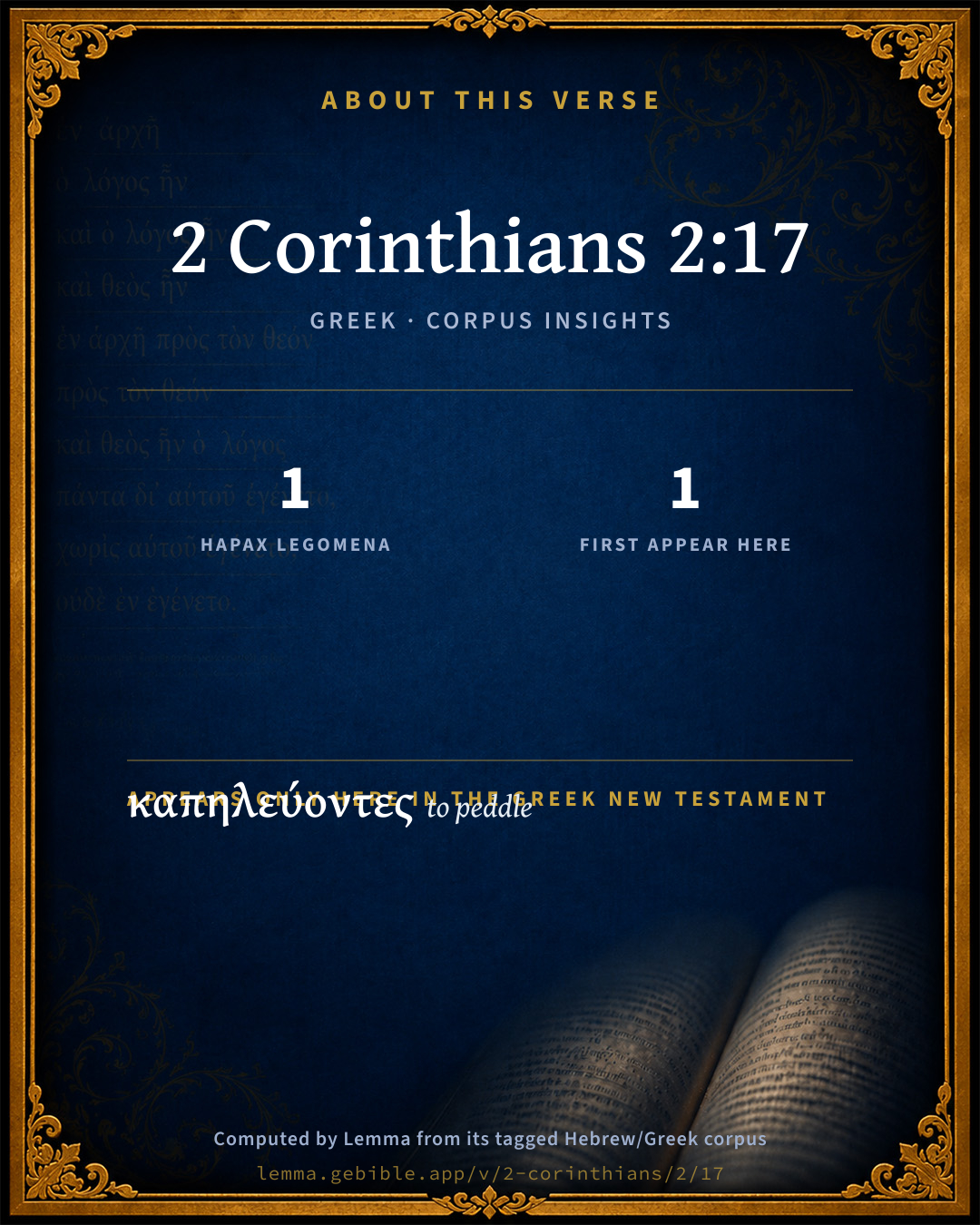
  • 1 hapax legomenon — only here in the Greek New Testament
  • 1 first appearance in the Greek New Testament
Full analysis ↓
Download a study sheet

One document with this verse’s original text, its word-by-word gloss line, the meaning frame, cross-references with their text, attributed commentary, and full source and license credits — printable, and it pastes into notes with its structure intact.

This verse Autodidact and up

Study sheet (.html) Plain text (.txt)

A passage Seminary Student

Up to 50 verses in one chapter. A passage sheet keeps up to 6 commentary sources and 12 cross-references per verse, in the order this page ranks them, and says so on the sheet whenever that leaves anything out. Ask for a single verse and you get the Autodidact verse sheet above.

Everything on this page stays free to read, with no account — the sheet is a download of what is already on screen, not access to it.

Want to remove ads? Support Godless Engineer
Compare translations 3

The same verse in 3 English versions, stacked beneath the original-language interlinear above. Click any original word for its lexicon entry.

Each is an independent rendering of the whole verse — the interlinear is not word-aligned to these translations.

Highlighted words mark where these versions differ — a whole-verse word diff, not a word-by-word alignment.

  • World English Bible Public Domain
    For we are not as so many, peddling the word of God. But as of sincerity, but as of God, in the sight of God, we speak in Christ.
  • King James Version Public Domain
    For we are not as many, which corrupt the word of God: but as of sincerity, but as of God, in the sight of God speak we in Christ.
  • unfoldingWord Literal Text CC BY-SA 4.0
    For we are not like the many peddling the word of God; but as from sincerity, but as from God, we speak in the presence of God in Christ.

unfoldingWord Literal Text — © unfoldingWord, licensed CC BY-SA 4.0. Word-aligned USFM3 via Door43 (git.door43.org/unfoldingWord/en_ult).

Versions to compare (up to 4)

3 of 4 selected

Show all 19 translations

Every available English version of this verse, each an independent rendering of the whole verse.

  • World English Bible Public Domain
    For we are not as so many, peddling the word of God. But as of sincerity, but as of God, in the sight of God, we speak in Christ.
  • Berean Standard Bible Public Domain
    For we are not like so many others, who peddle the word of God for profit. On the contrary, in Christ we speak before God with sincerity, as men sent from God.
  • Majority Standard Bible Public Domain
    For we are not like others, who peddle the word of God for profit. On the contrary, in Christ we speak before God with sincerity, as men sent from God.
  • King James Version Public Domain
    For we are not as many, which corrupt the word of God: but as of sincerity, but as of God, in the sight of God speak we in Christ.
  • American Standard Version (1901) Public Domain
    For we are not as the many, corrupting the word of God: but as of sincerity, but as of God, in the sight of God, speak we in Christ.
  • Revised Version (1885) Public Domain
    For we are not as the many, corrupting the word of God: but as of sincerity, but as of God, in the sight of God, speak we in Christ.
  • Geneva Bible (1599) Public Domain
    For wee are not as many, which make marchandise of the woorde of God: but as of sinceritie, but as of God in ye sight of God speake we in Christ.
  • Douay-Rheims (1899) Public Domain
    For we are not as many, adulterating the word of God; but with sincerity, but as from God, before God, in Christ we speak.
  • Young's Literal Translation Public Domain
    for we are not as the many, adulterating the word of God, but as of sincerity -- but as of God; in the presence of God, in Christ we do speak.
  • Literal Standard Version CC BY-SA 4.0
    For we are not as the many, adulterating the word of God, but as of sincerity—but as of God; in the presence of God, in Christ we speak.
  • Unlocked Literal Bible CC BY-SA 4.0
    For we are not like so many people who sell the word of God for profit. Instead, with purity of motives, we speak in Christ, as we are sent from God, in the sight of God.
  • unfoldingWord Literal Text CC BY-SA 4.0
    For we are not like the many peddling the word of God; but as from sincerity, but as from God, we speak in the presence of God in Christ.
  • Darby Bible Public Domain
    For we do not, as the many, make a trade of the word of God; but as of sincerity, but as of God, before God, we speak in Christ.
  • World Messianic Bible Public Domain
    For we are not as so many, peddling the word of God. But as of sincerity, but as of God, in the sight of God, we speak in Messiah.
  • Webster's Bible Public Domain
    For we are not as many, who corrupt the word of God: but as from sincerity, but as from God, in the sight of God we speak in Christ.
  • Free Bible Version CC BY-SA 4.0
    We are not like the majority who trade in the word of God for profit. Quite the opposite: we are sincere in sharing the word of God in Christ, knowing God is watching us.
  • Bible in Basic English Public Domain
    For we are not like the great number who make use of the word of God for profit: but our words are true, as from God, being said as before God in Christ.
  • Text-Critical English NT CC BY 4.0
    For we are not like others who peddle the word of God for profit. On the contrary, in Christ we speak with sincerity in the presence of God, as men sent from God.
  • Tyndale New Testament (1534) Public Domain
    For we are not as many are which choppe and chaunge with the worde of God: but even oute of purenes and by the power of God and in the sight of God so speake we in Christ.

Literal Standard Version (2020), Covenant Press — licensed CC BY-SA 4.0. Text via the HelloAO Bible API (eBible.org). Unlocked Literal Bible (unfoldingWord) — licensed CC BY-SA 4.0. Text via the HelloAO Bible API (eBible.org). unfoldingWord Literal Text — © unfoldingWord, licensed CC BY-SA 4.0. Word-aligned USFM3 via Door43 (git.door43.org/unfoldingWord/en_ult). Free Bible Version, Dr. Jonathan Gallagher — licensed CC BY-SA 4.0. Text via the HelloAO Bible API (eBible.org).

Word by word

More ways to search: Search by grammar → Find every occurrence → Compare this word →

Practice this passage: Drill this verse → Learn its vocabulary →

καπηλεύοντες
kapēleúō
G2585
“to peddle”
Verb, Present, Active, Participle, Nominative, Plural, Masculine
Part of Speech
Verb
Tense
Present
Voice
Active
Mood
Participle
Case
Nominative
Number
Plural
Gender
Masculine
Full Thayer's Definition

Origin: from kapelos (a huckster)

TDNT: 13:03,4

1. to be a retailer, to peddle 2. to make money by selling anything a. to get sordid gain by dealing in anything, to do a thing for base gain b. to trade in the word of God 1. to try to get base gain by teaching divine truth c. to corrupt, to adulterate 1. peddlers were in the habit of adulterating their commodities for the sake of gain
  1. οὐ ou G3756 “not” Particle, Negative
  2. γάρ gár G1063 “for” Conjunction
  3. ἐσμεν eimí G1510 “to be” Verb, Present, Active, Indicative, 1st person, Plural
  4. ὡς hōs G5613 “as” Adverb
  5. οἱ ho G3588 “the” Article, Nominative, Plural, Masculine
  6. πολλοὶ polýs G4183 “many” Adjective, Nominative, Plural, Masculine
  7. τὸν ho G3588 “the” Article, Accusative, Singular, Masculine
  8. λόγον lógos G3056 “word” Noun, Accusative, Singular, Masculine
  9. τοῦ ho G3588 “the” Article, Genitive, Singular, Masculine
  10. θεοῦ theós G2316 “God” Noun, Genitive, Singular, Masculine
  11. ἀλλ’ allá G235 “but” Conjunction
  12. ὡς hōs G5613 “as” Adverb
  13. ἐξ ek G1537 “from” Preposition
  14. εἰλικρινίας eilikríneia G1505 “purity” Noun, Genitive, Singular, Feminine
  15. ἀλλ’ allá G235 “but” Conjunction
  16. ὡς hōs G5613 “as” Adverb
  17. ἐκ ek G1537 “from” Preposition
  18. θεοῦ theós G2316 “God” Noun, Genitive, Singular, Masculine
  19. κατέναντι katénanti G2713 “opposite” Adverb
  20. θεοῦ theós G2316 “God” Noun, Genitive, Singular, Masculine
  21. ἐν en G1722 “in” Preposition
  22. Χριστῷ Christós G5547 “Christ” Noun, Dative, Singular, Masculine
  23. λαλοῦμεν laléō G2980 “to speak” Verb, Present, Active, Indicative, 1st person, Plural

About this verse

These counts appear in no published source. They are computed here, from the morphology-tagged text and Lemma’s own curated glosses. What Lemma adds →

24
words
16
distinct lemmas
Pauline Epistles
section

Notable vocabulary

1 hapax legomenon — a word that appears only here in the entire Greek New Testament:

  • καπηλεύοντες to peddle G2585

First appearance in Scripture

This word makes its first canonical appearance in the Greek New Testament here:

  • καπηλεύοντες to peddle G2585

Shared distinctive vocabulary

εἰλικρινίας purity G1505 occurs in 3 verses of the Greek New Testament. Also found in:
Repetition

Words recur within this verse:

Cross-references

23

Topical passages linked to 2 Corinthians 2:17 in the Treasury of Scripture Knowledge — connected by theme and wording, ordered by reader-vote popularity; previews shown in the World English Bible.

  • 2 Corinthians 4:2 But we have renounced the hidden things of shame, not walking in craftiness, nor handling the word of God deceitfully; but by the manifestation of the truth commending ourselves to every man's conscience in the sight of God.
  • 2 Corinthians 1:12 For our boasting is this: the testimony of our conscience, that in holiness and sincerity of God, not in fleshly wisdom but in the grace of God we behaved ourselves in the world, and more abundantly toward you.
  • 2 Peter 2:1–3 But there also arose false prophets among the people, as among you also there will be false teachers, who will secretly bring in destructive heresies, denying even the Master who bought them, bringing on themselves swift destruction.
  • 2 Timothy 4:3–4 For the time will come when they will not listen to the sound doctrine, but, having itching ears, will heap up for themselves teachers after their own lusts;
  • 1 Timothy 4:1–3 But the Spirit says expressly that in later times some will fall away from the faith, paying attention to seducing spirits and doctrines of demons,
  • Matthew 24:24 For there will arise false christs, and false prophets, and they will show great signs and wonders, so as to lead astray, if possible, even the chosen ones.
  • Jeremiah 5:31 the prophets prophesy falsely, and the priests bear rule by their means; and my people love to have it so: and what will you do in the end of it?
  • Jeremiah 23:27–32 who think to cause my people to forget my name by their dreams which they tell every man to his neighbor, as their fathers forgot my name for Baal.
  • 1 Corinthians 5:8 Therefore let us keep the feast, not with old yeast, neither with the yeast of malice and wickedness, but with the unleavened bread of sincerity and truth.
  • Titus 1:11 whose mouths must be stopped; men who overthrow whole houses, teaching things which they ought not, for dishonest gain's sake.
  • Jude 1:4 For there are certain men who crept in secretly, even those who were long ago written about for this condemnation: ungodly men, turning the grace of our God into lasciviousness, and denying our only Master, God, and Lord, Jesus Christ.
  • Revelation 2:14–15 But I have a few things against you, because you have there some who hold the teaching of Balaam, who taught Balak to throw a stumbling block before the children of Israel, to eat things sacrificed to idols, and to commit sexual immorality.
  • Revelation 2:20 But I have this against you, that you tolerate your woman, Jezebel, who calls herself a prophetess. She teaches and seduces my servants to commit sexual immorality, and to eat things sacrificed to idols.
  • Acts 20:20 how I didn't shrink from declaring to you anything that was profitable, teaching you publicly and from house to house,
  • 1 Timothy 1:19–20 holding faith and a good conscience; which some having thrust away made a shipwreck concerning the faith;
  • 1 John 4:1 Beloved, don't believe every spirit, but test the spirits, whether they are of God, because many false prophets have gone out into the world.
  • Acts 20:27 for I didn't shrink from declaring to you the whole counsel of God.
  • 2 Corinthians 11:13–15 For such men are false apostles, deceitful workers, masquerading as Christ's apostles.
  • 2 John 1:7–11 For many deceivers have gone out into the world, those who don't confess that Jesus Christ came in the flesh. This is the deceiver and the Antichrist.
  • Revelation 12:9 The great dragon was thrown down, the old serpent, he who is called the devil and Satan, the deceiver of the whole world. He was thrown down to the earth, and his angels were thrown down with him.
  • Revelation 19:20 The beast was taken, and with him the false prophet who worked the signs in his sight, with which he deceived those who had received the mark of the beast and those who worshiped his image. These two were thrown alive into the lake of fire that burns with sulfur.
  • Hebrews 11:27 By faith, he left Egypt, not fearing the wrath of the king; for he endured, as seeing him who is invisible.
  • 2 Timothy 2:6–18 The farmers who labor must be the first to get a share of the crops.

Cross-references courtesy of OpenBible.info (CC BY 4.0).

Where the printed editions differ

1 variant

Places in this verse where the major printed Greek editions disagree on the wording in a way that affects the translation — a comparison of editions, not a manuscript-by-manuscript collation. The editions are the modern critical texts (Nestlé-Aland 28/27, SBL, Westcott-Hort, Tregelles, Tyndale House) and the traditional texts behind the KJV (the Textus Receptus and the Byzantine/Majority text). It is not a claim about which reading is original.

  1. Different wording
    πολλοὶ

    “many”

    In NA28NA27TynSBLWHTregTR Not in Byz

    λοιποί (loipoi) 'rest' occurs in a few manuscripts (Byz) instead of πολλοὶ (polloi) 'many' in older manuscripts (NA28+NA27+Tyn+SBL+WH+Treg+TR)

Textual data: Translators Amalgamated Greek New Testament (STEPBible TAGNT) · CC BY 4.0.

Commentary

Notes on 2 Corinthians 2:17 from classic Christian and Jewish commentators (each source and its license shown beneath its notes). The classic Christian expositions comment on the surrounding passage and are grouped to its opening verse, so a note may address several verses; the Jewish commentaries on the Tanakh (Rashi and others) are per-verse, so they appear only where the commentator wrote on this verse.

Lemma curates 59 commentaries, every one of them public domain or Creative Commons licensed, each selected and text-cleaned for this edition rather than reprinted as found. About our sources →

Albert Barnes' Notes on the Bible

For we are not as many - This refers doubtless to the false teachers at Corinth; and to all who mingled human philosophy or tradition with the pure word of truth. Paul’s design in the statement in this verse seems to be to affirm that he had such a deep sense of the responsibility of the ministerial office, and of its necessary influence on the eternal destiny of man, that it led him to preach the simple gospel, the pure word of God. He did not dare to dilute it with any human mixture. He did not dare to preach philosophy, or human wisdom. He did not dare to mingle with it the crude conceptions of man. He sought to exhibit the simple truth as it was in Jesus; and so deep was his sense of the responsibility of the office, and so great was his desire on the subject, that he had been enabled to do it. and to triumph always in Christ. So that, although he was conscious that he was in himself unfit for these things, yet by the grace of God he had been able always to exhibit the simple truth, and his labors had been crowned with constant and signal success.

Which corrupt the word of God - Margin, “deal deceitfully with.” The word used here (καπηλεύοντες kapēleuontes) occurs nowhere else in the New Testament, and does not occur in the Septuagint. The word is derived from κάπηλος kapēlos, which signifies properly a huckster, or a retailer of wine, a petty chapman; a man who buys up articles for the purpose of selling them again. It also means sometimes a vintner, or an innkeeper. The proper idea is that of a small dealer and especially in wine. Such persons were notorious, as they are now, for diluting their wines with water (compare the Septuagint in Isa 1:22); and for compounding wines of other substances than the juice of the grape for purposes of gain. Wine, of all substances in trade, perhaps, affords the greatest facilities for such dishonest tricks; and, accordingly, the dealers in that article have generally been most distinguished for fraudulent practices and corrupt and diluted mixtures. Hence, the word comes to denote to adulterate; to corrupt, etc. It is here applied to those who adulterated or corrupted the pure word of God in any way, and for any purpose. It probably has particular reference to those who did it either by Judaizing opinions, or by the mixtures of a false and deceitful philosophy. The latter mode would be likely to prevail among the subtle and philosophizing Greeks. It is in such ways that the gospel has been usually corrupted:

(1) It is done by attempting to attach a philosophical explanation to the facts of revelation, and making the theory as important as the fact.

(2) By attempting to explain away the offensive points of revelation by the aid of philosophy.

(3) By attempting to make the facts of Scripture accord with the prevalent notions of philosophy, and by applying a mode of interpretation to the Bible which would fritter away its meaning, and make it mean anything or nothing at pleasure. In these, and in various other ways, people have corrupted the Word of God; and of all the evils which Christianity has ever sustained in this world, the worst have been those which it has received from philosophy, and from those teachers who have corrupted the Word of God. The fires of persecution it could meet, and still be pure; the utmost efforts of princes, and monarchs, and of Satan to destroy it, it has outlived, and has shone purely and brightly amidst all these efforts; but, when corrupted by philosophy, and by “science falsely so called,” it has been dimmed in its luster, paralyzed in its aims, and shorn of its power, and has ceased to be mighty in pulling down the strong holds of Satan’s kingdom. Accordingly, the enemy of God has ceased to excite persecution, and now aims in various ways to corrupt the gospel by the admixture of philosophy, and of human opinions. Tyndale renders this passage, “For we are not as many are which choppe and change with the word of God” - an idea which is important and beautiful - but this is one of the few instances in which he mistook the sense of the original text. In general, the accuracy of his translation and his acquaintance with the true sense of the Greek text are very remarkable.

But as of sincerity - Sincerely; actuated by unmingled honesty and simplicity of aim; see the note on 2Co 1:12.

As of God - As influenced by him; as under his control and direction; as having been sent by him; as acting by his command; see the note, 2Co 1:12.

In the sight of God - As if we felt that his eye was always on us. Nothing is better suited to make a person sincere and honest, than this.

Speak we in Christ - In the name, and in the service of Christ. We deliver our message with a deep consciousness that the eye of the all-seeing God is on us; that we can conceal nothing from Him; and that we must soon give up our account to Him.

Remarks

1. In this chapter, and in the management of the whole case to which Paul here refers, we have an instance of his tenderness in administering discipline. This tenderness was manifested in many ways:

(1) He did nothing to wound the feelings of the offending party.

(2) He did nothing in the way of punishment which a stern sense of duty did not demand,

(3) He did it all with many tears. He wept at the necessity of administering discipline at all. He wept over the remissness of the church. He wept over the fall of the offending brother.

(4) He did not mention even the name of the offender. He did not emblazon his faults abroad; nor has he left any clue by which it can be known; nor did he take any measures which were suited to pain, unnecessarily, the feelings of his friends. If all discipline in the church were conducted in this manner, it would probably always be effectual and successful, 2Co 2:1-10.

2. We ought cordially to receive and forgive an offending brother, as soon as he gives evidence of repentance. We should harbor no malice against him; and if, by repentance, he has put away his sins, we should hasten to forgive him. This we should do as individuals, and as churches. God cheerfully forgives us, and receives us into favor on our repentance; and we should hail the privilege of treating all our offending brethren in the same manner, 2Co 2:7-8.

3. Churches should be careful that Satan should not get an advantage over them, 2Co 2:11. In every way possible he will attempt it; and perhaps in few modes is it more often done than in administering discipline. In such a case, Satan gains an advantage over a church in the following ways.

(1) In inducing it to neglect discipline. This occurs often because an offender is rich, or talented, or is connected with influential families; because there is a fear of driving off such families from the church; because the individual is of elevated rank, and the church suffers him to remain in her bosom. The laws of the church, like other laws are often like cobwebs: Large flies break through, and the smaller ones are caught. The consequence is, that Satan gains an immense advantage. Rich and influential offenders remain in the church; discipline is relaxed; the cause of Christ is scandalized; and the church at large feels the influence, and the work of God declines.

(2) Satan gains an advantage in discipline, sometimes, by too great severity of discipline. If he cannot induce a church to relax altogether, and to suffer offenders to remain, then he excites them to improper and needless severity. He drives them on to harsh discipline for small offences. He excites a spirit of persecution. He enkindles a false zeal on account of the Shibboleth of doctrine. He excites a spirit of party, and causes the church to mistake it for zeal for truth. He excites a spirit of persecution against some of the best people in the church, on account of pretended errors in doctrine, and kindles the flames of intestine war; and breaks the church up into parties and fragments. Or he urges on the church, even in cases where discipline is proper, to needless and inappropriate severity; drives the offender from its bosom; breaks his spirit; and prevents ever-onward his usefulness, his return, and his happiness. One of the chief arts of Satan has been to cause the church in cases of discipline to use severity instead of kindness; to excite a spirit of persecution instead of love. Almost all the evils which grow out of attempts at discipline might have been prevented by a spirit of love.

(3) Satan gains an advantage in cases of discipline, when the church is unwilling to re-admit to fellowship an offending but a penitent member. His spirit is broken; his usefulness is destroyed. The world usually takes sides with him against the church, and the cause of religion bleeds.

4. Individual Christians, as well as churches, should be careful that Satan does not get an advantage over them, 2Co 2:11. Among the ways in which he does this are the following:

(1) By inducing them to conform to the world. This is done under the plea that religion is not gloomy, and morose, and ascetic. Thence he often leads professors into all the gaieties, and amusements, and follies of which the world partake. Satan gains an immense advantage to his cause when this is done - for all the influence of the professed Christian is with him.

(2) By producing laxness of opinion in regard to doctrine. Christ intends that his cause shall advance by the influence of truth; and that his church shall be the witness of the truth. The cause of Satan advances by error and falsehood; and when professed Christians embrace falsehood, or are indifferent to truth, their whole influence is on the side of Satan, and his advantage is immense when they become the advocates of error.

(3) By producing among Christians despondency, melancholy, and despair. Some of the best people are often thus afflicted and thrown into darkness, as Job was; Job 23:8-9. Indeed, it is commonly the best members of a church that have doubts in this manner, and that fall into temptation, and that are left to the buffetings of Satan. Your frivolous, and worldly, and fashionable Christians have usually no such troubles - except when they lie on a bed of death. They are not in the way of Satan. They do not oppose him, and he will not trouble them. It is your humble, praying, self-denying Christians that he dreads and hates; and it is these that he is suffered to tempt, and to make sad, and to fill with gloom and doubt. And when this is done, it is an immense advantage to his cause. It produces the impression that religion is nothing but gloom and melancholy, and the people of the world are easily led to hate and avoid it. Christians, therefore, should be cheerful, and benevolent, and happy - as they may be - lest Satan should get an advantage over them.

(4) By fanaticism. For when Satan finds that he can get no advantage over Christians by inducing them to do nothing, or to do anything positively wrong or immoral, he drives them on with over-heated and ill-timed zeal; he makes them unreasonably strenuous for some single opinion or measure; he disposes them to oppose and persecute all who do not fall into their views, and feel as they feel.

(5) By contentions and strifes. Satan often gets an advantage in that way. No matter what the cause may be, whether it be for doctrines, or for any other cause, yet the very fact that there are contentions among the professed followers of “the Prince of peace” does injury, and gives Satan an advantage. No small part of his efforts, therefore, have been to excite contentions among Christians, an effort in which he has been, and is still, eminently successful.

5. Satan gets an advantage over sinners, and they should be on their guard. He does it:

(1) By producing a sense of security in their present condition; and by leading them to indifference in regard to their eternal condition. In this he is eminently successful; and when this is gained, all is gained that his cause demands. It is impossible to conceive of greater success in anything than Satan has in producing a state of indifference to the subject of religion among people.

(2) By inducing them to defer attention to religion to some future time. This is an advantage, because:

It accomplishes all he wishes at present; Because it is usually successful altogether. It is usually the same thing as resolving not to attend to religion at all.

(3) By producing false views of religion. He represents it at one time as gloomy, sad, and melancholy; at another, as so easy, that it may be obtained, whenever they please; at another, by persuading them that their sins are so great that they cannot be forgiven. One great object of Satan is to blind the minds of sinners to the true nature of religion; and in this he is usually successful.

(4) He deludes the aged by telling them it is too late; and the young by telling them that now is the time for mirth and pleasure, and that religion may be attended to at some future period of life.

(5) He gains an advantage by plunging the sinner deeper and deeper in sin; inducing him to listen to the voice of temptation; by making him the companion of the wicked; and by deluding him with the promises of pleasure, honor, and gain in this world until it is too late, and he dies.

6. Ministers of the gospel may have occasion to triumph in the success of their work. Paul always met with success of some kind; always had some cause of triumph. In all his trials, he had occasion of rejoicing, and always was assured that he was pursuing that course which would lead him ultimately to triumph, 2Co 2:14.

7. The gospel may be so preached as to be successful, 2Co 2:14. In the hands of Paul it was successful. So it was with the other apostles. So it was with Luther, Knox, Calvin. So it was with Whitefield, Edwards Wesley, and Payson. If ministers are not successful, it is not the fault of the gospel. It is adapted to do good, and to save people; and it may be so preached as to accomplish those great ends. If all ministers were as self-denying, and laborious, and prayerful as were these people, the gospel would be as successful now as it has ever been.

(There is much truth in this representation. Certainly no great revival of religion can rationally be expected when the ministers of the gospel are not self-denying laborious, and prayerful. Yet we cannot certainly pronounce, that equal diligence in the use of means will in every case be attended with equal success. Allowance must be made for God’s sovereignty, in dispensing his grace. Otherwise, wherever the word was preached under most favorable circumstances, as far as excellence of means is concerned, there also, we should expect, and find most success. But it has not been so in reality. Never did hearers enjoy a more favorable opportunity of conversion, than when more than the eloquence of angels fell from the lips of Jesus, and he taught the people as one having authority and not as the scribes. Yet comparatively few, a solitary one here and there, listened to the voice of the charmer, though he charmed so wisely. Was it that he did not display the gospel in all its fullness, sufficiency, and loveliness? Was there any lack of moral persuasion, powerful argument, strung motive, touching appeal, in the Saviour’s addresses? No! Yet immediately after the ascension of Jesus, the Word of God subdued thousands on thousands, although employed by apostles only, whose ministrations, considered apart, must have been immeasurably inferior to those of Jesus. The same Jews that persisted in their unbelief, under the ministry of Christ, were disarmed of their prejudice, under the preaching of Peter! Whence the difference of efficacy? Whence the lack of success, where most we should have expected to find it, and the command of it, where least we could have looked for it? One sentence solves the difficulty. “The Holy Spirit was not yet given, because that Jesus was not yet glorified.”

Similar comparisons might he made between the ministrations of different individuals now. People of the highest abilities, persevering diligence, and elevated piety, have been left to complain of comparative barrenness in the sphere which they occupied, while humbler instruments, in a field no way more promising, have been blessed with the harvest of souls. The comparison might even be made of different periods of the same ministry. All other circumstances being equal, or differing so slightly as not to affect the argument, the word spoken at one time seems to fall powerless to the ground, as the arrow on the breast of steel. No shaft hits the mark, no sinner retires like the stricken deer to bleed alone. At another time, the people are made willing in the day of power. Conviction spreads with the rapidity of contagion, and the Lord daily adds to his people such as shall be saved. Now this difference cannot be explained but by referring it to the different measures in which God is pleased to communicate his spirit.)

8. Much of the work of the ministry is pleasant and delightful. It is the savor of life unto life, 2Co 2:15-16. There is no joy on earth of a higher and purer character than that which the ministers of the gospel have in the success of their work. There is no work more pleasant than that of imparting the consolations of religion to the sick, and the afflicted; than that of directing inquiring sinners to the Lamb of God; no joy on earth so pure and elevated as that which a pastor has in a revival of religion. In the evidence that God accepts his labors, and that to many his message is a savor of life unto life, there is a joy which no other pursuit can furnish; a joy, even on earth, which is more than a compensation for all the toils, self-denials, and trials of the ministry.

9. In view of the happy and saving results of the work of the ministry, we see the importance of the work. Those results are to be seen in heaven. They are to enter into the eternal destiny of the righteous. They are to be seen in the felicity and holiness of those who shall be redeemed from death. The very happiness of heaven, therefore, is dependent on the fidelity and success of the ministry. This work stretches beyond the grave. It reaches into eternity. It is to be seen in heaven. Other plans and labors of people terminate at death. But the work of the ministry reaches in its results into the skies; and is to be seen ever onward in eternity. Well might the apostle ask, “Who is sufficient for these things?”

10. The ministers of the gospel will be accepted of God, if faithful, whatever may be the result of their labors; whether seen in the salvation, or the augmented condemnation of those who hear them, 2Co 2:15. They are a sweet savor to God. Their acceptance with him depends not on the measure of their success; but on their fidelity. If people reject the gospel, and make it the occasion of their greater condemnation, the fault is not that of ministers, but is their own. If people are faithful, God accepts their efforts; and even if many reject the message and perish, still a faithful ministry will not be to blame. That such results should follow from their ministry, indeed, increases their responsibility, and makes their office more awful, but it will not render them less acceptable in their labors in the sight of God.

11. We are to anticipate that the ministry will be the means of the deeper condemnation of many who hear the gospel, 2Co 2:16. The gospel is to them a savor of death unto death. We are to expect that many will reject and despise the message, and sink into deeper sin, and condemnation, and woe. We are not to be disappointed, therefore, when we see such effects follow, and when the sinner sinks into a deeper hell from under the ministry of the gospel. It always has been the case, and we have reason to suppose it always will be. And painful as is the fact, yet ministers must make up their minds to witness this deeply painful result of their work.

12. The ministry is a deeply and awfully responsible work, 2Co 2:16. It is connected with the everlasting happiness, or the deep and eternal condemnation of all those who hear the gospel. Every sermon that is preached is making an impression that will never be obliterated, and producing an effect that will never terminate. Its effects will never all be seen until the day of judgment, and in the awful solemnities of the eternal world. Well might Paul ask, “Who is sufficient for these things?”

13. It is a solemn thing to hear the gospel. If it is solemn for a minister to dispense it, it is not less solemn to hear it. It is connected with the eternal welfare of those who hear. And thoughtless as are multitudes who hear it, yet it is deeply to affect them hereafter. If they ever embrace it, they will owe their eternal salvation to it; if they continue to neglect it, it will sink them deep and forever in the world of woe. Every individual, therefore, who hears the gospel dispensed, no matter by whom, should remember that he is listening to God’s solemn message to mankind; and that it will and must exert a deep influence on his eternal doom.

14. A people should pray much for a minister. Paul often entreated the churches to which he wrote to pray for him. If Paul needed the prayers of Christians, assuredly Christians now do. Prayer for a minister is demanded because:

(1) He has the same infirmities, conflicts, and temptations which other Christians have.

(2) He has those which are special, and which grow out of the very nature of his office; for the warfare of Satan is carried on mainly with the leaders of the army of God.

(3) He is engaged in a great and most responsible work - the greatest work ever committed to mortal man.

(4) His success will be generally in proportion as a people pray for him. The welfare of a people, therefore, is identified with their praying for their minister. He will preach better, and they will hear better, just in proportion as they pray for him. His preaching will be dull, dry, heavy; will be without unction, spirituality, and life, unless they pray for him; and their hearing will be dull, lifeless, and uninterested, unless they pray for him. No people will hear the gospel to much advantage who do not feel anxiety enough about it to pray for their minister.

15. The interview between a minister and his people in the day of judgment will be a very solemn one. Then the effect of his ministry will be seen. Then it will be known to whom it was a savor of life unto life, and to whom it was a savor of death unto death. Then the eternal destiny of all will be settled. Then the faithful minister will be attended to heaven by all to whom his ministry has been a savor of life unto life; and then he will part forever with all whom he so often warned and entreated in vain. In distant worlds - worlds forever separated - shall be experienced the result of his labors. O! how solemn must be the scene when he must give up his account for the manner in which he has preached; and they, for the manner in which they attended on his ministry!

16. Let all ministers, then, be careful that they do not corrupt the word of God, 2Co 2:17. Let them preach it in simplicity and in truth. Let them not preach philosophy, or metaphysics, or their own fancy, or the tradition of human beings, or the teaching of the schools, but the simple truth as it is in Jesus. Let them preach as sent by God; as in the sight of God; as commissioned by Christ to deliver a simple, plain, pure message to mankind, whether they will hear or forbear. Their success will be in proportion to the simplicity and purity of the gospel which they present; their peace and joy in death and in heaven will be just as they shall have evidence then that in simplicity and sincerity they have endeavored to present everywhere, and to all, the pure and simple gospel of Jesus Christ. As ministers, therefore, desire acceptance with God and success in the work let them preach the pure gospel; not adulterating it with foreign admixtures; not endeavoring to change it so as to be palatable to the carnal mind; not substituting philosophy for the gospel, and not withholding anything in the gospel because people do not love it; and let the people of God everywhere sustain the ministry by their prayers, and aid them in their work by daily commending them to the God of grace. So shall they be able to perform the solemn functions of their office to divine acceptance; and so shall ministers and people find the gospel to be “a savor of life unto life.”

Albert Barnes' Notes on the Bible (1834–1885) — public domain. Text from a community e-Sword/MySword module.

The Biblical Illustrator

Joseph S. Exell

2Co_2:17

For we are not as many, which corrupt the Word of God.

Corrupting the Word of God

The expression has the idea of self-interest, and especially of petty gain, at its basis. It means literally to sell in small quantities, to retail for profit. But it was specially applied to tavern keeping, and extended to cover all the devices by which the wine-sellers in ancient times deceived their customers. Then it was used figuratively as here; and Lucian speaks of philosophers as selling the sciences, and in most cases (πολλοι a curious parallel to St. Paul), like tavern keepers blending, adulterating, and giving bad measure. There are two separable ideas here. One is that of men qualifying the gospel, infiltrating their own ideas into the Word of God, tempering its severity, or perhaps its goodness, veiling its inexorableness, dealing in compromise. The other is that all such proceedings are faithless and dishonest because some private interest underlies them. It need not be avarice, though it is as likely to be this as anything else. A man corrupts the Word of God, makes it the stock in trade of a paltry business of his own, in many other ways than by subordinating it to the need of a livelihood. When he exercises his calling as minister for the gratification of his vanity, or when he preaches not that awful message in which life and death are bound up, but himself, his cleverness, his learning, humour, fine voice or gestures, he does so. He makes the Word minister to him, instead of being a minister of the Word; and that is the essence of the sin. It is the same if ambition be his motive, if he preaches to win disciples to himself, to gain an ascendency over souls, to become the head of a party which will bear the impress of his mind. (J. Denney, B. D.)

The way to preach the gospel

I. With conscious honesty. As of sincerity in direct antagonism to all duplicity and hypocrisy. No man can preach the gospel effectively who is not a true man--true to himself and to the doctrines he proclaims. He must be uninfluenced by prepossessions, by sectarian bias, by worldly interests or fame. No man can have this conscious honesty--

1. Unless he preaches his own personal convictions of the gospel. Not the opinions of others, nor even his own opinions, but convictions self-formed, vital, and profound.

2. Unless his own convictions have been reached by impartial, earnest, and devout study. The man who thus preaches, preaches a fresh, living, mighty gospel.

II. With conscious divinity. Of God, in the sight of God, i.e.--

1. From God. He must feel that he has a Divine commission.

2. Before God. In the sight of God. He must feel that the God who hath sent him confronts him. This consciousness will make him--

(1) Earnestly living. His soul will be all excitement.

(2) Utterly fearless of man.

III. With conscious Christliness. In Christ. There are two senses in which we are said to be in another.

1. In their affections. Without poetry or figure we are in those, in the hearts of those who love us. The child is in the heart of the loving parent, etc. Thus all Christs disciples are in His heart, in His affections. They live in Him.

2. In their character and spirit. Thus the admiring student lives in the character and spirit of his loved teacher, the admiring reader in the thoughts and genius of his favourite author, etc. This is the sense that is specially implied in the text. What is the spirit of Christ? It is that of supreme love to the Great Father and self-sacrificing love for humanity. (D. Thomas, D. D.)

.

The Biblical Illustrator, edited by Joseph S. Exell (c. 1880s–1900s) — public domain. Text from a community e-Sword module.

Joseph Benson's Commentary

2Co 2:17. For we are not as many who corrupt — Greek, καπηλευοντες, adulterate, the word of God — Like those vintners who mix their wines with baser liquors. Thus Isaiah says, Isa 1:22, (as his words are rendered by the LXX.,) Καπηλοι σου μισγουσι τον οινον υδατι, thy vintners mix their wine with water. By this metaphor the best Greek writers represented the arts of sophists, who, to make gain of their lectures, mixed their doctrine with falsehoods, to render it acceptable to their disciples. The apostle uses this metaphor to show that he and his fellow-labourers did not, like the false teachers referred to 2Co 11:22-23, corrupt the pure truth of the gospel by falsehoods, for the purpose of pleasing the vitiated taste of their hearers; but preached it in sincerity, without mixture of error, as the expression signifies: as of God — Transmitting his pure word, and not their own word; in the sight of God — As in his presence; remembering that his eye was upon them, and that he marked every word of their tongue; speaking in Christ — Words which he gave, approved, and blessed.

Joseph Benson's Commentary on the Old and New Testaments (1811–1818) — public domain. Text from a community e-Sword module.

Tyndale Open Study Notes

Tyndale Open Resources

2:17 Paul contrasts his service with that of his opponents. • They preach for personal profit and adulterate the truth, like merchants in Paul’s day who offered shoddy goods, or innkeepers who watered down the wine. By contrast, Paul preached with sincerity and with Christ’s authority (cp. 1:12; 4:2). Paul’s denial of mercenary motives reemerges in 11:1–12:21.

Tyndale Open Study Notes — © Tyndale Open Resources, licensed CC BY-SA 4.0. Text via the HelloAO Bible API.

Bengel's Gnomon

Johann Albrecht Bengel

2Co 2:17. Οἱ πολλοὶ, the many) so 2Co 11:18. הָרַבִּים, 1Ki 18:25. The article has force; the many, most men, ἄοσμοι, void of savour: comp. Php 2:21.—καπηλεύοντες [cauponantes]) corrupting [adulterating for gain]; men who do not make it their aim to show forth as much virtue [as much of the power of the Gospel] as possible, but to make gain by it. These men speak of Christ, but not as “from [of] God,” and “in the sight of God.” κάπηλοι, [caupones], vintners, select their merchandise from different quarters; they adulterate it; they manage it with a view to profit. The apostles deal otherwise with the word of God; for they speak as of God, and as of sincerity, and so as to approve themselves unto God. δολοῦντες, adulterating, 2Co 4:2 [Engl. Vers., handling deceitfully], is a synonymous expression, and also ἐμπορεύεσθαι, to make merchandise of, 2Pe 2:3.—ἐξ εἰλικρινείας, of sincerity) We give our whole attention to [our whole aim is] the word of God by itself.—ἀλλʼ ὡς ἐκ, but as of) a gradation [ascending climax], but being repeated; as is explanatory.[14]—κατενώπιον—ΛΑΛΟῦΜΕΝ, in the sight of God—we speak) So decidedly, ch. 2Co 12:19. We always think, that God, from [sent by] whom we speak, is present to the speakers; we do not care for men.—ἐν, in) Our discourse, which we hold in Christ, is given and directed from above.—λαλοῦμεν, we speak) We use the tongue; the power belongs to God.

[14] The Germ. Ver., however, omits both the particle ὡς before ἐξ εἰλικρινείας and the particle ἀλλʼ before ὡς ἐχ Θεοῦ, although the omission has by no means been approved of by the margins of both Ed.—E. B.

ABCD (Λ) read the ὡς after ἀλλ’ (or ἀλλὰ in B), in the first ἀλλʼ ὡς: Gfg Vulg. Memph. Iren. omit it. In the second ἀλλʼ ὡς, ABCD (Λ) support the ἀλλʼ. Gfg Vulg. (Fuld.), later Syr. Iren. omit it.—ED.

Bengel's Gnomon of the New Testament — English translation (T&T Clark, Edinburgh, 1860) — public domain. Text from a community e-Sword module.

Meyer's Critical & Exegetical Commentary

Heinrich August Wilhelm Meyer

2Co_2:17. The answer to the foregoing question is not to be supplied, so that it should be conceived as negative (εἰ δὲ μὴ ἱκανοὶ, χάριτος τὸ γινόμενον, Chrysostom, Neander, Hofmann, and others), but it is given, though indirectly, in 2Co_2:17 itself, inasmuch as the expression introduced by γάρ readily suggests to the reader the conclusion, that the subjects of ἐσμεν, i.e. Paul and his like, are the ἱκανοί, and that the πολλοί are not so. See Klotz, ad Devar. p. 240; Baeumlein, Partik. p. 83. If Paul had wished to convey in his question the negative statement, No one is capable of this, he could not but have added a limiting ἀφʼ ἑαντοῦ or the like (comp. 2Co_3:5), in order to place the reader in the right point of vie.

οἱ πολλοί] the known many, the anti-Pauline teachers.[153] Comp. 2Co_11:13; Php_3:18. See on οἱ πολλοί de certis quibusdam et definitis multis, Ellendt, Lex. Soph. II. p. 603; comp. also Rom_12:5. To understand by it the majority of the Christian teachers in general, is to throw a shadow on the apostolic church, which its history as known to us at least does not justif.

καπηλεὺοντες] belongs to ἐσμέν. The verb means (1) to carry on the business of a κάπηλος, a retailer, particularly a vintner; (2) to negotiate; (3) to practise usury with anything (τὶ), in particular, by adulteration, since the κάπηλοι adulterated the wine (LXX. Isa_1:22), and in general, had an evil reputation for cheating (κάπηλα τεχνήματα, Aesch. Fragm. 328 D). In this sense the word is also used by the Greeks of intellectual objects, as Plato, Protag. p. 313 D: οἱ τὰ μαθήματα … καπηλεύοντες. Comp. Lucian, Hermot 59: φιλόσοφοι ἀποδίδονται τὰ μαθήματα ὥσπερ οἱ κάπηλοι, κερασάμενοί γε οἱ πολλοὶ καὶ δολώσαντες καὶ κακομετροῦντες. Philostr 16: τὴν σοφίαν καπηλεύειν. So also here: comp. the opposite ἐξ εἰλικρ. and 2Co_4:2. Hence: we practise no deceitful usury with the word of God, as those do, who, with selfish intention, dress up what they preach as the word of God palatably and as people wish to hear it, and for that end τὰ αὐτῶν ἀναμιγνύουσι τοῖς θείοις, Chrysostom. Comp. 2Pe_2:3. Such are named in Ignat. Trall. (Interpol.) 6, comp. 10, χριστέμποροι, and are described as τὸν ἰὸν προσπλέκοντες τῆς πλάνης τῇ γλυκείᾳ προσηγορίᾳ.

ἀλλʼ ὡς ἐξ εἰλικρ.] but we speak (λαλοῦμεν) as one speaks from sincerity of mind (which has no dealings with adulteration), so that what we speak proceeds from an honest heart and thought. Comp. 2Co_1:12. ὡς is as in Joh_1:14. On ἐκ, compare Joh_3:31; Joh_8:44; 1Jn_4:5.

ἀλλʼ ὡς ἐκ θεοῦ] but as one speaks from God (who is in the speaker), as θεόπνευστος. Comp. Mat_10:20; 1Co_14:25; 2Co_5:20. The ἀλλά is repeated in the lively climax of the thought. Comp. 2Co_7:11, and see on 1Co_6:11. Rückert strangely wishes to connect it with τὸν λόγον, and to supply ὄντα. So also Estius (tanquam profectum et acceptum a Deo), Emmerling, and others. That is, in fact, impossible after ἀλλʼ ὡς ἐξ εἰλικρ.

κατέναντι θεοῦ ἐν Χριστῷ] Since neither ἀλλά nor ὡς is repeated before κατέναντι, Paul himself indicates the connection and division: but as from sincerity, but as from God, we speak before God in Christ, so that the commas after the twice-occurring θεοῦ are, with Lachmann and Tischendorf, to be deleted. This in opposition to the opinion cherished also by Hofmann, that κατέναντι θεοῦ and ἐν Χριστῷ are two modal definitions of λαλοῦμεν, running parallel with the foregoing point.

κατέναντι θεοῦ] before God, with the consciousness of having Him present as witness. Comp. Rom_4:17.

ἐν Χριοτῷ] can neither mean Christi nomine (Grotius, comp. Luther, Estius, Calovius, Zachariae, Heumann, Schulz, Rosenmüller), nor de Christo (Beza, Cornelius a Lapide, Morus, Flatt), nor secundum Christum (Calvin), but it is the habitually employed expression in Christo. We speak in Christo, in so far as Christ is the sphere in which our speaking moves. Comp. 2Co_12:19; Rom_9:1. In Him we live and move with our speaking, οὐδὲν τῇ ἡμετέρᾳ σοφίᾳ ἀλλὰ τῇ παρʼ ἐκείνου δυνάμει ἐνηχούμενοι, Chrysostom.

[153] Not merely the anti-Pauline Gentile-teachers, as Hofmann with the reading εἱ λοιποί arbitrarily limits it. It was among the Jewish-Christians that the most of those were found whom Paul had to regard as falsifiers of the word, and who every-where pushed themselves into the sphere of his labours.

Meyer — Critical and Exegetical Commentary on the New Testament — English translation by Peter Christie, edited by Frederick Crombie (T&T Clark, 1880) — public domain. Text from a community e-Sword module.

Expositor's Greek Testament

ed. W. Robertson Nicoll

2Co 2:17 . οὐ γάρ ἐσμεν ὡς κ . τ . λ .: for we are not as the many, viz. , the ordinary teachers with whom you meet. The indirect reference is to his opponents at Corinth, though they are not named. At least he is more worthy to fill the high office of which he has been speaking than many who would be only too glad to usurp his authority; cf. chap. 2Co 4:2 , 1Th 2:3 ; 1Th 2:5 for similar comparisons. καπηλεύοντες τὸν λόγον τοῦ Θεοῦ : who adulterate the word of God, i.e. , the Divine message as revealed in the Gospel (the usual sense in the N.T. of ὁ λόγος τοῦ Θεοῦ ; cf. 2Co 4:2 and 2Ti 2:15 ). κάπηλος ( Sir 26:29 ) is “a huckster,” and is used in Isa 1:22 of one who adulterates wine; so the primary sense of καπηλεύειν is “to make merchandise of” (R.V. margin), which readily passed into “to corrupt” or “adulterate” for the purposes of trade. ἀλλʼ ὡς ἐξ εἰλικρινείας f1κ . τ . λ .: but as of sincerity (our subjective attitude of mind), but as of God (the objective source of our message and of our commission to speak), in the sight of God ( sc. , in the consciousness of His presence; cf. 2Co 2:10 above), speak we in Christ, sc. , as members of Christ’s Body, in fellowship with Him. This solemn and impressive confirmation of what has been said is repeated, chap. 2Co 12:19 , κατέναντι Θεοῦ ἐν Χριστῷ λαλοῦμεν .

The Expositor's Greek Testament, edited by W. Robertson Nicoll (1897–1910) — public domain. Text from a community e-Sword module.

Geneva Bible (1599)

Geneva Bible translators

We do not handle it craftily and covetously, or less sincerely than we ought: and he useth a metaphor which is taken from hucksters, which used to play the false harlots with whatsoever cometh into their hands.

Geneva Bible (1599) marginal notes — public domain. Text via Bolls.life.

Jamieson, Fausset & Brown

Robert Jamieson, A. R. Fausset & David Brown

not as many-- (Co2 11:18; Phi 2:21). Rather, "the many," namely, the false teachers of whom he treats (tenth through twelfth chapters, especially Co2 11:13; Th1 2:3).

which corrupt--Greek, "adulterating, as hucksters do wine for gain" (Co2 4:2; Isa 1:22; Pe2 2:3, "Make merchandise of you").

as of sincerity . . . as of God--as one speaking from (out of) sincerity, as from (that is, by the command of, and so in dependence on) God.

in Christ's--as united to Him in living membership, and doing His work (compare Co2 12:19). The whole Gospel must be delivered such as it is, without concession to men's corruptions, and without selfish aims, if it is to be blessed with success (Act 20:27).

Next: 2 Corinthians Chapter 3

Jamieson, Fausset & Brown — Commentary Critical and Explanatory on the Whole Bible (1871) — public domain (CC PDM 1.0). Text via the HelloAO Bible API.

Adam Clarke's Commentary

Verse 17. For we are not as many, which corrupt the word of God] God has made US sufficient for these things by giving us his own pure doctrine, the ministry of reconciliation, which we conscientiously preserve and preach; and we act, not like many among you, who, having received that doctrine, corrupt it; mingling with it their own inventions, and explaining away its force and influence, so as to accommodate it to men of carnal minds.

The word καπηλευοντες, from καπηλος, a tavernkeeper, signifies acting like an unprincipled vintner; for this class of men have ever been notorious for adulterating their wines, mixing them with liquors of no worth, that thereby they might increase their quantity; and thus the mixture was sold for the same price as the pure wine. Isa 1:22, Thy wine is mixed with water, the Septuagint thus translate: οἱ καπηλοι σου μισγουσι τον οινον ὑδατι· "Thy vintners mix thy wine with water;" that is, thy false prophets and corrupt priests adulterate the word of God, and render it of none effect, by their explanations and traditions.

The word has been used, both among the Greeks and Latins, to signify a prostitution of what was right and just, for the sake of gain. So Herodian, lib. vi. cap. 11; Ειρηνην χρυσιου καπηλευοντες, "Making peace for money." So cauponari bellum is, "To make war for money." In short, the word is used to signify any artifice employed to get gain by making a thing look more or better than it is; or mingling that which is excellent with what is not so to promote the gain of the adulterater.

It is used by Aristophanes, Plut. Act. iv., scene 5, ver. 1064, to express an old woman who was patched and painted to hide her deformity.

Ου δητ', επει μεν νυν καπηλικως εχει·

Ει δ' εκπλυνειται τουτο το ψιμυθιον,

Οψει καταδηλα του προσωπου γε τα ῥακη.

Not at all; the old woman is painted:

If the paint were washed off, then you

Would plainly see her wrinkled face.

Where see the note of the Scholiast, who observes that the term is applied to those who deal in clothes, patching, mending, c., as well as to those who mix bad wine with good. Καπηλικως εχει· Πανουργικως· επει οἱ καπηλοι χριειν και αναποιειν τα ἱματια ειωθασι, και τον οινον δε νωθυλευουσι, συμμιγνυντες αυτῳ σαπρον. Vid. Kusteri Aristoph., page 45.

But as of sincerity] εξ ειλικρινειας. 2Co 1:12. We receive the doctrine pure from God we keep it pure, and deliver it in its purity to mankind. For we speak in Christ - in the things of his Gospel, as being in the sight of God - our whole souls and all their motives being known to him. As the unprincipled vintner knows that he adulterates the wine, his conscience testifying this; so we know that we deliver the sincere truth of God, our conscience witnessing that we deliver it to you, as we receive it, by the inspiration of the Spirit of truth.

1. THAT St. Paul was a man of a very tender and loving spirit is evident from all his epistles; but especially from this, and particularly from the chapter before us. It was not an easy thing with him to give a reproof; and nothing but a sense of his duty to God and his Church could have led him to use his apostolical power, to inflict spiritual punishment on transgressors. He felt like a loving and tender father, who, being obliged to correct his froward and disobedient child, feels in his own heart the pain of a hundred blows for that occasioned by one laid on the body of his son. There are some ministers who think nothing of cutting off members from the Church of Christ; they seem to do it, if not cheerfully, yet with indifference and unconcern! How can this be? Nothing but absolute duty to God should induce any man to separate any person from the visible Church; and then it must be on the conviction that the case is totally hopeless. And who, even in those circumstances, that knows the worth of a soul, can do it without torture of heart?

2. We must not only love the doctrines, but also the morality of the Gospel. He who loves this will not corrupt it; but, as Quesnel says truly, in order to love the truth a man must practise it; as in order to practise it he must love it. That a minister, says he, may preach the word of God in such a manner as is worthy of him, he must, with St. Paul, be always mindful of these three things:

1. That he be sent by God, and that he speak directly from him, and as his ambassador.

2. That he speak as in his presence, and under his immediate inspection.

3. That he consider himself as being in the place of Christ, and endeavour to minister to the souls of men, as he has reason to believe Christ would do, were he in the place; and as he knows Christ did, when he sojourned among men.

The minister of the Gospel is Christ's ambassador; and he prays men in Christ's stead to be reconciled to God. See 2Co 5:20. The people should consider the nature of this embassage, and receive it as coming immediately from God, that it may accomplish the end for which he has sent it.

Adam Clarke's Commentary on the Bible (1810–1826) — public domain. Text from a community e-Sword/MySword module.

John Calvin's Commentaries

17. For we are not. He now contrasts himself more openly with the false apostles, and that by way of amplifying, and at the same time, with the view of excluding them from the praise that he had claimed to himself. “It is on good grounds,” says he, “that I speak in honorable terms of my apostleship, for I am not afraid of being convicted of vanity, if proof is demanded. But many on false grounds arrogate the same thing to themselves, who will be found to have nothing in common with me. For they adulterate the word of the Lord, which I dispense with the greatest faithfulness and sincerity for the edification of the Church.” I do not think it likely, however, that those, who are here reproved, preached openly wicked or false doctrines; but am rather of opinion, that they corrupted the right use of doctrine, for the sake either of gain or of ambition, so as utterly to deprive it of energy. This he terms adulterating. Erasmus prefers to render it — cauponari — huckstering The Greek word καπηλεύειν, is taken from retailers, or tavern-keepers, who are accustomed to adulterate their commodities, that they may fetch a higher price. I do not know whether the word cauponari is used in that sense among the Latins.

It is, indeed, certain from the corresponding clause, that Paul intended to express here — corruption of doctrine — not as though they had revolted from the truth, but because they presented it under disguise, and not in its genuine purity. For the doctrine of God is corrupted in two ways. It is corrupted in a direct way, when it is mixed up with falsehood and lies, so as to be no longer the pure and genuine doctrine of God, but is falsely commended under that title. It is corrupted indirectly, when, although retaining its purity, it is turned hither and thither to please men, and is disfigured by unseemly disguises, by way of hunting after favor. Thus there will be found some, in whose doctrine there will be no impiety detected, but as they hunt after the applauses of the world by making a display of their acuteness and eloquence, or are ambitious of some place, or gape for filthy lucre, (1 Timothy 3:8,) or are desirous by some means or other to rise, they, nevertheless, corrupt the doctrine itself by wrongfully abusing it, or making it subservient to their depraved inclinations. I am, therefore, inclined to retain the word adulterate, as it expresses better what ordinarily happens in the case of all that play with the sacred word of God, as with a ball, and transform it according to their own convenience. For it must necessarily be, that they degenerate from the truth, and preach a sort of artificial and spurious Gospel.

But as of sincerity. The word as here is superfluous, as in many other places. In contrast with the corruption that he had made mention of, he makes use, first of all, of the term sincerity, which may be taken as referring to the manner of preaching, as well as to the disposition of the mind. I approve rather of the latter. Secondly, he places in contrast with it a faithful and conscientious dispensation of it, inasmuch as he faithfully delivers to the Church from hand to hand, as they say, the Gospel which God had committed to him, and had given him in charge. Thirdly, he subjoins to this a regard to the Divine presence. For whoever has the three following things, is in no danger of forming the purpose of corrupting the word of God. The first is — that we be actuated by a true zeal for God. The second is — that we bear in mind that it is his business that we are transacting, and bring forward nothing but what has come from him. The third is — that we consider, that we do nothing of which he is not the witness and spectator, and thus learn to refer every thing to his judgment.

In Christ means according to Christ. For the rendering of Erasmus, By Christ, is foreign to Paul’s intention.

John Calvin's Commentaries (1540-1563) — public domain. Text from the Calvin Translation Society English edition (1840s-50s) via the Christian Classics Ethereal Library (ccel.org). Calvin's coverage is partial (roughly two-thirds of the Bible); uncommented books and verses are honest gaps, never fabricated. The 19th-century editor's footnotes and remarks are omitted so the notes are faithfully Calvin's own voice.

Ellicott's Commentary for English Readers

(17) For we are not as many, which corrupt the word of God.—More accurately, We are not as most, as the greater number. There is a ring of sadness in the words. Even then the ways of error were manifold, and the way of truth was one. Among Judaisers, and the seekers after Greek wisdom, asserters of license for liberty, questioners of the resurrection: how few were those who preached the true word of God in its purity! The word for “corrupt,” formed from a word which signifies “huckster” or “tavern-keeper,” implies an adulteration like that which such people commonly practised. We, says St. Paul, play no such tricks of trade with what we preach; we do not meet the tastes of our hearers by prophesying deceits. The very fact that we know the tremendous issues of our work would hinder that. Comp. St. Peter’s use of the same figure in “the sincere (the unadulterated) milk of the reason” (1Pe_2:2). It is doubtful whether the imagery of the triumph is still present to his thoughts. If it were, we may think of the word “corrupt” as connected with the thought of the sweet savour: “Our incense, at any rate, is pure. If it brings death it is through no fault of ours. It is not a poisoned perfume.”

As of sincerity, but as of God.—The two clauses are half connected, half contrasted. To have said “of sincerity” alone would have been giving too much prominence to what was purely subjective. He could not feel sure that he was sincere unless he knew that his sincerity was given to him by God. (For the word “sincerity,” see Note on 2Co_1:12.)

A Bible Commentary for English Readers, edited by Charles John Ellicott (1878–1897) — public domain. Text from a community e-Sword module.

The Cambridge Bible for Schools and Colleges

gen. ed. J. J. S. Perowne

17. For we are not as many, which corrupt the word of God] The original makes ‘many’ definite with the article, thus clearly pointing out the false teachers, against whom so much of this and the former Epistle is directed. The word of God may be corrupted (1) by the admixture of foreign doctrines, e. g. those of the Judaizers, who grafted on Christianity the alien doctrine of the universal obligation of the Jewish law, (2) by degrading the doctrine of Christ into a system of argument and disputation (1Co_1:17-31; 1Co_2:1; 1Co_2:4-5; 1Co_2:14), and (3) by the introduction of personal objects, such as influence, authority, the praise of men (1Co_4:6; 2Co_10:12; 2Co_11:18; Gal_4:17). The word here translated corrupt occurs nowhere else in the New Testament. It is derived from a substantive equivalent in meaning to our higgler or huckster, especially a dealer in wine (See the LXX. of Isa_1:22. The word is not in the Hebrew), and hence from the dishonest practices of these small dealers it has come, by a process somewhat similar to that of our reproachful terms ‘higgling’ or ‘huckstering,’ to mean adulterate, i.e. to mix what should be pure with worthless or even deleterious substances.

but as of sincerity, but as of God] See note on 2Co_1:12. The word is here opposed to the idea of corrupting by admixture. The Apostle does not lose sight even here of the truth to which he returns in ch. 2Co_3:5, that his purity of heart is a supernatural gift. If he preaches Christ of sincerity, it is because the power to do so comes from God, Who gave the mission.

in the sight of God] A task imposed by God, and performed with the consciousness that His All-seeing Eye is upon those whom He has sent.

speak we in Christ] St Paul, throughout the whole of this chapter, has had in view the vindication of himself from any ulterior motives or lower principles of action in preaching Christ. His sole object is to minister Him. He desires nothing for himself. If he rebukes, it is for the offender’s sake. If he tests the obedience of the Church, it is because he is set over it for its benefit, not for his. If he preaches the word of God, it is by virtue of an inspiration from Him, whereby he preaches simply and faithfully the words put in his mouth by Christ. His doctrine is of God, delivered as in His sight, and spoken in Christ.

The Cambridge Bible for Schools and Colleges (gen. ed. J. J. S. Perowne; Cambridge University Press, 1878–1918) — public domain. Text from a community e-Sword module.

John Gill's Exposition

For we are not as many,.... The apostle here removes from himself, and other ministers of the Gospel, a character which belonged not to them, but to the false apostles; who are described by their number many; there were great swarms of false teachers in the early times of Christianity; see Jo1 2:18; some copies read, "as the rest": and so the Syriac and Arabic versions; and also by their quality,

which corrupt the word of God; by "the word of God", may be meant the Scriptures in general, which are from God, contain his will, and which he uses for the good of men, and his own glory, and may be corrupted by false glosses, and human mixtures, and by adding to them, or taking from them; or the Gospel in particular, which is the word of truth, of faith, righteousness, reconciliation, and salvation, and which was corrupted by these false teachers, by making merchandise of it; they huckstered the word of God, made gain of it, sought merely their own worldly interest and advantage in it, and so mixed it with their own vain philosophy, to please the carnal ears and hearts of men; they blended law and Gospel, grace and works, in the business of salvation; they did, as peddling merchants do, mix good and bad commodities together, and then vend them for sound ware; or as vintners, who mix their wine with water, and sell it for neat wine. The Septuagint interpreters on Isa 1:22, translate the last clause of that verse thus, , "thy vintners mix wine with water"; which may be understood in a moral or spiritual sense; so did these men mix, and hereby corrupt the Gospel, the word of God; and so the Syriac version reads the words "who mix the word of God": now the apostle says, they did not do so; they delivered out the word pure and unmixed, without any corruption or adulteration:

but as of sincerity, but as of God, in the sight of God, says he,

speak we in Christ; they spoke "in Christ", in the name of Christ, of or concerning him, and him only, and freely, fully, and plainly, as God's free gift, and the only way of salvation without the works of men: and they spoke, "as of sincerity"; what they delivered was the sincere milk of the word; the manner in which they did it was sincere, with all integrity and faithfulness; and so were their views, which were not their own profit and applause, but the glory of God and the good of souls; they spoke in Christ, and with all sincerity, "as of God"; by whom they were called and sent forth to speak in his name, and from whom they received the Gospel, and gifts, and abilities to preach it; and all this they did, in the sight of God, as the searcher of hearts, and to whom they knew they must give an account of their ministry another day.

Next: 2 Corinthians Chapter 3

John Gill's Exposition of the Whole Bible (1746–1763) — public domain (CC PDM 1.0). Text via the HelloAO Bible API.

Trapp's Complete Commentary

John Trapp

17 For we are not as many, which corrupt the word of God: but as of sincerity, but as of God, in the sight of God speak we in Christ.

Ver. 17. Which corrupt the word] Gr. καπηλευοντες, which huckster it, by handling it craftily and covetously, not serving the Lord Jesus Christ, but their own bellies; as those popish trencher flies and our court parasites, who served for false glasses, to make bad faces look fair, and doubted not to adulterate the milk of the word, to the hurt of men’s souls.

In the sight of God] It is impossible to speak as in God’s presence, and not sincerely; such as do so are not acquainted with that "holy hypocrisy" commended in Dominic the founder of the Dominican friars (Vincent. Belnac. Episc. in hist. Sancti Dom.), whom he was wont to admonish, to feign themselves more virtuous than indeed they were, when they came in company with the laity, that they might get the more respect to themselves and to their doctrine. This was one of the "devil’s depths," τα βαθη του Σατανα, Rev 2:24; whereunto God’s faithful ministers are perfect strangers.

John Trapp, A Commentary or Exposition upon All the Books of the Old and New Testament (1647–1656) — public domain. Text from a community e-Sword module.

Haydock's Catholic Bible Commentary

We are not as many false doctors and preachers, who adulterate [4] the word of God, by mixing human doctrine, to be more esteemed, or for gain-sake. The expression is metaphorical, from the custom of those who mix and adulterate wines, says St. John Chrysostom, for their greater gain and advantage. (Witham)

===============================

[BIBLIOGRAPHY]

Adulterantes, Greek: kapeleuontes, cauponantes; upon which St. John Chrysostom, p. 576, Greek: otan tis notheue ton oinon.

====================

George Leo Haydock (1774–1849), Haydock's Catholic Family Bible and Commentary, 1859 edition — public domain. Excludes Psalms (Douay-Rheims chapter numbering differs from Protestant) and Deuterocanonical books (Catholic canon only).

Matthew Poole's English Annotations

Lest the false apostles and teachers in this church should slight this exclamation of the apostle’s, and the pretended difficulty he made of the ministerial work, the apostle adds these words: I confess (saith he) it is no very difficult thing to speak of Christ, and pretend to preach and do as much as I do; but there are many καπηλευοντες, we translate it, corrupt the word; the Greek word signifies, to sell wine or victuals for money; and because such kind of people make no conscience to deceive, cheat, and deal fraudulently with their customers, it is sometimes used to signify corrupting or deceiving. We are not (saith the apostle) of the number of those who in preaching merely serve their own bellies, and turn the church into a tavern or victualling house, making a gain of the gospel, and discoursing a little while in a pulpit for gain; and so making no conscience, either what they speak, or how they speak. But we speak by authority from Christ, and in Christ’s name; clothed with his authority, and as his ambassadors; and so dare not say any thing unto people, and deliver to his people what he never gave us any commission to speak, nor yet to speak whatever cometh at our tongue’s end; but we must remember that we are

in the sight of God, and speak as from God of God; and that not fraudulently, but sincerely; sincerely aiming at the glory of God in what we do, and the salvation of the souls of them to whom we speak. This is a great work, first to consult the mind and will of God, and find it out by study and meditation; then faithfully to communicate it unto people, without any vain or corrupt mixtures (which do but adulterate the word preached); then to apply it to the consciences of those that hear us.

Who is sufficient for these things? That is, to discharge the office of the ministry in the preaching of the gospel, as men ought to preach it.

Matthew Poole's English Annotations on the Holy Bible (1683–1685) — public domain. Text from a community e-Sword/MySword module.

Whedon's Commentary on the Bible

Daniel D. Whedon

17. For—Reason for this agonized exclamation.

Many—Literally, the many; the multitudes. The word often signifies the entire whole, but more often the commonalty in distinction from the choice few or one.

Which corrupt—Literally, which huckster. The verb is derived from a noun signifying a huckster, or pedler of small wares, wines, or provisions. And they were reputed as guilty of adulterating, tricking, and cheating for gain. And so the pagan satirist, Lucian, says: “The philosophers retail their teachings, like hucksters, the great body of them mixing, cheating, and dealing false measures.” Paul refers to the errorists who were trying to make gain by adulterating the word of God—such as the Judaists, who substituted circumcision for Christ; the Libertines, who defended incest; the Gnostics, who denied the literal resurrection of the body. Of—Out from sincerity, as from a pure fountain. Of—Out from God, as the primal source of our utterance—by his inspiration.

In the sight of God—With, therefore, a dread sense of the necessity of pureness and rectitude.

In Christ—In his power, gospel, and very being. This solemn and cumulative assertion of sincerity, inspiration, and identification with Christ is in powerful issue with his Judaic opposers, who, while claiming to be Christine, truly depreciated Christ. But how does all this furnish reason for the wail as indicated by the above for. It furnishes reason why it was he that uttered it. He felt the solemn responsibilities implied in 2Co_2:15-16, the hucksters did not.

Daniel D. Whedon (gen. ed.), Commentary on the Old and New Testaments (1874–1909) — public domain. Text from a community e-Sword module.

The Pulpit Commentary

For we are not as many; rather, as the many. This clause is introduced to show how much courage and effort the work requires. "The many" might, by Greek idiom, mean "the majority." The apparent harshness of the assertion that the majority of teachers in the apostolic age dealt untruly with the Word of God, led to the substitution of oiJ loipoi, the rest, in some manuscripts (D, E, F, G, L). But "the many" here means "the many antagonists of mine," who preach a different gospel. (Gal_1:6) It must be remembered that conceit, Pharisaism, moral laxity, and factions were all at work in the Corinthian Church. Which corrupt. The Word means who are merely" trafficking with," "adulterating," "huckstering," the Word of life. The word occurs in the LXX of Isa_1:22; Ecc 26:29; and Plato applies the same metaphor to the sophists, who peddle their wisdom about ("Protag.," p. 313 d). The substantive kapelos means "a retail dealer," and especially a vintner, and the verb kapeleuo is always used in a bad sense, like the English "to huckster." Such deceitful dealers with the gospel are described 2Pe_2:3, and in one of the Ignatian letters they are called Christemporoi, Christ-traffickers. Such were those who altered the perspective of the gospel, lowered its standard, and adulterated it with strange admixtures. Their methods and their teaching are constantly alluded to in these Epistles. (1Co_1:17, 31 2:1-4; and 2Co_10:12, 15 11:13-15, etc.) But as of sincerity, but as of God. lake one who speaks from the sincerity of his heart (2Co_1:12 2Co_4:2) and by the inspiration of God. (1Co_14:25) Before God speak we in Christ. The sphere of our teaching as of our life is Christ; and our work is done

As ever in our great Taskmaster"s eye.

The way in which the gospel should be preached.

we are not as many, which corrupt the Word of God: but as of sincerity, but as of God, in the sight of God speak we in Christ." The words suggests the way in which the gospel should be preached.

I WITH CONSCIOUS HONESTY. "As of sincerity." This is a state of mind in direct antagonism to all duplicity. No man who is not true to his convictions and to himself can preach the gospel. He must be a true man who would preach truth, a loving man who would inculcate love. To have conscious honesty he must preach his own personal convictions of the gospel, not the opinions of others.

II WITH CONSCIOUS DIVINITY. "As of God, in the sight of God.

1. He must be conscious that God sent him. From God, not from schools, sects, Churches, or ecclesiastics, but direct from God himself.

2. He must be conscious that God sees him. "In the sight of God." This consciousness will make him humble, earnest, fearless, caring nothing for the frowns or smiles of his audience.

III WITH CONSCIOUS CHRISTLINESS. "Speak we in Christ." To be "in Christ" is to be in his character, in his Spirit. "The love of Christ constraineth me," etc. He who is conscious of the Spirit of Christ within him will be free from all self-seeking, all sordid motives, all cravings for popularity and fame.

Conscious simplicity and integrity.

word for "corrupt," formed from a word which signifies "huckster," or "tavern keeper," implies an adulteration like that which such people commonly practised. We, says St. Paul, play no such tricks of trade with what we preach; we do not meet the tastes of our hearers by prophesying deceits. The very fact that we know the tremendous issues of our work would hinder that." God"s gospel word, the message of eternal life in Christ Jesus, may be adulterated or corrupted in three ways.

1. By mixing up with it foreign, inharmonious, merely human, teachings.

2. Or by making the gospel revelation into a stiffened, formal creed, overthe precise terms of which we may wrangle and dispute.

3. Or by displacing the true motive in preaching it, and giving place to lowaims, and purposes of merely selfish ambition, and longing for the praise of men. The appeal of the text has its special force when we remember of what things the Judaizing party accused the apostle. St. Paul"s enemies forced this appeal from him. Usually it is enough that the sincere and true man should keep on his faithful way, little heeding the opinions or accusations of others, trusting the care of his reputation to God. But occasions do arise when something like public vindication becomes necessary, and a man is called to assert his conscious integrity. Of this we have two very striking instances recorded in Scripture. Samuel, when set aside by the mistaken longing for a visible king, felt deeply hurt, though more for the insult thus offered to Jehovah, the ever-present but invisible King, than for his own sake. He pleaded thus with the people: "I have walked before you from my childhood unto this day. Behold, here I am: witness against me before the Lord, and before his anointed: whose ox have I taken? or whose ass have I taken? or whom have I defrauded? whom have I oppressed? or of whose hand have I received any bribe to blind mine eyes therewith? and I will restore it you". (1Sa_12:2, 1Sa_12:3) And David, misunderstood and slandered, turns to speak to God in the bearing of the people, and says, "Judge me according to my righteousness, and according to mine integrity that is in me". (Psa_7:8) Consider

I THE GREAT GOSPEL TRUST.

1. On the one side, the trust of Divine revelation and message. Illustrate bythe direct communications of the Divine will made to the ancient prophets. These they were expected to deliver with all simplicity and completeness, and without making any additions of their own to them.

2. On the other side, the trust of men"s souls. The world was given to theapostles as the sphere in which their gospel message was to be delivered. Such a trust demanded seriousness, sincerity, and holy zeal. It should ever call out the best that is in a man.

II THE PERIL OF ITS INJURY THROUGH THE GUILE OF THE SELF SEEKER. Men will surely take their impressions of it from the character of the men who preach it. If we get a soiled idea of the gospel preacher, as an insincere, self-seeking man, it is only too likely that we shall have a soiled and stained image of the gospel that he preaches in our minds. Men can make golden glowings or deep shadows rest on the gospel that they declare, the message which they have in trust.

III THE FORCE OF IT AS PRESERVED WHEN THE AGENT IS GUILELESS AND SINCERE. The stream gets no foulness as it flows through him. Illustrate how men of transparent character and beautiful piety put honour on religion. The commendation of Christ"s gospel to men is

(1) the pure and stainless Christ himself, and then

(2) the graciousness and charm of his servants who are like him.

The force behind gospel preaching is the life of the men who preach. The simple-minded, sincere, uncorrupted man may positively make additions to the practical power of the gospel upon men. Distinguish, however, between simplicity and moral weakness, and also between guilelessness and ignorance. The simplicity required is "unity" as opposed to "double mindedness;" it is being wholly for God. R.T.

The Pulpit Commentary (1880–1919), ed. H.D.M. Spence-Jones & Joseph S. Exell — public domain. Text from a community e-Sword module.

John Wesley's Explanatory Notes

For we are not as many, who adulterate the word of God - Like those vintners (so the Greek word implies) who mix their wines with baser liquors. But as of sincerity - Without any mixture. But as from God - This rises higher still; transmitting his pure word, not our own. In the sight of God - Whom we regard as always present, and noting every word of our tongue. Speak we - The tongue is ours, but the power is God's. In Christ - Words which he gives, approves, and blesses.

John Wesley, Explanatory Notes Upon the Whole Bible (1754–1765) — public domain. Text via the GEBible commentary corpus.

Burkitt's Expository Notes on the New Testament

William Burkitt

Observe here, 1. The character which the apostle gives the false apostles who were crept in amongst the Corinthians: they were corrupters of the word of God; they did sophisticate and adulterate the sincere word of God, by intermixing their own pride and passions, their own inventions and imaginations, with the doctrine which they delivered. False teachers deal with the word, as some vintners deal with their wines; they imbase them in their nature, that they may advance them in their price, and thereby increase their own profit; they deliver the word of God in subtilty, but not in sincerity.

Observe, 2. The declaration which the apostle makes of his own uprightness and integrity in preaching the gospel of Jesus Christ: As of sincerity, as of God, and in the sight of God speak we in Christ; that is, we act as men of sincerity in what we do, as men taught of God and sent by God, as men acted by the power and guided by the Spirit of Christ, and all this is in the sight of God; we speak as from God, of God, in obedience to his command, and with an eye at his glory. He is a better preacher that speaks with an upright heart, than he that speaks with an eloquent tongue; he that acts from religious principles, for holy ends, as in the presence of the all-seeing God, and with a fixed eye at the glory of God in what he preaches, he is an interpreter one of a thousand.

William Burkitt's Expository Notes on the New Testament (1700–1703) — public domain. Text from a community e-Sword module.

McGarvey & Pendleton's Commentaries

J. W. McGarvey

For we are not as the many, corrupting the word of God: but as of sincerity, but as of God, in the sight of God, speak we in Christ . [But thanks be unto God for the relief which we received in Macedonia. And God's readings are ever thus. He leads us as a bound, anxious, trembling captive in his triumphal procession, but is constantly showing us mercy; for the procession is the triumph of Christ. He leads us in this procession as a priest bearing a censer, of which the gospel is the incense, giving forth, as a sweet-smelling savor, the knowledge of Christ at Ephesus, Troas, Macedonia or every place whither he leads us. Yea, we ourselves (because Christ liveth in us-- Phi_1:21 ) are a sweet savor of Christ unto God, both to them that are saved and to them that perish. To the one the incense of our presence is a deadly savor, and to the other a veritable source of life, for we make them all conscious of the triumph of Christ of which they are part. Now in every triumph some captives know that they are being led to death, and others that they are approaching the moment of forgiveness and life, and of these fates the incense keeps them in mind. And who, therefore, is sufficient to the task of being such a warning, despair-dealing, hope-dispensing, life-giving savor? who is able to preach this gospel of life and death befittingly? Realizing our insufficiency to such a task, we nevertheless do our best, for we are not like the many who oppose us ready to adulterate the word of God to make it popular or to suit our own selfish ends; but, discharging our duty in all sincerity as men inspired of God, and laboring in the sight of God, we speak under authority of Christ. It will be remembered that Paul wrote these words in an age when all the world was familiar with the glorious pageantry of a Roman triumph. When L. Mummius had conquered Corinth, the procession in his honor was one of the most splendid which the world had ever seen. In A. D. 51, just a short while before Paul penned these words, the emperor Claudius had celebrated his triumph over the Britons, and their king Caractacus was led in the triumph, but was spared. Ordinarily when the victor reached the capitol it was the signal for the slaying of many of the captives in his honor, and for the forgiveness of others. Thus the incense of the procession which permeated the air, and kept the captives conscious of the nature of the journey on which they marched, was redolent with hope or sorrow, according to the expectations held out to them by their victors. The phrases "from death unto death" and "from life unto life" are regarded by some as mere Hebrew superlatives; but "from" indicates source: the meaning therefore is, the gospel, which arises from Christ and which is preached through us, is to the unbelieving, but the incense arising from one crucified and dead, and so it is to them a savor from the dead and producing death. But to the believing it is a savor from the living, producing life.]

J. W. McGarvey (with Philip Y. Pendleton), Commentaries on the New Testament (The Fourfold Gospel, 1914; Acts; and the epistles) — public domain. Text from a community e-Sword/MySword module.

The People's New Testament

B. W. Johnson

17. We are not as many which corrupt the word of God. The Greek figure is taken from the tavern-keepers who adulterate the wine they offer for sale. There were those at Corinth, Judaizing teachers, who adulterated the gospel with ingredients of Judaism. These are the “false brethren” (11:26) with whom his whole ministry was a struggle. On the contrary, he and his fellow-preachers spoke the words of genuine sincerity and with a sense of responsibility to God.

B. W. Johnson's The People's New Testament with Notes (1889–1891) — public domain. Electronic text from the Christian Classics Ethereal Library (CCEL) ThML edition.

Cambridge Greek Testament for Schools and Colleges

17. οἱ πολλοί (אABCK, most versions) rather than οἱ λοιποί (DFGL, Syr., Arm.); and κατέναντι θεοῦ (א1ABC) rather than κατενώπιον τοῦ θεοῦ (FGKL) or κατέναντι τοῦ θεοῦ (P) or κατενώπιον θεοῦ (D).

2Co 2:1-17. THE VINDICATION CONTINUED

There should be no break here. The first chapter should have ended at 2Co 1:22, or still better at 2Co 2:14. There is the closest connexion between 2Co 1:23-24 and what follows, and from 2Co 1:15 to 2Co 2:4 the answer to the charge of “lightness” continues unbroken.

17. οὐ γάρ ἐσμεν ὡς οἱ πολλοί. The answer to the question is lost in the contrast between the Apostle and the other teachers: but the answer which is implied is that ‘we are sufficient’; for we are not as the many. The article is again ignored in the A.V., as in 2Co 2:6. But, unless the Apostle is here comparing the Judaizing teachers with himself, Silvanus, and Timothy, οἱ πολλοί can hardly have its common meaning of ‘the majority.’ Even in his most desponding moods S. Paul would scarcely say that in the Church at large false teachers were ‘the majority.’ But οἱ πολλοί may mean a definite group which is large, ‘the many’ who are well known, as in Polycarp 2, 7. In any case it retains the tone of contempt with which οἱ πολλοί are often mentioned.

καπηλεύοντες τὸν λόγον τοῦ θεοῦ. Corrupting the word of God. The participle goes with ἐσμέν: ‘such is not our manner of teaching.’ But ‘corrupt is an inadequate rendering of καπηλεύω, which means ‘corrupt for sordid gain.’ Their corrupting or falsifying of the word is spoken of as δολοῦντες (2Co 4:2): and the Vulgate has adulterantes in both places. Erasmus suggested cauponati; and this is used by Cassiodorus; quod verbum veritatis videantur esse cauponati (Hist. Eccl. iv. 24). A κάπηλος is one who sells by retail, a huckster, especially a retailer of wine; and hence one who makes gain by petty traffic, with or without the additional notion of cheating by adulteration or otherwise: comp. οἱ κάπηλοί σου μίσγουσι τὸν οἶνον ὕδατι (Isa 1:22). In the only other passage in the LXX. in which κάπηλος occurs, ‘An huckster shall not be judged free from sin’ (Sir 26:29), there is the same idea of cheating. Here καπηλεύοντες means ‘adulterating for the sake of pitiful gain.’

ἀλλʼ ὡς ἐξ εἰλικρινίας, ἀλλʼ ὡς ἐκ θεοῦ. ‘Sincerity (2Co 1:12) is in our hearts; nay more, God is in our hearts; and therefore what comes from sincerity comes from Him.’ The second ἀλλά marks a climax: in 2Co 7:11 and 1Co 6:11 we have a series. Both sources (ἐκ) of the Apostle’s teaching are in marked contrast to καπηλεύοντες.

κατέναντι θεοῦ. This consciousness of the Divine presence (2Co 12:19; Rom 4:17) is a guarantee for sincerity. See critical note. Neither κατέναντι (2Co 12:19; Rom 4:17, &c.) nor κατενώπιον (Eph 1:4; Col 1:22; Jud 1:24) are found in classical authors: both occur several times in the LXX.

ἐν Χριστῷ. As being His members and ministers. In Him our teaching lives and moves. Comp. 2Co 5:17; Rom 16:10.

Cambridge Greek Testament for Schools and Colleges (Cambridge University Press, 1896; 21 vols, various authors incl. Carr, Maclear, Plummer, Farrar, Lumby, Moule, M. R. James, Simcox) — public domain. Text from a community e-Sword module.

Alford’s Greek Testament

Henry Alford

17.] οἱ πολλοί here points definitely at those false teachers, of whom he by and by, ch. 10-12, speaks more plainly.

ἐσμεν … καπηλεύοντες] are not in the habit of adulterating (the word κάπηλος (Sir. 26:29) originally signifies any kind of huckster or vender, but especially of wine,—and thence, from the frequency of adulteration of wine, καπηλεύω implied to adulterate: in Isa 1:22, we have οἱ κάπηλοί σου μίσγουσι τὸν οἶνον ὕδατι: in the Etymol. (Wetst.) κάπηλος, ὁ οἰνοπώλης … ὁ δὲ Αἰσχύλος τὰ δόλια πάντα καλεῖ κάπηλα· ‘κάπηλα προφέρων τεχνήματα:’ in Lucian, Hermotim. 59 (ib.), ὅτι καὶ φιλόσοφοι ἀποδίδονται τὰ μαθήματα, ὥσπερ οἱ κάπηλοι, κερασάμενοί γε οἱ πολλοί, καὶ δολώσαντες, καὶ κακομετροῦντες. See many more examples in Wetst. The same is expressed ch. 4:2, by δολοῦντες τ. λόγον τ. θεοῦ) the word of God, but as (‘ut qui’) from sincerity (the subjective regard of the speakers), but as from God (the objective regard—a dependence on the divine suggestion) we speak before God (with a consciousness of His presence) in Christ (not ‘in the name of Christ,’ Grot., al., nor ‘concerning Christ,’—Beza, al.: nor ‘according to Christ,’ Calv.: but as usual, in Christ: as united to Him, and members of His Body, and employed in His work).

Henry Alford, The Greek Testament (1849–1861) — public domain. Text from a community e-Sword module.

International Critical Commentary

17. οὐ γάρ ἐσμεν ὡς οἱ πολλοί. The γάπ indicates the reply to the question just asked. ‘We are sufficient for these things, for we are not as the many teachers.’ Here we have for the first time in the Epistle a passage that is manifestly polemical. The Apostle’s opponents may have been in his thoughts in earlier places, but here it is quite certain that he is censuring other teachers for doing what the Apostle and his colleagues never do; they garble the word of God, in order to make the preaching of it more profitable to themselves. There are similar polemical hits in 3:1, 4:2, 5:12, while 10-13 teems with them, e.g. 10:12, 18, 11:12, 13, 20, 12:14. With ὡς οἱπολλοί comp. ὥς τινες (3:1). Here, as in Rom 5:15, Rom 5:19, AV ignores the article before πολλοί and translates ‘many’ instead of ‘the many.’ But we need not give the article its strongest force and make οἱ πολλοί mean ‘the majority,’ although it is likely that at Corinth the majority of the teachers were misleading the converts; and that the Judaizers on the one hand, and the advocates of Gentile licence on the other, far outnumbered the Apostle, Silvanus, and Timothy with whatever helpers they may have had. The meaning here seems to be ‘the mob of teachers,’ without comparing them in number with the Apostle and his colleagues. On the opposition to St Paul see K. Lake, Earlier Epp. pp. 219 f. In what sense he claims ἴκανότης for himself and his fellow-workers he tells us at once in 3:5, 6; none are sufficient, excepting those whom God has made so, and it is evident whom He has made sufficient, viz., those who preach His word as He would have it preached.

καπηλεύοντες τὸν λόγον τοῦ Θεοῦ. ‘Adulterating the word of God.’ The participle belongs to ἐσμέν not to οἱ πολλοί; ‘We are not people who adulterate the word.’ Vulg. has adulterantes for καπηλεύοντες here and for δολοῦντες 4:2. ‘Adulterate’ suggests more clearly than ‘corrupt’ (AV, RV) that the corruption is done for the sake of some miserable personal gain. The word occurs, nowhere else in Biblical Greek, but κάπηλος, ‘a retail dealer,’ occurs twice in LXX. In Isa 1:22 we have οἱκάπηλοί σου μίσγουσι τὸν οἱνον ὕδατι, ‘Thy hucksters mix their wine with water,’ in order to cheat the buyers; and Ecclus. 26:29, οὐ δικαιωθήσεται κάπηλος άπὸ ἁμαρτίας, ‘An huckster shall not be judged free from sin.’ St Paul may have had Isa 1:22 in his mind in using καπηλεύοντες. The Talmud counts the huckster as one whose business involves robbery, and Deu 30:13 is interpreted to mean that the Law cannot be found among hucksters or merchants. Plato says, “Knowledge is the food of the soul; and we must take care that the sophist does not deceive us when he praises what he sells, like those who sell the food of the body, the merchant and the hawker (κάπηλος); for they praise all their wares, without knowing what is good or bad for the body. In like manner those who carry about items of knowledge, to sell and hawk (καπηλεύοντες) them to any one who is in want of them, praise them, all alike, though neither they nor their customers know their effect upon the soul” (Protag. 313 D). Lucian says that philosophers dispose of their wares just as hucksters (κάπηλοι) do, most of them giving bad measure after adulterating and falsifying what they sell (Hermotimus, 59): κάπηλος is frequently used of a retailer of wine. Other illustrations in Wetstein.

The expression, ‘the word of God,’ ὁ λόγος τοῦ Θεοῦ, is very freq. in N.T., nearly forty times in all, without counting the expression, which is also freq., ‘the word of the Lord,’ ὁ λόγος τοῦ Κυρίον. It is specially common in Acts (twelve times) and in the Pauline Epp. (4:2; 1Co 15:36; Rom 9:6; Col 1:25; 1Th 2:13; 2Ti 2:9; Tit 2:5). Its usual meaning, as here, is the Gospel as preached, the contents of the new religion, as set forth in the O.T. and in the life and teaching of Christ. Often ὁ λόγος, without τοῦ Θεοῦ, is used in much the same sense, and in interpreting it in the Pauline Epp. we must bear in mind 1Co 2:2, ‘I determined not to know anything among you, save Jesus Christ, and Him crucified,’ so that the preaching of the word means the preaching of Jesus Christ, crucified and raised again. It was this λόγος that was being adulterated at Corinth. See J. H. Bernard, Past Epp. pp. 74 f.; Harnack, Constitution and Law of the Church, pp. 332 f.

As to the manner of the adulteration, omnis doctor qui auctoritatem Scripturarum, per quam potest audientes corripere, vertit ad gratiam et ita loquitur ut non corrigat sed delectet audientes, vinum Scripurarum violat et corrumpit sensu suo (Jerome on Isa 1:22). As Chrys. puts it, such teachers τὰ αὐτῶν ἀναμιγνύουσιτοῖς θείοις.

ἀλλʼ ὡς ἐξ εἰλικρινίας, ἀλλʼ ώ̔ ἐκ Θεοῦ. ‘But as from sincerity, nay, as from God.’ Sincerity (see on 1:12) is the internal source, and God is the external source, of what the missionaries preach. Their message rings true, for it comes from an honest and good heart (Luk 8:15), and is inspired by the faithful God (1:18) who cannot lie (Tit 1:2). Cf. οὐ γὰρ ὑμεῖς ἐστε οἰ λαλοῦντες, ἀλλὰ τὸ πνεῦμα τοῦ πατρὸς ὑμῶν τὸ λαλοῦν ἐν ὑμῖν (Mat 10:20). The ὡς means ‘as any one acts who acts ἑξ εἰλ, ἐκ Θ.’ The repetition of ἀλλά gives emphasis in an ascending scale; 7:11; 1Co 6:11; ὡς as in Mt. 7:49; Joh 1:14.

κατέναντι Θεοῦ. Cf. 12:19; Rom 4:17, etc. Neither κατέναντι nor κατενώπιον is classical; both are found several times in N.T. and LXX. There is no ἀλλʼ ὡς before κατ. Θ, and there should be no comma either before or after these words; ‘but as from God in the sight of God speak we in Christ.’ God is the source of what they preach and the witness of it; what greater guarantee of truthfulness could there be?

ἐν Χριστῷ. See on v. 14. Neither Christi nomine (Grot.), nor secundum Christum (Calv.), nor de Christo (Beza), but, quite literally, in Christo (Vulg.); it is ‘in Christ,’ as members of His Body, that ministers of the Gospel do their work, in the power that flows from union with Him. The branches bear fruit by being in the vine, and in no other way (Joh 15:4).

In this last verse (17), St Paul states both negatively and positively some leading characteristics of the minister who is equal to the responsibility of delivering a message which is so crucial that it may determine, not only the salvation of those who are already seekers after truth, but also the ruin of those who have set their faces against it. Such a minister is not one who, in order to win converts on easy terms, waters down the claims which the Gospel makes upon those who accept it. He is one who teaches with the openness and fulness which come from the God who inspires him; and in God’s presence he works as befits a member of Christ. He has, as the motive of all that he does or says, not his own gain or glory or satisfaction, but the desire to serve God by causing others to perceive the sweetness and the saving power of knowing something of Him. St Paul’s own experiences lie at the root of all this. He never forgets how Saul the persecutor was changed into Paul the Apostle.

αἱ πολλοί (א A B C K, d e f Vulg. Copt. Aeth.) rather than οἰ λοιποί (D E F G L, g Syrr. Arm.). F G, d e f Vulg. Copt. Goth. omit the second ὡς F G, d e f g Vulg. Copt. Goth. omit the second ἀλλʼ. In all three cases, as in that of εἰς τὸ εὐαλλἐλιον in v. 12, D E do not agree with d e. κατέναντ (א* A B C P 17) rather than κατενώπιον (א3 D E F G K L;). The second Θεοῦ without τοῦ (א* A B C D * 17) rather than with τοῦ (א3 D2 and 3 E F G K L P). On the difference between Θεός and ὀ Θεός see Westcott, additional note on 1Jn 4:2.

* The Vulg. varies much in the trans-lation of κρίνω: statuo, aestimo, judicio subjicio, and (most often) judicio.

B B (Fourth century). Codex Vaticanus.

17 17. (Evan. 33, Act_13. Ninth century). Now at paris. “The queen of the cursives” and the best for the Pauline Epistles; more than any other it preserves Pre-Syrian readings and agrees with B D L.

37 37. (Evan. 69, Acts 69, Rev_14. Fifteenth century). The well-known Leicester codex; belongs to the Ferrar group.

* information respecting the commentator is to be found in the volume on the First Epistle, pp. lxvi f.

D D (Sixth century). Codex Claromontanus; now at Paris. A Graeco-Latin MS. The Latin (d) is akin to the Old Latin. Many subsequent hands (sixth to ninth centuries) have corrected the MS.

E E (Ninth century). At Petrograd. A copy of D, and unimportant

G G (Late ninth century). Codex Boernerianus; at Dresden. Interlined with the Latin (in minluscules). The Greek text is almost the same as that of F, but the Latin (g) shows Old Latin elements.

אԠא (Fourth century). Codex Sinaiticus; now at Petrograd, the only uncial MS. containing the whole N.T.

A (Fifth century). Codex Alexandrinus, now in the British Museum. All of 2 Corinthians from ἐπίστευσα 4:13 to ἐξ ἐμοῦ 12:6 is wanting.

C C (Fifth century). Codex Ephraemi, a Palimpsest; now at Paris, very defective. Of 2 Corinthians all from 10:8 onwards is wanting.

* In the frayed original only νιν is legible; and εἰκόνιν = είκὀνιον is a better restoration than ὀθὀνιν, which was an earlier conjecture.

† Wieseler thinks that these verses may refer to the letter of 1Co 5:9, but they evidently refer to something more recent, and to the last letter which he had sent them. As this cannot be 1 Cor., it must be a letter written later than 1 Cor.

O O (Ninth century). Two leaves at Petrograd contain 2Co 1:20-12.

P P (Ninth century). Codex Porfirianus Chiovensis, formerly possessed by Bishop Porfiri of Kiev, and now at Petrograd.

F F (Late ninth century). Codex Augiensis (from Reichenau); now at Trinity College, Cambridge.

K K (Ninth century). Codex Mosquensis; now at Moscow.

L L (Ninth century). Codex Angelicus; now in the Angelica Library at Rome.

* “These words cannot be referred to our first canonical Epistle, and no more characterise its general tone than what he says about his second visit describes his first mission” (Orello Cone, Paul, p. 121).

* The omission is all the more astonishing when we remember that St Paul had ordered that the offender should be handed over to Satan, and that (on this hypothesis) the sentence had not been executed.

† McFadyen is inconsistent. On 1Co 5:1 he says that it is uncertain whether the father was dead when to son took his father’s wife; on 2Co 7:12 he assumes that the father was alive when the son formed this reveling union.

* Es muss sich hier um eine schwere persönlichs Kraänkung dest Paulus und um einen personlichen Beleidiger handeln (Bousset, p. 175). See also Hastings, DB i. p. 493; Enc. Bibl. 1:902; G. H. Rendall, p. 61; Schmiedel, p. 221. Bleek, Hilgenfeld, Ewald, Godet, Bachmann, Lietzmann und outhers take a similar view; the offence was a personal attack on St Paul.

† Krenkel’s suggestion that the offender had wronged a fellow-Christian in a matter of property has found little support. It is more probable than the supposed reference to 1Co 5:1; but the only reasonable hypothesis is that the ἀδικία was against St Paul himself. Against Timothy is not impoossible, but it is improbable

* If the offender were the incestuous man, could St Paul have said, ‘He has not pained me at all’? For the moral of these words see Chadwick, The Pastoral Teaching of St. Paul, p. 239.

† Bachmann quotes what Zeus says about the parasites (Lucian, Timon, 10), ἱκανὴ καὶ αὔτη τιμωρία ἔσται αὐτοῖς, viz. that of seeing Timon rolling in money, which tells against the supposed distinction.

‡ Sufficiens non quantum ad Dei judicium, sed quantum expediebattmpori.

* Vulg. here and elsewhere uses donare to translate χαρίζεσθαι, and donare may mean ‘to forgive’; culpa gravis precibus donatur saepe suorum (Ov. pont.11. vii. 51). The idea that an offence involves a debt to be wiped out by punishment lies at the back of such language.

* Until the Reformation it was not seriously disputed that indulgenes were comparatively modern. But the Council of Trent (Sess. xxv.) delared them to have been used antiquissimis temporibus, and this view is authoritatively upheld.

* The corruption of ῃ to ει occurs elsewhere; ἀρέσῃ to ἀρέσει (1Co 7:32).

* Vulg. always has circumvenire for πλεονεκτεῖν? (7:2, 12:17, 18; 1Th 4:6): so also had Cyprian (Test. iii. 88).

* Cf. Act 20:5, Act 20:6, where the art, is omitted and inserted of the same place in consecutive verses.

† Valida fama percrebuit migraturum Alexandriam vel Ilium, trenslatis simul opibus imperii (Julius, 79).

d d The Latin companion of D

e d The Latin companion of E

* Suidas gives δημοσιεύσας as the equivalent of θριαμβεύσας.

† St Paul uses a number of words to xpress his relation to God as a minister of the Gospel. It is λειτουργία and διακονία (9:12), πρεσβεία (5:20), στρατεία (10:4), ὑπηρεσία and οἰκονομία (1Co 4:1); but this metaphor of being led in triumph by Him is the most striking of all.

* “Ask different persons what is the leading doctrine of the Apostle of the Gentiles, and you will get different answers. Some will reply, justification by faith, others, the liberty of the Gospel. You will find that for once when either of these doctrines is referred to , union with Christ will be mentioned ten times. They are indeed prominent. But it underlies the whyole.” (Lightfoot, Sermons in St Paul’s, p. 227).

* In LXX, the most common verbs with ὀσμήν are ποιεῖν and διδόναι

* “Wherever Christ’s servants are, there should be fragfrance. A Christian without this redolence is as impossible as incense whose presence is unfelt by those who come ear it. It penetrates the atmosphere and compels attention;—so plainly that their presence is, as it were, a perpetual challenge to their environment, repelling some, attracting others. They constitute a living standard, which compels men involuntarily to expose the inner quality of their life” (McFadyen, pp. 274 f.)

† Other terms used by St Paul in reference to the fate ofd unbelievers are θάνατος (Rom 6:23, Rom 8:6), φθορά (Gal 6:8), ὀργή (Rom 2:5, Rom 2:8, Rom 2:5:9; 1Th 1:10, 1Th 5:9). But he is much more concerned to remind his readers that believers can be sure of salvation in Christ than to discuss the future of those who refuse to believe on Him

f d The Latin companion of F

g d The Latin companion of G

International Critical Commentary — older volumes (1896–1929), various authors — public domain. Text from a community e-Sword module.

Vincent's Word Studies in the New Testament

Marvin R. Vincent

Which corrupt [καπηλευοντες] . Only here in the New Testament.

From kaphlov a huckster or pedler; also a tavernkeeper. The kaphloi formed a distinct class among the Greek dealers, distinguished from the ejuporoi merchants or wholesale dealers. So Plato : "Is not retailer [καπηλους] the term which is applied to those who sit in the market - place buying and selling, while those who wander from one city to another are called merchants ?" (" Republic, "371; compare" Statesman, "260) The term included dealers in victuals and all sorts of wares, but was especially applied to retailers of wine, with whom adulteration and short measure were matters of course. Galen speaks of wine - dealers kaphleuontev touv oinouv playing tricks with their wines; mixing the new, harsh wines, so as to make them pass for old. These not only sold their wares in the market, but had kaphleia wine - shops all over the town, where it was not thought respectable to take refreshments. The whole trade was greatly despised. In Thebes no one who had sold in the market within the last ten years was allowed to take part in the government. So Plato, speaking of the evils of luxury and poverty :" What remedy can a city of sense find against this disease ? In the first place, they must have as few retail traders as possible "(" Laws," 919. The whole passage is well worth reading). The moral application of the term was familiar in classical Greek. Lucian says : "The philosophers deal out their instructions like hucksters." Plato : "Those who carry about the wares of knowledge, and make the round of the cities, and sell or retail them to any customer who is in want of them, praise them all alike; though I should not wonder if many of them were really ignorant of their effect upon the soul; and their customers equally ignorant, unless he who buys of them happens to be a physician of the soul" (" Protagoras, "313). Paul here uses the term of those who trade in the word of God, adulterating it for the purpose of gain or popularity. Compare 1Ti 6:5, Rev. In the" Teaching of the Twelve Apostles " occurs the word cristemporov a Christ - monger (ch. 12 5).

Marvin R. Vincent, Word Studies in the New Testament (1887–1900) — public domain. Text from a community e-Sword/MySword module.

Lesson kit

Teaching starters — assembled from the data on this page, not authored interpretation. Every prompt links to the verse data it draws on. Edit before teaching.

2 Corinthians, in the Pauline Epistles, opens this verse with 24 words (16 distinct Greek lemmas). Its most distinctive word is kapēleúō (“to peddle”). A historical commentator’s framing appears above. Read the whole chapter for the surrounding context.

Discussion questions

  1. The word kapēleúō carries the sense “to peddle.” How does it shape the verse?
  2. This verse holds 1 word here found nowhere else in the Greek New Testament. What might the rare word draw attention to?
  3. The word “to peddle” first appears here in Scripture. What is being introduced at this debut?
  4. 1 Corinthians 5:8 shares the word «purity» with this verse. How do the two illuminate each other?
  5. “God” occurs 3× in this one verse. What is the effect of the repetition?
  6. These translations render this verse differently. What is at stake in choosing one wording over another?
  7. Reading how Albert Barnes' Notes on the Bible and The Biblical Illustrator read this verse, where do the two commentators agree and where do they part?

Things to notice

  • 1 word in this verse appears nowhere else in the Greek New Testament.
  • 1 word makes its first canonical appearance in Scripture here.
  • These translations choose different wording for 6 words in this verse.
  • “God” occurs 3× in this single verse.
  • 16 distinct Greek lemmas span 24 words in this verse.

Reading settings

Reading text

Shown beneath each verse's original-language words.

Old Testament
Old Testament edition

Read the OT as the Masoretic Hebrew (MT) or the Greek Septuagint (LXX).

English shown for the Greek Septuagint (in the Hebrew ↔ Greek comparison).

Comparing translations? Open the Compare panel on any verse page to stack up to four side by side.