

Romans 1:4
Greek (Tischendorf 8th ed.) Romans 1:4 appears in the Greek New Testament. The text above is from the Tischendorf 8th edition. Each word links to its Strong’s number and a concise gloss. Click any word for its full Thayer’s Greek Lexicon entry.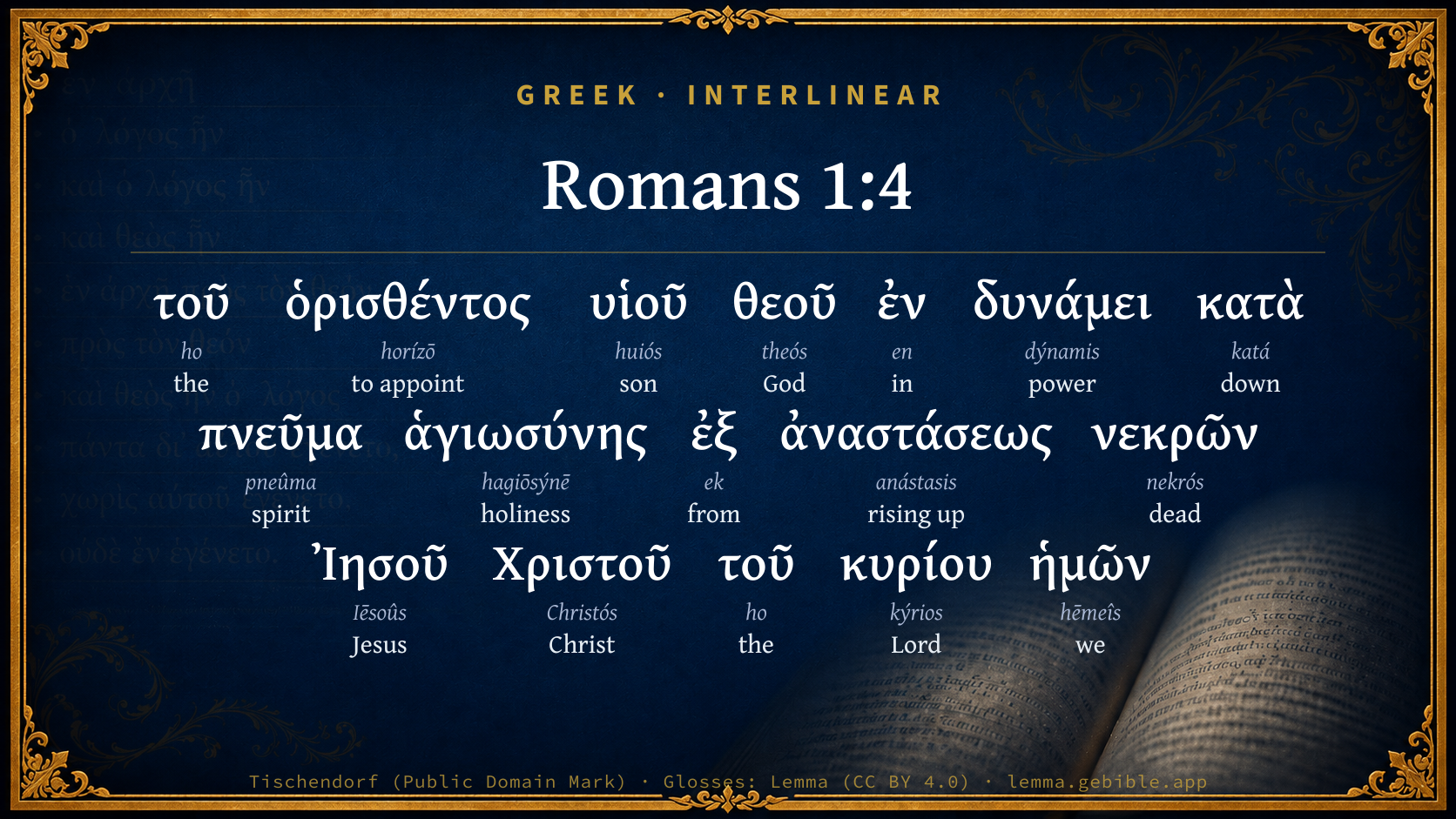
who was declared to be the Son of God with power, according to the Spirit of holiness, by the resurrection from the dead, Jesus Christ our Lord,
Download a study sheet
One document with this verse’s original text, its word-by-word gloss line, the meaning frame, cross-references with their text, attributed commentary, and full source and license credits — printable, and it pastes into notes with its structure intact.
This verse Autodidact and up
A passage Seminary Student
Up to 50 verses in one chapter. A passage sheet keeps up to 6 commentary sources and 12 cross-references per verse, in the order this page ranks them, and says so on the sheet whenever that leaves anything out. Ask for a single verse and you get the Autodidact verse sheet above.
Everything on this page stays free to read, with no account — the sheet is a download of what is already on screen, not access to it.
Compare translations 3
The same verse in 3 English versions, stacked beneath the original-language interlinear above. Click any original word for its lexicon entry.
Each is an independent rendering of the whole verse — the interlinear is not word-aligned to these translations.
Highlighted words mark where these versions differ — a whole-verse word diff, not a word-by-word alignment.
-
World English Bible Public Domain
who was declared to be the Son of God with power, according to the Spirit of holiness, by the resurrection from the dead, Jesus Christ our Lord,
-
King James Version Public Domain
And declared to be the Son of God with power, according to the spirit of holiness, by the resurrection from the dead:
-
unfoldingWord Literal Text CC BY-SA 4.0
the one having been designated the Son of God in power according to the Spirit of holiness by the resurrection of dead ones—Jesus Christ our Lord,
unfoldingWord Literal Text — © unfoldingWord, licensed CC BY-SA 4.0. Word-aligned USFM3 via Door43 (git.door43.org/unfoldingWord/en_ult).
Show all 19 translations
Every available English version of this verse, each an independent rendering of the whole verse.
-
World English Bible Public Domain
who was declared to be the Son of God with power, according to the Spirit of holiness, by the resurrection from the dead, Jesus Christ our Lord,
-
Berean Standard Bible Public Domain
and who through the Spirit of holiness was declared with power to be the Son of God by His resurrection from the dead: Jesus Christ our Lord.
-
Majority Standard Bible Public Domain
and who through the Spirit of holiness was declared with power to be the Son of God by His resurrection from the dead: Jesus Christ our Lord.
-
King James Version Public Domain
And declared to be the Son of God with power, according to the spirit of holiness, by the resurrection from the dead:
-
American Standard Version (1901) Public Domain
who was declared `to be' the Son of God with power, according to the spirit of holiness, by the resurrection from the dead; `even' Jesus Christ our Lord,
-
Revised Version (1885) Public Domain
who was declared to be the Son of God with power, according to the spirit of holiness, by the resurrection of the dead; even Jesus Christ our Lord,
-
Geneva Bible (1599) Public Domain
And declared mightily to be the Sonne of God, touching the Spirit of sanctification by the resurrection from the dead)
-
Douay-Rheims (1899) Public Domain
Who was predestinated the Son of God in power, according to the spirit of sanctification, by the resurrection of our Lord Jesus Christ from the dead;
-
Young's Literal Translation Public Domain
who is marked out Son of God in power, according to the Spirit of sanctification, by the rising again from the dead,) Jesus Christ our Lord;
-
Literal Standard Version CC BY-SA 4.0
who is marked out [as the] Son of God in power, according to the Spirit of sanctification, by the resurrection from the dead—Jesus Christ our Lord;
-
Unlocked Literal Bible CC BY-SA 4.0
Through the Spirit of holiness he was declared with power to be the Son of God by the resurrection from the dead, Jesus Christ our Lord.
-
unfoldingWord Literal Text CC BY-SA 4.0
the one having been designated the Son of God in power according to the Spirit of holiness by the resurrection of dead ones—Jesus Christ our Lord,
-
Darby Bible Public Domain
marked out Son of God in power, according to [the] Spirit of holiness, by resurrection of [the] dead) Jesus Christ our Lord;
-
World Messianic Bible Public Domain
who was declared to be the Son of God with power according to the Spirit of holiness, by the resurrection from the dead, Yeshua the Messiah our Lord,
-
Webster's Bible Public Domain
And declared to be the Son of God, with power, according to the spirit of holiness, by the resurrection from the dead:
-
Free Bible Version CC BY-SA 4.0
but who was revealed as God's Son by his resurrection from the dead through the power of the Holy Spirit. He is Jesus Christ our Lord.
-
Bible in Basic English Public Domain
But was marked out as Son of God in power by the Holy Spirit through the coming to life again of the dead; Jesus Christ our Lord,
-
Text-Critical English NT CC BY 4.0
and who was declared to be the Son of God in power according to the Spirit of holiness by the resurrection from the dead, Jesus Christ our Lord,
-
Tyndale New Testament (1534) Public Domain
and declared to be the sonne of God with power of the holy goost that sanctifieth sence the tyme that Iesus Christ oure Lorde rose agayne from deeth
Literal Standard Version (2020), Covenant Press — licensed CC BY-SA 4.0. Text via the HelloAO Bible API (eBible.org). Unlocked Literal Bible (unfoldingWord) — licensed CC BY-SA 4.0. Text via the HelloAO Bible API (eBible.org). unfoldingWord Literal Text — © unfoldingWord, licensed CC BY-SA 4.0. Word-aligned USFM3 via Door43 (git.door43.org/unfoldingWord/en_ult). Free Bible Version, Dr. Jonathan Gallagher — licensed CC BY-SA 4.0. Text via the HelloAO Bible API (eBible.org).
Word by word
More ways to search: Search by grammar → Find every occurrence → Compare this word →
Practice this passage: Drill this verse → Learn its vocabulary →
- Appears 3× in the Greek New Testament
- First appears here
- Part of Speech
- Noun
- Case
- Genitive
- Number
- Singular
- Gender
- Feminine
Full Thayer's Definition
- τοῦ ho G3588 “the” Article, Genitive, Singular, Masculine
- ὁρισθέντος horízō G3724 “to appoint” Verb, Aorist, Passive, Participle, Genitive, Singular, Masculine
- υἱοῦ huiós G5207 “son” Noun, Genitive, Singular, Masculine
- θεοῦ theós G2316 “God” Noun, Genitive, Singular, Masculine
- ἐν en G1722 “in” Preposition
- δυνάμει dýnamis G1411 “power” Noun, Dative, Singular, Feminine
- κατὰ katá G2596 “down” Preposition
- πνεῦμα pneûma G4151 “spirit” Noun, Accusative, Singular, Neuter
- ἁγιωσύνης hagiōsýnē G42 “holiness” Noun, Genitive, Singular, Feminine
- ἐξ ek G1537 “from” Preposition
- ἀναστάσεως anástasis G386 “rising up” Noun, Genitive, Singular, Feminine
- νεκρῶν nekrós G3498 “dead” Adjective, Genitive, Plural, Masculine
- Ἰησοῦ Iēsoûs G2424 “Jesus” Noun, Genitive, Singular, Masculine
- Χριστοῦ Christós G5547 “Christ” Noun, Genitive, Singular, Masculine
- τοῦ ho G3588 “the” Article, Genitive, Singular, Masculine
- κυρίου kýrios G2962 “Lord” Noun, Genitive, Singular, Masculine
- ἡμῶν hēmeîs G2249 “we” Personal pronoun, 1st person, Genitive, Plural
About this verse
These counts appear in no published source. They are computed here, from the morphology-tagged text and Lemma’s own curated glosses. What Lemma adds →
- 17
- words
- 16
- distinct lemmas
- Pauline Epistles
- section
Notable vocabulary
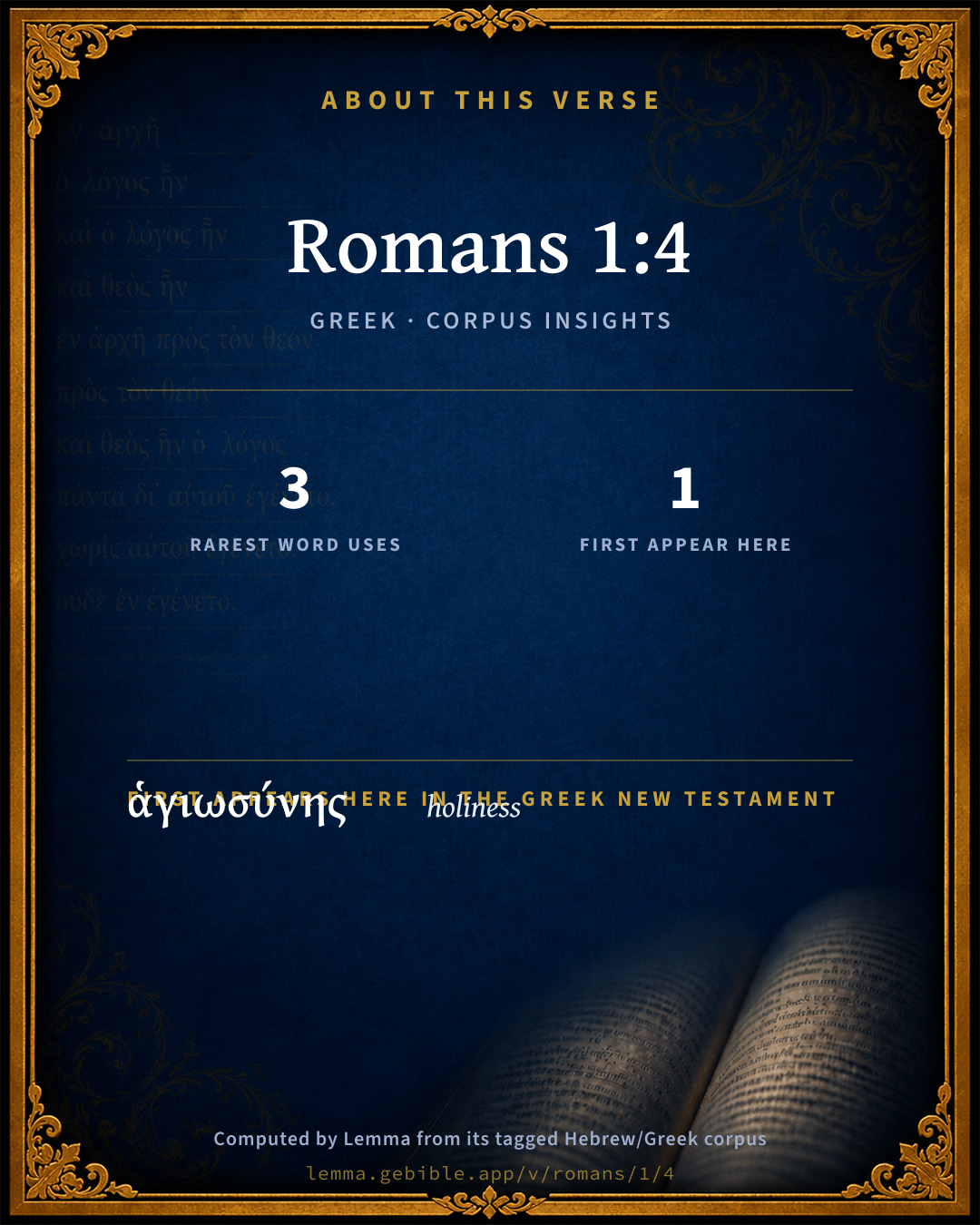
The rarest word here is ἁγιωσύνης holiness G42 — appearing just 3 times in the whole Greek New Testament.
First appearance in Scripture
This word makes its first canonical appearance in the Greek New Testament here:
- ἁγιωσύνης holiness G42
Shared distinctive vocabulary
ἁγιωσύνης holiness G42 occurs in 3 verses of the Greek New Testament. Also found in:
Repetition
A word recurs within this verse:
- τοῦ the G3588 ×2
Cross-references
19Topical passages linked to Romans 1:4 in the Treasury of Scripture Knowledge — connected by theme and wording, ordered by reader-vote popularity; previews shown in the World English Bible.
- Hebrews 9:14 how much more will the blood of Christ, who through the eternal Spirit offered himself without blemish to God, cleanse your conscience from dead works to serve the living God?
- Ephesians 1:19–23 and what is the exceeding greatness of his power toward us who believe, according to that working of the strength of his might
- Hebrews 5:5–6 So also Christ didn't glorify himself to be made a high priest, but it was he who said to him, "You are my Son. Today I have become your father."
- Acts 13:33–35 that God has fulfilled the same to us, their children, in that he raised up Jesus. As it is also written in the second psalm, 'You are my Son. Today I have become your father.'
- 2 Corinthians 13:4 For he was crucified through weakness, yet he lives through the power of God. For we also are weak in him, but we will live with him through the power of God toward you.
- Acts 5:30–32 The God of our fathers raised up Jesus, whom you killed, hanging him on a tree.
- John 2:18–21 The Jews therefore answered him, "What sign do you show us, seeing that you do these things?"
- Acts 2:24 whom God raised up, having freed him from the agony of death, because it was not possible that he should be held by it.
- Acts 2:32 This Jesus God raised up, to which we all are witnesses.
- Acts 3:15 and killed the Prince of life, whom God raised from the dead, to which we are witnesses.
- Acts 4:10–12 be it known to you all, and to all the people of Israel, that in the name of Jesus Christ of Nazareth, whom you crucified, whom God raised from the dead, in him does this man stand here before you whole.
- Acts 17:31 because he has appointed a day in which he will judge the world in righteousness by the man whom he has ordained; of which he has given assurance to all men, in that he has raised him from the dead."
- Romans 1:3 concerning his Son, who was born of the seed of David according to the flesh,
- 1 Peter 1:11 searching for who or what kind of time the Spirit of Christ, which was in them, pointed to, when he predicted the sufferings of Christ, and the glories that would follow them.
- 2 Peter 1:21 For no prophecy ever came by the will of man: but holy men of God spoke, being moved by the Holy Spirit.
- Luke 18:31–33 He took the twelve aside, and said to them, "Behold, we are going up to Jerusalem, and all the things that are written through the prophets concerning the Son of Man will be completed.
- Luke 24:26–27 Didn't the Christ have to suffer these things and to enter into his glory?"
- Revelation 1:18 and the Living one. I was dead, and behold, I am alive forevermore. Amen. I have the keys of Death and of Hades.
- Revelation 19:10 I fell down before his feet to worship him. He said to me, "Look! Don't do it! I am a fellow bondservant with you and with your brothers who hold the testimony of Jesus. Worship God, for the testimony of Jesus is the Spirit of Prophecy."
Cross-references courtesy of OpenBible.info (CC BY 4.0).
Lesson kit
Teaching starters — assembled from the data on this page, not authored interpretation. Every prompt links to the verse data it draws on. Edit before teaching.
Romans, in the Pauline Epistles, opens this verse with 17 words (16 distinct Greek lemmas). Its most distinctive word is hagiōsýnē (“holiness”). A historical commentator’s framing appears above. Read the whole chapter for the surrounding context.
Discussion questions
- How does “holiness” (hagiōsýnē) shape what this verse is saying?
- This is the first place “holiness” appears in Scripture (first appears here). What does its debut here establish?
- How does 2 Corinthians 7:1, which shares the word «holiness», read alongside this verse?
- What does the repetition of “the” (2× in this one verse) do in this verse?
- These translations render this verse differently; the difference is in the English rendering, not the original. What questions does that raise?
- Compare how Albert Barnes' Notes on the Bible and MacLaren's Expositions of Holy Scripture read this verse. Where do they agree or differ?
Things to notice
- 1 word makes its first canonical appearance in Scripture here.
- These translations choose different wording for 10 words in this verse.
- “the” occurs 2× in this single verse.
- 16 distinct Greek lemmas span 17 words in this verse.
Commentary
Notes on Romans 1:4 from classic Christian and Jewish commentators (each source and its license shown beneath its notes). The classic Christian expositions comment on the surrounding passage and are grouped to its opening verse, so a note may address several verses; the Jewish commentaries on the Tanakh (Rashi and others) are per-verse, so they appear only where the commentator wrote on this verse.
Lemma curates 59 commentaries, every one of them public domain or Creative Commons licensed, each selected and text-cleaned for this edition rather than reprinted as found. About our sources →
Albert Barnes' Notes on the Bible
Albert Barnes' Notes on the Bible (1834–1885) — public domain. Text from a community e-Sword/MySword module.
MacLaren's Expositions of Holy Scripture
Alexander MacLaren
Alexander MacLaren, Expositions of Holy Scripture (1904–1910) — public domain. Text from a community e-Sword module.
Tyndale Open Study Notes
Tyndale Open Resources
Tyndale Open Study Notes — © Tyndale Open Resources, licensed CC BY-SA 4.0. Text via the HelloAO Bible API.
Bengel's Gnomon
Johann Albrecht Bengel
Bengel's Gnomon of the New Testament — English translation (T&T Clark, Edinburgh, 1860) — public domain. Text from a community e-Sword module.
Hodge's Commentary on Romans, Ephesians & First Corinthians
Charles Hodge
Charles Hodge — Commentary on Romans (1835), First Corinthians (1857), and Ephesians (1856) — public domain. Text from a community e-Sword module.
Geneva Bible (1599)
Geneva Bible translators
Geneva Bible (1599) marginal notes — public domain. Text via Bolls.life.
Jamieson, Fausset & Brown
Robert Jamieson, A. R. Fausset & David Brown
Jamieson, Fausset & Brown — Commentary Critical and Explanatory on the Whole Bible (1871) — public domain (CC PDM 1.0). Text via the HelloAO Bible API.
Adam Clarke's Commentary
Adam Clarke's Commentary on the Bible (1810–1826) — public domain. Text from a community e-Sword/MySword module.
John Calvin's Commentaries
John Calvin's Commentaries (1540-1563) — public domain. Text from the Calvin Translation Society English edition (1840s-50s) via the Christian Classics Ethereal Library (ccel.org). Calvin's coverage is partial (roughly two-thirds of the Bible); uncommented books and verses are honest gaps, never fabricated. The 19th-century editor's footnotes and remarks are omitted so the notes are faithfully Calvin's own voice.
Ellicott's Commentary for English Readers
A Bible Commentary for English Readers, edited by Charles John Ellicott (1878–1897) — public domain. Text from a community e-Sword module.
The Cambridge Bible for Schools and Colleges
gen. ed. J. J. S. Perowne
The Cambridge Bible for Schools and Colleges (gen. ed. J. J. S. Perowne; Cambridge University Press, 1878–1918) — public domain. Text from a community e-Sword module.
John Gill's Exposition
John Gill's Exposition of the Whole Bible (1746–1763) — public domain (CC PDM 1.0). Text via the HelloAO Bible API.
Trapp's Complete Commentary
John Trapp
John Trapp, A Commentary or Exposition upon All the Books of the Old and New Testament (1647–1656) — public domain. Text from a community e-Sword module.
Haydock's Catholic Bible Commentary
George Leo Haydock (1774–1849), Haydock's Catholic Family Bible and Commentary, 1859 edition — public domain. Excludes Psalms (Douay-Rheims chapter numbering differs from Protestant) and Deuterocanonical books (Catholic canon only).
Matthew Poole's English Annotations
Matthew Poole's English Annotations on the Holy Bible (1683–1685) — public domain. Text from a community e-Sword/MySword module.
Whedon's Commentary on the Bible
Daniel D. Whedon
Daniel D. Whedon (gen. ed.), Commentary on the Old and New Testaments (1874–1909) — public domain. Text from a community e-Sword module.
The Pulpit Commentary
The Pulpit Commentary (1880–1919), ed. H.D.M. Spence-Jones & Joseph S. Exell — public domain. Text from a community e-Sword module.
John Wesley's Explanatory Notes
John Wesley, Explanatory Notes Upon the Whole Bible (1754–1765) — public domain. Text via the GEBible commentary corpus.
Godbey's Commentary on the New Testament
William B. Godbey
William B. Godbey, Commentary on the New Testament (1896–1900) — public domain. Text from a community e-Sword module.
McGarvey & Pendleton's Commentaries
J. W. McGarvey
J. W. McGarvey (with Philip Y. Pendleton), Commentaries on the New Testament (The Fourfold Gospel, 1914; Acts; and the epistles) — public domain. Text from a community e-Sword/MySword module.
The People's New Testament
B. W. Johnson
B. W. Johnson's The People's New Testament with Notes (1889–1891) — public domain. Electronic text from the Christian Classics Ethereal Library (CCEL) ThML edition.
unfoldingWord translationNotes
Door43 World Missions Community
unfoldingWord translationNotes — © Distant Shores Media and the Door43 World Missions Community, licensed CC BY-SA 4.0. Source: git.door43.org/Door43/en_tn.
Cambridge Greek Testament for Schools and Colleges
Cambridge Greek Testament for Schools and Colleges (Cambridge University Press, 1896; 21 vols, various authors incl. Carr, Maclear, Plummer, Farrar, Lumby, Moule, M. R. James, Simcox) — public domain. Text from a community e-Sword module.
Alford’s Greek Testament
Henry Alford
Henry Alford, The Greek Testament (1849–1861) — public domain. Text from a community e-Sword module.
International Critical Commentary
International Critical Commentary — older volumes (1896–1929), various authors — public domain. Text from a community e-Sword module.
Vincent's Word Studies in the New Testament
Marvin R. Vincent
Marvin R. Vincent, Word Studies in the New Testament (1887–1900) — public domain. Text from a community e-Sword/MySword module.