Acts 18:21

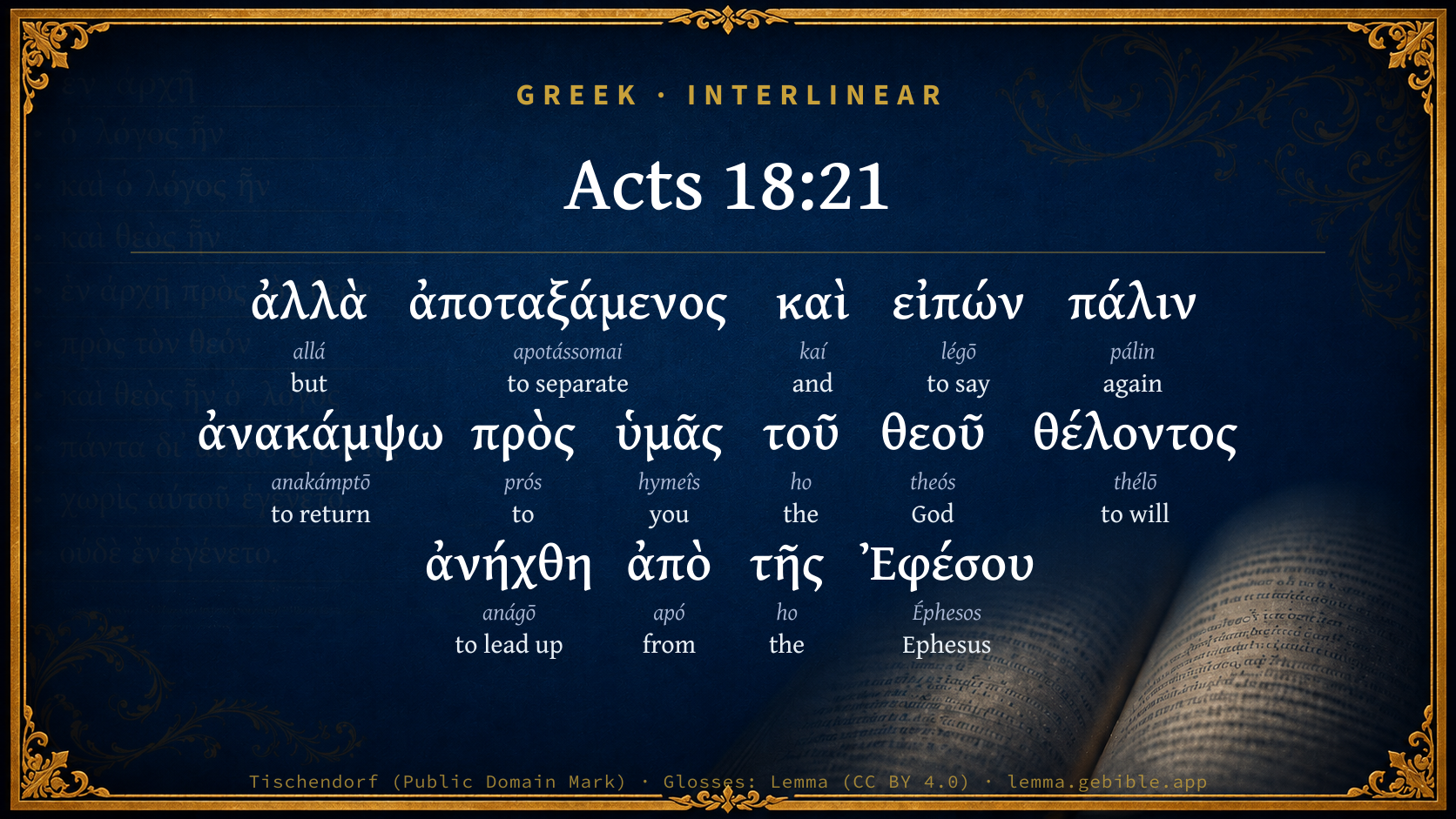
Greek (Tischendorf 8th ed.) Acts 18:21 appears in the Greek New Testament. The text above is from the Tischendorf 8th edition. Each word links to its Strong’s number and a concise gloss. Click any word for its full Thayer’s Greek Lexicon entry.
Download image
Cite this verse

Acts 18:21 (World English Bible). Public Domain. Lemma interlinear Bible study tool, https://lemma.gebible.app/v/acts/18/21.

Show BibTeX & RIS
BibTeX
RIS
English Translation
but taking his leave of them, and saying, "I must by all means keep this coming feast in Jerusalem, but I will return again to you if God wills," he set sail from Ephesus.
World English Bible · Public Domain
Download a study sheet

One document with this verse’s original text, its word-by-word gloss line, the meaning frame, cross-references with their text, attributed commentary, and full source and license credits — printable, and it pastes into notes with its structure intact.

This verse Autodidact and up

Study sheet (.html) Plain text (.txt)

A passage Seminary Student

Up to 50 verses in one chapter. A passage sheet keeps up to 6 commentary sources and 12 cross-references per verse, in the order this page ranks them, and says so on the sheet whenever that leaves anything out. Ask for a single verse and you get the Autodidact verse sheet above.

Everything on this page stays free to read, with no account — the sheet is a download of what is already on screen, not access to it.

Want to remove ads? Support Godless Engineer
Compare translations 3

The same verse in 3 English versions, stacked beneath the original-language interlinear above. Click any original word for its lexicon entry.

Each is an independent rendering of the whole verse — the interlinear is not word-aligned to these translations.

Highlighted words mark where these versions differ — a whole-verse word diff, not a word-by-word alignment.

  • World English Bible Public Domain
    but taking his leave of them, and saying, "I must by all means keep this coming feast in Jerusalem, but I will return again to you if God wills," he set sail from Ephesus.
  • King James Version Public Domain
    But bade them farewell, saying, I must by all means keep this feast that cometh in Jerusalem: but I will return again unto you, if God will. And he sailed from Ephesus.
  • unfoldingWord Literal Text CC BY-SA 4.0
    But leaving them and saying, “I will return again to you, God being willing,” he put to sea from Ephesus.

unfoldingWord Literal Text — © unfoldingWord, licensed CC BY-SA 4.0. Word-aligned USFM3 via Door43 (git.door43.org/unfoldingWord/en_ult).

Versions to compare (up to 4)

3 of 4 selected

Show all 19 translations

Every available English version of this verse, each an independent rendering of the whole verse.

  • World English Bible Public Domain
    but taking his leave of them, and saying, "I must by all means keep this coming feast in Jerusalem, but I will return again to you if God wills," he set sail from Ephesus.
  • Berean Standard Bible Public Domain
    But as he left, he said, “I will come back to you if God is willing.” And he set sail from Ephesus.
  • Majority Standard Bible Public Domain
    But as he left, he said, “I must by all means keep this coming feast in Jerusalem, but I will come back to you if God is willing.” And he set sail from Ephesus.
  • King James Version Public Domain
    But bade them farewell, saying, I must by all means keep this feast that cometh in Jerusalem: but I will return again unto you, if God will. And he sailed from Ephesus.
  • American Standard Version (1901) Public Domain
    but taking his leave of them, and saying, I will return again unto you if God will, he set sail from Ephesus.
  • Revised Version (1885) Public Domain
    but taking his leave of them, and saying, I will return again unto you, if God will, he set sail from Ephesus.
  • Geneva Bible (1599) Public Domain
    But bade the farewel, saying, I must needes keepe this feast that commeth, in Hierusalem: but I will returne againe vnto you, if God will. So he sailed from Ephesus.
  • Douay-Rheims (1899) Public Domain
    But taking his leave, and saying: I will return to you again, God willing, he departed from Ephesus.
  • Young's Literal Translation Public Domain
    but took leave of them, saying, `It behoveth me by all means the coming feast to keep at Jerusalem, and again I will return unto you -- God willing.' And he sailed from Ephesus,
  • Literal Standard Version CC BY-SA 4.0
    but took leave of them, saying, “It is necessary for me by all means to keep the coming celebration at Jerusalem, and again I will return to you—God willing.” And he sailed from Ephesus,
  • Unlocked Literal Bible CC BY-SA 4.0
    But taking his leave of them, he said, “I will return again to you if it is God's will.” He then set sail from Ephesus.
  • unfoldingWord Literal Text CC BY-SA 4.0
    But leaving them and saying, “I will return again to you, God being willing,” he put to sea from Ephesus.
  • Darby Bible Public Domain
    but bade them farewell, saying, [I must by all means keep the coming feast at Jerusalem]; I will return to you again, if God will: and he sailed away from Ephesus.
  • World Messianic Bible Public Domain
    but taking his leave of them, he said, “I must by all means keep this coming feast in Jerusalem, but I will return again to you if God wills.” Then he set sail from Ephesus.
  • Webster's Bible Public Domain
    But bade them farewell, saying, I must by all means keep this feast that cometh in Jerusalem: but I will return to you, if God will. And he sailed from Ephesus.
  • Free Bible Version CC BY-SA 4.0
    He said his goodbyes, and set sail from Ephesus, telling them, “I'll come back and see you if it's God's will.”
  • Bible in Basic English Public Domain
    And went from them, saying, I will come back to you if God lets me; and he took ship from Ephesus.
  • Text-Critical English NT CC BY 4.0
    However, as he took leave of them, he said, “ I must by all means keep the coming feast in Jerusalem, but I will return to you again, God willing.” Then he set sail from Ephesus.
  • Tyndale New Testament (1534) Public Domain
    but bad the fare well sayinge. I must nedes at this feast that cometh be in Ierusalem: but I will returne agayne vnto you yf God will. And he departed from Ephesus

Literal Standard Version (2020), Covenant Press — licensed CC BY-SA 4.0. Text via the HelloAO Bible API (eBible.org). Unlocked Literal Bible (unfoldingWord) — licensed CC BY-SA 4.0. Text via the HelloAO Bible API (eBible.org). unfoldingWord Literal Text — © unfoldingWord, licensed CC BY-SA 4.0. Word-aligned USFM3 via Door43 (git.door43.org/unfoldingWord/en_ult). Free Bible Version, Dr. Jonathan Gallagher — licensed CC BY-SA 4.0. Text via the HelloAO Bible API (eBible.org).

Word by word

More ways to search: Search by grammar → Find every occurrence → Compare this word →

Practice this passage: Drill this verse → Learn its vocabulary →

ἀνακάμψω
anakámptō
G344
“to return”
Verb, Future, Active, Indicative, 1st person, Singular
Part of Speech
Verb
Tense
Future
Voice
Active
Mood
Indicative
Person
1st person
Number
Singular
Full Thayer's Definition

Origin: from G303 and G2578

TDNT: None

1. to bend back, to turn back 2. to return
  1. ἀλλὰ allá G235 “but” Conjunction
  2. ἀποταξάμενος apotássomai G657 “to separate” Verb, Aorist, Middle, Participle, Nominative, Singular, Masculine
  3. καὶ kaí G2532 “and” Conjunction
  4. εἰπών légō G3004 “to say” Verb, Aorist, Active, Participle, Nominative, Singular, Masculine
  5. πάλιν pálin G3825 “again” Adverb
  6. πρὸς prós G4314 “to” Preposition
  7. ὑμᾶς hymeîs G5210 “you” Personal pronoun, 2nd person, Accusative, Plural
  8. τοῦ ho G3588 “the” Article, Genitive, Singular, Masculine
  9. θεοῦ theós G2316 “God” Noun, Genitive, Singular, Masculine
  10. θέλοντος thélō G2309 “to will” Verb, Present, Active, Participle, Genitive, Singular, Masculine
  11. ἀνήχθη anágō G321 “to lead up” Verb, Aorist, Passive, Indicative, 3rd person, Singular
  12. ἀπὸ apó G575 “from” Preposition
  13. τῆς ho G3588 “the” Article, Genitive, Singular, Feminine
  14. Ἐφέσου Éphesos G2181 “Ephesus” Noun, Genitive, Singular, Feminine

About this verse

These counts appear in no published source. They are computed here, from the morphology-tagged text and Lemma’s own curated glosses. What Lemma adds →

15
words
14
distinct lemmas
Acts
section

Notable vocabulary

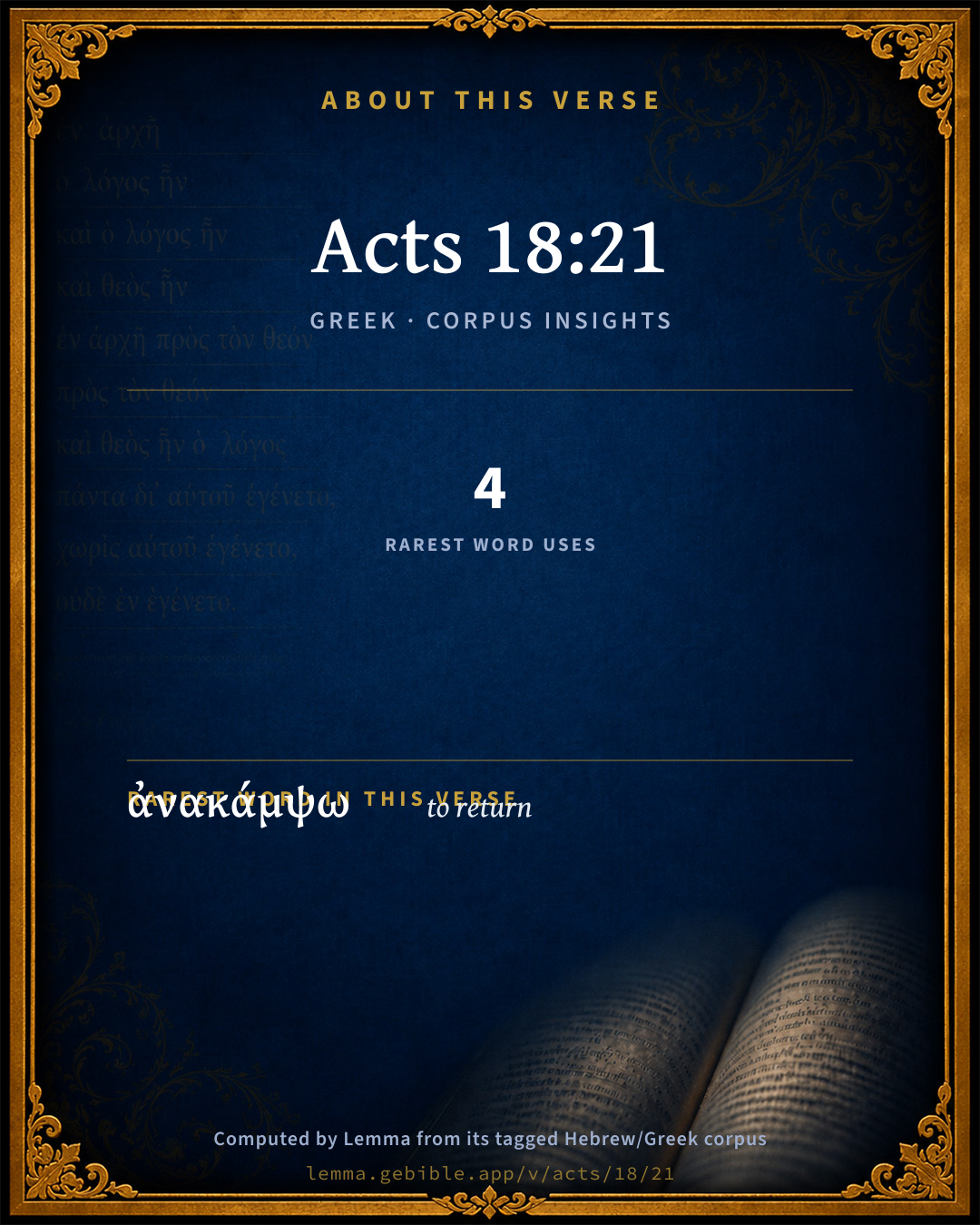
The rarest word here is ἀνακάμψω to return G344 — appearing just 4 times in the whole Greek New Testament.

Shared distinctive vocabulary

ἀνακάμψω to return G344 occurs in 4 verses of the Greek New Testament. Also found in:

Repetition

A word recurs within this verse:

Cross-references

16

Topical passages linked to Acts 18:21 in the Treasury of Scripture Knowledge — connected by theme and wording, ordered by reader-vote popularity; previews shown in the World English Bible.

  • 1 Corinthians 4:19 But I will come to you shortly, if the Lord is willing. And I will know, not the word of those who are puffed up, but the power.
  • James 4:15 For you ought to say, "If the Lord wills, we will both live, and do this or that."
  • Acts 20:16 For Paul had determined to sail past Ephesus, that he might not have to spend time in Asia; for he was hastening, if it were possible for him, to be in Jerusalem on the day of Pentecost.
  • Romans 1:10 requesting, if by any means now at last I may be prospered by the will of God to come to you.
  • Romans 15:32 that I may come to you in joy through the will of God, and together with you, find rest.
  • Hebrews 6:3 This will we do, if God permits.
  • Deuteronomy 16:1 Observe the month of Abib, and keep the Passover to Yahweh your God; for in the month of Abib Yahweh your God brought you forth out of Egypt by night.
  • Matthew 26:39 He went forward a little, fell on his face, and prayed, saying, "My Father, if it is possible, let this cup pass away from me; nevertheless, not what I desire, but what you desire."
  • Acts 15:29 that you abstain from things sacrificed to idols, from blood, from things strangled, and from sexual immorality, from which if you keep yourselves, it will be well with you. Farewell."
  • Acts 19:21 Now after these things had ended, Paul determined in the spirit, when he had passed through Macedonia and Achaia, to go to Jerusalem, saying, "After I have been there, I must also see Rome."
  • Acts 21:14 When he would not be persuaded, we ceased, saying, "The Lord's will be done."
  • 1 Corinthians 16:7 For I do not wish to see you now in passing, but I hope to stay a while with you, if the Lord permits.
  • 2 Corinthians 13:11 Finally, brothers, rejoice. Be perfected, be comforted, be of the same mind, live in peace, and the God of love and peace will be with you.
  • Philippians 2:19–24 But I hope in the Lord Jesus to send Timothy to you soon, that I also may be cheered up when I know how you are doing.
  • 1 Peter 3:17 For it is better, if the will of God should so will, that you suffer for doing well than for doing evil.
  • Luke 9:61 Another also said, "I want to follow you, Lord, but first allow me to bid farewell to those who are at my house."

Cross-references courtesy of OpenBible.info (CC BY 4.0).

Where the printed editions differ

1 variant

Places in this verse where the major printed Greek editions disagree on the wording in a way that affects the translation — a comparison of editions, not a manuscript-by-manuscript collation. The editions are the modern critical texts (Nestlé-Aland 28/27, SBL, Westcott-Hort, Tregelles, Tyndale House) and the traditional texts behind the KJV (the Textus Receptus and the Byzantine/Majority text). It is not a claim about which reading is original.

  1. Extra text
    δεῖ με πάντως τὴν ἑορτὴν τὴν ἐρχομένην ποιῆσαι εἰς Ἱεροσόλυμα·

    “necessary me by all means the feast which is coming to do into Jerusalem;”

    In TRByz Not in NA28NA27TynSBLWHTreg

    δεῖ με πάντως τὴν ἑορτὴν τὴν ἐρχομένην ποιῆσαι εἰς Ἱεροσόλυμα· (dei me pantōs tēn he'ortēn tēn erchomenēn poiēsai eis Hi'erosoluma) 'necessary me by all means the feast which is coming to do into Jerusalem;' is only in traditional manuscripts (TR+Byz)

Textual data: Translators Amalgamated Greek New Testament (STEPBible TAGNT) · CC BY 4.0.

Commentary

Notes on Acts 18:21 from classic Christian and Jewish commentators (each source and its license shown beneath its notes). The classic Christian expositions comment on the surrounding passage and are grouped to its opening verse, so a note may address several verses; the Jewish commentaries on the Tanakh (Rashi and others) are per-verse, so they appear only where the commentator wrote on this verse.

Lemma curates 59 commentaries, every one of them public domain or Creative Commons licensed, each selected and text-cleaned for this edition rather than reprinted as found. About our sources →

The Biblical Illustrator

Joseph S. Exell

Act_18:21

I must by all means keep this feast that cometh in Jerusalem.

The duty of observing the sacrament of the Lords Supper

When our Lord came to be baptized He satisfied John by saying, Suffer it to be so, for thus it behoveth us to fulfil all righteousness--i.e., it becomes us to observe every righteous ordinance of God. The same spirit that animated the Master directed the conduct of His disciples; everywhere they were distinguished by a reverence for the ordinances of religion. And if there be an instance in which this spirit was more strikingly exemplified, we see it in the case before us. Surrounded as he was by the people of Ephesus, who entreated him to remain among them for a longer period, he still felt the preponderating influence of the obligation to observe the feast of Pentecost in Jerusalem. I trust every heart here responds to the feeling of the apostle. A Christian will say, I must by all means keep this feast, for--

I. It is the commandment of Christ. Were it a mere conventional ordinance, merely one of those outward circumstances which are not essential to the existence of Christianity, it might be left to our own discretion whether we should observe it or not. But it comes to us on the authority of the Saviour, who said, Do this in remembrance of Me. There is not any precept more explicitly laid down, and we cannot refuse to observe it without setting aside the authority of Him to whom we are indebted for all that we now are or hope hereafter to enjoy.

II. That I may be the better warned of the evil of sin. There is in this ordinance a manifestation of the evil of sin that is not to be found elsewhere; for we commemorate that great sacrifice which the Father required: in order to render the exercise of mercy to the penitent consistent with the exercise of His justice, in the moral administration of the world. When, therefore, the believer sits down at the table of the Son of God, and has his eyes turned to the Cross of Christ, his heart is smitten with a sense of the evil nature and destroying tendency of sin, and he feels that the world is crucified unto him and he unto the world.

III. Because it is one of the appointed means of grace. There is no feeling to which the heart is more ready to respond than our need of strength greater than our own for the varied duties and trials and sorrows of our nature. And God has promised that His grace shall be sufficient for us--that His strength shall be perfect in our weakness. But we must wait upon Him for this strength and grace in the way of His appointing (Eze_36:37). We are not, therefore, to expect the blessing unless we employ the means. And the Lords Supper is one of the appointed means by which the Spirit of God meets the believer, to renew, to sanctify, to encourage, and to direct him.

IV. Because it is one of the most direct means of uniting the family of God in the bonds of peace and love. At this table the rich and the poor meet together. There we learn to love mankind when we see that love which embraced the world. There we learn to forgive an enemy when we see Christ bleeding for His foes.

V. Because we know not that we shall have another opportunity. We are all dying creatures, and we know not what a day may bring forth. (J. Johnston.)

If God will.

Recognition of the Divine will in human affairs

There is a self-reliance that stifles the spirit of religion. On the other hand, there are timid souls who are ever hesitating and wavering, and who would rather be carried by the current than take the oars and impel their skiff against it. Merciless, overbearing strength, and weak, purposeless yielding are neither of them attractive. Paul was a man of strong will and ready decision. There was a strength about him that could be relied upon. And yet he was gentle, sympathetic, open to influence and persuasion. The character was balanced and kept right by faith. He did not determine matters hastily. He listened and weighed, then he referred the matter for decision to God. There was, in his idea of life, another will beside his own--another wisdom--another choice. And he was glad to subordinate himself to that as the determining element. We have here--

I. A recognition of the Divine superintendence and ordination of human life. The words imply that all is not left to Pauls determinations; that he has not the shaping of his own course. There is a Divine will over all, and it prevails. We are here in circumstances in which we are required to act for ourselves, but we find ourselves often thwarted; our will, determining itself, comes into collision with others; there are plans into which others do not fit. More than this, there is another will stronger than ours which prevails against us. Do what we please, we can only reach our end, perfect our plan, fulfil our purpose--if God will. Is, then, man the mere sport and play of a Divine decree--the creature of Fate--the victim of an Iron Rule that uses or crushes, as the case may be? Certainly not. Man has power of choice; he is called upon to judge what is most fitting and most proper. But God, who has left him free, realises His own ends through that freedom, even through that freedom should determine itself in opposition to the behests of His will. We see about us natural processes going on--the day and night, the seasons, the sunshine, the winds and storms. Man has no power over any one of them. But he can realise his purposes by means of them, and God is always doing so. In like manner He realises His purposes by means of the free choice of His creatures.

II. An expression of humble submission. The words imply that Paul did not wish any other will than Gods to be done. Paul did not desire to be where God did not wish him to be. He desired God to rule his life for him. He would return if God led him thither; otherwise they should see his face no more. This is the essential principle of the regenerate heart. The essence of sin is neither more nor less than self will. Only when the spirit of life in Christ Jesus is in us, do we get rid of the desire to order our own away. What schooling it needs to perfect this mind in us! How stubborn and rebellious we are! What frightful blunders we make! How heart breaking are our disappointments! It is by a discipline the most painful, sometimes carried through long years, that God teaches us to let Him order our life for us, and prepare our good. The trials and disappointments of life are all meant to teach us that Gods will is far better than ours, and to school our rebellion into acquiescence, our self-determination into adoring trust. We should cultivate this spirit more and more.

III. A declaration that God has ways of making His will known. The sphere, conditions, and time of labour are Divinely ordained. But how are we to know what God would have us do? There is a light which shines from the Word, and a light which shines in the spirit, an inward persuasion that such and such works are to be done, and there is an objective providential light by which God guides His own as by the pillar of cloud and fire. By these means God lets men see what He would have them do. Conclusion: There is here, then--

1. A caution suggested against that presumption which is based on the idea of human power and prerogative.

2. A condition of effectual prayer.

3. What confidence, what peace, there must come to those who feel, like Paul, that God knows them, cares for them, orders their way, appoints their lot.

4. How easy submission ought to be to us! (W. H. Davison.)

The Biblical Illustrator, edited by Joseph S. Exell (c. 1880s–1900s) — public domain. Text from a community e-Sword module.

Tyndale Open Study Notes

Tyndale Open Resources

18:21 “I will come back later”: Paul later spent significant time in Ephesus during his third missionary journey (19:1–20:1; see 19:8, 10).

Tyndale Open Study Notes — © Tyndale Open Resources, licensed CC BY-SA 4.0. Text via the HelloAO Bible API.

Bengel's Gnomon

Johann Albrecht Bengel

Act 18:21. Εἰς Ἱεροσόλυμα, in Jerusalem[110]) To this is to be referred Act 18:22. The particular feast is not expressed in this passage: several years after (from Miletus) he hastened thither to keep Pentecost: ch. Act 20:16.—ἀνακάμψω), I will return) He did so: ch. Act 19:1. In the interim their longings for him increased.

[110] The larger Ed. had preferred the shorter reading in this place; but Ed. 2 and Germ. Vers. agree with the Gnomon.—E. B.

ABEe Vulg. Memph. Theb. omit from δεῖ με to εἰς Ἱεροσόλυμα. Dd, with the Rec. Text, support the words.—E. and T.

Bengel's Gnomon of the New Testament — English translation (T&T Clark, Edinburgh, 1860) — public domain. Text from a community e-Sword module.

Meyer's Critical & Exegetical Commentary

Heinrich August Wilhelm Meyer

Act_18:21. What feast was meant by τὴν ἑορτὴν τὴν ἐρχομ. must remain undetermined, as δεῖ με πάντως does not allow us absolutely to exclude the winter season dangerous for navigation, and as the indefinite ἡμέρας ἱκανάς, Act_18:18which period is not included in the one and a half years (see on Act_18:11)prevents an exact reckoning. It is commonly supposed to be either Easter or Pentecost. The latter by Anger, de temp. rat. p. 60 ff., and Wieseler, p. 48 ff. The former (Ewald) is at least not to be inferred from the use of the article the feast, which in general (Fritzsche, ad Matth. p. 804), and here specially on account of the addition τὴν ἐρχομ., would be an uncertain ground. The motive, also, of the determination indicated by δεῖ is completely unknown.

ποιεῖν] as in Act_18:23; see on Act_15:33.

εἰς Ἱεροσόλ.] see Winer, p. 387 [E. T. 518].

πάλιν δὲ κ.τ.λ.] which took place, Act_19:1.

Meyer — Critical and Exegetical Commentary on the New Testament — English translation by Peter Christie, edited by Frederick Crombie (T&T Clark, 1880) — public domain. Text from a community e-Sword module.

Expositor's Greek Testament

ed. W. Robertson Nicoll

Act 18:21 . See critical note. The Feast, as Ramsay maintains, St. Paul , p. 264 (so Ewald, Renan, Zöckler, Rendall, Blass and others), was the Passover, the one which seems most reconcilable with the chronology; others maintain Pentecost, so Anger, Alford, Wieseler, Plumptre see Alford, in loco , and Turner, Chron. of the N. T. , p. 422; Lewin favours Tabernacles. ἀνακάμψω , cf. Act 19:1 : used by St. Luke, Luk 10:6 , Mat 2:12 , Heb 11:15 ; used also several times in LXX, Jud.ges11:39 A, 2Sa 8:13 , 1Ki 12:20 , Job 39:4 , Sus. 14, and other instances, so in classical Greek, to return to a place, Herod., ii. 8. τοῦ Θ . θέλ ., cf. 1Co 4:19 ; 1Co 16:17 , Jas 4:15 . Not only amongst Jews and Arabs but amongst Greeks and Romans similar phrases were in vogue, see Meyer’s note on Jas 4:15 ; see critical note on β . ἀνήχθη , see above on Act 13:13 .

The Expositor's Greek Testament, edited by W. Robertson Nicoll (1897–1910) — public domain. Text from a community e-Sword module.

Geneva Bible (1599)

Geneva Bible translators

So we should promise nothing without this clause, for we know not what the day following will bring forth.

Geneva Bible (1599) marginal notes — public domain. Text via Bolls.life.

Jamieson, Fausset & Brown

Robert Jamieson, A. R. Fausset & David Brown

I must . . . keep this feast--probably Pentecost, presenting a noble opportunity of preaching the Gospel.

but I will return--the fulfilment of which promise is recorded in Act 19:1.

Jamieson, Fausset & Brown — Commentary Critical and Explanatory on the Whole Bible (1871) — public domain (CC PDM 1.0). Text via the HelloAO Bible API.

Adam Clarke's Commentary

Verse 21. I must - keep this feast] Most likely the passover, at which he wished to attend for the purpose of seeing many of his friends, and having the most favourable opportunity to preach the Gospel to thousands who would attend at Jerusalem on that occasion. The whole of this clause, I must by all means keep this feast that cometh in Jerusalem, is wanting in ABE, six others; with the Coptic, AEthiopic, Armenian, and Vulgate. Griesbach leaves it in the text, with the mark of doubtfulness; and Professor White, in his Crisews, says, probabiliter delenda. Without this clause the verse will read thus: But he bade them farewell, saying, I will return again unto you, if God will. And this he did before the expiration of that same year, Ac 19:1, and spent three years with them, Ac 20:31, extending and establishing the Church at that place.

Adam Clarke's Commentary on the Bible (1810–1826) — public domain. Text from a community e-Sword/MySword module.

Ellicott's Commentary for English Readers

(21) I must by all means keep this feast that Cometh.—Literally, the coming, or, the next feast. This was, probably, as has been said, the Feast of Pentecost. (See Note on Act_18:18.) If he missed that, there would be no other feast till that of Tabernacles; and then, in October, travelling, whether by sea or land, became dangerous and difficult. (See Note on Act_27:9.)

If God will.—In this resting in the thought of the will of the Father as ordering all things well—even in their use of almost the same formula, to them much more than such a formula as the Deo volente has often become in the lips of Christians—we find another point of agreement between St. Paul and St. James (Jas_4:15).

A Bible Commentary for English Readers, edited by Charles John Ellicott (1878–1897) — public domain. Text from a community e-Sword module.

The Cambridge Bible for Schools and Colleges

gen. ed. J. J. S. Perowne

21. but bade them farewell] This is the same verb as in Act_18:18, and should be rendered in the same way. “But took his leave of them.” The oldest authorities and the best modern editors, followed by the Revised Version, omit a large portion of the verse, reading thus: “but taking his leave of them, and saying, I will return again unto you, if God will, he set sail from Ephesus.” The words thus omitted are deemed to have been an insertion suggested by Act_20:16. It is not only on the authority of a small number of uncials that the words are rejected; their omission is supported by several cursives, as well as by the Vulgate and some other versions.

There has been much discussion on the question whether it was the feast of the Passover or the Pentecost which the Apostle desired to keep in Jerusalem. If we accept the omission, as the authorities seem fully to warrant, the question is not raised.

I will return again unto you] Having the opportunity, he soon redeemed his promise, see Act_19:1.

The Cambridge Bible for Schools and Colleges (gen. ed. J. J. S. Perowne; Cambridge University Press, 1878–1918) — public domain. Text from a community e-Sword module.

John Gill's Exposition

And after he had spent some time there,.... At Antioch:

he departed; from thence:

and went over all the country of Galatia and Phrygia in order, strengthening all the disciples; that were in those parts, confirming them in the faith of Christ, and fortifying their minds against the temptations of Satan, and encouraging them to bear the reproaches and persecutions of men; which shows the affection, diligence, and industry of the apostle: it seems there were disciples in these countries of Galatia and Phrygia, which very likely were made by the apostle, when he passed trough those places, Act 16:6 and who were the beginning of Gospel churches in these places, which continued for ages after: certain it is, there were churches in Galatia in the apostle's time, of whom he makes mention, and to whom he wrote, Co1 16:1. According to the apostolical constitutions, Crescens, mentioned Ti2 4:10 was appointed by the apostles bishop of the churches of Galatia; and particularly it is said, that he was bishop of Chalcedon in Galatia; See Gill on Luk 10:1 and in the "second" century, there was a church at Ancyra, which was disturbed by the heresy of Montanus, and was established by Apolinarius, who makes mention of the elders of this church (q): in the "third" century there were churches in Galatia, which Stephen bishop of Rome threatened with excommunication, because they rebaptized heretics: in the beginning of the "fourth" century, there were bishops from hence, which assisted at the council of Nice, against Arius, and at the synod of Sardica, in the same century; and at the beginning of it, Clemens bishop of Ancyra, after he had taught twenty nine years, suffered much in the persecution of Dioclesian, first at Rome, then at Nicomedia, and at last was put to death by the sword; in this age also lived Basil, bishop of Ancyra, under Constantius; he first came to the bishopric of that place under Constantine, but being deprived of it for four years, was restored by Constantius in the council of Sardica; under the former he disputed against Photinus, as Epiphanius (r) relates; who makes mention of Anysius his deacon, and Eutyches and Theodulus his notaries; and the same writer (s) takes notice of several elders and officers of the same church in that age, as Photinus, Eustathius, another Photinus, and Sigerius, elders, Hyginus deacon, Heracides subdeacon, Elpidus reader, and Cyriacus president of the church: in the "fifth" century, there were many churches in Galatia, yea, they are said to be innumerable; Leontius was bishop of Ancyra in the times of Arcadius and Honorius; and was succeeded by Theodotus, who was in the first Ephesine synod against Nestorius, as was also Eusebius bishop of the same church, at another synod in the same place; Anastasius was bishop of the said church, lived under the emperor Leo the first, and was at the synod of Constantinople; Meliphthongus, bishop of Juliopolis in the same country, assisted at several synods; Eusebius, bishop of Aspona in Galatia, was present in the first synod at Ephesus, against Nestorius; likewise Peter bishop of Gangrae, and Theoctistus bishop of Pessinus, both lived in the time of the two synods, the infamous one at Ephesus, and the other at Chalcedon: in the "sixth" century, there were bishops of Ancyra, Juliopolis, and other cities in Galatia, who were present at the Roman and Constantipolitan synod; in this age, under Anastasius the emperor, lived Dorotheus bishop of Ancyra: in the "seventh" century were present, at the sixth council at Constantinople, several bishops of the churches of Galatia; as of Sinope, Pessinus, Aspona, and others: in the "eighth" century, mention is made of Basil, bishop of the church at Ancyra, Nicodemus bishop of Didymi, Gregory bishop of Sinope: and even in the ninth century a garrison of Christians was placed in Ancyra, against the incursions of the Saracens (t); so long the Christian name remained in those parts: and that there were also churches in Phrygia is as evident; Aristarchus, a companion of the apostle Paul, is said to be bishop of Apamea, which was a city in Phrygia; See Gill on Luk 10:1 the second century, Papias, a disciple of the Apostle John, was bishop of Hierapolis in this country (u); and in the same age there was a church at Philomelium in Phrygia, to which the church at Smyrna wrote a letter, still extant in Eusebius (w), which gives an account of the martyrdom of Polycarp; likewise the church at Lyons, in France, sent a letter to the churches in Asia and Phrygia, giving an account of their martyrs, which is to be seen in the same writer (x); in this century lived Apolinarius, bishop of Hierapolis, who opposed the Phrygian heresy of Montanus; and who makes mention of Zoticus, of the village of Comana, and Julianus of Apamea, both in Phrygia, as his fellow elders and bishops (y): Dionysius, of Alexandria, speaks of a church, and of the brethren at Synnada, which was in Phrygia, in a letter of his to Philemon, a presbyter at Rome (z); at Lampsacus in Phrygia, there were martyrs that suffered under Decius: in the third century, there was a church at Hierapolis, famous from the times of the apostles. Tertullian makes mention of the believers in Christ in Phrygia, in his time (a): in the beginning of the "fourth" century under Dioclesian, a whole city in Phrygia of Christians was set on fire and burnt, men, women, and children, calling upon Christ the God of all (b); and at the council of Nice, under Constantine, were present bishops of many churches in Phrygia; as Ilium, Synnada, Eucarpia, Hierapolis, and others; at Lampsacus, in this country, was held a memorable synod against Eudoxus and Acacius, the chief of the Arian faction: in the "fifth" century there were churches in Phrygia; Theodosius and Agapetus were bishops of Synnada in Phrygia Pacatiana; Marinianus, bishop of the same place, was present at the several synods in this century; Nunechius of Laodicea, Gennadius of Acmonii, Thomas and Olympius, both of Theodosiopolis, Lucianus of Ipsa, Albertus of Hierapolis, Eusebius of Doryleus, with many others, all in Phrygia, are made mention of in history: in the "sixth" century, several bishops of Phrygia, as of Philomelium, &c. were present at the synod held at Rome and Constantinople: in the "seventh" century, bishops of several churches in this country, as of Hierapolis, Synnada, &c. assisted at the sixth synod at Constantinople: in the eighth century were many churches here, whose bishops were present at the Nicene synod, as Basil, bishop of Pergamus, Nicetas of Ilium, John of Synnada, and others (c).

(q) Apud Euseb. Eccl. Hist. l. 5. c. 16. (r) Contra Haeres. l. 3. Haeres. 71. (s) Ib. Haeres. 72. (t) Magdeburg. cent. 3. c. 7. p. 117. cent. 4. c. 2. p. 3. c. 9. p. 350, 425. c. 10. p. 550, 554. cent. 5. c. 2. p. 4. c. 10. p. 604, 605. cent. 6. c. 2. p. 5. c. 10. p. 341. cent. 7. c. 2. p. 3. c. 10. p. 254. cent. 8. c. 2. p. 5. c. 10. p. 360. cent. 9. c. 2. p. 3. (u) Euseb. Eccl. Hist. l. 3. c. 36. (w) Ib. l. 4. c. 15. (x) Euseb. Eccl. Hist. l. 5. c. 1. (y) Ib. c. 16. (z) Ib. l. 7. c. 7. (a) Adv. Judaeos, c. 7. (b) Euseb. Eccl. Hist. l. 8. c. 11. (c) Magdeburg. Hist. Eccles. cent. 3. c. 2. p. 2. cent. 4. c. 2. p. 3. c. 9. p. 48l. cent. 5. c. 2. p. 3. c. 10. p. 597. &c. cent. 6. c. 2. p. 4. cent. 7. c. 2. p. 3. c. 10. p. 254. cent. 8. c. 2. p. 4. c. 10. p. 366.

John Gill's Exposition of the Whole Bible (1746–1763) — public domain (CC PDM 1.0). Text via the HelloAO Bible API.

Trapp's Complete Commentary

John Trapp

21 But bade them farewell, saying, I must by all means keep this feast that cometh in Jerusalem: but I will return again unto you, if God will. And he sailed from Ephesus.

Ver. 21. Keep this feast] As waiting an occasion, by that solemn meeting, of winning many to Christ. Paul was insatiabilis Dei cultor, as insatiable worshipper of God, Chrysostom truly saith of him. George Eagles the martyr, for his great pains in travelling from place to place to confirm the brethren, was surnamed Trudgeover the World.

John Trapp, A Commentary or Exposition upon All the Books of the Old and New Testament (1647–1656) — public domain. Text from a community e-Sword module.

Albert Barnes' Notes on the Bible

Keep this feast - Probably the Passover is here referred to. Why he was so anxious to celebrate that feast at Jerusalem, the historian has not informed us. It is probable, however, that he wished to meet as many of his countrymen as possible, and to remove, if practicable, the prejudices which had everywhere been raised against him, Act 21:20-21. Perhaps, also, he supposed that there would be many Christian converts present, whom he might meet also.

But I will return ... - This he did Act 19:1, and remained there three years, Act 20:31.

Albert Barnes' Notes on the Bible (1834–1885) — public domain. Text from a community e-Sword/MySword module.

Matthew Poole's English Annotations

This feast; the feast of the passover; which is meant where feast is put absolutely, unless some after expression qualifies it: not that this holy man did out of conscience to the feast intend to observe it, for Christ is the end of the law to them that believe, Rom 10:4; but because of the vast concourse from all places to Jerusalem at that time, which would give him an opportunity of making Christ known to such multitudes, and to gain their souls unto him.

If God will; though he was an apostle, and had the Spirit of prophecy, and might know whether he should return or no, yet he does not absolutely promise them to return to them, but conditionally, if the Lord will; to teach us what caution we should use in all our promises and resolutions, as Jam 4:15, being we know not what a day may bring forth. Besides, in our owning of God’s will and pleasure, we acknowledge a providence of God in all things, especially in our concerns, which we desire to refer all unto.

Matthew Poole's English Annotations on the Holy Bible (1683–1685) — public domain. Text from a community e-Sword/MySword module.

Whedon's Commentary on the Bible

Daniel D. Whedon

21. I must… Jerusalem—This entire clause is found wanting in a number of the best manuscripts; but it is sufficiently sustained to be retained in the text. Paul’s promise to return was fulfilled soon after. Sailed—It is uncertain whether in the same or another ship. The same route was pursued in Paul’s return from his third journey, (Act_21:1-8,) where see notes.

Daniel D. Whedon (gen. ed.), Commentary on the Old and New Testaments (1874–1909) — public domain. Text from a community e-Sword module.

The Pulpit Commentary

Taking his leave of them, and saying for bade them farewell, saying, A.V.; I will return for I must by all means keep this feast that cometh in Jerusalem; but I will return, A.V. and T.R.; he set sail for and he sailed, A.V. and T.R. Taking his leave; as in ver. 18, note. I must by all means, etc. This clause is not found in a, A, B, E, and several versions, and is omitted in the R.T. But Alford, Meyer, Wordsworth, and others consider it to be genuine. It is certainly difficult to account for such words being inserted in the text if they were not genuine; whereas it is easy to account for their omission, either by accident or from the fact that the brevity of the allusion to his visit to Jerusalem in ver. 22 might easily mislead a copyist into thinking that St. Paul did not go to Jerusalem at this time, and therefore that the words were misplaced. Observe how St. Paul"s fixed purpose to reach Jerusalem as soon as possible tallies with the account of his vow. This feast (A.V.). Iris not clear what feast is meant. Alford, Wordsworth, "Speaker"s Commentary," and others, following Wieseler, think it was the Feast of Pentecost, being influenced by the consideration that sailing was dangerous and very unusual so early as before the Passover. But Meyer thinks it uncertain. But the expression, "I must by all means," would cover the risk of a voyage in the stormy season. I will return again. The fulfillment of this promise is related in Act_19:1, etc. If God will. (see Jam_4:13-15)

The Pulpit Commentary (1880–1919), ed. H.D.M. Spence-Jones & Joseph S. Exell — public domain. Text from a community e-Sword module.

John Wesley's Explanatory Notes

I must by all means keep the feast at Jerusalem - This was not from any apprehension that he was obliged in conscience to keep the Jewish feasts; but to take the opportunity of meeting a great number of his countrymen to whom he might preach Christ, or whom he might farther instruct, or free from the prejudices they had imbibed against him. But I will return to you - So he did, chap. xix, 1.

John Wesley, Explanatory Notes Upon the Whole Bible (1754–1765) — public domain. Text via the GEBible commentary corpus.

Godbey's Commentary on the New Testament

William B. Godbey

21, 22. Going down to Caesarea, and up to Jerusalem,

William B. Godbey, Commentary on the New Testament (1896–1900) — public domain. Text from a community e-Sword module.

McGarvey & Pendleton's Commentaries

J. W. McGarvey

See notes on verse 19

J. W. McGarvey (with Philip Y. Pendleton), Commentaries on the New Testament (The Fourfold Gospel, 1914; Acts; and the epistles) — public domain. Text from a community e-Sword/MySword module.

Cambridge Greek Testament for Schools and Colleges

21. ἀποταξάμενος καὶ εἰπών with אABD. Vulg. ‘valefaciens et dicens.’

Δεῖ με πάντως τὴν ἑορτὴν τὴν ἐρχομένην ποιῆσαι εἰς Ἱεροσόλνμα omitted with אABE. Not represented in Vulg.

The δὲ after πάλιν, and καὶ before ἀνήχθη disappear as a consequence of the preceding omission.

21. ἀλλὰ ἀποταξάμενος καὶ εἰπών, but bidding them farewell and saying. The words in the Text. recept., which are omitted from this verse, seem to be an addition suggested by Act 20:16. The authorities for the omission are numerous, both uncials, cursives and versions.

πάλιν ἀνακάμψω πρὸς ὑμᾶς τοῦ θεοῦ θέλοντος, I will return again to you, if God will. Having the opportunity, he soon redeemed his promise. See Act 19:1.

Cambridge Greek Testament for Schools and Colleges (Cambridge University Press, 1896; 21 vols, various authors incl. Carr, Maclear, Plummer, Farrar, Lumby, Moule, M. R. James, Simcox) — public domain. Text from a community e-Sword module.

Alford’s Greek Testament

Henry Alford

21.] The omission of the words here inserted in rec., δεῖ με πάντως τὴν ἑορτὴν τὴν ἐρχομένην ποιῆσαι εἰς Ἱεροσόλυμα, seems necessitated on the principle of being guided in doubtful cases by the testimony of our most ancient mss. The text thus produced is the shortest and simplest, and the facts, of other glosses having been attempted on this verse, and of ms. 36 inserting the words without altering the construction to suit them, and omitting the καί before ἀνήχθη, and the δέ before ἀνακάμψω, tend perhaps to throw discredit on the insertion. The gloss, if such it be, has probably been owing to an endeavour to conform the circumstances to those related in ch. 20:16. If they stand, and for those who read them, it may still be interesting to enquire at what feast they may be supposed to point. (1) Not at the Passover: for the ordinary duration of the ‘mare clausum’ was (Livy xxxvii. 9) till the vernal equinox. According to Vegetius de Re Milit. iv. 39, ‘ex die iii. Id. Novembr. usque in diem vi. Id. Martii, maria claudebantur.’ And we are not at liberty to assume an exceptional case, such as sometimes occurred (Philo, Leg. ad Caium, § 29, vol. ii. p. 573; Tacit. Ann. xii. 43; Plin. ii. 47). Hence, if the voyage from Corinth at all approached the length of that from Philippi to Jerusalem in ch. 20, 21, he would have set sail at a time when it would have been hardly possible. (2) Not at the feast of Tabernacles. For if it were, he must have sailed from Corinth in August or September. Now, as he stayed there something more than a year and a half, his sea-voyage from Berœa to Athens would in this case have been made in the depth of winter; which (especially as a choice of land or water was open to him) is impossible. (3) It remains, then, that the feast should have been Pentecost; at which Paul also visited Jerusalem, ch. 20:16. (The above is the argument of Wieseler, Chron. d. Apostelgesch. pp. 48-50, who however allows too long for the voyage from Corinth, forgetting that from the seven weeks’ voyage of ch. 20, 21 are to be taken seven days at Troas (20:6), seven at Tyre (21:4), one at Ptolemais (21:7), ἡμέραι πλείους at Cæsarea (21:10),—in all certainly not less than three weeks.)

The Apostle’s promise of return was fulfilled ch. 19:1 ff.

Henry Alford, The Greek Testament (1849–1861) — public domain. Text from a community e-Sword module.

Vincent's Word Studies in the New Testament

Marvin R. Vincent

I must by all means keep this feast that cometh in Jerusalem.

The best texts omit.

Marvin R. Vincent, Word Studies in the New Testament (1887–1900) — public domain. Text from a community e-Sword/MySword module.

Lesson kit

Teaching starters — assembled from the data on this page, not authored interpretation. Every prompt links to the verse data it draws on. Edit before teaching.

Acts, in the Acts, opens this verse with 15 words (14 distinct Greek lemmas). Its most distinctive word is anakámptō (“to return”). A historical commentator’s framing appears above. Read the whole chapter for the surrounding context.

Discussion questions

  1. How does “to return” (anakámptō) shape what this verse is saying?
  2. How does Matthew 2:12, which shares the word «to return», read alongside this verse?
  3. What does the repetition of “the” (2× in this one verse) do in this verse?
  4. The translations on this page render this verse differently — a whole-verse word diff, not a word-by-word alignment. What might account for the different wordings?
  5. Compare how The Biblical Illustrator and Tyndale Open Study Notes read this verse. Where do they agree or differ?

Things to notice

Reading settings

Reading text

Shown beneath each verse's original-language words.

Old Testament
Old Testament edition

Read the OT as the Masoretic Hebrew (MT) or the Greek Septuagint (LXX).

English shown for the Greek Septuagint (in the Hebrew ↔ Greek comparison).

Comparing translations? Open the Compare panel on any verse page to stack up to four side by side.