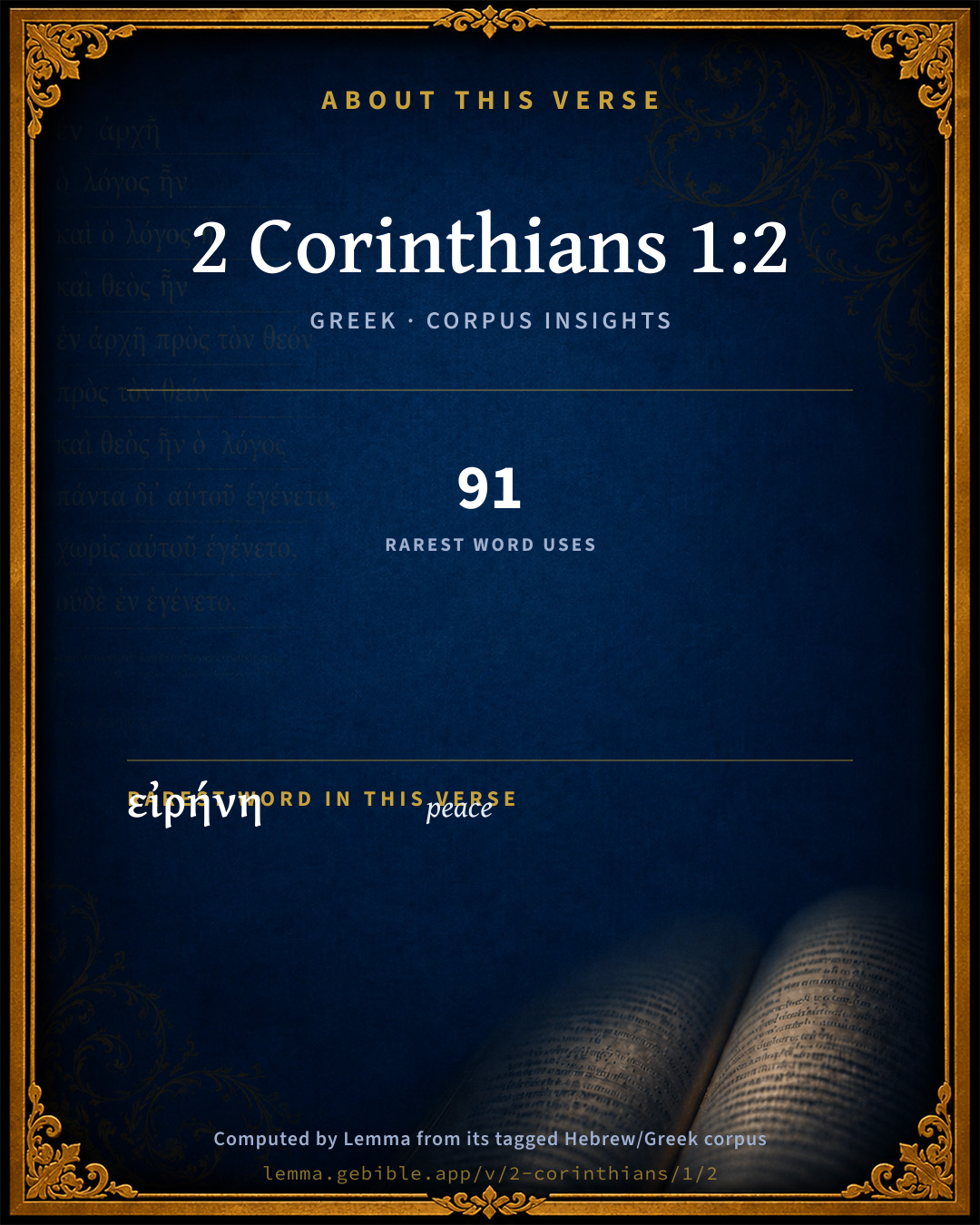
2 Corinthians 1:2

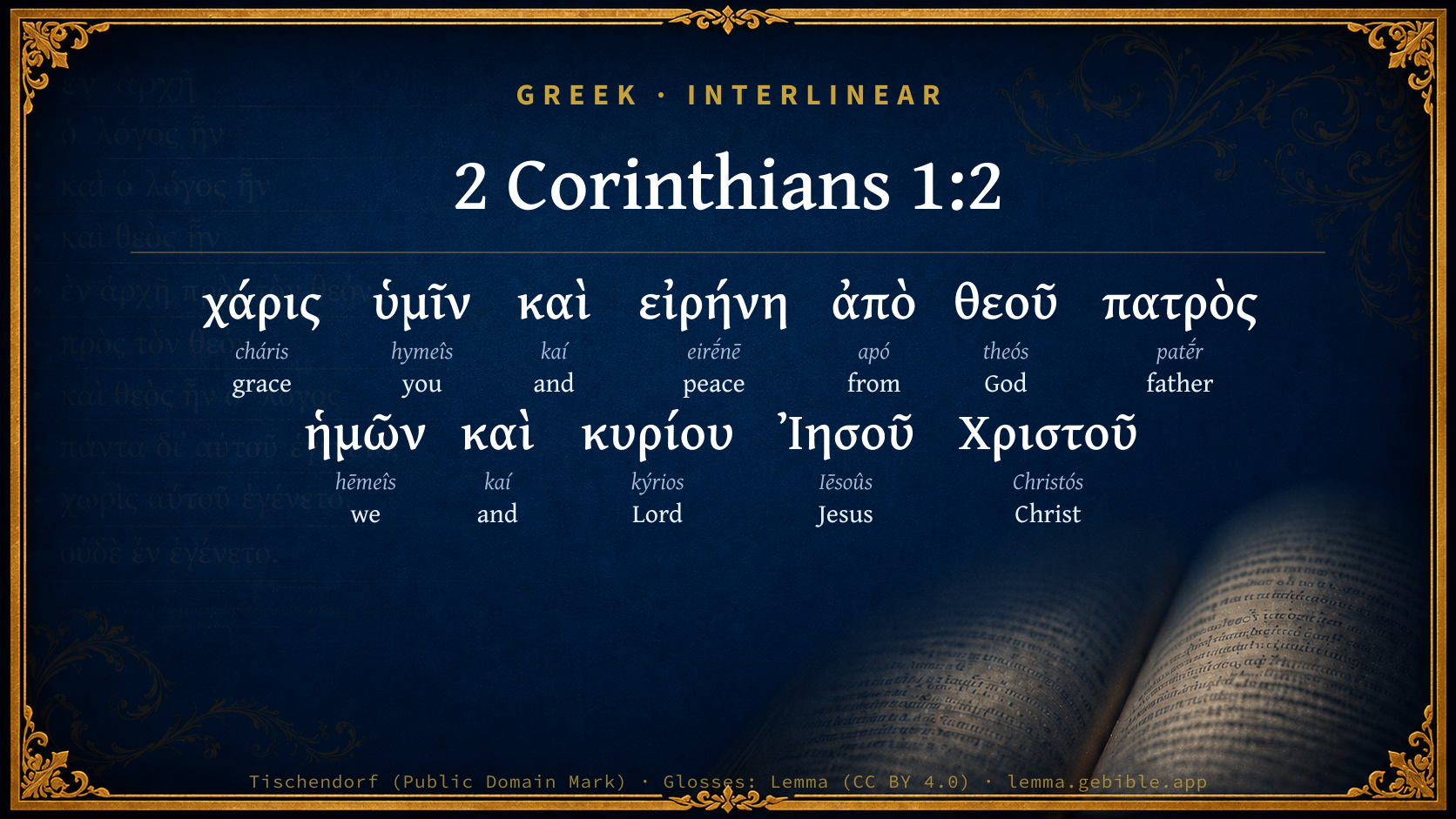
Greek (Tischendorf 8th ed.) 2 Corinthians 1:2 appears in the Greek New Testament. The text above is from the Tischendorf 8th edition. Each word links to its Strong’s number and a concise gloss. Click any word for its full Thayer’s Greek Lexicon entry.
Download image
Cite this verse

2 Corinthians 1:2 (World English Bible). Public Domain. Lemma interlinear Bible study tool, https://lemma.gebible.app/v/2-corinthians/1/2.

Show BibTeX & RIS
BibTeX
RIS
English Translation
Grace to you and peace from God our Father and the Lord Jesus Christ.
World English Bible · Public Domain
Download a study sheet

One document with this verse’s original text, its word-by-word gloss line, the meaning frame, cross-references with their text, attributed commentary, and full source and license credits — printable, and it pastes into notes with its structure intact.

This verse Autodidact and up

Study sheet (.html) Plain text (.txt)

A passage Seminary Student

Up to 50 verses in one chapter. A passage sheet keeps up to 6 commentary sources and 12 cross-references per verse, in the order this page ranks them, and says so on the sheet whenever that leaves anything out. Ask for a single verse and you get the Autodidact verse sheet above.

Everything on this page stays free to read, with no account — the sheet is a download of what is already on screen, not access to it.

Want to remove ads? Support Godless Engineer
Compare translations 3

The same verse in 3 English versions, stacked beneath the original-language interlinear above. Click any original word for its lexicon entry.

Each is an independent rendering of the whole verse — the interlinear is not word-aligned to these translations.

Highlighted words mark where these versions differ — a whole-verse word diff, not a word-by-word alignment.

  • World English Bible Public Domain
    Grace to you and peace from God our Father and the Lord Jesus Christ.
  • King James Version Public Domain
    Grace be to you and peace from God our Father, and from the Lord Jesus Christ.
  • unfoldingWord Literal Text CC BY-SA 4.0
    Grace to you and peace from God our Father and the Lord Jesus Christ.

unfoldingWord Literal Text — © unfoldingWord, licensed CC BY-SA 4.0. Word-aligned USFM3 via Door43 (git.door43.org/unfoldingWord/en_ult).

Versions to compare (up to 4)

3 of 4 selected

Show all 19 translations

Every available English version of this verse, each an independent rendering of the whole verse.

  • World English Bible Public Domain
    Grace to you and peace from God our Father and the Lord Jesus Christ.
  • Berean Standard Bible Public Domain
    Grace and peace to you from God our Father and the Lord Jesus Christ.
  • Majority Standard Bible Public Domain
    Grace and peace to you from God our Father and the Lord Jesus Christ.
  • King James Version Public Domain
    Grace be to you and peace from God our Father, and from the Lord Jesus Christ.
  • American Standard Version (1901) Public Domain
    Grace to you and peace from God our Father and the Lord Jesus Christ.
  • Revised Version (1885) Public Domain
    Grace to you and peace from God our Father and the Lord Jesus Christ.
  • Geneva Bible (1599) Public Domain
    Grace be with you, and peace from God our Father, and from the Lord Iesus Christ.
  • Douay-Rheims (1899) Public Domain
    Grace unto you and peace from God our Father, and from the Lord Jesus Christ.
  • Young's Literal Translation Public Domain
    Grace to you and peace from God our Father, and the Lord Jesus Christ!
  • Literal Standard Version CC BY-SA 4.0
    Grace to you and peace from God our Father and the Lord Jesus Christ!
  • Unlocked Literal Bible CC BY-SA 4.0
    May grace be to you and peace from God our Father and the Lord Jesus Christ.
  • unfoldingWord Literal Text CC BY-SA 4.0
    Grace to you and peace from God our Father and the Lord Jesus Christ.
  • Darby Bible Public Domain
    Grace to you, and peace from God our Father, and [the] Lord Jesus Christ.
  • World Messianic Bible Public Domain
    Grace to you and peace from God our Father and the Lord Yeshua the Messiah.
  • Webster's Bible Public Domain
    Grace be to you and peace from God our Father, and from the Lord Jesus Christ.
  • Free Bible Version CC BY-SA 4.0
    May you have grace and peace from God our Father and the Lord Jesus Christ.
  • Bible in Basic English Public Domain
    Grace to you and peace from God our Father and the Lord Jesus Christ.
  • Text-Critical English NT CC BY 4.0
    Grace to you and peace from God our Father and the Lord Jesus Christ.
  • Tyndale New Testament (1534) Public Domain
    Grace be with you and peace from God oure father and from the Lorde Iesus Christ.

Literal Standard Version (2020), Covenant Press — licensed CC BY-SA 4.0. Text via the HelloAO Bible API (eBible.org). Unlocked Literal Bible (unfoldingWord) — licensed CC BY-SA 4.0. Text via the HelloAO Bible API (eBible.org). unfoldingWord Literal Text — © unfoldingWord, licensed CC BY-SA 4.0. Word-aligned USFM3 via Door43 (git.door43.org/unfoldingWord/en_ult). Free Bible Version, Dr. Jonathan Gallagher — licensed CC BY-SA 4.0. Text via the HelloAO Bible API (eBible.org).

Word by word

More ways to search: Search by grammar → Find every occurrence → Compare this word →

Practice this passage: Drill this verse → Learn its vocabulary →

εἰρήνη
eirḗnē
G1515
“peace”
Noun, Nominative, Singular, Feminine
Part of Speech
Noun
Case
Nominative
Number
Singular
Gender
Feminine
Full Thayer's Definition

Origin: probably from a primary verb eiro (to join)

TDNT: 08:40,2

1. a state of national tranquillity a. exemption from the rage and havoc of war 2. peace between individuals, i.e. harmony, concord 3. security, safety, prosperity, felicity, (because peace and harmony make and keep things safe and prosperous) 4. of the Messiah's peace a. the way that leads to peace (salvation) 5. of Christianity, the tranquil state of a soul assured of its salvation through Christ, and so fearing nothing from God and content with its earthly lot, of whatsoever sort that is 6. the blessed state of devout and upright men after death
  1. χάρις cháris G5485 “grace” Noun, Nominative, Singular, Feminine
  2. ὑμῖν hymeîs G5210 “you” Personal pronoun, 2nd person, Dative, Plural
  3. καὶ kaí G2532 “and” Conjunction
  4. ἀπὸ apó G575 “from” Preposition
  5. θεοῦ theós G2316 “God” Noun, Genitive, Singular, Masculine
  6. πατρὸς patḗr G3962 “father” Noun, Genitive, Singular, Masculine
  7. ἡμῶν hēmeîs G2249 “we” Personal pronoun, 1st person, Genitive, Plural
  8. καὶ kaí G2532 “and” Conjunction
  9. κυρίου kýrios G2962 “Lord” Noun, Genitive, Singular, Masculine
  10. Ἰησοῦ Iēsoûs G2424 “Jesus” Noun, Genitive, Singular, Masculine
  11. Χριστοῦ Christós G5547 “Christ” Noun, Genitive, Singular, Masculine

About this verse

These counts appear in no published source. They are computed here, from the morphology-tagged text and Lemma’s own curated glosses. What Lemma adds →

12
words
11
distinct lemmas
Pauline Epistles
section

Repetition

A word recurs within this verse:

Cross-references

12

Topical passages linked to 2 Corinthians 1:2 in the Treasury of Scripture Knowledge — connected by theme and wording, ordered by reader-vote popularity; previews shown in the World English Bible.

  • Romans 1:7 to all who are in Rome, beloved of God, called to be saints: Grace to you and peace from God our Father and the Lord Jesus Christ.
  • Ephesians 6:23 Peace be to the brothers, and love with faith, from God the Father and the Lord Jesus Christ.
  • Philippians 1:2 Grace to you, and peace from God, our Father, and the Lord Jesus Christ.
  • Philemon 1:3 Grace to you and peace from God our Father and the Lord Jesus Christ.
  • 1 Chronicles 12:18 Then the Spirit came on Amasai, who was chief of the thirty, [and he said], "We are yours, David, and on your side, you son of Jesse: peace, peace be to you, and peace be to your helpers; for your God helps you." Then David received them, and made them captains of the band.
  • 1 Corinthians 1:3 Grace to you and peace from God our Father and the Lord Jesus Christ.
  • Colossians 1:2 to the saints and faithful brothers in Christ at Colossae: Grace to you and peace from God our Father, and the Lord Jesus Christ.
  • 1 Thessalonians 1:1 Paul, Silvanus, and Timothy, to the assembly of the Thessalonians in God the Father and the Lord Jesus Christ: Grace to you and peace from God our Father and the Lord Jesus Christ.
  • 2 Thessalonians 1:2 Grace to you and peace from God our Father and the Lord Jesus Christ.
  • 2 Samuel 15:20 Whereas you came but yesterday, should I this day make you go up and down with us, seeing I go where I may? return you, and take back your brothers; mercy and truth be with you.
  • Galatians 6:16 As many as walk by this rule, peace and mercy be on them, and on God's Israel.
  • Daniel 4:1 Nebuchadnezzar the king, to all the peoples, nations, and languages, who dwell in all the earth: Peace be multiplied to you.

Cross-references courtesy of OpenBible.info (CC BY 4.0).

Commentary

Notes on 2 Corinthians 1:2 from classic Christian and Jewish commentators (each source and its license shown beneath its notes). The classic Christian expositions comment on the surrounding passage and are grouped to its opening verse, so a note may address several verses; the Jewish commentaries on the Tanakh (Rashi and others) are per-verse, so they appear only where the commentator wrote on this verse.

Lemma curates 59 commentaries, every one of them public domain or Creative Commons licensed, each selected and text-cleaned for this edition rather than reprinted as found. About our sources →

Tyndale Open Study Notes

Tyndale Open Resources

1:2 Paul turns the usual, colorless “greetings” (Greek chairein) into a rich salutation by praying for God’s grace (Greek charis) and peace on his readers.

Tyndale Open Study Notes — © Tyndale Open Resources, licensed CC BY-SA 4.0. Text via the HelloAO Bible API.

Expositor's Greek Testament

ed. W. Robertson Nicoll

2Co 1:2 . ἀπὸ Θεοῦ πατρὸς κ . τ . λ .: this coupling of the names of God our Father and the Lord Jesus Christ as alike the source of grace and peace is most significant in its bearing upon St. Paul’s Christology ( cf. 2Co 13:13 ).

I. The Obedience of the Corinthians to the Instructions of the First Epistle (2Co 1:3 to 2Co 7:16 ). This is the main topic of the first section of this Epistle. 2Co 1:3-7 : THANKSGIVING; GOD’S CONSOLATIONS AND THE SYMPATHY OF SORROW. St. Paul’s habit is to begin his letters with an expression of thankfulness for the Christian progress of his correspondents. The only exceptions are the Epp. to Titus and to the Galatians (in this case he had received bad news from Galatia). In 1Ti 1:12 the cause of his thankfulness is the exhibition of the Divine mercy to himself; and this Epistle begins with a like thought, from which he passes (2Co 1:14 ) to his confident belief that the Corinthian Christians are still his καύχημα . It was especially important that a letter which was so largely taken up with rebuke and with the assertion of his apostolical authority should begin with a message of sympathy and hopefulness (2Co 1:11 ff.).

The Expositor's Greek Testament, edited by W. Robertson Nicoll (1897–1910) — public domain. Text from a community e-Sword module.

Cambridge Greek Testament for Schools and Colleges

2. χάρις ὑμῖν καὶ εἰρήνη. A combination of the Greek χαίρειν (Act 15:23; Act 23:26; Jas 1:1) with the Hebrew Shalom (2Sa 18:28); in both cases with the meaning enriched: comp. Num 6:25-26. The one is the favour of God, the other the blessing of being restored to His favour after being opposed to Him. This is the usual salutation in the Pauline, as in the Petrine Epistles, 1 and 2 Timothy being exceptions. In them and in 2 John we have χάρις, ἔλεος, εἰρήνη, and in Jude ἔλεος, εἰρήνη, ἀγάπη. See Hort on 1Pe 1:2 and Mayor on Jas 1:1.

ἀπὸ θεοῦ πατρὸς ἡμῶν καὶ κυρίου Ἰησοῦ Χριστοῦ. The coordination of Jesus Christ as Lord with God as Father under one preposition is evidence, all the more powerful for being indirect, of the hold which the doctrine of the equality of Christ with the Father had on the Apostle’s mind. In the earliest of all his letters (1Th 1:1) we find the same phenomenon. Comp. 2Co 5:10; 1Co 1:3 and the benediction at the end of this letter (2Co 13:14) and of that to the Ephesians (Eph 6:23).

In the O.T. God is the Father of the nation (Deu 32:6; Isa 63:16; Jer 3:4; Jer 3:19; Jer 31:9; Mal 1:6; Mal 2:10). In the Apocrypha individuals begin to speak of God as their Father (Wis 2:16; Wis 14:3; Sir 23:1; Sir 23:4; Tob 13:4; 3Ma 6:3). Christ gave His disciples the right to do this (Joh 1:12, comp. 2Co 3:3; Rom 8:23; Gal 4:5).

2Co 1:3-11. THANKSGIVING FOR RECENT DELIVERANCE FROM PERIL OF DEATH

The thanksgiving is a conspicuous feature in S. Paul’s letters, and its absence in the severe letter to the Galatians is the more remarkable on that account: comp. 1Th 1:2; 2Th 1:3; 1Co 1:4; Rom 1:8; Eph 1:3; Col 1:3; Php 1:3; 1Ti 1:12; 2Ti 1:3; Phm 1:4. This example is perhaps only an outburst of gratitude towards God, and of affection towards his readers. But he may be aiming at giving comfort to others. The word ‘comfort’ (παράκλησις six times, παρακαλεῖν four) occurs ten times in five verses, a fact which the A.V. obscures by substituting, four times, ‘consolation.’ Usually S. Paul thanks God for the condition of those whom he addresses; here for his own rescue from a terrible crisis, which he uses to win the sympathy of the Corinthians.

Cambridge Greek Testament for Schools and Colleges (Cambridge University Press, 1896; 21 vols, various authors incl. Carr, Maclear, Plummer, Farrar, Lumby, Moule, M. R. James, Simcox) — public domain. Text from a community e-Sword module.

International Critical Commentary

2. Χάρις ὑμῖν κ. εἰρήνη. So in all the Pauline Epp. (except 1 and 2 Tim.) and in 1 and 2 Pet. In N.T., ‘peace’ probably has much the same meaning as in Jewish salutations,—freedom from external enmity and internal distraction. The two Apostles “naturally retain the impressive term traditional with their countrymen, but they subordinate it to the term ‘grace,’ which looked back from the gift to the Giver, and which the Gospel had clothed with special significance. This subordination is marked not only by the order, but by the collocation of ὑμῖν, which invariably precedes καὶ εἰρήνη” (Hort on 1Pe 1:2; see on 1Co 1:3). It is the grace which produces the peace, In 2 Macc. 1:1 we have Χαίρειν … εἰρήνην ἀγαθήν, and in 2 Macc. 1:10, 9:19, we have the frequent combination Χαίρειν κ. ὑγιαίνειν, which is found in the oldest Greek letter known to us, 4th cent. b.c.. (Deissmann, Light from Anc. East, p. 149). See J. A. Robinson (Eph. pp. 221 f.) on χάρις in Bibl. Grk., and G. Milligan (Thess. p. 127f.) on St Paul’s use of current epistolary forms and phrases.

ἀπὸ Θεοῦ πατρὸς ἡμῶν καὶ κυρίου Ἰ. Χρ. As at the beginning of the earliest book in N.T. (1Th 1:1) we find the notable phrase ‘God the Father,’ so here we find Christ called ‘Lord,’ the usual title of God, and we find Christ linked with God the Father under one preposition, which shows that the Apostle regards the two as on an equality. “In the appellation ‘Father’ we have already the first beginning—may we not say the first decisive step, which potentially contains the rest?—of the doctrine of the Trinity … The striking thing about it is that the Son already holds a place beside the Father” (Sanday, Outlines of the Life of Christ, p. 218). “It is well known that the phrase ‘God the Father’ is especially common in these opening salutations. We cannot think that it is a new coinage of St Paul. It comes to his pen quite naturally, and not as thought it needed any explanation. We may safely set it down as part of the general vocabulary of Christians. Its occurrence in Q is proof that it was familiar in circles far removed from Pauline influence” (Christ in Recent Research, p. 131). It is not probable that the Spirit is omitted because eo templore nullus errabat de Spiritu. St Paul is not consciously teaching Trinitarian doctrine; he uses language which indicates, without his intending it, how much he held of that doctrine. Cf. 13:13.

This Salutation exhibits undoubted resemblances in form to secular letters that have come down to us from the same period. But the differences are greater, and that in three respects. There is the firm assertion of Apostolic authority, the clear indication that those whom he addresses are not ordinary people but a consecrated society, and the spiritual character of the good wishes which he sends them. Comparison with a letter from some religious official, addressed to those who had been initiated into one of the Mysteries, if we did but possess such, would be of great interest.

The Thanksgiving which follows the Salutation, in accordance with St Paul’s almost invariable practice, is also a common feature in secular letters; cf. 2 Macc. 9:20. Deissmann (Light from Anc. East, p. 168) gives a close parallel to this one in a letter from Apion, an Egyptian soldier, to his father, 2nd cent. a.d. After the usual greeting and good wishes he says: “I thank the Lord Serapis, that, when I was near being drowned in the sea, he saved me straightway”— εὐΧαριστῶ τῷ κυρίῳ Σεράπιδι, ὅτι μον κινδυνεύσαντος εἰς φάλασσαν ἔσωσε εὐφέως. See also Bibelstudien, p. 210, an example not given in Bible Studies. St Paul usually thanks God for some grace bestowed on those whom he addresses, and hence his omission of the Thanksgiving in the stern letter to the Galatians; here and in 1Ti 1:12 he gives thanks for benefits bestowed on himself. But his readers are not forgotten (vv. 6, 7); it is largely on their account that he is so thankful. The Thanksgiving is in two parts; for Divine Comfort (3-7) and for Divine Deliverance (8-11).

1:3-11 PREAMBLE OF THANKSGIVING AND HOPE

I bless God for the recovery and comfort which enables us to recover and comfort the fallen and distressed.

3 Blessed be the God and Father of our Lord Jesus Christ,—the Father who is full of compassion and the God who is the Source of all comfort. 4 Blessed be He, for He ever comforts us all through our affliction, and He does this as a lesson to us how to comfort other people in any kind of affliction whether of body or soul, viz. by using the same way of comforting that God uses with us. 5 For if, through our intimate union with the Christ, we have an abundant share of His sufferings, to just the same extent, through His merciful mediation, we can draw upon an abundant fund of comfort. 6 So then, whatever happens to us, you reap an advantage: for, if we receive afflictions, it is to bring comfort and spiritual well-being to you; and if we receive comforting in our afflictions, our comforting is for your benefit, for God makes it effective to you when you courageously accept the same kind of sufferings as He lays upon us. And our confidence in your future is too well founded to be shaken, 7because we know well that, as surely as you share our sufferings, so surely do you share our comfort.

8 When I speak of our sufferings, I mean something very real. I do not wish you, my Brothers, to be in any uncertainty about that. Affliction so intense came upon us in Asia that it prostrated us beyond all power of endurance; so much so that we despaired of preserving even life. 9 Indeed, when we asked within ourselves, whether it was to be life or death for us, our own presentiment said ‘Death,’—a presentiment which God sent to teach us not to rely any more on our powers, but on Him who not only can rescue from death but restores the dead to life. 10 Of course He can do both; for it was He who delivered us out of such imminent peril of death and will do so again; and it is on Him that we have set our hope that He will continue to deliver us, 11 while you also join in helping on our behalf by your intercessions for us. And the blessed result of this will be that from many uplifted faces thanksgivings on our behalf will be offered by many for the mercy which has been shown to us.

As in Eph 1:3-14 (see Westcott), the rhythmical flow of the passage will be felt, if it is read according to the balance of the clauses, which is very marked in the first half.

Εὐλογητὸς ὁ Θεὸς καὶ πατὴρ τοῦ κυρίου ἡμῶν Ἰησοῦ Χριστοῦ,

ὁ πατὴρ τῶν οἰκτιρμῶν καὶ Θεὸς πάσης παρακλήσεως,

ὁ παρακαλῶν ἡμᾶς ἐπὶ πάσῃ τῇ θλίψει ἡμῶν,

εἰς τὸ δύνασθαι ἡμᾶς παρακαλεῖν τοὺς ἐν πάσῃ θλίψει

διὰ τῆς παρακλήσεως ἧς παρακαλούμεθα αὐτοὶ ὑπὸ τοῦ Θεοῦ.

ὅτι καθὼς περισσεύει τὰ παθήματα τοῦ Χριστοῦ εἰς ἡμᾶς,

οὕτως διὰ τοῦ Χριστοῦ περισσεύει καὶ ἡ παράκλησις ἡμῶν.

εἴτε δὲ θλιβόμεθα, ὑπὲρ τῆς ὑμῶν παρακλήσεως,

εἴτε δὲ παρακαλούμεθα, ὑπὲρ τῆς ὑμῶν παρακλήσεως.

International Critical Commentary — older volumes (1896–1929), various authors — public domain. Text from a community e-Sword module.

Adam Clarke's Commentary

Verse 2. Grace be to you and peace] See Ro 1:7.

Adam Clarke's Commentary on the Bible (1810–1826) — public domain. Text from a community e-Sword/MySword module.

Ellicott's Commentary for English Readers

(2) Grace be to you.—See Rom_1:7; 1Co_1:3.

A Bible Commentary for English Readers, edited by Charles John Ellicott (1878–1897) — public domain. Text from a community e-Sword module.

The Cambridge Bible for Schools and Colleges

gen. ed. J. J. S. Perowne

2. Grace] See note on 1Co_1:3, and below, 2Co_1:12.

be to you and peace from God our Father, and from the Lord Jesus Christ] Here, as in 1Co_1:3 (see note there), Jesus Christ is associated with the Father as the source of grace and peace.

The Cambridge Bible for Schools and Colleges (gen. ed. J. J. S. Perowne; Cambridge University Press, 1878–1918) — public domain. Text from a community e-Sword module.

John Gill's Exposition

Grace be to you,.... This salutation is the same with that in the former epistle, and is common to all his epistles; See Gill on Rom 1:7.

.

2 Corinthians 1:3

co2 1:3

co2 1:3

co2 1:3Blessed be God,.... This is an ascription of praise and glory to God, for he can only be blessed of men, by their praising and glorifying him, or by ascribing honour and blessing to him: and in this form of blessing him he is described, first by his relation to Christ,

even the Father of our Lord Jesus Christ: whose Son Christ is, not by creation, as angels and men, nor by adoption, as saints, but in such a way of filiation, as no creatures are, or possibly can be: he is his only begotten Son, his own proper Son, his natural and eternal Son, is of the same nature with him, and equal to him in perfections, power, and glory. This is rightly prefaced by the apostle to the other following characters, since there is no mercy nor comfort administered to the sons of men but through the Lord Jesus Christ, the Son of God, and Saviour of sinners. And next he is described by his attribute of mercy, and the effects of it, or by his merciful disposition to his creatures,

the Father of mercies. The Jews frequently address God in their prayers (a) under the title or character of, , "Father of mercies". The plural number is used, partly to show that God is exceeding merciful; he delights in showing mercy to poor miserable creatures, and is rich and plenteous in the exercise of it: nothing is more common in the Talmudic writings, than to call him "the merciful", and this is partly to express the multitude of his tender mercies, of which he is the "Father", author, and giver, both in a temporal, and spiritual sense; for there are not only innumerable providential mercies which the people of God share in, and partake of, but also a multitude of spiritual mercies. Such as redemption by Christ, pardon of sin through his blood, regeneration by his Spirit, supplies of grace out of his fulness, and the word and ordinances; all which are owing to the mercy of God, which they have abundant reason to be thankful to him, and bless him for, being altogether unworthy and undeserving of them. God is also described by his work of comforting the saints,

and the God of all comfort; most rightly is this character given him, for there is no solid comfort but what comes from him; there is none to be had in, and from the creatures; and whatever is had through them it is from him: and all spiritual comfort is of him; whatever consolation the saints enjoy they have it from God, the Father of Christ, and who is their covenant God and Father in Christ; and the consolation they have from him through Christ in a covenant way is not small, and for which they have great reason to bless the Lord, as the apostle here does; for it is from him that Christ, the consolation of Israel, and the Spirit, the Comforter, come, and whatever is enjoyed by the Gospel.

(a) Seder Tephillot, fol. 55. 8. Ed. Basil. fol. 77. 1. & passim, Ed. Amstelod. Sapher Shaare Zion, fol. 54. 1. Vid. Kabbala Denudata, par. 1. p. 7.

John Gill's Exposition of the Whole Bible (1746–1763) — public domain (CC PDM 1.0). Text via the HelloAO Bible API.

Trapp's Complete Commentary

John Trapp

2 Grace be to you and peace from God our Father, and from the Lord Jesus Christ.

Ver. 2. From God the Father] The Father is the fountain, the Son the conduit, whereby all good things are derived to us.

John Trapp, A Commentary or Exposition upon All the Books of the Old and New Testament (1647–1656) — public domain. Text from a community e-Sword module.

Albert Barnes' Notes on the Bible

Grace be to you ... - This is the usual Christian salutation; see the Rom 1:7 note; 1Co 1:3 note.

Albert Barnes' Notes on the Bible (1834–1885) — public domain. Text from a community e-Sword/MySword module.

Matthew Poole's English Annotations

This was the apostle’s common salutation, Rom 1:7. See Poole on "Rom 1:7". 1Co 1:3; where it is observable, that not the Father only, but the Lord Jesus Christ is invoked, and made the Author of grace, which is the free love of God, and of peace, which signifieth either reconciliation with God upon the free pardon of our sin, or union with men, and brotherly love amongst themselves. The heathens used to begin their epistles with wishing one another health and prosperity; but the apostle hath shown us a more Christian way, and more suited to the faith of Christians, who believe the love and favour of God the greatest and most desirable blessings.

Matthew Poole's English Annotations on the Holy Bible (1683–1685) — public domain. Text from a community e-Sword/MySword module.

Whedon's Commentary on the Bible

Daniel D. Whedon

2. Grace be to you—Doddridge says that this benediction occurs in eleven of Paul’s epistles. The apostle would scatter his benedictions wherever Christian Churches can be found.

Daniel D. Whedon (gen. ed.), Commentary on the Old and New Testaments (1874–1909) — public domain. Text from a community e-Sword module.

The Pulpit Commentary

Grace be to you and peace. On this pregnant synthesis of the Greek and Hebrew greetings, see 1Co_1:3; Rom_1:7.

The Pulpit Commentary (1880–1919), ed. H.D.M. Spence-Jones & Joseph S. Exell — public domain. Text from a community e-Sword module.

McGarvey & Pendleton's Commentaries

J. W. McGarvey

Grace to you and peace from God our Father and the Lord Jesus Christ . [Since Paul's apostleship was in dispute, and since it seems to have been insinuated that he ought to have had a letter from the apostles or some others, commending him as such ( 2Co_3:1 ), he begins by asserting that he is such through the will of God, and hence needs no human commendation. He joins Timothy with him in the letter, since this young man had assisted in founding the church at Corinth. Anciently Achaia was the northern strip of the Peloponnese, and in this restricted sense Paul appears to have used it at 1Co_16:15 ; for he there calls Stephanas the "firstfruits of Achaia." But in the times in which Paul wrote, Achaia was a Roman province embracing all the countries south of Macedonia, and having Corinth as its capital. Since Paul uses the word "whole," it is likely that Paul means this larger Achaia which included Athens, and of which Dionysius the Areopagite, or some other Athenian, was the "firstfruits" ( Act_17:34 ). As Corinth was the political capital of the region, Paul treated it as the religious headquarters, and addressed all the Achaians through it that any who came to the capital might feel a personal interest in his letter, and read or make copies of it.]

J. W. McGarvey (with Philip Y. Pendleton), Commentaries on the New Testament (The Fourfold Gospel, 1914; Acts; and the epistles) — public domain. Text from a community e-Sword/MySword module.

The People's New Testament

B. W. Johnson

2. Grace be to you, etc. See note on 1 Cor. 1:3.

B. W. Johnson's The People's New Testament with Notes (1889–1891) — public domain. Electronic text from the Christian Classics Ethereal Library (CCEL) ThML edition.

Alford’s Greek Testament

Henry Alford

2.] Address and greeting.

2.] See 1Co 1:3.

Henry Alford, The Greek Testament (1849–1861) — public domain. Text from a community e-Sword module.

Lesson kit

Teaching starters — assembled from the data on this page, not authored interpretation. Every prompt links to the verse data it draws on. Edit before teaching.

2 Corinthians, in the Pauline Epistles, opens this verse with 12 words (11 distinct Greek lemmas). Its most distinctive word is eirḗnē (“peace”). A historical commentator’s framing appears above. Read the whole chapter for the surrounding context.

Discussion questions

  1. The word eirḗnē carries the sense “peace.” How does it shape the verse?
  2. How does Romans 1:7, which shares this passage’s theme, read alongside this verse?
  3. What does the repetition of “and” (2× in this one verse) do in this verse?
  4. Compare how Tyndale Open Study Notes and Expositor's Greek Testament read this verse. Where do they agree or differ?

Things to notice

Reading settings

Reading text

Shown beneath each verse's original-language words.

Old Testament
Old Testament edition

Read the OT as the Masoretic Hebrew (MT) or the Greek Septuagint (LXX).

English shown for the Greek Septuagint (in the Hebrew ↔ Greek comparison).

Comparing translations? Open the Compare panel on any verse page to stack up to four side by side.