1 Corinthians 4:5

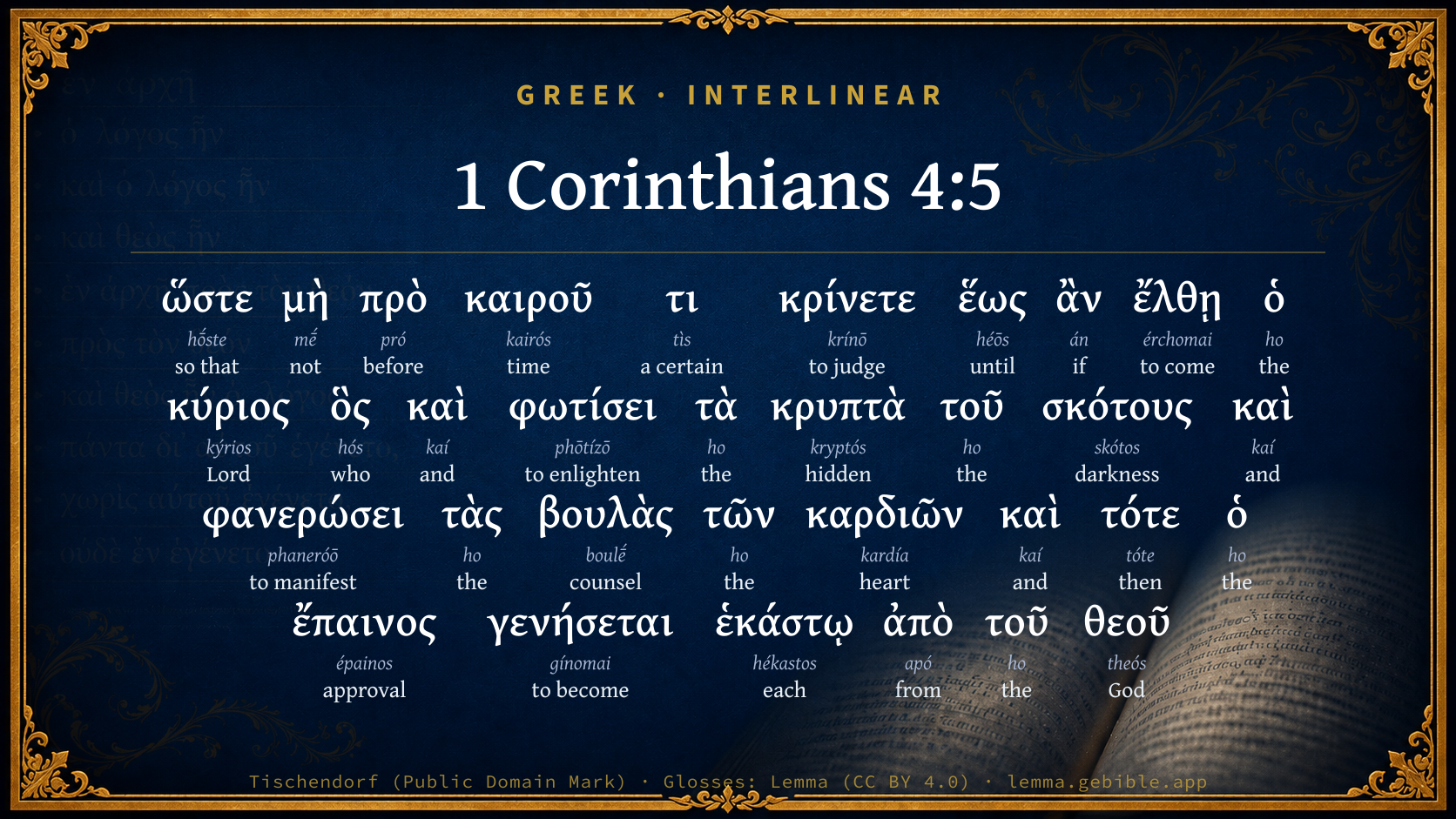
Greek (Tischendorf 8th ed.) 1 Corinthians 4:5 appears in the Greek New Testament. The text above is from the Tischendorf 8th edition. Each word links to its Strong’s number and a concise gloss. Click any word for its full Thayer’s Greek Lexicon entry.
Download image
Cite this verse

1 Corinthians 4:5 (World English Bible). Public Domain. Lemma interlinear Bible study tool, https://lemma.gebible.app/v/1-corinthians/4/5.

Show BibTeX & RIS
BibTeX
RIS
English Translation
Therefore judge nothing before the time, until the Lord comes, who will both bring to light the hidden things of darkness, and reveal the counsels of the hearts. Then each man will get his praise from God.
World English Bible · Public Domain
Download a study sheet

One document with this verse’s original text, its word-by-word gloss line, the meaning frame, cross-references with their text, attributed commentary, and full source and license credits — printable, and it pastes into notes with its structure intact.

This verse Autodidact and up

Study sheet (.html) Plain text (.txt)

A passage Seminary Student

Up to 50 verses in one chapter. A passage sheet keeps up to 6 commentary sources and 12 cross-references per verse, in the order this page ranks them, and says so on the sheet whenever that leaves anything out. Ask for a single verse and you get the Autodidact verse sheet above.

Everything on this page stays free to read, with no account — the sheet is a download of what is already on screen, not access to it.

Want to remove ads? Support Godless Engineer
Compare translations 3

The same verse in 3 English versions, stacked beneath the original-language interlinear above. Click any original word for its lexicon entry.

Each is an independent rendering of the whole verse — the interlinear is not word-aligned to these translations.

Highlighted words mark where these versions differ — a whole-verse word diff, not a word-by-word alignment.

  • World English Bible Public Domain
    Therefore judge nothing before the time, until the Lord comes, who will both bring to light the hidden things of darkness, and reveal the counsels of the hearts. Then each man will get his praise from God.
  • King James Version Public Domain
    Therefore judge nothing before the time, until the Lord come, who both will bring to light the hidden things of darkness, and will make manifest the counsels of the hearts: and then shall every man have praise of God.
  • unfoldingWord Literal Text CC BY-SA 4.0
    Therefore, do not judge anything before the time, until the Lord comes, who will both bring to light the hidden things of darkness and reveal the purposes of the hearts. And then the praise from God will come to each one.

unfoldingWord Literal Text — © unfoldingWord, licensed CC BY-SA 4.0. Word-aligned USFM3 via Door43 (git.door43.org/unfoldingWord/en_ult).

Versions to compare (up to 4)

3 of 4 selected

Show all 19 translations

Every available English version of this verse, each an independent rendering of the whole verse.

  • World English Bible Public Domain
    Therefore judge nothing before the time, until the Lord comes, who will both bring to light the hidden things of darkness, and reveal the counsels of the hearts. Then each man will get his praise from God.
  • Berean Standard Bible Public Domain
    Therefore judge nothing before the appointed time; wait until the Lord comes. He will bring to light what is hidden in darkness and will expose the motives of men’s hearts. At that time each will receive his praise from God.
  • Majority Standard Bible Public Domain
    Therefore judge nothing before the appointed time; wait until the Lord comes. He will bring to light what is hidden in darkness and will expose the motives of men’s hearts. At that time each will receive his praise from God.
  • King James Version Public Domain
    Therefore judge nothing before the time, until the Lord come, who both will bring to light the hidden things of darkness, and will make manifest the counsels of the hearts: and then shall every man have praise of God.
  • American Standard Version (1901) Public Domain
    Wherefore judge nothing before the time, until the Lord come, who will both bring to light the hidden things of darkness, and make manifest the counsels of the hearts; and then shall each man have his praise from God.
  • Revised Version (1885) Public Domain
    Wherefore judge nothing before the time, until the Lord come, who will both bring to light the hidden things of darkness, and make manifest the counsels of the hearts; and then shall each man have his praise from God.
  • Geneva Bible (1599) Public Domain
    Therefore iudge nothing before the time, vntill the Lord come, who will lighten things that are hid in darkenesse, and make the counsels of the hearts manifest: and then shall euery man haue praise of God.
  • Douay-Rheims (1899) Public Domain
    Therefore judge not before the time; until the Lord come, who both will bring to light the hidden things of darkness, and will make manifest the counsels of the hearts; and then shall every man have praise from God.
  • Young's Literal Translation Public Domain
    so, then, nothing before the time judge ye, till the Lord may come, who will both bring to light the hidden things of the darkness, and will manifest the counsels of the hearts, and then the praise shall come to each from God.
  • Literal Standard Version CC BY-SA 4.0
    so, then, judge nothing before the time, until the LORD may come, who will both bring to light the hidden things of the darkness, and will reveal the counsels of the hearts, and then the praise will come to each from God.
  • Unlocked Literal Bible CC BY-SA 4.0
    Therefore do not pronounce judgment about anything before the time, before the Lord comes. He will bring to light the hidden things of darkness and reveal the purposes of the heart. Then each one will receive his praise from God.
  • unfoldingWord Literal Text CC BY-SA 4.0
    Therefore, do not judge anything before the time, until the Lord comes, who will both bring to light the hidden things of darkness and reveal the purposes of the hearts. And then the praise from God will come to each one.
  • Darby Bible Public Domain
    So that do not judge anything before [the] time, until the Lord shall come, who shall also both bring to light the hidden things of darkness, and shall make manifest the counsels of hearts; and then shall each have [his] praise from God.
  • World Messianic Bible Public Domain
    Therefore judge nothing before the time, until the Lord comes, who will both bring to light the hidden things of darkness and reveal the counsels of the hearts. Then each man will get his praise from God.
  • Webster's Bible Public Domain
    Therefore judge nothing before the time, until the Lord shall come, who will both bring to light the hidden things of darkness, and will make manifest the counsels of the hearts: and then shall every man have praise from God.
  • Free Bible Version CC BY-SA 4.0
    So don't judge anything before the right time—when the Lord comes. He will bring to light all the darkest secrets that are hidden, and he will reveal people's motives. God will give everyone whatever praise they deserve.
  • Bible in Basic English Public Domain
    For this reason let there be no judging before the time, till the Lord comes, who will make clear the secret things of the dark, and the designs of the heart; and then will every man have his praise from God.
  • Text-Critical English NT CC BY 4.0
    So then, do not judge anything before the appointed time. Wait until the Lord comes, who will bring to light what is hidden in darkness and reveal the intentions of the heart. At that time each person will receive his praise from God.
  • Tyndale New Testament (1534) Public Domain
    Therfore iudge no thinge before the tyme vntill the Lorde come which will lighten thinges that are hyd in darcknes and open the counsels of the hertes. And then shall every man have prayse of God.

Literal Standard Version (2020), Covenant Press — licensed CC BY-SA 4.0. Text via the HelloAO Bible API (eBible.org). Unlocked Literal Bible (unfoldingWord) — licensed CC BY-SA 4.0. Text via the HelloAO Bible API (eBible.org). unfoldingWord Literal Text — © unfoldingWord, licensed CC BY-SA 4.0. Word-aligned USFM3 via Door43 (git.door43.org/unfoldingWord/en_ult). Free Bible Version, Dr. Jonathan Gallagher — licensed CC BY-SA 4.0. Text via the HelloAO Bible API (eBible.org).

Word by word

More ways to search: Search by grammar → Find every occurrence → Compare this word →

Practice this passage: Drill this verse → Learn its vocabulary →

φωτίσει
phōtízō
G5461
“to enlighten”
Verb, Future, Active, Indicative, 3rd person, Singular
Part of Speech
Verb
Tense
Future
Voice
Active
Mood
Indicative
Person
3rd person
Number
Singular
Full Thayer's Definition

Origin: from G5457

TDNT: 14:10,1

1. to give light, to shine 2. to enlighten, light up, illumine 3. to bring to light, render evident a. to cause something to exist and thus come to light and become clear to all 4. to enlighten, spiritually, imbue with saving knowledge a. to instruct, to inform, teach b. to give understanding to
  1. ὥστε hṓste G5620 “so that” Conjunction
  2. μὴ mḗ G3361 “not” Particle, Negative
  3. πρὸ pró G4253 “before” Preposition
  4. καιροῦ kairós G2540 “time” Noun, Genitive, Singular, Masculine
  5. τι tìs G5100 “a certain” Indefinite pronoun, Accusative, Singular, Neuter
  6. κρίνετε krínō G2919 “to judge” Verb, Present, Active, Imperative, 2nd person, Plural
  7. ἕως héōs G2193 “until” Adverb
  8. ἂν án G302 “if” Particle
  9. ἔλθῃ érchomai G2064 “to come” Verb, Aorist, Active, Subjunctive, 3rd person, Singular
  10. ὁ ho G3588 “the” Article, Nominative, Singular, Masculine
  11. κύριος kýrios G2962 “Lord” Noun, Nominative, Singular, Masculine
  12. ὃς hós G3739 “who” Relative pronoun, Nominative, Singular, Masculine
  13. καὶ kaí G2532 “and” Conjunction
  14. τὰ ho G3588 “the” Article, Accusative, Plural, Neuter
  15. κρυπτὰ kryptós G2927 “hidden” Adjective, Accusative, Plural, Neuter
  16. τοῦ ho G3588 “the” Article, Genitive, Singular, Neuter
  17. σκότους skótos G4655 “darkness” Noun, Genitive, Singular, Neuter
  18. καὶ kaí G2532 “and” Conjunction
  19. φανερώσει phaneróō G5319 “to manifest” Verb, Future, Active, Indicative, 3rd person, Singular
  20. τὰς ho G3588 “the” Article, Accusative, Plural, Feminine
  21. βουλὰς boulḗ G1012 “counsel” Noun, Accusative, Plural, Feminine
  22. τῶν ho G3588 “the” Article, Genitive, Plural, Feminine
  23. καρδιῶν kardía G2588 “heart” Noun, Genitive, Plural, Feminine
  24. καὶ kaí G2532 “and” Conjunction
  25. τότε tóte G5119 “then” Adverb
  26. ὁ ho G3588 “the” Article, Nominative, Singular, Masculine
  27. ἔπαινος épainos G1868 “approval” Noun, Nominative, Singular, Masculine
  28. γενήσεται gínomai G1096 “to become” Verb, Future, Middle deponent, Indicative, 3rd person, Singular
  29. ἑκάστῳ hékastos G1538 “each” Adjective, Dative, Singular, Masculine
  30. ἀπὸ apó G575 “from” Preposition
  31. τοῦ ho G3588 “the” Article, Genitive, Singular, Masculine
  32. θεοῦ theós G2316 “God” Noun, Genitive, Singular, Masculine

About this verse

These counts appear in no published source. They are computed here, from the morphology-tagged text and Lemma’s own curated glosses. What Lemma adds →

33
words
25
distinct lemmas
Pauline Epistles
section

Notable vocabulary

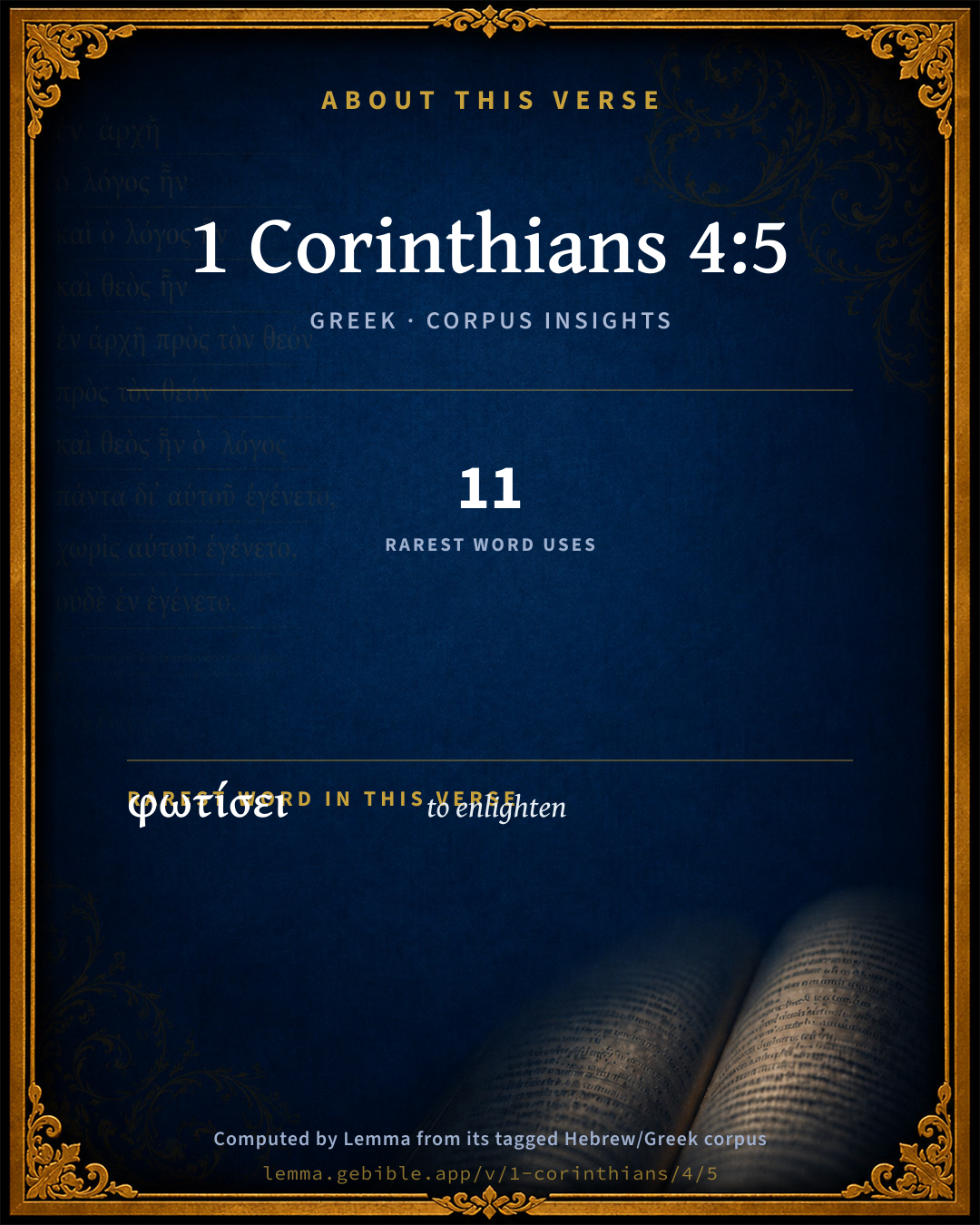
The rarest word here is φωτίσει to enlighten G5461 — appearing just 11 times in the whole Greek New Testament.

Shared distinctive vocabulary

φωτίσει to enlighten G5461 occurs in 11 verses of the Greek New Testament. Also found in:

Repetition

Words recur within this verse:

Cross-references

37

Topical passages linked to 1 Corinthians 4:5 in the Treasury of Scripture Knowledge — connected by theme and wording, ordered by reader-vote popularity; previews shown in the World English Bible.

  • James 5:7 Be patient therefore, brothers, until the coming of the Lord. Behold, the farmer waits for the precious fruit of the earth, being patient over it, until it receives the early and late rain.
  • 2 Corinthians 5:10 For we must all be revealed before the judgment seat of Christ; that each one may receive the things in the body, according to what he has done, whether good or bad.
  • 1 Corinthians 3:13 each man's work will be revealed. For the Day will declare it, because it is revealed in fire; and the fire itself will test what sort of work each man's work is.
  • Hebrews 4:13 There is no creature that is hidden from his sight, but all things are naked and laid open before the eyes of him with whom we have to do.
  • Romans 2:16 in the day when God will judge the secrets of men, according to my Gospel, by Jesus Christ.
  • 2 Corinthians 10:18 For it isn't he who commends himself who is approved, but whom the Lord commends.
  • Ecclesiastes 12:14 For God will bring every work into judgment, with every hidden thing, whether it is good, or whether it is evil.
  • Romans 2:1 Therefore you are without excuse, O man, whoever you are who judge. For in that which you judge another, you condemn yourself. For you who judge practice the same things.
  • Revelation 20:12 I saw the dead, the great and the small, standing before the throne, and they opened books. Another book was opened, which is the book of life. The dead were judged out of the things which were written in the books, according to their works.
  • 1 Peter 1:7 that the proof of your faith, which is more precious than gold that perishes even though it is tested by fire, may be found to result in praise, glory, and honor at the revelation of Jesus Christ--
  • Romans 2:29 but he is a Jew who is one inwardly, and circumcision is that of the heart, in the spirit not in the letter; whose praise is not from men, but from God.
  • Romans 14:10–13 But you, why do you judge your brother? Or you again, why do you despise your brother? For we will all stand before the judgment seat of Christ.
  • John 5:44 How can you believe, who receive glory from one another, and you don't seek the glory that comes from the only God?
  • Romans 14:4 Who are you who judge another's servant? To his own lord he stands or falls. Yes, he will be made to stand, for God has power to make him stand.
  • 2 Corinthians 4:2 But we have renounced the hidden things of shame, not walking in craftiness, nor handling the word of God deceitfully; but by the manifestation of the truth commending ourselves to every man's conscience in the sight of God.
  • Matthew 7:1–2 "Don't judge, so that you won't be judged.
  • Matthew 24:46 Blessed is that servant whom his lord finds doing so when he comes.
  • Luke 6:37 Don't judge, And you won't be judged. Don't condemn, And you won't be condemned. Set free, And you will be set free.
  • James 4:11 Don't speak against one another, brothers. He who speaks against a brother and judges his brother, speaks against the law and judges the law. But if you judge the law, you are not a doer of the law, but a judge.
  • Luke 12:1–3 Meanwhile, when a multitude of many thousands had gathered together, so much so that they trampled on each other, he began to tell his disciples first of all, "Beware of the yeast of the Pharisees, which is hypocrisy.
  • John 21:22 Jesus said to him, "If I desire that he stay until I come, what is that to you? You follow me."
  • 1 Thessalonians 5:2 For you yourselves know well that the day of the Lord comes like a thief in the night.
  • 1 Peter 5:4 When the chief Shepherd is revealed, you will receive the crown of glory that doesn't fade away.
  • Revelation 1:7 Behold, he is coming with the clouds, and every eye will see him, including those who pierced him. All the tribes of the earth will mourn over him. Even so, Amen.
  • Malachi 3:18 Then you shall return and discern between the righteous and the wicked, between him who serves God and him who doesn't serve him.
  • Matthew 24:30 and then the sign of the Son of Man will appear in the sky. Then all the tribes of the earth will mourn, and they will see the Son of Man coming on the clouds of the sky with power and great glory.
  • Matthew 25:23 "His lord said to him, 'Well done, good and faithful servant. You have been faithful over a few things, I will set you over many things. Enter into the joy of your lord.'
  • 2 Peter 3:4 and saying, "Where is the promise of his coming? For, from the day that the fathers fell asleep, all things continue as they were from the beginning of the creation."
  • Ecclesiastes 11:9 Rejoice, young man, in your youth, And let your heart cheer you in the days of your youth, And walk in the ways of your heart, And in the sight of your eyes; But know that for all these things God will bring you into judgment.
  • Romans 2:7 to those who by patience in well-doing seek for glory and honor and incorruptibility, eternal life;
  • 1 Corinthians 1:7 so that you come behind in no gift; waiting for the revelation of our Lord Jesus Christ;
  • 1 Corinthians 11:26 For as often as you eat this bread and drink this cup, you proclaim the Lord's death until he comes.
  • 1 Corinthians 15:23 But each in his own order: Christ the first fruits, then those who are Christ's, at his coming.
  • 2 Peter 3:12 looking for and earnestly desiring the coming of the day of God, by reason of which the heavens being on fire will be dissolved, and the elements will melt with fervent heat?
  • Jude 1:14 About these also Enoch, the seventh from Adam, prophesied, saying, "Behold, the Lord came with ten thousands of his holy ones,
  • Matthew 25:21 "His lord said to him, 'Well done, good and faithful servant. You have been faithful over a few things, I will set you over many things. Enter into the joy of your lord.'
  • 1 Corinthians 3:8 Now he who plants and he who waters are the same, but each will receive his own reward according to his own labor.

Cross-references courtesy of OpenBible.info (CC BY 4.0).

Commentary

Notes on 1 Corinthians 4:5 from classic Christian and Jewish commentators (each source and its license shown beneath its notes). The classic Christian expositions comment on the surrounding passage and are grouped to its opening verse, so a note may address several verses; the Jewish commentaries on the Tanakh (Rashi and others) are per-verse, so they appear only where the commentator wrote on this verse.

Lemma curates 59 commentaries, every one of them public domain or Creative Commons licensed, each selected and text-cleaned for this edition rather than reprinted as found. About our sources →

Tyndale Open Study Notes

Tyndale Open Resources

4:5 don’t make judgments about anyone: Only the Lord can fully know a person’s heart, and when he returns, he will judge. Paul took God’s judgment of his ministry very seriously (see 2 Cor 5:9-10; Phil 2:16; 1 Thes 2:19-20; cp. 2 Cor 1:14).

Tyndale Open Study Notes — © Tyndale Open Resources, licensed CC BY-SA 4.0. Text via the HelloAO Bible API.

Bengel's Gnomon

Johann Albrecht Bengel

1Co 4:5. Κρίνατε, judge) He does not say ἀνακρίνατε, decide; he more closely alludes to the judgment, which the Lord will give.—ὁ Κύριος, the Lord) Jesus whom we serve, 1Co 4:1.—καὶ) also: He will not only judge, but will bring forth to light His judgment.—φωτίσει) φωτίζειν is to throw light upon any object, for example, φωτίζειν τὴν νύκτα, to throw light upon the night, Exo 14:20, on the margin of the ed. Wech.: or to bring a thing to light, 2Ti 1:10. Both of these will be done at that time.—τὰ κρυπτὰ, the hidden things) The heart of man is truly a hidden cavern [crypt].—τοῦ σκότους, of the darkness) into which no human eye penetrates.—φανερώσει, will make manifest) so that you will then at length clearly know us.—τὰς βουλὰς, the counsels) showing, who hath been faithful or not.—τῶν καρδιῶν, of the hearts) according to the state of the heart, so the conduct is just [justified, 1Co 4:4] and praiseworthy or the reverse.—τότε, then) Therefore wait.—ἔπαινος, praise) The world praises its princes, warlike leaders, ambassadors, wise men, artists: God will hereafter praise His ministers.—ἑκάστῳ) to every one, who is a praiseworthy, faithful steward; you only praise one, for example, Paul. So every one, 1Co 3:8. Concerning praise from God, see Mat 25:21. Those too, who are not faithful, expect praise, but their praise will be reproach. Therefore the contrary is also included by implication in the word praise, which is a euphemism [the opposite of praise being not expressed, though implied]; so the euphemism in, shall try or prove, etc., c. 1Co 3:13, 1Co 8:8; 1Co 8:10, notes. So blessing also comprehends cursing, Gen 49:28; Gen 49:7. There is a similar passage, 1Sa 26:23 (24).

Bengel's Gnomon of the New Testament — English translation (T&T Clark, Edinburgh, 1860) — public domain. Text from a community e-Sword module.

Meyer's Critical & Exegetical Commentary

Heinrich August Wilhelm Meyer

1Co_4:5. Therefore judge nothing before the time, namely, with respect to me; not as Billroth thinks: one sect regarding another, which is inadmissible in view of the preceding ἀνακρ. με and of the whole passage, 1Co_4:3-4, which all applies to Paul. The process of thought from 1Co_4:3 onwards is, namely, this: For my part, you may judge me if you will, I make very little of that; but (1Co_4:4) seeing that I do not even judge myself, but that he that judgeth me is Christ, I therefore counsel you (1Co_4:5) not to pass a judgment upon me prematurely.

πρὸ καιροῦ] i.e. before it is the right time, Mat_8:29; Sir_30:24; Sir_51:30; Lucian, Jov. Trag. 47. How long such judging would continue to be πρὸ καιροῦ, we learn only from what comes after; hence we must not by anticipation assign to καιρός the specific sense of tempus reditus Christi.

τι] i.e. κρίσιν τινά, Joh_7:24.

κρίνετε] describes the passing of the judgment, the consequence of the ἀνακρ., a manner accordant with the looking forward to the Messianic judgment. Luther, Raphel, and Wolf render: alium alii praeferte; but this runs counter to the context, for it must be analogous to the general ἀνακρ.

ἕως ἂν ἔλθῃ ὁ κ.] Epexegesis of πρὸ καιροῦ: judge not before the time (judge not, I say), until the Lord shall have come. Then only is it a καίριον κρίνειν, because then only can the judgment be pronounced rightly according to the Lords decision. The ἄν marks out the coming as in so far problematical (depending upon circumstances; see Hartung, Partikell. p. 291), inasmuch as it was not, indeed, doubted, and yet at the same time not dependent upon subjective determination, but an object of expectant faith in the unknown future. Comp Mat_16:28; Mar_9:1; Luk_9:27; Luk_13:35; Rev_2:25.

ὃς καί] καί is the also customary with the relative, the effect of which is to bring into prominence some element in keeping with what has gone before (Baeumlein, Partik. p. 152; Buttmann, neut. Gr. p. 243 [E. T. 283]). In His function as Judge, in which He is to come, He will do this also, He will light up, i.e. make manifest, what is hidden in the darkness. Respecting φωτίσει, comp Sir_24:32; 2Ti_1:10; Plut. Mor. p. 931 C, and the passages in Wetstein. What withdraws itself from the light as its opposite (Hofmann, who takes καὶ … καί as meaning as well, as also) is included here, but not that alone. Compare rather the general statement in Luk_8:17.

καὶ φανερ. τ. βουλ. τῶν καρδ.] a special element selected from the foregoing general affirmation. The significant bearing of what Paul here affirms of Christ at His coming is the application which the readers were to make of it to himself and the other teachers; it was to be understood, namely, that their true character also would only then become manifest, i.e. be laid open as an object of knowledge, but now was not yet submitted to judgment.

καὶ τότε … Θεοῦ] so that ye can only then pass judgment on your teachers with sure (divine) warrant for what ye do. The chief emphasis is upon the ἀπὸ τ. Θεοῦ, which is for that reason put at the end (Kühner, II. p. 625), and next to it upon what is placed first, ὁ ἔπαινος. This does not mean praemium (so Flatt, with older expositors, citing wrongly in support of it such passages as Rom_2:29; Rom_13:3; 1Pe_1:7; 1Pe_2:14; Wis_15:19; Polybius, 2. 58. 11), nor is it a vox media (as, following Casaubon, a[616] Epict. 67, Wolf, Rosenmüller, Pott, and others assume wholly without proof); but it denotes simply the praise, the commendation. The apparent incongruity with ἑκάστῳ is obviated by the article: the praise that appertains to him (Bernhardy, p. 315) shall be given to each,so that Paul here puts entirely out of sight those who deserve no praise at all. And rightly so. For his readers were to apply this to him and Apollos; hence, as Calvin justly remarks: haec vox ex bonae conscientiae fiducia nascitur. See 1Co_4:4. Theophylacts view, although adopted by many, is an arbitrary one: unde et contrarium datur intelligi, sed mavult εὐφημεῖν, Grotius (so also Bengel, Billroth, Rückert, Olshausen).

ἀπὸ τ. Θεοῦ] not from men, as ye now place and praise the one above the other, but on the part of God; for Christ the Judge is Gods vicegerent and representative, Joh_5:27 ff.; Act_10:42; Act_17:31; Rom_2:16, al[617]

[616] d refers to the note of the commentator or editor named on the particular passage.

[617] l. and others; and other passages; and other editions.

Meyer — Critical and Exegetical Commentary on the New Testament — English translation by Peter Christie, edited by Frederick Crombie (T&T Clark, 1880) — public domain. Text from a community e-Sword module.

Expositor's Greek Testament

ed. W. Robertson Nicoll

1Co 4:5 . The practical conclusion of the statement respecting Christ’s servants (see note on ὥστε , 1Co 3:21 ): “So then do not before the time be passing any judgment”. τι , the cognate ace. = κρίσιν τινά , as in Joh 7:24 . πρὸ καιροῦ (the fit time, not the set time) signifies prematurely (so Æsch., Eumen. , 367), as ἐν καιρῷ seasonably (Luk 12:42 ). Our Lord gives another reason for not judging, in Mat 7:1 ff.; this prohibition, like that, points to His tribunal, bidding men hold back their verdicts on each other in deference to His ( cf. Rom 14:10 ). “Until the Lord come:” ἕως ἄν indicates contingency in the time , not the event itself; for this uncertainty, cf. 1Th 5:2 , Mat 25:13 , Luk 12:39 , Act 1:7 , etc. His coming is the ἀποκάλυψις toward which the hope of this Church was directed from the first (1Co 1:7 : see note); it will reveal with perfect evidence the matters on which the Cor [665] are officiously and ignorantly pronouncing. ὃς καὶ φωτίσει κ . τ . λ .: “who shall also illuminate the hidden things of darkness”. φωτίζω points to the cause , as φανερόω to the result , and ἀποκαλύπτω (1Co 2:10 ) to the mode of Divine disclosures. Christ’s presence of itself illuminates ( cf. 2Co 4:6 , and other parls.); His Parousia is light as well as fire (1Co 3:13 ) both instruments of judgment. τὰ κρυπτὰ τοῦ σκότους , “the secrets hidden in the darkness” ( res tenebris occultatas , Bz [666] ) not necessarily evil things (see Rom 2:16 , 2Co 4:6 ), but things impenetrable to present light. Chief amongst these, “the Lord will make manifest ( φανερώσει ) the counsels of the hearts ”. These God (and with Him Christ, ὁ ἀνακρίνων : 1Co 4:4 ) already searches out (Rom 8:27 ; Psa 139 , etc.); then He will make plain to men, about themselves and each other, what was dark before. The καρδία is the real self, the “hidden,” “inward man” (Eph 3:16 f., 1Pe 3:4 , and other parls.), known absolutely to God alone ( cor hominis crypta est , Bz [667] ); its “counsels” are those self-communings and purposings which determine action and belong to the essence of character. “And then (not before) the (due) praise will come ( ὁ ἔπαινος γενήσεται ) to each from God (not from human lips).” ἀπὸ τ . Θεοῦ for it is on God’s behalf that Christ will judge; His commendation is alone of value (Rom 2:29 ; Joh 5:44 ). The Church is God’s field and temple (1Co 3:9 ff.); all work wrought in it awaits His approval. ἑκάστῳ recalls the lesson of 1Co 3:8 ; 1Co 3:11-13 , respecting the discriminating and individual character of Divine rewards. “Praise” ambitious Gr [668] teachers coveted: let them seek it from God. “Praise” the Cor [669] partisans lavished on their admired leaders: this is God’s prerogative, let them check their impertinent eulogies. Enough was said in 1Co 3:15 ; 1Co 3:17 , of condemned work; P. is thinking here of his true συνεργοί (1Co 4:1 f.), who with himself labour and hope for approval at the Day of Christ; little need they reck of the criticisms of the hour.

[665] Corinth, Corinthian or Corinthians.

[666] Beza’s Nov. Testamentum: Interpretatio et Annotationes (Cantab., 1642).

[667] Beza’s Nov. Testamentum: Interpretatio et Annotationes (Cantab., 1642).

[668] Greek, or Grotius’ Annotationes in N.T.

[669] Corinth, Corinthian or Corinthians.

The Expositor's Greek Testament, edited by W. Robertson Nicoll (1897–1910) — public domain. Text from a community e-Sword module.

International Critical Commentary

5. ὥστε. With the imperative (see on 3:21), ‘So then.’

μή τι κρίνετε. ‘Cease to pass any judgment,’ or ‘Make a practice of passing no judgement’ (pres. imper.). The τι is a cognate accusative, such as we have in Joh 7:24. ‘As far as I am concerned, you may judge as you please, it is indifferent to me; but, as Christians, you should beware of passing any judgment on any one, until the Judge of all has made all things clear. All anticipation is vain.’

πρὸ καιροῦ. ‘Before the fitting time,’ or ‘the appointed time,’ when οἰ ἅγιοι τὸν κόσμον κρινοῦσιν (6:2). Καιρός has no exact equivalent in English, French, or German. Cf. Mat 8:29.

ἕως ἄν ἔλθῃ. The addition or omission of ἄν after ἕως in the N.T. is somewhat irregular, and this fact precludes any sure generalization as to particular shades of meaning. In later Greek the force of ἄν is weakened, and therefore the difference between its presence and absence is lessened. Here, not the coming, but the time of it, is doubtful; ‘till the Advent, whenever that may be.’ See Milligan on 2Th 2:7, where there is no ἄν, and Edwards here. In Rev 2:25, ἄχρι οὗ ἂν ἥξω, it is doubtful whether ἥξω is fut. indic. or aor. subj. At the Day of Judgment they will take part in judging (6:2, 3), with all the facts before them.

ὅς καὶ φωτίσει. ‘Who shall both throw light upon,’ ‘shall illumine,’ lucem inferet in (Beng.). But the difference between ‘bringing light to’ and ‘bringing to light’ is not great. The καί is probably ‘both,’ not ‘also’; but if ‘also,’ the meaning is, ‘will come to judge and also will illumine,’ which is less probable. Φωτίζω points to the source of the revelation.

τὰ κρυπτὰ τοῦ σκότους. Abscondita tenebrarum (Vulg.); occulta tenebrarum = res tenebris occultatas (Beza). The genitive may be possessive or characterizing, ‘the hidden things which darkness holds,’ or ‘the hidden things whose nature is dark.’ The point is, not that what will be revealed is morally bad, although that may be suggested, but that hitherto they have been quite secret, hidden, it may be, from the person’s own conscience.

καὶ φανερώσει. Two things are necessary for an unerring judgment of human actions,—a complete knowledge of the facts, and full insight into the motives. These the Lord will apply when He comes; and to attempt to judge men without these indispensable qualifications is futile arrogance. Φανερόω points to the result of the revelation.

καὶ τότε ὁ ἔπαινος. ‘And then, and not till then, the measure of praise that is due will come to each from God.’ ‘He will have his praise’ (RV.), what rightly belongs to him, which may be little or none, and will be very different from the praise of partizans here. We have the same thought in 2Co 10:18; Rom 2:29; and Clem. Rom reproduces it, Cor. 30. Compare μισθός, 3:14, and ὁ μισθός, Rom 4:4, and see Hort on 1Pe 1:7, p. 43.

ἀπὸ τοῦ Θεοῦ. At the end, with emphasis; the award is final, as ἀπό intimates; there is not further court of appeal: and it is from God that Christ has authority to judge the world (Joh 5:27). Cf. 2 Esdr. 16:62-65. With ἑκάστῳ compare the fivefold ἕκαστος in 3:5-13.

D E F G, Aug. omit the ὅς before καί. D omits the τοῦ before Θεοῦ. The conjecture of ὑπό for ἀπό before τοῦ Θεοῦ has no probability of being right. Christ is the ὡρισμένος ὑπὸ τοῦ Θεοῦ κριτής (Act 10:42): cf. μέλλει κρίνειν τὴν οἰκουμένην ἐν ἀνδρὶ ᾧ ὤρισεν (Act 17:31): so that the judgments pronounced by Christ are ἀπὸ τοῦ Θεοῦ.

4:6-21. Personal Application of the Foregoing Passage (3:5-4:5), and Close of the Subject of the Dissensions

My aim in all this is to correct party-spirit and conceit. Do compare your self-glorification with the humiliations of your teachers. This admonition comes from a father whom you ought to imitate. I really am coming to you. Is it to be in severity or in gentleness?

6 These comments I have modified in form, so as to apply to myself and Apollos, without including others, for you certainly have made party-leaders of him and me. And I have done this for your sakes, not ours, in order that by us as examples you may learn the meaning of the words, Go not beyond what is written; in short, to keep any one of you from speaking boastfully in favour of the one teacher to the disparagement of the other. 7 For, my friend, who gives you the right to prefer one man to another and proclaim Paul and Apollos as leaders? And what ability do you possess that was not given to you by God? You must allow that you had it as a gift from Him. Then why do you boast as if you had the credit of acquiring it? 8 No doubt you Corinthians are already in perfect felicity; already you are quite rich; without waiting for us poor teachers, you have come to your kingdom! And I would to God that you had come to the Kingdom, that we also might be there with you! But we are far from that happy condition. For it seems to me that God has exhibited us His Apostles last of all, as men doomed to death are the last spectacle in a triumphal procession: for a spectacle we are become to the universe, to the whole amphitheatre of angels and men. 10 We poor simpletons go on with the foolishness of preaching Christ, while you in your relation to Him are men of sagacity. We feel our weakness; you are so strong as to stand alone. You have the glory, and we the contempt. 11 Up to this very moment we go hungry, thirsty, and scantily clothed; we get plenty of hard blows and have no proper home; 12 and we have to work hard with our hands to earn our daily bread. Men revile us, and we bless them; they persecute us, and we are patient; they slander us, and we merely deprecate. 13 We have been treated as the scum of the earth, the refuse of society, and are treated so still.

14 I am not writing in this tone to put you to shame: you are my dearly loved children, and I am showing you where you are wrong. 15 For you may have any number of instructors in Christ, yet you have not more than one father: for in Christ Jesus it was I, and no one else, who begat you through the Glad-tidings which I brought you. 16 I have, therefore, the right to beseech you to follow my steps. 17 And because I wish you to follow my example, I have sent Timothy to you; for he also is a child of mine, dearly loved as you are, loyal and trusty in the Lord, and he will bring back to your remembrance the simple and lowly ways which I have as a Christian teacher, not only at Corinth, but everywhere and in every Church. 18 Some of you boastfully declared that my sending Timothy meant that I did not dare to come myself; so they would do as they pleased. 19 But I do mean to come, and that soon, to you, if the Lord pleases; and I will then take cognizance, not of what these inflated boasters say, but of what they can do. Have they any spiritual power? 20 For the Kingdom of God is not a thing of words, but of spiritual power. 21 Which is it to be then? Am I to come to you rod in hand, or in love and a spirit of gentleness?

After a brief, plain statement of his purpose (6, 7) in the preceding exposition of the Pastoral Office, the Apostle severely rebukes the inflated glorying of his readers (8-13), and then, in a more tender strain (14-16), but still not without sternness (17-21), explains the mission of Timothy, the precursor of his own intended visit.

International Critical Commentary — older volumes (1896–1929), various authors — public domain. Text from a community e-Sword module.

Hodge's Commentary on Romans, Ephesians & First Corinthians

Charles Hodge

1Co_4:5

Therefore judge nothing before the time, until the Lord come, who both will bring to light the hidden things of darkness, and will make manifest the counsels of the hearts: and then shall every man have praise of God.

As the Lord is the only judge, we must wait for his appearance, and neither assume his prerogative, nor anticipate his decision. Judge nothing before the time (καιρός), i.e. the appropriate, or appointed time. What time is intended is intimated in the next clause. Until the Lord come, (ἕωϚ ἂν ἔλθη, shall have come) i.e. until the second advent of Christ, which in the New Testament is constantly represented as contemporaneous with the resurrection of the dead and the general judgment. He is to come for judgment, Mat_24:30, Mat_24:46; 2Pe_3:4, 2Pe_3:12; Jud_1:14; Rev_1:7. The reason why the coming of the Lord is the appropriate time for judgment is, that he will then do what cannot be done before, or by any creature. He will bring to light (shed light upon) the secret things of darkness; that is, things which are now hidden in darkness. This includes acts which are now unknown, and those principles of action which lie concealed in the recesses of the heart, where no human eye can reach them. This is all the context requires. In other connections the secret things, or the works of darkness, means wicked works; works done in the dark to avoid detection; or works which spring from moral darkness, Eph_5:11. But the apostle is here speaking of the reason why judgment should be deferred until the coming of Christ. The reason is that he alone can bring to light the secret acts and motives of men. These secret works and motives, and not merely outward acts, are the grounds of judgment. Whether a man is faithful in preaching the gospel depends upon his motives; for some preached Christ of contention, Phi_1:16. This view of the passage is confirmed by the explanatory clause which follows, and will make manifest the counsels of the hearts. The former expression is general, this is special. The counsels of the heart are included in the secret things of darkness. He who sheds light on the secret things of darkness not only reveals acts done in secret, but makes manifest the counsels of the heart. What a work is here ascribed to the Lord Jesus! He will bring to light the secret acts and hidden motives of every human being. He will exercise the prerogative of judging the heart and conscience; a prerogative which none but an omniscient being can rightfully claim or possibly exercise. It is therefore in Scripture always spoken of as peculiar to God, Psa_26:2; Jer_11:20; Jer_20:12; Rev_2:23. Paul appealed from the fallible judgment of short-sighted men, to the infallible judgment of his omniscient Lord.

And then; not before, because not until then will the full truth be known. Shall every man have praise (ἔπαινος, much praise, applause, a loud and clear acclaim of commendation; Well done, thou good and faithful servant!) The reason why Paul uses the word praise, and not the general term recompense, probably is, that he is throughout the passage speaking of himself. The Corinthians had sat in judgment on his fidelity. He tells them that neither they nor he could competently decide whether he was faithful or not. The Lord was the only judge. When he comes, the truth will be known, and then there shall be praise. He knew there was laid up for him a crown of righteousness, which the Lord the righteous judge would give him in that day, 2Ti_4:8. Still, as what is true of him is true of others, he expresses himself in general terms. Then shall every man have praise. That is, every faithful servant. Praise of God, i.e. from God. He is the ultimate source of all good. He is in Christ; and Christ is in God. The Theanthropos, as final judge, is the representative of the Godhead, so that his decisions and awards are the decisions and awards of God. As remarked above, 1Co_2:15, what the apostle says of his independence of human judgment, and his command not to anticipate the judgment of the Lord, is consistent with his frequent recognition of the right and duty of the church to sit in judgment on the qualifications of her own members. He is here speaking of the heart. The church cannot judge the heart. Whether a man is sincere or insincere in his professions, whether his experience is genuine or spurious, God only can decide. The church can only judge of what is outward. If any man profess to be holy, and yet is immoral, the church is bound to reject him, as Paul clearly teaches in a following chapter. Or if he profess to be a Christian, and yet rejects Christianity, or any of its essential doctrines, he cannot be received, Tit_3:10. But the counsels of the heart the Searcher of hearts only can judge.

Charles Hodge — Commentary on Romans (1835), First Corinthians (1857), and Ephesians (1856) — public domain. Text from a community e-Sword module.

Geneva Bible (1599)

Geneva Bible translators

One could not be praised above the rest, but the other should be blamed: and he mentioneth praise rather than dispraise, for that the beginning of this sore was this, that they gave more to some men than meet was.

A third reason proceeding of a conclusion as it were, out of the former reasons. It is God’s office, to esteem every man according to his value, because he knoweth the secrets of the heart, which men for the most part are ignorant of. Therefore this judgment pertaineth not to you.

Geneva Bible (1599) marginal notes — public domain. Text via Bolls.life.

Jamieson, Fausset & Brown

Robert Jamieson, A. R. Fausset & David Brown

Disproving the judicial power claimed by the Romish priesthood in the confessional.

Therefore--as the Lord is the sole Decider or Dijudicator.

judge--not the same Greek word as in Co1 4:3-4, where the meaning is to approve of or decide on, the merits of one's case. Here all judgments in general are forbidden, which would, on our part, presumptuously forestall God's prerogative of final judgment.

Lord--Jesus Christ, whose "ministers" we are (Co1 4:1), and who is to be the judge (Joh 5:22, Joh 5:27; Act 10:42; Act 17:31).

manifest . . . hearts--Our judgments now (as those of the Corinthians respecting their teachers) are necessarily defective; as we only see the outward act, we cannot see the motives of "hearts." "Faithfulness" (Co1 4:2) will hereby be estimated, and the "Lord" will "justify," or the reverse (Co1 4:4), according to the state of the heart.

then shall every man have praise-- (Co1 3:8; Sa1 26:23; Mat 25:21, Mat 25:23, Mat 25:28). Rather, "his due praise," not exaggerated praise, such as the Corinthians heaped on favorite teachers; "the praise" (so the Greek) due for acts estimated by the motives. "Then," not before: therefore wait till then (Jam 5:7).

Jamieson, Fausset & Brown — Commentary Critical and Explanatory on the Whole Bible (1871) — public domain (CC PDM 1.0). Text via the HelloAO Bible API.

Adam Clarke's Commentary

Verse 5. Judge nothing before the time] God, the righteous Judge, will determine every thing shortly: it is his province alone to search the heart, and bring to light the hidden things of darkness. If you be so pure and upright in your conduct, if what you have been doing in these divisions, c., be right in his sight, then shall you have praise for the same if otherwise, yourselves are most concerned. Some refer the praise to St. Paul and his companions: Then shall every one of us apostles have praise of God.

Adam Clarke's Commentary on the Bible (1810–1826) — public domain. Text from a community e-Sword/MySword module.

John Calvin's Commentaries

5. Therefore judge nothing before the time From this conclusion it is manifest, that Paul did not mean to reprove every kind of judgment without exception, but only what is hasty and rash, without examination of the case. For the Corinthians did not mark with unjaundiced eye the character of each individual, but, blinded by ambition, groundlessly extolled one and depreciated another, and took upon themselves to mark out the dignity of each individual beyond what is lawful for men. Let us know, then, how much is allowed us, what is now within the sphere of our knowledge, and what is deferred until the day of Christ, and let us not attempt to go beyond these limits. For there are some things that are now seen openly, while there are others that lie buried in obscurity until the day of Christ.

Who will bring to light. If this is affirmed truly and properly respecting the day of Christ, it follows that matters are never so well regulated in this world but that many things are involved in darkness, and that there is never so much light, but that many things remain in obscurity. I speak of the life of men, and their actions. He explains in the second clause, what is the cause of the obscurity and confusion, so that all things are not now manifest. It is because there are wonderful recesses and deepest lurking-places in the hearts of men. Hence, until the thoughts of the hearts are brought to light, there will always be darkness.

And then shall every one have praise It is as though he had said, “You now, O Corinthians, as if you had the adjudging of the prizes, crown some, and send away others with disgrace, but this right and office belong exclusively to Christ. You do that before the time — before it has become manifest who is worthy to be crowned, but the Lord has appointed a day on which he will make it manifest.” This statement takes its rise from the assurance of a good conscience, which brings us also this advantage, that committing our praises into the hands of God, we disregard the empty breath of human applause.

John Calvin's Commentaries (1540-1563) — public domain. Text from the Calvin Translation Society English edition (1840s-50s) via the Christian Classics Ethereal Library (ccel.org). Calvin's coverage is partial (roughly two-thirds of the Bible); uncommented books and verses are honest gaps, never fabricated. The 19th-century editor's footnotes and remarks are omitted so the notes are faithfully Calvin's own voice.

Ellicott's Commentary for English Readers

(5) Before the time.—This is explained by the following words to be “the day of the Lord.” When this arrives the truth will be ascertainable, for God will bring into light all the things at present hidden in the darkness, and will show forth the inner motives of each heart. Then every man (and not only one party leader, as at Corinth) shall have his due and proper praise from God—not from man.

A Bible Commentary for English Readers, edited by Charles John Ellicott (1878–1897) — public domain. Text from a community e-Sword module.

The Cambridge Bible for Schools and Colleges

gen. ed. J. J. S. Perowne

5. Therefore judge nothing before the time] The precept is here applied to the relation of teacher and taught which is laid down generally in St Mat_7:1 and Rom_2:1. It is our duty to listen to the teaching of God’s ministers, test it humbly yet candidly and sincerely, by the aid of God’s word, to ‘hold fast that which is good’ and act upon it (1Th_5:21), but to avoid all scrutiny and imputation of motives, since to search the heart is the prerogative of God alone. “Learn not to judge, for we do not know the secrets of the heart. We judge men by gifts, or by a correspondence with our own peculiarities, but God judges by fidelity.”—Robertson.

The Cambridge Bible for Schools and Colleges (gen. ed. J. J. S. Perowne; Cambridge University Press, 1878–1918) — public domain. Text from a community e-Sword module.

John Gill's Exposition

Therefore judge nothing before the time,.... This is said to prevent rash and precipitate judgment, and agrees with that well know Jewish maxim, , "be slow in judgment" (s); not hasty to pass sentence; it is best to leave things to the great day of account, than to be free in censuring one another. There is a time "fixed" for the awful judgment, though of that day and hour knows no man: judge nothing

until the Lord come; who at the fixed time will certainly come to judgment, and that suddenly, at unawares, in an hour no man knows of:

who will bring to light the hidden things of darkness; meaning not so much vices, immoralities, wickedness of all sorts committed in the dark, and which it is a shame to speak of; but those hidden things of dishonesty, those secret arts and private methods which false teachers have made use of to conceal themselves, and carry on their base designs to the injury of truth, the souls of men, and the cause of Christ:

and will make manifest the counsels of the heart; what were the views and intentions, the aims and ends of these men in taking upon them to be preachers of the word; when it will appear that these were not the glory of God, and the good of the souls of men, but filthy lucre, popular applause, or some such mercenary view, and sinister end.

And then shall every man have praise of God. Every regenerated soul; everyone that is a Jew inwardly; everyone that has the circumcision of the Spirit; and particularly every faithful minister, who is more especially designed; to whom it will be said, "well done good and faithful servant, enter thou into the joy of thy Lord". The apostle, in these words, has respect to the false teachers who sought the praise of men, and not the honour which comes from God; and which the true ministers of the word will have another day, however despised and criticised by men now.

(s) T. Bab Sanhed, fol. 7. 2. & Pirke Abot, c. 1. sect. 1.

John Gill's Exposition of the Whole Bible (1746–1763) — public domain (CC PDM 1.0). Text via the HelloAO Bible API.

Trapp's Complete Commentary

John Trapp

5 Therefore judge nothing before the time, until the Lord come, who both will bring to light the hidden things of darkness, and will make manifest the counsels of the hearts: and then shall every man have praise of God.

Ver. 5. Until the Lord come] Tot argumeuta quot verba, saith Paraeus, every word here hath its weight. There shall be a resurrection one day of names as well as of bodies. Let that stay us when belied or misreported.

And then shall every man have praise of God] His faith (now haply hidden, or not noticed) shall then be "found to praise, honour, and glory," 1Pe 1:7, -praise from the mouth of the Judge, honour in the hearts of saints and angels, glory in the kingdom of heaven after the judgment ended. Christ shall then be not only his compurgator, {a} but his encomiast (eulogizer).

{a} A witness to character who swore along with the person accused, in order to the acquittal of the latter. ŒD

John Trapp, A Commentary or Exposition upon All the Books of the Old and New Testament (1647–1656) — public domain. Text from a community e-Sword module.

Albert Barnes' Notes on the Bible

Therefore - Inview of the danger of being deceived in your judgment, and the impossibility of certainly knowing the failings of the heart.

Judge nothing - Pass no decided opinion; see the note at Mat 7:1. The apostle here takes occasion to inculcate on them an important lesson - one of the leading lessons of Christianity - not to pass a harsh opinion on the conduct of any man, since there are so many things that go to make up his character which we cannot know; and so many secret failings and motives which are all concealed from us.

Until the Lord come - The Lord Jesus at the Day of Judgment, when all secrets shall be revealed, and a true judgment shall be passed on all men.

Who both will bring to light; - See Rom 2:10.

The hidden things of darkness - The secret things of the heart which have been hidden as it were in darkness. The subsequent clause shows that this is the sense. He does not refer to the deeds of night, or those things which were performed in the secret places of idolatry, but to the secret designs of the heart; and perhaps means gently to insinuate that there were many things about the character and feelings of his enemies which would not well bear the revelations of that Day.

The counsels of the hearts - The purposes, designs, and intentions of men. All their plans shall be made known on that Day. And it is a most fearful and alarming truth, that no man can conceal his purposes beyond the Day of Judgment.

And then shall every man have praise of God - The word here rendered “praise” ἔπαινος epainos denotes in this place reward, or that which is due to him; the just sentence which ought to be pronounced on his character. It does not mean as our translation would imply, that every man will then receive the divine approbation which will not be true; but that every man shall receive what is due to his character, whether good or evil. So Bloomfield and Bretschneider explain it. Hesychius explains it by judgment (κρισις krisis). The word must be limited in its signification according to the subject or the connection. The passage teaches:

(1) That we should not be guilty of harsh judgment of others.

(2) The reason is, that we cannot know their feelings and motives.

(3) That all secret things will be brought forth in the great Day, and nothing be concealed beyond that time.

(4) That every man shall receive justice there. He shall be treated as he ought to be. The destiny of no one will be decided by the opinions of people; but the doom of all will be fixed by God. How important is it, therefore, that we be prepared for that Day; and how important to cherish such feelings, and form such plans, that they may be developed without involving us in shame and contempt!

Albert Barnes' Notes on the Bible (1834–1885) — public domain. Text from a community e-Sword/MySword module.

Haydock's Catholic Bible Commentary

Judge not, &c. He gives them an admonition against rash and false judgments, and hints at those among them, who said, this man is better, this man is greater than such a one, &c. See St. John Chrysostom. (Witham)

George Leo Haydock (1774–1849), Haydock's Catholic Family Bible and Commentary, 1859 edition — public domain. Excludes Psalms (Douay-Rheims chapter numbering differs from Protestant) and Deuterocanonical books (Catholic canon only).

Matthew Poole's English Annotations

Therefore judge nothing before the time, until the Lord come; seeing that the judgment of secret things belongs to God, judge nothing before the time, which God hath set to judge all things. The works of the flesh are manifest, and men may judge of them; but for secret things, of which it is impossible that those who do not know the hearts of men should make up a judgment, do not judge of them before the time, when God will certainly come to judge all men.

Who both will bring to light the hidden things of darkness, and will make manifest the counsels of the hearts: if men cloak the hidden things of darkness with the cover of hypocrisy and fair pretences, they will at that day be most certainly uncovered, and the secret thoughts, counsels, and imaginations of men’s hearts shall in that day be made manifest.

And then shall every man have praise of God; and then those that have done well, every of them shall have praise of God; as, on the contrary, (which is understood, though not here expressed), those that are hypocrites, and whose hearts have been full of evil thoughts and counsels, shall by God be put to shame and exposed to contempt.

Matthew Poole's English Annotations on the Holy Bible (1683–1685) — public domain. Text from a community e-Sword/MySword module.

Whedon's Commentary on the Bible

Daniel D. Whedon

5. The true Dignity of the Apostles, 1Co_4:1-13.

1. Stewards of divine mysteries to be judged by their own masters, 1Co_4:1-5.

2. Not to be treated with partisan arrogance, 1Co_4:6-8.

3. The effects of which arrogance on the suffering apostles is vividly depicted, 1Co_4:9-13.

Daniel D. Whedon (gen. ed.), Commentary on the Old and New Testaments (1874–1909) — public domain. Text from a community e-Sword module.

The Pulpit Commentary

Judge nothing. St. Paul, in the Epistle to the Romans, insists with some indignation on this duty of checking the tendency to vain depreciation, both because we have not the capacity for forming adequate judgments, and because censoriousness is a very common though thoroughly unchristian vice. (Rom_14:4, Rom_14:10, Rom_14:13) Before the time. The time is when God shall "judge the secrets of men", (Rom_2:16) and when "the day shall try every man"s work of what sort it is". (1Co_3:13) Until the Lord come. The advent is called in the New Testament sometimes the "epiphany," and sometimes the parousia of Christ. The word used for "until" (heos an) points to a time entirely indefinite. Both; rather, also; i.e. among other things. The hidden things of darkness. "All things are naked and opened unto the eyes of him with whom we have to do". (Heb_4:13; comp Ecc_12:14) God "shall illuminate the crypts of the darkness which naturally fills the self deceiving heart." The counsels of the hearts. These may bear no scrutiny, even when the actions of the life have been made to look plausible enough. And then. God only "seeth in secret", (Mat_6:4) and therefore the praise and blame of men may in this life be equally unjust. Shall every man have praise of God; rather, each one shall then have his praise (i.e. such praise as he deserves) from God. Some of the Greek Fathers (e.g. Theophylact) here make "praise" a "word of intermediate sense," involving either praise or blame. But St. Paul says "praise" for two reasons partly because he is thinking of faithful teachers like Cephas, Apollos, and himself, who were depreciated by rival factions; and partly because he, like other apostles, shows an invariable tendency to allude to the bright rather than to the dark side of judgment. The "praise from God the "Well done, good and faithful servant is so infinitely precious that it reduces to insignificance the comparative value of human praise or blame.

The Pulpit Commentary (1880–1919), ed. H.D.M. Spence-Jones & Joseph S. Exell — public domain. Text from a community e-Sword module.

John Wesley's Explanatory Notes

Therefore judge nothing before the time - Appointed for judging all men. Until the Lord come, who, in order to pass a righteous judgment, which otherwise would be impossible, will both bring to light the things which are now covered with impenetrable darkness, and manifest the most secret springs of action, the principles and intentions of every heart. And then shall every one - Every faithful steward, have praise of God.

John Wesley, Explanatory Notes Upon the Whole Bible (1754–1765) — public domain. Text via the GEBible commentary corpus.

Burkitt's Expository Notes on the New Testament

William Burkitt

Our apostle’s design in these words, is not to condemn all judgment of persons, words, or actions, or to oblige us to suspend our judging till the day of judgment; but only forbids rash censuring, unadvised, uncertain, and unseasonable judging of the hearts and final states of men. We may judge what appeareth, but not what is hidden and unseen: for the judging of hidden things is referred to him from whom nothing is hidden.

Learn hence, That to take upon us to judge the heart, or to judge that which doth not appear, is to assume the office, and to take upon us the place of God: only he that is invisible can look into that which is invisible.

Observe farther, The person spoken of, who makes manifest the counsels of the heart, and brings to light the hidden things of darkness: it is Jesus Christ. Judge nothing till the Lord come, the Lord Jesus Christ.

A strong argument to prove the divinity of our blessed Saviour; he that has knowledge of the heart, of the secrets of the hearts of all men, and has all these subject to his judgment, is undoubtedly God. But Christ ascribes all this knowledge to himself, All the churches shall know that I am he which searcheth the reins and hearts; and I will give to every one according to his works: Rev 2:23 therefore he is essentially and really God.

Observe lastly, What will be the issue and consequence of our Lord’s knowing and judging the secrets of men: Then shall every one have praise of God; that is, every one shall have praise that is praiseworthy; every good man, though now dispraised and despised, though censured and condemned, though loaded with scandals and false reports, yet then every righteous man shall have praise from Christ the righteous Judge.

William Burkitt's Expository Notes on the New Testament (1700–1703) — public domain. Text from a community e-Sword module.

McGarvey & Pendleton's Commentaries

J. W. McGarvey

Wherefore judge nothing before the time, until the Lord come, who will both bring to light the hidden things of darkness, and make manifest the counsels of the hearts; and then shall each man have his praise from God . [The revelation or manifestation of things which shall accompany the Lord's coming, was mentioned in our last section. In the light of that hour, not only the deeds of men will be manifest, but even the motives which prompted the deeds. The Corinthians, having no adequate means of telling whether Paul spoke less or more than was revealed, would have to wait until that hour of revelation before they could judge him accurately and absolutely. If he was then approved, he would receive not only their praise, but the praise of God-- Mat_25:21 ]

J. W. McGarvey (with Philip Y. Pendleton), Commentaries on the New Testament (The Fourfold Gospel, 1914; Acts; and the epistles) — public domain. Text from a community e-Sword/MySword module.

The People's New Testament

B. W. Johnson

5. Therefore, judge nothing, etc. Hence, let no one form premature judgments. Only when the Lord comes, in the day of judgment, will all secrets be brought to light, and the motives of hearts be manifest. Then, when just judgments are given, shall every man shall have the praise (due him) of God. Each shall be judged as he deserves. Only then can the Corinthians form an infallibly correct estimate of their religious teachers.

B. W. Johnson's The People's New Testament with Notes (1889–1891) — public domain. Electronic text from the Christian Classics Ethereal Library (CCEL) ThML edition.

unfoldingWord translationNotes

Door43 World Missions Community

Therefore

"Because what I have just said is true"

He will bring to light the hidden things of darkness and reveal the purposes of the heart

Here "bring to light the hidden things of darkness" is a metaphor for making known to everyone things that were done in secret. Here "heart" is a metonym for people's thoughts and intentions. AT: "Like a light that shines on things in darkness, God will show what people have secretly done and what they secretly planned" (See: Metaphor and Metonymy)

translationWords

judge

lord

darkness

heart

praise

God

unfoldingWord translationNotes — © Distant Shores Media and the Door43 World Missions Community, licensed CC BY-SA 4.0. Source: git.door43.org/Door43/en_tn.

Cambridge Greek Testament for Schools and Colleges

5. ὥστε μὴ πρὸ καιροῦ τι κρίνετε. κρίνω here, because the decision, not the process is meant, while the present tense signifies the habit of exercising judgment. καιρός signifies the proper time for the decision. The precept is here applied to the relation of teacher and taught which is laid down generally in Mat 7:1 and Rom 2:1. It is our duty to listen to the teaching of God’s ministers, test it humbly yet candidly, by the aid of God’s word, to ‘hold fast that which is good’ and act upon it (1Th 5:21), but to avoid all scrutiny and imputation of motives, since to search the heart is the prerogative of God alone. ‘Learn not to judge, for we do not know the secrets of the heart. We judge men by gifts, or by a correspondence with our own peculiarities, but God judges by fidelity.’ Robertson.

τὰ κρυπτὰ τοῦ σκότους. Cf. Psa 44:21; Rom 2:16 and ch. 1Co 14:25. It clearly means the secret iniquity of the heart.

ὁ ἔπαινος. The praise he deserves.

Cambridge Greek Testament for Schools and Colleges (Cambridge University Press, 1896; 21 vols, various authors incl. Carr, Maclear, Plummer, Farrar, Lumby, Moule, M. R. James, Simcox) — public domain. Text from a community e-Sword module.

Alford’s Greek Testament

Henry Alford

5.] So then (because the Lord is the sole infallible dijudicator) decide nothing (concerning us, of merit or demerit) before the time, until the Lord shall have come (explains πρὸ καιρ.), who shall also (καί, inter alia: as part of the proceedings of that Day: or both) bring to light (throw light on) the hidden things of darkness (general—all things which are hidden in darkness), and shall make manifest the counsels of the hearts (then first shewing, what your teachers really are, in heart), and then shall the (fitting) praise accrue to each from God. ἔπαινος is not a vox media, praise or blame, as the case may be, but strictly praise. Theophyl., Grot., Billr., Rück., Olsh., suppose the word to be used euphemistically, “unde et contrarium datur intelligi, sed mavult εὐφημεῖν,” Grot.: Calv., Meyer, al., think that he speaks without reference to those who will obtain no praise: “hæc vox ex bonæ conscientiæ fiducia nascitur.” Calv. But I agree with De Wette, in thinking that he refers to καυχᾶσθαι ἐν ἀνθρώποις:—they, their various parties, gave exaggerated praise to certain teachers: let them wait till the day when the fitting praise (be it what it may) will be adjudged to each from God; Christ as the Judge being the ὡρισμένος ὑπὸ τοῦ θεοῦ κριτής, Act 10:42, and so His sentences being ἀπὸ θεοῦ. See also Act 17:31, and Rom 2:16, κρινεῖ ὁ θεὸς τὰ κρυπτὰ τῶν ἀνθρώπων, … διὰ Ἰησοῦ χριστοῦ.

Henry Alford, The Greek Testament (1849–1861) — public domain. Text from a community e-Sword module.

Vincent's Word Studies in the New Testament

Marvin R. Vincent

Judge [κρινετε] . See on ch. 1Co 2:14. The change of the verb favors the rendering examine for ajnakrinw. The Lord is the only competent examiner therefore do not judge until He comes to judgment. Even I myself am not competent to institute a conclusive examination, for the absence of condemnation from my conscience does not absolutely acquit me. See the critical note on 1Jo 3:19 - 22.

Marvin R. Vincent, Word Studies in the New Testament (1887–1900) — public domain. Text from a community e-Sword/MySword module.

Godet's Commentaries

Frédéric Louis Godet

Vv. 5. “Therefore judge nothing before the time, until the Lord come, who even will bring to light the hidden things of darkness, and will make manifest the counsels of the hearts: and then shall every man have praise of God.”

This verse is, as it were, the full period put to the personal application which Paul has just made in 1Co 4:1-4. The ὥστε, so that, therefore corresponds to that of 1Co 3:21. There the meaning was: therefore no infatuation!

Here: therefore no judgment! — The τι is rather a qualifying pronoun than the indication of the object of κρίνετε: “Do not pass any judgment!”

The words, before the time, are explained by what follows: till the Lord come, the true Judge. This character which belongs to Him exclusively is explained by the two following relative propositions. In fact, the infallible judgment of a human life supposes two things: the revelation of the acts of that life in their totality, even the most unknown, and the manifestation of the inner springs of the will, in the acts known or unknown. This is what Paul means by the two phrases: “the things of darkness” and “the counsels of the hearts.” The hidden acts, which will be brought to light, are not only the bad, but also the good (Mat 6:3-4; Mat 6:6; 1Ti 5:23-25). It is the more necessary to have regard to the last here as there is no question afterwards except that of praise.

The inner springs and feelings are what determine the true quality of actions in the eyes of God; it is therefore on the complete knowledge of them that the just appreciation of a human life rests.

The καί before φωτίσει, which we have translated by even, which others render by also, has been variously understood. Osiander, Rückert: “He will come not only to judge, but also to set in light.” This sense is inadmissible; for the second of these deeds should not follow but precede the first. Meyer: “Among other things, at His coming, He will also do this (set in light).” But why allude to other things, and what are those things? Hofmann establishes a correlation between the two καί in the sense of: both...and..., or of: not only..., but also. But why emphasize so strongly the hardly appreciable shade between the two almost synonymous verbs? It seems to me that the first καί, rendered by even, bears on the two following verbs, and contrasts the whole portion of the life known by other men with that which the Lord only knows and which He will then manifest. The second καί, and, serves only to connect the two parallel and equivalent verbs.

The and then brings out the gravity of this time of complete revelation; it contrasts it with the premature judgments of the Corinthians (before the time). — Praise: the true praise, that which will run no risk of being changed into a sentence of condemnation by a higher tribunal, like the premature praises which the Corinthians decreed to their favourite teachers. What a sting lay in this last word addressed both to the frivolous admirers and to the self - sufficient orators who had excited this profane enthusiasm! From the passage about to follow, 1Co 4:18-21, we shall be able to gather to what point things were already going at Corinth in this painful direction.

Frédéric Louis Godet — Commentaries on Luke, John, Romans, and 1 Corinthians — English translation (T&T Clark, Edinburgh, 1870s–1890s) — public domain. Text from a community e-Sword module.

Lesson kit

Teaching starters — assembled from the data on this page, not authored interpretation. Every prompt links to the verse data it draws on. Edit before teaching.

1 Corinthians, in the Pauline Epistles, opens this verse with 33 words (25 distinct Greek lemmas). Its most distinctive word is phōtízō (“to enlighten”). A historical commentator’s framing appears above. Read the whole chapter for the surrounding context.

Discussion questions

  1. What does “to enlighten” (phōtízō) contribute to the verse as a whole?
  2. Luke 11:36 shares the word «to enlighten» with this verse. How do the two illuminate each other?
  3. “the” occurs 7× in this one verse. What is the effect of the repetition?
  4. These translations render this verse differently. What is at stake in choosing one wording over another?
  5. Reading how Tyndale Open Study Notes and Bengel's Gnomon read this verse, where do the two commentators agree and where do they part?

Things to notice

Reading settings

Reading text

Shown beneath each verse's original-language words.

Old Testament
Old Testament edition

Read the OT as the Masoretic Hebrew (MT) or the Greek Septuagint (LXX).

English shown for the Greek Septuagint (in the Hebrew ↔ Greek comparison).

Comparing translations? Open the Compare panel on any verse page to stack up to four side by side.