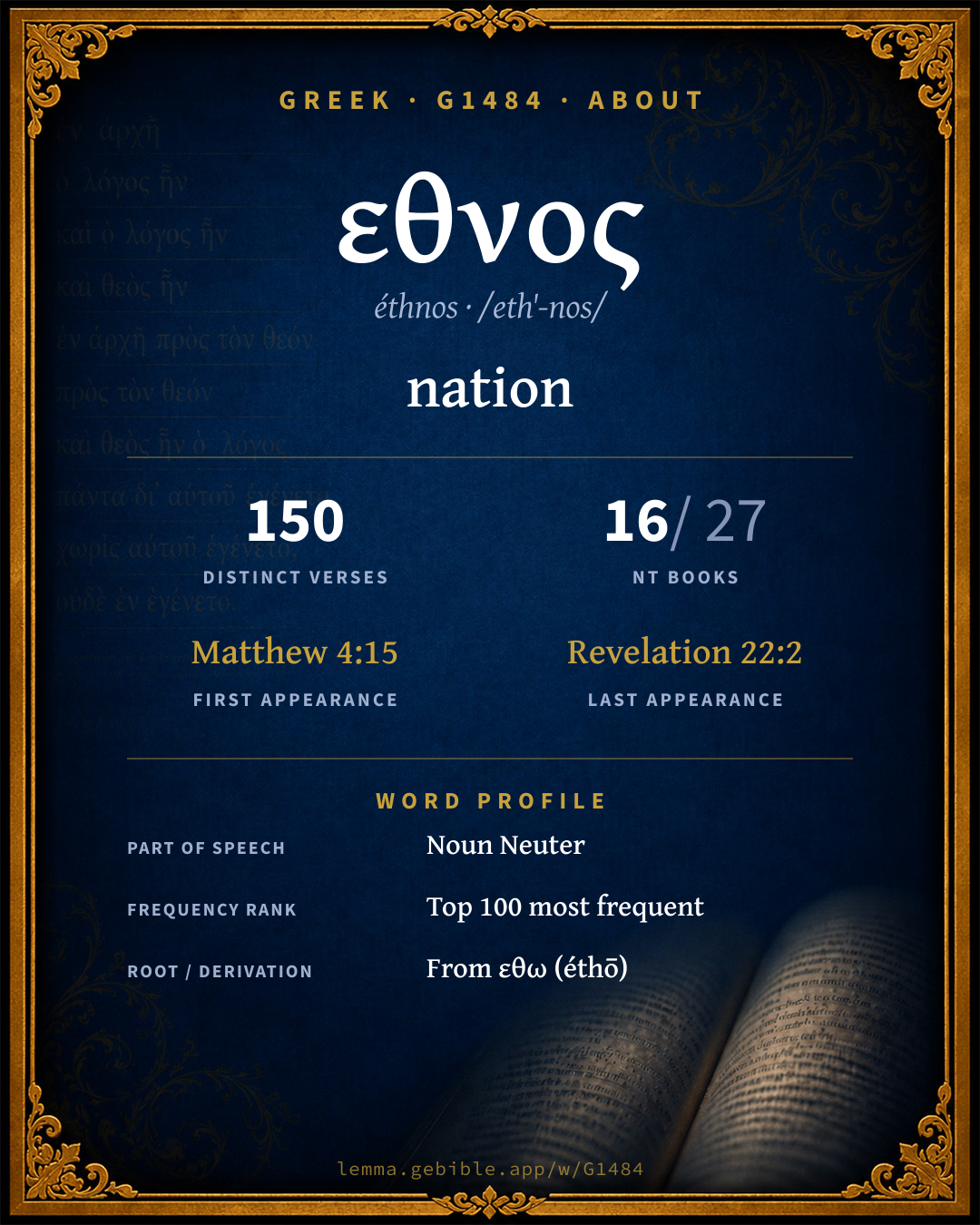
ἔθνος
nation
‘nation’ is one of 5 main senses fuller range ↓
Full lexicon entry — Thayer's Greek Lexicon
From Thayer's Greek Lexicon
Where this word appears
See every Genitive-case word in the Greek New Testament →
Grammar key — what these labels mean
Part of speech
- Noun
- A naming word — a person, place, thing, or idea.
Case
- Genitive
- The case of source, possession, or “of” — answers “whose / from what.”
- Dative
- The case of the indirect object, means, or location — “to / for / with / in.”
- Nominative
- The case of the subject (and the predicate nominative).
- Accusative
- The case of the direct object and of extent.
- Vocative
- The case of direct address (“O Lord”).
Gender
- Neuter
- Grammatically neuter.
Number
- Plural
- More than one.
- Singular
- One.
Grammatical forms 9 distinct
- Noun, Genitive, Plural, Neuter 46 times (28%)
- Noun, Dative, Plural, Neuter 32 times (20%)
- Noun, Nominative, Plural, Neuter 26 times (16%)
- Noun, Accusative, Plural, Neuter 25 times (15%)
- Noun, Accusative, Singular, Neuter 12 times (7%)
- Noun, Dative, Singular, Neuter 7 times (4%)
- Noun, Genitive, Singular, Neuter 7 times (4%)
- Noun, Nominative, Singular, Neuter 6 times (4%)
+1 more form (1 occurrence)
Parsed forms decoded from the imported morphology (Robinson–Tischendorf, public domain), counted across 162 parsed occurrences — not distinct verses.
Every verse where G1484 appears — 150 distinct verses across 16 books. Click any verse to open its interlinear word-by-word view. Verse text shown in the World English Bible for context — . Each verse’s Greek form is shown with its reference; the English is not keyword-highlighted, since the data carries no word-level English alignment. Use “Compare translations” on any verse to read it across multiple English versions. This concordance covers the Greek New Testament; Septuagint (Greek Old Testament) occurrences of this word are not indexed here.
Matthew 14 verses
- Matthew 4:15 ἐθνῶν n gen pl neut "The land of Zebulun and the land of Naphtali, Toward the sea, beyond the Jordan, Galilee of the Gentiles,
- Matthew 6:32 ἔθνη n nom pl neut For the Gentiles seek after all these things, for your heavenly Father knows that you need all these things.
- Matthew 10:5 ἐθνῶν n gen pl neut Jesus sent these twelve out, and charged them, saying, "Don't go among the Gentiles, and don't enter into any city of the Samaritans.
- Matthew 10:18 ἔθνεσιν n dat pl neut Yes, and you will be brought before governors and kings for my sake, for a testimony to them and to the Gentiles.
- Matthew 12:18 ἔθνεσιν n dat pl neut "Behold, my servant whom I have chosen; My beloved in whom my soul is well pleased: I will put my Spirit on him. He will proclaim justice to the Gentiles.
- Matthew 12:21 ἔθνη n nom pl neut In his name, the Gentiles will hope."
- Matthew 20:19 ἔθνεσιν n dat pl neut and will hand him over to the Gentiles to mock, to scourge, and to crucify; and the third day he will be raised up."
- Matthew 20:25 ἐθνῶν n gen pl neut But Jesus summoned them, and said, "You know that the rulers of the Gentiles lord it over them, and their great ones exercise authority over them.
- Matthew 21:43 ἔθνει n dat sg neut "Therefore I tell you, the Kingdom of God will be taken away from you, and will be given to a nation bringing forth its fruits.
- Matthew 24:7 ἔθνος ἔθνος n nom sg neut n acc sg neut For nation will rise against nation, and kingdom against kingdom; and there will be famines, plagues, and earthquakes in various places.
- Matthew 24:9 ἐθνῶν n gen pl neut Then they will deliver you up to oppression, and will kill you. You will be hated by all of the nations for my name's sake.
- Matthew 24:14 ἔθνεσιν n dat pl neut This Gospel of the Kingdom will be preached in the whole world for a testimony to all the nations, and then the end will come.
- Matthew 25:32 ἔθνη n nom pl neut Before him all the nations will be gathered, and he will separate them one from another, as a shepherd separates the sheep from the goats.
- Matthew 28:19 ἔθνη n acc pl neut Therefore go, and make disciples of all nations, baptizing them in the name of the Father and of the Son and of the Holy Spirit,
Mark 5 verses
- Mark 10:33 ἔθνεσιν n dat pl neut "Behold, we are going up to Jerusalem. The Son of Man will be delivered to the chief priests and the scribes. They will condemn him to death, and will deliver him to the Gentiles.
- Mark 10:42 ἐθνῶν n gen pl neut Jesus summoned them, and said to them, "You know that they who are recognized as rulers over the Gentiles lord it over them, and their great ones exercise authority over them.
- Mark 11:17 ἔθνεσιν n dat pl neut He taught, saying to them, "Isn't it written, 'My house will be called a house of prayer for all the nations?' But you have made it a den of robbers!"
- Mark 13:8 ἔθνος ἔθνος n nom sg neut n acc sg neut For nation will rise against nation, and kingdom against kingdom. There will be earthquakes in various places. There will be famines and troubles. These things are the beginning of birth pains.
- Mark 13:10 ἔθνη n acc pl neut The Gospel must first be preached to all the nations.
Luke 10 verses
- Luke 2:32 ἐθνῶν n gen pl neut A light for revelation to the Gentiles, And the glory of your people Israel."
- Luke 7:5 ἔθνος n acc sg neut for he loves our nation, and he built our synagogue for us."
- Luke 12:30 ἔθνη n nom pl neut For the nations of the world seek after all of these things, but your Father knows that you need these things.
- Luke 18:32 ἔθνεσιν n dat pl neut For he will be delivered up to the Gentiles, will be mocked, treated shamefully, and spit on.
- Luke 21:10 ἔθνος ἔθνος n nom sg neut n acc sg neut Then he said to them, "Nation will rise against nation, and kingdom against kingdom.
- Luke 21:24 ἔθνη ἐθνῶν ἐθνῶν n acc pl neut n gen pl neut n gen pl neut They will fall by the edge of the sword, and will be led captive into all the nations. Jerusalem will be trampled down by the Gentiles, until the times of the Gentiles are fulfilled.
- Luke 21:25 ἐθνῶν n gen pl neut There will be signs in the sun, moon, and stars; and on the earth anxiety of nations, in perplexity for the roaring of the sea and the waves;
- Luke 22:25 ἐθνῶν n gen pl neut He said to them, "The kings of the Gentiles lord it over them, and those who have authority over them are called 'benefactors.'
- Luke 23:2 ἔθνος n acc sg neut They began to accuse him, saying, "We found this man perverting the nation, forbidding paying taxes to Caesar, and saying that he himself is Christ, a king."
- Luke 24:47 ἔθνη n acc pl neut and that repentance and remission of sins should be preached in his name to all the nations, beginning at Jerusalem.
John 5 verses
- John 11:48 ἔθνος n acc sg neut If we leave him alone like this, everyone will believe in him, and the Romans will come and take away both our place and our nation."
- John 11:50 ἔθνος n nom sg neut nor do you consider that it is advantageous for us that one man should die for the people, and that the whole nation not perish."
- John 11:51 ἔθνους n gen sg neut Now he didn't say this of himself, but being high priest that year, he prophesied that Jesus would die for the nation,
- John 11:52 ἔθνους n gen sg neut and not for the nation only, but that he might also gather together into one the children of God who are scattered abroad.
- John 18:35 ἔθνος n nom sg neut Pilate answered, "I'm not a Jew, am I? Your own nation and the chief priests delivered you to me. What have you done?"
Acts 43 verses
- Acts 2:5 ἔθνους n gen sg neut Now there were dwelling in Jerusalem Jews, devout men, from every nation under the sky.
- Acts 4:25 ἔθνη n nom pl neut who by the mouth of your servant, David, said, 'Why do the nations rage, And the peoples plot a vain thing?
- Acts 4:27 ἔθνεσιν n dat pl neut For truly, in this city against your holy servant, Jesus, whom you anointed, both Herod and Pontius Pilate, with the Gentiles and the people of Israel, were gathered together
- Acts 7:7 ἔθνος n acc sg neut 'I will judge the nation to which they will be in bondage,' said God, 'and after that will they come out, and serve me in this place.'
- Acts 7:45 ἐθνῶν n gen pl neut which also our fathers, in their turn, brought in with Joshua when they entered into the possession of the nations, whom God drove out before the face of our fathers, to the days of David,
- Acts 8:9 ἔθνος n acc sg neut But there was a certain man, Simon by name, who used to practice sorcery in the city, and amazed the people of Samaria, making himself out to be some great one,
- Acts 9:15 ἐθνῶν n gen pl neut But the Lord said to him, "Go your way, for he is my chosen vessel to bear my name before the nations and kings, and the children of Israel.
- Acts 10:22 ἔθνους n gen sg neut They said, "Cornelius, a centurion, a righteous man and one who fears God, and well spoken of by all the nation of the Jews, was directed by a holy angel to invite you to his house, and to listen to what you say."
- Acts 10:35 ἔθνει n dat sg neut but in every nation he who fears him and works righteousness is acceptable to him.
- Acts 10:45 ἔθνη n acc pl neut They of the circumcision who believed were amazed, as many as came with Peter, because the gift of the Holy Spirit was also poured out on the Gentiles.
- Acts 11:1 ἔθνη n nom pl neut Now the apostles and the brothers who were in Judea heard that the Gentiles had also received the word of God.
- Acts 11:18 ἔθνεσιν n dat pl neut When they heard these things, they held their peace, and glorified God, saying, "Then God has also granted to the Gentiles repentance to life!"
- Acts 13:19 ἔθνη n acc pl neut When he had destroyed seven nations in the land of Canaan, he gave them their land for an inheritance, for about four hundred fifty years.
- Acts 13:46 ἔθνη n acc pl neut Paul and Barnabas spoke out boldly, and said, "It was necessary that God's word should be spoken to you first. Since indeed you thrust it from you, and judge yourselves unworthy of eternal life, behold, we turn to the Gentiles.
- Acts 13:47 ἐθνῶν n gen pl neut For so has the Lord commanded us, saying, 'I have set you as a light for the Gentiles, That you should bring salvation to the uttermost parts of the earth.'"
- Acts 13:48 ἔθνη n nom pl neut As the Gentiles heard this, they were glad, and glorified the word of God. As many as were appointed to eternal life believed.
- Acts 14:2 ἐθνῶν n gen pl neut But the disbelieving Jews stirred up and embittered the souls of the Gentiles against the brothers.
- Acts 14:5 ἐθνῶν n gen pl neut When some of both the Gentiles and the Jews, with their rulers, made a violent attempt to mistreat and stone them,
- Acts 14:16 ἔθνη n acc pl neut who in the generations gone by allowed all the nations to walk in their own ways.
- Acts 14:27 ἔθνεσιν n dat pl neut When they had arrived, and had gathered the assembly together, they reported all the things that God had done with them, and that he had opened a door of faith to the Gentiles.
- Acts 15:3 ἐθνῶν n gen pl neut They, being sent on their way by the assembly, passed through both Phoenicia and Samaria, declaring the conversion of the Gentiles. They caused great joy to all the brothers.
- Acts 15:7 ἔθνη n acc pl neut When there had been much discussion, Peter rose up and said to them, "Brothers, you know that a good while ago God made choice among you, that by my mouth the Gentiles should hear the word of the Gospel, and believe.
- Acts 15:12 ἔθνεσιν n dat pl neut All the multitude kept silence, and they listened to Barnabas and Paul reporting what signs and wonders God had done among the Gentiles through them.
- Acts 15:14 ἐθνῶν n gen pl neut Simeon has reported how God first visited the Gentiles, to take out of them a people for his name.
- Acts 15:17 ἔθνη n nom pl neut That the rest of men may seek after the Lord; All the Gentiles who are called by my name, Says the Lord, who does all these things.
- Acts 15:19 ἐθνῶν n gen pl neut "Therefore my judgment is that we don't trouble those from among the Gentiles who turn to God,
- Acts 15:23 ἐθνῶν n gen pl neut They wrote these things by their hand: "The apostles, the elders, and the brothers, to the brothers who are of the Gentiles in Antioch, Syria, and Cilicia: greetings.
- Acts 17:26 ἔθνος n acc sg neut He made from one blood every nation of men to dwell on all the surface of the earth, having determined appointed seasons, and the boundaries of their dwellings,
- Acts 18:6 ἔθνη n acc pl neut When they opposed him and blasphemed, he shook out his clothing and said to them, "Your blood be on your own heads! I am clean. From now on, I will go to the Gentiles!"
- Acts 21:11 ἐθνῶν n gen pl neut Coming to us, and taking Paul's belt, he bound his own feet and hands, and said, "Thus says the Holy Spirit: 'So will the Jews at Jerusalem bind the man who owns this belt, and will deliver him into the hands of the Gentiles.'"
- Acts 21:19 ἔθνεσιν n dat pl neut When he had greeted them, he reported one by one the things which God had worked among the Gentiles through his ministry.
- Acts 21:21 ἔθνη n acc pl neut They have been informed about you, that you teach all the Jews who are among the Gentiles to forsake Moses, telling them not to circumcise their children neither to walk after the customs.
- Acts 21:25 ἐθνῶν n gen pl neut But concerning the Gentiles who believe, we have written our decision that they should observe no such thing, except that they should keep themselves from food offered to idols, from blood, from strangled things, and from sexual immorality."
- Acts 22:21 ἔθνη n acc pl neut "He said to me, 'Depart, for I will send you out far from here to the Gentiles.'"
- Acts 24:3 ἔθνει n dat sg neut we accept it in all ways and in all places, most excellent Felix, with all thankfulness.
- Acts 24:10 ἔθνει n dat sg neut When the governor had beckoned to him to speak, Paul answered, "Because I know that you have been a judge of this nation for many years, I cheerfully make my defense,
- Acts 24:17 ἔθνος n acc sg neut Now after some years, I came to bring gifts for the needy to my nation, and offerings;
- Acts 26:4 ἔθνει n dat sg neut "Indeed, all the Jews know my way of life from my youth up, which was from the beginning among my own nation and at Jerusalem;
- Acts 26:17 ἐθνῶν n gen pl neut delivering you from the people, and from the Gentiles, to whom I send you,
- Acts 26:20 ἔθνεσιν n dat pl neut but declared first to them of Damascus, at Jerusalem, and throughout all the country of Judea, and also to the Gentiles, that they should repent and turn to God, doing works worthy of repentance.
- Acts 26:23 ἔθνεσιν n dat pl neut how the Christ must suffer, and how, by the resurrection of the dead, he would be first to proclaim light both to these people and to the Gentiles."
- Acts 28:19 ἔθνους n gen sg neut But when the Jews spoke against it, I was constrained to appeal to Caesar, not that I had anything about which to accuse my nation.
- Acts 28:28 ἔθνεσιν n dat pl neut "Be it known therefore to you, that the salvation of God is sent to the Gentiles. They will also listen."
Romans 23 verses
- Romans 1:5 ἔθνεσιν n dat pl neut through whom we received grace and apostleship, for obedience of faith among all the nations, for his name's sake;
- Romans 1:13 ἔθνεσιν n dat pl neut Now I don't desire to have you unaware, brothers, that I often planned to come to you, and was hindered so far, that I might have some fruit among you also, even as among the rest of the Gentiles.
- Romans 2:14 ἔθνη n nom pl neut (for when Gentiles who don't have the law do by nature the things of the law, these, not having the law, are a law to themselves,
- Romans 2:24 ἔθνεσιν n dat pl neut For "the name of God is blasphemed among the Gentiles because of you," just as it is written.
- Romans 3:29 ἐθνῶν ἐθνῶν n gen pl neut n gen pl neut Or is God the God of Jews only? Isn't he the God of Gentiles also? Yes, of Gentiles also,
- Romans 4:17 ἐθνῶν n gen pl neut As it is written, "I have made you a father of many nations." This is in the presence of him whom he believed: God, who gives life to the dead, and calls the things that are not, as though they were.
- Romans 4:18 ἐθνῶν n gen pl neut Who in hope believed against hope, to the end that he might become a father of many nations, according to that which had been spoken, "So will your seed be."
- Romans 9:24 ἐθνῶν n gen pl neut us, whom he also called, not from the Jews only, but also from the Gentiles?
- Romans 9:30 ἔθνη n nom pl neut What shall we say then? That the Gentiles, who didn't follow after righteousness, attained to righteousness, even the righteousness which is of faith;
- Romans 10:19 ἔθνει ἔθνει n dat sg neut n dat sg neut But I ask, didn't Israel know? First Moses says, "I will provoke you to jealousy with that which is no nation, With a nation void of understanding I will make you angry."
- Romans 11:11 ἔθνεσιν n dat pl neut I ask then, did they stumble that they might fall? May it never be! But by their fall salvation has come to the Gentiles, to provoke them to jealousy.
- Romans 11:12 ἐθνῶν n gen pl neut Now if their fall is the riches of the world, and their loss the riches of the Gentiles; how much more their fullness?
- Romans 11:13 ἔθνεσιν ἐθνῶν n dat pl neut n gen pl neut For I speak to you who are Gentiles. Since then as I am an apostle to Gentiles, I glorify my ministry;
- Romans 11:25 ἐθνῶν n gen pl neut For I don't desire, brothers, to have you ignorant of this mystery, so that you won't be wise in your own conceits, that a partial hardening has happened to Israel, until the fullness of the Gentiles has come in,
- Romans 15:9 ἔθνη ἔθνεσιν n nom pl neut n dat pl neut and that the Gentiles might glorify God for his mercy. As it is written, "Therefore will I give praise to you among the Gentiles, And sing to your name."
- Romans 15:10 ἔθνη n voc pl neut Again he says, "Rejoice, you Gentiles, with his people."
- Romans 15:11 ἔθνη n nom pl neut Again, "Praise the Lord, all you Gentiles! Let all the peoples praise him."
- Romans 15:12 ἐθνῶν ἔθνη n gen pl neut n nom pl neut Again, Isaiah says, "There will be the root of Jesse, He who arises to rule over the Gentiles; On him will the Gentiles hope."
- Romans 15:16 ἔθνη ἐθνῶν n acc pl neut n gen pl neut that I should be a servant of Christ Jesus to the Gentiles, ministering as a priest the Gospel of God, that the offering up of the Gentiles might be made acceptable, sanctified by the Holy Spirit.
- Romans 15:18 ἐθνῶν n gen pl neut For I will not dare to speak of any things except those which Christ worked through me, for the obedience of the Gentiles, by word and deed,
- Romans 15:27 ἔθνη n nom pl neut Yes, it has been their good pleasure, and they are their debtors. For if the Gentiles have been made partakers of their spiritual things, they owe it to them also to serve them in fleshly things.
- Romans 16:4 ἐθνῶν n gen pl neut who for my life, laid down their own necks; to whom not only I give thanks, but also all the assemblies of the Gentiles.
- Romans 16:26 ἔθνη n acc pl neut
1 Corinthians 3 verses
- 1 Corinthians 1:23 ἔθνεσιν n dat pl neut but we preach Christ crucified; a stumbling block to Jews, and foolishness to Greeks,
- 1 Corinthians 5:1 ἔθνεσιν n dat pl neut It is actually reported that there is sexual immorality among you, and such sexual immorality as is not even named among the Gentiles, that one has his father's wife.
- 1 Corinthians 12:2 ἔθνη n nom pl neut You know that when you were heathen, you were led away to those mute idols, however you might be led.
2 Corinthians 1 verse
Galatians 9 verses
- Galatians 1:16 ἔθνεσιν n dat pl neut to reveal his Son in me, that I might preach him among the Gentiles, I didn't immediately confer with flesh and blood,
- Galatians 2:2 ἔθνεσιν n dat pl neut I went up by revelation, and I laid before them the Gospel which I preach among the Gentiles, but privately before those who were respected, for fear that I might be running, or had run, in vain.
- Galatians 2:8 ἔθνη n acc pl neut (for he who appointed Peter to the apostleship of the circumcision appointed me also to the Gentiles);
- Galatians 2:9 ἔθνη n acc pl neut and when they perceived the grace that was given to me, James and Cephas and John, they who were reputed to be pillars, gave to me and Barnabas the right hand of fellowship, that we should go to the Gentiles, and they to the circumcision.
- Galatians 2:12 ἐθνῶν n gen pl neut For before some people came from James, he ate with the Gentiles. But when they came, he drew back and separated himself, fearing those who were of the circumcision.
- Galatians 2:14 ἔθνη n acc pl neut But when I saw that they didn't walk uprightly according to the truth of the Gospel, I said to Peter before them all, "If you, being a Jew, live as the Gentiles do, and not as the Jews do, why do you compel the Gentiles to live as the Jews do?
- Galatians 2:15 ἐθνῶν n gen pl neut "We, being Jews by nature, and not Gentile sinners,
- Galatians 3:8 ἔθνη ἔθνη n acc pl neut n nom pl neut The Scripture, foreseeing that God would justify the Gentiles by faith, preached the Gospel beforehand to Abraham, saying, "In you all the nations will be blessed."
- Galatians 3:14 ἔθνη n acc pl neut that the blessing of Abraham might come on the Gentiles through Christ Jesus; that we might receive the promise of the Spirit through faith.
Ephesians 5 verses
- Ephesians 2:11 ἔθνη n nom pl neut Therefore remember that once you, the Gentiles in the flesh, who are called "uncircumcision" by that which is called "circumcision," (in the flesh, made by hands);
- Ephesians 3:1 ἐθνῶν n gen pl neut For this cause I, Paul, am the prisoner of Christ Jesus on behalf of you Gentiles,
- Ephesians 3:6 ἔθνη n acc pl neut that the Gentiles are fellow heirs, and fellow members of the body, and fellow partakers of his promise in Christ Jesus through the Gospel,
- Ephesians 3:8 ἔθνεσιν n dat pl neut To me, the very least of all saints, was this grace given, to preach to the Gentiles the unsearchable riches of Christ,
- Ephesians 4:17 ἔθνη n nom pl neut This I say therefore, and testify in the Lord, that you no longer walk as the rest of the Gentiles also walk, in the futility of their mind,
Colossians 1 verse
1 Thessalonians 2 verses
1 Timothy 2 verses
- 1 Timothy 2:7 ἐθνῶν n gen pl neut to which I was appointed a preacher and an apostle (I am telling the truth in Christ, not lying), a teacher of the Gentiles in faith and truth.
- 1 Timothy 3:16 ἔθνεσιν n dat pl neut Without controversy, the mystery of godliness is great: God was revealed in the flesh, Justified in the spirit, Seen by angels, Preached among the nations, Believed on in the world, And received up in glory.
2 Timothy 1 verse
1 Peter 3 verses
- 1 Peter 2:9 ἔθνος n nom sg neut But you are a chosen race, a royal priesthood, a holy nation, a people for God's own possession, that you may show forth the excellencies of him who called you out of darkness into his marvelous light:
- 1 Peter 2:12 ἔθνεσιν n dat pl neut having good behavior among the nations, so in that which they speak against you as evil-doers, they may by your good works, which they see, glorify God in the day of visitation.
- 1 Peter 4:3 ἐθνῶν n gen pl neut For we have spent enough of our past time doing the desire of the Gentiles, and having walked in lewdness, lusts, drunken binges, orgies, carousings, and abominable idolatries.
Revelation 23 verses
- Revelation 2:26 ἐθνῶν n gen pl neut He who overcomes, and he who keeps my works to the end, to him I will give authority over the nations.
- Revelation 5:9 ἔθνους n gen sg neut They sang a new song, saying, "You are worthy to take the book, And to open its seals: For you were killed, And bought us for God with your blood, Out of every tribe, language, people, and nation,
- Revelation 7:9 ἔθνους n gen sg neut After these things I looked, and behold, a great multitude, which no man could number, out of every nation and of all tribes, peoples, and languages, standing before the throne and before the Lamb, dressed in white robes, with palm branches in their hands.
- Revelation 10:11 ἔθνεσιν n dat pl neut They told me, "You must prophesy again over many peoples, nations, languages, and kings."
- Revelation 11:2 ἔθνεσιν n dat pl neut Leave out the court which is outside of the temple, and don't measure it, for it has been given to the gentiles. They will tread the holy city under foot for forty-two months.
- Revelation 11:9 ἐθνῶν n gen pl neut From among the peoples, tribes, languages, and nations people will look at their dead bodies for three and a half days, and will not allow their dead bodies to be laid in a tomb.
- Revelation 11:18 ἔθνη n nom pl neut The nations were angry, and your wrath came, as did the time for the dead to be judged, and to give your bondservants the prophets, their reward, as well as to the saints, and those who fear your name, to the small and the great; and to destroy those who destroy the earth."
- Revelation 12:5 ἔθνη n acc pl neut She gave birth to a son, a male child, who is to rule all the nations with a rod of iron. Her child was caught up to God, and to his throne.
- Revelation 13:7 ἔθνος n acc sg neut It was given to him to make war with the saints, and to overcome them. Authority over every tribe, people, language, and nation was given to him.
- Revelation 14:6 ἔθνος n acc sg neut I saw an angel flying in mid heaven, having an eternal Gospel to proclaim to those who dwell on the earth, and to every nation, tribe, language, and people.
- Revelation 14:8 ἔθνη n acc pl neut Another, a second angel, followed, saying, "Babylon the great has fallen, which has made all the nations to drink of the wine of the wrath of her sexual immorality."
- Revelation 15:3 ἐθνῶν n gen pl neut They sang the song of Moses, the servant of God, and the song of the Lamb, saying, "Great and marvelous are your works, Lord God, the Almighty; Righteous and true are your ways, you King of the nations.
- Revelation 15:4 ἔθνη n nom pl neut Who wouldn't fear you, Lord, And glorify your name? For you only are holy. For all the nations will come and worship before you. For your righteous acts have been revealed."
- Revelation 16:19 ἐθνῶν n gen pl neut The great city was divided into three parts, and the cities of the nations fell. Babylon the great was remembered in the sight of God, to give to her the cup of the wine of the fierceness of his wrath.
- Revelation 17:15 ἔθνη n nom pl neut He said to me, "The waters which you saw, where the prostitute sits, are peoples, multitudes, nations, and languages.
- Revelation 18:3 ἔθνη n nom pl neut For all the nations have drunk of the wine of the wrath of her sexual immorality, the kings of the earth committed sexual immorality with her, and the merchants of the earth grew rich from the abundance of her luxury."
- Revelation 18:23 ἔθνη n nom pl neut The light of a lamp will shine no more at all in you. The voice of the bridegroom and of the bride will be heard no more at all in you; for your merchants were the princes of the earth; for with your sorcery all the nations were deceived.
- Revelation 19:15 ἔθνη n acc pl neut Out of his mouth proceeds a sharp, double-edged sword, that with it he should strike the nations. He will rule them with a rod of iron. He treads the winepress of the fierceness of the wrath of God, the Almighty.
- Revelation 20:3 ἔθνη n acc pl neut and cast him into the abyss, and shut it, and sealed it over him, that he should deceive the nations no more, until the thousand years were finished. After this, he must be freed for a short time.
- Revelation 20:8 ἔθνη n acc pl neut and he will come out to deceive the nations which are in the four corners of the earth, Gog and Magog, to gather them together to the war; the number of whom is as the sand of the sea.
- Revelation 21:24 ἔθνη n nom pl neut The nations will walk in its light. The kings of the earth bring the glory and honor of the nations into it.
- Revelation 21:26 ἐθνῶν n gen pl neut and they shall bring the glory and the honor of the nations into it so that they may enter.
- Revelation 22:2 ἐθνῶν n gen pl neut in the middle of its street. On this side of the river and on that was the tree of life, bearing twelve kinds of fruits, yielding its fruit every month. The leaves of the tree were for the healing of the nations.
About this entry
At a glance — auto-summarized from this page’s data, not written by a person. Every figure links to its source below. This summary describes the numbers; it doesn’t interpret them.
“nation” is the headline sense of the Greek noun εθνος (éthnos). Catalogued under 5 senses, its meaning is not single-sense. It appears 150 verses across 16 books of the Greek New Testament, among its common vocabulary. More than a quarter of its appearances fall in Acts. Scripture first uses it in Matthew 4:15. The sections below give every sense, occurrence, and version rendering.
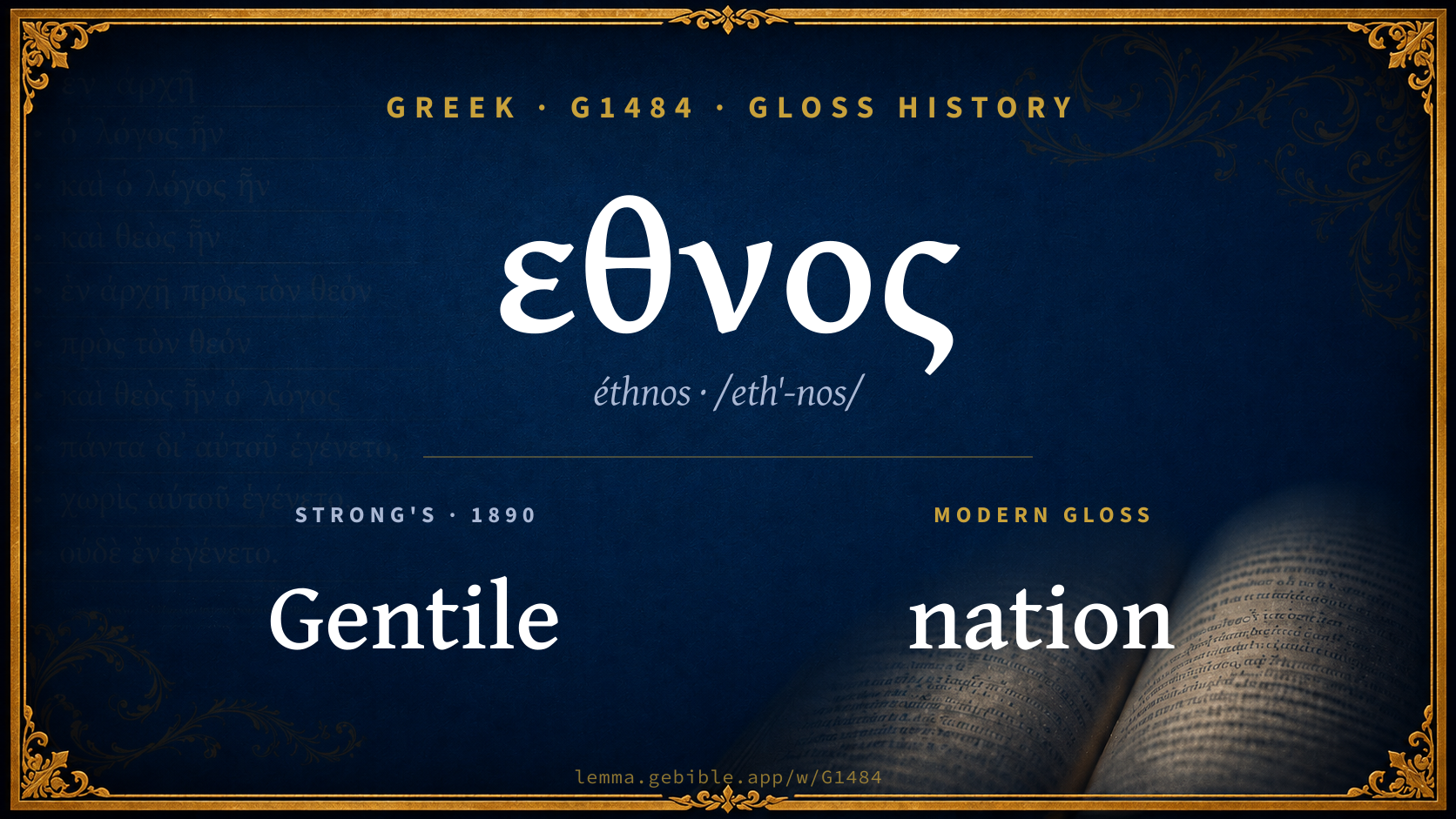
Gloss history
Strong's 1890 vs modern scholarship
About this word
Strong's G1484 catalogs a Greek word from the Greek New Testament.
These counts are not copied from any lexicon or concordance. They are computed here, from the morphology-tagged Greek New Testament. What Lemma adds →
- 150
- distinct verses
- The word appears in 150 distinct verses.
- 16 / 27
- NT books
- The word appears in 16 of 27 New Testament books.
- #98
- by frequency
- Top 100 most frequent Greek words (rank 98 of 5,347 Greek words by occurrence).
View all 150 occurrences in the concordance →
Most concentrated in
- Acts 43 verses 29%
- Romans 23 verses 15%
- Revelation 23 verses 15%
By section of the New Testament
By traditional corpus
Conventional, traditional groupings — biblical authorship is debated, so this is a traditional corpus grouping, not an authorship claim. Some books belong to more than one corpus (Luke is in both the Gospels and the Lukan corpus, and so on), so these shares overlap and need not total 100%. Each figure is a share of the word’s 150 distinct verses.
- Lukan (Luke–Acts) 53 verses · 35%
- Pauline corpus 47 verses · 31%
- Gospels 34 verses · 23%
- Johannine 28 verses · 19%
- Revelation 23 verses · 15%
- General (Catholic) Epistles 3 verses · 2%
How translations render this word
Counts come from each version’s own published word-to-Strong’s tagging or interlinear alignment — an approximate guide to how each version renders this word, not a word-level alignment the data otherwise carries. Because each total is that version’s own tagged count, the per-version totals vary from one another and need not match the appearance or distinct-verse counts above. These counts may also differ from a printed concordance because Lemma counts each distinctly tagged rendering and does not collapse phrase taggings into a single head-word total. This is a fixed set of word-tagged versions (KJV, ASV, BSB, ULT) and does not change with the reading translation you choose elsewhere. Each version’s license is shown beside its name below (and on Sources).
- King James Version: Gentiles 90×, Nations 37×, Nation 26×
- American Standard Version: Gentiles 85×, Nations 36×, Nation 31×
- Berean Standard Bible: Gentiles 86×, Nations 37×, Nation 27×
- unfoldingWord Literal Text: Gentiles 86×, Nations 40×, Nation 31×
King James Version Public Domain
Renders G1484 across 164 tagged occurrences — most commonly:
Plus 4 renderings that appear only once — usually multi-word phrases or single function words the recovered tagging swept in, not distinct renderings.
American Standard Version Public Domain
Renders G1484 across 159 tagged occurrences — most commonly:
Plus 5 renderings that appear only once — usually multi-word phrases or single function words the recovered tagging swept in, not distinct renderings.
Berean Standard Bible Public Domain
Renders G1484 across 162 tagged occurrences — most commonly:
Plus 2 renderings that appear only once — usually multi-word phrases or single function words the recovered tagging swept in, not distinct renderings. Not rendered by a distinct English word in 1 further occurrence.
unfoldingWord Literal Text CC BY-SA 4.0
Renders G1484 across 173 tagged occurrences — most commonly:
Plus 4 renderings that appear only once — usually multi-word phrases or single function words the recovered tagging swept in, not distinct renderings.
Senses in Thayer's
The 5 senses Thayer's distinguishes for this word, in lexicon order (not ranked by frequency or importance). The full entry — with sub-senses — is in the Lexicon Entry tab.
- a multitude (whether of men or of beasts) associated or living together
- a multitude of individuals of the same nature or genus
- a tribe, nation, people group
- in the OT, foreign nations not worshipping the true God, pagans, Gentiles
- Paul uses the term for Gentile Christians
Word origin
Derived from εθω (éthō) (G1486) — to be accustomed.
Probably from G1486 ; a race (as of the same habit ) that is a tribe ; specifically a foreign ( non-Jewish ) one (usually by implication pagan ): - Gentile heathen nation people.
— Strong’s Exhaustive Concordance (1890), public domain.
Forms in the corpus
The 6 distinct written forms G1484 takes in the Greek New Testament, most frequent first — each parse links to that case’s occurrences in the concordance.
| Form | Parsing | Example | Uses |
|---|---|---|---|
| ἔθνη éthnē | Noun, Nominative, Plural, Neuter | Matthew 6:32 | 52 |
| ἐθνῶν ethnō̂n | Noun, Genitive, Plural, Neuter | Matthew 4:15 | 46 |
| ἔθνεσιν éthnesin | Noun, Dative, Plural, Neuter | Matthew 10:18 | 32 |
| ἔθνος éthnos | Noun, Accusative, Singular, Neuter | Matthew 24:7 | 18 |
| ἔθνει éthnei | Noun, Dative, Singular, Neuter | Matthew 21:43 | 7 |
| ἔθνους éthnous | Noun, Genitive, Singular, Neuter | John 11:51 | 7 |
Same root — word family
Other Thayer's entries built from the same root as G1484, grouped by Strong’s listed origin. These share a root / origin per the lexicon — not necessarily a shared meaning. Each links to that word’s own entry.
Derives from
Shares the same root
Derived from this word
Compare all same-root words → Showing 4 of 5 — not the complete family. They share a root, not necessarily a meaning.
Septuagint usage
The same Greek word εθνος appears 719 times in the Greek Old Testament (Septuagint), across 643 verses in 34 books.
- 719
- LXX occurrences
- Tagged occurrences of this Greek word in the Septuagint.
- 643
- verses
- Distinct Septuagint verses containing this word.
- 34 / 39
- OT books
- The word appears in 34 of the 39 Old Testament books.
Sample Septuagint occurrences
- Genesis 10:5 ἔθνος
- Exodus 1:9 ἔθνος
- Leviticus 18:24 ἔθνος
- Numbers 13:28 ἔθνος
- Deuteronomy 1:28 ἔθνος
- Joshua 4:24 ἔθνος
- Judges 2:12 ἔθνος
- 1 Samuel 8:5 ἔθνος
- 2 Samuel 7:23 ἔθνος
- 1 Kings 11:2 ἔθνος
- 2 Kings 6:18 ἔθνος
- 1 Chronicles 14:17 ἔθνος
Septuagint occurrences (same lexeme)
Every verse where the same Strong’s number (G1484) appears in the Greek Septuagint — showing the first 50 of 643. Verse text shown in the World English Bible for context; the Greek form is the matched word — the English is not keyword-highlighted.
- Genesis 10:5 ἔθνος Of these were the isles of the nations divided in their lands, everyone after his language, after their families, in their nations.
- Genesis 10:20 ἔθνος These are the sons of Ham, after their families, after their languages, in their lands, in their nations.
- Genesis 10:31 ἔθνος These are the sons of Shem, after their families, after their languages, in their lands, after their nations.
- Genesis 10:32 ἔθνος These are the families of the sons of Noah, after their generations, in their nations. Of these were the nations divided in the earth after the flood.
- Genesis 12:2 ἔθνος I will make of you a great nation. I will bless you, and make your name great. You will be a blessing.
- Genesis 14:1 ἔθνος It happened in the days of Amraphel, king of Shinar, Arioch, king of Ellasar, Chedorlaomer, king of Elam, and Tidal, king of Goiim,
- Genesis 14:5 ἔθνος In the fourteenth year Chedorlaomer came, and the kings who were with him, and struck the Rephaim in Ashteroth Karnaim, and the Zuzim in Ham, and the Emim in Shaveh-kiriathaim,
- Genesis 14:9 ἔθνος against Chedorlaomer king of Elam, and Tidal king of Goiim, and Amraphel king of Shinar, and Arioch king of Ellasar; four kings against the five.
- Genesis 15:14 ἔθνος I will also judge that nation, whom they will serve. Afterward they will come out with great substance.
- Genesis 17:4 ἔθνος "As for me, behold, my covenant is with you. You will be the father of a multitude of nations.
- Genesis 17:5 ἔθνος Neither will your name any more be called Abram, but your name will be Abraham; for the father of a multitude of nations have I made you.
- Genesis 17:6 ἔθνος I will make you exceeding fruitful, and I will make nations of you. Kings will come out of you.
- Genesis 17:16 ἔθνος I will bless her, and moreover I will give you a son by her. Yes, I will bless her, and she will be a mother of nations. Kings of peoples will come from her."
- Genesis 17:20 ἔθνος As for Ishmael, I have heard you. Behold, I have blessed him, and will make him fruitful, and will multiply him exceedingly. He will become the father of twelve princes, and I will make him a great nation.
- Genesis 17:27 ἔθνος All the men of his house, those born in the house, and those bought with money of a foreigner, were circumcised with him.
- Genesis 18:18 ἔθνος seeing that Abraham has surely become a great and mighty nation, and all the nations of the earth will be blessed in him?
- Genesis 20:4 ἔθνος Now Abimelech had not come near her. He said, "Lord, will you kill even a righteous nation?
- Genesis 21:13 ἔθνος Also of the son of the handmaid will I make a nation, because he is your seed."
- Genesis 21:18 ἔθνος Get up, lift up the boy, and hold him in your hand. For I will make him a great nation."
- Genesis 22:18 ἔθνος In your seed will all the nations of the earth be blessed, because you have obeyed my voice."
- Genesis 25:16 ἔθνος These are the sons of Ishmael, and these are their names, by their villages, and by their encampments: twelve princes, according to their nations.
- Genesis 25:23 ἔθνος Yahweh said to her, Two nations are in your womb, Two peoples will be separated from your body. The one people will be stronger than the other people. The elder will serve the younger.
- Genesis 26:4 ἔθνος I will multiply your seed as the stars of the sky, and will give to your seed all these lands. In your seed will all the nations of the earth be blessed,
- Genesis 27:29 ἔθνος Let peoples serve you, Nations bow down to you. Be lord over your brothers, Let your mother's sons bow down to you. Cursed be everyone who curses you, Blessed be everyone who blesses you."
- Genesis 28:3 ἔθνος May God Almighty bless you, and make you fruitful, and multiply you, that you may be a company of peoples,
- Genesis 35:11 ἔθνος God said to him, "I am God Almighty. Be fruitful and multiply. A nation and a company of nations will be from you, and kings will come out of your loins.
- Genesis 36:40 ἔθνος These are the names of the chiefs who came from Esau, according to their families, after their places, and by their names: chief Timna, chief Alvah, chief Jetheth,
- Genesis 46:3 ἔθνος He said, "I am God, the God of your father. Don't be afraid to go down into Egypt; for there I will make of you a great nation.
- Genesis 48:4 ἔθνος and said to me, 'Behold, I will make you fruitful, and multiply you, and I will make of you a company of peoples, and will give this land to your seed after you for an everlasting possession.'
- Genesis 48:19 ἔθνος His father refused, and said, "I know, my son, I know. He also will become a people, and he also will be great. However, his younger brother will be greater than he, and his seed will become a multitude of nations."
- Genesis 49:10 ἔθνος The scepter will not depart from Judah, Nor the ruler's staff from between his feet, Until he comes to whom it belongs. To him will the obedience of the peoples be.
- Exodus 1:9 ἔθνος He said to his people, "Behold, the people of the children of Israel are more and mightier than we.
- Exodus 9:24 ἔθνος So there was very severe hail, and lightning mixed with the hail, such as had not been in all the land of Egypt since it became a nation.
- Exodus 15:14 ἔθνος The peoples have heard. They tremble. Pangs have taken hold on the inhabitants of Philistia.
- Exodus 19:5 ἔθνος Now therefore, if you will indeed obey my voice, and keep my covenant, then you shall be my own possession from among all peoples; for all the earth is mine;
- Exodus 19:6 ἔθνος and you shall be to me a kingdom of priests, and a holy nation.' These are the words which you shall speak to the children of Israel."
- Exodus 21:8 ἔθνος If she doesn't please her master, who has married her to himself, then he shall let her be redeemed. He shall have no right to sell her to a foreign people, seeing he has dealt deceitfully with her.
- Exodus 23:11 ἔθνος but the seventh year you shall let it rest and lie fallow, that the poor of your people may eat; and what they leave the animal of the field shall eat. In like manner you shall deal with your vineyard and with your olive grove.
- Exodus 23:18 ἔθνος "You shall not offer the blood of my sacrifice with leavened bread, neither shall the fat of my feast remain all night until the morning.
- Exodus 23:22 ἔθνος But if you indeed listen to his voice, and do all that I speak, then I will be an enemy to your enemies, and an adversary to your adversaries.
- Exodus 23:27 ἔθνος I will send my terror before you, and will confuse all the people to whom you come, and I will make all your enemies turn their backs to you.
- Exodus 32:10 ἔθνος Now therefore leave me alone, that my wrath may burn hot against them, and that I may consume them; and I will make of you a great nation."
- Exodus 33:13 ἔθνος Now therefore, if I have found favor in your sight, please show me now your ways, that I may know you, so that I may find favor in your sight: and consider that this nation is your people."
- Exodus 33:16 ἔθνος For how would people know that I have found favor in your sight, I and your people? Isn't it in that you go with us, so that we are separated, I and your people, from all the people who are on the surface of the earth?"
- Exodus 34:10 ἔθνος He said, "Behold, I make a covenant: before all your people I will do marvels, such as have not been worked in all the earth, nor in any nation; and all the people among which you are shall see the work of Yahweh; for it is an awesome thing that I do with you.
- Exodus 34:24 ἔθνος For I will drive out nations before you and enlarge your borders; neither shall any man desire your land when you go up to appear before Yahweh, your God, three times in the year.
- Leviticus 18:24 ἔθνος "'Don't defile yourselves in any of these things: for in all these the nations which I am casting out before you were defiled.
- Leviticus 18:28 ἔθνος that the land not vomit you out also, when you defile it, as it vomited out the nation that was before you.
- Leviticus 19:16 ἔθνος "'You shall not go up and down as a slanderer among your people; neither shall you stand against the life of your neighbor. I am Yahweh.
- Leviticus 20:2 ἔθνος "Moreover, you shall tell the children of Israel, 'Anyone of the children of Israel, or of the strangers who live as foreigners in Israel, who gives any of his seed to Molech; he shall surely be put to death. The people of the land shall stone him with stones.
These are occurrences of the same Greek lexeme (G1484) in the Septuagint — not a translation of any one Hebrew word. The store carries no word-level Hebrew↔Greek alignment, so no Hebrew original is asserted here. Counts come from the recovered LXX Strong's tagging — high-frequency vocabulary is well covered, while rare or late forms may be untagged — so they reflect tagged occurrences and may slightly undercount.