Acts 24:17

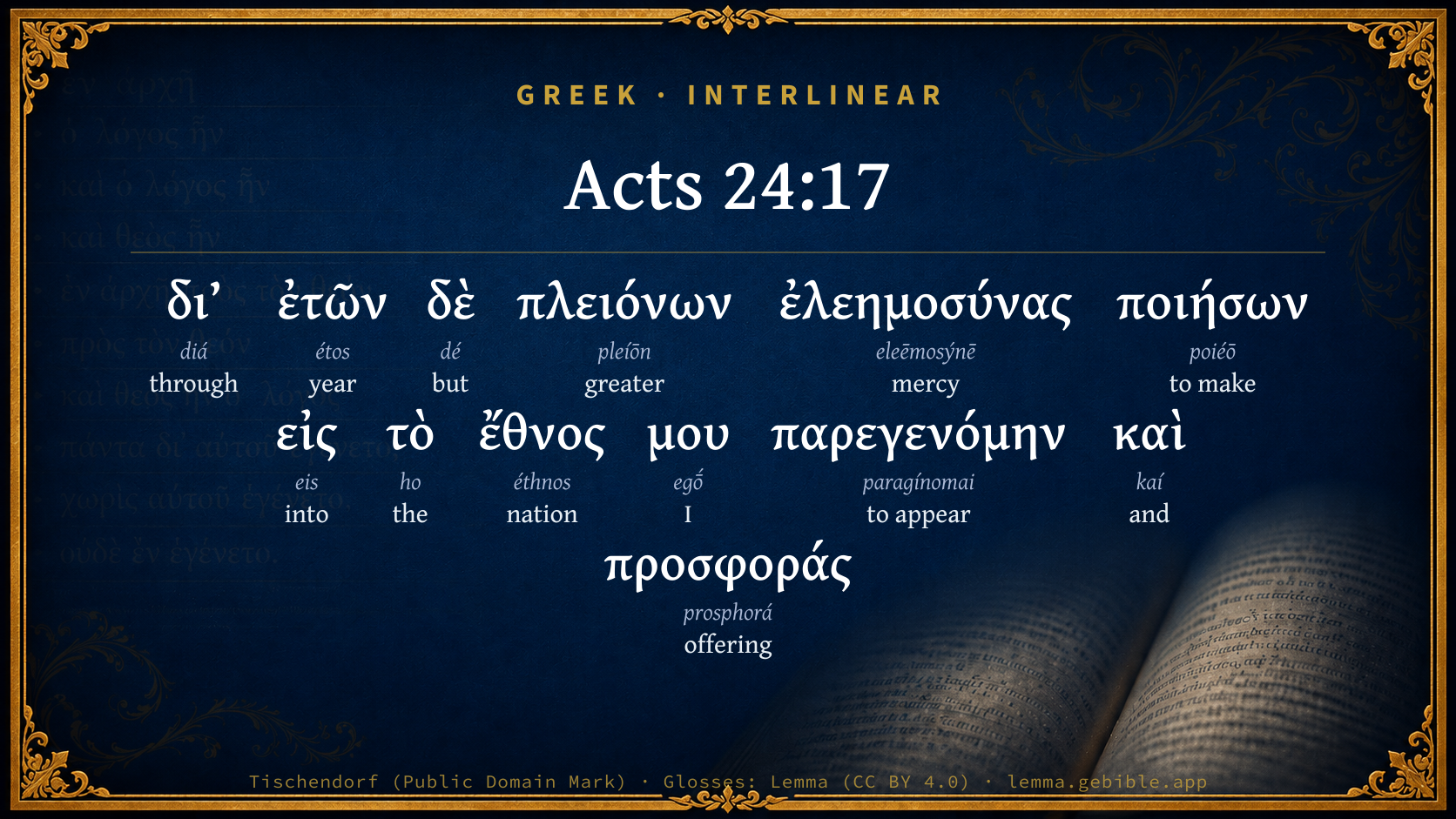
Greek (Tischendorf 8th ed.) Acts 24:17 appears in the Greek New Testament. The text above is from the Tischendorf 8th edition. Each word links to its Strong’s number and a concise gloss. Click any word for its full Thayer’s Greek Lexicon entry.
Download image
Cite this verse

Acts 24:17 (World English Bible). Public Domain. Lemma interlinear Bible study tool, https://lemma.gebible.app/v/acts/24/17.

Show BibTeX & RIS
BibTeX
RIS
English Translation
Now after some years, I came to bring gifts for the needy to my nation, and offerings;
World English Bible · Public Domain
Download a study sheet

One document with this verse’s original text, its word-by-word gloss line, the meaning frame, cross-references with their text, attributed commentary, and full source and license credits — printable, and it pastes into notes with its structure intact.

This verse Autodidact and up

Study sheet (.html) Plain text (.txt)

A passage Seminary Student

Up to 50 verses in one chapter. A passage sheet keeps up to 6 commentary sources and 12 cross-references per verse, in the order this page ranks them, and says so on the sheet whenever that leaves anything out. Ask for a single verse and you get the Autodidact verse sheet above.

Everything on this page stays free to read, with no account — the sheet is a download of what is already on screen, not access to it.

Want to remove ads? Support Godless Engineer
Compare translations 3

The same verse in 3 English versions, stacked beneath the original-language interlinear above. Click any original word for its lexicon entry.

Each is an independent rendering of the whole verse — the interlinear is not word-aligned to these translations.

Highlighted words mark where these versions differ — a whole-verse word diff, not a word-by-word alignment.

  • World English Bible Public Domain
    Now after some years, I came to bring gifts for the needy to my nation, and offerings;
  • King James Version Public Domain
    Now after many years I came to bring alms to my nation, and offerings.
  • unfoldingWord Literal Text CC BY-SA 4.0
    Now after many years I came to my nation bringing alms and offerings,

unfoldingWord Literal Text — © unfoldingWord, licensed CC BY-SA 4.0. Word-aligned USFM3 via Door43 (git.door43.org/unfoldingWord/en_ult).

Versions to compare (up to 4)

3 of 4 selected

Show all 19 translations

Every available English version of this verse, each an independent rendering of the whole verse.

  • World English Bible Public Domain
    Now after some years, I came to bring gifts for the needy to my nation, and offerings;
  • Berean Standard Bible Public Domain
    After several years, then, I returned to Jerusalem to bring alms to my people and to present offerings.
  • Majority Standard Bible Public Domain
    After several years, then, I returned to Jerusalem to bring alms to my people and to present offerings.
  • King James Version Public Domain
    Now after many years I came to bring alms to my nation, and offerings.
  • American Standard Version (1901) Public Domain
    Now after some years I came to bring alms to my nation, and offerings:
  • Revised Version (1885) Public Domain
    Now after many years I came to bring alms to my nation, and offerings:
  • Geneva Bible (1599) Public Domain
    Now after many yeres, I came and brought almes to my nation and offerings.
  • Douay-Rheims (1899) Public Domain
    Now after many years, I came to bring alms to my nation, and offerings, and vows.
  • Young's Literal Translation Public Domain
    `And after many years I came, about to do kind acts to my nation, and offerings,
  • Literal Standard Version CC BY-SA 4.0
    And after many years I came, about to do kind acts to my nation, and offerings,
  • Unlocked Literal Bible CC BY-SA 4.0
    Now after many years I came to bring help to my nation and gifts of money.
  • unfoldingWord Literal Text CC BY-SA 4.0
    Now after many years I came to my nation bringing alms and offerings,
  • Darby Bible Public Domain
    And after a lapse of many years I arrived, bringing alms to my nation, and offerings.
  • World Messianic Bible Public Domain
    Now after some years, I came to bring gifts for the needy to my nation, and offerings;
  • Webster's Bible Public Domain
    Now after many years, I came to bring alms to my nation, and offerings.
  • Free Bible Version CC BY-SA 4.0
    Having been away for a few years I returned to bring some money to help the poor and to give offerings to God.
  • Bible in Basic English Public Domain
    Now after a number of years I came to give help and offerings to my nation:
  • Text-Critical English NT CC BY 4.0
    After being away for many years, I came to bring charitable gifts to my nation along with offerings.
  • Tyndale New Testament (1534) Public Domain
    But after many yeres I came and brought almes to my people and offeringes in the which they founde me purified in the temple nether with multitude nor yet with vnquyetnes.

Literal Standard Version (2020), Covenant Press — licensed CC BY-SA 4.0. Text via the HelloAO Bible API (eBible.org). Unlocked Literal Bible (unfoldingWord) — licensed CC BY-SA 4.0. Text via the HelloAO Bible API (eBible.org). unfoldingWord Literal Text — © unfoldingWord, licensed CC BY-SA 4.0. Word-aligned USFM3 via Door43 (git.door43.org/unfoldingWord/en_ult). Free Bible Version, Dr. Jonathan Gallagher — licensed CC BY-SA 4.0. Text via the HelloAO Bible API (eBible.org).

Word by word

More ways to search: Search by grammar → Find every occurrence → Compare this word →

Practice this passage: Drill this verse → Learn its vocabulary →

προσφοράς
prosphorá
G4376
“offering”
Noun, Accusative, Plural, Feminine
Part of Speech
Noun
Case
Accusative
Number
Plural
Gender
Feminine
Full Thayer's Definition

Origin: from G4374

TDNT: 10:08,1

1. the act of offering, a bringing to 2. that which is offered, a gift, a present. In the NT a sacrifice, whether bloody or not: offering for sin, expiatory offering
  1. δι’ diá G1223 “through” Preposition
  2. ἐτῶν étos G2094 “year” Noun, Genitive, Plural, Neuter
  3. δὲ dé G1161 “but” Conjunction
  4. πλειόνων pleíōn G4119 “greater” Adjective, Genitive, Plural, Neuter, Comparative
  5. ἐλεημοσύνας eleēmosýnē G1654 “mercy” Noun, Accusative, Plural, Feminine
  6. ποιήσων poiéō G4160 “to make” Verb, Future, Active, Participle, Nominative, Singular, Masculine
  7. εἰς eis G1519 “into” Preposition
  8. τὸ ho G3588 “the” Article, Accusative, Singular, Neuter
  9. ἔθνος éthnos G1484 “nation” Noun, Accusative, Singular, Neuter
  10. μου egṓ G1473 “I” Personal pronoun, 1st person, Genitive, Singular
  11. παρεγενόμην paragínomai G3854 “to appear” Verb, Aorist, Middle deponent, Indicative, 1st person, Singular
  12. καὶ kaí G2532 “and” Conjunction

About this verse

These counts appear in no published source. They are computed here, from the morphology-tagged text and Lemma’s own curated glosses. What Lemma adds →

13
words
13
distinct lemmas
Acts
section

Notable vocabulary

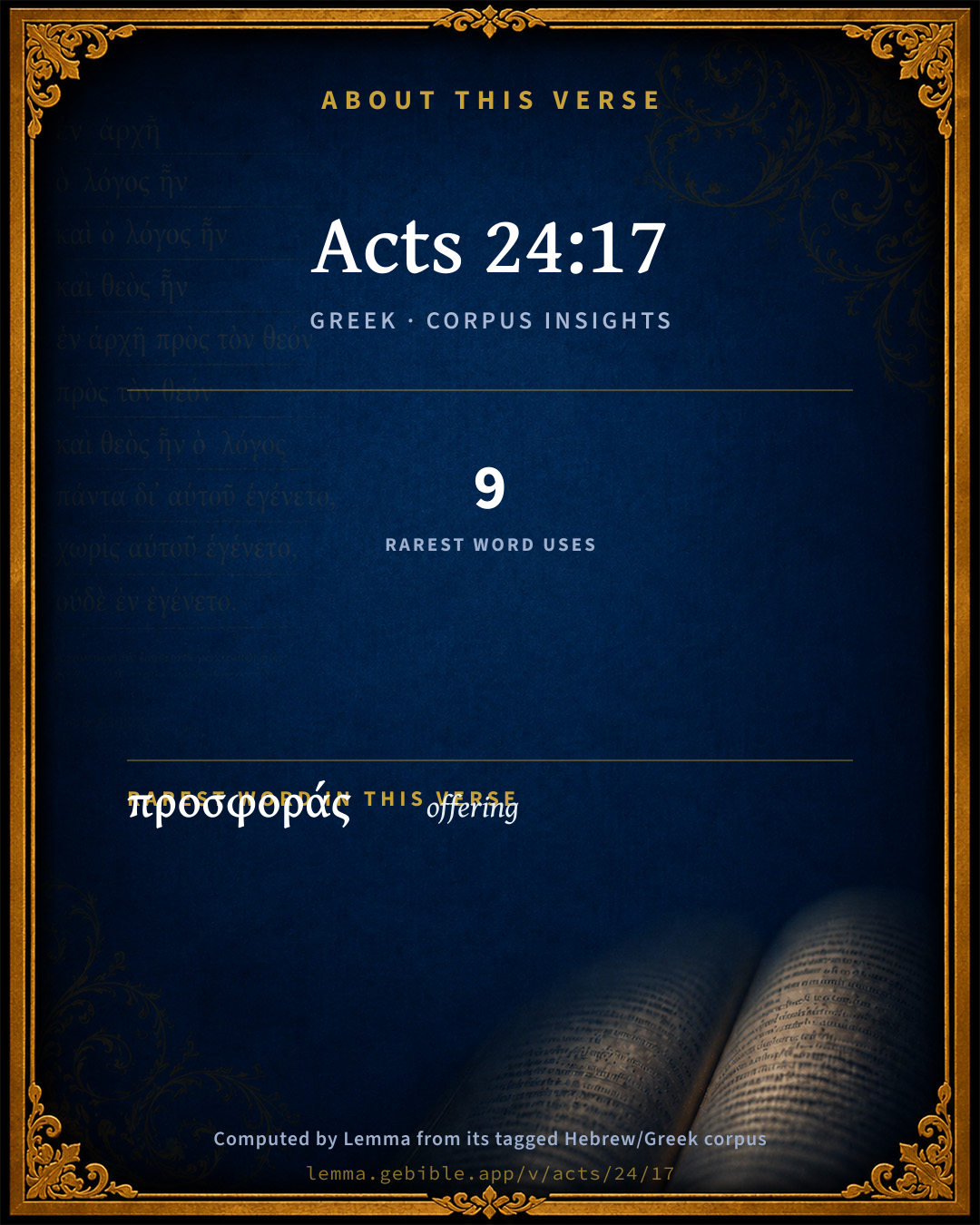
The rarest word here is προσφοράς offering G4376 — appearing just 9 times in the whole Greek New Testament.

Shared distinctive vocabulary

προσφοράς offering G4376 occurs in 9 verses of the Greek New Testament. Also found in:

Cross-references

12

Topical passages linked to Acts 24:17 in the Treasury of Scripture Knowledge — connected by theme and wording, ordered by reader-vote popularity; previews shown in the World English Bible.

  • Galatians 2:10 They only asked us to remember the poor--which very thing I was also zealous to do.
  • Romans 15:25–28 But now, I say, I am going to Jerusalem, serving the saints.
  • 1 Corinthians 16:1–4 Now concerning the collection for the saints, as I commanded the assemblies of Galatia, you do likewise.
  • Acts 11:29–30 As any of the disciples had plenty, each determined to send relief to the brothers who lived in Judea;
  • 2 Corinthians 8:1–4 Moreover, brothers, we make known to you the grace of God which has been given in the assemblies of Macedonia;
  • Acts 20:16 For Paul had determined to sail past Ephesus, that he might not have to spend time in Asia; for he was hastening, if it were possible for him, to be in Jerusalem on the day of Pentecost.
  • Romans 15:31 that I may be delivered from those who are disobedient in Judea, and that my service which I have for Jerusalem may be acceptable to the saints;
  • 2 Corinthians 8:9 For you know the grace of our Lord Jesus Christ, that, though he was rich, yet for your sakes he became poor, that you through his poverty might become rich.
  • 2 Corinthians 9:1–2 It is indeed unnecessary for me to write to you concerning the service to the saints,
  • 2 Corinthians 9:12 For this service of giving that you perform not only makes up for lack among the saints, but abounds also through many givings of thanks to God;
  • Acts 20:31 Therefore watch, remembering that for a period of three years I didn't cease to admonish everyone night and day with tears.
  • Acts 21:26 Then Paul took the men, and the next day, purified himself and went with them into the temple, declaring the fulfillment of the days of purification, until the offering was offered for every one of them.

Cross-references courtesy of OpenBible.info (CC BY 4.0).

Commentary

Notes on Acts 24:17 from classic Christian and Jewish commentators (each source and its license shown beneath its notes). The classic Christian expositions comment on the surrounding passage and are grouped to its opening verse, so a note may address several verses; the Jewish commentaries on the Tanakh (Rashi and others) are per-verse, so they appear only where the commentator wrote on this verse.

Lemma curates 59 commentaries, every one of them public domain or Creative Commons licensed, each selected and text-cleaned for this edition rather than reprinted as found. About our sources →

Joseph Benson's Commentary

Act 24:17-21. Now after many years, &c. — They have represented me as a profane and lawless person, as if I had thrown contempt upon religion, and done them a great deal of wrong; but so far have I been from doing any thing to injure the Jews, to whom by birth I belong, or from attempting to profane the temple, as these my enemies falsely pretend, that I have given many public and important proofs of my particular regard for the good of my country, and of the veneration that I have for all that is sacred. Accordingly, after several years — Which I had spent in other parts; I came to bring alms to the poor of my nation — Which I had been collecting for them in the Gentile provinces where I had any interest; and offerings — To God, which I proposed to make by assisting some Nazarites to discharge their vow, according to the law; whereupon — At the very time when I was thus employed; certain Jews from Asia — Who raised the first outcry against me; found me purified in the temple — That is, performing such things as the law required, and in which the legal purification of Nazarites consisted; neither with multitude — Attending me; nor with tumult — Made by me; the multitude being of their own gathering together, and the tumult, if any, being made by themselves. So that there was no colour for the charge brought against him, but evidence sufficient against it. And it was very unreasonable and hard, 1st, To accuse him as an enemy to their nation, when, after long absence from Jerusalem, he came to bring alms to it, money which he had collected among his friends for the relief of the poor at Jerusalem; and, 2d, To accuse him of having profaned the temple, when he brought offerings to the temple, and was found purifying himself therein, according to the law, and that in a very quiet and orderly manner. And as to what was, perhaps, suggested to Felix, that he had brought Greeks into the temple contrary to their law, he challenges them to prove it. Those Jews of Asia, says he, who were the causes of all the tumult, confusion, and violent proceedings, ought to have been here before thee — As being the only proper witnesses of the facts, if there were any which could justify their laying violent hands upon me. These, however, were now absent, probably because they knew they could not make good their charge against him, and were conscious of having injured him by their accusation; and doubtless Felix so understood it. As for the other Jews, they could only testify on the report of others, or give hear-say evidence, which could not be sufficient in any cause or court. Or else let these same here say — Paul is willing to allow the validity of the testimony of the Jews present, about such things as they themselves had been eye or ear witnesses of, namely, of what had passed in the council when Paul was brought before it; if they have found any evil-doing in me — Any crime committed by me, or any thing done or said, for which I merit punishment. Except it be for this one voice — As if he had said, Let them object, if they can, any other fault; that I cried, standing among them, Touching the resurrection of the dead I am called in question — Which, nevertheless, was the real truth. And, if my affirming it be a fault for which I must suffer, I acknowledge it, and there needs no other proof. But as that was one of the great articles of the national faith, he could not be blamed, either for maintaining it, or for asserting that God had given a proof of it, in the resurrection of Jesus from the dead.

Joseph Benson's Commentary on the Old and New Testaments (1811–1818) — public domain. Text from a community e-Sword module.

Tyndale Open Study Notes

Tyndale Open Resources

24:17 money to aid my people: See study note on 20:1-2; see also Rom 15:25-29; 1 Cor 16:1-2; 2 Cor 9:1-7. • and to offer sacrifices to God: See Acts 21:23-26.

Tyndale Open Study Notes — © Tyndale Open Resources, licensed CC BY-SA 4.0. Text via the HelloAO Bible API.

Bengel's Gnomon

Johann Albrecht Bengel

Act 24:17. Πλειόνων, many) He, who was long away, could not have been planning revolution; but ought to have been received with kindness, especially as he was about to present an offering of alms.

Bengel's Gnomon of the New Testament — English translation (T&T Clark, Edinburgh, 1860) — public domain. Text from a community e-Sword module.

Meyer's Critical & Exegetical Commentary

Heinrich August Wilhelm Meyer

Act_24:17. Δἰ ἐτῶν δὲ πλειόνων] interjectis autem pluribus annis. The δέ leads over to the defence on the special point of accusation in Act_24:6. Regarding διά, after,[154] see on Gal_2:1. Paul means the four years, which had elapsed since his last visit to Jerusalem, Act_18:22. How does the very fact of this long alibi, preceding the short period of my present visit, witness against that accusation!

εἰς τὸ ἔθνος μου] for my nation. What a contrast in this patriotic love to the hostile calumnies of his accusers! And Paul might so speak, for the Greek and Asiatic contributions which he had brought (1Co_16:1 ff.; 2Co_8:9; Rom_15:25) were destined for the support of the Jerusalem Christians, who for the most part consisted of native Jews. If he conveyed alms for these, he assisted in them his nation, in doing which he cherished the national point of view, that the Gentiles, having become partakers of the spiritual blessings of the Jews, owed corporeal aid to these in turn (Rom_15:27).

προσφοράς] i.e. festival offerings. The performance of these had been among the objects of the journey. The taking on him the Nazarite offerings was only induced after his arrival by circumstances. Whether Paul defrayed the expenses of the Nazarite offerings from the contribution-moneys (Baumgarten), is neither here nor elsewhere said, and cannot be determined.

[154] Not while (in opposition to Stölting, Beitr. z. Exegese d. Paulin. Briefe, 1869, p. 163 f.), as if Paul would say: while I have done this (the ἀσκεῖν κ.τ.λ.) already for several years; which neither stands in the text, nor would be suitable after the διαπαντός already expressing far more. Bengel gives correctly the practical significance in this statement of time.

Meyer — Critical and Exegetical Commentary on the New Testament — English translation by Peter Christie, edited by Frederick Crombie (T&T Clark, 1880) — public domain. Text from a community e-Sword module.

Expositor's Greek Testament

ed. W. Robertson Nicoll

Act 24:17 . πλειόνων : “many,” R.V., but margin, “some,” so Rendall: if Act 18:22 refers to a visit to Jerusalem (see note) at the close of the Apostle’s second missionary journey, the number expressed by πλειόνων would not exceed four or five. ἐλεημοσύνας ποιήσων , see above on collection for the Saints at Jerusalem. ἐλεη .: not elsewhere used by Paul, who speaks of κοινωνία , διακονία είς τοὺς ἁγίους , see on Act 10:2 . παρεγενόμην , Lucan, but cf. also 1Co 16:3 , for the word again used by St. Paul. εἰς τὸ ἔθνος μου : quite natural for St. Paul to speak thus of the Jewish nation, for the Jewish-Christian Church naturally consisted of Jews, cf. Rom 9:3 . For this allusion in Acts to the great work of the collection, and its evidential value, as corroborating the notices in the Epistles, see above on p. 422, and Paley, H.P. , chap. ii., 1. On this use of εἰς cf. 1Co 16:1 , 2Co 8:4 ; 2Co 9:1 ; 2Co 9:13 , Rom 15:26 , and see Deissmann, Bibelstudien , p. 113. καὶ προσφοράς : no mention is made of offerings as part of the purpose of St. Paul’s visit to Jerusalem, but we know that he came up to Jerusalem to worship, Act 24:11 , and to be present at the Feast of Pentecost, Act 20:16 , and even if he did not present some offering in connection with that Feast (a thank-offering as Bethge supposes), Dr. Hort’s view may well commend itself that the Apostle wished to make some offering on his own account, or it may be a solemn peace-offering in connection with the Gentile contribution for the Jewish Christians, and its acceptance, see on Act 21:26 , and also Weiss, in loco . The position of προσφ . seems against the supposition that we can take it simply with ἐλεη ., and in combination with it, as if both words referred to the collection for the Saints. Jüngst would omit the words καὶ προσφ … ἱερῷ altogether, whilst even Hilgenfeld regards Act 24:17-21 as an addition of his “Author to Theophilus”.

The Expositor's Greek Testament, edited by W. Robertson Nicoll (1897–1910) — public domain. Text from a community e-Sword module.

Geneva Bible (1599)

Geneva Bible translators

Paul in conclusion telleth the thing which was done, truly, which Tertullus had before divers ways corrupted.

Geneva Bible (1599) marginal notes — public domain. Text via Bolls.life.

Jamieson, Fausset & Brown

Robert Jamieson, A. R. Fausset & David Brown

Now after many--several

years absence from Jerusalem--I came to bring alms to my of Macedonia and Greece, which he had taken such pains to gather. This only allusion in the Acts to what is dwelt upon so frequently in his own Epistles (Rom 15:25-26; Co1 16:1-4; Co2 8:1-4), throws a beautiful light on the truth of this History. (See PALEY'S Horæ Paulinæ).

and offerings--connected with his Jewish vow: see Act 24:18.

Jamieson, Fausset & Brown — Commentary Critical and Explanatory on the Whole Bible (1871) — public domain (CC PDM 1.0). Text via the HelloAO Bible API.

Adam Clarke's Commentary

Verse 17. Now, after many years, &c.] And as a full proof that I act according to the dictates of this Divine and beneficent creed, though I have been many years absent from my own country, and my political relation to it is almost necessarily dissolved, yet, far from coming to disturb the peace of society, or to injure any person, I have brought ALMS to my nation, the fruits of my own earning and influence among a foreign people, and OFFERINGS to my God and his temple, proving hereby my attachment to my country, and my reverence for the worship of my country's God.

Adam Clarke's Commentary on the Bible (1810–1826) — public domain. Text from a community e-Sword/MySword module.

John Calvin's Commentaries

17. And after many years. His meaning is, that he had not of long time been at Jerusalem, but was conversant in other countries far distant, and that after long time he came now to bring alms, and to offer to God the sacrifice of thanks. Whereby doth also appear their want of good nature and their unthankfulness, because, seeing he had by all means deserved the goodwill of all the whole nation, they recompense him so evil. This place doth expound the former, where mention was made of worshipping. For it is certain that Paul came not purposely to offer in the temple, because he purposed to do that after he was come. But he doth only recite what the Jews found in him, which was of greatest weight for the matter which was now in hand. At length, when he saith that he was found in the temple doing this, and that having used first solemn purging, and, secondly, quietly without raising any tumult, he cleareth himself again of both crimes. For his purifying did witness that he did not pollute the temple; and, secondly, forasmuch as he did it quietly without any multitude, there was no suspicion of tumult.

John Calvin's Commentaries (1540-1563) — public domain. Text from the Calvin Translation Society English edition (1840s-50s) via the Christian Classics Ethereal Library (ccel.org). Calvin's coverage is partial (roughly two-thirds of the Bible); uncommented books and verses are honest gaps, never fabricated. The 19th-century editor's footnotes and remarks are omitted so the notes are faithfully Calvin's own voice.

Ellicott's Commentary for English Readers

(17) Now after many years.—Four years had passed since the previous visit of Act_18:22. The use of “many” in this instance may be noted as throwing light on Act_24:10.

To bring alms to my nation, and offerings.—The “alms” were, of course, the large sums of money which St. Paul had been collecting, since his last visit, for the disciples (possibly in part, also, for those who were not disciples) at Jerusalem. It is noticeable that this is the only mention in the Acts of that which occupies so prominent a place in the Epistles of this period. (See Rom_15:25; 1Co_16:1-4; 2Co_8:1-4.) The manifestly undesigned coincidence between the Acts and the Epistles on this point has naturally often been dwelt on by writers on the evidences which each supplies to the other. The “offerings” were the sacrifices which the Apostle was about to offer on the completion of the Nazarite vow with which he had associated himself. There is, perhaps, a refined courtesy in St. Paul’s use of the word “nation” (commonly used only of the heathen) instead of the more usual “people.” He avoids the term which would have implied a certain assumption of superiority to the magistrate before whom he stood. (See Notes on Mat_25:32; Mat_28:19.)

A Bible Commentary for English Readers, edited by Charles John Ellicott (1878–1897) — public domain. Text from a community e-Sword module.

The Cambridge Bible for Schools and Colleges

gen. ed. J. J. S. Perowne

17. Now after many years] He had come to Jerusalem on the return from his second missionary journey in a.d. 53. It was now a.d. 58, so that his absence had lasted four or five years (see note on Act_24:10).

I came to bring alms to my nation] These consisted of the money which had been collected in the churches of Macedonia and Achaia at St Paul’s request, and which is often alluded to in his epistles (cp. 1Co_16:1; Rom_15:26; 2Co_8:4, &c.). There could be no desire to wound the feelings of the Jews in a man who had come for such a purpose. It is noticeable too that he describes the alms as not for the Christians only, but for his nation, conveying by the word the impression of his great regard for all the Jews.

and offerings] These were the sacrifices connected with the vow which he had undertaken. They must be offered in the Temple, and the offered was not likely to be one who thought of profaning the holy place.

The Cambridge Bible for Schools and Colleges (gen. ed. J. J. S. Perowne; Cambridge University Press, 1878–1918) — public domain. Text from a community e-Sword module.

John Gill's Exposition

Whereupon,.... Or "among which"; while the apostle was busy about the offerings of the Nazarites:

certain Jews from Asia found me purified in the temple; and therefore could not be said to profane it; this he observes in answer to the charge of his attempting to profane it, and acquaints the governor how that was; as that having joined himself to four men that had a vow upon them, and being in the temple purifying himself with them, certain Jews that came from Ephesus, in Asia, who knew him there, and had a pique against him, found him here; not profaning the temple, as they pretended, but acting according to the worship and service of it; and that,

neither with a multitude; for there were but four men with him;

nor with tumult; making any noise and riot, or stirring up persons to sedition and rebellion.

John Gill's Exposition of the Whole Bible (1746–1763) — public domain (CC PDM 1.0). Text via the HelloAO Bible API.

Trapp's Complete Commentary

John Trapp

17 Now after many years I came to bring alms to my nation, and offerings.

Ver. 17. To bring alms to my nation] And therefore should have been better welcomed; a present makes room for a man, Pro 18:16. But it is God alone that fashioneth men’s opinions and affections: and therefore, Rom 15:31, St Paul prayeth that this service of his might be accepted by the saints themselves. The Jews at this day send their alms yearly from all parts to Jerusalem for the maintenance of the praying poor that live there.

John Trapp, A Commentary or Exposition upon All the Books of the Old and New Testament (1647–1656) — public domain. Text from a community e-Sword module.

Albert Barnes' Notes on the Bible

Now after many years - After many years’ absence. Paul here commences a reply to the charge of Tentullus, that he had endeavored to profane the temple, Act 24:6. He begins by saying that his design in coming up to Jerusalem was to bring to his countrymen needed aid in a time of distress. It would be absurd to suppose, therefore, that his object in coming was to violate the customs of the temple, and to defile it.

I came to bring - See Act 11:29-30; compare the notes on Rom 15:25-26.

Alms - Charities; the gift of the churches.

To my nation - Not to all the nation, but to the poor saints or Christians who were in Judea, and who were suffering much by persecutions and trials.

And offerings - The word used here properly denotes “an offering or gift” of any kind; but it is usually applied to an oblation or offering made to God in the temple - “a thank-offering, a sacrifice.” This is probably its meaning here. He came to bring aid to his needy countrymen, and an offering to God; and it was, therefore, no part of his purpose to interfere with, or to profane the worship of the temple.

Albert Barnes' Notes on the Bible (1834–1885) — public domain. Text from a community e-Sword/MySword module.

Matthew Poole's English Annotations

After many years; it is thought fourteen years, which we find mentioned, Gal 2:1; and therefore the more unlike to have any seditious practices there, where he had so little acquaintance.

I came to bring alms to my nation; and he was so far from designing mischief to his nation, that his charity to them put him upon this journey.

And offerings; which in his condescension to the Jews, and hoping to gain their good will, he brought according to the law; as Act 21:26. For whilst Jerusalem and the temple stood, those offerings were in a sort permitted; but God, in that general destruction of both city and temple, put an end to them all.

Matthew Poole's English Annotations on the Holy Bible (1683–1685) — public domain. Text from a community e-Sword/MySword module.

Whedon's Commentary on the Bible

Daniel D. Whedon

17. Now—Upon the charge of SACRILEGE Paul gives a brief statement of the facts, and challenges the counter proof. (Act_21:18-29.)

Many years—Rather, after some years more, referring to the period of four years since Paul’s last previous visit to Jerusalem. (Act_18:22.)

Alms—This incidental mention of alms is the only allusion to the fact that Paul was all this four years largely engaged in taking collections from his various Churches for the poor Christians at Jerusalem, of which mention is so frequently made in his epistles. (Rom_15:25-26; 1Co_16:1-4; 2Co_8:1-4. See note Act_11:29.) This is one of those undesigned coincidences, showing that both the Acts and Epistles are genuine documents.

Daniel D. Whedon (gen. ed.), Commentary on the Old and New Testaments (1874–1909) — public domain. Text from a community e-Sword module.

The Pulpit Commentary

After many years; or, several years. St. Paul"s last visit to Jerusalem was that mentioned in Act_18:22. Since then he had spent "some time" (cro tina) at Antioch, had gone over all the country of Phrygia and Galatia, had come to Ephesus, and stopped between two and three years there, had gone through Macedonia, had spent three months at Corinth, had returned to Macedonia, and from thence had come to Jerusalem in about fifty days. All which must have occupied four or five years from A.D. 54 to A.D. 58 according to most chronologers. Evidently Paul had not been plotting seditious movements at Jerusalem, where he had only,arrived twelve days before, for a purely benevolent and pious purpose, after an absence of four or five years Alms and offerings. Those of which he speaks in 1Co_16:1-4 2Co 8; Rom_15:25, Rom_15:26, Rom_15:31. To this may be added "the charges" for which he made himself answerable for the poor Nazarites. (Act_21:24, Act_21:26)

The Pulpit Commentary (1880–1919), ed. H.D.M. Spence-Jones & Joseph S. Exell — public domain. Text from a community e-Sword module.

Kretzmann's Popular Commentary

Paul E. Kretzmann

The conclusion of Paul’s defense:

v. 17. Now after many years I came to bring alms to my nation and offerings.

v. 18. Whereupon certain Jews from Asia found me purified in the Temple, neither with multitude nor with tumult,

v. 19. who ought to have been here before thee and object if they had aught against me.

v. 20. Or else let these same here say if they have found any evil doing in me while I stood before the Council,

v. 21. except it be for this one voice, that I cried standing among them, Touching the resurrection of the dead I am called in question by you this day.

v. 22. And when Felix heard these things, having more perfect knowledge of that way, he deferred them and said, When Lysias, the chief captain, shall come down, I will know the uttermost of your matter.

Having disposed of the charges of the Jews and showing their utter untenableness, Paul now turns the tables upon his accusers and mentions some considerations which place them in a very unfavorable light. He states the purpose of the present trip. After a number of years, a matter of some eight or nine years, he had come up to bring alms to his nation, the collection which had been made in the congregations of Macedonia, Achaia, and Asia, and to offer sacrifices, the usual sacrifices of the festival, or he may include the offerings made for the sake of the Nazirite Jewish Christians. In the performance of these religious duties, after he had been purified in the Temple, certain Jews from Asia had found him, but not with a crowd which he might have been trying to incite to sedition, nor with any tumult which may have resulted from any intrigues of his. These Jews were the ones that had first seized him (a delicate correction of the statement of v. 5), and their place it would properly have been to be present at this trial and to make accusation if the words of Lysias had been obeyed. It was a very significant fact, as Paul indicates, that the only personal witnesses of what he did in the Temple were not present to testify against him. And to this telling shot Paul adds another semi-sarcastic remark. He challenges these very men present here to state what fault they found in him as he was standing before the Synedrion at the hearing of Lysias, unless it were regarding that one utterance when he cried out as he was standing there that it was on account of the resurrection of the dead that he was on trial today before them. This was a most effective taunt, since it would show Felix that they were moved against him by party jealousy, that the entire contention was about a matter in which the Jews themselves were at variance. Altogether, the defense of Paul was a brilliant justification of himself and his cause, utterly overthrowing the fabric of lies which Tertullus had reared. And Felix could not but feel this. But he acted in a characteristic way. He put off the Jews and remanded Paul for another hearing, as though it were not possible at once to pass a judgment of acquittal or condemnation before further inquiry in the matter. Felix had a more exact and detailed knowledge of the way, of the Christian religion, since he had not been blind all these years and there was a Christian congregation in Caesarea. He knew that the Christians were harmless, innocent persons. On the other hand, reasons of policy forbade his taking the part of Paul openly and thus provoking the enmity of the Jews. So he stated as the reason for his action that he must wait until Lysias, the chiliarch, came down, when he would be able to render a decision with reference to the testimony from all sides. Note: Felix here, like Pontius Pilate, is an example of an unjust judge, one that will indeed hinder gross violence, but at the same time courts the favor of the people and curtails the rights of the believers.

Paul E. Kretzmann, Popular Commentary of the Bible (1921–1924) — public domain. Text from a community e-Sword module.

Burkitt's Expository Notes on the New Testament

William Burkitt

The apostle had vindicated himself from the charge and imputation of sedition and heresy before: he comes now to clear himself of the third charge, namely, the profanation of the temple; in order whereunto he declares, that he had not been a long time at Jerusalem before this journey: and that he now came to bring alms to the poor Jews that were converted to Christianity: he acknowledges that at this time he went into the temple, yet not to profane it, but to perform those rites in it which the law of the Jews required of such as had the vow of Nazarites upon them. Thus the apostle cleared himself of all that was objected against him, and made it evidently appear to the face of his enemies, that all the accusations brought against him were false and clamorous.

Learn thence, That generally the accusations laid by the malicious to the charge of the innocent, are nothing but empty noise and clamour.

Having thus vindicated himself to their faces, he next makes an appeal to the consciences of his accusers; whether there was any thing of moment charged upon him more than this, That he professed and believed the resurrection of the dead.

Thus bravely did the apostle plead his own cause here, or rather the Spirit of God that spake in him, though Satan had got the high priest Ananias, and his eloquent orator Tertullus, to implead and impeach St. Paul; yet behold with what a flood of truth and eloquence doth the apostle vindicate his own innocence. Magna est Veritas & praevalebit: "Great is the truth, and will finally prevail."

William Burkitt's Expository Notes on the New Testament (1700–1703) — public domain. Text from a community e-Sword module.

McGarvey & Pendleton's Commentaries

J. W. McGarvey

See notes on verse 10

J. W. McGarvey (with Philip Y. Pendleton), Commentaries on the New Testament (The Fourfold Gospel, 1914; Acts; and the epistles) — public domain. Text from a community e-Sword/MySword module.

unfoldingWord translationNotes

Door43 World Missions Community

Now

This word marks a shift in Paul's argument. Here he explains the situation in Jerusalem when some of the Jews arrested him.

after many years

"after many years away from Jerusalem"

I came to bring help to my nation and gifts of money

Here "I came" can be translated as "I went." AT: "I went to help my people by bringing them money as a gift" (See: Go and Come)

in a purification ceremony in the temple

"in the temple after I had finished a ceremony to purify myself"

not with a crowd or an uproar

This can be stated as a separate new sentence. AT: "I had not gathered a crowd nor was I trying to start a riot" (See: Assumed Knowledge and Implicit Information)

These men

"The Jews from Asia"

if they have anything

"if they have anything to say"

translationWords

nation

gift

Jew

Asia

pure

temple

unfoldingWord translationNotes — © Distant Shores Media and the Door43 World Missions Community, licensed CC BY-SA 4.0. Source: git.door43.org/Door43/en_tn.

Cambridge Greek Testament for Schools and Colleges

17. δι’ ἐνῶν δὲ πλειόνων, now after many years. St Paul had come to Jerusalem on the return from his second missionary journey in A.D. 53. It was now A.D. 58, so that his absence had lasted four or five years (see note on Act 24:10).

ἐλεημοσύνας ποιήσων εἰς τὸ ἔθνος μου, to bring alms to my nation. These consisted of the money which had been collected in the Churches of Macedonia and Achaia at St Paul’s request, and which is often alluded to in his Epistles (cp. 1Co 16:1; Rom 15:26; 2Co 8:4, &c.). There could be no desire to wound the feelings of the Jews in a man who had come for such a purpose. It is noticeable too that he describes the alms as not for the Christians only, but for his nation, conveying by the word the impression of his great regard for all the Jews.

St Paul can say ἐλεημοσύνας ποιεῖν, for though the gifts were not his own, he was the cause of their being sent.

καὶ προσφοράς, and offerings. These were the sacrifices connected with the vow which he had undertaken. They must be offered in the Temple, and the offerer was not likely to be one who thought of profaning the holy place.

Cambridge Greek Testament for Schools and Colleges (Cambridge University Press, 1896; 21 vols, various authors incl. Carr, Maclear, Plummer, Farrar, Lumby, Moule, M. R. James, Simcox) — public domain. Text from a community e-Sword module.

Alford’s Greek Testament

Henry Alford

17.] δέ refers back to the former δέ, ver. 14. ‘But the matter of which they complain is this, that after an absence of many years,’ &c.

See 1Co 16:3, 1Co 16:4; 2Co 8:92Co_8:92Co 8:9. notes, ch. 20:4.

Henry Alford, The Greek Testament (1849–1861) — public domain. Text from a community e-Sword module.

Lesson kit

Teaching starters — assembled from the data on this page, not authored interpretation. Every prompt links to the verse data it draws on. Edit before teaching.

Acts, in the Acts, opens this verse with 13 words (13 distinct Greek lemmas). Its most distinctive word is prosphorá (“offering”). A historical commentator’s framing appears above. Read the whole chapter for the surrounding context.

Discussion questions

  1. The word prosphorá carries the sense “offering.” How does it shape the verse?
  2. How does Acts 21:26, which shares the word «offering», read alongside this verse?
  3. These translations render this verse differently. What is at stake in choosing one wording over another?
  4. Compare how Joseph Benson's Commentary and Tyndale Open Study Notes read this verse. Where do they agree or differ?

Things to notice

Reading settings

Reading text

Shown beneath each verse's original-language words.

Old Testament
Old Testament edition

Read the OT as the Masoretic Hebrew (MT) or the Greek Septuagint (LXX).

English shown for the Greek Septuagint (in the Hebrew ↔ Greek comparison).

Comparing translations? Open the Compare panel on any verse page to stack up to four side by side.