Revelation 13:7

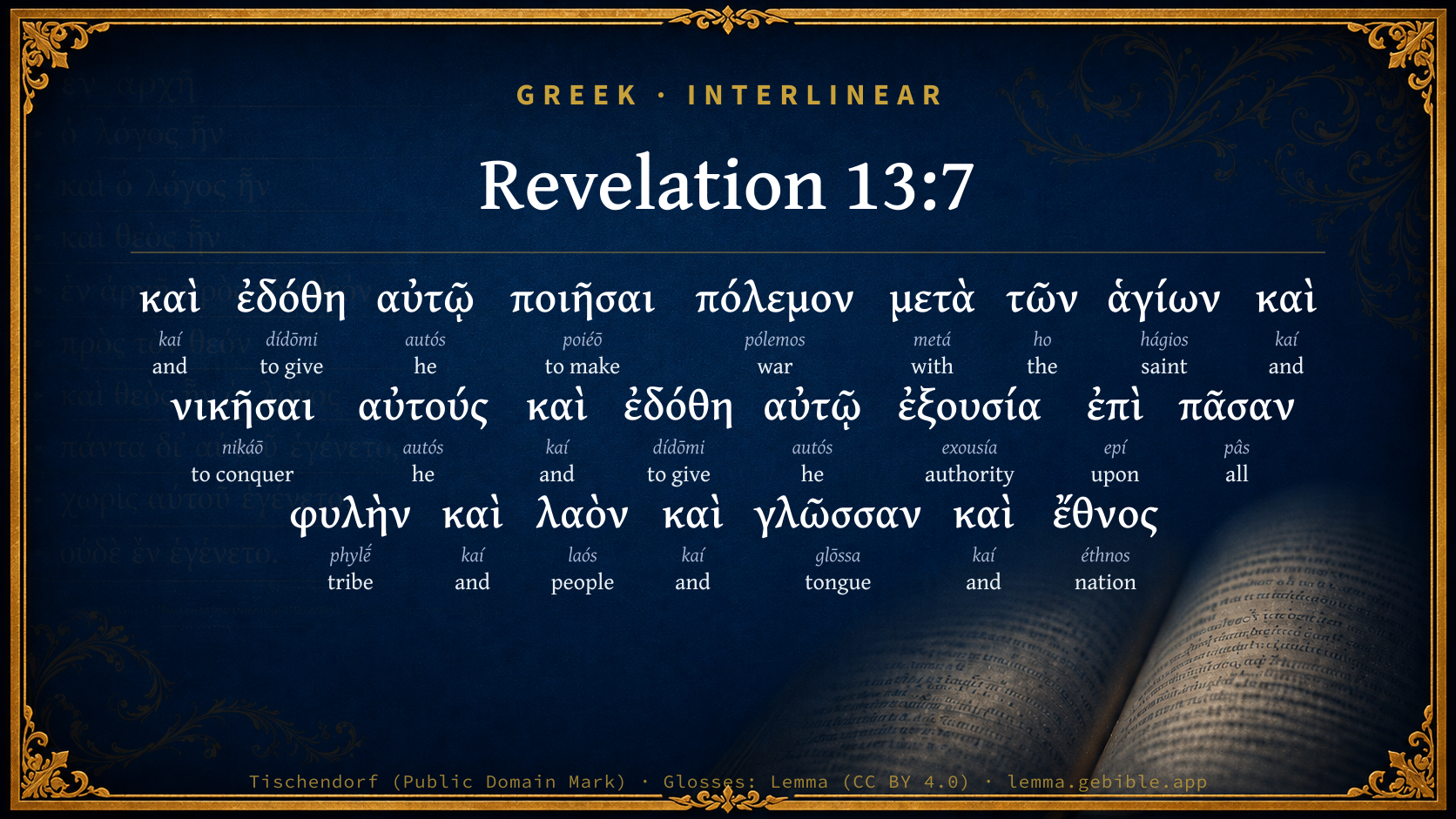
Greek (Tischendorf 8th ed.) Revelation 13:7 appears in the Greek New Testament. The text above is from the Tischendorf 8th edition. Each word links to its Strong’s number and a concise gloss. Click any word for its full Thayer’s Greek Lexicon entry.
Download image
Cite this verse

Revelation 13:7 (World English Bible). Public Domain. Lemma interlinear Bible study tool, https://lemma.gebible.app/v/revelation/13/7.

Show BibTeX & RIS
BibTeX
RIS
English Translation
It was given to him to make war with the saints, and to overcome them. Authority over every tribe, people, language, and nation was given to him.
World English Bible · Public Domain
Download a study sheet

One document with this verse’s original text, its word-by-word gloss line, the meaning frame, cross-references with their text, attributed commentary, and full source and license credits — printable, and it pastes into notes with its structure intact.

This verse Autodidact and up

Study sheet (.html) Plain text (.txt)

A passage Seminary Student

Up to 50 verses in one chapter. A passage sheet keeps up to 6 commentary sources and 12 cross-references per verse, in the order this page ranks them, and says so on the sheet whenever that leaves anything out. Ask for a single verse and you get the Autodidact verse sheet above.

Everything on this page stays free to read, with no account — the sheet is a download of what is already on screen, not access to it.

Want to remove ads? Support Godless Engineer
Compare translations 3

The same verse in 3 English versions, stacked beneath the original-language interlinear above. Click any original word for its lexicon entry.

Each is an independent rendering of the whole verse — the interlinear is not word-aligned to these translations.

Highlighted words mark where these versions differ — a whole-verse word diff, not a word-by-word alignment.

  • World English Bible Public Domain
    It was given to him to make war with the saints, and to overcome them. Authority over every tribe, people, language, and nation was given to him.
  • King James Version Public Domain
    And it was given unto him to make war with the saints, and to overcome them: and power was given him over all kindreds, and tongues, and nations.
  • unfoldingWord Literal Text CC BY-SA 4.0
    And to it was granted to make war with the saints and to conquer them, and authority was given to it over every tribe and people and language and nation.

unfoldingWord Literal Text — © unfoldingWord, licensed CC BY-SA 4.0. Word-aligned USFM3 via Door43 (git.door43.org/unfoldingWord/en_ult).

Versions to compare (up to 4)

3 of 4 selected

Show all 19 translations

Every available English version of this verse, each an independent rendering of the whole verse.

  • World English Bible Public Domain
    It was given to him to make war with the saints, and to overcome them. Authority over every tribe, people, language, and nation was given to him.
  • Berean Standard Bible Public Domain
    Then the beast was permitted to wage war against the saints and to conquer them, and it was given authority over every tribe and people and tongue and nation.
  • Majority Standard Bible Public Domain
    Then the beast was permitted to wage war against the saints and to conquer them, and it was given authority over every tribe and people and tongue and nation.
  • King James Version Public Domain
    And it was given unto him to make war with the saints, and to overcome them: and power was given him over all kindreds, and tongues, and nations.
  • American Standard Version (1901) Public Domain
    And it was given unto him to make war with the saints, and to overcome them: and there was given to him authority over every tribe and people and tongue and nation.
  • Revised Version (1885) Public Domain
    And it was given unto him to make war with the saints, and to overcome them: and there was given to him authority over every tribe and people and tongue and nation.
  • Geneva Bible (1599) Public Domain
    And it was giuen vnto him to make warre with the Saints, and to ouercome them, and power was giuen him ouer euery kinred, and tongue, and nation.
  • Douay-Rheims (1899) Public Domain
    And it was given unto him to make war with the saints, and to overcome them. And power was given him over every tribe, and people, and tongue, and nation.
  • Young's Literal Translation Public Domain
    and there was given to it to make war with the saints, and to overcome them, and there was given to it authority over every tribe, and tongue, and nation.
  • Literal Standard Version CC BY-SA 4.0
    and there was given to it to make war with the holy ones, and to overcome them, and there was given to it authority over every tribe, and tongue, and nation.
  • Unlocked Literal Bible CC BY-SA 4.0
    The beast was permitted to wage war with the saints and to conquer them. Also, authority was given to it over every tribe, people, language, and nation.
  • unfoldingWord Literal Text CC BY-SA 4.0
    And to it was granted to make war with the saints and to conquer them, and authority was given to it over every tribe and people and language and nation.
  • Darby Bible Public Domain
    And there was given to it to make war with the saints, and to overcome them; and there was given to it authority over every tribe, and people, and tongue, and nation;
  • World Messianic Bible Public Domain
    It was given to him to make war with the holy ones and to overcome them. Authority over every tribe, people, language, and nation was given to him.
  • Webster's Bible Public Domain
    And it was given to him to make war with the saints, and to overcome them: and power was given him over all kindreds, and languages, and nations.
  • Free Bible Version CC BY-SA 4.0
    The beast was given power to attack believers and defeat them, and he was also given authority over every people, tribe, language, and nation.
  • Bible in Basic English Public Domain
    And it was given to him to make war on the saints and to overcome them: and there was given to him authority over every tribe and people and language and nation.
  • Text-Critical English NT CC BY 4.0
    He was permitted to wage war against the saints and conquer them, and he was given authority over every tribe, people, tongue, and nation.
  • Tyndale New Testament (1534) Public Domain
    And it was geven vnto him to make warre with the saynctes and to overcome them. And power was geven him over all kynred tonge and nacion:

Literal Standard Version (2020), Covenant Press — licensed CC BY-SA 4.0. Text via the HelloAO Bible API (eBible.org). Unlocked Literal Bible (unfoldingWord) — licensed CC BY-SA 4.0. Text via the HelloAO Bible API (eBible.org). unfoldingWord Literal Text — © unfoldingWord, licensed CC BY-SA 4.0. Word-aligned USFM3 via Door43 (git.door43.org/unfoldingWord/en_ult). Free Bible Version, Dr. Jonathan Gallagher — licensed CC BY-SA 4.0. Text via the HelloAO Bible API (eBible.org).

Word by word

More ways to search: Search by grammar → Find every occurrence → Compare this word →

Practice this passage: Drill this verse → Learn its vocabulary →

πόλεμον
pólemos
G4171
“war”
Noun, Accusative, Singular, Masculine
Part of Speech
Noun
Case
Accusative
Number
Singular
Gender
Masculine
Full Thayer's Definition

Origin: from pelomai (to bustle)

TDNT: 14:22,9

1. a war 2. a fight, a battle 3. a dispute, strife, quarrel
  1. καὶ kaí G2532 “and” Conjunction
  2. ἐδόθη dídōmi G1325 “to give” Verb, Aorist, Passive, Indicative, 3rd person, Singular
  3. αὐτῷ autós G846 “he” Personal pronoun, Dative, Singular, Neuter
  4. ποιῆσαι poiéō G4160 “to make” Verb, Aorist, Active, Infinitive
  5. μετὰ metá G3326 “with” Preposition
  6. τῶν ho G3588 “the” Article, Genitive, Plural, Masculine
  7. ἁγίων hágios G40 “saint” Adjective, Genitive, Plural, Masculine
  8. καὶ kaí G2532 “and” Conjunction
  9. νικῆσαι nikáō G3528 “to conquer” Verb, Aorist, Active, Infinitive
  10. αὐτούς autós G846 “he” Personal pronoun, Accusative, Plural, Masculine
  11. καὶ kaí G2532 “and” Conjunction
  12. ἐδόθη dídōmi G1325 “to give” Verb, Aorist, Passive, Indicative, 3rd person, Singular
  13. αὐτῷ autós G846 “he” Personal pronoun, Dative, Singular, Neuter
  14. ἐξουσία exousía G1849 “authority” Noun, Nominative, Singular, Feminine
  15. ἐπὶ epí G1909 “upon” Preposition
  16. πᾶσαν pâs G3956 “all” Adjective, Accusative, Singular, Feminine
  17. φυλὴν phylḗ G5443 “tribe” Noun, Accusative, Singular, Feminine
  18. καὶ kaí G2532 “and” Conjunction
  19. λαὸν laós G2992 “people” Noun, Accusative, Singular, Masculine
  20. καὶ kaí G2532 “and” Conjunction
  21. γλῶσσαν glōssa G1100 “tongue” Noun, Accusative, Singular, Feminine
  22. καὶ kaí G2532 “and” Conjunction
  23. ἔθνος éthnos G1484 “nation” Noun, Accusative, Singular, Neuter

About this verse

These counts appear in no published source. They are computed here, from the morphology-tagged text and Lemma’s own curated glosses. What Lemma adds →

24
words
16
distinct lemmas
Revelation
section

Notable vocabulary

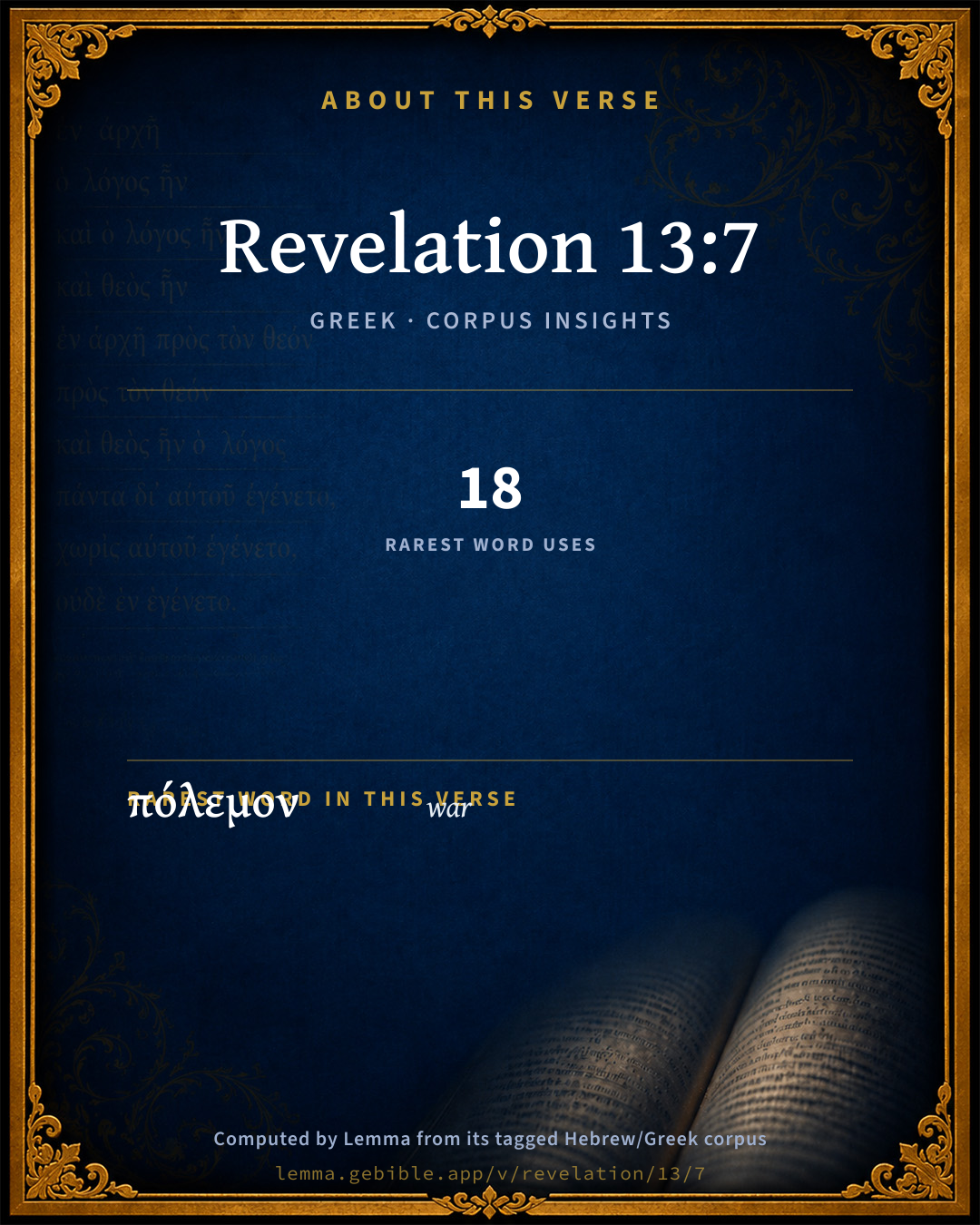
The rarest word here is πόλεμον war G4171 — appearing just 18 times in the whole Greek New Testament.

Shared distinctive vocabulary

πόλεμον war G4171 occurs in 16 verses of the Greek New Testament. Also found in:

Repetition

Words recur within this verse:

  • ἐδόθη to give G1325 ×2
  • καὶ and G2532 ×6
  • αὐτῷ he G846 ×3

Cross-references

20

Topical passages linked to Revelation 13:7 in the Treasury of Scripture Knowledge — connected by theme and wording, ordered by reader-vote popularity; previews shown in the World English Bible.

  • Daniel 7:21 I saw, and the same horn made war with the saints, and prevailed against them;
  • Revelation 11:7 When they have finished their testimony, the beast that comes up out of the abyss will make war with them, and overcome them, and kill them.
  • Daniel 7:25 He shall speak words against the Most High, and shall wear out the saints of the Most High; and he shall think to change the times and the law; and they shall be given into his hand until a time and times and half a time.
  • Revelation 12:17 The dragon grew angry with the woman, and went away to make war with the rest of her seed, who keep God's commandments and hold Jesus' testimony.
  • Daniel 8:24–25 His power shall be mighty, but not by his own power; and he shall destroy wonderfully, and shall prosper and do [his pleasure]; and he shall destroy the mighty ones and the holy people.
  • Daniel 12:1 "At that time shall Michael stand up, the great prince who stands for the children of your people; and there shall be a time of trouble, such as never was since there was a nation even to that same time: and at that time your people shall be delivered, everyone who shall be found written in the book.
  • Revelation 17:15 He said to me, "The waters which you saw, where the prostitute sits, are peoples, multitudes, nations, and languages.
  • John 19:11 Jesus answered, "You would have no power at all against me, unless it were given to you from above. Therefore he who delivered me to you has greater sin."
  • Revelation 11:18 The nations were angry, and your wrath came, as did the time for the dead to be judged, and to give your bondservants the prophets, their reward, as well as to the saints, and those who fear your name, to the small and the great; and to destroy those who destroy the earth."
  • Daniel 11:36–39 The king shall do according to his will; and he shall exalt himself, and magnify himself above every god, and shall speak marvelous things against the God of gods; and he shall prosper until the indignation be accomplished; for that which is determined shall be done.
  • Luke 4:6 The devil said to him, "I will give you all this authority, and their glory, for it has been delivered to me; and I give it to whomever I want.
  • Revelation 5:9 They sang a new song, saying, "You are worthy to take the book, And to open its seals: For you were killed, And bought us for God with your blood, Out of every tribe, language, people, and nation,
  • Revelation 10:11 They told me, "You must prophesy again over many peoples, nations, languages, and kings."
  • Exodus 9:16 but indeed for this cause I have made you stand: to show you my power, and that my name may be declared throughout all the earth;
  • Jeremiah 51:20–24 You are my battle-axe and weapons of war: and with you will I break in pieces the nations; and with you will I destroy kingdoms;
  • Isaiah 10:15 Shall the axe boast itself against him who hews therewith? Shall the saw magnify itself against him who wields it? as if a rod should wield those who lift it up, [or] as if a staff should lift up [him who is] not wood.
  • Isaiah 37:26 Have you not heard how I have done it long ago, and formed it of ancient times? now have I brought it to pass, that it should be your to lay waste fortified cities into ruinous heaps.
  • Jeremiah 25:9 behold, I will send and take all the families of the north, says Yahweh, and [I will send] to Nebuchadrezzar the king of Babylon, my servant, and will bring them against this land, and against the inhabitants of it, and against all these nations round about; and I will utterly destroy them, and make them an astonishment, and a hissing, and perpetual desolations.
  • Jeremiah 27:6–7 Now have I given all these lands into the hand of Nebuchadnezzar the king of Babylon, my servant; and the animals of the field also have I given him to serve him.
  • Daniel 5:18–23 You king, the Most High God gave Nebuchadnezzar your father the kingdom, and greatness, and glory, and majesty:

Cross-references courtesy of OpenBible.info (CC BY 4.0).

Where the printed editions differ

1 variant

Places in this verse where the major printed Greek editions disagree on the wording in a way that affects the translation — a comparison of editions, not a manuscript-by-manuscript collation. The editions are the modern critical texts (Nestlé-Aland 28/27, SBL, Westcott-Hort, Tregelles, Tyndale House) and the traditional texts behind the KJV (the Textus Receptus and the Byzantine/Majority text). It is not a claim about which reading is original.

  1. Extra text
    καὶ λαὸν

    “and people”

    In NA28NA27TynSBLWHTregByz Not in TR

    καὶ λαὸν (kai laon) 'and people' is only in older manuscripts (NA28+NA27+Tyn+SBL+WH+Treg+Byz)

Textual data: Translators Amalgamated Greek New Testament (STEPBible TAGNT) · CC BY 4.0.

Commentary

Notes on Revelation 13:7 from classic Christian and Jewish commentators (each source and its license shown beneath its notes). The classic Christian expositions comment on the surrounding passage and are grouped to its opening verse, so a note may address several verses; the Jewish commentaries on the Tanakh (Rashi and others) are per-verse, so they appear only where the commentator wrote on this verse.

Lemma curates 59 commentaries, every one of them public domain or Creative Commons licensed, each selected and text-cleaned for this edition rather than reprinted as found. About our sources →

The Biblical Illustrator

Joseph S. Exell

Rev_13:7-8

To make war with the saints.

War with the saints

Observe--

1. A war proclaimed; the beast makes war upon the saints, by bloodshed and persecution, and by the force of those weapons overcomes them; that is to outward appearance and in the opinion of the world. But really do the saints overcome him by their patience under sufferings, and by adhering to the truth.

2. The large extent of the beasts power that was given him, namely, over all kindreds, tongues, and nations. Christs flock is a little flock, compared with antichrists herd: how wrong a note then is multitude of the right Church?

3. That as the power of the beast is universal, so is the worship also. All that dwell on the earth shall worship him.

4. We have a number excepted, Whose names are written in the book of life. Christ has His number of faithful ones, who are not defiled by antichrists pollutions; a number whose conversations are in heaven.

5. The title here given to our Lord Jesus Christ, He is styled the Lamb slain from the foundation of the world. (W. Burkitt, M. A.)

The Lamb slain from the foundation of the world.--

Christ sacrificed in eternity

I. The things that are to happen in the universe in the most distant future are to God as facts already accomplished.

1. Gods intelligence is infinite.

2. Gods purposes are unfrustrable.

II. The principle of self-sacrificing love is an eternal principle in the creation.

1. It is the root of the universe.

2. It is typified in all material existences.

3. It agrees with the moral constitution of the soul, which is so formed--

(1) That it can recognise nothing as morally praiseworthy that does not spring from it.

(2) Its conscience can approve of no act of its own that is not inspired by it.

(3) Its happiness can be realised only as it is controlled by it.

III. Redemption is no afterthought in the arrangements of the universe.

IV. Our planet was probably formed for the special purpose of becoming the theatre of Gods redemptive love to man. Small in bulk as our planet is, compared with that of other orbs that roll in splendour under the eye of God, it has a grand moral distinction. Its dust formed, its fruit fed the body of the Son of God. Here He lived, laboured, suffered, and was buried, and here His grand work is being carried on. If it be moral facts that give importance to places, is there a more important spot than this earth? (D. Thomas, D. D.)

Eternal atonement

The prevalent opinion no doubt has been that the atonement is simply an historic fact, dating back now some fourteen hundred years; and that only the purpose of it is eternal. But Johann Wessel, the great German theologian, who died only six years after Martin Luther was born, got hold of the idea that not election only, but atonement also is an eternal act. And this, it seems to me, is both rational and Scriptural. Eternal election, profoundly considered, requires eternal atonement for its support. Both are eternal, as all Divine realities are eternal. And so the relationship of God to moral evil stands forth as an eternal relationship. Not that evil is itself eternal; but God always knew it and always felt it. It may help our thinking in this direction to remember that there is a sense in which creation itself is eternal; not independently eternal, but, of Gods will, dependently eternal. There must nothing be said, or thought, in mitigation of the ethical verdict against moral evil. The hatefulness of it, no matter what its chronology may be, is simply unspeakable. Wrong doing is the one thing nowhere, and never, to be either condoned or endured. Nor should any attempt be made to get at the genesis of moral evil. The beginning of it is simply inconceivable. The whole thing is a mystery, and must be let alone. Moral evil is not eternal; or there would be two infinities. Nor is it a creature of God; or God would be divided against Himself. And yet it had the Divine permission, whatever that may be imagined to have been. Practically, historic sin finds relief in historic redemption. Apparently, there was little, if any, interval between the two. But the Lamb slain from the foundation of the world suggests a far sublimer theodicy. We are taken back behind the human ages, behind all time, into awful infinite depths, into the very bosom of the Triune God. Trinity is another name for the self-consciousness, and self-communion of God. Father, Son, and Holy Spirit are vastly more than the revelation of God to man; they are the revelation of God to Himself, and the intercourse of God with Himself. They suggest infinite fulness and richness of being. Our scientific definitions of God do not amount to much. What we need is to see God in the life, both of nature and of man. God creates, governs, judges, punishes, redeems, and saves; but love is the root of all. This yearning, grieved, and suffering God is the God and Father of our Lord and Saviour Jesus Christ: Son of God, Son of Mary. This sinless child should have had no sins of His own. His sorrows could have been only those old eternal shadows of permitted sin. The Cross on which He died, flinging out its arms as if to embrace the world, lifted up its head toward the Lamb slain from the foundation of the world. Our hearts now go back to Calvary; and from Calvary they go up to God. One word more. This stupendous idea of eternal atonement carries with it the idea of universal atonement. Whatever it was, and is, it must needs have been infinite. No magnitude of sin, no multitude of sinners, can bankrupt its treasury of grace. God so loved the world, is its everlasting refrain. He that will, let him take the water of life freely. (R. D. Hitchcock, D. D.)

The Lamb slain

I. The designation here given to the Saviour. He is called the Lamb. This is a most appropriate title, since we look upon a lamb as the emblem of innocence, gentleness, and submission; qualities of goodness in which the blessed Redeemer was pre-eminent, and fairer than the children of men.

II. The slaughter. The Lamb slain. The slaughtered Lamb was a prominent element in the Jewish ritual, and a standing type of the Lamb of God, whose obedience unto death procured the life of the world. There were three remarkable instances of this under the Old Testament dispensation. The first is the case of Abraham in offering his son Isaac. St. Paul tells us that this was a figure of the death and resurrection of Christ. The second distinct instance of the typical allusion, is the paschal lamb. This is shown by the observation of St. Paul, Christ our Passover is sacrificed for us; therefore let us keep the feast. The third instance in which this animal is used as a type of Christ was on the daily sacrifice.

III. The date of this transaction--from the foundation of the world. How is this to be understood?

1. He was slain in the purpose of God. Contingency with man is certainty with God. Purpose and accomplishment are the same with Him.

2. Not only in purpose but in type is the doctrine true.

3. He was so in effect. (American National Preacher.)

The place of the Cross in the world

The Lamb is said to have been slain from the foundation of the world. It was not the result of an accident; it was not the result of an emergency; it was something involved in the plan of the creation itself--a design of its being. Its first stone was laid with a view to the development of the sacrificial life. Was St. John, then, an optimist, or a pessimist? In the worldly sense of these words he was something different from either, and something which admitted a truth in both. On the one hand he holds with the worldly optimist that all things do work for the highest good; the universe is to him the product of love. But on the other hand, just because it is the product of love, he could never admit that it is a field for self-gratification. He found in it a sphere that, from the beginning to the end of the day, disappointed every selfish hope, wrecked every ship that sailed only for its own cargo. And why so? Because to him the essence of God was love. If God be love, the highest good must be to be made in the image of love. St. John asked himself how that could be done on the Greek principle of self-indulgence, or the Jewish principle of s physical Messiah. He felt that if the end of life were simply to wear purple and fine linen, and fare sumptuously every day, and if life itself were amply suited to such an end, then life was incompatible with love. This world, in short, is to St. John a development and an upward development; but it is a development of self-sacrifice. The Apocalypse has been called a sensuous book; it is to my mind the least sensuous book in the Bible. It describes the process of the ages as a process of self-surrender. This, then, is the meaning of the passage, The Lamb slain from the foundation of the world. It means that Christ was all along the goal of creation, and that creation is a making for Christ. More particularly, it means that the line of this worlds progress has been a development of self-sacrifice. It seems to me that in this last point the writer of the Apocalypse has come nearer to a philosophy of history than all who went before him. If you take any other line of progress you will fail, in my opinion, to prove that there has been an advance in the march from the old to the new. Shall we take intellect? Do we feel that the amount of mind force is greater in the modern Englishman than it was in the ancient Greek? It would be difficult to feel it, and it would be impossible to prove it: are Plato and Aristotle inferior to the best intellects among us? Shall we take imagination? Have we reached the architectural conception which planned the pyramids? Have we outrun the triumphs of Greek sculpture? Have we surpassed the poetry of Homer? Have we sustained the fame of the mediaeval painters? Have you ever considered how much of invention is itself due to the spread of the unselfish principle? Why have the great ages of discovery been the ages after Christ? Is it not just because Christ has been before them? Is it not because the spirit of sacrifice has awakened man to the wants of man? The times of self-seeking were not the times of invention. St. John says creation is moving toward a type--a lamb slain, and it is moving toward that type in a straight line--the line of sacrifice. It is climbing to its goal by successive steps which might be called steps downward--increasing limitations of the self-life. To what extent did St. John see this? He saw in visible nature a series of gospel pictures; everything seemed to live only by losing itself. He saw the waves of the sea of Patmos passing into waves of light; he beheld the waves of light passing into eddies of the sea. It seemed to him that even in that lonely spot God had inscribed upon the walls of nature the image of a cross. By and by, before the eyes of the seer there flashed a higher order of creation, and it was clothed in the same garb--the robe of sacrifice. He passed from the pictorial representation of sacrifice in nature to its actual, though involuntary, representation in animal life. The very reference to a slain lamb is a reference to an animal sacrifice. How did St. John reconcile himself to that spectacle of an involuntary sacrifice of the animal life prescribed by the Old Testament? He said it was a type of Christ. If sacrifice be the law of the highest being, it is desirable to reach it. You can only reach anything by a repeated experience of it. There passed before him the natural sacrifices of the human heart. I believe that the cares of the heart prevent every man from living the full amount of his natural years. What is the difference, then, between the sacrifice of the animal and the sacrifice of the man? It is an inward difference; the obligatory has become the voluntary. What has made it voluntary? It is love, a force to which in the animal world nothing exactly corresponds, a force which adds to the sacrifice, and at the same time helps to bear it. And yet merely natural love is far from having reached the goal. It is noble; it is beautiful; but it is not the topmost triumph. The mothers love, the brothers love, the husbands love, the son and daughters love, are each and all the search for something kindred to ourselves. St. John looks out for a vaster type--a love that can come where there is no kindred, no sympathy. He seeks a love that shall strive for the survival of the unfittest--the blood of a spotless soul that can wash the sins of the absolutely impure. This is to John the perfect type of altruism--the Lamb that was slain. It is the progress towards this type that constitutes to St. John the philosophy o| history. (G. Matheson, D. D.)

The Biblical Illustrator, edited by Joseph S. Exell (c. 1880s–1900s) — public domain. Text from a community e-Sword module.

Tyndale Open Study Notes

Tyndale Open Resources

13:7 The beast’s authority extends over all the people of the world.

Tyndale Open Study Notes — © Tyndale Open Resources, licensed CC BY-SA 4.0. Text via the HelloAO Bible API.

Bengel's Gnomon

Johann Albrecht Bengel

Rev 13:7. Πόλεμον ποιῆσαι μετὰ τῶν ἁγίων, to make war with the saints) Dan 7:21, עבדא קרב עם קדושין, LXX., ἐποίει πόλεμον μετὰ τῶν ἁγίων. Thus πόλεμον ποιεῖν, Rev 12:17; Rev 19:19, and the LXX. often for עשה מלחמה. I. C. Becman, in his Dissertation respecting the justice of the arms of Cevennes, p. 33, rightly refers this war with the saints to the Crusades against the Waldenses.—πᾶσαν, every) The law of the Roman Pontiffs prevailed over a greater portion of the earth, than that of the Emperors: Greg. vii. lib. 2, Ep. 75.

Bengel's Gnomon of the New Testament — English translation (T&T Clark, Edinburgh, 1860) — public domain. Text from a community e-Sword module.

Expositor's Greek Testament

ed. W. Robertson Nicoll

Rev 13:7 . In Enoch xlvi. 7 the rulers and kings “make themselves masters of the stars of heaven [ i.e. , the righteous], and raise their hands against the Most High”. The beast’s world-wide authority goes back to the dragon’s commission (2) but ultimately to divine permission (so in 5). There is a providence higher even than the beast.

The Expositor's Greek Testament, edited by W. Robertson Nicoll (1897–1910) — public domain. Text from a community e-Sword module.

Jamieson, Fausset & Brown

Robert Jamieson, A. R. Fausset & David Brown

power--Greek, "authority."

all kindreds . . . tongues . . . nations--Greek, "every tribe . . . tongue . . . nation." A, B, C, Vulgate, Syriac, ANDREAS, and PRIMASIUS add "and people," after "tribe" or "kindred."

Jamieson, Fausset & Brown — Commentary Critical and Explanatory on the Whole Bible (1871) — public domain (CC PDM 1.0). Text via the HelloAO Bible API.

Adam Clarke's Commentary

Verse 7. And it was given unto him to make war with the saints, and to overcome them] "Who can make any computation," says Bishop Newton, "or even frame any conception, of the numbers of pious Christians who have fallen a sacrifice to the bigotry and cruelty of Rome? Mede upon the place hath observed, from good authorities, that in the war with the Albigenses and Waldenses there perished of these poor creatures in France alone a million. From the first institution of the Jesuits to the year 1580, that is, in little more than thirty years, nine hundred thousand orthodox Christians were slain, and these all by the common executioner. In the space of scarce thirty years the inquisition destroyed, by various kinds of torture, a hundred and fifty thousand Christians. Sanders himself confesses that an innumerable multitude of Lollards and Sacramentarians were burnt throughout all Europe, who yet, he says, were not put to death by the pope and bishops, but by the civil magistrates." The dragon in a new shape, or Roman empire of Germany, acted a very conspicuous part in this nefarious warfare against the remnant of the woman's seed, who kept the commandments of God, and had the testimony of Jesus Christ. See the imperial edict of Frederic II. against heretics, in Limborch's History of the Inquisition.

And power was given him over all kindreds, and tongues, and nations.] As the book of the Revelation is a prophecy of all that should come upon the Christian world till the end of time, all kindreds, and tongues, and nations, must imply the whole Christian world. That the Latin empire in the course of its reign has had the extensive power here spoken of, is evident from history. It is well known that the profession of Christianity was chiefly confined within the limits of the Greek and Latin empires, till the period of the Reformation. By means of the crusades the Latins extended their empire over several provinces of the Greeks. In 1097 Baldwin extended his conquests over the hills of Armenia and the plain of Mesopotamia, and founded the first principality of the Franks or Latins, which subsisted fifty-four years, beyond the Euphrates. In 1204 the Greeks were expelled from Constantinople by the Latins, who set up an empire there which continued about fifty-seven years. The total overthrow of the Latin states in the east soon followed the recovery of Constantinople by the Greeks; and in 1291 the Latin empire in the east was entirely dissolved. Thus the Latins have had power over the whole world professedly Christian: but it is not said that the whole world was in utter subjection to him, for we read in the following verse:-

Adam Clarke's Commentary on the Bible (1810–1826) — public domain. Text from a community e-Sword/MySword module.

Ellicott's Commentary for English Readers

(7) And it was given . . .—Better, He makes war with the saints, and conquers them. This, too, is said to be “given him.” The conquest is not a conquest of their fidelity; it is rather that the beast so far succeeds that they must suffer or submit. The saints seem to be single handed; for there was given him authority over every tribe, and people, and tongues, and nations. Nor does his success end here; the next verse shows us how completely earth is at his feet.

A Bible Commentary for English Readers, edited by Charles John Ellicott (1878–1897) — public domain. Text from a community e-Sword module.

The Cambridge Bible for Schools and Colleges

gen. ed. J. J. S. Perowne

7. And it was given unto him … to overcome them] There is considerable authority for the omission of this clause: but the omission is no doubt merely accidental—it was left out in one or more very early copies, because scribes passed from one clause beginning “and there was given unto him” to another. For the sense cf. Dan_7:21 and ch. Rev_11:7 : the latter proves that “the Saints” (i.e. the holy people of God) are to be understood as Christians, not as Israelites.

over all kindreds &c.] Lit., over every tribe, and people, and tongue, and nation. The Devil gives to Antichrist what he offered to Christ, St Luk_4:6.

The Cambridge Bible for Schools and Colleges (gen. ed. J. J. S. Perowne; Cambridge University Press, 1878–1918) — public domain. Text from a community e-Sword module.

John Gill's Exposition

And it was given unto him to make war with the saints,.... The remnant of the woman's seed, Rev 12:17, whom God has set apart for himself, Christ has cleansed from sin by his blood, and the Holy Spirit has sanctified by his grace; and who under the influence of it live holy lives and conversations; against such Satan always bore an enmity; and it is an aggravation of the wickedness of the Romish antichrist, that he makes war with such, which he is stirred up to by Satan, with a malicious intent, and is permitted by God for the trial of the faith and patience of his people: this war of antichrist, with the saints, may be understood not merely spiritually, of his anathemas, excommunications, bulls, and the like, but literally, of his drawing the temporal sword against them; see Rev 13:10; and bringing of armies against them, and fighting pitched battles; and it is thought there may be a special regard had to his war with the Waldenses and Albigenses, in which war it is said that a million were slain; and may take in all his ways and methods of destroying the saints, by the bloody Inquisition, murders, massacres, and punishments of all sorts; and also his last war with the two witnesses, in which they will be slain, which is yet to come, Rev 11:7;

and to overcome them: not so as to submit to him, and to forsake the doctrines and ordinances of Christ, but by killing them; and who, by dying in the faith and cause of Christ, overcome Satan, get the victory over the world, and antichrist, and are more than conquerors through him that has loved them.

And power was given him over all kindreds, and tongues, and nations; in the Roman empire, which wondered after him, and worshipped him, and over whom he has reigned, and has exercised both a temporal and spiritual jurisdiction; see Rev 17:15.

John Gill's Exposition of the Whole Bible (1746–1763) — public domain (CC PDM 1.0). Text via the HelloAO Bible API.

Trapp's Complete Commentary

John Trapp

7 And it was given unto him to make war with the saints, and to overcome them: and power was given him over all kindreds, and tongues, and nations.

Ver. 7. To make war with the saints] As he did with the Albigenses, publishing his Crusades against them, as if they had been Saracens, and destroying ten hundred thousand of them in France only, if Perionias may be believed. Not to speak of the many thousands since slain in battle by the pope’s champions in Germany, France, Ireland, and now also in England; besides those many more that have died for religion by the bloody Inquisition, by the hands of the hangman, 3600 in the Low Countries by the command of the Duke of Alva, 800 here in Queen Mary’s days, &c. The beast hath even made himself drunk with the blood of the saints.

And to overcome them] So it seemed, but so it was not. See Rev 12:11. The saints never more prevail and triumph than when it seems otherwise. Of them the enemies may say, as the Persians did once of the Athenians at the field of Marathon (Stobaeus),

Βαλλομεν, ου πιπτουσι, τιτρωσκομεν, ου φοβεονται.

We fell them, yet they fall not; thrust them through,

They feel no mischief, but are well enough.

Over all kindreds and tongues] Here the Holy Ghost points to the Popish Catholicism. The Jesuits will still needsly have the Roman Church to be the Catholic Church, though so many kindreds, tongues, and nations have utterly disclaimed it. Herein they are like that mad fellow Thrasilaus in Horace, who laid claim to all the ships that came into the harbour at Athens, though he had no right to the least boat there.

John Trapp, A Commentary or Exposition upon All the Books of the Old and New Testament (1647–1656) — public domain. Text from a community e-Sword module.

Albert Barnes' Notes on the Bible

And it was given unto him - By the same power that taught him to blaspheme God and his church. See the notes on Rev 13:2, Rev 13:5.

To make war with the saints - See this fully illustrated in the notes on the parallel passage in Dan 7:21, and at the end of that chapter, (f).

And to overcome them - In those wars. This was abundantly fulfilled in the wars with the Waldenses, the Albigenses, and the other sincere followers of the Saviour in the time of the papal persecutions. The language used here is the same as what is found in Dan 7:21; “The same horn made war with the saints, and prevailed against them.” See the notes on that passage.

And power was given him - See the notes on Rev 13:2.

Over all kindreds, and tongues, and nations - For the meaning of these words see the notes on Rev 7:9. The meaning here is, that this dominion was set up over the world. Compare Dan 7:25. The fact that so large a portion of the kingdoms of the earth was under the influence of the papacy, and sustained it, and the claim which it set up to universal dominion, and to the right of deposing kings and giving away kingdoms, corresponds entirely with the language used here.

Albert Barnes' Notes on the Bible (1834–1885) — public domain. Text from a community e-Sword/MySword module.

Matthew Poole's English Annotations

God showeth John, that after antichrist had gone on blaspheming the name, and tabernacle, and saints of God, some years, the devil should influence him also

to make war against God’s holy ones, and he would suffer him

to overcome them; and he should have a

power over all the nations of that part of the world, where God had his church. This was eminently fulfilled after the year 1200, when the doctrine of transubstantiation was established. The Inquisition was set up in Spain, 1206; the number of those murdered by it was exceeding great. But yet this was too slow a work, the pope quickly raised vast armies against the Albigenses, first under the conduct of his legate, then of Simon de Montford. Perionius (one of their own) saith, that more than a million were slain in these wars of these poor people, merely for not complying with the Church of Rome in her apostacy. But what were these to those slain in the valleys of Piedmont, Provence, Calabria, Alsatia, Bohemia, before the year 1517, when the Reformation began in Germany? What slaughters have been since made in Germany, Hungary, Flanders, Ireland, &c., every one knows. The latter clause was eminently verified until the year 1517, there being no nation in Europe but was subject to the pope of Rome, so as he had a

power over all kindreds, and tongues, and nations. The poor Albigenses thought themselves concerned in this prophecy; for when the popish general, Simon de Montford, had made a vast slaughter of them, and the archbishop of Tholouse interceded for those that survived, upon condition that they would embrace the Romish faith, they boldly refused, sending the archbishop word, that they were the overcome servants of Jesus Christ; and all died comforting themselves with the prophecy of this text.

Matthew Poole's English Annotations on the Holy Bible (1683–1685) — public domain. Text from a community e-Sword/MySword module.

Whedon's Commentary on the Bible

Daniel D. Whedon

7. Make war with the saints—By bloody wars, inquisitions, and burnings at the stake of all who would reform.

Overcome them—Subjecting them, by blood and terror, to her despotic authority, denying all “right of private judgment.”

All kindreds—The Roman beast styles herself solely catholic, that is, universal. She claims that every human being is bound to obey her. “You all belong to me,” said Pope Pius IX. to the Emperor William. She claims every American as her rightful subject, and the only reason at this hour that she does not force the claim by the same war and bloodshed, is want of power.

Daniel D. Whedon (gen. ed.), Commentary on the Old and New Testaments (1874–1909) — public domain. Text from a community e-Sword module.

The Pulpit Commentary

And it was given unto him to make war with the saints, and to overcome them. This clause is omitted in A, C, P, and some others. So in Dan_7:21, "The same horn made war with the saints, and prevailed against them; until the Ancient of days came, and judgment was given to the saints of the Most High." And in Rev_11:7, "The beast that ascendeth out of the bottomless pit shall make war against them the two witnesses, and shall overcome them, and kill them." Overcome; that is, apparently; so far as is seen by the world. In the same way the world overcame Christ; but by his death came victory. So in Rev_2:10 the Church at Smyrna is encouraged by the words, "Fear none of those things which thou shalt suffer... be thou faithful unto death, and I will give thee a crown of life." And power was given him over all kindreds, and tongues, and nations; over every tribe, and people, and tongue, and nation. Laon "people," is inserted in every manuscript except a few cursives. The fourfold enumeration, applied to the earth, denotes the universal character of the description. (cf. the four living beings, Rev_4:6. Also Rev_5:9 Rev_7:9 Rev_11:9 Rev_14:6) The same classification is adopted in the song of the redeemed, (Rev_5:9) which may be contrasted with this passage. Although the power of Satan extends to every section of the nations of the earth, yet men are not irrevocably delivered into his hand. From every part of mankind men are also redeemed.

The Pulpit Commentary (1880–1919), ed. H.D.M. Spence-Jones & Joseph S. Exell — public domain. Text from a community e-Sword module.

John Wesley's Explanatory Notes

And it was given him - That is, God permitted him. To make war with his saints - With the Waldenses and Albigenses. It is a vulgar mistake, that the Waldenses were so called from Peter Waldo of Lyons. They were much more ancient than him; and their true name was Vallenses or Vaudois from their inhabiting the valleys of Lucerne and Agrogne. This name, Vallenses, after Waldo appeared about the year 1160, was changed by the Papists into Waldenses, on purpose to represent them as of modern original. The Albigenses were originally people of Albigeois, part of Upper Languedoc, where they considerably prevailed, and possessed several towns in the year 1200. Against these many of the Popes made open war. Till now the blood of Christians had been shed only by the heathens or Arians; from this time by scarce any but the Papacy. In the year 1208 Innocent III. proclaimed a crusade against them. In June, 1209, the army assembled at Toulouse; from which time abundance of blood was shed, and the second army of martyrs began to be added to the first, who had cried "from beneath the altar." And ever since, the beast has been warring against the saints, and shedding their blood like water. And authority was given him over every tribe and people - Particularly in Europe. And when a way was found by sea into the East Indies, and the West, these also were brought under his authority.

John Wesley, Explanatory Notes Upon the Whole Bible (1754–1765) — public domain. Text via the GEBible commentary corpus.

Burkitt's Expository Notes on the New Testament

William Burkitt

Observe here, 1. A war proclaimed; the beast makes war upon the saints, by bloodshed and persecution, and by the force of those weapons overcomes them; that is, to outward appearance, and in the opinion of the world, they seem to be totally overcome, because visibly slain: but really do the saints overcome him, by their patience and constancy under sufferings; and by rejecting his cursed idolatry, and adhering to the truth.

Observe, 2. The large extent of the beast’s power that was given him, namely, over all kindreds, tongues, and nations. This must not be understood of individual persons, nor universally of all nations, but of the nations belonging to the Roman empire: whole nations were carried away with his idolatry, though not all of every nation. Christ’s flock is a little flock, compared with antichrist’s herd: how wrong a note then is multitude of the right church!

Observe, 3. That as the power of the beast is universal, so is the worship also: All that dwell on the earth shall worship him, that is, the generality of the Roman empire shall obey and honour him, and comply with him in his idolatry; few comparatively refusing it.

Yet, 4. We have a number excepted, whose names are written in the book of life. Blessed by God for this comfortable restriction: all are not worshippers of the beast. Christ has his number of faithful ones, who are not defiled by antichrist’s pollutions; a number whose conversations are in heaven, and whose names are written there, in the book of life, called the book of the Lamb; because it is by him, and by the merit of his blood, that we obtain eternal life.

Observe lastly, The title here given to our Lord Jesus Christ, he is styled the Lamb slain from the foundation of the world, and that in several respects:

1. In the purpose and decree of God.

2. In the promise of God made from the beginning, Gen 3:15.

3. In respect of the types, shadows, and sacrifices, whereby his death was prefigured and represented; Christ was slain typically in those sacrifices which Adam and Abel offered up unto God daily.

4. In respect of the virtue and efficacy of his death, which was effectual to all that truly believe in him, from the first promise made of him. The merits of Christ’s death have saved all that have been saved from the foundation of the world.

Behold here, The tender care of God in providing for our salvation before we were, yea, before the world was; and observe also, that the saints of God, in all ages, have been saved the same way, and by the same mean, namely, by faith in the death of Christ, which has extended itself to all true believers from the beginning of the world; and the efficacy of it will reach to all such, even to the end of the world; the virtue of the sacrifice is as fresh as the first moment it was slain, the death of Christ is of eternal efficacy.

William Burkitt's Expository Notes on the New Testament (1700–1703) — public domain. Text from a community e-Sword module.

The People's New Testament

B. W. Johnson

7. It was given unto him. He had power to make war on the saints and to overcome them for a long period. Compare 12:14–17. His dominion was also one that seemed universal, and he claimed rule over all kindreds … and nations.

B. W. Johnson's The People's New Testament with Notes (1889–1891) — public domain. Electronic text from the Christian Classics Ethereal Library (CCEL) ThML edition.

unfoldingWord translationNotes

Door43 World Missions Community

authority was given to it

This can be stated in active form. AT: "God gave authority to the beast" (See: Active or Passive)

every tribe, people, language, and nation

This means that people from every ethnic group are included. See how you translated a similar list in Revelation 5:9.

will worship it

"will worship the beast"

everyone whose name was not written ... in the Book of Life

This phrase clarifies who on the earth will worship the beast. It can be stated in active form. AT: "those whose names the Lamb did not write ... in The Book of Life" or "those whose names were not ... in the Book of Life" (See: Active or Passive)

since the creation of the world

"when God created the world"

the Lamb

A "lamb" is a young sheep. Here is it used symbolically to refer to Christ. See how you translated this in Revelation 5:6. (See: Symbolic Language)

who had been slaughtered

This can be stated in active form. AT: "whom the people slaughtered" (See: Active or Passive)

translationWords

beast

believe

authority

tribe

people group

nation

worship

create

Book of Life

lamb

slaughter

unfoldingWord translationNotes — © Distant Shores Media and the Door43 World Missions Community, licensed CC BY-SA 4.0. Source: git.door43.org/Door43/en_tn.

Cambridge Greek Testament for Schools and Colleges

7. καὶ ἐδόθη … αὐτούς. ACP 1* omit this clause.

7. καὶ ἐδόθη … αὐτούς. There is considerable authority for the omission of this clause: but the omission is no doubt merely accidental—it was left out in one or more very early copies, because scribes passed from one clause beginning “and there was given unto him” to another. For the sense cf. Dan 7:21 and ch. Rev 11:7: the latter proves that “the Saints” (i.e. the holy people of God) are to be understood as Christians, not as Israelites.

ἐπὶ πᾶσαν φυλὴν καὶ λαὸν καὶ γλῶσσαν καὶ ἔθνος. See Rev 5:9 n. The Devil gives to Antichrist what he offered to Christ, St Luk 4:6.

Cambridge Greek Testament for Schools and Colleges (Cambridge University Press, 1896; 21 vols, various authors incl. Carr, Maclear, Plummer, Farrar, Lumby, Moule, M. R. James, Simcox) — public domain. Text from a community e-Sword module.

Vincent's Word Studies in the New Testament

Marvin R. Vincent

The saints [των αγιων] . See on Act 26:10.

All kindreds [πασαν φυλην] . Rev., more literally and correctly, every tribe. See on ch. Rev 1:7; v. 9. After tribe insert kai laon and people. See on 1Pe 2:9.

Nation [εθνος] . See on 1Pe 2:9.

Marvin R. Vincent, Word Studies in the New Testament (1887–1900) — public domain. Text from a community e-Sword/MySword module.

Lesson kit

Teaching starters — assembled from the data on this page, not authored interpretation. Every prompt links to the verse data it draws on. Edit before teaching.

Revelation, in the Revelation, opens this verse with 24 words (16 distinct Greek lemmas). Its most distinctive word is pólemos (“war”). A historical commentator’s framing appears above. Read the whole chapter for the surrounding context.

Discussion questions

  1. How does “war” (pólemos) shape what this verse is saying?
  2. Matthew 24:6 shares the word «war» with this verse. How do the two illuminate each other?
  3. “to give” occurs 2× in this one verse. What is the effect of the repetition?
  4. These translations render this verse differently; the difference is in the English rendering, not the original. What questions does that raise?
  5. Reading how The Biblical Illustrator and Tyndale Open Study Notes read this verse, where do the two commentators agree and where do they part?

Things to notice

Reading settings

Reading text

Shown beneath each verse's original-language words.

Old Testament
Old Testament edition

Read the OT as the Masoretic Hebrew (MT) or the Greek Septuagint (LXX).

English shown for the Greek Septuagint (in the Hebrew ↔ Greek comparison).

Comparing translations? Open the Compare panel on any verse page to stack up to four side by side.