

1 Timothy 2:7
Greek (Tischendorf 8th ed.) 1 Timothy 2:7 appears in the Greek New Testament. The text above is from the Tischendorf 8th edition. Each word links to its Strong’s number and a concise gloss. Click any word for its full Thayer’s Greek Lexicon entry.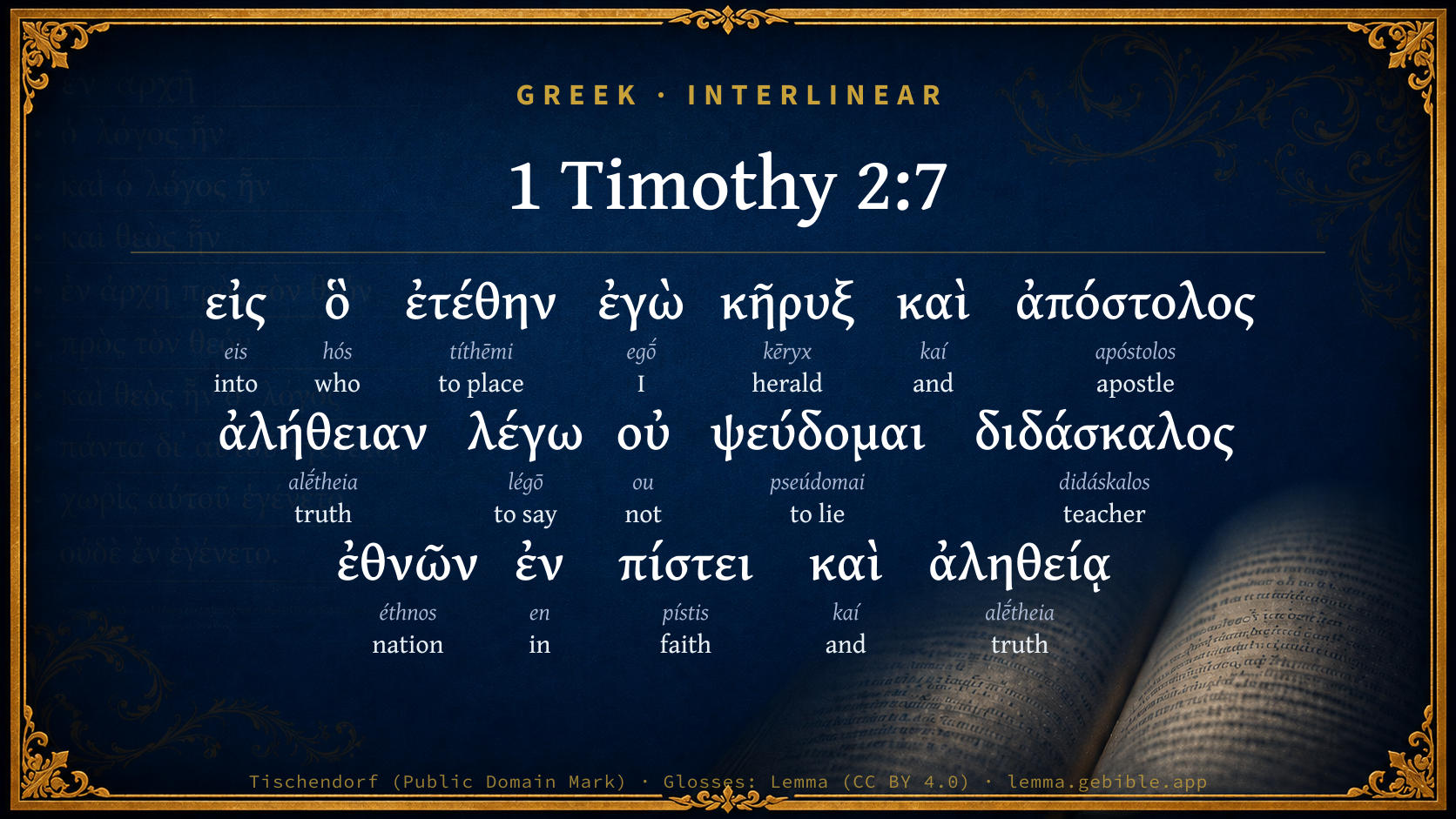
to which I was appointed a preacher and an apostle (I am telling the truth in Christ, not lying), a teacher of the Gentiles in faith and truth.
Download a study sheet
One document with this verse’s original text, its word-by-word gloss line, the meaning frame, cross-references with their text, attributed commentary, and full source and license credits — printable, and it pastes into notes with its structure intact.
This verse Autodidact and up
A passage Seminary Student
Up to 50 verses in one chapter. A passage sheet keeps up to 6 commentary sources and 12 cross-references per verse, in the order this page ranks them, and says so on the sheet whenever that leaves anything out. Ask for a single verse and you get the Autodidact verse sheet above.
Everything on this page stays free to read, with no account — the sheet is a download of what is already on screen, not access to it.
Compare translations 3
The same verse in 3 English versions, stacked beneath the original-language interlinear above. Click any original word for its lexicon entry.
Each is an independent rendering of the whole verse — the interlinear is not word-aligned to these translations.
Highlighted words mark where these versions differ — a whole-verse word diff, not a word-by-word alignment.
-
World English Bible Public Domain
to which I was appointed a preacher and an apostle (I am telling the truth in Christ, not lying), a teacher of the Gentiles in faith and truth.
-
King James Version Public Domain
Whereunto I am ordained a preacher, and an apostle, (I speak the truth in Christ, and lie not;) a teacher of the Gentiles in faith and verity.
-
unfoldingWord Literal Text CC BY-SA 4.0
for which I was made a herald and an apostle—I am speaking the truth in Christ, I am not lying—a teacher of the Gentiles in faith and truth.
unfoldingWord Literal Text — © unfoldingWord, licensed CC BY-SA 4.0. Word-aligned USFM3 via Door43 (git.door43.org/unfoldingWord/en_ult).
Show all 19 translations
Every available English version of this verse, each an independent rendering of the whole verse.
-
World English Bible Public Domain
to which I was appointed a preacher and an apostle (I am telling the truth in Christ, not lying), a teacher of the Gentiles in faith and truth.
-
Berean Standard Bible Public Domain
For this reason I was appointed as a preacher, an apostle, and a faithful and true teacher of the Gentiles. I am telling the truth; I am not lying about anything.
-
Majority Standard Bible Public Domain
For this reason I was appointed as a preacher, an apostle, and a faithful and true teacher of the Gentiles. I am telling the truth in Christ; I am not lying about anything.
-
King James Version Public Domain
Whereunto I am ordained a preacher, and an apostle, (I speak the truth in Christ, and lie not;) a teacher of the Gentiles in faith and verity.
-
American Standard Version (1901) Public Domain
whereunto I was appointed a preacher and an apostle (I speak the truth, I lie not), a teacher of the Gentiles in faith and truth.
-
Revised Version (1885) Public Domain
whereunto I was appointed a preacher and an apostle (I speak the truth, I lie not), a teacher of the Gentiles in faith and truth.
-
Geneva Bible (1599) Public Domain
Whereunto I am ordeined a preacher and an Apostle (I speake the trueth in Christ, and lie not) euen a teacher of the Gentiles in faith and veritie.
-
Douay-Rheims (1899) Public Domain
Whereunto I am appointed a preacher and an apostle, (I say the truth, I lie not,) a doctor of the Gentiles in faith and truth.
-
Young's Literal Translation Public Domain
in regard to which I was set a preacher and apostle -- truth I say in Christ, I do not lie -- a teacher of nations, in faith and truth.
-
Literal Standard Version CC BY-SA 4.0
in regard to which I was set a preacher and apostle—truth I say in Christ, I do not lie—a teacher of nations, in faith and truth.
-
Unlocked Literal Bible CC BY-SA 4.0
For this purpose, I myself, was made a herald and an apostle. I am telling the truth. I am not lying. I am a teacher of the Gentiles in faith and truth.
-
unfoldingWord Literal Text CC BY-SA 4.0
for which I was made a herald and an apostle—I am speaking the truth in Christ, I am not lying—a teacher of the Gentiles in faith and truth.
-
Darby Bible Public Domain
to which *I* have been appointed a herald and apostle, (I speak [the] truth, I do not lie,) a teacher of [the] nations in faith and truth.
-
World Messianic Bible Public Domain
to which I was appointed a proclaimer and an emissary—I am telling the truth in Messiah, not lying—a teacher of the Gentiles in faith and truth.
-
Webster's Bible Public Domain
For which I am ordained a preacher and an apostle, (I speak the truth in Christ, and lie not) a teacher of the Gentiles in faith and verity.
-
Free Bible Version CC BY-SA 4.0
I was appointed to share this message and be its messenger, a teacher to the foreigners about trusting God and the truth (I'm not lying, I'm telling the truth!)
-
Bible in Basic English Public Domain
And of this I became a preacher and an Apostle (what I say is true, not false,) and a teacher of the Gentiles in the true faith.
-
Text-Critical English NT CC BY 4.0
For this testimony I was appointed to be a preacher, an apostle, and a teacher of the Gentiles in faith and truth. (I am speaking the truth in Christ; I am not lying.)
-
Tyndale New Testament (1534) Public Domain
where vnto I am ordayned a preacher and an apostle: I tell the trueth in Christ and lye not beynge the teacher of the gentyls in fayth and veritie.
Literal Standard Version (2020), Covenant Press — licensed CC BY-SA 4.0. Text via the HelloAO Bible API (eBible.org). Unlocked Literal Bible (unfoldingWord) — licensed CC BY-SA 4.0. Text via the HelloAO Bible API (eBible.org). unfoldingWord Literal Text — © unfoldingWord, licensed CC BY-SA 4.0. Word-aligned USFM3 via Door43 (git.door43.org/unfoldingWord/en_ult). Free Bible Version, Dr. Jonathan Gallagher — licensed CC BY-SA 4.0. Text via the HelloAO Bible API (eBible.org).
Word by word
More ways to search: Search by grammar → Find every occurrence → Compare this word →
Practice this passage: Drill this verse → Learn its vocabulary →
- Appears 3× in the Greek New Testament
- First appears here
- Part of Speech
- Noun
- Case
- Nominative
- Number
- Singular
- Gender
- Masculine
Full Thayer's Definition
- εἰς eis G1519 “into” Preposition
- ὃ hós G3739 “who” Relative pronoun, Accusative, Singular, Neuter
- ἐτέθην títhēmi G5087 “to place” Verb, Aorist, Passive, Indicative, 1st person, Singular
- ἐγὼ egṓ G1473 “I” Personal pronoun, 1st person, Nominative, Singular
- κῆρυξ kēryx G2783 “herald” Noun, Nominative, Singular, Masculine
- καὶ kaí G2532 “and” Conjunction
- ἀπόστολος apóstolos G652 “apostle” Noun, Nominative, Singular, Masculine
- ἀλήθειαν alḗtheia G225 “truth” Noun, Accusative, Singular, Feminine
- λέγω légō G3004 “to say” Verb, Present, Active, Indicative, 1st person, Singular
- οὐ ou G3756 “not” Particle, Negative
- ψεύδομαι pseúdomai G5574 “to lie” Verb, Present, Middle or Passive deponent, Indicative, 1st person, Singular
- διδάσκαλος didáskalos G1320 “teacher” Noun, Nominative, Singular, Masculine
- ἐθνῶν éthnos G1484 “nation” Noun, Genitive, Plural, Neuter
- ἐν en G1722 “in” Preposition
- πίστει pístis G4102 “faith” Noun, Dative, Singular, Feminine
- καὶ kaí G2532 “and” Conjunction
- ἀληθείᾳ alḗtheia G225 “truth” Noun, Dative, Singular, Feminine
About this verse
These counts appear in no published source. They are computed here, from the morphology-tagged text and Lemma’s own curated glosses. What Lemma adds →
- 17
- words
- 15
- distinct lemmas
- Pauline Epistles
- section
Notable vocabulary
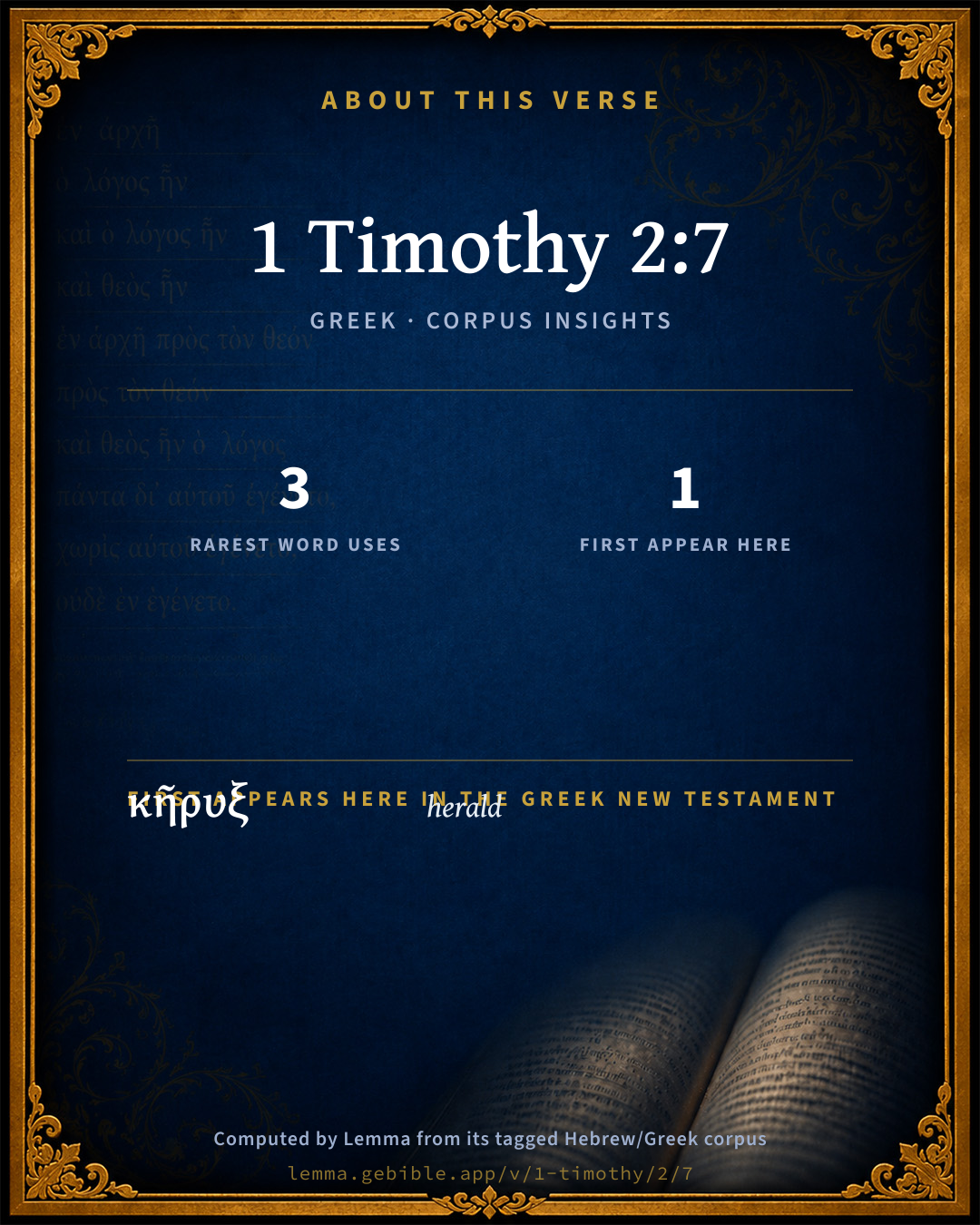
The rarest word here is κῆρυξ herald G2783 — appearing just 3 times in the whole Greek New Testament.
First appearance in Scripture
This word makes its first canonical appearance in the Greek New Testament here:
- κῆρυξ herald G2783
Shared distinctive vocabulary
κῆρυξ herald G2783 occurs in 3 verses of the Greek New Testament. Also found in:
Cross-references
26Topical passages linked to 1 Timothy 2:7 in the Treasury of Scripture Knowledge — connected by theme and wording, ordered by reader-vote popularity; previews shown in the World English Bible.
- Acts 9:15 But the Lord said to him, "Go your way, for he is my chosen vessel to bear my name before the nations and kings, and the children of Israel.
- 2 Timothy 1:11 For this, I was appointed as a preacher, an apostle, and a teacher of the Gentiles.
- Romans 9:1 I tell the truth in Christ. I am not lying, my conscience testifying with me in the Holy Spirit,
- Romans 15:16 that I should be a servant of Christ Jesus to the Gentiles, ministering as a priest the Gospel of God, that the offering up of the Gentiles might be made acceptable, sanctified by the Holy Spirit.
- Ephesians 3:7–8 of which I was made a servant, according to the gift of that grace of God which was given me according to the working of his power.
- Ecclesiastes 12:8–10 Vanity of vanities, says the Preacher; All is vanity!
- Romans 11:13 For I speak to you who are Gentiles. Since then as I am an apostle to Gentiles, I glorify my ministry;
- Galatians 1:16 to reveal his Son in me, that I might preach him among the Gentiles, I didn't immediately confer with flesh and blood,
- Galatians 1:20 Now about the things which I write to you, behold, before God, I'm not lying.
- Galatians 2:9 and when they perceived the grace that was given to me, James and Cephas and John, they who were reputed to be pillars, gave to me and Barnabas the right hand of fellowship, that we should go to the Gentiles, and they to the circumcision.
- Psalms 111:7 The works of his hands are truth and justice. All his precepts are sure.
- Ecclesiastes 1:1–2 The words of the Preacher, the son of David, king in Jerusalem:
- Ecclesiastes 1:12 I, the Preacher, was king over Israel in Jerusalem.
- Ecclesiastes 7:27 Behold, this have I found, says the Preacher, one to another, to find out the scheme;
- John 7:35 The Jews therefore said among themselves, "Where will this man go that we won't find him? Will he go to the Dispersion among the Greeks, and teach the Greeks?
- Acts 14:27 When they had arrived, and had gathered the assembly together, they reported all the things that God had done with them, and that he had opened a door of faith to the Gentiles.
- Acts 22:21 "He said to me, 'Depart, for I will send you out far from here to the Gentiles.'"
- Acts 26:20 but declared first to them of Damascus, at Jerusalem, and throughout all the country of Judea, and also to the Gentiles, that they should repent and turn to God, doing works worthy of repentance.
- Romans 10:14 How then will they call on him in whom they have not believed? How will they believe in him whom they have not heard? How will they hear without a preacher?
- 2 Corinthians 11:31 The God and Father of the Lord Jesus Christ, he who is blessed forevermore, knows that I don't lie.
- Galatians 3:9 So then, those who are of faith are blessed with the faithful Abraham.
- 1 Timothy 1:11–12 according to the Gospel of the glory of the blessed God, which was committed to my trust.
- 2 Peter 2:5 and didn't spare the ancient world, but preserved Noah with seven others, a preacher of righteousness, when he brought a flood on the world of the ungodly;
- Acts 26:17–18 delivering you from the people, and from the Gentiles, to whom I send you,
- Romans 1:9 For God is my witness, whom I serve in my spirit in the Gospel of his Son, how unceasingly I make mention of you always in my prayers,
- Galatians 2:16 yet knowing that a man is not justified by the works of the law but through the faith of Jesus Christ, even we believed in Christ Jesus, that we might be justified by faith in Christ, and not by the works of the law, because no flesh will be justified by the works of the law.
Cross-references courtesy of OpenBible.info (CC BY 4.0).
Where the printed editions differ
1 variantPlaces in this verse where the major printed Greek editions disagree on the wording in a way that affects the translation — a comparison of editions, not a manuscript-by-manuscript collation. The editions are the modern critical texts (Nestlé-Aland 28/27, SBL, Westcott-Hort, Tregelles, Tyndale House) and the traditional texts behind the KJV (the Textus Receptus and the Byzantine/Majority text). It is not a claim about which reading is original.
-
Extra text
ἐν Χριστῷ,
“in Christ”
In TRByz Not in NA28NA27TynSBLWHTregἐν Χριστῷ, (en Christō) 'in Christ' is only in traditional manuscripts (TR+Byz)
Textual data: Translators Amalgamated Greek New Testament (STEPBible TAGNT) · CC BY 4.0.
Lesson kit
Teaching starters — assembled from the data on this page, not authored interpretation. Every prompt links to the verse data it draws on. Edit before teaching.
1 Timothy, in the Pauline Epistles, opens this verse with 17 words (15 distinct Greek lemmas). Its most distinctive word is kēryx (“herald”). A historical commentator’s framing appears above. Read the whole chapter for the surrounding context.
Discussion questions
- How does “herald” (kēryx) shape what this verse is saying?
- The word “herald” first appears here in Scripture. What is being introduced at this debut?
- 2 Timothy 1:11 shares the word «herald» with this verse. How do the two illuminate each other?
- “truth” occurs 2× in this one verse. What is the effect of the repetition?
- The translations on this page render this verse differently — a whole-verse word diff, not a word-by-word alignment. What might account for the different wordings?
- Reading how Albert Barnes' Notes on the Bible and Matthew Poole's English Annotations read this verse, where do the two commentators agree and where do they part?
Things to notice
- 1 word makes its first canonical appearance in Scripture here.
- These translations choose different wording for 16 words in this verse.
- “truth” occurs 2× in this single verse.
- 15 distinct Greek lemmas span 17 words in this verse.
Commentary
Notes on 1 Timothy 2:7 from classic Christian and Jewish commentators (each source and its license shown beneath its notes). The classic Christian expositions comment on the surrounding passage and are grouped to its opening verse, so a note may address several verses; the Jewish commentaries on the Tanakh (Rashi and others) are per-verse, so they appear only where the commentator wrote on this verse.
Lemma curates 59 commentaries, every one of them public domain or Creative Commons licensed, each selected and text-cleaned for this edition rather than reprinted as found. About our sources →
Albert Barnes' Notes on the Bible
Albert Barnes' Notes on the Bible (1834–1885) — public domain. Text from a community e-Sword/MySword module.
Matthew Poole's English Annotations
Matthew Poole's English Annotations on the Holy Bible (1683–1685) — public domain. Text from a community e-Sword/MySword module.
Bengel's Gnomon
Johann Albrecht Bengel
Bengel's Gnomon of the New Testament — English translation (T&T Clark, Edinburgh, 1860) — public domain. Text from a community e-Sword module.
Meyer's Critical & Exegetical Commentary
Heinrich August Wilhelm Meyer
Meyer — Critical and Exegetical Commentary on the New Testament — English translation by Peter Christie, edited by Frederick Crombie (T&T Clark, 1880) — public domain. Text from a community e-Sword module.
Expositor's Greek Testament
ed. W. Robertson Nicoll
The Expositor's Greek Testament, edited by W. Robertson Nicoll (1897–1910) — public domain. Text from a community e-Sword module.
Cambridge Greek Testament for Schools and Colleges
Cambridge Greek Testament for Schools and Colleges (Cambridge University Press, 1896; 21 vols, various authors incl. Carr, Maclear, Plummer, Farrar, Lumby, Moule, M. R. James, Simcox) — public domain. Text from a community e-Sword module.
Geneva Bible (1599)
Geneva Bible translators
Geneva Bible (1599) marginal notes — public domain. Text via Bolls.life.
Jamieson, Fausset & Brown
Robert Jamieson, A. R. Fausset & David Brown
Jamieson, Fausset & Brown — Commentary Critical and Explanatory on the Whole Bible (1871) — public domain (CC PDM 1.0). Text via the HelloAO Bible API.
Adam Clarke's Commentary
Adam Clarke's Commentary on the Bible (1810–1826) — public domain. Text from a community e-Sword/MySword module.
John Calvin's Commentaries
John Calvin's Commentaries (1540-1563) — public domain. Text from the Calvin Translation Society English edition (1840s-50s) via the Christian Classics Ethereal Library (ccel.org). Calvin's coverage is partial (roughly two-thirds of the Bible); uncommented books and verses are honest gaps, never fabricated. The 19th-century editor's footnotes and remarks are omitted so the notes are faithfully Calvin's own voice.
Ellicott's Commentary for English Readers
A Bible Commentary for English Readers, edited by Charles John Ellicott (1878–1897) — public domain. Text from a community e-Sword module.
The Cambridge Bible for Schools and Colleges
gen. ed. J. J. S. Perowne
The Cambridge Bible for Schools and Colleges (gen. ed. J. J. S. Perowne; Cambridge University Press, 1878–1918) — public domain. Text from a community e-Sword module.
John Gill's Exposition
John Gill's Exposition of the Whole Bible (1746–1763) — public domain (CC PDM 1.0). Text via the HelloAO Bible API.
Trapp's Complete Commentary
John Trapp
John Trapp, A Commentary or Exposition upon All the Books of the Old and New Testament (1647–1656) — public domain. Text from a community e-Sword module.
Whedon's Commentary on the Bible
Daniel D. Whedon
Daniel D. Whedon (gen. ed.), Commentary on the Old and New Testaments (1874–1909) — public domain. Text from a community e-Sword module.
The Pulpit Commentary
The Pulpit Commentary (1880–1919), ed. H.D.M. Spence-Jones & Joseph S. Exell — public domain. Text from a community e-Sword module.
Fairbairn on Ezekiel, Jonah & the Pastoral Epistles
Patrick Fairbairn
Patrick Fairbairn — An Exposition of Ezekiel (1851), Jonah (1849), and The Pastoral Epistles (1874) — public domain. Text from a community e-Sword module.
Burkitt's Expository Notes on the New Testament
William Burkitt
William Burkitt's Expository Notes on the New Testament (1700–1703) — public domain. Text from a community e-Sword module.
The People's New Testament
B. W. Johnson
B. W. Johnson's The People's New Testament with Notes (1889–1891) — public domain. Electronic text from the Christian Classics Ethereal Library (CCEL) ThML edition.
Vincent's Word Studies in the New Testament
Marvin R. Vincent
Marvin R. Vincent, Word Studies in the New Testament (1887–1900) — public domain. Text from a community e-Sword/MySword module.