
Revelation 2:26

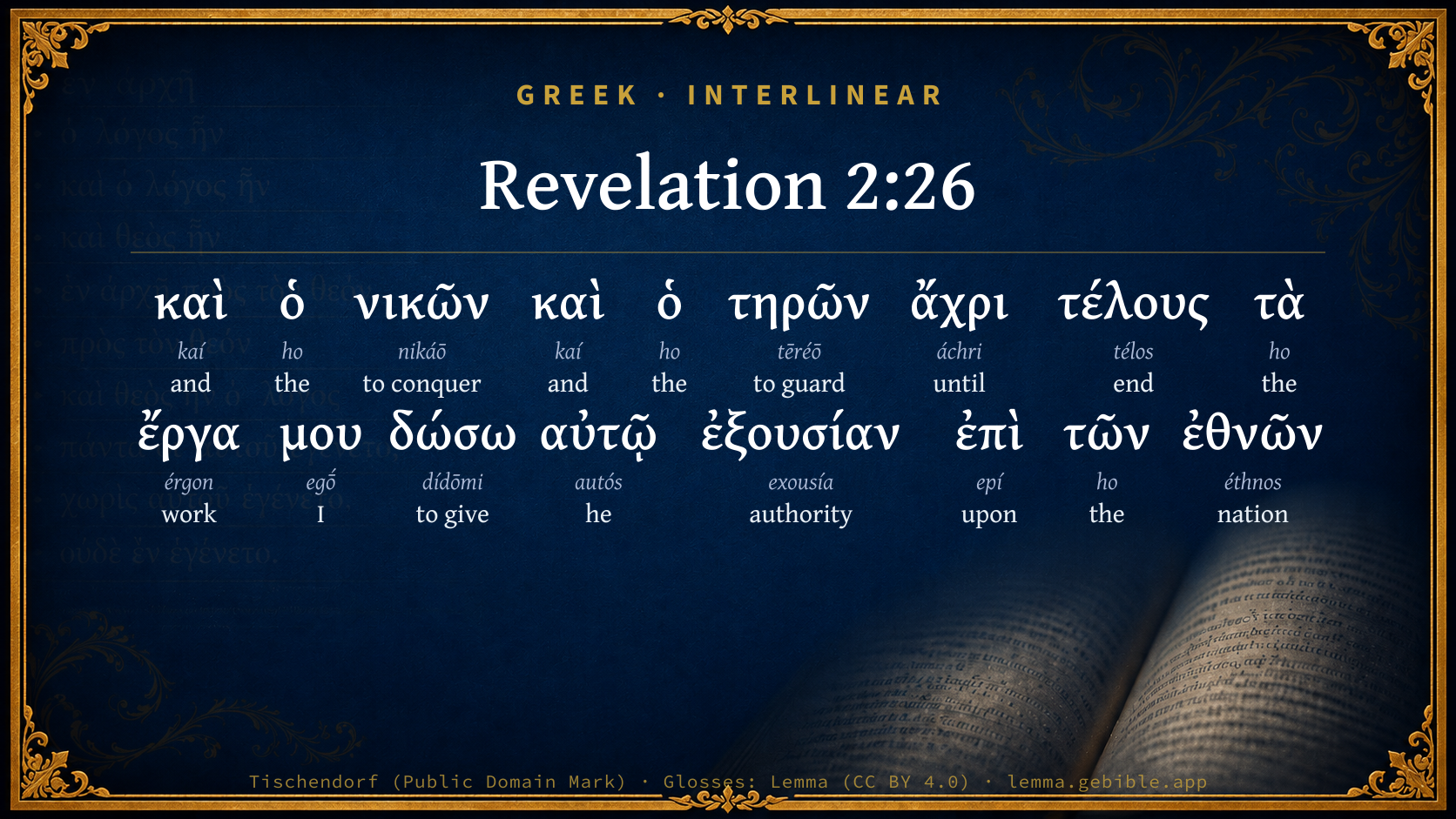
Greek (Tischendorf 8th ed.) Revelation 2:26 appears in the Greek New Testament. The text above is from the Tischendorf 8th edition. Each word links to its Strong’s number and a concise gloss. Click any word for its full Thayer’s Greek Lexicon entry.
Download image
Cite this verse

Revelation 2:26 (World English Bible). Public Domain. Lemma interlinear Bible study tool, https://lemma.gebible.app/v/revelation/2/26.

Show BibTeX & RIS
BibTeX
RIS
English Translation
He who overcomes, and he who keeps my works to the end, to him I will give authority over the nations.
World English Bible · Public Domain
Download a study sheet

One document with this verse’s original text, its word-by-word gloss line, the meaning frame, cross-references with their text, attributed commentary, and full source and license credits — printable, and it pastes into notes with its structure intact.

This verse Autodidact and up

Study sheet (.html) Plain text (.txt)

A passage Seminary Student

Up to 50 verses in one chapter. A passage sheet keeps up to 6 commentary sources and 12 cross-references per verse, in the order this page ranks them, and says so on the sheet whenever that leaves anything out. Ask for a single verse and you get the Autodidact verse sheet above.

Everything on this page stays free to read, with no account — the sheet is a download of what is already on screen, not access to it.

Want to remove ads? Support Godless Engineer
Compare translations 3

The same verse in 3 English versions, stacked beneath the original-language interlinear above. Click any original word for its lexicon entry.

Each is an independent rendering of the whole verse — the interlinear is not word-aligned to these translations.

Highlighted words mark where these versions differ — a whole-verse word diff, not a word-by-word alignment.

  • World English Bible Public Domain
    He who overcomes, and he who keeps my works to the end, to him I will give authority over the nations.
  • King James Version Public Domain
    And he that overcometh, and keepeth my works unto the end, to him will I give power over the nations:
  • unfoldingWord Literal Text CC BY-SA 4.0
    And the one conquering and the one keeping my works until the end, to him I will give authority over the nations.

unfoldingWord Literal Text — © unfoldingWord, licensed CC BY-SA 4.0. Word-aligned USFM3 via Door43 (git.door43.org/unfoldingWord/en_ult).

Versions to compare (up to 4)

3 of 4 selected

Show all 19 translations

Every available English version of this verse, each an independent rendering of the whole verse.

  • World English Bible Public Domain
    He who overcomes, and he who keeps my works to the end, to him I will give authority over the nations.
  • Berean Standard Bible Public Domain
    And to the one who overcomes and continues in My work until the end, I will give authority over the nations.
  • Majority Standard Bible Public Domain
    And to the one who overcomes and continues in My work until the end, I will give authority over the nations.
  • King James Version Public Domain
    And he that overcometh, and keepeth my works unto the end, to him will I give power over the nations:
  • American Standard Version (1901) Public Domain
    And he that overcometh, and he that keepeth my works unto the end, to him will I give authority over the nations:
  • Revised Version (1885) Public Domain
    And he that overcometh, and he that keepeth my works unto the end, to him will I give authority over the nations:
  • Geneva Bible (1599) Public Domain
    For he that ouercommeth and keepeth my workes vnto the end, to him will I giue power ouer nations,
  • Douay-Rheims (1899) Public Domain
    And he that shall overcome, and keep my works unto the end, I will give him power over the nations.
  • Young's Literal Translation Public Domain
    and he who is overcoming, and who is keeping unto the end my works, I will give to him authority over the nations,
  • Literal Standard Version CC BY-SA 4.0
    and he who is overcoming, and who is keeping My works to the end, I will give to him authority over the nations,
  • Unlocked Literal Bible CC BY-SA 4.0
    The one who conquers and who does what I have done until the end, to him I will give authority over the nations.
  • unfoldingWord Literal Text CC BY-SA 4.0
    And the one conquering and the one keeping my works until the end, to him I will give authority over the nations.
  • Darby Bible Public Domain
    And he that overcomes, and he that keeps unto the end my works, to him will I give authority over the nations,
  • World Messianic Bible Public Domain
    He who overcomes, and he who keeps my works to the end, to him I will give authority over the nations.
  • Webster's Bible Public Domain
    And he that overcometh, and keepeth my works to the end, to him will I give power over the nations:
  • Free Bible Version CC BY-SA 4.0
    I will give authority over the nations to those who are victorious and who do what I say until the end.
  • Bible in Basic English Public Domain
    He who overcomes, and keeps my works to the end, to him I will give rule over the nations,
  • Text-Critical English NT CC BY 4.0
    To him who overcomes and keeps my works to the end, I will give authority over the nations,
  • Tyndale New Testament (1534) Public Domain
    and whosoever overcometh and kepeth my workes vnto the ende to hym will I geve power over nacions

Literal Standard Version (2020), Covenant Press — licensed CC BY-SA 4.0. Text via the HelloAO Bible API (eBible.org). Unlocked Literal Bible (unfoldingWord) — licensed CC BY-SA 4.0. Text via the HelloAO Bible API (eBible.org). unfoldingWord Literal Text — © unfoldingWord, licensed CC BY-SA 4.0. Word-aligned USFM3 via Door43 (git.door43.org/unfoldingWord/en_ult). Free Bible Version, Dr. Jonathan Gallagher — licensed CC BY-SA 4.0. Text via the HelloAO Bible API (eBible.org).

Word by word

More ways to search: Search by grammar → Find every occurrence → Compare this word →

Practice this passage: Drill this verse → Learn its vocabulary →

νικῶν
nikáō
G3528
“to conquer”
Verb, Present, Active, Participle, Nominative, Singular, Masculine
Part of Speech
Verb
Tense
Present
Voice
Active
Mood
Participle
Case
Nominative
Number
Singular
Gender
Masculine
Full Thayer's Definition

Origin: from G3529

TDNT: 19:42,6

1. to conquer a. to carry off the victory, come off victorious 1. of Christ, victorious over all His foes 2. of Christians, that hold fast their faith even unto death against the power of their foes, and temptations and persecutions 3. when one is arraigned or goes to law, to win the case, maintain one's cause
  1. καὶ kaí G2532 “and” Conjunction
  2. ὁ ho G3588 “the” Article, Nominative, Singular, Masculine
  3. καὶ kaí G2532 “and” Conjunction
  4. ὁ ho G3588 “the” Article, Nominative, Singular, Masculine
  5. τηρῶν tēréō G5083 “to guard” Verb, Present, Active, Participle, Nominative, Singular, Masculine
  6. ἄχρι áchri G891 “until” Adverb
  7. τέλους télos G5056 “end” Noun, Genitive, Singular, Neuter
  8. τὰ ho G3588 “the” Article, Accusative, Plural, Neuter
  9. ἔργα érgon G2041 “work” Noun, Accusative, Plural, Neuter
  10. μου egṓ G1473 “I” Personal pronoun, 1st person, Genitive, Singular
  11. δώσω dídōmi G1325 “to give” Verb, Future, Active, Indicative, 1st person, Singular
  12. αὐτῷ autós G846 “he” Personal pronoun, Dative, Singular, Masculine
  13. ἐξουσίαν exousía G1849 “authority” Noun, Accusative, Singular, Feminine
  14. ἐπὶ epí G1909 “upon” Preposition
  15. τῶν ho G3588 “the” Article, Genitive, Plural, Neuter
  16. ἐθνῶν éthnos G1484 “nation” Noun, Genitive, Plural, Neuter

About this verse

These counts appear in no published source. They are computed here, from the morphology-tagged text and Lemma’s own curated glosses. What Lemma adds →

17
words
13
distinct lemmas
Revelation
section

Shared distinctive vocabulary

νικῶν to conquer G3528 occurs in 24 verses of the Greek New Testament. Also found in:
Repetition

Words recur within this verse:

Cross-references

30

Topical passages linked to Revelation 2:26 in the Treasury of Scripture Knowledge — connected by theme and wording, ordered by reader-vote popularity; previews shown in the World English Bible.

  • Revelation 3:21 He who overcomes, I will give to him to sit down with me on my throne, as I also overcame, and sat down with my Father on his throne.
  • Daniel 7:27 The kingdom and the dominion, and the greatness of the kingdoms under the whole the sky, shall be given to the people of the saints of the Most High: his kingdom is an everlasting kingdom, and all dominions shall serve and obey him.
  • Psalms 2:8 Ask of me, and I will give the nations for your inheritance, The uttermost parts of the earth for your possession.
  • Revelation 2:7 He who has an ear, let him hear what the Spirit says to the assemblies. To him who overcomes I will give to eat of the tree of life, which is in the Paradise of my God.
  • Revelation 20:4 I saw thrones, and they sat on them, and judgment was given to them. I saw the souls of those who had been beheaded for the testimony of Jesus, and for the word of God, and such as didn't worship the beast nor his image, and didn't receive the mark on their forehead and on their hand. They lived, and reigned with Christ for the thousand years.
  • Revelation 22:5 There will be no night, and they need no lamp light; for the Lord God will illuminate them. They will reign forever and ever.
  • Matthew 24:13 But he who endures to the end, the same will be saved.
  • John 6:29 Jesus answered them, "This is the work of God, that you believe in him whom he has sent."
  • 1 John 5:5 Who is he who overcomes the world, but he who believes that Jesus is the Son of God?
  • Daniel 7:22 until the ancient of days came, and judgment was given to the saints of the Most High, and the time came that the saints possessed the kingdom.
  • Daniel 7:18 But the saints of the Most High shall receive the kingdom, and possess the kingdom forever, even forever and ever.
  • Revelation 2:11 He who has an ear, let him hear what the Spirit says to the assemblies. He who overcomes won't be harmed by the second death.
  • Romans 2:7 to those who by patience in well-doing seek for glory and honor and incorruptibility, eternal life;
  • Romans 8:37 No, in all these things, we are more than conquerors through him who loved us.
  • Hebrews 10:38–39 But the righteous will live by faith. If he shrinks back, my soul has no pleasure in him."
  • James 2:20 But do you want to know, vain man, that faith apart from works is dead?
  • 1 John 3:23 This is his commandment, that we should believe in the name of his Son, Jesus Christ, and love one another, even as he commanded.
  • Revelation 2:17 He who has an ear, let him hear what the Spirit says to the assemblies. To him who overcomes, to him I will give of the hidden manna, and I will give him a white stone, and on the stone a new name written, which no one knows but he who receives it.
  • Revelation 3:12 He who overcomes, I will make him a pillar in the temple of my God, and he will go out from there no more. I will write on him the name of my God, and the name of the city of my God, the new Jerusalem, which comes down out of heaven from my God, and my own new name.
  • Psalms 49:14 They are appointed as a flock for Sheol. Death shall be their shepherd. The upright shall have dominion over them in the morning. Their beauty shall decay in Sheol, Far from their mansion.
  • Matthew 19:28 Jesus said to them, "Most assuredly I tell you that you who have followed me, in the regeneration when the Son of Man will sit on the throne of his glory, you also will sit on twelve thrones, judging the twelve tribes of Israel.
  • Luke 8:13–15 Those on the rock are they who, when they hear, receive the word with joy; but these have no root, who believe for a while, then fall away in time of temptation.
  • Luke 22:29–30 I confer on you a kingdom, even as my Father conferred on me,
  • John 8:31–32 Jesus therefore said to those Jews who had believed him, "If you remain in my word, then you are truly my disciples.
  • 1 Corinthians 6:3–4 Don't you know that we will judge angels? How much more, things that pertain to this life?
  • Hebrews 3:6 but Christ is faithful as a Son over his house; whose house we are, if we hold fast our confidence and the glorying of our hope firm to the end.
  • Revelation 21:7 He who overcomes, I will give him these things. I will be his God, and he will be my son.
  • 1 Thessalonians 3:5 For this cause I also, when I couldn't stand it any longer, sent that I might know your faith, for fear that by any means the tempter had tempted you, and our labor would have been in vain.
  • 1 John 2:19 They went out from us, but they didn't belong to us; for if they had belonged to us, they would have continued with us. But they left, that they might be revealed that none of them belong to us.
  • Revelation 3:5 He who overcomes will be arrayed in white garments, and I will in no way blot his name out of the book of life, and I will confess his name before my Father, and before his angels.

Cross-references courtesy of OpenBible.info (CC BY 4.0).

Commentary

Notes on Revelation 2:26 from classic Christian and Jewish commentators (each source and its license shown beneath its notes). The classic Christian expositions comment on the surrounding passage and are grouped to its opening verse, so a note may address several verses; the Jewish commentaries on the Tanakh (Rashi and others) are per-verse, so they appear only where the commentator wrote on this verse.

Lemma curates 59 commentaries, every one of them public domain or Creative Commons licensed, each selected and text-cleaned for this edition rather than reprinted as found. About our sources →

Joseph Benson's Commentary

Rev 2:26-29. And he that overcometh — That holds fast faith and a good conscience, notwithstanding the efforts of the enemies of my gospel to wrest them from him; and keepeth my works — Those which I have commanded to be done; unto the end — Of his time and trials; to him will I give power over the nations — That is, I will give him to share with me in that glorious victory which the Father hath promised me over all the nations which as yet resist me, Psa 2:8-9. This, says Doddridge, appears to be intended of that “final triumph of Christ over his enemies in the last day, when he shall crush them all to utter and irrecoverable ruin, and when all his saints, raised from the dead, and clothed with robes of glory, shall sit down with them on his throne, and constitute that illustrious body which in and with their exalted Head, shall subdue every opposing power.” And he shall rule them — That is, shall share with me when I do this; with a rod of iron — With irresistible power, employed on those only who will not otherwise submit; who will hereby be dashed in pieces, totally conquered. And I will give him the morning-star — Thou, O Jesus, art the Morning-Star! O give thyself to me! Then will I desire no sun, only thee, who art the sun also. He whom this Star enlightens, has always morning and no evening. The duties and promises here answer each other: the valiant conqueror has power over the stubborn nations. And he that, after having conquered his enemies, keeps the words of Christ to the end, shall have the morning-star — an unspeakable brightness and peaceable dominion in him.

Joseph Benson's Commentary on the Old and New Testaments (1811–1818) — public domain. Text from a community e-Sword module.

MacLaren's Expositions of Holy Scripture

Alexander MacLaren

Revelation

IV.-THE VICTOR’S LIFE-POWER

Rev 2:26-28.

This promise to the victors in Thyatira differs from the preceding ones in several remarkable respects. If you will observe, the summons to give ear to ‘what the Spirit saith to the churches’ precedes the promises in the previous letters; here it follows that promise, and that order is observed in the three subsequent epistles. Now the structure of all these letters is too careful and artistic to allow of the supposition that the change is arbitrary or accidental. There must be some significance in it, but I do not profess to be ready with the explanation, and I prefer acknowledging perplexity to pretending enlightenment.

Then there is another remarkable peculiarity of this letter, viz., the expansion which is given to the designation of the victor as ‘He that overcometh and keepeth My works unto the end.’ Probably not unconnected with that expansion is the other peculiarity of the promise here, as compared with its precursors, viz., that they all regard simply the individual victor and promise to him ‘partaking of the tree of life’; a ‘crown of life’; immunity from ‘the second death’; ‘the hidden manna’; the ‘white stone’; and the ‘new name written’; which, like all the rest of the promises there, belonged to Himself alone; but here the field is widened, and we have others brought in on whom the victor is to exercise an influence. So, then, we enter upon a new phase of conceptions of that future life in these words, which not only dwell upon the sustenance, the repose, the glory that belong to the man himself, but look upon him as still an instrument in Christ’s hands, and an organ for carrying out, by His activities, Christ’s purposes in the world. So, then, I want you to look with me very simply at the ideas suggested by these words.

I. We have the victor’s authority.

Now the promise in my text is moulded by a remembrance of the great words of the second psalm. That psalm stands at the beginning of the Psalter as a kind of prelude; and in conjunction with its companion psalm, the first, is a summing up of the two great factors in the religious life of the Hebrews, viz., the blessedness in the keeping of the law, and the brightness of the hope of the Messiah. The psalm in question deals with that Messianic hope under the symbols of an earthly conquering monarch, and sets forth His dominion as established throughout the whole earth. And our letter brings this marvellous thought, that the spirits of just men made perfect are, somehow or other, associated with Him in that campaign of conquest.

Now, there is much in these words which, of course, it is idle for us to attempt to expand or expound. We can only wait, as we gaze upon the dim brightness, for experience to unlock the mystery. But there is also much which, if we will reverently ponder it, may stimulate us to brave conflict and persistent diligence in keeping Christ’s commandments. I, for my part, believe that Scripture is the only source of such knowledge as we have of the future life; and I believe, too, that the knowledge, such as it is, which we derive from Scripture is knowledge, and can be absolutely trusted. And so, though I abjure all attempts at rhetorical setting forth of the details of this mysterious symbol, I would lay it upon our hearts. It is not the less powerful because it is largely inconceivable; and the mystery, the darkness, the dimness, may be, and are part of the revelation and of the light. ‘There was the hiding of His power.’

And so, notice that whatever may be the specific contents of such a promise as this, the general form of it is in full harmony with the words of our Lord whilst He was on earth. Twice over, according to the gospel narratives - once in connection with Peter’s foolish question, What shall we have therefore? ‘and once in a still more sacred connection, at the table on the eve of Calvary - our Lord gave His trembling disciples this great promise:’ In the regeneration, when the Son of man shall sit on the throne of His glory, ye also shall sit on twelve thrones, judging the twelve tribes of Israel.’ Make all allowance that you like for the vesture of symbolism, the reality that lies beneath is that Jesus Christ, the truth, has pledged Himself to this, that His servants shall be associated with Him in the activity of His royalty. And the same great thought, which we only spoil when we try to tear apart the petals which remain closed until the sun shall open them, underlies the twin parables of the pounds and the talents, in regard to each of which we have, ‘Thou hast been faithful over a few things; I will make thee ruler over many things’; and, linked along with the promise of authority, the assurance of union with the Master, ‘Enter thou into the joy of thy Lord.’ So this book of the Revelation is only following in the footsteps and expanding the hints of Christ’s own teaching when it triumphs in the thought that we are made kings and priests to God; when it points onwards to a future wherein - we know not how, but we know, if we believe Him when He speaks, that it shall be so - they shall reign with Him for ever and ever.

My text adds further the image of a conquering campaign, of a sceptre of iron crushing down antagonism, of banded opposition broken into shivers, ‘as a potter’s vessel’ dashed upon a pavement of marble. And it says that in that final conflict and final conquest they that have passed into the rest of God, and have dwelt with Christ, shall be with Him, the armies of heaven following Him, clad in white raiment pure and glistening, and with Him subduing, ay! and converting into loyal love the antagonisms of earth. I abjure all attempts at millenarian prophecy, but I point to this, that all the New Testament teaching converges upon this one point, that the Christ who came to die shall come again to reign, and that He shall reign, and His servants with Him. That is enough; and that is all. For all the rest is conjecture and fancy and sometimes folly; and details minimize, and do not magnify, the great, undetailed, magnificent fact.

But all the other promises deal not with something in the remoter future, but with something that begins to take effect the moment the dust, and confusion, and garments rolled in blood, of the battlefield are swept away. At one instant the victors are fighting, at the next they are partaking of the Tree of Life, and on their locks lies the crown, and their happy lips are feeding upon ‘the hidden manna.’ And so, I think, that though, no doubt, the main stress of the promise of authority here points onwards, as our Lord Himself has taught us, to the time of ‘the regeneration, when the Son of man shall sit on the throne of His glory,’ the incidence of the promise is not to be exclusively confined thereto. There must be something in the present for the blessed dead, as well as for them in the future. And this is, that they are united with Jesus Christ in His present activities, and through Him, and in Him, and with Him, are even now serving Him. The servant, when he dies, and has been fitted for it, enters at once on his government of the ten cities.

Thus this promise of my text, in its deepest meaning, corresponds with the deepest needs of a man’s nature. For we can never be at rest unless we are at work; and a heaven of doing nothing is a heaven of ennui and weariness. Whatever sneers may have been cast at the Christian conception of the future, which find vindication, one is sorry to say, in many popular representations and sickly bits of hymns, the New Testament notion of what that future life is to be is noble with all energy, and fruitful with all activity, and strenuous with all service. This promise of my text comes in to supplement the three preceding. They were addressed to the legitimate, wearied longings for rest and fullness of satisfaction for oneself. This is addressed to the deeper and nobler longing for larger service. And the words of my text, whatever dim glory they may partially reveal, as accruing to the victor in the future, do declare that, when he passes beyond the grave, there will be waiting for him nobler work to do than any that he ever has done here.

But let us not forget that all this access of power and enlargement of opportunity are a consequence of Christ’s royalty and Christ’s conquering rule. That is to say, whatever we have in the future we have because we are knit to Him, and all our service there, as all our blessedness here, flows from our union with that Lord. So when He says, as in the words that I have already quoted, that His servants shall sit on thrones, He presents Himself as on the central throne. The authority of the steward over the ten cities is but a consequence of the servant’s entrance into the joy of the Lord. "Whatever there lies in the heavens, the germ of it all is this, that we are as Christ, so closely identified with Him that we are like Him, and share in all His possessions. He says to each of us, ‘All Mine is thine.’ He has taken part of our flesh and blood that we may share in His Spirit. The bride is endowed with the wealth of the bridegroom, and the crowns that are placed on the heads of the redeemed are the crown which Christ Himself has received as the reward of His Cross - ‘even as I have received of My Father.’

II. Note the victor’s starry splendor.

The second symbol of my text is difficult of interpretation, like the first: ‘I will give him the morning star.’ Now, no doubt, throughout Scripture a star is a symbol of royal dominion; and many would propose so to interpret it in the present case. But it seems to me that whilst that explanation - which makes the second part of our promise simply identical with the former, though under a different garb- does justice to one part of the symbol, it entirely omits the other. For the emphasis is here laid on ‘morning’ rather than on ‘star.’ It is ‘the morning star,’ not any star that blazes in the heavens, that is set forth here as a symbolical representation of the victor’s condition. Then another false scent, as it were, on which interpretations have gone, seems to me to be that, taking into account the fact that in the last chapter of the Revelation our Lord is Himself described as ‘the bright and morning star,’ they bring this promise down simply to mean, ‘I will give him Myself.’ Now though it is quite true that, in the deepest of all views, Jesus Christ Himself is the gift as well as the giver of all these sevenfold promises, yet the propriety of representation seems to me to forbid that He should here say, I will give them Myself!’ So I think we must fall back upon what any touch of poetic imagination would at once suggest to be the meaning of the promise, that it is the dawning splendor of that planet of hope and morning, the harbinger of day, which we are to lay hold of. Hebrew prophets, long before, had spoken of Lucifer, ‘light bringer’ ‘the son of the morning.’ Many a poet sang of it before Milton with his

‘Hesperus, that led the starry host, Rode brightest.’

So that I think we are just to lay hold of the thought that the starry splendor, the beauty and the lustre that will be poured upon the victor is that which is expressed by this symbol here. What that lustre will consist in it becomes us not to say. That future keeps its secret well, but that it shall be the perfecting of human nature up to the most exquisite and consummate height of which it is capable, and the enlargement of it beyond all that human experience here can conceive, we may peaceably anticipate and quietly trust.

Only, note the advance here on the previous promises is as conspicuous as in the former part of this great promise. There the Christian man’s influence and authority were set forth under the emblem of regal dominion. Here they are set forth under the emblem of lustrous splendor. It is the spectators that see the glory of the beam that comes from the star. And this promise, like the former, implies that in that future there will be a sphere in which perfected spirits may ray out their light, and where they may gladden and draw some eyes by their beams. I have no word to say as to the sky in which the rays of that star may shine, but I do feel that the very essence of this great representation is that Christian souls in the future, as in the present, will stand forth as the visible embodiments of the glory and lustre of the unseen God.

Further, remember that this image, like the former, traces up the lustre, as that traced the royalty, to communion with Christ, and to impartation from Him. ‘I will give him the morning star.’ We shall shine as the ‘brightness of the firmament, and as the stars for ever,’ as Daniel said - not by inherent but by reflected light. We are not suns, but planets, that move round the Sun of Righteousness, and flash with His beauty.

III. Lastly, mark the condition of the authority and of the lustre.

Here I would say a word about the remarkable expansion of the designation of the victor, to which I have already referred: ‘He that overcometh, and keepeth My works unto the end.’ We do not know why that expansion was put in, in reference to Thyatira only, but if you will glance over the letter you will see that there is more than usual about works - works to be repented of, or works which make the material of a final retribution and judgment.

Whatever may be the explanation of the expanded designation here, the lesson that it reads to us is a very significant and a very important one. Bring the metaphor of a victor down to the plain, hard, prose fact of doing Christ’s work right away to the end of life. Strip off the rhetoric of the fight, and it comes down to this - dogged, persistent obedience to Christ’s commandments. ‘He that keepeth My works’ does not appeal to the imagination as ‘He that overcometh’ does. But it is the explanation of the victory, and one that we all need to lay to heart.

‘My works ‘: that means the works that He enjoins. No doubt; but look at a verse before my text: ‘I will give unto every one of you according to your works.’ That is, the works that you do, and Christ’s works are not only those which He enjoys, but those of which He Himself set the pattern. He will ‘give according to works’; He will give authority; give the morning star. That is to say, the life which has been moulded according to Christ’s pattern and shaped in obedience to Christ’s commandments is the life which is capable of being granted participation in His dominion, and invested with reflected lustre. If here we do His work we shall be able to do it more fully yonder. ‘The works that I do shall he do also.’ That is the law for life - ay and it is the promise for heaven. ‘And greater works than these shall he do, because I go to My Father.’ When we have come to partial conformity with Him here we may hope - and only then have we the right to hope - for entire assimilation to Him hereafter. If here, from this dim spot which men call earth, and amid the confusion and dust and distances of this present life, we look to Him, and with unveiled faces behold Him, and here, in degree and part, are being changed from glory to glory, there He will turn His face upon us, and, beholding it, in righteousness, ‘we shall be satisfied when we awake with His likeness.’

Brethren, it is for us to choose whether we shall share in Christ’s dominion or be crushed by His iron sceptre. It is for us to choose whether, molding our lives after His will and pattern, we shall hereafter be made like Him in completeness. It is for us to choose whether, seeing Him here, we shall, when the brightness of His coming draws near, be flooded with gladness, or whether we shall call upon the rocks and the hills to cover us from the face of Him that sitteth on the Throne. Time is the mother of Eternity. To-day moulds to-morrow, and when all the to-days and to-morrows have become yesterdays, they will have determined our destiny, because they will have settled our characters. Let us keep Christ’s commandments, and we shall be invested with dignity and illuminated with glory, and entrusted to work, far beyond anything that we can conceive here, though, in their farthest reach and most dazzling brightness, these are but the continuation and the perfecting and the feeble beginnings of earthly conflict and service.

Alexander MacLaren, Expositions of Holy Scripture (1904–1910) — public domain. Text from a community e-Sword module.

Tyndale Open Study Notes

Tyndale Open Resources

2:26-28 Christ promises that those who are obedient will share authority with him, as symbolized by the iron rod that will smash the opposition like clay pots (quoting Ps 2:8-9; cp. Rev 12:5; 19:15). • The morning star is the planet Venus, which signals the coming of a new day. Here it refers to the promise of resurrection at Christ’s return (22:16; 2 Pet 1:19).

Tyndale Open Study Notes — © Tyndale Open Resources, licensed CC BY-SA 4.0. Text via the HelloAO Bible API.

Bengel's Gnomon

Johann Albrecht Bengel

Rev 2:26. Ὁ νικῶι—δώσω αὐτῷ) The things which you may suppose not to sound so well in Greek, will sound well when cast in Hebrew mould of thought. See instances, ch. Rev 6:8, Rev 7:2, Rev 9:12 (where the feminine is put for the neuter), 14, Rev 20:8. There is a very similar construction, Κύριος, ἐν οὐρανῷ ὁ θρόνος αὐτοῦ, Psa 11:4; and so Psa 57:5 (4), Psa 103:15.—ἐπὶ τῶν ἐθνῶν) Psa 2:8-9, αἴτησαι παρʼ ἐμοῦ, καὶ δώσω σοὶ ἔθνη τὴν κληρονομίαν σου, καὶ τὴν κατάσχεσίν σου τὰ πέρατα τῆς γῆς· ποιμανεῖς αὐτοὺς ἐν ῥάβδῳ σιδηρᾷ, ὡς σκεύη κεραμέως συντρίψεις αὐτούς.

Bengel's Gnomon of the New Testament — English translation (T&T Clark, Edinburgh, 1860) — public domain. Text from a community e-Sword module.

Meyer's Critical & Exegetical Commentary

Heinrich August Wilhelm Meyer

Rev_2:26-28. The promise to the victor.

The combination with Rev_2:25, indicated by the καὶ,[1279] lies in the fact that the victory is won by the τηρεῖν ἄχρι τέλους τὰ ἕργα μου, which in meaning is nothing else than the κρατεῖν commanded in Rev_2:25. With respect to the form of the expression, the τηρεῖν corresponds to the κρατεῖν, the ἄχρι τέλους to the ἄχρι οὗ ἂν ἥξω. The τὰ ἔργα μου find their explanation partly in opposition to the works of Jezebel,[1280] and partly in combination with Rev_2:25; they are such works as the Lord requires by the commandment which he imposes. Incorrectly, Grotius: Metonymy, for ἔργα are said to be precepts concerning works.

Concerning the broken construction of the sentence, Rev_2:26, as the αὐτῷ refers back to absolute preceding nominative ὁ νικῶν, κ.τ.λ., cf. Winer, pp. 170, 533.

The substantial sense of the promise δώσω

πατρός μου is that the victor is to share in the work of establishing the βασιλεία[1281] at the coming of the Lord. For just as the Son has already received (εἰλ.) from the Father power over the heathen, that he breaks them like earthen vessels with a rod of iron,[1282] so also will they who believe in Jesus Christ be raised by him, their Mediator, through whom they have already at the present time the kingdom,[1283] to participation in the glory which then becomes manifest.[1284] The coming of the Lord completely and actually effects the victory over all that is hostile; and he who remains faithful until that coming will then receive as a reward the royal glory in its fuller development, whose possession in faith has already conditioned the victory over all temptations or persecutions on the part of the world. Incorrectly Grot., on ἐξουσ. ἐπὶ τ. ἐθν.: I will raise him to the grade of presbyter, that he may judge concerning those who live not in a Christian but a heathen way; and Rev_2:27 of excommunication.[1285] The conversion of the heathen, also, we must regard neither alone,[1286] nor with the addition of the idea of the future royal dominion.[1287]

ΠΟΙΜΑΝΕῖ[1288] according to the LXX., Psa_2:9, for תְּרֹעֵם (break), is interchanged with תִּרְעְת (feed).

In the epistle to the church at Thyatira, this promise has its reference to the opposition to the heathen libertinism of Jezebel and her party.

Κ. ΔΏΣΩ ΑὐΤῷ ΤῸΝ ἈΣΤ. Τ. ΠΡ., Rev_2:28, cannot be like ΘΉΣΩ ΑὐΤΌΝ, Κ.Τ.Λ.[1289] That the morning star which Christ will give to the victor is the glorious body refulgent with the endowment of brilliancy,[1290] is an entirely arbitrary assumption of exegetical helplessness; while still others have advanced the idea, with allusion to Isa_14:12, that by the morning star the Devil is to be understood,[1291] or the Babylonian, i.e., the most powerful king of the world.[1292] According to Rev_22:16, to understand Christ himself[1293] is impossible because of the ΔΏΣΩ, which makes us expect[1294] a gift of the Lord. According to the analogy of Dan_12:3, Mat_13:43, 1Co_15:40 sqq., the expression in general designates the bright glory,[1295] the heavenly ΔΌΞΑ,[1296] with which the victor is to be endowed, without regarding ἈΣΤΉΡ itself as used[1297] of nothing else than brilliancy and rays of the star.[1298] Yet it is difficult for the discourse to be in reference to a domination of the star, similar to that in what precedes.[1299] The bold poetical idea appears rather to be, that the victor beams in the brilliancy of the morning star, because he has the morning star in his possession, just as a precious stone adds its effulgence to those who wear it. [See Note XXXIV., p. 157.]

[1279] Cf. Bengel, De Wette, Hengstenb.

[1280] Rev_2:22. Eichh., Heinr., Ewald, etc.

[1281] Cf. Rev_19:15, Rev_12:5.

[1282] Cf. Psa_2:8-9.

[1283] Rev_1:6; Rev_1:9.

[1284] Rev_3:21, Rev_20:6.

[1285] ῥαβδ. σιδ. ═ word of God, a part of which is excommunication.

[1286] Cf. Primas, Beda, Alcas., who immediately regard the iron rod as a designation of the bishops crosier.

[1287] Cf. Ebrard.

[1288] Cf. Rev_12:5, Rev_19:15.

[1289] Eichh. Cf. also Heinr.

[1290] N. de Lyra. Cf. Rev_2:17.

[1291] Cf. Rom_16:20. Andr., Areth.

[1292] Züll.

[1293] Primas, Beda, Alcas., C. a Lap., Calov., Vitr., Wolf, Beng., Stern, Ebrard, Klief.

[1294] Rev_2:17; Rev_2:10.

[1295] Aretius.

[1296] De, Wette. Cf. also Hengstenb.

[1297] Ew. ii. wishes to insert the entire promise of Rev_2:28 into Rev_3:5, and then to interpret ἀστ. according to Rev_1:20.

[1298] Rev_12:1. Heinr., Ewald.

[1299] Cf. De Wette.

NOTES BY THE AMERICAN EDITOR

XXXIV. Rev_2:28. τὸν ἀστέρα τὸν πρωινόν

Luthardt, briefly: That the new day of Jesus Christ is to break upon him. So Stier does not approve of the application of the words, in this connection, to Christ himself, but finds in them first the messenger heralding the day, and then the beginning of participation in the heavenly kingdom. According to his scheme of interpretation, he finds the first realization of this in the Reformation. Tait: A share in my kingdom at its first manifestation. Plumptre, on the other hand: The fruition of his glorious presence.… When he gives that star, he gives himself (ch. Rev_22:16). The star had of old been the emblem of sovereignty; cf. Num_24:17; Mat_2:2. It was the symbol of sovereignty on its brighter and benignant side, and was, therefore, the fitting and necessary complement of the attributes which had gone before. The king came not only to judge and punish and destroy, but also to illumine and cheer (Luk_1:8).… The conqueror in the great strife should receive light in its fulness, and transmit that light to others (Dan_12:3).

Meyer — Critical and Exegetical Commentary on the New Testament — English translation by Peter Christie, edited by Frederick Crombie (T&T Clark, 1880) — public domain. Text from a community e-Sword module.

Expositor's Greek Testament

ed. W. Robertson Nicoll

Rev 2:26 . Triumph here consists in unflagging attention to the duties of a Christian vocation. The ἔργα are (Rev 14:12 , Rev 19:8 ) the normal activities of this calling, viewed as the outcome of a personal relation to Jesus; they are “his,” as commanded by him and executed in his strength. The general idea of this and the following verse is that the only irresistible force is the force of a life which is able to resist seduction and compromise, because it holds to faith and purity. The promise of reward, preceding (as in Rev 3:5 ; Rev 3:12 ; Rev 3:21 ) the appeal for attention, is couched in terms of messianic conquest (from Psa 2:8-9 ). In a more or less figurative form, the rule of the saints, a cherished hope of Jewish eschatology, had its own attraction for some circles of early Christianity (see on Rev 5:10 and 1Co 6:3 ; and for ῥάβδῳ , the well-known flail wielded by Horus, the Egyptian god of requital or warfare): evidently it appealed to their eagerness for a righting of present wrongs and a reversal of the immoral sway of captain ill over captive good. The ἐξουσία ἐπὶ τῶν ἐθνῶν (by which they are not governed but shivered in irreparable ruin; cf. Isa 30:14 , Jer 19:11 ) is defined with ferocious detail in 27; the whole description is modelled on a traditionally messianic application of (LXX) Psa 2:8-9 . For the shepherd’s staff as a royal sceptre see E. Bi. 4317. ὡς κἀγὼ κ . τ . λ ., God, Christ, and the individual Christian as in Rev 3:21 (Joh 17:16-22 ). “Illud ὡς aliquam similitudinem, non paritatem significat” (Rosenmüller). Joh 21:15-17 is not “a deliberate correction of this terrible sentence” (Selwyn, 195), but the mature expression of Christian solicitude in a different province, from which messianic incongruities have been wholly purged.

The Expositor's Greek Testament, edited by W. Robertson Nicoll (1897–1910) — public domain. Text from a community e-Sword module.

Geneva Bible (1599)

Geneva Bible translators

The conclusion, wherein Christ assureth unto his servants the communion of his Kingdom and glory, in this verse and the next following, and commandeth an holy attention in the last verse.

That is, I will make him a King by communion with me, and my fellow heir, as it is promised, Matt. 19:28 and 25:34; Rom. 8:17 and 1 Cor. 6:3; Eph. 2:6 and 1 Tim. 2:12.

Geneva Bible (1599) marginal notes — public domain. Text via Bolls.life.

Jamieson, Fausset & Brown

Robert Jamieson, A. R. Fausset & David Brown

And--implying the close connection of the promise to the conqueror that follows, with the preceding exhortation, Rev 2:25.

and keepeth--Greek, "and he that keepeth." Compare the same word in the passage already alluded to by the Lord, Act 15:28-29, end.

my works--in contrast to "her (English Version, 'their') works" (Rev 2:22). The works which I command and which are the fruit of My Spirit.

unto the end-- (Mat 24:13). The image is perhaps from the race, wherein it is not enough to enter the lists, but the runner must persevere to the end.

give power--Greek, "authority."

over the nations--at Christ's coming the saints shall possess the kingdom "under the whole heaven"; therefore over this earth; compare Luk 19:17, "have thou authority [the same word as here] over ten cities."

Jamieson, Fausset & Brown — Commentary Critical and Explanatory on the Whole Bible (1871) — public domain (CC PDM 1.0). Text via the HelloAO Bible API.

Adam Clarke's Commentary

Verse 26. Power over the nations] Every witness of Christ has power to confute and confound all the false doctrines and maxims of the nations of the world, for Christianity shall at last rule over all; the kingdom of Christ will come, and the kingdoms of this world become the kingdoms of our God and of his Christ.

Adam Clarke's Commentary on the Bible (1810–1826) — public domain. Text from a community e-Sword/MySword module.

Ellicott's Commentary for English Readers

(26, 27) Power (or, authority) over the nations: and he shall rule them (or, shepherd them) with a rod of iron; as the vessels of a potter shall they be broken to shivers.—The promise is of authority (“the might of right, not the right of might”) to share in the shepherd-like sovereignty of the anointed King. (Comp. the Messianic prophecy of Psalms 2) Those who refused to stoop to the customs around them, and to gain influence by crushing or ignoring their convictions—those who, like their Master, refused to win power by doing homage to wrong (Mat_4:8-10), would share the nobler sway which He now established. Wherever the Church has illegitimately grasped at power, she has lost it. “The wretched power which she had wrenched and stolen from the nations has been turned against her; she has been obliged to crouch to them, and beg their help, and they have justly spurned her. She has chosen to exalt herself like Lucifer, and she has fallen like Lucifer. If she had trusted her Lord, He would have given her the morning star. She would have derived from Him what she claimed independently of Him. She would have dispensed light to the world.”

A Bible Commentary for English Readers, edited by Charles John Ellicott (1878–1897) — public domain. Text from a community e-Sword module.

The Cambridge Bible for Schools and Colleges

gen. ed. J. J. S. Perowne

26. And he that overcometh, &c.] Literally, And he that overcometh, and he that keepeth, &c.

my works] “Such works as I do” is rather the sense than “such as I approve.” Cf. Joh_14:12, “The works that I do shall he do also.”

The Cambridge Bible for Schools and Colleges (gen. ed. J. J. S. Perowne; Cambridge University Press, 1878–1918) — public domain. Text from a community e-Sword module.

John Gill's Exposition

And he that overcometh,.... Jezebel and her idolatries, her children, and all that commit adultery with her; such as are not drawn into the same evil practices with them, but bravely stand their ground against the Romish antichrist and his followers, and bear their testimony against his impious doctrines and idolatrous practices:

and keepeth my works unto the end; either of life, or of this church state, or of time, when Christ will personally appear, even at the end of the world; and by his works are meant, not the works which were done by him, as his miracles and works of mercy to the souls and bodies of men, and works of righteousness in obedience to the law, and the work of redemption and salvation; though these are works to be observed, and kept in view, and to be preserved in memory, and for the encouragement of faith and hope; but the works which are commanded, and required by Christ to be done by his people; as the public work of the ministry, by the preachers of the Gospel; and every private work, both internal and external, as the work of faith, the labour of love, and every act of obedience, which is constantly to be discharged. The Arabic version reads, "and keepeth my words and my works"; things both relating to doctrine and practice:

to him will I give power over the nations; or Gentiles, the Papists; so called because of the Pagan notions and worship introduced by them; and because they consist of many nations, tongues, and people, who are deceived, and drawn into idolatry by them: and this power over them may be understood in a spiritual sense, through the preaching of the Gospel, which being attended with the power of God, is the means of converting sinners, and so of weakening the kingdom of Satan, and of antichrist; and which had its fulfilment, at least in part, at the time of the Reformation, and onward, and will have still a greater accomplishment in the spiritual reign of Christ and his people, under the Philadelphian church state; and it may also design the temporal power which the saints shall have over antichrist, when they shall take away his dominion, and consume and destroy it, and the kingdom and the dominion under the whole heaven shall be given to the saints of the most High; Dan 7:25.

John Gill's Exposition of the Whole Bible (1746–1763) — public domain (CC PDM 1.0). Text via the HelloAO Bible API.

Trapp's Complete Commentary

John Trapp

26 And he that overcometh, and keepeth my works unto the end, to him will I give power over the nations:

Ver. 26. And keepeth my works] In opposition to Jezebel’s works, q.d. that keepeth himself unspotted from the world, that foul lust that lieth in that wicked one, 1Jn 5:19.

John Trapp, A Commentary or Exposition upon All the Books of the Old and New Testament (1647–1656) — public domain. Text from a community e-Sword module.

Albert Barnes' Notes on the Bible

And he that overcometh - notes on Rev 2:7.

And keepeth my works unto the end - The works that I command and that I require, to the end of his life. Compare Joh 13:1.

To him will I give power over the nations - The evident meaning of what is said here, and in the next verse, is, that in accordance with the uniform promise made to the redeemed in the New Testament, they would partake of the final triumph anal glory of the Saviour, and be associated with him. It is not said that they would have exclusive power over the nations, or that they would hold offices of trust under him during a personal reign on the earth; but the meaning is, that they would be associated with him in his future glory. Compare the Rom 8:17 note; 1Co 6:2-3 notes.

Albert Barnes' Notes on the Bible (1834–1885) — public domain. Text from a community e-Sword/MySword module.

Matthew Poole's English Annotations

And he that overcometh, and keepeth my works unto the end: See Poole on "Rev 2:7", See Poole on "Rev 2:11", See Poole on "Rev 2:17". Overcoming is here expounded by keeping Christ’s works; that is, either the works by him commanded, or walking as he walked, and persevering therein to the end of his or their lives.

To him will I give power over the nations; either to judge those who live heathenish lives; or to convert nations to the faith; or, which is most probable, he shall sit with me upon a throne in the day of judgment, Mat 19:28, and judge the world, 1Co 6:2.

Matthew Poole's English Annotations on the Holy Bible (1683–1685) — public domain. Text from a community e-Sword/MySword module.

Whedon's Commentary on the Bible

Daniel D. Whedon

26. Unto the end—Of his life trial.

Power over the nations— Identification with the Son of God, who is heir of all the promises of the second psalm.

Daniel D. Whedon (gen. ed.), Commentary on the Old and New Testaments (1874–1909) — public domain. Text from a community e-Sword module.

The Pulpit Commentary

And he that overcometh. The usual promise (vers. 7, 11, 17 Rev_3:5, Rev_3:12, Rev_3:21) is here closely connected with the charge which immediately precedes. In this and in the remaining three epistles the proclamation, "He that hath an ear," etc., follows instead of preceding the promise. Keepeth my works. This is a phrase thoroughly characteristic of St. John"s style; compare for this use of "keep," Rev_1:3 Rev_3:3, Rev_3:8, Rev_3:10, etc.; Joh_8:51, Joh_8:52, 55 9:16 14:15, 21, 23, 24, etc.; 1Jn_2:3, 1Jn_2:4, 5 3:22, 24, etc.; and for "works," in the sense of works which Christ does or approves, comp. Rev 15:3Jo Rev 6:28, 29 7:3, 21 11:3, 4, etc. "My works" here are in marked contrast to "her works" in ver. 22. "He that overcometh, and he that keepeth" is a nominativus pendens; and such constructions are specially frequent in St. John. (comp. Rev_3:12, 21Jo 6:39 7:38 15:2 17:2 1Jn_2:24, 1Jn_2:27) Links of connexion between the Revelation and the Gospel or Epistles of St. John should be carefully noted. The phrase for "unto the end" (acritelouv) occurs only here and Heb_6:11; but comp. Heb_3:6, 14 1Co_1:8. "Unto the end" (eiv telov) in Joh 13. I probably means "to the uttermost," not "to the end of life." Authority over the nations. "Authority" is better than "power" for exousia , not merely as implying that the power is rightly held and exercised, but also to mark the parallel with "Have thou authority over ten cities". (Luk_19:17; comp. Mat_21:23, Mat_21:24, 27 Act_9:14 Act_26:10)

The Pulpit Commentary (1880–1919), ed. H.D.M. Spence-Jones & Joseph S. Exell — public domain. Text from a community e-Sword module.

John Wesley's Explanatory Notes

By works - Those which I have commanded. To him will I give power over the nations - That is, I will give him to share with me in that glorious victory which the Father hath promised me over all the nations who as yet resist me, Psalm ii, 8, 9.

John Wesley, Explanatory Notes Upon the Whole Bible (1754–1765) — public domain. Text via the GEBible commentary corpus.

The People's New Testament

B. W. Johnson

26. Keepeth my works unto the end. Until death. I will give power over the nations. In the coming period when Christ shall rule all kingdoms the saints who have endured shall share his authority.

B. W. Johnson's The People's New Testament with Notes (1889–1891) — public domain. Electronic text from the Christian Classics Ethereal Library (CCEL) ThML edition.

unfoldingWord translationNotes

Door43 World Missions Community

The one who conquers

This refers anyone who conquers. See how you translated this in Revelation 2:7. AT: "Anyone who resists evil" or "The person who does not agree to do evil" (See: Generic Noun Phrases)

He will rule ... break them into pieces

This is a prophecy from the Old Testament about a king of Israel, but Jesus applied it here to those to whom he gives authority over the nations.

He will rule them with an iron rod

Ruling harshly is spoken of as ruling with an iron rod. AT: "He will rule them harshly as if striking them with an iron stick" (See: Metaphor)

like clay jars he will break them into pieces

Breaking them to pieces is an image that represents either 1) destroying evildoers or 2) defeating enemies. AT: "He will defeat his enemies completely as if breaking clay jars into pieces" (See: Simile)

Just as I have received from my Father

Some languages may need to tell what was received. Possible meanings are 1) "Just as I have received authority from my Father" or 2) "Just as I have received the morning star from my Father." (See: Assumed Knowledge and Implicit Information)

my Father

This is an important title for God that describes the relationship between God and Jesus. (See: Translating Son and Father)

I will also give him

Here "him" refers to the one who conquers.

morning star

This is a bright star that sometimes appears early in the morning just before dawn. It was a symbol of victory. (See: Symbolic Language)

Let the one who has an ear listen

Being willing to listen is spoken of as having an ear. See how you translated this in Revelation 2:7. AT: "Let the one who is willing to listen, listen" or "If you are willing, listen" (See: Metaphor)

translationWords

authority

nation

rod

God the Father

Holy Spirit

unfoldingWord translationNotes — © Distant Shores Media and the Door43 World Missions Community, licensed CC BY-SA 4.0. Source: git.door43.org/Door43/en_tn.

Cambridge Greek Testament for Schools and Colleges

26. καὶ ὁ νικῶν καὶ ὁ τηρῶν. “He that overcometh and he that keepeth” are one; in most parts of the New Testament there would only be one article. This is the only passage where the promise to him that overcometh is introduced by καί. Here and Rev 3:12 and Rev 3:21 the writer begins with a nominative which has no regular construction.

τὰ ἔργα μου. “Such works as I do” is the sense, rather than “such as I approve.” Cf. Joh 14:12 “the works that I do shall he do also.”

Cambridge Greek Testament for Schools and Colleges (Cambridge University Press, 1896; 21 vols, various authors incl. Carr, Maclear, Plummer, Farrar, Lumby, Moule, M. R. James, Simcox) — public domain. Text from a community e-Sword module.

Alford’s Greek Testament

Henry Alford

26.] And (the announcement of reward to the conqueror now first precedes the proclamation to hear what the Spirit saith to the churches: and is joined, here alone, by καί (to the preceding portion of the Epistle; being indeed more closely connected with it in this case than in any of the others; see below) he that conquereth and he that (by the second ὁ, this καί is precluded from being taken as introducing a clause merely epexegetical of νικῶν, as Düsterd., al. Rather must we say, that by it ὁ τηρῶν κ.τ.λ. is included in the class pointed out by ὁ νικῶν) keepeth to the end (it is remarkable that immediately after the words, so pointedly alluded to above, in the apostolic decree, Act 15:28, was added, ἐξ ὧν διατηροῦντες ἑαυτοὺς εὖ πράξετε) my works (contrast to τὰ ἔργα αὐτῆς, ver. 22: but extending beyond that contrast to a general and blessed truth. μου, gen. possess, which belong to Me, are the attributes of Myself and of mine), I will give to him authority over the nations (compare the ἴσθι ἐξουσίαν ἔχων ἐπάνω δέκα πόλεων in Luk 19:17, which is the reward of him who obeyed the command πραγματεύσασθε ἐν ᾧ ἔρχομαι. The authority here spoken of is that which shall be conferred on the saints when they shall inherit the earth, and reign with Christ in His Kingdom. It has been gradually realized, as the stone cut out without hands has broken in pieces other kingdoms; but shall only then find its entire fulfilment. Various insufficient meanings have been given: of which one of the most curious is that of Grot., “Evolvam ilium in gradum presbyteri, ut judicet de iis qui non christiane sed ἐθνικῶς vivunt;” who also understands ver. 27 below of excommunication, “per gladium hic intelligitur verbum Dei, cujus pars est et excommunicato”), and he shall govern (lit. “shepherd.” It is the LXX rendering of the Heb. תְּרֹעֵם, break in pieces, which they have taken as תִּרְעֵם, shepherd, in ref. Ps. The saying, as rendered by them, is sanctioned by being thrice quoted in this book, see reff.) them with (see 1Co 4:21) a rod of iron (a sceptre of severity: “inflexibili justitia,” as Lyra), as the vessels of pottery are broken up (συντρίβεται, are crushed, or shivered, or broken up: the συν gives the idea of the multitudinous fragments collapsing into an heap: the “broken to shivers” of the E.V. is very good), as I also have received from my Father (viz. in Psa 2:9, in which Psalm it is said υἱός μου εἶ σύ, ver. 7. The power there conferred on Me, I will delegate to my victorious servant; see Luk 22:29). And I will give to him the star of the morning (it is not easy to say what, in strict exactness, these words import. The interpretations given, even in the Catena, are very various and inconsistent. Andr. and Areth. understand it of the Lucifer of Isa 14:12, i. e. the devil, whom our Lord saw as lightning fall from heaven,—or, as there imported, the King of Babylon, the most powerful monarch on earth; so Züllig. Another meaning in the Catena is τὸν ὑπὸ τοῦ Πέτρου λεχθέντα φώσφορον ἐν ταῖς καρδίαις τῶν πιστῶν ἀνατέλλοντα, 2Pe 1:19. Victorinus says, “Primam resurrectionem scilicet promittit.” Primas., Bede, Alcas., Corn.-a-lap., Calov., Vitr., Wolf, Beng., Stern, Ebrard, understand Christ Himself, who, ch. 22:16, declares Himself to be ὁ ἀστὴρ ὁ λαμπρός, ὁ πρωϊνός: and doubtless, as has been before remarked on the fruit of the tree of life, ver. 7, and on the hidden manna, ver. 17, in the mystical sense, Christ Himself is the sum and inclusion of all Christ’s gifts: this truth serves to connect the symbolism of all these passages, but does not justify us in disturbing that of one by introducing that of another. Here the morning star clearly is not Christ Himself, the very terms of the sentence separating the two. Then again, we have Lyra,—“id est, corpus gloriosum dote claritatis refulgens,”—nearly the same words in which he before explained the white stone, ver. 17, only that there it was “charitatis:” Grot., “dabo et fulgorem, non qualis cuique stellæ, sed Luciferi, qui cæteras stellas multum vincit.” And this interpretation is probably near the mark. In Dan 12:3 we read that the righteous shall shine ὡς οἱ ἀστέρες, and in Mat 13:43 that they ἐκλάμψουσιν ὡς ὁ ἥλιος ἐν τῇ βασιλείᾳ τοῦ πατρὸς αὐτῶν. And in Pro 4:18 we read that “the path of the just is as the shining light that shineth more and more unto the perfect day.” Still, this interpretation does not quite satisfy the words δώσω αὐτῷ: unless indeed the poetic imagery be, that he is imagined as clad in the glory of that star, putting it on as a jewel, or as a glittering robe. De Wette supposes it is to be given to him as its ruler: but such an interpretation would lead into a wide field of speculation which does not seem to have been opened by Scripture, and is hardly required by the passage itself).

Henry Alford, The Greek Testament (1849–1861) — public domain. Text from a community e-Sword module.

Lesson kit

Teaching starters — assembled from the data on this page, not authored interpretation. Every prompt links to the verse data it draws on. Edit before teaching.

Revelation, in the Revelation, opens this verse with 17 words (13 distinct Greek lemmas). Its most distinctive word is nikáō (“to conquer”). A historical commentator’s framing appears above. Read the whole chapter for the surrounding context.

Discussion questions

  1. What does “to conquer” (nikáō) contribute to the verse as a whole?
  2. How does Luke 11:22, which shares the word «to conquer», read alongside this verse?
  3. What does the repetition of “the” (4× in this one verse) do in this verse?
  4. These translations render this verse differently; the difference is in the English rendering, not the original. What questions does that raise?
  5. Compare how Joseph Benson's Commentary and MacLaren's Expositions of Holy Scripture read this verse. Where do they agree or differ?

Things to notice

Reading settings

Reading text

Shown beneath each verse's original-language words.

Old Testament
Old Testament edition

Read the OT as the Masoretic Hebrew (MT) or the Greek Septuagint (LXX).

English shown for the Greek Septuagint (in the Hebrew ↔ Greek comparison).

Comparing translations? Open the Compare panel on any verse page to stack up to four side by side.