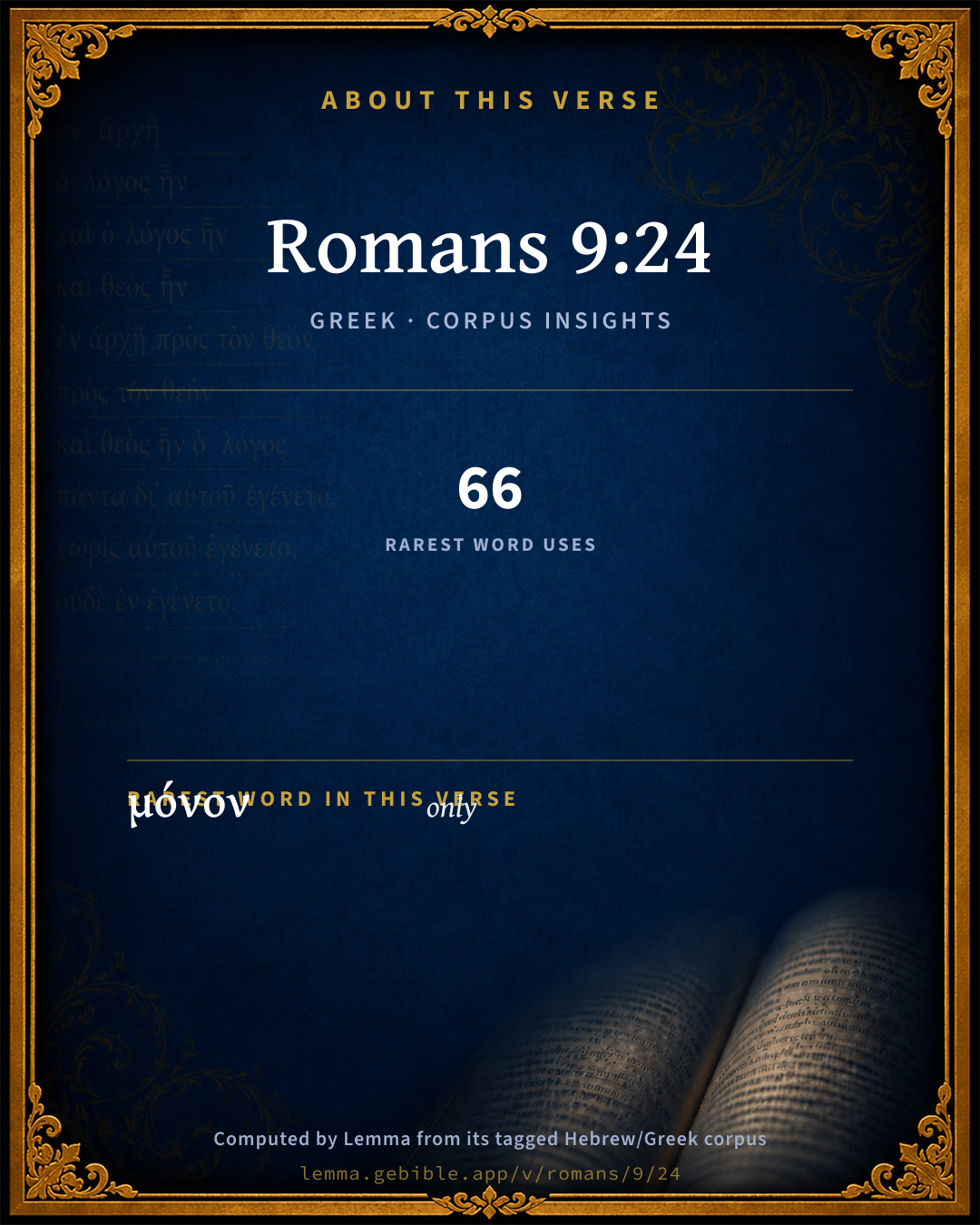
Romans 9:24

Greek (Tischendorf 8th ed.) Romans 9:24 appears in the Greek New Testament. The text above is from the Tischendorf 8th edition. Each word links to its Strong’s number and a concise gloss. Click any word for its full Thayer’s Greek Lexicon entry.
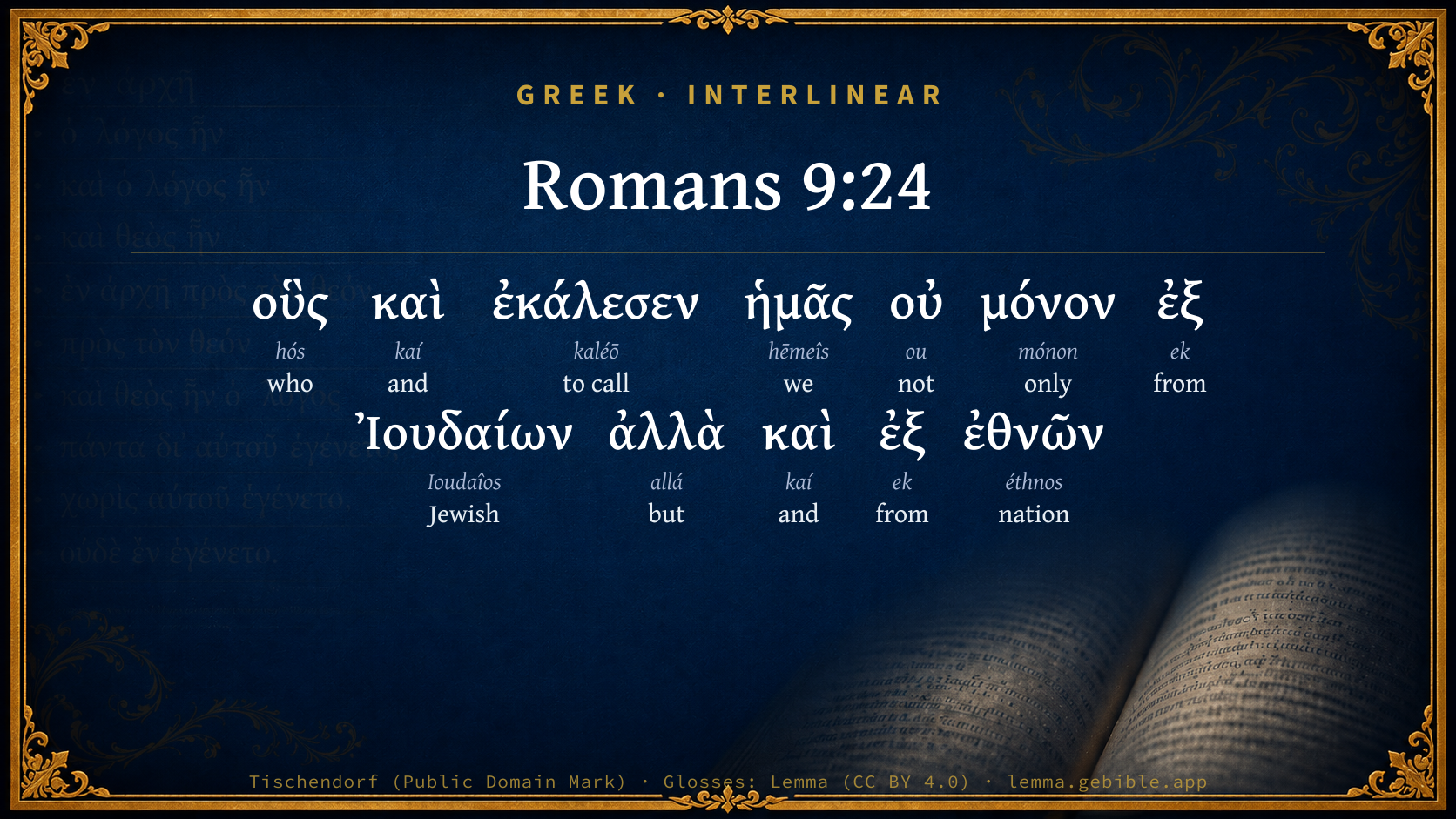
Download image
Cite this verse

Romans 9:24 (World English Bible). Public Domain. Lemma interlinear Bible study tool, https://lemma.gebible.app/v/romans/9/24.

Show BibTeX & RIS
BibTeX
RIS
English Translation
us, whom he also called, not from the Jews only, but also from the Gentiles?
World English Bible · Public Domain
Download a study sheet

One document with this verse’s original text, its word-by-word gloss line, the meaning frame, cross-references with their text, attributed commentary, and full source and license credits — printable, and it pastes into notes with its structure intact.

This verse Autodidact and up

Study sheet (.html) Plain text (.txt)

A passage Seminary Student

Up to 50 verses in one chapter. A passage sheet keeps up to 6 commentary sources and 12 cross-references per verse, in the order this page ranks them, and says so on the sheet whenever that leaves anything out. Ask for a single verse and you get the Autodidact verse sheet above.

Everything on this page stays free to read, with no account — the sheet is a download of what is already on screen, not access to it.

Want to remove ads? Support Godless Engineer
Compare translations 3

The same verse in 3 English versions, stacked beneath the original-language interlinear above. Click any original word for its lexicon entry.

Each is an independent rendering of the whole verse — the interlinear is not word-aligned to these translations.

Highlighted words mark where these versions differ — a whole-verse word diff, not a word-by-word alignment.

  • World English Bible Public Domain
    us, whom he also called, not from the Jews only, but also from the Gentiles?
  • King James Version Public Domain
    Even us, whom he hath called, not of the Jews only, but also of the Gentiles?
  • unfoldingWord Literal Text CC BY-SA 4.0
    even us whom he called, not only from the Jews, but also from the Gentiles?

unfoldingWord Literal Text — © unfoldingWord, licensed CC BY-SA 4.0. Word-aligned USFM3 via Door43 (git.door43.org/unfoldingWord/en_ult).

Versions to compare (up to 4)

3 of 4 selected

Show all 19 translations

Every available English version of this verse, each an independent rendering of the whole verse.

  • World English Bible Public Domain
    us, whom he also called, not from the Jews only, but also from the Gentiles?
  • Berean Standard Bible Public Domain
    including us, whom He has called not only from the Jews, but also from the Gentiles?
  • Majority Standard Bible Public Domain
    including us, whom He has called not only from the Jews, but also from the Gentiles?
  • King James Version Public Domain
    Even us, whom he hath called, not of the Jews only, but also of the Gentiles?
  • American Standard Version (1901) Public Domain
    `even' us, whom he also called, not from the Jews only, but also from the Gentiles?
  • Revised Version (1885) Public Domain
    even us, whom he also called, not from the Jews only, but also from the Gentiles?
  • Geneva Bible (1599) Public Domain
    Euen vs whome hee hath called, not of of the Iewes onely, but also of the Gentiles,
  • Douay-Rheims (1899) Public Domain
    Even us, whom also he hath called, nor only of the Jews, but also of the Gentiles.
  • Young's Literal Translation Public Domain
    not only out of Jews, but also out of nations,
  • Literal Standard Version CC BY-SA 4.0
    not only out of Jews, but also out of nations,
  • Unlocked Literal Bible CC BY-SA 4.0
    What if he did this also for us, whom he also called, not only from among the Jews, but also from among the Gentiles?
  • unfoldingWord Literal Text CC BY-SA 4.0
    even us whom he called, not only from the Jews, but also from the Gentiles?
  • Darby Bible Public Domain
    us, whom he has also called, not only from amongst [the] Jews, but also from amongst [the] nations?
  • World Messianic Bible Public Domain
    us, whom he also called, not from the Jews only, but also from the Gentiles?
  • Webster's Bible Public Domain
    Even us whom he hath called, not of the Jews only, but also of the Gentiles.
  • Free Bible Version CC BY-SA 4.0
    This is who we are—people he has called, not just from among the Jews, but from among the foreigners too...
  • Bible in Basic English Public Domain
    Even us, who were marked out by him, not only from the Jews, but from the Gentiles?
  • Text-Critical English NT CC BY 4.0
    namely us whom he has called, not from the Jews only but also from the Gentiles?
  • Tyndale New Testament (1534) Public Domain
    that is to saye vs which he called not of the Iewes only but also of the gentyls.

Literal Standard Version (2020), Covenant Press — licensed CC BY-SA 4.0. Text via the HelloAO Bible API (eBible.org). Unlocked Literal Bible (unfoldingWord) — licensed CC BY-SA 4.0. Text via the HelloAO Bible API (eBible.org). unfoldingWord Literal Text — © unfoldingWord, licensed CC BY-SA 4.0. Word-aligned USFM3 via Door43 (git.door43.org/unfoldingWord/en_ult). Free Bible Version, Dr. Jonathan Gallagher — licensed CC BY-SA 4.0. Text via the HelloAO Bible API (eBible.org).

Word by word

More ways to search: Search by grammar → Find every occurrence → Compare this word →

Practice this passage: Drill this verse → Learn its vocabulary →

About this verse

These counts appear in no published source. They are computed here, from the morphology-tagged text and Lemma’s own curated glosses. What Lemma adds →

12
words
10
distinct lemmas
Pauline Epistles
section

Repetition

Words recur within this verse:

Cross-references

19

Topical passages linked to Romans 9:24 in the Treasury of Scripture Knowledge — connected by theme and wording, ordered by reader-vote popularity; previews shown in the World English Bible.

  • Colossians 3:11 where there can't be Greek and Jew, circumcision and uncircumcision, barbarian, Scythian, bondservant, freeman; but Christ is all, and in all.
  • Genesis 49:10 The scepter will not depart from Judah, Nor the ruler's staff from between his feet, Until he comes to whom it belongs. To him will the obedience of the peoples be.
  • Psalms 22:27 All the ends of the earth shall remember and turn to Yahweh. All the relatives of the nations shall worship before you.
  • Acts 13:47–48 For so has the Lord commanded us, saying, 'I have set you as a light for the Gentiles, That you should bring salvation to the uttermost parts of the earth.'"
  • Acts 15:14 Simeon has reported how God first visited the Gentiles, to take out of them a people for his name.
  • Acts 21:17–20 When we had come to Jerusalem, the brothers received us gladly.
  • Romans 3:29–30 Or is God the God of Jews only? Isn't he the God of Gentiles also? Yes, of Gentiles also,
  • Romans 8:28–30 We know that all things work together for good for those who love God, to those who are called according to his purpose.
  • Romans 10:12 For there is no distinction between Jew and Greek; for the same Lord is Lord of all, and is rich to all who call on him.
  • Romans 11:11–13 I ask then, did they stumble that they might fall? May it never be! But by their fall salvation has come to the Gentiles, to provoke them to jealousy.
  • Romans 15:8–16 Now I say that Christ has been made a minister of the circumcision for the truth of God, that he might confirm the promises given to the fathers,
  • 1 Corinthians 1:9 God is faithful, through whom you were called into the fellowship of his Son, Jesus Christ, our Lord.
  • Galatians 3:28 There is neither Jew nor Greek, there is neither slave nor free man, there is neither male nor female; for you are all one in Christ Jesus.
  • Ephesians 2:11–13 Therefore remember that once you, the Gentiles in the flesh, who are called "uncircumcision" by that which is called "circumcision," (in the flesh, made by hands);
  • Ephesians 3:6–8 that the Gentiles are fellow heirs, and fellow members of the body, and fellow partakers of his promise in Christ Jesus through the Gospel,
  • Hebrews 3:1 Therefore, holy brothers, partakers of a heavenly calling, consider the Apostle and High Priest of our confession, Jesus;
  • 1 Peter 5:10 But may the God of all grace, who called you to his eternal glory by Christ Jesus, after you have suffered a little while, perfect, establish, strengthen, and settle you.
  • Revelation 19:9 He said to me, "Write, 'Blessed are those who are invited to the marriage supper of the Lamb.'" He said to me, "These are true words of God."
  • Romans 4:11–12 He received the sign of circumcision, a seal of the righteousness of the faith which he had while he was in uncircumcision, that he might be the father of all those who believe, though they be in uncircumcision, that righteousness might also be accounted to them.

Cross-references courtesy of OpenBible.info (CC BY 4.0).

Commentary

Notes on Romans 9:24 from classic Christian and Jewish commentators (each source and its license shown beneath its notes). The classic Christian expositions comment on the surrounding passage and are grouped to its opening verse, so a note may address several verses; the Jewish commentaries on the Tanakh (Rashi and others) are per-verse, so they appear only where the commentator wrote on this verse.

Lemma curates 59 commentaries, every one of them public domain or Creative Commons licensed, each selected and text-cleaned for this edition rather than reprinted as found. About our sources →

Joseph Benson's Commentary

Rom 9:24-26. Even us, whom he hath called — By his gospel and his grace, to repentance, faith, and holiness, and hath enabled us to obey the call; we are these vessels of mercy, of what nation soever we may be; not of the Jews only — Who have hitherto been the peculiar people of God; but also of the Gentiles — Who are now taken for God’s people, as well as the Jews. As he saith also in Osee, I will call them my people, &c. — These words are quoted from two places of the prophecy of Hosea; (namely, chap. Rom 1:10; Rom 2:23;) and according to the connection in which they there stand, they seem very evidently to refer primarily to God’s purpose of restoring the Jews to the privileges of his people, after they had been a while rejected of him; but nevertheless they are here applied by the apostle to the calling of the Gentiles, which they doubtless were also intended to include. (See the notes on those passages of Hosea.) Indeed, as Dr. Doddridge justly observes, that great event might, with some probability, be inferred, partly from the temporary rejection of the Jews, of which this text also speaks; (for it was not to be imagined that God would have no people in the world;) and partly as it was in the nature of things more probable that he should call the heathen, than that he should restore the Jews, when he had cast them off for such ingratitude, as rendered them less worthy of his favour than the most idolatrous nations. And her beloved — As a spouse; who once was not beloved — Consequently not unconditionally elected. In these words the apostle, nearly following the Septuagint version, rather interprets than quotes Hosea’s words, which are, I will have mercy on her that had not obtained mercy. The expressions of the apostle are different from those of the prophet, but their meaning is the same. “In the beginning of the chapter, Hosea, having described the idolatry of the Jews under the figure of whoredom, and their chastisement by hedging up their way with thorns, foretels their return to their first husband, who would speak comfortably to them, and betroth them a second time. He then adds the words above quoted, which the apostle very properly expresses by, I will call her beloved who was not beloved — That is, I will pardon her, and restore her to her former place in my affection, and to her ancient relation to me, by introducing her into the gospel church. In quoting this passage from Hosea, the apostle begins with the conversion of the Gentiles, because it was to happen first; but the prophet speaks first of the conversion of the Jews.” — Macknight. And it shall come to pass, &c. — Here the apostle quotes Hosea’s words exactly, (see Hos 1:10,) and that with a view still more fully to show that the conversion of the Gentiles had been foretold, to which this passage more plainly refers than those cited above: that in the place — In the countries; where it was said — To the idolatrous Gentiles; Ye are not my people — Where there was no church formerly, namely, in the times of the Old Testament; there they shall be called — Not only the people, but the children — The sons and daughters; of the living God — For, as the living God, he can easily bring it to pass, however incredible it may appear.

Joseph Benson's Commentary on the Old and New Testaments (1811–1818) — public domain. Text from a community e-Sword module.

Tyndale Open Study Notes

Tyndale Open Resources

9:24-26 God was free to select people from the Jews who would have a true spiritual relationship with him; similarly, he was also free to choose some from the Gentiles to be saved as well. Paul uses the prophecy of Hosea to reinforce his point. Hosea predicted that God would renew his mercy to the ten northern tribes that had rebelled against God and were under his judgment. Paul saw a principle that applies to Gentiles as well. • Those who were not my people: See study note on 10:19.

Tyndale Open Study Notes — © Tyndale Open Resources, licensed CC BY-SA 4.0. Text via the HelloAO Bible API.

Bengel's Gnomon

Johann Albrecht Bengel

Rom 9:24. Οὓς καὶ, whom also) καὶ, also, in chap. Rom 8:30, Cluverus: whom (having been previously prepared for glory) He hath also called.—ἐκάλεσεν, called) in some respects an antithesis to, He endured, Rom 9:22. Again, I will call, occurs in the next verse.—ἡμᾶς, us) This gnome[114] leads Paul to come to the proposition respecting grace, which is laid open to Jews and Gentiles; and he proceeds to refute the Jewish Particularism, and to defend the universality of grace.—οὐ μόνον ἐξ, not only from) The believing Jew is not called on the very ground that he is a Jew, but he is called from the Jews. This is the root of the word ἐκκλησία. [The epistle to the Ephesians most especially corresponds to this whole section, as well as to the exhortation, chapters 14, 15, deduced from it.—V. g.]—ἐξ Ἰουδαίων, from the Jews) He treats of this at Rom 9:27.—ἐξ ἐθνῶν, from the Gentiles) He treats of this, Rom 9:25, etc.

[114] ‘Noëma,’ a gnome or religious and moral sentiment appertaining to human life and action.—See Appendix.

Bengel's Gnomon of the New Testament — English translation (T&T Clark, Edinburgh, 1860) — public domain. Text from a community e-Sword module.

Meyer's Critical & Exegetical Commentary

Heinrich August Wilhelm Meyer

Rom_9:24. Not a confirmation of the design of the divine endurance expressed in Rom_9:23 (Hofmann), but as the continuation of the relative construction most readily suggests, the concrete more precise designation of those intended by σκεύη ἐλέους, and that for the confirmation of what was said of them by ἃ προητοίμασεν εἰς δόξαν. The καί denotes what is added to this προητοίμ. ἐ. δ.: as which σκεύη He has also called us to this glory of the Messianic kingdom.

οὕς] attracted by ἡμᾶς into the same gender. See Bernhardy, p. 302; Winer, p. 156 f. [E. T. 207]. The relative after an interrogative sentence has the emphasis of an οὗτος γάρ (Kühner, ad Xen. Mem. i. 2. 64); but the masculine is first introduced here, not in the preceding relative sentence (against Hofmanns objection), because the neuter expression ἃ προητοίμ. was required by the conformity with the correlate κατηρτισμένα.

οὐ μόνον κ.τ.λ.] Therefore without preference of the Jews. Judaeus credens non est eo ipso vocatus, quod Judaeus est, sed vocatus est ex Judaeis, Bengel.

Meyer — Critical and Exegetical Commentary on the New Testament — English translation by Peter Christie, edited by Frederick Crombie (T&T Clark, 1880) — public domain. Text from a community e-Sword module.

Hodge's Commentary on Romans, Ephesians & First Corinthians

Charles Hodge

Rom_9:24

Even us who hath called, not of the Jews only, but also of the Gentiles. We are the vessels of his mercy, even we whom he hath called, i.e. effectually introduced by his Spirit into the kingdom of Christ; see Rom_8:28, Rom_8:30. The use of the masculine relative οὕς, although the antecedent σκεύη ἐλέους is neuter, may be explained as a constructio ad sensum, or better as a case of attraction; οὕς taking the gender of the following ἡμᾶς. Winer, §63, 1. How naturally does the apostle here return to the main subject of discussion! How skillfully is the conclusion brought out at which he has continually aimed! God chose Isaac in preference to Ishmael, Jacob in preference to Esau; it is a prerogative which he claims and exercises, of selecting from among the guilty family of men, whom he pleases as the objects of his mercy, and leaving whom he pleases to perish in their sins, unrestricted in his choice by the descent or previous conduct of the individuals. He has mercy upon whom he will have mercy. He calls men, therefore, from among the Gentiles and from among the Jews indiscriminately. This is the conclusion at which the apostle aimed. The Gentiles are admitted into the Messiahs kingdom, Rom_9:25, Rom_9:26; and the great body of the Jews are excluded, Rom_9:27. This conclusion he confirms by explicit declarations of Scripture. Ex disputatione, quam hactenus de libertate divinae electionis habuit, duo consequebantur: nempe Dei gratiam non ita inclusam esse in populo Judaico, ut non ad alias quoque nationes emanare, et in orbem universum effundere se posset: deinde ne sic quidem alligatam esse Judaeis, ut ad omnes Abrahae filios secundum carnem sine exceptione perveniat. Calvin.

Doctrine

1. No external circumstance, no descent from pious parents, no connection with the true church, can secure admission for men into the kingdom of Christ, Rom_9:6-12.

2. Paul teaches clearly the doctrine of the personal election of men to eternal life, an election founded not on works, but on the good pleasure of God. The choice is to eternal life, and not to external privileges merely.

1. Because the very point to be illustrated and established through this and the two following chapters, is the free admission of men into the Messiahs kingdom, and its spiritual and eternal blessings.

2. Because the language of the apostle seems of itself to preclude the other idea, in Rom_9:15, Rom_9:16, and especially in Rom_9:18, Therefore he hath mercy on whom he will, and whom he will he hardeneth. This is not applicable to the reception of men to a state of peculiar external privileges or their rejection from it.

3. The case of Pharaoh is not an illustration of the refusal to admit some men to peculiar privileges.

4. The choice is between the vessels of mercy and vessels of wrath; vessels of mercy chosen unto glory, not unto church privileges, and vessels of wrath who were to be made the examples of Gods displeasure against sin.

5. The character of the objections to the apostles doctrine shows that such was the nature of the choice. If this election is to eternal life, it is, of course, a choice of individuals, and not of communities, because communities, as such, do not inherit eternal life. This is still farther proved by the cases of Isaac and Ishmael, and Jacob and Esau, between whom, as individuals, the choice was made. From the illustration derived from the case of Pharaoh. From the objections presented in Rom_9:14, Rom_9:19. From the answer to these objections in Rom_9:15, Rom_9:16, Rom_9:20, Rom_9:23, especially from the passage just referred to, which speaks of the vessels of mercy prepared unto glory; which cannot be applied to nations or communities. This election is sovereign, i.e. is founded on the good pleasure of God, and not on any thing in its objects.

1. Because this is expressly asserted. The choice between Jacob and Esau was made prior to birth, that it might be seen that it was not formed on works, but on the good pleasure of God, Rom_9:11. The same is clearly stated in Rom_9:16, It is not of him that willeth or of him that runneth, but of God that showeth mercy; and also in Rom_9:18, Therefore he hath mercy on whom he will, etc. The decision rests with God.

2. Because otherwise there would be no shadow of objection to the doctrine. How could men say it was unjust if God chose one and rejected another according to their works? And how could any one object, as in Rom_9:19, that as the will of God could not be resisted, men were not to be blamed, if the decision in question did not depend on the sovereign will of God? How easy for the apostle to have answered the objector, You are mistaken, the choice is not of God; he does not choose whom he will, but those who he sees will choose him. It is not his will, but mans that decides the point. Paul does not thus answer. He vindicates the doctrine of the divine sovereignty. The fact, therefore, that Paul had to answer the same objections which are now constantly urged against the doctrine of election, goes far to show that doctrine was his.

3. That the election is sovereign, is taught elsewhere in Scripture. In 2Ti_1:9 it is said to be not according to our works, but according to his own purpose and grace. Eph_1:5 it is said to be according to the good pleasure of his will, i.e. his sovereign pleasure.

4. This view alone harmonizes with the doctrine, that all good thoughts and right purposes and feelings proceed from God, which is clearly taught in the Scriptures. For if the purpose not to resist common grace, is a right purpose, it is of God, and, of course, it is of him that one man forms it, and another does not.

5. This doctrine is alone consistent with Christian experience. Why was I made to hear thy voice? No Christian answers this question by saying, because I was better than others.

3. The two leading objections against the doctrine of election, viz., that it is inconsistent with the divine character, and incompatible with human responsibility, are answered by the apostle. It cannot be unjust, because God claims and exercises the right of sovereign choice. It is not inconsistent with human responsibility, because God does not make men wicked. Though, as their Sovereign, he has a right to dispose of wicked men as he pleases. He can, of the same corrupt mass, choose one to honor, and the other to dishonor, Rom_9:14-23.

4. Scripture must ever be consistent with itself. The rejection of the Jews could not be inconsistent with any of Gods promises, Rom_9:6.

5. The true children of God become such in virtue of a divine promise, or by the special exercise of his grace. They are born not of the will of the flesh, but of God, Rom_9:8.

6. Though children prior to birth do neither good nor evil, yet they may be naturally depraved. They neither hunger nor thirst, yet hunger and thirst are natural appetites. They exercise neither love nor anger, yet these are natural passions. They know probably neither joy nor sorrow, yet are these natural emotions, Rom_9:11.

7. The manifestation of the divine perfections is the last and highest end of all things, Rom_9:17, Rom_9:22, Rom_9:23.

8. The facet that the destiny of men is in the hands of God (that it is not of him that willeth, or him that runneth,) is not inconsistent with the necessity of the use of means. The fact that the character of the harvest depends on the sovereign pleasure of God, does not render the labor of the husband man of no account. The same God who says, I will have mercy on whom I will, says also, Work out your salvation with fear and trembling. The sovereignty of God and the necessity of human efforts are both clearly taught in the Scriptures. At times the former, as in this chapter, at times the latter doctrine is most insisted upon. Neither should be forgotten or neglected, as both combine to produce the right impression on the mind, and to lead us to God in the way of his own appointment, Rom_9:16.

9. Men, considered as the objects of election, are regarded as fallen. It is from the corrupt mass that God chooses one vessel to honor and one to dishonor, Rom_9:22, Rom_9:23.

10. The judicial abandonment of men to their own ways, the giving them up to work out their own destruction, is a righteous though dreadful doom, Rom_9:18, Rom_9:22, also Rom_1:24, Rom_1:26.

Remarks

1. If descent from Abraham, participation in all the privileges of the theocracy, the true and only church, failed to secure for the Jews the favor of God, how foolish the expectation of those who rely on outward ordinances and church-relations as the ground of their acceptance, Rom_9:6-13.

2. The doctrine of the sovereignty of God in the choice of the objects of his mercy should produce,

1. The most profound humility in those who are called according to his purpose. They are constrained to say, Not unto us, not unto us, but unto thy name be all the glory.

2. The liveliest gratitude, that we, though so unworthy, should from eternity have been selected as the objects in which God displays the riches of his glory.

3. Confidence and peace, under all circumstances, because the purpose of God does not change; whom he has predestinated, them he also calls, justifies, and glorifies.

4. Diligence in the discharge of all duty, to make our calling and election sure. That is, to make it evident to ourselves and others, that we are the called and chosen of God. We should ever remember that election is to holiness, and consequently to live in sin, is to invalidate every claim to be considered as one of Gods elect.

3. As God is the immutable standard of right and truth, the proper method to answer objections against the doctrines we profess, is to appeal to what God says, and to what he does. Any objection that can be shown to be inconsistent with any declaration of Scripture, or with any fact in providence, is sufficiently answered, Rom_9:15, Rom_9:17.

4. It should, therefore, be assumed as a first principle, that God cannot do wrong. If he does a thing, it must be right. And it is much safer for us, corrupt and blinded mortals, thus to argue, than to pursue the opposite course, and maintain that God does not and cannot do so and so, because in our judgment it would be wrong, Rom_9:15-19.

5. All caviling against God is wicked. It is inconsistent with our relation to him as our Creator. It is a manifestation of self-ignorance and of irreverence toward God, Rom_9:20.

6. What proof of piety is there in believing our own eyes, or in receiving the deductions of our own reasoning? But to confide in God, when clouds and darkness are round about him; to be sure that what he does is right, and that what he says is true, when we cannot see how either the one or the other can be, this is acceptable in his sight. And to this trial he subjects all his people, Rom_9:20-24.

7. If the manifestation of the divine glory is the highest end of God in creation, providence, and redemption, it is the end for which we should live and be willing to die. To substitute any other end, as our own glory and advantage, is folly, sin, and self-destruction, Rom_9:17, Rom_9:22. 23.

8. The fact that God says to some men, Let them alone; that he gives them up to a reprobate mind; that he withholds from them, in punishment of their sins, the influences of his Spirit, should fill all the impenitent with alarm. It should lead them to obey at once his voice, lest he swear in his wrath that they shall never enter into his rest, Rom_9:17, Rom_9:18.

9. We and all things else are in the hands of God. He worketh all things after the counsel of his own will. The Lord reigns, let the earth rejoice, Rom_9:14-24.

Charles Hodge — Commentary on Romans (1835), First Corinthians (1857), and Ephesians (1856) — public domain. Text from a community e-Sword module.

Geneva Bible (1599)

Geneva Bible translators

He saith not that all and every one of the Jews are called, but some of the Jews, and some of the Gentiles.

Having established the doctrine of the eternal predestination of God on both parts: that is, as well of the reprobate, as of the elect, he cometh now to show the use of it, teaching us that we ought not to seek the testimony of it in the secret counsel of God, but by the vocation which is made manifest and set forth in the Church, propounding unto us the example of the Jews and Gentiles, that the doctrine may be better perceived.

Geneva Bible (1599) marginal notes — public domain. Text via Bolls.life.

Jamieson, Fausset & Brown

Robert Jamieson, A. R. Fausset & David Brown

even us, whom he hath called, &c.--rather, "Whom he hath also called, even us," &c., in not only "afore preparing," but in due time effectually "calling us."

not of the Jews, &c.--better, "not from among Jews only, but also from among Gentiles." Here for the first title in this chapter the calling of the Gentiles is introduced; all before having respect, not to the substitution of the called Gentiles for the rejected Jews, but to the choice of one portion and the rejection of another of the same Israel. Had Israel's rejection been total, God's promise to Abraham would not have been fulfilled by the substitution of the Gentiles in their room; but Israel's rejection being only partial, the preservation of a "remnant," in which the promise was made good, was but "according to the election of grace." And now, for the first time, the apostle tells us that along with this elect remnant of Israel, it is God's purpose to "take out of the Gentiles a people for His name" (Act 28:14); and that subject, thus introduced, is now continued to the end of the eleventh chapter.

Jamieson, Fausset & Brown — Commentary Critical and Explanatory on the Whole Bible (1871) — public domain (CC PDM 1.0). Text via the HelloAO Bible API.

Adam Clarke's Commentary

Verse 24. Even us, whom he hath called] All the Jews and Gentiles who have been invited by the preaching of the Gospel to receive justification by faith in our Lord Jesus Christ, and have come to the Gospel feast on this invitation.

Adam Clarke's Commentary on the Bible (1810–1826) — public domain. Text from a community e-Sword/MySword module.

John Calvin's Commentaries

24. Whom he also called, etc. From the reasoning which he has been hitherto carrying on respecting the freedom of divine election, two things follow, — that the grace of God is not so confined to the Jewish people that it does not also flow to other nations, and diffuse itself through the whole world, — and then, that it is not even so tied to the Jews that it comes without exception to all the children of Abraham according to the flesh; for if God’s election is based on his own good pleasure alone, wherever his will turns itself, there his election exists. Election being then established, the way is now in a manner prepared for him to proceed to those things which he designed to say respecting the calling of the Gentiles, and also respecting the rejection of the Jews; the first of which seemed strange for its novelty, and the other wholly unbecoming. As, however, the last had more in it to offend, he speaks in the first place of that which was less disliked. He says then, that the vessels of God’s mercy, whom he selects for the glory of his name, are taken from every people, from the Gentiles no less than from the Jews.

But though in the relative whom the rule of grammar is not fully observed by Paul, yet his object was, by making as it were a transition, to subjoin that we are the vessels of God’s glory, who have been taken in part from the Jews and in part from the Gentiles; and he proves from the calling of God, that there is no difference between nations made in election. For if to be descended from the Gentiles was no hinderance that God should not call us, it is evident that the Gentiles are by no means to be excluded from the kingdom of God and the covenant of eternal salvation.

John Calvin's Commentaries (1540-1563) — public domain. Text from the Calvin Translation Society English edition (1840s-50s) via the Christian Classics Ethereal Library (ccel.org). Calvin's coverage is partial (roughly two-thirds of the Bible); uncommented books and verses are honest gaps, never fabricated. The 19th-century editor's footnotes and remarks are omitted so the notes are faithfully Calvin's own voice.

Ellicott's Commentary for English Readers

(24) Even us.—So far the form of the sentence had been abstract—“vessels of wrath,” “vessels of glory.” Now the Apostle explains who are meant by these abstract terms. The “vessels of glory” are those who were intended to accept the Christian teaching, whether Jews or Gentiles. The “vessels of wrath” are the unbelieving mass of the people of Israel.

A Bible Commentary for English Readers, edited by Charles John Ellicott (1878–1897) — public domain. Text from a community e-Sword module.

The Cambridge Bible for Schools and Colleges

gen. ed. J. J. S. Perowne

24. even us] Lit., and better, whom also he called, us, &c. The “also” or “even” goes with the verb, and seems to indicate that the “afore-preparation” is rather that of the electing purpose of God than that of personal sanctification (which is, however, the sure sequel of the other). Q. d., “He fore-ordained to glory the vessels of mercy, and then proceeded actually to call them to grace.”

hath called] Better, called. See on Rom_8:28.

not of the Jews only] Here St Paul reminds us of the special subject of this discussion; the apparent rejection of Israel. By the true heirs of Abraham was all along meant the church of the elect; those who should be “called” and should “love God.” In the Mosaic age these were but some of the bodily Israel; in the Christian age they were largely found outside that Israel. But in both cases the Promise, in its true intention, was fulfilling. He now quotes in proof of that true intention.

The Cambridge Bible for Schools and Colleges (gen. ed. J. J. S. Perowne; Cambridge University Press, 1878–1918) — public domain. Text from a community e-Sword module.

John Gill's Exposition

As he also saith in Osee,.... Hos 2:23, so "Hosea" is called "Osee", as here, in the Septuagint in Neh 10:23. That is, as God says in the prophecy of Hosea, which was given by divine inspiration; and speaks of the calling of the Gentiles, as the spiritual Israel, after God had wrote a "lo-ammi", Hos 1:9, and a "loruhamah", Hos 1:6, upon the people of the Jews; and shows, that he had appointed some from among the Gentiles, to obtain salvation by Jesus Christ; since he foretells their calling, long before they were in being; which could have no other foundation than his own eternal sovereign will and pleasure:

I will call them my people, which were not my people; his people they were before he called them, in some sense; inasmuch as he had chosen them for his people, had promised in covenant they should be, had given them to Christ as his people, and him to be a covenant to them: who, as such, made reconciliation for them, sanctified them by his blood, redeemed and saved them; but then they were not known to be the people of God, neither by themselves, who knew not God, and so could not know themselves to be his people; nor by others, by the Jews, by whom they were called the uncircumcision, sinners of the Gentiles; looking upon the character or the people of God, as only belonging to themselves: God had not as yet laid hold on them as his people, and claimed his right in them, and made known himself to them as their covenant God; he had not avouched them to be his people, nor had they avouched him to be their God; as yet they were not his willing people, nor a holy people, not being formed for himself, by his mighty grace; nor a people near unto him, with respect to worship and fellowship, but afar off from him. His calling them his people, is his acquainting them with their relation to him, which he had taken them in to himself, of his own grace; for so it is in Hos 2:23, "And I will say unto them which were not my people, thou art my people": in the effectual calling, the Spirit of God is sent down into the hearts of his people, to witness their relation to him, and to work faith in their souls, to receive the testimony; when they reply and say, "thou art my God", Hos 2:23, and so they come to know themselves to be the people of God, of which they were before ignorant; and to be known others, by being made a willing people, in the day God's power upon them, willing to be saved by him in his own way, and willing to serve and worship him in his own ordinances, and according to his own appointment; and by being holy and righteous, having the characters, and enjoying the privileges of the people of God:

and her beloved, which was not beloved. In the text in Hos 2:23, it is, "I will have mercy on her that had not obtained mercy": hence the Vulgate Latin has added this clause to the text, though unsupported by any copy, or other version. The apostle is to be justified in his version, by the Septuagint interpreters, who have rendered the passage in Hosea, "I will love her that was not beloved"; and by the true sense of the word there used, which signifies to love in the most kind, tender, and endearing manner; see Psa 18:1; where the word is used and so rendered. The sense is not, that God's chosen ones among the Gentiles were not the objects of his love before calling; for their very calling is the fruit, effect, and so the evidence of love before. The love of God is from everlasting to everlasting, invariably and unchangeably the same; he had chosen them in his Son; he had made a covenant with them in Christ, had put them into his hands, and made them his care and charge; he had sent him to die for them, and obtain eternal redemption for them; and all this before he called them, which abundantly proves his love to them: but this love was not manifested to their souls; it had not been shed abroad in their hearts; they had no sensation of it in their breasts; the streams of that river of God had not as yet flowed into their souls; nor were they partakers of the effects of it in themselves; but being called by grace, they feel, they experience, and enjoy that, and all the happy: fruits and effects of it; the loving kindness of God is let down into their hearts in the effectual calling, and with it he draws them to himself, as a fruit and evidence of his everlasting and unchangeable love to them.

John Gill's Exposition of the Whole Bible (1746–1763) — public domain (CC PDM 1.0). Text via the HelloAO Bible API.

Trapp's Complete Commentary

John Trapp

24 Even us, whom he hath called, not of the Jews only, but also of the Gentiles?

Ver. 24. Even us] Not me Paul only hath he assured of vocation, and so consequently of election to eternal life.

John Trapp, A Commentary or Exposition upon All the Books of the Old and New Testament (1647–1656) — public domain. Text from a community e-Sword module.

Albert Barnes' Notes on the Bible

Even us ... - See Rom 1:16; Rom 2:10; Rom 3:29-30. To prove that the Gentiles might be called as well as the Jews, was a leading design of the Epistle.

Us - Christians, selected from both Jews and Gentiles. This proves that he did not refer to nations primarily, but to individuals chosen out of nations. Two things are established here.

(1) That the grace of God was not confined to the Jewish people, as they supposed, so that it could be conferred on no others.

(2) That God was not bound to confer grace on all the descendants of Abraham, as he bestowed it on those selected from the mass, according to his own will, and not of necessity “on the mass” itself.

Albert Barnes' Notes on the Bible (1834–1885) — public domain. Text from a community e-Sword/MySword module.

Haydock's Catholic Bible Commentary

Whom also he hath called, &c. That is, he hath called some of the Jews, and many of the Gentiles, to be vessels of election, as he foretold by his prophet Osee, (ii. 24.) I will call them my people, that were not my people,...and I will make them the children of the living God. And as it was also foretold by the prophet Isaias, of all the numerous nation of the Jews, only a remnant shall be saved, by their obstinacy in not receiving, and refusing to believe in, their Messias. For finishing his word, and reducing it by his justice to a little, because the Lord will bring to pass his word reducing it to a small compass upon the earth. The sense and construction of this verse is equally obscure in the Greek and in the Latin text: the true sense seems to be, that finishing his word, or fulfilling his promises to Israel, those that are to be saved, will be reduced by his justice for their sins, to a few; because, though he brings to pass his word, and his promises, the saved among the Israelites will be reduced to a small compass, in comparison of the great number of the Gentiles. This exposition agrees with the rest of the text, and with what follows, and was foretold by Isaias, (chap. i. 9.) that unless the God of Sabaoth (of hosts) had, through his mercy, left them a seed, a small number, they would all in a manner have deserved to be utterly destroyed, like Sodom and Gomorrha. (Witham) --- What I say, shall come to pass, that in those places, viz. Greece, Italy, &c. where those who are strangers to the worship of the true God dwell, and have been called, on account of their profane worship, not my people. In those very places, they shall receive the true worship God, and by this means shall become and be called the children of the living God. He is so particular as to place, lest the Jews should imagine that the Gentiles would be converted like their former proselytes, and either dwell in Judea, or repair to it at certain stated times. Thus the apostle repeats what Jesus Christ had before said to the Samaritan woman. The hour will come when neither in this mountain, nor in Jerusalem, shall you adore the Father. (Estius) (John iv.) --- A remnant. That is, a small number only of the children of Israel shall be converted and saved. How perversely is this text quoted for the salvation of men of all religions, when it speaks only of the converts of the children of Israel. (Challoner) --- St. Paul is here speaking of the reprobation of the Jews, and of the vocation of the Gentiles, and foretells that a remnant, or small number of the children of Israel shall be converted, and saved. In the sense of St. Paul, we sincerely hope, and confidently trust, that a remnant of all will be saved through a timely conversion. But we no where read, in the Old, or New Scriptures, that a remnant of all will be saved, as if it were a matter of indifference to what society or connexion a Christian was joined. (Haydock)

George Leo Haydock (1774–1849), Haydock's Catholic Family Bible and Commentary, 1859 edition — public domain. Excludes Psalms (Douay-Rheims chapter numbering differs from Protestant) and Deuterocanonical books (Catholic canon only).

Matthew Poole's English Annotations

Hitherto he hath been showing, that the promise was never made or meant to the carnal seed of Abraham. This argument he began, Rom 9:6,7, and he continues it (using several apostrophes and amplifications, which were to his purpose) till he comes to these words; and here he tells you plainly who are the true seed of Abraham, and the children of the promise, even the called of God of all nations, whether Jews or Gentiles. And he takes occasion to fall into it, by speaking of some in the foregoing verse, that were vessels of mercy, afore prepared unto glory: now here, in this verse, he tells you, who these are; (and to be sure they are the persons he is inquiring after, viz. the spiritual seed of Abraham, and the children of the promise:) he says, they are such as God called; i.e. effectually called,

not of the Jews only, but also of the Gentiles; and that this is so, he further proves in the following verse.

Matthew Poole's English Annotations on the Holy Bible (1683–1685) — public domain. Text from a community e-Sword/MySword module.

Whedon's Commentary on the Bible

Daniel D. Whedon

5. God’s right to establish this enlarged system of free-agency shown by predictions of the call of the Gentiles, (24-29.)

This presupposes the identity of the Church of Jesus with the spiritual side of the two lines above given, and the unbelieving Jews with the vessels of wrath, Rom_9:22.

24. Even us—By a sudden turn the whole weight of the climax of the above argument comes down with a forcible emphasis upon the present company. Of the bright side and dark side of the above antithesis between vessels of glory and of wrath, between Moses and Pharaoh, between the elect and reprobate of entire history, the bright side belongs to us, the new living Church. And that by no birth, necessity, or accident; for (including Rom_10:18-21) it includes Jews and Gentiles. And this blessed dispensation he illustrates with touches of prediction from the old prophets.

But this paragraph, reserving the case of Gentile believers to Rom_10:18-21, describes believing Jews only. It parallels them with the old Jews restored from the Assyrian captivity, who, like the Jews gathered into the Christian Church, were but a remnant.

Daniel D. Whedon (gen. ed.), Commentary on the Old and New Testaments (1874–1909) — public domain. Text from a community e-Sword module.

John Wesley's Explanatory Notes

Even us - Here the apostle comes to the other proposition, of grace free for all, whether Jew or gentile. Of the Jews - This he treats of, ver. 25. Of the gentiles - Treated of in the same verse.

John Wesley, Explanatory Notes Upon the Whole Bible (1754–1765) — public domain. Text via the GEBible commentary corpus.

Godbey's Commentary on the New Testament

William B. Godbey

24-26. Here Paul speaks of the fact that these vessels of honor are elected both from Jews and Gentiles indiscriminately.

William B. Godbey, Commentary on the New Testament (1896–1900) — public domain. Text from a community e-Sword module.

McGarvey & Pendleton's Commentaries

J. W. McGarvey

even us, whom he also called, not from the Jews only, but also from the Gentiles? [The apostle ends his question with a clear specification of who the vessels of mercy are. They are those called impartially from both Jews and Gentiles. "In calling to salvation," says Lard, "God is equally merciful to all. He sends to all the same Christ, the same gospel; on them he spends the same influences, and to them presents the same incentives to duty. But beyond this he strictly discriminates in bestowing mercy. He bestows it on those only that obey his Son. On the rest he will one day pour out his wrath." We may add, that toward those who accept his call he is equally impartial in preparing for glory, giving them the same remission of sins, the same gift of the Holy Spirit, the same promises, etc. But the impartiality which the apostle emphasizes is that which gave no preference to the Jew.]

J. W. McGarvey (with Philip Y. Pendleton), Commentaries on the New Testament (The Fourfold Gospel, 1914; Acts; and the epistles) — public domain. Text from a community e-Sword/MySword module.

The People's New Testament

B. W. Johnson

24. Even us whom he hath called. He “endured the vessels of wrath” that he might make known his mercy in calling both Jews and Gentiles. The destruction of the Jewish nation, predicted by the Savior in Matt. 24, was delayed in mercy until tens of thousands of Jews, as well as of Gentiles, accepted Christ. The whole passage shows that God suffered the sins of the Jewish nation, without cutting it off, because its existence was essential in his plans for saving the world. Of it Christ came. From it the apostles were chosen. In it the church was formed, and from it went forth the gospel preachers.

B. W. Johnson's The People's New Testament with Notes (1889–1891) — public domain. Electronic text from the Christian Classics Ethereal Library (CCEL) ThML edition.

Cambridge Greek Testament for Schools and Colleges

24. οὓς καὶ ἐκάλεσεν. The attraction of οὓς (to ἡμᾶς) marks the turn of thought from regarding the persons as instruments to regarding the instruments as persons: the personal agency of men comes out.

ἡμᾶς. Even us, or in us—or perhaps—which He actually called us to be.

οὐ μόνον κ.τ.λ. Here the underlying thought of the whole passage becomes explicit: and its importance is marked by the anacoluthon: instead of finishing his sentence S. Paul goes on at once to illustrate the fact of this call from prophetic sayings. It may also be that he shrank from enforcing his argument that the unbelieving Jews were σκεύη ὀργῆς.

Cambridge Greek Testament for Schools and Colleges (Cambridge University Press, 1896; 21 vols, various authors incl. Carr, Maclear, Plummer, Farrar, Lumby, Moule, M. R. James, Simcox) — public domain. Text from a community e-Sword module.

Alford’s Greek Testament

Henry Alford

24.] Of which kind (quales, agreeing with ἡμᾶς—i.e. σκεύη ἐλέους) He also called us, not only from among the Jews, but also from among the Gentiles. It being entirely in the power of God to preordain and have mercy on whom He will, He has exercised this right by calling not only the remnant of His own people, but a people from among the Gentiles also.

25,

Henry Alford, The Greek Testament (1849–1861) — public domain. Text from a community e-Sword module.

International Critical Commentary

24. οὕς καὶ ἐκάλεσεν ἡμᾶς: ‘even us whom He has called.’ The οὕς is attracted into the gender of ἡμᾶς. The relative clause gives an additional fact in a manner not unusual with St. Paul. Rom 1:6 ἐν οἷς ἐστε καὶ ὑμεῖς: 2Ti 1:10 φωτίσαντος δὲ ζωὴν καὶ ἀφθαρσίαν διὰ τοῦ εὐαγγελίου, εἰς ὅ ἐτέθην ἐγὼ κήρυξ. The calling of the Gentiles is introduced not because it was a difficulty St. Paul was discussing, but because, as he shows afterwards, the calling of the Gentiles had come through the rejection of the Jews.

There have been two main lines of interpretation of the above three verses. (1) According to the one taken above they modify and soften the apparent harshness of the preceding passage (19-21). That this is the right view is shown by the exegetical considerations given above, and by the drift of the argument which culminating as it does in a reference to the elect clearly implies some mitigation in the severity of the Divine power as it has been described. (2) The second view would make the words of ver. 22 continue and emphasize this severity of tone: ‘And even if God has borne with the reprobate for a time only in order to exhibit more clearly the terror of His wrath, and in order to reveal His mercy to the elect, even then what right have you—man that you are— to complain?’ Cf. Calvin: Ea si dominus ad aliquod tempus patienter sustinet … ad demonstranda suae severitatis iudicia … ad virtutem suam illustrandam, … praeterea quo inde notior fiat et clarius elucescat suae in electos misericordiae amplitudo: quid in hac dispensatione misericordine dignum?

International Critical Commentary — older volumes (1896–1929), various authors — public domain. Text from a community e-Sword module.

Vincent's Word Studies in the New Testament

Marvin R. Vincent

Called - of. Compare ch. 8 30. For of, read from [εξ] , as Rev. From among.

Marvin R. Vincent, Word Studies in the New Testament (1887–1900) — public domain. Text from a community e-Sword/MySword module.

Godet's Commentaries

Frédéric Louis Godet

Vv. 24. And those predestined to glory, He has drawn by long-suffering, not only from the midst of the lost mass of the Jews, but also from among the Gentiles. This was what Jesus had declared: “I have yet other sheep which are not of this fold” (Joh 10:16). And this Paul had in view in the words: the riches of His glory. While He gleaned among the Jews, He reaped a harvest among the Gentiles, and thus carried out, in spite of Jewish pretensions, the free and large plan of salvation which He had formed on the sole prevision of faith.

The καί, also, reminds us of the relation between the eternal decree and the call in time.

It is thus a new people of elect ones, composed of the believing portion of the old Israel and of the entire multitude of the believing Gentiles, whom the apostle sees rising to the divine call to take the place of that carnal Israel; comp. Luk 14:15-24 and Rev 7:9 et seq. He cannot but think with a profound feeling of gratitude that it is by his own ministry this rich exercise of grace is effected; that he is himself in a way the hand of God, to form out of the mass of the Gentile world that multitude of vessels unto honor!

Here should be placed logically the principal proposition, which is interrogative, but understood, on which rests the two preceding subordinate propositions, beginning with now if, Rom 9:22, and and if, Rom 9:23: “And if those Jews, already ripe for perdition, are still borne with by God, who holds His arm ready to strike them and cast them far from Him, and if as to those believers whom He has prepared beforehand He does not confine Himself to take them from Israel, but goes in search of them to the very ends of the earth..., will mankind be entitled to find fault with God who thus directs their destinies? Will the Jewish people in particular be able to reproach God for the way in which He exercises His justice on them, seeing they have so justly brought this judgment upon them, and for the use which He at the same time makes of His mercy, calling His elect from the whole mass of mankind, without disturbing Himself about the reprobation which Israel is pleased to suspend over one whole part of this mass?...Yea. O Jew, who dost venture to dispute with God, what hast thou to say!” And I ask every reader who has attentively followed this explanation of the apostle’s words, what can be said against this defence of God’s dealings? Do not all the divine perfections concur harmoniously in realizing God’s plan, and has not the freedom of man its legitimate place in the course of history, in perfect harmony with God’s sovereign freedom in His acts of grace as well as in His judgments?

The word of God has not therefore been made of no effect by the fact of the rejection of the Israelitish nation (Rom 9:6). For, 1st, the principle of divine selection which controlled the early destinies of the patriarchal family is only realized anew in the distinction between believing Israelites and the carnal and rejected mass (Rom 9:6-13). 2d. God, when making choice of this people to prepare for the salvation of the world, did not abdicate His freedom to reject them on certain conditions, and if He came to think this good; neither did He abdicate His liberty of calling other individuals not belonging to this people, on certain conditions, and if He came to see good reason. And the use which He actually makes of this liberty, in rejecting His obstinately rebellious people while sparing them as long as possible, and even after the greatest crimes, is not tantamount to the annulling of His word (Rom 9:14-24). But, 3d, more remains to be said: this double dispensation of the calling of the Gentiles and of the rejection of Israel is nothing else than the fulfilling of His very word; for it was announced beforehand. This is what is proved by the third part of this discussion, Rom 9:25-29.

Frédéric Louis Godet — Commentaries on Luke, John, Romans, and 1 Corinthians — English translation (T&T Clark, Edinburgh, 1870s–1890s) — public domain. Text from a community e-Sword module.

Lesson kit

Teaching starters — assembled from the data on this page, not authored interpretation. Every prompt links to the verse data it draws on. Edit before teaching.

Romans, in the Pauline Epistles, opens this verse with 12 words (10 distinct Greek lemmas). Its most distinctive word is mónon (“only”). A historical commentator’s framing appears above. Read the whole chapter for the surrounding context.

Discussion questions

  1. What does “only” (mónon) contribute to the verse as a whole?
  2. How does Colossians 3:11, which shares this passage’s theme, read alongside this verse?
  3. What does the repetition of “and” (2× in this one verse) do in this verse?
  4. The translations on this page render this verse differently — a whole-verse word diff, not a word-by-word alignment. What might account for the different wordings?
  5. Compare how Joseph Benson's Commentary and Tyndale Open Study Notes read this verse. Where do they agree or differ?

Things to notice

  • These translations choose different wording for 1 word in this verse.
  • “and” occurs 2× in this single verse.
  • 10 distinct Greek lemmas span 12 words in this verse.

Reading settings

Reading text

Shown beneath each verse's original-language words.

Old Testament
Old Testament edition

Read the OT as the Masoretic Hebrew (MT) or the Greek Septuagint (LXX).

English shown for the Greek Septuagint (in the Hebrew ↔ Greek comparison).

Comparing translations? Open the Compare panel on any verse page to stack up to four side by side.