Galatians 2:8

Greek (Tischendorf 8th ed.) Galatians 2:8 appears in the Greek New Testament. The text above is from the Tischendorf 8th edition. Each word links to its Strong’s number and a concise gloss. Click any word for its full Thayer’s Greek Lexicon entry.
Download image
Cite this verse

Galatians 2:8 (World English Bible). Public Domain. Lemma interlinear Bible study tool, https://lemma.gebible.app/v/galatians/2/8.

Show BibTeX & RIS
BibTeX
RIS
English Translation
(for he who appointed Peter to the apostleship of the circumcision appointed me also to the Gentiles);
World English Bible · Public Domain
Download a study sheet

One document with this verse’s original text, its word-by-word gloss line, the meaning frame, cross-references with their text, attributed commentary, and full source and license credits — printable, and it pastes into notes with its structure intact.

This verse Autodidact and up

Study sheet (.html) Plain text (.txt)

A passage Seminary Student

Up to 50 verses in one chapter. A passage sheet keeps up to 6 commentary sources and 12 cross-references per verse, in the order this page ranks them, and says so on the sheet whenever that leaves anything out. Ask for a single verse and you get the Autodidact verse sheet above.

Everything on this page stays free to read, with no account — the sheet is a download of what is already on screen, not access to it.

Want to remove ads? Support Godless Engineer
Compare translations 3

The same verse in 3 English versions, stacked beneath the original-language interlinear above. Click any original word for its lexicon entry.

Each is an independent rendering of the whole verse — the interlinear is not word-aligned to these translations.

Highlighted words mark where these versions differ — a whole-verse word diff, not a word-by-word alignment.

  • World English Bible Public Domain
    (for he who appointed Peter to the apostleship of the circumcision appointed me also to the Gentiles);
  • King James Version Public Domain
    (For he that wrought effectually in Peter to the apostleship of the circumcision, the same was mighty in me toward the Gentiles:)
  • unfoldingWord Literal Text CC BY-SA 4.0
    (for the one having worked in Peter for apostleship to the circumcision also worked in me to the Gentiles),

unfoldingWord Literal Text — © unfoldingWord, licensed CC BY-SA 4.0. Word-aligned USFM3 via Door43 (git.door43.org/unfoldingWord/en_ult).

Versions to compare (up to 4)

3 of 4 selected

Show all 19 translations

Every available English version of this verse, each an independent rendering of the whole verse.

  • World English Bible Public Domain
    (for he who appointed Peter to the apostleship of the circumcision appointed me also to the Gentiles);
  • Berean Standard Bible Public Domain
    For the One who was at work in Peter’s apostleship to the circumcised was also at work in my apostleship to the Gentiles.
  • Majority Standard Bible Public Domain
    For the One who was at work in Peter’s apostleship to the circumcised was also at work in my apostleship to the Gentiles.
  • King James Version Public Domain
    (For he that wrought effectually in Peter to the apostleship of the circumcision, the same was mighty in me toward the Gentiles:)
  • American Standard Version (1901) Public Domain
    (for he that wrought for Peter unto the apostleship of the circumcision wrought for me also unto the Gentiles);
  • Revised Version (1885) Public Domain
    (for he that wrought for Peter unto the apostleship of the circumcision wrought for me also unto the Gentiles);
  • Geneva Bible (1599) Public Domain
    (For he that was mightie by Peter in the Apostleship ouer the circumcision, was also mightie by me toward the Gentiles)
  • Douay-Rheims (1899) Public Domain
    (For he who wrought in Peter to the apostleship of the circumcision, wrought in me also among the Gentiles.)
  • Young's Literal Translation Public Domain
    for He who did work with Peter to the apostleship of the circumcision, did work also in me in regard to the nations,
  • Literal Standard Version CC BY-SA 4.0
    for He who worked with Peter to the apostleship of the circumcision, worked also in me in regard to the nations,
  • Unlocked Literal Bible CC BY-SA 4.0
    For God, who worked in Peter for the apostleship to those who are circumcised, also worked in me to the Gentiles.
  • unfoldingWord Literal Text CC BY-SA 4.0
    (for the one having worked in Peter for apostleship to the circumcision also worked in me to the Gentiles),
  • Darby Bible Public Domain
    (for he that wrought in Peter for [the] apostleship of the circumcision wrought also in me towards the Gentiles,)
  • World Messianic Bible Public Domain
    for he who worked through Peter in the apostleship with the circumcised also worked through me with the Gentiles—
  • Webster's Bible Public Domain
    (For he that wrought effectually in Peter to the apostleship of the circumcision, the same was mighty in me towards the Gentiles:)
  • Free Bible Version CC BY-SA 4.0
    (for the same God who worked through Peter as apostle to the Jews also worked through me as apostle to the foreigners),
  • Bible in Basic English Public Domain
    (Because he who was working in Peter as the Apostle of the circumcision was working no less in me among the Gentiles);
  • Text-Critical English NT CC BY 4.0
    For he who worked through Peter in his apostleship to the circumcised also worked through me in my apostleship to the Gentiles.
  • Tyndale New Testament (1534) Public Domain
    for he that was myghty in Peter in the Apostleshippe over the circumcision the same was myghty in me amonge the gentyls:

Literal Standard Version (2020), Covenant Press — licensed CC BY-SA 4.0. Text via the HelloAO Bible API (eBible.org). Unlocked Literal Bible (unfoldingWord) — licensed CC BY-SA 4.0. Text via the HelloAO Bible API (eBible.org). unfoldingWord Literal Text — © unfoldingWord, licensed CC BY-SA 4.0. Word-aligned USFM3 via Door43 (git.door43.org/unfoldingWord/en_ult). Free Bible Version, Dr. Jonathan Gallagher — licensed CC BY-SA 4.0. Text via the HelloAO Bible API (eBible.org).

Word by word

More ways to search: Search by grammar → Find every occurrence → Compare this word →

Practice this passage: Drill this verse → Learn its vocabulary →

ἀποστολὴν
apostolḗ
G651
“apostleship”
Noun, Accusative, Singular, Feminine
Part of Speech
Noun
Case
Accusative
Number
Singular
Gender
Feminine
Full Thayer's Definition

Origin: from G649

TDNT: 08:26,7

1. a sending away a. of the sending off of a fleet b. of consuls with an army, i.e. of an expedition 2. a sending away, i.e. a dismissal, release 3. a thing sent, esp. of gifts 4. in the NT, the office and dignity of the apostles of Christ, apostleship
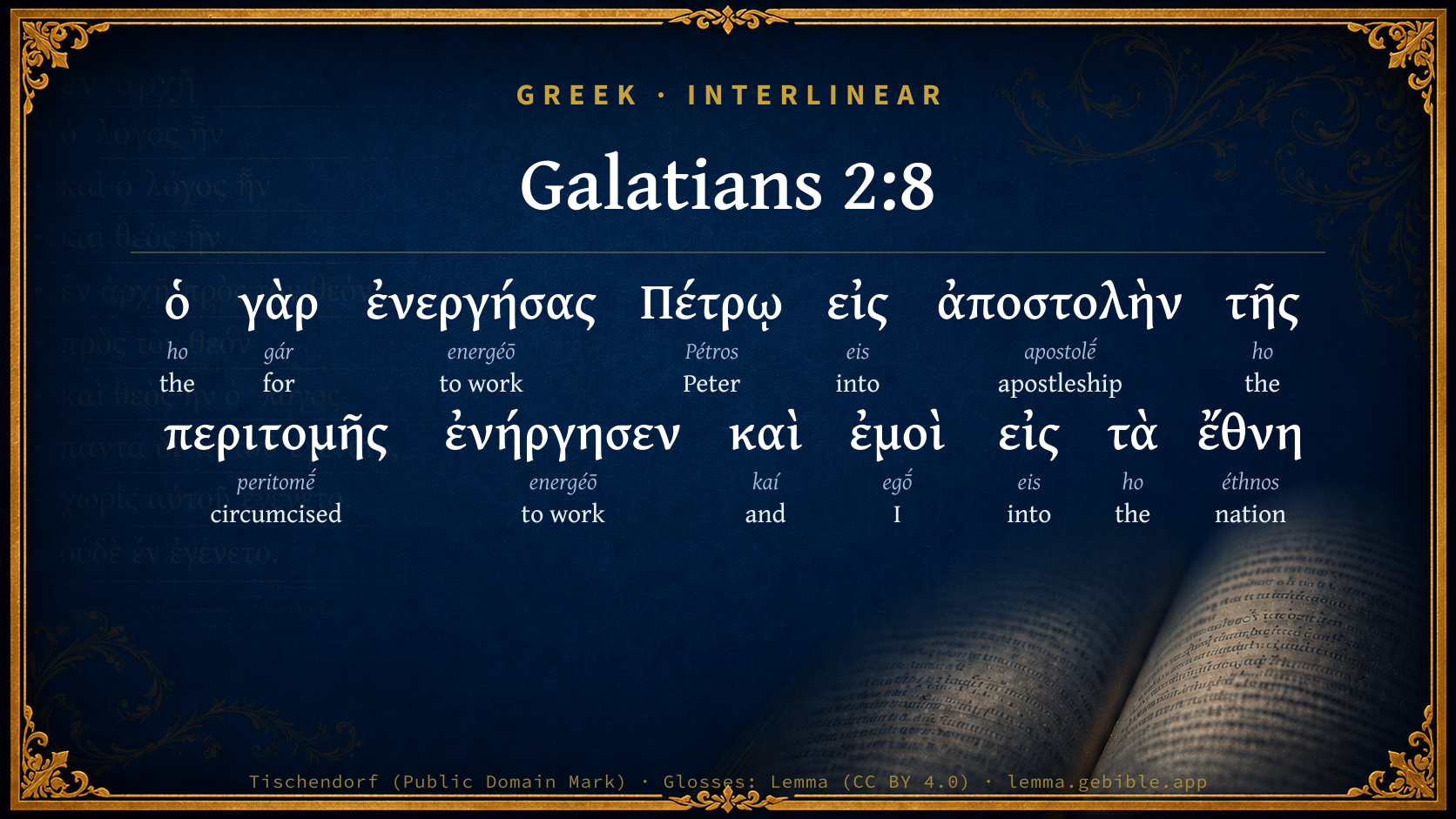
  1. ὁ ho G3588 “the” Article, Nominative, Singular, Masculine
  2. γὰρ gár G1063 “for” Conjunction
  3. ἐνεργήσας energéō G1754 “to work” Verb, Aorist, Active, Participle, Nominative, Singular, Masculine
  4. Πέτρῳ Pétros G4074 “Peter” Noun, Dative, Singular, Masculine
  5. εἰς eis G1519 “into” Preposition
  6. τῆς ho G3588 “the” Article, Genitive, Singular, Feminine
  7. περιτομῆς peritomḗ G4061 “circumcised” Noun, Genitive, Singular, Feminine
  8. ἐνήργησεν energéō G1754 “to work” Verb, Aorist, Active, Indicative, 3rd person, Singular
  9. καὶ kaí G2532 “and” Conjunction
  10. ἐμοὶ egṓ G1473 “I” Personal pronoun, 1st person, Dative, Singular
  11. εἰς eis G1519 “into” Preposition
  12. τὰ ho G3588 “the” Article, Accusative, Plural, Neuter
  13. ἔθνη éthnos G1484 “nation” Noun, Accusative, Plural, Neuter

About this verse

These counts appear in no published source. They are computed here, from the morphology-tagged text and Lemma’s own curated glosses. What Lemma adds →

14
words
10
distinct lemmas
Pauline Epistles
section

Notable vocabulary

The rarest word here is ἀποστολὴν apostleship G651 — appearing just 4 times in the whole Greek New Testament.

Shared distinctive vocabulary

ἀποστολὴν apostleship G651 occurs in 4 verses of the Greek New Testament. Also found in:

Repetition

Words recur within this verse:

  • ἐνεργήσας to work G1754 ×2
  • εἰς into G1519 ×2
  • ὁ the G3588 ×3

Cross-references

21

Topical passages linked to Galatians 2:8 in the Treasury of Scripture Knowledge — connected by theme and wording, ordered by reader-vote popularity; previews shown in the World English Bible.

  • Acts 9:15 But the Lord said to him, "Go your way, for he is my chosen vessel to bear my name before the nations and kings, and the children of Israel.
  • Acts 22:21 "He said to me, 'Depart, for I will send you out far from here to the Gentiles.'"
  • Acts 2:14–41 But Peter, standing up with the eleven, lifted up his voice, and spoke out to them, "You men of Judea, and all you who dwell at Jerusalem, let this be known to you, and listen to my words.
  • Acts 15:12 All the multitude kept silence, and they listened to Barnabas and Paul reporting what signs and wonders God had done among the Gentiles through them.
  • Acts 19:11–12 God worked special miracles by the hands of Paul,
  • Acts 21:19 When he had greeted them, he reported one by one the things which God had worked among the Gentiles through his ministry.
  • Acts 1:8 But you will receive power when the Holy Spirit has come upon you. You will be witnesses to me in Jerusalem, in all Judea and Samaria, and to the uttermost parts of the earth."
  • Acts 1:25 to take part in this ministry and apostleship from which Judas fell away, that he might go to his own place."
  • Acts 3:12–26 When Peter saw it, he responded to the people, "You men of Israel, why do you marvel at this man? Why do you fasten your eyes on us, as though by our own power or godliness we had made him walk?
  • Acts 4:4 But many of those who heard the word believed, and the number of the men came to be about five thousand.
  • Acts 5:12–16 By the hands of the apostles many signs and wonders were done among the people. They were all with one accord in Solomon's porch.
  • Acts 8:17 Then they laid their hands on them, and they received the Holy Spirit.
  • Acts 13:2–11 As they served the Lord and fasted, the Holy Spirit said, "Separate Barnabas and Saul for me, for the work to which I have called them."
  • Acts 14:3–11 Therefore they stayed there a long time, speaking boldly in the Lord, who testified to the word of his grace, granting signs and wonders to be done by their hands.
  • 1 Corinthians 9:2 If to others I am not an apostle, yet at least I am to you; for you are the seal of my apostleship in the Lord.
  • 1 Corinthians 15:10 But by the grace of God I am what I am. His grace which was bestowed on me was not futile, but I worked more than all of them; yet not I, but the grace of God which was with me.
  • 2 Corinthians 11:4–5 For if he who comes preaches another Jesus, whom we did not preach, or if you receive a different spirit, which you did not receive, or a different gospel, which you did not accept, you put up with that well enough.
  • Acts 26:17–18 delivering you from the people, and from the Gentiles, to whom I send you,
  • 1 Corinthians 1:5–7 that in everything you were enriched in him, in all speech and all knowledge;
  • Galatians 3:5 He therefore who supplies the Spirit to you, and works miracles among you, does he do it by the works of the law, or by hearing of faith?
  • Colossians 1:29 for which I also labor, striving according to his working, which works in me mightily.

Cross-references courtesy of OpenBible.info (CC BY 4.0).

Commentary

Notes on Galatians 2:8 from classic Christian and Jewish commentators (each source and its license shown beneath its notes). The classic Christian expositions comment on the surrounding passage and are grouped to its opening verse, so a note may address several verses; the Jewish commentaries on the Tanakh (Rashi and others) are per-verse, so they appear only where the commentator wrote on this verse.

Lemma curates 59 commentaries, every one of them public domain or Creative Commons licensed, each selected and text-cleaned for this edition rather than reprinted as found. About our sources →

Bengel's Gnomon

Johann Albrecht Bengel

Gal 2:8. Εἰς τὰ ἔθνη, to the Gentiles) i.e. to the apostleship of the Gentiles.

Bengel's Gnomon of the New Testament — English translation (T&T Clark, Edinburgh, 1860) — public domain. Text from a community e-Sword module.

Meyer's Critical & Exegetical Commentary

Heinrich August Wilhelm Meyer

Gal_2:8. A parenthetic historical substantiation of the preceding πεπίστευμαι τὸ εὐαγγ. τῆς ἀκροβ., καθῶς Πετρ. τῆς περιτ.: for He who has been efficacious for Peter as regards the apostleship to the circumcision, has also been efficacious for me as regards the Gentiles; that is, for God, who has wrought effectually[78] in order to make Peter the apostle to the Jews, has also wrought effectually for me, to make me an apostle to the Gentiles. The stress lies on ἐνεργήσας and ἘΝΉΡΓΗΣΕ: God has been not inactive, but efficacious, etc. But that in Ὁ ἘΝΕΡΓΉΣΑς Paul did not refer to Christ (Paulus, comp. Chrysostom), is evident not only from passages such as 1Co_12:6, Php_2:13, Col_1:29, but also from the fact that he constantly considers his apostleship to be the gift of Gods grace, bestowed upon him through the mediation of Christ (Gal_1:1; Gal_1:15; Rom_1:5; Rom_15:15; 1Co_15:10; Eph_3:2; Eph_3:7, et al.).

Πέτρῳ is the dativus commodi; comp. Pro_29:12 (Pro_31:12), according to the usual reading, ἐνεργεῖ γὰρ τῷ ἀνδρὶ εἰς ἀγαθά.

ΕἸς ΤᾺ ἜΘΝΗ] in reference to the Gentiles. The precise sense follows from the first half of the verse, namely, εἰς ἀποστολὴν τῶν ἐθνῶν. The well-known comparatio compendiaria. See Kühner, ad Xen. Mem. iii. 5. 4; Winer, p. 578 [E. T. 778]; Fritzschiorum Opusc. p. 217 f. There is therefore the less reason for assuming that Paul desired to avoid the expression εἰς ἀποστ. τ. ἔθνων (Holsten). Observe, however, how Paul places himself on a par with Peter; perfecta auctoritas in praedicatione gentium, Ambrosiaster.

[78] Namely, by communicating the requisite endowments, enlightenment, strengthening, and generally the whole equipment belonging thereto. It is not the divine action towards the attainment of the ἀποστολή (Vatablus, Schott, Fritzsche) that is meant, but the making fit for it; the attainment was indicated in ver. 7, and is substantiated in ver. 8 by the further divine action which had taken place. But neither are the results of the office, brought about by Gods helpful operation, referred to (Winer, Usteri, Baur, de Wette, Hofmann), which would anticipate the sequel.

Meyer — Critical and Exegetical Commentary on the New Testament — English translation by Peter Christie, edited by Frederick Crombie (T&T Clark, 1880) — public domain. Text from a community e-Sword module.

Expositor's Greek Testament

ed. W. Robertson Nicoll

Gal 2:8 . ἐνεργήσας . When this verb is applied to the work of the Spirit in the hearts of men, the preposition ἐν is added to it. The absence of ἐν before Πέτρῳ and ἐμοί indicates that this verse is not describing the work of grace in the hearts of Peter and Paul, but the work of God for them, i.e. , for the furtherance of the Gospel which they preached.

The Expositor's Greek Testament, edited by W. Robertson Nicoll (1897–1910) — public domain. Text from a community e-Sword module.

Jamieson, Fausset & Brown

Robert Jamieson, A. R. Fausset & David Brown

he--God (Co1 12:6).

wrought effectually--that is, made the preached word efficacious to conversion, not only by sensible miracles, but by the secret mighty power of the Holy Ghost.

in Peter--ELLICOTT and others, translate, "For Peter." GROTIUS translates as English Version.

to--with a view to.

was mighty--Translate as before, the Greek being the same, "wrought effectually."

in me--"for (or 'in') me also."

Jamieson, Fausset & Brown — Commentary Critical and Explanatory on the Whole Bible (1871) — public domain (CC PDM 1.0). Text via the HelloAO Bible API.

Adam Clarke's Commentary

Verse 8. For he that wrought effectually] Ὁ ενεργησας Πετρῳ, ενηργησε και εμοι· He who wrought powerfully with Peter, wrought powerfully also with me. He gave us both those talents which were suited to our work, and equal success in our different departments.

Adam Clarke's Commentary on the Bible (1810–1826) — public domain. Text from a community e-Sword/MySword module.

John Calvin's Commentaries

8. He that wrought effectually. That the province which had been assigned to him was truly his own, is proved by the exertion of divine power during his ministry. Now, this manifestation of divine energy, as we have frequently seen, is the seal by which his doctrine was attested, and his office as a teacher sanctioned. Whether Paul refers God’s effectual working to the success of his preaching, or to the graces of the Holy Spirit which were then bestowed on believers, is doubtful. I do not understand it as denoting the mere success, but the spiritual power and efficacy, which he has elsewhere mentioned. (1 Corinthians 2:4.) The amount of the whole is, that it was no idle bargain which the apostles had made among themselves, but a decision which God had sealed.

John Calvin's Commentaries (1540-1563) — public domain. Text from the Calvin Translation Society English edition (1840s-50s) via the Christian Classics Ethereal Library (ccel.org). Calvin's coverage is partial (roughly two-thirds of the Bible); uncommented books and verses are honest gaps, never fabricated. The 19th-century editor's footnotes and remarks are omitted so the notes are faithfully Calvin's own voice.

Ellicott's Commentary for English Readers

(8) He that wrought effectually in Peter . . . the same was mighty in me.—This is an instance of that capriciousness in our translators which was due to their free poetic handling and superabundant command of words. “Wrought effectually” and “was mighty” are the same word in the Greek, and there does not seem to be any sufficient reason why the translation should be altered. “In Peter” and “in me” would be better translated for Peter and for me. He that wrought effectually for Peter to the apostleship of the circumcision, the same wrought effectually for me towards the Gentiles.

A Bible Commentary for English Readers, edited by Charles John Ellicott (1878–1897) — public domain. Text from a community e-Sword module.

The Cambridge Bible for Schools and Colleges

gen. ed. J. J. S. Perowne

8. This verse is parenthetical. It expands and explains Gal_2:7.

in Peter] Rather, ‘for Peter’—so ‘for me’.

The Cambridge Bible for Schools and Colleges (gen. ed. J. J. S. Perowne; Cambridge University Press, 1878–1918) — public domain. Text from a community e-Sword module.

John Gill's Exposition

For he that wrought effectually in Peter,.... The Syriac version renders it, "he who exhorted Peter to"; the Arabic version is, "he who strengthened Peter in"; the Spirit of God is meant, who filled Peter with such eminent gifts, and inspired him with so much zeal and resolution

to the apostleship of circumcision, to discharge his office as an apostle among the Jews; and who wrought by him such wonderful works for the confirmation of it, as curing the man that was lame from his birth, striking Ananias and Sapphira dead for telling lies, and raising Dorcas from the dead, and communicating miraculous gifts by the imposition of his hands; and which same Spirit also made his ministrations effectual to the conversion of a large number of souls, as of three thousand by one sermon.

The same was mighty in me towards the Gentiles. The Spirit of God wrought as effectually in, and by him, as in Peter; filled him with extraordinary gifts for the discharge of his work among the Gentiles, and inspired him with equal zeal, constancy, and intrepidity of mind; wrought as many miracles by him to confirm his mission; such as striking blind Elymas the sorcerer, healing the cripple at Lystra, raising Eutychus from the dead, with many other signs and wonders wrought by him among the Gentiles, through the power of the Spirit of God, whereby they became obedient by word and deed. The same Spirit also accompanied the Gospel preached by him, to the conversion of multitudes, by which means many famous churches were founded and raised among the Gentiles; and this is another reason which induced the apostles at Jerusalem to take Paul and Barnabas into an association with them.

John Gill's Exposition of the Whole Bible (1746–1763) — public domain (CC PDM 1.0). Text via the HelloAO Bible API.

Trapp's Complete Commentary

John Trapp

8 (For he that wrought effectually in Peter to the apostleship of the circumcision, the same was mighty in me toward the Gentiles:)

Ver. 8. For he that wrought, &c.] He argues from the success of his and Peter’s ministry to the lawfulness of their calling to the work. So he doth 1Co 9:1-3 2Co 13:4-5. {See Trapp on "1Co 9:1"} {See Trapp on "1Co 9:2"} {See Trapp on "1Co 9:3"} {See Trapp on "2Co 13:4"} {See Trapp on "2Co 13:5"} He also ascribeth the glory of all to God, when he saith "was mighty in me." A phrase not unlike that other, 1Co 15:10; "Not I, but the grace of God." And again, not we, "but the weapons of our warfare are mighty through God," &c., 2Co 10:4.

John Trapp, A Commentary or Exposition upon All the Books of the Old and New Testament (1647–1656) — public domain. Text from a community e-Sword module.

Albert Barnes' Notes on the Bible

For he that wrought effectually in Peter ... - Or by the means or agency of Peter. The argument here is, that the same effects had been produced under the ministry of Paul among the Gentiles which had been under the preaching of Peter among the Jews. It is inferred, therefore, that God had called both to the apostolic office; see this argument illustrated in the notes at Act 11:17.

The same was mighty in me ... - In enabling me to work miracles, and in the success which attended the ministry.

Albert Barnes' Notes on the Bible (1834–1885) — public domain. Text from a community e-Sword/MySword module.

Matthew Poole's English Annotations

As Paul’s call was equal to that of Peter both of them being Divine, so, saith the apostle, my ability and success was equal; as God

wrought effectually in and by Peter in the discharge of his apostleship in the province intrusted to him, (which was preaching to the Jews), so he wrought effectually and mightily in me, or by me, in the province wherein I was employed, viz. carrying the gospel to the Gentiles. This efficious working of God, both by Paul and Peter, was seen in the conversion of multitudes by their ministry, as well as in their miraculous operations, by which they confirmed the doctrine of the gospel which they preached.

Matthew Poole's English Annotations on the Holy Bible (1683–1685) — public domain. Text from a community e-Sword/MySword module.

Whedon's Commentary on the Bible

Daniel D. Whedon

8. He that wrought—The mission of each was wrought by the same God.

Daniel D. Whedon (gen. ed.), Commentary on the Old and New Testaments (1874–1909) — public domain. Text from a community e-Sword module.

The Pulpit Commentary

For he that wrought effectually in Peter to the apostleship of the circumcision (oJ gasav Petrw eijv ajpostolhn thv peritomhv); he that had wrought on Peter"s behalf for apostleship of the circumcision. In form, the sentence is an absolute statement of fact; but its bearing in the context would be fairly represented by rendering it relatively, "for that he who," etc.; for it was the perception of the fact here stated which led that assembly to the conviction that Paul had been entrusted with the apostleship of the uncircumcision. The dative Petrw can scarcely be governed, as the Authorized Version presupposes, by the preposition in ejnerghsav, this verb not being a separable compound; it is rather the dativus commodi, as in Pro_31:12, jEnergei tw ajndri. When operation in a subject is meant, the preposition ejn is added, as Eph_1:20 Eph_2:2; Gal_3:5. The worker is God, not Christ (comp. (1Co_12:6; Php_2:13) God wrought on Peter"s behalf for apostleship of the circumcision; that is, towards, in furtherance of, his work as their apostle, by constituting him their apostle, by making his ministry effectual in turning their hearts to Christ, and by miracles wrought by his hands, including the impartation through him of miraculous gifts to his converts; for such were "the signs of the apostle". (2Co_12:12) The same was mighty in me toward the Gentiles (ejnhrghse kai ejmoi eijv ta eqnh); had wrought also on my behalf towards the Gentiles. Comp. hsen Act_15:12, "They hearkened unto Barnabas and Paul rehearsing what signs and wonders God had wrought (ejpoi) among the Gentiles by them;" where likewise, as here, the aorist tense is used of action they were then looking back upon as past. The absence of Barnabas"s name in this verse, though mentioned in the next, is significant. Barnabas was not an apostle in that highest sense of the term in which Paul was an apostle, and which alone he is now thinking of; although he was associated with Paul, both in ministerial work and in that lower form of apostleship which beth had received from men. (comp. Act_14:4, Act_14:14; and Dissertation I in the Introduction)

The Pulpit Commentary (1880–1919), ed. H.D.M. Spence-Jones & Joseph S. Exell — public domain. Text from a community e-Sword module.

John Wesley's Explanatory Notes

For he that wrought effectually in Peter for the apostleship of the circumcision - To qualify him for, and support him in, the discharge of that office to the Jews. Wrought likewise effectually in and by me - For and in the discharge of my office toward the gentiles.

John Wesley, Explanatory Notes Upon the Whole Bible (1754–1765) — public domain. Text via the GEBible commentary corpus.

Luther on Galatians

Martin Luther

VERSE 8. For he that wrought effectually in Peter.

With these words Paul refutes another argument of the false apostles. "What reason have the false apostles to boast that the Gospel of Peter was mighty, that he converted many, that he wrought great miracles, and that his very shadow healed the sick? These reports are true enough. But where did Peter acquire this power? God gave him the power. I have the same power. I received my power, not from Peter, but from the same God, the same Spirit who was mighty in Peter was mighty in me also." Luke corroborates Paul’s statement in the words: "And God wrought special miracles by the hands of Paul, so that from his body were brought unto the sick handkerchiefs or aprons, and the diseases departed from them, and the evil spirits went out of them." (Act 19:11-12.)

To conclude, Paul is not going to be inferior to the rest of the apostles. Some secular writers put Paul’s boasting down as carnal pride. But Paul had no personal interest in his boasting. It was with him a matter of faith and doctrine. The controversy was not about the glory of Paul, but the glory of God, the Word of God, the true worship of God, true religion, and the righteousness of faith.

Martin Luther — Commentary on the Epistle to the Galatians (1535), English translation by Theodore Graebner (Zondervan, 1939) — public domain (U.S. copyright not renewed). Text from a community e-Sword module.

McGarvey & Pendleton's Commentaries

J. W. McGarvey

(for he that wrought for Peter unto the apostleship of the circumcision wrought for me also unto the Gentiles)

J. W. McGarvey (with Philip Y. Pendleton), Commentaries on the New Testament (The Fourfold Gospel, 1914; Acts; and the epistles) — public domain. Text from a community e-Sword/MySword module.

The People's New Testament

B. W. Johnson

8. For he that wrought effectually in Peter. As Christ gave Peter the wisdom, knowledge and power needful to establish the church among the Jews, so he had fully endowed Paul for a similar work among the Gentiles.

B. W. Johnson's The People's New Testament with Notes (1889–1891) — public domain. Electronic text from the Christian Classics Ethereal Library (CCEL) ThML edition.

Cambridge Greek Testament for Schools and Colleges

8. ὁ γὰρ. Justifying his assertion that he had received a commission as Peter had; God wrought for each.

ἐνεργήσας Πέτρῳ, “He that worked for Peter.”

So Pro 31:12 (Pro 31:31), ἐνεργεῖ γὰρ τῳ ἀνδρὶ ἀγαθὰ πάντα τὸν βίον. With dative only in this verse in the N.T. Cf. Gal 5:6 note.

εἰς ἀποστολὴν (Act 1:25; Rom 1:5; 1Co 9:2[75]), not only for the call to it, but also for its fulfilment.

[75] Is affixed to a word it means that all the passages are mentioned where that word occurs in the New Testament.

τῆς περιτομῆς. Genitive marking the sphere in which the apostleship was exercised. For euphony at the end of the verse, where there is no preceding εἰς, he reverts to the more natural εἰς with the accusative.

Cambridge Greek Testament for Schools and Colleges (Cambridge University Press, 1896; 21 vols, various authors incl. Carr, Maclear, Plummer, Farrar, Lumby, Moule, M. R. James, Simcox) — public domain. Text from a community e-Sword module.

Alford’s Greek Testament

Henry Alford

8.] Parenthetic explanation of πεπίστευμαι κ.τ.λ.

Πέτρῳ and ἐμοί are datives commodi, not governed by the ἐν in ἐνεργ., the meaning of this preposition being already expressed in the word ἐνεργεῖν, and having therefore no force to pass on: cf. ref. Prov.

ἐνήργ. applies to the ἀπακολουθοῦντα σημεῖα with which the Lord accompanied His word spoken by them, and to the power with which they spoke that word. The agent in ἐνεργ. is God,—the Father: see 1Co 12:6; Php 2:13; Rom 15:15, Rom 15:16.

εἰς ἀποστ.] towards, with a view to, the Apostleship,—reff.

εἰς τὰ ἔθνη] The fuller construction would be, εἰς ἀποστολὴν τ. ἐθνῶν: so τάων οὔτις ὁμοῖα νοήματα Πηνελοπείῃ | ᾔδη, Od. β. 120: and frequently.

Henry Alford, The Greek Testament (1849–1861) — public domain. Text from a community e-Sword module.

International Critical Commentary

8. ὁ γὰρ ἐνεργήσας Πέτρῳ εἰς ἀποστολὴν τῆς περιτομῆς ἐνήργησεν καὶ ἐμοὶ εἰς τὰ ἔθνη, “for he who wrought for Peter unto an apostleship to the circumcised wrought also for me unto an apostleship to the Gentiles.” This parenthetical v. is confirmatory of the implied assertion of v. 7, being intended either as a statement of the reasoning by which the pillar apostles reached their conviction there stated, or more probably of Paul’s own thought by which he supports and confirms their conclusion. Conceding without reserve Peter’s apostleship and its divine source, Paul justifies their recognition of his own claim to apostleship by appeal to his own equal and like experience of God.

Whether the appeal is to the inner experience of each by which they were endowed for their work, or to the known results, in the way of converts, etc., of his work and Peter’s, depends upon the precise sense in which Paul used the words ἐνεργήσας and ἐνήργησεν. The usage of ἐνεργέω in 1Co 12:6, 1Co 12:11, where it refers to the work of the Spirit of God in men, fitting and endowing each for his own work, suggests the first view. But Php 2:13, where in the second instance ἐνεργεῖν means specifically “to effect, to produce results,” shows that Paul might easily use the word here with reference to the divine activity in accomplishing results through himself and Peter, perhaps preferring it to κατεργάζομαι (see Rom 15:18) because it is intransitive and because it more distinctly suggests the divine energy by which the results were accomplished. The argument on this view would be similar to that of 1Co 9:1, but also wholly appropriate to the present connection, and more forcible than a reference to the inner experience of Peter and himself, which would be known only to each of them respectively.

In ὁ γὰρ ἐνεργήσας, as in some other passages, Paul refers to God by a descriptive epithet without the insertion of the word θεός. See 1:6, 15 and notes; Col 3:10. To understand ὁ ἐνεργήσας of Christ rather than God, would not be consistent with Paul’s usual method of expression concerning the apostleship. Save where as in Gal 1:1 the two ideas coalesce in the representation of God and Christ as immediate source, it is his habit to speak of God as its source and Christ as the agent or mediator of it (Rom 1:5, Rom 1:15:15, 1Co 15:10, Eph 3:2, Eph 3:7, Gal 1:15; cf. also on his use of the verb ἐνεργέω 1Co 12:6, Php 2:13).

The dative Πέτρῳ is a dative of advantage, not governed by ἐν in composition, ἐνεργήσας not being a verb compounded with ἐν, but derived from ἐνεργής or ἐνεργός = ἐν ἔργῳ, “effective,” and meaning “to be operative, to work.”

Ἀποστολή, here as always in N. T. (see Act 1:25, Rom 1:5, 1Co 9:2; it is otherwise in classical Greek and the Lxx) refers specifically to the office and work of an apostle of Christ; see on 1:1. The omission of the article gives the word qualitative force. The preposition εἰς expresses not mere reference but purpose or result, “for or unto the creation of,” i. e., “so as to make him an apostle.”

Τῆς περιτομῆς is here, as in v. 7, by metonymy for “the circumcised.” εἰς τὰ ἔθνη is manifestly a condensed expression equivalent to εἰς ἀποστολὴν τῶν εθνῶν, or the like, used for brevity’s sake or through negligence. That ἀποστολήν is omitted because of an unwillingness on Paul’s part to claim apostleship for himself is excluded alike by the whole thought of the sentence and by 1:1.

8. Paul’s account of the subsequent incident at Antioch also excludes the possibility of fellowship between Jews and Gentiles in the church having been agreed to at Jerusalem either on the basis of the Gentiles conforming to the Jewish law of foods or of the Jews disregarding their law. It is practically certain, therefore, that the practice of Jewish and Gentile Christians eating together in disregard of the Jewish law arose at Antioch, independent of any decision at Jerusalem, and probably subsequent to the Jerusalem conference. Cf. on v. 12, p. 105.

International Critical Commentary — older volumes (1896–1929), various authors — public domain. Text from a community e-Sword module.

Vincent's Word Studies in the New Testament

Marvin R. Vincent

He that wrought effectually [ο ενεργησας] . See on 1Th 2:13. Rev. omits effectually, but it is fairly implied in the verb. 48 Comp. 1Co 12:6; Phi 2:13; Col 1:29. The reference is to God, not to Christ.

In Peter [πετρω] . Better, for Peter. In Peter would be ejn Petrw.

Unto the apostleship [εις] . Not merely with reference to the apostleship, but with the design of making him an apostle. Comp. 2Co 2:12; Col 1:29. Observe how Paul puts himself on an equality with Peter.

Unto the Gentiles [εις τα εθνη] . To make me an apostle to the Gentiles.

Marvin R. Vincent, Word Studies in the New Testament (1887–1900) — public domain. Text from a community e-Sword/MySword module.

Lesson kit

Teaching starters — assembled from the data on this page, not authored interpretation. Every prompt links to the verse data it draws on. Edit before teaching.

Galatians, in the Pauline Epistles, opens this verse with 14 words (10 distinct Greek lemmas). Its most distinctive word is apostolḗ (“apostleship”). A historical commentator’s framing appears above. Read the whole chapter for the surrounding context.

Discussion questions

  1. The word apostolḗ carries the sense “apostleship.” How does it shape the verse?
  2. Acts 1:25 shares the word «apostleship» with this verse. How do the two illuminate each other?
  3. “to work” occurs 2× in this one verse. What is the effect of the repetition?
  4. The translations on this page render this verse differently — a whole-verse word diff, not a word-by-word alignment. What might account for the different wordings?
  5. Reading how Bengel's Gnomon and Meyer's Critical & Exegetical Commentary read this verse, where do the two commentators agree and where do they part?

Things to notice

Reading settings

Reading text

Shown beneath each verse's original-language words.

Old Testament
Old Testament edition

Read the OT as the Masoretic Hebrew (MT) or the Greek Septuagint (LXX).

English shown for the Greek Septuagint (in the Hebrew ↔ Greek comparison).

Comparing translations? Open the Compare panel on any verse page to stack up to four side by side.