

Luke 24:47
Greek (Tischendorf 8th ed.) Luke 24:47 appears in the Greek New Testament. The text above is from the Tischendorf 8th edition. Each word links to its Strong’s number and a concise gloss. Click any word for its full Thayer’s Greek Lexicon entry.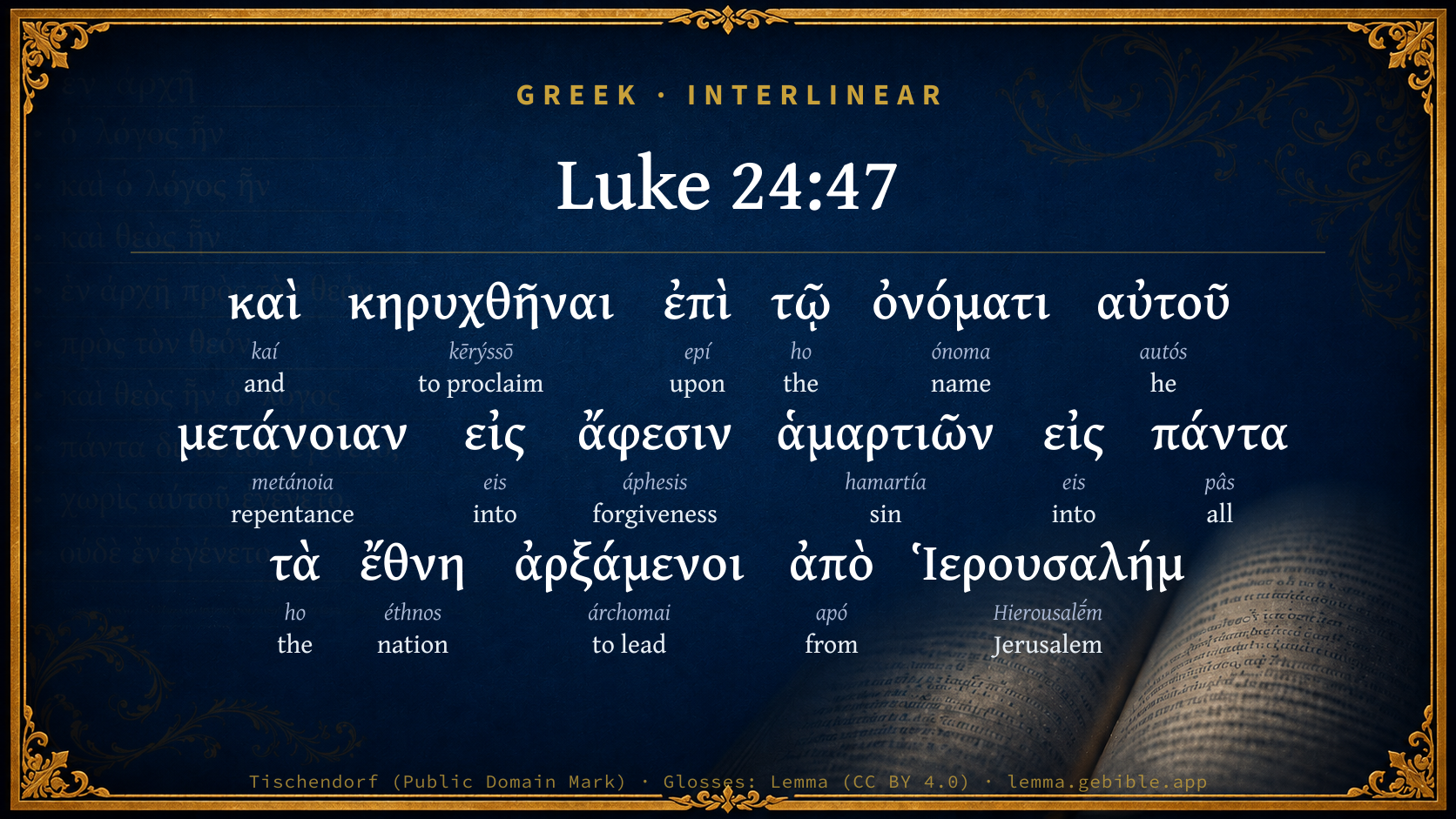
and that repentance and remission of sins should be preached in his name to all the nations, beginning at Jerusalem.
Download a study sheet
One document with this verse’s original text, its word-by-word gloss line, the meaning frame, cross-references with their text, attributed commentary, and full source and license credits — printable, and it pastes into notes with its structure intact.
This verse Autodidact and up
A passage Seminary Student
Up to 50 verses in one chapter. A passage sheet keeps up to 6 commentary sources and 12 cross-references per verse, in the order this page ranks them, and says so on the sheet whenever that leaves anything out. Ask for a single verse and you get the Autodidact verse sheet above.
Everything on this page stays free to read, with no account — the sheet is a download of what is already on screen, not access to it.
Compare translations 3
The same verse in 3 English versions, stacked beneath the original-language interlinear above. Click any original word for its lexicon entry.
Each is an independent rendering of the whole verse — the interlinear is not word-aligned to these translations.
Highlighted words mark where these versions differ — a whole-verse word diff, not a word-by-word alignment.
-
World English Bible Public Domain
and that repentance and remission of sins should be preached in his name to all the nations, beginning at Jerusalem.
-
King James Version Public Domain
And that repentance and remission of sins should be preached in his name among all nations, beginning at Jerusalem.
-
unfoldingWord Literal Text CC BY-SA 4.0
and repentance for forgiveness of sins would be proclaimed in his name to all the nations, beginning from Jerusalem.
unfoldingWord Literal Text — © unfoldingWord, licensed CC BY-SA 4.0. Word-aligned USFM3 via Door43 (git.door43.org/unfoldingWord/en_ult).
Show all 19 translations
Every available English version of this verse, each an independent rendering of the whole verse.
-
World English Bible Public Domain
and that repentance and remission of sins should be preached in his name to all the nations, beginning at Jerusalem.
-
Berean Standard Bible Public Domain
and in His name repentance and forgiveness of sins will be proclaimed to all nations, beginning in Jerusalem.
-
Majority Standard Bible Public Domain
and in His name repentance and forgiveness of sins will be proclaimed to all nations, beginning in Jerusalem.
-
King James Version Public Domain
And that repentance and remission of sins should be preached in his name among all nations, beginning at Jerusalem.
-
American Standard Version (1901) Public Domain
and that repentance and remission of sins should be preached in his name unto all the nations, beginning from Jerusalem.
-
Revised Version (1885) Public Domain
and that repentance and remission of sins should be preached in his name unto all the nations, beginning from Jerusalem.
-
Geneva Bible (1599) Public Domain
And that repentance, and remission of sinnes should be preached in his Name among all nations, beginning at Hierusalem.
-
Douay-Rheims (1899) Public Domain
And that penance and remission of sins should be preached in his name, unto all nations, beginning at Jerusalem.
-
Young's Literal Translation Public Domain
and reformation and remission of sins to be proclaimed in his name to all the nations, beginning from Jerusalem:
-
Literal Standard Version CC BY-SA 4.0
and conversion and forgiveness of sins is to be proclaimed in His Name to all the nations, beginning from Jerusalem:
-
Unlocked Literal Bible CC BY-SA 4.0
Repentance and forgiveness of sins should be preached in his name to all the nations, beginning from Jerusalem.
-
unfoldingWord Literal Text CC BY-SA 4.0
and repentance for forgiveness of sins would be proclaimed in his name to all the nations, beginning from Jerusalem.
-
Darby Bible Public Domain
and that repentance and remission of sins should be preached in his name to all the nations beginning at Jerusalem.
-
World Messianic Bible Public Domain
and that repentance and remission of sins should be preached in his name to all the nations, beginning at Jerusalem.
-
Webster's Bible Public Domain
And that repentance and remission of sins should be preached in his name among all nations, beginning at Jerusalem.
-
Free Bible Version CC BY-SA 4.0
repentance for the forgiveness of sins would be preached to all nations, beginning in Jerusalem.
-
Bible in Basic English Public Domain
And that teaching about a change of heart and forgiveness of sins is to be given to Jerusalem first and to all nations in his name.
-
Text-Critical English NT CC BY 4.0
and for repentance and remission of sins to be preached in his name to all nations, beginning from Jerusalem.
-
Tyndale New Testament (1534) Public Domain
and that repentaunce and remission of synnes shuld be preached in his name amonge all nacions and must beginne at Ierusalem.
Literal Standard Version (2020), Covenant Press — licensed CC BY-SA 4.0. Text via the HelloAO Bible API (eBible.org). Unlocked Literal Bible (unfoldingWord) — licensed CC BY-SA 4.0. Text via the HelloAO Bible API (eBible.org). unfoldingWord Literal Text — © unfoldingWord, licensed CC BY-SA 4.0. Word-aligned USFM3 via Door43 (git.door43.org/unfoldingWord/en_ult). Free Bible Version, Dr. Jonathan Gallagher — licensed CC BY-SA 4.0. Text via the HelloAO Bible API (eBible.org).
Word by word
More ways to search: Search by grammar → Find every occurrence → Compare this word →
Practice this passage: Drill this verse → Learn its vocabulary →
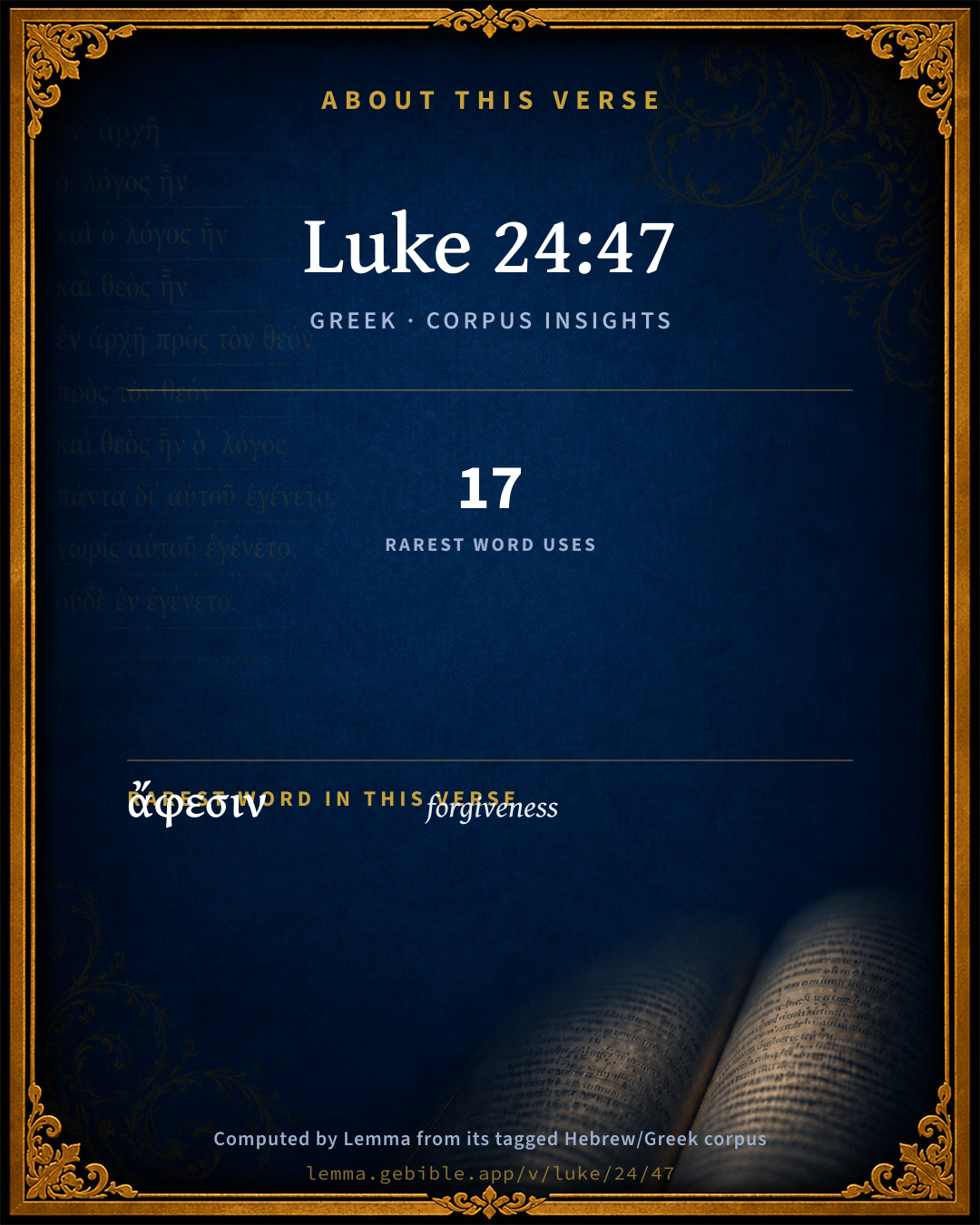
- Appears 17× in the Greek New Testament
- First appears at Matthew 26:28
- Part of Speech
- Noun
- Case
- Accusative
- Number
- Singular
- Gender
- Feminine
Full Thayer's Definition
- καὶ kaí G2532 “and” Conjunction
- κηρυχθῆναι kērýssō G2784 “to proclaim” Verb, Aorist, Passive, Infinitive
- ἐπὶ epí G1909 “upon” Preposition
- τῷ ho G3588 “the” Article, Dative, Singular, Neuter
- ὀνόματι ónoma G3686 “name” Noun, Dative, Singular, Neuter
- αὐτοῦ autós G846 “he” Personal pronoun, Genitive, Singular, Masculine
- μετάνοιαν metánoia G3341 “repentance” Noun, Accusative, Singular, Feminine
- εἰς eis G1519 “into” Preposition
- ἄφεσιν áphesis G859 “forgiveness” Noun, Accusative, Singular, Feminine
- ἁμαρτιῶν hamartía G266 “sin” Noun, Genitive, Plural, Feminine
- εἰς eis G1519 “into” Preposition
- πάντα pâs G3956 “all” Adjective, Accusative, Plural, Neuter
- τὰ ho G3588 “the” Article, Accusative, Plural, Neuter
- ἔθνη éthnos G1484 “nation” Noun, Accusative, Plural, Neuter
- ἀρξάμενοι árchomai G756 “to lead” Verb, Aorist, Middle, Participle, Nominative, Plural, Masculine
- ἀπὸ apó G575 “from” Preposition
- Ἱερουσαλήμ Hierousalḗm G2419 “Jerusalem” Noun, Proper, indeclinable
About this verse
These counts appear in no published source. They are computed here, from the morphology-tagged text and Lemma’s own curated glosses. What Lemma adds →
- 17
- words
- 15
- distinct lemmas
- Gospels
- section
Cross-references
52Topical passages linked to Luke 24:47 in the Treasury of Scripture Knowledge — connected by theme and wording, ordered by reader-vote popularity; previews shown in the World English Bible.
- Isaiah 49:6 yes, he says, It is too light a thing that you should be my servant to raise up the tribes of Jacob, and to restore the preserved of Israel: I will also give you for a light to the Gentiles, that you may be my salvation to the end of the earth.
- Acts 5:31 God exalted him with his right hand to be a Prince and a Savior, to give repentance to Israel, and remission of sins.
- Matthew 28:19 Therefore go, and make disciples of all nations, baptizing them in the name of the Father and of the Son and of the Holy Spirit,
- Acts 2:38 Peter said to them, "Repent, and be baptized, everyone of you, in the name of Jesus Christ for the forgiveness of sins, and you will receive the gift of the Holy Spirit.
- Acts 20:21 testifying both to Jews and to Greeks repentance toward God, and faith toward our Lord Jesus.
- Isaiah 2:1–3 This is what Isaiah the son of Amoz saw concerning Judah and Jerusalem.
- Malachi 1:11 For from the rising of the sun even to the going down of the same, my name is great among the nations, and in every place incense will be offered to my name, and a pure offering: for my name is great among the nations," says Yahweh of Hosts.
- Acts 13:46 Paul and Barnabas spoke out boldly, and said, "It was necessary that God's word should be spoken to you first. Since indeed you thrust it from you, and judge yourselves unworthy of eternal life, behold, we turn to the Gentiles.
- Genesis 12:3 I will bless those who bless you, and I will curse him who curses you. In you will all of the families of the earth be blessed."
- Psalms 67:2–4 That your way may be known on earth, And your salvation among all nations,
- Psalms 86:9 All nations you have made will come and worship before you, Lord. They shall glorify your name.
- Psalms 98:1–3 Sing to Yahweh a new song, For he has done marvelous things! His right hand, and his holy arm, have worked salvation for him.
- Jeremiah 31:34 and they shall teach no more every man his neighbor, and every man his brother, saying, Know Yahweh; for they shall all know me, from the least of them to the greatest of them, says Yahweh: for I will forgive their iniquity, and their sin will I remember no more.
- Daniel 9:24 Seventy weeks are decreed on your people and on your holy city, to finish disobedience, and to make an end of sins, and to make reconciliation for iniquity, and to bring in everlasting righteousness, and to seal up vision and prophecy, and to anoint the most holy.
- Acts 11:18 When they heard these things, they held their peace, and glorified God, saying, "Then God has also granted to the Gentiles repentance to life!"
- Acts 13:38–39 Be it known to you therefore, brothers, that through this man is proclaimed to you remission of sins,
- Acts 26:18 to open their eyes, that they may turn from darkness to light and from the power of Satan to God, that they may receive remission of sins and an inheritance among those who are sanctified by faith in me.'
- Romans 10:12–18 For there is no distinction between Jew and Greek; for the same Lord is Lord of all, and is rich to all who call on him.
- Psalms 22:27 All the ends of the earth shall remember and turn to Yahweh. All the relatives of the nations shall worship before you.
- Hosea 2:23 I will sow her to me in the earth; And I will have mercy on her who had not obtained mercy; And I will tell those who were not my people, 'You are my people;' And they will say, 'My God!'"
- Acts 17:30–31 The times of ignorance therefore God overlooked. But now he commands that all people everywhere should repent,
- Colossians 1:27 to whom God was pleased to make known what are the riches of the glory of this mystery among the Gentiles, which is Christ in you, the hope of glory;
- Micah 4:2 Many nations will go and say, "Come, and let us go up to the mountain of Yahweh, And to the house of the God of Jacob; And he will teach us of his ways, And we will walk in his paths." For out of Zion will go forth the law, And the word of Yahweh from Jerusalem;
- Matthew 3:2 "Repent, for the Kingdom of Heaven is at hand!"
- Acts 3:19 "Repent therefore, and turn again, that your sins may be blotted out, so that there may come times of refreshing from the presence of the Lord,
- Acts 4:12 There is salvation in none other, for neither is there any other name under heaven, that is given among men, by which we must be saved!"
- Acts 10:43 All the prophets testify about him, that through his name everyone who believes in him will receive remission of sins."
- Romans 15:8–16 Now I say that Christ has been made a minister of the circumcision for the truth of God, that he might confirm the promises given to the fathers,
- 1 John 2:12 I write to you, little children, because your sins are forgiven you for his name's sake.
- Psalms 117:1–2 Praise Yahweh, all you nations! Extol him, all you peoples!
- Isaiah 52:10 Yahweh has made bare his holy arm in the eyes of all the nations; and all the ends of the earth have seen the salvation of our God.
- Isaiah 52:15 so shall he sprinkle many nations; kings shall shut their mouths at him: for that which had not been told them shall they see; and that which they had not heard shall they understand.
- Isaiah 60:1–3 Arise, shine; for your light is come, and the glory of Yahweh is risen on you.
- Isaiah 66:18–21 For I [know] their works and their thoughts: [the time] comes, that I will gather all nations and languages; and they shall come, and shall see my glory.
- Psalms 67:7 God will bless us. All the ends of the earth shall fear him.
- Isaiah 5:4 What could have been done more to my vineyard, that I have not done in it? Why, when I looked for it to yield grapes, did it yield wild grapes?
- Isaiah 11:10 It shall happen in that day, that the root of Jesse, who stands for an ensign of the peoples, to him shall the nations seek; and his resting-place shall be glorious.
- Isaiah 49:22 Thus says the Lord Yahweh, Behold, I will lift up my hand to the nations, and set up my ensign to the peoples; and they shall bring your sons in their bosom, and your daughters shall be carried on their shoulders.
- Hosea 11:8 "How can I give you up, Ephraim? How can I hand you over, Israel? How can I make you like Admah? How can I make you like Zeboiim? My heart is turned within me, My compassion is aroused.
- Matthew 8:10–11 When Jesus heard it, he marveled, and said to those who followed, "Most assuredly I tell you, I haven't found so great a faith, not even in Israel.
- Matthew 9:13 But you go and learn what this means: 'I desire mercy, and not sacrifice,' for I came not to call the righteous, but sinners to repentance."
- Matthew 10:5–6 Jesus sent these twelve out, and charged them, saying, "Don't go among the Gentiles, and don't enter into any city of the Samaritans.
- Luke 13:34 "Jerusalem, Jerusalem, that kills the prophets, and stones those who are sent to her! How often I wanted to gather your children together, like a hen gathers her own brood under her wings, and you refused!
- Acts 3:25–26 You are the children of the prophets, and of the covenant which God made with our fathers, saying to Abraham, 'In your seed will all the families of the earth be blessed.'
- Acts 10:46–48 For they heard them speaking in other languages and magnifying God. Then Peter answered,
- Acts 18:5–6 But when Silas and Timothy came down from Macedonia, Paul was compelled by the Spirit, testifying to the Jews that Jesus was the Christ.
- Acts 26:20 but declared first to them of Damascus, at Jerusalem, and throughout all the country of Judea, and also to the Gentiles, that they should repent and turn to God, doing works worthy of repentance.
- Acts 28:28 "Be it known therefore to you, that the salvation of God is sent to the Gentiles. They will also listen."
- Romans 5:20 The law came in besides, that the trespass might abound; but where sin abounded, grace did abound more exceedingly;
- Romans 11:26–27 and so all Israel will be saved. Even as it is written, "There will come out of Zion the Deliverer, And he will turn away ungodliness from Jacob.
- Ephesians 1:6 to the praise of the glory of his grace, by which he freely bestowed favor on us in the Beloved,
- Ephesians 3:8 To me, the very least of all saints, was this grace given, to preach to the Gentiles the unsearchable riches of Christ,
Cross-references courtesy of OpenBible.info (CC BY 4.0).
Where the printed editions differ
1 variantPlaces in this verse where the major printed Greek editions disagree on the wording in a way that affects the translation — a comparison of editions, not a manuscript-by-manuscript collation. The editions are the modern critical texts (Nestlé-Aland 28/27, SBL, Westcott-Hort, Tregelles, Tyndale House) and the traditional texts behind the KJV (the Textus Receptus and the Byzantine/Majority text). It is not a claim about which reading is original.
-
Different wording
εἰς
“to”
In NA28NA27WH Not in TynSBLTregTRByzκαὶ (kai) 'and' occurs in traditional manuscripts (Tyn+SBL+Treg+TR+Byz) instead of εἰς (eis) 'to' in older manuscripts (NA28+NA27+WH)
Textual data: Translators Amalgamated Greek New Testament (STEPBible TAGNT) · CC BY 4.0.
Lesson kit
Teaching starters — assembled from the data on this page, not authored interpretation. Every prompt links to the verse data it draws on. Edit before teaching.
Luke, in the Gospels, opens this verse with 17 words (15 distinct Greek lemmas). Its most distinctive word is áphesis (“forgiveness”). A historical commentator’s framing appears above. Read the whole chapter for the surrounding context.
Discussion questions
- What does “forgiveness” (áphesis) contribute to the verse as a whole?
- Matthew 26:28 shares the word «forgiveness» with this verse. How do the two illuminate each other?
- “into” occurs 2× in this one verse. What is the effect of the repetition?
- These translations render this verse differently; the difference is in the English rendering, not the original. What questions does that raise?
- Reading how Matthew Poole's English Annotations and Tyndale Open Study Notes read this verse, where do the two commentators agree and where do they part?
Things to notice
- These translations choose different wording for 7 words in this verse.
- “into” occurs 2× in this single verse.
- 15 distinct Greek lemmas span 17 words in this verse.
Commentary
Notes on Luke 24:47 from classic Christian and Jewish commentators (each source and its license shown beneath its notes). The classic Christian expositions comment on the surrounding passage and are grouped to its opening verse, so a note may address several verses; the Jewish commentaries on the Tanakh (Rashi and others) are per-verse, so they appear only where the commentator wrote on this verse.
Lemma curates 59 commentaries, every one of them public domain or Creative Commons licensed, each selected and text-cleaned for this edition rather than reprinted as found. About our sources →
Matthew Poole's English Annotations
Matthew Poole's English Annotations on the Holy Bible (1683–1685) — public domain. Text from a community e-Sword/MySword module.
Tyndale Open Study Notes
Tyndale Open Resources
Tyndale Open Study Notes — © Tyndale Open Resources, licensed CC BY-SA 4.0. Text via the HelloAO Bible API.
Bengel's Gnomon
Johann Albrecht Bengel
Bengel's Gnomon of the New Testament — English translation (T&T Clark, Edinburgh, 1860) — public domain. Text from a community e-Sword module.
Expositor's Greek Testament
ed. W. Robertson Nicoll
The Expositor's Greek Testament, edited by W. Robertson Nicoll (1897–1910) — public domain. Text from a community e-Sword module.
Geneva Bible (1599)
Geneva Bible translators
Geneva Bible (1599) marginal notes — public domain. Text via Bolls.life.
Jamieson, Fausset & Brown
Robert Jamieson, A. R. Fausset & David Brown
Jamieson, Fausset & Brown — Commentary Critical and Explanatory on the Whole Bible (1871) — public domain (CC PDM 1.0). Text via the HelloAO Bible API.
Adam Clarke's Commentary
Adam Clarke's Commentary on the Bible (1810–1826) — public domain. Text from a community e-Sword/MySword module.
Ellicott's Commentary for English Readers
A Bible Commentary for English Readers, edited by Charles John Ellicott (1878–1897) — public domain. Text from a community e-Sword module.
The Cambridge Bible for Schools and Colleges
gen. ed. J. J. S. Perowne
The Cambridge Bible for Schools and Colleges (gen. ed. J. J. S. Perowne; Cambridge University Press, 1878–1918) — public domain. Text from a community e-Sword module.
John Gill's Exposition
John Gill's Exposition of the Whole Bible (1746–1763) — public domain (CC PDM 1.0). Text via the HelloAO Bible API.
Trapp's Complete Commentary
John Trapp
John Trapp, A Commentary or Exposition upon All the Books of the Old and New Testament (1647–1656) — public domain. Text from a community e-Sword module.
Albert Barnes' Notes on the Bible
Albert Barnes' Notes on the Bible (1834–1885) — public domain. Text from a community e-Sword/MySword module.
Haydock's Catholic Bible Commentary
George Leo Haydock (1774–1849), Haydock's Catholic Family Bible and Commentary, 1859 edition — public domain. Excludes Psalms (Douay-Rheims chapter numbering differs from Protestant) and Deuterocanonical books (Catholic canon only).
The Pulpit Commentary
The Pulpit Commentary (1880–1919), ed. H.D.M. Spence-Jones & Joseph S. Exell — public domain. Text from a community e-Sword module.
John Wesley's Explanatory Notes
John Wesley, Explanatory Notes Upon the Whole Bible (1754–1765) — public domain. Text via the GEBible commentary corpus.
Scofield Reference Notes
C. I. Scofield
The Scofield Reference Bible (1917 edition), notes by C. I. Scofield — public domain. Text from a community e-Sword module.
Cambridge Greek Testament for Schools and Colleges
Cambridge Greek Testament for Schools and Colleges (Cambridge University Press, 1896; 21 vols, various authors incl. Carr, Maclear, Plummer, Farrar, Lumby, Moule, M. R. James, Simcox) — public domain. Text from a community e-Sword module.
Alford’s Greek Testament
Henry Alford
Henry Alford, The Greek Testament (1849–1861) — public domain. Text from a community e-Sword module.
International Critical Commentary
International Critical Commentary — older volumes (1896–1929), various authors — public domain. Text from a community e-Sword module.
Vincent's Word Studies in the New Testament
Marvin R. Vincent
Marvin R. Vincent, Word Studies in the New Testament (1887–1900) — public domain. Text from a community e-Sword/MySword module.