
Acts 14:5

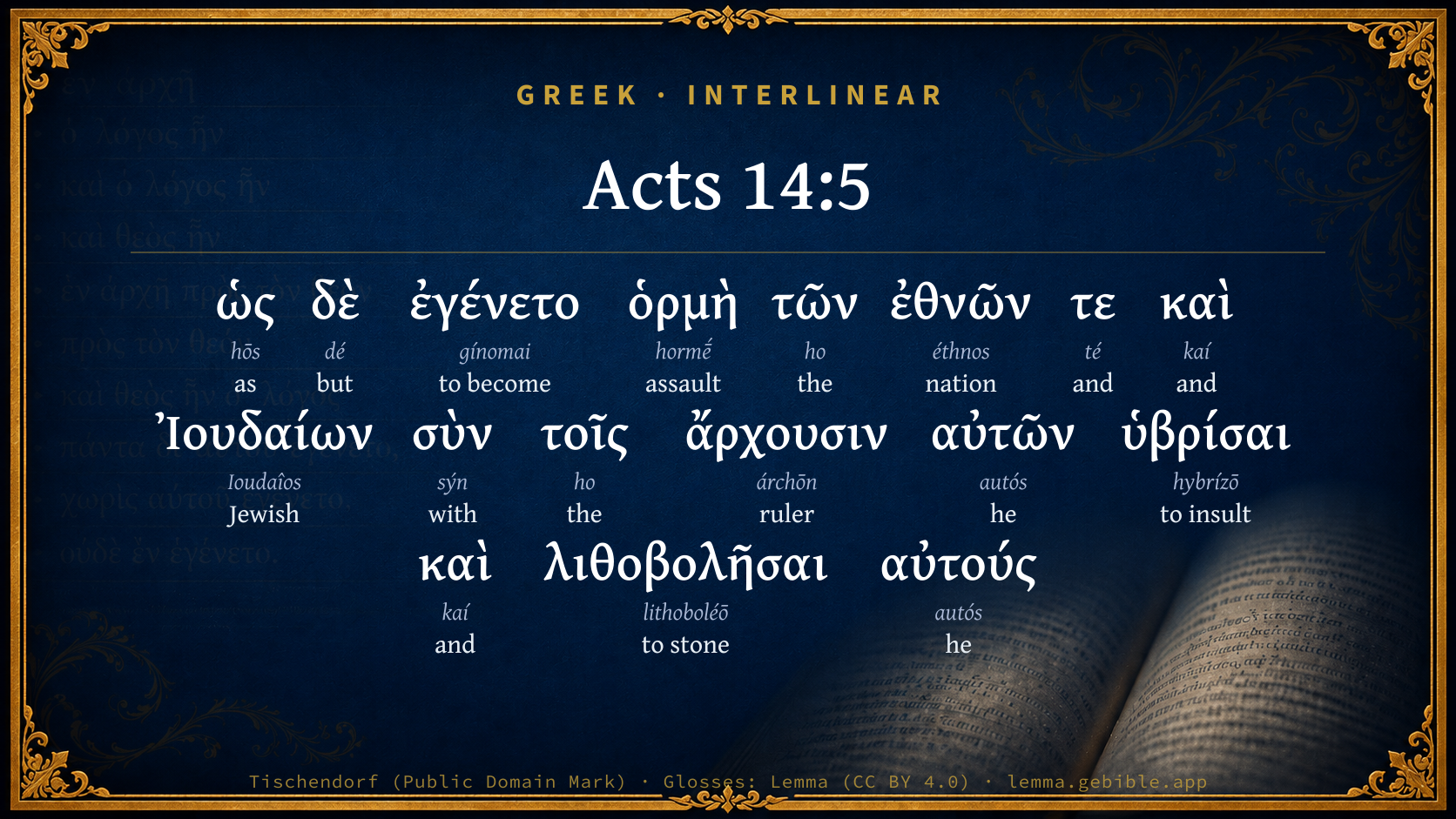
Greek (Tischendorf 8th ed.) Acts 14:5 appears in the Greek New Testament. The text above is from the Tischendorf 8th edition. Each word links to its Strong’s number and a concise gloss. Click any word for its full Thayer’s Greek Lexicon entry.
Download image
Cite this verse

Acts 14:5 (World English Bible). Public Domain. Lemma interlinear Bible study tool, https://lemma.gebible.app/v/acts/14/5.

Show BibTeX & RIS
BibTeX
RIS
English Translation
When some of both the Gentiles and the Jews, with their rulers, made a violent attempt to mistreat and stone them,
World English Bible · Public Domain
Highlights
  • 1 first appearance in the Greek New Testament
Full analysis ↓
Download a study sheet

One document with this verse’s original text, its word-by-word gloss line, the meaning frame, cross-references with their text, attributed commentary, and full source and license credits — printable, and it pastes into notes with its structure intact.

This verse Autodidact and up

Study sheet (.html) Plain text (.txt)

A passage Seminary Student

Up to 50 verses in one chapter. A passage sheet keeps up to 6 commentary sources and 12 cross-references per verse, in the order this page ranks them, and says so on the sheet whenever that leaves anything out. Ask for a single verse and you get the Autodidact verse sheet above.

Everything on this page stays free to read, with no account — the sheet is a download of what is already on screen, not access to it.

Want to remove ads? Support Godless Engineer
Compare translations 3

The same verse in 3 English versions, stacked beneath the original-language interlinear above. Click any original word for its lexicon entry.

Each is an independent rendering of the whole verse — the interlinear is not word-aligned to these translations.

Highlighted words mark where these versions differ — a whole-verse word diff, not a word-by-word alignment.

  • World English Bible Public Domain
    When some of both the Gentiles and the Jews, with their rulers, made a violent attempt to mistreat and stone them,
  • King James Version Public Domain
    And when there was an assault made both of the Gentiles, and also of the Jews with their rulers, to use them despitefully, and to stone them,
  • unfoldingWord Literal Text CC BY-SA 4.0
    But when a plot happened of both the Gentiles and the Jews, with their rulers, to mistreat and stone them,

unfoldingWord Literal Text — © unfoldingWord, licensed CC BY-SA 4.0. Word-aligned USFM3 via Door43 (git.door43.org/unfoldingWord/en_ult).

Versions to compare (up to 4)

3 of 4 selected

Show all 19 translations

Every available English version of this verse, each an independent rendering of the whole verse.

  • World English Bible Public Domain
    When some of both the Gentiles and the Jews, with their rulers, made a violent attempt to mistreat and stone them,
  • Berean Standard Bible Public Domain
    But when the Gentiles and Jews, together with their rulers, set out to mistreat and stone them,
  • Majority Standard Bible Public Domain
    But when the Gentiles and Jews, together with their rulers, set out to mistreat and stone them,
  • King James Version Public Domain
    And when there was an assault made both of the Gentiles, and also of the Jews with their rulers, to use them despitefully, and to stone them,
  • American Standard Version (1901) Public Domain
    And when there was made an onset both of the Gentiles and of the Jews with their rulers, to treat them shamefully and to stone them,
  • Revised Version (1885) Public Domain
    And when there was made an onset both of the Gentiles and of the Jews with their rulers, to entreat them shamefully, and to stone them,
  • Geneva Bible (1599) Public Domain
    And when there was an assault made both of the Gentiles, and of the Iewes with their rulers, to doe them violence, and to stone them,
  • Douay-Rheims (1899) Public Domain
    And when there was an assault made by the Gentiles and the Jews with their rulers, to use them contumeliously, and to stone them:
  • Young's Literal Translation Public Domain
    and when there was a purpose both of the nations and of the Jews with their rulers to use `them' despitefully, and to stone them,
  • Literal Standard Version CC BY-SA 4.0
    and when there was a purpose both of the nations and of the Jews with their rulers to mistreat [them], and to stone them,
  • Unlocked Literal Bible CC BY-SA 4.0
    When both Gentiles and Jews attempted to persuade their leaders to mistreat and stone Paul and Barnabas,
  • unfoldingWord Literal Text CC BY-SA 4.0
    But when a plot happened of both the Gentiles and the Jews, with their rulers, to mistreat and stone them,
  • Darby Bible Public Domain
    And when an assault was making, both of [those of] the nations and [the] Jews with their rulers, to use [them] ill and stone them,
  • World Messianic Bible Public Domain
    When some of both the Gentiles and the Jews, with their rulers, made a violent attempt to mistreat and stone them,
  • Webster's Bible Public Domain
    And when there was an assault made both of the Gentiles, and also of the Jews, with their rulers, to use them despitefully, and to stone them,
  • Free Bible Version CC BY-SA 4.0
    But then the foreigners and the Jews, together with their leaders, decided to attack and stone Paul and Barnabas.
  • Bible in Basic English Public Domain
    And when a violent attempt was made by the Gentiles and the Jews, with their rulers, to make an attack on them and have them stoned,
  • Text-Critical English NT CC BY 4.0
    And when an attempt was made by both the Gentiles and the Jews, together with their rulers, to mistreat them and stone them,
  • Tyndale New Testament (1534) Public Domain
    When ther was a saute made both of the gentyls and also of the Iewes with their rulers to put them to shame and to stone them

Literal Standard Version (2020), Covenant Press — licensed CC BY-SA 4.0. Text via the HelloAO Bible API (eBible.org). Unlocked Literal Bible (unfoldingWord) — licensed CC BY-SA 4.0. Text via the HelloAO Bible API (eBible.org). unfoldingWord Literal Text — © unfoldingWord, licensed CC BY-SA 4.0. Word-aligned USFM3 via Door43 (git.door43.org/unfoldingWord/en_ult). Free Bible Version, Dr. Jonathan Gallagher — licensed CC BY-SA 4.0. Text via the HelloAO Bible API (eBible.org).

Word by word

More ways to search: Search by grammar → Find every occurrence → Compare this word →

Practice this passage: Drill this verse → Learn its vocabulary →

ὁρμὴ
hormḗ
G3730
“assault”
Noun, Nominative, Singular, Feminine
Part of Speech
Noun
Case
Nominative
Number
Singular
Gender
Feminine
Full Thayer's Definition

Origin: of uncertain affinity

TDNT: 12:47,7

1. a violent motion, impulse 2. a hostile movement, onset, assault
  1. ὡς hōs G5613 “as” Adverb
  2. δὲ dé G1161 “but” Conjunction
  3. ἐγένετο gínomai G1096 “to become” Verb, Aorist, Middle deponent, Indicative, 3rd person, Singular
  4. τῶν ho G3588 “the” Article, Genitive, Plural, Neuter
  5. ἐθνῶν éthnos G1484 “nation” Noun, Genitive, Plural, Neuter
  6. τε té G5037 “and” Particle
  7. καὶ kaí G2532 “and” Conjunction
  8. Ἰουδαίων Ioudaîos G2453 “Jewish” Adjective, Genitive, Plural, Masculine
  9. σὺν sýn G4862 “with” Preposition
  10. τοῖς ho G3588 “the” Article, Dative, Plural, Masculine
  11. ἄρχουσιν árchōn G758 “ruler” Noun, Dative, Plural, Masculine
  12. αὐτῶν autós G846 “he” Personal pronoun, Genitive, Plural, Masculine
  13. ὑβρίσαι hybrízō G5195 “to insult” Verb, Aorist, Active, Infinitive
  14. καὶ kaí G2532 “and” Conjunction
  15. λιθοβολῆσαι lithoboléō G3036 “to stone” Verb, Aorist, Active, Infinitive
  16. αὐτούς autós G846 “he” Personal pronoun, Accusative, Plural, Masculine

About this verse

These counts appear in no published source. They are computed here, from the morphology-tagged text and Lemma’s own curated glosses. What Lemma adds →

17
words
14
distinct lemmas
Acts
section

Notable vocabulary

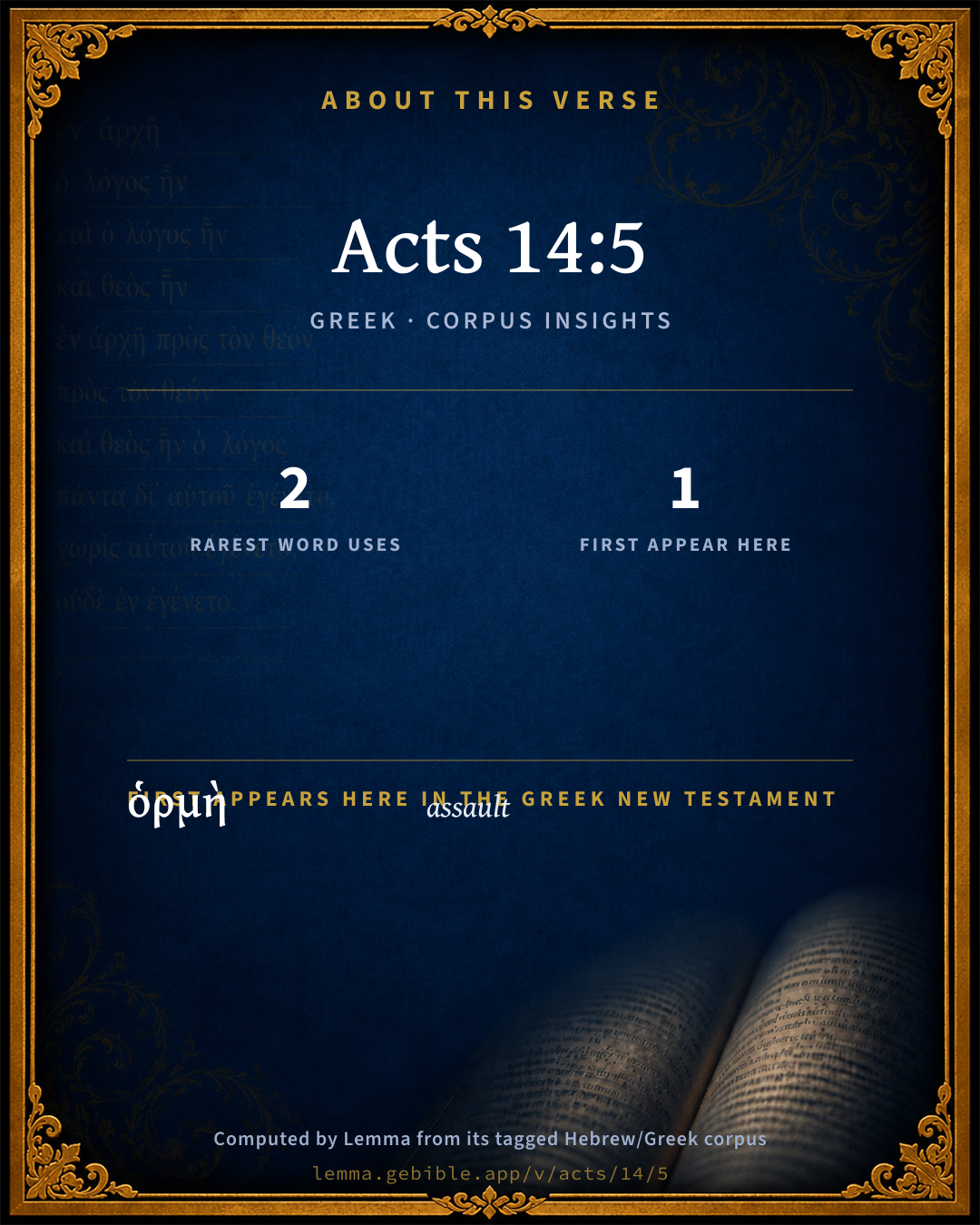
The rarest word here is ὁρμὴ assault G3730 — appearing just 2 times in the whole Greek New Testament.

First appearance in Scripture

This word makes its first canonical appearance in the Greek New Testament here:

  • ὁρμὴ assault G3730

Shared distinctive vocabulary

ὁρμὴ assault G3730 occurs in 2 verses of the Greek New Testament. Also found in:
Repetition

Words recur within this verse:

  • τῶν the G3588 ×2
  • καὶ and G2532 ×2
  • αὐτῶν he G846 ×2

Cross-references

8

Topical passages linked to Acts 14:5 in the Treasury of Scripture Knowledge — connected by theme and wording, ordered by reader-vote popularity; previews shown in the World English Bible.

  • Acts 14:19 But some Jews from Antioch and Iconium came there, and having persuaded the multitudes, they stoned Paul, and dragged him out of the city, supposing that he was dead.
  • 2 Timothy 3:11 persecutions, and sufferings: those things that happened to me at Antioch, Iconium, and Lystra. I endured those persecutions. Out of them all the Lord delivered me.
  • Acts 4:25–29 who by the mouth of your servant, David, said, 'Why do the nations rage, And the peoples plot a vain thing?
  • Acts 17:5 But the unpersuaded Jews took along some wicked men from the marketplace, and gathering a crowd, set the city in an uproar. Assaulting the house of Jason, they sought to bring them out to the people.
  • Psalms 2:1–3 Why do the nations rage, And the peoples plot a vain thing?
  • Psalms 83:5 For they have conspired together with one mind. They form an alliance against you.
  • Matthew 5:44 But I tell you, love your enemies, bless those who curse you, do good to those who hate you, and pray for those who mistreat you and persecute you,
  • Luke 6:28 bless those who curse you, and pray for those who mistreat you.

Cross-references courtesy of OpenBible.info (CC BY 4.0).

Commentary

Notes on Acts 14:5 from classic Christian and Jewish commentators (each source and its license shown beneath its notes). The classic Christian expositions comment on the surrounding passage and are grouped to its opening verse, so a note may address several verses; the Jewish commentaries on the Tanakh (Rashi and others) are per-verse, so they appear only where the commentator wrote on this verse.

Lemma curates 59 commentaries, every one of them public domain or Creative Commons licensed, each selected and text-cleaned for this edition rather than reprinted as found. About our sources →

Joseph Benson's Commentary

Act 14:5-7. And when there was an assault made — Or was about to be made; both of the Gentiles, and the Jews — Who, though generally at enmity with one another, yet were united against the Christians, as Herod and Pontius Pilate, the Pharisees and Sadducees, against Christ. If the churches enemies can unite for its destruction, shall not its friends, laying aside all personal feuds, unite for its preservation? To use them despitefully — To expose them to disgrace; and then to stone, and put them to death: and thus they hoped to ruin their cause. They were aware of it — When the project was just ripe for execution, Paul and Barnabas received intelligence of it, and prevented the bloody attempt by withdrawing from thence; they fled unto Lystra first, and then to Derbe; and after that to the region that lay round Lycaonia, namely, the region of Phrygia and Galatia. In thus fleeing from their persecutors they followed their Master’s advice, who directed them, when persecuted in one city, to flee unto another: for though he enabled them to work miracles for the confirmation of the gospel, he gave them no power of working any to save themselves from persecution. And there they preached — Κακει ησαν ευαγγελιζομενοι, and there they were preaching; the gospel — And that, it appears, in a very successful manner, so that the church was still increased by the very methods taken to destroy it.

Joseph Benson's Commentary on the Old and New Testaments (1811–1818) — public domain. Text from a community e-Sword module.

Meyer's Critical & Exegetical Commentary

Heinrich August Wilhelm Meyer

Act_14:5-7. Ὁρμή] impetus (Vulg.), but not exactly in the sense of an assault (Luther, comp. Castalio, Calvin, and others), nor yet a plot (Kuinoel, de Wette, and others). The former meaning, according to the context, expresses too much; the latter is not sanctioned by linguistic usage (even in Jam_3:4). It denotes a strong pressure, a pushing and thronging. Comp. Herod. vii. 18 : ἐπεὶ δαιμονίη τις γίνεται ὁρμή, Plat. Phil. p. 35 D: ψυχῆς ξύμπασαν τήν τε ὁρμὴν καὶ ἐπιθυμίαν, Dem. 309. 4 : εἰς ὁρμὴν τοῦ τὰ δέοντα ποιεῖν προτρέψαι, Xen. Mem. iv. 4. 2; Jam_3:4; 3Ma_1:23; 3Ma_4:3.

σὺν τοῖς ἄρχουσιν αὐτῶν] joins on closely to Ἰουδαίων, whose rulers of the synagogue and elders are meant. Comp. Php_1:1. On ὑβρίσαι, comp. Luk_18:32; 1Th_2:2; Lucian, Soloec. 10.[15]

συνιδόντες] Comp. on Act_12:12. It had become known to them, what was at work against them.

Λύστρα (sometimes used as feminine singular, and sometimes as neuter plural, as in Act_14:8, see Grotius) and Δέρβη, two cities of Lycaonia, to the north of Taurus, and lying in a southeastern direction from Iconium. Ptol. v. 4 reckons the former to belong to the neighbouring Isauria; but Plin. v. 32 confirms the statement of our passage. On their ruins, see Hamiltons Travels in Asia Minor, II. pp. 301 f., 307 f.; Hackett, p. 228.

[15] ἤτοι πληγαῖς ἢ δεσμοῖς ἢ καὶ ἄλλῳ τρόπῳ. The distinction there stated of ὑβρίζειν with εἰς is groundless. See, on the contrary, e.g. Dem. 522. ult. 539. 14.

Meyer — Critical and Exegetical Commentary on the New Testament — English translation by Peter Christie, edited by Frederick Crombie (T&T Clark, 1880) — public domain. Text from a community e-Sword module.

Expositor's Greek Testament

ed. W. Robertson Nicoll

Act 14:5 . The real contrast is marked in this verse, ὡς δὲ ἐγέν . Hitherto the evil results indicated in Act 14:2 had not resulted in an open combination of Jews and Gentiles to injure Paul and Barnabas, but now the Jews and their rulers were prepared to act in concert with the Gentiles, so that the opposition assumed a public shape, and a definite accusation of blasphemy could be formulated against the Apostles. ὁρμὴ , “onset,” R.V.; “assault,” A.V., but neither word seems appropriate, since neither onset nor assault actually occurred. It seems therefore better to take the word as expressing the inclination, or hostile intention, or instigation, and to connect it with the infinitives. In classical Greek the word is used of eagerness (joined with ἐπιθυμία ), of impulse, of eager desire of, or for, a thing, cf. Thuc. iv. 4, Plat., Phil. , 35 D, although it is also used of an assault or attack. The only other place in the N.T. in which it occurs is Jas 3:4 (R.V. renders “impulse”). Hesychius regards it as equivalent to βουλή , ἐπιθυμία but see also for its use as expressing attack, violence, 3Ma 1:16 ; 3Ma 1:23 ; Mal 4:5Mal 4:5 . σὺν τοῖς ἄρχουσιν αὐτῶν , i.e. , of the Jewish synagogues, as αὐτῶν shows. Hackett and Lumby take it of the heathen magistrates. On the distinction between these and the ἀρχισυνάγωγος , see Schürer, div. ii., vol. ii., pp. 64, 250, E.T. The magistrates of the city could not have participated in an act of mob-violence, and the plot to stone the Apostles seems to point to Jewish instigation for enforcing the punishment of blasphemy. ὑβρίσαι , “to entreat them shamefully,” so A. and R.V., indicating outrage, insolence in act, cf. Mat 22:6 , Luk 18:32 , 2Ma 14:42 , 3Ma 6:9 ; in Luk 11:45 of insulting words. St. Paul uses the same word of treatment at Philippi, 1Th 2:2 , and he describes his own conduct towards the Christians by the cognate noun ὑβριστής , 1Ti 1:13 .

The Expositor's Greek Testament, edited by W. Robertson Nicoll (1897–1910) — public domain. Text from a community e-Sword module.

Jamieson, Fausset & Brown

Robert Jamieson, A. R. Fausset & David Brown

an assault made . . . to stone them--rather here, "an impetuous movement" with a view to stoning them: for in Co2 11:25, Paul says, "Once I was stoned," and that was at Lystra, as expressly related in Act 14:19. (PALEY'S remarks--Horæ Paulinæ--on this singular coincidence between the Epistle and the history are very striking).

fled--(See Mat 10:23).

Jamieson, Fausset & Brown — Commentary Critical and Explanatory on the Whole Bible (1871) — public domain (CC PDM 1.0). Text via the HelloAO Bible API.

Adam Clarke's Commentary

Verse 5. An assault made] ορμη, A desperate attempt was made by their rulers, i.e. by the heathen rulers of the people, and the rulers of the synagogue.

To use them despitefully] To expose them, bring them into contempt, and make them appear as monsters, or movers of sedition; and then to stone them for this falsely alleged crime.

Adam Clarke's Commentary on the Bible (1810–1826) — public domain. Text from a community e-Sword/MySword module.

John Calvin's Commentaries

5. Mark how far forth the holy champions of Christ did suffer. They give not back when their enemies do only set themselves against them; but when the sedition waxeth hot, and they be in danger of stoning, though they have many favorers of their doctrine, they go no further, but remembering the saying of Christ, wherein he warneth the faithful in patience to possess their souls, they avoid the fury of the enemy. And though they fly, lest they throw themselves headlong into death, yet their constancy in preaching the gospel doth sufficiently declare that they feared not danger. For Luke saith that they preached the gospel in other places also. This is the right kind of fear, when the servants of Christ do not run willfully into the hands of their enemies, of them to be murdered, and yet they do not foreslow [abandon] their duty; neither doth fear hinder them from obeying God when he calleth; and so, consequently, they can afford, if need be, to go even through death itself to do their duty.

John Calvin's Commentaries (1540-1563) — public domain. Text from the Calvin Translation Society English edition (1840s-50s) via the Christian Classics Ethereal Library (ccel.org). Calvin's coverage is partial (roughly two-thirds of the Bible); uncommented books and verses are honest gaps, never fabricated. The 19th-century editor's footnotes and remarks are omitted so the notes are faithfully Calvin's own voice.

Ellicott's Commentary for English Readers

(5) To use them despitefully.—The verb expresses wanton insult and outrage. St. Paul uses the noun derived from it to express the character of his own conduct as a persecutor (1Ti_1:13), and must have felt, as afterwards in the actual stoning of Act_14:19, that he was receiving the just reward of his own deeds.

A Bible Commentary for English Readers, edited by Charles John Ellicott (1878–1897) — public domain. Text from a community e-Sword module.

The Cambridge Bible for Schools and Colleges

gen. ed. J. J. S. Perowne

5. when there was an assault made] The noun does not necessarily imply that any direct attack had been made, which, from what follows, we can see was not the case. It rather applies to the excitement, urging, and instigation which the Jews were applying to their heathen companions, and which was likely to end in violence.

with their rulers] The word is of the most general character, and it is impossible to form any conjecture from it what these authorities were.

and to stone them] From this we see that the prompting came from the Jews. Stoning was their mode of punishment for blasphemy, and such they would represent the teaching of the Apostles to be. We need not suppose that any regular legal stoning like that of Stephen was intended, or that to accomplish that object the rulers here mentioned were such Jewish authorities as could be gathered together in Iconium, and that they are indicated by a vague term because they had no very settled position. The previous verb “to use them despitefully” rather points to the opposite conclusion, and marks the intended proceeding as a piece of mob-outrage, for which the countenance of any authority was gladly welcomed.

In connection with St Paul’s residence at Iconium, there exists a story of the conversion of a maiden named Thecla, of which the apocryphal “Acts of Paul and Thecla” represents the form into which the legend had grown in the fourth century. Thecla, who was espoused to Thamyris, is said to have been deeply affected by the preaching of the Apostle, which she accidentally heard, and when the Apostle was put in prison on the accusation of being a magician, she bribed the gaoler and visited the prisoner, and was fully instructed by him in the Christian faith. The Apostle was punished and sent away from Iconium. Thecla was condemned to die for her refusal to marry Thamyris, but was miraculously saved, and after many troubles joined St Paul in his missionary travels, and ultimately made her home in the neighbourhood of Seleucia, where she led the life of a nun till her death, which took place when she was ninety years old.

This story may at first have had some basis of truth to rest on, but it has been so distorted with inconsistent details, that it is impossible now to judge what the foundation of it may have been.

The Cambridge Bible for Schools and Colleges (gen. ed. J. J. S. Perowne; Cambridge University Press, 1878–1918) — public domain. Text from a community e-Sword module.

John Gill's Exposition

And when there was an assault made,.... Or a strong bias and inclination were in the minds,

both of the Gentiles, and also of the Jews, with their rulers; who encouraged them in it:

to use them despitefully, and to stone them; not only to give them reproachful language, but to smite, buffet, and scourge them, and to stone them for blasphemy, which was a punishment among the Jews for such causes.

John Gill's Exposition of the Whole Bible (1746–1763) — public domain (CC PDM 1.0). Text via the HelloAO Bible API.

Trapp's Complete Commentary

John Trapp

5 And when there was an assault made both of the Gentiles, and also of the Jews with their rulers, to use them despitefully, and to stone them,

Ver. 5. And to stone them] Stephen had the maidenhead of this kind of death: as that martyr, who was threatened with whipping, wished that he might have the maidenhead of that kind of suffering (for he had not heard of any that had been so served): and as Basil, threatened by Valens with death, cried out, ειθε γενοιτο μοι, I would it might be so.

John Trapp, A Commentary or Exposition upon All the Books of the Old and New Testament (1647–1656) — public domain. Text from a community e-Sword module.

Albert Barnes' Notes on the Bible

An assault made - Greek: a “rush” - ὁρμή hormē. It denotes “an impetuous excitement and aggression; a rush to put them to death.” It rather describes a popular tumult than a calm and deliberate purpose. There was a violent, tumultuous excitement.

Both of the Gentiles ... - Of that part of them which was opposed to the apostles.

To use them despitefully - See the notes on Mat 5:44. To reproach them; to bring contempt upon them; to injure them.

And to stone them - To put them to death by stoning; probably as blasphemers, Act 7:57-59.

Albert Barnes' Notes on the Bible (1834–1885) — public domain. Text from a community e-Sword/MySword module.

Matthew Poole's English Annotations

Rulers, such as were called the chief men of the city, Act 13:50.

To use them despitefully; thus they that were called to the marriage of the king’s son, Mat 22:6, entreated the servants despitefully.

And to stone them; they would have used them as such who were not worthy to live, and then have taken away their lives from them, as they did by our Saviour; first they spat upon him, and then crucified him.

Matthew Poole's English Annotations on the Holy Bible (1683–1685) — public domain. Text from a community e-Sword/MySword module.

Whedon's Commentary on the Bible

Daniel D. Whedon

5. Assault—Rather an onset or rush, for before the assault could be made the apostles, being informed, escaped.

Rulers—Probably the rulers of the Jewish synagogues, leading the Jews to inflict the Jewish punishment of stoning.

Daniel D. Whedon (gen. ed.), Commentary on the Old and New Testaments (1874–1909) — public domain. Text from a community e-Sword module.

The Pulpit Commentary

Made an onset for an assault made, A.V.; of the Jews for also of the Jews, A.V.; to entreat them shamefully for to use them despitefully, A.V., as, 1Th_2:2. As regards oJrmh neither the A.V. assault nor the R.V. onset expresses it exactly. JOrmh means the strong bent of the mind, as in Jam_3:4, where it expresses the strong will of the steersman directing the ship against the force of the winds. Here it means that both Jews with their rulers, and Gentiles, under the influence of violent passion, had determined and agreed to assault Paul and Barnabas. To entreat them shamefully. Ybriv and uJbri denote "violence," as Mat_22:6; Luk_18:32; 2Co_12:10. It is sometimes used of corporal punish-merit, even legally inflicted, as Pro_19:18 (LXX).

The Pulpit Commentary (1880–1919), ed. H.D.M. Spence-Jones & Joseph S. Exell — public domain. Text from a community e-Sword module.

McGarvey & Pendleton's Commentaries

J. W. McGarvey

See notes one verse 3

J. W. McGarvey (with Philip Y. Pendleton), Commentaries on the New Testament (The Fourfold Gospel, 1914; Acts; and the epistles) — public domain. Text from a community e-Sword/MySword module.

The People's New Testament

B. W. Johnson

5, 6. There was an assault made. Hardly an assault, so much as a movement to make one. The Greek term implies a sudden movement. The attempt was avoided by the preachers receiving information and escaping from the city. In this effort there was concert of action between the Gentiles and Jews, the rulers of the synagogue joining, and the purpose was murderous. Paul (2 Cor. 11:25) says, “Once was I stoned.” That stoning was at Lystra. There was an attempt to stone at Iconium, but not a stone was thrown.

Fled to Lystra and Derbe. These were Lycaonian cities, not far from Iconium. Neither now exists, but the ruins of Lystra, and those of Derbe it is thought, are identical. The first is called by a name meaning “The Thousand and One Churches,” on account of the ruins of so many sacred edifices. Lystra is named frequently in early church history as a center of Christian influence.

B. W. Johnson's The People's New Testament with Notes (1889–1891) — public domain. Electronic text from the Christian Classics Ethereal Library (CCEL) ThML edition.

unfoldingWord translationNotes

Door43 World Missions Community

General Information:

Here the word "they" refers to Paul and Barnabas.

attempted to persuade their leaders

"tried to convince the leaders of Iconium." Here "attempted" implies they were not able to fully persuade them before the apostles left the city.

to mistreat and stone Paul and Barnabas

"to beat Paul and Barnabas and to kill them by throwing stones at them"

Lycaonia

A district in Asia Minor (See: How to Translate Names)

Lystra

A city in Asia Minor south of Iconium and north of Derbe (See: How to Translate Names)

Derbe

A city in Asia Minor south of Iconium and Lystra (See: How to Translate Names)

there they were proclaiming the gospel

"Paul and Barnabas also preached the gospel there"

translationWords

Gentile

Jew

stone

Paul

Barnabas

Lystra

preach

good news

unfoldingWord translationNotes — © Distant Shores Media and the Door43 World Missions Community, licensed CC BY-SA 4.0. Source: git.door43.org/Door43/en_tn.

Cambridge Greek Testament for Schools and Colleges

5. ὡς δὲ ἐγένετο ὁρμή, but when there was an onset made. The noun does not necessarily imply that any direct attack had been made, which, from what follows, we can see was not the case. It rather refers to the excitement, urging, and instigation which the Jews were applying to their heathen companions, and which was likely to end in violence. Chrysostom says οὐ γὰρ ἐδιώκοντο, ἀλλ’ ἐπολεμοῦντο μόνον.

σὺν τοῖς ἄρχουσιν, with their rulers. The religious animosity calling in the civil power, as on other occasions, to work its wishes.

καὶ λιθοβολῆσαι αὐτούς, and to stone them. We can see from this that the prompting to violence came from the Jews. Stoning was their punishment for blasphemy, and such they would represent the teaching of the Apostles to be. We need not suppose that any regular legal stoning like that of Stephen was intended, or that to accomplish that object the rulers here mentioned were such Jewish authorities as could be gathered together in Iconium, and that they are indicated by a vague term because they had no very settled position. The previous verb ‘to use them despitefully’ rather points to the opposite conclusion, and marks the intended proceeding as a piece of mob-outrage, for which the countenance of any authority was gladly welcomed.

In connexion with St Paul’s residence at Iconium, there exists a story of the conversion of a maiden named Thecla, of which the apocryphal Acts of Paul and Thecla represents the form into which the legend had grown in the fourth century. Thecla, who was espoused to Thamyris, is said to have been deeply affected by the preaching of the Apostle, which she accidentally heard, and when St Paul was put in prison on the accusation of being a magician, she bribed the gaoler and visited the prisoner, and was fully instructed by him in the Christian faith. The Apostle was punished and sent away from Iconium. Thecla was condemned to die for her refusal to marry Thamyris, but was miraculously saved, and after many troubles joined St Paul in his missionary travels, and ultimately made her home in the neighbourhood of Seleucia, where she led the life of a nun till her death, which took place when she was ninety years old.

This story may at first have had some basis of truth to rest on, but it has been so distorted with inconsistent details, that it is impossible now to judge what the foundation of it may have been.

Cambridge Greek Testament for Schools and Colleges (Cambridge University Press, 1896; 21 vols, various authors incl. Carr, Maclear, Plummer, Farrar, Lumby, Moule, M. R. James, Simcox) — public domain. Text from a community e-Sword module.

Alford’s Greek Testament

Henry Alford

5.] ὁρμή is not a rush (‘impetus,’ Vulg.: ‘assault,’ E. V.), but as Hesych. βουλή, ἐπιθυμία,—as is manifest from συνιδόντες, rightly rendered in E. V. they were ware of it; which it would be strange if they were not, if an assault had been made on them.

Henry Alford, The Greek Testament (1849–1861) — public domain. Text from a community e-Sword module.

Vincent's Word Studies in the New Testament

Marvin R. Vincent

Assault [ορμη] . Too strong, as is also the Rev., onset. In case an actual assault had been made, it would have been absurd for Luke to tell us that "they were ware of it." It is rather the purpose and intention of assault beginning to assume the character of a movement. See on Jas 3:4. To stone. Paul says he was stoned once (2Co 11:25). This took place at Lystra (see ver. 19).

Marvin R. Vincent, Word Studies in the New Testament (1887–1900) — public domain. Text from a community e-Sword/MySword module.

Lesson kit

Teaching starters — assembled from the data on this page, not authored interpretation. Every prompt links to the verse data it draws on. Edit before teaching.

Acts, in the Acts, opens this verse with 17 words (14 distinct Greek lemmas). Its most distinctive word is hormḗ (“assault”). A historical commentator’s framing appears above. Read the whole chapter for the surrounding context.

Discussion questions

  1. The word hormḗ carries the sense “assault.” How does it shape the verse?
  2. This is the first place “assault” appears in Scripture (first appears here). What does its debut here establish?
  3. How does James 3:4, which shares the word «assault», read alongside this verse?
  4. What does the repetition of “the” (2× in this one verse) do in this verse?
  5. These translations render this verse differently. What is at stake in choosing one wording over another?
  6. Compare how Joseph Benson's Commentary and Meyer's Critical & Exegetical Commentary read this verse. Where do they agree or differ?

Things to notice

  • 1 word makes its first canonical appearance in Scripture here.
  • These translations choose different wording for 12 words in this verse.
  • “the” occurs 2× in this single verse.
  • 14 distinct Greek lemmas span 17 words in this verse.

Reading settings

Reading text

Shown beneath each verse's original-language words.

Old Testament
Old Testament edition

Read the OT as the Masoretic Hebrew (MT) or the Greek Septuagint (LXX).

English shown for the Greek Septuagint (in the Hebrew ↔ Greek comparison).

Comparing translations? Open the Compare panel on any verse page to stack up to four side by side.