

Revelation 11:9
Greek (Tischendorf 8th ed.) Revelation 11:9 appears in the Greek New Testament. The text above is from the Tischendorf 8th edition. Each word links to its Strong’s number and a concise gloss. Click any word for its full Thayer’s Greek Lexicon entry.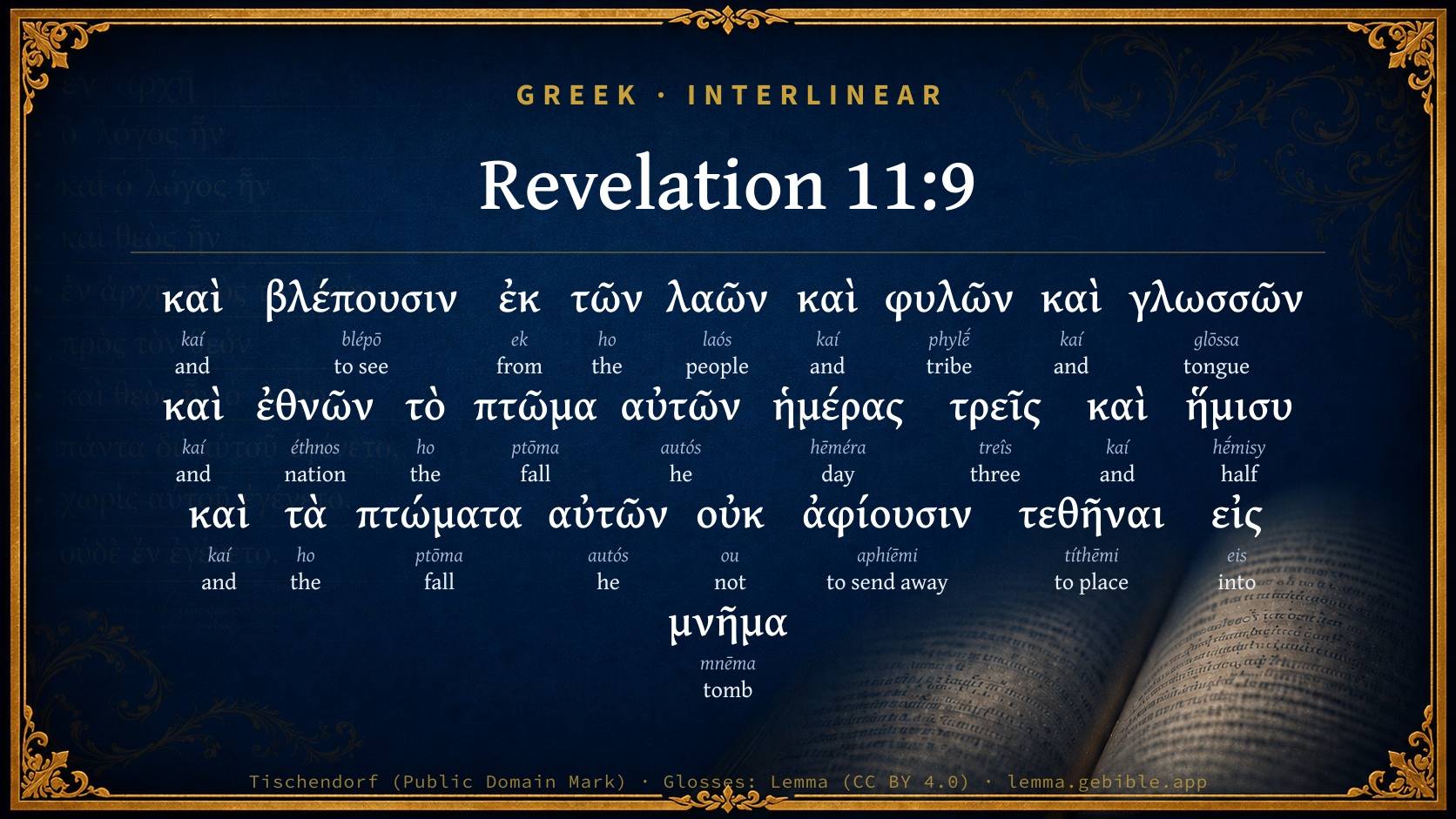
From among the peoples, tribes, languages, and nations people will look at their dead bodies for three and a half days, and will not allow their dead bodies to be laid in a tomb.
Download a study sheet
One document with this verse’s original text, its word-by-word gloss line, the meaning frame, cross-references with their text, attributed commentary, and full source and license credits — printable, and it pastes into notes with its structure intact.
This verse Autodidact and up
A passage Seminary Student
Up to 50 verses in one chapter. A passage sheet keeps up to 6 commentary sources and 12 cross-references per verse, in the order this page ranks them, and says so on the sheet whenever that leaves anything out. Ask for a single verse and you get the Autodidact verse sheet above.
Everything on this page stays free to read, with no account — the sheet is a download of what is already on screen, not access to it.
Compare translations 3
The same verse in 3 English versions, stacked beneath the original-language interlinear above. Click any original word for its lexicon entry.
Each is an independent rendering of the whole verse — the interlinear is not word-aligned to these translations.
Highlighted words mark where these versions differ — a whole-verse word diff, not a word-by-word alignment.
-
World English Bible Public Domain
From among the peoples, tribes, languages, and nations people will look at their dead bodies for three and a half days, and will not allow their dead bodies to be laid in a tomb.
-
King James Version Public Domain
And they of the people and kindreds and tongues and nations shall see their dead bodies three days and an half, and shall not suffer their dead bodies to be put in graves.
-
unfoldingWord Literal Text CC BY-SA 4.0
And those from people and tribe and language and nation look at their corpses for three and a half days, and they do not permit their corpses to be placed in a tomb.
unfoldingWord Literal Text — © unfoldingWord, licensed CC BY-SA 4.0. Word-aligned USFM3 via Door43 (git.door43.org/unfoldingWord/en_ult).
Show all 19 translations
Every available English version of this verse, each an independent rendering of the whole verse.
-
World English Bible Public Domain
From among the peoples, tribes, languages, and nations people will look at their dead bodies for three and a half days, and will not allow their dead bodies to be laid in a tomb.
-
Berean Standard Bible Public Domain
For three and a half days all peoples and tribes and tongues and nations will view their bodies and will not permit them to be laid in a tomb.
-
Majority Standard Bible Public Domain
For three and a half days all peoples and tribes and tongues and nations will view their bodies and will not permit them to be laid in a tomb.
-
King James Version Public Domain
And they of the people and kindreds and tongues and nations shall see their dead bodies three days and an half, and shall not suffer their dead bodies to be put in graves.
-
American Standard Version (1901) Public Domain
And from among the peoples and tribes and tongues and nations do `men' look upon their dead bodies three days and a half, and suffer not their dead bodies to be laid in a tomb.
-
Revised Version (1885) Public Domain
And from among the peoples and tribes and tongues and nations do men look upon their dead bodies three days and a half, and suffer not their dead bodies to be laid in a tomb.
-
Geneva Bible (1599) Public Domain
And they of the people and kinreds, and tongues, and Gentiles shall see their corpses three dayes and an halfe, and shall not suffer their carkeises to be put in graues.
-
Douay-Rheims (1899) Public Domain
And they of the tribes, and peoples, and tongues, and nations, shall see their bodies for three days and a half: and they shall not suffer their bodies to be laid in sepulchres.
-
Young's Literal Translation Public Domain
and they shall behold -- they of the peoples, and tribes, and tongues, and nations -- their dead bodies three days and a half, and their dead bodies they shall not suffer to be put into tombs,
-
Literal Standard Version CC BY-SA 4.0
and they gaze—[those] of the peoples, and tribes, and tongues, and nations—on their dead bodies three and a half days, and they will not allow their dead bodies to be put into tombs,
-
Unlocked Literal Bible CC BY-SA 4.0
For three and a half days some from every people, tribe, language, and nation will look at their bodies. They will not permit them to be placed in a tomb.
-
unfoldingWord Literal Text CC BY-SA 4.0
And those from people and tribe and language and nation look at their corpses for three and a half days, and they do not permit their corpses to be placed in a tomb.
-
Darby Bible Public Domain
And [men] of the peoples and tribes and tongues and nations see their body three days and a half, and they do not suffer their bodies to be put into a sepulchre.
-
World Messianic Bible Public Domain
From among the peoples, tribes, languages, and nations, people will look at their dead bodies for three and a half days, and will not allow their dead bodies to be laid in a tomb.
-
Webster's Bible Public Domain
And they of the people, and kindreds, and languages, and nations, shall see their dead bodies three days and a half, and shall not suffer their dead bodies to be put in graves.
-
Free Bible Version CC BY-SA 4.0
For three and a half days those from the peoples and tribes and languages and nations will look at their dead bodies, and will not allow their corpses to be buried.
-
Bible in Basic English Public Domain
And the peoples and tribes and languages and nations will be looking on their dead bodies three days and a half, and will not let their dead bodies be put in the earth.
-
Text-Critical English NT CC BY 4.0
For three and a half days some from among the peoples, tribes, tongues, and nations will look at their dead bodies and refuse to let them be placed in a tomb.
-
Tyndale New Testament (1534) Public Domain
And they of the people and kynredes and tonges and they of the nacions shall se their bodyes.iii. dayes and an halfe and shall not suffre their boddyes to be put in graves.
Literal Standard Version (2020), Covenant Press — licensed CC BY-SA 4.0. Text via the HelloAO Bible API (eBible.org). Unlocked Literal Bible (unfoldingWord) — licensed CC BY-SA 4.0. Text via the HelloAO Bible API (eBible.org). unfoldingWord Literal Text — © unfoldingWord, licensed CC BY-SA 4.0. Word-aligned USFM3 via Door43 (git.door43.org/unfoldingWord/en_ult). Free Bible Version, Dr. Jonathan Gallagher — licensed CC BY-SA 4.0. Text via the HelloAO Bible API (eBible.org).
Word by word
More ways to search: Search by grammar → Find every occurrence → Compare this word →
Practice this passage: Drill this verse → Learn its vocabulary →
- Appears 5× in the Greek New Testament
- First appears at Mark 6:23
- Part of Speech
- Adjective
- Case
- Accusative
- Number
- Singular
- Gender
- Neuter
Full Thayer's Definition
- καὶ kaí G2532 “and” Conjunction
- βλέπουσιν blépō G991 “to see” Verb, Present, Active, Indicative, 3rd person, Plural
- ἐκ ek G1537 “from” Preposition
- τῶν ho G3588 “the” Article, Genitive, Plural, Masculine
- λαῶν laós G2992 “people” Noun, Genitive, Plural, Masculine
- καὶ kaí G2532 “and” Conjunction
- φυλῶν phylḗ G5443 “tribe” Noun, Genitive, Plural, Feminine
- καὶ kaí G2532 “and” Conjunction
- γλωσσῶν glōssa G1100 “tongue” Noun, Genitive, Plural, Feminine
- καὶ kaí G2532 “and” Conjunction
- ἐθνῶν éthnos G1484 “nation” Noun, Genitive, Plural, Neuter
- τὸ ho G3588 “the” Article, Accusative, Singular, Neuter
- πτῶμα ptōma G4430 “fall” Noun, Accusative, Singular, Neuter
- αὐτῶν autós G846 “he” Personal pronoun, Genitive, Plural, Masculine
- ἡμέρας hēméra G2250 “day” Noun, Accusative, Plural, Feminine
- τρεῖς treîs G5140 “three” Adjective, Accusative, Plural, Feminine
- καὶ kaí G2532 “and” Conjunction
- ἥμισυ hḗmisy G2255 “half” Adjective, Accusative, Singular, Neuter
- καὶ kaí G2532 “and” Conjunction
- τὰ ho G3588 “the” Article, Accusative, Plural, Neuter
- πτώματα ptōma G4430 “fall” Noun, Accusative, Plural, Neuter
- αὐτῶν autós G846 “he” Personal pronoun, Genitive, Plural, Masculine
- οὐκ ou G3756 “not” Particle, Negative
- ἀφίουσιν aphíēmi G863 “to send away” Verb, Present, Active, Indicative, 3rd person, Plural
- τεθῆναι títhēmi G5087 “to place” Verb, Aorist, Passive, Infinitive
- εἰς eis G1519 “into” Preposition
- μνῆμα mnēma G3418 “tomb” Noun, Accusative, Singular, Neuter
About this verse
These counts appear in no published source. They are computed here, from the morphology-tagged text and Lemma’s own curated glosses. What Lemma adds →
- 27
- words
- 18
- distinct lemmas
- Revelation
- section
Cross-references
12Topical passages linked to Revelation 11:9 in the Treasury of Scripture Knowledge — connected by theme and wording, ordered by reader-vote popularity; previews shown in the World English Bible.
- Psalms 79:2–3 They have given the dead bodies of your servants to be food for the birds of the sky, The flesh of your saints to the animals of the earth.
- Revelation 17:15 He said to me, "The waters which you saw, where the prostitute sits, are peoples, multitudes, nations, and languages.
- Revelation 10:11 They told me, "You must prophesy again over many peoples, nations, languages, and kings."
- Revelation 11:2–3 Leave out the court which is outside of the temple, and don't measure it, for it has been given to the gentiles. They will tread the holy city under foot for forty-two months.
- Revelation 11:11 After the three and a half days, the breath of life from God entered into them, and they stood on their feet. Great fear fell on those who saw them.
- Ecclesiastes 6:3 If a man fathers a hundred children, and lives many years, so that the days of his years are many, but his soul is not filled with good, and moreover he has no burial; I say, that an untimely birth is better than he:
- Matthew 7:2 For with whatever judgment you judge, you will be judged; and with whatever measure you measure, it will be measured to you.
- Revelation 13:7 It was given to him to make war with the saints, and to overcome them. Authority over every tribe, people, language, and nation was given to him.
- Isaiah 33:1 Woe to you who destroy, and you weren't destroyed; and deal treacherously, and they didn't deal treacherously with you! When you have ceased to destroy, you shall be destroyed; and when you have made an end of dealing treacherously, they shall deal treacherously with you.
- Jeremiah 7:33 The dead bodies of this people shall be food for the birds of the sky, and for the animals of the earth; and none shall frighten them away.
- Revelation 5:8 Now when he had taken the book, the four living creatures and the twenty-four elders fell down before the Lamb, each one having a harp, and golden bowls full of incense, which are the prayers of the saints.
- Revelation 19:17–18 I saw an angel standing in the sun. He cried with a loud voice, saying to all the birds that fly in the sky, "Come! Be gathered together to the great supper of God,
Cross-references courtesy of OpenBible.info (CC BY 4.0).
Where the printed editions differ
2 variantsPlaces in this verse where the major printed Greek editions disagree on the wording in a way that affects the translation — a comparison of editions, not a manuscript-by-manuscript collation. The editions are the modern critical texts (Nestlé-Aland 28/27, SBL, Westcott-Hort, Tregelles, Tyndale House) and the traditional texts behind the KJV (the Textus Receptus and the Byzantine/Majority text). It is not a claim about which reading is original.
-
Different wording
πτῶμα
“body”
In NA28NA27TynSBLWHTregByz Not in TRπτώματα (ptōmata) 'bodies' occurs in traditional manuscripts (TR) instead of πτῶμα (ptōma) 'body' in older manuscripts (NA28+NA27+Tyn+SBL+WH+Treg+Byz)
-
Different wording
μνῆμα.
“a tomb.”
In NA28NA27TynSBLWHTregByz Not in TRμνῆματα (mnēmata) 'tombs' occurs in traditional manuscripts (TR) instead of μνῆμα. (mnēma) 'a tomb.' in older manuscripts (NA28+NA27+Tyn+SBL+WH+Treg+Byz)
Textual data: Translators Amalgamated Greek New Testament (STEPBible TAGNT) · CC BY 4.0.
Lesson kit
Teaching starters — assembled from the data on this page, not authored interpretation. Every prompt links to the verse data it draws on. Edit before teaching.
Revelation, in the Revelation, opens this verse with 27 words (18 distinct Greek lemmas). Its most distinctive word is hḗmisy (“half”). A historical commentator’s framing appears above. Read the whole chapter for the surrounding context.
Discussion questions
- The word hḗmisy carries the sense “half.” How does it shape the verse?
- Mark 6:23 shares the word «half» with this verse. How do the two illuminate each other?
- “fall” occurs 2× in this one verse. What is the effect of the repetition?
- These translations render this verse differently; the difference is in the English rendering, not the original. What questions does that raise?
- Reading how Tyndale Open Study Notes and Bengel's Gnomon read this verse, where do the two commentators agree and where do they part?
Things to notice
- These translations choose different wording for 26 words in this verse.
- “fall” occurs 2× in this single verse.
- 18 distinct Greek lemmas span 27 words in this verse.
Commentary
Notes on Revelation 11:9 from classic Christian and Jewish commentators (each source and its license shown beneath its notes). The classic Christian expositions comment on the surrounding passage and are grouped to its opening verse, so a note may address several verses; the Jewish commentaries on the Tanakh (Rashi and others) are per-verse, so they appear only where the commentator wrote on this verse.
Lemma curates 59 commentaries, every one of them public domain or Creative Commons licensed, each selected and text-cleaned for this edition rather than reprinted as found. About our sources →
Tyndale Open Study Notes
Tyndale Open Resources
Tyndale Open Study Notes — © Tyndale Open Resources, licensed CC BY-SA 4.0. Text via the HelloAO Bible API.
Bengel's Gnomon
Johann Albrecht Bengel
Bengel's Gnomon of the New Testament — English translation (T&T Clark, Edinburgh, 1860) — public domain. Text from a community e-Sword module.
Expositor's Greek Testament
ed. W. Robertson Nicoll
The Expositor's Greek Testament, edited by W. Robertson Nicoll (1897–1910) — public domain. Text from a community e-Sword module.
Geneva Bible (1599)
Geneva Bible translators
Geneva Bible (1599) marginal notes — public domain. Text via Bolls.life.
Jamieson, Fausset & Brown
Robert Jamieson, A. R. Fausset & David Brown
Jamieson, Fausset & Brown — Commentary Critical and Explanatory on the Whole Bible (1871) — public domain (CC PDM 1.0). Text via the HelloAO Bible API.
Adam Clarke's Commentary
Adam Clarke's Commentary on the Bible (1810–1826) — public domain. Text from a community e-Sword/MySword module.
The Cambridge Bible for Schools and Colleges
gen. ed. J. J. S. Perowne
The Cambridge Bible for Schools and Colleges (gen. ed. J. J. S. Perowne; Cambridge University Press, 1878–1918) — public domain. Text from a community e-Sword module.
John Gill's Exposition
John Gill's Exposition of the Whole Bible (1746–1763) — public domain (CC PDM 1.0). Text via the HelloAO Bible API.
Trapp's Complete Commentary
John Trapp
John Trapp, A Commentary or Exposition upon All the Books of the Old and New Testament (1647–1656) — public domain. Text from a community e-Sword module.
Albert Barnes' Notes on the Bible
Albert Barnes' Notes on the Bible (1834–1885) — public domain. Text from a community e-Sword/MySword module.
Matthew Poole's English Annotations
Matthew Poole's English Annotations on the Holy Bible (1683–1685) — public domain. Text from a community e-Sword/MySword module.
Whedon's Commentary on the Bible
Daniel D. Whedon
Daniel D. Whedon (gen. ed.), Commentary on the Old and New Testaments (1874–1909) — public domain. Text from a community e-Sword module.
The Pulpit Commentary
The Pulpit Commentary (1880–1919), ed. H.D.M. Spence-Jones & Joseph S. Exell — public domain. Text from a community e-Sword module.
John Wesley's Explanatory Notes
John Wesley, Explanatory Notes Upon the Whole Bible (1754–1765) — public domain. Text via the GEBible commentary corpus.
The People's New Testament
B. W. Johnson
B. W. Johnson's The People's New Testament with Notes (1889–1891) — public domain. Electronic text from the Christian Classics Ethereal Library (CCEL) ThML edition.
Cambridge Greek Testament for Schools and Colleges
Cambridge Greek Testament for Schools and Colleges (Cambridge University Press, 1896; 21 vols, various authors incl. Carr, Maclear, Plummer, Farrar, Lumby, Moule, M. R. James, Simcox) — public domain. Text from a community e-Sword module.
Vincent's Word Studies in the New Testament
Marvin R. Vincent
Marvin R. Vincent, Word Studies in the New Testament (1887–1900) — public domain. Text from a community e-Sword/MySword module.