Revelation 15:3

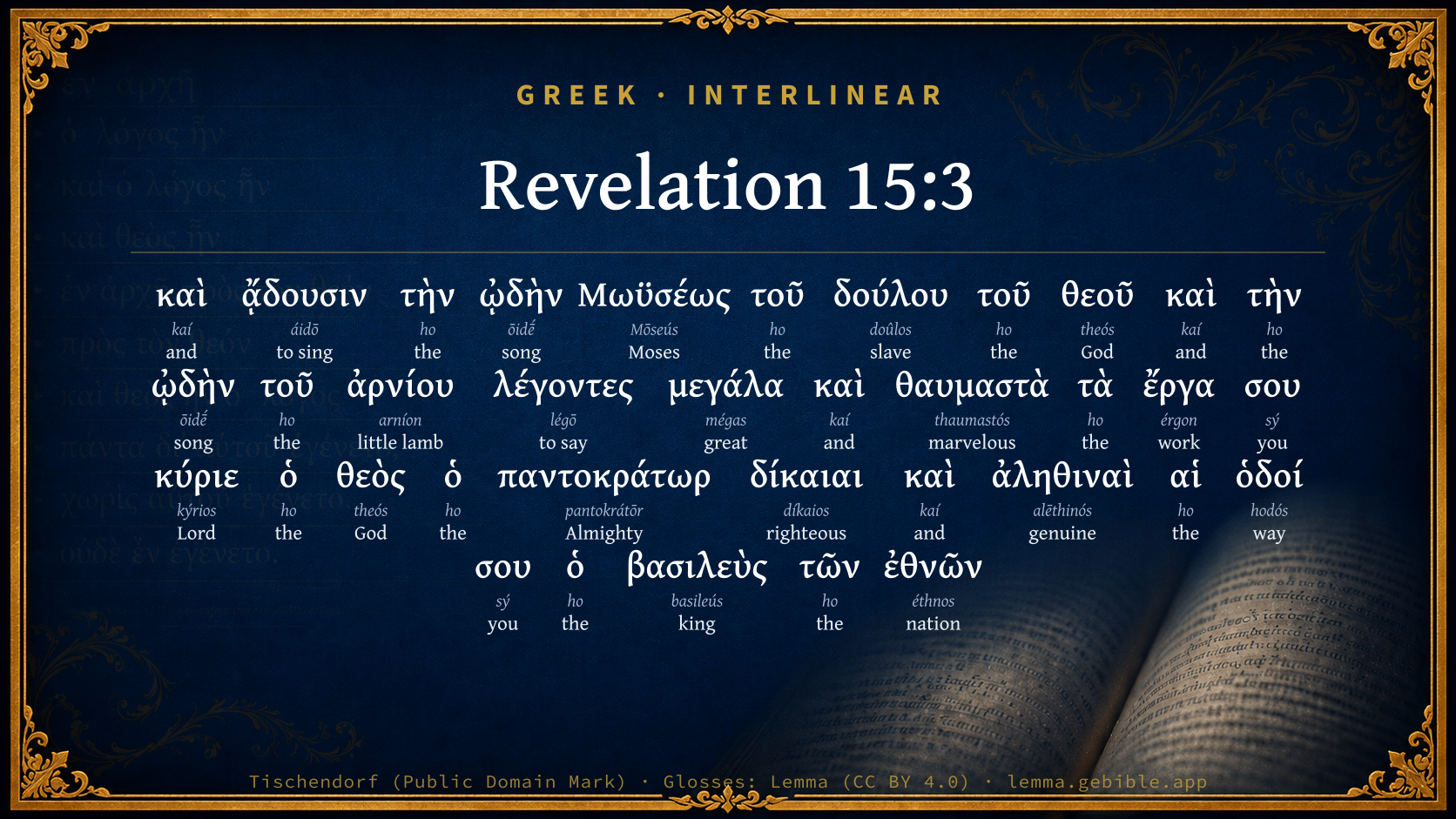
Greek (Tischendorf 8th ed.) Revelation 15:3 appears in the Greek New Testament. The text above is from the Tischendorf 8th edition. Each word links to its Strong’s number and a concise gloss. Click any word for its full Thayer’s Greek Lexicon entry.
Download image
Cite this verse

Revelation 15:3 (World English Bible). Public Domain. Lemma interlinear Bible study tool, https://lemma.gebible.app/v/revelation/15/3.

Show BibTeX & RIS
BibTeX
RIS
English Translation
They sang the song of Moses, the servant of God, and the song of the Lamb, saying, "Great and marvelous are your works, Lord God, the Almighty; Righteous and true are your ways, you King of the nations.
World English Bible · Public Domain
Download a study sheet

One document with this verse’s original text, its word-by-word gloss line, the meaning frame, cross-references with their text, attributed commentary, and full source and license credits — printable, and it pastes into notes with its structure intact.

This verse Autodidact and up

Study sheet (.html) Plain text (.txt)

A passage Seminary Student

Up to 50 verses in one chapter. A passage sheet keeps up to 6 commentary sources and 12 cross-references per verse, in the order this page ranks them, and says so on the sheet whenever that leaves anything out. Ask for a single verse and you get the Autodidact verse sheet above.

Everything on this page stays free to read, with no account — the sheet is a download of what is already on screen, not access to it.

Want to remove ads? Support Godless Engineer
Compare translations 3

The same verse in 3 English versions, stacked beneath the original-language interlinear above. Click any original word for its lexicon entry.

Each is an independent rendering of the whole verse — the interlinear is not word-aligned to these translations.

Highlighted words mark where these versions differ — a whole-verse word diff, not a word-by-word alignment.

  • World English Bible Public Domain
    They sang the song of Moses, the servant of God, and the song of the Lamb, saying, "Great and marvelous are your works, Lord God, the Almighty; Righteous and true are your ways, you King of the nations.
  • King James Version Public Domain
    And they sing the song of Moses the servant of God, and the song of the Lamb, saying, Great and marvellous are thy works, Lord God Almighty; just and true are thy ways, thou King of saints.
  • unfoldingWord Literal Text CC BY-SA 4.0
    And they sing the song of Moses the servant of God and the song of the Lamb, saying, “Great and marvelous your deeds, Lord God, Ruler of All. Righteous and true your ways, King of the Ages.

unfoldingWord Literal Text — © unfoldingWord, licensed CC BY-SA 4.0. Word-aligned USFM3 via Door43 (git.door43.org/unfoldingWord/en_ult).

Versions to compare (up to 4)

3 of 4 selected

Show all 19 translations

Every available English version of this verse, each an independent rendering of the whole verse.

  • World English Bible Public Domain
    They sang the song of Moses, the servant of God, and the song of the Lamb, saying, "Great and marvelous are your works, Lord God, the Almighty; Righteous and true are your ways, you King of the nations.
  • Berean Standard Bible Public Domain
    and they sang the song of God’s servant Moses and of the Lamb: “Great and wonderful are Your works, O Lord God Almighty! Just and true are Your ways, O King of the nations!
  • Majority Standard Bible Public Domain
    and they sang the song of God’s servant Moses and of the Lamb: “Great and wonderful are Your works, O Lord God Almighty! Just and true are Your ways, O King of the nations!
  • King James Version Public Domain
    And they sing the song of Moses the servant of God, and the song of the Lamb, saying, Great and marvellous are thy works, Lord God Almighty; just and true are thy ways, thou King of saints.
  • American Standard Version (1901) Public Domain
    And they sing the song of Moses the servant of God, and the song of the Lamb, saying, Great and marvellous are thy works, O Lord God, the Almighty; righteous and true are thy ways, thou King of the ages.
  • Revised Version (1885) Public Domain
    And they sing the song of Moses the servant of God, and the song of the Lamb, saying, Great and marvelous are thy works, O Lord God, the Almighty; righteous and true are thy ways, thou King of the ages.
  • Geneva Bible (1599) Public Domain
    And they sung the song of Moses the seruant of God, and the song of the Lambe, saying, Great and marueilous are thy workes, Lord God almightie: iust and true are thy wayes, King of Saints.
  • Douay-Rheims (1899) Public Domain
    And singing the canticle of Moses, the servant of God, and the canticle of the Lamb, saying: Great and wonderful are thy works, O Lord God Almighty; just and true are thy ways, O King of ages.
  • Young's Literal Translation Public Domain
    and they sing the song of Moses, servant of God, and the song of the Lamb, saying, `Great and wonderful `are' Thy works, O Lord God, the Almighty, righteous and true `are' Thy ways, O King of saints,
  • Literal Standard Version CC BY-SA 4.0
    and they sing the song of Moses, servant of God, and the song of the Lamb, saying, “Great and wonderful [are] Your works, O LORD God, the Almighty, righteous and true [are] Your ways, O King of holy ones!
  • Unlocked Literal Bible CC BY-SA 4.0
    They were singing the song of Moses, the servant of God, the song of the Lamb: “Great and marvelous are your deeds, Lord God, the Almighty. Just and true are your ways, King of the nations.
  • unfoldingWord Literal Text CC BY-SA 4.0
    And they sing the song of Moses the servant of God and the song of the Lamb, saying, “Great and marvelous your deeds, Lord God, Ruler of All. Righteous and true your ways, King of the Ages.
  • Darby Bible Public Domain
    And they sing the song of Moses bondman of God, and the song of the Lamb, saying, Great and wonderful [are] thy works, Lord God Almighty; righteous and true [are] thy ways, O King of nations.
  • World Messianic Bible Public Domain
    They sang the song of Moses, the servant of God, and the song of the Lamb, saying, “Great and marvelous are your works, Lord God, the Almighty! Righteous and true are your ways, you King of the nations.
  • Webster's Bible Public Domain
    And they sing the song of Moses the servant of God, and the song of the Lamb, saying, Great and marvelous are thy works, Lord God Almighty; just and true are thy ways, thou King of saints.
  • Free Bible Version CC BY-SA 4.0
    and they sang the song of Moses, the servant of God, and the song of the Lamb: “What you have done is tremendous and marvelous, Lord God, the All-powerful One. Your ways are right and true, King of the nations.
  • Bible in Basic English Public Domain
    And they give the song of Moses, the servant of God, and the song of the Lamb, saying, Great and full of wonder are your works, O Lord God, Ruler of all; true and full of righteousness are your ways, eternal King.
  • Text-Critical English NT CC BY 4.0
    They sang the song of Moses, the servant of God, and the song of the Lamb: “Great and marvelous are yoʋr works, O Lord God, the Almighty! Righteous and true are yoʋr ways, O King of the nations!
  • Tyndale New Testament (1534) Public Domain
    and they songe the songe of Moses the servaunt of god and the songe of the lambe sayinge. Gret and marvellous are thy workes Lorde god almyghty iuste and true are thy wayes kynge of saynctes.

Literal Standard Version (2020), Covenant Press — licensed CC BY-SA 4.0. Text via the HelloAO Bible API (eBible.org). Unlocked Literal Bible (unfoldingWord) — licensed CC BY-SA 4.0. Text via the HelloAO Bible API (eBible.org). unfoldingWord Literal Text — © unfoldingWord, licensed CC BY-SA 4.0. Word-aligned USFM3 via Door43 (git.door43.org/unfoldingWord/en_ult). Free Bible Version, Dr. Jonathan Gallagher — licensed CC BY-SA 4.0. Text via the HelloAO Bible API (eBible.org).

Word by word

More ways to search: Search by grammar → Find every occurrence → Compare this word →

Practice this passage: Drill this verse → Learn its vocabulary →

ᾄδουσιν
áidō
G103
“to sing”
Verb, Present, Active, Indicative, 3rd person, Plural
Part of Speech
Verb
Tense
Present
Voice
Active
Mood
Indicative
Person
3rd person
Number
Plural
Full Thayer's Definition

Origin: a primary word

TDNT: 03:43,2

1. to the praise of anyone, to sing
  1. καὶ kaí G2532 “and” Conjunction
  2. τὴν ho G3588 “the” Article, Accusative, Singular, Feminine
  3. ᾠδὴν ōidḗ G5603 “song” Noun, Accusative, Singular, Feminine
  4. Μωϋσέως Mōseús G3475 “Moses” Noun, Genitive, Singular, Masculine
  5. τοῦ ho G3588 “the” Article, Genitive, Singular, Masculine
  6. δούλου doûlos G1401 “slave” Noun, Genitive, Singular, Masculine
  7. τοῦ ho G3588 “the” Article, Genitive, Singular, Masculine
  8. θεοῦ theós G2316 “God” Noun, Genitive, Singular, Masculine
  9. καὶ kaí G2532 “and” Conjunction
  10. τὴν ho G3588 “the” Article, Accusative, Singular, Feminine
  11. ᾠδὴν ōidḗ G5603 “song” Noun, Accusative, Singular, Feminine
  12. τοῦ ho G3588 “the” Article, Genitive, Singular, Neuter
  13. ἀρνίου arníon G721 “little lamb” Noun, Genitive, Singular, Neuter
  14. λέγοντες légō G3004 “to say” Verb, Present, Active, Participle, Nominative, Plural, Masculine
  15. μεγάλα mégas G3173 “great” Adjective, Nominative, Plural, Neuter
  16. καὶ kaí G2532 “and” Conjunction
  17. θαυμαστὰ thaumastós G2298 “marvelous” Adjective, Nominative, Plural, Neuter
  18. τὰ ho G3588 “the” Article, Nominative, Plural, Neuter
  19. ἔργα érgon G2041 “work” Noun, Nominative, Plural, Neuter
  20. σου sý G4771 “you” Personal pronoun, 2nd person, Genitive, Singular
  21. κύριε kýrios G2962 “Lord” Noun, Vocative, Singular, Masculine
  22. ὁ ho G3588 “the” Article, Nominative, Singular, Masculine
  23. θεὸς theós G2316 “God” Noun, Nominative, Singular, Masculine
  24. ὁ ho G3588 “the” Article, Nominative, Singular, Masculine
  25. παντοκράτωρ pantokrátōr G3841 “Almighty” Noun, Nominative, Singular, Masculine
  26. δίκαιαι díkaios G1342 “righteous” Adjective, Nominative, Plural, Feminine
  27. καὶ kaí G2532 “and” Conjunction
  28. ἀληθιναὶ alēthinós G228 “genuine” Adjective, Nominative, Plural, Feminine
  29. αἱ ho G3588 “the” Article, Nominative, Plural, Feminine
  30. ὁδοί hodós G3598 “way” Noun, Nominative, Plural, Feminine
  31. σου sý G4771 “you” Personal pronoun, 2nd person, Genitive, Singular
  32. ὁ ho G3588 “the” Article, Nominative, Singular, Masculine
  33. βασιλεὺς basileús G935 “king” Noun, Nominative, Singular, Masculine
  34. τῶν ho G3588 “the” Article, Genitive, Plural, Neuter
  35. ἐθνῶν éthnos G1484 “nation” Noun, Genitive, Plural, Neuter

About this verse

These counts appear in no published source. They are computed here, from the morphology-tagged text and Lemma’s own curated glosses. What Lemma adds →

36
words
20
distinct lemmas
Revelation
section

Notable vocabulary

The rarest word here is ᾄδουσιν to sing G103 — appearing just 5 times in the whole Greek New Testament.

Shared distinctive vocabulary

ᾄδουσιν to sing G103 occurs in 5 verses of the Greek New Testament. Also found in:

Repetition

Words recur within this verse:

Cross-references

40

Topical passages linked to Revelation 15:3 in the Treasury of Scripture Knowledge — connected by theme and wording, ordered by reader-vote popularity; previews shown in the World English Bible.

  • Psalms 111:2 Yahweh's works are great, Pondered by all those who delight in them.
  • Exodus 15:1–18 Then Moses and the children of Israel sang this song to Yahweh, and said, "I will sing to Yahweh, for he has triumphed gloriously: The horse and his rider he has thrown into the sea.
  • Psalms 139:14 I will give thanks to you, For I am fearfully and wonderfully made. Your works are wonderful. My soul knows that very well.
  • Revelation 5:9–13 They sang a new song, saying, "You are worthy to take the book, And to open its seals: For you were killed, And bought us for God with your blood, Out of every tribe, language, people, and nation,
  • Psalms 145:17 Yahweh is righteous in all his ways, And gracious in all his works.
  • Isaiah 33:22 For Yahweh is our judge, Yahweh is our lawgiver, Yahweh is our king; he will save us.
  • Hosea 14:9 Who is wise, that he may understand these things? Who is prudent, that he may know them? For the ways of Yahweh are right, And the righteous walk in them; But the rebellious stumble in them.
  • Hebrews 3:5 Moses indeed was faithful in all his house as a servant, for a testimony of those things which were afterward to be spoken,
  • Psalms 100:5 For Yahweh is good. His loving kindness endures forever, His faithfulness to all generations.
  • Zechariah 9:9 Rejoice greatly, daughter of Zion! Shout, daughter of Jerusalem! Behold, your king comes to you! He is righteous, and having salvation; Lowly, and riding on a donkey, Even on a colt, the foal of a donkey.
  • John 1:17 For the law was given through Moses. Grace and truth came through Jesus Christ.
  • Genesis 17:1 When Abram was ninety-nine years old, Yahweh appeared to Abram, and said to him, "I am God Almighty. Walk before me, and be blameless.
  • Revelation 19:2 for true and righteous are his judgments. For he has judged the great prostitute, who corrupted the earth with her sexual immorality, and he has avenged the blood of his servants at her hand."
  • Isaiah 32:1–2 Behold, a king shall reign in righteousness, and princes shall rule in justice.
  • Revelation 14:3 They sing a new song before the throne, and before the four living creatures and the elders. No one could learn the song except the one hundred forty-four thousand, those who had been redeemed out of the earth.
  • Revelation 16:5–7 I heard the angel of the waters saying, "You are righteous, who are and who were, you Holy One, because you have judged these things.
  • Deuteronomy 31:30–32:43 Moses spoke in the ears of all the assembly of Israel the words of this song, until they were finished.
  • Revelation 4:8 The four living creatures, each one of them having six wings, are full of eyes around about and within. They have no rest day and night, saying, "Holy, holy, holy, holy, holy, holy, holy, holy, holy is the Lord God, the Almighty, who was and who is and who is to come!"
  • Revelation 7:10–11 They cried with a loud voice, saying, "Salvation be to our God, who sits on the throne, and to the Lamb!"
  • Revelation 11:17 saying: "We give you thanks, Lord God, the Almighty, the one who is and who was; because you have taken your great power, and reigned.
  • Revelation 17:14 These will war against the Lamb, and the Lamb will overcome them, for he is Lord of lords, and King of kings. They also will overcome who are with him, called and chosen and faithful."
  • Psalms 78:12 He did marvelous things in the sight of their fathers, In the land of Egypt, in the field of Zoan.
  • Psalms 85:10–11 Mercy and truth meet together. Righteousness and peace have kissed each other.
  • Psalms 99:4 The King's strength also loves justice. You do establish equity. You execute justice and righteousness in Jacob.
  • Psalms 105:5 Remember his marvelous works that he has done; His wonders, and the judgments of his mouth,
  • Psalms 118:22–23 The stone which the builders rejected has become the head of the corner.
  • Psalms 145:6 Men will speak of the might of your awesome acts. I will declare your greatness.
  • Isaiah 45:21 Declare you, and bring [it] forth; yes, let them take counsel together: who has shown this from ancient time? who has declared it of old? Haven't I, Yahweh? and there is no God else besides me, a just God and a Savior; there is no one besides me.
  • Daniel 4:2–3 It has seemed good to me to show the signs and wonders that the Most High God has worked toward me.
  • Daniel 6:20 When he came near to the den to Daniel, he cried with a lamentable voice; the king spoke and said to Daniel, Daniel, servant of the living God, is your God, whom you serve continually, able to deliver you from the lions?
  • 1 Chronicles 6:49 But Aaron and his sons offered on the altar of burnt offering, and on the altar of incense, for all the work of the most holy place, and to make atonement for Israel, according to all that Moses the servant of God had commanded.
  • 2 Chronicles 24:6 The king called for Jehoiada the chief, and said to him, Why haven't you required of the Levites to bring in out of Judah and out of Jerusalem the tax of Moses the servant of Yahweh, and of the assembly of Israel, for the tent of the testimony?
  • Job 5:9 Who does great things that can't be fathomed, Marvelous things without number;
  • Isaiah 9:6–7 For to us a child is born, to us a son is given; and the government shall be on his shoulder: and his name shall be called Wonderful, Counselor, Mighty God, Everlasting Father, Prince of Peace.
  • Micah 7:20 You will give truth to Jacob, and mercy to Abraham, As you have sworn to our fathers from the days of old.
  • Zephaniah 3:5 Yahweh, in the midst of her, is righteous. He will do no wrong. Every morning he brings his justice to light. He doesn't fail, but the unjust know no shame.
  • Revelation 19:16 He has on his garment and on his thigh a name written, "KING OF KINGS, AND LORD OF LORDS."
  • Revelation 14:8 Another, a second angel, followed, saying, "Babylon the great has fallen, which has made all the nations to drink of the wine of the wrath of her sexual immorality."
  • Nehemiah 9:14 and made known to them your holy Sabbath, and commanded them commandments, and statutes, and a law, by Moses your servant,
  • Daniel 9:11 Yes, all Israel have transgressed your law, even turning aside, that they should not obey your voice: therefore has the curse been poured out on us, and the oath that is written in the law of Moses the servant of God; for we have sinned against him.

Cross-references courtesy of OpenBible.info (CC BY 4.0).

Where the printed editions differ

1 variant

Places in this verse where the major printed Greek editions disagree on the wording in a way that affects the translation — a comparison of editions, not a manuscript-by-manuscript collation. The editions are the modern critical texts (Nestlé-Aland 28/27, SBL, Westcott-Hort, Tregelles, Tyndale House) and the traditional texts behind the KJV (the Textus Receptus and the Byzantine/Majority text). It is not a claim about which reading is original.

  1. Editions differ
    ἐθνῶν.

    “nations!”

    In NA28NA27TynTregByz Not in SBLWHTR

Textual data: Translators Amalgamated Greek New Testament (STEPBible TAGNT) · CC BY 4.0.

Commentary

Notes on Revelation 15:3 from classic Christian and Jewish commentators (each source and its license shown beneath its notes). The classic Christian expositions comment on the surrounding passage and are grouped to its opening verse, so a note may address several verses; the Jewish commentaries on the Tanakh (Rashi and others) are per-verse, so they appear only where the commentator wrote on this verse.

Lemma curates 59 commentaries, every one of them public domain or Creative Commons licensed, each selected and text-cleaned for this edition rather than reprinted as found. About our sources →

Tyndale Open Study Notes

Tyndale Open Resources

15:3-4 The song of Moses and the Lamb signifies that God’s will is united in the old and new covenants.

15:3 The Lord God, the Almighty (see also 1:8; 4:8; 11:17; 16:7; 19:6; 21:22): For persecuted Christians, the message that God is all-powerful provides great comfort and security. • The truth that God is also just and true is the foundation of human integrity in the midst of a confused, unjust, and dishonest world. • God is the supreme, universal King of the nations, not a localized deity attached to one nation or to a human monarch with limited authority.

Tyndale Open Study Notes — © Tyndale Open Resources, licensed CC BY-SA 4.0. Text via the HelloAO Bible API.

Bengel's Gnomon

Johann Albrecht Bengel

Rev 15:3. [174] Ὁ ΒΑΣΙΛΕῪς ΤῶΝ ἘΘΝῶΝ, King of nations) An august and befitting title: comp. Rev 15:4, and Jer 10:7; and yet it has been variously changed by the copyists.[175]

[174] τὴν ᾠδὴν τοῦ ἀρνίου, the song of the Lamb) The Lamb sings that song in honour of His Father in the great congregation; Psa 22:23-26.—V. g.

[175] C Vulg. Syr. read τῶν αἰώνων. ABh Memph. Cypr. read τῶν ἐθνῶν: so Lachm. and Tisch. But Rec. Text, without good authority, τῶν ἁγίων.—E.

Bengel's Gnomon of the New Testament — English translation (T&T Clark, Edinburgh, 1860) — public domain. Text from a community e-Sword module.

Expositor's Greek Testament

ed. W. Robertson Nicoll

Rev 15:3 . As in Exodus 14-15. Moses leads Israel in a song of praise to God over the dead Egyptians, so, after Rome’s downfall (Rev 14:8 f., Rev 15:2 ) the faithful are led by their captain (Rev 12:11 , Rev 14:1 ; Rev 14:4 , cf. Heb 2:12 ), in a chant of triumph and gratitude. (Note the lack of any reference to their own sufferings. Their interest is in the great work of God.) For messiah as a second Moses in Jewish tradition, cf. Gfrörer, ii. 328 f. The song on the Red Sea had already been adapted to the worship of the Therapeutae (Philo, de uit. contempl . § xi.) τὴν ᾠδὴν τ . ἀ . There is a continuity in redemption, which unites the first deliverance to the final. True to his cardinal idea of the identity of God’s people (Christians being the real Israel, cf. on Rev 1:6 ), the prophet hails Jesus as the Christian Moses who, at the cost of his life, is commissioned by God to deliver the new Israel from their bondage to an earthly monarchy. The lyric with its Hebrew parallelisms is a Vorspiel of the succeeding judgments; it resembles ( cf. E.Bi. 4954) the benediction after the Shema of Judaism (“a new song did they sing to Thy name, they that were delivered, by the seashore; together did all praise and own Thee as King, saying, ‘Yahveh shall reign world without end’ ”), and is almost entirely composed of O.T. phrases. Adoration is its theme, stirred by the sense of God’s justice. Similarly the famous hymn to Shamash, the Assyrian god of justice, which represents one of the highest reaches in ancient religious literature (Jastrow, pp. 300, 301): “Eternally just in the heavens are thou, / Of faithful judgment towards all the world art thou.” Most editors take the phrase καὶ τὴν ᾠδ . τ . ἀ . as a gloss; but if the song has nothing to do with the Lamb, it is as silent on Moses. Since the whole section comes from the pen of the general author, and since the collocation of the two ᾠδαί (equivalent of course to a single hymn) is awkward mainly in appearance, while the omission of the Lamb’s Song would leave the section incomplete, it seems better to regard it as original rather than as a scribe’s addition like Rev 14:10 , etc. As in Rev 14:1 ; Rev 14:3 , the Lamb is among his followers, yet not of them.

The Expositor's Greek Testament, edited by W. Robertson Nicoll (1897–1910) — public domain. Text from a community e-Sword module.

Geneva Bible (1599)

Geneva Bible translators

Thy doings.

That song of triumph which is Exod. 15:2.

So is Moses called for honor’s sake, as it is set forth, Deut. 34:10.

This song hath two parts, one a confession, but particular in this verse, and general, in the beginning of the next verse: another, a narration of causes belonging to the confession, whereof one kind is eternal in itself, and most present unto the godly in that God is both holy, and alone God, another kind is future and to come, in that the elect taken out of the Gentiles (that is, out of the wicked ones and unbelieving: as Rev. 11:2) were to be brought unto the same state of happiness by the magnificence of the judgment of God, in the next verse.

Geneva Bible (1599) marginal notes — public domain. Text via Bolls.life.

Jamieson, Fausset & Brown

Robert Jamieson, A. R. Fausset & David Brown

song of Moses . . . and . . . the Lamb--The New Testament song of the Lamb (that is, the song which the Lamb shall lead, as being "the Captain of our salvation," just as Moses was leader of the Israelites, the song in which those who conquer through Him [Rom 8:37] shall join, Rev 12:11) is the antitype to the triumphant Old Testament song of Moses and the Israelites at the Red Sea (Exo. 15:1-21). The Churches of the Old and New Testament are essentially one in their conflicts and triumphs. The two appear joined in this phrase, as they are in the twenty-four elders. Similarly, Isa 12:1-6 foretells the song of the redeemed (Israel foremost) after the second antitypical exodus and deliverance at the Egyptian Sea. The passage through the Red Sea under the pillar of cloud was Israel's baptism, to which the believer's baptism in trials corresponds. The elect after their trials (especially those arising from the beast) shall be taken up before the vials of wrath be poured on the beast and his kingdom. So Noah and his family were taken out of the doomed world before the deluge; Lot was taken out of Sodom before its destruction; the Christians escaped by a special interposition of Providence to Pella before the destruction of Jerusalem. As the pillar of cloud and fire interposed between Israel and the Egyptian foe, so that Israel was safely landed on the opposite shore before the Egyptians were destroyed; so the Lord, coming with clouds and in flaming fire, shall first catch up His elect people "in the clouds to meet Him in the air," and then shall with fire destroy the enemy. The Lamb leads the song in honor of the Father amidst the great congregation. This is the "new song" mentioned in Rev 14:3. The singing victors are the 144,000 of Israel, "the first-fruits," and the general "harvest" of the Gentiles.

servant of God-- (Exo 14:31; Num 12:7; Jos 22:5). The Lamb is more: He is the SON.

Great and marvellous are thy works, &c.--part of Moses' last song (Deu 32:3-4). The vindication of the justice of God that so He may be glorified is the grand end of God's dealings. Hence His servants again and again dwell upon this in their praises (Rev 16:7; Rev 19:2; Pro 16:4; Jer 10:10; Dan 4:37). Especially at the judgment (Psa 50:1-6; Psa 145:17).

saints--There is no manuscript authority for this. A, B, Coptic, and CYPRIAN read, "of the NATIONS." C reads "of the ages," and so Vulgate and Syriac. The point at issue in the Lord's controversy with the earth is, whether He, or Satan's minion, the beast, is "the King of the nations"; here at the eve of the judgments descending on the kingdom of the beast, the transfigured saints hail Him as "the King of the nations" (Eze 21:27).

Jamieson, Fausset & Brown — Commentary Critical and Explanatory on the Whole Bible (1871) — public domain (CC PDM 1.0). Text via the HelloAO Bible API.

Adam Clarke's Commentary

Verse 3. They sing the song of Moses] That which Moses sang, Ex 15:1, when he and the Israelites, by the miraculous power of God, had got safely through the Red Sea, and saw their enemies all destroyed.

And the song of the Lamb] The same song adapted to the state of the suffering, but now delivered Christians.

Great and marvellous are thy works] God's works are descriptive of his infinite power and wisdom.

Lord God Almighty] Nearly the same as Jehovah, God of hosts.

Just and true are thy ways] Every step God takes in grace or providence is according to justice, and he carefully accomplishes all his threatenings and all his promises; to this he is bound by his truth.

Adam Clarke's Commentary on the Bible (1810–1826) — public domain. Text from a community e-Sword/MySword module.

Ellicott's Commentary for English Readers

(3) And they sing the song of Moses the servant of God, and the song of the Lamb.—They join their voices to the music of their harps. The song of Moses was a pæan of victory over Pharaoh and his hosts (Exo_14:26-31; Exo_15:1-21). Israel stood on the margin of the Red Sea and saw the tokens of the overthrow of the great world-power of that day; so these saints stand by the border of the fire-blent sea of glass, and sing the song of triumph over the doom of the great world-powers of every age. The cases are parallel, the songs are alike; and it would not be out of place were the words of that other song of Moses, the man of God, to be heard from those who are made glad according to the days of their affliction, and who are clothed with the beauty of the Lord their God (Psa_90:1; Psa_90:15; Psa_90:17). They also sing the song of the Lamb. The Apocalypse is full of Christ; the Lamb is the axis on which the world of its scenery moves; He is the key of earth’s history; the victory of the saints is in Him (Rev_12:11); their song of triumph is of Him who put a new song in their mouth and in whom all things are reconciled (Eph_1:10; Php_2:10-11).

(3, 4) Great and marvellous are thy works. . . .—The song is better thus translated:—

“Great and marvellous are Thy works,

Lord God Almighty.

Just and true are Thy ways,

Thou King of the nations.

Who will not fear, O Lord, and glorify Thy name?

Because Thou only art holy:

Because all the nations shall come and worship

in Thy presence:

Because Thy judgments were manifested.”

The works are called “great;” the “ways” are called just and true. It is not mere marvel which calls forth the song of praise, but righteousness, truth, and holiness. The Almighty is the righteous ruler. The English version has “King of saints;” the reading should be “King of the nations” or else, perhaps, “King of the ages” The latter reading harmonises well with the immediate context and with the other passages, which link the thought of “the ages” with the “righteous dealings” of God. “Thy righteousness is an everlasting righteousness, and thy law is the truth” (Psa_119:142; comp. also Psa_119:144; Psa_119:151-152; Psa_119:160). But the former is to be preferred; it is appropriate in a song which celebrates a victory over those who vaunted themselves as the princes of this world, and which proclaims the submission of the nations to God; and it seems to have been transplanted here from Jeremiah (Jer_10:7): “Who would not fear thee, thou King of the nations?” The song celebrates the noble acts of the Lord; it declares them to be great; but it is not their greatness, it is their righteousness and faithfulness which calls forth the grateful praise. The long days of oppression, and the seeming silence of the Almighty, when the prayer and cry “How long?” has risen from perplexed and suffering saints, have brought the temptation of the psalmist: “I have cleansed my heart in vain” (Psa_73:3-13). But now the righteous acts of the Lord are manifested; now it is acknowledged that “verily there is a reward for the righteous; verily He is a God that judgeth in the earth” (Psa_58:11). Though clouds and darkness have sometimes been round about Him, it is now beyond doubt that “righteousness and judgment are the habitation of His throne” (Psa_97:2).

A Bible Commentary for English Readers, edited by Charles John Ellicott (1878–1897) — public domain. Text from a community e-Sword module.

The Cambridge Bible for Schools and Colleges

gen. ed. J. J. S. Perowne

3. the song of Moses] Exodus 15—the song of God’s redeemed people, delivered from their enemies, and confident of coming, but not come yet, “unto the rest and to the inheritance which the Lord their God doth give unto them.” There is probably no allusion to their coming from the “Red Sea” of martyrdom: that is a pretty conceit, but below the dignity of prophecy.

the servant of God] Exo_14:31 is particularly referred to; but also in Num_12:7; Jos_1:1-2; Jos_1:7; Jos_1:13; Jos_1:15; Jos_22:5; Psa_105:26 “the servant of the Lord” is used as a special honourable title of Moses: cf. Heb_3:5.

the song of the Lamb] For the Lamb has redeemed them, as Moses redeemed Israel. “The song of the Lamb” is not a different song from “the song of Moses,” but the same interpreted in a higher sense: well illustrated by the Christian use of Psalms 114, and the other Passover Psalms, in our Easter services.

Great and marvellous &c.] There may be references to Psa_111:2; Psa_139:14; Psa_145:17 : but this psalm rather continues the spirit of those than combines their words. It is noticeable that this song, alone of those occurring in this book, has the parallelism or quasi-metrical structure of Hebrew poetry.

of saints] Read, of the nations or of the ages; the best editors are divided in their preference for one of these readings, but both are better attested than that of the received text. See Jer_10:7, which no doubt is quoted, in these words and the clause following, and perhaps decides the balance of probability in favour of “nations.”

The Cambridge Bible for Schools and Colleges (gen. ed. J. J. S. Perowne; Cambridge University Press, 1878–1918) — public domain. Text from a community e-Sword module.

John Gill's Exposition

And they sing the song of Moses the servant of God,.... Not that in Deu 32:1 but that in Exo 15:1 and the sense is, either that they observed the law of Moses, which he as a servant in the Lord's house faithfully delivered, and kept it distinct from the Gospel, and did not blend them together, as in the times before; or rather, that they sung a song like that of Moses, and on a like occasion. Pharaoh was the very picture of the pope of Rome; his oppression and cruel usage of the Israelites represent the tyranny and cruelty of the Romish antichrist; and the deliverance of Israel out of Egypt, and the destruction of the Egyptians at the Red sea, which occasioned the song of Moses, were an emblem of God's bringing his people out of antichristian bondage, and of the ruin of antichrist, upon which this song is sung; and Rome, in this book, is called Egypt, Rev 11:8. The Jews have a notion, that the very song of Moses itself will be sung in the world to come, in the days of the Messiah; for they say, there are in it the times of the Messiah, and of Gog and Magog, and of the resurrection of the dead, and the world to come (l). And this song was sung by the Levites in the daily service (m).

And the song of the Lamb; the Lamb of God, who was slain for the sins of men; the same song of which mention is made, Rev 5:9 the song of redeeming love, a song of praise for the blessings of grace which come through him, and of deliverance by him:

saying, great and marvellous are thy works, Lord God Almighty; Christ is in this song addressed as a divine person, as Lord of all, God over all, blessed for ever, the Almighty God, as his works declare him to be; his works of creation, providence, and redemption, which are all great and marvellous, particularly the accomplishment of the glorious things spoken of his church, and the destruction of his enemies, which are here designed:

just and true are thy ways, thou King of saints: made so by his Father, and acknowledged by all his people, and especially at this time, when his kingdom will more visibly and gloriously appear: the Alexandrian copy, one of Stephens's, the Complutensian edition, and Arabic version, read, King of nations, as in Jer 10:7 from whence this, and the beginning of the next verse, seem to be taken; the Vulgate Latin and Syriac versions read, "King of ages", an everlasting King, as in Jer 10:10 but the generality of copies read as we have it: and the ways of this King are just and true; his purposes, decrees, and counsels of old, are faithfulness and truth; all his proceedings towards his own people, his subjects, are mercy and truth; his precepts and ordinances, his worship and service, are just and true, in opposition to every false way; and all his judgments upon his enemies, which are intended, are just, being what their sins deserved, and are true, being agreeably to his word and threatenings.

(l) Zohar in Exod. fol. 23. 2. & 24. 3, 4. & 25. 2. & T. Bab. Sanhedrin, fol. 91. 2. (m) Maimon. Tamidim, c. 6. sect. 9.

John Gill's Exposition of the Whole Bible (1746–1763) — public domain (CC PDM 1.0). Text via the HelloAO Bible API.

Trapp's Complete Commentary

John Trapp

3 And they sing the song of Moses the servant of God, and the song of the Lamb, saying, Great and marvellous are thy works, Lord God Almighty; just and true are thy ways, thou King of saints.

Ver. 3. And they sing] There cannot but be music in the temple of the Holy Ghost.

The song of Moses] As being delivered out of spiritual Egypt.

And the song of the Lamb] That mentioned Rev 14:3, and the same in effect with that of St Paul, 1Ti 1:15; 1Ti 1:17.

John Trapp, A Commentary or Exposition upon All the Books of the Old and New Testament (1647–1656) — public domain. Text from a community e-Sword module.

Albert Barnes' Notes on the Bible

And they sing the song of Moses the servant of God - A song of thanksgiving and praise, such as Moses taught the Hebrew people to sing after their deliverance from Egyptian bondage. See Exo. 15. The meaning here is, not that they would sing that identical song, but that, as Moses taught the people to celebrate their deliverance with an appropriate hymn of praise, the redeemed would celebrate their delivery and redemption in a similar manner. There is an obvious propriety here in referring to the “song of Moses,” because the circumstances are very similar; the occasion of the redemption from that formidable anti-Christian power here referred to, had a strong resemblance to the rescue from Egyptian bondage.

And the song of the Lamb - The hymn which is sung in honor of the Lamb, as their great deliverer. Compare the notes on Rev 5:9-10, Rev 5:12-13.

Saying, Great and marvelous are thy works - See the notes on Rev 15:1. The meaning is, that great power was evinced in redeeming them; and that the interposition of the divine goodness in doing it was marvelous, or was such as to excite wonder and admiration.

Lord God Almighty - This would seem to mean the same thing as the expression so common in the Old Testament, “Yahweh, God of hosts.” The union of these appellations give solemnity and impressiveness to the ascription of praise, for it brings into view the fact, that he whose praise is celebrated is Lord - Yahweh - -the uncreated and eternal One; that he is God the creator, upholder, and sovereign of all things; and that he is Almighty - having all power in all worlds. All these names and attributes are suggested when we think of redemption; for all the perfections of a glorious God are suggested in the redemption of the soul from death. It is the Lord the Ruler of all worlds; it is God - the Maker of the race, and the Father of the race, who performs the work of redemption; and it is a work which could be accomplished only by one who is Almighty.

Just and true - The attributes of justice and truth are brought prominently into view also in the redemption of man. The fact that God is just, and that in all this work he has been careful to maintain his justice Rom 3:26; and the fact that he is true to himself, true to the creation, true to the fulfillment of all his promises, are prominent in this work, and it is proper that these attributes should be celebrated in the songs of praise in heaven.

Are thy ways - Thy ways or dealings with us, and with the enemies of the church. That is, all the acts or “ways” of God in the redemption of his people had been characterized by justice and truth.

Thou King of saints - King of those who are holy; of all who are redeemed and sanctified. The more approved reading here, however, is “King of nations” - ὁ βασιλεὺς τῶν ἐθνῶν ho basileus tōn ethnōn - instead of “King of saints” - τὼν ἁγιῶν tōn hagiōn. So it is read in the critical editions of Griesbach, Tittmann, and Hahn. The sense is not materially affected by the difference in the reading.

Albert Barnes' Notes on the Bible (1834–1885) — public domain. Text from a community e-Sword/MySword module.

Haydock's Catholic Bible Commentary

And singing. This sea of glass and fire may also represent the sea which Moses passed in leaving Egypt; and the memory of this famous event, in every respect so similar to the deliverance of the saints from the persecutions to which they had been exposed during their lives, affords them the opportunity of singing the canticle of Moses, at the conclusion of which, they join in the praises of the Almighty for their own particular deliverance. (Calmet) --- O King of ages. In the common Greek is now read, O king of saints. (Witham)

George Leo Haydock (1774–1849), Haydock's Catholic Family Bible and Commentary, 1859 edition — public domain. Excludes Psalms (Douay-Rheims chapter numbering differs from Protestant) and Deuterocanonical books (Catholic canon only).

Matthew Poole's English Annotations

And they sing the song of Moses the servant of God; the song which Moses sang upon God’s delivery of the Israelites from the danger of Pharaoh, which we have, Exo 15:1-27; not that they sang those words, but to the same sense.

And the song of the Lamb; a song to the honour of Christ, to the same sense that Moses sang, and upon a much like occasion.

Saying, Great and marvellous are thy works, Lord God Almighty; admiring the greatness and marvellousness of what God had done in their deliverance, and giving him the glory of his Almighty power.

Just and true are thy ways, thou King of saints; acknowledging, that all the acts of his providence were both just, God in them giving to every one their due, and true, God by them but justifying his promises and threatenings. These words are taken out of Psa 145:17.

Matthew Poole's English Annotations on the Holy Bible (1683–1685) — public domain. Text from a community e-Sword/MySword module.

Whedon's Commentary on the Bible

Daniel D. Whedon

3. Song of Moses—Sung on the sea after a similar escape.

Of the Lamb—The same song elevated to a higher triumph. It is a song not only of triumph but of judgment; once over Egypt, now over Babylon, finally over the world.

Saying—The import of the twofold song is now given. It is a chant of adoration to God for his wonderful judgments on the organic wickedness of the profane world.

Works—Of just overthrow by him whose name is majestically expanded to its trinal form.

King of saints— Better reading, of ages; and perhaps still better, of nations. It then alludes to the profane nations typified by Babylon, and bound to be overthrown.

Daniel D. Whedon (gen. ed.), Commentary on the Old and New Testaments (1874–1909) — public domain. Text from a community e-Sword module.

The Pulpit Commentary

And they sing the song of Moses the servant of God, and the song of the Lamb. Most probably the song of deliverance after the passage of the Red Sea, (Ex 15) to which this bears a general resemblance. Moses is called the "servant of God" in Exo_14:31 and elsewhere. The song of Moses is also the song of the Lamb; the Old Testament and the New Testament Churches are one. Saying, Great and marvellous are thy works, Lord God Almighty. (cf. Exo_15:7, "And in the greatness of thine excellency thou hast overthrown them;" also Psa_111:2 Psa_139:14) This song, like that in Rev_4:8, is addressed to the "Lord God Almighty." Just and true are thy ways, thou King of saints. The reading of the Textus Receptus, agiwn , "of saints," is certainly incorrect. It does not appear in any Greek manuscripts, but was inserted by Erasmus to represent the sanctorum of his Vulgate, which word, however, is itself a corruption of saeculorum, the true Vulgate reading representing aiwnwn. Eynwn , "of nations," is read in a, A, B, P, 1, 7, 8, 14. etc., An-dress, Primasius; while aiwnon , "of ages," is the reading of a, C, 95, Vulgate, etc. It has been conjectured that AIYNWN (by itacism for eynwn) has been confused with AIWNWN a parallel to the reading, "King of nations" is found in Jer_10:7, Hebrew text and Theodotion, but not LXX: "Who would not fear thee, O King of nations?" which is very like the succeeding clause in ver. 5, especially in connection with the "nations" there mentioned. The title "King of the ages," or "eternal King," is applied to God in 1Ti_1:17, and in the Book of Tobit twice, (RAPC Tob 13:6, 10) but seems unknown to the Old Testament.

Vers. 3, 4. The prelude of the plagues the beginning of the end.

It seemed as if all was ended with the harvest and the vintage, of which we are told in the close of the previous chapter. What can come after the ingathering of the saints and the final judgment? And, indeed, nothing can. But what is here given in the chapters that follow is the more detailed setting forth of the Divine judgments upon the Church"s three great enemies the dragon and the two beasts; or, in other words, the dragon, the beast, and the false prophet. The overthrow of Satan is, however, related last of all. Ere the Divine judgments on these enemies of the people of God begin, we have the song of the redeemed the song, as it is termed, "of Moses the servant of God and of the Lamb." An objection may be felt by some that the saints of God should be represented, as they are here, as exulting over the awful woes which had come upon their enemies. Is such triumph over a fallen foe in harmony with the Spirit of Christ, and with the perfectly sanctified nature of the inhabitants of heaven? In reply, we may say that what is right anywhere is right everywhere; and if it were right for Israel to exult over the dead Egyptians and the utter destruction of Pharaoh and his hosts as surely it was then like exultation over far worse foes cannot be wrong. We are scarcely able to comprehend either Israel"s or St. John"s condition of mind. We have so long dwelt at ease, in the enjoyment of full liberty, none daring to make us afraid, that the intense feeling aroused by hideous murder, bloody cruelty, monstrous injustice, and relentless oppression, threatening, not one or two, but a whole people, and enacted under our own eyes, and felt in our own persons what all this would arouse in men"s minds we do not know, and can scarce imagine. One present amid the Sepoy massacres in the Indian Mutiny tells with what fresh understanding he and his fellow worshippers listened in church to the lessons which fell then to be read out of the Book of Joshua. Burning indignation against wrong can never be wrong. It was in Christ, and should be in us. Exultation, therefore, over its downfall is not only natural, but right. The coupling together of the song of Moses and of the Lamb teaches that in the first we are to find the pattern of the second. Note, therefore

I THE SCENE. Our thoughts are sent back to the thrilling story of Israel in Egypt. The pouring out of the vials is called by the same name as were God"s judgments in Egypt. And the scene of this song alludes plainly to Israel at the Red Sea. We are standing before a sea of glass, as we read in Revelation 4. But that sea now seems "mingled with fire." On its margin stand the throngs of the redeemed. That sea so lustrous, so still, so smooth, so firm, like as the Red Sea seemed in comparison with the fearful storm of the night of the Exodus. But it had been a sea of judgment to their foes. In its depths lay horse and rider, chariot and horseman, Pharaoh and his army. Fitly did the fire, mingled with this sea of glass, tell of that. And the rejoicing Israelites were the type of which the redeemed Church of Christ, safe in glory, is the antitype. This scene is another reminder, out of many more, that in the story of Israel may be read, in symbol, the story of the Christian Church. The comfort, the counsel, and the warning for all are there of the one are for the other also.

II THE SONG.

1. It is a song, not a speech. Sung, not said. Music, the vehicle of song, is the language of thoughts that lie too deep for words. Words are not adequate to tell of the heart"s feelings. The flush of shame; the flash of the angry eye as his, whose "eyes were as a flame of fire;" the tears of sorrow; the sigh of distress. More than words is wanted, and music is one of the many means, more expressive far than words, whereby the deeper feelings and thoughts of the heart are uttered. Music is especially animated with joy, and the fact that the heavenly company "sing." tells of their "joy of heart.

2. It is a song wherein all the glory is given to God. Moses does not say one word of himself, but bids the people "sing unto the Lord." So was it, so will it be.

3. It lingers on the terribleness of their enemies. It tells of their proud boast, their cruel intent, their formidable power. Thus the "wrath of man" praised God. And in the future review, when we think of our adversaries, the seemingly insuperable difficulties these will be, as the like were, part of our song.

4. It tells of the enemies" complete overthrow.

5. The future consequences of this victory. Moses celebrates that. How "the dukes of Edom, the people of Palestina," will be moved with fear. And so in the song of the Lamb, "Who shall not fear," etc.? (ver. 4). The redeemed distinctly contemplate further triumphs for the Lord over those as yet not yielded to him. The "firstfruits," "the Church of the Firstborn," "the elect of God and it is these, and their glorious salvation, which is portrayed here are, as their prototypes were, for the blessing of others, many others; "all the nations of the earth" are to be blessed in Christ and in his seed. And the elect are to be the instruments. And the mighty lever that shall overturn the mass of error and sin shall be God"s marvellous mercy to them. Oh to be numbered amongst "the sacramental host of God"s elect"! For they are

III THE SINGERS OF THIS SONG. They were and are such as:

1. Once were bond- men.

2. Had been in sore peril of being re-enslaved.

3. Their preservation due to the fact that they had been kept by the power of God. It was his restraining hand had held back the waves, that but for this would have overwhelmed them.

4. They are a blood-besprinkled band. On the lintel and doorposts of every house of Israel the blood of the Paschal lamb had been sprinkled, and so had they and theirs been saved alive. Never were they to think that it was for their own worthiness they were saved. To crush such thought the Passover sacrifice was ordained. And the singers of this song owe their all to the fact that for them Christ"s blood was shed. In virtue of that they are what and where they are. Do any ask How is this? We answer"I cannot tell the woe Which thou wast pleased to bear, O Lamb of God; but this I know That all my sins were there. S.C.

The praise of the Divine works.

It is most meet that all should praise the works of God those works which themselves do praise him. But the Church of God is especially called upon to view the works of God in the world. There the Almighty Ruler displays his power and wisdom and goodness. There the thoughtful may learn of him; for the righteousness and the truthfulness of his ways are a revelation of the righteousness and truth of his Name.

I PRAISE IS THE CREATURE"S BECOMING ASCRIPTION TO ALMIGHTY GOD. His supremacy and government, his wisdom and power, his goodness and beneficence every attribute which the human mind may be able, even dimly, to trace, it is the duty of the human heart to praise. It is little that can be offered by a creature to the Creditor. His best service is his true, lowly, reverent, sincere praise. "He that offereth praise glorifieth God; ... Praise waiteth for thee, O God, in Zion.

II PRAISE APPROPRIATELY ASSUMES THE FORM OF AN INSPIRITING SONG OF FAITH. Faith has its one foundation in God. Whatever lifts man upward to God stimulates to faith in the Divine Name. Without the knowledge of God there can be no faith in him; but as the glory of the Divine Name shines upon the human soul, that soul grows up into filial, obedient confidence in God. The song of praise stirs the sleepy spirit as the battle cry the warrior. To praise God for the goodness and greatness of his works is sure to inspirit the faith that is in him.

III PRAISE RECOGNIZING THE MIGHT AND MAJESTY OF GOD ASSURES THE HEART OF A FINAL CONQUEST OVER THE FEEBLENESS OF EVIL. This is the subject of the song in these words: "Who shall not fear, O Lord, and glorify thy Name? for thou only art holy.

IV PRAISE CALMLY ANTICIPATES THE ULTIMATE HAPPY AND PEACEFUL SUBMISSION OF ALL TO THE RIGHTEOUSNESS OF "THE LORD GOD, THE ALMIGHTY." "All the nations shall come and worship before thee.

V THIS PRAISE HAS FOR ITS SUBJECT THE HOLY NAME AND RIGHTEOUS WAY OF GOD. R.G.

The Pulpit Commentary (1880–1919), ed. H.D.M. Spence-Jones & Joseph S. Exell — public domain. Text from a community e-Sword module.

John Wesley's Explanatory Notes

And they sing the song of Moses - So called, partly from its near agreement, with the words of that song which he sung after passing the Red Sea, Exod. xv, 11, and of that which he taught the children of Israel a little before his death, Deut. xxxii, 3, 4. But chiefly because Moses was the minister and representative of the Jewish church, as Christ is of the church universal. Therefore it is also termed the sons of the Lamb. It consists of six parts, which answer each other: 1. Great and wonderful are thy. 2. For thou only art gracious. works, Lord God Almighty. 3. Just and true are thy ways, O. 4. For all the nations shall come King of the nations and worship before thee. 5. Who would not fear thee, O. 6. For thy judgments are made Lord, and glorify thy name? manifest. We know and acknowledge that all thy works in and toward all the creatures are great and wonderful; that thy ways with all the children of men, good and evil, are just and true. For thou only art gracious - And this grace is the spring of all those wonderful works, even of his destroying the enemies of his people. Accordingly in Psalm cxxxvi, 1-26., that clause, "For his mercy endureth forever," is subjoined to the thanksgiving for his works of vengeance as well as for his delivering the righteous. For all the nations shall come and worship before thee - They shall serve thee as their king with joyful reverence. This is a glorious testimony of the future conversion of all the heathens. The Christians are now a little flock: they who do not worship God, an immense multitude. But all the nations shall come, from all parts of the earth, to worship him and glorify his name. For thy judgments are made manifest - And then the inhabitants of the earth will at length learn to fear him.

John Wesley, Explanatory Notes Upon the Whole Bible (1754–1765) — public domain. Text via the GEBible commentary corpus.

The People's New Testament

B. W. Johnson

3, 4. They sing the song of Moses … and the song of the Lamb. When Israel was delivered from Egypt they sang the song Moses as they had done on the shores of the Red Sea. Here, the spiritual Israel, redeemed, standing on the crystal sea, sings a song of deliverance, but it is the old song to a new strain; the song of the Lamb now; of the Redeemer. Just and true are thy ways. The salvation of the true worshipers and the judgment seat upon which the wicked beast, demonstrated the truth and justice of God.

B. W. Johnson's The People's New Testament with Notes (1889–1891) — public domain. Electronic text from the Christian Classics Ethereal Library (CCEL) ThML edition.

unfoldingWord translationNotes

Door43 World Missions Community

They were singing

"Those who had been victorious over the beast were singing"

Who will not fear you, Lord, and glorify your name?

This question is used to show their amazement at how great and glorious the Lord is. It can be expressed as an exclamation. AT: "Lord, everyone will fear you and glorify your name!" (See: Rhetorical Question)

glorify your name

The phrase "your name" refers to God. AT: "glorify you" (See: Metonymy)

your righteous deeds have been revealed

This can be stated in active form. AT: "you have made everyone know about your righteous deeds" (See: Active or Passive)

translationWords

Moses

servant

lamb

amazed

works

lord

Almighty

just

true

king

nation

fear

glory

name

holy

worship

righteous

reveal

unfoldingWord translationNotes — © Distant Shores Media and the Door43 World Missions Community, licensed CC BY-SA 4.0. Source: git.door43.org/Door43/en_tn.

Cambridge Greek Testament for Schools and Colleges

3. τῶν ἐθνῶν. א*C have αἰώνων. Text. Rec[507] has ἁγίων, a retranslation of a misread compendium sctorum for sclorum.

[507] Rec. Textus Receptus as printed by Scrivener.

3. τὴν ᾠδὴν Μωϋσέως. Exodus 15—the song of God’s redeemed people, delivered from their enemies, and confident of coming, but not come yet, “unto the rest and to the inheritance which the Lord their God doth give unto them.” There is probably no allusion to their coming from the “Red Sea” of martyrdom: that is a pretty conceit, but below the dignity of prophecy.

τοῦ δούλου τοῦ θεοῦ. Exo 14:31 is particularly referred to; but also in Num 12:7; Jos 1:1-2; Jos 1:7; Jos 1:13; Jos 1:15; Jos 22:5; Psa 105:26 “the servant of the Lord “is used as a special honourable title of Moses: cf. Heb 3:5.

τῆν ᾠδὴν τοῦ ὠρνίου. For the Lamb has redeemed them, as Moses redeemed Israel. “The song of the Lamb” is not a different song from “the song of Moses,” but the same interpreted in a higher sense: well illustrated by the Christian use of Psalms 114, and the other Passover Psalms, in our Easter services.

Μεγάλα καὶ θανμαστά. There may be references to Psa 111:2; Psa 139:14; Psa 145:17: but this psalm rather continues the spirit of those than combines their words. It is noticeable that this song, almost alone of those occurring in this book, has the parallelism or quasimetrical structure of Hebrew poetry.

ὁ βασιλεὺς τῶν ἐθνῶν. See crit. note. The thought is the same as in chap. Rev 11:15; Rev 11:17. God, Who of old sanctified to Himself a peculiar people, has now taken the heathen also for His heritage. The expression here and in the following clause (which fixes the sense and the text) is taken from Jer 10:7.

Cambridge Greek Testament for Schools and Colleges (Cambridge University Press, 1896; 21 vols, various authors incl. Carr, Maclear, Plummer, Farrar, Lumby, Moule, M. R. James, Simcox) — public domain. Text from a community e-Sword module.

Vincent's Word Studies in the New Testament

Marvin R. Vincent

The song of Moses. See Exodus 15. Compare Deuteronomy 32; to which some refer this allusion.

The servant of God. See Exo 14:31; Num 12:7; Psa 105:26; Heb 3:5.

The song of the Lamb. There are not two distinct songs. The song of Moses is the song of the Lamb. The Old and the New Testament churches are one.

Great and marvelous are Thy works. Psa 111:2; Psa 139:14; 1Ch 16:9.

Just and true are Thy ways. Rev., righteous for just. See Deu 32:4.

King of saints [βασιλευς των αγιων] . The readings differ. Some read for saints, ejqnwn of the nations; others aijwnwn of the ages. So Rev. Compare Jer 10:7.

Marvin R. Vincent, Word Studies in the New Testament (1887–1900) — public domain. Text from a community e-Sword/MySword module.

Lesson kit

Teaching starters — assembled from the data on this page, not authored interpretation. Every prompt links to the verse data it draws on. Edit before teaching.

Revelation, in the Revelation, opens this verse with 36 words (20 distinct Greek lemmas). Its most distinctive word is áidō (“to sing”). A historical commentator’s framing appears above. Read the whole chapter for the surrounding context.

Discussion questions

  1. How does “to sing” (áidō) shape what this verse is saying?
  2. Ephesians 5:19 shares the word «to sing» with this verse. How do the two illuminate each other?
  3. “song” occurs 2× in this one verse. What is the effect of the repetition?
  4. These translations render this verse differently. What is at stake in choosing one wording over another?
  5. Reading how Tyndale Open Study Notes and Bengel's Gnomon read this verse, where do the two commentators agree and where do they part?

Things to notice

Reading settings

Reading text

Shown beneath each verse's original-language words.

Old Testament
Old Testament edition

Read the OT as the Masoretic Hebrew (MT) or the Greek Septuagint (LXX).

English shown for the Greek Septuagint (in the Hebrew ↔ Greek comparison).

Comparing translations? Open the Compare panel on any verse page to stack up to four side by side.