
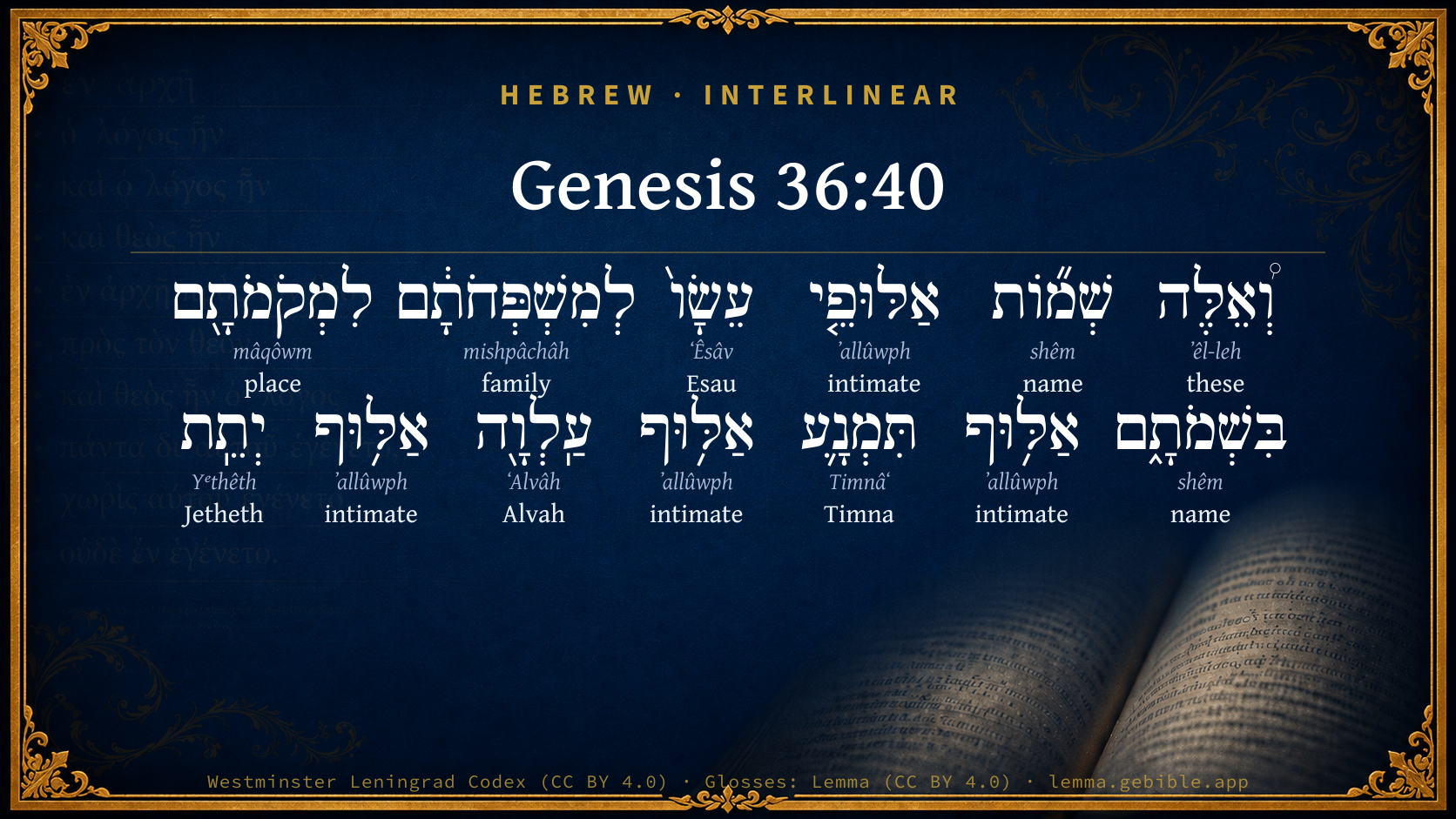
Genesis 36:40

Hebrew (Westminster Leningrad Codex) Genesis 36:40 appears in the Hebrew Old Testament. The text above is from the Westminster Leningrad Codex. Each word links to its Strong’s number, a concise gloss, and parsing drawn from the Open Scriptures Hebrew Bible morphology. Click any word for its full Brown-Driver-Briggs (BDB) entry.
Download image
Cite this verse

Genesis 36:40 (World English Bible). Public Domain. Lemma interlinear Bible study tool, https://lemma.gebible.app/v/genesis/36/40.

Show BibTeX & RIS
BibTeX
RIS
English Translation
These are the names of the chiefs who came from Esau, according to their families, after their places, and by their names: chief Timna, chief Alvah, chief Jetheth,
World English Bible · Public Domain
Highlights
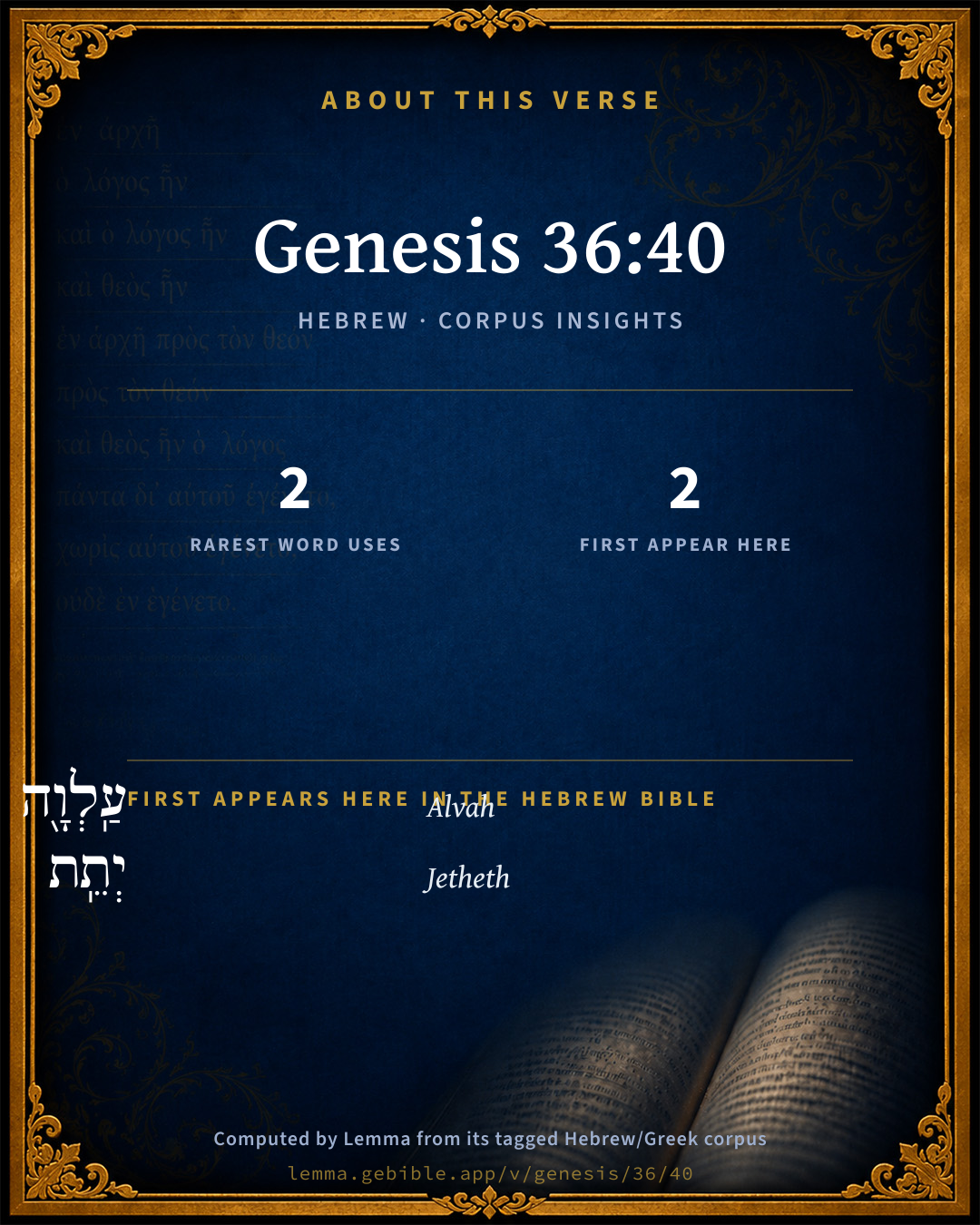
  • 2 first appearances in the Hebrew Bible
Full analysis ↓
Download a study sheet

One document with this verse’s original text, its word-by-word gloss line, the meaning frame, cross-references with their text, attributed commentary, and full source and license credits — printable, and it pastes into notes with its structure intact.

This verse Autodidact and up

Study sheet (.html) Plain text (.txt)

A passage Seminary Student

Up to 50 verses in one chapter. A passage sheet keeps up to 6 commentary sources and 12 cross-references per verse, in the order this page ranks them, and says so on the sheet whenever that leaves anything out. Ask for a single verse and you get the Autodidact verse sheet above.

Everything on this page stays free to read, with no account — the sheet is a download of what is already on screen, not access to it.

Want to remove ads? Support Godless Engineer
Compare translations 3

The same verse in 3 English versions, stacked beneath the original-language interlinear above. Click any original word for its lexicon entry.

Each is an independent rendering of the whole verse — the interlinear is not word-aligned to these translations.

Highlighted words mark where these versions differ — a whole-verse word diff, not a word-by-word alignment.

  • World English Bible Public Domain
    These are the names of the chiefs who came from Esau, according to their families, after their places, and by their names: chief Timna, chief Alvah, chief Jetheth,
  • King James Version Public Domain
    And these are the names of the dukes that came of Esau, according to their families, after their places, by their names; duke Timnah, duke Alvah, duke Jetheth,
  • unfoldingWord Literal Text CC BY-SA 4.0
    And these the names of the chiefs of Esau, according to their clans, according to their places, by their names: Chief Timna, Chief Alvah, Chief Jetheth,

unfoldingWord Literal Text — © unfoldingWord, licensed CC BY-SA 4.0. Word-aligned USFM3 via Door43 (git.door43.org/unfoldingWord/en_ult).

Versions to compare (up to 4)

3 of 4 selected

Show all 18 translations

Every available English version of this verse, each an independent rendering of the whole verse.

  • World English Bible Public Domain
    These are the names of the chiefs who came from Esau, according to their families, after their places, and by their names: chief Timna, chief Alvah, chief Jetheth,
  • Berean Standard Bible Public Domain
    These are the names of Esau’s chiefs, according to their families and regions, by their names: Chiefs Timna, Alvah, Jetheth,
  • Majority Standard Bible Public Domain
    These are the names of Esau’s chiefs, according to their families and regions, by their names: Chiefs Timna, Alvah, Jetheth,
  • King James Version Public Domain
    And these are the names of the dukes that came of Esau, according to their families, after their places, by their names; duke Timnah, duke Alvah, duke Jetheth,
  • American Standard Version (1901) Public Domain
    And these are the names of the chiefs that came of Esau, according to their families, after their places, by their names: chief Timna, chief Alvah, chief Jetheth,
  • Revised Version (1885) Public Domain
    And these are the names of the dukes that came of Esau, according to their families, after their places, by their names; duke Timna, duke Alvah, duke Jetheth;
  • Geneva Bible (1599) Public Domain
    Then these are the names of the Dukes of Esau according to their families, their places and by their names: Duke Timna, Duke Aluah, Duke Ietheth,
  • Douay-Rheims (1899) Public Domain
    And these are the names of the dukes of Esau in their kindreds, and places, and callings: duke Thamna, duke Alva, duke Jetheth,
  • Young's Literal Translation Public Domain
    And these `are' the names of the chiefs of Esau, according to their families, according to their places, by their names: chief Timnah, chief Alvah, chief Jetheth,
  • Literal Standard Version CC BY-SA 4.0
    And these [are] the names of the chiefs of Esau, according to their families, according to their places, by their names: Chief Timnah, Chief Alvah, Chief Jetheth,
  • Unlocked Literal Bible CC BY-SA 4.0
    These were the names of the heads of clans from Esau's descendants, according to their clans and their regions, by their names: Timna, Alvah, Jetheth,
  • unfoldingWord Literal Text CC BY-SA 4.0
    And these the names of the chiefs of Esau, according to their clans, according to their places, by their names: Chief Timna, Chief Alvah, Chief Jetheth,
  • Darby Bible Public Domain
    And these are the names of the chiefs of Esau, according to their families, after their places, with their names: chief Timna, chief Alvah, chief Jetheth,
  • World Messianic Bible Public Domain
    These are the names of the chiefs who came from Esau, according to their families, after their places, and by their names: chief Timna, chief Alvah, chief Jetheth,
  • Webster's Bible Public Domain
    And these are the names of the dukes, descendants of Esau, according to their families, after their places, by their names; duke Timnah, duke Alvah, duke Jetheth,
  • Free Bible Version CC BY-SA 4.0
    These were the names of the tribal leaders descended from Esau, according to their families and where they lived, listed by name: tribal leaders Timna, Alvah, Jetheth,
  • Bible in Basic English Public Domain
    These are the names of the chiefs of Esau in the order of their families and their places: Timna, Alvah, Jetheth,
  • JPS Tanakh (1917) Public Domain
    And these are the names of the chiefs that came of Esau, according to their families, after their places, by their names: the chief of Timna, the chief of Alvah, the chief of Jetheth;

Literal Standard Version (2020), Covenant Press — licensed CC BY-SA 4.0. Text via the HelloAO Bible API (eBible.org). Unlocked Literal Bible (unfoldingWord) — licensed CC BY-SA 4.0. Text via the HelloAO Bible API (eBible.org). unfoldingWord Literal Text — © unfoldingWord, licensed CC BY-SA 4.0. Word-aligned USFM3 via Door43 (git.door43.org/unfoldingWord/en_ult). Free Bible Version, Dr. Jonathan Gallagher — licensed CC BY-SA 4.0. Text via the HelloAO Bible API (eBible.org).

Word by word

More ways to search: Search by grammar → Find every occurrence → Compare this word →

Practice this passage: Drill this verse → Learn its vocabulary →

יְתֵֽת
Yᵉthêth
H3509
“Jetheth”
Noun, Proper
Part of Speech
Noun
Type
Proper
Full BDB Definition

Origin: of uncertain derivation

TWOT: None

Jetheth = "a nail" - one of the dukes of Edom who came of Esau
  1. וְ֠אֵלֶּה ʼêl-leh H428 “and · these” Conjunction + Pronoun, Demonstrative, Common, Plural
  2. שְׁמ֞וֹת shêm H8034 “names of” Noun, Common, Masculine, Plural, Construct
  3. אַלּוּפֵ֤י ʼallûwph H441 “intimates of” Noun, Common, Masculine, Plural, Construct
  4. עֵשָׂו֙ ʻÊsâv H6215 “Esau” Noun, Proper
  5. לְמִשְׁפְּחֹתָ֔ם mishpâchâh H4940 “to/for · families · their” Preposition + Noun, Common, Feminine, Plural, Construct + Suffix, Personal, 3rd Person, Masculine, Plural
  6. לִמְקֹמֹתָ֖ם mâqôwm H4725 “to/for · places · their” Preposition + Noun, Common, Masculine, Plural, Construct + Suffix, Personal, 3rd Person, Masculine, Plural
  7. בִּשְׁמֹתָ֑ם shêm H8034 “in/at · names · their” Preposition + Noun, Common, Masculine, Plural, Construct + Suffix, Personal, 3rd Person, Masculine, Plural
  8. אַלּ֥וּף ʼallûwph H441 “intimate” Noun, Common, Masculine, Singular, Absolute
  9. תִּמְנָ֛ע Timnâʻ H8555 “Timna” Noun, Proper
  10. אַלּ֥וּף ʼallûwph H441 “intimate” Noun, Common, Masculine, Singular, Absolute
  11. עַֽלְוָ֖ה ʻAlvâh H5933 “Alvah” Noun, Proper
  12. אַלּ֥וּף ʼallûwph H441 “intimate” Noun, Common, Masculine, Singular, Absolute

About this verse

These counts appear in no published source. They are computed here, from the morphology-tagged text and Lemma’s own curated glosses. What Lemma adds →

13
words
9
distinct lemmas
Pentateuch
section

Notable vocabulary

The rarest word here is יְתֵֽת Jetheth H3509 — appearing just 2 times in the whole Hebrew Bible.

First appearance in Scripture

These words make their first canonical appearance in the Hebrew Bible here:

  • עַֽלְוָ֖ה Alvah H5933
  • יְתֵֽת Jetheth H3509

Shared distinctive vocabulary

יְתֵֽת Jetheth H3509 occurs in 2 verses of the Hebrew Bible. Also found in:

Grammatical profile

  • 12 nouns
  • 1 pronoun

Repetition

Words recur within this verse — often emphatic in Hebrew:

  • אַלּוּפֵ֤י intimate H441 ×4
  • שְׁמ֞וֹת name H8034 ×2

Hebrew & Septuagint length

In English translation the verse runs 28 words from the Hebrew and 29 from the Septuagint (LXX English) — closely comparable.

A rough comparison of the two English renderings, which tokenize alike — not a word-level alignment.

Word counts can differ between the Hebrew and the Greek without any difference in meaning — e.g. the Hebrew direct-object marker אֵת has no separate Greek word, and Greek often adds the article ὁ.

Cross-references

4

Topical passages linked to Genesis 36:40 in the Treasury of Scripture Knowledge — connected by theme and wording, ordered by reader-vote popularity; previews shown in the World English Bible.

  • 1 Chronicles 1:51–54 Hadad died. The chiefs of Edom were: chief Timna, chief Aliah, chief Jetheth,
  • Exodus 15:15 Then the chiefs of Edom were dismayed. Trembling takes hold of the mighty men of Moab. All the inhabitants of Canaan are melted away.
  • Genesis 36:15–16 These are the chiefs of the sons of Esau: the sons of Eliphaz the firstborn of Esau: chief Teman, chief Omar, chief Zepho, chief Kenaz,
  • Genesis 36:31 These are the kings who reigned in the land of Edom, before any king reigned over the children of Israel.

Cross-references courtesy of OpenBible.info (CC BY 4.0).

Hebrew and Greek witnesses Masoretic Hebrew ↔ Greek Septuagint

The same verse in the two great witnesses to the Old Testament, shown verse-for-verse.

These are two independent witnesses, not word-aligned to each other, and the Septuagint is shown in lemma (dictionary) form.

Hebrew Genesis 36:40 Masoretic · Westminster Leningrad Codex

וְ֠אֵלֶּה שְׁמ֞וֹת אַלּוּפֵ֤י עֵשָׂו֙ לְמִשְׁפְּחֹתָ֔ם לִמְקֹמֹתָ֖ם בִּשְׁמֹתָ֑ם אַלּ֥וּף תִּמְנָ֛ע אַלּ֥וּף עַֽלְוָ֖ה אַלּ֥וּף יְתֵֽת

These are the names of the chiefs who came from Esau, according to their families, after their places, and by their names: chief Timna, chief Alvah, chief Jetheth,

World English Bible · Public Domain

Greek LXX Genesis 36:40 Septuagint · lemma form

οὗτος ὁ ὄνομα ὁ ἡγεμών ησαυ ἐν ὁ φυλή αὐτός κατά τόπος αὐτός ἐν ὁ χώρα αὐτός καί ἐν ὁ ἔθνος αὐτός ἡγεμών θαμνα ἡγεμών γωλα ἡγεμών ιεθερ

These are the names of the chiefs of Esau, in their tribes, according to their place, in their countries, and in their nations; chief Thamna, chief Gola, chief Jether,

LXX2012 (modern English Septuagint) · Public Domain

On this verse, Haydock's Catholic Bible Commentary discusses the Septuagint’s reading. Read the note in Commentary ↓

Hebrew: Westminster Leningrad Codex (CC BY 4.0). Greek: Septuagint (public domain); English from LXX2012 (modern English Septuagint) (Public Domain). How the Septuagint differs from the Hebrew →

Targum (Aramaic paraphrase)

2

The Targum is the ancient Jewish Aramaic paraphrase of the Hebrew Scriptures — an interpretive translation, not the Hebrew text itself. Onkelos (literal) and Pseudo-Jonathan (expansive) render the Torah, and Jonathan the Prophets. Coverage is partial: where no permissively-licensed English translation exists for a verse, only the Aramaic is shown. This is verse-level text, not a word-by-word alignment to the Hebrew.

  1. Targum Onkelos Torah (Genesis–Deuteronomy)
    וְאִלֵּין שְׁמָהַת רַבְרְבֵי עֵשָׂו לְזַרְעֲיָתְהוֹן לְאַתְרֵיהוֹן בִּשְׁמָהַתְהוֹן רַבָּא תִמְנָע רַבָּא עַלְוָה רַבָּא יְתֵת

    (no public-domain English translation for this verse)

    Targum Onkelos — Aramaic: “Onkelos Genesis” (public domain); “Onkelos Exodus” (public domain); “Onkelos Leviticus” (public domain); “Onkelos Numbers” (public domain); “Onkelos Deuteronomy” (public domain). English: “Sefaria Community Translation” (CC0 1.0 (public-domain dedication)); “J.W. Etheridge. The Targums of Onkelos and Jonathan Ben Uzziel on the Pentateuch. London: Longmans, Green, 1862” (public domain). Text via Sefaria.

  2. Targum Pseudo-Jonathan Torah (Genesis–Deuteronomy)
    וְאִלֵין שְׁמָהַת רַבְרְבֵי עֵשָו לְיִחוּסֵיהוֹן לְאָתַר מְדוֹרֵיהוֹן בִּשְׁמָהַתְהוֹן רַבָּא תִמְנָע רַבָּא עַלְוָה רַבָּא יְתֵת

    And these are the names of the chieftains of Esau after their kindreds, after the place of their habitation,with their names Rabba Timna, Rabba Alva, Rabba Jetheth,

    Targum Pseudo-Jonathan — Aramaic: “Targum Jonathan on Genesis” (public domain); “Targum Jonathan on Exodus” (public domain); “Targum Jonathan on Leviticus” (public domain); “Targum Jonathan on Numbers” (public domain); “Targum Jonathan on Deuteronomy” (public domain). English: “The Targum of Jonathan ben Uzziel, trans. J. W. Etheridge, London, 1862” (public domain). Text via Sefaria.

Commentary

Notes on Genesis 36:40 from classic Christian and Jewish commentators (each source and its license shown beneath its notes). The classic Christian expositions comment on the surrounding passage and are grouped to its opening verse, so a note may address several verses; the Jewish commentaries on the Tanakh (Rashi and others) are per-verse, so they appear only where the commentator wrote on this verse.

Lemma curates 59 commentaries, every one of them public domain or Creative Commons licensed, each selected and text-cleaned for this edition rather than reprinted as found. About our sources →

Ellicott's Commentary for English Readers

(40) According to their families, after their places.—The final list of the dukes is said, both here and in Gen_36:43, to be territorial, by which is meant, not that the persons mentioned were not real men, but that Edom finally settled down into eleven “thousands” named after these chieftains. So in Canaan the names of the sons of Jacob became those also of territorial divisions, two of which, however, were given to Joseph and his sons, while no district was called after Levi. What is remarkable here is the vast amount of change. No Horite duke gives his name to any of these divisions of the land of Edom. Omitting Korah from Gen_36:16, there were originally thirteen of these tribal princes, each with his own territory, but with no central government; just as the children of Israel dwelt for centuries in Canaan, each tribe independently in its own district, and with nothing to bind them together except their religion. In Gen_36:40-43 we find eleven tribes, of which only two, those of Teman and Kenaz, retain the names of the sons of Esau, while of the rest we know nothing. We may, however, safely conclude that these nine persons, who gave their names to districts of Edom, were all men who rose to power during the troubled times when king after king seized the crown only to be displaced by some one else. Probably many such men arose, but these were all who consolidated their power sufficiently to leave their names behind them. Amidst this anarchy, the two districts of Teman and Kenaz alone remained unbroken, and continued to be ruled by princes of the same family. This word “family” has in Hebrew a meaning different from that which it has with us; for it signifies one of the larger divisions of a tribe, of which the subdivisions are called “fathers’ houses,” which again are subdivided into households (Num_1:2, &c.). In Gen_36:43 “habitations” would be better rendered settlements.

A Bible Commentary for English Readers, edited by Charles John Ellicott (1878–1897) — public domain. Text from a community e-Sword module.

Trapp's Complete Commentary

John Trapp

Gen 36:40 And these [are] the names of the dukes [that came] of Esau, according to their families, after their places, by their names; duke Timnah, duke Alvah, duke Jetheth,

Ver. 40. Duke Timnah, duke Alvah.] We had a Duke d’Alva lately in the Netherlands, governor there for the Spaniard, infamous for his inhumanity. For he roasted some to death, starved others, and that even after quarter; saying, though he promised to give them their lives, he did not promise to find them meat. {a} This was a right Romish Edomite. The Hebrews think the Romans came of the Idumeans. Sure I am, if they be not of the natural descent, they are of the spiritual, or unnatural; and so like, as by the one we may see the face, favour, and affection of the other.

{a} Grimston, Hist. of Netherlands.

John Trapp, A Commentary or Exposition upon All the Books of the Old and New Testament (1647–1656) — public domain. Text from a community e-Sword module.

Whedon's Commentary on the Bible

Daniel D. Whedon

DUKES OF ESAU AFTER THEIR PLACES, Gen_36:40-43.

Some suppose that the eleven dukes here named were contemporary with Hadar, the last named king; but 1Ch_1:51-54, which mentions the dearth of Hadar, (called Hadad there,) implies that they survived him. But the expressions, according to their families, after their places, by their names (Gen_36:40) and according to their habitations in the land of their possession, (Gen_36:43,) denote rather the ducal cities, or districts. We should accordingly translate, duke of Timnah, duke of Alvah, and etc., and understand that Aholibamah, Kenaz, and Teman are here the names of cities, called after their founders; perhaps the persons bearing these names in the previous part of the genealogy.

Daniel D. Whedon (gen. ed.), Commentary on the Old and New Testaments (1874–1909) — public domain. Text from a community e-Sword module.

Tyndale Open Study Notes

Tyndale Open Resources

36:40-43 These chiefs descended from Esau, who was a great and powerful overlord. As father of the Edomites, he ruled over clans and regions, with eleven chiefs descended from him. By separating from Jacob, Esau was beginning to shake Jacob’s yoke from his neck (27:39-40).

Tyndale Open Study Notes — © Tyndale Open Resources, licensed CC BY-SA 4.0. Text via the HelloAO Bible API.

Jamieson, Fausset & Brown

Robert Jamieson, A. R. Fausset & David Brown

Recapitulation of the dukes according to their residences.

Next: Genesis Chapter 37

Jamieson, Fausset & Brown — Commentary Critical and Explanatory on the Whole Bible (1871) — public domain (CC PDM 1.0). Text via the HelloAO Bible API.

Adam Clarke's Commentary

Verse 40. These are the names of the dukes that came of Esau] These dukes did not govern the whole nation of the Idumeans, but they were chiefs in their respective families, in their places - the districts they governed, and to which they gave their names. Calmet thinks that those mentioned above were dukes in Edom or Idumea at the time of the exodus of Israel from Egypt.

Adam Clarke's Commentary on the Bible (1810–1826) — public domain. Text from a community e-Sword/MySword module.

The Cambridge Bible for Schools and Colleges

gen. ed. J. J. S. Perowne

40–43. Edomite Chiefs

40. families … places … names] This short supplementary list of chiefs consists of names partly tribal, partly local, and partly personal.

duke Timna] i.e. the chieftain of Timna; cf. note on Gen_36:15.

Alvah] In 1Ch_1:51, Aliah. In Gen_36:23, Alvan.

The Cambridge Bible for Schools and Colleges (gen. ed. J. J. S. Perowne; Cambridge University Press, 1878–1918) — public domain. Text from a community e-Sword module.

Haydock's Catholic Bible Commentary

Callings. They left their names to various places. They were in power when the Hebrews approached their respective territories, and threw them into dismay, Exodus xv. 15. --- Alva. Septuagint, gola. (Calmet)

George Leo Haydock (1774–1849), Haydock's Catholic Family Bible and Commentary, 1859 edition — public domain. Excludes Psalms (Douay-Rheims chapter numbering differs from Protestant) and Deuterocanonical books (Catholic canon only).

Matthew Poole's English Annotations

1496

The names of the dukes, of their persons, and generations, and families. The state of Edom between the times of Esau and Moses seems to have been this; there were first dukes, then kings, and after them dukes again. But if it be objected, that the time was too short for a succession of so many persons, it may be replied, that what is confessed concerning the dukes preceding the kings, might be true also of these succeeding dukes, and that the Edomites either having taken some distaste at kingly government, or differing about the choice of a new king, divided themselves again into several petty principalities or dukedoms; and so several of those were dukes at the same time in divers parts.

Matthew Poole's English Annotations on the Holy Bible (1683–1685) — public domain. Text from a community e-Sword/MySword module.

The Pulpit Commentary

Vers. 40-43. And these are the names of the dukes that came of Esau, according to their families, after their places, by their names. It is now generally agreed that this and the ensuing verses contain not a second list of dukes who rose to power on the overthrow of the preceding monarchical institutions (Bertheau, Ainsworth, Patrick), or a continuation of the preceding list of dukes, which had simply been interrupted by a parenthesis about the kings (Bush); but either an enumeration of the hereditary phylarchs who were contemporaneous with Hadar, and in all probability formed, his council (Murphy), or a territorial catalogue of the districts in which the original alluphim who sprang from Esau (vers. 15-19) exercised their sovereignty (Keil, Kalisch, Lange, "Speaker"s Commentary"). Duke Timnah, according to the explanation just given this should perhaps be read duke of Timnah = Amalek, whose mother was Timna (Lange), but this is conjecturalduke Alvah, or of Alvah, or Allah, closely allied to Alvan (ver. 23)duke (of) Jetheth, (Gesenius), "Subjugation" (Furst)duke (of) Aholiba-mah, vide ver. 2; perhaps Esau"s wife as well as Eliphaz"s concubine gave her name to the district over which her son ruledduke Elah, (Furst), "Tere-binth" (Murphy)duke Pinon, probably equal to Pimon, dark (Gesenius)duke Kenaz (vide ver. 11), duke Teman (ver. 15), duke Mibzar, "Strong City" (Gesenius)duke Magdiel, of God" (Gesenius)duke Iram: (Gesenius)these be the dukes of Edom, according to their habitations (i.e. their capitals, or districts) in the land of their possessions. The word seems to indicate an independent sovereignty within their respective provinces or principalities. He is Esau the father of the Edomites. The clause is equivalent to saying, This Esau (already referred to) was the ancestor of these Edomites.

The Pulpit Commentary (1880–1919), ed. H.D.M. Spence-Jones & Joseph S. Exell — public domain. Text from a community e-Sword module.

Keil & Delitzsch

C. F. Keil & F. Delitzsch

(Parallel, Ch1 1:51-54). Seats of the Tribe-Princes of Esau According to Their Families. - That the names which follow are not a second list of Edomitish tribe-princes (viz., of those who continued the ancient constitution, with its hereditary aristocracy, after Hadar's death), but merely relate to the capital cities of the old phylarchs, is evident from the expression in the heading, "After their places, by their names," as compared with Gen 36:43, "According to their habitations in the land of their possession." This being the substance and intention of the list, there is nothing surprising in the fact, that out of the eleven names only two correspond to those given in Gen 36:15-19. This proves nothing more than that only two of the capitals received their names from the princes who captured or founded them, viz., Timnah and Kenaz. Neither of these has been discovered yet. The name Aholibamah is derived from the Horite princess (Gen 36:25); its site is unknown. Elah is the port Aila (vid., Gen 14:6). Pinon is the same as Phunon, an encampment of the Israelites (Num 33:42-43), celebrated for its mines, in which many Christians were condemned to labour under Diocletian, between Petra and Zoar, to the northeast of Wady Musa. Teman is the capital of the land of the Temanites (Gen 36:34). Mibzar is supposed by Knobel to be Petra; but this is called Selah elsewhere (Kg2 14:7). Magdiel and Iram cannot be identified. The concluding sentence, "This is Esau, the father (founder) of Edom" (i.e., from his sprang the great nation of the Edomites, with its princes and kings, upon the mountains of Seir), not only terminates this section, but prepared the way for the history of Jacob, which commences with the following chapter.

Keil & Delitzsch — Biblical Commentary on the Old Testament (1861–1891) — public domain (CC PDM 1.0). Text via the HelloAO Bible API. (Old Testament only.)

unfoldingWord translationNotes

Door43 World Missions Community

the heads of clans

"the leaders of the clans"

according to their clans and their regions, by their names

The clans and the regions were named after the heads of the clans. AT: "the names of their clans and the regions where they lived were named after them. These are their names" (See: Assumed Knowledge and Implicit Information)

Timna, Alvah, Jetheth, Oholibamah, Elah, Pinon, Kenaz, Teman, Mibzar, Magdiel, and Iram

These are names of people groups. (See: How to Translate Names)

their settlements

"their dwelling places" or "the places they lived"

This was Esau

This list is said "to be" Esau, which means that it is the whole list of his descendants. AT: "This is the list of the descendants of Esau" (See: Metonymy)

translationWords

clan

Esau

Edom

ancestor

unfoldingWord translationNotes — © Distant Shores Media and the Door43 World Missions Community, licensed CC BY-SA 4.0. Source: git.door43.org/Door43/en_tn.

Rashi

Rabbi Shlomo Yitzchaki (Rashi)

ואלה שמות אלופי עשו AND THESE ARE THE NAMES OF THE CHIEFS OF ESAU — [… AFTER THEIR PLACES ACCORDING TO THEIR NAMES] they were called by the names of their districts after Hadad died and the royal dignity had ceased so far as they were concerned. The former names mentioned above (v. 15ff.), are the names given them at their birth. This, too, (the first statement made here) is expressly set forth in Chronicles (2:51) “And Hadad (Hadar) died, and the chiefs of Edom were: the chief of Timna etc.” (We must therefore translate here: “the chieftain of Timna etc.”)

Rashi on the Tanakh — English translations: “The Judaica Press complete Tanach with Rashi, translated by A. J. Rosenberg” (CC BY 4.0); “Pentateuch with Rashi's commentary by M. Rosenbaum and A.M. Silbermann, 1929-1934” (public domain); “The Metsudah Tanach series, Lakewood, N.J” (CC BY 4.0); and “The Book of Joshua, Metsudah Publications, 1997” (CC BY 4.0). Text via Sefaria.

Ramban (Nachmanides)

Rabbi Moshe ben Nachman (Ramban / Nachmanides)

AND THESE ARE THE NAMES OF THE CHIEFS THAT CAME TO ESAU. At first Scripture enumerated Esau’s grandsons who were chieftains in that generation, and afterwards some of his descendants succeeded in attaining sovereignty. After that their kingdom ceased, and the Edomites once again appointed these chieftains as their head. And so it is said in the book of Chronicles: And Hadad died. And the chiefs of Edom were: the chief of Timna. So did Rashi explain it here in his commentary on this verse.And that which Scripture says here, according to their families, after their places, by their names, [and in Verse 43], after their habitations in the land of their possessions means that among the previous chiefs, [mentioned above in Verses 15-19], all the brothers who were the chiefs dwelled in one city, ruling one people, or their position was analogous to the princes of the tribes and the heads of families [in Israel]. But these latter ones were chiefs according to their families, meaning that each one was chief of all the families of Esau’s descendants, and in all of their dwelling places, for in that generation he alone was called “chief,” no other person being so called in all the land they possessed. Thus they were as kings in their countries, but they were not enthroned, and the glory of royalty was not bestowed upon them.In the opinion of many commentators (Verse 31) refers to Saul, king of Israel. Moses who wrote the Torah could therefore know it only by prophecy. this section was written as a prophecy. But this is not correct. Why should prophecy mention these kings, and until what point in time was Scripture to enumerate them and stop? Rather the correct interpretation is that all these ruled before the Torah was given in the days of Moses. Now we may say that they all ruled in one time, and then the explanation of after their places would be that each one ruled in his place, or else their rule lasted but a short time, as Scripture says, But the years of the wicked shall be shortened.

Ramban (Nachmanides) on the Tanakh — English translation: “Commentary on the Torah by Ramban (Nachmanides). Translated and annotated by Charles B. Chavel. New York, Shilo Pub. House, 1971-1976” (CC BY 4.0). Text via Sefaria.

Radak

Rabbi David Kimhi (Radak)

ואלה, now the Torah mentions eight Alufim who were in positions of leadership after the kingdom of Edom had ceased to exist as such. There were eleven such Alufim.

Radak on the Tanakh — English translations: “Sefaria Community Translation” (CC0 1.0 (public-domain dedication)); “Eliyahu Munk, HaChut Hameshulash” (CC BY 4.0); “Rabbi Mike Feuer, Jerusalem Anthology” (CC BY 4.0); and “R. David Kimhi on the first book of Psalms, Translated by R.G. Finch, London, 1919” (public domain). Text via Sefaria.

Lesson kit

Teaching starters — assembled from the data on this page, not authored interpretation. Every prompt links to the verse data it draws on. Edit before teaching.

Genesis, in the Pentateuch, opens this verse with 13 words (9 distinct Hebrew lemmas). Its most distinctive word is Yᵉthêth (“Jetheth”). A historical commentator’s framing appears above. Read the whole chapter for the surrounding context.

Discussion questions

  1. How does “Jetheth” (Yᵉthêth) shape what this verse is saying?
  2. 2 words make their first appearance in Scripture here. What does this debut establish?
  3. How does 1 Chronicles 1:51, which shares the word «Jetheth», read alongside this verse?
  4. What does the repetition of “intimate” (4× in this one verse) do in this verse?
  5. These translations render this verse differently. What is at stake in choosing one wording over another?
  6. Compare how Ellicott's Commentary for English Readers and Trapp's Complete Commentary read this verse. Where do they agree or differ?

Things to notice

  • 2 words make their first canonical appearance in Scripture here.
  • These translations choose different wording for 11 words in this verse.
  • “intimate” occurs 4× in this single verse.
  • 9 distinct Hebrew lemmas span 13 words in this verse.

Reading settings

Reading text

Shown beneath each verse's original-language words.

Old Testament
Old Testament edition

Read the OT as the Masoretic Hebrew (MT) or the Greek Septuagint (LXX).

English shown for the Greek Septuagint (in the Hebrew ↔ Greek comparison).

Comparing translations? Open the Compare panel on any verse page to stack up to four side by side.