
Romans 15:9

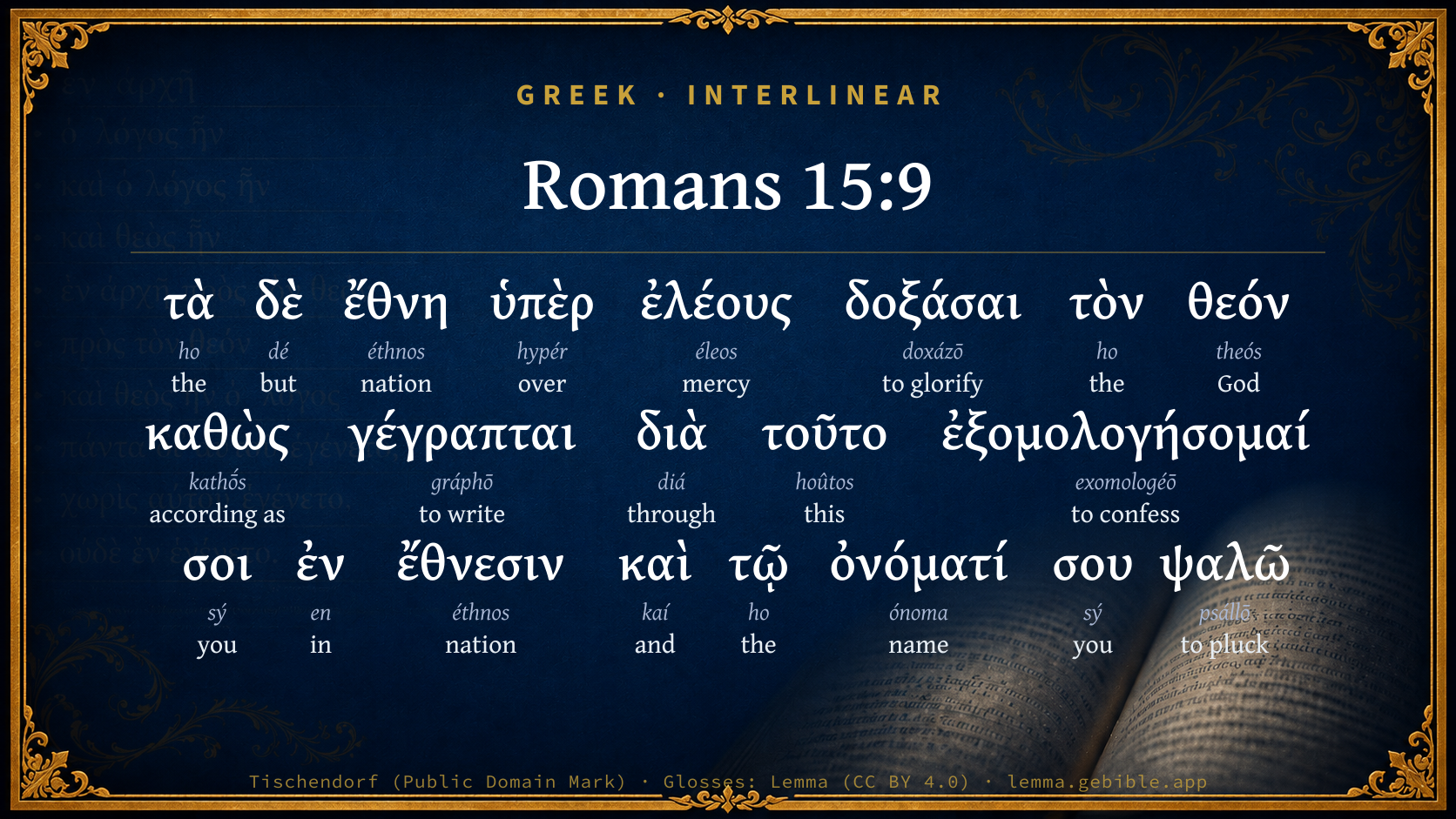
Greek (Tischendorf 8th ed.) Romans 15:9 appears in the Greek New Testament. The text above is from the Tischendorf 8th edition. Each word links to its Strong’s number and a concise gloss. Click any word for its full Thayer’s Greek Lexicon entry.
Download image
Cite this verse

Romans 15:9 (World English Bible). Public Domain. Lemma interlinear Bible study tool, https://lemma.gebible.app/v/romans/15/9.

Show BibTeX & RIS
BibTeX
RIS
English Translation
and that the Gentiles might glorify God for his mercy. As it is written, "Therefore will I give praise to you among the Gentiles, And sing to your name."
World English Bible · Public Domain
Highlights
  • 1 first appearance in the Greek New Testament
Full analysis ↓
Download a study sheet

One document with this verse’s original text, its word-by-word gloss line, the meaning frame, cross-references with their text, attributed commentary, and full source and license credits — printable, and it pastes into notes with its structure intact.

This verse Autodidact and up

Study sheet (.html) Plain text (.txt)

A passage Seminary Student

Up to 50 verses in one chapter. A passage sheet keeps up to 6 commentary sources and 12 cross-references per verse, in the order this page ranks them, and says so on the sheet whenever that leaves anything out. Ask for a single verse and you get the Autodidact verse sheet above.

Everything on this page stays free to read, with no account — the sheet is a download of what is already on screen, not access to it.

Want to remove ads? Support Godless Engineer
Compare translations 3

The same verse in 3 English versions, stacked beneath the original-language interlinear above. Click any original word for its lexicon entry.

Each is an independent rendering of the whole verse — the interlinear is not word-aligned to these translations.

Highlighted words mark where these versions differ — a whole-verse word diff, not a word-by-word alignment.

  • World English Bible Public Domain
    and that the Gentiles might glorify God for his mercy. As it is written, "Therefore will I give praise to you among the Gentiles, And sing to your name."
  • King James Version Public Domain
    And that the Gentiles might glorify God for his mercy; as it is written, For this cause I will confess to thee among the Gentiles, and sing unto thy name.
  • unfoldingWord Literal Text CC BY-SA 4.0
    and also for the Gentiles to glorify God because of his mercy, just as it is written, “For this, I will confess you among the Gentiles and sing psalms to your name.” ts\*

unfoldingWord Literal Text — © unfoldingWord, licensed CC BY-SA 4.0. Word-aligned USFM3 via Door43 (git.door43.org/unfoldingWord/en_ult).

Versions to compare (up to 4)

3 of 4 selected

Show all 19 translations

Every available English version of this verse, each an independent rendering of the whole verse.

  • World English Bible Public Domain
    and that the Gentiles might glorify God for his mercy. As it is written, "Therefore will I give praise to you among the Gentiles, And sing to your name."
  • Berean Standard Bible Public Domain
    so that the Gentiles may glorify God for His mercy. As it is written: “Therefore I will praise You among the Gentiles; I will sing hymns to Your name.”
  • Majority Standard Bible Public Domain
    so that the Gentiles may glorify God for His mercy. As it is written: “Therefore I will praise You among the Gentiles; I will sing hymns to Your name.”
  • King James Version Public Domain
    And that the Gentiles might glorify God for his mercy; as it is written, For this cause I will confess to thee among the Gentiles, and sing unto thy name.
  • American Standard Version (1901) Public Domain
    and that the Gentiles might glorify God for his mercy; as it is written, Therefore will I give praise unto thee among the Gentiles, And sing unto thy name.
  • Revised Version (1885) Public Domain
    and that the Gentiles might glorify God for his mercy; as it is written, Therefore will I give praise unto thee among the Gentiles, And sing unto thy name.
  • Geneva Bible (1599) Public Domain
    And let the Gentiles prayse God, for his mercie, as it is written, For this cause I wil confesse thee among the Gentiles, and sing vnto thy Name.
  • Douay-Rheims (1899) Public Domain
    But that the Gentiles are to glorify God for his mercy, as it is written: Therefore will I confess to thee, O Lord, among the Gentiles, and will sing to thy name.
  • Young's Literal Translation Public Domain
    and the nations for kindness to glorify God, according as it hath been written, `Because of this I will confess to Thee among nations, and to Thy name I will sing praise,'
  • Literal Standard Version CC BY-SA 4.0
    and the nations for kindness to glorify God, according as it has been written: “Because of this I will confess to You among nations, and to Your Name I will sing praise”;
  • Unlocked Literal Bible CC BY-SA 4.0
    and for the Gentiles to glorify God for his mercy. As it is written, “Therefore I will give praise to you among the Gentiles and sing praise to your name.”
  • unfoldingWord Literal Text CC BY-SA 4.0
    and also for the Gentiles to glorify God because of his mercy, just as it is written, “For this, I will confess you among the Gentiles and sing psalms to your name.” ts\*
  • Darby Bible Public Domain
    and that the nations should glorify God for mercy; according as it is written, For this cause I will confess to thee among [the] nations, and will sing to thy name.
  • World Messianic Bible Public Domain
    and that the Gentiles might glorify God for his mercy. As it is written, “Therefore I will give praise to you among the Gentiles and sing to your name.”
  • Webster's Bible Public Domain
    And that the Gentiles might glorify God for his mercy; as it is written, For this cause I will confess to thee among the Gentiles, and sing to thy name.
  • Free Bible Version CC BY-SA 4.0
    He also came that foreigners could praise God for his mercy, as Scripture says, “Therefore I will praise you among the foreigners; I will sing praises to your name.”
  • Bible in Basic English Public Domain
    And so that the Gentiles might give glory to God for his mercy; as it is said, For this reason I will give praise to you among the Gentiles, and I will make a song to your name.
  • Text-Critical English NT CC BY 4.0
    so that the Gentiles might glorify God for his mercy. As it is written, “Therefore I will confess yoʋ among the Gentiles; I will sing praise to yoʋr name.”
  • Tyndale New Testament (1534) Public Domain
    And let the gentyls prayse god for his mercy as it is written: For this cause I will prayse the amonge the gentyls and synge in thy name.

Literal Standard Version (2020), Covenant Press — licensed CC BY-SA 4.0. Text via the HelloAO Bible API (eBible.org). Unlocked Literal Bible (unfoldingWord) — licensed CC BY-SA 4.0. Text via the HelloAO Bible API (eBible.org). unfoldingWord Literal Text — © unfoldingWord, licensed CC BY-SA 4.0. Word-aligned USFM3 via Door43 (git.door43.org/unfoldingWord/en_ult). Free Bible Version, Dr. Jonathan Gallagher — licensed CC BY-SA 4.0. Text via the HelloAO Bible API (eBible.org).

Word by word

More ways to search: Search by grammar → Find every occurrence → Compare this word →

Practice this passage: Drill this verse → Learn its vocabulary →

ψαλῶ
psállō
G5567
“to pluck”
Verb, Future, Active, Indicative, 1st person, Singular
Part of Speech
Verb
Tense
Future
Voice
Active
Mood
Indicative
Person
1st person
Number
Singular
Full Thayer's Definition

Origin: probably strengthened from psao (to rub or touch the surface, cf G5597 )

TDNT: 16:09,1

1. to pluck off, pull out 2. to cause to vibrate by touching, to twang a. to touch or strike the chord, to twang the strings of a musical instrument so that they gently vibrate b. to play on a stringed instrument, to play, the harp, etc. c. to sing to the music of the harp d. in the NT to sing a hymn, to celebrate the praises of God in song
  1. τὰ ho G3588 “the” Article, Nominative, Plural, Neuter
  2. δὲ dé G1161 “but” Conjunction
  3. ἔθνη éthnos G1484 “nation” Noun, Nominative, Plural, Neuter
  4. ὑπὲρ hypér G5228 “over” Preposition
  5. ἐλέους éleos G1656 “mercy” Noun, Genitive, Singular, Neuter
  6. δοξάσαι doxázō G1392 “to glorify” Verb, Aorist, Active, Infinitive
  7. τὸν ho G3588 “the” Article, Accusative, Singular, Masculine
  8. θεόν theós G2316 “God” Noun, Accusative, Singular, Masculine
  9. καθὼς kathṓs G2531 “according as” Adverb
  10. γέγραπται gráphō G1125 “to write” Verb, Perfect, Passive, Indicative, 3rd person, Singular
  11. διὰ diá G1223 “through” Preposition
  12. τοῦτο hoûtos G3778 “this” Demonstrative pronoun, Accusative, Singular, Neuter
  13. ἐξομολογήσομαί exomologéō G1843 “to confess” Verb, Future, Middle, Indicative, 1st person, Singular
  14. σοι sý G4771 “you” Personal pronoun, 2nd person, Dative, Singular
  15. ἐν en G1722 “in” Preposition
  16. ἔθνεσιν éthnos G1484 “nation” Noun, Dative, Plural, Neuter
  17. καὶ kaí G2532 “and” Conjunction
  18. τῷ ho G3588 “the” Article, Dative, Singular, Neuter
  19. ὀνόματί ónoma G3686 “name” Noun, Dative, Singular, Neuter
  20. σου sý G4771 “you” Personal pronoun, 2nd person, Genitive, Singular

About this verse

These counts appear in no published source. They are computed here, from the morphology-tagged text and Lemma’s own curated glosses. What Lemma adds →

21
words
17
distinct lemmas
Pauline Epistles
section

Notable vocabulary

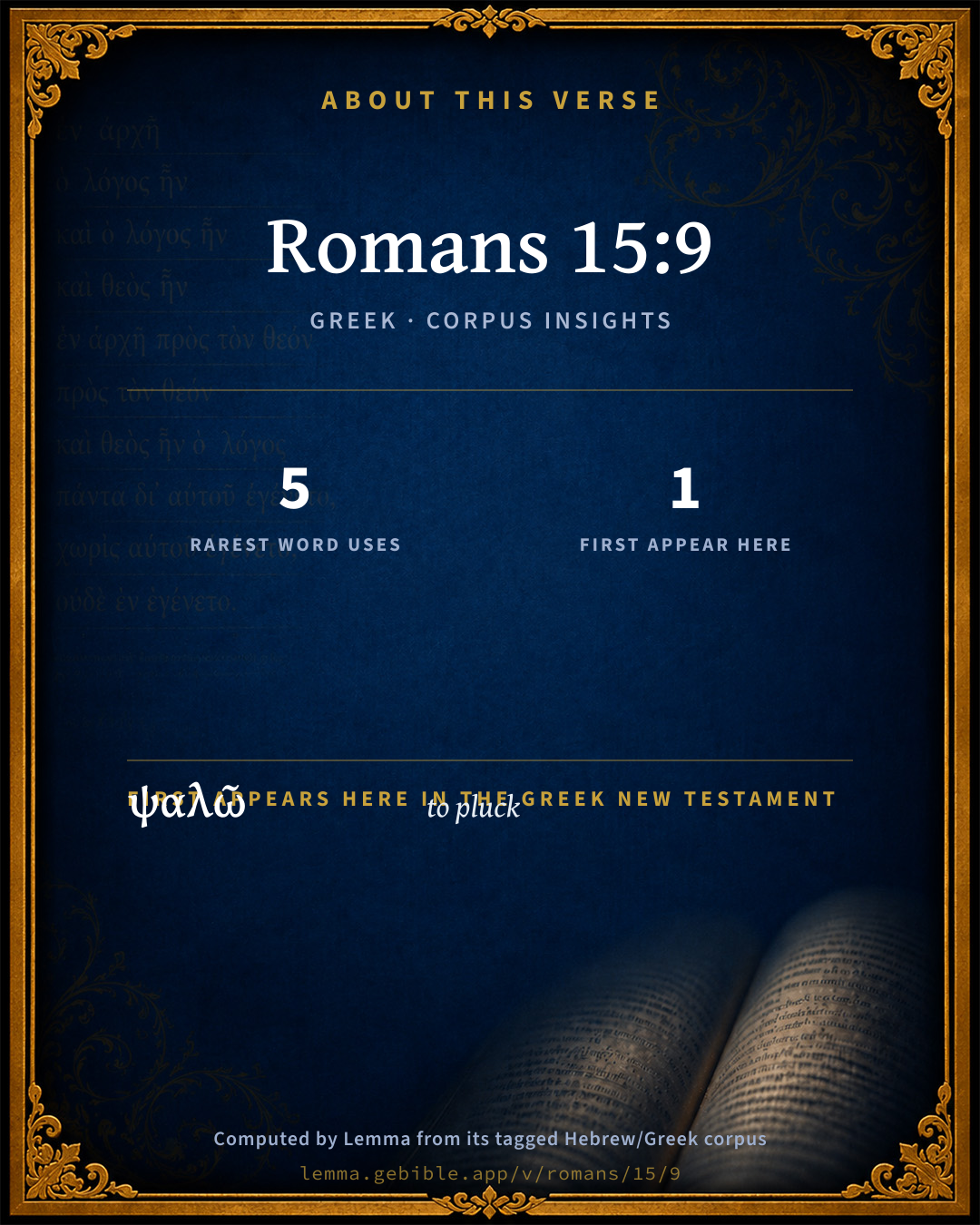
The rarest word here is ψαλῶ to pluck G5567 — appearing just 5 times in the whole Greek New Testament.

First appearance in Scripture

This word makes its first canonical appearance in the Greek New Testament here:

  • ψαλῶ to pluck G5567

Shared distinctive vocabulary

ψαλῶ to pluck G5567 occurs in 4 verses of the Greek New Testament. Also found in:
Repetition

Words recur within this verse:

Cross-references

4

Topical passages linked to Romans 15:9 in the Treasury of Scripture Knowledge — connected by theme and wording, ordered by reader-vote popularity; previews shown in the World English Bible.

  • 2 Samuel 22:50 Therefore I will give thanks to you, Yahweh, among the nations, Will sing praises to your name.
  • Psalms 18:49 Therefore I will give thanks to you, Yahweh, among the nations, And will sing praises to your name.
  • Romans 3:29 Or is God the God of Jews only? Isn't he the God of Gentiles also? Yes, of Gentiles also,
  • Matthew 9:8 But when the multitudes saw it, they marveled and glorified God, who had given such authority to men.

Cross-references courtesy of OpenBible.info (CC BY 4.0).

Commentary

Notes on Romans 15:9 from classic Christian and Jewish commentators (each source and its license shown beneath its notes). The classic Christian expositions comment on the surrounding passage and are grouped to its opening verse, so a note may address several verses; the Jewish commentaries on the Tanakh (Rashi and others) are per-verse, so they appear only where the commentator wrote on this verse.

Lemma curates 59 commentaries, every one of them public domain or Creative Commons licensed, each selected and text-cleaned for this edition rather than reprinted as found. About our sources →

Tyndale Open Study Notes

Tyndale Open Resources

15:9-12 These quotations from the Old Testament all emphasize God’s promise that Gentiles would join with Jews in praising God. Gentiles are now full members of God’s people.

Tyndale Open Study Notes — © Tyndale Open Resources, licensed CC BY-SA 4.0. Text via the HelloAO Bible API.

Bengel's Gnomon

Johann Albrecht Bengel

Rom 15:9. Διὰ—ἔθνεσι—ψαλῶ) Psa 18:50, LXX., διὰ—ἔθνεσι, Κύριε—ψαλῶ.—ἐξομολογήσομαι, I will confess) Paul says that the Gentiles do that, which Christ declares in the Psalm, that He will do; in fact, Christ is doing this among [or rather, in the person of] the Gentiles, Heb 2:12, where Paul quotes Psalms 22, as here Psalms 18 is quoted. In Psalms 22. Christ announces the name of the Lord to His brethren; in Psalms 18. He confesses to the Lord among [or in the person of] the Gentiles, and the Gentiles confess to Him in [the person of] Christ. Afterwards in Psalms 117 the Jews invite all tribes and all nations; לאם signifies a multitude, and עם a political community.—ψαλῶ, I will sing) The Gentiles sing and praise, because they have obtained mercy, Heb. אזמרה, using the organ.

Bengel's Gnomon of the New Testament — English translation (T&T Clark, Edinburgh, 1860) — public domain. Text from a community e-Sword module.

Expositor's Greek Testament

ed. W. Robertson Nicoll

Rom 15:9 . τὰ δὲ ἔθνη ὑπὲρ ἐλέους δοξάσαι τὸν θεόν : Some expositors make this depend directly on λέγω , as if Paul had meant: “I say Christ has become a minister of circumcision, in the interest of the truth of God … and that the Gentiles have glorified God for His mercy ,” the only contrast being that between God’s faithfulness , as shown to the descendants of Abraham, and His mercy as shown to those without the old covenant. But if τὰ δὲ ἔθνη κ . τ . λ . is made to depend on εἰς τὸ , as in the A.V., there is a double contrast brought out: that of faithfulness and mercy being no more emphatic than that of the fathers and the Gentiles . Indeed, from the passages quoted, it is clear that Paul is preoccupied rather with the latter of these two contrasts than with the former; for all the passages concern the place of the Gentiles in the Church. At the same time it is made clear even to the Gentiles that the salvation which they enjoy is “of the Jews”. Hence the Gentiles must not be contemptuous of scruples or infirmities, especially such as rise out of any associations with the old covenant; nor should the Jews be censorious of a Gentile liberty which has its vindication in the free grace of God. καθὼς γέγραπται : the contemplated glorification of God answers to what we find in Psa 18:50 , LXX. Christ is assumed to be the speaker, and we may say that He gives thanks to God among the Gentiles when the Gentiles give thanks to God through Him (Heb 2:12 ).

The Expositor's Greek Testament, edited by W. Robertson Nicoll (1897–1910) — public domain. Text from a community e-Sword module.

Hodge's Commentary on Romans, Ephesians & First Corinthians

Charles Hodge

Rom_15:9

And that the Gentiles might glorify God for his mercy. Might glorify, δοξάσαι, have glorified. The effect is considered as accomplished. The apostles language is, as usual, concise. There are two consequences of the work of Christ which he here presents; the one, that the truth of God has been vindicated by the fulfillment of the promises made to the Jews; and the other, that the Gentiles have been led to praise God for his mercy. The grammatical connection of this sentence with the preceding is not very clear. The most probable explanation is that which makes (δοξάσαι) glorify depend upon (λέγω) I say, in Rom_15:8 : I say that Jesus Christ became a minister to the Jews, and I say the Gentiles have glorified God; it was thus he received both. Calvin supplies δεῖν, and translates, The Gentiles ought to glorify God for his mercy; which is not necessary, and does not so well suit the context. The mercy for which the Gentiles were to praise God, is obviously the great mercy of being received into the kingdom of Christ, and made partakers of all its blessings.

As it is written, I will confess to thee among the Gentiles, and sing unto thy name, Psa_18:49. In this and the following quotations from the Old Testament, the idea is more or less distinctly expressed, that true religion was to be extended to the Gentiles; and they therefore all include the promise of the extension of the Redeemers kingdom to them, as well as to the Jews. In Psa_18:49, David is the speaker. It is he that says: I will praise thee among the Gentiles. He is contemplated as surrounded by Gentiles giving thanks unto God, which implies that they were the worshippers of God. Our version renders ἐξομολογήσομαι, I will confess, make acknowledgment to thee. The word in itself may mean, to acknowledge the truth or sin, or Gods mercies; and therefore it is properly rendered, at times, to give thanks, or to praise, which is an acknowledgment of Gods goodness.

Charles Hodge — Commentary on Romans (1835), First Corinthians (1857), and Ephesians (1856) — public domain. Text from a community e-Sword module.

Geneva Bible (1599)

Geneva Bible translators

I will openly profess, and set forth thy Name.

An applying of the same to the Gentiles, whom also the Lord of his incomprehensible goodness had regard of, so that they are not to be condemned of the Jews as strangers.

Geneva Bible (1599) marginal notes — public domain. Text via Bolls.life.

Jamieson, Fausset & Brown

Robert Jamieson, A. R. Fausset & David Brown

that the Gentiles might glorify God for his mercy--A number of quotations from the Old Testament here follow, to show that God's plan of mercy embraced, from the first, the Gentiles along with the Jews.

as it is written-- (Psa 18:49).

I will confess to--that is, glorify

thee among the Gentiles.

Jamieson, Fausset & Brown — Commentary Critical and Explanatory on the Whole Bible (1871) — public domain (CC PDM 1.0). Text via the HelloAO Bible API.

Adam Clarke's Commentary

Verse 9. And that the Gentiles might glorify God for his mercy] As the Jews were to glorify God for his truth, so the Gentiles were to glorify God for his mercy. The Jews received the blessings of the Gospel by right of promise, which promise God had most punctually and circumstantially fulfilled. The Gentiles had received the same Gospel as an effect of God's mere mercy, having no right in consequence of any promise or engagement made with any of their ancestors, though they were originally included in the covenant made with Abraham; and the prophets had repeatedly declared that they should be made equal partakers of those blessings with the Jews themselves; as the apostle proceeds to prove.

I will confess to thee among the Gentiles] This quotation is taken from Ps 18:49, and shows that the Gentiles had a right to glorify God for his mercy to them; and we shall see the strength of this saying farther, when we consider a maxim of the Jews delivered in Megillah, fol. 14: "From the time that the children of Israel entered into the promised land, no Gentile had any right to sing a hymn of praise to God. But after that the Israelites were led into captivity, then the Gentiles began to have a right to glorify God." Thus the Jews themselves confess that the Gentiles have a right to glorify God; and this on account of being made partakers of his grace and mercy. And if, says Schoettgen, we have a right to glorify God, then it follows that our worship must be pleasing to him; and if it be pleasing to him, then it follows that this worship must be good, otherwise God could not be pleased with it.

Dr. Taylor gives a good paraphrase of this and the three following verses: As you Jews glorify God for his truth, so the Gentiles have a right to join with you in glorifying God for his mercy. And you have Scripture authority for admitting them to such fellowship; for instance, David says, Ps 18:49, Therefore will I give thanks unto thee, O Lord, among the Gentiles, and sing praises unto thy name. And again, Moses himself says, De 32:43, Rejoice, O ye Gentiles, with his people. And again, it is evident, from Ps 117:1, Ps 117:2, that praise to God is not to be confined to the Jews only, but that all people, as they all share in his goodness, should also join in thanks to their common benefactor: O praise the Lord, all ye nations, (Gentiles,) praise him all ye people; for his merciful kindness is great towards us; and the truth of the Lord endureth for ever. Again the Prophet Isaiah expressly and clearly declares, Isa 11:10, There shall be a root of Jesse, (that is, the Messiah,) and he shall rise to reign over the Gentiles, and in him shall the Gentiles hope: ελπιουσιν. And thus the apostle proves, both to the Jews and to the Gentiles, who were probably unwilling to join with each other in religious fellowship, that they had both an equal right to glorify God, being equally interested in his mercy, goodness, and truth; and that, from the evidence of the above scriptures, the Gentiles had as much right to hope in Christ, for the full enjoyment of his kingdom, as the Jews had: and, taking occasion from the last word hope, ελπιουσιν, which we improperly translate trust, he pours out his heart in the following affectionate prayer.

Adam Clarke's Commentary on the Bible (1810–1826) — public domain. Text from a community e-Sword/MySword module.

John Calvin's Commentaries

9. The Gentiles also, etc. This is the second point, on proving which he dwells longer, because it was not so evident. The first testimony he quotes is taken from Psalm 18; which psalm is recorded also in 2 Samuel 22, where no doubt a prophecy is mentioned concerning the kingdom of Christ; and from it Paul proves the calling of the Gentiles, because it is there promised, that a confession to the glory of God should be made among the Gentiles; for we cannot really make God known, except among those who hear his praises while they are sung by us. Hence that God’s name may be known among the Gentiles, they must be favored with the knowledge of him, and come into communion with his people: for you may observe this everywhere in Scripture, that God’s praises cannot be declared, except in the assembly of the faithful, who have ears capable of hearing his praise.

John Calvin's Commentaries (1540-1563) — public domain. Text from the Calvin Translation Society English edition (1840s-50s) via the Christian Classics Ethereal Library (ccel.org). Calvin's coverage is partial (roughly two-thirds of the Bible); uncommented books and verses are honest gaps, never fabricated. The 19th-century editor's footnotes and remarks are omitted so the notes are faithfully Calvin's own voice.

Ellicott's Commentary for English Readers

(9) For his mercy.—On account of His mercy. The Jews had their covenant to appeal to, and the attributes of God most clearly brought home to them in Christianity was His veracity in fulfilling the promises contained in this covenant. The Gentiles had no such covenant, and their admission to the blessings of Christianity was an act of pure grace and mercy, which they could only thankfully recognise. The Apostle then proceeds to quote from the Old Testament a succession of passages bearing upon this ultimate reception and triumph of the Gentiles.

For this cause. . . .—Psalms 18, from which this quotation is taken, is assigned by the heading, as most commentators believe, rightly, to David himself, as a review of his past life, and a thanksgiving for his deliverance from his enemies. David is here taken as a type of Christ. He is said to “confess to God among the Gentiles,” inasmuch as He is the head of the Gentile Church, in whose name its praises are offered, and by whom they are presented.

Confess. . . .—Comp. the Note on Rom_14:11. Here the meaning, “praise,” is more distinctly brought out. The confession or acknowledgment of mercies is itself an act of praise.

A Bible Commentary for English Readers, edited by Charles John Ellicott (1878–1897) — public domain. Text from a community e-Sword module.

The Cambridge Bible for Schools and Colleges

gen. ed. J. J. S. Perowne

9. and] Lit. but. A slight contrast or correction is implied; “to confirm indeed the promise given to Israel, but also to bring in mercy for the Gentiles.”

for his mercy] Lit. for mercy. The word “mercy” is here used, perhaps, with reference to the previous position of the Gentiles as “strangers from” an explicit “covenant of promise.” (Eph_2:12)—Cp. however Rom_11:32 for the real equality of mercy in all cases of salvation.

For this cause, &c.] Psalms 18 (LXX. 17):49. Verbatim with LXX., only omitting the word “Lord.”

St Paul interprets the ver. as ultimately fulfilled in Messiah, and as foretelling that He, as Saviour, shall rejoice among the Gentiles as the saved.

The Cambridge Bible for Schools and Colleges (gen. ed. J. J. S. Perowne; Cambridge University Press, 1878–1918) — public domain. Text from a community e-Sword module.

John Gill's Exposition

And again he saith,.... God or Christ, in Deu 32:43;

rejoice ye Gentiles with his people; which from the Hebrew text are by some rendered, "rejoice his people O ye Gentiles"; to which agree the Targums of Onkelos and Jonathan, who render it, "praise O ye nations his people"; or as some copies of the former, "the judgment of his people"; and the latter adds, the house of Israel. The note of R. Sol. Jarchi on the text is,

"at that time the nations shall praise Israel; see what is the praise of this people that cleave unto the Lord, &c.''

But the design of this song is to praise God, and not the people of Israel; who in it are severely reproved for their many iniquities, and especially their very great ingratitude to God, and are threatened with the heaviest judgments. This is seen by other Jewish writers, who interpret the words accordingly, as R. Aben Ezra does, whose note is

"then shall they praise him, when God shall avenge their blood;''

and to this sense is the Jerusalem Targum,

"praise before him O ye people, praise him O his people of the house of Israel;''

but the words may be better translated either thus, "rejoice O ye nations, his people"; that is, ye Gentiles who are his people, whom God has taken into his covenant, and whom he will declare as such in his own time, which time was now come, and therefore had reason to rejoice; see Pe1 2:9; or thus, "rejoice ye Gentiles, and his people"; let both Jews and Gentiles rejoice; let them rejoice together when they come to be fellow heirs, and of the same body, and partakers of the same promises and privileges; when they shall be together in one fold, under one shepherd; and especially when the fulness of each of them is brought in, and God has avenged himself of his and their enemies; and which agrees with the apostle's sense, and whose version is supported by the Septuagint interpreters; and his supplement is to be justified, there only wanting a copulative in the Hebrew text, which is often the case in that language, and which may easily be supplied by "and" or "with"; as it is with the latter by the apostle, in perfect agreement with the sense of the words.

John Gill's Exposition of the Whole Bible (1746–1763) — public domain (CC PDM 1.0). Text via the HelloAO Bible API.

Trapp's Complete Commentary

John Trapp

9 And that the Gentiles might glorify God for his mercy; as it is written, For this cause I will confess to thee among the Gentiles, and sing unto thy name.

Ver. 9. And that the Gentiles] Though they had no such promises, might glorify God’s free grace in the day of their visitation.

John Trapp, A Commentary or Exposition upon All the Books of the Old and New Testament (1647–1656) — public domain. Text from a community e-Sword module.

Albert Barnes' Notes on the Bible

And that the Gentiles ... - The benefits of the gospel were not to be confined to “the Jews;” and as God “designed” that those benefits should be extended to the “Gentiles,” so the Jewish converts ought to be willing to admit them and treat them as brethren. That God “did” design this, the apostle proceeds to show.

Might glorify God - Might “praise,” or give thanks to God. This implies that the favor shown to them was a “great” favor.

For his mercy - Greek, On account of the mercy shown to them.

As it is written - Psa 18:49. The expression there is one of David’s. He says that he will praise God for his mercies “among” the pagan, or when surrounded “by” the pagan; or that he would confess and acknowledge the mercies of God to him, as we should say, “to all the world.” The apostle, however, uses it in this sense, that the “Gentiles” would “participate” with the Jew in offering praise to God, or that they would be united. This does not appear to have been the original design of David in the psalm, but the “words” express the idea of the apostle.

And sing ... - Celebrate thy praise. This supposes that “benefits” would be conferred on them, for which they would celebrate his goodness.

Albert Barnes' Notes on the Bible (1834–1885) — public domain. Text from a community e-Sword/MySword module.

Matthew Poole's English Annotations

Here he proves the second part, that Christ hath also received the Gentiles. There is a plain ellipsis in the words; this is understood, that there were promises made of or to the Gentiles, and Christ came to confirm them also. The sum of these promises was this,

that the Gentiles should glorify God for his mercy. Some have observed how the truth of God is spoken of in the foregoing verse with respect to the Jews, and the mercy of God with respect to the Gentiles; not that the one was without the other; for the salvation of the Jews, as it was of truth, so of mercy also, Mic 7:20; and the vocation of the Gentiles, as it was of mercy, so also of truth; for there were many promises of God concerning that matter, but mercy is predicated of the Gentiles, because that attribute of God appeared more eminently in their conversion and calling. You had the like distribution and difference in Rom 4:25; 10:10.

As it is written: because the Jews were hardly persuaded of the mercy of God to the Gentiles, therefore he proves it by divers Scripture testimonies. This first is taken out of Psa 18:49; See Poole on "Psa 18:49". David speaks this in the person of Christ. In the Psalm it is: I will give thanks to thee; but here, according to the LXX., I will confess to thee, or celebrate thee among the Gentiles. They then are received to mercy, forasmuch as it was foretold they should celebrate or praise God for his mercy.

Matthew Poole's English Annotations on the Holy Bible (1683–1685) — public domain. Text from a community e-Sword/MySword module.

Whedon's Commentary on the Bible

Daniel D. Whedon

9. Written—(Psa_18:49.) In these quotations the translators of the Old Testament have variously used the words nation, heathen, Gentiles, in the same meaning.

Daniel D. Whedon (gen. ed.), Commentary on the Old and New Testaments (1874–1909) — public domain. Text from a community e-Sword module.

John Wesley's Explanatory Notes

As it is written - In the eighteenth Psalm, here the gentiles and Jews are spoken of as joining in the worship of the God of Israel. Psalm xviii, 49

John Wesley, Explanatory Notes Upon the Whole Bible (1754–1765) — public domain. Text via the GEBible commentary corpus.

McGarvey & Pendleton's Commentaries

J. W. McGarvey

and that the Gentiles might glorify God for his mercy [In order that he might vindicate the veracity of God in confirming and in keeping the promises of the covenant given unto the fathers, Abraham, Isaac and Jacob: (now these covenant promises contained blessings for the Gentiles-- Gen_22:18 ; these blessings thus coming to them through the circumcision people and covenant-- Joh_4:22 ; therefore Christ became the minister of the circumcision for the sake of the Gentiles also, that the Gentiles might also be received) and that they might glorify God for his mercy. If Christ, then, the Lord and Master, was a minister ( Mat_20:27-28 ) unto each for purposes of unity and concord ( Eph_2:11-22 ), with what lowly humility should his servants receive and serve each other to effect these results]; as it is written, Therefore will I give praise unto thee among the Gentiles, And sing unto thy name . ["Sing" (psalloo) means, literally, "strike the harp to thy name." This quotation argues that the use of that instrument, as a means of divine praise, is innocent and permissible.]

J. W. McGarvey (with Philip Y. Pendleton), Commentaries on the New Testament (The Fourfold Gospel, 1914; Acts; and the epistles) — public domain. Text from a community e-Sword/MySword module.

The People's New Testament

B. W. Johnson

9. That the Gentiles might glorify God. It was a part of this plan, all the while, that Christ, “born under the law,” should save the Gentiles, and enable them to glorify God for his mercy to them. As it is written. Various passages from the Old Testament are now quoted to show God's purpose to give the gospel to the Gentiles. For this cause, etc. This quotation is from Psalm 18:49, and implies that God shall be confessed, and his praises sung among the Gentiles.

B. W. Johnson's The People's New Testament with Notes (1889–1891) — public domain. Electronic text from the Christian Classics Ethereal Library (CCEL) ThML edition.

Cambridge Greek Testament for Schools and Colleges

9. τὸ δὲ ἔθνη … δοξάσαι. The two infinitives under one article mark the fact that the twofold result is really one: the confirmation of the promises comes by the call of the Gentiles. The δὲ marks the contrast between τὰ ἔθνη and τῶν πατέρων; the one result brought a double benefit, to Jews and to the Gentiles:= ‘while for their part.’

ὑπὲρ ἐλέους. Cf. Rom 11:30-31:= on account of mercy received; nearly = περὶ, v. Blass, p. 135. The order puts emphasis on ὑπὲρ ἐλέους; the absence of the article emphasises the character of the new state.

καθὼς γέγραπται. The order quotations all illustrate the union of Jew and Gentile in ‘the promises’: the first three as uniting in rendering praise to GOD for His mercies, the last as sharing in the promise of the Davidic king.

διὰ τοῦτο κ.τ.λ. Psalms 18 (17):49 (Κύριε after ἔθνεσιν) the triumph of David over his enemies and the establishment of his throne is the effect of Jehovah’s faithfulness to His servant, and must be celebrated not only in Israel but among the heathen. These then have some share in the knowledge of Jehovah and His faithfulness.

Cambridge Greek Testament for Schools and Colleges (Cambridge University Press, 1896; 21 vols, various authors incl. Carr, Maclear, Plummer, Farrar, Lumby, Moule, M. R. James, Simcox) — public domain. Text from a community e-Sword module.

International Critical Commentary

9. τὰ δὲ ἔθνη … δοξάσαι. Two constructions are possible for these words: (1) they may be taken as directly subordinate to λέγω γάρ (Weiss, Oltr. Go.). The only object in this construction would be to contrast ὑπὲρ ἐλέους with ὑπὲρ ἀληθείας. But the real antithesis of the passage is between βεβαιῶσαι τὰς ἐπαγγελίας and τὰ ἔθνη δοξάσαι: and hence (2) τὰ δὲ … ἔθνη … δοξάσαι should be taken as subordinate to εἰς τό and co-ordinate with βεβαιῶσαι (Gif. Mey. Lid., Va.). With this construction the point of the passage becomes much greater, the call of the Gentiles is shown to be (as it certainly was), equally with the fulfilment of the promise to the Jews, dependent on the covenant made with Abraham (4:11, 12, 16, 17).

καθὼς γέγραπται. The Apostle proceeds, as so often in the Epistle, to support his thesis by a series of passages quoted from the O. T.

διὰ τοῦτο κ.τ.λ.: taken almost exactly from the LXX of Ps. 17:50 (18). In the original David, as the author of the Psalm, is celebrating a victory over the surrounding nations: in the Messianic application Christ is represented as declaring that among the Gentiles, i. e. in the midst of, and therefore together with them, He will praise God. ἐξομολογήσομαι, ‘I will praise thee’: cf. 14:11.

International Critical Commentary — older volumes (1896–1929), various authors — public domain. Text from a community e-Sword module.

Vincent's Word Studies in the New Testament

Marvin R. Vincent

It is written. The citations are from Psa 18:50, compare 2Sa 22:50; Deu 32:43; Psa 117:1; Isa 11:10.

Confess. Rev., give praise. See on ch. Rom 14:11.

Sing [ψαλω] . See on Jas 5:13.

Marvin R. Vincent, Word Studies in the New Testament (1887–1900) — public domain. Text from a community e-Sword/MySword module.

Lesson kit

Teaching starters — assembled from the data on this page, not authored interpretation. Every prompt links to the verse data it draws on. Edit before teaching.

Romans, in the Pauline Epistles, opens this verse with 21 words (17 distinct Greek lemmas). Its most distinctive word is psállō (“to pluck”). A historical commentator’s framing appears above. Read the whole chapter for the surrounding context.

Discussion questions

  1. The word psállō carries the sense “to pluck.” How does it shape the verse?
  2. This is the first place “to pluck” appears in Scripture (first appears here). What does its debut here establish?
  3. How does 1 Corinthians 14:15, which shares the word «to pluck», read alongside this verse?
  4. What does the repetition of “nation” (2× in this one verse) do in this verse?
  5. These translations render this verse differently; the difference is in the English rendering, not the original. What questions does that raise?
  6. Compare how Tyndale Open Study Notes and Bengel's Gnomon read this verse. Where do they agree or differ?

Things to notice

  • 1 word makes its first canonical appearance in Scripture here.
  • These translations choose different wording for 12 words in this verse.
  • “nation” occurs 2× in this single verse.
  • 17 distinct Greek lemmas span 21 words in this verse.

Reading settings

Reading text

Shown beneath each verse's original-language words.

Old Testament
Old Testament edition

Read the OT as the Masoretic Hebrew (MT) or the Greek Septuagint (LXX).

English shown for the Greek Septuagint (in the Hebrew ↔ Greek comparison).

Comparing translations? Open the Compare panel on any verse page to stack up to four side by side.