
Galatians 2:14

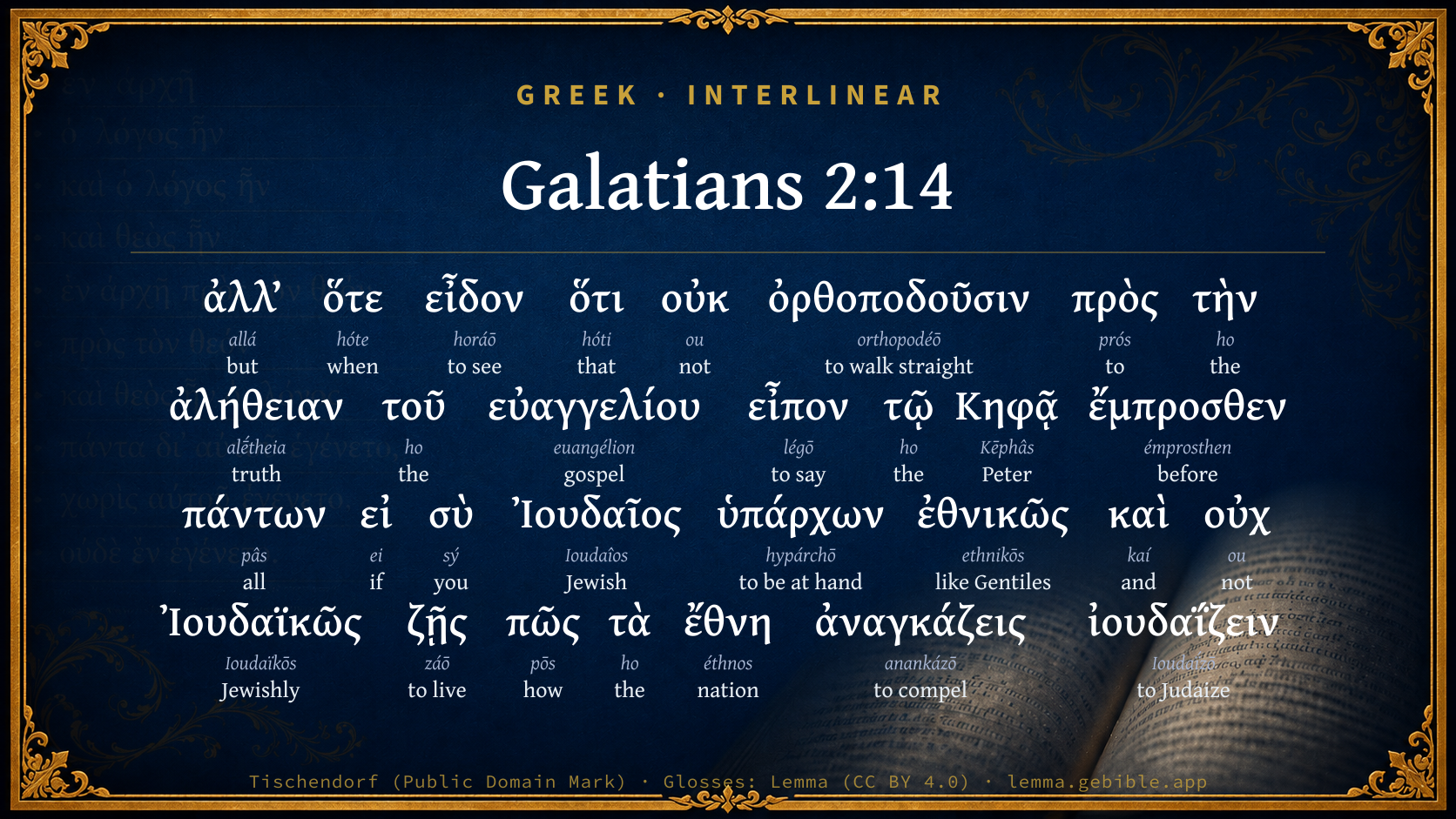
Greek (Tischendorf 8th ed.) Galatians 2:14 appears in the Greek New Testament. The text above is from the Tischendorf 8th edition. Each word links to its Strong’s number and a concise gloss. Click any word for its full Thayer’s Greek Lexicon entry.
Download image
Cite this verse

Galatians 2:14 (World English Bible). Public Domain. Lemma interlinear Bible study tool, https://lemma.gebible.app/v/galatians/2/14.

Show BibTeX & RIS
BibTeX
RIS
English Translation
But when I saw that they didn't walk uprightly according to the truth of the Gospel, I said to Peter before them all, "If you, being a Jew, live as the Gentiles do, and not as the Jews do, why do you compel the Gentiles to live as the Jews do?
World English Bible · Public Domain
Highlights
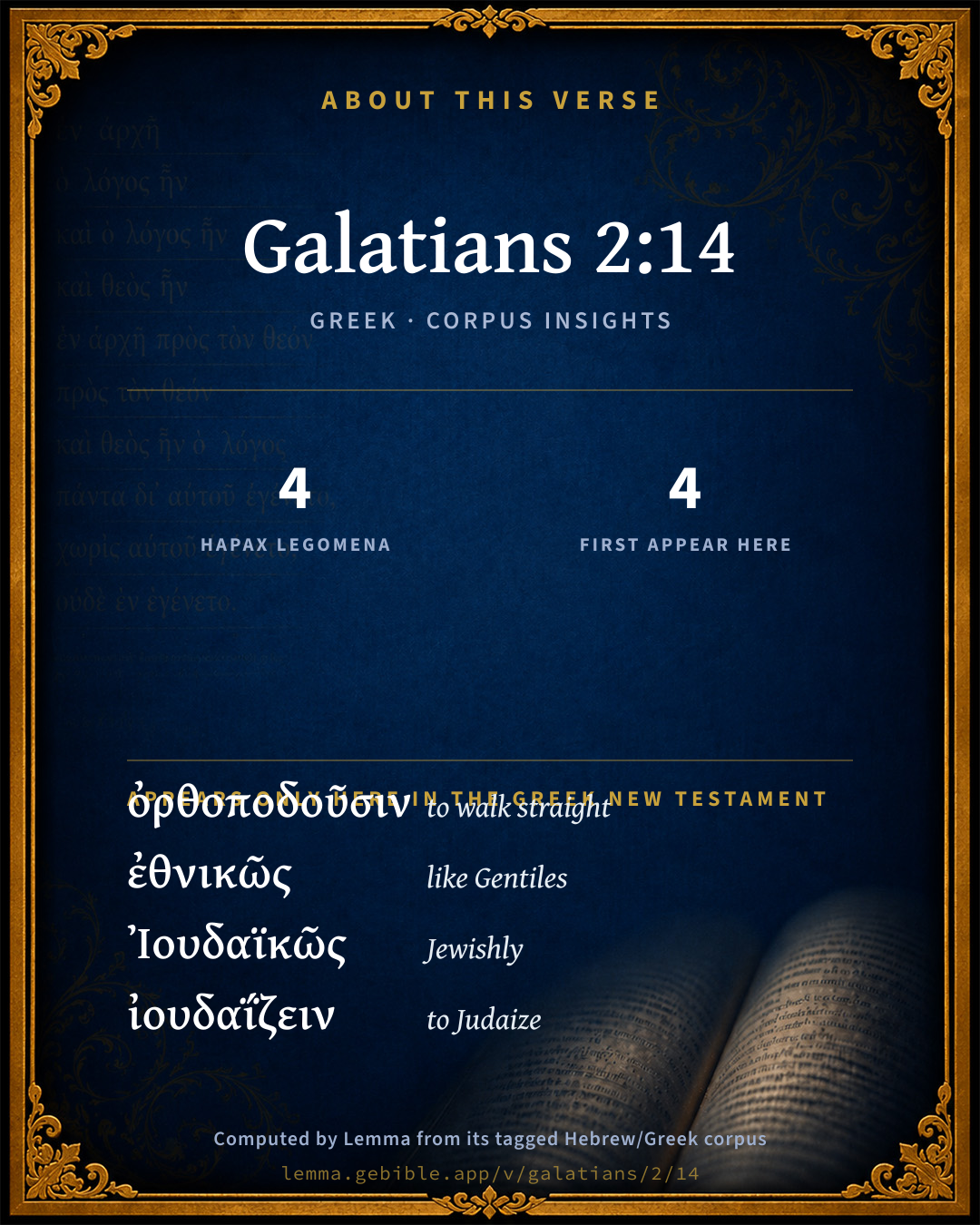
  • 4 hapax legomena — only here in the Greek New Testament
  • 4 first appearances in the Greek New Testament
Full analysis ↓
Download a study sheet

One document with this verse’s original text, its word-by-word gloss line, the meaning frame, cross-references with their text, attributed commentary, and full source and license credits — printable, and it pastes into notes with its structure intact.

This verse Autodidact and up

Study sheet (.html) Plain text (.txt)

A passage Seminary Student

Up to 50 verses in one chapter. A passage sheet keeps up to 6 commentary sources and 12 cross-references per verse, in the order this page ranks them, and says so on the sheet whenever that leaves anything out. Ask for a single verse and you get the Autodidact verse sheet above.

Everything on this page stays free to read, with no account — the sheet is a download of what is already on screen, not access to it.

Want to remove ads? Support Godless Engineer
Compare translations 3

The same verse in 3 English versions, stacked beneath the original-language interlinear above. Click any original word for its lexicon entry.

Each is an independent rendering of the whole verse — the interlinear is not word-aligned to these translations.

Highlighted words mark where these versions differ — a whole-verse word diff, not a word-by-word alignment.

  • World English Bible Public Domain
    But when I saw that they didn't walk uprightly according to the truth of the Gospel, I said to Peter before them all, "If you, being a Jew, live as the Gentiles do, and not as the Jews do, why do you compel the Gentiles to live as the Jews do?
  • King James Version Public Domain
    But when I saw that they walked not uprightly according to the truth of the gospel, I said unto Peter before them all, If thou, being a Jew, livest after the manner of Gentiles, and not as do the Jews, why compellest thou the Gentiles to live as do the Jews?
  • unfoldingWord Literal Text CC BY-SA 4.0
    But when I saw that they were not walking correctly according to the truth of the gospel, I said to Cephas in front of all, “If you, being a Jew, live like a Gentile and not like a Jew, how can you force the Gentiles to live like Jews?

unfoldingWord Literal Text — © unfoldingWord, licensed CC BY-SA 4.0. Word-aligned USFM3 via Door43 (git.door43.org/unfoldingWord/en_ult).

Versions to compare (up to 4)

3 of 4 selected

Show all 19 translations

Every available English version of this verse, each an independent rendering of the whole verse.

  • World English Bible Public Domain
    But when I saw that they didn't walk uprightly according to the truth of the Gospel, I said to Peter before them all, "If you, being a Jew, live as the Gentiles do, and not as the Jews do, why do you compel the Gentiles to live as the Jews do?
  • Berean Standard Bible Public Domain
    When I saw that they were not walking in line with the truth of the gospel, I said to Cephas in front of them all, “If you, who are a Jew, live like a Gentile and not like a Jew, how can you compel the Gentiles to live like Jews?”
  • Majority Standard Bible Public Domain
    When I saw that they were not walking in line with the truth of the gospel, I said to Peter in front of them all, “If you, who are a Jew, live like a Gentile and not like a Jew, how can you compel the Gentiles to live like Jews?”
  • King James Version Public Domain
    But when I saw that they walked not uprightly according to the truth of the gospel, I said unto Peter before them all, If thou, being a Jew, livest after the manner of Gentiles, and not as do the Jews, why compellest thou the Gentiles to live as do the Jews?
  • American Standard Version (1901) Public Domain
    But when I saw that they walked not uprightly according to the truth of the gospel, I said unto Cephas before `them' all, If thou, being a Jew, livest as do the Gentiles, and not as do the Jews, how compellest thou the Gentiles to live as do the Jews?
  • Revised Version (1885) Public Domain
    But when I saw that they walked not uprightly according to the truth of the gospel, I said unto Cephas before them all, If thou, being a Jew, livest as do the Gentiles, and not as do the Jews, how compellest thou the Gentiles to live as do the Jews?
  • Geneva Bible (1599) Public Domain
    But when I saw, that they went not ye right way to the trueth of ye Gospel, I sayd vnto Peter before all men, If thou being a Iewe, liuest as the Gentiles, and not like the Iewes, why constrainest thou the Gentiles to doe like the Iewes?
  • Douay-Rheims (1899) Public Domain
    But when I saw that they walked not uprightly unto the truth of the gospel, I said to Cephas before them all: If thou, being a Jew, livest after the manner of the Gentiles, and not as the Jews do, how dost thou compel the Gentiles to live as do the Jews?
  • Young's Literal Translation Public Domain
    But when I saw that they are not walking uprightly to the truth of the good news, I said to Peter before all, `If thou, being a Jew, in the manner of the nations dost live, and not in the manner of the Jews, how the nations dost thou compel to Judaize?
  • Literal Standard Version CC BY-SA 4.0
    But when I saw that they are not walking uprightly to the truth of the good news, I said to Peter before all, “If you, being a Jew, live in the manner of the nations, and not in the manner of the Jews, how do you compel the nations to live like Jews?
  • Unlocked Literal Bible CC BY-SA 4.0
    But when I saw that their behavior was not following the truth of the gospel, I said to Cephas in front of all of them, “If you are a Jew but are living like a Gentile and not like a Jew, how can you force the Gentiles to live like Jews?”
  • unfoldingWord Literal Text CC BY-SA 4.0
    But when I saw that they were not walking correctly according to the truth of the gospel, I said to Cephas in front of all, “If you, being a Jew, live like a Gentile and not like a Jew, how can you force the Gentiles to live like Jews?
  • Darby Bible Public Domain
    But when I saw that they do not walk straightforwardly, according to the truth of the glad tidings, I said to Peter before all, If *thou*, being a Jew, livest as the nations and not as the Jews, how dost thou compel the nations to Judaize?
  • World Messianic Bible Public Domain
    But when I saw that they didn’t walk uprightly according to the truth of the Good News, I said to Peter before them all, “If you, being a Jew, live as the Gentiles do, and not as the Jews do, why do you compel the Gentiles to live as the Jews do?
  • Webster's Bible Public Domain
    But when I saw that they walked not uprightly according to the truth of the gospel, I said to Peter before them all, If thou, being a Jew, livest after the manner of Gentiles, and not as do the Jews, why compellest thou the Gentiles to live as do the Jews?
  • Free Bible Version CC BY-SA 4.0
    When I realized that they weren't taking a firm stand for the truth of the good news, I said to Peter in front of everyone, “If you're a Jew yet live like the foreigners and not like Jews, why are you forcing the foreigners to live like Jews?
  • Bible in Basic English Public Domain
    But when I saw that they were not living uprightly in agreement with the true words of the good news, I said to Cephas before them all, If you, being a Jew, are living like the Gentiles, and not like the Jews, how will you make the Gentiles do the same as the Jews?
  • Text-Critical English NT CC BY 4.0
    But when I saw that they were not walking uprightly in accordance with the truth of the gospel, I said to Peter in front of them all, “If yoʋ, though a Jew, live like a Gentile and not like a Jew, why do yoʋ compel the Gentiles to live like Jews?”
  • Tyndale New Testament (1534) Public Domain
    But when I sawe that they went not the ryght waye after the trueth of the gospell I sayde vnto Peter before all men yf thou beynge a Iewe livest after the maner of the gentyls and not as do the Iewes: why causest thou the getyls to live as do the Iewes?

Literal Standard Version (2020), Covenant Press — licensed CC BY-SA 4.0. Text via the HelloAO Bible API (eBible.org). Unlocked Literal Bible (unfoldingWord) — licensed CC BY-SA 4.0. Text via the HelloAO Bible API (eBible.org). unfoldingWord Literal Text — © unfoldingWord, licensed CC BY-SA 4.0. Word-aligned USFM3 via Door43 (git.door43.org/unfoldingWord/en_ult). Free Bible Version, Dr. Jonathan Gallagher — licensed CC BY-SA 4.0. Text via the HelloAO Bible API (eBible.org).

Word by word

More ways to search: Search by grammar → Find every occurrence → Compare this word →

Practice this passage: Drill this verse → Learn its vocabulary →

ὀρθοποδοῦσιν
orthopodéō
G3716
“to walk straight”
Verb, Present, Active, Indicative, 3rd person, Plural
Part of Speech
Verb
Tense
Present
Voice
Active
Mood
Indicative
Person
3rd person
Number
Plural
Full Thayer's Definition

Origin: from a compound of G3717 and G4228

TDNT: 12:31,7

1. to walk in a straight course 2. metaph. to act uprightly
  1. ἀλλ’ allá G235 “but” Conjunction
  2. ὅτε hóte G3753 “when” Adverb
  3. εἶδον horáō G3708 “to see” Verb, Aorist, Active, Indicative, 1st person, Singular
  4. ὅτι hóti G3754 “that” Conjunction
  5. οὐκ ou G3756 “not” Particle, Negative
  6. πρὸς prós G4314 “to” Preposition
  7. τὴν ho G3588 “the” Article, Accusative, Singular, Feminine
  8. ἀλήθειαν alḗtheia G225 “truth” Noun, Accusative, Singular, Feminine
  9. τοῦ ho G3588 “the” Article, Genitive, Singular, Neuter
  10. εὐαγγελίου euangélion G2098 “gospel” Noun, Genitive, Singular, Neuter
  11. εἶπον légō G3004 “to say” Verb, Aorist, Active, Indicative, 1st person, Singular
  12. τῷ ho G3588 “the” Article, Dative, Singular, Masculine
  13. Κηφᾷ Kēphâs G2786 “Peter” Noun, Dative, Singular, Masculine
  14. ἔμπροσθεν émprosthen G1715 “before” Preposition
  15. πάντων pâs G3956 “all” Adjective, Genitive, Plural, Masculine
  16. εἰ ei G1487 “if” Conditional
  17. σὺ sý G4771 “you” Personal pronoun, 2nd person, Nominative, Singular
  18. Ἰουδαῖος Ioudaîos G2453 “Jewish” Adjective, Nominative, Singular, Masculine
  19. ὑπάρχων hypárchō G5225 “to be at hand” Verb, Present, Active, Participle, Nominative, Singular, Masculine
  20. ἐθνικῶς ethnikōs G1483 “like Gentiles” Adverb
  21. καὶ kaí G2532 “and” Conjunction
  22. οὐχ ou G3756 “not” Particle, Negative
  23. Ἰουδαϊκῶς Ioudaïkōs G2452 “Jewishly” Adverb
  24. ζῇς záō G2198 “to live” Verb, Present, Active, Indicative, 2nd person, Singular
  25. πῶς pōs G4459 “how” Adverb, Interrogative
  26. τὰ ho G3588 “the” Article, Accusative, Plural, Neuter
  27. ἔθνη éthnos G1484 “nation” Noun, Accusative, Plural, Neuter
  28. ἀναγκάζεις anankázō G315 “to compel” Verb, Present, Active, Indicative, 2nd person, Singular
  29. ἰουδαΐζειν Ioudaḯzō G2450 “to Judaize” Verb, Present, Active, Infinitive

About this verse

These counts appear in no published source. They are computed here, from the morphology-tagged text and Lemma’s own curated glosses. What Lemma adds →

30
words
26
distinct lemmas
Pauline Epistles
section

Notable vocabulary

4 hapax legomena — words that appear only here in the entire Greek New Testament:

  • ὀρθοποδοῦσιν to walk straight G3716
  • ἐθνικῶς like Gentiles G1483
  • Ἰουδαϊκῶς Jewishly G2452
  • ἰουδαΐζειν to Judaize G2450

First appearance in Scripture

These words make their first canonical appearance in the Greek New Testament here:

  • ὀρθοποδοῦσιν to walk straight G3716
  • ἐθνικῶς like Gentiles G1483
  • Ἰουδαϊκῶς Jewishly G2452
  • ἰουδαΐζειν to Judaize G2450

Shared distinctive vocabulary

Κηφᾷ Peter G2786 occurs in 9 verses of the Greek New Testament. Also found in:
Repetition

Words recur within this verse:

Cross-references

24

Topical passages linked to Galatians 2:14 in the Treasury of Scripture Knowledge — connected by theme and wording, ordered by reader-vote popularity; previews shown in the World English Bible.

  • Galatians 2:5 to whom we gave no place in the way of subjection, not for an hour, that the truth of the Gospel might continue with you.
  • Acts 10:28 He said to them, "You yourselves know how it is an unlawful thing for a man who is a Jew to join himself or come to one of another nation, but God has shown me that I shouldn't call any man unholy or unclean.
  • Acts 15:10–11 Now therefore why do you tempt God, that you should put a yoke on the neck of the disciples which neither our fathers nor we were able to bear?
  • 1 Timothy 5:20 Those who sin, reprove in the sight of all, that the rest also may be in fear.
  • Psalms 84:11 For Yahweh God is a sun and a shield. Yahweh will give grace and glory. He withholds no good thing from those who walk blamelessly.
  • Proverbs 2:7 He lays up sound wisdom for the upright. He is a shield to those who walk in integrity;
  • Acts 15:28–29 For it seemed good to the Holy Spirit, and to us, to lay no greater burden on you than these necessary things:
  • Galatians 6:12 As many as desire to look good in the flesh, they compel you to be circumcised; only that they may not be persecuted for the cross of Christ.
  • Acts 15:19–21 "Therefore my judgment is that we don't trouble those from among the Gentiles who turn to God,
  • Acts 15:24 Because we have heard that some who went out from us have troubled you with words, unsettling your souls, saying, 'You must be circumcised and keep the law,' to whom we gave no commandment;
  • Romans 14:14 I know, and am persuaded in the Lord Jesus, that nothing is unclean of itself; except that to him who considers anything to be unclean, to him it is unclean.
  • Galatians 2:7 but to the contrary, when they saw that I had been entrusted with the Gospel for the uncircumcision, even as Peter with the Gospel for the circumcision
  • Galatians 2:9 and when they perceived the grace that was given to me, James and Cephas and John, they who were reputed to be pillars, gave to me and Barnabas the right hand of fellowship, that we should go to the Gentiles, and they to the circumcision.
  • Galatians 2:11–13 But when Peter came to Antioch, I resisted him to the face, because he stood condemned.
  • 1 Timothy 4:3–5 forbidding marriage and commanding to abstain from foods which God created to be received with thanksgiving by those who believe and know the truth.
  • Hebrews 9:10 being only (with meats and drinks and various washings) fleshly ordinances, imposed until a time of reformation.
  • Hebrews 12:13 and make straight paths for your feet, so that which is lame may not be dislocated, but rather be healed.
  • Leviticus 19:17 "'You shall not hate your brother in your heart. You shall surely rebuke your neighbor, and not bear sin because of him.
  • Psalms 15:2 He who walks blamelessly does what is right, And speaks truth in his heart;
  • Psalms 58:1 Do you indeed speak righteousness, silent ones? Do you judge blamelessly, you sons of men?
  • Psalms 141:5 Let the righteous strike me, it is kindness; Let him reprove me, it is like oil on the head; Don't let my head refuse it; Yet my prayer is always against evil deeds.
  • Proverbs 10:9 He who walks blamelessly walks surely, But he who perverts his ways will be found out.
  • Proverbs 27:5–6 Better is open rebuke Than hidden love.
  • Acts 11:3–18 saying, "You went in to uncircumcised men, and ate with them!"

Cross-references courtesy of OpenBible.info (CC BY 4.0).

Commentary

Notes on Galatians 2:14 from classic Christian and Jewish commentators (each source and its license shown beneath its notes). The classic Christian expositions comment on the surrounding passage and are grouped to its opening verse, so a note may address several verses; the Jewish commentaries on the Tanakh (Rashi and others) are per-verse, so they appear only where the commentator wrote on this verse.

Lemma curates 59 commentaries, every one of them public domain or Creative Commons licensed, each selected and text-cleaned for this edition rather than reprinted as found. About our sources →

The Cambridge Bible for Schools and Colleges

gen. ed. J. J. S. Perowne

14. This was not a case for private remonstrance. The conduct of Peter and the rest was a practical denial of the truth of the Gospel, and, as such, could not but do widespread mischief. St Paul therefore took occasion to rebuke him in the presence of the whole company of believers (comp. ‘I withstood him to the face’, Gal_2:11).

according to the truth] Lit. ‘towards the truth,’ i.e. with a view to its maintenance and propagation.

If thou, being a Jew … Jews] Various opinions have been held with regard to the limit of the address to Peter. Some suppose it to terminate in this verse; others with Gal_2:15 or 18; most, at the end of the chapter. But a comparison of the abruptness of the opening words with the more calm argumentative style of what follows, seems to confirm the view that the actual words addressed to Peter are contained in Gal_2:14, and that Paul passes imperceptibly into a discussion of the great principle which he felt to be at stake. It is possible that the later verses contain the substance of the Apostle’s remonstrance with Peter, as they certainly contain the ground of the expostulation in Gal_2:14. This is confirmed by the expression “We, Jews by nature”; but the whole passage has direct reference to the state and dangers of the Galatians.

being a Jew] a Jew by birth and education, not a Gentile proselyte.

livest after … Gentiles] Ever since his visit to Cornelius, Peter had associated freely and eaten with the Gentiles.

why compellest thou] How is it that now by your example you are forcing the Gentile converts to conform to the Jewish ceremonial? It is of course moral compulsion that is meant, that kind of influence to which new converts would be specially prone to yield.

to live as do the Jews] Lit. to Judaize, to observe the ceremonial law, as necessary to salvation. That no less is intended appears from Gal_2:21.

The Cambridge Bible for Schools and Colleges (gen. ed. J. J. S. Perowne; Cambridge University Press, 1878–1918) — public domain. Text from a community e-Sword module.

The Biblical Illustrator

Joseph S. Exell

Gal_2:14-15

But when I saw that they walked not uprightly.

Moral shuffling

I. Its nature.

1. Literally--not to walk on straight feet, i.e., erect, or straightforwardly.

2. Morally.

(1) Thinking rightly and acting wrongly.

(2) Orthodoxy in creed, heterodoxy in conduct.

(3) All compromises when conscience is concerned.

II. Its relation to the gospel. It is not according to its truth.

1. In the letter.

2. In the spirit.

III. Its motives.

1. Aversion to unpleasantness.

2. Desire to be agreeable all round.

3. Hope by its means to get over a temporary difficulty.

IV. Its consequences.

1. It deceives the very elect, even Barnabas.

2. It involves others in deplorable inconsistencies.

V. Its inexcusableness (Gal_2:15-16).

1. Knowledge and experience are against it.

2. Spiritual privileges render it unnecessary.

3. Gods Word has condemned the doing of evil that good may come.

VI. The duty of the truth-lover with reference to it. To rebuke it in--

1. The most eminent.

2. The most esteemed.

Straightforwardness

has been defined as a mixture of sincerity and simplicity, and is well illustrated by an anecdote of Bishop Atterbury. On one occasion he was asked why he would not suffer his servants to deny him when he did not care to see company. It is not a lie for them to say that you are not at home, for it deceives no one; every one knows that it only means that your lordship is busy. He replied, If it is (which I doubt) consistent with sincerity, yet I am sure it is not consistent with that simplicity which becomes a bishop. But the fine nervous Saxon word aptly explains the virtue for which it stands. It is rectitude in motion, movement in a right direction in spite of all inducements to swerve, movement on that straight line which in morals as in mathematics is the shortest distance between two points.

The grave question at issue

There was no question of charity here, but a question of principle. To eat with the Gentiles was either right or wrong. In the light of the gospel it was right; but to shilly-shally on the matter and to let it depend on the presence or absence of certain people was clearly wrong. It was monstrous that a Gentile convert should at one time be treated as a brother, and at another shunned as though he were a Pariah. (F. H. Farrar.)

Eating with the Gentiles

This involved concessions of the nature of which it is almost impossible for us at this distance to conceive. It was to the Jew what the breaking of caste is to the Hindoo, as startling, in some respects, as though in our own country peers and working men were found to be working daily on the most friendly terms, (S. Pearson, M. A.)

Law versus gospel

Many have the gospel, but not the truth of the gospel. So Paul saith here, that Peter, Barnabas, and other of the Jews, had the gospel, but walked not uprightly according to the gospel. For, albeit they preached the gospel, yet, through their dissimulation (which could not stand with the truth of the gospel) they established the law; but the establishing of the law is the abolishing of the gospel. Whoso then can rightly judge between the law and the gospel, let him thank God, and know that he is a right divine. Now the way to discern the one from the other, is to place the gospel in heaven, and the law on earth; to call the righteousness of the gospel heavenly, and that of the law earthly; and to put as great difference between the righteousness of the gospel and of the law as God hath made between heaven and earth, light and darkness, day and night. Wherefore, if the question be concerning the matter of faith or conscience, let us utterly exclude the law, and leave it on the earth; but, if we have to do with works, then let us lighten the lantern of works and of the righteousness of the law. Wherefore, if thy conscience be terrified with the sense and feeling of sin, think thus with thyself: Thou art now remaining upon earth; there let the ass labour and travail; there let him serve and carry the burden that is laid upon him; that is to say, let the body with his members be subject to the law. But when thou mountest up into heaven, then leave the ass with his burden on the earth; for the conscience hath nothing to do with the law, or works, or with the earthly righteousness. So doth the ass remain in the valley, but the conscience ascendeth with Isaac into the mountain, knowing nothing at all of the law or works thereof, but only looking to the remission of sins and pure righteousness offered and freely given unto us in Christ. (Luther.)

Unswerving integrity

Bishop Hooper was condemned to be burned at Gloucester, in Queen Marys reign. A gentleman, with the view of inducing him to recant, said to him, Life is sweet, and death is bitter. Hooper replied, The death to come is more bitter, and the life to come more sweet. I am come hither to end this life, and suffer death, because I will not gainsay the truth I have here formerly taught you. When brought to the stake, a box, with a pardon from the queen in it, was set before him. The determined martyr cried out, If you love my soul, away with it! if you love my soul, away with it! (Foster.)

Fidelity

A man gave his two infant children in charge of a negro slave, to be by him cared for, and taken to a distant port. The ship was wrecked, and had to be abandoned. The boats were nearly full. The slave had his choice to leave the children, or himself be left. He kissed them; bade the sailors take good care of them, and tell his master of his faithfulness; and soon went bravely down with the foundering ship. (Foster.)

Swerving from the truth

1. The multitude of those who swerve from truth should not make truth seem less lovely to others, or damp their ardour in defending it against error. Though truth should be deserted by all except one only, yet is it worthy to be owned, stood to, and defended by that one, against all who oppose it.

2. It is the duty of all professors to walk so, both in the matter of opinion and practice, as is suitable to, and well agreeing with, the sincere truth of God held out in the gospel; holding nothing which is even indirectly contrary to it, and practising nothing which may reflect upon it. When they halt, or walk not with a straight foot in either of those, they are blameworthy.

3. When many are guilty of one and the same sin, the minister of Jesus Christ ought to reprove wisely and without respect of persons; making the weight of the reproof light upon them, as they have been more or less accessory to the sin.

4. Though private sins, which have not broken forth to a public scandal of many, are to be rebuked in private (Mat_18:15), yet public sins are to receive public rebukes, that hereby the public scandal may be removed, and others may be scared from taking encouragement to do the like (1Ti_5:20).

5. Though the binding power of the ceremonial law was abrogated at Christs death, and the practice thereof, in some things at least, left as a thing lawful and in itself indifferent unto all for a time after that, yet the observance thereof, even for that time, was dispensed with more for the Jews sake, and was more tolerable in them who were born and educated under the binding power of that yoke, than in the Gentiles, to whom that law was never given, and so were to observe it, or any part of it, only in ease of scandalising the weak Jews by their neglect of it (Rom_14:20-21).

6. A minister must not take liberty of practice to himself in things which he condemns in others.

7. It is no small sin for superiors to bind where the Lord has left free, by urging upon their inferiors the observing of a thing, in its own nature indifferent, as necessary; except it be in those cases wherein the Lord, by those circumstances which accompany it, points it out as necessary; e.g., cases of scandal (Act_15:28-29), and contempt (1Co_14:40).

8. In the primitive times of the Christian Church, the people of God did wonderfully subject themselves to the ministry of the Word in the head of His servants, and much more than people now do; for if the actions of the apostles compelled men to do this or that, as Peters action did compel the Gentiles, what then did their doctrine and heavenly exhortations? (James Fergusson.)

Inconsistency reproved

I. That the gospel supplies the rule of life.

II. To depart from the rule of gospel truth is to become inconsistent in the Christian life.

III. Such inconsistency calls for reproof.

1. That reproofs are sometimes necessary. An earthly life is ever an imperfect one, and the best men may in unguarded moments fall into grievous errors.

2. They should be given with faithfulness, yet in love. No ties of private friendship should prevent sin being reproved, and where the sin has been committed openly, it should be reproved openly--Burkitt. Yet there should be no personal reproaches, but the manifestations of brotherly love. (R. Nicholls.)

The Biblical Illustrator, edited by Joseph S. Exell (c. 1880s–1900s) — public domain. Text from a community e-Sword module.

Joseph Benson's Commentary

Gal 2:14. When I saw that, in this matter, they walked not uprightly — Ουκ ορθοποδουσι, did not walk with a straight step, or in a plain and straight path; according to the truth of the gospel — That is, according to their own knowledge of the simplicity of the true gospel doctrine; I said to Peter, before them all — That is, in the hearing of Barnabas and all the Judaizers: see Paul single against Peter and all the Jews! If thou, being a Jew — And having been brought by circumcision under the strongest engagements to fulfil the whole law; livest after the manner of the Gentiles — Conversing and eating freely with them, as since the vision which thou sawest thou hast done; and not as do the Jews — Not observing the ceremonial law, which thou knowest to be now abolished; why compellest thou the Gentiles — By refusing to eat and converse freely with them, as if the distinction of meats was necessary to be observed in order to salvation, and by withdrawing thyself, and all the ministers, from them; to live as do the Jews — Ιουδαιζειν, to Judaize; to keep the ceremonial law, or be excluded from church communion. What is here recorded, probably took place at the conclusion of some of their meetings for public worship; for on these occasions it was usual, after the reading of the law and the prophets, to give the assembly exhortations. Had this offence of Peter been of a private nature, undoubtedly, as duty required, Paul would have expostulated with him privately upon it, and not have brought it, at least in the first instance, before such a number of persons: but as it was a public affair, in which many persons were deeply concerned, the method Paul took was certainly most proper. And in thus openly reproving Peter, he not only acted honestly, but generously; for it would have been mean to have found fault with him behind his back, without giving him an opportunity to vindicate himself, if he could have done it. “Perhaps,” says Macknight, “Peter in this, and in a former instance, may have been suffered to fall, the more effectually to discountenance the arrogant claims of his pretended successors to supremacy and infallibility.”

Joseph Benson's Commentary on the Old and New Testaments (1811–1818) — public domain. Text from a community e-Sword module.

Whedon's Commentary on the Bible

Daniel D. Whedon

a. Paul’s declaration of his gospel to Peter, Gal_2:14-21.

The purpose of Paul in this speech is to put an end to this paltering between law-justification and Christ-justification. If we are justified by Christ. why need we law observances? We analyze these verses as follows:—14. If you, Peter, a born Jew, rely on Christ-justification, why make even Gentiles law-keepers? 15, 16. We born Jews certainly have flung ourselves on Christ as our sole justification. 17. But if, while relying on Christ-justification, we admit ourselves by law-keeping to be still unjustified sinners, is Christ to submit to being made tributary to a real non-justification? By no means. 18. For such we really make him when, by law-keeping, we build up that law-justification we once destroyed, and so make our self in Christ an unjustified transgressor. 19-21. There is, then, but one sole way of justification. The law itself kills and drives us to Christ for life. We are dead to the law, or Christ has needlessly died. Christ, without the old law, is our sole life.

14. The truth of the gospel—Which makes all one in Christ. Before…

all—Which must have been in a public assembly of the Church. And, Gal_2:11, it was a rebuke to the face. This was, perhaps, the most decisive stroke of Paul’s life in the cause of Gentile Christian emancipation. It saved Antioch, and rolled the overwhelming wave of Judaism back.

Upon the words of Paul (Gal_2:14-21) there are differences of opinion. Prof. Lightfoot does not believe that they were really uttered, but holds that Paul loses himself, as it were, in the writing, and runs into discourse for the Galatians. Others think that Paul’s speech to Peter closes with Gal_2:14. We suppose that Paul, commencing with his literal words in Gal_2:14, gives in what follows a free summary of the grounds taken by him in this conference with Peter. It is not probable that nothing else was said save this brief isolated speech. Probably interchanges of remark took place, and Paul was led to lay here that explicit platform of justification by faith alone, which he subsequently expanded in the book of Romans. As that book was written about the same time with this book, the phraseology of both is not a little shaped in the same modes and forms.

14. If thou—Peter.

Livest after the manner of Gentiles—Unfolding the fact, doubtless well remembered by Gentiles present, how he lived before the men from James arrived.

Compellest thou the Gentiles—By force of his example, after these men arrived.

Daniel D. Whedon (gen. ed.), Commentary on the Old and New Testaments (1874–1909) — public domain. Text from a community e-Sword module.

Tyndale Open Study Notes

Tyndale Open Resources

2:14-21 The actions of Peter and the others implied that faith in Christ was not enough. Paul eloquently argues against such a compromise of the truth of the gospel message, showing that the law plays no role in defining a Christian’s position before God, which is by grace through faith (Eph 2:8-9). • It is not clear where Paul’s public rebuke of Peter ends and his message to the Galatians resumes (see study note on Gal 2:16). While Paul was recounting his address to Peter, he was also speaking to the Galatians. His rebuke of Peter was also a rebuke of them (see 3:1).

2:14 By living like a Gentile—eating with Gentiles and not observing Jewish food laws—Peter communicated God’s acceptance of Gentiles on equal terms with Jews, on the basis of faith in Christ (see Acts 10:34-43; 11:17-18). • why are you now trying to make these Gentiles follow the Jewish traditions? Both Jews and Gentiles would draw this conclusion from Peter’s actions.

Tyndale Open Study Notes — © Tyndale Open Resources, licensed CC BY-SA 4.0. Text via the HelloAO Bible API.

Bengel's Gnomon

Johann Albrecht Bengel

Gal 2:14. Ἐ͂ιδον, I saw) A happy observation [of their error].—ὀρθοποδοῦσι) they walk [with a straightforward and open step] according to the rule, Gal 6:16; in the right way, or rather with body erect [as Engl. Vers. translates it uprightly], so that it is opposed to lameness, and to what is properly called straddling. Straightness of the feet is the thing intended. The Greeks say also ὀρθοβατεῖν, ὀρθοδραμεῖν.—τοῦ εὐαγγελίου, of the Gospel) For the Gospel teaches, that righteousness from the works of the law and the necessity for observance of the ceremonial law are inconsistent with redemption by the death of Christ.—εἶπον, I said) Paul alone maintained the point in this place, without associates [to support him], against Judaism; afterwards also against heathenism, 2Ti 4:16-17.—τῷ) The authors of this conduct ought to be attacked.—ἔμπροσθεν πάντων, before all) 1Ti 5:20.—εἰ σὺ, if thou) In this argument Paul reminds Peter of the argument which the latter had used against the Pharisees, Act 15:10-11. Here commences a proposition consisting of two members, of which the first, if thou, etc., is treated of in Gal 2:15-16; the second, why—the Gentiles, etc., at Gal 2:17-18.—Ἰουδαῖος ὑπάρχων, being a Jew) and therefore more closely related to the law.—ἐθνικῶς ζῇς, livest after the manner of Gentiles) So Paul speaks, κατʼ ἄνθρωπον, i.e. [using the ad hominem argument, turning Peter’s own practice as an argument against him] For Peter, retracting his former mode of living, declared for the Gentile mode, since it was right in itself. Taking away this figure, the proposition itself, we must not live after the manner of the Jews, is presently discussed.—τὰ ἔθνη, the Gentiles) set free from the law.—ἀναγκάζεις, thou compellest) by thy conduct. They would have held it necessary that the Gentiles should either follow the Jewish ritual, or be deprived of communion with the Church.—Ἰουδαΐζειν, to live as do the Jews [Judaize]) what had been formerly obedience to the law is now mere Judaism.

Bengel's Gnomon of the New Testament — English translation (T&T Clark, Edinburgh, 1860) — public domain. Text from a community e-Sword module.

Meyer's Critical & Exegetical Commentary

Heinrich August Wilhelm Meyer

Gal_2:14. Ὅτι οὐκ ὀρθοποδοῦσι] ὀρθοποδεῖν (comp. ὀρθοβατεῖν, Anthol. ix. 11. 4), not preserved elsewhere in Biblical language, undoubtedly means to be straight-footed, that is, to walk with straight feet (comp. ὀρθόπους, Soph. Ant. 985; Nicand. Alexiph. 419, ὀρθόποδες βαίνοντες). Here used in a figurative senseas words expressive of walking are favourites with Paul in representing ethical ideas (comp. περιπατεῖν, στοιχεῖν κ.τ.λ.)equivalent to acting rightly (with straightness), conducting oneself properly (ὀρθοπραγεῖν, Aristot. Pol. i. 5. 8). Vulgate, recte ambularent.[90] It is the moral ὈΡΘΌΤΗς ΠΡΆΞΕΩς (Plat. Men. p. 97 B), the opposite of the moral σκολιόν (Plat. Gorg. p. 525 A), στρεβλόν (Sir_36:25), ΧΩΛΌΝ (Heb_12:13). According to the leaning of Greek authors towards the direct mode of expression, the present is quite regular. See Kühner, § 846.

πρὸς τὴν ἀλήθ. τοῦ εὐαγγέλ.] ΠΡΌς is understood as secundum (2Co_5:10; Luk_12:47; Bernhardy, p. 265) by most expositors (including Winer, Rückert, de Wette, Ewald, Wieseler); by others in the sense of direction towards the mark (Flacius, Grotius, Estius, Wolf, Morus, Hofmann), which would mean, so as to maintain and promote the truth of the gospel. The former interpretation is to be preferred, because it is the more simple and the first to suggest itself, and it yields a very suitable sense. Hence: corresponding to the truth, which is the contents of the gospel (Gal_2:5). Certainly Paul never in verbs of walking expresses the rule prepositionally by πρός, but by ΚΑΤΆ (Rom_8:4; Rom_14:15; 1Co_3:3, et al.); but in this passage πρὸς κ.τ.λ. is the epexegesis of ὈΡΘῶς, according to its ethical idea.

ἔμπροσθεν πάντων] consequently, not under some four eyes merely, but in the sight of the whole church although not assembled expressly for this purpose (Thiersch); τοὺς ἁμαρτάνοντας ἐνώπιον πάντων ἔλεγχε, ἵνα καὶ οἱ λοιποὶ φόβον ἔχωσι, 1Ti_5:20. Non enim utile erat errorem, qui palam noceret, in secreto emendare, Augustine.

εἰ σὺ Ἰουδαῖος ὑπάρχων κ.τ.λ.] that is, If thou, although a born Jew, orderest thy mode of living in conformity with that of the born Gentiles, ΧΩΡῚς ἸΟΥΔΑΙΚῆς ΠΑΡΑΤΗΡΉΣΕΩς (Chrysostom), and not with that of the born Jewsa course of conduct, which thou hast just practically exemplified by eating in company with Gentile Christianshow comes it to pass that thou (by the example of the wholly opposite conduct which thou hast now adopted since the arrival of those ΤΙΝΈς) urgest the born Gentiles to adopt the custom of the born Jews? What a contradiction of conduct is it, thus in one breath to live ἘΘΝΙΚῶς and to urge the ἜΘΝΗ to the ἸΟΥΔΑΐΖΕΙΝ! The present Ζῇς denotes that which was constant, accordant with principle, in Peters case (contrary to the view of Hilgenfeld and others). This is laid down by Paul, with the argumentative εἰ, as certain and settled, and that not merely by inference from his recent experience of Peter having eaten in company with Gentiles, but also on the ground of his knowledge otherwise of this apostle and of his practical principles on this point, with which the ἐθνικῶς ζῆν just before actually carried out by Peter was in accordance. Groundlessly and erroneously Rückert labours (since it does not run: ἘΠΕΙΔΉ … ἜΖΗΣΑς) to extract an entirely different meaning, understanding ἸΟΥΔΑΪΚῶς Ζῇς in an ideal sense (Rom_2:28 f.; Joh_1:48), and ἐθνικῶς ζῇς as its opposite: By thy present conduct thou showest thyself truly not as a genuine Jew, but as a Gentile (sinner); how art thou at liberty to ask that the Gentiles should adopt Jewish customs, which by thy behaviour thou thyself dost not honour? But, in fact, the reader could only take the explanation of the ἘΘΝΙΚῶς Ζῇς from ΜΕΤᾺ ΤῶΝ ἘΘΝῶΝ ΣΥΝΉΣΘΙΕΝ (Gal_2:12), and of the ἸΟΥΔΑΪΚῶς Ζῇς from ὙΠΈΣΤΕΛΛΕ … ΠΕΡΙΤΟΜῆς (Gal_2:12). No one could light upon the alleged ideal view (reverting, in the apodosis, to the empirical!), the more especially as the breaking off from eating with the Gentiles would have to be regarded as a Gentile habit (in an ethical sense)! The ζῆν is not the moral living according to the Gentile or the Jewish fashion, but the shaping of the life with reference to the category of external social observances within the Christian communion, such as, in the individual case in question, the following (Ἰουδαϊκῶς) or non-following (ἘΘΝΙΚῶς) of the Jewish restrictions as to eating.

Πῶς] qui fit, ut (Rom_3:6; Rom_6:2; Rom_10:14, and frequently), indicating the incomprehensibleness of this morally contradictory behaviour.

τὰ ἔθνη ἀναγκάζεις Ἰουδαΐζειν] indirect compulsion. For the Gentile Christians in Antioch must very naturally have felt themselves constrained by the imposing example of the highly-esteemed Peter to look upon the Jewish habit of livingthe observance of the special peculiarities of the outward legal Judaism (the Ἰουδαΐζειν: comp. Est_8:17; Plut. Cic. 7[91])as something belonging to Christianity, and necessary for partaking in Christian fellowship and for attaining the Messianic salvation; and they would shape their conduct in practice in accordance with this view (comp. Usteri, p. 66 f.). De Wette (comp. also Wieseler, Chronol. p. 198 f., Komment. p. 168) assumes, that the emissaries of James preached the principle of the necessity of observing the law, and that Peter gave his support, at least tacitly, to this preaching. This is not at all intimated in the text, and is not rendered necessary by the literal sense of ἀναγκάζειν, which is sufficiently explained by the moral constraint of the inducement of so influential an example, as it is often used in classical authors, de varia necessitate quam praesens rerum conditio efficit (Sturz, Lex. Xen. I. 18. 6). The view which understands the word here not at all of indirect constraint, but of definite demands (Ritschl, p. 146), by which Peter sought to turn them back into the path of Jewish Christianity, is opposed to the divine instruction imparted to this apostle, to his utterances at the council, and to our context, according to which the ἀναγκάζειν can have consisted in nothing more than the οὐκ ὀρθοποδεῖν as it is represented in Gal_2:12 f., and consequently must have been merely a practical, indirect compulsion, not conveyed in any express demands. Wieseler obscures the intelligibility of the whole passage by understanding the Ἰουδαΐζειν of the observance of the restrictions as to food enacted by the apostolic council. In decisive opposition to this view it may be urged, that in the whole context this council is left entirely unmentioned; further, that these restrictions as to food had nothing to do with the Jewish proselytes (on whose account, possibly, their observance might have been called an Ἰουδαΐζειν); lastly, that the compliance with the same on the part of the church at Antioch, especially so soon after the council (see on Gal_2:11), cannot, according to Act_15:30, at all be a matter of doubt. Moreover, how could Paul, who had himself together with Peter so essentially co-operated towards this decree of the council, havein the presence of Peter, of the Christians of Antioch, and even of those who were sent by Jamescharacterized the obedience given to the restrictions in question by the inapplicable and ill-sounding name Ἰουδαΐζειν? It would have shown at least great want of tact.

[90] Hofmann, to stand with straight foot. But comp. ὀξυποδεῖν, ὠκυποδεῖν, to be swift-footed, that is, swift in running. The standing would probably have been expressed, as perhaps by ὀρθοστατεῖν. The ὀρθοποδῶν is not lame (χωλεύει), but makes τροχιὰς ὀρθὰς τοῖς ποσίν, Heb_12:13.

[91] Where a freedman is spoken of, who was ἔνοχος τῷ Ἰουδαΐζειν, and in reference to whom Cicero says, τί Ἰουδαίῳ πρὸς χοίρον; comp. also Ignat. ad Magnes. 10, ἄτοπόν ἐστιν Χριστὸν Ἰησοῦν λαλεῖν καὶ Ἰουδαΐζειν.

Meyer — Critical and Exegetical Commentary on the New Testament — English translation by Peter Christie, edited by Frederick Crombie (T&T Clark, 1880) — public domain. Text from a community e-Sword module.

Expositor's Greek Testament

ed. W. Robertson Nicoll

Gal 2:14 . πρὸς τ . ἀλήθειαν . Our versions render πρός , according to , like κατά : and so impugn these men for want of uprightness in their conduct rather than for inconsistency of doctrine. But the censure of the Apostle is really directed to the falsehood of their teaching. They were not dealing straightforwardly with the truth in casting the slur of uncleanness on those whom God had cleansed in Christ. ἀναγκάζεις . Peter was by his example really putting a severe pressure on Gentile converts to adopt a Jewish rule of life, though perhaps unintentionally. ὑπάρχων . This participle notes the bearing of antecedents on present action. Peter being a Jew might have been expected to act otherwise.

The Expositor's Greek Testament, edited by W. Robertson Nicoll (1897–1910) — public domain. Text from a community e-Sword module.

Geneva Bible (1599)

Geneva Bible translators

He saith they were constrained, which played the Jews by Peter’s example.

Word for word, with a right foot which he setteth against halting and dissembling which is backward.

He calleth the truth of the Gospel both the doctrine itself, and also the use of doctrine, which we call the practice.

Geneva Bible (1599) marginal notes — public domain. Text via Bolls.life.

Jamieson, Fausset & Brown

Robert Jamieson, A. R. Fausset & David Brown

walked not uprightly--literally, "straight": "were not walking with straightforward steps." Compare Gal 6:16.

truth of the gospel--which teaches that justification by legal works and observances is inconsistent with redemption by Christ. Paul alone here maintained the truth against Judaism, as afterwards against heathenism (Ti2 4:16-17).

Peter--"Cephas" in the oldest manuscripts

before . . . all-- (Ti1 5:20).

If thou, &c.--"If thou, although being a Jew (and therefore one who might seem to be more bound to the law than the Gentiles), livest (habitually, without scruple and from conviction, Act 15:10-11) as a Gentile (freely eating of every food, and living in other respects also as if legal ordinances in no way justify, Gal 2:12), and not as a Jew, how (so the oldest manuscripts read, for 'why') is it that thou art compelling (virtually, by thine example) the Gentiles to live as do the Jews?" (literally, to Judaize, that is, to keep the ceremonial customs of the Jews: What had been formerly obedience to the law, is now mere Judaism). The high authority of Peter would constrain the Gentile Christians to regard Judaizing as necessary to all, since Jewish Christians could not consort with Gentile converts in communion without it.

Jamieson, Fausset & Brown — Commentary Critical and Explanatory on the Whole Bible (1871) — public domain (CC PDM 1.0). Text via the HelloAO Bible API.

Adam Clarke's Commentary

Verse 14. That they walked not uprightly] ουκ ορθοποδουσι. They did not walk with a straight step-they did not maintain a firm footing.

According to the truth of the Gospel] According to that true doctrine, which states that Christ is the end of the law for justification to every one that believes; and that such are under no obligation to observe circumcision and the other peculiar rites and ceremonies of the law.

If thou, being a Jew, livest] This was a cutting reproof. He was a Jew, and had been circumstantially scrupulous in every thing relative to the law, and it required a miracle to convince him that the Gentiles were admitted, on their believing in Christ, to become members of the same Church, and fellow heirs of the hope of eternal life; and in consequence of this, he went in with the Gentiles and ate with them; i.e. associated with them as he would with Jews. But now, fearing them of the circumcision, he withdrew from this fellowship.

Why compellest thou the Gentiles] Thou didst once consider that they were not under such an obligation, and now thou actest as if thou didst consider the law in full force; but thou art convinced that the contrary is the case, yet actest differently! This is hypocrisy.

Adam Clarke's Commentary on the Bible (1810–1826) — public domain. Text from a community e-Sword/MySword module.

John Calvin's Commentaries

14. But when I saw that they walked not uprightly. Some apply these words to the Gentiles, who, perplexed by Peter’s example, were beginning to give way; but it is more natural to understand them as referring to Peter and Barnabas, and their followers. The proper road to the truth of the gospel was, to unite the Gentiles with the Jews in such a manner that the true doctrine should not be injured. But to bind the consciences of godly men by an obligation to keep the law, and to bury in silence the doctrine of liberty, was to purchase unity at an exorbitant price.

The truth of the gospel is here used, by Paul, in the same sense as before, and is contrasted with those disguises by which Peter and others concealed its beauty. In such a case, the struggle which Paul had to maintain must unquestionably have been serious. They were perfectly agreed about doctrine; but since, laying doctrine out of view, Peter yielded too submissively to the Jews, he is accused of halting. There are some who apologize for Peter on another ground, because, being the apostle of the circumcision, he was bound to take a particular concern in the salvation of the Jews; while they at the same time admit that Paul did right in pleading the cause of the Gentiles. But it is foolish to defend what the Holy Spirit by the mouth of Paul has condemned. This was no affair of men, but involved the purity of the gospel, which was in danger of being contaminated by Jewish leaven.

Before them all. This example instructs us, that those who have sinned publicly must be publicly chastised, so far as concerns the Church. The intention is, that their sin may not, by remaining unpunished, form a dangerous example; and Paul elsewhere (1 Timothy 5:20) lays down this rule expressly, to be observed in the case of elders,

“Them that sin rebuke before all, that others also may fear;”

because the station which they hold renders their example more pernicious. It was particularly advantageous, that the good cause, in which all had an interest, should be openly defended in presence of the people, that Paul might have a better opportunity of shewing that he did not shrink from the broad light of day.

If thou, being a Jew. Paul’s address to Peter consists of two parts. In the first, he expostulates with him for his injustice toward the Gentiles, in compelling them to keep the law, from the obligations of which he wished himself to be exempted. For, not to mention that every man is bound to keep the law which he lays down for others, his conduct was greatly aggravated by compelling the Gentiles to observe Jewish ceremonies, while he, being a Jew, left himself at liberty. The law was given to Jews, not to Gentiles; so that he argues from the less to the greater.

Next, it is argued, that, in a harsh and violent manner, he compelled the Gentiles, by withdrawing from their communion, unless they chose to submit to the yoke of the law; and thus imposed on them an unjust condition. And, indeed, the whole force of the reproof lies in this word, which neither Chrysostom nor Jerome has remarked. The use of ceremonies was free for the purposes of edification, provided that believers were not deprived of their liberty, or laid under any restraint from which the gospel sets them free.

John Calvin's Commentaries (1540-1563) — public domain. Text from the Calvin Translation Society English edition (1840s-50s) via the Christian Classics Ethereal Library (ccel.org). Calvin's coverage is partial (roughly two-thirds of the Bible); uncommented books and verses are honest gaps, never fabricated. The 19th-century editor's footnotes and remarks are omitted so the notes are faithfully Calvin's own voice.

Ellicott's Commentary for English Readers

(14) Walked not uprightly.—This is a single word in the Greek, and found here alone in the New Testament. It means, literally, “to walk on straight feet”—i.e., erect and straightforwardly, as opposed to “shuffling.”

Unto Peter before them all.—The true reading is again Cephas. The Apostle lays stress upon the publicity of his remonstrance, as showing that in his controversy with the Apostles of the circumcision he did something more than hold his own.

Being a Jew.—“Being” is here emphatic, and means, “with all the antecedents of a Jew.” It is implied that a different rule must be applied to the Gentiles, with totally different antecedents.

Livest after the manner of Gentiles—i.e., in the matter of eating promiscuously with those whom the Law (or rather, the Pharisaic tradition) forbids you to eat with.

Why.—The great preponderance of MSS. is here in favour of the reading how—i.e., how does it come about that?

Compellest.—Do what you can to compel.

A Bible Commentary for English Readers, edited by Charles John Ellicott (1878–1897) — public domain. Text from a community e-Sword module.

John Gill's Exposition

But when I saw that they walked not uprightly,.... Or "did not foot it aright"; or "walked not with a right foot": they halted, as the Jews of old did, between two opinions, being partly for God, and partly for Baal; so these seemed, according to their conduct, to be partly for grace, and partly for the works of the law; they seemed to be for joining Christ and Moses, and the grace of the Gospel, and the ceremonies of the law together; they did not walk evenly, were in and out, did not make straight paths for their feet, but crooked ones, whereby the lame were turned out of the way; they did not walk in that sincerity, with that uprightness and integrity of soul, they ought to have done:

nor according to the truth of the Gospel; though their moral conversations were as became the Gospel of Christ, yet their Christian conduct was not according to the true, genuine, unmixed Gospel of Christ; which as it excludes all the works of the law, moral or ceremonial, from the business of justification and salvation, so it declares an entire freedom from the yoke of it, both to Jews and Gentiles. Now when, and as soon as this was observed, the apostle, without any delay, lest some bad consequences should follow, thought fit to make head against it, and directly oppose it:

I said unto Peter before them all. The Alexandrian copy, and others, and the Vulgate Latin, Syriac, and Ethiopic versions, read "Cephas", as before. The reproof was given personally and principally to Peter, though Barnabas and others were concerned with him, because he was the first in it, the chief aggressor, who by his example led on the rest; and this was given publicly before Barnabas, and the other Jews that dissembled with him, and for their sakes as well as his; before the Jews that came from James for their instruction and conviction, and before all the members of the church at Antioch, for the confirmation of such who might be staggered at such conduct; nor was this any breach of the rule of Christ, Mat 28:15 for this was a public offence done before all, and in which all were concerned, and therefore to be rebuked in a public manner: and which was done in this expostulatory way,

if thou being a Jew; as Peter was, born of Jewish parents, brought up in the Jews' religion, and was obliged to observe the laws that were given to that people:

livest after the manner of Gentiles, and not as do the Jews; that is, he had done so, he had ate with the Gentiles, and as the Gentiles did, without regarding the laws and ceremonies of the Jews relating to meats and drinks; being better informed by the Spirit of God, that these things were not now obligatory upon him, even though he was a Jew, to whom these laws were formerly made:

why compellest thou the Gentiles to live as do the Jews? he asks him, with what conscience, honour, and integrity, with what consistency with his own principles and former practice, he could compel, not by force, nor, it may be, even by persuasions and exhortations, but by his example, which was very strong and powerful, the Gentiles, to whom these laws were never given, and to observe which they never were obliged; how he could, I say, make use of any means whatever to engage these to comply with Jewish rites and ceremonies. The argument is very strong and nervous; for if he, who was a Jew, thought himself free from this yoke, and had acted accordingly, then a Gentile, upon whom it was never posed, ought not to be entangled with it: and in what he had done, either he had acted right or wrong; if he had acted wrong in eating with the Gentiles, he ought to acknowledge his fault, and return to Judaism; but if right, he ought to proceed, and not by such uneven conduct ensnare the minds of weak believers.

John Gill's Exposition of the Whole Bible (1746–1763) — public domain (CC PDM 1.0). Text via the HelloAO Bible API.

Albert Barnes' Notes on the Bible

But when I saw that they walked not uprightly - To walk, in the Scriptures, is usually expressive of conduct or deportment; and the idea here is, that their conduct in this case was not honest.

According to the truth of the gospel - According to the true spirit and design of the gospel. That requires perfect honesty and integrity; and as that was the rule by which Paul regulated his life, and by which he felt that all ought to regulate their conduct, he felt himself called on openly to reprove the principal person who had been in fault. The spirit of the world is crafty, cunning, and crooked. The gospel would correct all that wily policy, and would lead man in a path of entire honesty and truth.

I said unto Peter before them all - That is, probably, before all the church, or certainly before all who had offended with him in the case. Had this been a private affair, Paul would doubtless have sought a private interview with Peter, and would have remonstrated with him in private on the subject. But it was public. It was a case where many were involved, and where the interests of the church were at stake. It was a case where it was very important to establish some fixed and just principles, and he therefore took occasion to remonstrate with him in public on the subject. This might have been at the close of public worship; or it may have been that the subject came up for debate in some of their public meetings, whether the rites of the Jews were to be imposed on the Gentile converts. This was a question which agitated all the churches where the Jewish and Gentile converts were intermingled; and it would not be strange that it should be the subject of public debate at Antioch. The fact that Paul reproved Peter before “them all,” proves:

(1) That he regarded himself, and was so regarded by the church, as on an equality with Peter, and as having equal authority with him.

(2) That public reproof is right when an offence has been public, and when the church at large is interested, or is in danger of being led into error; compare 1Ti 5:20, “Them that sin rebuke before all, that others also may fear.”

(3) That it is a duty to reprove those who err. It is a painful duty, and one much neglected; still it is a duty often enjoined in the Scriptures, and one that is of the deepest importance to the church. He does a favor to another man who, in a kind spirit, admonishes him of his error, and reclaims him from a course of sin. He does another the deepest injury, who suffers sin unrebuked to lie upon him, and who sees him injuring himself and others, and who is at no pains to admonish him for his faults.

(4) If it is the duty of one Christian to admonish another who is an offender, and to do it in a kind spirit, it is the duty of him who has offended to receive the admonition in a kind spirit, and with thankfulness. Excitable as Peter was by nature, yet there is no evidence that he became angry here, or that he did not receive the admonition of his brother Paul with perfect good temper, and with an acknowledgment that Paul was right and that he was wrong. Indeed, the case was so plain, as it usually is if men would be honest, that he seems to have felt that it was right, and to have received the rebuke as became a Christian. Peter, unhappily, was accustomed to rebukes; and he was at heart too good a man to be offended when he was admonished that he had done wrong. A good man is willing to be reproved when he has erred, and it is usually proof that there is much that is wrong when we become excited and irritable if another admonishes us of our faults. It may be added here that nothing should be inferred from this in regard to the inspiration or apostolic authority of Peter. The fault was not that he taught error of doctrine, but that he sinned in conduct. Inspiration, though it kept the apostles from teaching error, did not keep them necessarily from sin. A man may always teach the truth, and yet be far from perfection in practice. The case here proves that Peter was not perfect, a fact proved by his whole life; it proves that he was sometimes timid, and even, for a period, timeserving, but it does not prove that what he wrote for our guidance was false and erroneous.

If thou, being a Jew - A Jew by birth.

Livest after the manner of the Gentiles - In eating, etc., as he had done before the Judaizing teachers came from Jerusalem, Gal 2:12.

And not as do the Jews - Observing their special customs, and their distinctions of meats and drinks.

Why compellest thou the Gentiles ... - As he would do, if he insisted that they should be circumcised, and observe the special Jewish rites. The charge against him was gross inconsistency in doing this. “Is it not at least as lawful for them to neglect the Jewish observances, as it was for thee to do it but a few days ago?” Doddridge. The word here rendered “compellest,” means here moral compulsion or persuasion. The idea is, that the conduct of Peter was such as to lead the Gentiles to the belief that it was necessary for them to be circumcised in order to be saved. For similar use of the word, see Mat 14:22; Luk 14:23; Act 28:19.

Albert Barnes' Notes on the Bible (1834–1885) — public domain. Text from a community e-Sword/MySword module.

Matthew Poole's English Annotations

Uprightly, here, is opposed to halting. Peter halted between two opinions, (as Elijah sometime told the Israelites), when he was with the Gentiles alone, he did as they did, using the liberty of the gospel; but when the Jews came from Jerusalem, he left the Gentile church, and joined with the Jews; this was not according to that plainness and sincerity which the gospel required; he did not (according to the precept he held, Heb 12:13) make straight paths to his feet, lest that which is lame be turned out of the way. Paul not hearing this from the report of others, but being an eye-witness to it, doth not defer the reproof, lest the scandal should grow: nor doth he reprove him privately, because the offence was public, and such a plaster would not have fitted the sore; but he speaketh

unto Peter before them all, rebuking him openly, because he sinned openly; and by this action had not offended a private person, but the church in the place where he was, who were all eyewitnesses of his halting and prevarication, 1Ti 5:20.

If thou, being a Jew, livest after the manner of Gentiles, and not as do the Jews; if thou, who art a Jew, not by religion only, but by birth and education, hast formerly lived, eat, and drank, and had communion with the Gentiles, in the omission of the observance of circumcision, and other Jewish rites, generally observed by those of their synagogues; (as Peter had done before the Jews came from from Jerusalem to Antioch);

why compellest thou the Gentiles to live as do the Jews? Why dost thou, by thy example, compel the members of a Gentile church to observe the Jewish rites? For compelling here doth not signify any act of violence, (Peter used none such), but the example of leaders in the church, who are persons of reputation and authority, is a kind of compulsion to those that are inferiors, and who have a great veneration for such leaders. So the word here used, αναγκαζεις, is used in 2Co 12:2, as also to express the force of exhortations and arguments. Of such a compulsion the word is used, Luk 14:23. Peter, by his example, and possibly by some words and arguments he used, potently moved those proselyted Jews, who were in communion with the churches of Galatia, to observe the Jewish rites: so that by this fact he did not only contradict himself, who by his former walking with the Gentile church had practically asserted the gospel liberty; but he also scandalized those Christians in these churches who stood fast in the liberty which Christ had purchased for them, and Paul had taught them; and also drew others away from the truth they had owned and practised. This was the cause of Paul’s so open and public reproof of him.

Matthew Poole's English Annotations on the Holy Bible (1683–1685) — public domain. Text from a community e-Sword/MySword module.

The Pulpit Commentary

But when I saw that they walked not uprightly (ajll ote eidon oti oujk ojrqopodousi); but when I saw that they were not walking rightly. The strongly adversative ajlla seems to imply: But I set myself to stem the mischief; comp. "withstood" (ver. 11). The precise force of ojrqopodein is doubtful. The verb occurs nowhere else except in later writers, who, it is thought, borrowed it from this passage. Etymologically, according to the ambiguous meaning of ojrqov either vertically or horizontally it may be either "walk uprightly," that is, "sincerely," which, however, is an unusual application of the notion of ojrqothv; or, "walk straight onward," that is, "rightly." As the apostle is more concerned on behalf of the truth which he was contending for than on behalf of their sincerity or consistency, the latter seems the preferable view. Compare the force of the same adjective in ojrqobatein ojrqopragein, ojrqodromein ojrqotomein, etc. According to the truth of the gospel (prov thqeian tou aujaggeliou); with an eye to the truth of the gospel. Prov, "with an eye towards," may refer to the truth of the gospel, either as a rule for one"s direction (as in 2Co_5:10, Prov a epraxen) or as a thing to be forwarded. (cf. JUpeav, 2Co_13:8) The same ambiguity attaches to the use of the preposition in Luk_12:47. The "truth of the gospel," as in ver. 5, is the truth which the gospel embodies, with especial reference to the doctrine of justification by faith. Peter and Barnabas were acting in a manner which both was inconsistent with their holding of that truth, and contravened its advancement in the world. I said unto Peter (ei+pon tw Khfa Receptus, Petrw); I said to Cephas. Here again we are to read Cephas. Before them all (emprosqen pantwn). At some general meeting of the Antiochian brethren. Both the expression and St. Paul"s proceeding are illustrated by 1Ti_5:20, "Them who sin sc. of the elders reprove in the sight of all (ejnwpion pantwn elegce)." If thou, being a Jew (eij su jIoudaiov uJparcwn); if thou, originally a Jew, as thou art. jUparcwn, as distinguished from wn, denotes this, together with a reference to subsequent action starting from this foregoing condition. Compare, for example, its use in Gal_1:14; Php_2:6. This distinctive shade of meaning is not always discernible. Livest after the manner of Gentiles, and not as do the Jews (ejqnikwv zhv kai oujk jIoudaikwv) livest as do the Gentiles and not as the Jews. In what sense, and to what extent, were these words true of St. Peter? When, in the vision at Joppa, unclean animals together with clean were offered to him for food, he had answered, "Not so, Lord; for! have never eaten anything that is common and unclean." This shows that, up to that time, the personal teachings of Christ when he was upon earth had not relieved his mind of the sense that to use certain kinds of meat was for him an unlawful thing. The heavenly rejoinder, "What God hath cleansed, make not thou common," appears to have been understood by him with reference, at least in the first instance, to human beings. (Act_10:28) There seems to be no doubt that the habit of mind generated by long subjection to the Levitical Law. producing repugnance to Gentiles as habitually using unclean meats, he brought with him when crossing Cornelius"s threshold; and that it is quite supposable that, in "eating with Gentiles" while his visit to Cornelius continued, he had had no occasion to break through those barriers of restriction which the Law of itself imposed. But, on the other hand, it is also quite supposable that the answer made to him in the vision had, if not at once, at least later, led him on to the further conviction that God had now made all kinds of meat lawful for a Christian"s use, although, when consorting, as in the main he had to do, with Jews, he would still bow to the Levitical restrictions. The Petrine Gospel of St. Mark appears, according to the now by many accepted reading of kaqarizwn in the text of Mar_7:19, to have stated that Christ in teaching, "Whatsoever from without goeth into the man, it cannot defile him," had said this, "making all meats clean." There is no question that in St. Paul"s own view at that epoch of his ministry when he wrote this Epistle, "nothing," to use his own words, "is unclean of itself" (Rom_14:14; 1Co_10:23, 1Co_10:25) and we have no reason to doubt that he had "been in the Lord Jesus persuaded" of this long before, at the very outset probably of his ministry. It is, therefore, not unlikely that this same persuasion of the real indifferency of all kinds of meat had been by Christ instilled into St. Peter"s mind as well. But if it were thus in respect to the use of meats, it would be thus also in reference to all other kinds of purely ceremonial restriction. Very shortly before these occurrences at Antioch, St. Peter had at Jerusalem openly and strongly expressed the feeling which he experienced, how intolerably galling were the restraints imposed by the Levitical, not to say by the rabbinical, ceremonialism; "a yoke," he said, "which neither our fathers nor we were able to bear language which seems to betoken a mind which had spiritually been set at liberty from the yoke. On the whole, the inference naturally suggested by St. Paul"s words, "Thou livest as do the Gentiles, and not as do the Jews," commends itself as the true one; namely this that St. Peter, not on that occasion only, but also on others, when thrown into contact with masses of Gentile converts, was wont to assert his Christian liberty; that, like as St. Paul did, so did he: while, on the one hand, to the Jews he became as a Jew, to them under the Law as under the Law, that he might gain the Jews, gain them that were under the Law, so also, on the other, to them that were without Law he became as without Law, that he might gain also them. (1Co_9:20, 1Co_9:21) Why compellest thou the Gentiles to live as do the Jews? (pwv Receptus, ti tazeiv jIoudaizein). In place of ti, why, recent editions read, pwv, how, which is a more emphatic interrogatory with a tinge of wonderment; as if it were, "How is it possible that?" (so 1Co_15:12) The verb "Judaize" occurs in the Septuagint ofizon Est_8:17, "And many of the Gentiles had themselves circumcised and Judaized (ijouda) by reason of their fear of the Jews." It is plainly equivalent to ijoudaikwv zhn. Compellest, i.e. settest thyself to compel. The "compulsion" applied by Cephas was a moral compulsion; he was, in effect, withholding front them Christian fellowship, unless they Judaized. Put into words, his conduct said this: "If you will Judaize, I will hold fellowship with you; if you will not, you are not qualified for full fraternal recognition from me." The withholding of Christian fraternization, short of formal Church excommunication such as 1Co_5:3-5, is a powerful engine of Christian influence, the use of which is distinctly authorized and even commanded in Scripture (Rom_16:17; 1Co_5:11; 2Th_3:6, 2Th_3:14; 2Ti_3:5; Tit_3:10 2Jn_1:10) and may on occasion be employed by private Christians on their own responsibility. But its use, when not clearly justified, is not only a cruelty to our brethren, but an outrage upon what St. Paul here calls the truth of the gospel. It is at our peril that we grieve, by a cold or unbrotherly bearing towards him, one whom we have reason to believe God has "received". (Rom_14:3 Rom_15:7) If God in Christ owns and loves him as a son, we ought to frankly own and love him as a brother.

The Pulpit Commentary (1880–1919), ed. H.D.M. Spence-Jones & Joseph S. Exell — public domain. Text from a community e-Sword module.

John Wesley's Explanatory Notes

I said to Cephas before them all - See Paul single against Peter and all the Jews! If thou being a Jew, yet livest, in thy ordinary conversation, after the manner of the gentiles - Not observing the ceremonial law, which thou knowest to be now abolished. Why compellest thou the gentiles - By withdrawing thyself and all the ministers from them; either to judaize, to keep the ceremonial law, or to be excluded from church communion?

John Wesley, Explanatory Notes Upon the Whole Bible (1754–1765) — public domain. Text via the GEBible commentary corpus.

Luther on Galatians

Martin Luther

VERSE 14. But when I saw that they walked not uprightly according to the truth of the gospel.

No one except Paul had his eyes open. Consequently it was his duty to reprove Peter and his followers for swerving from the truth of the Gospel. It was no easy task for Paul to reprimand Peter. To the honor of Peter it must be said that he took the correction. No doubt, he freely acknowledged his fault.

The person who can rightly divide Law and Gospel has reason to thank God. He is a true theologian. I must confess that in times of temptation I do not always know how to do it. To divide Law and Gospel means to place the Gospel in heaven, and to keep the Law on earth; to call the righteousness of the Gospel heavenly, and the righteousness of the Law earthly; to put as much difference between the righteousness of the Gospel and that of the Law, as there is difference between day and night. If it is a question of faith or conscience, ignore the Law entirely. If it is a question of works, then lift high the lantern of works and the righteousness of the Law. If your conscience is oppressed with a sense of sin, talk to your conscience. Say: "You are now groveling in the dirt. You are now a laboring ass. Go ahead, and carry your burden. But why don’t you mount up to heaven? There the Law cannot follow you!" Leave the ass burdened with laws behind in the valley. But your conscience, let it ascend with Isaac into the mountain.

In civil life obedience to the law is severely required. In civil life Gospel, conscience, grace, remission of sins, Christ Himself, do not count, but only Moses with the lawbooks. If we bear in mind this distinction, neither Gospel nor Law shall trespass upon each other. The moment Law and sin cross into heaven, i.e., your conscience, kick them out. On the other hand, when grace wanders unto the earth, i.e., into the body, tell grace: "You have no business to be around the dreg and dung of this bodily life. You belong in heaven."

By his compromising attitude Peter confused the separation of Law and Gospel. Paul had to do something about it. He reproved Peter, not to embarrass him, but to conserve the difference between the Gospel which justifies in heaven, and the Law which justifies on earth.

The right separation between Law and Gospel is very important to know. Christian doctrine is impossible without it. Let all who love and fear God, diligently learn the difference, not only in theory but also in practice.

When your conscience gets into trouble, say to yourself: "There is a time to die, and a time to live; a time to learn the Law, and a time to unlearn the Law; a time to hear the Gospel, and a time to ignore the Gospel. Let the Law now depart, and let the Gospel enter, for now is the right time to hear the Gospel, and not the Law." However, when the conflict of conscience is over and external duties must be performed, close your ears to the Gospel, and open them wide to the Law.

VERSE 14. I said unto Peter before them all, If thou being a Jew, livest after the manner of Gentiles, and not as do the Jews, why compellest thou the Gentiles to live as do the Jews.

To live as a Jew is nothing bad. To eat or not to eat pork, what difference does it make? But to play the Jew, and for conscience’ sake to abstain from certain meats, is a denial of Christ. When Paul saw that Peter’s attitude tended to this, he withstood Peter and said to him: "You know that the observance of the law is not needed unto righteousness. You know that we are justified by faith in Christ. You know that we may eat all kinds of meats. Yet by your example you obligate the Gentiles to forsake Christ, and to return to the Law. You give them reason to think that faith is not sufficient unto salvation."

Peter did not say so, but his example said quite plainly that the observance of the Law must be added to faith in Christ, if men are to be saved. From Peter’s example the Gentiles could not help but draw the conclusion that the Law was necessary unto salvation. If this error had been permitted to pass unchallenged, Christ would have lost out altogether.

The controversy involved the preservation of pure doctrine. In such a controversy Paul did not mind if anybody took offense.

Martin Luther — Commentary on the Epistle to the Galatians (1535), English translation by Theodore Graebner (Zondervan, 1939) — public domain (U.S. copyright not renewed). Text from a community e-Sword module.

McGarvey & Pendleton's Commentaries

J. W. McGarvey

But when I saw that they walked not uprightly according to the truth of the gospel, I said unto Cephas before them all [Antioch was the center and citadel of Gentile Christianity with all its privileges and liberties, and Antioch was being captured. It was time to act, and the whole fate of the church, humanly speaking, rested on one man, but that man was equal to the occasion. When leaders failed to walk according to the truth of the gospel, Paul was always heard from. He spoke here, and the church was saved. The open boldness of his unsparing rebuke, delivered before some great congregation, was a warning to these gospel-perverters of what he would do should he come to Galatia. Doubt exists as to where Paul's words to Peter end, but they seem to embrace the entire chapter], If thou, being a Jew, livest as do the Gentiles, and not as do the Jews, how compellest thou the Gentiles to live as do the Jews?

J. W. McGarvey (with Philip Y. Pendleton), Commentaries on the New Testament (The Fourfold Gospel, 1914; Acts; and the epistles) — public domain. Text from a community e-Sword/MySword module.

The People's New Testament

B. W. Johnson

14. But when I saw. It was time to act decisively. Antioch was a great center. It was important that no wrong influences go forth from that center. Hence Paul administered the stern rebuke to Peter which follows. Before them all. The rebuke was on a public occasion. If thou, being a Jew, livest after the manner of Gentiles. He had, right there in Antioch, lived with the Gentile Christians according to their customs (verse 12). Why compellest thou the Gentiles, etc. Now, he insisted, at least by his example, that the Gentile Christians should become Jews. He virtually refused to fellowship them.

B. W. Johnson's The People's New Testament with Notes (1889–1891) — public domain. Electronic text from the Christian Classics Ethereal Library (CCEL) ThML edition.

Cambridge Greek Testament for Schools and Colleges

14. τῷ Κηφᾷ. אABC vulg. (syrpesh as everywhere). τῷ Πέτρῳ Text. Rec. with DG syrHarcl.

καὶ οὐκ Ἰουδαϊκῶς. “οὐχ MSS.” W.H. margin. Perhaps here because of the aspirate near the beginning of the Semitic form of “Jew.” But the interchange of οὐκ and οὐχ is common in the LXX. (Helbing, Grammatik der Septuaginta, p. 25; Thackeray, Grammar of the O.T. in Greek, 1909, pp. 125–7).

14. ἀλλʼ ὅτε εἶδον. In his zeal for his Master, as he saw men carried off, his feelings must have faintly resembled those which prompted the question in Joh 6:67.

ὅτι οὐκ ὀρθοποδοῦσιν[79]. Present for vividness. The verb means to be straightfooted, i.e. “the ὀρθοποδῶν is not lame (χωλεύει), but makes τροχιὰς ὀρθὰς τους ποσίν Heb 12:13” (Meyer). It therefore suggests not only the crooked walk, but the crooked track thereby made, likely to lead others astray.

[79] Is affixed it means that all the passages are mentioned where the word occurs in the Greek Bible.

πρὸς, “in accordance with.” Eph 4:14; 2Co 5:10; Luk 12:47.

τ. ἀλήθειαν τοῦ εὐαγγελίου, Gal 2:5 note. The clause is epexegetic of ὀρθῶς.

εἶπον τῷ Κηφᾷ ἔμπροσθεν πάντων. Probably at a meeting of the whole Church at Antioch, the majority of which seems to have been in favour of St Paul (Act 15:3). Publicum scandalum non poterat privatim curari (Pelagius in Zahn); cf. 1Ti 5:20.

εἰ σὺ Ἰουδαῖος ὑπάρχων, Gal 1:14 note. Ἰουδ. Gal 2:13, Gal 3:28. Col 3:11 note. It refers first to nationality and race, but here has also the connotation of observance of religious customs.

ἐθνικῶς[80]. The adjective occurs in one Hexaplaric translation, Lev 21:7.

[80] Is affixed it means that all the passages are mentioned where the word occurs in the Greek Bible.

καὶ οὐκ. See notes on Textual Criticism.

Ἰουδαϊκῶς[81]: cf. Tit 1:14.

[81] Is affixed to a word it means that all the passages are mentioned where that word occurs in the New Testament.

ζῇς, i.e. ordinarily, and when not under the influence of this ὑπόκρισις.

πῶς τὰ ἔθνη ἀναγκάζεις Ἰουδαΐζειν; observe that St Paul does not merely argue that St Peter is inconsistent, but that his inconsistency affects the Gentiles. “The force of his example, concealing his true principles, became a species of compulsion” (Lightfoot). Ἰουδαΐζειν[82] suggests more studied observance than Ἰουδαϊκῶς ζῆν.

[82] Is affixed to a word it means that all the passages are mentioned where that word occurs in the New Testament.

Cambridge Greek Testament for Schools and Colleges (Cambridge University Press, 1896; 21 vols, various authors incl. Carr, Maclear, Plummer, Farrar, Lumby, Moule, M. R. James, Simcox) — public domain. Text from a community e-Sword module.

Alford’s Greek Testament

Henry Alford

14.] ὀρθοποδεῖν apparently not occurring elsewhere, its meaning must be got from cognate words. We have ἀτραπὸν ὀρθοβατεῖν, Anthol. ix. 11, ὀρθοπραγεῖν, Arist. Eth. Eud. iii. 2, and ὀρθοτομέω, ὀρθοδρομέω, &c.: to walk straight is therefore undoubtedly its import, and metaphorically (cf. περιπατεῖν, στοιχεῖν frequently in Paul), to behave uprightly.

πρός] It is best, with Meyer, to take ἀλήθεια as in ver. 5, and render, connecting πρός with ὀρθοποδοῦσιν, towards (with a view to) maintaining and propagating the truth (objectively, the unadulterated character) of the Gospel. Others (De W., al.) render πρός ‘with reference to,’ (‘according to,’ E.V.,) and take τ. ἀλήθ. τ. εὐ to mean ‘the truth (-fulness of character) required by the Gospel.’ Mey. remarks, that St. Paul does not express nouns after verbs of motion by πρός, but by κατά, cf. Rom 8:4; Rom 14:15; 1Co 3:3. Ellic. however answers, that in all these instances, περιπατέω, St. Paul’s favourite verb of moral motion, is used, and that ὀρθοποδέω does not so plainly express motion as περιπατέω. Still, I prefer the former meaning, as better suiting the expression ἡ ἀλήθεια τ. εὐαγγ.: cf. ver. 5.

ἔμπρ. πάντ.] ‘before the church assembled.’ The words require this, and the reproof would otherwise have fallen short of its desired effect on the Jewish converts.

The speech which follows, and which I believe to extend to the end of the chapter, must be regarded as a compendium of what was said, and a free report of it, as we find in the narratives by St. Paul himself of his conversion. See below. If thou, being (by birth, originally, cf. Act 16:20 and note) a Jew, livest (as thy usual habit. As Neander (Pfl. u. Leit., p. 114) remarks, these words shew that Peter had long been himself convinced of the truth on this matter, and lived according to it: see further on ver. 18) as a Gentile (how, is shewn by μετὰ τῶν ἐθνῶν συνήσθιεν above) and not as a Jew, how (is it that (reff.)) thou art compelling the Gentiles (i.e. virtually and ultimately; for the high authority of Peter and Barnabas would make the Gentile converts view their course as necessary to all Christians. There is no need, with De W. and Wieseler, to suppose that the τινες ἀπὸ Ἰακ. actually compelled the Gentile converts to Judaize, as necessary to salvation, and Peter upheld them: nor is there any difficulty in the expression: the present may mean, as it often does, ‘art compelling to the best of thy power,’ ‘doing thy part to compel,’—for such certainly would be the ultimate result, if Jews and Gentiles might not company together in social life—“his principle logically involved this, or his influence and example would be likely to effect it.” Jowett) to Judaize (observe the ceremonial law)?

Henry Alford, The Greek Testament (1849–1861) — public domain. Text from a community e-Sword module.

International Critical Commentary

14. ἀλλʼ ὅτε εἶδον ὅτι οὐκ ὀρθοποδοῦσιν πρὸς τὴν ἀλήθειαν τοῦ εὐαγγελίου, “But when I saw that they were not pursuing a straightforward course in relation to the truth of the gospel.” The natural implication of this sentence and indeed of the preceding narrative is that all the events thus far related, the coming of the emissaries of James, the retreat of Peter from his first position, the like action of the rest of the Jewish Christians and even of Barnabas, took place before Paul himself took a position of open opposition to Peter. Had Paul, then, been in Antioch all this time, either holding his peace while the whole Jewish element in the church took a position which he judged to be wrong, or unable, without open opposition to Peter, to stem the tide, and reluctant to resort to this? The latter alternative is the more probable, if he was actually present. But the most probable explanation of the facts, neither directly supported nor opposed by anything in the passage itself, is that Paul was absent during the early part of Peter’s stay in Antioch.

It is indeed possible to suppose that Paul’s activity in the matter was due not to his arrival in Antioch but to a new perception (note the word εἶδον) of the significance of the question at issue. Possibly he himself had not, till this controversy cleared the air, seen how far the principles of the gospel that he preached must carry him in his antilegalism, had offered no active opposition to Peter’s attempt to bring the Jewish Christians under the law, and only when the movement began to spread to the Gentile Christians (see v. 14 fin.) saw clearly that the only position consistent with the gospel was that if the law was not binding upon the Gentile, neither could it be really so upon the Jew, and that when obedience to it by Gentile or Jew became an obstacle in the way of the gospel, then both Jew and Gentile must cease to obey its statutes. But on this hypothesis Paul himself was involved only less deeply than Peter in the latter’s confusion of thought and it is therefore hardly likely that he would have spoken in the words of sharp condemnation of Peter which he employs in v. 11 and in this verse.

The verb ὀρθοποδέω, used only here (and in later eccl. writers where its use may be traced to this passage, Ltft.), means “to make a straight path” rather than “to walk erect.” Cf.. ὸρθόποδες βαίνοντες, Nicander, Al. 419; and Sophocles, Greek Lexicon of Rom. and Byz. Period. Cf. Paul’s frequent use of περιπατέω, “to walk,” as a figure for moral conduct, chap. 5:16, Rom 6:4, Rom 8:4, etc. The present word is apparently not simply a general ethical term for doing right, but, as the context implies, denotes straightforward, unwavering, and sincere conduct in contrast with the pursuing of a crooked, wavering, and more or less insincere course, such as Paul has just attributed to Peter and those. who followed him. The present tense describes the fact from the point of view of Paul’s original perception of it—“they are not acting straightforwardly.” It is not, however, a historical present (Sief.) but the present of the direct form retained in indirect discourse even after a past tense (BMT 341 [b]). The preposition πρός probably means “towards,” “in relation to” (chap. 6:10, 2Co 1:12, Col 4:5), and the phrase πρός … εὐαγγ· constitutes a definitive limitation of ὀρθοποδοῦσιν, yielding the sense “pursue a straight course in relation to the truth of the gospel,” “to deal honestly and consistently with it, not juggling, or warping, or misrepresenting it.” πρός may indeed mean “in conformity with” (Luk 12:47, 2Co 5:10, Eph 3:4; so Th. Ltft. Ell. Sief.), and the phrase constitute an epexegesis of ὀρθοποδοῦσιν, yielding the sense “pursuing a straightforward (righteous) course, viz., one in accordance with the truth of the gospel.” But the fact that Paul regularly employs κατά with περιπατέω in the sense “in conformity to” (2Co 10:2, 2Co 10:3, Rom 14:15 etc.) is against this latter view, while the former is more in accordance with the context, which refers not so much to conformity to the truth of the gospel as to an attitude (of straightforwardness or crookedness) towards it. The interpretation of πρός in the sense of (motion) towards, making the truth of the gospel the goal of their action, involves a sense possible to πρός, but out of harmony with the context. The phrase, “the truth of the gospel,” is doubtless used here in the same sense as in v. 5, q. v.

εἶπον τῷ Κηφᾷ ἔμπροσθεν πάντων “I said to Cephas in the presence of everybody.” The omission of the article before πάντων makes the statement very general, not simply before those who have just been mentioned (τῶν πάντων) but when all the members of the church were present. Cf. 1Co 11:18, 1Co 14:23, and esp. 1Ti 5:20.

How much of what follows was actually uttered on this occasion it is impossible to say with certainty. Only the first sentence (v. 14b) contains unmistakable evidence of having been addressed to Peter, and the absence of any direct address in the remainder of the chapter makes it unlikely that through the whole of it Paul is still quoting what he said to Peter. Yet on the other hand it is improbable that he intends to limit his report of his words on that occasion to a single sentence. He passes imperceptibly from the report of his former words into argument on the theme itself, and the line between the two can not be detected.

Εἰ σὺ Ἰουδαῖος ὑπάρχων ἐθνικῶς καὶ οὐχὶ Ἰουδαϊκῶς ζῇς, πῶς τὰ ἔθνη ἀναγκάζεις Ἰουδαΐζειν; “If thou, though a Jew, livest after the manner of the Gentiles, and not after that of the Jews, how is it that thou dost constrain the Gentiles to live after the Jewish manner?” The terms ἐθνικῶς and Ἰουδαϊκῶς manifestly refer to the living according to Gentile and Jewish customs respectively, especially in the matter of foods. The conditional clause evidently refers, as is often the case with a simple present supposition, to an admitted fact. (BMT 244.) It is an overpressing of the present tense to maintain that it must refer to an act at that very time in progress, which is plainly excluded by the preceding narrative. Grammatically it is doubtless to be taken not as a present for an imperfect, but as a general present, describing a habit or mental attitude which, being illustrated by a recent act, may itself be assumed to be still in force (cf. Mar 2:7, Mat 12:26 ff. Act 22:7, Act 22:8, Act 22:23:3, Act 22:4, Psa 89:42, Psa 89:43). The use of it implies that Peter had not really in principle abandoned the Gentile way of life, though temporarily from fear returning to the Jewish way of living. In English we should probably say in such a case, “If you can live,” or “If your convictions permit you to live.” Over against this recent practice Paul forcibly sets forth Peter’s inconsistency in compelling the Gentiles to follow the Jewish mode of life. The words ἀναγκάζεις Ἰουδαΐζειν are of crucial importance for the understanding of Paul’s position. They show what he regarded as the significance if not the deliberate intent of Peter’s conduct in refusing longer to eat with the Gentile Christians. Under the circumstances this amounted not simply to maintaining the validity of the Jewish law for Jewish Christians, but involved the forcing of Jewish practices upon the Gentile Christians. By his refusal any longer to eat with them and by the adoption under his influence of the same course on the part of the Jewish members of the Antioch church, he left to the Gentiles no choice but either to conform to the Jewish law of foods, or suffer a line of division to be drawn through the church. It was this element of coercion brought to bear on the Gentile Christians that made the matter one of direct concern to Paul. Against efforts to maintain the observance of the Jewish law on the part of Jewish Christians, he would doubtless have had nothing to say so long as they were confined to Jewish communities, concerned the Jews only, and did not affect the Gentiles. Had Peter, when he came to Antioch, chosen from the first to abstain from eating with the Gentiles on the ground that his relation to the Jewish Christians made it inexpedient, Paul would probably have made no objection. But when Peter, having first associated freely with the Gentiles, afterwards under pressure from the men that came from James, drew back, carrying all the other Jewish Christians with him, and forcing the Gentile Christians to choose between subjection to the Jewish law and the disruption of their church, this conduct involved an interference with the freedom of the Gentiles which was of most vital concern to Paul as the apostle of the Gentiles and defender of their freedom. That he interpreted the creation of such a situation as a forcing of the Gentile Christians to judaise, ignoring the possibility of escape from this by creating a division of the church, is itself of significance as showing how important to him was the maintenance of the unity of the church as against any division into Jewish and Gentile wings, and confirms the interpretation given above to μή πως … ἔδραμον (v. 2), and of εἰς τὰ ἔθνη (v. 9).

To the men who came from James it might have seemed an entirely feasible course that the Gentiles should constitute a separate—from their point of view a second-rank—Christian body. Has not a similar thing sometimes happened for other reasons on a modern mission field? They might have justified their course in the matter on the ground that they were not dictating to the Gentile Christians what course they should pursue; it did not concern them which horn of the dilemma the Gentiles chose, whether they elected to observe the Jewish law, or to constitute a separate body from the Jewish believers; they were concerning themselves only with the conduct of Jewish Christians. Even Peter might have assumed somewhat the same position, maintaining that he was dealing only with the question of the obligation of the Jews in the matter of foods; for the action of the Gentiles the latter were themselves responsible. To Paul the matter did not appear thus. To a territorial division of the field he had indeed consented at Jerusalem; but the creation of a division between the Jewish and Gentile Christians in the Gentile territory was evidently to him intolerable and out of the question.

Thus in the maintenance of the freedom of the Gentiles Paul was forced to take a position respecting the validity of the law for the Jews and concerning the unity of the Christian community in Gentile cities. The former at least was decidedly in advance of the position taken at Jerusalem, though logically involved in it. The Jerusalem decision was essentially a compromise between contradictories, the validity of the law, and its non-validity. The practical decision that the Jewish Christians should continue to observe the law and the Gentiles be free from it left it undecided which of these principles should take precedence over the other when they should come into that conflict which was sooner or later inevitable. The visit of Peter to Antioch and the subsequent arrival of the men from James precipitated the conflict. The Jerusalem brethren practically took the position that the first half of the Jerusalem agreement must be kept at any cost—the Jewish Christian must keep the law whatever the effect in respect to the Gentile Christians. Paul, carrying to its logical issue the principle which underlay the position which he had taken at Jerusalem, maintained that the Gentile Christians must not be forced to keep the law, even if to avoid such forcing the Jews themselves had to abandon the law. In Antioch much more clearly than at Jerusalem the issue was made between legalism and antilegalism. It was incidental to the event at Antioch, but from the point of view from which Paul introduced the matter here, a matter of primary importance that on this occasion more decisively than ever before he declared his independence of Jerusalem and her apostles.

The oldest and most trustworthy mss. are divided between οὐχ and οὐχί before Ἰουδαϊκῶς, the former being the reading of א*ACP 31, 33, the latter that of אcBD* and a few cursives. Db et c FGKsil L and most of the cursives read οὐκ. WH., adopting οὐκ with the margin: “οὐχ MSS.” apparently judge that οὐχ is a primitive error and οὐχί a derivative from it. But the grounds of this decision are not easy to discover. In view of Act 2:7, Rom 3:27, οὐχί can not be judged to be impossible, and in view of its strong attestation is probably to be accepted as the original reading, of which οὐχ is a corruption arising from the accidental omission of one ι, or from the substitution of the more familiar for the less familiar form.

Πῶς used as here in the sense of “how is it that,” nearly equivalent to “why,” expressing surprise or displeasure, is of not uncommon occurrence both in classical and biblical writers. See Hom. Il. IV 26; Aesch. Pers. 798; Soph. El. 407; Mat 22:12, Joh 4:9, Act 2:8, etc.

Ἀναγκάζεις is undoubtedly conative, referring not to an accomplished result, but to the intention or tendency of Peter’s action. BMT 11.

Ἰουδαΐζειν, “to follow the Jewish way of life”; i. e., to observe the Jewish law, occurs in the same sense in the Lxx of Est 8:17: καὶ πολλοὶ τῶν ἐθνῶν περιετέμνοντο καὶ ἰουδάΐζον διὰ τὸν φόβον τῶν Ἰοὐδαίων, in Ignat. Mag. 10:3: ἄτοπόν ἐστιν Ἰησοῦν Χριστὸν λαλεῖν καὶ ἰουδαΐζειν, and in Ev. Nic. 2; Plut. Son 7:3. In the sense “to favour the Jews,” it is found in Jos. Bell. 2. 463 (18:2).

Ἰουδαῖος ὑπάρχων, standing in opposition to ἐθνικῶς ζῆς, is concessive. The view of Ltft. that ὑπάρχων has reference to the original, natural state, being nearly equivalent to φύσει ὤν, is but slenderly supported by evidence. Certainly this is not the invariable force of ὑπάρχω in N. T. Cf. chap. 1:14, Act 2:30, Act 4:34, etc.

The term ἐθνικῶς occurs here only in Bib. Gr.; elsewhere only in later writers; cf. ἐθνικός, Mat 5:47, Mat 5:6:7, Mat 5:18:17, Mat 5:7. Ἰουδαϊκῶς occurs here only in Bib. Gr.; elsewhere in Jos. Bell. 6. 17 (1:3); cf. Ἰουδαϊκός, Tit 1:14, Tit 1:2 Mac. 13:21; Jos. Ant. 20. 258 (11:1). On the meaning of ζῇς, see note on ζάω, p. 134.

Gal 2:1-14 AND ACTS, CHAPS. 10, 11, 15

The discussion of the bearing of the historical data furnished by this chapter on the interpretation and criticism of the narrative of Acts belongs rather to the interpretation of the latter book than to the present task. It may not be amiss, however, to point out certain results of the interpretation of Galatians which are of concern to the student of the life of Paul.

14. From 8 and 10 it follows that before the events of Gal 2:1-10 the apostles at Jerusalem might have looked with favour upon the conversion of Gentiles to Christianity without the full acceptance of the Jewish statutes, and might have interpreted such an experience as that narrated of Peter in Acts, chap. 10, symbolically, as indicating that Gentiles to whom God gave his Spirit could not be rejected by them; yet that it is wholly improbable, not to say impossible, that they should also have interpreted it as indicating the abolition of the Jewish law of foods for themselves. Cf. Act 11:3, and p. 105 above.

g. Continuation and expansion of Paul’s address at Antioch, so stated as to be for the Galatians also an exposition of the gospel which he preached (2:15-21)

Having in the preceding verses, 11-14, narrated the incident of his controversy with Peter in Antioch, he passes in these to discuss the question on its merits, yet at first having still in mind the Antioch situation and mentally addressing Peter, if not quoting from what he said to him. When he leaves the Antioch situation behind, or whether he really does so at all, it is impossible to say. The argument is at first an appeal to the course which both he and Peter had followed in seeking justification in Christ, whereby they confessed the worthlessness of works of law. He then raises and answers the objection to his position that since his premises had led him and Peter to abandon and disregard the statutes of the law, they had made Christ a minister of sin, denying the premise of this objection that violation of law is sin, and affirming, on the contrary, that one becomes a transgressor by insisting upon obedience to the statutes of the law. This paradoxical statement he in turn sustains by the affirmation that he—speaking now emphatically of his own experience—through law died to law, i. e., by his experience under law was forced to

abandon it, in order to live to God. The legitimacy of his anti-legalistic course he still further defends by maintaining that in his death to law he became a sharer in the death of Christ, and that in his new life Christ lives in him, his own impulses and will being displaced by those of the Christ, and his life being sustained by faith upon the Son of God who loved him and gave himself for him. Finally he denies that in so doing he is making of no account the grace of God manifest in giving the law, pointing out that the premise of this objection that God intended law as the means of justification makes the death of Christ needless, a thing which no believer in Christ would affirm or admit.

15 We though Jews by nature and not sinners of Gentile origin, 16 yet knowing that a man is not justified by works of law, but only through faith in Christ Jesus, even we believed in Christ Jesus, that we might be justified by faith in Christ and not by works of law, because by works of law “shall no flesh be justified.” 17 But if through seeking to be justified in Christ, we ourselves also were found to be sinners, is Christ therefore a minister of sin? By no means. 18 For if the things that I broke down, these I build up again, I show myself a transgressor. 19 For I through law died to law that I might live to God. 20 I have been crucified with Christ, and it is no longer I that live, but Christ that liveth in me, and the life that I now live in the flesh, I live in faith, faith which is in the Son of God, who loved me and gave himself for me. 21 I do not make of no effect the grace of God; for if righteousness is through law, Christ died needlessly.

International Critical Commentary — older volumes (1896–1929), various authors — public domain. Text from a community e-Sword module.

Vincent's Word Studies in the New Testament

Marvin R. Vincent

See additional note at the end of this chapter. Walked not uprightly (ojrqopodousin). Lit. are not walking. N. T. o. o LXX o Class. Lit. to be straight - footed.

Being a Jew [υπαρχων] . The verb means originally to begin; thence to come forth, be at hand, be in existence. It is sometimes claimed that uJparcein as distinguished from einai implies an antecedent condition - being originally. That is true in some cases. 52 But, on the other hand, it sometimes denotes a present as related to a future condition. 53 The most that can be said is that it often is found simply in the sense of to be. Livest after the manner of Gentiles [εθνικως ζης] . Eqnikwv, N. T. o. The force of the present livest must not be pressed. The reference is not strictly temporal, either as referring to Peter's former intercourse with the Gentile Christians, or as indicating that he was now associating with them at table. It is rather the statement of a general principle. If you, at whatever time, act on the principle of living according to Gentile usage. At the time of Paul 's address to Peter, Peter was living after the manner of Jews [ιουδαικως] .

Compellest [αναγκαζεις] . Indirect compulsion exerted by Peter's example. Not that he directly imposed Jewish separatism on the Gentile converts.

To live as do the Jews [ιουδαιζειν] . N. T. o. Once in LXX, Est 8:17. Also in Joseph. B. J. 2 18, 2, and Plut. Cic. 7. It is used by Ignatius, Magn. 10. Cristianizein to practice Christianity occurs in Origen.

Marvin R. Vincent, Word Studies in the New Testament (1887–1900) — public domain. Text from a community e-Sword/MySword module.

Lesson kit

Teaching starters — assembled from the data on this page, not authored interpretation. Every prompt links to the verse data it draws on. Edit before teaching.

Galatians, in the Pauline Epistles, opens this verse with 30 words (26 distinct Greek lemmas). Its most distinctive word is orthopodéō (“to walk straight”). A historical commentator’s framing appears above. Read the whole chapter for the surrounding context.

Discussion questions

  1. The word orthopodéō carries the sense “to walk straight.” How does it shape the verse?
  2. 4 words here appear nowhere else in the Greek New Testament. Why might the author reach for such rare wording?
  3. 4 words make their first appearance in Scripture here. What does this debut establish?
  4. How does John 1:43, which shares the word «Peter», read alongside this verse?
  5. What does the repetition of “the” (4× in this one verse) do in this verse?
  6. The translations on this page render this verse differently — a whole-verse word diff, not a word-by-word alignment. What might account for the different wordings?
  7. Compare how The Cambridge Bible for Schools and Colleges and The Biblical Illustrator read this verse. Where do they agree or differ?

Things to notice

  • 4 words in this verse appear nowhere else in the Greek New Testament.
  • 4 words make their first canonical appearance in Scripture here.
  • These translations choose different wording for 23 words in this verse.
  • “the” occurs 4× in this single verse.
  • 26 distinct Greek lemmas span 30 words in this verse.

Reading settings

Reading text

Shown beneath each verse's original-language words.

Old Testament
Old Testament edition

Read the OT as the Masoretic Hebrew (MT) or the Greek Septuagint (LXX).

English shown for the Greek Septuagint (in the Hebrew ↔ Greek comparison).

Comparing translations? Open the Compare panel on any verse page to stack up to four side by side.