

Mark 13:8
Greek (Tischendorf 8th ed.) Mark 13:8 appears in the Greek New Testament. The text above is from the Tischendorf 8th edition. Each word links to its Strong’s number and a concise gloss. Click any word for its full Thayer’s Greek Lexicon entry.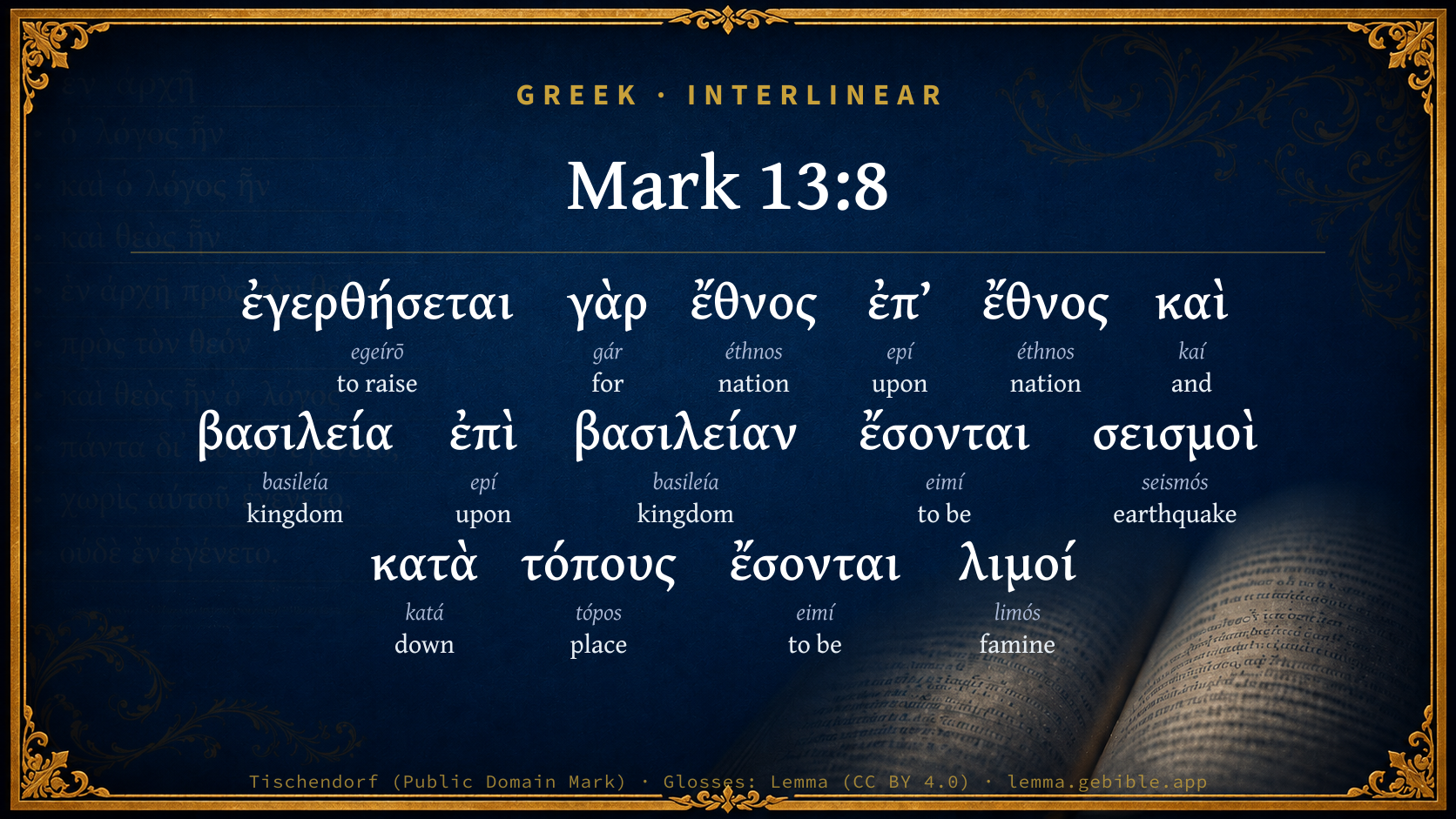
For nation will rise against nation, and kingdom against kingdom. There will be earthquakes in various places. There will be famines and troubles. These things are the beginning of birth pains.
Download a study sheet
One document with this verse’s original text, its word-by-word gloss line, the meaning frame, cross-references with their text, attributed commentary, and full source and license credits — printable, and it pastes into notes with its structure intact.
This verse Autodidact and up
A passage Seminary Student
Up to 50 verses in one chapter. A passage sheet keeps up to 6 commentary sources and 12 cross-references per verse, in the order this page ranks them, and says so on the sheet whenever that leaves anything out. Ask for a single verse and you get the Autodidact verse sheet above.
Everything on this page stays free to read, with no account — the sheet is a download of what is already on screen, not access to it.
Compare translations 3
The same verse in 3 English versions, stacked beneath the original-language interlinear above. Click any original word for its lexicon entry.
Each is an independent rendering of the whole verse — the interlinear is not word-aligned to these translations.
Highlighted words mark where these versions differ — a whole-verse word diff, not a word-by-word alignment.
-
World English Bible Public Domain
For nation will rise against nation, and kingdom against kingdom. There will be earthquakes in various places. There will be famines and troubles. These things are the beginning of birth pains.
-
King James Version Public Domain
For nation shall rise against nation, and kingdom against kingdom: and there shall be earthquakes in divers places, and there shall be famines and troubles: these are the beginnings of sorrows.
-
unfoldingWord Literal Text CC BY-SA 4.0
For nation will rise against nation, and kingdom against kingdom. There will be earthquakes in various places; there will be famines. These things the beginning of birth pains.
unfoldingWord Literal Text — © unfoldingWord, licensed CC BY-SA 4.0. Word-aligned USFM3 via Door43 (git.door43.org/unfoldingWord/en_ult).
Show all 19 translations
Every available English version of this verse, each an independent rendering of the whole verse.
-
World English Bible Public Domain
For nation will rise against nation, and kingdom against kingdom. There will be earthquakes in various places. There will be famines and troubles. These things are the beginning of birth pains.
-
Berean Standard Bible Public Domain
Nation will rise against nation, and kingdom against kingdom. There will be earthquakes in various places, as well as famines. These are the beginning of birth pains.
-
Majority Standard Bible Public Domain
Nation will rise against nation, and kingdom against kingdom. There will be earthquakes in various places, as well as famines and riots. These are the beginning of birth pains.
-
King James Version Public Domain
For nation shall rise against nation, and kingdom against kingdom: and there shall be earthquakes in divers places, and there shall be famines and troubles: these are the beginnings of sorrows.
-
American Standard Version (1901) Public Domain
For nation shall rise against nation, and kingdom against kingdom; there shall be earthquakes in divers places; there shall be famines: these things are the beginning of travail.
-
Revised Version (1885) Public Domain
For nation shall rise against nation, and kingdom against kingdom: there shall be earthquakes in divers places; there shall be famines: these things are the beginning of travail.
-
Geneva Bible (1599) Public Domain
For nation shall rise against nation, and kingdome against kingdome, and there shalbe earthquakes in diuers quarters, and there shalbe famine and troubles: these are the beginnings of sorowes.
-
Douay-Rheims (1899) Public Domain
For nation shall rise against nation and kingdom against kingdom, and there shall be earthquakes in divers places, and famines. These things are the beginning of sorrows.
-
Young's Literal Translation Public Domain
for nation shall rise against nation, and kingdom against kingdom, and there shall be earthquakes in divers places, and there shall be famines and troubles; beginnings of sorrows `are' these.
-
Literal Standard Version CC BY-SA 4.0
for nation will rise against nation, and kingdom against kingdom, and there will be earthquakes in various places, and there will be famines and troubles; these [are the] beginning of travails.
-
Unlocked Literal Bible CC BY-SA 4.0
For nation will rise against nation, and kingdom against kingdom. There will be earthquakes in many places, and famines. These are the beginnings of birth pains.
-
unfoldingWord Literal Text CC BY-SA 4.0
For nation will rise against nation, and kingdom against kingdom. There will be earthquakes in various places; there will be famines. These things the beginning of birth pains.
-
Darby Bible Public Domain
For nation shall rise up against nation, and kingdom against kingdom; and there shall be earthquakes in [different] places, and there shall be famines and troubles: these things [are the] beginnings of throes.
-
World Messianic Bible Public Domain
For nation will rise against nation, and kingdom against kingdom. There will be earthquakes in various places. There will be famines and troubles. These things are the beginning of birth pains.
-
Webster's Bible Public Domain
For nation will rise against nation, and kingdom against kingdom: and there will be earthquakes in divers places, and there will be famines, and troubles: these are the beginnings of sorrows.
-
Free Bible Version CC BY-SA 4.0
Nation will fight against nation, and kingdom against kingdom. There will be earthquakes in various places, and famines too. These are the beginnings of the world's birth pains.
-
Bible in Basic English Public Domain
Nation will go to war with nation, and kingdom with kingdom: there will be earth-shocks in different places; there will be times when there is no food; these things are the first of the troubles.
-
Text-Critical English NT CC BY 4.0
For nation will rise up against nation, and kingdom against kingdom. There will be earthquakes in various places, along with famines and riots. These are the beginning of the labor pains.
-
Tyndale New Testament (1534) Public Domain
For ther shall nacion aryse agaynste nacion and kyngdome agaynst kyngdome. And ther shalbe erth quakes in all quarters and famyshment and troubles. These are the begynnynge of sorowes.
Literal Standard Version (2020), Covenant Press — licensed CC BY-SA 4.0. Text via the HelloAO Bible API (eBible.org). Unlocked Literal Bible (unfoldingWord) — licensed CC BY-SA 4.0. Text via the HelloAO Bible API (eBible.org). unfoldingWord Literal Text — © unfoldingWord, licensed CC BY-SA 4.0. Word-aligned USFM3 via Door43 (git.door43.org/unfoldingWord/en_ult). Free Bible Version, Dr. Jonathan Gallagher — licensed CC BY-SA 4.0. Text via the HelloAO Bible API (eBible.org).
Word by word
More ways to search: Search by grammar → Find every occurrence → Compare this word →
Practice this passage: Drill this verse → Learn its vocabulary →
- Appears 12× in the Greek New Testament
- First appears at Matthew 24:7
- Part of Speech
- Noun
- Case
- Nominative
- Number
- Plural
- Gender
- Masculine
Full Thayer's Definition
- ἐγερθήσεται egeírō G1453 “to raise” Verb, Future, Passive, Indicative, 3rd person, Singular
- γὰρ gár G1063 “for” Conjunction
- ἔθνος éthnos G1484 “nation” Noun, Nominative, Singular, Neuter
- ἐπ’ epí G1909 “upon” Preposition
- ἔθνος éthnos G1484 “nation” Noun, Accusative, Singular, Neuter
- καὶ kaí G2532 “and” Conjunction
- βασιλεία basileía G932 “kingdom” Noun, Nominative, Singular, Feminine
- ἐπὶ epí G1909 “upon” Preposition
- βασιλείαν basileía G932 “kingdom” Noun, Accusative, Singular, Feminine
- ἔσονται eimí G1510 “to be” Verb, Future, Middle deponent, Indicative, 3rd person, Plural
- σεισμοὶ seismós G4578 “earthquake” Noun, Nominative, Plural, Masculine
- κατὰ katá G2596 “down” Preposition
- τόπους tópos G5117 “place” Noun, Accusative, Plural, Masculine
- ἔσονται eimí G1510 “to be” Verb, Future, Middle deponent, Indicative, 3rd person, Plural
- λιμοί limós G3042 “famine” Noun, Nominative, Plural, Masculine
About this verse
These counts appear in no published source. They are computed here, from the morphology-tagged text and Lemma’s own curated glosses. What Lemma adds →
- 15
- words
- 11
- distinct lemmas
- Gospels
- section
Cross-references
18Topical passages linked to Mark 13:8 in the Treasury of Scripture Knowledge — connected by theme and wording, ordered by reader-vote popularity; previews shown in the World English Bible.
- Psalms 48:6 Trembling took hold of them there, Pain, as of a woman in travail.
- Matthew 24:8 But all these things are the beginning of birth pains.
- Isaiah 37:3 They said to him, Thus says Hezekiah, This day is a day of trouble, and of rebuke, and of rejection; for the children have come to the birth, and there is no strength to bring forth.
- Haggai 2:22 I will overthrow the throne of kingdoms. I will destroy the strength of the kingdoms of the nations. I will overthrow the chariots, and those who ride in them. The horses and their riders will come down, everyone by the sword of his brother.
- 1 Thessalonians 5:3 For when they are saying, "Peace and safety," then sudden destruction will come on them, like birth pains on a pregnant woman; and they will in no way escape.
- Isaiah 19:2 I will stir up the Egyptians against the Egyptians: and they shall fight everyone against his brother, and everyone against his neighbor; city against city, [and] kingdom against kingdom.
- Jeremiah 6:24 We have heard the report of it; our hands wax feeble: anguish has taken hold of us, [and] pangs as of a woman in travail.
- Jeremiah 13:21 What will you say, when he shall set over you as head those whom you have yourself taught to be friends to you? shall not sorrows take hold of you, as of a woman in travail?
- Jeremiah 22:23 Inhabitant of Lebanon, who makes your nest in the cedars, how greatly to be pitied shall you be when pangs come on you, the pain as of a woman in travail!
- Jeremiah 25:32 Thus says Yahweh of hosts, Behold, evil shall go forth from nation to nation, and a great tempest shall be raised up from the uttermost parts of the earth.
- Jeremiah 49:24 Damascus has grown feeble, she turns herself to flee, and trembling has seized on her: anguish and sorrows have taken hold of her, as of a woman in travail.
- Jeremiah 50:43 The king of Babylon has heard the news of them, and his hands wax feeble: anguish has taken hold of him, [and] pangs as of a woman in travail.
- Micah 4:9–10 Now why do you cry out aloud? Is there no king in you? Has your counselor perished, That pains have taken hold of you as of a woman in travail?
- Zechariah 14:13 It will happen in that day, that a great panic from Yahweh will be among them; and they will lay hold everyone on the hand of his neighbor, and his hand will rise up against the hand of his neighbor.
- Acts 11:28 One of them named Agabus stood up, and indicated by the Spirit that there should be a great famine all over the world, which also happened in the days of Claudius.
- 2 Chronicles 15:6 They were broken in pieces, nation against nation, and city against city; for God did vex them with all adversity.
- Jeremiah 4:31 For I have heard a voice as of a woman in travail, the anguish as of her who brings forth her first child, the voice of the daughter of Zion, who gasps for breath, who spreads her hands, [saying], Woe is me now! for my soul faints before the murderers.
- Revelation 6:4 Another came forth, a red horse. To him who sat on it was given power to take peace from the earth, and that they should kill one another. There was given to him a great sword.
Cross-references courtesy of OpenBible.info (CC BY 4.0).
Where the printed editions differ
2 variantsPlaces in this verse where the major printed Greek editions disagree on the wording in a way that affects the translation — a comparison of editions, not a manuscript-by-manuscript collation. The editions are the modern critical texts (Nestlé-Aland 28/27, SBL, Westcott-Hort, Tregelles, Tyndale House) and the traditional texts behind the KJV (the Textus Receptus and the Byzantine/Majority text). It is not a claim about which reading is original.
-
Extra text
καὶ ταραχαί·
“and disturbance;”
In TRByz Not in NA28NA27TynSBLWHTregκαὶ ταραχαί· (kai tarachai) 'and disturbance;' is only in traditional manuscripts (TR+Byz)
-
Different wording
ἀρχὴ
“[The] beginning”
In NA28NA27TynSBLWHTreg Not in TRByzἀρχαὶ (archai) '[The] beginnings' occurs in traditional manuscripts (TR+Byz) instead of ἀρχὴ (archē) '[The] beginning' in older manuscripts (NA28+NA27+Tyn+SBL+WH+Treg)
Textual data: Translators Amalgamated Greek New Testament (STEPBible TAGNT) · CC BY 4.0.
Lesson kit
Teaching starters — assembled from the data on this page, not authored interpretation. Every prompt links to the verse data it draws on. Edit before teaching.
Mark, in the Gospels, opens this verse with 15 words (11 distinct Greek lemmas). Its most distinctive word is limós (“famine”). A historical commentator’s framing appears above. Read the whole chapter for the surrounding context.
Discussion questions
- What does “famine” (limós) contribute to the verse as a whole?
- How does Matthew 24:7, which shares the word «famine», read alongside this verse?
- What does the repetition of “nation” (2× in this one verse) do in this verse?
- These translations render this verse differently. What is at stake in choosing one wording over another?
- Compare how The Biblical Illustrator and The Expositor's Bible read this verse. Where do they agree or differ?
Things to notice
- These translations choose different wording for 11 words in this verse.
- “nation” occurs 2× in this single verse.
- 11 distinct Greek lemmas span 15 words in this verse.
Commentary
Notes on Mark 13:8 from classic Christian and Jewish commentators (each source and its license shown beneath its notes). The classic Christian expositions comment on the surrounding passage and are grouped to its opening verse, so a note may address several verses; the Jewish commentaries on the Tanakh (Rashi and others) are per-verse, so they appear only where the commentator wrote on this verse.
Lemma curates 59 commentaries, every one of them public domain or Creative Commons licensed, each selected and text-cleaned for this edition rather than reprinted as found. About our sources →
The Biblical Illustrator
Joseph S. Exell
The Biblical Illustrator, edited by Joseph S. Exell (c. 1880s–1900s) — public domain. Text from a community e-Sword module.
The Expositor's Bible
William Robertson Nicoll, ed., The Expositor's Bible (London: Hodder & Stoughton, 1887–1910) — public domain. 65 of 66 books (1 Corinthians is not separately keyed, as that volume carries no machine-parseable verse references); section-level commentary keyed to the opening verse. Introductory and overview sections not keyed to a specific passage are excluded.
Bengel's Gnomon
Johann Albrecht Bengel
Bengel's Gnomon of the New Testament — English translation (T&T Clark, Edinburgh, 1860) — public domain. Text from a community e-Sword module.
Expositor's Greek Testament
ed. W. Robertson Nicoll
The Expositor's Greek Testament, edited by W. Robertson Nicoll (1897–1910) — public domain. Text from a community e-Sword module.
Adam Clarke's Commentary
Adam Clarke's Commentary on the Bible (1810–1826) — public domain. Text from a community e-Sword/MySword module.
The Cambridge Bible for Schools and Colleges
gen. ed. J. J. S. Perowne
The Cambridge Bible for Schools and Colleges (gen. ed. J. J. S. Perowne; Cambridge University Press, 1878–1918) — public domain. Text from a community e-Sword module.
John Gill's Exposition
John Gill's Exposition of the Whole Bible (1746–1763) — public domain (CC PDM 1.0). Text via the HelloAO Bible API.
Trapp's Complete Commentary
John Trapp
John Trapp, A Commentary or Exposition upon All the Books of the Old and New Testament (1647–1656) — public domain. Text from a community e-Sword module.
Whedon's Commentary on the Bible
Daniel D. Whedon
Daniel D. Whedon (gen. ed.), Commentary on the Old and New Testaments (1874–1909) — public domain. Text from a community e-Sword module.
Scofield Reference Notes
C. I. Scofield
The Scofield Reference Bible (1917 edition), notes by C. I. Scofield — public domain. Text from a community e-Sword module.
Cambridge Greek Testament for Schools and Colleges
Cambridge Greek Testament for Schools and Colleges (Cambridge University Press, 1896; 21 vols, various authors incl. Carr, Maclear, Plummer, Farrar, Lumby, Moule, M. R. James, Simcox) — public domain. Text from a community e-Sword module.
Alford’s Greek Testament
Henry Alford
Henry Alford, The Greek Testament (1849–1861) — public domain. Text from a community e-Sword module.
International Critical Commentary
International Critical Commentary — older volumes (1896–1929), various authors — public domain. Text from a community e-Sword module.