
Galatians 3:8

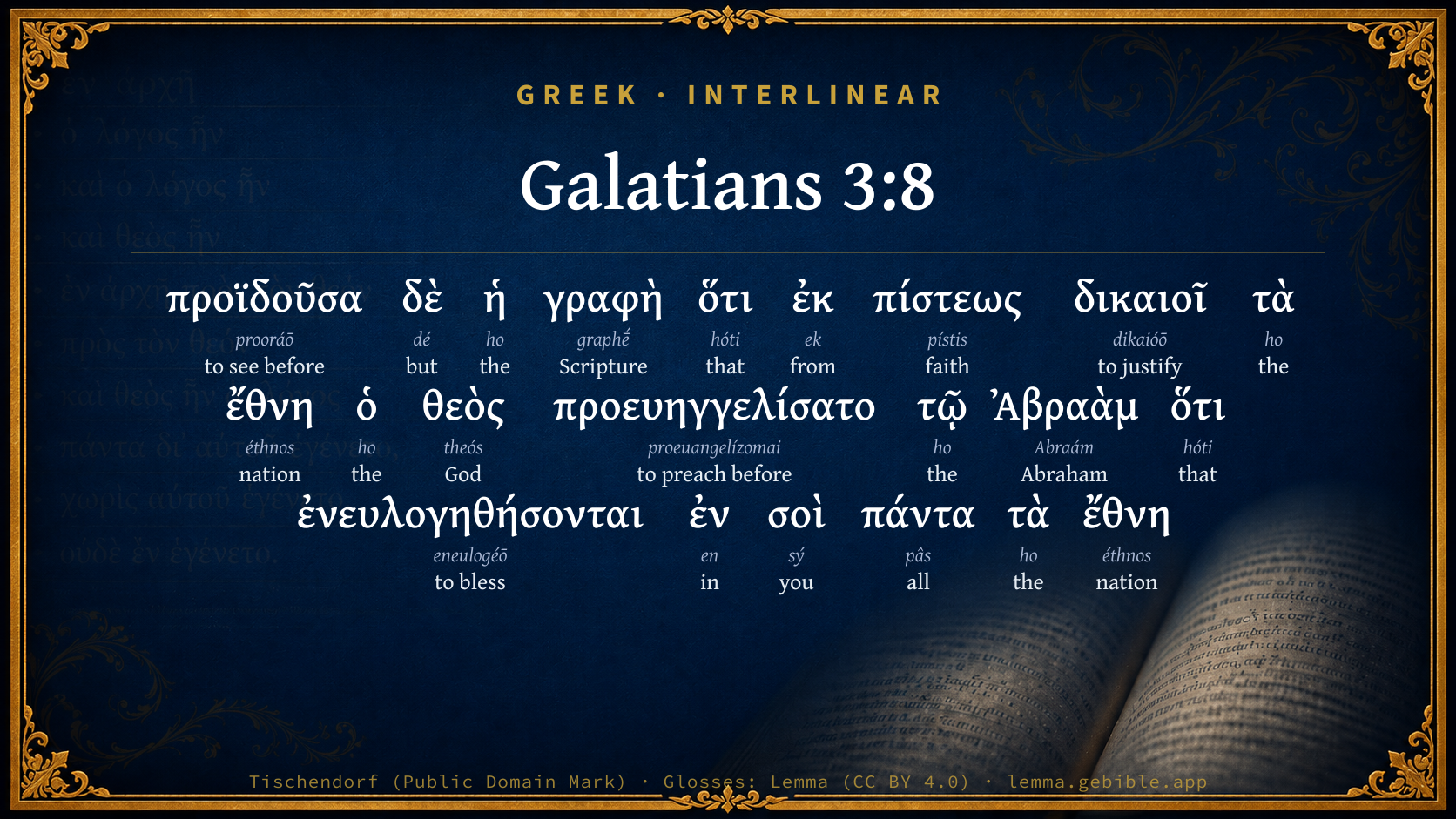
Greek (Tischendorf 8th ed.) Galatians 3:8 appears in the Greek New Testament. The text above is from the Tischendorf 8th edition. Each word links to its Strong’s number and a concise gloss. Click any word for its full Thayer’s Greek Lexicon entry.
Download image
Cite this verse

Galatians 3:8 (World English Bible). Public Domain. Lemma interlinear Bible study tool, https://lemma.gebible.app/v/galatians/3/8.

Show BibTeX & RIS
BibTeX
RIS
English Translation
The Scripture, foreseeing that God would justify the Gentiles by faith, preached the Gospel beforehand to Abraham, saying, "In you all the nations will be blessed."
World English Bible · Public Domain
Highlights
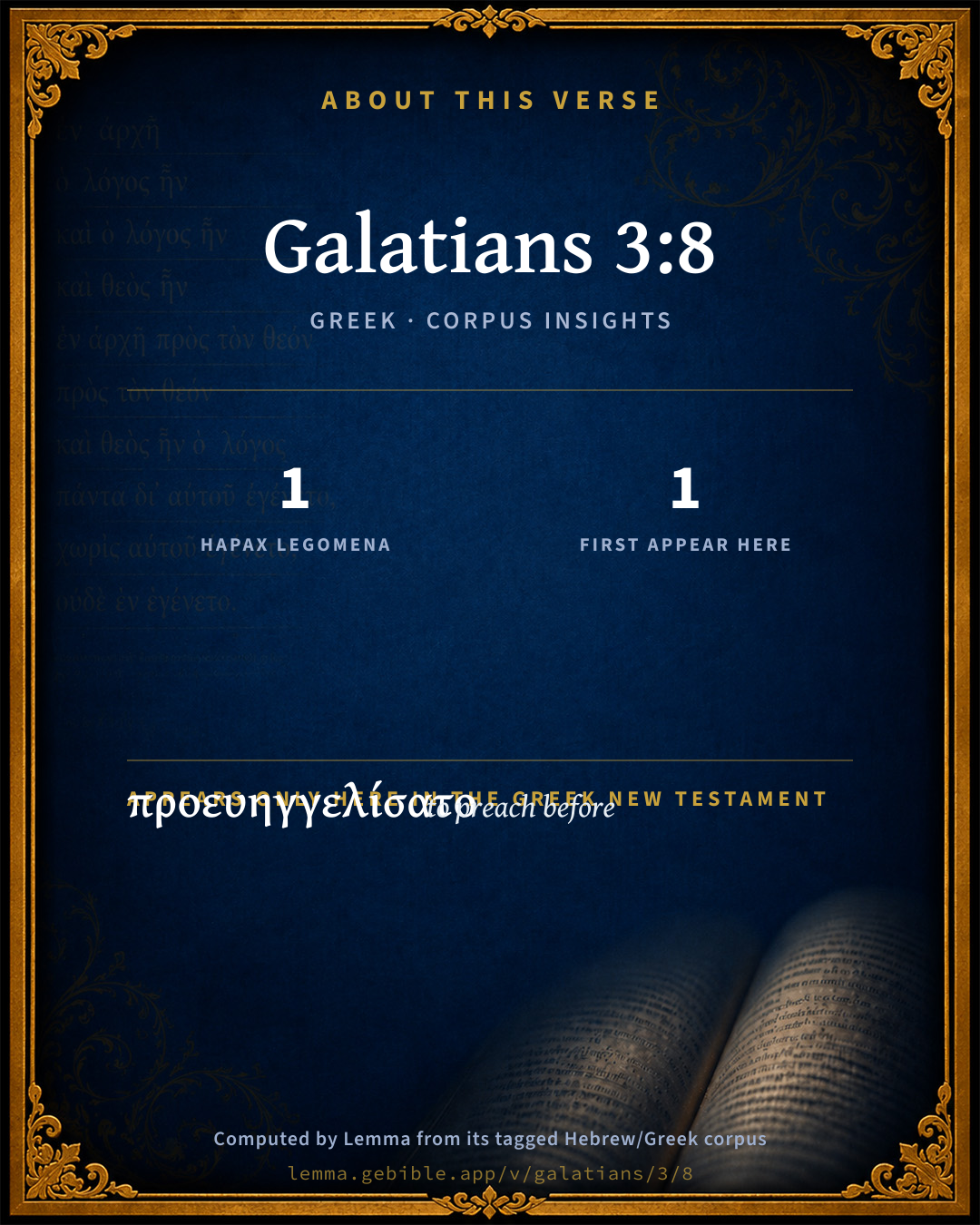
  • 1 hapax legomenon — only here in the Greek New Testament
  • 1 first appearance in the Greek New Testament
Full analysis ↓
Download a study sheet

One document with this verse’s original text, its word-by-word gloss line, the meaning frame, cross-references with their text, attributed commentary, and full source and license credits — printable, and it pastes into notes with its structure intact.

This verse Autodidact and up

Study sheet (.html) Plain text (.txt)

A passage Seminary Student

Up to 50 verses in one chapter. A passage sheet keeps up to 6 commentary sources and 12 cross-references per verse, in the order this page ranks them, and says so on the sheet whenever that leaves anything out. Ask for a single verse and you get the Autodidact verse sheet above.

Everything on this page stays free to read, with no account — the sheet is a download of what is already on screen, not access to it.

Want to remove ads? Support Godless Engineer
Compare translations 3

The same verse in 3 English versions, stacked beneath the original-language interlinear above. Click any original word for its lexicon entry.

Each is an independent rendering of the whole verse — the interlinear is not word-aligned to these translations.

Highlighted words mark where these versions differ — a whole-verse word diff, not a word-by-word alignment.

  • World English Bible Public Domain
    The Scripture, foreseeing that God would justify the Gentiles by faith, preached the Gospel beforehand to Abraham, saying, "In you all the nations will be blessed."
  • King James Version Public Domain
    And the scripture, foreseeing that God would justify the heathen through faith, preached before the gospel unto Abraham, saying, In thee shall all nations be blessed.
  • unfoldingWord Literal Text CC BY-SA 4.0
    And the Scripture, having foreseen that God would justify the Gentiles by faith, preached the gospel beforehand to Abraham, “In you all the nations will be blessed.”

unfoldingWord Literal Text — © unfoldingWord, licensed CC BY-SA 4.0. Word-aligned USFM3 via Door43 (git.door43.org/unfoldingWord/en_ult).

Versions to compare (up to 4)

3 of 4 selected

Show all 19 translations

Every available English version of this verse, each an independent rendering of the whole verse.

  • World English Bible Public Domain
    The Scripture, foreseeing that God would justify the Gentiles by faith, preached the Gospel beforehand to Abraham, saying, "In you all the nations will be blessed."
  • Berean Standard Bible Public Domain
    The Scripture foresaw that God would justify the Gentiles by faith, and foretold the gospel to Abraham: “All nations will be blessed through you.”
  • Majority Standard Bible Public Domain
    The Scripture foresaw that God would justify the Gentiles by faith, and foretold the gospel to Abraham: “All nations will be blessed through you.”
  • King James Version Public Domain
    And the scripture, foreseeing that God would justify the heathen through faith, preached before the gospel unto Abraham, saying, In thee shall all nations be blessed.
  • American Standard Version (1901) Public Domain
    And the scripture, foreseeing that God would justify the Gentiles by faith, preached the gospel beforehand unto Abraham, `saying,' In thee shall all the nations be blessed.
  • Revised Version (1885) Public Domain
    And the scripture, foreseeing that God would justify the Gentiles by faith, preached the gospel beforehand unto Abraham, saying, In thee shall all the nations be blessed.
  • Geneva Bible (1599) Public Domain
    For the Scripture foreseeing, that God would iustifie the Gentiles through faith, preached before the Gospel vnto Abraham, saying, In thee shall all the Gentiles be blessed.
  • Douay-Rheims (1899) Public Domain
    And the scripture, foreseeing, that God justifieth the Gentiles by faith, told unto Abraham before: In thee shall all nations be blessed.
  • Young's Literal Translation Public Domain
    and the Writing having foreseen that by faith God doth declare righteous the nations did proclaim before the good news to Abraham --
  • Literal Standard Version CC BY-SA 4.0
    and the Writing, having foreseen that God declares righteous the nations by faith, foretold the good news to Abraham:
  • Unlocked Literal Bible CC BY-SA 4.0
    The scripture, foreseeing that God would justify the Gentiles by faith, preached the gospel beforehand to Abraham, saying, “In you all the nations will be blessed.”
  • unfoldingWord Literal Text CC BY-SA 4.0
    And the Scripture, having foreseen that God would justify the Gentiles by faith, preached the gospel beforehand to Abraham, “In you all the nations will be blessed.”
  • Darby Bible Public Domain
    and the scripture, foreseeing that God would justify the nations on the principle of faith, announced beforehand the glad tidings to Abraham: In thee all the nations shall be blessed.
  • World Messianic Bible Public Domain
    The Scripture, foreseeing that God would justify the Gentiles by faith, preached the Good News beforehand to Abraham, saying, “In you all the nations will be blessed.”
  • Webster's Bible Public Domain
    And the scripture foreseeing that God would justify the heathen through faith, preached before the gospel to Abraham, saying, In thee shall all nations be blessed.
  • Free Bible Version CC BY-SA 4.0
    In Scripture it was foreseen that God would make right the foreigners who trusted in him. The good news is revealed to Abraham beforehand with the words, “Through you all the nations will be blessed.”
  • Bible in Basic English Public Domain
    And the holy Writings, seeing before the event that God would give the Gentiles righteousness by faith, gave the good news before to Abraham, saying, In you will all the nations have a blessing.
  • Text-Critical English NT CC BY 4.0
    Now the Scripture, foreseeing that God would justify the Gentiles by faith, preached the gospel beforehand to Abraham, saying, “All the nations will be blessed in yoʋ.”
  • Tyndale New Testament (1534) Public Domain
    For the scripture sawe afore honde that God wolde iustifie the hethen thorow fayth and therfore shewed before honde glad tydinges vnto Abraham: In the shall all nacions be blessed.

Literal Standard Version (2020), Covenant Press — licensed CC BY-SA 4.0. Text via the HelloAO Bible API (eBible.org). Unlocked Literal Bible (unfoldingWord) — licensed CC BY-SA 4.0. Text via the HelloAO Bible API (eBible.org). unfoldingWord Literal Text — © unfoldingWord, licensed CC BY-SA 4.0. Word-aligned USFM3 via Door43 (git.door43.org/unfoldingWord/en_ult). Free Bible Version, Dr. Jonathan Gallagher — licensed CC BY-SA 4.0. Text via the HelloAO Bible API (eBible.org).

Word by word

More ways to search: Search by grammar → Find every occurrence → Compare this word →

Practice this passage: Drill this verse → Learn its vocabulary →

προευηγγελίσατο
proeuangelízomai
G4283
“to preach before”
Verb, Aorist, Middle deponent, Indicative, 3rd person, Singular
Part of Speech
Verb
Tense
Aorist
Voice
Middle deponent
Mood
Indicative
Person
3rd person
Number
Singular
Full Thayer's Definition

Origin: middle voice from G4253 and G2097

TDNT: 14:17,3

1. to announce or promise glad tidings beforehand
  1. προϊδοῦσα prooráō G4308 “to see before” Verb, Aorist, Active, Participle, Nominative, Singular, Feminine
  2. δὲ dé G1161 “but” Conjunction
  3. ἡ ho G3588 “the” Article, Nominative, Singular, Feminine
  4. γραφὴ graphḗ G1124 “Scripture” Noun, Nominative, Singular, Feminine
  5. ὅτι hóti G3754 “that” Conjunction
  6. ἐκ ek G1537 “from” Preposition
  7. πίστεως pístis G4102 “faith” Noun, Genitive, Singular, Feminine
  8. δικαιοῖ dikaióō G1344 “to justify” Verb, Present, Active, Indicative, 3rd person, Singular
  9. τὰ ho G3588 “the” Article, Accusative, Plural, Neuter
  10. ἔθνη éthnos G1484 “nation” Noun, Accusative, Plural, Neuter
  11. ὁ ho G3588 “the” Article, Nominative, Singular, Masculine
  12. θεὸς theós G2316 “God” Noun, Nominative, Singular, Masculine
  13. τῷ ho G3588 “the” Article, Dative, Singular, Masculine
  14. Ἀβραὰμ Abraám G11 “Abraham” Noun, Proper, indeclinable
  15. ὅτι hóti G3754 “that” Conjunction
  16. ἐνευλογηθήσονται eneulogéō G1757 “to bless” Verb, Future, Passive, Indicative, 3rd person, Plural
  17. ἐν en G1722 “in” Preposition
  18. σοὶ sý G4771 “you” Personal pronoun, 2nd person, Dative, Singular
  19. πάντα pâs G3956 “all” Adjective, Nominative, Plural, Neuter
  20. τὰ ho G3588 “the” Article, Nominative, Plural, Neuter
  21. ἔθνη éthnos G1484 “nation” Noun, Nominative, Plural, Neuter

About this verse

These counts appear in no published source. They are computed here, from the morphology-tagged text and Lemma’s own curated glosses. What Lemma adds →

22
words
16
distinct lemmas
Pauline Epistles
section

Notable vocabulary

1 hapax legomenon — a word that appears only here in the entire Greek New Testament:

  • προευηγγελίσατο to preach before G4283

First appearance in Scripture

This word makes its first canonical appearance in the Greek New Testament here:

  • προευηγγελίσατο to preach before G4283

Shared distinctive vocabulary

ἐνευλογηθήσονται to bless G1757 occurs in 2 verses of the Greek New Testament. Also found in:
Repetition

Words recur within this verse:

Cross-references

24

Topical passages linked to Galatians 3:8 in the Treasury of Scripture Knowledge — connected by theme and wording, ordered by reader-vote popularity; previews shown in the World English Bible.

  • Genesis 12:3 I will bless those who bless you, and I will curse him who curses you. In you will all of the families of the earth be blessed."
  • Genesis 22:18 In your seed will all the nations of the earth be blessed, because you have obeyed my voice."
  • Genesis 28:14 Your seed will be as the dust of the earth, and you will spread abroad to the west, and to the east, and to the north, and to the south. In you and in your seed will all the families of the earth be blessed.
  • Genesis 18:18 seeing that Abraham has surely become a great and mighty nation, and all the nations of the earth will be blessed in him?
  • Genesis 26:4 I will multiply your seed as the stars of the sky, and will give to your seed all these lands. In your seed will all the nations of the earth be blessed,
  • Romans 3:28–30 We maintain therefore that a man is justified by faith apart from the works of the law.
  • Hebrews 4:2 For indeed we have had good news preached to us, even as they also did, but the word they heard didn't profit them, because it wasn't mixed with faith by those who heard.
  • Galatians 3:22 But the Scriptures shut up all things under sin, that the promise by faith in Jesus Christ might be given to those who believe.
  • Genesis 49:10 The scepter will not depart from Judah, Nor the ruler's staff from between his feet, Until he comes to whom it belongs. To him will the obedience of the peoples be.
  • John 7:38 He who believes in me, as the Scripture has said, from within him will flow rivers of living water."
  • Acts 15:15–18 This agrees with the words of the prophets. As it is written,
  • Galatians 3:16 Now the promises were spoken to Abraham and to his seed. He doesn't say, "To seeds," as of many, but as of one, "To your seed," which is Christ.
  • Isaiah 65:9 I will bring forth a seed out of Jacob, and out of Judah an inheritor of my mountains; and my chosen shall inherit it, and my servants shall dwell there.
  • Romans 9:17 For the Scripture says to Pharaoh, "For this very purpose I caused you to be raised up, that I might show in you my power, and that my name might be published abroad in all the earth."
  • Romans 9:30 What shall we say then? That the Gentiles, who didn't follow after righteousness, attained to righteousness, even the righteousness which is of faith;
  • 2 Timothy 3:15–17 From infancy, you have known the sacred writings which are able to make you wise for salvation through faith, which is in Christ Jesus.
  • Revelation 11:15 The seventh angel sounded, and great voices in heaven followed, saying, "The kingdom of the world has become the Kingdom of our Lord, and of his Christ. He will reign forever and ever!"
  • Psalms 72:7 In his days, the righteous shall flourish, And abundance of peace, until the moon is no more.
  • Isaiah 6:13 If there are yet a tenth in it, It also shall in turn be eaten up: As a terebinth, and as an oak, whose stock remains, when they are felled; So the holy seed is its stock."
  • John 7:42 Hasn't the Scripture said that the Christ comes of the seed of David, and from Bethlehem, the village where David was?"
  • Acts 2:35 Until I make your enemies a footstool for your feet."'
  • Galatians 4:30 However what does the Scripture say? "Throw out the handmaid and her son, for the son of the handmaid will not inherit with the son of the free woman."
  • John 19:37 Again another Scripture says, "They will look on him whom they pierced."
  • Acts 2:25–26 For David says concerning him, 'I saw the Lord always before my face, For he is on my right hand, that I should not be moved.

Cross-references courtesy of OpenBible.info (CC BY 4.0).

Commentary

Notes on Galatians 3:8 from classic Christian and Jewish commentators (each source and its license shown beneath its notes). The classic Christian expositions comment on the surrounding passage and are grouped to its opening verse, so a note may address several verses; the Jewish commentaries on the Tanakh (Rashi and others) are per-verse, so they appear only where the commentator wrote on this verse.

Lemma curates 59 commentaries, every one of them public domain or Creative Commons licensed, each selected and text-cleaned for this edition rather than reprinted as found. About our sources →

The Biblical Illustrator

Joseph S. Exell

Gal_3:8

And the Scripture foreseeing that God would justify the heathen through faith.

The Scripture foreseeing

I. God foresaw that He would justify the heathen through faith.

II. Foreseeing this issue, God announced it by word of mouth to Abraham.

III. Moses recorded it in the spirit of prophecy.

IV. Paul justifies this use of scripture here, and in Rom_15:1-4, and 1Co_10:1-11. See also 1Pe_1:11-12.

V. We may apply it to the New Testament.

1. The Scripture foresaw and provided against the doctrine of the supremacy of Peter, which is the foundation of the Papal claims (Gal_2:11, etc.; Eph_2:20; 1Pe_5:1-3).

2. Against mariolatry (Luk_8:21; Luk_9:28). (Dean Goulburn.)

The foresight of Scripture

The Old Testament is endowed with foresight of the New; the New with foresight of things that should come after in the history of the Church. The Scripture expresses the prescience of its Divine Author. Nor is there any ground for confining this prescience to great events, and the solemn crises of ecclesiastical history. God foresaw us, with the circumstances into which we should be thrown, the characters which we should exhibit, the temptations to which we should be subjected. Writing in the spirit of foresight we may well conceive then that He has dropped a word for each one of us somewhere in His book, and that this word will find us out, and come home to us if we study it under the light of prayer. (Dean Goulburn.)

The gospel

I. Its antiquity--preached to Abraham.

II. Its universality.

1. In its objects: heathen, all nations.

2. In its terms: faith.

III. The slowness but sureness of its development: foreseeing.

IV. Its gratuitousness: justification

V. Its blessedness.

1. Fellowship in Abrahams privileges on earth.

2. Fellowship with Abraham in heaven.

The universality of the gospel. Salvation is for all the sinful family of man. The plan is vast, immense, worthy of God. The arms of Divine love are open to embrace all. All nations are invited to the life-giving waters of Gods grace. Let the sons of wealth come, and they shall be welcome; let the hardy sons of toil come, and they shall quench their thirst; let the ignorant come, and they shall be made wise unto salvation; let the young come, and Godwill be their guide through life; let the aged come, and they shall find peace at the eleventh hour. (Thomas Jones.)

The worst are justified by faith

Mr. Fleming, in his Fulfilling of the Scriptures, relates the case of a man who was a very great sinner, and for his horrible wickedness was put to death in the town of Ayr. This man had been so stupid and brutish a fellow, that all who knew him thought him beyond the reach of all ordinary means of grace; but while the man was in prison, the Lord wonderfully wrought on his heart, and in such a measure discovered to him his sinfulness, that after much serious exercise and sore wrestling, a most kindly work of repentance followed, with great assurance of mercy, insomuch, that when he came to the place of execution, he could not cease crying out to the people, under the sense of pardon, and the comforts of the presence and favour of God,--O, He is a great forgiver! He is a great forgiver! And he added the following words,--Now hath perfect love cast out fear. I know God hath nothing to lay against me, for Jesus Christ hath paid all; and those are free whom the Son makes free.

The gospel is

I. Old as Abraham: the promise given to him contained the spirit of it--the assurance of it--the power of it, for he was justified by faith.

II. Comprehensive as the world: it includes all nations--offers them the same privileges--on the same terms.

III. Unchangeable as God: it is His purpose.

foreseen and predicted--steadily advancing with the course of time--must be fully accomplished in the happiness of all nations. (J. Lyth.)

The Biblical Illustrator, edited by Joseph S. Exell (c. 1880s–1900s) — public domain. Text from a community e-Sword module.

Tyndale Open Study Notes

Tyndale Open Resources

3:8 the Scriptures looked forward: By faith, Abraham foresaw the coming Messiah (cp. John 8:56) and received the message that “All nations will be blessed through you” (Gen 12:3; 18:18; 22:18).Through Abraham’s offspring, the Messiah, God would accept all nations on the same basis as Abraham himself—by faith.

Tyndale Open Study Notes — © Tyndale Open Resources, licensed CC BY-SA 4.0. Text via the HelloAO Bible API.

Bengel's Gnomon

Johann Albrecht Bengel

Gal 3:8. Προιδοῦσα δὲ, but [and moreover] foreseeing) Δὲ, but [and moreover] being an emphatic addition (ἐπιτατικὸν), extends the force of the argument to the Gentiles also. The term foreseeing implies divine foreknowledge, more ancient than the law. The great excellence of sacred Scripture is, that all the points likely to be controverted are foreseen and decided in it, even in the most appropriate language.—ἡ γραφὴ, scripture) A mode of expression abbreviated and condensed in a manifold degree, as will be evident to him who evolves the ideas involved in it, thus; it is God who has given testimony to these things; God foreknew that He would act in this manner with the Gentiles; God therefore already at that time acted in a similar manner with Abraham; God also caused it to be consigned to writing, and that too when at the time that it was written, it was still future. All these things are included in that expression, foreseeing —— All these ideas could not be so briefly expressed in our mode of speaking, otherwise [or if they could] they might be considered obscure. But the ardour of the apostle’s mind, which, being filled with the Spirit, was directed to one topic, and that too of principal importance, produces this effect [the combination of great brevity with freedom from obscurity]. What was spoken to Abraham, was written out in the time of Moses.—ἐκ πίστεως, by faith) not by works.—δικαιοῖ, justifies [instead of would justify]) The present, in respect of Paul then writing; so, they have the blessing [are blessed, εὐλογοῦνται], Gal 3:9.—προευηγγελίσατο, preached the Gospel before) A word, which very sweetly approaches to a Catachresis.[22] The Gospel was preached to Abraham before the times of the Gospel. The Gospel is therefore older than the law.—ἐνευλογηθήσονται) ונברכו Gen 12:3: then more expressly והתברכו Gen 22:18; Psa 72:17. There is the mere promise of blessing; nothing is said as to works. Moreover, justification and blessing are conjoined. At the same time the nature of faith is evident from the form of the Hebrew verb: they shall bless themselves, they shall congratulate themselves regarding the blessing. Isa 65:16; comp. Deu 29:18.—ἘΝ ΣΟῚ, in thee) as in the father of the Messiah; therefore much more in Messiah [Himself]. The Gentiles, as believers in Christ, are the seed of Abraham. Seed first, then blessing, was promised to Abraham. Add note to Gal 3:16.

[22] See Append. A turning aside of the term Gospel here from its strict sense, in order to apply it to what was akin to it, viz. the promise given to Abraham.—ED.

Bengel's Gnomon of the New Testament — English translation (T&T Clark, Edinburgh, 1860) — public domain. Text from a community e-Sword module.

Meyer's Critical & Exegetical Commentary

Heinrich August Wilhelm Meyer

Gal_3:8. Δέ] marks the transition from the sonship of Abraham pertaining to believers to the participation in his blessing.

προϊδοῦσα] personification. Comp. Gal_3:22; Rom_4:3; Rom_9:17; Joh_7:38. The Scripture foresaw and the Scripture announced beforehand, inasmuch as whatever God foresaw and announced beforehandin reference, namely, to that which is at present taking placeformed an element of Scripture, and was expressed in it. Comp. the frequent λέγει ἡ γραφή; likewise Siphra, f. 186. Galatians 2 : Quid vidit (ראה) scriptura, etc.

ἐκ πίστεως] is the main point of the participial sentence: of faith, not of the works of the law as the causal condition on the side of man.

δικαιοῖ] present, for the time foreseen (προϊδοῦσα) was the Christian present.

τὰ ἔθνη] the Gentiles (comp. Gal_3:14), so that the latter have not to subject themselves to the law in order to become righteous.

προευηγγελίσατο] pre-announced the glad tidings. προ refers, as in προϊδοῦσα, to the future realization in Christian times. This promise was a gospel before the gospel. The word does not occur elsewhere in the New Test., in the LXX., or the Apocrypha; but it is found in Philo, de opif m. p. 7 A, de rum. mut. p. 1069 D; also Schol. Soph. Trach. 335.

ὅτι ἐνευλογηθήσ. ἐν σοὶ πάντα τὰ ἔθνη] Gen_12:3, quoted according to the LXX. with the recitative ὅτι, but so that, instead of πᾶσαι αἱ φυλαὶ τῆς γῆς, πάντα τὰ ἔθνη is adopted from Gen_18:18 (comp. also Gen_22:18); and this not accidentally, but because Paul is dealing with Gentile Christians, whom it was desired to subject to the law. Hence (and see Gal_3:14) it is not to be explained (with Winer, Matthias, Schott, Baumgarten-Crusius, following earlier expositors) of all nations, both Jews and Gentiles.

The emphasis in this utterance of promise is to be laid, not on πάντα (Schott), but on the prefixed ἐνευλογηθήσονται. For if the Scripture had not foreseen that faith would justify the Gentiles, it would not have promised blessing in Abraham to all the Gentiles; from which it follows (Gal_3:10) that it is believers who receive this blessing, and not those of the law, on whom indeed the Scripture pronounces not blessing, but curse (Gal_3:10). The characteristic ἐνευλογ. can only be meant to apply to those who are of faith, and not to those who are of the law. What it is that in Pauls view is expressed by ἐνευλογεῖσθαι, Gen_12:3, in its Messianic fulfilment, is evident from the preceding ὅτι ἐκ πίστεως δικαιοῖ τὰ ἔθνη, namely, Gods gracious gift of justification (the opposite of the κατάρα, Gal_3:10-11), which, because it is promised as blessing, can only be shared by believers, and not by those of the law who are under curse.[122] The correctness of this view is certainly confirmed by Gal_3:14, where to the reception of the blessing there is annexed, as a further reception, that of the Holy Spirit, so that the bestowal of the Spirit is not included in the idea of the εὐλογία, but this idea is limited in conformity with the context to the justification, with which the whole reception of salvation begins.

ἘΝ ΣΟΊ is not: per tuam posteritatem, i.e. Christum (Jerome, Oecumenius, Menochius, Estius, Calovius, Rambach, Morus, Borger, Flatt, Schott; comp. also Bengel), by which interpretation the personal σοί (and how much at variance with Gal_3:9!) is entirely set aside, as if ἘΝ Τῷ ΣΠΈΡΜΑΤΊ ΣΟΥ (Gal_3:16) were used. But it is: in thee; that is, in the fact that thou art blessed (art justified) is involved (as a consequence) the blessedness of all the Gentiles, in so far as all the Gentiles are to attain justification by faith, and it is in the blessing of Abraham, the father of all the faithful (Romans 4.), that the connection between faith and justification is opened and instituted for all future time. Comp. Ellicott. On ἐνευλογεῖσθαι, to be blessed in the person of any one, a word which does not occur in Greek authors, comp. Act_3:25, Sir_44:21.

[122] De Wette, who is followed by Wieseler, understands the blessing to be the whole salvation of the kingdom of God,an idea too comprehensive for the context. Bähr (in Stud. u. Krit. 1849, p. 920) erroneously concludes from Gal_3:14, that by the blessing is meant the reception of the Spirit. See on Gal_3:14. This reception, as well as the Messianic salvation generally,or, the good which is intended for mankind, as Hofmann puts it,ensues as a consequence of the εὐλογία, as the Messianic ἀπώλεια ensues as a consequence of the κατάρα, if the latter, as in the case of those who adhere to the works of the law, is not cancelled (Gal_3:10). The εὐλογία, therefore, is not yet the blessing of Messianic salvation itself, the κληρονομία, but, as Hunnius (in Calovius) aptly explains it, Benedici in hac promissione est liberari maledictione legis aeternae et vicissim haeredem scribi justitiae et bonorum coelestium. Grotius is much too indefinite: Summa bena adipiscentur. Also Ewalds paraphrase, the blessing of the true religion, is too general. Beza, Usteri, Rückert, take the right view; comp. also Möller (on de Wette) and Reithmayr.

Gal_3:8-9. After having pointed out from the Scripture that none other than believers are sons of Abraham, Paul now shows further according to Scripture that none other than these have a share in Abrahams blessing, that is, are justified.

Meyer — Critical and Exegetical Commentary on the New Testament — English translation by Peter Christie, edited by Frederick Crombie (T&T Clark, 1880) — public domain. Text from a community e-Sword module.

Expositor's Greek Testament

ed. W. Robertson Nicoll

Gal 3:8 . δικαιοῖ : justifieth . The present tense is used because justification by faith, though not revealed to the Gentiles till Christ came, was an eternal truth of God’s dealings with man, to be revealed in due time. There were in Genesis anticipations of this truth, and Abraham himself, the father of the faithful, was a kind of firstfruits of the Gentiles (Rom 4:10-12 ). The quotation here given contains the substance of promises recorded in Gen 12:3 ; Gen 18:18 with slight verbal alteration. These were an earlier Gospel, but not (as our versions intimate) the Gospel.

The Expositor's Greek Testament, edited by W. Robertson Nicoll (1897–1910) — public domain. Text from a community e-Sword module.

Geneva Bible (1599)

Geneva Bible translators

Blessing in this place, signifieth the free promise by faith.

A proof of the first and second grounds, out of the words of Moses.

The third, that all people that believe, are without exception, comprehended in the promise of the blessing.

Geneva Bible (1599) marginal notes — public domain. Text via Bolls.life.

Jamieson, Fausset & Brown

Robert Jamieson, A. R. Fausset & David Brown

And--Greek, "Moreover."

foreseeing--One great excellency of Scripture is, that in it all points liable ever to be controverted, are, with prescient wisdom, decided in the most appropriate language.

would justify--rather, "justifieth." Present indicative. It is now, and at all times, God's one way of justification.

the heathen--rather, "the Gentiles"; or "the nations," as the same Greek is translated at the end of the verse. God justifieth the Jews, too, "by faith, not by works." But he specifies the Gentiles in particular here, as it was their case that was in question, the Galatians being Gentiles.

preached before the gospel--"announced beforehand the Gospel." For the "promise" was substantially the Gospel by anticipation. Compare Joh 8:56; Heb 4:2. A proof that "the old fathers did not look only for transitory promises" [Article VII, Church of England]. Thus the Gospel, in its essential germ, is older than the law though the full development of the former is subsequent to the latter.

In thee--not "in thy seed," which is a point not here raised; but strictly "in thee," as followers of thy faith, it having first shown the way to justification before God [ALFORD]; or "in thee," as Father of the promised seed, namely, Christ (Gal 3:16), who is the Object of faith (Gen 22:18; Psa 72:17), and imitating thy faith (see on Gal 3:9).

all nations--or as above, "all the Gentiles" (Gen 12:3; Gen 18:18; Gen 22:18).

be blessed--an act of grace, not something earned by works. The blessing of justification was to Abraham by faith in the promise, not by works. So to those who follow Abraham, the father of the faithful, the blessing, that is, justification, comes purely by faith in Him who is the subject of the promise.

Jamieson, Fausset & Brown — Commentary Critical and Explanatory on the Whole Bible (1871) — public domain (CC PDM 1.0). Text via the HelloAO Bible API.

Adam Clarke's Commentary

Verse 8. The Scripture, foreseeing] See the notes on Ro 4:3-16. As God intended to justify the heathen through faith, he preached the Gospel that contains the grand display of the doctrine of salvation by faith, before, to Abraham, while he was in his heathen state; and thus he is called the father of believers: therefore it must refer to them who shall believe the same Gospel among the Gentiles; and, as the door of faith was open to all the Gentiles, consequently the promise was fulfilled: In thee shall all the nations of the earth be blessed.

Adam Clarke's Commentary on the Bible (1810–1826) — public domain. Text from a community e-Sword/MySword module.

John Calvin's Commentaries

8. The scripture foreseeing. What he had said in a general manner is now applied expressly to the Gentiles; for the calling of the Gentiles was a new and extraordinary occurrence. Doubts existed as to the manner in which they should be called. Some thought that they were required “to be circumcised and to keep the law,” (Acts 15:24,) and that otherwise they were shut out from having a share in the covenant. But Paul shews, on the other hand, that by faith they arrive at the blessing, and by faith they must be “in grafted” (Romans 11:17, 24,) into the family of Abraham. How does he prove this? Because it is said, In thee shall all nations be blessed. These words unquestionably recall that all must be blessed in the same manner as Abraham; for he is the model, nay, the rule, to be universally observed. Now, he obtained the blessing by faith, and in the same manner must it be obtained by all.

John Calvin's Commentaries (1540-1563) — public domain. Text from the Calvin Translation Society English edition (1840s-50s) via the Christian Classics Ethereal Library (ccel.org). Calvin's coverage is partial (roughly two-thirds of the Bible); uncommented books and verses are honest gaps, never fabricated. The 19th-century editor's footnotes and remarks are omitted so the notes are faithfully Calvin's own voice.

Ellicott's Commentary for English Readers

(8) The universalism of the promise is accounted for by the fact that it is rested upon faith and not on works—thus showing a distinct prevision of a time when the whole world should be invited to claim a share in it by the exercise of faith.

The scripture.—Here, with a more decided personification than usual, the Scripture is said to foresee what God, by whom Scripture is inspired, foresaw.

Foreseeing.—It appears to have been a rather common formula among the Jews to say “What saw the Scripture?” (i.e., What had the Scripture in sight, or in view?) for “What did it mean?” Here the metaphor falls in naturally with the personification.

Would justify.—Literally, justifies. The use of the present tense implies that the justification of the Gentiles is regarded as forming part of the eternal purpose of God, to whom the future and the present are one.

The heathen.—It is to be noticed that the same word is translated indifferently by “heathen” (as here, and also in 2Co_11:26; Gal_1:16; Gal_2:9), “nations” (as in the second clause of this verse, and frequently elsewhere), and “Gentiles” (as in Gal_2:2; Gal_2:8; Gal_2:12; Gal_2:14-15; Gal_3:14 of this Epistle, and most commonly in other places where it occurs).

Preached before the gospel.—For this translation we might substitute, announced the glad tidings beforehand. The Authorised version, however, hardly involves an anachronism, as the promise is regarded as anticipating the gospel, inasmuch as it already contained the doctrine of justification by faith, in which the essence of the gospel consisted.

In thee.—The righteousness which was imputed to Abraham his spiritual descendants also could claim by virtue of their descent from him. What applied to him applied (potentially and prophetically) to them. In like manner it is said, in Heb_7:9, that “Levi paid tithes in Abraham.”

The quotation is a combination of Gen_12:3 (“In thee shall all families of the earth be blessed”) and Gen_18:18 (“All the nations of the earth shall be blessed in him.”)

Be blessed.—With the bliss of the Messianic kingdom.

A Bible Commentary for English Readers, edited by Charles John Ellicott (1878–1897) — public domain. Text from a community e-Sword module.

The Cambridge Bible for Schools and Colleges

gen. ed. J. J. S. Perowne

8. St Paul’s appeal here and elsewhere to the authority of the O.T. as the unerring, irreversible decision is very instructive. This authority depends on an inspiration which is verbal, though not mechanical. The quotation combines a reference to two distinct promises, that in Gen_12:3, “And in thee shall the tribes of the earth be blessed”; and in Gen_18:18, “And all the nations of the earth shall be blessed in him”. The true seed (children) of Abraham are ‘they which are of faith’—not his natural descendants, as such, but all who, whether Jews or Gentiles, “walk in the footsteps of the faith which Abraham had in uncircumcision”.

the scripture, foreseeing] The Scripture is here personified, as in Gal_3:22. It of course means the Holy Ghost, by Whose inspiration the passage was written. In the Epistle to the Hebrews the usual formula is, ‘As the Holy Ghost saith’. Such forms of expression as ‘the Scripture said’, were common in the Rabbinic writers.

The connexion of this verse with what precedes is this:—Abraham was justified by faith, and they who are of faith are his children. But on the authority of the same Scripture we know that this filial relationship is not limited to his natural descendants, for it was promised that in him all nations should be blessed.

would justify] Pres. tense, ‘justifieth’, by an eternal law of His moral government.

the heathen] Better, ‘the Gentiles’.

preached before the gospel] Proclaimed the good tidings of justification by faith for all who believe. This announcement was made before, ‘a Gospel before Gospel times’, Bengel. Others explain it a Gospel antecedent not only to the Law, but to the institution of circumcision, Rom_4:11.

in thee] This is supposed by some to mean “as their spiritual progenitor”. Of course there is no reference to a transmitted and inherited faith. Dr Jowett’s explanation is undoubtedly right, “in thee, by anticipation”, that is, “as the progenitor of the Messiah” (Bengel). The blessing (justification) comes to man only from the atoning death and imputed merit of Christ. It was apprehended by faith in the case of Abraham; it is so apprehended by each one of his spiritual descendants. Thus, Gal_3:9, they that are of faith (note Gal_3:7) are blessed with faithful Abraham.

The Cambridge Bible for Schools and Colleges (gen. ed. J. J. S. Perowne; Cambridge University Press, 1878–1918) — public domain. Text from a community e-Sword module.

John Gill's Exposition

And the Scripture foreseeing,.... This seems to agree with the Jewish forms or citing passages of Scripture, , "what does the Scripture foresee?" and , (n) "what does the law foresee?" The Scripture here, by a "prosopopeia", is represented as foreseeing an event that would come to pass, and accordingly spoke of it before hand, and designs God the author of the Scripture; and so the Syriac version renders it, "for seeing" , "that God" foreknew, &c. and means either the Holy Spirit, who searches the deep things of God, is privy to all his counsels and decrees, and to this of the justification of the Gentiles; or God the Father, who justifies the uncircumcision through faith, according to his own provision and predetermination of it, before the world was; for he was in Christ, reconciling the world, his elect among the Gentiles, from all eternity; when he resolved not to impute their sins to them, but to his Son, who engaged to be their surety: or rather the Son of God, since he was the preacher of this to Abraham; who lay in the bosom of the Father, and was not only acquainted with all his purposes and determinations, but entered into a covenant with him, for, and on the behalf of the people, the chosen ones, among the Gentiles as well as Jews; and undertook to bring in a righteousness for them, by which, being received by faith, they should evidentially, manifestly, in the court of their own consciences, be justified: wherefore the wisdom of God, the eternal Logos, having such a certain foresight, both as God and as Mediator, concerned in the covenant of grace for his people,

that God would justify the Heathen through faith: that is, that whereas a righteousness would be wrought out, and brought in, for the justification of all God's elect, and the doctrine of it be preached among the Gentiles, to whom faith would be given to lay hold on, and receive this righteousness, God would hereby, and hereupon pronounce the sentence of justification in the court of conscience; from whence follow peace and joy in the Holy Ghost; the Scripture, the author, and substance of it, God the Word,

preached before, the Gospel unto Abraham; for not to the Father or the Spirit, as to the Son, can preaching be so well ascribed: Christ was the first preacher of the Gospel that ever was; he first preached it to Adam and Eve in the garden, and afterwards to Abraham: it was Gospel, it was good news to him, that the Messiah should spring from him, and all nations be blessed in him; he rejoiced at it, and by faith saw Christ's day and was glad and particularly that part of the Gospel, and which is a principal part of it, justification by faith; and that, as it concerned the Gentiles, was preached unto him; and before his circumcision, of which that was a sign and seal, namely, that the righteousness of faith should be upon the uncircumcised Gentiles; and before the law of works was given on Mount Sinai, and long before the doctrine of justification by faith was preached unto the Gentiles, and they enjoyed the comfort of it; which shows this to be the Gospel, and to be no new doctrine, nor different from what was so early taught; the sum and substance of which lies in these words, "in thee shall all nations be blessed"; the passage referred to, is in Gen 12:3 and is repeated Gen 18:18 and in

Ge 22:18 is thus expressed,

in thy seed shall all the nations of the earth be blessed; which shows, that this is not to be understood of Abraham personally, but of his seed; and which cannot intend Isaac, the immediate seed of Abraham, in whom it was never verified; and besides, is carried down to his seed, Gen 26:4 as not terminating in him; and for the same reason it cannot design Jacob, the immediate seed of Isaac; see Gen 28:14 nor the whole body of the Jews, the posterity of Jacob, in whom it never had its completion; for when and how have the nations of the earth been blessed in them? either whilst in their own land, when they would have no conversation with them, neither on a civil or sacred account, unless they conformed to their rites; or since their dispersion, so far from it, that their name is used by way of reproach, and as a proverb, a taunt, and a curse everywhere; but it is to be understood of the Messiah, the Lord Jesus Christ, who is the son of Abraham, took upon him the seed of Abraham, and to whom it is applied, Gal 3:16 as by the Apostle Peter, Act 3:25. The phrase being "blessed in" him, does not signify a blessing of themselves or others, or a proverbial expression that should be used among the Gentiles, "God bless thee as Abraham, or the God of Abraham bless thee, or God bless you as he did the Israelites, or seed of Abraham"; for no one instance can be produced of the nations of the world ever using such a form of blessing; no history, sacred or profane, makes mention that these, or any other Jewish forms of blessing, were ever used among the Gentiles: but here it designs blessings in Christ, and not temporal, but spiritual ones, even all spiritual blessings; as redemption, reconciliation, peace, pardon, adoption, sanctification, and eternal life, and particularly justification; this is the blessedness more especially intended, which comes not upon the circumcision only, but the uncircumcision also; and they that partake of this are blessed indeed; for they are justified from all sin, are free from condemnation, secure from the wrath of God, have a title to eternal life, and shall certainly be glorified: and when it is said that "all nations" shall be thus blessed, the meaning is, not that every individual of all nations shall enjoy this happiness, for all are not in Christ, nor have his righteousness imputed to them, nor have faith in him, there are many that will be condemned with the world; but some of all nations, that God will have saved, and Christ has redeemed by his blood; and these are the many he justifies, even all the elect of God, in the various nations of the world.

(n) Bemidbar Rabba, Parash. 10. fol. 201. 4. Tzeror Hammor, fol. 122. 1.

John Gill's Exposition of the Whole Bible (1746–1763) — public domain (CC PDM 1.0). Text via the HelloAO Bible API.

Trapp's Complete Commentary

John Trapp

8 And the scripture, foreseeing that God would justify the heathen through faith, preached before the gospel unto Abraham, saying, In thee shall all nations be blessed.

Ver. 8. And the Scripture foreseeing] Scripture therefore is not a brute dead thing, as the Jesuits blaspheme. Excellently spake he, who called the Scripture, Cor et animam Dei, The heart and soul of God. (Greg. in Reg. 3.)

Preached the gospel] There is gospel therefore in the Old Testament.

In thee shall all nations] {See Trapp on "Gen 12:3"} "All nations shall be blessed," i.e. justified by faith.

John Trapp, A Commentary or Exposition upon All the Books of the Old and New Testament (1647–1656) — public domain. Text from a community e-Sword module.

Albert Barnes' Notes on the Bible

And the Scripture - The word Scripture refers to the Old Testament; see the note at Joh 5:39. It is here personified, or spoken of as foreseeing. The idea is, that he by whom the scriptures were inspired, foresaw that. It is agreeable, the meaning is, to the account on the subject in the Old Testament. The Syriac renders this, “Since God foreknew that the Gentiles would be justified by faith, he before announced to Abraham, as the scripture saith, In thee shall all nations be blessed.”

Foreseeing - That is, this doctrine is contained in the Old Testament. It was foreseen and predicted that the pagan would be justified by faith, and not by the works of the Law.

That God would justify the heathen - Greek: “The nations” - τὰ ἔθνη ta ethnē - the Gentiles. The fact that the pagan, or the Gentiles would be admitted to the privileges of the true religion, and be interested in the benefits of the coming of the Messiah, is a fact which is everywhere abundantly predicted in the Old Testament. As an instance, see Isa 49:6, Isa 49:22-23; 60. I do not know that it is anywhere distinctly foretold that the pagan would be justified by faith, nor does the argument of the apostle require us to believe this. He says that the Scriptures, that is, he who inspired the Scriptures, foresaw that fact, and that the Scriptures were written as if with the knowledge of that fact; but it is not directly affirmed. The whole structure and frame of the Old Testament, however, proceeds on the supposition that it would be so; and this is all that the declaration of the apostle requires us to understand,

Preached before the gospel - This translation does not convey quite the idea to us, which the language of Paul, in the original, would to the people to whom he addressed it. We have affixed a technical sense to the phrase “to preach the gospel.” It is applied to the formal and public annunciation of the truths of religion, especially the “good news” of a Saviour’s birth, and of redemption by his blood. But we are not required by the language used here to suppose that this was done to Abraham, or that “the gospel” was preached to him in the sense in which we all now use that phrase. The expression, in Greek προευηγγελίσατο proeuēngelisato, means merely, “the joyful news was announced beforehand to Abraham;” scil. that in him should all the nations of the earth be blessed. It was implied, indeed, that it would be by the Messiah; but the distinct point of the “good news” was not the “gospel” as we understand it, but it was that somehow through him all the nations of the earth would be made happy. Tyndale has well translated it,” Showed beforehand glad tidings unto Abraham.” This translation should have been adopted in our common version.

In thee shall all nations be blessed - See the Act 3:25 note; Rom 4:13 note. All nations should be made happy in him, or through him. The sense is, that the Messiah was to be descended from him, and the religion of the Messiah, producing peace and salvation, was to be extended to all the nations of the earth: see Gen 12:3; compare the note at Gal 3:16.

Εὐαγγελίζω Euangelizō doubtless here, as elsewhere, signifies to announce glad tidings. And in all the passages where this word occurs, even in those where the author might be disposed to allow that the “gospel technically” was meant, the translation which he proposes here would be very suitable and exact. It was certainly the same gospel that was preached to Abraham, that is now preached to us, though not with, the same fulness of revelation, in his case. The apostle here affirms that the gospel, that is, the way of justification through Christ, in opposition to the legal system he had been condemning - was, in few words, preached to Abraham, being contained in that promise, “in thee shall all nations be blessed;” see Gen 22:17. The full meaning of the promise, indeed, could not be gathered from the words themselves, but Abraham must have understood their application in a far more extensive sense than that “somehow through him all the nations of the earth would be made happy.” Whether the true import were made known to him directly by the Spirit of God, or discerned by him in typical representation, it is certain that Abraham’s faith terminated on the promised Seed, that is, Christ whose day he desired to see, and seeing it afar, was glad, Joh 8:56. “Hereof it followeth,” says Luther on the place, “that the blessing and faith of Abraham is the same that ours is, that Abraham’s Christ is our Christ, that Christ died as well for the sins of Abraham as for us.”)

Albert Barnes' Notes on the Bible (1834–1885) — public domain. Text from a community e-Sword/MySword module.

Matthew Poole's English Annotations

The Holy Ghost in Scripture (by whose inspiration the Scripture was written) foreseeing, or knowing, the counsels and designs of God, that the heathen (when the fulness of times as to them should come) should be justified through faith in Christ, preached the same doctrine before unto Abraham; so as it is no new doctrine; the gospel which we now preach unto you, was long since revealed unto Abraham, who saw Christ’s day, and rejoiced, Joh 8:56. To prove which, he quoteth the promise, Gen 12:3, where God tells Abraham, that in him all the nations of the earth should be blessed; which quotation of it by the apostle in this place informeth us, that it is to be understood of those spiritual blessings which are in Christ Jesus. For all the nations of the earth were no otherwise blessed in Abraham, than as Christ (who is called the desire of all nations, and he in whom the Gentiles should trust, and a light to enlighten the Gentiles) descended from Abraham.

Matthew Poole's English Annotations on the Holy Bible (1683–1685) — public domain. Text from a community e-Sword/MySword module.

Whedon's Commentary on the Bible

Daniel D. Whedon

8. Scripture, foreseeing—A personification of Scripture, as in Gal_3:22; a strong proof that Paul views Scripture as God speaking. The Jewish writers used the expressive phrase, What saw the Scripture? Heathen, as well as nations below, the same in Greek as the word Gentile, Gal_3:14.

Preached before the gospel—Pre-evangelized, pre-announced the glad news. The gospel of Christ and the gospel of Abraham are one, the latter being earliest preached, and by Jehovah himself.

In thee—See note, Rom_5:12. That the posterity is in the progenitor, as the oak is said to be in the acorn, is not a physical fact, but a conception of the imagination by which truths are forcibly impressed on the mind. The root and causation of their blessedness is in thee.

All nations—All Gentiles, so not Jews alone. This quotation is a blending of Gen_12:3; Gen_18:18; a double promise in one.

Daniel D. Whedon (gen. ed.), Commentary on the Old and New Testaments (1874–1909) — public domain. Text from a community e-Sword module.

The Pulpit Commentary

The substance of this verse, taken in conjunction with the next, is this: The announcement which the Scripture records as made to Abraham, that "in him all the nations should be blessed," that is, that by being like him in faith all nations should be blessed like him, did thus early preach to Abraham that which is the great cardinal truth of the gospel preached now: it proceeded upon a foresight of the fact now coming to pass, that by faith simply God would justify the Gentiles. As well as the Scripture quoted before from Genesis 15., so this announcement also ascertains to us the position that they that are of faith, and they alone, are blessed with the believing patriarch. Such appears to be the general scope of the passage; but the verbal details are not free from difficulty. And the Scripture, foreseeing (proidousa de); and, again, the Scripture, foreseeing. The conjunction de indicates transition to another item of proof, as, e.g. in av Rom_9:27, JHsai de. The word "Scripture" in 2Pe_1:20, "no prophecy of Scripture," certainly denotes the sacred writings as taken collectively, that is, what is frequently recited by the plural, aiJ grafai "the Scriptures." So probably in Act_8:22, "the passage of Scripture." We are, therefore, war, anted in supposing it possible, and being possible it is here also probable, that this is the sense in which the apostle now uses the term as well as in ver. 22, rather than as denoting, either the one particular passage cited or the particular book out of which it is taken. This view better suits the personification under which the Old Testament is hero presented. This personification groups with that in?" Rom_9:17, "The Scripture saith unto Pharaoh, For this very purpose did I raise thee up." In both cases the "Scripture" is put in place of the announcement which Scripture records as having been made, the Scripture itself being written after the time of both Abraham and Pharaoh, and not addressed to them. But hero there is the additional feature, of foresight being attributed to Scripture a foresight, net exactly of the Holy Spirit inspiring the Scripture, but of the Divine Being who, on the occasion referred to, was holding communication with Abraham; although, yet again, "the Scripture" seems in the words, "foreseeing that God would justify," etc., distinguished from "God." The sense, however, is clear; Scripture shows that, as early as the time of Abraham, a Divine intimation was given that God would, on the ground of faith simply, justify any human being throughout the world that should believe in him as Abraham did. Rabbinical scholars tell us that in those writings a citation from Scripture is frequently introduced with the words, "What sees the Scripture?" or, "What sees he or, "it" That God would justify the heathen through faith (oti ejk pistewv diakaioi tav); that by (Greek, out of) faith would God justify the nations. The position of ejk pistewv betokens that the apostle"s point here is, not that God would justify the Gentiles, but that it was by faith that he would do so irrespectively of any fulfilment on their part of ceremonial observances. The tense of the present indicative dikaioi is hardly to be explained thus: would justify as we now see he is doing. The usual effect of the oratio obliqua transfers the standpoint of time in dikaioi to the time of the foresight, the present tense being put instead of the future (dikaiwsei), as intimating that God was, so to speak, even now preparing thus to justify, or, in the Divine estimate of spaces of time, was on the eve of thus justifying; analogously with the force of the present tense in the participles "given" and "poured out" (didomen ejkcunomenon) in Luk_22:19, Luk_22:20. The condition of mankind in the meanwhile is described in vers. 22, 23 shut up unto the faith that was to be revealed. A question arises as to the exact interpretation of the word eqnh as twice occurring in this verse. Does the apostle use it as the correlative to Jews, "Gentiles;" or without any such sense of contradistinction, "nations" including both Jews anti Gentiles? In answer, we observe:

(1) The great point in these verses (6-9) is, not the call of the Gentiles, but the efficacy of faith without Levitical ceremonialism, as summed up in the words of ver. 9.

(2) The original passage which the apostle is now referring to is that in Gen_12:3, where the Septuagint, conformably with the Hebrew, has Kaisontai ejn soi pasai aiJ fulai thv ghv: in our Authorized Version," And in thee shall all families Hebrew, mishpechoth) of the earth be blessed:" only, through some cause or other, instead of "all families," he writes the words, "all nations" (panta ta eqnh), which we find in what was said by the Lord to the two angels, (Gen_18:18) Kaisontai ejn aujtw that is, Abraham panta ta eqnh thv ghv: Authorized Version, "all the nations of the earth" Gen_22:18, and the promise to Isaac, Gen_26:4, are irrelevant to the point now under consideration) We, therefore, are warranted in assuming that, as eqnh might be used as coextensive with fulai ("families"), it really is here employed by the apostle with the same extension of application. We may add that, most certainly, the apostle utterly repudiated the notion that God justifies Gentiles on a different footing from that on which he justifies Jews: whether Jews or Gentiles, they only who are of faith are blessed with Abraham; and, whether Jews or Gentiles all who are of faith are blessed with him. Preached before the gospel unto Abraham, saying (proeuhggelisato tw jAbraam oti); preached the gospel beforehand unto Abraham, saying. Very striking and animated is the apostle"s use of this word proeuhggelisato, a compound verb, minted no doubt for the occasion out of his own ardent thought, though it is found also in his senior contemporary, Philo. It is plainly an allusion to the "gospel" now openly proclaimed to the world as having been "by anticipation" already then announced to Abraham, the Most High himself the herald; signifying also the joy which it brought to the patriarch, and (Chrysostom adds) his great desire for its accomplishment. Tim blessed and glorious gospel of the grace of God has been the thought of God in all ages. May we connect with this the mysterious passage in Joh_8:56. In point of construction, the verb eujaggelizomai is nowhere else followed by oti: but as it is sometimes found governing an accusative of the matter preached (Luk_1:19 Luk_2:10; Act_5:42 Act_8:12; Eph_2:17) there is no harshness in its construction with oti, which we may here represent in English by "saying." In thee shall all nations be blessed (ejneuloghqhsontai Receptus, eujloghqhsontai ejn sointa ta eqnh). "In thee" as their type and pattern, in respect both to the "blessing" bestowed upon him and to the faith out of which his blessing sprang. The "blessing" consists of God"s love and all the wellbeing which can flow from God"s love; the form of well-being varying according to the believer"s circumstances, whether in this life or in the life to come; it receives its consummation with the final utterance, "Come, ye blessed (eujloghmenoi) of my Father, inherit the kingdom prepared for you from the foundation of the world." Into this condition of blessedness the sinful and guilty can only be brought through justification; but justification through Christ does of necessary consequence bring us into it. The compound form of the verb, ejneuloghqh, added to ejn soi, forcibly indicates that moral inherency in Abraham, through our being in faith and obedience his spiritual offspring, whereby alone the blessing is attained and possessed. Chrysostom remarks, "If, then, those were Abraham"s sons, not who were related to him by blood, but who follow his faith, for this is the meaning of the words, "In thee all nations," it is plain that the Gentiles are brought into kindred with him." Augustine explains "in thee," similarly: "To wit, by imitation of his faith by which he was justified even before the sacrament of circumcision." Luther writes "In Abraham are we blessed, but in what Abraham? The believing Abraham, to wit; because if we are not in Abraham, we are under a curse rather, even if we were in Abraham according to the flesh." Calvin likewise: "These words beyond all doubt mean that all must become objects of blessing after Abraham"s fashion; for he is the common pattern, nay rather, rule. But he by faith obtained blessing; therefore faith is for all the means."

The Pulpit Commentary (1880–1919), ed. H.D.M. Spence-Jones & Joseph S. Exell — public domain. Text from a community e-Sword module.

John Wesley's Explanatory Notes

And the scripture - That is, the Holy Spirit, who gave the scripture. Foreseeing that God would justify the gentiles also by faith, declared before - So great is the excellency and fulness of the scripture, that all the things which can ever be controverted are therein both foreseen and determined. In or through thee - As the father of the Messiah, shall all the nations be blessed. Gen. xii, 3

John Wesley, Explanatory Notes Upon the Whole Bible (1754–1765) — public domain. Text via the GEBible commentary corpus.

Luther on Galatians

Martin Luther

VERSE 8. And the Scripture, foreseeing that God would justify the heathen through faith.

"Your boasting does not get you anywhere," says Paul to the Galatians, "because the Sacred Scriptures foresaw and foretold long before the Law was ever given, that the heathen should be justified by the blessed ’seed’ of Abraham and not by the Law. This promise was made four hundred and thirty years before the Law was given. Because the Law was given so many years after Abraham, it could not abolish the promised blessing." This argument is strong because it is based on the exact factor of time. "Why should you boast of the Law, my Galatians, when the Law came four hundred and thirty years after the promise ?"

The false apostles glorified the Law and despised the promise made unto Abraham, although it antedated the Law by many years. It was after Abraham was accounted righteous because of his faith that the Scriptures first make mention of circumcision. "The Scriptures," says Paul, "meant to forestall your infatuation for the righteousness of the Law by installing the righteousness of faith before circumcision and the Law ever were ordained."

VERSE 8. Preached before the gospel unto Abraham, saying, In thee shall all nations be blessed.

The Jews misconstrue this passage. They want the term "to bless" to mean "to praise." They want the passage to read: In thee shall all the nations of the earth be praised. But this is a perversion of the words of Holy Writ. With the words "Abraham believed" Paul describes a spiritual Abraham, renewed by faith and regenerated by the Holy Ghost, that he should be the spiritual father of many nations. In that way all the Gentiles could be given to him for an inheritance.

The Scriptures ascribe no righteousness to Abraham except through faith. The Scriptures speak of Abraham as he stands before God, a man justified by faith. Because of his faith God extends to him the promise: "In thee shall all nations be blessed."

Martin Luther — Commentary on the Epistle to the Galatians (1535), English translation by Theodore Graebner (Zondervan, 1939) — public domain (U.S. copyright not renewed). Text from a community e-Sword module.

Burkitt's Expository Notes on the New Testament

William Burkitt

Observe here, that because the former consequence from Abraham’s justification to ours, might be questioned whether it holds in the Gentiles, who were not of Abraham’s posterity; therefore the apostle declares, that the greatest promise made to him, was, That in him, that is, in the Messias Christ Jesus, who was to come of him, all nations, Gentiles as well as Jews, should be blessed; God having determined, that all believers indefinitely, of what nation or kindred soever, should be all justified one and the same way, namely, by faith in Christ, without the works of the law. So that all that are of faith, or true believers, whether Gentiles or Jews, do partake of all those benefits and blessings which believing Abraham did partake of, amongst which justification by faith is the chief.

Learn hence, 1. That the gospel is no new doctrine, but the same for substance, though not for clearness, with that which was preached to Abraham and to the church under the Old Testament; The scripture preached before the gospel unto Abraham.

Learn, 2. That the blessing of justification by faith, and of other spiritual favours promised to the nations in Abraham, was such as Abraham himself was a sharer in, and partaker of; they were blessed with faithful Abraham.

William Burkitt's Expository Notes on the New Testament (1700–1703) — public domain. Text from a community e-Sword module.

McGarvey & Pendleton's Commentaries

J. W. McGarvey

And the scripture, foreseeing that God would justify the Gentiles by faith, preached the gospel beforehand unto Abraham, saying, In thee shall all the nations be blessed . [ Gen_12:3 ]

J. W. McGarvey (with Philip Y. Pendleton), Commentaries on the New Testament (The Fourfold Gospel, 1914; Acts; and the epistles) — public domain. Text from a community e-Sword/MySword module.

The People's New Testament

B. W. Johnson

8. The Scripture, foreseeing. Looking forward to the salvation of the heathen who believe on Christ. Preached before the gospel unto Abraham. Announced it in anticipation, in a great Messianic promise. In thee shall, etc. See Gen. 12:3. Observe (1) that this promise is made to Abraham long before he was circumcised. (2) It is a promise of a blessing for the Gentile nations through him. (3) It is a promise of Christ, and hence the gospel in promise before the law existed.

B. W. Johnson's The People's New Testament with Notes (1889–1891) — public domain. Electronic text from the Christian Classics Ethereal Library (CCEL) ThML edition.

Cambridge Greek Testament for Schools and Colleges

8. προϊδοῦσα δὲ. “The exact force of δέ, which is never simply connective, and never loses all shades of its true oppositive character, deserves almost more attentive consideration in these Epp. than any other particle, and will often be found to supply the only true clue to the sequence and evolution of the argument” (Ell.). Here it suggests either (a) It s nothing new that the Gentiles should be saved by faith; this was told to Abraham; or, better, (b) It is not only a question of sonship but also of blessing.

προϊδοῦσα, i.e. before the present time, Act 2:31. It is a common figure of speech to attribute personal activity to Scripture, due ultimately, no doubt, to the sense of Personality behind it; so here “foreseeing” and “preached the Gospel beforehand”; Gal 3:22, “shut up,” besides the common “saith.”

ἡ γραφὴ. In St John the singular = the particular passage quoted (cf. “another scripture,” Joh 19:37), and so generally in St Paul, even in Gal 3:22 (see note there). If so, St Paul here meant: “the particular passage of Scripture which I am about to quote, ‘foreseeing’ etc., preached the Gospel to Abraham beforehand in its words.” But it may be doubted whether here he did not merely translate the common neo-Hebraic ‘amar ha-kâthûb, “the Scripture saith,” which means the written word generally. He afterwards gives the words in which Scripture thus speaks. πᾶσα γραφή in 2Ti 3:16 doubtless means every document, rather than every passage short or long.

ὅτι ἐκ πίστεως δικαιοῖ (Gal 2:16), strictly present. Observe the emphatic position of ἐκ πίστεως.

τὰ ἔθνη. Here first directly stated though implied in Gal 2:14 end, 16 end. δικ. τ. ἔθνη must have been an oxymoron to Jewish readers. Cf. Bengel on 1Co 1:2, Ecclesia Dei in Corintho: laetum et ingens paradoxon.

ὁ θεὸς (with δικαιοῖ). προευηγγελίσατο [94]τῷ Ἀβραὰμ. Evangelium lege antiquius (Bengel), but St Paul has hardly come to this yet (Gal 3:17). προ- is “beforehand,” i.e. before the blessing came to the Gentiles, as in προϊδοῦσα. Note that for St Paul the Gospel necessarily involves the inclusion of the Gentiles, Gal 3:14.

[94] Is affixed it means that all the passages are mentioned where the word occurs in the Greek Bible.

ὅτι Ἐνευλογηθήσονται ἐν σοὶ πάντα τὰ ἔθνη. ἐνευλ., Act 3:25[95]. The quotation is a fusion of Gen 12:3; Gen 18:18; cf. Gen 22:18. In the Hebrew the verb is probably reflexive, “shall bless themselves”; in the LXX. and the N.T. passive. The blessing seems to be defined in Gal 3:10 sqq., particularly as freedom from the curse of the Law. But more generally it is that state of friendly and covenant relation to God in which Abraham stood. ἐν σοί, in fellowship with Abraham and the truth he represents.

[95] Is affixed to a word it means that all the passages are mentioned where that word occurs in the New Testament.

Cambridge Greek Testament for Schools and Colleges (Cambridge University Press, 1896; 21 vols, various authors incl. Carr, Maclear, Plummer, Farrar, Lumby, Moule, M. R. James, Simcox) — public domain. Text from a community e-Sword module.

Alford’s Greek Testament

Henry Alford

8.] But (transitional (see Ellicott’s note)) the Scripture (as we say, Nature: meaning, the Author of the Scripture; see reff.) foreseeing (Schöttgen, Hor. Hebr. i. 732, gives examples of ‘quid vidit Scriptura?’ and the like, as common sayings among the Jews) that of faith (emphatic,—‘and not of works’) God justifieth (present, not merely as Mey., De W., al., because the time foreseen was regarded as present, nor ‘respectu Pauli scribentis,’ as Bengel,—but because it was God’s one way of justification—He never justified in any other way—so that it is the normal present, q. d. ‘is a God that justifieth’) the Gentiles (observe, there is no stress here on τὰ ἔθνη,—it is not ἐκ πίστεως καὶ τὰ ἔθνη δικαιοῖ ὁ θ.: so that, as is remarked above, no question is raised between the carnal and spiritual seed of Abraham,—nor, as Bengel, ‘δέ vim argumenti extendit etiam ad gentes:’ the question is between those who were ἐκ πίστεως, and those who wanted to return to the ἔργα νόμου, whether Jews or Gentiles. So that in fact τὰ ἔθνη must be here taken in its widest sense, as in the Abrahamic promise soon to be quoted) announced the good news beforehand (the word is found only in Philo, and in this sense:—ἑσπέρα τε καὶ πρωΐα, ὧν ἡ μὲν προεναγγελίζεται μέλλοντα ἥλιον ἀνίσχειν, de Mundi Opif. § 9, vol. i. p. 7, and de mut. nom. § 29, p. 602, ὃς (viz. ὁ νεοττὸς) … τοὺς ταρσοὺς διασείειν φιλεῖ, τὴν ἐλπίδα τοῦ πέτεσθαι δυνήσεσθαι προευαγγελιζόμενος) to Abraham: (ὅτι recitative) In thee (not, ‘in thy seed,’ which is a point not here raised; but strictly in thee, as followers of thy faith, it having first shewn the way to justification before God. That the words will bear that other reference, does not shew that it must be introduced here) shall all the Gentiles (see above: not to be restricted with Meyer, al., to its narrower sense, but expressing, from Gen 18:18; Gen 22:18, in a form suiting better the Apostle’s present argument, the πᾶσαι αἱ φυλαὶ τῆς γῆς of Gen 12:3) be blessed.

Henry Alford, The Greek Testament (1849–1861) — public domain. Text from a community e-Sword module.

International Critical Commentary

8. προϊδοῦσα δὲ ἡ γραφὴ ὅτι ἐκ πίστεως δικαιοῖ τὰ ἔθνη ὁ θεὸς προευηγγελίσατο τῷ Ἀβραὰμ ὅτι “Ἐνευλογηθήσονται ἐν σοὶ πάντα τὰ ἔθνη.” “And the scripture foreseeing that God would justify the Gentiles on ground of faith, announced the gospel to Abraham beforehand, saying, In thee shall all the nations be blessed.” This is doubtless Paul’s answer to an argument put forth by the judaisers to the effect that inasmuch as it is in Abraham that all the nations are to be blessed, the Gentiles to be blessed must be in Abraham, i. e., incorporated in his descendants by circumcision. Appealing to the fact that Abraham was justified by faith (the particle δέ connects this v. with v. 7, itself deduced from v. 6), he finds the ground and explanation of the promise that the Gentiles would be blessed in Abraham in the foreseen fact of their justification by faith after the pattern of his justification. He thus converts the very oracle which his opponents have cited (Gen 12:3) into an announcement, in advance, of his own doctrine that God will justify the Gentiles by faith. This is obviously an interpretation after the fact. For the nature of the reasoning, see fine print below.

Ἡ γραφή (sing.), usually at least, denotes a particular passage of scripture (see Luk 4:21, 2Ti 3:16 and cf. note on 3:22), and there is no reason to depart from this usage here. The passage referred to is Gen 12:3 (cf. 18:18). The participle is causal, “because the scripture foresaw.” Attributing foresight to the scripture is, of course, a figure of speech for the thought that the divine foresight is expressed in the scripture in question. Cf. Philo. Leg. alleg. III 118 (40), εἰδὼς γοῦν ὁ ἱερὸς λόγος. On ἐκ πίστεως δικαιοῖ, see detached notes on Πίστις and Δικαιόω and notes on 2:14 ff., δικαιοῖ is a present for a future (as is demanded by προϊδοῦσα) in indirect discourse. The choice of the present may be due in a measure to the feeling that what is here stated as then future is, in fact, a general principle, God’s rule of action in all time. τὰ ἔθνη is clearly “the Gentiles,” not “the nations” inclusively, since it is the former whose justification is under discussion. Had he meant to employ an inclusive phrase covering the Gentiles, he must have taken over the full phrase πάντα τὰ ἔθνη from the quotation, where it has the more inclusive sense, ἔθνη meaning “nations.” προευηγγελίσατο, found neither elsewhere in N. T. nor in the Lxx or Apocr., but in Philo, Opif. mund. 34 (9); Mutat. nom. 158 (29); Schol. Soph. Trach. 335 (cf. Th. s. v., and Sief. ad loc.), is probably to be taken here specifically in the sense “announced the gospel”; this meaning accords with the usual N. T. usage of εὑαγγέλιον and its cognates, and with the fact that what Paul here represents as fore-announced, ὅτι, etc., is that which was to him the distinctive and central message of the εὐαγγέλιον.

The quotation follows the Lxx of Gen 12:3, but for πᾶσαι αἱ φυλαί substitutes πάντα τὰ ἔθνη of Gen 18:18, doubtless for the purpose of bringing in the word ἔθνη, which Paul desires because of its current use in the sense of Gentiles. For a similar reason τῆς γῆς found in both passages is omitted. No violence is, however, thereby done to the meaning of the passage, since what is true of all the families (or nations) of the earth is, of course, true of the Gentiles. But in following the Lxx with the passive ἐνευλογηθήσονται the apostle has probably missed the meaning of the Hebrew, which is, “In thee shall all the families of the earth bless themselves,” i. e., shall make thee the standard of blessing, saying, “May God bless us as he blessed Abraham.” He doubtless takes ἐν in its causal, basal sense, meaning “on the basis of what he is or has done,” and interprets it as having reference to his faith. By virtue of his faith and the establishment in connection with it of the principle of justification by faith a blessing is conferred on all the Gentiles, since to them also faith is possible. Whether the apostle has specifically in mind here the fact that Abraham, when he believed and had his faith accounted as righteousness, was himself uncircumcised and, therefore, himself a “Gentile” (as in Rom 4:10, Rom 4:11) is doubtful. There is no reference to that aspect of the matter.

Paul’s discovery in the language of Gen 12:3 of the fact that God will justify the Gentiles on ground of faith, and that, therefore, this statement is a pre-evangelic announcement of the gospel (of justification by faith) is not, of course, based on a verbal exegesis of the sentence as it stands either in Heb. or Lxx. The language itself and alone will sustain neither his view nor that which we have above supposed the judaisers to have found in it. But the effort to discover a more definite meaning than the words themselves conveyed was on both sides legitimate. The passage meant to the original author more than its words simply as words expressed. The phrase ἐν σοί, in particular, is a condensed and ambiguous expression which calls for closer definition. The judaiser doubtless found the basis of his view in a genealogical sense of ἐν, reinforced by Gen 17:9-14. Paul may have based his interpretation in part on the context of Gen 12:3. In its reference to Abraham’s response to the divine command to leave his father’s house and go out into another land (see Heb 11:8 for évidence that this act of Abraham was in Paul’s day accounted one of faith and cf. v. 9 for evidence that Paul had that phase of it in mind here) he may have found ground for interpreting ἐν σοί as meaning, “in thee, because by this exercise of faith in God thou hast given occasion to the establishment and announcement of the principle that God’s approval and blessing are upon those that believe.” If this principle is established in Abraham’s case it follows not only that the blessing that the Gentiles are to receive is divine acceptance, but that such acceptance is on ground of faith. Secondly, he may have found in the fact that the blessing was extended to all the nations evidence of the fact that it was not to be bestowed on the basis of the law, since the Gentiles were not under the law. Yet this reasoning would be precarious, since it was easy to reply that Gen_17 made it clear that the nations could partake in the Abrahamic blessing only in case they joined the seed of Abraham by circumcision. Thirdly, he may have reasoned that the oracle ought to be interpreted in view of the fact, to him well established by his own observation, that God was accepting Gentiles on the basis of faith without works of law in general or circumcision in particular. This consideration doubtless had great weight with him, and was probably the decisive one. It must be remembered, of course, that he is not so much proving by original argument that his doctrine is sustained by scripture as refuting the argument of his opponents that the scripture sustains their view.

International Critical Commentary — older volumes (1896–1929), various authors — public domain. Text from a community e-Sword module.

Vincent's Word Studies in the New Testament

Marvin R. Vincent

The scripture [η γραφη] . See on 1Ti 5:18. The particular passage cited below. See on Mr 12:10; Joh 2:22 Joh 5:47 footnote. Foreseeing [προιδουσα] . The passage of Scripture is personified. Comp. hath concluded, verse 22. The Jews had a formula of reference, "What did the Scripture see?" Would justify [δικαιοι] . Better justifieth. The present tense. The time foreseen was the Christian present. Comp. 1Co 3:13; Mt 26:2.

Preached before the gospel [προευηγγελισατο] . N. T. o. An awkward translation. Better, preached the gospel before - hand.

All nations [παντα τα εθνη] . From Gen 18:18; comp. Gen 22:18, LXX Gen 12:3 reads pasai aiJ fulai all the tribes. Ta eqnh was the collective term by which all non - Jews were denoted, and is more suitable to Paul 's Gentile audience.

Shall be blessed [ενευλογηθησονται] . In N. T. only here. LXX, Gen 12:3; Gen 18:18; Gen 22:18; Gen 26:4; Sir 64 21. The blessing is the messianic blessing of which the Gentiles are to partake - the imparting of the Spirit as the new life principle and the pledge of future blessedness in Christ. This blessing Abraham shared on the ground of his faith, and believers shall share it as the true spiritual children of Abraham.

In thee [εν σοι] . Not, through thy posterity, Christ, but in the fact that thou art blessed is involved the blessedness of the Gentiles through faith, in so far as they shall be justified by faith, and through justification receive the Holy Spirit.

Marvin R. Vincent, Word Studies in the New Testament (1887–1900) — public domain. Text from a community e-Sword/MySword module.

Lesson kit

Teaching starters — assembled from the data on this page, not authored interpretation. Every prompt links to the verse data it draws on. Edit before teaching.

Galatians, in the Pauline Epistles, opens this verse with 22 words (16 distinct Greek lemmas). Its most distinctive word is proeuangelízomai (“to preach before”). A historical commentator’s framing appears above. Read the whole chapter for the surrounding context.

Discussion questions

  1. The word proeuangelízomai carries the sense “to preach before.” How does it shape the verse?
  2. 1 word here appears nowhere else in the Greek New Testament. Why might the author reach for such rare wording?
  3. This is the first place “to preach before” appears in Scripture (first appears here). What does its debut here establish?
  4. How does Acts 3:25, which shares the word «to bless», read alongside this verse?
  5. What does the repetition of “nation” (2× in this one verse) do in this verse?
  6. These translations render this verse differently; the difference is in the English rendering, not the original. What questions does that raise?
  7. Compare how The Biblical Illustrator and Tyndale Open Study Notes read this verse. Where do they agree or differ?

Things to notice

  • 1 word in this verse appears nowhere else in the Greek New Testament.
  • 1 word makes its first canonical appearance in Scripture here.
  • These translations choose different wording for 12 words in this verse.
  • “nation” occurs 2× in this single verse.
  • 16 distinct Greek lemmas span 22 words in this verse.

Reading settings

Reading text

Shown beneath each verse's original-language words.

Old Testament
Old Testament edition

Read the OT as the Masoretic Hebrew (MT) or the Greek Septuagint (LXX).

English shown for the Greek Septuagint (in the Hebrew ↔ Greek comparison).

Comparing translations? Open the Compare panel on any verse page to stack up to four side by side.