
Luke 21:24

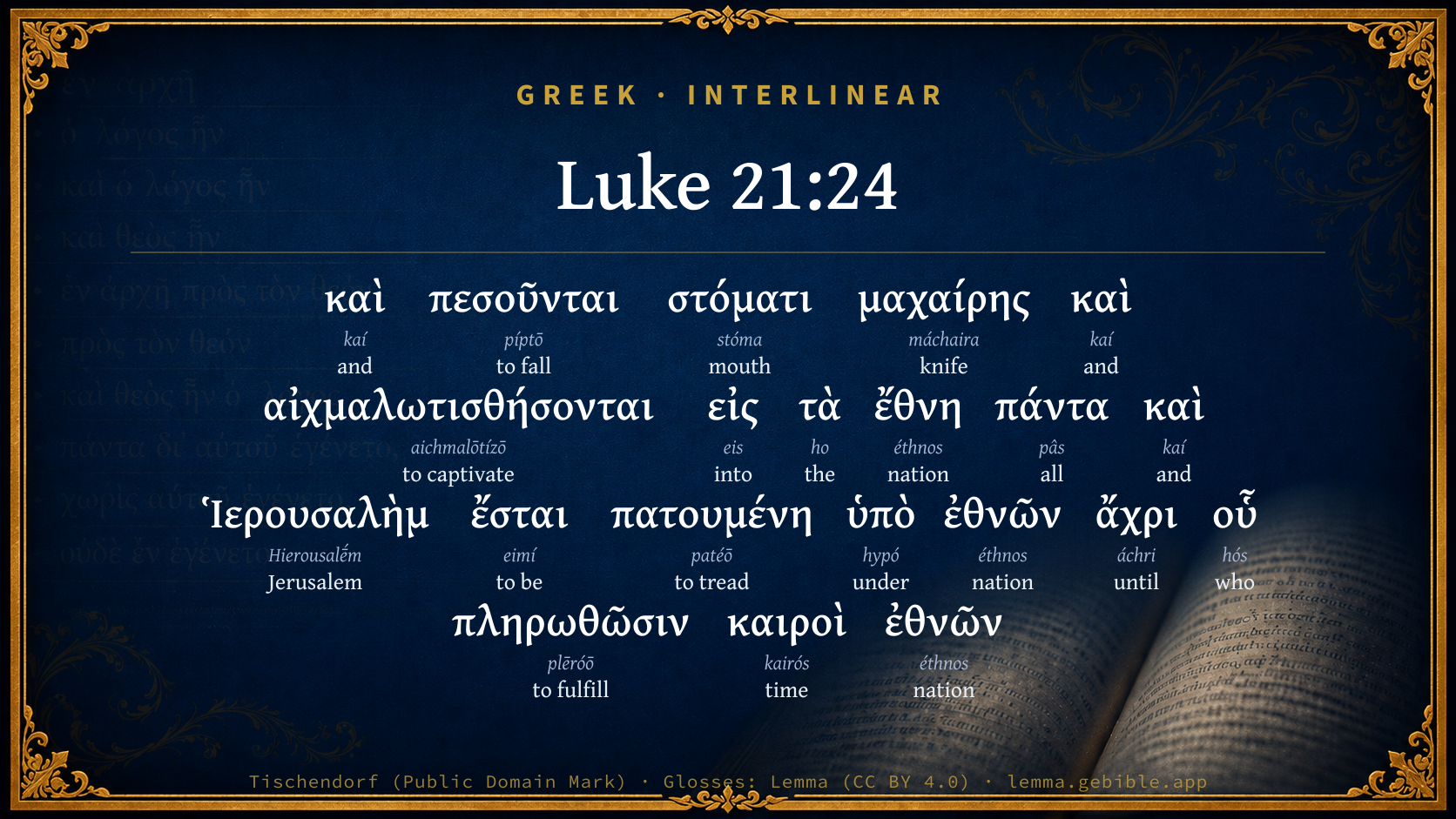
Greek (Tischendorf 8th ed.) Luke 21:24 appears in the Greek New Testament. The text above is from the Tischendorf 8th edition. Each word links to its Strong’s number and a concise gloss. Click any word for its full Thayer’s Greek Lexicon entry.
Download image
Cite this verse

Luke 21:24 (World English Bible). Public Domain. Lemma interlinear Bible study tool, https://lemma.gebible.app/v/luke/21/24.

Show BibTeX & RIS
BibTeX
RIS
English Translation
They will fall by the edge of the sword, and will be led captive into all the nations. Jerusalem will be trampled down by the Gentiles, until the times of the Gentiles are fulfilled.
World English Bible · Public Domain
Highlights
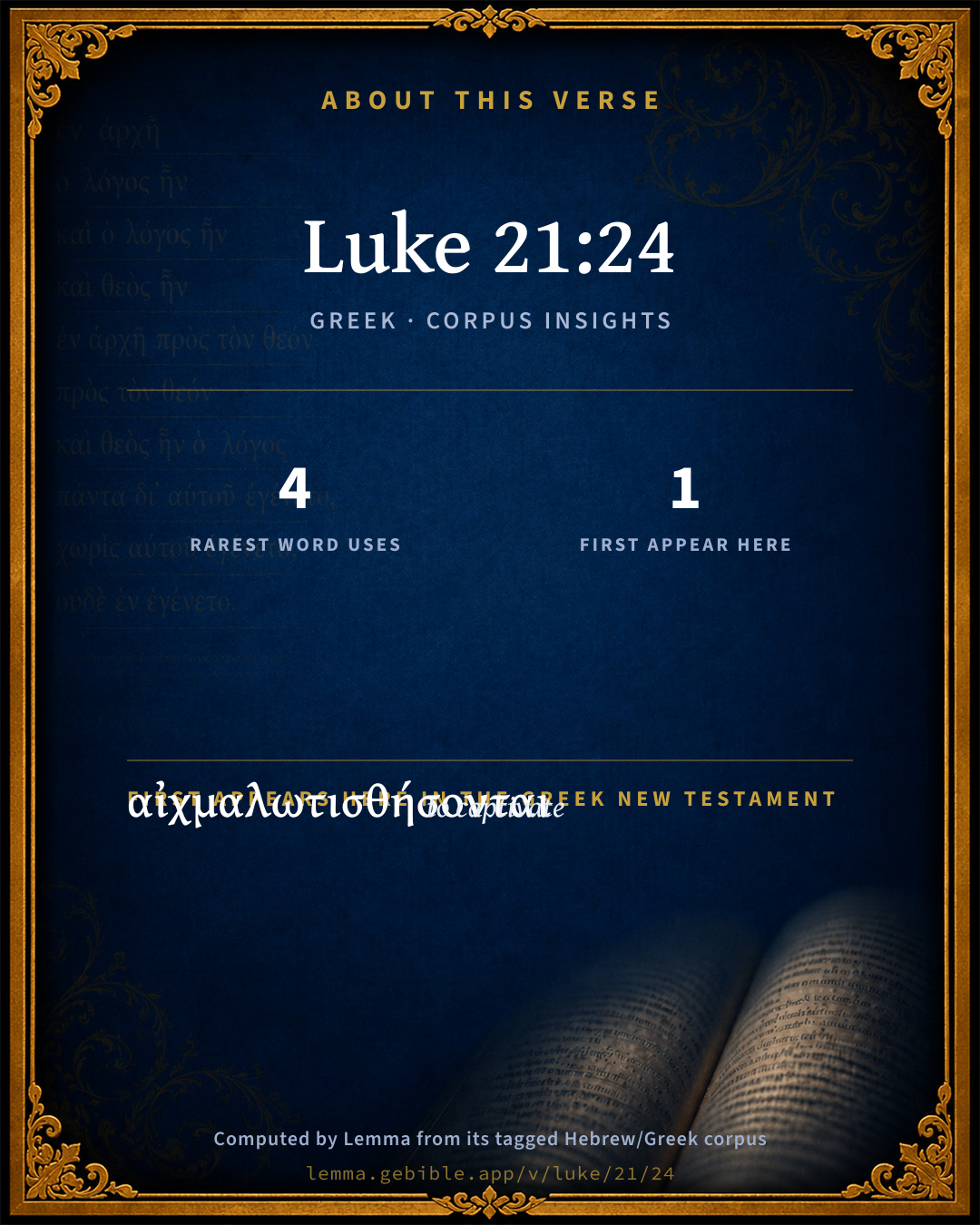
  • 1 first appearance in the Greek New Testament
Full analysis ↓
Download a study sheet

One document with this verse’s original text, its word-by-word gloss line, the meaning frame, cross-references with their text, attributed commentary, and full source and license credits — printable, and it pastes into notes with its structure intact.

This verse Autodidact and up

Study sheet (.html) Plain text (.txt)

A passage Seminary Student

Up to 50 verses in one chapter. A passage sheet keeps up to 6 commentary sources and 12 cross-references per verse, in the order this page ranks them, and says so on the sheet whenever that leaves anything out. Ask for a single verse and you get the Autodidact verse sheet above.

Everything on this page stays free to read, with no account — the sheet is a download of what is already on screen, not access to it.

Want to remove ads? Support Godless Engineer
Compare translations 3

The same verse in 3 English versions, stacked beneath the original-language interlinear above. Click any original word for its lexicon entry.

Each is an independent rendering of the whole verse — the interlinear is not word-aligned to these translations.

Highlighted words mark where these versions differ — a whole-verse word diff, not a word-by-word alignment.

  • World English Bible Public Domain
    They will fall by the edge of the sword, and will be led captive into all the nations. Jerusalem will be trampled down by the Gentiles, until the times of the Gentiles are fulfilled.
  • King James Version Public Domain
    And they shall fall by the edge of the sword, and shall be led away captive into all nations: and Jerusalem shall be trodden down of the Gentiles, until the times of the Gentiles be fulfilled.
  • unfoldingWord Literal Text CC BY-SA 4.0
    And they will fall by the mouth of the sword, and they will be led captive into all the nations, and Jerusalem will be trampled by the nations until the times of the nations are fulfilled.

unfoldingWord Literal Text — © unfoldingWord, licensed CC BY-SA 4.0. Word-aligned USFM3 via Door43 (git.door43.org/unfoldingWord/en_ult).

Versions to compare (up to 4)

3 of 4 selected

Show all 19 translations

Every available English version of this verse, each an independent rendering of the whole verse.

  • World English Bible Public Domain
    They will fall by the edge of the sword, and will be led captive into all the nations. Jerusalem will be trampled down by the Gentiles, until the times of the Gentiles are fulfilled.
  • Berean Standard Bible Public Domain
    They will fall by the edge of the sword and be led captive into all the nations. And Jerusalem will be trodden down by the Gentiles, until the times of the Gentiles are fulfilled.
  • Majority Standard Bible Public Domain
    They will fall by the edge of the sword and be led captive into all the nations. And Jerusalem will be trodden down by the Gentiles, until the times of the Gentiles are fulfilled.
  • King James Version Public Domain
    And they shall fall by the edge of the sword, and shall be led away captive into all nations: and Jerusalem shall be trodden down of the Gentiles, until the times of the Gentiles be fulfilled.
  • American Standard Version (1901) Public Domain
    And they shall fall by the edge of the sword, and shall be led captive into all the nations: and Jerusalem shall be trodden down of the Gentiles, until the times of the Gentiles be fulfilled.
  • Revised Version (1885) Public Domain
    And they shall fall by the edge of the sword, and shall be led captive into all the nations: and Jerusalem shall be trodden down of the Gentiles, until the times of the Gentiles be fulfilled.
  • Geneva Bible (1599) Public Domain
    And they shall fall on the edge of the sword, and shalbe led captiue into all nations, and Hierusalem shalbe troden vnder foote of the Gentiles, vntill the time of the Gentiles be fulfilled.
  • Douay-Rheims (1899) Public Domain
    And they shall fall by the edge of the sword; and shall be led away captives into all nations; and Jerusalem shall be trodden down by the Gentiles; till the times of the nations be fulfilled.
  • Young's Literal Translation Public Domain
    and they shall fall by the mouth of the sword, and shall be led captive to all the nations, and Jerusalem shall be trodden down by nations, till the times of nations be fulfilled.
  • Literal Standard Version CC BY-SA 4.0
    and they will fall by the mouth of the sword, and will be led captive to all the nations, and Jerusalem will be trodden down by nations, until the times of nations be fulfilled.
  • Unlocked Literal Bible CC BY-SA 4.0
    They will fall by the edge of the sword, and they will be led captive into all the nations, and Jerusalem will be trampled by the Gentiles until the times of the Gentiles are fulfilled.
  • unfoldingWord Literal Text CC BY-SA 4.0
    And they will fall by the mouth of the sword, and they will be led captive into all the nations, and Jerusalem will be trampled by the nations until the times of the nations are fulfilled.
  • Darby Bible Public Domain
    And they shall fall by the edge of the sword, and be led captive into all the nations; and Jerusalem shall be trodden down of [the] nations until [the] times of [the] nations be fulfilled.
  • World Messianic Bible Public Domain
    They will fall by the edge of the sword, and will be led captive into all the nations. Jerusalem will be trampled down by the Gentiles until the times of the Gentiles are fulfilled.
  • Webster's Bible Public Domain
    And they shall fall by the edge of the sword, and shall be led away captive into all nations: and Jerusalem shall be trodden down by the Gentiles, until the times of the Gentiles shall be fulfilled.
  • Free Bible Version CC BY-SA 4.0
    They will be killed by the sword and taken away as prisoners to all the nations. Jerusalem will be trodden down by the foreign nations until their time is fulfilled.
  • Bible in Basic English Public Domain
    And they will be put to death with the sword, and will be taken as prisoners into all the nations; and Jerusalem will be crushed under the feet of the Gentiles, till the times of the Gentiles are complete.
  • Text-Critical English NT CC BY 4.0
    They will fall by the edge of the sword and be led captive into all the nations, and Jerusalem will be trampled by the Gentiles until the times of the Gentiles are fulfilled.
  • Tyndale New Testament (1534) Public Domain
    And they shall fall on the edge of the swearde and shalbe leed captive into all nacions. And Ierusalem shalbe trooden vnder fote of the gentyls vntyll the tyme of the gentyls be fulfilled.

Literal Standard Version (2020), Covenant Press — licensed CC BY-SA 4.0. Text via the HelloAO Bible API (eBible.org). Unlocked Literal Bible (unfoldingWord) — licensed CC BY-SA 4.0. Text via the HelloAO Bible API (eBible.org). unfoldingWord Literal Text — © unfoldingWord, licensed CC BY-SA 4.0. Word-aligned USFM3 via Door43 (git.door43.org/unfoldingWord/en_ult). Free Bible Version, Dr. Jonathan Gallagher — licensed CC BY-SA 4.0. Text via the HelloAO Bible API (eBible.org).

Word by word

More ways to search: Search by grammar → Find every occurrence → Compare this word →

Practice this passage: Drill this verse → Learn its vocabulary →

αἰχμαλωτισθήσονται
aichmalōtízō
G163
“to captivate”
Verb, Future, Passive, Indicative, 3rd person, Plural
Part of Speech
Verb
Tense
Future
Voice
Passive
Mood
Indicative
Person
3rd person
Number
Plural
Full Thayer's Definition

Origin: from G164

TDNT: 04:15,3

1. to lead away captive 2. metaph. to capture ones mind, captivate
  1. καὶ kaí G2532 “and” Conjunction
  2. πεσοῦνται píptō G4098 “to fall” Verb, Future, Middle or Passive deponent, Indicative, 3rd person, Plural
  3. στόματι stóma G4750 “mouth” Noun, Dative, Singular, Neuter
  4. μαχαίρης máchaira G3162 “knife” Noun, Genitive, Singular, Feminine
  5. καὶ kaí G2532 “and” Conjunction
  6. εἰς eis G1519 “into” Preposition
  7. τὰ ho G3588 “the” Article, Accusative, Plural, Neuter
  8. ἔθνη éthnos G1484 “nation” Noun, Accusative, Plural, Neuter
  9. πάντα pâs G3956 “all” Adjective, Accusative, Plural, Neuter
  10. καὶ kaí G2532 “and” Conjunction
  11. Ἱερουσαλὴμ Hierousalḗm G2419 “Jerusalem” Noun, Proper, indeclinable
  12. ἔσται eimí G1510 “to be” Verb, Future, Middle deponent, Indicative, 3rd person, Singular
  13. πατουμένη patéō G3961 “to tread” Verb, Present, Passive, Participle, Nominative, Singular, Feminine
  14. ὑπὸ hypó G5259 “under” Preposition
  15. ἐθνῶν éthnos G1484 “nation” Noun, Genitive, Plural, Neuter
  16. ἄχρι áchri G891 “until” Adverb
  17. οὗ hós G3739 “who” Relative pronoun, Genitive, Singular, Masculine
  18. πληρωθῶσιν plēróō G4137 “to fulfill” Verb, Aorist, Passive, Subjunctive, 3rd person, Plural
  19. καιροὶ kairós G2540 “time” Noun, Nominative, Plural, Masculine
  20. ἐθνῶν éthnos G1484 “nation” Noun, Genitive, Plural, Neuter

About this verse

These counts appear in no published source. They are computed here, from the morphology-tagged text and Lemma’s own curated glosses. What Lemma adds →

21
words
17
distinct lemmas
Gospels
section

Notable vocabulary

The rarest word here is αἰχμαλωτισθήσονται to captivate G163 — appearing just 4 times in the whole Greek New Testament.

First appearance in Scripture

This word makes its first canonical appearance in the Greek New Testament here:

  • αἰχμαλωτισθήσονται to captivate G163

Shared distinctive vocabulary

αἰχμαλωτισθήσονται to captivate G163 occurs in 4 verses of the Greek New Testament. Also found in:
Repetition

Words recur within this verse:

  • ἔθνη nation G1484 ×3
  • καὶ and G2532 ×3

Cross-references

12

Topical passages linked to Luke 21:24 in the Treasury of Scripture Knowledge — connected by theme and wording, ordered by reader-vote popularity; previews shown in the World English Bible.

  • Romans 11:25 For I don't desire, brothers, to have you ignorant of this mystery, so that you won't be wise in your own conceits, that a partial hardening has happened to Israel, until the fullness of the Gentiles has come in,
  • Revelation 11:2 Leave out the court which is outside of the temple, and don't measure it, for it has been given to the gentiles. They will tread the holy city under foot for forty-two months.
  • Isaiah 63:18 Your holy people possessed [it] but a little while: our adversaries have trodden down your sanctuary.
  • Daniel 12:7 I heard the man clothed in linen, who was above the waters of the river, when he held up his right hand and his left hand to heaven, and swore by him who lives forever that it shall be for a time, times, and a half; and when they have made an end of breaking in pieces the power of the holy people, all these things shall be finished.
  • Daniel 9:27 He shall make a firm covenant with many for one week: and in the midst of the week he shall cause the sacrifice and the offering to cease; and on the wing of abominations [shall come] one who makes desolate; and even to the full end, and that determined, shall [wrath] be poured out on the desolate.
  • Isaiah 5:5 Now I will tell you what I will do to my vineyard. I will take away its hedge, and it will be eaten up. I will break down its wall of it, and it will be trampled down.
  • Daniel 8:13 Then I heard a holy one speaking; and another holy one said to that certain one who spoke, How long shall be the vision [concerning] the continual [burnt-offering], and the disobedience that makes desolate, to give both the sanctuary and the host to be trodden under foot?
  • Isaiah 66:19 I will set a sign among them, and I will send such as escape of them to the nations, to Tarshish, Pul, and Lud, who draw the bow, to Tubal and Javan, to the isles afar off, who have not heard my fame, neither have seen my glory; and they shall declare my glory among the nations.
  • Malachi 1:11 For from the rising of the sun even to the going down of the same, my name is great among the nations, and in every place incense will be offered to my name, and a pure offering: for my name is great among the nations," says Yahweh of Hosts.
  • Isaiah 66:12 For thus says Yahweh, Behold, I will extend peace to her like a river, and the glory of the nations like an overflowing stream: and you shall suck [of it]; you shall be borne on the side, and shall be dandled on the knees.
  • Lamentations 1:15 The Lord has set at nothing all my mighty men in the midst of me; He has called a solemn assembly against me to crush my young men: The Lord has trodden as in a winepress the virgin daughter of Judah.
  • Deuteronomy 28:64–68 Yahweh will scatter you among all peoples, from the one end of the earth even to the other end of the earth; and there you shall serve other gods, which you have not known, you nor your fathers, even wood and stone.

Cross-references courtesy of OpenBible.info (CC BY 4.0).

Where the printed editions differ

1 variant

Places in this verse where the major printed Greek editions disagree on the wording in a way that affects the translation — a comparison of editions, not a manuscript-by-manuscript collation. The editions are the modern critical texts (Nestlé-Aland 28/27, SBL, Westcott-Hort, Tregelles, Tyndale House) and the traditional texts behind the KJV (the Textus Receptus and the Byzantine/Majority text). It is not a claim about which reading is original.

  1. Extra text
    καὶ ἔσονται

    “and will be”

    In WH Not in NA28NA27TynSBLTregTRByz

    καὶ ἔσονται (kai esontai) 'and will be' is only in a few manuscripts (WH)

Textual data: Translators Amalgamated Greek New Testament (STEPBible TAGNT) · CC BY 4.0.

Commentary

Notes on Luke 21:24 from classic Christian and Jewish commentators (each source and its license shown beneath its notes). The classic Christian expositions comment on the surrounding passage and are grouped to its opening verse, so a note may address several verses; the Jewish commentaries on the Tanakh (Rashi and others) are per-verse, so they appear only where the commentator wrote on this verse.

Lemma curates 59 commentaries, every one of them public domain or Creative Commons licensed, each selected and text-cleaned for this edition rather than reprinted as found. About our sources →

Joseph Benson's Commentary

Luk 21:24. And they shall fall by the edge of the sword, and shall be led away captive into all nations — The fulfilment of this part of the prophecy, we have Bell., Luk 7:16, where Josephus describes the sacking of the city. “And now, rushing into every lane, they slew whomsoever they found without distinction, and burned the houses, and all the people who had fled into them. And when they entered for the sake of plunder, they found whole families of dead persons, and houses full of carcasses destroyed by famine; then they came out with their hands empty. And though they thus pitied the dead, they did not feel the same emotion for the living, but killed all they met, whereby they filled the lanes with dead bodies. The whole city ran with blood, insomuch that many things which were burning were extinguished by the blood.” Thus were the inhabitants of Jerusalem slain with the sword: thus was she laid even with the ground, and her children with her. Ibid. — “The soldiers being now wearied with killing the Jews, and yet a great number remaining alive, Cesar commanded that only the armed and they who resisted should be slain. But the soldiers killed also the old and infirm; and taking the young and strong prisoners, carried them into the women’s court in the temple. Cesar appointed one Fronto, his freedman and friend, to guard them, and to determine the fate of each. All the robbers and seditious he slew, one of them betraying another. But picking out such youths as were remarkable for stature and beauty, he reserved them for the triumph. All the rest that were above seventeen years old he sent bound into Egypt, to be employed in labour there. Titus also sent many of them into the provinces, to be slain in the theatres by beasts and the sword. And those who were under seventeen years of age were slain. And during the time Fronto judged them, one thousand died of hunger.” Chap. 17. — “Now the number of the captives that were taken during the time of the war, was ninety-seven thousand; and of all that died and were slain during the siege, was one million one hundred thousand, the most of them Jews by nation, though not inhabitants of the place; for being assembled together from all parts to the feast of unleavened bread, of a sudden they were environed with war.” Thus were the Jews led away captive into all nations. However, the falling by the edge of the sword, mentioned in the prophecy, is not to be confined to what happened at the siege. It comprehends all the slaughters that were made of the Jews in the different battles, and sieges, and massacres, both in their own land and out of it, during the whole course of the war. Such as at Alexandria, where fifty thousand perished; at Cesarea, ten thousand; at Scythopolis, thirteen thousand; at Damascus, ten thousand; at Ascalon, ten thousand; at Apheck, fifteen thousand; upon Gerizim, eleven thousand; and at Jotapa, thirty thousand. And thus was verified what our Lord told his disciples, the first time he uttered his prophecy concerning the destruction of Jerusalem, that wherever the carcass was, there the eagles should be gathered together, Luk 17:37. See notes on Deu 28:62; Mat 24:15-21; and Mar 13:14.

Jerusalem shall be trodden down of the Gentiles — The accomplishment of this part of the prophecy is wonderful. For, after the Jews were utterly destroyed by death and captivity, Vespasian commanded the whole land of Judea to be sold. Bell., Luk 7:26. — “At that time Cesar wrote to Bassus, and to Liberius Maximus, the procurator, to sell the whole land of the Jews; for he did not build any city there, but appropriated their country to himself, leaving there only eight hundred soldiers, and giving them a place to dwell in, called Emmaus, thirty stadia from Jerusalem; and he imposed a tribute upon all the Jews, wheresoever they lived, commanding every one of them to bring two drachms into the capitol, according as in former times they were wont to pay unto the temple of Jerusalem. And this was the state of the Jews at that time.” Thus was Jerusalem in particular, with its territory, possessed by the Gentiles, becoming Vespasian’s property, who sold it to such Gentiles as chose to settle there. That Jerusalem continued in this desolate state we learn from Dio: for he tells us, that the Emperor Adrian rebuilt it, sent a colony thither to inhabit it, and called it Ælia. But he altered its situation, leaving out Zion and Bezetha, and enlarging it so as to comprehend Calvary, where our Lord was crucified. Moreover, Eusebius informs us, that Adrian made a law, that no Jew should come into the region around Jerusalem. Hist., Luk 21:6. So that the Jews being banished, such a number of aliens came into Jerusalem, that it became a city and colony of the Romans, Hist., Luk 4:6. In later times, when Julian apostatized to heathenism, being sensible that the evident accomplishment of our Lord’s prophecy concerning the Jewish nation made a strong impression upon the Gentiles, and was a principal means of their conversion, he resolved to deprive Christianity of this support, by bringing the Jews to occupy their own land, and by allowing them the exercise of their religion, and a form of civil government. For this purpose he resolved to rebuild Jerusalem, and to rear up the temple upon its ancient foundations, because there only he knew they would offer prayers and sacrifices. In the prosecution of this design he wrote a letter to the community of the Jews, which is still extant among his other works, inviting them to return to their native country; for their encouragement, he says to them, among other things, “The holy city, Jerusalem, which of many years ye have desired to see inhabited, I will rebuild by mine own labour, and will inhabit it,” epist. 25. And now the emperor, having made great preparations, began the execution of his scheme with rebuilding the temple; but his workmen were soon obliged to desist, by an immediate and evident interposition of God. “He resolved,” says Ammianus Marcellinus, lib. 23., “to build, at an immense expense, a certain lofty temple at Jerusalem; and gave it in charge to Alypius of Antioch, to hasten the work. But when Alypius, with great earnestness, applied himself to the execution of it, and the governor of the province assisted him in it, terrible balls of fire bursting forth near the foundation, with frequent explosions, and divers times burning the workmen, rendered the place inaccessible. Thus the fire continually driving them away, the work ceased.” This fact is attested, likewise, by Zemuth David, a Jew, who honestly confesses that Julian was hindered by God in this attempt. It is attested, likewise, by Nazianzen and Chrysostom among the Greeks, by Ambrose and Ruffin among the Latins, who lived at the time when the thing happened; by Theodoret and Sozomon, of the orthodox persuasion; by Philistorgius, an Arian, in the extracts of his history made by Photius; (lib. 7. cap. 9;) and by Socrates, a favourer of the Novatians, who wrote his history within the space of fifty years after these things happened, and while the eye-witnesses thereof were yet alive. Thus, while Jews and heathen, under the direction of a Roman emperor, united their whole force to baffle our Lord’s prediction, they did but still the more conspicuously accomplish it. See notes on Deu 28:64-68. Until the times of the Gentiles be fulfilled — The time determined in the counsel of God for the conversion of the Gentiles. The Apostle Paul has given us a clear explication of this passage, Rom 11:25. This part of the prophecy answers to Dan 9:27 : He shall make it (Jerusalem) desolate, even until the consummation, namely, of wrath upon this people, and that determined be poured upon the desolate. The meaning of both passages is, that after the destruction here foretold, Jerusalem shall continue desolate, until God has poured upon it the whole wrath he has determined; and this wrath will not be finished until the Gentiles are converted.

Joseph Benson's Commentary on the Old and New Testaments (1811–1818) — public domain. Text from a community e-Sword module.

Tyndale Open Study Notes

Tyndale Open Resources

21:24 until the period of the Gentiles comes to an end: Daniel predicted a period of successive Gentile empires before the coming of God’s Kingdom (Dan 2:44; 7:27).

Tyndale Open Study Notes — © Tyndale Open Resources, licensed CC BY-SA 4.0. Text via the HelloAO Bible API.

Bengel's Gnomon

Johann Albrecht Bengel

Luk 21:24. Ἔσται πατουμένη) This conveys the idea of something more than πατηθήσεται, shall be trodden down; it shall be (and continue) in a trodden down state, as also in a desecrated state: comp. note on 1Ti 1:9. The Derivation and sense of the old name of the city, Jebus, is in consonance with this.[227] So in Rev 11:2, et seqq., “They shall tread under foot the holy city forty and two months;” although there the angel is speaking of a certain one time of its being trodden under foot, and that a very remarkable one; whereas in Luke the Lord is speaking of all the times of its being so trodden. In fact, in whatever way you explain the “forty and two months,” Jerusalem has been already, for a longer period than that, trodden down by the Romans, the Persians, the Saracens, the Franks, the Turks; and it shall continue hereafter to be trodden down until the times of the Gentiles be fulfilled. Moreover “the times of the Gentiles” are the times appointed to the Gentiles wherein they are to be permitted to tread down the city: and these times shall be terminated upon the conversion of the Gentiles being most fully consummated: Rom 11:25 [“Blindness in part is happened to Israel, until the fulness of the Gentiles be come in. And so all Israel shall be saved”]; Rev 15:4 [“All nations shall come and worship before Thee”]; for certainly the Gentiles, whilst treading down Jerusalem, are themselves meanwhile unbelievers. The expression, “the times of the Gentiles,” is used as “the time of figs,” and “the time of the dead:” Mar 11:13; Rev 11:18. It is not to be inferred from this that the temple and its worship of shadowy types is going to be restored; but yet there will be many at that time there, as indeed even at the present time there are some to be found, who are worshippers bearing the Christian name, and there shall be many too of these belonging to the people of Israel: and it is in the same last time that God and Magog shall make this assault: Rev 20:9. Ἄχρι, until, forms a tacit limitation in the verses. From this verse to Luk 21:27, are summarily comprehended all the times which are about to follow the destruction of the city down to the termination of all things.—καιροὶ ἐθνῶν) the times of the Gentiles, i.e. which are peculiarly their own. Αὐτῶν is not the expression used, but the term ἘΘΝῶΝ, of the Gentiles, is repeated, in order to show the correspondence of the event with the prediction. The article is not added. The times of Israel, which would have continued uninterruptedly, if Israel had been obedient, Psa 81:13-16, are interrupted by times of Gentiles. These latter times had their own intervals of suspension, as in the Fourth and Twelfth centuries. The plural, καιροί, is therefore used. A certain time of the Gentiles was fulfilled when Constantine was emperor; and then the treading down of Jerusalem abated; but not lastingly. The times during which the Christians held Jerusalem were brief intervals, if you compare them with the times in which the [unconverted] Gentiles held the city.

[227] Jdg 19:10, Jebus = one who treads under foot.—E. and T.

Bengel's Gnomon of the New Testament — English translation (T&T Clark, Edinburgh, 1860) — public domain. Text from a community e-Sword module.

Geneva Bible (1599)

Geneva Bible translators

Word for word, mouth, for the Hebrews call the edge of a sword the mouth, because the edge biteth.

Geneva Bible (1599) marginal notes — public domain. Text via Bolls.life.

Jamieson, Fausset & Brown

Robert Jamieson, A. R. Fausset & David Brown

Jerusalem . . . trodden down . . . until, &c.--Implying (1) that one day Jerusalem shall cease to be "trodden down by the Gentiles" (Rev 11:2), as then by pagan so now by Mohammedan unbelievers; (2) that this shall be at the "completion" of "the times of the Gentiles," which from Rom 11:25 (taken from this) we conclude to mean till the Gentiles have had their full time of that place in the Church which the Jews in their time had before them--after which, the Jews being again "grafted into their own olive tree," one Church of Jew and Gentile together shall fill the earth (Rom. 11:1-36). What a vista this opens up!

Jamieson, Fausset & Brown — Commentary Critical and Explanatory on the Whole Bible (1871) — public domain (CC PDM 1.0). Text via the HelloAO Bible API.

Adam Clarke's Commentary

Verse 24. They shall fall by the edge of the sword] Those who perished in the siege are reckoned to be not less than eleven hundred thousand. See Mt 24:22.

And shall be led away captive] To the number of ninety-seven thousand. See Josephus, War, b. vi. c. ix. s. 2, 3, and on Mt 24:31.

Trodden down of the Gentiles] Judea was so completely subjugated that the very land itself was sold by Vespasian; the Gentiles possessing it, while the Jews were either nearly all killed or led away into captivity.

Of the Gentiles be fulfilled.] Till the different nations of the earth, to whom God shall have given the dominion over this land, have accomplished all that which the Lord hath appointed them to do; and till the time of their conversion to God take place. But when shall this be? We know not. The nations are still treading down Jerusalem, and the end is known only to the Lord. See Clarke on Mt 24:31.

Adam Clarke's Commentary on the Bible (1810–1826) — public domain. Text from a community e-Sword/MySword module.

Ellicott's Commentary for English Readers

(24) And they shall fall by the edge of the sword.—There is nothing in the parallel prophecies of the other two Gospels that answers to this special description, and it is possible, as suggested above, that St. Luke’s report here has somewhat of the character of a free paraphrase, such as was natural in an oral communication of what was variously remembered.

Until the times of the Gentiles be fulfilled.—The thought expressed in this clause, that the punishment of Israel, and the desolation of Jerusalem were to have a limit, that there was one day to be a restoration of both, is noticeable as agreeing with the whole line of St. Paul’s thoughts in Romans 9-11, and being in all probability the germ of which those thoughts are the development. In Rom_11:25, “till the fulness of the Gentiles be come in,” we have a distinct echo of the words, “until the times (better, the seasons) of the Gentiles be fulfilled.”

A Bible Commentary for English Readers, edited by Charles John Ellicott (1878–1897) — public domain. Text from a community e-Sword module.

The Cambridge Bible for Schools and Colleges

gen. ed. J. J. S. Perowne

24. fall by the edge of the sword] Literally, “mouth of the sword.” Gen_34:26. 1,100,000 Jews are said to have perished in the war and siege. “It seems as though the whole race had appointed a rendezvous for extermination.” Renan.

led away captive into all nations] Josephus speaks of 97,000 Jev]s sent to various provinces and to the Egyptian mines. B. J. vi. 9.

shall be trodden dawn of the Gentiles] So that the very thing happened which the Maccabees had tried to avert by their fortifications (1Ma_4:60). All sorts of Gentiles—Romans, Saracens, Persians, Franks, Norsemen, Turks—have ‘trodden down’ Jerusalem since then. The estai patounmene of the original implies a more permanent result than the simple future. Comp. Rev_11:2.

until the times of the Gentiles be fulfilled] By the times — ‘seasons’ or ‘opportunities’ of the Gentiles—is meant the period allotted for their full evangelisation. Rom_11:25, “Blindness in part is happened to Israel, until the fulness of the Gentiles be come in.”

The Cambridge Bible for Schools and Colleges (gen. ed. J. J. S. Perowne; Cambridge University Press, 1878–1918) — public domain. Text from a community e-Sword module.

John Gill's Exposition

And he spake to them a parable,.... That is, to his disciples:

behold the fig tree, and all the trees; that, or any other tree; See Gill on Mat 24:32.

John Gill's Exposition of the Whole Bible (1746–1763) — public domain (CC PDM 1.0). Text via the HelloAO Bible API.

Trapp's Complete Commentary

John Trapp

24 And they shall fall by the edge of the sword, and shall be led away captive into all nations: and Jerusalem shall be trodden down of the Gentiles, until the times of the Gentiles be fulfilled.

Ver. 24. Until the times of the Gentiles] The Gentiles then shall not always tread down Jerusalem. Those kings of the East, the Jews, may, likely, have their way prepared to it, through Euphrates, Rev 16:12, and Jerusalem be again inhabited by them, even in Jerusalem, Zec 12:6. But this will be not long before the last day, Luk 21:25.

John Trapp, A Commentary or Exposition upon All the Books of the Old and New Testament (1647–1656) — public domain. Text from a community e-Sword module.

Haydock's Catholic Bible Commentary

Whoever reads Josephus’s history of the calamities which befall Jerusalem before its destruction, will find none of these terrible menaces unfulfilled. Seventy thousand were carried away captives in this war. After the soldiers were weary of killing, Titus ordered the finest of the young men to be kept to adorn his triumph. The number of captive Jews was so great in Rome, as to make the heathen poet, Rutilius Numantianus, who lived about the year 410, complain of it as a great burden to the empire. Atque utinam nunquam Judea subacta fuisset

Pompeii bellis, imperioque Titi;

Latius excisæ pestis contagia serpunt

Victoresque suos natio victa premit.

--- Trodden down, &c. After Jerusalem had been taken and destroyed by the Romans, another city was built from its ruins, called Ælia, after the name of the emperor Ælius Adrian. This was inhabited by pagans and some Christians for the Jews were forbidden even to come near it, for more than two or three centuries. Tertullian informs us, that they even bought, at a great price, permission to see it at a distance, and drop a tear over the ashes of their ancient and ill-fated country. Thus was Jerusalem trodden under foot, till the time of the nations was accomplished; that is, till Christianity, in every nation, had triumphed over the persecution of paganism. (Calmet) --- Till the times of the nations be fulfilled. According to the common exposition of this, and some other places, the Jews from the time of the destruction of their temple and city, under Titus Vespasian; and especially from their utter destruction under the emperor Adrian, in punishment of their obstinate blindness, shall remain dispersed through the world under miseries and oppressions, till the gospel hath been preached to all nations; then, not long before the end of the world, the Jews shall be converted, and acknowledge Jesus to be their true Messias. See Romans xi. 25. (Witham)

George Leo Haydock (1774–1849), Haydock's Catholic Family Bible and Commentary, 1859 edition — public domain. Excludes Psalms (Douay-Rheims chapter numbering differs from Protestant) and Deuterocanonical books (Catholic canon only).

Whedon's Commentary on the Bible

Daniel D. Whedon

24. They shall fall by the edge of the sword—This most important verse is furnished by Luke alone. It forms the bridge by which the prophecy travels over the chasm of ages and brings us down to the termination of the rejection of Israel. At the same time it is a wonderful prophecy, whose fulfilment has been going on from the time of its first writing to the present era. When a distinguished general told Bishop Newton that the prophecies of Scripture were written after the event, the bishop brought him to sober thought by telling him that there are prophecies of Scripture which are being fulfilled at the present day. How wonderfully are the Jews fulfilling the prophecies of the Jesus they rejected, proving by their very rejection the truth of his mission!

Led away captive into all nations—The sufferings of the Jews are those briefly described by Watson in his Theological Dictionary:

The Romans, under Vespasian, invaded the country, and took the cities of Galilee, Chorazin, Bethsaida, Capernaum, etc., where Christ had been especially rejected, and murdered numbers of the inhabitants. At Jerusalem the scene was most wretched of all. At the passover, when there might have been two or three millions of people in the city, the Romans surrounded it with troops, trenches, and walls, that none might escape. The three different factions within murdered one another. Titus did all in his power to persuade them to an advantageous surrender, but they scorned every proposal. The multitudes of unburied carcasses corrupted the air, and produced a pestilence. The people fed on one another; and even ladies, it is said, boiled their suckling infants, and ate them. After a siege of six months, the city was taken. The Romans murdered almost every Jew they met. Titus was bent to save the temple, but could not; six thousand Jews who had taken shelter in it were all burned or murdered. The whole city, except three towers, and a small part of the wall, was razed to the ground, and the foundations of the temple and other places were ploughed up.

Soon after the forts of Herodian and Machaeron were taken, the garrison of Massada murdered themselves rather than surrender. At Jerusalem alone, it is said, one million one hundred thousand perished by sword, famine, and pestilence. In other places we hear of two hundred and fifty thousand that were cut off, besides vast numbers that were sent into Egypt, to labour as slaves. About fifty years after, the Jews murdered about five hundred thousand of the Roman subjects, for which they were severely punished by Trajan. About A.D. 130 one Barcocaba pretended that he was the Messiah, and raised a Jewish army of two hundred thousand, who murdered all the heathens and Christians that came in their way; but he was defeated by Adrian’s forces. In this war, it is said, about six hundred thousand Jews were slain, or perished by famine and pestilence. Adrian built a city on Mount Calvary, and erected a marble statue of a swine over the gate that led to Bethlehem. No Jew was allowed to enter the city, or to look to it at a distance, under pain of death.” Truly the Jew has been led a captive among all nations.

And Jerusalem shall be trodden down—Not merely trodden, but trodden down; subjugated and debased.

Of the Gentiles—Jerusalem has repeatedly changed possessors, but has never been possessed by the Jews since the Romans destroyed it.

Until the times of the Gentiles be fulfilled—The time of the exclusive Gentile dispensation and churchdom. The times of the Gentiles will have been fulfilled when Israel is gathered into the Christian Church; “and so all Israel shall be saved.” Rom_11:26. So in the same chapter Paul tells us that “blindness in part hath happened unto Israel until the fulness of the Gentiles be come in.” We have here a striking resemblance between the language of Luke and Paul, confirming the opinion that Paul was Luke’s instructing apostle. By “the fulness of the Gentiles” is to be understood the full measure of Gentile conversion foreseen by God as to be, before the return of the Jews. That return of the Jews to God will be, as Paul says, as life from the dead. The restoration of the Jews shall redound to the happiness of the Gentiles. “For if the fall of them be the riches of the world, and the diminishing of them be the riches of the Gentiles, how much more their fulness?” Then shall there be one Shepherd and one fold, and the Lord alone shall be exalted in that day.

Trodden down… until—The language until implies that when the times of the Gentiles are fulfilled Jerusalem will cease to be trodden down, and recover her ancient glory. And it cannot but seem probable to every reflecting mind that the Jewish race is preserved for some great and providential reason.

Daniel D. Whedon (gen. ed.), Commentary on the Old and New Testaments (1874–1909) — public domain. Text from a community e-Sword module.

The Pulpit Commentary

And they shall fall by the edge of the sword, and shall be led away captive into all nations. It is computed that 1, 100, 000 Jews perished in the terrible war when Jerusalem fell (A.D. 70). Renan writes of this awful slaughter, "that it would seem as though the whole (Jewish) race had determined upon a rendezvous for extermination." Jerusalem shall be trodden down of the Gentiles. After incredible slaughter and woes, Titus, the Emperor Vespasian"s son, who commanded the Roman armies, ordered the city (of Jerusalem) to be razed so completely as to look like a spot which had never been inhabited (Josephus, "Bell. Jud:," 5:10. The storied city has been rebuilt on the old sitebut without the temple and since that fatal day, more than eighteen centuries ago, no Jew save on bare sufferance has dwelt in the old loved and sacred spot. In turn, Roman and Saracen, Norseman and Turk, have trodden Jerusalem down. Literally, indeed, have the sad words of Jesus been fulfilled. Until the times of the Gentiles be fulfilled. These few words carry on the prophecy past our own time (how far past?) carry it on close to the days of the end. "The times of the Gentiles" signify the whole period or epoch which must elapse between the destruction of Jerusalem and the temple, and the beginning of the times of the end when the Lord will return. In other words, these "times of the Gentiles" denote the period during which they the Gentiles hold the Church of God in place of the Jews, deposal from that position of favor and honor. These words separate the prophecy of Jesus which belongs solely to the ruin of the cry and temple from the eschatological portion of the same prophecy. Hitherto the Lord"s words referred solely to the fall of Jerusalem and the ruin of the Jewish race. Now begins a short prophetic description of the end and of the coming of the Son of man in glory.

The Pulpit Commentary (1880–1919), ed. H.D.M. Spence-Jones & Joseph S. Exell — public domain. Text from a community e-Sword module.

John Wesley's Explanatory Notes

They shall fall by the edge of the sword, and shall be led away captive - Eleven hundred thousand perished in the siege of Jerusalem, and above ninety thousand were sold for slaves. So terribly was this prophecy fulfilled! And Jerusalem shall be trodden by the Gentiles - That is, inhabited. So it was indeed. The land was sold, and no Jew suffered even to come within sight of Jerusalem. The very foundations of the city were ploughed up, and a heathen temple built where the temple of God had stood. The times of the Gentiles - That is, the times limited for their treading the city; which shall terminate in the full conversion of the Gentiles.

John Wesley, Explanatory Notes Upon the Whole Bible (1754–1765) — public domain. Text via the GEBible commentary corpus.

Scofield Reference Notes

C. I. Scofield

trodden down of the Gentiles

The "times of the Gentiles" began with the captivity of Judah under Nebuchadnezzar 2Ch 36:1-21, since which time Jerusalem has been under Gentile overlordship.

The Scofield Reference Bible (1917 edition), notes by C. I. Scofield — public domain. Text from a community e-Sword module.

Cambridge Greek Testament for Schools and Colleges

24. στόματι μαχαίρης. A Hebraism, though στόμα in the sense of ‘edge’ is also classical (comp. δίστομος). 1,100,000 Jews are said to have perished in the war. “It seems as though the whole race had appointed a rendezvous for extermination” Renan. (See on Luk 22:49.)

αἰχμαλωτισθήσονται. This is one of the group of words used only by St Luke and St Paul. Josephus speaks of 97,000 Jews sent to various provinces and to the Egyptian mines. B. J. VI. 9.

ἔσται πατουμένη ὑπὸ ἐθνῶν. So that the very thing happened which the Maccabees had tried to avert by their fortifications (1Ma 4:60). All sorts of Gentiles—Romans, Saracens, Persians, Franks, Norsemen, Turks—have ‘trodden down’ Jerusalem since then. The analytic future implies a permanent result.

ἄχρι οὗ πληρωθῶσιν. Attic Greek would require ἄχρι ἄν, but the ἂν is constantly omitted in the N.T. with these particles of time. See Luk 12:50, Luk 13:8, &c.; Mar 14:32.

καιροὶ ἐθνῶν. By the times—’seasons’ or ‘opportunities’ of the Gentiles—is meant the period allotted for their full evangelisation. Rom 11:25. This limit of time was fulfilled at Christ’s Parousia in the destruction of Jerusalem. The καιροὶ merely means the one καιρὸς regarded in its several elements.

Cambridge Greek Testament for Schools and Colleges (Cambridge University Press, 1896; 21 vols, various authors incl. Carr, Maclear, Plummer, Farrar, Lumby, Moule, M. R. James, Simcox) — public domain. Text from a community e-Sword module.

Alford’s Greek Testament

Henry Alford

24.] A most important addition, serving to fix the meaning of the other two Evangelists,—see notes there,—and carrying on the prophetic announcements, past our own times, even close to the days of the end.

πεσοῦνται … αἰχμ., viz. this people.

ἔσται πατ.] See Rev 11:2. The present state of Jerusalem. Meyer maintains that the whole of this was to be consummated in the lifetime of the hearers, on account of the ἀνακύψατε, &c. ver. 28. What views of the discourses of our Lord must such an expositor have!

πληρ. καιροὶ ἐθν.] Who could suppose that καιροὶ ἐθνῶν should have been interpreted (by Meyer) the appointed time until the Gentiles shall have finished this judgment of wrath—to be ended by the παρουσία, within the lifetime of the hearers?

The καιρ. ἐθν. (see reff.) are the end of the Gentile dispensation,—just as the καιρός of Jerusalem was the end, fulfilment, of the Jewish dispensation:—the great rejection of the Lord by the Gentile world,—answering to its type, His rejection by the Jews,—being finished, the καιρός shall come, of which the destruction of Jerusalem was a type. καιροί = καιρός: no essential difference is to be insisted on. It is plural, because the ἔθνη are plural: each Gentile people having in turn its καιρός.

25,

Henry Alford, The Greek Testament (1849–1861) — public domain. Text from a community e-Sword module.

International Critical Commentary

24. καὶ πεσοῦνται μαχαίρης. This verse and the last words of Ver. 23 are peculiar to Lk. Note the characteristic πάντα, periphrastic future, and ἄχρι. The often repeated assertion of Josephus, that 1,100,000 perished in the siege and 97,000 were carried into captivity (B. J. 6:9, 3) is quite incredible: they could not have found standing-ground within the walls. The sexcenta millia of Tacitus (Hist. v. 13, 4), if taken literally, is far too many for the number of those besieged: but sexcenti need not mean more than “very many.” Perhaps 70,000 is an ample estimate.

The phrase ἐν στόματι μαχαίρας occurs Gen 24:26; Gen 10:28; ἐν στόματι ρομφαίας, 6:21, 8:24; ἐν στόματι ξἰφους, Jos 10:30, Jos 10:32, Jos 10:35, Jos 10:37, Jos 10:39. The plur. στόματα μαχαίρης is found Heb 11:34 In the best MSS. substantives in ρα form gen. and dat. in ρης and ρῃ (WH, 2. App. p. 156).

ἔσται πατουμένη. See on 1:20, and see also Burton., § 71.Plus sonat quam πατηθήσται (Beng.): it expresses the permanent condition, la domination écrasante (Godet). Comp. the LXX of Zec 12:3, θήσομαι τὴν Ἰερουσαλὴμ λίθον καταπατούμενον πᾶσιν τοῖς ἔθνεσιν.1 Jerusalem has more often been under the feet of Gentiles than in the hands of Christians. Romans, Saracens, Persians, and Turks have all trampled upon her in turn.

The Latin Versions vary much: erit calcata (dδ) erit incalcata (e), erit in concalcation (a), concalcabitur (r), calcabitur (Vulg.).

ἄχρι οὖ. See on 2:20: ἄχρις οὗ is possibly correct Rom 11:25; Heb 3:13.

καιροι ἐθνῶν. As stated already, the whole of this verse is peculiar to Lk., and some have supposed that the last part of it is in addition made by him. It is not necessary to charge him with any such licence; although it is possible that oral tradition has here, as elsewhere, paraphrased and condensed what was said. The “seasons of the Gentiles” or “opportunities of the Gentiles” cannot be interpreted with certainty. Either (1) Seasons for executing the Divine judgments; or (2) for lording it over Israel; or (3) for existing as Gentiles; or (4) for themselves becoming subject to Divine judgments; or (5) opportunities of turning to God; or (6) of possessing the privileges which the Jews had forfeited. The first and last are best, and they are not mutually exclusive. Comp. ἄχρι οὗ τὸ πλήρωμα τῶν ἐθνῶν εἰσέλθῃ (Rom 11:25), where the whole section is a comment on the promise that the punishment of Israel has a limit. The plur. καιροί corresponds with the plur. ἔθνη: each nation has its καιρός but comp. ἔως πληρωθῶσιν καιροὶ τοῦ αἰῶνος (Tob. 14:5), where the whole passage should be compared with this.

International Critical Commentary — older volumes (1896–1929), various authors — public domain. Text from a community e-Sword module.

Vincent's Word Studies in the New Testament

Marvin R. Vincent

Edge [στοματι] . Lit., the mouth. So Wyc. Either in the sense of the foremost part, or picturing the sword as a devouring monster. In Heb 11:33, 34, the word is used in both senses : "the mouths of lions;" " the edge of the sword. "

Led away captive. See on captives, ch. 4 18.

Trodden down. Denoting the oppression and contempt which shall follow conquest.

Marvin R. Vincent, Word Studies in the New Testament (1887–1900) — public domain. Text from a community e-Sword/MySword module.

Lesson kit

Teaching starters — assembled from the data on this page, not authored interpretation. Every prompt links to the verse data it draws on. Edit before teaching.

Luke, in the Gospels, opens this verse with 21 words (17 distinct Greek lemmas). Its most distinctive word is aichmalōtízō (“to captivate”). A historical commentator’s framing appears above. Read the whole chapter for the surrounding context.

Discussion questions

  1. The word aichmalōtízō carries the sense “to captivate.” How does it shape the verse?
  2. The word “to captivate” first appears here in Scripture. What is being introduced at this debut?
  3. Romans 7:23 shares the word «to captivate» with this verse. How do the two illuminate each other?
  4. “nation” occurs 3× in this one verse. What is the effect of the repetition?
  5. The translations on this page render this verse differently — a whole-verse word diff, not a word-by-word alignment. What might account for the different wordings?
  6. Reading how Joseph Benson's Commentary and Tyndale Open Study Notes read this verse, where do the two commentators agree and where do they part?

Things to notice

  • 1 word makes its first canonical appearance in Scripture here.
  • These translations choose different wording for 9 words in this verse.
  • “nation” occurs 3× in this single verse.
  • 17 distinct Greek lemmas span 21 words in this verse.

Reading settings

Reading text

Shown beneath each verse's original-language words.

Old Testament
Old Testament edition

Read the OT as the Masoretic Hebrew (MT) or the Greek Septuagint (LXX).

English shown for the Greek Septuagint (in the Hebrew ↔ Greek comparison).

Comparing translations? Open the Compare panel on any verse page to stack up to four side by side.