
Exodus 21:8

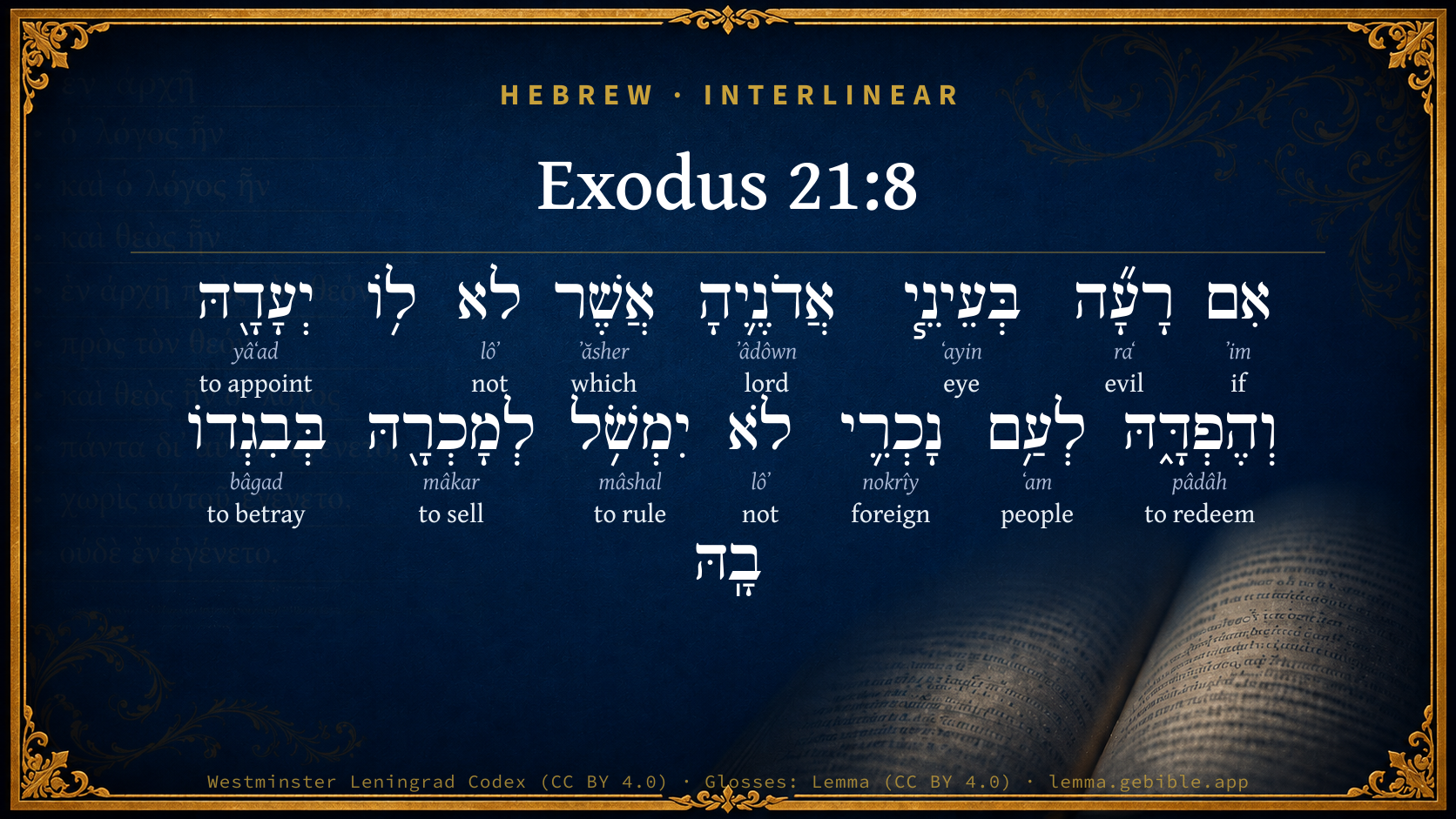
Hebrew (Westminster Leningrad Codex) Exodus 21:8 appears in the Hebrew Old Testament. The text above is from the Westminster Leningrad Codex. Each word links to its Strong’s number, a concise gloss, and parsing drawn from the Open Scriptures Hebrew Bible morphology. Click any word for its full Brown-Driver-Briggs (BDB) entry.
Download image
Cite this verse

Exodus 21:8 (World English Bible). Public Domain. Lemma interlinear Bible study tool, https://lemma.gebible.app/v/exodus/21/8.

Show BibTeX & RIS
BibTeX
RIS
English Translation
If she doesn't please her master, who has married her to himself, then he shall let her be redeemed. He shall have no right to sell her to a foreign people, seeing he has dealt deceitfully with her.
World English Bible · Public Domain
Highlights
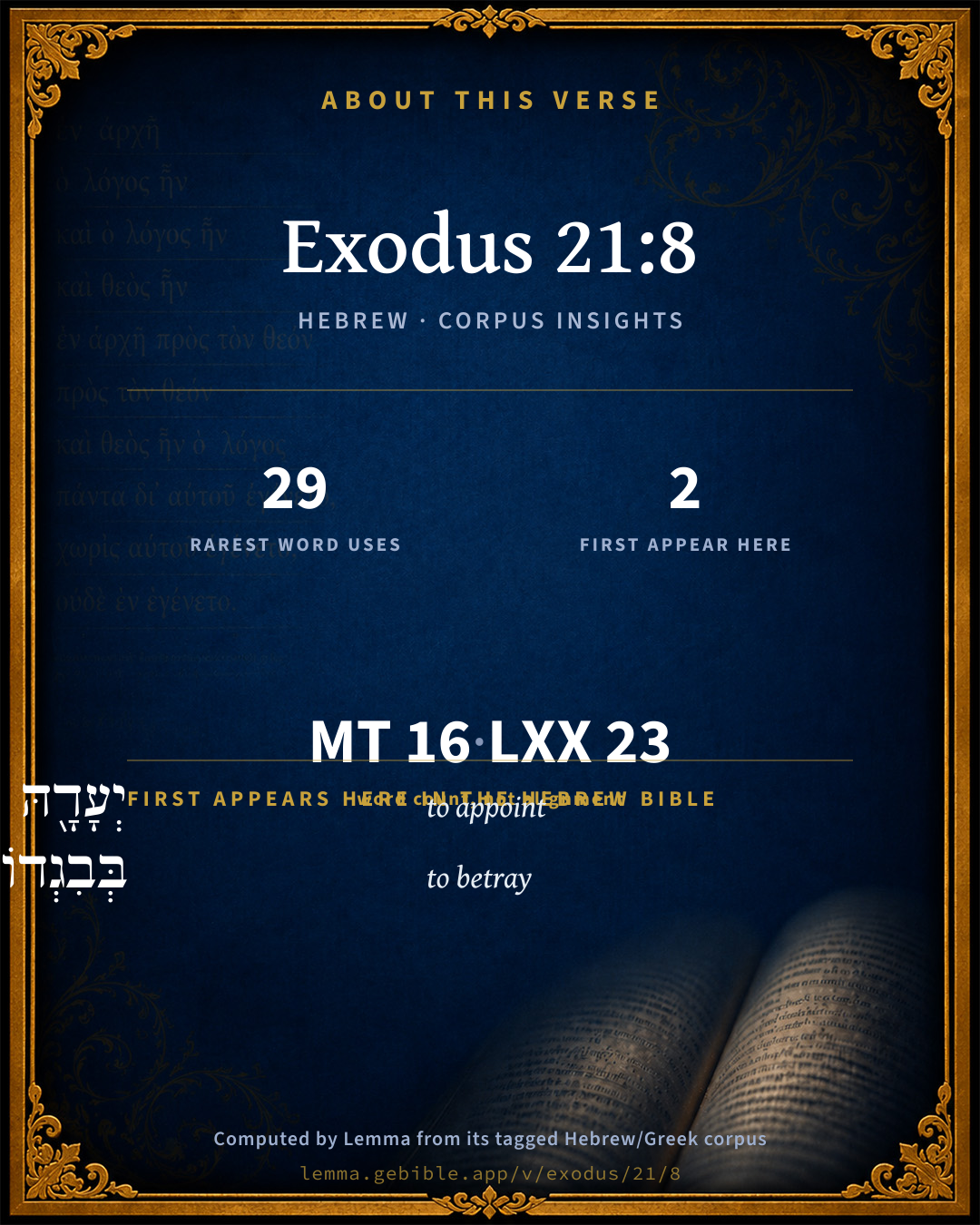
  • 2 first appearances in the Hebrew Bible
Full analysis ↓
Download a study sheet

One document with this verse’s original text, its word-by-word gloss line, the meaning frame, cross-references with their text, attributed commentary, and full source and license credits — printable, and it pastes into notes with its structure intact.

This verse Autodidact and up

Study sheet (.html) Plain text (.txt)

A passage Seminary Student

Up to 50 verses in one chapter. A passage sheet keeps up to 6 commentary sources and 12 cross-references per verse, in the order this page ranks them, and says so on the sheet whenever that leaves anything out. Ask for a single verse and you get the Autodidact verse sheet above.

Everything on this page stays free to read, with no account — the sheet is a download of what is already on screen, not access to it.

Want to remove ads? Support Godless Engineer
Compare translations 3

The same verse in 3 English versions, stacked beneath the original-language interlinear above. Click any original word for its lexicon entry.

Each is an independent rendering of the whole verse — the interlinear is not word-aligned to these translations.

Highlighted words mark where these versions differ — a whole-verse word diff, not a word-by-word alignment.

  • World English Bible Public Domain
    If she doesn't please her master, who has married her to himself, then he shall let her be redeemed. He shall have no right to sell her to a foreign people, seeing he has dealt deceitfully with her.
  • King James Version Public Domain
    If she please not her master, who hath betrothed her to himself, then shall he let her be redeemed: to sell her unto a strange nation he shall have no power, seeing he hath dealt deceitfully with her.
  • unfoldingWord Literal Text CC BY-SA 4.0
    If she is bad in the eyes of her master, who has appointed her for himself, then he shall cause her to be ransomed. He has no authority to sell her to a foreign people, since he has acted treacherously with her.

unfoldingWord Literal Text — © unfoldingWord, licensed CC BY-SA 4.0. Word-aligned USFM3 via Door43 (git.door43.org/unfoldingWord/en_ult).

Versions to compare (up to 4)

3 of 4 selected

Show all 18 translations

Every available English version of this verse, each an independent rendering of the whole verse.

  • World English Bible Public Domain
    If she doesn't please her master, who has married her to himself, then he shall let her be redeemed. He shall have no right to sell her to a foreign people, seeing he has dealt deceitfully with her.
  • Berean Standard Bible Public Domain
    If she is displeasing in the eyes of her master who had designated her for himself, he must allow her to be redeemed. He has no right to sell her to foreigners, since he has broken faith with her.
  • Majority Standard Bible Public Domain
    If she is displeasing in the eyes of her master who had designated her for himself, he must allow her to be redeemed. He has no right to sell her to foreigners, since he has broken faith with her.
  • King James Version Public Domain
    If she please not her master, who hath betrothed her to himself, then shall he let her be redeemed: to sell her unto a strange nation he shall have no power, seeing he hath dealt deceitfully with her.
  • American Standard Version (1901) Public Domain
    If she please not her master, who hath espoused her to himself, then shall he let her be redeemed: to sell her unto a foreign people he shall have no power, seeing he hath dealt deceitfully with her.
  • Revised Version (1885) Public Domain
    If she please not her master, who hath espoused her to himself, then shall he let her be redeemed: to sell her unto a strange people he shall have no power, seeing he hath dealt deceitfully with her.
  • Geneva Bible (1599) Public Domain
    If shee please not her master, who hath betrothed her to him selfe, then shall hee cause to buy her: hee shall haue no power to sell her to a strange people, seeing he despised her.
  • Douay-Rheims (1899) Public Domain
    If she displease the eyes of her master to whom she was delivered, he shall let her go: but he shall have no power to sell her to a foreign nation, if he despise her.
  • Young's Literal Translation Public Domain
    if evil in the eyes of her lord, so that he hath not betrothed her, then he hath let her be ransomed; to a strange people he hath not power to sell her, in his dealing treacherously with her.
  • Literal Standard Version CC BY-SA 4.0
    if [it is] evil in the eyes of her lord, so that he has not betrothed her, then he has let her be ransomed; he has no power to sell her to a strange people, in his dealing treacherously with her.
  • Unlocked Literal Bible CC BY-SA 4.0
    If she does not please her master, who has designated her for himself, then he must let her be bought back. He has no right to sell her to a foreign people. He has no such right, since he has treated her deceitfully.
  • unfoldingWord Literal Text CC BY-SA 4.0
    If she is bad in the eyes of her master, who has appointed her for himself, then he shall cause her to be ransomed. He has no authority to sell her to a foreign people, since he has acted treacherously with her.
  • Darby Bible Public Domain
    If she is unacceptable in the eyes of her master, who had taken her for himself, then shall he let her be ransomed: to sell her unto a foreign people he hath no power, after having dealt unfaithfully with her.
  • World Messianic Bible Public Domain
    If she doesn’t please her master, who has married her to himself, then he shall let her be redeemed. He shall have no right to sell her to a foreign people, since he has dealt deceitfully with her.
  • Webster's Bible Public Domain
    If she shall not please her master, who hath betrothed her to himself, then shall he let her be redeemed: to sell her to a strange nation he shall have no power, seeing he hath dealt deceitfully with her.
  • Free Bible Version CC BY-SA 4.0
    If the man who chose her for himself is not pleased with her, he must let her be bought back. He is not permitted to sell her to foreigners, since he has been unfair to her.
  • Bible in Basic English Public Domain
    If she is not pleasing to her master who has taken her for himself, let a payment be made for her so that she may go free; her master has no power to get a price for her and send her to a strange land, because he has been false to her.
  • JPS Tanakh (1917) Public Domain
    If she please not her master, who hath espoused her to himself, then shall he let her be redeemed; to sell her unto a foreign people he shall have no power, seeing he hath dealt deceitfully with her.

Literal Standard Version (2020), Covenant Press — licensed CC BY-SA 4.0. Text via the HelloAO Bible API (eBible.org). Unlocked Literal Bible (unfoldingWord) — licensed CC BY-SA 4.0. Text via the HelloAO Bible API (eBible.org). unfoldingWord Literal Text — © unfoldingWord, licensed CC BY-SA 4.0. Word-aligned USFM3 via Door43 (git.door43.org/unfoldingWord/en_ult). Free Bible Version, Dr. Jonathan Gallagher — licensed CC BY-SA 4.0. Text via the HelloAO Bible API (eBible.org).

Word by word

More ways to search: Search by grammar → Find every occurrence → Compare this word →

Practice this passage: Drill this verse → Learn its vocabulary →

יְעָדָ֖הּ
yâʻad
H3259
“to appoint · her”
Verb, Qal, Perfect, 3rd Person, Masculine, Singular + Suffix, Personal, 3rd Person, Feminine, Singular
Part of Speech
Verb
Stem
Qal
Form
Perfect
Person
3rd Person
Gender
Masculine
Number
Singular
Full BDB Definition

Origin: a primitive root

TWOT: 878

to fix, appoint, assemble, meet, set, betroth - (Qal) to appoint, assign, designate - (Niphal) - to meet - to meet by appointment - to gather, assemble by appointment - (Hiphil) to cause to meet - (Hophal) to be set, be placed before, be fixed
  1. אִם ʼim H518 “if” Conjunction
  2. רָעָ֞ה raʻ H7451 “evil” Adjective, Adjective, Feminine, Singular, Absolute
  3. בְּעֵינֵ֧י ʻayin H5869 “in/at · eyes of” Preposition + Noun, Common, Both, Dual, Construct
  4. אֲדֹנֶ֛יהָ ʼâdôwn H113 “lords · her” Noun, Common, Masculine, Plural, Construct + Suffix, Personal, 3rd Person, Feminine, Singular
  5. אֲשֶׁר ʼăsher H834 “which” Particle, Relative
  6. לא lôʼ H3808 “not” Particle, Negative
  7. וְהֶפְדָּ֑הּ pâdâh H6299 “and · to redeem · her” Conjunction + Verb, Hiphil, Sequential Perfect, 3rd Person, Masculine, Singular + Suffix, Personal, 3rd Person, Feminine, Singular
  8. לְעַ֥ם ʻam H5971 “to/for · people” Preposition + Noun, Common, Masculine, Singular, Absolute
  9. נָכְרִ֛י nokrîy H5237 “foreign” Adjective, Adjective, Masculine, Singular, Absolute
  10. לֹא lôʼ H3808 “not” Particle, Negative
  11. יִמְשֹׁ֥ל mâshal H4910 “to rule” Verb, Qal, Imperfect, 3rd Person, Masculine, Singular
  12. לְמָכְרָ֖הּ mâkar H4376 “to sell · her” Preposition + Verb, Qal, Infinitive Construct + Suffix, Personal, 3rd Person, Feminine, Singular
  13. בְּבִגְדוֹ bâgad H898 “in/at · to betray · him” Preposition + Verb, Qal, Infinitive Construct + Suffix, Personal, 3rd Person, Masculine, Singular

About this verse

These counts appear in no published source. They are computed here, from the morphology-tagged text and Lemma’s own curated glosses. What Lemma adds →

16
words
13
distinct lemmas
Pentateuch
section

First appearance in Scripture

These words make their first canonical appearance in the Hebrew Bible here:

  • יְעָדָ֖הּ to appoint H3259
  • בְּבִגְדוֹ to betray H898

Shared distinctive vocabulary

יְעָדָ֖הּ to appoint H3259 occurs in 29 verses of the Hebrew Bible. Also found in:

Grammatical profile

  • 5 verbs
  • 3 nouns
  • 2 adjectives
  • 2 prepositions
  • 1 conjunction
  • 3 particles

Verb forms

  • יְעָדָ֖הּ Qal · Perfect
  • וְהֶפְדָּ֑הּ Hiphil · Sequential Perfect
  • יִמְשֹׁ֥ל Qal · Imperfect
  • לְמָכְרָ֖הּ Qal · Infinitive Construct
  • בְּבִגְדוֹ Qal · Infinitive Construct

Repetition

A word recurs within this verse — often emphatic in Hebrew:

Hebrew & Septuagint length

In English translation the verse runs 38 words from the Hebrew and 40 from the Septuagint (LXX English) — closely comparable.

A rough comparison of the two English renderings, which tokenize alike — not a word-level alignment.

Word counts can differ between the Hebrew and the Greek without any difference in meaning — e.g. the Hebrew direct-object marker אֵת has no separate Greek word, and Greek often adds the article ὁ.

In the original languages it is 16 Hebrew tokens and 23 Greek tokens — but the two are counted differently (Hebrew bundles its prefixes and suffixes into one token; the Greek is in lemma form), so that isn’t a like-for-like length.

Cross-references

10

Topical passages linked to Exodus 21:8 in the Treasury of Scripture Knowledge — connected by theme and wording, ordered by reader-vote popularity; previews shown in the World English Bible.

  • Genesis 28:8 Esau saw that the daughters of Canaan didn't please Isaac, his father.
  • Exodus 8:29 Moses said, "Behold, I go out from you, and I will pray to Yahweh that the swarms of flies may depart from Pharaoh, from his servants, and from his people, tomorrow; only don't let Pharaoh deal deceitfully any more in not letting the people go to sacrifice to Yahweh."
  • Deuteronomy 20:7 What man is there who has pledged to be married a wife, and has not taken her? let him go and return to his house, lest he die in the battle, and another man take her.
  • Deuteronomy 21:11–14 and see among the captives a beautiful woman, and you have a desire to her, and would take her to you as wife;
  • Judges 9:19 if you then have dealt truly and righteously with Jerubbaal and with his house this day, then rejoice you in Abimelech, and let him also rejoice in you:
  • Judges 14:3 Then his father and his mother said to him, Is there never a woman among the daughters of your brothers, or among all my people, that you go to take a wife of the uncircumcised Philistines? Samson said to his father, Get her for me; for she pleases me well.
  • Malachi 2:11–15 Judah has dealt treacherously, and an abomination is committed in Israel and in Jerusalem; for Judah has profaned the holiness of Yahweh which he loves, and has married the daughter of a foreign god.
  • 1 Samuel 8:6 But the thing displeased Samuel, when they said, Give us a king to judge us. Samuel prayed to Yahweh.
  • 1 Samuel 18:8 Saul was very angry, and this saying displeased him; and he said, They have ascribed to David ten thousands, and to me they have ascribed but thousands: and what can he have more but the kingdom?
  • Job 6:15 My brothers have dealt deceitfully as a brook, As the channel of brooks that pass away;

Cross-references courtesy of OpenBible.info (CC BY 4.0).

Hebrew and Greek witnesses Masoretic Hebrew ↔ Greek Septuagint

The same verse in the two great witnesses to the Old Testament, shown verse-for-verse.

These are two independent witnesses, not word-aligned to each other, and the Septuagint is shown in lemma (dictionary) form.

Hebrew Exodus 21:8 Masoretic · Westminster Leningrad Codex

אִם רָעָ֞ה בְּעֵינֵ֧י אֲדֹנֶ֛יהָ אֲשֶׁר לא ל֥וֹ יְעָדָ֖הּ וְהֶפְדָּ֑הּ לְעַ֥ם נָכְרִ֛י לֹא יִמְשֹׁ֥ל לְמָכְרָ֖הּ בְּבִגְדוֹ בָֽהּ

If she doesn't please her master, who has married her to himself, then he shall let her be redeemed. He shall have no right to sell her to a foreign people, seeing he has dealt deceitfully with her.

World English Bible · Public Domain

Greek LXX Exodus 21:8 Septuagint · lemma form

ἐάν μή εὐαρεστέω ὁ κύριος αὐτός ὅς ἑαυτοῦ καταὁμολογέω ἀπολυτρόω αὐτός ἔθνος δέ ἀλλότριος οὐ κύριος εἰμί πωλέω αὐτός ὅτι ἀθετέω ἐν αὐτός

If she be not pleasing to her master, after she has betrothed herself to him, he shall let her go free; but he is not at liberty to sell her to a foreign nation, because he has trifled with her.

LXX2012 (modern English Septuagint) · Public Domain

Hebrew: Westminster Leningrad Codex (CC BY 4.0). Greek: Septuagint (public domain); English from LXX2012 (modern English Septuagint) (Public Domain). How the Septuagint differs from the Hebrew →

Targum (Aramaic paraphrase)

2

The Targum is the ancient Jewish Aramaic paraphrase of the Hebrew Scriptures — an interpretive translation, not the Hebrew text itself. Onkelos (literal) and Pseudo-Jonathan (expansive) render the Torah, and Jonathan the Prophets. Coverage is partial: where no permissively-licensed English translation exists for a verse, only the Aramaic is shown. This is verse-level text, not a word-by-word alignment to the Hebrew.

  1. Targum Onkelos Torah (Genesis–Deuteronomy)
    אִם בִּישָׁא בְּעֵינֵי רִבּוֹנַהּ דִיקַיְמַהּ לֵהּ וְיִפְרְקִנַהּ לִגְבַר אָחֳרָן לֵית לֵהּ רְשׁוּ לְזַבּוֹנַהּ בְּמִשְׁלְטֵהּ בַהּ:

    (no public-domain English translation for this verse)

    Targum Onkelos — Aramaic: “Onkelos Genesis” (public domain); “Onkelos Exodus” (public domain); “Onkelos Leviticus” (public domain); “Onkelos Numbers” (public domain); “Onkelos Deuteronomy” (public domain). English: “Sefaria Community Translation” (CC0 1.0 (public-domain dedication)); “J.W. Etheridge. The Targums of Onkelos and Jonathan Ben Uzziel on the Pentateuch. London: Longmans, Green, 1862” (public domain). Text via Sefaria.

  2. Targum Pseudo-Jonathan Torah (Genesis–Deuteronomy)
    אִין לָא אַשְׁכַּחַת חִינָא קֳדָם רִבּוֹנָהָא דְּזַבִּין יָתָהּ וְיִפְרוֹק יָתָהּ אָבוּהָא לִגְבַר אוֹחֲרָן לֵית לֵיהּ רְשׁוּ לִזְבּוֹנָהּ חֲלַף דְּמַנִי מָרָהּ רְשׁוּתֵיהּ עֲלָהּ

    If she hath not found favour before her master who bought her, then her father may redeem her; but to a foreigner he shall not have power to sell her; for as a vessel of her Lord he hath power over her.

    Targum Pseudo-Jonathan — Aramaic: “Targum Jonathan on Genesis” (public domain); “Targum Jonathan on Exodus” (public domain); “Targum Jonathan on Leviticus” (public domain); “Targum Jonathan on Numbers” (public domain); “Targum Jonathan on Deuteronomy” (public domain). English: “The Targum of Jonathan ben Uzziel, trans. J. W. Etheridge, London, 1862” (public domain). Text via Sefaria.

Commentary

Notes on Exodus 21:8 from classic Christian and Jewish commentators (each source and its license shown beneath its notes). The classic Christian expositions comment on the surrounding passage and are grouped to its opening verse, so a note may address several verses; the Jewish commentaries on the Tanakh (Rashi and others) are per-verse, so they appear only where the commentator wrote on this verse.

Lemma curates 59 commentaries, every one of them public domain or Creative Commons licensed, each selected and text-cleaned for this edition rather than reprinted as found. About our sources →

Trapp's Complete Commentary

John Trapp

Exo 21:8 If she please not her master, who hath betrothed her to himself, then shall he let her be redeemed: to sell her unto a strange nation he shall have no power, seeing he hath dealt deceitfully with her.

Ver. 8. He hath dealt deceitfully with her.] By not answering her expectation. This God tolerated for the hardness of their hearts, but approved not.

John Trapp, A Commentary or Exposition upon All the Books of the Old and New Testament (1647–1656) — public domain. Text from a community e-Sword module.

Joseph Benson's Commentary

Exo 21:8. Who hath betrothed her to himself — For a concubine, or secondary wife. Not that masters always took maid-servants on those terms. Then shall he let her be redeemed — Either by herself or her friends, or any other person that will redeem her. To sell her to a strange nation he shall have no power — This was prohibited, because a heathen would keep her for a perpetual servant, which the Israelites might not do.

Seeing he hath dealt deceitfully with her — In breaking his promise of marriage made to her, or in disappointing the hopes he had encouraged her to entertain of it.

Joseph Benson's Commentary on the Old and New Testaments (1811–1818) — public domain. Text from a community e-Sword module.

Geneva Bible (1599)

Geneva Bible translators

By giving another money to buy her of him.

Or, deflowered her.

Geneva Bible (1599) marginal notes — public domain. Text via Bolls.life.

Ellicott's Commentary for English Readers

(8) Who hath betrothed her to himself.—The reading is to be preferred which gives the opposite sense—“who hath not betrothed her;” and the meaning is, “If the man, after purchasing the woman to be his wife, finds that he does not like her, and refuses to go through the ceremony of betrothal”—

Then shall he let her be redeemed.—Heb., then let him cause her to be redeemed: i.e., let him provide some one to take his place, and carry out his contract, only taking care that the substitute be a Hebrew, and not one of “a strange nation,” since her father did not intend to have her wed a foreigner.

A Bible Commentary for English Readers, edited by Charles John Ellicott (1878–1897) — public domain. Text from a community e-Sword module.

The Cambridge Bible for Schools and Colleges

gen. ed. J. J. S. Perowne

8. First special case under the general law of v. 7: if a woman, bought with the intention of being made her master’s concubine, does not please her master, he must let her be redeemed, and he has no power to sell her into foreign slavery.

who hath designated (2Sa_20:5; Jer_47:7) her for himself] viz. at the time when he bought her: ‘for himself’ is shewn by its position in the Heb. to be emphatic; it is opposed to ‘for his son’ in v. 9, The marg. (לא for לו) may be disregarded, if only because yâ‘ad does not mean to ‘espouse’: to ‘designate’ a woman for any one may indeed be equivalent to ‘to espouse,’ but that does not justify ‘designate,’ used absolutely, being rendered ‘espouse.’

let her be redeemed] by her father, or other relative, if able to do so: she had been bought to become a concubine, and had consequently certain rights. If however the woman’s relatives did not redeem her, her master was apparently at liberty to sell her to another Israelite; for the following clause only forbids him to sell her into foreign servitude. Of course, the woman is not to be supposed to have actually become her master’s concubine: in this case, if he found he did not like her, he would have to give her her freedom unconditionally (cf. v. 11).

strange] foreign, the now obsolete sense of ‘strange’ noticed on Exo_2:22.

deceitfully] or untruly, viz. in not making her his concubine, as it was understood, when he bought her, that he would do.

The Cambridge Bible for Schools and Colleges (gen. ed. J. J. S. Perowne; Cambridge University Press, 1878–1918) — public domain. Text from a community e-Sword module.

John Gill's Exposition

If she please not her master,.... "Be evil in the eyes of her master" (p); and he has no liking of her, and love to her, not being agreeable in her person, temper, or conduct, so that he does not choose to make her his wife:

who hath betrothed her to him; but not completed the marriage, as he promised, when he bought her, or at least gave reason to expect that he would; for, according to the Jewish canons, a Hebrew handmaid might not be sold but to one who laid himself under obligation to espouse her to himself, or his son, when she was fit to be betrothed (q); and so Jarchi says, he ought to espouse her, and take her to be his wife, for the money of her purchase is the money of her espousals. There is a double reading of this passage, the Keri, or marginal reading we follow; the Cetib, or written text, is, "who hath not betrothed her", both may be taken in, "who hath not betrothed her to him", as he said he would, or as it was expected he should; for, had she been really betrothed, what follows could not have been done:

then shall he let her be redeemed; she being at age, and fit for marriage, and her master not caring to marry her, her father shall redeem her, as the Targum of Jonathan; it was incumbent on him to do that, as it was on her master to let her be redeemed, to admit of the redemption of her; or whether, as Aben Ezra says, she redeemed herself, or her father, or one of her relations, if she was near the six years (the end of them), they reckoned how many years she had served, and how many were yet to the seventh, or to the time that she is in her own power, and according to the computation was the redemption: thus, for instance, as it is by others (r) put, if she was bought for six pounds, then one pound is the service of every year; and if she redeemed herself, her master took off of the money for the years she had served; or thus (s), if she was bought for sixty pence, and had served two years, he must pay her forty pence, and so free her:

to sell her unto a strange nation, he shall have no power; that is, to another man, as both the Targums of Onkelos and Jonathan, even to an Israelite that was of another family, to whom the right of redemption did not belong; for to sell an Israelite, man or woman, to a Gentile, or one of another nation, was not allowed of in any case, as Josephus (t) observes; but the meaning is, he had no power to sell her to another, though of the same nation, to be his handmaid; this power neither her master nor her father had, as Jarchi asserts, she being redeemed, and in her own power:

seeing he hath dealt deceitfully with her; in not fulfilling his promise made to her father when he sold her to him, or not answering the expectation he had raised in her; and especially he dealt thus with her, if he had corrupted her, and yet refused to betroth and marry her.

(p) "mala in oculis", Montanus; "mala videbitur in oculis", Junius & Tremellius; "mala fuerit in oculis", Drusius. (q) Maimon. Hilchot Abadim, c. 4. sect. 11. & in Misn. Kiddushin, c. 1. sect. 2. (r) Bartenora in Kiddush. ib. (s) Maimon. in ib. (t) Antiqu. l. 16. c. 1. sect. 1.

John Gill's Exposition of the Whole Bible (1746–1763) — public domain (CC PDM 1.0). Text via the HelloAO Bible API.

Matthew Poole's English Annotations

Who hath betrothed her to himself, for a concubine or secondary wife. Not that masters did always take maid-servants upon these terms, as some conceive; but that some did so, and of them this place speaks. Though here is a differing reading; and as the margin hath lo the pronoun, signifying to him, so the text hath lo the adverb, signifying not; and so the text may be translated thus, so that he doth not betroth her, to wit, to himself, or to his son, as he gave her hopes he intended. Either reading or sense is proper and probable.

Then shall he let her be redeemed, either by herself or friends, or any other person that will redeem her.

Quest. How could he part with her, and sell her, when she was betrothed to him?

Answ. 1. This might be one of those many indulgences given to them for the hardness of their hearts; and there is no doubt God could dispense with his own positive laws.

2. The latter reading avoids this difficulty.

To sell her unto a strange nation he shall have no power: this was in general prohibited for all Hebrew servants, but it is particularly mentioned here, because there was special reason for it; both because there was more danger of her corruption in chastity and religion in regard of her sex, and because the master in that case was under a greater temptation of selling her to a foreigner, because no Israelite would buy her, or give so much money for her as a heathen would, who would and might keep her for a perpetual servant, which the Israelites might not do.

He hath dealt deceitfully with her, viz. in breaking his promise of marriage made to her, or blasting the hopes he encouraged her to have of it. The Hebrew words are exactly rendered thus, in dealing deceitfully or falsely with her or against her; and they may be added as an aggravation of that sin of selling her to a strange nation, wherein there was a double false dealing; the one towards God, who by his law forbad this; the other towards her, whom he hired upon other terms, and not with a power to dispose of her contrary to the law and manner of the Israelites.

Matthew Poole's English Annotations on the Holy Bible (1683–1685) — public domain. Text from a community e-Sword/MySword module.

Whedon's Commentary on the Bible

Daniel D. Whedon

8. Please not her master — Hebrews, if she be evil in the eyes of her master. If he discover some defect in her, or find her less attractive and useful to him than he had expected.

Dealt deceitfully with her — The purchase implied the pledge of marriage or concubinage, with its legal rights. These involved obligations which, if not met, exposed to the charge of deceitful dealing.

Daniel D. Whedon (gen. ed.), Commentary on the Old and New Testaments (1874–1909) — public domain. Text from a community e-Sword module.

The Pulpit Commentary

If she please not her master. If he decline, i.e. , to carry out the contract, and take her for his wife. Then let her be redeemed. Rather, "Then let him cause her to be redeemed." Let him, i.e. , look out for some one who will buy her of him and take his obligation of marriage off his hands To sell her to a strange nation he shall not have power. Only, this purchaser must be a Hebrew, like himself, and not a foreigner, since her father consented to her becoming a slave only on the condition of her being wedded to a Hebrew. Seeing he hath dealt deceitfully with her. By professing to take her as a secondary wife, and not carrying out the contract.

The Pulpit Commentary (1880–1919), ed. H.D.M. Spence-Jones & Joseph S. Exell — public domain. Text from a community e-Sword module.

John Wesley's Explanatory Notes

Who hath betrothed her to himself - For a concubine, or secondary Wife. Not that Masters always took Maid-servants on these terms.

John Wesley, Explanatory Notes Upon the Whole Bible (1754–1765) — public domain. Text via the GEBible commentary corpus.

Rashi

Rabbi Shlomo Yitzchaki (Rashi)

אם רעה בעיני אדניה IF SHE BE EVIL IN THE EYES OF HER LORD — i. e. that she did not find favour in his eyes so that he might be induced to marry her (cf. Mekhilta).

אשר לו יעדה means: [IF SHE BE EVIL IN THE EYES OF HER LORD] WHO OUGHT TO HAVE DESIGNATED HER to be his wife and ought to have married her, her purchase-money serving as the money necessary to contract a marriage (כסף קידושין). Scripture hereby implicitly tells you that it is his duty to designate her for himself, and since it makes no mention of the manner in which the marriage is to be contracted it implicitly tells you at the same time that she requires no other rite of marriage than the passing of the purchase-money from the master to her father (cf. Kiddushin 19a, Bekhorot 13a).

והפדה means he shall afford her the opportunity to obtain her release from service — that he himself must cooperate in respect to the amount of her ransom. And what is this opportunity he has to give her? That he allows her a deduction from her ransom corresponding to the number of years she has served in his house, as though she were only hired by him. How can this be done? Supposing he had bought her for a maneh (one hundred shekels) and she had served him two years. We say to him: “You knew that she was to go free at the end of six years; it follows then that you bought the labour of each year for one sixth of a maneh. Now she has served you two years, that is the equivalent of one-third of the maneh: accept therefore two-thirds of a maneh as a ransom and let her go free out of your house (Kiddushin 14b).

לעם נכרי לא ימשל למכרה means that neither the master nor the father has a right to sell her to another Jewish man (Kiddushin 18a),

בבגדו בה SEEING THAT HE HATH DEALT DECEITFULLY WITH HER — If “he” means the master then these words signify: if he intends to deal faithlessly with her, i. e. if he does not intend to fulfil the commandment of “Jiud” (of designating her to himself). So also the father — he has no right to sell her to another man since he has dealt faithlessly with her as a father having sold her to this man (Mekhilta; Kiddushin 18b).

Rashi on the Tanakh — English translations: “The Judaica Press complete Tanach with Rashi, translated by A. J. Rosenberg” (CC BY 4.0); “Pentateuch with Rashi's commentary by M. Rosenbaum and A.M. Silbermann, 1929-1934” (public domain); “The Metsudah Tanach series, Lakewood, N.J” (CC BY 4.0); and “The Book of Joshua, Metsudah Publications, 1997” (CC BY 4.0). Text via Sefaria.

Ramban (Nachmanides)

Rabbi Moshe ben Nachman (Ramban / Nachmanides)

L’AM NOCHRI’ HE SHALL HAVE NO POWER TO SELL HER. “Neither her master nor her father has the right to sell her to another [Hebrew man]. [literally: “unto a foreign people”] as signifying “unto a strange man,” i.e., to another Israelite. Thus the verse is stating that neither the father nor the master has a right to resell her. Ramban will question this interpretation. Seeing he hath dealt deceitfully with her — if he [i.e. the master] intends to act deceitfully towards her and not to fulfill the commandment of designating her as his wife [or his son’s]. So also did her father act deceitfully towards her, by selling her to this master.” Thus far Rashi’s language. And if so, l’am nochri would be like l’ish nochri (to a strange man), but we find in all Scripture no parallel to such a usage [that am (people) should be understood in the sense of “man”]. Perhaps the letter lamed in the word l’am draws along with it a similar letter in the next word, thus making it: ‘l’am l’nochri’ he shall have no power to sell her, and the explanation thereof would be similar to the verse, Thou gavest him to be food ‘l’am l’tziyim’ (to the folk inhabiting the wilderness) where the second word l’tziyim explains: who is the folk? — the men who inhabit the wilderness; so here too He says, he shall have no power to sell her ‘l’am’, and He explains: who is l’am? — l’nochri, that is to say, to any stranger from the whole people [i.e., to another Israelite]. The term nochri here will then be similar in usage to the expressions: and thy labors in the house of a ‘nochri’ (stranger), which means in the house of another man; even from the ‘nochriyah’ (the strange woman) that maketh smooth her words, 2:16. meaning the woman who is not his wife. All this I have written in order to uphold the words of the Sages who say that a man is not permitted to sell his daughter twice into the status of a handmaid, thus holding to the explanation: since he has once dealt deceitfully with her [by selling her to such a status of a handmaid], he has no more the right to sell her.But I have seen in the Mechilta: “‘L’am nochri’ he shall have no power to sell her, — this is a warning to the court that he [i.e., the father] should not sell her to an alien [i.e., a non-Israelite].” It would thus appear from their language that this verse is not meant as an admonition against the father reselling her to this Israelite master or to another one, but is a prohibition against her being sold altogether [even the first time] to a non-Israelite, so that a man may not sell his minor daughter to an idolator as a handmaid. [It was necessary for this to be stated] because in the case of a Hebrew servant He said, and he sell himself unto the stranger who is a settler with thee, or to the offshoot of a stranger’s family, therefore it had to say that this should not be done to a woman. The reason for it is obvious. This surely is the plain meaning of Scripture, that after the father — the vendor — redeemed her from her first master, he cannot sell her to an idolator, and the same law applies to the original sale. Scripture, however, [had to state this prohibition in the case of a re-sale], because sometimes a man may very much want to redeem his daughter from a master who did not take her as his wife, and will want to sell her to an idolator for a year or two with the intention of then taking her out from him; therefore Scripture warned him against doing this. Or it may be that this expression [i.e., ‘l’am nochri’ he shall have no power to sell her] refers back to the beginning of this subject: And if a man sell his daughter to be a maidservant — he shall have no power to sell her to a foreign man. If so, then the Rabbis’ interpretation in the Talmud that a man may not resell his daughter into the status of a handmaid, [even to an Israelite], is derived [not from ‘l’am nochri’ he shall have no power to sell her, but] from the [apparently] superfluous expression: seeing he hath dealt deceitfully with her. For to a non-Israelite he never has power to sell her; so why did G-d say: seeing he hath dealt deceitfully with her, [since he cannot sell her even once to a foreign man], and the meaning of that expression is that since he acted once deceitfully with her by selling her into a status of a handmaid, he cannot do so another time? Therefore the Rabbis interpreted the verse thus: “to a foreign people he shall have no power to sell her [altogether], and when he hath dealt deceitfully with her [he also has no power to sell her];” that is to say, he shall have no power to sell her if he dealt deceitfully with her, for after he sold her once [to an Israelite], he cannot sell her again. There are many instances where the Rabbis interpreted the verses in such a manner. [Thus we find: Unto the stranger that is within thy gates thou shalt give it that he may eat it, or thou mayest sell it unto a foreigner — which Rabbi Meir interpreted]: “Read the verse thus: unto the stranger that is within thy gates thou shalt give it that he may eat it, or thou mayest sell it; thou shalt give it that he may eat it or thou mayest sell it unto a foreigner.” Similarly they interpreted here then shall she go out for nothing, without money, which, on account of the redundant language, [“for nothing,” “without money”] they made the basis for two additional ways of the Hebrew maidservant regaining her freedom: “she shall go out for nothing, and she shall go out without money;” thus establishing that she goes out to freedom when she produces signs of puberty, or signs of fuller development if she had no signs of puberty — this being that maturity of the barren woman, [who is incapable of conception], as is stated in the beginning of Tractate Kiddushin. The plain meaning of Scripture in this section is as follows: If a man sell his minor daughter to be a maidservant, she shall not go out as these menservants, [i.e., the Hebrew menservants] mentioned [above in Verses 2-6,] who go out to freedom in the seventh year and in the jubilee year: for the master can never send her away from his house if the maiden pleases him and she obtains kindness of him, but he is to take her for a wife as is his will. But if she pleaseth not her master, who has not espoused her to be his wife — for he who buys an Israelite’s daughter does so with the intention of taking her as his wife, thus she is under ordinary conditions designated for him; but now if her master does not desire her, then shall the father mentioned redeem her, for as soon as the master says: “I do not want to marry her,” it is forbidden for the father to leave her any longer under his authority, nor may he sell her to a foreign people in case he comes to deal deceitfully with her, for it is deceit for a man to sell his daughter except to someone who can marry her. Or the meaning thereof may be that anyone who sells his daughter [even to an Israelite], deals deceitfully with her.

Ramban (Nachmanides) on the Tanakh — English translation: “Commentary on the Torah by Ramban (Nachmanides). Translated and annotated by Charles B. Chavel. New York, Shilo Pub. House, 1971-1976” (CC BY 4.0). Text via Sefaria.

Lesson kit

Teaching starters — assembled from the data on this page, not authored interpretation. Every prompt links to the verse data it draws on. Edit before teaching.

Exodus, in the Pentateuch, opens this verse with 16 words (13 distinct Hebrew lemmas). Its most distinctive word is yâʻad (“to appoint”). A historical commentator’s framing appears above. Read the whole chapter for the surrounding context.

Discussion questions

  1. The word yâʻad carries the sense “to appoint.” How does it shape the verse?
  2. 2 words make their first appearance in Scripture here. What does this debut establish?
  3. How does Exodus 21:9, which shares the word «to appoint», read alongside this verse?
  4. What does the repetition of “not” (2× in this one verse) do in this verse?
  5. The translations on this page render this verse differently — a whole-verse word diff, not a word-by-word alignment. What might account for the different wordings?
  6. «יְעָדָ֖הּ» is a Qal Perfect verb. How does that grammatical form shape the action described?
  7. Compare how Trapp's Complete Commentary and Joseph Benson's Commentary read this verse. Where do they agree or differ?

Things to notice

Reading settings

Reading text

Shown beneath each verse's original-language words.

Old Testament
Old Testament edition

Read the OT as the Masoretic Hebrew (MT) or the Greek Septuagint (LXX).

English shown for the Greek Septuagint (in the Hebrew ↔ Greek comparison).

Comparing translations? Open the Compare panel on any verse page to stack up to four side by side.