
Acts 15:3

Greek (Tischendorf 8th ed.) Acts 15:3 appears in the Greek New Testament. The text above is from the Tischendorf 8th edition. Each word links to its Strong’s number and a concise gloss. Click any word for its full Thayer’s Greek Lexicon entry.

Download image
Cite this verse

Acts 15:3 (World English Bible). Public Domain. Lemma interlinear Bible study tool, https://lemma.gebible.app/v/acts/15/3.

Show BibTeX & RIS
BibTeX
RIS
English Translation
They, being sent on their way by the assembly, passed through both Phoenicia and Samaria, declaring the conversion of the Gentiles. They caused great joy to all the brothers.
World English Bible · Public Domain
Highlights
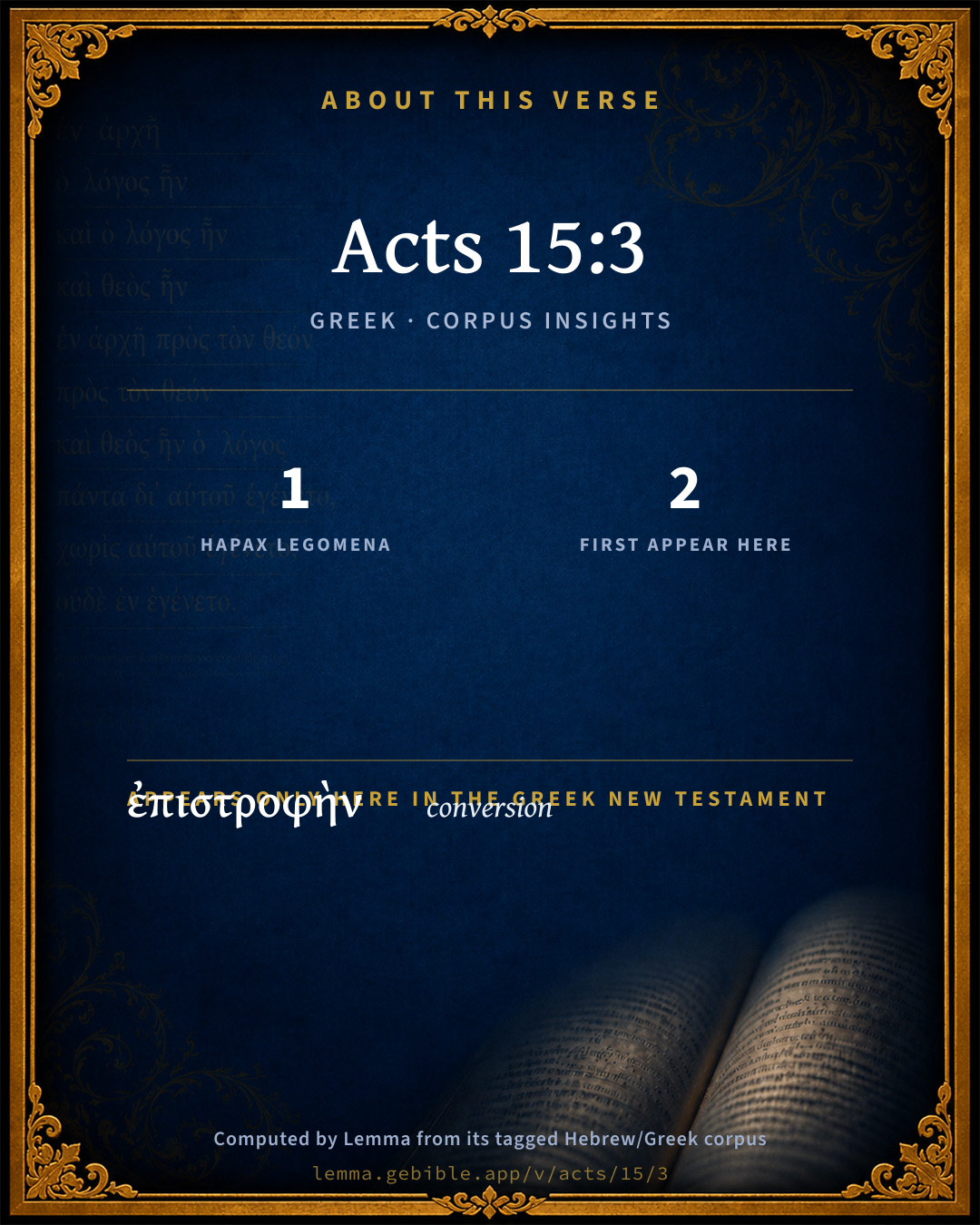
  • 1 hapax legomenon — only here in the Greek New Testament
  • 2 first appearances in the Greek New Testament
Full analysis ↓
Download a study sheet

One document with this verse’s original text, its word-by-word gloss line, the meaning frame, cross-references with their text, attributed commentary, and full source and license credits — printable, and it pastes into notes with its structure intact.

This verse Autodidact and up

Study sheet (.html) Plain text (.txt)

A passage Seminary Student

Up to 50 verses in one chapter. A passage sheet keeps up to 6 commentary sources and 12 cross-references per verse, in the order this page ranks them, and says so on the sheet whenever that leaves anything out. Ask for a single verse and you get the Autodidact verse sheet above.

Everything on this page stays free to read, with no account — the sheet is a download of what is already on screen, not access to it.

Want to remove ads? Support Godless Engineer
Compare translations 3

The same verse in 3 English versions, stacked beneath the original-language interlinear above. Click any original word for its lexicon entry.

Each is an independent rendering of the whole verse — the interlinear is not word-aligned to these translations.

Highlighted words mark where these versions differ — a whole-verse word diff, not a word-by-word alignment.

  • World English Bible Public Domain
    They, being sent on their way by the assembly, passed through both Phoenicia and Samaria, declaring the conversion of the Gentiles. They caused great joy to all the brothers.
  • King James Version Public Domain
    And being brought on their way by the church, they passed through Phenice and Samaria, declaring the conversion of the Gentiles: and they caused great joy unto all the brethren.
  • unfoldingWord Literal Text CC BY-SA 4.0
    Therefore indeed the ones having been sent out by the church were passing through both Phoenicia and Samaria, describing the conversion of the Gentiles and producing great joy in all the brothers,

unfoldingWord Literal Text — © unfoldingWord, licensed CC BY-SA 4.0. Word-aligned USFM3 via Door43 (git.door43.org/unfoldingWord/en_ult).

Versions to compare (up to 4)

3 of 4 selected

Show all 19 translations

Every available English version of this verse, each an independent rendering of the whole verse.

  • World English Bible Public Domain
    They, being sent on their way by the assembly, passed through both Phoenicia and Samaria, declaring the conversion of the Gentiles. They caused great joy to all the brothers.
  • Berean Standard Bible Public Domain
    Sent on their way by the church, they passed through Phoenicia and Samaria, recounting the conversion of the Gentiles and bringing great joy to all the brothers.
  • Majority Standard Bible Public Domain
    Sent on their way by the church, they passed through Phoenicia and Samaria, recounting the conversion of the Gentiles and bringing great joy to all the brothers.
  • King James Version Public Domain
    And being brought on their way by the church, they passed through Phenice and Samaria, declaring the conversion of the Gentiles: and they caused great joy unto all the brethren.
  • American Standard Version (1901) Public Domain
    They therefore, being brought on their way by the church, passed through both Phoenicia and Samaria, declaring the conversion of the Gentiles: and they caused great joy unto all the brethren.
  • Revised Version (1885) Public Domain
    They therefore, being brought on their way by the church, passed through both Phoenicia and Samaria, declaring the conversion of the Gentiles: and they caused great joy unto all the brethren.
  • Geneva Bible (1599) Public Domain
    Thus being brought forth by ye Church, they passed through Phenice and Samaria, declaring the conuersion of the Gentiles, and they brought great ioy vnto all the brethren.
  • Douay-Rheims (1899) Public Domain
    They therefore being brought on their way by the church, passed through Phenice, and Samaria, relating the conversion of the Gentiles; and they caused great joy to all the brethren.
  • Young's Literal Translation Public Domain
    they indeed, then, having been sent forward by the assembly, were passing through Phenice and Samaria, declaring the conversion of the nations, and they were causing great joy to all the brethren.
  • Literal Standard Version CC BY-SA 4.0
    they indeed, then, having been sent forward by the assembly, were passing through Phoenicia and Samaria, declaring the conversion of the nations, and they were causing great joy to all the brothers.
  • Unlocked Literal Bible CC BY-SA 4.0
    They therefore, being sent by the church, passed through both Phoenicia and Samaria and announced the conversion of the Gentiles. They brought great joy to all the brothers.
  • unfoldingWord Literal Text CC BY-SA 4.0
    Therefore indeed the ones having been sent out by the church were passing through both Phoenicia and Samaria, describing the conversion of the Gentiles and producing great joy in all the brothers,
  • Darby Bible Public Domain
    They therefore, having been set on their way by the assembly, passed through Phoenicia and Samaria, relating the conversion of [those of] the nations. And they caused great joy to all the brethren.
  • World Messianic Bible Public Domain
    They, being sent on their way by the assembly, passed through both Phoenicia and Samaria, declaring the conversion of the Gentiles. They caused great joy to all the brothers.
  • Webster's Bible Public Domain
    And being brought on their way by the church, they passed through Phenice, and Samaria, declaring the conversion of the Gentiles: and they caused great joy to all the brethren.
  • Free Bible Version CC BY-SA 4.0
    The church sent them on their way, and as they traveled through Phoenicia and Samaria, they explained how foreigners were being converted, which made all the believers very happy.
  • Bible in Basic English Public Domain
    So they, being sent on their way by the church, went through Phoenicia and Samaria, giving news of the salvation of the Gentiles, to the great joy of all the brothers.
  • Text-Critical English NT CC BY 4.0
    After being sent on their way by the church, they passed through Phoenicia and Samaria and brought great joy to all the brothers when they described in detail the conversion of the Gentiles.
  • Tyndale New Testament (1534) Public Domain
    And after they were brought on their waye by the congregacion they passed over Phenices and Samaria declarynge the conuersion of the getyls and they brought great ioye vnto all the brethren.

Literal Standard Version (2020), Covenant Press — licensed CC BY-SA 4.0. Text via the HelloAO Bible API (eBible.org). Unlocked Literal Bible (unfoldingWord) — licensed CC BY-SA 4.0. Text via the HelloAO Bible API (eBible.org). unfoldingWord Literal Text — © unfoldingWord, licensed CC BY-SA 4.0. Word-aligned USFM3 via Door43 (git.door43.org/unfoldingWord/en_ult). Free Bible Version, Dr. Jonathan Gallagher — licensed CC BY-SA 4.0. Text via the HelloAO Bible API (eBible.org).

Word by word

More ways to search: Search by grammar → Find every occurrence → Compare this word →

Practice this passage: Drill this verse → Learn its vocabulary →

ἐπιστροφὴν
epistrophḗ
G1995
“conversion”
Noun, Accusative, Singular, Feminine
Part of Speech
Noun
Case
Accusative
Number
Singular
Gender
Feminine
Full Thayer's Definition

Origin: from G1994

TDNT: 19:02,1

1. conversion (of the Gentiles from idolatry to the true God)
  1. οἱ ho G3588 “the” Article, Nominative, Plural, Masculine
  2. μὲν mén G3303 “truly” Particle
  3. οὖν oûn G3767 “therefore” Conjunction
  4. προπεμφθέντες propémpō G4311 “to send before” Verb, Aorist, Passive, Participle, Nominative, Plural, Masculine
  5. ὑπὸ hypó G5259 “under” Preposition
  6. τῆς ho G3588 “the” Article, Genitive, Singular, Feminine
  7. ἐκκλησίας ekklēsía G1577 “assembly” Noun, Genitive, Singular, Feminine
  8. διήρχοντο diérchomai G1330 “to pass through” Verb, Imperfect, Middle or Passive deponent, Indicative, 3rd person, Plural
  9. τήν ho G3588 “the” Article, Accusative, Singular, Feminine
  10. τε té G5037 “and” Particle
  11. Φοινίκην Phoiníkē G5403 “Phoenicia” Noun, Accusative, Singular, Feminine
  12. καὶ kaí G2532 “and” Conjunction
  13. Σαμάριαν Samáreia G4540 “Samaria” Noun, Accusative, Singular, Feminine
  14. ἐκδιηγούμενοι ekdiēgéomai G1555 “to relate” Verb, Present, Middle or Passive deponent, Participle, Nominative, Plural, Masculine
  15. τὴν ho G3588 “the” Article, Accusative, Singular, Feminine
  16. τῶν ho G3588 “the” Article, Genitive, Plural, Neuter
  17. ἐθνῶν éthnos G1484 “nation” Noun, Genitive, Plural, Neuter
  18. καὶ kaí G2532 “and” Conjunction
  19. ἐποίουν poiéō G4160 “to make” Verb, Imperfect, Active, Indicative, 3rd person, Plural
  20. χαρὰν chará G5479 “joy” Noun, Accusative, Singular, Feminine
  21. μεγάλην mégas G3173 “great” Adjective, Accusative, Singular, Feminine
  22. πᾶσιν pâs G3956 “all” Adjective, Dative, Plural, Masculine
  23. τοῖς ho G3588 “the” Article, Dative, Plural, Masculine
  24. ἀδελφοῖς adelphós G80 “brother” Noun, Dative, Plural, Masculine

About this verse

These counts appear in no published source. They are computed here, from the morphology-tagged text and Lemma’s own curated glosses. What Lemma adds →

25
words
19
distinct lemmas
Acts
section

Notable vocabulary

1 hapax legomenon — a word that appears only here in the entire Greek New Testament:

  • ἐπιστροφὴν conversion G1995

First appearance in Scripture

These words make their first canonical appearance in the Greek New Testament here:

  • προπεμφθέντες to send before G4311
  • ἐπιστροφὴν conversion G1995

Shared distinctive vocabulary

ἐκδιηγούμενοι to relate G1555 occurs in 2 verses of the Greek New Testament. Also found in:
Repetition

Words recur within this verse:

Cross-references

20

Topical passages linked to Acts 15:3 in the Treasury of Scripture Knowledge — connected by theme and wording, ordered by reader-vote popularity; previews shown in the World English Bible.

  • Acts 14:27 When they had arrived, and had gathered the assembly together, they reported all the things that God had done with them, and that he had opened a door of faith to the Gentiles.
  • Acts 21:5 When it happened that we had accomplished the days, we departed and went on our journey. They all, with wives and children, brought us on our way until we were out of the city. Kneeling down on the beach, we prayed.
  • Acts 11:18–19 When they heard these things, they held their peace, and glorified God, saying, "Then God has also granted to the Gentiles repentance to life!"
  • Acts 15:12 All the multitude kept silence, and they listened to Barnabas and Paul reporting what signs and wonders God had done among the Gentiles through them.
  • Romans 15:24 whenever I journey to Spain, I will come to you. For I hope to see you on my journey, and to be helped on my way there by you, if first I may enjoy your company for a while.
  • 1 Corinthians 16:6 But with you it may be that I will stay, or even winter, that you may send me on my journey wherever I go.
  • 1 Corinthians 16:11 Therefore let no one despise him. But set him forward on his journey in peace, that he may come to me; for I expect him with the brothers.
  • Titus 3:13 Send Zenas, the lawyer, and Apollos on their journey speedily, that nothing may be lacking for them.
  • Isaiah 60:4–5 Lift up your eyes round about, and see: they all gather themselves together, they come to you; your sons shall come from far, and your daughters shall be carried in the arms.
  • Isaiah 66:12–14 For thus says Yahweh, Behold, I will extend peace to her like a river, and the glory of the nations like an overflowing stream: and you shall suck [of it]; you shall be borne on the side, and shall be dandled on the knees.
  • Luke 15:5–10 When he has found it, he carries it on his shoulders, rejoicing.
  • Luke 15:23–24 Bring the fattened calf, kill it, and let us eat, and celebrate;
  • Luke 15:32 But it was appropriate to celebrate and be glad, for this, your brother, was dead, and is alive again. He was lost, and is found.'"
  • Acts 8:14 Now when the apostles who were at Jerusalem heard that Samaria had received the word of God, they sent Peter and John to them,
  • Acts 13:48 As the Gentiles heard this, they were glad, and glorified the word of God. As many as were appointed to eternal life believed.
  • Acts 13:52 The disciples were filled with joy with the Holy Spirit.
  • Acts 21:19–20 When he had greeted them, he reported one by one the things which God had worked among the Gentiles through his ministry.
  • Acts 28:15 From there the brothers, when they heard of us, came to meet us as far as The Market of Appius and The Three Taverns. When Paul saw them, he thanked God, and took courage.
  • 2 Corinthians 1:16 and by you to pass into Macedonia, and again from Macedonia to come to you, and to be sent forward by you on my journey to Judea.
  • 3 John 1:6–8 They have testified about your love before the assembly. You will do well to send them forward on their journey in a manner worthy of God,

Cross-references courtesy of OpenBible.info (CC BY 4.0).

Commentary

Notes on Acts 15:3 from classic Christian and Jewish commentators (each source and its license shown beneath its notes). The classic Christian expositions comment on the surrounding passage and are grouped to its opening verse, so a note may address several verses; the Jewish commentaries on the Tanakh (Rashi and others) are per-verse, so they appear only where the commentator wrote on this verse.

Lemma curates 59 commentaries, every one of them public domain or Creative Commons licensed, each selected and text-cleaned for this edition rather than reprinted as found. About our sources →

The Biblical Illustrator

Joseph S. Exell

Act_15:3-6

They therefore, being brought on their way.

Working on the road

1. For a little time the noise of controversy ceases. Paul and Barnabas might have taken a much shorter way to Jerusalem; but Paul, like the Master, always wished to do some work on the way. When Christ was apparently hastening to a particular locality, He would often on the road stop to do some intermediate miracle. So Paul said, We will make this a missionary journey. So they passed through Phoenicia and Samaria--the district where Philip had done his wonderful works. We should all leave footprints behind us; people that come afterwards should know that we were there first.

2. Follow the apostles. They find a line of Churches all the way, generally speaking, from Antioch to Jerusalem. There were houses of call on the road. The pioneer had, by sacred influence, said, Other and stronger men will be coming this road some day--be prepared for them. We, too, walk on roads that have been well trodden for us. We take the roads of a country as a matter of course. Who ever thinks of roads, or could suppose that a poet could wax eloquent upon road making? Yet even so common a thing as a road is essential to civilisation. Surely as they passed along Paul and Barnabas would often think of Philip, and would often hear of him in the homes where they lodged. It is pleasant to see, in little wayside houses, the pictures of Wesley and Whitefield, and pastors of humbler name, who have lived in the locality. These pictures are texts. Despise not your forerunners.

3. What peeps we get into the domestic life of the time! The two men coming into a house turned it into an historical temple. There are some visits that transfigure the localities in which they are paid. And the little common feast, and the sort of talk which passes between men and unites mens hearts! Forget not the little idylls that help to make up the massive poetry of great histories. There were little occasions, as well as great ones, in the development of the Christian story. Handgrips, and special prayers, and visits to the sick chamber, where the tenderest of all supplications were breathed, and still the men passed on, having to maintain a valiant and historical testimony in the face of the first council of the Christian Church.

4. As they went along what did they talk about? Declaring the conversion of the Gentiles. There ought to be great joy when soldiers come from the field of war with the latest news. We soon rough down, by dumb applause, the stumbling missionary who tries to tell us that the blood-red banner is floating higher than ever in the wind! The early Christians were full of their subject; we easily slip out of ours. They had but one theme, only it included all other themes. They took pleasure in their work; they liked Sunday better than Monday--nay, they made Sunday seven days long.

5. In Act_15:4 note that the Church is spoken of in its unity. We have made it into a thousand. I do not object to denominations any more than I object to regiments; but as I expect all the regiments to bow to one throne, so I would expect all denominations to have common ground upon which they can have a common altar. Being received by the Church, the two speakers stood up to tell their tale. Have we no tale to tell? If a thief broke into your house, you would tell everybody about it. If your house was on fire, all the neighbourhood would know it. A man who has a tale to tell tells it; and he is right in doing so. We are not unwilling to speak, but we have no story to relate.

6. Look at Act_15:5. The contention was Pharisaic. Not many of them believed, and those who did were greater opponents as believers than as unbelievers. There are hinderers in the Church as well as outside. This position was not only Pharisaic, it was founded upon a narrow reading of the letter. If Christianity is a square with well-defined walls, there are men who could stand in the middle of it and defend it bravely; but if Christianity is a horizon which recedes as we advance, and which has room enough within it for other universes tenfold larger than our own, they become bewildered, the letter is of little use to them, and so they make four corners for themselves, and subside within the prison of a creed. It is difficult for some men to see the bud in the seed. Christianity has its blossom as well as its root, its fruit as well as its blossom. The type only lives by its little self until the fulfilment comes, and then it passes away. They who upheld the law of Moses were Pharisees. How marvellous the providence that a Pharisee of the Pharisees was sent to answer them! They would have made short work of other men, but there arose a very prince of the blood, and in his presence they met an unexpected and successful check. A man who knows a smattering of a language may astound the villagers who never heard of it; but let a man arise who knows the language perfectly, and then the blatant pretender will fall away in shame. God grows His own men, and will always find His own champions. Let us rest in the God of truth, and the truth shall never be in want of a man of adequate capacity and needful eloquence to show its grandeur and enforce its claims. (J. Parker, D. D.)

The Biblical Illustrator, edited by Joseph S. Exell (c. 1880s–1900s) — public domain. Text from a community e-Sword module.

Joseph Benson's Commentary

Act 15:3-5. And being brought on their way by the church — That is, by several of its members; they passed through Phenice and Samaria — Which lay in their way; declaring — To their fellow-Christians, whom they met with in the several towns through which they passed; the conversion of the Gentiles — That is, of multitudes of them, by the blessing of God on their labours. And they caused great joy unto all the brethren — By the account they gave. And when they were come, &c., they were received — That is, solemnly welcomed by the church, and particularly by the apostles and elders who resided at Jerusalem, who all showed them every mark of respect. And they declared all things — That is, the principal things; which God had done by them — That by their ministry he had converted the Gentiles in many countries, and had bestowed upon many of them the Holy Ghost, in the plenitude of his gifts. But, they added, that at Antioch there rose up certain of the Pharisees who believed — Affirming that it was necessary to circumcise them; and that the brethren of Antioch had sent them to lay the matter before the apostles.

Joseph Benson's Commentary on the Old and New Testaments (1811–1818) — public domain. Text from a community e-Sword module.

Bengel's Gnomon

Johann Albrecht Bengel

Act 15:3. Προπεμφθέντες, being brought on their way) A frequent and sacred office of kindness.—διήρχοντο, they passed through) propagating the kingdom of GOD on their way.—ἀδελφοῖς, unto the brethren) who were in Phenice and Samaria.

Bengel's Gnomon of the New Testament — English translation (T&T Clark, Edinburgh, 1860) — public domain. Text from a community e-Sword module.

Meyer's Critical & Exegetical Commentary

Heinrich August Wilhelm Meyer

Act_15:3. Προπεμφθέντες] after they were sent forth, deducti, i.e. escorted for a part of the way. Comp. 3Jn_1:6; Herod. i. 111, viii. 124, 126; Plat. Menex. p. 236 D; Soph. O. C. 1663. Morus and Heinrichs: rebus ad iter suscipiendum necessariis instructi. That, however, must have been suggested by the context, as in Tit_3:13. The provision with necessaries for the journey is understood of itself,[24] but is not contained in the words.

τοῖς ἀδελφοῖς] They caused joy by their visit and by their narratives, not only to the Jewish-Christians (Heinrichs), but to all.

[24] Although the travellers, on account of the hospitality of the churches, which they visited by the way, certainly needed but little.

Meyer — Critical and Exegetical Commentary on the New Testament — English translation by Peter Christie, edited by Frederick Crombie (T&T Clark, 1880) — public domain. Text from a community e-Sword module.

Expositor's Greek Testament

ed. W. Robertson Nicoll

Act 15:3 . οἱ μὲν οὖν : Phœnicia and Samaria on the one hand welcome them with joy, but on the other hand the Church in Jerusalem is divided, Act 15:5 , see Rendall, Appendix on μὲν οὖν , p. 161. Blass however thinks that the words are used “without opposition” as often. διήρχοντο τὴν Φ . καὶ Σ ., see note on Act 13:6 . In both cases the presence of brethren is presupposed, cf. Act 8:25 , Act 11:19 , imperfect, “peragrabant donec pervenerunt,” Act 15:4 (Blass). προπεμφ .: escorted on their way, not as Tit 3:13 , of being provided with necessaries for the journey ( Wis 19:2 ); cf. Act 20:38 , Act 21:5 , and so in classical Greek, only in Luke and Paul in N.T. (except once, 3Jn 1:6 ), cf. Rom 15:24 ; but in 1Co 16:6 ; 1Co 16:11 , 2Co 1:16 , R.V. renders as in Titus, l. c. , and John, l. c.; cf. 1Es 4:47 , Jdt 10:15 , 1Ma 12:4 , see Grimm-Thayer, sub v. ; Polycarp, Phil. , i., 1, of the conduct of St. Ignatius through Macedonia, amongst the early Christians, as amongst the Jews (Gen 18:16 ), a mark of affection and respect. The meaning of the word, as Wendt points out, depends on the context. ἐκδιηγ .: only here and in quotation, Act 13:41 in N.T., “telling the tale of the conversion of the Gentiles”; so διηγεῖσθαι and ἐξηγεῖσθαι more frequently in Luke than in other N.T. writers. Hobart describes all three as medical terms but all three also occur frequently in LXX. ἐκδ .: cf. Hab 1:5 ; several times in Ecclus., also in Josephus and Arist. (Grimm-Thayer, sub v. ). χ . μεγάλην : on Luke’s fondness for the predicate μέγας , Friedrich, p. 41, with χαρά as here, cf. Luk 2:10 ; Luk 24:52 , Act 8:8 (Mat 2:10 ; Mat 28:8 ), cf. LXX, Jon 4:6 , Isa 39:2 , A. S. ἐποίουν , imperfect, continuous joy, as they went from place to place, perhaps visiting Cornelius or Philip the Evangelist, Act 8:40 , in their progress. ἐπιστροφὴν : only here in N.T. ( cf. 1Th 1:9 ), Sir 18:21 (20), Sir 49:2 .

The Expositor's Greek Testament, edited by W. Robertson Nicoll (1897–1910) — public domain. Text from a community e-Sword module.

Geneva Bible (1599)

Geneva Bible translators

Courteously and lovingly brought on their way by the Church, that is, by certain appointed by the Church.

Geneva Bible (1599) marginal notes — public domain. Text via Bolls.life.

Jamieson, Fausset & Brown

Robert Jamieson, A. R. Fausset & David Brown

being brought on their way by the church--a kind of official escort.

they passed through Phenice--(See on Act 11:19).

and Samaria, declaring the conversion of the Gentiles, and they caused great joy to the brethren--As the converts in those parts were Jewish (Act 11:19), their spirit contrasts favorably with that of others of their nation.

Jamieson, Fausset & Brown — Commentary Critical and Explanatory on the Whole Bible (1871) — public domain (CC PDM 1.0). Text via the HelloAO Bible API.

Adam Clarke's Commentary

Verse 3. Being brought on their way by the Church] That is; the members of the Church provided them with all necessaries for their journey; for it does not appear that they had any property of their own.

Declaring the conversion of the Gentiles] Much stress is laid on this: it was a miracle of God's mercy that the Gentiles should be received into the Church of God; and they had now the fullest proof that the thing was likely to become general, by the conversion of Cornelius, the conversion of the people of Antioch, of Cyprus, Pisidia, Pamphylia, Lycaonia, &c., &c.

Adam Clarke's Commentary on the Bible (1810–1826) — public domain. Text from a community e-Sword/MySword module.

John Calvin's Commentaries

3. Being brought on the way by the Church. Whereas, by the common consent of the Church, there were joined to Paul and Barnabas companions, who might, for duty’s sake, conduct them, we may thereby gather, that all the godly were on their side; and that they did never otherwise think but that the cause was theirs as well as the apostles. Wherefore they determined the journey of Paul and Barnabas with like minds as they took it in hand; to wit, that they might tame and put to silence those troublesome spirits who did falsely make boast of the apostles. Whereas he saith shortly after, that they certified the brethren in their voyage of the wonderful conversion of the Gentiles, it is a testimony and token that they came not to Jerusalem fraught with fear; but that they did even without fear stoutly profess that which they had taught before. Therefore, they come not to plead their cause before their judges; but that they may, with common consent and judgment, on both sides, approve that which was commanded by God touching the abolishing of ceremonies. For though they did not despise the judgment of the apostles, yet because they knew that it was not lawful for them, neither for the apostles, to decree otherwise concerning the cause, it did not become them to stand as men whose matter is handled at the bar. Thence cometh the boldness of rejoicing; to this end tendeth the joy of the godly, whereby they subscribe both to the doctrine of Paul and also the calling of the Gentiles.

John Calvin's Commentaries (1540-1563) — public domain. Text from the Calvin Translation Society English edition (1840s-50s) via the Christian Classics Ethereal Library (ccel.org). Calvin's coverage is partial (roughly two-thirds of the Bible); uncommented books and verses are honest gaps, never fabricated. The 19th-century editor's footnotes and remarks are omitted so the notes are faithfully Calvin's own voice.

Ellicott's Commentary for English Readers

(3) They passed through Phenice and Samaria.—The route lay from Seleucia, at the mouth of the Orontes, along the coast of Sidon, Tyre, and, probably, Cæsarea, and then through Samaria. They might have gone to Joppa, and so have avoided the old Canaanite cities and the region of the hated Samaritans. The very journey was, therefore, an assertion of the principles for which they were contending. We note, too, that the facts imply that they found “brethren,” i.e., established Christian societies, in both regions. “Tyre and Sidon” had repented and believed, though Chorazin and Bethsaida had hardened themselves in unbelief (Luk_11:13). The “woman of Canaan,” of Mar_7:26, may, by this time, have eaten not of the “crumbs,” but of the “Bread” of Life. Everything points to Philip as the probable Evangelist of this region as well as of Samaria. Paul and Barnabas would accordingly, as they travelled, be setting their seal to his work, claiming fellowship with Canaanites and Samaritans; and wherever they went they were received with joy. Here, at least, they were certain of support; and, on mere grounds of policy, they were strengthening their cause by appearing at Jerusalem as the representatives of such important communities, having the courage of their convictions, and determined, though they might make concessions in things indifferent, not to sacrifice a single principle.

They caused great joy.—The tense implies continued action. Wherever they went the tidings of the conversion of the Gentiles were received by the disciples at large with a gladness which presented the strongest possible contrast to the narrowness and bitterness of the Pharisee section of the Church of Jerusalem.

A Bible Commentary for English Readers, edited by Charles John Ellicott (1878–1897) — public domain. Text from a community e-Sword module.

The Cambridge Bible for Schools and Colleges

gen. ed. J. J. S. Perowne

3. brought on their way] It was not an uncommon mark of affection or respect that a part of the church at any place should attend its chief teachers for a short way on their journeys. (Cp. infra Act_20:38, Act_21:16.) And for the antiquity of the custom among the Jews, see Gen_18:16, where Abraham brings his heavenly visitors on their way.

Among the companions of Paul and Barnabas on this journey must have been Titus, for we read of him, and the question raised about his circumcision, in St Paul’s own notice of this visit (Gal_2:3).

through Phenice (Phœnicia) and Samaria] The road would take them along the coast through Berytus, Tyre and Sidon, which at this time were places of great importance, and most likely to have bodies of Christians among their inhabitants.

declaring the conversion of the Gentiles] This would naturally be St Paul’s great theme. Among those who were going up to Jerusalem with him would be members of the Judaizing party, but their presence was no check on the Apostle’s zeal that all men should hear of the bringing in of Gentiles to the faith of Christ. The verb used implies that he gave his story with all details, and we may be sure that he dwelt on the way in which the Spirit of God had set a seal upon the work, though the converts of whom he spake were all uncircumcised.

unto all the brethren] We see therefore that it was only some of the Jews who demanded from the Gentiles complete conformity to the Law. At Jerusalem (Act_15:5) the Judaizing party is described as ‘certain of the sect of the Pharisees which believed,’ and the Gospel history represents the Pharisees on all occasions as determined supporters of the ceremonial law. Probably their party was most numerous at Jerusalem, where all the ritual observances could be most completely carried out. In the more remote congregations the joy over the Gentile conversions would be unalloyed.

The Cambridge Bible for Schools and Colleges (gen. ed. J. J. S. Perowne; Cambridge University Press, 1878–1918) — public domain. Text from a community e-Sword module.

John Gill's Exposition

And being brought on their way by the church,.... That is, either being accompanied by some of the brethren of the church some part of the way, out of respect unto them, or being provided by them with things necessary for their journey; see Tit 3:13

they passed through Phenice and Samaria; which both lay between Syria and Judea; in the former of which places those that were scattered upon the death of Stephen had preached, and a great number were converted and believed in Christ who were Jews, Act 11:19 and in the latter Philip the evangelist had preached with much success, Act 8:5 as therefore their way to Jerusalem lay through these places, they called upon the brethren as they passed;

declaring the conversion of the Gentiles; in the several places where they had been, as in Syria, Pisidia, Pamphylia, and Lycaonia, how by their ministry they were turned from darkness to light, from Satan unto God, from their superstition and idolatry to the worship of the true God, and to faith in Christ Jesus:

and they caused great joy unto all the brethren; the believing Jews in those parts, who being truly believers in Christ, rejoiced at the spread of his Gospel, and the increase of his interest, even among the Gentiles; for if angels rejoice, much more should saints rejoice at the conversion of sinners, let them be who or where they will; and where there is true grace, there will be joy when this is the case. There were churches in each of these places, of which "the brethren" here mentioned were members, and which continued for many ages afterwards: the foundation of the churches in Phenice was first laid by the converts made by them, who were scattered abroad through the persecution at the death of Stephen, Act 11:19. Quartus, mentioned in Rom 16:23 is said to be bishop of Berytus in this country. In the "second" century there were churches at Tyre and Ptolemais, two cities in Phoenicia; Cassius was bishop of the one, and Clarus of the other (k): in the "third" century several Phoenician bishops suffered martyrdom, as Tyrannio, bishop of the church of Tyre, Zenobius, presbyter of that at Sidon, and Sylvanus, bishop of Emisa (l): in the "fourth" century, at the beginning of it, there were present, at the council of Nice, the bishops of Ptolemais, Damascus, Tripolis, Paneas, and Emisa; as they were also at a synod held at Jerusalem in the same century, on account of the Arians, and at another at Antioch on the same account: in the fifth century there were churches in Phoenicia reformed by Chrysostom, by whose means also the temples of the idols were destroyed, and many were converted in these countries; and in this age lived several persons of note here, as Antiochus bishop of Ptolemais, Eustathius bishop of Berytus, Paulus bishop of Emisa, Pompeianus and Uranius of the same place, and Damianus bishop of Sidon, and other Phoenician bishops, who assisted at the council of Chalcedon; as Olympius bishop of Atrapolis, Theodorus bishop of Tripoils, Joseph bishop of Heliopolis, Valerius bishop of Laodicea, Thomas bishop of Euroma, and Theonas bishop of Enria or Enaria, all in Phoenicia: in the sixth century, mention is made of the bishops of Ptolemais, Tyre, Sidon, and Berytus, in the acts of the synod at Rome and Constantinople; and though Phoenicia was seized upon, and wasted by the Arabians and Persians, in the seventh century; yet we read, in the eighth century, of Adeodatus, a bishop of Berytus, who baptized many converted Jews (m). As for Samaria, our Lord himself preached and converted many persons there; and after his resurrection he gave his apostles a commission and directions to go there; and here Philip preached with great success. Nicolaus, the deacon, is said to be the first bishop of Samaria; and though in after ages Heathenism very much prevailed in those parts; yet there were Christians and churches, more or less, for several centuries; even in the sixth century there was a bishop of Neapolis in Samaria, killed with the sword, and some presbyters who were taken and fried in a pan, with the remains of some martyrs, by the Samaritan Jews (n).

(k) Euseb. Eccl. Hist. l. 5. c. 25. (l) Ib. l. 8. c. 13. (m) Madgeburg. Hist. Eccles. cent. 4. c. 2. p. 2. c. 9. p. 35O, 390, 404. cent. 5. c. 2. p. 3, 12, 13. c. 10. p. 550, 551. cent. 6. c. 2. p. 3. cent. 7. c. 3. p. 17. c. 16. p. 365. cent 8. c. 2. p. 3. (n) Ib. cent. 6. c. 3. p. 22.

John Gill's Exposition of the Whole Bible (1746–1763) — public domain (CC PDM 1.0). Text via the HelloAO Bible API.

Trapp's Complete Commentary

John Trapp

3 And being brought on their way by the church, they passed through Phenice and Samaria, declaring the conversion of the Gentiles: and they caused great joy unto all the brethren.

Ver. 3. By the Church] That is, by the community of God’s people, who therefore (as it may seem) sided with Paul and Barnabas, against those disturbers.

They passed through Phenice and Samaria] They took a long journey for a public good. Calvin was wont to say, that he would gladly sail over ten seas {a} to settle a general peace and good agreement in the reformed Churches. Terentius (that noble general under Valens the emperor), when he was bidden ask what he would, and it should be done, asked nothing but that the Church might be freed from Arians. And when the emperor tore his petition, he said that he would never ask anything for himself, if he might not prevail for the Church: this that he might, he would undertake any pains, undergo any peril by sea or land. (Theodoret, iv. 32.)

{a} Ne decem quidem maria, &c. Beza.

John Trapp, A Commentary or Exposition upon All the Books of the Old and New Testament (1647–1656) — public domain. Text from a community e-Sword module.

Albert Barnes' Notes on the Bible

And being brought on their way by the church - Being attended and conducted by the Christian brethren. See the notes on Rom 15:24. It was customary for the Christians to attend the apostles in their travels. Compare 1Co 16:6, 1Co 16:11; 3Jo 1:6.

Through Phenice - See the note at Act 11:19.

And Samaria - These places were directly on their route to Jerusalem.

Declaring the conversion ... - Of the Gentiles in Antioch, and in the regions in Asia Minor through which they had traveled. These remarkable events they would naturally communicate with joy to the Christians with whom they would have contact in their journey.

Caused great joy - At the news of the extensive spread of the gospel. It was an indication of their deep feeling in the interests of religion that they thus rejoiced. Where Christians are themselves awake, and engaged in the service of Christ, they rejoice at the news of the conversion of sinners. Where they are cold, they hear such news with indifference, or with the utmost unconcern. One way of testing our feelings on the subject of religion is by the emotions which we have when we hear of extensive and glorious revivals of religion. Compare the notes on Act 8:8.

Albert Barnes' Notes on the Bible (1834–1885) — public domain. Text from a community e-Sword/MySword module.

Matthew Poole's English Annotations

Brought on their way by the church; the brethren or believers of Antioch, out of respect, went part of the way with them; as also thereby showing, that Paul and Barnabas did not go upon their own business or mind only, and that there was no dissension betwixt them and the church there.

The conversion of the Gentiles; it is a conversion or turning indeed from error to truth, from impurity to holiness; that is, from darkness to light, and from the power of Satan unto the ever living God, Act 26:18.

They caused great joy unto all the brethren; nothing more rejoices a good man, than the bringing of souls unto God, and the enlarging of the kingdom of Jesus Christ.

Matthew Poole's English Annotations on the Holy Bible (1683–1685) — public domain. Text from a community e-Sword/MySword module.

Whedon's Commentary on the Bible

Daniel D. Whedon

3. Brought on their way—Honourably escorted and authenticated, so as to be hospitably and deferentially received and forwarded by the Churches on their way.

Through Phenice and Samaria—Not through Galilee, but along the Phenician coast probably as far as Ptolemais; then turned eastward through the plain of Esdraelon; thence by Samaria to Jerusalem.

Declaring—We see by tracing this journey how Christianity had overspread these regions, and their joy indicates that the Judaizers had sought to oppose them, and shows how largely this Christianity was Gentile and Pauline.

Daniel D. Whedon (gen. ed.), Commentary on the Old and New Testaments (1874–1909) — public domain. Text from a community e-Sword module.

The Pulpit Commentary

They therefore... passed for and they passed, A.V.; both Phoenicia for Phonice, A.V. Being brought on their way (propemfqentev). The word propempein has two distinct though allied meanings: one is "to conduct a person on his way," as in Act_20:38 Act_21:5; the other is "to help a person on his way, by supplying him with all necessaries for his journey," as in Rom_15:24; 1Co_16:6 Col_1:16; Tit_3:13 3Jn_1:6. This last is the meaning here. Being the messengers of the Church, they traveled at the Church"s expense. Both Phoenicia and Samaria. Their course would be through Berytus, Type, Sidon, and Samaria. Declaring the conversion of the Gentiles. There was an especial reason for doing so, as it had a strong bearing upon the great controversy about to be decided at Jerusalem.

The Pulpit Commentary (1880–1919), ed. H.D.M. Spence-Jones & Joseph S. Exell — public domain. Text from a community e-Sword module.

Scofield Reference Notes

C. I. Scofield

Phenice

Phoenicia.

The Scofield Reference Bible (1917 edition), notes by C. I. Scofield — public domain. Text from a community e-Sword module.

Burkitt's Expository Notes on the New Testament

William Burkitt

Here note, 1. How that great but humble apostle, St. Paul, who had learned of his Master to be meek and lowly in spirit, was willing and content to be a servant and messenger of the church to the apostles, though he was nothing inferior to the chiefest apostle: Paul and Barnabas went up to the apostles that were at Jerusalem. The more holiness a Christian has, the more humility he has. Humility is a great part of our holiness, it is an argument of our sincerity, and an ornament to our profession; it is the great design of the gospel to make us humble, and keep us humble.

Note, 1. With what great pleasure and satisfaction Paul and Barnabas make report of the success of their ministry, both at Phenice, Samaria, and Jerusalem, in the conversion of the poor Gentiles, and with what joy the report was received and entertained: They declared the conversion of the Gentiles, and it caused great joy unto all the brethren.

Thence learn, that nothing more rejoices the hearts of believers, than the hearing of souls brought home to God by converting grace, and thereby of the increasing and enlarging of the kingdom of Jesus Christ. The Gentiles’ conversion was joyful news to the saints at Jerusalem.

Note, 3. With what great and due reverence and respect the church at Jerusalem received and entertained those laborious apostles, Paul and Barnabas, who were now sent unto them by the church at Antioch: When they were come to Jerusalem, they were received of the church; that is, received with great veneration and regard, for their indefatigable labors in order to the Gentiles’ conversion.

Thence learn, That double honour and respect is certainly due and payable to such ministers of Christ as labour in the word and doctrine, and perform their duty to God and their people, with such zeal and application as becomes persons of their holy character and profession.

O how beautiful should the feet be of them that preach the gospel of peace, and bring glad tidings of good things, even the joyful tidings of salvation, to the ears of a lost world.

William Burkitt's Expository Notes on the New Testament (1700–1703) — public domain. Text from a community e-Sword module.

McGarvey & Pendleton's Commentaries

J. W. McGarvey

3. Their journey to Jerusalem, which was accomplished by land, lay through two sections of country which had already been evangelized to a considerable extent. (3) " Being sent forward by the Church, they passed through Phenicia and Samaria, relating the conversion of the Gentiles: and they caused great joy to all the brethren. " The Churches in Samaria did not, of course, sympathize with the Jewish prejudices, and although in Phenicia there were doubtless many Jews, yet the Gentile element sufficiently predominated to enable the brethren there, like the Samaritans, to rejoice that the gospel was spreading into the heathen world.

J. W. McGarvey (with Philip Y. Pendleton), Commentaries on the New Testament (The Fourfold Gospel, 1914; Acts; and the epistles) — public domain. Text from a community e-Sword/MySword module.

The People's New Testament

B. W. Johnson

3, 4. Being brought on their way by the church. A special escort of church members attended them on their journey. It was mark of honor. See 20:38 and 21:5. Passed through Phenice. Phoenicia. They went by the land route, visiting the churches of Phoenicia and Samaria, causing great joy by their account of so great success among the Gentiles.

Were received of the church. Had a cordial reception, a warm greeting.

B. W. Johnson's The People's New Testament with Notes (1889–1891) — public domain. Electronic text from the Christian Classics Ethereal Library (CCEL) ThML edition.

unfoldingWord translationNotes

Door43 World Missions Community

General Information:

Here the words "They," "they," and "them" refer to Paul, Barnabas, and certain others. (See: Acts 15:2)

They therefore, being sent by the church

This can be stated in active form. AT: "Therefore the community of believers sent them from Antioch to Jerusalem" (See: Active or Passive)

being sent by the church

Here "church" stands for the people that were a part of the church. (See: Metonymy)

passed through ... announced

The words "passed through" and "announced" indicate they spent some time in different places sharing in detail what God was doing.

announced the conversion of the Gentiles

The abstract noun "conversion" means the Gentiles were rejecting their false gods and believing in God. AT: "announced to the community of believers in those places that Gentiles were believing in God" (See: Abstract Nouns)

They brought great joy to all the brothers

Their message causing the brothers to be joyful is spoken of as if "joy" were an object that they brought to the brothers. AT: "What they said caused their fellow believers to rejoice" (See: Metaphor)

the brothers

Here "brothers" refers to fellow believers.

they were welcomed by the church and the apostles and the elders

This can be stated in active form. AT: "the apostles, the elders, and the rest of the community of believers welcomed them" (See: Active or Passive)

with them

"through them"

translationWords

church

Phoenicia

Samaria

Gentile

joy

Jerusalem

unfoldingWord translationNotes — © Distant Shores Media and the Door43 World Missions Community, licensed CC BY-SA 4.0. Source: git.door43.org/Door43/en_tn.

Cambridge Greek Testament for Schools and Colleges

3. προπεμφθέντες, being brought on their way. It was not an uncommon mark of affection or respect that a part of the Church at any place should attend its chief teachers for a short way on their journeys. (Cf. infra Act 20:38, Act 21:16.) And for the antiquity of the custom among the Jews, see Gen 18:16, where when the heavenly visitors were departing from Abraham it is said (LXX.), συνεπορεύετο μετ’ αὐτῶν συμπροπέμπων αὐτούς.

Among the companions of Paul and Barnabas on this journey must have been Titus, for we read of him, and of the question raised about his circumcision, in St Paul’s own notice of this visit (Gal 2:3).

διήρχοντο τήν τε Φοινίκην καὶ Σαμάρειαν, they passed through both Phænicia and Samaria. The road would take them along the coast through Berytus, Tyre and Sidon, which at this time were places of great importance, and most likely to have bodies of Christians among their inhabitants.

ἐκδιηγούμενοι τὴν ἐπιστροφὴν τῶν ἐθνῶν, declaring the conversion of the Gentiles. This would naturally be St Paul’s great theme. Among those who were going up to Jerusalem with him would be members of the Judaizing party, but their presence was no check on the Apostle’s zeal that all men should hear of the bringing in of Gentiles to the faith of Christ. The verb ἐκδιηγεῖσθαι implies that he gave his story with all details, and we may be sure that he dwelt on the way in which the Spirit of God had set a seal upon the work, though the converts of whom he spake were all uncircumcised.

πᾶσιν τοῖς ἀδελφοῖς, unto all the brethren, i.e. in the Churches through which they passed, in which places the brethren must have been in great part Jews, though there might be proselytes also among them. We see therefore that it was only some of the Jews who demanded from the Gentiles complete conformity to the Law. At Jerusalem (Act 15:5) the Judaizing party is described as ‘certain of the sect of the Pharisees which believed,’ and the Gospel history represents the Pharisees on all occasions as determined supporters of the ceremonial law. Probably their party was most numerous at Jerusalem, where all the ritual observances could be most completely carried out. In the more remote congregations the joy over the Gentile conversions would be more unalloyed.

Cambridge Greek Testament for Schools and Colleges (Cambridge University Press, 1896; 21 vols, various authors incl. Carr, Maclear, Plummer, Farrar, Lumby, Moule, M. R. James, Simcox) — public domain. Text from a community e-Sword module.

Alford’s Greek Testament

Henry Alford

3. προπεμφ.] This seems to have been something of an official escorting of them on the way, and perhaps parting from them with solemn commendation to God: not, as Morus and Heinrichs, ‘rebus ad iter suscipiendum instructis,’ which would hardly be thus specified, being a matter of course. At all events, it shews that the mind of the church was with them, not with the Judaizers. This was also the case in Phœnicia and Samaria, as is shewn by πᾶσιν below.

Henry Alford, The Greek Testament (1849–1861) — public domain. Text from a community e-Sword module.

Vincent's Word Studies in the New Testament

Marvin R. Vincent

Being brought on their way [προπρμφθεντες] . Lit., having been sent forth; under escort as a mark of honor.

Declaring. See on ch. Act 13:41. In the various towns along their route.

Marvin R. Vincent, Word Studies in the New Testament (1887–1900) — public domain. Text from a community e-Sword/MySword module.

Lesson kit

Teaching starters — assembled from the data on this page, not authored interpretation. Every prompt links to the verse data it draws on. Edit before teaching.

Acts, in the Acts, opens this verse with 25 words (19 distinct Greek lemmas). Its most distinctive word is epistrophḗ (“conversion”). A historical commentator’s framing appears above. Read the whole chapter for the surrounding context.

Discussion questions

  1. What does “conversion” (epistrophḗ) contribute to the verse as a whole?
  2. This verse holds 1 word here found nowhere else in the Greek New Testament. What might the rare word draw attention to?
  3. 2 words here appear for the first time in Scripture. What is being introduced at this debut?
  4. Acts 13:41 shares the word «to relate» with this verse. How do the two illuminate each other?
  5. “the” occurs 6× in this one verse. What is the effect of the repetition?
  6. These translations render this verse differently. What is at stake in choosing one wording over another?
  7. Reading how The Biblical Illustrator and Joseph Benson's Commentary read this verse, where do the two commentators agree and where do they part?

Things to notice

  • 1 word in this verse appears nowhere else in the Greek New Testament.
  • 2 words make their first canonical appearance in Scripture here.
  • These translations choose different wording for 23 words in this verse.
  • “the” occurs 6× in this single verse.
  • 19 distinct Greek lemmas span 25 words in this verse.

Reading settings

Reading text

Shown beneath each verse's original-language words.

Old Testament
Old Testament edition

Read the OT as the Masoretic Hebrew (MT) or the Greek Septuagint (LXX).

English shown for the Greek Septuagint (in the Hebrew ↔ Greek comparison).

Comparing translations? Open the Compare panel on any verse page to stack up to four side by side.