

1 Peter 2:12
Greek (Tischendorf 8th ed.) 1 Peter 2:12 appears in the Greek New Testament. The text above is from the Tischendorf 8th edition. Each word links to its Strong’s number and a concise gloss. Click any word for its full Thayer’s Greek Lexicon entry.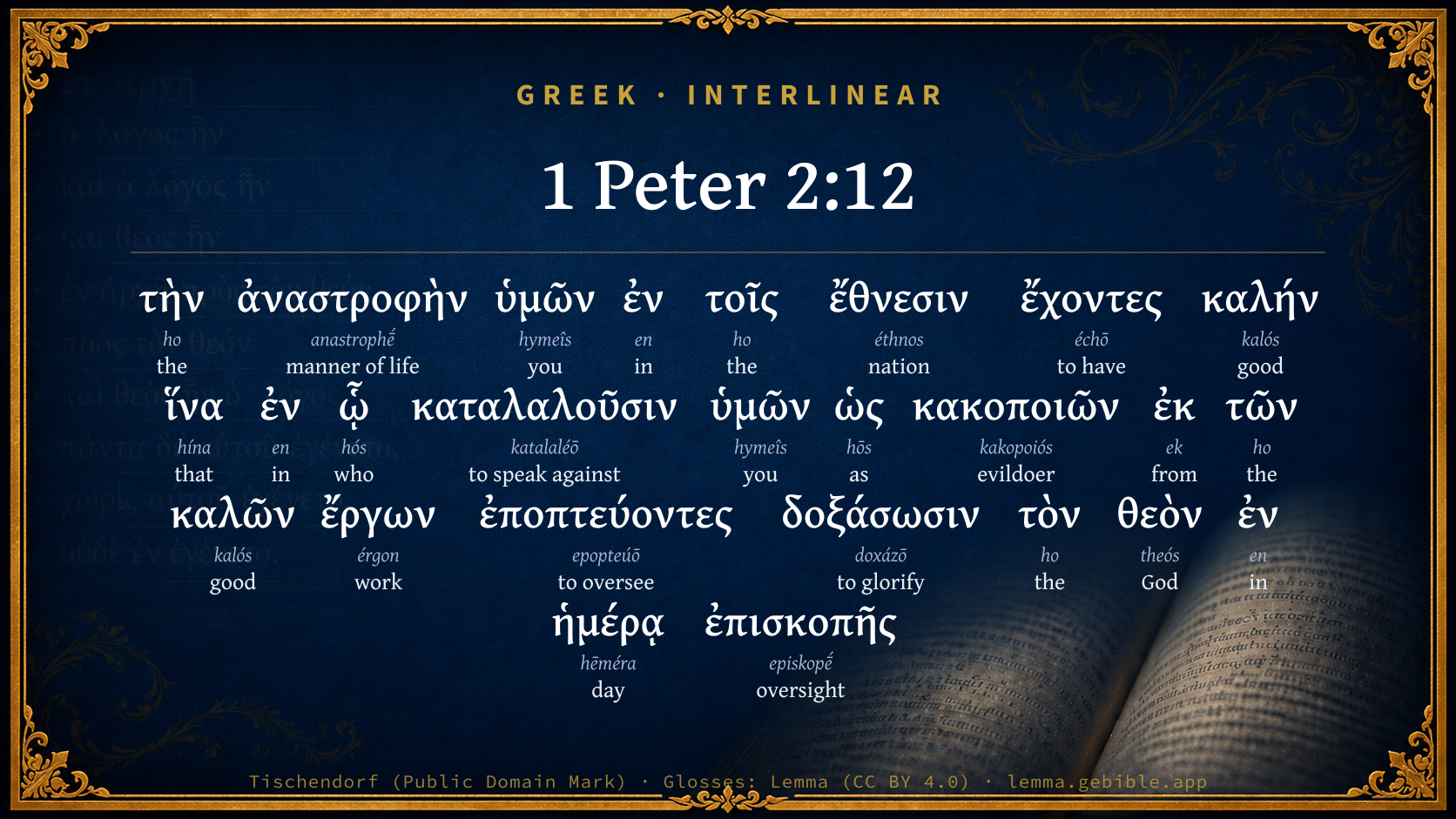
having good behavior among the nations, so in that which they speak against you as evil-doers, they may by your good works, which they see, glorify God in the day of visitation.
Download a study sheet
One document with this verse’s original text, its word-by-word gloss line, the meaning frame, cross-references with their text, attributed commentary, and full source and license credits — printable, and it pastes into notes with its structure intact.
This verse Autodidact and up
A passage Seminary Student
Up to 50 verses in one chapter. A passage sheet keeps up to 6 commentary sources and 12 cross-references per verse, in the order this page ranks them, and says so on the sheet whenever that leaves anything out. Ask for a single verse and you get the Autodidact verse sheet above.
Everything on this page stays free to read, with no account — the sheet is a download of what is already on screen, not access to it.
Compare translations 3
The same verse in 3 English versions, stacked beneath the original-language interlinear above. Click any original word for its lexicon entry.
Each is an independent rendering of the whole verse — the interlinear is not word-aligned to these translations.
Highlighted words mark where these versions differ — a whole-verse word diff, not a word-by-word alignment.
-
World English Bible Public Domain
having good behavior among the nations, so in that which they speak against you as evil-doers, they may by your good works, which they see, glorify God in the day of visitation.
-
King James Version Public Domain
Having your conversation honest among the Gentiles: that, whereas they speak against you as evildoers, they may by your good works, which they shall behold, glorify God in the day of visitation.
-
unfoldingWord Literal Text CC BY-SA 4.0
keeping your behavior among the Gentiles good so that, in whatever they slander you as evildoers, by observing your good works, they might glorify God in the day of visitation.
unfoldingWord Literal Text — © unfoldingWord, licensed CC BY-SA 4.0. Word-aligned USFM3 via Door43 (git.door43.org/unfoldingWord/en_ult).
Show all 19 translations
Every available English version of this verse, each an independent rendering of the whole verse.
-
World English Bible Public Domain
having good behavior among the nations, so in that which they speak against you as evil-doers, they may by your good works, which they see, glorify God in the day of visitation.
-
Berean Standard Bible Public Domain
Conduct yourselves with such honor among the Gentiles that, though they slander you as evildoers, they may see your good deeds and glorify God on the day He visits us.
-
Majority Standard Bible Public Domain
Conduct yourselves with such honor among the Gentiles that, though they slander you as evildoers, they may see your good deeds and glorify God on the day He visits us.
-
King James Version Public Domain
Having your conversation honest among the Gentiles: that, whereas they speak against you as evildoers, they may by your good works, which they shall behold, glorify God in the day of visitation.
-
American Standard Version (1901) Public Domain
having your behavior seemly among the Gentiles; that, wherein they speak against you as evil-doers, they may by your good works, which they behold, glorify God in the day of visitation.
-
Revised Version (1885) Public Domain
having your behaviour seemly among the Gentiles; that, wherein they speak against you as evil-doers, they may by your good works, which they behold, glorify God in the day of visitation.
-
Geneva Bible (1599) Public Domain
And haue your conuersation honest among the Gentiles, that they which speake euill of you as of euill doers, may by your good woorkes which they shall see, glorifie God in the day of visitation.
-
Douay-Rheims (1899) Public Domain
Having your conversation good among the Gentiles: that whereas they speak against you as evildoers, they may, by the good works, which they shall behold in you, glorify God in the day of visitation.
-
Young's Literal Translation Public Domain
having your behaviour among the nations right, that in that which they speak against you as evil-doers, of the good works having beheld, they may glorify God in a day of inspection.
-
Literal Standard Version CC BY-SA 4.0
having your behavior right among the nations, so that whenever they speak against you as evildoers, seeing [your] good works, they may glorify God in [the] day of inspection.
-
Unlocked Literal Bible CC BY-SA 4.0
You should have good behavior among the Gentiles, so that, if they speak about you as having done evil things, they may observe your good works and praise God on the day of his coming.
-
unfoldingWord Literal Text CC BY-SA 4.0
keeping your behavior among the Gentiles good so that, in whatever they slander you as evildoers, by observing your good works, they might glorify God in the day of visitation.
-
Darby Bible Public Domain
having your conversation honest among the Gentiles, that [as to that] in which they speak against you as evildoers, they may through [your] good works, [themselves] witnessing [them], glorify God in [the] day of visitation.
-
World Messianic Bible Public Domain
having good behavior among the nations, so in that of which they speak against you as evildoers, they may see your good works and glorify God in the day of visitation.
-
Webster's Bible Public Domain
Having your manner of life honest among the Gentiles: that, whereas they speak against you as evil-doers, they may by your good works, which they shall behold, glorify God in the day of visitation.
-
Free Bible Version CC BY-SA 4.0
Be sure to act appropriately when you're with non-Christians, so even if they accuse you of doing wrong, they will see the good things you do and glorify God when he comes.
-
Bible in Basic English Public Domain
Being of good behaviour among the Gentiles; so that though they say now that you are evil-doers, they may see your good works and give glory to God when he comes to be their judge.
-
Text-Critical English NT CC BY 4.0
keeping your conduct honorable among the Gentiles, so that when they speak against you as evildoers, they may see your good works and glorify God on the day of his visitation.
-
Tyndale New Testament (1534) Public Domain
and se that ye have honest conversacion amonge the getyls that they which backbyte you as evyll doars maye se youre good workes and prayse god in the daye of visitacion.
Literal Standard Version (2020), Covenant Press — licensed CC BY-SA 4.0. Text via the HelloAO Bible API (eBible.org). Unlocked Literal Bible (unfoldingWord) — licensed CC BY-SA 4.0. Text via the HelloAO Bible API (eBible.org). unfoldingWord Literal Text — © unfoldingWord, licensed CC BY-SA 4.0. Word-aligned USFM3 via Door43 (git.door43.org/unfoldingWord/en_ult). Free Bible Version, Dr. Jonathan Gallagher — licensed CC BY-SA 4.0. Text via the HelloAO Bible API (eBible.org).
Word by word
More ways to search: Search by grammar → Find every occurrence → Compare this word →
Practice this passage: Drill this verse → Learn its vocabulary →
- Appears 2× in the Greek New Testament
- First appears here
- Part of Speech
- Verb
- Tense
- Present
- Voice
- Active
- Mood
- Participle
- Case
- Nominative
- Number
- Plural
- Gender
- Masculine
Full Thayer's Definition
- τὴν ho G3588 “the” Article, Accusative, Singular, Feminine
- ἀναστροφὴν anastrophḗ G391 “manner of life” Noun, Accusative, Singular, Feminine
- ὑμῶν hymeîs G5210 “you” Personal pronoun, 2nd person, Genitive, Plural
- ἐν en G1722 “in” Preposition
- τοῖς ho G3588 “the” Article, Dative, Plural, Neuter
- ἔθνεσιν éthnos G1484 “nation” Noun, Dative, Plural, Neuter
- ἔχοντες échō G2192 “to have” Verb, Present, Active, Participle, Nominative, Plural, Masculine
- καλήν kalós G2570 “good” Adjective, Accusative, Singular, Feminine
- ἵνα hína G2443 “that” Conjunction
- ἐν en G1722 “in” Preposition
- ᾧ hós G3739 “who” Relative pronoun, Dative, Singular, Neuter
- καταλαλοῦσιν katalaléō G2635 “to speak against” Verb, Present, Active, Indicative, 3rd person, Plural
- ὑμῶν hymeîs G5210 “you” Personal pronoun, 2nd person, Genitive, Plural
- ὡς hōs G5613 “as” Adverb
- κακοποιῶν kakopoiós G2555 “evildoer” Adjective, Genitive, Plural, Masculine
- ἐκ ek G1537 “from” Preposition
- τῶν ho G3588 “the” Article, Genitive, Plural, Neuter
- καλῶν kalós G2570 “good” Adjective, Genitive, Plural, Neuter
- ἔργων érgon G2041 “work” Noun, Genitive, Plural, Neuter
- ἐποπτεύοντες epopteúō G2029 “to oversee” Verb, Present, Active, Participle, Nominative, Plural, Masculine
- δοξάσωσιν doxázō G1392 “to glorify” Verb, Aorist, Active, Subjunctive, 3rd person, Plural
- τὸν ho G3588 “the” Article, Accusative, Singular, Masculine
- θεὸν theós G2316 “God” Noun, Accusative, Singular, Masculine
- ἐν en G1722 “in” Preposition
- ἡμέρᾳ hēméra G2250 “day” Noun, Dative, Singular, Feminine
- ἐπισκοπῆς episkopḗ G1984 “oversight” Noun, Genitive, Singular, Feminine
About this verse
These counts appear in no published source. They are computed here, from the morphology-tagged text and Lemma’s own curated glosses. What Lemma adds →
- 26
- words
- 19
- distinct lemmas
- General Epistles
- section
Notable vocabulary
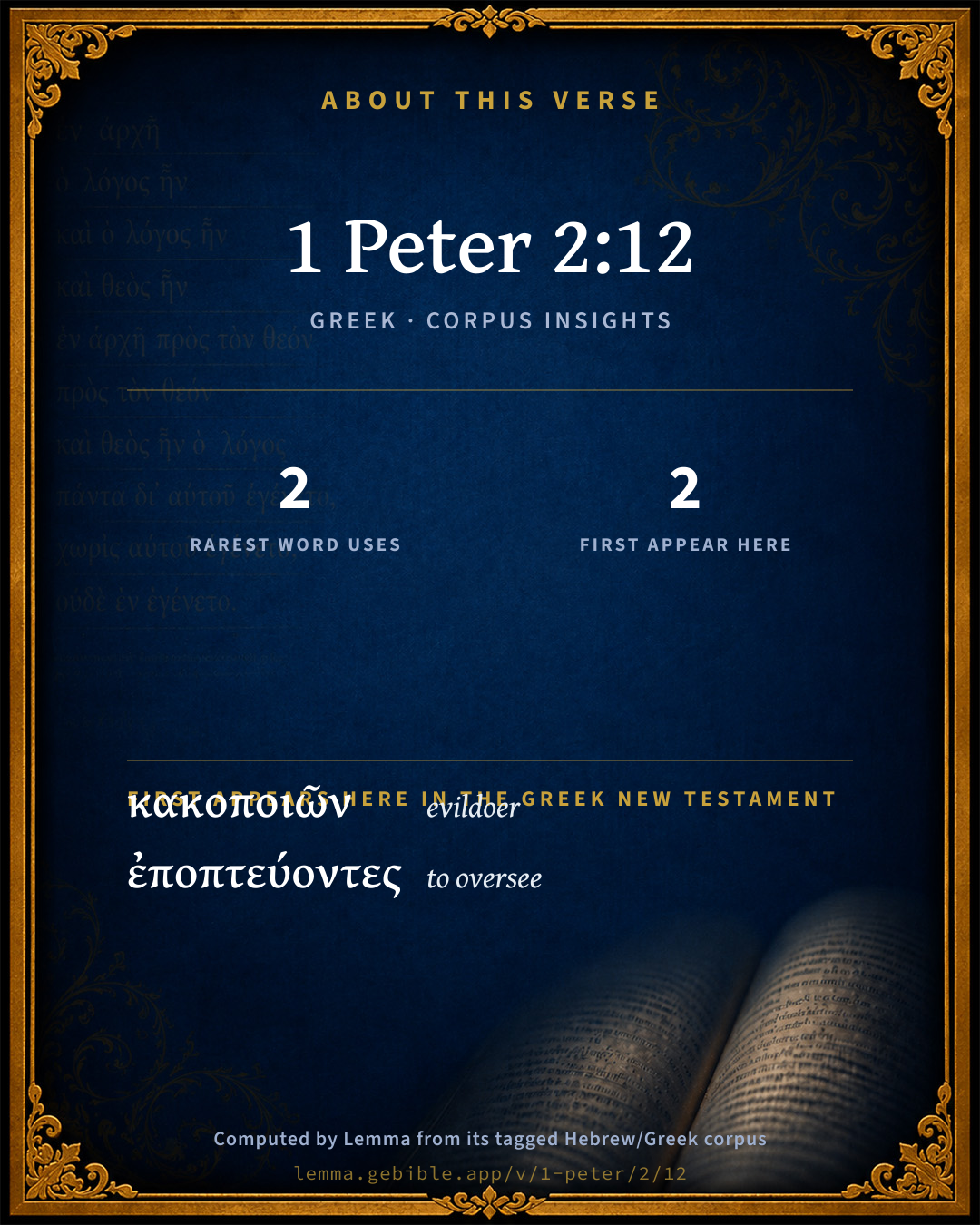
The rarest word here is ἐποπτεύοντες to oversee G2029 — appearing just 2 times in the whole Greek New Testament.
First appearance in Scripture
These words make their first canonical appearance in the Greek New Testament here:
Shared distinctive vocabulary
ἐποπτεύοντες to oversee G2029 occurs in 2 verses of the Greek New Testament. Also found in:
Cross-references
39Topical passages linked to 1 Peter 2:12 in the Treasury of Scripture Knowledge — connected by theme and wording, ordered by reader-vote popularity; previews shown in the World English Bible.
- 1 Peter 3:16 having a good conscience; that, while you are spoken against as evildoers, they may be disappointed who curse your good manner of life in Christ.
- Matthew 5:16 Even so, let your light shine before men; that they may see your good works, and glorify your Father who is in heaven.
- Titus 2:7–8 in all things showing yourself an example of good works; in your teaching showing integrity, seriousness, incorruptibility,
- Philippians 2:15–16 that you may become blameless and harmless, children of God without blemish in the midst of a crooked and perverse generation, among whom you are seen as lights in the world,
- 2 Corinthians 8:21 Having regard for honorable things, not only in the sight of the Lord, but also in the sight of men.
- 1 Thessalonians 4:12 that you may walk properly toward those who are outside, and may have need of nothing.
- 1 Timothy 4:12 Let no man despise your youth; but be an example to those who believe, in word, in your way of life, in love, in spirit, in faith, and in purity.
- Philippians 1:27 Only let your manner of life be worthy of the Gospel of Christ, that, whether I come and see you or am absent, I may hear of your state, that you stand firm in one spirit, with one soul striving for the faith of the Gospel;
- James 3:13 Who is wise and understanding among you? Let him show by his good conduct that his deeds are done in gentleness of wisdom.
- 2 Corinthians 1:12 For our boasting is this: the testimony of our conscience, that in holiness and sincerity of God, not in fleshly wisdom but in the grace of God we behaved ourselves in the world, and more abundantly toward you.
- 1 Peter 4:14–16 If you are insulted for the name of Christ, blessed are you; because the Spirit of glory and of God rests on you. On their part he is blasphemed, but on your part he is glorified.
- Romans 13:13 Let us walk properly, as in the day; not in reveling and drunkenness, not in sexual promiscuity and lustful acts, and not in strife and jealousy.
- Philippians 4:8 Finally, brothers, whatever things are true, whatever things are honorable, whatever things are just, whatever things are pure, whatever things are lovely, whatever things are of good report; if there is any virtue, and if there is any praise, think about these things.
- Hebrews 13:18 Pray for us, for we are persuaded that we have a good conscience, desiring to live honorably in all things.
- Psalms 50:23 Whoever offers the sacrifice of thanksgiving glorifies me, And prepares his way so that I will show God's salvation to him."
- Romans 12:17 Repay no one evil for evil. Respect what is honorable in the sight of all men.
- 2 Peter 3:11 Therefore since all these things are thus to be destroyed, what manner of persons ought you to be in holy living and godliness,
- Matthew 10:25 It is enough for the disciple that he be like his teacher, and the servant like his lord. If they have called the master of the house Beelzebul, how much more those of his household!
- Romans 15:9 and that the Gentiles might glorify God for his mercy. As it is written, "Therefore will I give praise to you among the Gentiles, And sing to your name."
- Ephesians 4:22 that you put away, as concerning your former way of life, the old man, that grows corrupt after the lusts of deceit;
- 1 Timothy 2:2 for kings and all who are in high places; that we may lead a tranquil and quiet life in all godliness and reverence.
- Hebrews 13:5 Be free from the love of money, content with such things as you have, for he has said, "I will in no way leave you, neither will I in any way forsake you."
- Genesis 13:7–8 There was a strife between the herdsmen of Abram's cattle and the herdsmen of Lot's cattle: and the Canaanite and the Perizzite lived then in the land.
- Isaiah 10:3 What will you do in the day of visitation, and in the desolation which shall come from far? to whom will you flee for help? and where will you leave your glory?
- Matthew 5:11 "Blessed are you when people reproach you, persecute you, and say all kinds of evil against you falsely, for my sake.
- 1 Peter 4:11 If any man speaks, let it be as it were oracles of God. If any man serves, let it be as of the strength which God supplies, that in all things God may be glorified through Jesus Christ, to whom belong the glory and the dominion forever and ever. Amen.
- Luke 19:44 and will dash you and your children within you to the ground. They will not leave in you one stone on another, because you didn't know the time of your visitation."
- Acts 24:13 Nor can they prove to you the things of which they now accuse me.
- Ephesians 2:3 among whom we also all once lived in the lust of our flesh, doing the desires of the flesh and of the mind, and were by nature children of wrath, even as the rest.
- 1 Peter 3:1–2 In like manner, wives, be in subjection to your own husbands; so that, even if any don't obey the Word, they may be won by the behavior of their wives without a word;
- Psalms 37:14 The wicked have drawn out the sword, and have bent their bow, To cast down the poor and needy, To kill those who are upright in the way.
- Acts 15:14 Simeon has reported how God first visited the Gentiles, to take out of them a people for his name.
- Matthew 9:8 But when the multitudes saw it, they marveled and glorified God, who had given such authority to men.
- Luke 1:68 "Blessed be the Lord, the God of Israel, For he has visited and worked redemption for his people;
- Luke 6:22 Blessed are you when men shall hate you, and when they shall exclude and mock you, and throw out your name as evil, for the Son of Man's sake.
- Acts 24:5–6 For we have found this man to be a plague, an instigator of insurrections among all the Jews throughout the world, and a ringleader of the sect of the Nazarenes.
- 1 Corinthians 14:25 And thus the secrets of his heart are revealed. So he will fall down on his face and worship God, declaring that God is among you indeed.
- 2 Corinthians 13:7 Now I pray to God that you do no evil; not that we may appear approved, but that you may do that which is honorable, though we are as reprobate.
- Acts 25:7 When he had come, the Jews who had come down from Jerusalem stood around him, bringing against him many and grievous charges which they could not prove,
Cross-references courtesy of OpenBible.info (CC BY 4.0).
Lesson kit
Teaching starters — assembled from the data on this page, not authored interpretation. Every prompt links to the verse data it draws on. Edit before teaching.
1 Peter, in the General Epistles, opens this verse with 26 words (19 distinct Greek lemmas). Its most distinctive word is epopteúō (“to oversee”). A historical commentator’s framing appears above. Read the whole chapter for the surrounding context.
Discussion questions
- The word epopteúō carries the sense “to oversee.” How does it shape the verse?
- 2 words here appear for the first time in Scripture. What is being introduced at this debut?
- 1 Peter 3:2 shares the word «to oversee» with this verse. How do the two illuminate each other?
- “good” occurs 2× in this one verse. What is the effect of the repetition?
- The translations on this page render this verse differently — a whole-verse word diff, not a word-by-word alignment. What might account for the different wordings?
- Reading how Tyndale Open Study Notes and Bengel's Gnomon read this verse, where do the two commentators agree and where do they part?
Things to notice
- 2 words make their first canonical appearance in Scripture here.
- These translations choose different wording for 21 words in this verse.
- “good” occurs 2× in this single verse.
- 19 distinct Greek lemmas span 26 words in this verse.
Commentary
Notes on 1 Peter 2:12 from classic Christian and Jewish commentators (each source and its license shown beneath its notes). The classic Christian expositions comment on the surrounding passage and are grouped to its opening verse, so a note may address several verses; the Jewish commentaries on the Tanakh (Rashi and others) are per-verse, so they appear only where the commentator wrote on this verse.
Lemma curates 59 commentaries, every one of them public domain or Creative Commons licensed, each selected and text-cleaned for this edition rather than reprinted as found. About our sources →
Tyndale Open Study Notes
Tyndale Open Resources
Tyndale Open Study Notes — © Tyndale Open Resources, licensed CC BY-SA 4.0. Text via the HelloAO Bible API.
Bengel's Gnomon
Johann Albrecht Bengel
Bengel's Gnomon of the New Testament — English translation (T&T Clark, Edinburgh, 1860) — public domain. Text from a community e-Sword module.
Expositor's Greek Testament
ed. W. Robertson Nicoll
The Expositor's Greek Testament, edited by W. Robertson Nicoll (1897–1910) — public domain. Text from a community e-Sword module.
Geneva Bible (1599)
Geneva Bible translators
Geneva Bible (1599) marginal notes — public domain. Text via Bolls.life.
Jamieson, Fausset & Brown
Robert Jamieson, A. R. Fausset & David Brown
Jamieson, Fausset & Brown — Commentary Critical and Explanatory on the Whole Bible (1871) — public domain (CC PDM 1.0). Text via the HelloAO Bible API.
Adam Clarke's Commentary
Adam Clarke's Commentary on the Bible (1810–1826) — public domain. Text from a community e-Sword/MySword module.
John Calvin's Commentaries
John Calvin's Commentaries (1540-1563) — public domain. Text from the Calvin Translation Society English edition (1840s-50s) via the Christian Classics Ethereal Library (ccel.org). Calvin's coverage is partial (roughly two-thirds of the Bible); uncommented books and verses are honest gaps, never fabricated. The 19th-century editor's footnotes and remarks are omitted so the notes are faithfully Calvin's own voice.
Ellicott's Commentary for English Readers
A Bible Commentary for English Readers, edited by Charles John Ellicott (1878–1897) — public domain. Text from a community e-Sword module.
The Cambridge Bible for Schools and Colleges
gen. ed. J. J. S. Perowne
The Cambridge Bible for Schools and Colleges (gen. ed. J. J. S. Perowne; Cambridge University Press, 1878–1918) — public domain. Text from a community e-Sword module.
John Gill's Exposition
John Gill's Exposition of the Whole Bible (1746–1763) — public domain (CC PDM 1.0). Text via the HelloAO Bible API.
Trapp's Complete Commentary
John Trapp
John Trapp, A Commentary or Exposition upon All the Books of the Old and New Testament (1647–1656) — public domain. Text from a community e-Sword module.
Albert Barnes' Notes on the Bible
Albert Barnes' Notes on the Bible (1834–1885) — public domain. Text from a community e-Sword/MySword module.
Haydock's Catholic Bible Commentary
George Leo Haydock (1774–1849), Haydock's Catholic Family Bible and Commentary, 1859 edition — public domain. Excludes Psalms (Douay-Rheims chapter numbering differs from Protestant) and Deuterocanonical books (Catholic canon only).
Matthew Poole's English Annotations
Matthew Poole's English Annotations on the Holy Bible (1683–1685) — public domain. Text from a community e-Sword/MySword module.
Whedon's Commentary on the Bible
Daniel D. Whedon
Daniel D. Whedon (gen. ed.), Commentary on the Old and New Testaments (1874–1909) — public domain. Text from a community e-Sword module.
The Pulpit Commentary
The Pulpit Commentary (1880–1919), ed. H.D.M. Spence-Jones & Joseph S. Exell — public domain. Text from a community e-Sword module.
John Wesley's Explanatory Notes
John Wesley, Explanatory Notes Upon the Whole Bible (1754–1765) — public domain. Text via the GEBible commentary corpus.
Burkitt's Expository Notes on the New Testament
William Burkitt
William Burkitt's Expository Notes on the New Testament (1700–1703) — public domain. Text from a community e-Sword module.
The People's New Testament
B. W. Johnson
B. W. Johnson's The People's New Testament with Notes (1889–1891) — public domain. Electronic text from the Christian Classics Ethereal Library (CCEL) ThML edition.
Cambridge Greek Testament for Schools and Colleges
Cambridge Greek Testament for Schools and Colleges (Cambridge University Press, 1896; 21 vols, various authors incl. Carr, Maclear, Plummer, Farrar, Lumby, Moule, M. R. James, Simcox) — public domain. Text from a community e-Sword module.
Alford’s Greek Testament
Henry Alford
Henry Alford, The Greek Testament (1849–1861) — public domain. Text from a community e-Sword module.
Vincent's Word Studies in the New Testament
Marvin R. Vincent
Marvin R. Vincent, Word Studies in the New Testament (1887–1900) — public domain. Text from a community e-Sword/MySword module.