Revelation 20:3

Greek (Tischendorf 8th ed.) Revelation 20:3 appears in the Greek New Testament. The text above is from the Tischendorf 8th edition. Each word links to its Strong’s number and a concise gloss. Click any word for its full Thayer’s Greek Lexicon entry.
Download image
Cite this verse

Revelation 20:3 (World English Bible). Public Domain. Lemma interlinear Bible study tool, https://lemma.gebible.app/v/revelation/20/3.

Show BibTeX & RIS
BibTeX
RIS
English Translation
and cast him into the abyss, and shut it, and sealed it over him, that he should deceive the nations no more, until the thousand years were finished. After this, he must be freed for a short time.
World English Bible · Public Domain
Download a study sheet

One document with this verse’s original text, its word-by-word gloss line, the meaning frame, cross-references with their text, attributed commentary, and full source and license credits — printable, and it pastes into notes with its structure intact.

This verse Autodidact and up

Study sheet (.html) Plain text (.txt)

A passage Seminary Student

Up to 50 verses in one chapter. A passage sheet keeps up to 6 commentary sources and 12 cross-references per verse, in the order this page ranks them, and says so on the sheet whenever that leaves anything out. Ask for a single verse and you get the Autodidact verse sheet above.

Everything on this page stays free to read, with no account — the sheet is a download of what is already on screen, not access to it.

Want to remove ads? Support Godless Engineer
Compare translations 3

The same verse in 3 English versions, stacked beneath the original-language interlinear above. Click any original word for its lexicon entry.

Each is an independent rendering of the whole verse — the interlinear is not word-aligned to these translations.

Highlighted words mark where these versions differ — a whole-verse word diff, not a word-by-word alignment.

  • World English Bible Public Domain
    and cast him into the abyss, and shut it, and sealed it over him, that he should deceive the nations no more, until the thousand years were finished. After this, he must be freed for a short time.
  • King James Version Public Domain
    And cast him into the bottomless pit, and shut him up, and set a seal upon him, that he should deceive the nations no more, till the thousand years should be fulfilled: and after that he must be loosed a little season.
  • unfoldingWord Literal Text CC BY-SA 4.0
    And he threw him into the abyss and shut it and sealed it over him so that he would not deceive the nations anymore until the thousand years were ended. After that, it is necessary for him to be released for a short time.

unfoldingWord Literal Text — © unfoldingWord, licensed CC BY-SA 4.0. Word-aligned USFM3 via Door43 (git.door43.org/unfoldingWord/en_ult).

Versions to compare (up to 4)

3 of 4 selected

Show all 19 translations

Every available English version of this verse, each an independent rendering of the whole verse.

  • World English Bible Public Domain
    and cast him into the abyss, and shut it, and sealed it over him, that he should deceive the nations no more, until the thousand years were finished. After this, he must be freed for a short time.
  • Berean Standard Bible Public Domain
    And he threw him into the Abyss, shut it, and sealed it over him, so that he could not deceive the nations until the thousand years were complete. After that, he must be released for a brief period of time.
  • Majority Standard Bible Public Domain
    And he threw him into the Abyss, shut it, and sealed it over him, so that he could not deceive the nations until the thousand years were complete. And after that, he must be released for a brief period of time.
  • King James Version Public Domain
    And cast him into the bottomless pit, and shut him up, and set a seal upon him, that he should deceive the nations no more, till the thousand years should be fulfilled: and after that he must be loosed a little season.
  • American Standard Version (1901) Public Domain
    and cast him into the abyss, and shut `it', and sealed `it' over him, that he should deceive the nations no more, until the thousand years should be finished: after this he must be loosed for a little time.
  • Revised Version (1885) Public Domain
    and cast him into the abyss, and shut it, and sealed it over him, that he should deceive the nations no more, until the thousand years should be finished: after this he must be loosed for a little time.
  • Geneva Bible (1599) Public Domain
    And cast him into the bottomles pit, and he shut him vp, and sealed the doore vpon him, that he should deceiue the people no more, till the thousand yeeres were fulfilled: for after that he must be loosed for a litle season.
  • Douay-Rheims (1899) Public Domain
    And he cast him into the bottomless pit, and shut him up, and set a seal upon him, that he should no more seduce the nations, till the thousand years be finished. And after that, he must be loosed a little time.
  • Young's Literal Translation Public Domain
    and he cast him to the abyss, and did shut him up, and put a seal upon him, that he may not lead astray the nations any more, till the thousand years may be finished; and after these it behoveth him to be loosed a little time.
  • Literal Standard Version CC BY-SA 4.0
    and he cast him into the abyss, and shut him up, and put a seal on him, that he may no longer lead the nations astray, until the one thousand years may be completed; and after these it is necessary for him to be loosed a short time.
  • Unlocked Literal Bible CC BY-SA 4.0
    He threw him into the bottomless pit. He shut it and sealed it over him. This was so that he would not deceive the nations anymore until the thousand years were over. After that, he must be set free for a short amount of time.
  • unfoldingWord Literal Text CC BY-SA 4.0
    And he threw him into the abyss and shut it and sealed it over him so that he would not deceive the nations anymore until the thousand years were ended. After that, it is necessary for him to be released for a short time.
  • Darby Bible Public Domain
    and cast him into the abyss, and shut [it] and sealed [it] over him, that he should not any more deceive the nations until the thousand years were completed; after these things he must be loosed for a little time.
  • World Messianic Bible Public Domain
    and cast him into the abyss, and shut it and sealed it over him, that he should deceive the nations no more until the thousand years were finished. After this, he must be freed for a short time.
  • Webster's Bible Public Domain
    And cast him into the bottomless pit, and shut him up, and set a seal upon him, that he should deceive the nations no more, till the thousand years should be fulfilled; and after that he must be loosed a little season.
  • Free Bible Version CC BY-SA 4.0
    The angel threw him into the Abyss and shut it and sealed it over him, so that he would no longer be able to deceive the nations until the thousand years were over. After that he has to be set free for a little while.
  • Bible in Basic English Public Domain
    And put him into the great deep, and it was shut and locked over him, so that he might put the nations in error no longer, till the thousand years were ended: after this he will be let loose for a little time.
  • Text-Critical English NT CC BY 4.0
    He threw him into the abyss and locked and sealed it over him, so that he would no longer deceive the nations until the thousand years were completed. After that he must be released for a short time.
  • Tyndale New Testament (1534) Public Domain
    and cast him into the bottomlesse pit and he bounde him and set a seale on him that he shuld desceaue the people no moare tyll the.M. yeares were fulfilled. And after that he muste be loosed for a litell season.

Literal Standard Version (2020), Covenant Press — licensed CC BY-SA 4.0. Text via the HelloAO Bible API (eBible.org). Unlocked Literal Bible (unfoldingWord) — licensed CC BY-SA 4.0. Text via the HelloAO Bible API (eBible.org). unfoldingWord Literal Text — © unfoldingWord, licensed CC BY-SA 4.0. Word-aligned USFM3 via Door43 (git.door43.org/unfoldingWord/en_ult). Free Bible Version, Dr. Jonathan Gallagher — licensed CC BY-SA 4.0. Text via the HelloAO Bible API (eBible.org).

Word by word

More ways to search: Search by grammar → Find every occurrence → Compare this word →

Practice this passage: Drill this verse → Learn its vocabulary →

μικρὸν
mikrón
G3397
“small”
Adjective, Accusative, Singular, Masculine
Part of Speech
Adjective
Case
Accusative
Number
Singular
Gender
Masculine
Full Thayer's Definition

Origin: masculine or neuter singular of G3398 (as noun)

TDNT: None

1. small, little a. of size: of stature, of length b. of space c. of age: less by birth, younger d. of time: short, brief, a little while, how little! e. of quantity: i.e. number, amount f. of rank or influence When translated "a little while", the Greek emphasises theshortness of the time interval, "oh how little". This phrase usedoften in the NT of the return of Christ.
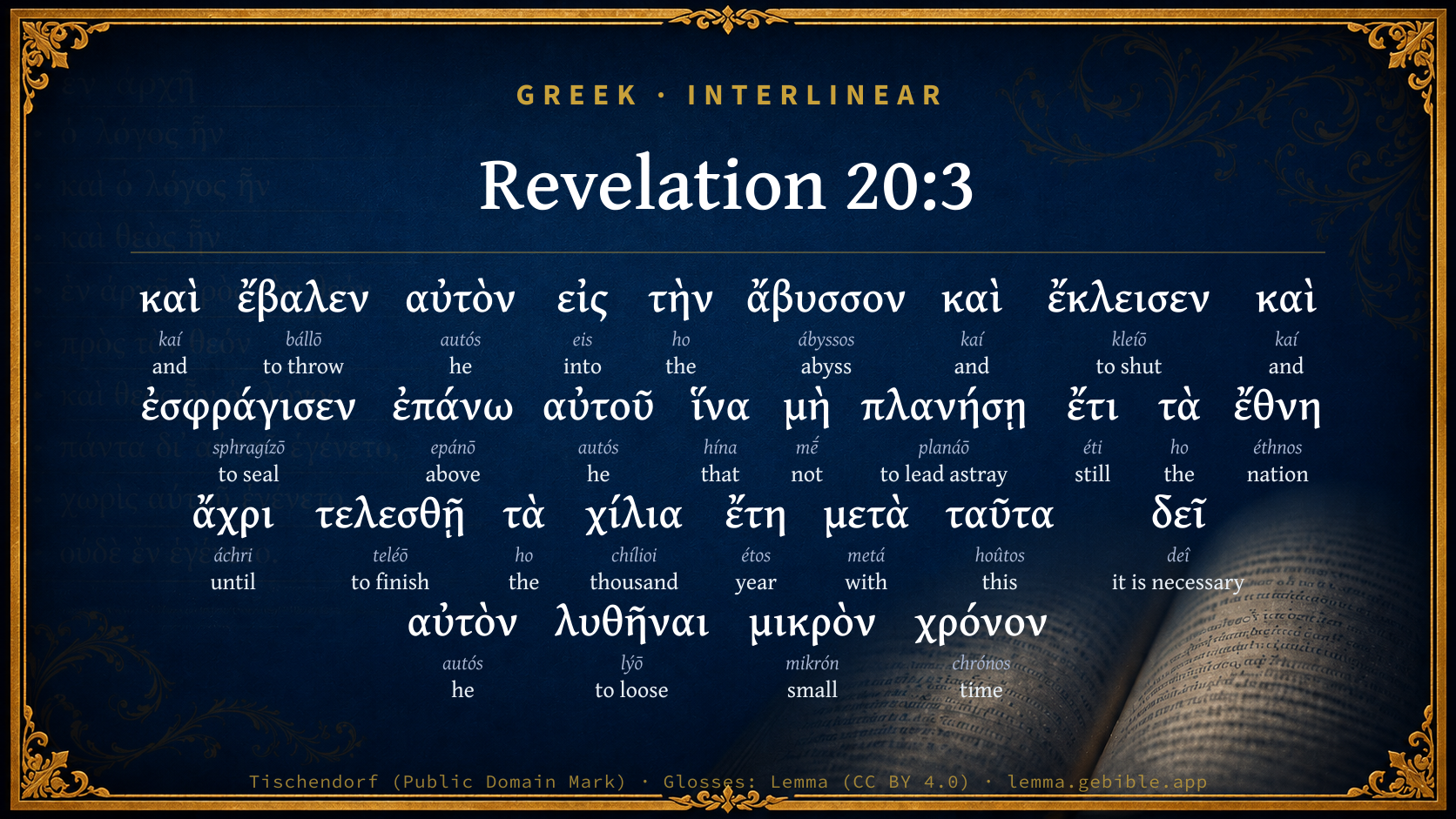
  1. καὶ kaí G2532 “and” Conjunction
  2. ἔβαλεν bállō G906 “to throw” Verb, Aorist, Active, Indicative, 3rd person, Singular
  3. αὐτὸν autós G846 “he” Personal pronoun, Accusative, Singular, Masculine
  4. εἰς eis G1519 “into” Preposition
  5. τὴν ho G3588 “the” Article, Accusative, Singular, Feminine
  6. ἄβυσσον ábyssos G12 “abyss” Noun, Accusative, Singular, Feminine
  7. καὶ kaí G2532 “and” Conjunction
  8. ἔκλεισεν kleíō G2808 “to shut” Verb, Aorist, Active, Indicative, 3rd person, Singular
  9. καὶ kaí G2532 “and” Conjunction
  10. ἐσφράγισεν sphragízō G4972 “to seal” Verb, Aorist, Active, Indicative, 3rd person, Singular
  11. ἐπάνω epánō G1883 “above” Adverb
  12. αὐτοῦ autós G846 “he” Personal pronoun, Genitive, Singular, Masculine
  13. ἵνα hína G2443 “that” Conjunction
  14. μὴ mḗ G3361 “not” Particle, Negative
  15. πλανήσῃ planáō G4105 “to lead astray” Verb, Aorist, Active, Subjunctive, 3rd person, Singular
  16. ἔτι éti G2089 “still” Adverb
  17. τὰ ho G3588 “the” Article, Accusative, Plural, Neuter
  18. ἔθνη éthnos G1484 “nation” Noun, Accusative, Plural, Neuter
  19. ἄχρι áchri G891 “until” Adverb
  20. τελεσθῇ teléō G5055 “to finish” Verb, Aorist, Passive, Subjunctive, 3rd person, Singular
  21. τὰ ho G3588 “the” Article, Nominative, Plural, Neuter
  22. χίλια chílioi G5507 “thousand” Adjective, Nominative, Plural, Neuter
  23. ἔτη étos G2094 “year” Noun, Nominative, Plural, Neuter
  24. μετὰ metá G3326 “with” Preposition
  25. ταῦτα hoûtos G3778 “this” Demonstrative pronoun, Accusative, Plural, Neuter
  26. δεῖ deî G1163 “it is necessary” Verb, Present, Active, Indicative, 3rd person, Singular
  27. αὐτὸν autós G846 “he” Personal pronoun, Accusative, Singular, Masculine
  28. λυθῆναι lýō G3089 “to loose” Verb, Aorist, Passive, Infinitive
  29. χρόνον chrónos G5550 “time” Noun, Accusative, Singular, Masculine

About this verse

These counts appear in no published source. They are computed here, from the morphology-tagged text and Lemma’s own curated glosses. What Lemma adds →

30
words
24
distinct lemmas
Revelation
section

Notable vocabulary

The rarest word here is μικρὸν small G3397 — appearing just 4 times in the whole Greek New Testament.

Shared distinctive vocabulary

μικρὸν small G3397 occurs in 4 verses of the Greek New Testament. Also found in:

Repetition

Words recur within this verse:

  • καὶ and G2532 ×3
  • αὐτὸν he G846 ×3
  • τὴν the G3588 ×3

Cross-references

15

Topical passages linked to Revelation 20:3 in the Treasury of Scripture Knowledge — connected by theme and wording, ordered by reader-vote popularity; previews shown in the World English Bible.

  • Revelation 17:8 The beast that you saw was, and is not; and is about to come up out of the abyss and to go into destruction. Those who dwell on the earth and whose names have not been written in the book of life from the foundation of the world will marvel when they see that the beast was, and is not, and shall be present.
  • Revelation 20:1 I saw an angel coming down out of heaven, having the key of the abyss and a great chain in his hand.
  • Daniel 6:17 A stone was brought, and laid on the mouth of the den; and the king sealed it with his own signet, and with the signet of his lords; that nothing might be changed concerning Daniel.
  • 2 Thessalonians 2:9–11 even he whose coming is according to the working of Satan with all power and signs and lying wonders,
  • Revelation 12:9 The great dragon was thrown down, the old serpent, he who is called the devil and Satan, the deceiver of the whole world. He was thrown down to the earth, and his angels were thrown down with him.
  • Matthew 27:66 So they went with the guard and made the tomb secure, sealing the stone.
  • 2 Corinthians 11:3 But I am afraid that somehow, as the serpent deceived Eve in his craftiness, so your minds might be corrupted from the simplicity that is in Christ.
  • Revelation 20:7–10 And after the thousand years, Satan will be released from his prison,
  • Psalms 90:4 For a thousand years in your sight Are but as yesterday when it is past, As a watch in the night.
  • 2 Corinthians 11:13–15 For such men are false apostles, deceitful workers, masquerading as Christ's apostles.
  • Revelation 16:14–16 for they are spirits of demons, performing signs; which go forth to the kings of the whole inhabited earth, to gather them together for the war of that great day of God, the Almighty.
  • Matthew 24:24 For there will arise false christs, and false prophets, and they will show great signs and wonders, so as to lead astray, if possible, even the chosen ones.
  • 2 Peter 3:8 But don't forget this one thing, beloved, that one day is with the Lord as a thousand years, and a thousand years as one day.
  • Revelation 13:14 He deceives my own people who dwell on the earth because of the signs he was granted to do in front of the beast; saying to those who dwell on the earth, that they should make an image to the beast who had the sword wound and lived.
  • Revelation 17:2 with whom the kings of the earth committed sexual immorality, and those who dwell in the earth were made drunken with the wine of her sexual immorality."

Cross-references courtesy of OpenBible.info (CC BY 4.0).

Commentary

Notes on Revelation 20:3 from classic Christian and Jewish commentators (each source and its license shown beneath its notes). The classic Christian expositions comment on the surrounding passage and are grouped to its opening verse, so a note may address several verses; the Jewish commentaries on the Tanakh (Rashi and others) are per-verse, so they appear only where the commentator wrote on this verse.

Lemma curates 59 commentaries, every one of them public domain or Creative Commons licensed, each selected and text-cleaned for this edition rather than reprinted as found. About our sources →

Tyndale Open Study Notes

Tyndale Open Resources

20:3 This incarceration, portrayed as the bottomless pit, is a preliminary defeat for Satan and the powers of evil. Various New Testament passages describe the effect of Christ’s work on Satan (Luke 10:17-20; Acts 10:38; 26:18; Rom 16:20; Eph 6:11; Jas 4:7; see Matt 12:24; 16:19; 18:18; John 12:31; 1 Jn 3:8). Christ’s presence with his people binds evil powers (see 2 Thes 2:7), reminding persecuted Christians that there is a future with God. • so Satan could not deceive: Deception is the trademark of the devil, who is a liar (see John 8:44; 1 Jn 3:8); no liar will enter heaven (Rev 21:8, 27; 22:15). The faithful believers who experience Christ’s reign will not be deceived. • The little while might be the equivalent of the symbolic three and a half years (see 11:2-3, 9-11; 12:14; 13:5)—it is a limited time.

Tyndale Open Study Notes — © Tyndale Open Resources, licensed CC BY-SA 4.0. Text via the HelloAO Bible API.

Bengel's Gnomon

Johann Albrecht Bengel

Rev 20:3. Ἔκλεισε) Erasmus adds αὐτὸν,[215] against the MSS. and the text of Andreas himself. In general, κλείειν, to shut, may be used, not only, for instance, of a prison, but also of a captive: but here Apringius rightly construes, shut upon him, so that both ἔκλεισεν and ἐσφράγισεν cohere with ἐπάνω αὐτοῦ, as, Gen 7:16, it is said, ἔκλεισεν ἔξωθεν αὐτοῦ· and altogether יסגר על איש, Job 12:14.—ἵνα μὴ, that not) One benefit only is here expressed, but that of itself is by far the greatest, and has many great blessings joined with it. For when the chief enemy is removed, the kingdom of God gains vigour without impediment among the nations, and the great mystery of God, announced by the prophets, is finished. Rev 10:7.

[215] ABh Vulg. oppose αὐτόν. Rec. Text has it without authority.—E.

Winckler, in his Disquisitions, p. 193, etc., refutes modern Chiliasm, as an error, and that a fundamental one, by arguments drawn from the article on creation, on redemption, and on sanctificiation; and he also censures me as a defender of that error. And yet not even one of your arguments, most courteous Winckler, affects my comment: but you have gratified me. For nothing can more plainly and efficaciously demonstrate the soundness of my opinion respecting the millennium, than a comparison of my treatise with yours. Look, I pray you, to Erkl. Offenb. p. 950, etc. I altogether differ from the things which you attribute to the Chiliasts; nay, that exegesis of mine, equally with your Disquisition, lays down the natural state of the world,—wayfaring men needing remission of sins and believing, the use of the law and the Gospel, death not yet swallowed up, etc. And do you, reader, admonished by this circumstance also, remember that the other side ought always to be heard. So far about Winckler: we return to the subject.

Whilst Satan is loosed from his imprisonment of a thousand years, and the earth is harassed by the last and lowest dregs [of its inhabitants], the martyrs live and reign, not on the earth, but with Christ: then the coming of Christ in glory at length takes place at the last day: then, next, there is the new heaven, the new earth, and the new Jerusalem. Those events, which pseudo-chiliasm confounds, a true interpretation in conformity with the text distinguishes. In such a manner, I had far rather be regarded as a maintainer of the thousand years, which prophecy publishes so decidedly, than take part with the indiscriminate antichiliasts, who, under this very name of theirs, assail even the plain letter of prophecy, and trample upon truth and error alike. The mystery of God is in progress: Rev 10:7. That is then finished, when the beast is destroyed, and Satan is bound. That consummation approaches nearer and nearer. It also comprises events by far the most important, and most closely connected with the glory of God. The knowledge of these events from day to day emerges into greater clearness, distinctness, and readiness of discernment. And meanwhile it is highly necessary to meet and oppose the extreme rage of the devil. But to speak against God, whose mystery it is, as many do; to weaken the oath of the angel, who confirms the mystery; ignorantly (Jud 1:10) to assail interpreters, who handle the subject in a befitting manner; and by thus assailing them, to hunt after favour among those of like character with themselves,—will not this at length be σκληρὸν, hard to the person himself [Act 9:5]? On the other hand, care must be taken, not to attribute to the millennium things which are reserved for eternity itself. Nor is it sufficient to assert, that it is still future; but its true character ought also to be soberly weighed. But these things are not to be imparted to the many by a lengthy treatise; spiritual maturity must be waited for.—μετὰ, after) An elegant Asyndeton,[216] in the case of an antithesis, as in the beginning of Rev 20:5.—μικρὸν χρόνον, a little chronus [period]) This, as is collected from certain marks, is equal to the half καιροῦ, of a time. [Nor does it begin later than the millennarian rule of those, who shall be partakers of the first resurrection. We must adhere closely to the order of the prophecy. The greatest affairs of the last times are briefly described: but it is not on that account befitting that they should be passed over with a light bound.—V. g.]

[216] Rec. Text, without authority, puts καὶ before μετά. ABh Vulg. oppose it.—E.

Bengel's Gnomon of the New Testament — English translation (T&T Clark, Edinburgh, 1860) — public domain. Text from a community e-Sword module.

Geneva Bible (1599)

Geneva Bible translators

Which being once expired, the second battle and victory shall be, of which verses 7, 8.

Namely, with that public and violent deceit which he attempted before, Chapter 12, and which after a thousand years (alack for woe) he most mightily procured in the Christian world.

Geneva Bible (1599) marginal notes — public domain. Text via Bolls.life.

Jamieson, Fausset & Brown

Robert Jamieson, A. R. Fausset & David Brown

shut him--A, B, Vulgate, Syriac, and ANDREAS omit "him."

set a seal upon him--Greek, "over him," that is, sealed up the door of the abyss over his head. A surer seal to keep him from getting out than his seal over Jesus in the tomb of Joseph, which was burst on the resurrection morn. Satan's binding at' this juncture is not arbitrary, but is the necessary consequence of the events (Rev 19:20); just as Satan's being cast out of heaven, where he had previously been the accuser of the brethren, was the legitimate judgment which passed on him through the death, resurrection, and ascension of Christ (Rev 12:7-10). Satan imagined that he had overcome Christ on Golgotha, and that his power was secure for ever, but the Lord in death overcame him, and by His ascension as our righteous Advocate cast out Satan, the accuser from heaven. Time was given on earth to make the beast and harlot powerful, and then to concentrate all his power in Antichrist. The Antichristian kingdom, his last effort, being utterly destroyed by Christ's mere appearing, his power on earth is at an end. He had thought to destroy God's people on earth by Antichristian persecutions (just as he had thought previously to destroy Christ); but the Church is not destroyed from the earth but is raised to rule over it, and Satan himself is shut up for a thousand years in the "abyss" (Greek for "bottomless pit"), the preparatory prison to the "lake of fire," his final doom. As before he ceased by Christ's ascension to be an accuser in heaven, so during the millennium he ceases to be the seducer and the persecutor on earth. As long as the devil rules in the darkness of the world, we live in an atmosphere impregnated with deadly elements. A mighty purification of the air will be effected by Christ's coming. Though sin will not be absolutely abolished--for men will still be in the flesh (Isa 65:20) --sin will no longer be a universal power, for the flesh is not any longer seduced by Satan. He will not be, as now, "the god and prince of the world"--nor will the world "lie in the wicked one"--the flesh will become ever more isolated and be overcome. Christ will reign with His transfigured saints over men in the flesh [AUBERLEN]. This will be the manifestation of "the world to come," which has been already set up invisibly in the saints, amidst "this world" (Co2 4:4; Heb 2:5; Heb 5:5). The Jewish Rabbis thought, as the world was created in six days and on the seventh God rested, so there would be six millenary periods, followed by a sabbatical millennium. Out of seven years every seventh is the year of remission, so out of the seven thousand years of the world the seventh millenary shall be the millenary of remission. A tradition in the house of Elias, A.D. 200, states that the world is to endure six thousand years; two thousand before the law, two thousand under the law, and two thousand under Messiah. Compare Note, see on Heb 4:9 and Heb 4:9, Margin; see on Rev 14:13. PAPIAS, JUSTIN MARTYR, IRENÆUS, and CYPRIAN, among the earliest Fathers, all held the doctrine of a millennial kingdom on earth; not till millennial views degenerated into gross carnalism was this doctrine abandoned.

that he should deceive--so A. But B reads, "that he deceive" (Greek, "plana," for "planeesee").

and--so Coptic and ANDREAS. But A, B, and Vulgate omit "and."

Jamieson, Fausset & Brown — Commentary Critical and Explanatory on the Whole Bible (1871) — public domain (CC PDM 1.0). Text via the HelloAO Bible API.

Adam Clarke's Commentary

Verse 3. He should deceive the nations no more] Be unable to blind men with superstition and idolatry as he had formerly done.

Adam Clarke's Commentary on the Bible (1810–1826) — public domain. Text from a community e-Sword/MySword module.

Ellicott's Commentary for English Readers

(3) And cast him into the bottomless pit . . .—Rather, and cast him into the abyss (same word as in Rev_20:1), and locked and sealed (the door or mouth) above him, that he may not deceive the nations any more until the thousand years shall have been finished; after these things he must be loosed for a little time. The sealing reminds us of the sealing employed when the wicked one had power through man’s agency to imprison God’s messengers. (Comp. Dan_6:17, and Mat_27:66.) Of the exact moment when this binding and imprisoning took place it is not needful to inquire too curiously. That which in the vision is described as the work of ä moment may in the fact and fulfilment be a very gradual work; or rather, the full manifestation of its accomplishment may be only gradually made clear. To fix it therefore, to any incident (for example, as Hengstenberg is disposed to do to the coronation of Charlemagne), is to fall into the “vicious realism” against which he rightly protests. The same applies to the duration of the imprisonment; it is not to be understood literally any more than the other numbers in the book; it symbolises a lengthened period. This period is followed by the loosing again of the devil for a short time. (See Note on Rev_20:7.)

A Bible Commentary for English Readers, edited by Charles John Ellicott (1878–1897) — public domain. Text from a community e-Sword module.

The Cambridge Bible for Schools and Colleges

gen. ed. J. J. S. Perowne

3. and shut him up … upon him] Read, and shut and sealed [it] over him: the opening of Rev_9:2 is undone.

he must be loosed] Rev_5:7.

The Cambridge Bible for Schools and Colleges (gen. ed. J. J. S. Perowne; Cambridge University Press, 1878–1918) — public domain. Text from a community e-Sword module.

John Gill's Exposition

And cast him into the bottomless pit,.... Or deep, into which the devils desired they might not be sent, and which they dreaded as a torment, it may be, because a place of confinement, Luk 8:31 for this is called a prison, Rev 20:7 and is distinguished from the lake of fire, into which the devil is afterwards cast, Rev 20:10.

And shut him up; that so he might not rove about in the air, nor go to and fro in the earth, nor walk about like a roaring lion, seeking to affright, disturb, or devour:

and set a seal upon him; or upon the door of the pit, for further security, as was upon the stone at the mouth of the lion's den, Dan 6:17 and of Christ's sepulchre, Mat 27:66. The Jews (u) make mention of a stone they call "Shetijah", with which the Lord of the world "sealed the mouth of the great deep", or bottomless pit, at the beginning; but here not that, but Satan in it, is sealed. The Alexandrian copy reads, "and sealed him firmly", so that it was impossible for him to break out: the end of this apprehension, binding, imprisonment, and security of Satan is,

that he should deceive the nations no more; that is, by drawing them into idolatry, false worship, and false doctrine; and by exciting them to make war against the saints, or to persecute them, as appears from Rev 20:8 as he had done before; and it is notorious enough that he has deceived them both these ways; he deceived the Pagan nations not only before, but since the coming of Christ, to worship the Heathen deities; and the Papists, who are called Gentiles, or nations, Rev 11:2 to fall down to idols of gold, silver, stone, and wood; and the nation of the Jews to entertain a false and deluded notion of the Messiah; and all of them, in their turns, to persecute the people of God, as the Jews at the death of Stephen, and afterwards; the Pagan emperors for the first three hundred years after Christ; the Papists from the rise of the beast, who had power given him to make war with the saints, and overcome them; but now he will be under such restraint, and in such close confinement, that he will not be able to move the wicked nations to anything of this kind, as he will when he is loosed at the end of the thousand years; nor will he be able so much as to tempt any of the saints, during this term of time, nor give them the least molestation or uneasiness.

Till the thousand years shall be fulfilled; or ended, the whole space of them run out:

and after that he must be loosed a little season; a small space of time, in comparison of the thousand years; how long it will be exactly, cannot be said; and this "must" be, not because he cannot be held any longer, or through any weakness in Christ; but because of the decree of God, who has so appointed it, for the glorifying of himself, in the salvation of his people, and in the final destruction of the devil, and the Gog and Magog army.

(u) Targum Jon. in Exod. xxviii. 30.

John Gill's Exposition of the Whole Bible (1746–1763) — public domain (CC PDM 1.0). Text via the HelloAO Bible API.

Trapp's Complete Commentary

John Trapp

3 And cast him into the bottomless pit, and shut him up, and set a seal upon him, that he should deceive the nations no more, till the thousand years should be fulfilled: and after that he must be loosed a little season.

Ver. 3. And cast him into the bottomless pit] That is, into the earth, Rev 12:9; Rev 12:12; Rev 13:11; the earth is the bottomless pit, out of which the beast was raised by the dragon.

Deceive the nations] The Gentiles, by defending Gentilism, and hindering the course of the gospel among them.

And after that he must be loosed] He must, because God hath so decreed it, for the glory of his own name in the defence of his people, but destruction of his enemies. As also that the devil may show his malice, which God can restrain at his pleasure. Roger Holland, martyr, said to Bonner, This I dare be bold in God to speak, which by his Spirit I am moved to say: that God will shorten your hand of cruelty, that for a time you shall not molest his Church. And after this day in this place shall there not any be by him put to the fire and fagot. And it proved so; for none after that suffered in Smithfield for the testimony of the gospel. (Acts and Mon. fol. 1852.)

John Trapp, A Commentary or Exposition upon All the Books of the Old and New Testament (1647–1656) — public domain. Text from a community e-Sword module.

Albert Barnes' Notes on the Bible

And cast him into the bottomless pit - See the notes on Rev 9:1. A state of peace and prosperity would exist as if Satan, the great disturber, were confined in the nether world as a prisoner.

And shut him up - Closed the massive doors of the dark prison-house upon him. Compare the notes on Job 10:21-22.

And set a seal upon him - Or, rather, “upon it” - ἐπάνω αὐτοῦ epanō autou. The seal was placed upon the “door” or “gate” of the prison, not because this would fasten the gate or door of itself, and make it secure, for this was secured by the key, but because it prevented intrusion, or any secret opening of it without its being known. See the Dan 6:17 note, and Mat 27:66 note. The idea here is, that every precaution was taken for absolute security.

That he should deceive the nations no more - That is, during the thousand years. Compare the notes on Rev 12:9.

Till the thousand years should be fulfilled - That is, during that period there will be a state of things upon the earth as if Satan should be withdrawn from the world, and confined in the great prison where he is ultimately to dwell forever.

And after that he must be loosed a little season - See Rev 20:7-8. That is, a state of things will then exist, for a brief period, as if he were again released from his prison-house, and suffered to go abroad upon the earth. The phrase “a little season” - μικρὸν χρόνον mikron chronon, “little time” - denotes properly that this would be brief as compared with the thousand years. No intimation is given as to the exact time, and it is impossible to conjecture how long it will be. All the circumstances stated, however, here and in Rev 20:7-10, would lead us to suppose that what is referred to will be like the sudden outbreak of a rebellion in a time of general peace, but which will soon be quelled.

Section a. - Condition of the world in the period referred to in Rev 20:1-3

It may be proper, in order to a correct understanding of this chapter, to present a brief summary under the different parts (see the Analysis of the chapter) of what, according to the interpretation proposed, may be expected to be the condition of things in the time referred to.

On the portion now before us Rev 20:1-3, according to the interpretation proposed, the following suggestions may be made:

(1) This will be subsequent to the downfall of the papacy and the termination of the Muhammedan power in the world. Of course, then, this lies in the future - how far in the future it is impossible to determine. The interpretation of the various portions of this book, and the book of Daniel, have, however, led to the conclusion that the termination of those powers cannot now be remote. If so, we are on the eve of important events in the world’s history. The affairs of the world look as if things were tending to a fulfillment of the prophecies so understood.

(2) It will be a condition of the world “as if” Satan were bound; that is, where his influences will be suspended, and the principles of virtue and religion will prevail. According to the interpretation of the previous chapters, it will be a state in which all that has existed, and that now exists, in the papacy to corrupt mankind, to maintain error, and to prevent the prevalence of free and liberal principles, will cease; in which all that there now is in the Muhammedan system to fetter and enslave mankind - now controlling more than one hundred and twenty million of the race - shall have come to an end; and in which, in a great measure, all that occurs under the direct influence of Satan in causing or perpetuating slavery, war, intemperance, lust, avarice, disorder, scepticism, atheism, will be checked arid stayed. It is proper to say, however, that this passage does not require us to suppose that there will be a “total cessation” of Satanic influence in the earth during that period. Satan will, indeed, be bound and restrained as to his former influence and power. But there will be no change in the character of man as he comes into the world. There will still be corrupt passions in the human heart. Though greatly restrained, and though there will be a general prevalence of righteousness on the earth, yet we are to remember that the race is fallen, and that even then, if restraint should be taken away, man would act out his fallen nature. This fact, if remembered, will make it appear less strange that, after this period of prevalent righteousness, Satan should be represented as loosed again, and as able once more for a time to deceive the nations.

(3) It will be a period of long duration. On the supposition that it is to be literally a period of one thousand years, this is in itself long, and will give, especially under the circumstances, opportunity for a vast progress in human affairs. To form some idea of the length of the period, we need only place ourselves in imagination “back” for a thousand years - say in the middle of the ninth century - and look at the condition of the world then, and think of the vast changes in human affairs that have occurred during that period. It is to be remembered, also, that if the millennial period were soon to commence, it would find the world in a far different state in reference to future progress from what it was in the ninth century, and that it would “start off,” so to speak, with all the advantages in the arts and sciences which have been accumulated in all the past periods of the world.

Even if there were no special divine interposition, it might be presumed that the race, in such circumstances, would make great and surprising advances in the long period of a thousand years. And here a very striking remark of Mr. Hugh Miller may be introduced as illustrating the subject. “It has been remarked by some student of the Apocalypse,” says he, “that the course of predicted events at first moves slowly, as one after one, six of seven seals are opened; that, on the opening of the seventh seal, the progress is so considerably quickened that the seventh period proves as fertile in events - represented by the sounding of the seven trumpets - as the foregoing six taken together; and that on the seventh trumpet, so great is the further acceleration, that there is an amount of incident condensed in this seventh part of the seventh period equal, as in the former case, to that of all the previous six parts in one. There are three cycles, it has been said, in the scheme - cycle within cycle - the second comprised within a seventh portion of the first, and the third within a seventh portion of the second. Be this as it may, we may, at least, see something that exceedingly resembles it in that actual economy of change and revolution manifested in English history for the last two centuries. “It would seem as if eyelets, in their downward course, had come under the influence of that law of gravitation through which falling bodies increase in speed, as they descend, according to the squares of the distance” (First Impressions of England and its People, pp. 7, 8.). If to this we add the supposition, which we have seen (see the notes on Rev 20:2) to be by no means improbable, that it is intended, in the description of the millennium in this chapter, that the world will continue under a reign of peace and righteousness for the long period of three hundred and sixty thousand years, it is impossible to anticipate what progress will be made during that period, or to enumerate the numbers that will be saved. On this subject, see some very interesting remarks in the “Old Red Sandstone,” by Hugh Miller, pp. 248-250, 258, 259. Compare Prof. Hitchcock’s “Religion and Geology,” pp. 370-409.

(4) What, then, will be the state of things during that long period of a thousand years?

(a) There will be a great increase in the population of the globe. Let wars cease, and intemperance cease, and slavery cease, and the numberless passions that now shorten life be stayed, and it is easy to see that there must be a vast augmentation in the number of the human species.

(b) There will be a general diffusion of intelligence upon the earth. Every circumstance would be favorable to it, and the world would be in a condition to make rapid advances in knowledge, Dan 12:4.

(c) That period will be characterized by the universal diffusion of revealed truth, Isa 11:9; Isa 25:7.

(d) It will be marked by unlimited subjection to the scepter of Christ, Psa 2:7; Psa 22:27-29; Isa 2:2-3; Isa 66:23; Zec 9:10; Zec 14:9; Mat 13:31-32; Rev 11:15.

(e) There will be great progress in all that tends to promote the welfare of man. We are not to suppose that the resources of nature are exhausted. Nature gives no signs of exhaustion or decay. In the future there is no reason to doubt that there will yet be discoveries and inventions mere surprising and wonderful than the art of printing, or the use of steam, or the magnetic telegraph. There are profounder secrets of nature that may be delivered up than any of these, and the world is tending to their development.

(f) It will be a period of the universal reign of peace. The attention of mankind will be turned to the things which tend to promote the welfare of the race, and advance the best interests of society. The single fact that wars will cease will make an inconceivable difference in the aspect of the world; for if universal peace shall prevail through the long period of the millennium, and the wealth, the talent, and the science now employed in human butchery shall be devoted to the interests of agriculture, the mechanical arts, learning, and religion, it is impossible now to estimate the progress which the race will make, and the changes which will be produced on the earth. For Scripture “proofs” that it will be a time of universal peace, see Isa 2:4; Isa 11:6-9; Mic 4:3.

(g) There will be a “general” prevalence of evangelical religion. This is apparent in the entire description in this passage, for the two most formidable opposing powers that religion has ever known - the beast and the false prophet - will be destroyed, and Satan will be bound. In this long period, therefore, we are to suppose that the gospel will exert its fair influence on governments, on families, on individuals; in the contact of neighbors, and in the contact of nations. God will be worshipped in spirit and in truth, and not in the mere “forms” of devotion; and temperance, truth, liberty, social order, honesty, and love, will prevail over the world.

(h) It will be a time when the Hebrew people - the Jews - will be brought to the knowledge of the truth, and will embrace the Messiah whom their fathers crucified, Zec 12:10; Zec 13:1; Rom 11:26-29.

(i) Yet we are not necessarily to suppose that “all” the world will be absolutely and entirely brought under the power of the gospel. There will be still on the earth the remains of wickedness in the corrupted human heart, and there will be so much “tendency” to sin in the human soul, that Satan, when released for a time Rev 20:7-8, will be able once more to deceive mankind, and to array a formidable force, represented by Gog and Magog, against the cause of truth and righteousness. We are not to suppose that the nature of mankind, as fallen, will be essentially changed, or that there may not be sin enough in the human heart to make it capable of the same opposition to the gospel of God which has thus far been evinced in all ages. From causes which are not fully stated Rev 20:8-9, Satan will be enabled once more to rouse up their enmity, and to make one more desperate effort to destroy the kingdom of the Redeemer by rallying his forces for a conflict. See these views illustrated in the work entitled “Christ’s Second Coming,” by Rev. David Brown, of James’ Free Church, Glasgow, pp. 398-442; New York, 1851.

Albert Barnes' Notes on the Bible (1834–1885) — public domain. Text from a community e-Sword/MySword module.

Matthew Poole's English Annotations

And cast him into the bottomless pit; that is, into hell, his proper place: he shall no longer, or at least not till these thousand years be expired, exercise his power, as prince of the power of the air, Eph 2:2, or compassing the earth, and walking up and down in it, as Job 1:7.

And shut him up, and set a seal upon him; he shall be restrained as much as one shut up in prison, whose doors are sealed up.

That he should deceive the nations no more, till the thousand years should be fulfilled; that till this time of God’s counsel for the quiet of his church be run out, he shall not deceive people by his old arts.

And after that he must be loosed a little season; and after that he shall have a liberty again {as Rev 20:7} for a little time.

Matthew Poole's English Annotations on the Holy Bible (1683–1685) — public domain. Text from a community e-Sword/MySword module.

Whedon's Commentary on the Bible

Daniel D. Whedon

3. Bottomless pit—See note on Rev_9:1. Why are the beast and false prophet (Rev_19:20) said to be cast into the lake of fire, the final doom of all the wicked, and Satan only into the “bottomless pit?”

The reason we would suggest is this: The former two are not real personages, but only principles or organisms which arise in human history, (really originating from that bottomless pit, see notes on chap. ix,) and so are consigned to their finality; whereas, the latter is a real being, whose life-history commences before the creation of man, who procures the human fall, and is, therefore, destined by the divine order to receive his finality when the period of human history is closed at the final judgment.

Set a seal upon—So that he cannot break out without breaking the seal.

Deceive the nations no more—Hence, the nations are still in existence, and blessedly exempt from all infernal influences. The bottomless pit of chapter 9 is closed up, and the demon-locusts fly no more. The prince of the power of the air no longer works in the hearts of men, rendering them children of disobedience. A blessed negation of evil forces—an abolition of depraving influences—is now established. So that whereas a Christian civilization of an impure kind has heretofore been extending itself over the world, that Christian civilization is itself now becoming purer and far holier. This is, however, to a great degree of a negative character. Great oppressions, injustices, impurities, falsities, and corruptions, are disappearing. But there are needed yet the positive blessed influences of the reign of Jesus and his paradise over the earth to kindle the heart of the world with the glow of a sublime piety. Those come in the next paragraph.

Must be loosed—It is the divine order that he be permitted to show himself worthy of his final doom.

Daniel D. Whedon (gen. ed.), Commentary on the Old and New Testaments (1874–1909) — public domain. Text from a community e-Sword module.

The Pulpit Commentary

Vers. 3-6. The second scene in the history of redeemed humanity: the age of moral triumph.

"And cast him into the bottomless pit, and shut him up, and set a seal upon him," etc. The first scene in the history of redeemed humanity namely, the scene of moral struggle occupied our attention in the last homily. The passage before us is a very glorious, though highly symbolic, view of the scene which will succeed itthe scene of moral triumph. This scene is, probably, many long centuries in the future; for as yet the great enemy of souls is the "prince of this world." But prophecy, the tendency of Christianity, the victories which the gospel has already achieved, and the unequivocal assurances of God"s Word in general, all show that, however far off, the bright era will dawn on the world when the "will of God shall be done on earth as it is in heaven." Stripping the words before us of their highly figurative garb, I discover four great features which will distinguish this glorious age.

I THE ENTIRE OVERTHROW OF MORAL EVIL. Satan, the great adversary, is said to be cast into "the bottomless pit." This figurative language suggests two thoughts.

1. That the great enemy will have lost his stand place in the world. His throne will have lost its foundation; he will not have a resting place for his foot in this period. What had been his stand place in the world? Error, prejudice, selfishness, evil passions, etc.; but these will have gone. He will have no fulcrum for his lever.

2. That the fall of the great enemy will be complete for a time. "Bottomless pit." He will be sinking for ages. The more humanity progresses in intelligence, rectitude, and holiness, the more hopeless his condition becomes. As humanity rises, he must sink.

II THE UNIVERSAL SOVEREIGNTY OF CHRIST. Christ is here spoken of as reigning for a "thousand years" (ver. 2). There are many who judge this passage "after the flesh," give it a carnal and Judaic interpretation. They infer from it a personal manifestation of Christ, with all the appendages of a temporal dominion. I disclaim this, for two reasons.

1. The only true sovereignty is spiritual. Who have been the greatest sovereigns of the world? The men who have sat on thrones of gold, and ruled with the sceptre of force? No! it is not your Pharaoh, Ceasar, Alexander; but your Aristotle, Bacon, Milton, and Bunyan. Men who direct the thoughts of humanity are the real rulers. Christ is the greatest spiritual Sovereign, and his sovereignty is destined to increase.

2. A religious spiritual sovereignty over man is the great want of the race. He who rules the human mind, directs its faculties, energies, and feelings rightly, is man"s greatest benefactor. This Christ does in the highest and most perfect manner. Let every philanthropist, therefore, pray that his kingdom may come that he may become the moral Monarch of all souls.

III THE GENERAL ASCENDANCY OF GREAT SOULS. The world, hitherto, has been under the dominion of weak and wicked men. Its kings and heroes have generally been as small as their hearts have been corrupt. In this scene the great soul will be "on thrones," and reign with Christ. The words suggest three things about the men who will then be in power.

1. They will be men who have passed through a spiritual resurrections. They had a part in the "first resurrection" (ver. 6). That a spiritual resurrection is here referred to is obvious, from three considerations.

(1) The idea harmonizes with the symbolical character of the whole book.

(2) The passage specially mentions "souls," and not bodies.

(3) The New Testament represents the awakening of a new spiritual life in man as a resurrection. (Joh_5:24-29 Col_3:1, etc.) Indeed, the resurrection of the body is but a type of the resurrection of the soul; the resurrection of the soul is the true resurrection. That of the body is but figurative. Two ideas are implied in the resurrection:

(1) The resuscitation of an old moral life in man Divine love.

(2) The resuscitation of an old moral life by God himself. It is God"s work alone to raise the dead.

2. They wilt be men of martyr mould. "The souls of them that were beheaded for the witness of Jesus, and for the Word of God, and which had not worshipped the beast, neither his image, neither had received his mark upon their foreheads or in their hands" (ver. 4). The idea unquestionably is, not that the "souls" of the old martyrs who have long since departed will be brought back to this earth, but souls like theirs will exist in this age. Souls marked by invincible attachment to truth, by the most generous sentiments; Divine aspirations, and noble daring; feeling truth to be ever more precious than existence itself. This interpretation agrees with the interpretation which one is bound to give such scriptural language as that which speaks of the ministry of John, the ministry of Elijah, and the conversion of the Jews, as a "life from the dead.

3. They will be men possessing exclusive ascendancy. "But the rest of the dead lived not again" (ver. 5). In this glorious age there is no reproduction of those little and corrupt men who, in every age, have played the despot, both in Church and state. Your Herods and Caiaphases, your Henrys and your Lauds, will have no representatives in this glorious age. "The rest of the dead lived not again.

4. They will be men raised forever beyond the reach of all future evil. "Blessed and holy is he that hath part in the first resurrection: on such the second death hath no power" (ver. 6). Such men are delivered forever from all the influences and all the fears of Hades. What an age is this! Would it had dawned!

IV THE EXTENSIVE DURATION OF THE WHOLE. "And shall reign with him a thousand years" (ver. 6). If you suppose that this is literal, that ten centuries are meant, it is a long period for the continuation of one moral scene in man"s history. How short was the scene of primeval innocence! The scene of wickedness, too, is never long without being broken. Conscience is everlastingly breaking in upon, and disturbing, wickedness here. Ten centuries of unbroken holiness and peace for the world are a long period! But I am disposed to regard the period referred to here as much longer than ten centuries. A little interpretation would not agree either with the general structure of the book or with this passage. Nor would it fully meet the nature of the case. I therefore regard the period either as meaning three hundred and sixty-five thousand years, or some vast indefinite period of time. The Jews and other nations were in the habit of using the expression, "a thousand years," to denote a period of immense duration.

1. This long period of holiness is a glorious set off against all the preceding ages of depravity and sin. When we think of the past ages of corruption, the millions who, from period to period, have passed away without a knowledge of the gospel, we are sometimes confounded. But all this may appear but as a few vibrations of a pendulum, when compared with the long ages of universal purity and peace. The lost, perhaps, will be as units to millions, compared with the saved.

2. This long period of holiness serves wonderfully to heighten our ideas of the grandeur of Christ"s work. Although the influence of Christianity as yet is confessedly limited compared with the widespread districts lying on all hands beyond its present reach, still no one who honestly looks at its past history will be disposed to deny that its conquests over the minds, systems, and institutions of humanity are unparalleled in the history of religions, and far out measure the appreciative faculty of the world"s greatest intellects. But, in the view of the effulgent ages before us, its past most brilliant achievements pale their fires. Hitherto its rays have only fallen in twilight dimness upon the summit of an isolated mountain here and there; but in the glorious time coming it shall flood the world in warm, cloudless, and life imparting light. Oh! let me learn, then, to estimate the greatness of Christ"s work, not by what he has done or is doing, but by those glorious achievements of his which prophecy has foretold. Let me not judge in this respect before the time. Shall I judge the husbandman just as he commences the cultivation of one of the hundred acres committed to his care? or the architect just as the scaffolding is reared and a few stones are brought together? Still less will I dare pronounce upon the work of Christ until in the great eternity I shall behold redemption finished. D.T.

The Pulpit Commentary (1880–1919), ed. H.D.M. Spence-Jones & Joseph S. Exell — public domain. Text from a community e-Sword module.

John Wesley's Explanatory Notes

And set a seal upon him - How far these expressions are to be taken literally, how far figuratively only, who can tell? That he might deceive the nations no more - One benefit only is here expressed, as resulting from the confinement of Satan. But how many and great blessings are implied! For the grand enemy being removed, the kingdom of God holds on its uninterrupted course among the nations; and the great mystery of God, so long foretold, is at length fulfilled; namely, when the beast is destroyed and Satan bound. This fulfilment approaches nearer and nearer; and contains things of the utmost importance, the knowledge of which becomes every day more distinct and easy. In the mean time it is highly necessary to guard against the present rage and subtilty of the devil. Quickly he will be bound: when he is loosed again, the martyrs will live and reign with Christ. Then follow his coming in glory, the new heaven, new earth, and new Jerusalem. The bottomless pit is properly the devil's prison; afterwards he is cast into the lake of fire. He can deceive the nations no more till the "thousand years," mentioned before, verse 2, chap. xx, 2 are fulfilled. Then he must be loosed - So does the mysterious wisdom of God permit. For a small time - Small comparatively: though upon the whole it cannot be very short, because the things to be transacted therein, verses 8, 9, chap. xx, 8, 9 must take up a considerable space. We are very shortly to expect, one after another, the calamities occasioned by the second beast, the harvest and the vintage, the pouring out of the phials, the judgment of Babylon, the last raging of the beast and his destruction, the imprisonment of Satan. How great things these! and how short the time! What is needful for us? Wisdom, patience, faithfulness, watchfulness. It is no time to settle upon our lees. This is not, if it be rightly understood, an acceptable message to the wise, the mighty, the honourable, of this world. Yet that which is to be done, shall be done: there is no counsel against the Lord.

John Wesley, Explanatory Notes Upon the Whole Bible (1754–1765) — public domain. Text via the GEBible commentary corpus.

The People's New Testament

B. W. Johnson

3. And cast him into the abyss. During this millennial period the chained enemy of man is cast into a prison house, but not the lake of fire. Had he gone there he should never more return. He shall go there as his ultimate fate (see verse 10), but after the thousand years, he is to return to the earth for a little season, and until the final effort of his long struggle against God he shall be confined in the abyss, from whence there is the possibility of escape, instead of being cast into the lake of fire, which is an eternal doom. In the bottomless pit the great deceiver shall remain till the thousand years are ended, when for a little season he shall regain his power.

B. W. Johnson's The People's New Testament with Notes (1889–1891) — public domain. Electronic text from the Christian Classics Ethereal Library (CCEL) ThML edition.

Cambridge Greek Testament for Schools and Colleges

3. ἐπάνω αὐτοῦ. A has ἐμμενῶς (? = ἐμπεδῶς) αὐτόν.

ἔτι τὰ ἔθνη. 1 cop[753] æth[754] Tyc[755] omit ἔτι. Text. Rec[756] inserts it after ἔθνη.

[753] Coptic.

[754] Aethiopic Version.

[755] Tyconius.

[756] Rec. Textus Receptus as printed by Scrivener.

3. καὶ ἔκλεισεν καὶ ἐσφράγισεν ἐπάνω αὐτοῦ. The pit which was opened Rev 9:2 is now sealed again.

τἀ ἔθνη. To be taken quite literally, though it probably limits the meaning of the passages which seem to speak of all but the elect worshipping the Beast. These are pressed by St Irenaeus to the uttermost, so that he supposes the Saints to reign over the surviving faithful who rapidly repeople the desolate earth, and fulfil the prophecies of a little one becoming a thousand and rebuilding the old waste places. Possibly we are to suppose that the Angelic warnings of Rev 14:6-11 are not wholly unfruitful.

δεῖ αὐτὸν λυθῆναι. It is very remarkable that neither St Irenaeus nor St Justin are known to speak of this.

Cambridge Greek Testament for Schools and Colleges (Cambridge University Press, 1896; 21 vols, various authors incl. Carr, Maclear, Plummer, Farrar, Lumby, Moule, M. R. James, Simcox) — public domain. Text from a community e-Sword module.

Vincent's Word Studies in the New Testament

Marvin R. Vincent

Sealed. See on Joh 3:33.

Must [δει] . According to God 's purpose. See on Mt 16:21; Luk 2:49; Luk 24:26.

Marvin R. Vincent, Word Studies in the New Testament (1887–1900) — public domain. Text from a community e-Sword/MySword module.

Lesson kit

Teaching starters — assembled from the data on this page, not authored interpretation. Every prompt links to the verse data it draws on. Edit before teaching.

Revelation, in the Revelation, opens this verse with 30 words (24 distinct Greek lemmas). Its most distinctive word is mikrón (“small”). A historical commentator’s framing appears above. Read the whole chapter for the surrounding context.

Discussion questions

  1. What does “small” (mikrón) contribute to the verse as a whole?
  2. John 7:33 shares the word «small» with this verse. How do the two illuminate each other?
  3. “and” occurs 3× in this one verse. What is the effect of the repetition?
  4. These translations render this verse differently; the difference is in the English rendering, not the original. What questions does that raise?
  5. Reading how Tyndale Open Study Notes and Bengel's Gnomon read this verse, where do the two commentators agree and where do they part?

Things to notice

Reading settings

Reading text

Shown beneath each verse's original-language words.

Old Testament
Old Testament edition

Read the OT as the Masoretic Hebrew (MT) or the Greek Septuagint (LXX).

English shown for the Greek Septuagint (in the Hebrew ↔ Greek comparison).

Comparing translations? Open the Compare panel on any verse page to stack up to four side by side.