

Revelation 5:9
Greek (Tischendorf 8th ed.) Revelation 5:9 appears in the Greek New Testament. The text above is from the Tischendorf 8th edition. Each word links to its Strong’s number and a concise gloss. Click any word for its full Thayer’s Greek Lexicon entry.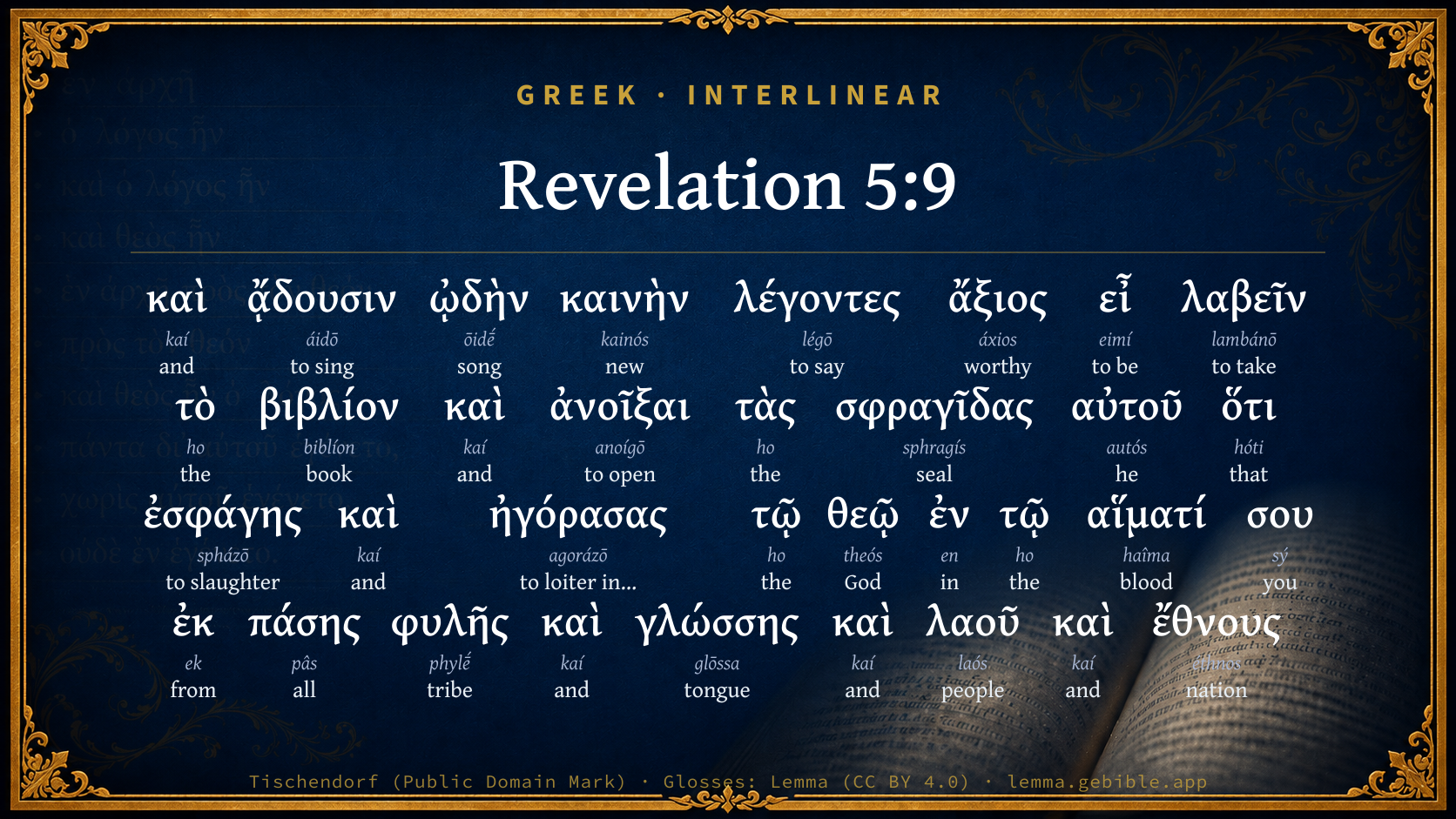
They sang a new song, saying, "You are worthy to take the book, And to open its seals: For you were killed, And bought us for God with your blood, Out of every tribe, language, people, and nation,
Download a study sheet
One document with this verse’s original text, its word-by-word gloss line, the meaning frame, cross-references with their text, attributed commentary, and full source and license credits — printable, and it pastes into notes with its structure intact.
This verse Autodidact and up
A passage Seminary Student
Up to 50 verses in one chapter. A passage sheet keeps up to 6 commentary sources and 12 cross-references per verse, in the order this page ranks them, and says so on the sheet whenever that leaves anything out. Ask for a single verse and you get the Autodidact verse sheet above.
Everything on this page stays free to read, with no account — the sheet is a download of what is already on screen, not access to it.
Compare translations 3
The same verse in 3 English versions, stacked beneath the original-language interlinear above. Click any original word for its lexicon entry.
Each is an independent rendering of the whole verse — the interlinear is not word-aligned to these translations.
Highlighted words mark where these versions differ — a whole-verse word diff, not a word-by-word alignment.
-
World English Bible Public Domain
They sang a new song, saying, "You are worthy to take the book, And to open its seals: For you were killed, And bought us for God with your blood, Out of every tribe, language, people, and nation,
-
King James Version Public Domain
And they sung a new song, saying, Thou art worthy to take the book, and to open the seals thereof: for thou wast slain, and hast redeemed us to God by thy blood out of every kindred, and tongue, and people, and nation;
-
unfoldingWord Literal Text CC BY-SA 4.0
And they sing a new song, saying, “You are worthy to take the scroll and to open its seals, because you were slaughtered and with your blood you bought for God from every tribe and language and people and nation.
unfoldingWord Literal Text — © unfoldingWord, licensed CC BY-SA 4.0. Word-aligned USFM3 via Door43 (git.door43.org/unfoldingWord/en_ult).
Show all 19 translations
Every available English version of this verse, each an independent rendering of the whole verse.
-
World English Bible Public Domain
They sang a new song, saying, "You are worthy to take the book, And to open its seals: For you were killed, And bought us for God with your blood, Out of every tribe, language, people, and nation,
-
Berean Standard Bible Public Domain
And they sang a new song: “Worthy are You to take the scroll and open its seals, because You were slain, and by Your blood You purchased for God those from every tribe and tongue and people and nation.
-
Majority Standard Bible Public Domain
And they sang a new song: “Worthy are You to take the scroll and open its seals, because You were slain, and by Your blood You purchased us for God from every tribe and tongue and people and nation.
-
King James Version Public Domain
And they sung a new song, saying, Thou art worthy to take the book, and to open the seals thereof: for thou wast slain, and hast redeemed us to God by thy blood out of every kindred, and tongue, and people, and nation;
-
American Standard Version (1901) Public Domain
And they sing a new song, saying, Worthy art thou to take the book, and to open the seals thereof: for thou was slain, and didst purchase unto God with thy blood `men' of every tribe, and tongue, and people, and nation,
-
Revised Version (1885) Public Domain
And they sing a new song, saying, Worthy art thou to take the book, and to open the seals thereof: for thou wast slain, and didst purchase unto God with thy blood men of every tribe, and tongue, and people, and nation,
-
Geneva Bible (1599) Public Domain
And they sung a new song, saying, Thou art worthie to take the Booke, and to open the seales thereof, because thou wast killed, and hast redeemed vs to God by thy blood out of euery kinred, and tongue, and people, and nation,
-
Douay-Rheims (1899) Public Domain
And they sung a new canticle, saying: Thou art worthy, O Lord, to take the book, and to open the seals thereof; because thou wast slain, and hast redeemed us to God, in thy blood, out of every tribe, and tongue, and people, and nation.
-
Young's Literal Translation Public Domain
and they sing a new song, saying, `Worthy art thou to take the scroll, and to open the seals of it, because thou wast slain, and didst redeem us to God in thy blood, out of every tribe, and tongue, and people, and nation,
-
Literal Standard Version CC BY-SA 4.0
and they sing a new song, saying, “Worthy are You to take the scroll, and to open its seals, because You were slain, and You purchased us to God in Your blood, out of every tribe, and tongue, and people, and nation,
-
Unlocked Literal Bible CC BY-SA 4.0
They sang a new song: “You are worthy to take the scroll and to open its seals. For you were slaughtered, and with your blood you purchased people for God from every tribe, language, people, and nation.
-
unfoldingWord Literal Text CC BY-SA 4.0
And they sing a new song, saying, “You are worthy to take the scroll and to open its seals, because you were slaughtered and with your blood you bought for God from every tribe and language and people and nation.
-
Darby Bible Public Domain
And they sing a new song, saying, Thou art worthy to take the book, and to open its seals; because thou hast been slain, and hast redeemed to God, by thy blood, out of every tribe, and tongue, and people, and nation,
-
World Messianic Bible Public Domain
They sang a new song, saying, “You are worthy to take the book and to open its seals, for you were killed, and bought us for God with your blood out of every tribe, language, people, and nation,
-
Webster's Bible Public Domain
And they sung a new song, saying, Thou art worthy to take the book, and to open the seals of it: for thou wast slain, and hast redeemed us to God by thy blood out of every kindred, and language, and people, and nation;
-
Free Bible Version CC BY-SA 4.0
They sang a new song, “You are worthy to take the scroll and open its seals, for you were slain and with your blood you redeemed for God people from every tribe, language, people, and nation.
-
Bible in Basic English Public Domain
And their voices are sounding in a new song, saying, It is right for you to take the book and to make it open: for you were put to death and have made an offering to God of your blood for men of every tribe, and language, and people, and nation,
-
Text-Critical English NT CC BY 4.0
And they sang a new song: “Worthy are yoʋ to take the scroll and open its seals, for yoʋ were slain, and by yoʋr blood yoʋ redeemed us for God out of every tribe, tongue, people, and nation.
-
Tyndale New Testament (1534) Public Domain
and they songe a newe songe saynge: thou art worthy to take the boke and to open the seales therof: for thou waste kylled and haste redemed vs by thy bloud out of all kynreddes and tonges and people and nacions
Literal Standard Version (2020), Covenant Press — licensed CC BY-SA 4.0. Text via the HelloAO Bible API (eBible.org). Unlocked Literal Bible (unfoldingWord) — licensed CC BY-SA 4.0. Text via the HelloAO Bible API (eBible.org). unfoldingWord Literal Text — © unfoldingWord, licensed CC BY-SA 4.0. Word-aligned USFM3 via Door43 (git.door43.org/unfoldingWord/en_ult). Free Bible Version, Dr. Jonathan Gallagher — licensed CC BY-SA 4.0. Text via the HelloAO Bible API (eBible.org).
Word by word
More ways to search: Search by grammar → Find every occurrence → Compare this word →
Practice this passage: Drill this verse → Learn its vocabulary →
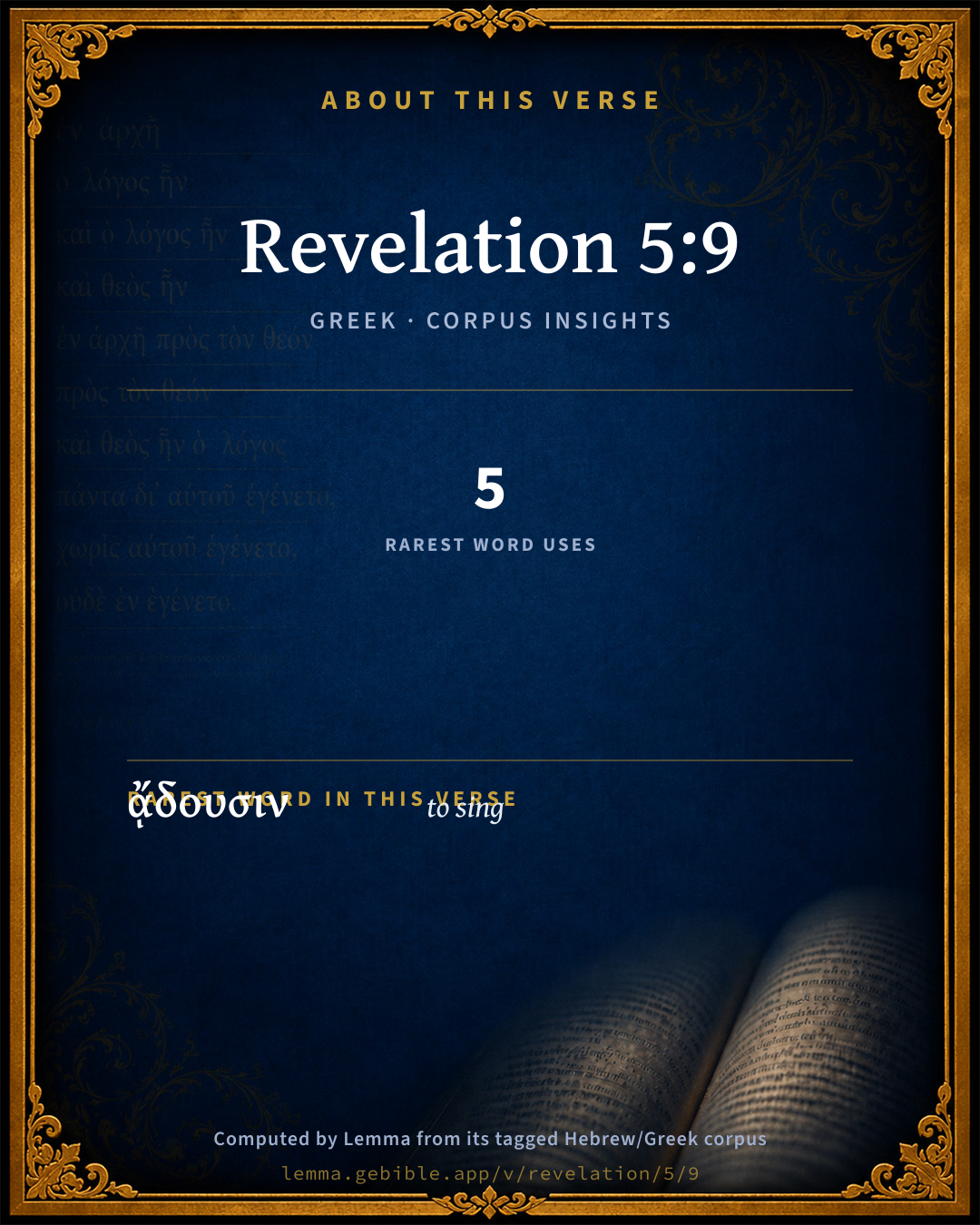
- Appears 5× in the Greek New Testament
- First appears at Ephesians 5:19
- Part of Speech
- Verb
- Tense
- Present
- Voice
- Active
- Mood
- Indicative
- Person
- 3rd person
- Number
- Plural
Full Thayer's Definition
- καὶ kaí G2532 “and” Conjunction
- ᾄδουσιν áidō G103 “to sing” Verb, Present, Active, Indicative, 3rd person, Plural
- ᾠδὴν ōidḗ G5603 “song” Noun, Accusative, Singular, Feminine
- καινὴν kainós G2537 “new” Adjective, Accusative, Singular, Feminine
- λέγοντες légō G3004 “to say” Verb, Present, Active, Participle, Nominative, Plural, Masculine
- ἄξιος áxios G514 “worthy” Adjective, Nominative, Singular, Masculine
- εἶ eimí G1510 “to be” Verb, Present, Active, Indicative, 2nd person, Singular
- λαβεῖν lambánō G2983 “to take” Verb, Aorist, Active, Infinitive
- τὸ ho G3588 “the” Article, Accusative, Singular, Neuter
- βιβλίον biblíon G975 “book” Noun, Accusative, Singular, Neuter
- καὶ kaí G2532 “and” Conjunction
- ἀνοῖξαι anoígō G455 “to open” Verb, Aorist, Active, Infinitive
- τὰς ho G3588 “the” Article, Accusative, Plural, Feminine
- σφραγῖδας sphragís G4973 “seal” Noun, Accusative, Plural, Feminine
- αὐτοῦ autós G846 “he” Personal pronoun, Genitive, Singular, Neuter
- ὅτι hóti G3754 “that” Conjunction
- ἐσφάγης spházō G4969 “to slaughter” Verb, Aorist, Passive, Indicative, 2nd person, Singular
- καὶ kaí G2532 “and” Conjunction
- ἠγόρασας agorázō G59 “to loiter in marketplace” Verb, Aorist, Active, Indicative, 2nd person, Singular
- τῷ ho G3588 “the” Article, Dative, Singular, Masculine
- θεῷ theós G2316 “God” Noun, Dative, Singular, Masculine
- ἐν en G1722 “in” Preposition
- τῷ ho G3588 “the” Article, Dative, Singular, Neuter
- αἵματί haîma G129 “blood” Noun, Dative, Singular, Neuter
- σου sý G4771 “you” Personal pronoun, 2nd person, Genitive, Singular
- ἐκ ek G1537 “from” Preposition
- πάσης pâs G3956 “all” Adjective, Genitive, Singular, Feminine
- φυλῆς phylḗ G5443 “tribe” Noun, Genitive, Singular, Feminine
- καὶ kaí G2532 “and” Conjunction
- γλώσσης glōssa G1100 “tongue” Noun, Genitive, Singular, Feminine
- καὶ kaí G2532 “and” Conjunction
- λαοῦ laós G2992 “people” Noun, Genitive, Singular, Masculine
- καὶ kaí G2532 “and” Conjunction
- ἔθνους éthnos G1484 “nation” Noun, Genitive, Singular, Neuter
About this verse
These counts appear in no published source. They are computed here, from the morphology-tagged text and Lemma’s own curated glosses. What Lemma adds →
- 34
- words
- 26
- distinct lemmas
- Revelation
- section
Cross-references
35Topical passages linked to Revelation 5:9 in the Treasury of Scripture Knowledge — connected by theme and wording, ordered by reader-vote popularity; previews shown in the World English Bible.
- 1 Peter 1:18–19 knowing that you were redeemed, not with corruptible things, with silver or gold, from the useless way of life handed down from your fathers,
- 1 John 1:7 But if we walk in the light, as he is in the light, we have fellowship with one another, and the blood of Jesus Christ, his Son, cleanses us from all sin.
- Matthew 26:28 for this is my blood of the new covenant, which is poured out for many for the remission of sins.
- Romans 3:24–26 being justified freely by his grace through the redemption that is in Christ Jesus;
- Psalms 40:3 He has put a new song in my mouth, even praise to our God. Many shall see it, and fear, and shall trust in Yahweh.
- Revelation 5:12 saying with a loud voice, "Worthy is the Lamb who has been killed to receive the power, wealth, wisdom, strength, honor, glory, and blessing!"
- 1 Corinthians 6:20 for you were bought with a price. Therefore glorify God in your body and in your spirit, which are God's.
- Revelation 14:6 I saw an angel flying in mid heaven, having an eternal Gospel to proclaim to those who dwell on the earth, and to every nation, tribe, language, and people.
- Matthew 20:28 even as the Son of Man came not to be served, but to serve, and to give his life as a ransom for many."
- Acts 20:28 Take heed, therefore, to yourselves, and to all the flock, in which the Holy Spirit has made you overseers, to shepherd the assembly of the Lord and God which he purchased with his own blood.
- Titus 2:14 who gave himself for us, that he might redeem us from all iniquity, and purify for himself a people for his own possession, zealous for good works.
- Revelation 4:11 "Worthy are you, our Lord and God, the Holy One, to receive the glory, the honor, and the power, for you created all things, and because of your desire they existed, and were created!"
- Ephesians 1:7 in whom we have our redemption through his blood, the forgiveness of our trespasses, according to the riches of his grace,
- Revelation 5:6 I saw in the midst of the throne and of the four living creatures, and in the midst of the elders, a Lamb standing, as though it had been slain, having seven horns, and seven eyes, which are the seven Spirits of God, sent out into all the earth.
- Colossians 1:14 in whom we have our redemption, the forgiveness of our sins;
- 2 Peter 2:1 But there also arose false prophets among the people, as among you also there will be false teachers, who will secretly bring in destructive heresies, denying even the Master who bought them, bringing on themselves swift destruction.
- 1 John 2:2 And he is the atoning sacrifice for our sins, and not for ours only, but also for the whole world.
- Revelation 14:3–4 They sing a new song before the throne, and before the four living creatures and the elders. No one could learn the song except the one hundred forty-four thousand, those who had been redeemed out of the earth.
- Psalms 33:3 Sing to him a new song. Play skillfully with a shout of joy!
- Psalms 149:1 Praise Yahweh! Sing to Yahweh a new song, His praise in the assembly of the saints.
- 1 Corinthians 7:23 You were bought with a price. Don't become bondservants of men.
- Revelation 5:2–3 I saw a mighty angel proclaiming with a loud voice, "Who is worthy to open the book, and to break its seals?"
- Revelation 7:9–12 After these things I looked, and behold, a great multitude, which no man could number, out of every nation and of all tribes, peoples, and languages, standing before the throne and before the Lamb, dressed in white robes, with palm branches in their hands.
- Psalms 96:1 Sing to Yahweh a new song! Sing to Yahweh, all the earth.
- Psalms 98:1 Sing to Yahweh a new song, For he has done marvelous things! His right hand, and his holy arm, have worked salvation for him.
- Psalms 144:9 I will sing a new song to you, God. On a ten-stringed lyre, I will sing praises to you.
- Revelation 11:9 From among the peoples, tribes, languages, and nations people will look at their dead bodies for three and a half days, and will not allow their dead bodies to be laid in a tomb.
- Revelation 13:8 All who dwell on the earth will worship him, everyone whose name has not been written from the foundation of the world in the book of life of the Lamb who has been killed.
- Isaiah 42:10 Sing to Yahweh a new song, and his praise from the end of the earth; you who go down to the sea, and all that is therein, the isles, and the inhabitants of it.
- Daniel 3:4 Then the herald cried aloud, To you it is commanded, peoples, nations, and languages,
- Daniel 6:25 Then king Darius wrote to all the peoples, nations, and languages, who dwell in all the earth: Peace be multiplied to you.
- Hebrews 11:14 For those who say such things make it clear that they are seeking after a country of their own.
- Mark 16:15–16 He said to them, "Go into all the world, and preach the Gospel to the whole creation.
- Colossians 1:23 if it is so that you continue in the faith, grounded and steadfast, and not moved away from the hope of the Gospel which you heard, which is being proclaimed in all creation under heaven; of which I, Paul, was made a servant.
- Daniel 4:1 Nebuchadnezzar the king, to all the peoples, nations, and languages, who dwell in all the earth: Peace be multiplied to you.
Cross-references courtesy of OpenBible.info (CC BY 4.0).
Where the printed editions differ
1 variantPlaces in this verse where the major printed Greek editions disagree on the wording in a way that affects the translation — a comparison of editions, not a manuscript-by-manuscript collation. The editions are the modern critical texts (Nestlé-Aland 28/27, SBL, Westcott-Hort, Tregelles, Tyndale House) and the traditional texts behind the KJV (the Textus Receptus and the Byzantine/Majority text). It is not a claim about which reading is original.
-
Extra text
ἡμᾶς
“of us”
In TynTregTRByz Not in NA28NA27SBLWHἡμᾶς (hēmas) 'of us' is only in traditional manuscripts (Tyn+Treg+TR+Byz)
Textual data: Translators Amalgamated Greek New Testament (STEPBible TAGNT) · CC BY 4.0.
Lesson kit
Teaching starters — assembled from the data on this page, not authored interpretation. Every prompt links to the verse data it draws on. Edit before teaching.
Revelation, in the Revelation, opens this verse with 34 words (26 distinct Greek lemmas). Its most distinctive word is áidō (“to sing”). A historical commentator’s framing appears above. Read the whole chapter for the surrounding context.
Discussion questions
- What does “to sing” (áidō) contribute to the verse as a whole?
- How does Ephesians 5:19, which shares the word «to sing», read alongside this verse?
- What does the repetition of “and” (6× in this one verse) do in this verse?
- These translations render this verse differently; the difference is in the English rendering, not the original. What questions does that raise?
- Compare how The Cambridge Bible for Schools and Colleges and Tyndale Open Study Notes read this verse. Where do they agree or differ?
Things to notice
- These translations choose different wording for 19 words in this verse.
- “and” occurs 6× in this single verse.
- 26 distinct Greek lemmas span 34 words in this verse.
Commentary
Notes on Revelation 5:9 from classic Christian and Jewish commentators (each source and its license shown beneath its notes). The classic Christian expositions comment on the surrounding passage and are grouped to its opening verse, so a note may address several verses; the Jewish commentaries on the Tanakh (Rashi and others) are per-verse, so they appear only where the commentator wrote on this verse.
Lemma curates 59 commentaries, every one of them public domain or Creative Commons licensed, each selected and text-cleaned for this edition rather than reprinted as found. About our sources →
The Cambridge Bible for Schools and Colleges
gen. ed. J. J. S. Perowne
The Cambridge Bible for Schools and Colleges (gen. ed. J. J. S. Perowne; Cambridge University Press, 1878–1918) — public domain. Text from a community e-Sword module.
Tyndale Open Study Notes
Tyndale Open Resources
Tyndale Open Study Notes — © Tyndale Open Resources, licensed CC BY-SA 4.0. Text via the HelloAO Bible API.
Bengel's Gnomon
Johann Albrecht Bengel
Bengel's Gnomon of the New Testament — English translation (T&T Clark, Edinburgh, 1860) — public domain. Text from a community e-Sword module.
Meyer's Critical & Exegetical Commentary
Heinrich August Wilhelm Meyer
Meyer — Critical and Exegetical Commentary on the New Testament — English translation by Peter Christie, edited by Frederick Crombie (T&T Clark, 1880) — public domain. Text from a community e-Sword module.
Expositor's Greek Testament
ed. W. Robertson Nicoll
The Expositor's Greek Testament, edited by W. Robertson Nicoll (1897–1910) — public domain. Text from a community e-Sword module.
Geneva Bible (1599)
Geneva Bible translators
Geneva Bible (1599) marginal notes — public domain. Text via Bolls.life.
Jamieson, Fausset & Brown
Robert Jamieson, A. R. Fausset & David Brown
Jamieson, Fausset & Brown — Commentary Critical and Explanatory on the Whole Bible (1871) — public domain (CC PDM 1.0). Text via the HelloAO Bible API.
Adam Clarke's Commentary
Adam Clarke's Commentary on the Bible (1810–1826) — public domain. Text from a community e-Sword/MySword module.
Ellicott's Commentary for English Readers
A Bible Commentary for English Readers, edited by Charles John Ellicott (1878–1897) — public domain. Text from a community e-Sword module.
John Gill's Exposition
John Gill's Exposition of the Whole Bible (1746–1763) — public domain (CC PDM 1.0). Text via the HelloAO Bible API.
Trapp's Complete Commentary
John Trapp
John Trapp, A Commentary or Exposition upon All the Books of the Old and New Testament (1647–1656) — public domain. Text from a community e-Sword module.
Albert Barnes' Notes on the Bible
Albert Barnes' Notes on the Bible (1834–1885) — public domain. Text from a community e-Sword/MySword module.
Haydock's Catholic Bible Commentary
George Leo Haydock (1774–1849), Haydock's Catholic Family Bible and Commentary, 1859 edition — public domain. Excludes Psalms (Douay-Rheims chapter numbering differs from Protestant) and Deuterocanonical books (Catholic canon only).
Matthew Poole's English Annotations
Matthew Poole's English Annotations on the Holy Bible (1683–1685) — public domain. Text from a community e-Sword/MySword module.
Whedon's Commentary on the Bible
Daniel D. Whedon
Daniel D. Whedon (gen. ed.), Commentary on the Old and New Testaments (1874–1909) — public domain. Text from a community e-Sword module.
The Pulpit Commentary
The Pulpit Commentary (1880–1919), ed. H.D.M. Spence-Jones & Joseph S. Exell — public domain. Text from a community e-Sword module.
John Wesley's Explanatory Notes
John Wesley, Explanatory Notes Upon the Whole Bible (1754–1765) — public domain. Text via the GEBible commentary corpus.
Scofield Reference Notes
C. I. Scofield
The Scofield Reference Bible (1917 edition), notes by C. I. Scofield — public domain. Text from a community e-Sword module.
The People's New Testament
B. W. Johnson
B. W. Johnson's The People's New Testament with Notes (1889–1891) — public domain. Electronic text from the Christian Classics Ethereal Library (CCEL) ThML edition.
unfoldingWord translationNotes
Door43 World Missions Community
unfoldingWord translationNotes — © Distant Shores Media and the Door43 World Missions Community, licensed CC BY-SA 4.0. Source: git.door43.org/Door43/en_tn.
Cambridge Greek Testament for Schools and Colleges
Cambridge Greek Testament for Schools and Colleges (Cambridge University Press, 1896; 21 vols, various authors incl. Carr, Maclear, Plummer, Farrar, Lumby, Moule, M. R. James, Simcox) — public domain. Text from a community e-Sword module.
Vincent's Word Studies in the New Testament
Marvin R. Vincent
Marvin R. Vincent, Word Studies in the New Testament (1887–1900) — public domain. Text from a community e-Sword/MySword module.