
Revelation 10:11

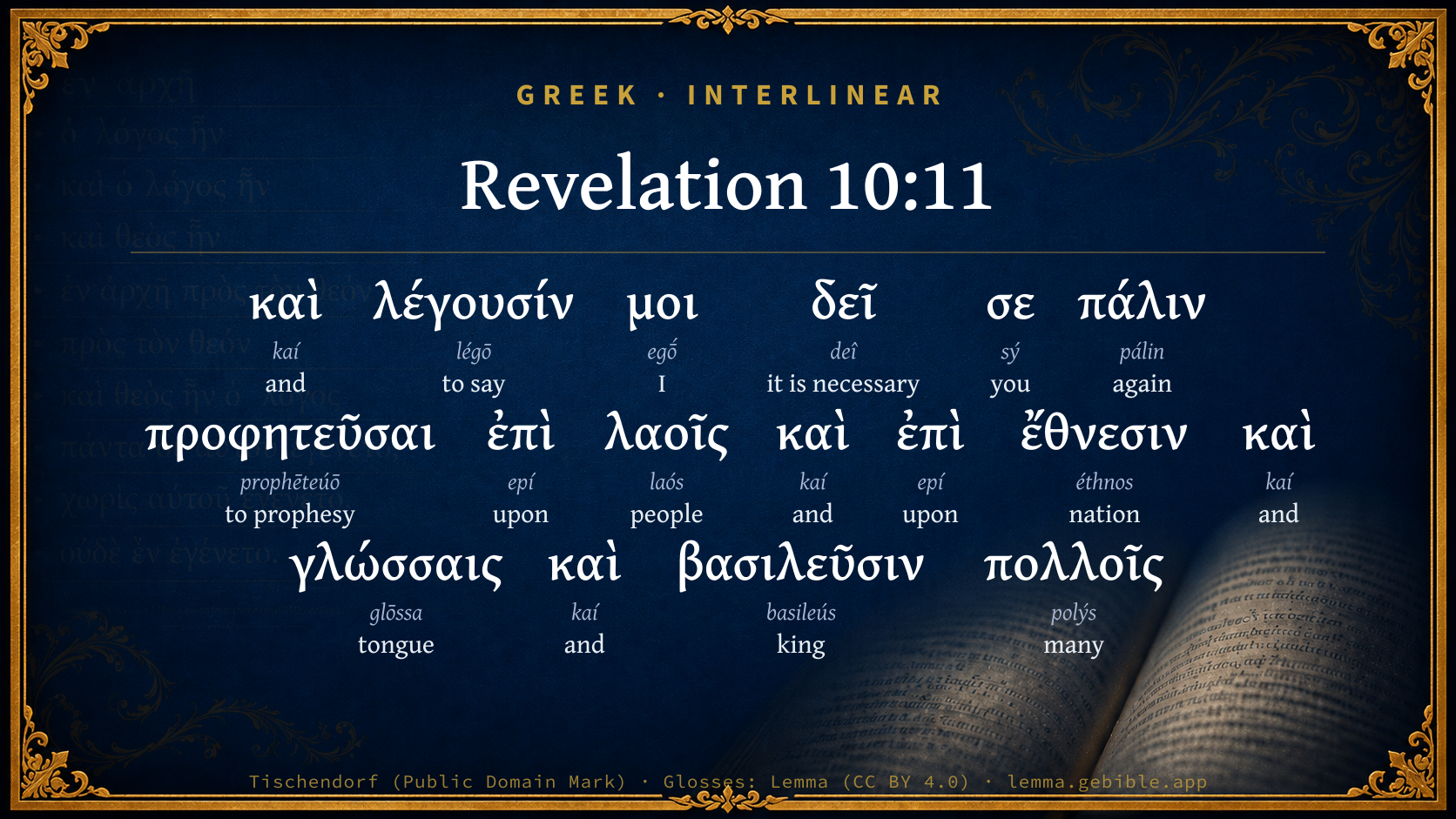
Greek (Tischendorf 8th ed.) Revelation 10:11 appears in the Greek New Testament. The text above is from the Tischendorf 8th edition. Each word links to its Strong’s number and a concise gloss. Click any word for its full Thayer’s Greek Lexicon entry.
Download image
Cite this verse

Revelation 10:11 (World English Bible). Public Domain. Lemma interlinear Bible study tool, https://lemma.gebible.app/v/revelation/10/11.

Show BibTeX & RIS
BibTeX
RIS
English Translation
They told me, "You must prophesy again over many peoples, nations, languages, and kings."
World English Bible · Public Domain
Download a study sheet

One document with this verse’s original text, its word-by-word gloss line, the meaning frame, cross-references with their text, attributed commentary, and full source and license credits — printable, and it pastes into notes with its structure intact.

This verse Autodidact and up

Study sheet (.html) Plain text (.txt)

A passage Seminary Student

Up to 50 verses in one chapter. A passage sheet keeps up to 6 commentary sources and 12 cross-references per verse, in the order this page ranks them, and says so on the sheet whenever that leaves anything out. Ask for a single verse and you get the Autodidact verse sheet above.

Everything on this page stays free to read, with no account — the sheet is a download of what is already on screen, not access to it.

Want to remove ads? Support Godless Engineer
Compare translations 3

The same verse in 3 English versions, stacked beneath the original-language interlinear above. Click any original word for its lexicon entry.

Each is an independent rendering of the whole verse — the interlinear is not word-aligned to these translations.

Highlighted words mark where these versions differ — a whole-verse word diff, not a word-by-word alignment.

  • World English Bible Public Domain
    They told me, "You must prophesy again over many peoples, nations, languages, and kings."
  • King James Version Public Domain
    And he said unto me, Thou must prophesy again before many peoples, and nations, and tongues, and kings.
  • unfoldingWord Literal Text CC BY-SA 4.0
    And they said to me, “It is necessary for you to prophesy again about many peoples and nations and languages and kings.”

unfoldingWord Literal Text — © unfoldingWord, licensed CC BY-SA 4.0. Word-aligned USFM3 via Door43 (git.door43.org/unfoldingWord/en_ult).

Versions to compare (up to 4)

3 of 4 selected

Show all 19 translations

Every available English version of this verse, each an independent rendering of the whole verse.

  • World English Bible Public Domain
    They told me, "You must prophesy again over many peoples, nations, languages, and kings."
  • Berean Standard Bible Public Domain
    And they told me, “You must prophesy again about many peoples and nations and tongues and kings.”
  • Majority Standard Bible Public Domain
    And they told me, “You must prophesy again about many peoples and nations and tongues and kings.”
  • King James Version Public Domain
    And he said unto me, Thou must prophesy again before many peoples, and nations, and tongues, and kings.
  • American Standard Version (1901) Public Domain
    And they say unto me, Thou must prophesy again over many peoples and nations and tongues and kings.
  • Revised Version (1885) Public Domain
    And they say unto me, Thou must prophesy again over many peoples and nations and tongues and kings.
  • Geneva Bible (1599) Public Domain
    And he said vnto me, Thou must prophecie againe among the people and nations, and tongues, and to many Kings.
  • Douay-Rheims (1899) Public Domain
    And he said to me: Thou must prophesy again to many nations, and peoples, and tongues, and kings.
  • Young's Literal Translation Public Domain
    and he saith to me, `It behoveth thee again to prophesy about peoples, and nations, and tongues, and kings -- many.'
  • Literal Standard Version CC BY-SA 4.0
    and he says to me, “You must again prophesy about many peoples, and nations, and tongues, and kings.”
  • Unlocked Literal Bible CC BY-SA 4.0
    Then someone said to me, “You must prophesy again about many peoples, nations, languages, and kings.”
  • unfoldingWord Literal Text CC BY-SA 4.0
    And they said to me, “It is necessary for you to prophesy again about many peoples and nations and languages and kings.”
  • Darby Bible Public Domain
    And it was said to me, Thou must prophesy again as to peoples and nations and tongues and many kings.
  • World Messianic Bible Public Domain
    They told me, “You must prophesy again over many peoples, nations, languages, and kings.”
  • Webster's Bible Public Domain
    And he said to me, Thou must prophesy again before many peoples, and nations, and languages, and kings.
  • Free Bible Version CC BY-SA 4.0
    I was told, “You must prophesy again regarding many peoples, nations, languages, and kings.”
  • Bible in Basic English Public Domain
    And they said to me, You are to give word again of what is coming in the future to the peoples and nations and languages and kings.
  • Text-Critical English NT CC BY 4.0
    Then I was told, “Yoʋ must prophesy again about many peoples, nations, tongues, and kings.”
  • Tyndale New Testament (1534) Public Domain
    And he sayde vnto me: thou muste prophesy agayne amonge the people and nacions and tonges and to many kynges.

Literal Standard Version (2020), Covenant Press — licensed CC BY-SA 4.0. Text via the HelloAO Bible API (eBible.org). Unlocked Literal Bible (unfoldingWord) — licensed CC BY-SA 4.0. Text via the HelloAO Bible API (eBible.org). unfoldingWord Literal Text — © unfoldingWord, licensed CC BY-SA 4.0. Word-aligned USFM3 via Door43 (git.door43.org/unfoldingWord/en_ult). Free Bible Version, Dr. Jonathan Gallagher — licensed CC BY-SA 4.0. Text via the HelloAO Bible API (eBible.org).

Word by word

More ways to search: Search by grammar → Find every occurrence → Compare this word →

Practice this passage: Drill this verse → Learn its vocabulary →

προφητεῦσαι
prophēteúō
G4395
“to prophesy”
Verb, Aorist, Active, Infinitive
Part of Speech
Verb
Tense
Aorist
Voice
Active
Mood
Infinitive
Full Thayer's Definition

Origin: from G4396

TDNT: 19:02,0

1. to prophesy, to be a prophet, speak forth by divine inspirations, to predict a. to prophesy b. with the idea of foretelling future events pertaining esp. to the kingdom of God c. to utter forth, declare, a thing which can only be known by divine revelation d. to break forth under sudden impulse in lofty discourse or praise of the divine counsels 1. under like prompting, to teach, refute, reprove, admonish, comfort others e. to act as a prophet, discharge the prophetic office
  1. καὶ kaí G2532 “and” Conjunction
  2. λέγουσίν légō G3004 “to say” Verb, Present, Active, Indicative, 3rd person, Plural
  3. μοι egṓ G1473 “I” Personal pronoun, 1st person, Dative, Singular
  4. δεῖ deî G1163 “it is necessary” Verb, Present, Active, Indicative, 3rd person, Singular
  5. σε sý G4771 “you” Personal pronoun, 2nd person, Accusative, Singular
  6. πάλιν pálin G3825 “again” Adverb
  7. ἐπὶ epí G1909 “upon” Preposition
  8. λαοῖς laós G2992 “people” Noun, Dative, Plural, Masculine
  9. καὶ kaí G2532 “and” Conjunction
  10. ἐπὶ epí G1909 “upon” Preposition
  11. ἔθνεσιν éthnos G1484 “nation” Noun, Dative, Plural, Neuter
  12. καὶ kaí G2532 “and” Conjunction
  13. γλώσσαις glōssa G1100 “tongue” Noun, Dative, Plural, Feminine
  14. καὶ kaí G2532 “and” Conjunction
  15. βασιλεῦσιν basileús G935 “king” Noun, Dative, Plural, Masculine
  16. πολλοῖς polýs G4183 “many” Adjective, Dative, Plural, Masculine

About this verse

These counts appear in no published source. They are computed here, from the morphology-tagged text and Lemma’s own curated glosses. What Lemma adds →

17
words
13
distinct lemmas
Revelation
section

Shared distinctive vocabulary

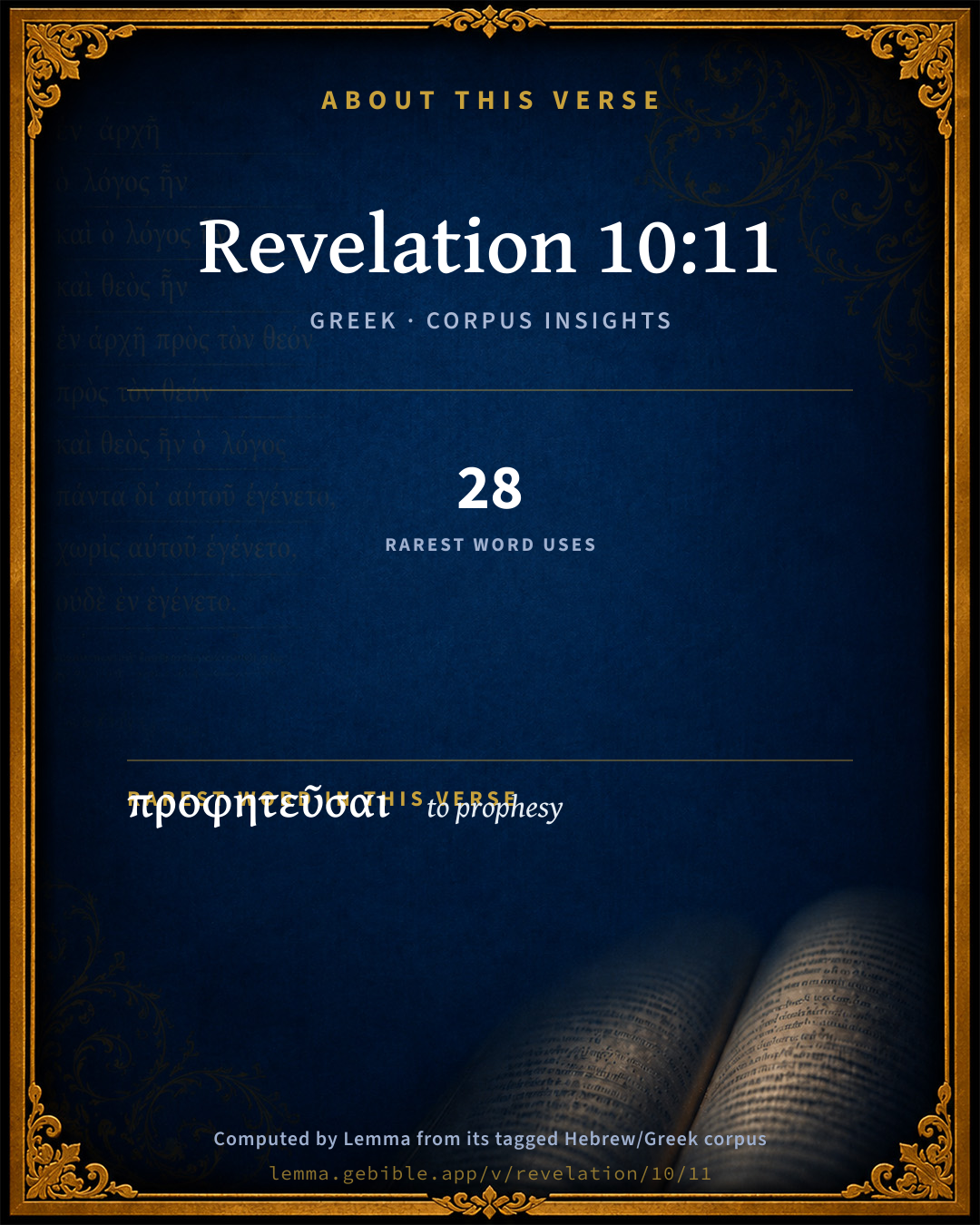
προφητεῦσαι to prophesy G4395 occurs in 27 verses of the Greek New Testament. Also found in:
Repetition

Words recur within this verse:

Cross-references

7

Topical passages linked to Revelation 10:11 in the Treasury of Scripture Knowledge — connected by theme and wording, ordered by reader-vote popularity; previews shown in the World English Bible.

  • Ezekiel 37:4 Again he said to me, Prophesy over these bones, and tell them, you dry bones, hear the word of Yahweh.
  • Jeremiah 1:9–10 Then Yahweh put forth his hand, and touched my mouth; and Yahweh said to me, Behold, I have put my words in your mouth:
  • Ezekiel 37:9 Then said he to me, Prophesy to the wind, prophesy, son of man, and tell the wind, Thus says the Lord Yahweh: Come from the four winds, breath, and breathe on these slain, that they may live.
  • Revelation 11:9 From among the peoples, tribes, languages, and nations people will look at their dead bodies for three and a half days, and will not allow their dead bodies to be laid in a tomb.
  • Revelation 14:6 I saw an angel flying in mid heaven, having an eternal Gospel to proclaim to those who dwell on the earth, and to every nation, tribe, language, and people.
  • Revelation 17:15 He said to me, "The waters which you saw, where the prostitute sits, are peoples, multitudes, nations, and languages.
  • Jeremiah 25:15–30 For thus says Yahweh, the God of Israel, to me: take this cup of the wine of wrath at my hand, and cause all the nations, to whom I send you, to drink it.

Cross-references courtesy of OpenBible.info (CC BY 4.0).

Commentary

Notes on Revelation 10:11 from classic Christian and Jewish commentators (each source and its license shown beneath its notes). The classic Christian expositions comment on the surrounding passage and are grouped to its opening verse, so a note may address several verses; the Jewish commentaries on the Tanakh (Rashi and others) are per-verse, so they appear only where the commentator wrote on this verse.

Lemma curates 59 commentaries, every one of them public domain or Creative Commons licensed, each selected and text-cleaned for this edition rather than reprinted as found. About our sources →

Joseph Benson's Commentary

Rev 10:11. And he said — Thou hast not yet finished the whole of thy work, in what thou hast already recorded of the visions of the Lord: but thou must again prophesy before, or to, many peoples and nations, &c. — Mede infers from hence, that the apostle is about to go over the same period of time that he had before been discoursing of, giving an account of the state of the church as he had just done of the state of the empire. But the new descriptions and new events to which the subsequent prophecies refer, that are introduced here, and which constitute the following chapters, are sufficient, without any peculiarity of interpretation, to justify the expression, Thou must prophesy again. Besides, as Bishop Newton observes, if the prophecy begin here again anew, the subject be resumed from the beginning, and all that follows be contained in the little book, then the little book contains more matter than the larger book; and part of the sealed book is made part of the open book, which is contrary to the regularity and order of the Apocalypse, and in a great measure destroys the beauty and symmetry of the different parts: for it is evident and undeniable that the seventh trumpet is the seventh part of the seventh seal, as the seventh seal is the seventh part of the sealed book, and consequently can be no part of the little open book, which ends, as we shall see, with the sixth trumpet, and immediately before the sounding of the seventh.

Joseph Benson's Commentary on the Old and New Testaments (1811–1818) — public domain. Text from a community e-Sword module.

Tyndale Open Study Notes

Tyndale Open Resources

10:11 Unlike Ezekiel, who prophesied for Israel alone, John must prophesy . . . about (or against) all the people of the world. There is debate whether “about” or “against” is the best translation; “about” allows for both promise and judgment (see both in 21:24-27).

Tyndale Open Study Notes — © Tyndale Open Resources, licensed CC BY-SA 4.0. Text via the HelloAO Bible API.

Bengel's Gnomon

Johann Albrecht Bengel

Rev 10:11. [106] Προφητεῦσαι, to prophesy) John acts in the vision throughout the whole course of the book.[107]

[106] πάλιν, again) as others have done, preceding thee, ver. 7.—V. g. βασιλεῦοι πολλοῖς, many kings) living contemporaneously with that period of time, which is mentioned ver. 6.—V. g.

[107] Bengel, J. A. (1866). Vol. 5: Gnomon of the New Testament (M. E. Bengel & J. C. F. Steudel, Ed.) (W. Fletcher, Trans.) (172–248). Edinburgh: T&T Clark.

Bengel's Gnomon of the New Testament — English translation (T&T Clark, Edinburgh, 1860) — public domain. Text from a community e-Sword module.

Expositor's Greek Testament

ed. W. Robertson Nicoll

Rev 10:11 . λέγ . μοι , an oblique, reverential way of describing the divine impulse, due to Aramaic idiom and common in later Biblical Hebrew ( cf. Dalman, i., viii. 11). The series of oracles, thus elaborately inaugurated, is concerned increasingly (“again,” in view of Rev 4:4 , 15, Rev 7:4 ; Rev 7:9 , Rev 8:13 , Rev 9:6 ; Rev 9:16 f.) with those international movements (“kings” = φυλαί , or those in Rev 17:10 ; Rev 17:12 ) which a prophet related to the course of the divine kingdom. Strictly speaking, the revelation assimilated in Rev 10:10-11 opens in 12., but the intervening passage is linked to both (see below). The first part of this passage (Rev 11:1-13 ) evidently forms part of the βιβλαρίδιον ( cf. Introd. § 2). Its enigmatic contents, interrupting the trumpet-visions with edges which do not fit into the context or the rest of the Apocalypse, point to the incorporation of a special and disparate source. Any analysis is more or less hypothetical, but the writer is evidently not moving with absolute freedom. He has his own end in view, but he reaches it, here as elsewhere ( cf. Rev 7:1 f.) by means of stepping-stones which originally lay in different surroundings. This is widely recognised by critics and editors, who commonly take 1 2 and 3 13 as separate oracles. Each indeed might be the torso of a larger source. But, in spite of the different descriptions of Jerusalem, the hypothesis of their original unity has much in its favour. How could so tiny a scrap of papyrus as that required for 1, 2 be preserved? Besides Rev 10:3 goes with Rev 10:2 (the prophetic mission as a counterpart to the punishment), the two periods are alike, the strange δίδωμι -construction occurs in both (here only in Apoc.), and the inversion of object and verb is common to both (Rev 10:2 ; Rev 10:5-6 ; Rev 10:9-10 ). To discover an oracle of the Zealots in 1, 2 (Wellhausen, Bousset, Baljon, J. Weiss) is precarious, for even if we could suppose that these passionate citizens took time to write oracles, they had not a monopoly of belief in the temple’s inviolability. The latter belief conflicts with Mar 13:1-2 (Act 6:14 ); but, while this makes it extremely unlikely that the passage was adopted, or at least composed, by one of the Twelve, it does not necessarily disprove a Jewish Christian origin for the fly-leaf. Patriotism must have often swayed hope, even in face of authoritative logia. Still, a Jewish origin is more probable (so from Vischer and Sabatier to Baljon, Forbes, von Soden, Wellhausen and J. Weiss), in which case 8 c ( ὅπου … ἐσταυρώθη ), with possibly 9 a and 12 b , must be Christianising touches by the editor. As 8 c is the only place in the Apocalypse where Jesus is thus designated (contrast 4), and as the unexampled αἱ … ἑστῶτες occurs in 4, the editor may be using a previous translation of the fly-leat. Otherwise, the repeated traces of Hebraistic idiom suggest that he translated it from an Aramaic or Hebrew original (so especially Weyland, Briggs, and Bruston) which was a Jewish (or Jewish Christian) oracle, composed towards the end of the siege in 70 A.D. between May and August ( cf. Joseph. Bell , ver 12, 3) by a prophet who anticipated ( cf. S. C. , 219, 220) that the temple and a nucleus of the God-fearing would be kept inviolate during the last times of the Gentiles , at the end of which anti-Christ or the pseudo-messiah would blasphemously re-assert himself in the temple (hence its preservation, 1, 2), according to one cycle of tradition (2Th 2:3 , etc., cf. A. C. 160 f.), after murdering the two heralds of messiah. The motives and further career of the beast are omitted, if not in the source, at least by the editor. He resumes the subject afterwards ( cf. Rev 13:6 ), when the eschatological monster is specially identified with the imperial power. Here his main concern is with the fate of the two witnesses. Probably it was this feature of the oracle which primarily led him to adopt and adapt it, as showing how the beast or anti-christ was foiled in his attack on messiah’s forerunners, just as (in 12) the dragon is foiled in his attack on messiah himself. The other details are left standing; in their present setting they have much the same pictorial and dramatic interest as the minutiæ of the parables, and it is perhaps doubtful whether the editor linked any symbolic or allegorical meaning to them, although such can easily be attached in a variety of ways, e.g. , to the language of 1, 2 in the light of Barn. iv. 11, Ign. ad Magn. 7, etc. (so Weiss, Simcox, Swete, and others). Even the two witnesses are not to be identified with any historical figures of contemporary life, much less taken as allegorical or as typifying aspects of the church’s testimony. “The vision … is of the nature of a superimposed photograph showing traces of many pasts” (Abbott). The original Jewish tradition which lay behind the source expected only Elijah, who should preach repentance to the pagan world, but he was occasionally furnished with a companion in Moses (on the basis of Deu 18:15 ; cf. Mal 4:4-5 , the transfiguration-story, and possibly the two radiant saints of Apoc. Pet. 6 f.). The only other serious rival is Enoch, a grand figure in Jewish and early Christian eschatological tradition (for the curious Sir 44:16 , cf. E. Bi. 1295). Later tradition, indeed, thinking mainly of Elijah and Enoch (Gfrörer ii. 261 f.; A. C. 203, 211), whom antichrist in wrath slays for their witness against him, and whom God (or Michael and Gabriel) resuscitates, suggests a fairly apposite cycle of belief which may reproduce the earlier Jewish expectation out of which the materials of this fragmentary oracle have been drawn. The unique character of this expectation is illustrated, not so much by Anu and Nudimmut, Marduk’s predecessors in the fight against Tiamât, as by the Zoroastrian belief that the temporary triumph of the evil spirit would be followed by the appearance of two reformers or prophets, Hushêdar and Hushêdaarmâh ( S. B. E. xxiii. 195; cf. Hübschmann, 227), who would act each for a millenium on earth as the precursors and heralds of their Lord, the Persian messiah. This belief is much older than the sources in which it occurs, and like several other Zoroastrian traits, it may have fused with the Jewish expectation in question, though the Zoroastrian heralds do not appear simultaneously ( cf. Encycl. Relig. and Ethics , i. 207). Here at any rate the appearance of the two anonymous and mysterious witnesses precedes the final outburst of evil (Rev 11:7 ; Rev 11:12 f.) and the manifestation of messiah (Rev 11:15 f., Rev 14:14 f.) an idea for which no exact basis can be found in the strictly Jewish eschatology of the period. It may have grown up under the influence of this kindred trait in the adjoining province of Zoroastrian belief, unless the doubling of the witnesses was simply due to the side-influence of the Zechariah-trait (in Rev 10:4 ). Wellhausen argues from the singular πτῶμα (Rev 10:8-9 ) that the two witnesses were a duplication of the original single witness, i.e. , Elijah; but the singular is collective, and there is no trace of any conflation with Jonah.

The Expositor's Greek Testament, edited by W. Robertson Nicoll (1897–1910) — public domain. Text from a community e-Sword module.

Geneva Bible (1599)

Geneva Bible translators

A simple and plain declaration of the sign before going, witnessing the divine calling of S. John, and laying upon him the necessity thereof.

Geneva Bible (1599) marginal notes — public domain. Text via Bolls.life.

Jamieson, Fausset & Brown

Robert Jamieson, A. R. Fausset & David Brown

he said--A, B, and Vulgate read, "they say unto me"; an indefinite expression for "it was said unto me."

Thou must--The obligation lies upon thee, as the servant of God, to prophesy at His command.

again--as thou didst already in the previous part of this book of Revelation.

before, &c.--rather as Greek (epilaois), "concerning many peoples," &c., namely, in their relation to the Church. The eating of the book, as in Ezekiel's case, marks John's inauguration to his prophetical office--here to a fresh stage in it, namely, the revealing of the things which befall the holy city and the Church of God--the subject of the rest of the book.

Next: Revelation Chapter 11

Jamieson, Fausset & Brown — Commentary Critical and Explanatory on the Whole Bible (1871) — public domain (CC PDM 1.0). Text via the HelloAO Bible API.

Adam Clarke's Commentary

Verse 11. Thou must prophesy again] Thou must write, not only for the instruction of the Jews in Palestine, but of those in the different provinces, as well as the heathens and heathen emperors and potentates in general.

THE reader will find, on comparing this chapter with Dan 8:1-27; Dan 12:1-13, and Eze 2:1-3:27, that there are several things similar in both; and the writer of the Apocalypse appears to keep these two prophets continually in view. I must once more say that I do not understand these prophecies, therefore I do not take upon me to explain them. I see with regret how many learned men have mistaken their way here. Commentators, and even some of the most modern, have strangely trifled in these solemn things; all trumpets, vials, woes, c., are perfectly easy to them yet from their descriptions, none get wise either to common sense or to the things that make for their peace.

On the same ground I cannot admit the interpretation that is given of the word χρονος, translated time in Re 10:6, which some have construed into an artificial period of 1,111 years, which they term chronos; hence we have the chronos, half-chronos, and non-chronos. Bengel has said much on these points, but to very little purpose; the word in the above place seems to signify delay simply, and probably refers to the long-suffering of God being ended in reference to Jerusalem; for I all along take for probable that this book was written previously to the destruction of that city.

Adam Clarke's Commentary on the Bible (1810–1826) — public domain. Text from a community e-Sword/MySword module.

Ellicott's Commentary for English Readers

(11) And he . . .—Better, And they (not “he,” as in the English version, but they say: an equivalent for “It was said,”) say to me, Thou must again prophesy concerning (or, with regard to) peoples, and nations, and tongues, and kings many. He is told that the bitterness will arise in connection with his prophecies with regard to peoples and kings. This carries us on to the vision in the next chapter, where the two witnesses stand so solitary, and prophesy so mightily, yet so vainly, among men. He will have to tell the story of churches and peoples, priests and princes, unmindful of their high calling and their allegiance to their true king, and of their hatred of God’s mightiest and purest witnesses. The end, indeed, will come. The Church will be victorious. The kingdoms of this world will become the kingdoms of Christ: but it will be through persecutions, apostasies, judgments. This is the sad vision he must describe. The interposed visions will answer the question, “What has the Church been doing?” but it will show how she has done that work, distressed by heresies, crippled by worldliness, trodden down by enemies, and, worse than enemies, foes veiled as friends. But this very vision will lead to the unfolding of the more truly spiritual aspects of the Church’s work, and of that conflict in which she contends with the multiform spirit and power of evil. Thus will he prophesy of peoples and kings many.

A Bible Commentary for English Readers, edited by Charles John Ellicott (1878–1897) — public domain. Text from a community e-Sword module.

The Cambridge Bible for Schools and Colleges

gen. ed. J. J. S. Perowne

11. And he said] Read, And they say.

Thou must prophesy again] Some try to make out that there is here a new commission given to the Apostle, and that in the remainder of the book there are higher mysteries than in the foregoing part. But it is surely simpler to take it as a personal warning to the Apostle himself; he was to see the end of all things in vision, but his own earthly work and duties were not at an end. He had already “prophesied before many peoples and nations and tongues and kings” (whether Nero or Domitian was the last of these): and he would have to do the same “again.”

The Cambridge Bible for Schools and Colleges (gen. ed. J. J. S. Perowne; Cambridge University Press, 1878–1918) — public domain. Text from a community e-Sword module.

John Gill's Exposition

And he said unto me,.... That is, the angel, from whom John received the little book; the Alexandrian copy reads, "they said unto me": both the voice of God the Father from heaven, that bid him take the book, and the angel that bid him eat it:

thou must prophesy again before many people, and nations, and tongues, and kings; which is to be understood not of John's preaching again to many people, and nations, after his return from his exile at Patmos, as he had done before his banishment thither; and much less of his prophesying along with Enoch and Elias, towards the end of the world, grounded upon two fabulous notions, the one that Enoch and Elias will appear in person before the coming of Christ, and the other, that John died not, but is still alive somewhere, and will continue till Christ's second coming; but rather of his delivering more prophecies out of the open little book; not "before", as we render it, but either "concerning" many people, nations, tongues, and kings, as the Syriac version renders it: or "against" them, that is, those people, multitudes, nations, and tongues, over which the whore of Babylon reigns, or has reigned, and the ten kings, and kings of the earth she rules over, Rev 17:12. Moreover, this may not so much design John's prophesying in person, as the prophesying: of the witnesses or ministers of the word in the several periods of time, whom John personated and represented; and of whom mention is made in the next chapter, to which this seems to be a transition.

Next: Revelation Chapter 11

John Gill's Exposition of the Whole Bible (1746–1763) — public domain (CC PDM 1.0). Text via the HelloAO Bible API.

Trapp's Complete Commentary

John Trapp

11 And he said unto me, Thou must prophesy again before many peoples, and nations, and tongues, and kings.

Ver. 11. Thou must prophesy] For all the sorrow, thou and thy successors must set close to the Lord’s work, for the regaining of those peoples, nations, &c., whom Antichrist hath enslaved. Or thus: Thou must prophesy, that is, before the time of fulfilling of all things, this book of the Revelation shall be made as clear as if John were come to prophesy again before men, and to give us a revelation of his Revelation, according to Isa 30:26. (Mr Burr, on Hosea.)

John Trapp, A Commentary or Exposition upon All the Books of the Old and New Testament (1647–1656) — public domain. Text from a community e-Sword module.

Albert Barnes' Notes on the Bible

And he said unto me - The angel then said.

Thou must prophesy - The word “prophesy” here is evidently used in the large sense of making known divine truth in general; not in the comparatively narrow and limited sense in which it is commonly used, as referring merely to the foretelling of future events. See the word explained in the Rom 12:6 note; 1Co 14:1 note. The meaning is, that, as a consequence of becoming possessed of the little volume and its contents, he would be called to proclaim divine truth, or to make the message of God known to mankind. The direct address is to John himself; but it is evidently not to be understood of him personally. He is represented as seeing the angel; as hearkening to his voice; as listening to the solemn oath which he took; as receiving and eating the volume; and then as prophesying to many people; but the reference is undoubtedly to the far-distant future. If the allusion is to the times of the Reformation, the meaning is, that the end of the world was not, as would be expected, about to occur, but that there was to be an interval long enough to permit the gospel to be proclaimed before “nations, and tongues, and kings”; that in consequence of coming into possession of the “little book,” the Word of God, the truth was yet to be proclaimed far and wide on the earth.

Again - πάλιν palin. This had been done before. That is, supposing this to refer to the time of the Reformation, it could be said:

(a)That this had been done before - that the gospel had been in former times proclaimed in its purity before “many peoples, and nations, and tongues, and kings”; and,

(b)That it would be done “again”; that is, though the Word of God had been hidden, and a mass of corrupt traditions had taken its place, yet the time would come when those pure truths would be made known again to all lands. This will explain the word “again” in this place - not meaning that John would do this personally, but that this would be in fact the result of the restoration of the Bible to the church.

Before many peoples - This word denotes people considered as masses, or as grouped together in masses, without reference to the manner in which it is done. It is used when we look on a mass of people, without taking into account the question whether they are of the same nation, or language, or rank. See the notes on Rev 7:9. The plural is used here - “peoples” - perhaps to denote that those to whom the truth would be made known would be very numerous. They would not only be numerous in regard to the individuals to whom it would be communicated, but numerous considered as communities or nations.

And nations - The word “nations” here denotes people considered as separated by national boundaries, constitutions, laws, customs. See the notes on Rev 7:9.

And tongues - People considered as divided by languages - a division not always or necessarily the same as that denoted by the word “people,” or “nations” as used in this passage.

And kings - Rulers of the people. The meaning is, that the gospel would not only be borne before the masses of mankind, but in a special manner before kings and rulers. The effect of thus possessing the “little volume,” or of the “open book” of revealed truth, would ultimately be that the message of life would be carried with power before princes and rulers, and would influence them as well as the common people.

In inquiring now for the proper application of this symbol as thus explained, we naturally turn to the Reformation, and ask whether there was anything in that of which this would he the proper emblem. The following things, then, are found in fact as occurring at that time, of which the symbol before us may be regarded as the proper representation:

(1) The reception of the Bible as from the hand of an angel - or its recovery from obscurity and forgetfulness, as if it were now restored to the church by a heavenly interposition. The influence of the Bible on the Reformation; the fact that it was now recovered from its obscurity, and that it was made the grand instrument in the Reformation, has already been illustrated. See the notes on Rev 10:2. The symbolical action of taking it from the hand of an angel was not an improper representation of its reception again by the church, and of its restoration to its true place in the church. It became, as it is proper that it should always be, the grand means of the defense of the faith, and of the propagation of truth in the world.

(2) The statement that the little book when eaten was “in the mouth sweet as honey,” is a striking and proper representation of the relish felt for the sacred Scriptures by those who love the truth (compare notes on Rev 10:9), and is especially appropriate to describe the interest which was felt in the volume of revealed truth in the time of the Reformation. For the Bible was to the Reformers emphatically a new book. It had been driven from common use to make way for the legends of the saints and the traditions of the church. It had, therefore, when translated into the vernacular tongue, and when circulated and read, the freshness of novelty - the interest which a volume of revealed truth would have if just given from heaven. Accordingly, it is well known with what avidity and relish the sacred volume was studied by Luther and his fellow-laborers in the Reformation; how they devoured its doctrines; how they looked to it for comfort in their times of trial; how sweet and sustaining were its promises in the troubles that came upon them, and in the labors which they were called to perform.

(3) The representation that, after it was eaten, it was “bitter,” would not improperly describe the effect, in some respects, of thus receiving the Bible, and making it the groundwork of faith. It brought the Reformers at once into conflict with all the power of the papacy and the priesthood; exposed them to persecution; aroused against them a host of enemies among the princes and rulers of the earth; and was the cause for which many of them were put to death. Such effects followed substantially when Wycliffe translated the Bible; when John Huss and Jerome of Prague published the pure doctrines of the New Testament; and when Luther gave to the people the Word of God in their own language. To a great extent this is always so - that, however sweet and precious the truths of the Bible may be to the preacher himself, one of the effects of his attempting to preach those truths may be such opposition on the part of people, such cold indifference, or such fierce persecution, that it would be well illustrated by what is said here, “it shall make thy belly bitter.”

(4) The representation that, as a consequence of receiving that book, he would prophesy again before many people, is a fit representation of the effect of the reception of the Bible again by the church, and of allowing it its proper place there. For:

(a) it led to preaching, or, in the language of this passage, “prophesying” - a thing comparatively little known before for many ages. The grand business in the papal communion was not, and is not, preaching, but the performance of rites and ceremonies. Genuflexions, crossings, burning of incense, processions, music, constitute the characteristic features of all papal churches; the grand thing that distinguishes the Protestant churches all over the world, just in proportion as they are Protestant, is preaching. The Protestant religion - the pure form of religion as it is revealed in the New Testament - has few ceremonies: its rites are simple: it depends for success on the promulgation and defense of the truth, with the attending influence of the Holy Spirit; and for this view of the nature and degree of religion the world is indebted to the fact that the Bible was again restored to its true place in the church.

(b) The Bible is the basis of all genuine preaching. Preaching will not be kept up in its purity, except in the places where the Bible is freely circulated, and where it is studied; and where it is studied, there will be, in the proper sense of the term, preachers. Just in proportion as the Bible is studied in the world, we may expect that preaching will be better understood, and that the number of preachers will be increased.

(c) The study of the Bible is the foundation of all the efforts to spread the knowledge of the truth to “peoples, and nations, and tongues, and kings,” in our own times. All these efforts have been originated by the restoration of the Bible to its proper place in the church, and to its more profound and accurate study in this age; for these efforts are but carrying out the injunction of the Saviour as recorded in this book - to “go into all the world, and preach the gospel to every creature.”

(d) The same thing will be true to the end of the world; or, in the language of the portion of the Book of Revelation before us, until “the kingdoms of this world become the kingdoms of our Lord, and of his Christ; and he shall reign forever and ever,” Rev 11:15. The fact of the restoration of the Bible to its proper place in the church will, therefore, ultimately be the means of the conversion of the whole world to God; and this fact, so momentous in its nature and its consequences, was worthy to be symbolized by the appearance of the “angel descending from heaven clothed with a cloud”; was properly represented by the manner in which he appeared - “his face radiant as the sun, and his feet as pillars of fire”; was worthy to be expressed by the position which he assumed, as “standing on the sea and the earth” - as if all the world were interested in the purpose of his mission, and was worthy of the loud proclamation which he made - as if a new order of things were to commence. Beautiful and sublime, then, as this chapter is, and always has been esteemed as a composition, it becomes still more beautiful and sublime if it be regarded as a symbol of the Reformation - an event the most glorious, and the most important in its issues, of any that has occurred since the Saviour appeared on the earth.

Albert Barnes' Notes on the Bible (1834–1885) — public domain. Text from a community e-Sword/MySword module.

Haydock's Catholic Bible Commentary

Thou must prophesy again: we may understand what still follows in this Apocalypse, or his gospel written afterwards, or his preaching and instructing the Asiatic Churches. (Witham)

====================

George Leo Haydock (1774–1849), Haydock's Catholic Family Bible and Commentary, 1859 edition — public domain. Excludes Psalms (Douay-Rheims chapter numbering differs from Protestant) and Deuterocanonical books (Catholic canon only).

Matthew Poole's English Annotations

Thou must prophesy again: these words (as many think) evince this a prophecy distinct from the former; he must prophesy again.

Before many peoples, and nations, and tongues, and kings; who shall be concerned to hear what shall now be revealed to thee concerning the rise of antichrist, his rule and tyranny, and his fall and ruin, which are things began long before, during the periods of time, when the six before mentioned trumpets sounded, but were not there clearly revealed; which things I will reveal unto thee, that thou, and after thee the ministers of the gospel, may in their several periods reveal them in the hearing of many people, and nations, &c.; so that hereby John (as some think) was constituted a prophet to reveal the state of the church under antichrist, and his tyranny, and finally his ruin, which began at the sounding of the seventh trumpet, Rev 11:15; but when it shall be finished, God alone must inform the world by the issues of his providence.

Matthew Poole's English Annotations on the Holy Bible (1683–1685) — public domain. Text from a community e-Sword/MySword module.

Whedon's Commentary on the Bible

Daniel D. Whedon

11. He said—Alford prefers the reading they say: the meaning is the same. The direction, as in Rev_10:8, was divine. And the plural divine Unanimity from which John receives the commission seems to confirm the thought that it comes from the Trinitarian Unity.

Again—As over against the entire previous apocalypse. He had, instrumentally, prophesied through the seven-church cycle, the seven-seal cycle, and six of the trumpet-cycle. But so all-comprehending is this SEVENTH TRUMPET that a fresh order is given to commence again.

Before—See note on Rev_22:16. The grandeur of the audience before which he was to prophesy is now unfolded. Not in person, but in the record, he is to be a world-wide and world-long prophet.

Many peoples—That prophecy should be heard among many unorganized peoples; be accepted by many organized and powerful nations; be translated into many tongues; and rule in power over many kings. And the number four expresses the earth-wide extent of his prophetic office. How wonderfully have the terms of this commission been fulfilled! For it is plain that the prophecy refers not to oral utterance, but to the written record which the seer was now in the process of preparing. And wonderful is the fulfilment of this four-fold extension, in the spreading of this prophecy in our own day to the four great quarters of the globe.

Daniel D. Whedon (gen. ed.), Commentary on the Old and New Testaments (1874–1909) — public domain. Text from a community e-Sword module.

The Pulpit Commentary

And he said unto me. Legousin , "they say," is read in a, A, B, and thirty cursives, and is adopted in the Revised Version. legei , "he saith," is found in P and seventeen cursives. Legousin leaves the speakers quite indefinite, amounting, in fact, to no more than" it was said" (Alford); cf. trefwsin in Rev_12:6; also Dan_7:5, Dan_7:13. Thou must prophesy again. Thou retest, because it is laid upon thee by God"s command. It is to be done again, because the seer has already to some extent set forth God"s will in the earlier part of the book; and he is now required to proceed with the delivery of his message. "Prophesy" (as in Rev_11:3) has rather its literal than its derived meaning. It is the telling forth of God"s purposes, and may refer to past as well as present or future events. The sentence refers to the announcements made in the following part of the Apocalypse (vide infra). Bede and others take it to mean the Gospel of St. John, which was, perhaps, afterwards composed (see Introduction). Victorinus thinks it points to the period of St. John"s return from Patmos to Ephesus, where the Apocalypse may have been published. Before many peoples, and nations, and tongues, and kings; concerning many peoples, etc. (epi , with dative). These are the objects of the prophecy, not the audience. This serves to explain the reference in the preceding sentence. The message is not delivered to, but about peoples, etc. The fourfold enumeration seems to point to the breadth of the signification it embraces the whole of mankind. (cf. Rev_5:9) This is the end of what is called by many writers the first episode; the second follows. The incident is often alluded to as the "new commission" of St. John; but it seems less a new commission than a solemn reenactment of the command delivered in Re 1.

The Pulpit Commentary (1880–1919), ed. H.D.M. Spence-Jones & Joseph S. Exell — public domain. Text from a community e-Sword module.

John Wesley's Explanatory Notes

Thou must prophesy again - Of the mystery of God; of which the ancient prophets had prophesied before. And he did prophesy, by "measuring the temple," chap. xi, 1; as a prophecy may be delivered either by words or actions. Concerning people, and nations, and tongues, and many kings - The people, nations, and tongues are contemporary; but the kings, being many, succeed one another. These kings are not mentioned for their own sake, but with a view to the "holy city," chap. xi, 2. Here is a reference to the great kingdoms in Spain, England, Italy, &c., which arose from the eighth century; or at least underwent a considerable change, as France and Germany in particular; to the Christian, afterward Turkish, empire in the east; and especially to the various potentates, who have successively reigned at or over Jerusalem, and do now, at least titularly, reign over it.

John Wesley, Explanatory Notes Upon the Whole Bible (1754–1765) — public domain. Text via the GEBible commentary corpus.

Cambridge Greek Testament for Schools and Colleges

11. λέγουσιν. Text. Rec[369] reads λέγει with P 1, most Latins, and other versions.

[369] Rec. Textus Receptus as printed by Scrivener.

καὶ ἔθνεσιν. B2 reads καὶ ἐπὶ ἔθν.

11. καὶ λέγουσίν μοι. For the impersonal plural cf. βλέπωσιν Rev 16:15.

δεῖ σε πάλιν προφητεῦσαι. If, as is possible (see on Rev 10:7), this implies a new or renewed commission to the Seer, it is surely unnecessary to try to make out that the remainder of the book contains higher mysteries than the foregoing part. The words certainly include a personal warning to the Apostle himself;—he was to see the end of all things in vision, but his own earthly work and duties were not at an end. He had already “prophesied before many peoples and nations and tongues and kings” (whether Nero or Domitian was the last of these): and he would have to do the same “again.”

Cambridge Greek Testament for Schools and Colleges (Cambridge University Press, 1896; 21 vols, various authors incl. Carr, Maclear, Plummer, Farrar, Lumby, Moule, M. R. James, Simcox) — public domain. Text from a community e-Sword module.

Lesson kit

Teaching starters — assembled from the data on this page, not authored interpretation. Every prompt links to the verse data it draws on. Edit before teaching.

Revelation, in the Revelation, opens this verse with 17 words (13 distinct Greek lemmas). Its most distinctive word is prophēteúō (“to prophesy”). A historical commentator’s framing appears above. Read the whole chapter for the surrounding context.

Discussion questions

  1. The word prophēteúō carries the sense “to prophesy.” How does it shape the verse?
  2. Matthew 7:22 shares the word «to prophesy» with this verse. How do the two illuminate each other?
  3. “upon” occurs 2× in this one verse. What is the effect of the repetition?
  4. These translations render this verse differently; the difference is in the English rendering, not the original. What questions does that raise?
  5. Reading how Joseph Benson's Commentary and Tyndale Open Study Notes read this verse, where do the two commentators agree and where do they part?

Things to notice

Reading settings

Reading text

Shown beneath each verse's original-language words.

Old Testament
Old Testament edition

Read the OT as the Masoretic Hebrew (MT) or the Greek Septuagint (LXX).

English shown for the Greek Septuagint (in the Hebrew ↔ Greek comparison).

Comparing translations? Open the Compare panel on any verse page to stack up to four side by side.