
Luke 22:25

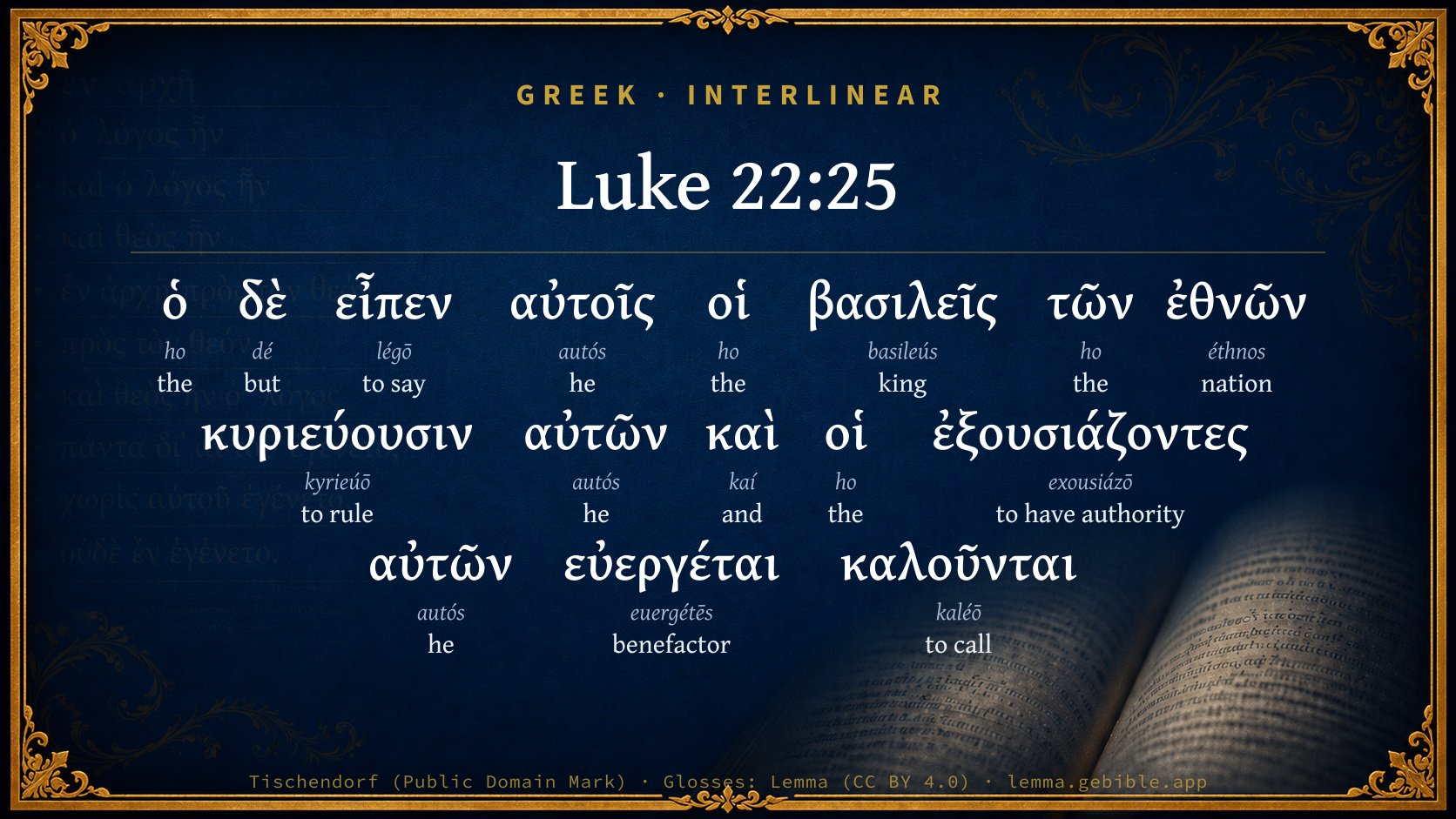
Greek (Tischendorf 8th ed.) Luke 22:25 appears in the Greek New Testament. The text above is from the Tischendorf 8th edition. Each word links to its Strong’s number and a concise gloss. Click any word for its full Thayer’s Greek Lexicon entry.
Download image
Cite this verse

Luke 22:25 (World English Bible). Public Domain. Lemma interlinear Bible study tool, https://lemma.gebible.app/v/luke/22/25.

Show BibTeX & RIS
BibTeX
RIS
English Translation
He said to them, "The kings of the Gentiles lord it over them, and those who have authority over them are called 'benefactors.'
World English Bible · Public Domain
Highlights
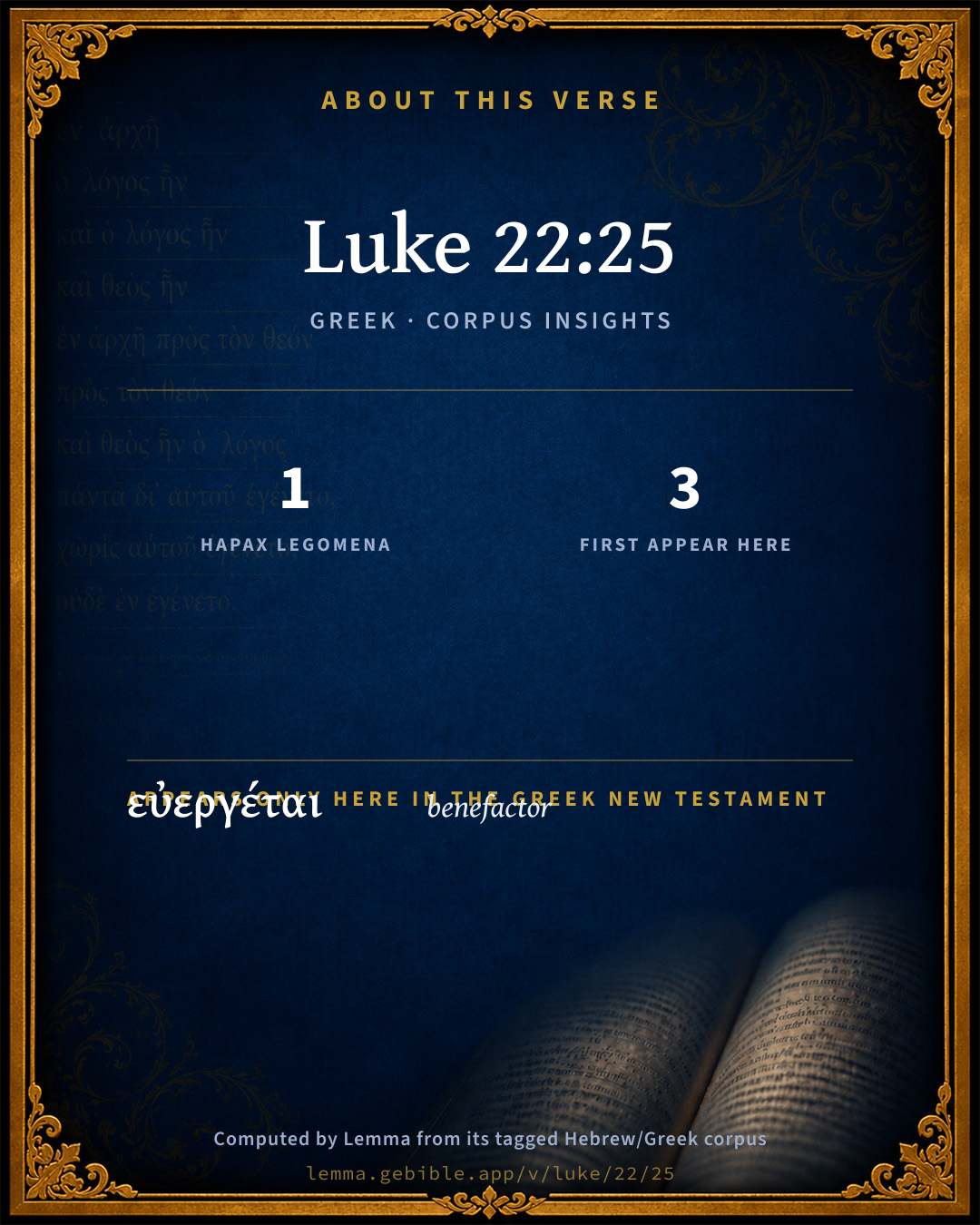
  • 1 hapax legomenon — only here in the Greek New Testament
  • 3 first appearances in the Greek New Testament
Full analysis ↓
Download a study sheet

One document with this verse’s original text, its word-by-word gloss line, the meaning frame, cross-references with their text, attributed commentary, and full source and license credits — printable, and it pastes into notes with its structure intact.

This verse Autodidact and up

Study sheet (.html) Plain text (.txt)

A passage Seminary Student

Up to 50 verses in one chapter. A passage sheet keeps up to 6 commentary sources and 12 cross-references per verse, in the order this page ranks them, and says so on the sheet whenever that leaves anything out. Ask for a single verse and you get the Autodidact verse sheet above.

Everything on this page stays free to read, with no account — the sheet is a download of what is already on screen, not access to it.

Want to remove ads? Support Godless Engineer
Compare translations 3

The same verse in 3 English versions, stacked beneath the original-language interlinear above. Click any original word for its lexicon entry.

Each is an independent rendering of the whole verse — the interlinear is not word-aligned to these translations.

Highlighted words mark where these versions differ — a whole-verse word diff, not a word-by-word alignment.

  • World English Bible Public Domain
    He said to them, "The kings of the Gentiles lord it over them, and those who have authority over them are called 'benefactors.'
  • King James Version Public Domain
    And he said unto them, The kings of the Gentiles exercise lordship over them; and they that exercise authority upon them are called benefactors.
  • unfoldingWord Literal Text CC BY-SA 4.0
    But he said to them, “The kings of the nations lord it over them, and the ones having authority over them are called Benefactors.

unfoldingWord Literal Text — © unfoldingWord, licensed CC BY-SA 4.0. Word-aligned USFM3 via Door43 (git.door43.org/unfoldingWord/en_ult).

Versions to compare (up to 4)

3 of 4 selected

Show all 19 translations

Every available English version of this verse, each an independent rendering of the whole verse.

  • World English Bible Public Domain
    He said to them, "The kings of the Gentiles lord it over them, and those who have authority over them are called 'benefactors.'
  • Berean Standard Bible Public Domain
    So Jesus declared, “The kings of the Gentiles lord it over them, and those in authority over them call themselves benefactors.
  • Majority Standard Bible Public Domain
    So Jesus declared, “The kings of the Gentiles lord it over them, and those in authority over them call themselves benefactors.
  • King James Version Public Domain
    And he said unto them, The kings of the Gentiles exercise lordship over them; and they that exercise authority upon them are called benefactors.
  • American Standard Version (1901) Public Domain
    And he said unto them, The kings of the Gentiles have lordship over them; and they that have authority over them are called Benefactors.
  • Revised Version (1885) Public Domain
    And he said unto them, The kings of the Gentiles have lordship over them; and they that have authority over them are called Benefactors.
  • Geneva Bible (1599) Public Domain
    But hee saide vnto them, The Kings of the Gentiles reigne ouer them, and they that beare rule ouer them, are called bountifull.
  • Douay-Rheims (1899) Public Domain
    And he said to them: The kings of the Gentiles lord it over them; and they that have power over them, are called beneficent.
  • Young's Literal Translation Public Domain
    And he said to them, `The kings of the nations do exercise lordship over them, and those exercising authority upon them are called benefactors;
  • Literal Standard Version CC BY-SA 4.0
    And He said to them, “The kings of the nations exercise lordship over them, and those exercising authority on them are called benefactors;
  • Unlocked Literal Bible CC BY-SA 4.0
    He said to them, “The kings of the Gentiles are masters over them, and the ones who have authority over them are referred to as those who do good to their people.
  • unfoldingWord Literal Text CC BY-SA 4.0
    But he said to them, “The kings of the nations lord it over them, and the ones having authority over them are called Benefactors.
  • Darby Bible Public Domain
    And he said to them, The kings of the nations rule over them, and they that exercise authority over them are called benefactors.
  • World Messianic Bible Public Domain
    He said to them, “The kings of the nations lord it over them, and those who have authority over them are called ‘benefactors.’
  • Webster's Bible Public Domain
    And he said to them, The kings of the Gentiles exercise lordship over them; and they that exercise authority upon them, are called benefactors.
  • Free Bible Version CC BY-SA 4.0
    Jesus told them, “Foreign kings lord it over their subjects, and those having power even want people to call them ‘benefactors.’
  • Bible in Basic English Public Domain
    And he said, The kings of the Gentiles are lords over them, and those who have authority are given names of honour.
  • Text-Critical English NT CC BY 4.0
    So Jesus said to them, “The kings of the Gentiles exercise lordship over them, and those who have authority over them are called benefactors.
  • Tyndale New Testament (1534) Public Domain
    And he sayde vnto them: the kynges of the getyls raygne over them and they that beare rule over them are called gracious lordes.

Literal Standard Version (2020), Covenant Press — licensed CC BY-SA 4.0. Text via the HelloAO Bible API (eBible.org). Unlocked Literal Bible (unfoldingWord) — licensed CC BY-SA 4.0. Text via the HelloAO Bible API (eBible.org). unfoldingWord Literal Text — © unfoldingWord, licensed CC BY-SA 4.0. Word-aligned USFM3 via Door43 (git.door43.org/unfoldingWord/en_ult). Free Bible Version, Dr. Jonathan Gallagher — licensed CC BY-SA 4.0. Text via the HelloAO Bible API (eBible.org).

Word by word

More ways to search: Search by grammar → Find every occurrence → Compare this word →

Practice this passage: Drill this verse → Learn its vocabulary →

εὐεργέται
euergétēs
G2110
“benefactor”
Noun, Nominative, Plural, Masculine
Part of Speech
Noun
Case
Nominative
Number
Plural
Gender
Masculine
Full Thayer's Definition

Origin: from G2095 and the base of G2041

TDNT: 12:54,3

1. benefactor 2. a title of honour, conferred on such as had done their country service, and upon princes, equivalent to Soter, Pater Patriae
  1. ὁ ho G3588 “the” Article, Nominative, Singular, Masculine
  2. δὲ dé G1161 “but” Conjunction
  3. εἶπεν légō G3004 “to say” Verb, Aorist, Active, Indicative, 3rd person, Singular
  4. αὐτοῖς autós G846 “he” Personal pronoun, Dative, Plural, Masculine
  5. οἱ ho G3588 “the” Article, Nominative, Plural, Masculine
  6. βασιλεῖς basileús G935 “king” Noun, Nominative, Plural, Masculine
  7. τῶν ho G3588 “the” Article, Genitive, Plural, Neuter
  8. ἐθνῶν éthnos G1484 “nation” Noun, Genitive, Plural, Neuter
  9. κυριεύουσιν kyrieúō G2961 “to rule” Verb, Present, Active, Indicative, 3rd person, Plural
  10. αὐτῶν autós G846 “he” Personal pronoun, Genitive, Plural, Neuter
  11. καὶ kaí G2532 “and” Conjunction
  12. οἱ ho G3588 “the” Article, Nominative, Plural, Masculine
  13. ἐξουσιάζοντες exousiázō G1850 “to have authority” Verb, Present, Active, Participle, Nominative, Plural, Masculine
  14. αὐτῶν autós G846 “he” Personal pronoun, Genitive, Plural, Neuter
  15. καλοῦνται kaléō G2564 “to call” Verb, Present, Passive, Indicative, 3rd person, Plural

About this verse

These counts appear in no published source. They are computed here, from the morphology-tagged text and Lemma’s own curated glosses. What Lemma adds →

16
words
11
distinct lemmas
Gospels
section

Notable vocabulary

1 hapax legomenon — a word that appears only here in the entire Greek New Testament:

  • εὐεργέται benefactor G2110

First appearance in Scripture

These words make their first canonical appearance in the Greek New Testament here:

  • κυριεύουσιν to rule G2961
  • ἐξουσιάζοντες to have authority G1850
  • εὐεργέται benefactor G2110

Shared distinctive vocabulary

ἐξουσιάζοντες to have authority G1850 occurs in 3 verses of the Greek New Testament. Also found in:
Repetition

Words recur within this verse:

  • ὁ the G3588 ×4
  • αὐτοῖς he G846 ×3

Cross-references

2

Topical passages linked to Luke 22:25 in the Treasury of Scripture Knowledge — connected by theme and wording, ordered by reader-vote popularity; previews shown in the World English Bible.

  • Matthew 20:25–28 But Jesus summoned them, and said, "You know that the rulers of the Gentiles lord it over them, and their great ones exercise authority over them.
  • Mark 10:41–45 When the ten heard it, they began to be indignant towards James and John.

Cross-references courtesy of OpenBible.info (CC BY 4.0).

Commentary

Notes on Luke 22:25 from classic Christian and Jewish commentators (each source and its license shown beneath its notes). The classic Christian expositions comment on the surrounding passage and are grouped to its opening verse, so a note may address several verses; the Jewish commentaries on the Tanakh (Rashi and others) are per-verse, so they appear only where the commentator wrote on this verse.

Lemma curates 59 commentaries, every one of them public domain or Creative Commons licensed, each selected and text-cleaned for this edition rather than reprinted as found. About our sources →

MacLaren's Expositions of Holy Scripture

Alexander MacLaren

Luke

PARTING PROMISES AND WARNINGS

CHRIST’S IDEAL OF A MONARCH 1

Luk 22:25 - Luk 22:26.

There have been sovereigns of England whose death was a relief. There have been others who were mourned with a certain tepid and decorous regret. But there has never been one on whose bier have been heaped such fragrant wreaths of universal love and sorrow as have been laid upon hers whom we have not yet learned to call by another name than that which has been musical for all these years-the Queen. Why has her people’s love thus compassed her? Surely, chiefly because they felt and saw that Christ’s ideal of rule, as stated in these words of our text, was her ideal, which she had gone far to realise. Here is the secret of her hold upon her people. Here is the reason why, from almost all the world, tributes have come, and as has been well said, ‘They that loved not England loved her.’

Now it would be impossible for me to speak words remote from the thought that has been filling the nation’s mind in these days. I can add nothing to the many eloquent and just appreciations to which we have listened in this past week, but I can draw your attention to the underlying secret which moulded and shaped that life. And it becomes the pulpit to do so. We Christians ought to infuse a Christian element into everything. We should ‘not sorrow as others,’ nor should we admire as others. We all unite in praising her, but eulogiums which ignore the ground of the virtues which they extol are superficial and misleading. I ask you to turn to the revelation of the secret of the nation’s love and sorrow suggested by the words of my text.

Christ sets forth, in two sharply contrasted pictures, the world’s ideal of a king and His ideal. The upper room was a strange place, and the eve of Calvary was a still stranger time, for disciples to squabble about pre-eminence. The Master was absorbed in the thought of His Cross, the servants were quarrelling about their places in His Kingdom. Perhaps it was the foot-washing that brought about the unseemly strife that arose among them, each desiring to hand on the menial office to another. Jesus Christ did it Himself; and to that, perhaps, refer the touching words which Luke gives as following the text; ‘I am among you as he that serveth,’ with the towel round His loins, and the basin in His hand.

The world’s ideal of a King.

Now, the one picture which He draws for us here, the world’s ideal of a king, is the portrait familiar enough to all who know anything about that ancient order of society, of tyrants and despots, in Assyria, Babylonia. Pharaohs and all the little kings round about Judaea; the vile old Herod and his equally vile brood, were recent or living examples of what the Master said when He sketched ‘the kings of the Gentiles,’ They ‘lord it over them.’ Arrogant superiority, imperious masterfulness, irresponsible wills, caprices ungoverned, an absolute oblivion of duties, no thought of responsibilities-these were the features of that ancient type of monarch: and which, in spite of all constitutional hedges and limitations, there is abundant room for the repetition of, even in so-called Christian countries.

And then, side by side with that, comes another characteristic: ‘They that exercise authority upon them are called “benefactors.”‘ They demand titles which shall credit them with virtues that they never try to possess, and live in a region filled with the fumes from a thousand venal censers of a flattery which intoxicates and makes giddy. A king in Egypt, very near our Lord’s time, had borne the title ‘benefactor,’ the very word that is employed here; even as many a most ungracious sovereign has been called ‘Your Most Gracious Majesty.’

The position tempts to such a type. And although the world has outgrown it, yet, as I have said, there is ample room for the recurrence to the old and obsolete form, unless a mightier hindrance than human nature knows, come in to prevent it. An ancient prophet lamented over the shepherds of Israel ‘that do feed themselves,’ and indignantly asked, ‘should not the shepherds feed the sheep?’ He meant precisely the same contrast which is drawn out at length in these two pictures that we have before us now.

The Christian conception.

‘Ye shall not be so.’ The Christian conception is in sharp contrast to, and the Christian realisation of the conception, should be the absolute opposite of that type to which I have already referred. ‘He that is greatest among you, let him be as the younger’; that suggests modesty and meekness of demeanour in bearing the loftiest office. ‘And he that is chief as he that doth serve’; that expresses an activity, not self-regarding and self-centred, but ever used for others. The simple words of Jesus Christ are the noblest expression of, and, as I believe, have been the mightiest impulse in producing, the modern recognition which, thank God! is becoming more and more pronounced every day amongst us, that power means duty, that elevation means the obligation to stoop, that true authority expresses itself in service. We see that conviction growing in all classes in England. Those who are lifted high are learning to-day, as they never learned before, the responsibilities and obligations of their position. And those who are low are beginning to apply the principle as they never did before, and to test the worthiness of the lofty, highly-endowed, wealthy, and noble, by their discharge of the obligations of their position. And although it anticipates what I have to say subsequently, I cannot but ask here, who shall say how the Queen’s example of authority becoming service has steadied the Empire, and made a peaceful transition from the old type of authority to the new, a possibility? Although not directly stated in my text, there is implied in it another thought, namely, that whilst power obliges to service, service brings power. He that uses his influence, his authority, his capacities, his possessions, not for himself, but for his brothers, will find that by the service he has garnered in a harvest of authority, and power of command which nothing else can ever give.

Christ’s ideal of a monarch.

And now I may turn, without passing beyond the bounds of the pulpit on such an occasion as the present, to look at the great illustration of the Christian ideal which the royal life now closed has given. I venture to say that, without exaggeration, and without irreverence, our Queen might have taken for her own the declaration of our Lord Himself on this occasion, ‘I am among you as one that serveth.’ She served her people by the diligent discharge of the duties that were laid upon her. During a strenuous reign of sixty-three years, she left no arrears, nothing neglected, nothing postponed, nothing undone. In sorrow as in joy, when life was young, and the love of husband and family joys were new, as when husband and children were taken away, and she was an old woman, lonelier because of her throne, she laboured as ‘ever in the great Taskmaster’s eye.’ That was serving her nation by the will of God. She served her people by that swift, sincere sympathy which claimed a share alike in great national and in small private sorrows. Was there some shipwreck or some storm, that widowed humble fisherfolk in their villages? The Queen’s sympathy was the first to reach them. Were the blinds drawn down in some colliery village because of an explosion? The Queen’s message was there to bring a gleam of light into darkened homes. Did some great name in literature or science pass away? Who but she was first to recognise the loss, to speak gracious words of appreciation? Did some poor shepherd die, in the strath where she made her Highland home? The widowed Queen was beside the widowed peasant, to share and to solace. Knowing sorrow herself only too well, she had learned to run to the help of the wretched. Dowered doubly with a woman’s gift of sympathy, she had not let the altitude of a throne freeze its flow.

She served her people yet more by letting them feel that she took them into her confidence, spreading before them in the days of her widowhood the cherished records that her happy pen had written in the vanished days of her wifehood, opening her heart to us in mute petition that we might give our hearts to her. She served her people by the simplicity of her tastes and habits in these days of senseless luxury, and fierce, sensuous excitement of living. She served her people by the purity of her life, and so far as she could by putting a barrier around her Court, across which nothing that was foul could pass. ‘He that worketh iniquity shall not tarry in my house,’ said an ancient king on taking his throne. And our Queen, to the utmost of her power, said the same; and frowned down-stern for once in a righteous cause-impurity in high places. Una had her lion, and this protest of a woman’s delicacy against the vices of modern society is not the least of the services for which we have to thank her.

Let me remind you that all this patient self-surrender had its root in Christian faith. She had taken her Lord for her example because her faith had knit her to Him as her Saviour.

Therefore she, as no other English sovereign, conquered the heart of the nation, and was best loved by the best men and women. Never was there a more striking confirmation of the truth that whoever in any region reigns to serve will serve to reign.

And now, before I close, let me remind you that the principles which I have been trying to express grip us in our several spheres, quite as tightly as they do those who may be more largely endowed, or more loftily placed than ourselves. There is no ideal for a Christian monarch which is not the ideal also for a Christian peasant. That which is the duty of the highest is no less the duty of the lowest. For us all it remains true that what we have we are bound to use, not for ourselves, but as recognising both our stewardship to God and the solidarity of humanity; to use for Him, that is to say, for men. This is the secret of all high, noble, blessed life for evermore.

And, brethren, whilst I for one heartily rejoice in the growing consciousness of responsibility which is being diffused through all ranks of society today, and, bless God, for one impulse to that recognition which, as I believe, came from the life now peacefully closed, I shall be no doubt charged by some of you with old-fashioned narrowness if I reiterate my own earnest conviction that we can rely on nothing to bring about a thoroughgoing, a widely-diffused, and a permanent altruism-to use the modern word-except the force that comes from the motive which Jesus Christ Himself adduced, in this very conversation, when He said, ‘I am among you as he that serveth.’ There is our example, aye! and more than our example, lodged in Him, and available for us, by our simple faith in Him. In love that seeks to copy, lies the only power that will cast out self, that ‘anarch old,’ from his usurped seat in our hearts, and will throne Jesus Christ there. It needs a mighty lever to heave a planet from its orbit, and to set it circling round another sun; and there is nothing that will deliver any man, in any rank of life, from the dominion of self, except submission to the dominion of Him who, because He died to serve, deserves, and has won, the supreme right of authority and dominion over human life.

To use anything for self is to miss its highest goodness, and to mar ourselves. To use anything for Christ and our brethren is to find its sweetest sweetness, and to bless ourselves to the very uttermost. Self-absorption is self-destruction; self-surrender is self-acquisition.

If we can truly say, ‘I am among you as he that serveth,’ if all our possessions suggest to us obligations and all our powers impose on us duties: then be we prince or peasant, rich or poor, entrusted with many talents or with but one, we shall make the best of life here, and pass to higher authority, which is nobler service hereafter. Be the servant of all, and all are yours; serve Christ, and possess yourselves-these are the lessons from that royal life of service. May we learn them! May the King walk in his mother’s steps and hearken to ‘the oracle which his mother taught him!

1 Preached on the occasion of the death of Queen Victoria.

Alexander MacLaren, Expositions of Holy Scripture (1904–1910) — public domain. Text from a community e-Sword module.

Tyndale Open Study Notes

Tyndale Open Resources

22:25 friends of the people: This translates a Greek word that refers to the practice of rulers bestowing gifts and favors on their subjects to gain loyalty and honor. Jesus contrasted the world’s leadership style—military power, coercion, and bribery—with his own servant leadership in sacrificing himself for others.

Tyndale Open Study Notes — © Tyndale Open Resources, licensed CC BY-SA 4.0. Text via the HelloAO Bible API.

Bengel's Gnomon

Johann Albrecht Bengel

Luk 22:25. Εὐεργέται) Aristotle, Eth. i. 8, ch. 13, βασιλεῖ πρὸς τοὺς βασιλευομένους φιλία ἐν ὑπεροχῇ εὐεργεσίας. Comp. note on Chrysost., περὶ ιἑρως, p. 452. So in 2Ma 4:2, Onias is said to be ὁ εὐεργέτης τῆς πόλεως—καλουνται) The Middle Voice (call themselves, or would have themselves called). They claim this title to themselves.

Bengel's Gnomon of the New Testament — English translation (T&T Clark, Edinburgh, 1860) — public domain. Text from a community e-Sword module.

Expositor's Greek Testament

ed. W. Robertson Nicoll

Luk 22:25-26 : borrowed from the incident of the two sons of Zebedee (Mat 20:25-26 , Mar 10:42-43 ), which Lk. omits and somewhat alters in expression.

Luk 22:25 . εὐεργέται : here only in N.T., either titular, like our “your highness,” e.g. , Ptolemy Euergetes (so, many), or = benefactors.

The Expositor's Greek Testament, edited by W. Robertson Nicoll (1897–1910) — public domain. Text from a community e-Sword module.

Geneva Bible (1599)

Geneva Bible translators

Have great titles, for so it was the custom to honor Princes with some great titles.

Geneva Bible (1599) marginal notes — public domain. Text via Bolls.life.

Jamieson, Fausset & Brown

Robert Jamieson, A. R. Fausset & David Brown

benefactors--a title which the vanity of princes eagerly coveted.

Jamieson, Fausset & Brown — Commentary Critical and Explanatory on the Whole Bible (1871) — public domain (CC PDM 1.0). Text via the HelloAO Bible API.

Adam Clarke's Commentary

Verse 25. Are called benefactors.] The very Greek word used by the evangelist, ευεργεται, was the surname of some of the Ptolemies of Egypt; Ptolemy Euergetes, i.e. the Benefactor. It was a custom among the ancient Romans to distribute part of the lands which they had conquered on the frontiers of the empire to their soldiers; those who enjoyed such lands were called beneficiarii, beneficed persons; and the lands themselves were termed beneficia, benefices, as being held on the beneficence of the sovereign; and it is no wonder that such sovereigns, however tyrannical or oppressive they might have been in other respects, were termed benefactors by those who were thus dependent on their bounty.

Adam Clarke's Commentary on the Bible (1810–1826) — public domain. Text from a community e-Sword/MySword module.

Ellicott's Commentary for English Readers

(25) The kings of the Gentiles exercise lordship over them.—See Notes on Mat_20:25; Mar_10:42. The repetition of the same words that had then been spoken in answer to the petition of the sons of Zebedee, suggests the probability that they were again prominent in the strife for pre-eminence.

Are called benefactors.—This takes the place of “their great ones exercise authority upon them,” in St. Matthew and St. Mark. Antiochus VII. of Syria, and Ptolemy III. of Egypt, were examples of kings who had borne the title of Euergetes, or benefactor. There is apparently an emphasis on “are called” as contrasted with “let him become,” in the next verse. The world gave the title of “benefactor” to those who were great in power only. In Christ’s kingdom true greatness was to be attained by benefiting others in the humblest services.

A Bible Commentary for English Readers, edited by Charles John Ellicott (1878–1897) — public domain. Text from a community e-Sword module.

The Cambridge Bible for Schools and Colleges

gen. ed. J. J. S. Perowne

25. exercise lordship] Peter learnt this lesson well. 1Pe_5:3.

are called benefactors] Euergetai—a name often inscribed on coins. How worthless and hollow the title was the disciples knew from the instances of Ptolemy Euergetes and other Syrian tyrants. Onias had been more deserving of the name, 2Ma_4:2.

The Cambridge Bible for Schools and Colleges (gen. ed. J. J. S. Perowne; Cambridge University Press, 1878–1918) — public domain. Text from a community e-Sword module.

John Gill's Exposition

But ye shall not be so,.... See Gill on Mat 20:26.

but he that is greatest among you; in age or gifts, or would be thought to be the greatest, who is most ambitious of grandeur and authority, which perhaps might be Peter's case, who was the oldest man:

let him be as the younger; as John, the beloved disciple, who was the youngest of them; and be as modest, and as humble as he, and reckon himself as in his place, and condescend to men of low estates, and esteem each other, even the youngest, better than himself. So the phrase, (r), "both greater and lesser", is used of the elder and younger.

And he that is chief; that is, a spiritual ruler and governor in the church of God, as all the disciples were:

as he that doth serve; for the apostles and ministers of the word, though they are over others in the Lord, and have the rule over them, yet they are servants for Jesus' sake, and so ought to reckon themselves; See Gill on Mat 20:27.

(r) Targum in 2 Chron. xxxi. 15.

John Gill's Exposition of the Whole Bible (1746–1763) — public domain (CC PDM 1.0). Text via the HelloAO Bible API.

Trapp's Complete Commentary

John Trapp

25 And he said unto them, The kings of the Gentiles exercise lordship over them; and they that exercise authority upon them are called benefactors.

Ver. 25. The kings of the Gentiles, &c.] In striving for precedence, the disciples showed themselves but Gentiles, who stand upon their birth and privileges.

Exercise lordship over them] As he did with a witness (of whom Melancthon writeth) that wrung money from his miserable subjects, by knocking out their teeth, one by one, till he had what he would. (Joh. Maulii, loc. com.)

Are called benefactors] Nedibim, bountiful princes, Psa 47:9; Psa 83:12. Such a one was Titus, son of Vespasian, who never sent away any suitor sorrowful; and was the author of this brave speech, Hodie non regnavimus, quia neminem affecimus beneficio: We seem not to have reigned this day, because we have done no man a good turn today.

John Trapp, A Commentary or Exposition upon All the Books of the Old and New Testament (1647–1656) — public domain. Text from a community e-Sword module.

Albert Barnes' Notes on the Bible

The kings of the Gentiles - The kings of the “nations,” or of the earth. They do this, and it is to be expected of them, and it is right. Our Lord does not mean to say that it was wrong that there should be such authority, but that “his” kingdom was to be of a different character, and they were not to expect it there.

Over them - That is, over the “nations.”

Are called benefactors - The word “benefactor” is applied to one who bestows “favor” on another. It was applied to kings by way of “compliment or flattery.” Some of them might have been truly benefactors of their people, but this was by no means true of “all.” Yet it was applied to all, and especially to the Roman emperors. It is found applied to them often in the writings of Josephus and Philo.

Albert Barnes' Notes on the Bible (1834–1885) — public domain. Text from a community e-Sword/MySword module.

Matthew Poole's English Annotations

See Poole on "Mat 20:25", and following verses to Mat 20:28. The sum is, our Saviour hereby teacheth all his disciples (his ministers especially) to avoid affectation of rule and dominion, as that which became heathens rather than Christians, and the kings of the Gentiles rather than the ministers of the Lord Jesus Christ. This text giveth no countenance to the levelling of all orders of men. Magistracy is an ordinance of God, and ought to be upheld. Order also in the church is to be observed, for God is the God of order; but no minister of Christ ought to affect great titles, nor to exercise a dominion or lordship. Our work is to feed the flock of God, taking the oversight of them, not by constraint, but willingly; not for filthy lucre, but of a ready mind; neither as being lords over God’s heritage, but being ensamples to the flock, 1Pe 5:2,3. Not for that we have dominion, over your faith, but are helpers of your joy, 2Co 1:24. That the ministers of Christ may not have titles given them, speaking honour and reverence due to them, I do not know. But the reason is obvious why they should not affect them to be fond of them; for pride is a vain and vicious affection, and more culpable in them than others. Their works are but a ministration to the church, in putting the laws of Christ relating to it in execution, and it is their greatest honour to be humble. Nor doth this at all degrade a minister of Christ, for even Christ himself, while he was upon the earth, was not as one that sat at meat, but as one that served.

Matthew Poole's English Annotations on the Holy Bible (1683–1685) — public domain. Text from a community e-Sword/MySword module.

Whedon's Commentary on the Bible

Daniel D. Whedon

25. Exercise lordship—Play the lord and despot. Jesus here does not condemn the exercise of a just governmental authority, in which the ruler, acting for the public good, is in fact the public servant. On the contrary, the powers that be are ordained of God. Rulers are a necessity in all human society. But every true ruler, whether in Church or State, is a true and faithful servant, both of God and of the people he rules.

They that exercise authority… benefactors—The most despotic tyrants and the bloodiest destroyers are often the themes of human eulogy.

Benefactors—The Greek title here named, Euergetes, was conferred upon or adopted by several of the Egyptian Ptolemies, who were anything but benefactors to their nation or race.

Daniel D. Whedon (gen. ed.), Commentary on the Old and New Testaments (1874–1909) — public domain. Text from a community e-Sword module.

The Pulpit Commentary

Are called benefactors (euergetai). Those who were listening knew well how utterly false these high-sounding human titles often were. Euergethv (Euergetes), Benefactor, was the well-known title appropriated by Ptolemy Euergetes and other hated royal tyrants well known to the Jewish people.

The Pulpit Commentary (1880–1919), ed. H.D.M. Spence-Jones & Joseph S. Exell — public domain. Text from a community e-Sword module.

John Wesley's Explanatory Notes

They that exercise the most arbitrary authority over them, have from their flatterers the vain title of benefactors.

John Wesley, Explanatory Notes Upon the Whole Bible (1754–1765) — public domain. Text via the GEBible commentary corpus.

Cambridge Greek Testament for Schools and Colleges

25. εὐεργέται καλοῦνται. εὐεργέται—a name often inscribed on coins. Comp. εὐεργέτην ἀπογραφῆναι, Herod. VIII. 85. How worthless and hollow the title was the disciples knew from the instances of Ptolemy Euergetes and other Syrian tyrants. Onias had been more deserving of the name, 2Ma 4:2.

Cambridge Greek Testament for Schools and Colleges (Cambridge University Press, 1896; 21 vols, various authors incl. Carr, Maclear, Plummer, Farrar, Lumby, Moule, M. R. James, Simcox) — public domain. Text from a community e-Sword module.

Alford’s Greek Testament

Henry Alford

25.] See on Mat 20:25. The expression here οἱ ἐξουσ. αὐτ. εὐεργ. καλ. also seems to be connected with what had just taken place. ‘Among them, the εὐεργέται are those who ἐξουσιάζουσιν αὐτῶν—but among you, I, your εὐεργέτης (see vv. 19, 20, ὑπὲρ ὑμῶν, bis), do not so, but am in the midst of you as your servant.’

Ptolemy εὐεργέτης at once occurs to us;—numerous other examples are given by Wetstein.

Henry Alford, The Greek Testament (1849–1861) — public domain. Text from a community e-Sword module.

International Critical Commentary

25. Almost verbatim as the account of the earlier strife provoked by James and John (Mat 20:25; Mar 10:42). For κυριεύουσιν comp. Rom 14:9; 2Co 1:24; 1Ti 6:15. Mt. and Mk. use the compounds, κατακυρ. and κατεξουσιαζ.

εὐεργέται καλοῦνται Peculiar to Lk. The phrase εὐεργέτης βασιλέος ἀνεγράφη (Hdt. viii. 85, 4: comp. Thuc. i. 129. 2; Est 2:23, Est 6:1) is not parallel. There persons who have done special service to the sovereign are formally credited with it. Here it is the sovereign who receives the title of Benefactor (i.e. of his country, or of mankind) as a perpetual epithet; e.g. some of the Greek kings of Egypt. Comp. Σωτήρ, Pater patriæ, Servus servorum. For less formal instances of the title see McClellan and Wetstein.

It is better to take καλοῦνται as middle: “claim the title,” hunc titulum sibi vindicant (Beng.). This is what the disciples were doing.

International Critical Commentary — older volumes (1896–1929), various authors — public domain. Text from a community e-Sword module.

Lesson kit

Teaching starters — assembled from the data on this page, not authored interpretation. Every prompt links to the verse data it draws on. Edit before teaching.

Luke, in the Gospels, opens this verse with 16 words (11 distinct Greek lemmas). Its most distinctive word is euergétēs (“benefactor”). A historical commentator’s framing appears above. Read the whole chapter for the surrounding context.

Discussion questions

  1. The word euergétēs carries the sense “benefactor.” How does it shape the verse?
  2. This verse holds 1 word here found nowhere else in the Greek New Testament. What might the rare word draw attention to?
  3. 3 words here appear for the first time in Scripture. What is being introduced at this debut?
  4. 1 Corinthians 6:12 shares the word «to have authority» with this verse. How do the two illuminate each other?
  5. “the” occurs 4× in this one verse. What is the effect of the repetition?
  6. These translations render this verse differently. What is at stake in choosing one wording over another?
  7. Reading how MacLaren's Expositions of Holy Scripture and Tyndale Open Study Notes read this verse, where do the two commentators agree and where do they part?

Things to notice

  • 1 word in this verse appears nowhere else in the Greek New Testament.
  • 3 words make their first canonical appearance in Scripture here.
  • These translations choose different wording for 10 words in this verse.
  • “the” occurs 4× in this single verse.
  • 11 distinct Greek lemmas span 16 words in this verse.

Reading settings

Reading text

Shown beneath each verse's original-language words.

Old Testament
Old Testament edition

Read the OT as the Masoretic Hebrew (MT) or the Greek Septuagint (LXX).

English shown for the Greek Septuagint (in the Hebrew ↔ Greek comparison).

Comparing translations? Open the Compare panel on any verse page to stack up to four side by side.