

Revelation 16:19
Greek (Tischendorf 8th ed.) Revelation 16:19 appears in the Greek New Testament. The text above is from the Tischendorf 8th edition. Each word links to its Strong’s number and a concise gloss. Click any word for its full Thayer’s Greek Lexicon entry.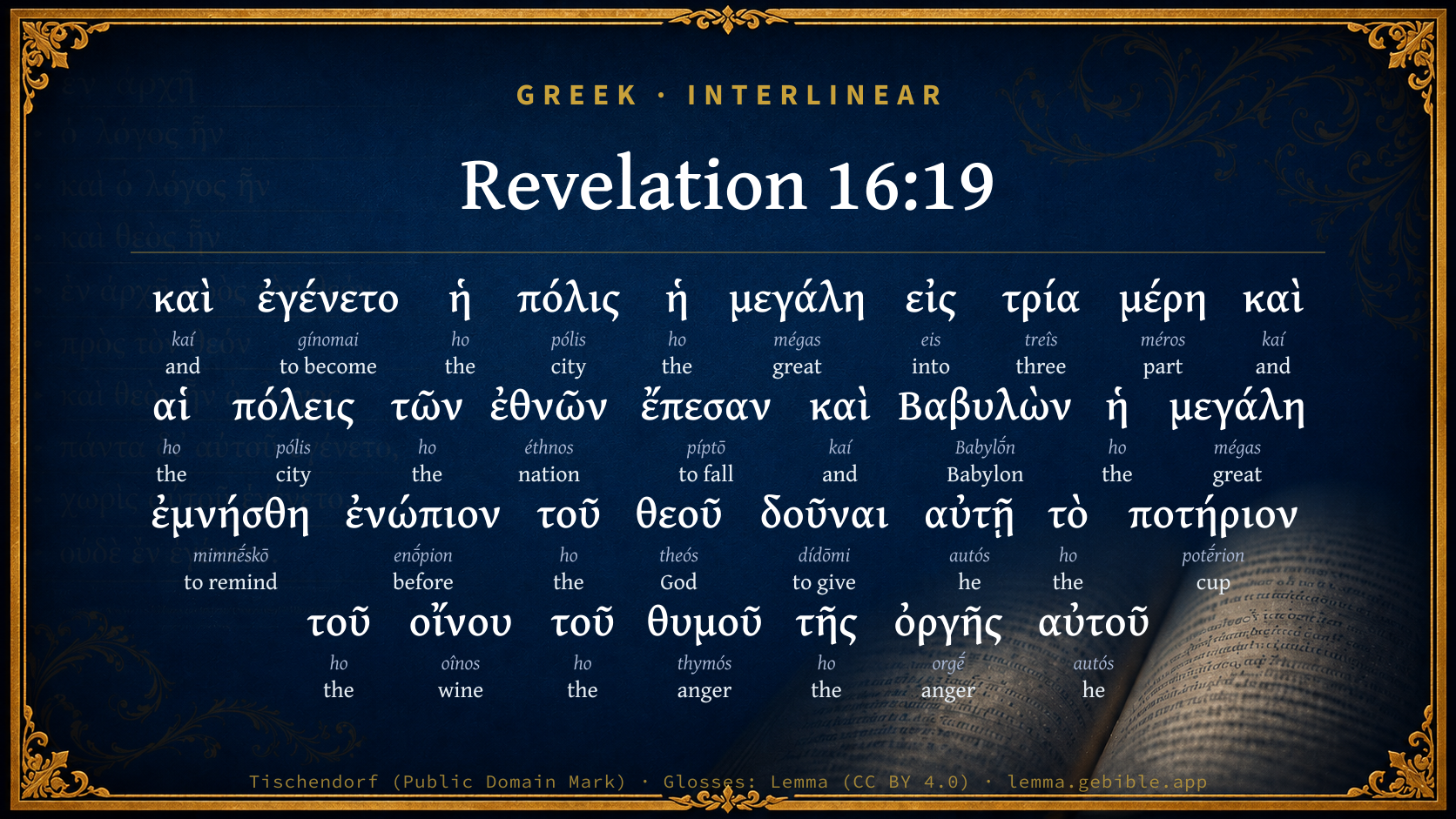
The great city was divided into three parts, and the cities of the nations fell. Babylon the great was remembered in the sight of God, to give to her the cup of the wine of the fierceness of his wrath.
Download a study sheet
One document with this verse’s original text, its word-by-word gloss line, the meaning frame, cross-references with their text, attributed commentary, and full source and license credits — printable, and it pastes into notes with its structure intact.
This verse Autodidact and up
A passage Seminary Student
Up to 50 verses in one chapter. A passage sheet keeps up to 6 commentary sources and 12 cross-references per verse, in the order this page ranks them, and says so on the sheet whenever that leaves anything out. Ask for a single verse and you get the Autodidact verse sheet above.
Everything on this page stays free to read, with no account — the sheet is a download of what is already on screen, not access to it.
Compare translations 3
The same verse in 3 English versions, stacked beneath the original-language interlinear above. Click any original word for its lexicon entry.
Each is an independent rendering of the whole verse — the interlinear is not word-aligned to these translations.
Highlighted words mark where these versions differ — a whole-verse word diff, not a word-by-word alignment.
-
World English Bible Public Domain
The great city was divided into three parts, and the cities of the nations fell. Babylon the great was remembered in the sight of God, to give to her the cup of the wine of the fierceness of his wrath.
-
King James Version Public Domain
And the great city was divided into three parts, and the cities of the nations fell: and great Babylon came in remembrance before God, to give unto her the cup of the wine of the fierceness of his wrath.
-
unfoldingWord Literal Text CC BY-SA 4.0
And the great city came into three parts and the cities of the nations fell, and Babylon the Great was remembered before God to give to her the cup of the wine of the wrath of his anger.
unfoldingWord Literal Text — © unfoldingWord, licensed CC BY-SA 4.0. Word-aligned USFM3 via Door43 (git.door43.org/unfoldingWord/en_ult).
Show all 19 translations
Every available English version of this verse, each an independent rendering of the whole verse.
-
World English Bible Public Domain
The great city was divided into three parts, and the cities of the nations fell. Babylon the great was remembered in the sight of God, to give to her the cup of the wine of the fierceness of his wrath.
-
Berean Standard Bible Public Domain
The great city was split into three parts, and the cities of the nations collapsed. And God remembered Babylon the great and gave her the cup of the wine of the fury of His wrath.
-
Majority Standard Bible Public Domain
The great city was split into three parts, and the cities of the nations collapsed. And God remembered Babylon the great and gave her the cup of the wine of the fury of His wrath.
-
King James Version Public Domain
And the great city was divided into three parts, and the cities of the nations fell: and great Babylon came in remembrance before God, to give unto her the cup of the wine of the fierceness of his wrath.
-
American Standard Version (1901) Public Domain
And the great city was divided into three parts, and the cities of the nations fell: and Babylon the great was remembered in the sight of God, to give unto her the cup of the wine of the fierceness of his wrath.
-
Revised Version (1885) Public Domain
And the great city was divided into three parts, and the cities of the nations fell: and Babylon the great was remembered in the sight of God, to give unto her the cup of the wine of the fierceness of his wrath.
-
Geneva Bible (1599) Public Domain
And the great citie was deuided into three partes, and the cities of the nations fell: and that great Babylon came in remembrance before God, to giue vnto her the cup of the wine of the fiercenesse of his wrath.
-
Douay-Rheims (1899) Public Domain
And the great city was divided into three parts; and the cities of the Gentiles fell. And great Babylon came in remembrance before God, to give her the cup of the wine of the indignation of his wrath.
-
Young's Literal Translation Public Domain
And it came -- the great city -- into three parts, and the cities of the nations did fall, and Babylon the great was remembered before God, to give to her the cup of the wine of the wrath of His anger,
-
Literal Standard Version CC BY-SA 4.0
And it came—the great city—into three parts, and the cities of the nations fell, and Babylon the great was remembered before God, to give to her the cup of the wine of the wrath of His anger,
-
Unlocked Literal Bible CC BY-SA 4.0
The great city was split into three parts, and the nations' cities collapsed. Then God called to mind Babylon the great, and he gave that city the cup filled with the wine made from his furious wrath.
-
unfoldingWord Literal Text CC BY-SA 4.0
And the great city came into three parts and the cities of the nations fell, and Babylon the Great was remembered before God to give to her the cup of the wine of the wrath of his anger.
-
Darby Bible Public Domain
And the great city was [divided] into three parts; and the cities of the nations fell: and great Babylon was remembered before God to give her the cup of the wine of the fury of his wrath.
-
World Messianic Bible Public Domain
The great city was divided into three parts, and the cities of the nations fell. Babylon the great was remembered in the sight of God, to give to her the cup of the wine of the fierceness of his wrath.
-
Webster's Bible Public Domain
And the great city was divided into three parts, and the cities of the nations fell: and great Babylon came in remembrance before God, to give to her the cup of the wine of the fierceness of his wrath.
-
Free Bible Version CC BY-SA 4.0
The great city was split into three. The cities of the nations were destroyed. Babylon the great was remembered in God's presence so that she should be given the cup filled with the wine of his hostility.
-
Bible in Basic English Public Domain
And the great town was cut into three parts, and the towns of the nations came to destruction: and Babylon the great came into mind before God, to be given the cup of the wine of his wrath.
-
Text-Critical English NT CC BY 4.0
The great city was split into three parts, and the cities of the nations fell. God remembered Babylon the great and gave her the cup filled with the wine of the fury of his wrath.
-
Tyndale New Testament (1534) Public Domain
And the greate cite was devyded into thre parties And the cities of nacions fell. And grett Babilon came in remembraunce before God to geve vnto hyr the cuppe of wyne of the fearcenes of his wrathe.
Literal Standard Version (2020), Covenant Press — licensed CC BY-SA 4.0. Text via the HelloAO Bible API (eBible.org). Unlocked Literal Bible (unfoldingWord) — licensed CC BY-SA 4.0. Text via the HelloAO Bible API (eBible.org). unfoldingWord Literal Text — © unfoldingWord, licensed CC BY-SA 4.0. Word-aligned USFM3 via Door43 (git.door43.org/unfoldingWord/en_ult). Free Bible Version, Dr. Jonathan Gallagher — licensed CC BY-SA 4.0. Text via the HelloAO Bible API (eBible.org).
Word by word
More ways to search: Search by grammar → Find every occurrence → Compare this word →
Practice this passage: Drill this verse → Learn its vocabulary →
- Appears 12× in the Greek New Testament
- First appears at Matthew 1:11
- Part of Speech
- Noun
- Case
- Nominative
- Number
- Singular
- Gender
- Feminine
Full Thayer's Definition
- καὶ kaí G2532 “and” Conjunction
- ἐγένετο gínomai G1096 “to become” Verb, Aorist, Middle deponent, Indicative, 3rd person, Singular
- ἡ ho G3588 “the” Article, Nominative, Singular, Feminine
- πόλις pólis G4172 “city” Noun, Nominative, Singular, Feminine
- ἡ ho G3588 “the” Article, Nominative, Singular, Feminine
- μεγάλη mégas G3173 “great” Adjective, Nominative, Singular, Feminine
- εἰς eis G1519 “into” Preposition
- τρία treîs G5140 “three” Adjective, Accusative, Plural, Neuter
- μέρη méros G3313 “part” Noun, Accusative, Plural, Neuter
- καὶ kaí G2532 “and” Conjunction
- αἱ ho G3588 “the” Article, Nominative, Plural, Feminine
- πόλεις pólis G4172 “city” Noun, Nominative, Plural, Feminine
- τῶν ho G3588 “the” Article, Genitive, Plural, Neuter
- ἐθνῶν éthnos G1484 “nation” Noun, Genitive, Plural, Neuter
- ἔπεσαν píptō G4098 “to fall” Verb, Aorist, Active, Indicative, 3rd person, Plural
- καὶ kaí G2532 “and” Conjunction
- Βαβυλὼν Babylṓn G897 “Babylon” Noun, Nominative, Singular, Feminine
- ἡ ho G3588 “the” Article, Nominative, Singular, Feminine
- μεγάλη mégas G3173 “great” Adjective, Nominative, Singular, Feminine
- ἐμνήσθη mimnḗskō G3403 “to remind” Verb, Aorist, Passive, Indicative, 3rd person, Singular
- ἐνώπιον enṓpion G1799 “before” Adverb
- τοῦ ho G3588 “the” Article, Genitive, Singular, Masculine
- θεοῦ theós G2316 “God” Noun, Genitive, Singular, Masculine
- δοῦναι dídōmi G1325 “to give” Verb, Aorist, Active, Infinitive
- αὐτῇ autós G846 “he” Personal pronoun, Dative, Singular, Feminine
- τὸ ho G3588 “the” Article, Accusative, Singular, Neuter
- ποτήριον potḗrion G4221 “cup” Noun, Accusative, Singular, Neuter
- τοῦ ho G3588 “the” Article, Genitive, Singular, Masculine
- οἴνου oînos G3631 “wine” Noun, Genitive, Singular, Masculine
- τοῦ ho G3588 “the” Article, Genitive, Singular, Masculine
- θυμοῦ thymós G2372 “anger” Noun, Genitive, Singular, Masculine
- τῆς ho G3588 “the” Article, Genitive, Singular, Feminine
- ὀργῆς orgḗ G3709 “anger” Noun, Genitive, Singular, Feminine
- αὐτοῦ autós G846 “he” Personal pronoun, Genitive, Singular, Masculine
About this verse
These counts appear in no published source. They are computed here, from the morphology-tagged text and Lemma’s own curated glosses. What Lemma adds →
- 34
- words
- 20
- distinct lemmas
- Revelation
- section
Cross-references
14Topical passages linked to Revelation 16:19 in the Treasury of Scripture Knowledge — connected by theme and wording, ordered by reader-vote popularity; previews shown in the World English Bible.
- Revelation 17:18 The woman whom you saw is the great city, which reigns over the kings of the earth."
- Revelation 18:5 for her sins have reached to the sky, and God has remembered her iniquities.
- Revelation 18:10 standing far away for the fear of her torment, saying, 'Woe, woe, the great city, Babylon, the strong city! For your judgment has come in one hour.'
- Revelation 18:21 A mighty angel took up a stone like a great millstone and cast it into the sea, saying, "Thus with violence will Babylon, the great city, be thrown down, and will be found no more at all.
- Revelation 18:2 He cried with a mighty voice, saying, "Fallen, fallen is Babylon the great, and she has become a habitation of demons, a prison of every unclean spirit, and a prison of every unclean and hateful bird!
- Revelation 18:16–19 saying, 'Woe, woe, the great city, she who was dressed in fine linen, purple, and scarlet, and decked with gold and precious stones and pearls!
- Jeremiah 25:15–16 For thus says Yahweh, the God of Israel, to me: take this cup of the wine of wrath at my hand, and cause all the nations, to whom I send you, to drink it.
- Jeremiah 25:26 and all the kings of the north, far and near, one with another; and all the kingdoms of the world, which are on the surface of the earth: and the king of Sheshach shall drink after them.
- Daniel 4:30 The king spoke and said, Is not this great Babylon, which I have built for the royal dwelling-place, by the might of my power and for the glory of my majesty?
- Revelation 11:8 Their dead bodies will be in the street of the great city, which spiritually is called Sodom and Egypt, where also their Lord was crucified.
- Revelation 17:5 And on her forehead a name was written, "MYSTERY, BABYLON THE GREAT, THE MOTHER OF THE PROSTITUTES AND OF THE ABOMINATIONS OF THE EARTH."
- Isaiah 49:26 I will feed those who oppress you with their own flesh; and they shall be drunken with their own blood, as with sweet wine: and all flesh shall know that I, Yahweh, am your Savior, and your Redeemer, the Mighty One of Jacob.
- Isaiah 51:17–23 Awake, awake, stand up, Jerusalem, that have drunk at the hand of Yahweh the cup of his wrath; you have drunken the bowl of the cup of staggering, and drained it.
- Revelation 14:8–10 Another, a second angel, followed, saying, "Babylon the great has fallen, which has made all the nations to drink of the wine of the wrath of her sexual immorality."
Cross-references courtesy of OpenBible.info (CC BY 4.0).
Lesson kit
Teaching starters — assembled from the data on this page, not authored interpretation. Every prompt links to the verse data it draws on. Edit before teaching.
Revelation, in the Revelation, opens this verse with 34 words (20 distinct Greek lemmas). Its most distinctive word is Babylṓn (“Babylon”). A historical commentator’s framing appears above. Read the whole chapter for the surrounding context.
Discussion questions
- How does “Babylon” (Babylṓn) shape what this verse is saying?
- Matthew 1:11 shares the word «Babylon» with this verse. How do the two illuminate each other?
- “city” occurs 2× in this one verse. What is the effect of the repetition?
- These translations render this verse differently; the difference is in the English rendering, not the original. What questions does that raise?
- Reading how Scofield Reference Notes and Geneva Bible (1599) read this verse, where do the two commentators agree and where do they part?
Things to notice
- These translations choose different wording for 8 words in this verse.
- “city” occurs 2× in this single verse.
- 20 distinct Greek lemmas span 34 words in this verse.
Commentary
Notes on Revelation 16:19 from classic Christian and Jewish commentators (each source and its license shown beneath its notes). The classic Christian expositions comment on the surrounding passage and are grouped to its opening verse, so a note may address several verses; the Jewish commentaries on the Tanakh (Rashi and others) are per-verse, so they appear only where the commentator wrote on this verse.
Lemma curates 59 commentaries, every one of them public domain or Creative Commons licensed, each selected and text-cleaned for this edition rather than reprinted as found. About our sources →
Scofield Reference Notes
C. I. Scofield
The Scofield Reference Bible (1917 edition), notes by C. I. Scofield — public domain. Text from a community e-Sword module.
Geneva Bible (1599)
Geneva Bible translators
Geneva Bible (1599) marginal notes — public domain. Text via Bolls.life.
Jamieson, Fausset & Brown
Robert Jamieson, A. R. Fausset & David Brown
Jamieson, Fausset & Brown — Commentary Critical and Explanatory on the Whole Bible (1871) — public domain (CC PDM 1.0). Text via the HelloAO Bible API.
Adam Clarke's Commentary
Adam Clarke's Commentary on the Bible (1810–1826) — public domain. Text from a community e-Sword/MySword module.
The Cambridge Bible for Schools and Colleges
gen. ed. J. J. S. Perowne
The Cambridge Bible for Schools and Colleges (gen. ed. J. J. S. Perowne; Cambridge University Press, 1878–1918) — public domain. Text from a community e-Sword module.
John Gill's Exposition
John Gill's Exposition of the Whole Bible (1746–1763) — public domain (CC PDM 1.0). Text via the HelloAO Bible API.
Trapp's Complete Commentary
John Trapp
John Trapp, A Commentary or Exposition upon All the Books of the Old and New Testament (1647–1656) — public domain. Text from a community e-Sword module.
Albert Barnes' Notes on the Bible
Albert Barnes' Notes on the Bible (1834–1885) — public domain. Text from a community e-Sword/MySword module.
Haydock's Catholic Bible Commentary
George Leo Haydock (1774–1849), Haydock's Catholic Family Bible and Commentary, 1859 edition — public domain. Excludes Psalms (Douay-Rheims chapter numbering differs from Protestant) and Deuterocanonical books (Catholic canon only).
Matthew Poole's English Annotations
Matthew Poole's English Annotations on the Holy Bible (1683–1685) — public domain. Text from a community e-Sword/MySword module.
Whedon's Commentary on the Bible
Daniel D. Whedon
Daniel D. Whedon (gen. ed.), Commentary on the Old and New Testaments (1874–1909) — public domain. Text from a community e-Sword module.
The Pulpit Commentary
The Pulpit Commentary (1880–1919), ed. H.D.M. Spence-Jones & Joseph S. Exell — public domain. Text from a community e-Sword module.
John Wesley's Explanatory Notes
John Wesley, Explanatory Notes Upon the Whole Bible (1754–1765) — public domain. Text via the GEBible commentary corpus.
The People's New Testament
B. W. Johnson
B. W. Johnson's The People's New Testament with Notes (1889–1891) — public domain. Electronic text from the Christian Classics Ethereal Library (CCEL) ThML edition.
Cambridge Greek Testament for Schools and Colleges
Cambridge Greek Testament for Schools and Colleges (Cambridge University Press, 1896; 21 vols, various authors incl. Carr, Maclear, Plummer, Farrar, Lumby, Moule, M. R. James, Simcox) — public domain. Text from a community e-Sword module.