

1 Thessalonians 2:16
Greek (Tischendorf 8th ed.) 1 Thessalonians 2:16 appears in the Greek New Testament. The text above is from the Tischendorf 8th edition. Each word links to its Strong’s number and a concise gloss. Click any word for its full Thayer’s Greek Lexicon entry.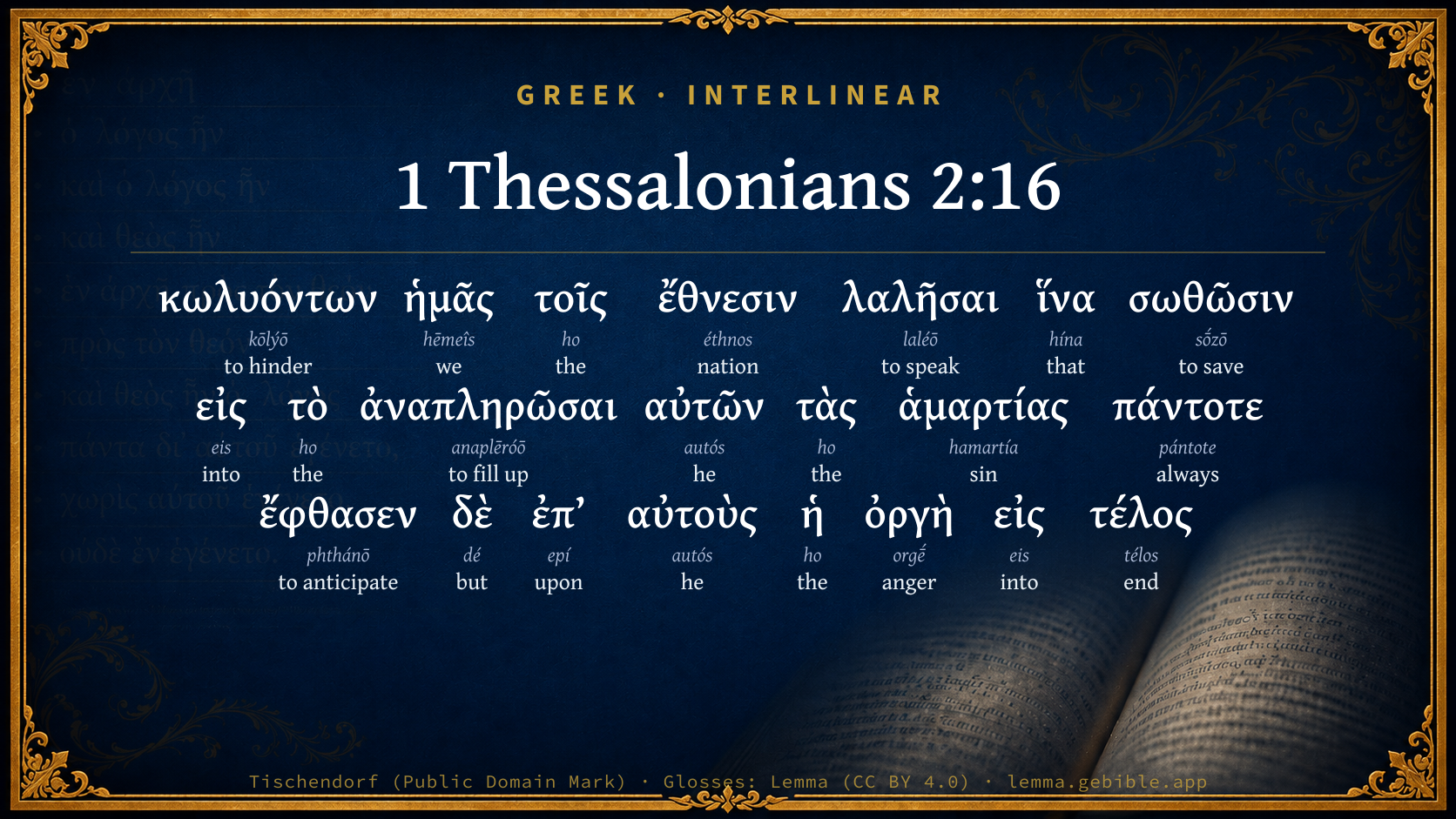
forbidding us to speak to the Gentiles that they may be saved; to fill up their sins always. But wrath has come on them to the uttermost.
Download a study sheet
One document with this verse’s original text, its word-by-word gloss line, the meaning frame, cross-references with their text, attributed commentary, and full source and license credits — printable, and it pastes into notes with its structure intact.
This verse Autodidact and up
A passage Seminary Student
Up to 50 verses in one chapter. A passage sheet keeps up to 6 commentary sources and 12 cross-references per verse, in the order this page ranks them, and says so on the sheet whenever that leaves anything out. Ask for a single verse and you get the Autodidact verse sheet above.
Everything on this page stays free to read, with no account — the sheet is a download of what is already on screen, not access to it.
Compare translations 3
The same verse in 3 English versions, stacked beneath the original-language interlinear above. Click any original word for its lexicon entry.
Each is an independent rendering of the whole verse — the interlinear is not word-aligned to these translations.
Highlighted words mark where these versions differ — a whole-verse word diff, not a word-by-word alignment.
-
World English Bible Public Domain
forbidding us to speak to the Gentiles that they may be saved; to fill up their sins always. But wrath has come on them to the uttermost.
-
King James Version Public Domain
Forbidding us to speak to the Gentiles that they might be saved, to fill up their sins alway: for the wrath is come upon them to the uttermost.
-
unfoldingWord Literal Text CC BY-SA 4.0
forbidding us to speak to the Gentiles so that they might be saved, so that always fill up their sins. But the wrath has come upon them to the end.
unfoldingWord Literal Text — © unfoldingWord, licensed CC BY-SA 4.0. Word-aligned USFM3 via Door43 (git.door43.org/unfoldingWord/en_ult).
Show all 19 translations
Every available English version of this verse, each an independent rendering of the whole verse.
-
World English Bible Public Domain
forbidding us to speak to the Gentiles that they may be saved; to fill up their sins always. But wrath has come on them to the uttermost.
-
Berean Standard Bible Public Domain
hindering us from telling the Gentiles how they may be saved. As a result, they continue to heap up their sins to full capacity; the utmost wrath has come upon them.
-
Majority Standard Bible Public Domain
hindering us from telling the Gentiles how they may be saved. As a result, they continue to heap up their sins to full capacity; the utmost wrath has come upon them.
-
King James Version Public Domain
Forbidding us to speak to the Gentiles that they might be saved, to fill up their sins alway: for the wrath is come upon them to the uttermost.
-
American Standard Version (1901) Public Domain
forbidding us to speak to the Gentiles that they may be saved; to fill up their sins always: but the wrath is come upon them to the uttermost.
-
Revised Version (1885) Public Domain
forbidding us to speak to the Gentiles that they may be saved; to fill up their sins alway: but the wrath is come upon them to the uttermost.
-
Geneva Bible (1599) Public Domain
And forbid vs to preach vnto the Gentiles, that they might be saued, to fulfill their sinnes alwayes: for the wrath of God is come on them, to the vtmost.
-
Douay-Rheims (1899) Public Domain
Prohibiting us to speak to the Gentiles, that they may be saved, to fill up their sins always: for the wrath of God is come upon them to the end.
-
Young's Literal Translation Public Domain
forbidding us to speak to the nations that they might be saved, to fill up their sins always, but the anger did come upon them -- to the end!
-
Literal Standard Version CC BY-SA 4.0
forbidding us to speak to the nations that they might be saved, so as to always fill up their sins, but [God’s] anger came on them—to the end!
-
Unlocked Literal Bible CC BY-SA 4.0
They forbid us to speak to the Gentiles for them to be saved. The result is that they always fill up their own sins. Wrath must come on them in the end.
-
unfoldingWord Literal Text CC BY-SA 4.0
forbidding us to speak to the Gentiles so that they might be saved, so that always fill up their sins. But the wrath has come upon them to the end.
-
Darby Bible Public Domain
forbidding us to speak to the nations that they may be saved, that they may fill up their sins always: but wrath has come upon them to the uttermost.
-
World Messianic Bible Public Domain
forbidding us to speak to the Gentiles that they may be saved, to fill up their sins always. But wrath has come on them to the uttermost.
-
Webster's Bible Public Domain
Forbidding us to speak to the Gentiles that they may be saved, to fill up their sins always: for the wrath is come upon them to the uttermost.
-
Free Bible Version CC BY-SA 4.0
trying to prevent us from speaking to the other nations to prevent them from being saved. They're always sinning to the maximum extent, but for them full judgment has arrived!
-
Bible in Basic English Public Domain
Who, to make the measure of their sins complete, kept us from giving the word of salvation to the Gentiles: but the wrath of God is about to come on them in the fullest degree.
-
Text-Critical English NT CC BY 4.0
by hindering us from telling the Gentiles how they can be saved. In this way they are always filling up the measure of their sins, but wrath has come upon them at last.
-
Tyndale New Testament (1534) Public Domain
and forbid vs to preache vnto the gentyls that they myght be saved to fulfill their synnes all waye. For the wrath of God is come on them even to the vtmost.
Literal Standard Version (2020), Covenant Press — licensed CC BY-SA 4.0. Text via the HelloAO Bible API (eBible.org). Unlocked Literal Bible (unfoldingWord) — licensed CC BY-SA 4.0. Text via the HelloAO Bible API (eBible.org). unfoldingWord Literal Text — © unfoldingWord, licensed CC BY-SA 4.0. Word-aligned USFM3 via Door43 (git.door43.org/unfoldingWord/en_ult). Free Bible Version, Dr. Jonathan Gallagher — licensed CC BY-SA 4.0. Text via the HelloAO Bible API (eBible.org).
Word by word
More ways to search: Search by grammar → Find every occurrence → Compare this word →
Practice this passage: Drill this verse → Learn its vocabulary →
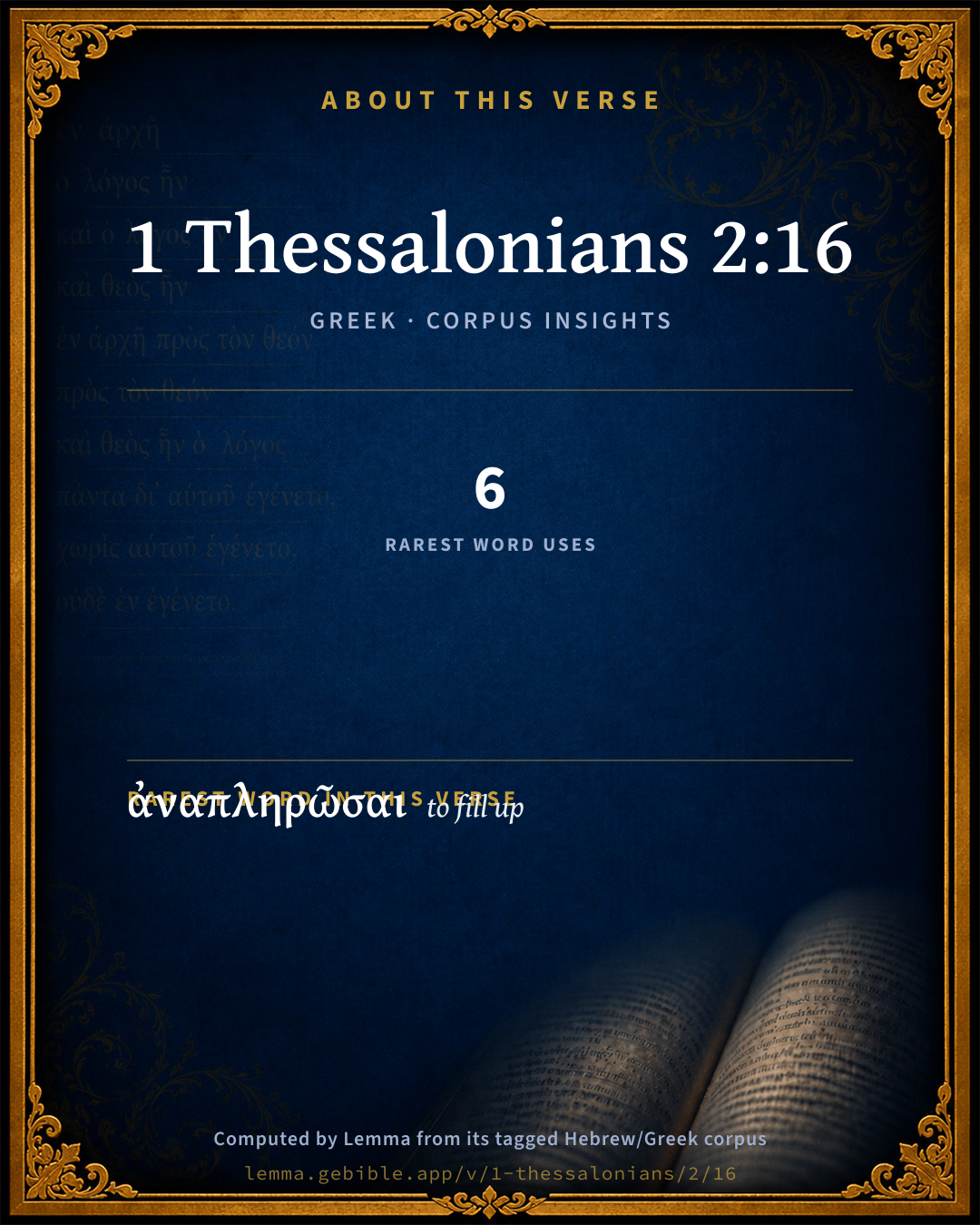
- Appears 6× in the Greek New Testament
- First appears at Matthew 13:14
- Part of Speech
- Verb
- Tense
- Aorist
- Voice
- Active
- Mood
- Infinitive
Full Thayer's Definition
- κωλυόντων kōlýō G2967 “to hinder” Verb, Present, Active, Participle, Genitive, Plural, Masculine
- ἡμᾶς hēmeîs G2249 “we” Personal pronoun, 1st person, Accusative, Plural
- τοῖς ho G3588 “the” Article, Dative, Plural, Neuter
- ἔθνεσιν éthnos G1484 “nation” Noun, Dative, Plural, Neuter
- λαλῆσαι laléō G2980 “to speak” Verb, Aorist, Active, Infinitive
- ἵνα hína G2443 “that” Conjunction
- σωθῶσιν sṓzō G4982 “to save” Verb, Aorist, Passive, Subjunctive, 3rd person, Plural
- εἰς eis G1519 “into” Preposition
- τὸ ho G3588 “the” Article, Accusative, Singular, Neuter
- ἀναπληρῶσαι anaplēróō G378 “to fill up” Verb, Aorist, Active, Infinitive
- αὐτῶν autós G846 “he” Personal pronoun, Genitive, Plural, Masculine
- τὰς ho G3588 “the” Article, Accusative, Plural, Feminine
- ἁμαρτίας hamartía G266 “sin” Noun, Accusative, Plural, Feminine
- πάντοτε pántote G3842 “always” Adverb
- ἔφθασεν phthánō G5348 “to anticipate” Verb, Aorist, Active, Indicative, 3rd person, Singular
- δὲ dé G1161 “but” Conjunction
- ἐπ’ epí G1909 “upon” Preposition
- αὐτοὺς autós G846 “he” Personal pronoun, Accusative, Plural, Masculine
- ἡ ho G3588 “the” Article, Nominative, Singular, Feminine
- ὀργὴ orgḗ G3709 “anger” Noun, Nominative, Singular, Feminine
- εἰς eis G1519 “into” Preposition
- τέλος télos G5056 “end” Noun, Accusative, Singular, Neuter
About this verse
These counts appear in no published source. They are computed here, from the morphology-tagged text and Lemma’s own curated glosses. What Lemma adds →
- 22
- words
- 17
- distinct lemmas
- Pauline Epistles
- section
Cross-references
44Topical passages linked to 1 Thessalonians 2:16 in the Treasury of Scripture Knowledge — connected by theme and wording, ordered by reader-vote popularity; previews shown in the World English Bible.
- Acts 17:13 But when the Jews of Thessalonica had knowledge that the word of God was proclaimed by Paul at Beroea also, they came there likewise, agitating the multitudes.
- Acts 14:19 But some Jews from Antioch and Iconium came there, and having persuaded the multitudes, they stoned Paul, and dragged him out of the city, supposing that he was dead.
- Malachi 4:1 "For, behold, the day comes, it burns as a furnace; and all the proud, and all who work wickedness, will be stubble; and the day that comes will burn them up," says Yahweh of Hosts, "that it shall leave them neither root nor branch.
- Matthew 23:32 Fill up, then, the measure of your fathers.
- Mark 16:16 He who believes and is baptized will be saved; but he who disbelieves will be condemned.
- Acts 14:5 When some of both the Gentiles and the Jews, with their rulers, made a violent attempt to mistreat and stone them,
- Matthew 21:41–44 They told him, "He will miserably destroy those miserable men, and will lease out the vineyard to other farmers, who will give him the fruit in its season."
- Acts 13:50 But the Jews stirred up the devout and prominent women and the chief men of the city, and stirred up a persecution against Paul and Barnabas, and threw them out of their borders.
- Acts 22:21–22 "He said to me, 'Depart, for I will send you out far from here to the Gentiles.'"
- Galatians 5:11 But I, brothers, if I still preach circumcision, why am I still persecuted? Then the stumbling-block of the cross has been removed.
- 2 Thessalonians 2:10 and with all deception of wickedness for those who are being lost, because they didn't receive the love of the truth, that they might be saved.
- James 5:1–6 Come now, you rich, weep and howl for your miseries that are coming on you.
- Genesis 15:16 In the fourth generation they will come here again, for the iniquity of the Amorite is not yet full."
- Malachi 4:5 Behold, I will send you Elijah the prophet before the great and terrible day of Yahweh comes.
- Matthew 3:7–10 But when he saw many of the Pharisees and Sadducees coming for his baptism, he said to them, "You offspring of vipers, who warned you to flee from the wrath to come?
- Matthew 3:12 His winnowing fork is in his hand, and he will thoroughly cleanse his threshing floor. He will gather his wheat into the barn, but the chaff he will burn up with unquenchable fire."
- Matthew 12:45 Then he goes, and takes with himself seven other spirits more evil than he is, and they enter in and dwell there. The last state of that man becomes worse than the first. Even so will it be also to this evil generation."
- Luke 11:50–51 that the blood of all the prophets, which was shed from the foundation of the world, may be required of this generation;
- Acts 13:45 But when the Jews saw the multitudes, they were filled with jealousy, and contradicted the things which were spoken by Paul, and blasphemed.
- Acts 18:12–13 But when Gallio was proconsul of Achaia, the Jews with one accord rose up against Paul and brought him before the judgment seat,
- 1 Timothy 2:4 who desires all people to be saved and come to full knowledge of the truth.
- Isaiah 45:22 Look to me, and be you saved, all the ends of the earth; for I am God, and there is none else.
- Joel 2:30–31 I will show wonders in the heavens and in the earth: Blood, fire, and pillars of smoke.
- Zechariah 5:6–8 I said, "What is it?" He said, "This is the ephah basket that is appearing." He said moreover, "This is their appearance in all the land
- Matthew 22:6–7 and the rest grabbed his servants, and treated them shamefully, and killed them.
- Matthew 24:6 You will hear of wars and rumors of wars. See that you aren't troubled, for all this must happen, but the end is not yet.
- Matthew 24:14 This Gospel of the Kingdom will be preached in the whole world for a testimony to all the nations, and then the end will come.
- Matthew 24:21–22 for then there will be great oppression, such as has not been from the beginning of the world until now, no, nor ever will be.
- Luke 19:42–44 saying, "If you, even you, had known today the things which belong to your peace! But now, they are hidden from your eyes.
- Luke 21:20–24 "But when you see Jerusalem surrounded by armies, then know that its desolation is at hand.
- Acts 4:12 There is salvation in none other, for neither is there any other name under heaven, that is given among men, by which we must be saved!"
- Acts 11:2–3 When Peter had come up to Jerusalem, those who were of the circumcision contended with him,
- Acts 14:2 But the disbelieving Jews stirred up and embittered the souls of the Gentiles against the brothers.
- Acts 19:9 But when some were hardened and disobedient, speaking evil of the Way before the multitude, he departed from them, and separated the disciples, reasoning daily in the school of Tyrannus.
- Acts 21:27–31 When the seven days were almost completed, the Jews from Asia, when they saw him in the temple, stirred up all the multitude and laid hands on him,
- Romans 10:13–15 For, "Whoever will call on the name of the Lord will be saved."
- Ephesians 3:8 To me, the very least of all saints, was this grace given, to preach to the Gentiles the unsearchable riches of Christ,
- Ephesians 3:13 Therefore I ask that you may not lose heart at my troubles for you, which are your glory.
- 1 Thessalonians 1:10 and to wait for his Son from heaven, whom he raised from the dead-- Jesus, who delivers us from the wrath to come.
- Hebrews 6:8 but if it bears thorns and thistles, it is rejected and near being cursed, whose end is to be burned.
- Hebrews 10:27–30 but a certain fearful expectation of judgment, and a fierceness of fire which will devour the adversaries.
- Revelation 22:11 He who acts unjustly, let him act unjustly still. He who is filthy, let him be filthy still. He who is righteous, let him do righteousness still. He who is holy, let him be holy still."
- Acts 11:17–18 If then God gave to them the same gift as us, when we believed in the Lord Jesus Christ, who was I, that I could withstand God?"
- Acts 17:5–6 But the unpersuaded Jews took along some wicked men from the marketplace, and gathering a crowd, set the city in an uproar. Assaulting the house of Jason, they sought to bring them out to the people.
Cross-references courtesy of OpenBible.info (CC BY 4.0).
Where the printed editions differ
1 variantPlaces in this verse where the major printed Greek editions disagree on the wording in a way that affects the translation — a comparison of editions, not a manuscript-by-manuscript collation. The editions are the modern critical texts (Nestlé-Aland 28/27, SBL, Westcott-Hort, Tregelles, Tyndale House) and the traditional texts behind the KJV (the Textus Receptus and the Byzantine/Majority text). It is not a claim about which reading is original.
-
Extra text
τοῦ θεοῦ
“of the God”
In NIV06 Not in NA28NA27TynSBLWHTregTRByzτοῦ θεοῦ (tou theou) 'of the God' is only in a few manuscripts (NIV+06)
Textual data: Translators Amalgamated Greek New Testament (STEPBible TAGNT) · CC BY 4.0.
Lesson kit
Teaching starters — assembled from the data on this page, not authored interpretation. Every prompt links to the verse data it draws on. Edit before teaching.
1 Thessalonians, in the Pauline Epistles, opens this verse with 22 words (17 distinct Greek lemmas). Its most distinctive word is anaplēróō (“to fill up”). A historical commentator’s framing appears above. Read the whole chapter for the surrounding context.
Discussion questions
- How does “to fill up” (anaplēróō) shape what this verse is saying?
- Matthew 13:14 shares the word «to fill up» with this verse. How do the two illuminate each other?
- “into” occurs 2× in this one verse. What is the effect of the repetition?
- These translations render this verse differently. What is at stake in choosing one wording over another?
- Reading how Tyndale Open Study Notes and Bengel's Gnomon read this verse, where do the two commentators agree and where do they part?
Things to notice
- These translations choose different wording for 8 words in this verse.
- “into” occurs 2× in this single verse.
- 17 distinct Greek lemmas span 22 words in this verse.
Commentary
Notes on 1 Thessalonians 2:16 from classic Christian and Jewish commentators (each source and its license shown beneath its notes). The classic Christian expositions comment on the surrounding passage and are grouped to its opening verse, so a note may address several verses; the Jewish commentaries on the Tanakh (Rashi and others) are per-verse, so they appear only where the commentator wrote on this verse.
Lemma curates 59 commentaries, every one of them public domain or Creative Commons licensed, each selected and text-cleaned for this edition rather than reprinted as found. About our sources →
Tyndale Open Study Notes
Tyndale Open Resources
Tyndale Open Study Notes — © Tyndale Open Resources, licensed CC BY-SA 4.0. Text via the HelloAO Bible API.
Bengel's Gnomon
Johann Albrecht Bengel
Bengel's Gnomon of the New Testament — English translation (T&T Clark, Edinburgh, 1860) — public domain. Text from a community e-Sword module.
Expositor's Greek Testament
ed. W. Robertson Nicoll
The Expositor's Greek Testament, edited by W. Robertson Nicoll (1897–1910) — public domain. Text from a community e-Sword module.
Geneva Bible (1599)
Geneva Bible translators
Geneva Bible (1599) marginal notes — public domain. Text via Bolls.life.
Jamieson, Fausset & Brown
Robert Jamieson, A. R. Fausset & David Brown
Jamieson, Fausset & Brown — Commentary Critical and Explanatory on the Whole Bible (1871) — public domain (CC PDM 1.0). Text via the HelloAO Bible API.
Adam Clarke's Commentary
Adam Clarke's Commentary on the Bible (1810–1826) — public domain. Text from a community e-Sword/MySword module.
John Calvin's Commentaries
John Calvin's Commentaries (1540-1563) — public domain. Text from the Calvin Translation Society English edition (1840s-50s) via the Christian Classics Ethereal Library (ccel.org). Calvin's coverage is partial (roughly two-thirds of the Bible); uncommented books and verses are honest gaps, never fabricated. The 19th-century editor's footnotes and remarks are omitted so the notes are faithfully Calvin's own voice.
Ellicott's Commentary for English Readers
A Bible Commentary for English Readers, edited by Charles John Ellicott (1878–1897) — public domain. Text from a community e-Sword module.
The Cambridge Bible for Schools and Colleges
gen. ed. J. J. S. Perowne
The Cambridge Bible for Schools and Colleges (gen. ed. J. J. S. Perowne; Cambridge University Press, 1878–1918) — public domain. Text from a community e-Sword module.
John Gill's Exposition
John Gill's Exposition of the Whole Bible (1746–1763) — public domain (CC PDM 1.0). Text via the HelloAO Bible API.
Trapp's Complete Commentary
John Trapp
John Trapp, A Commentary or Exposition upon All the Books of the Old and New Testament (1647–1656) — public domain. Text from a community e-Sword module.
Albert Barnes' Notes on the Bible
Albert Barnes' Notes on the Bible (1834–1885) — public domain. Text from a community e-Sword/MySword module.
Haydock's Catholic Bible Commentary
George Leo Haydock (1774–1849), Haydock's Catholic Family Bible and Commentary, 1859 edition — public domain. Excludes Psalms (Douay-Rheims chapter numbering differs from Protestant) and Deuterocanonical books (Catholic canon only).
Matthew Poole's English Annotations
Matthew Poole's English Annotations on the Holy Bible (1683–1685) — public domain. Text from a community e-Sword/MySword module.
Whedon's Commentary on the Bible
Daniel D. Whedon
Daniel D. Whedon (gen. ed.), Commentary on the Old and New Testaments (1874–1909) — public domain. Text from a community e-Sword module.
The Pulpit Commentary
The Pulpit Commentary (1880–1919), ed. H.D.M. Spence-Jones & Joseph S. Exell — public domain. Text from a community e-Sword module.
John Wesley's Explanatory Notes
John Wesley, Explanatory Notes Upon the Whole Bible (1754–1765) — public domain. Text via the GEBible commentary corpus.
Scofield Reference Notes
C. I. Scofield
The Scofield Reference Bible (1917 edition), notes by C. I. Scofield — public domain. Text from a community e-Sword module.
McGarvey & Pendleton's Commentaries
J. W. McGarvey
J. W. McGarvey (with Philip Y. Pendleton), Commentaries on the New Testament (The Fourfold Gospel, 1914; Acts; and the epistles) — public domain. Text from a community e-Sword/MySword module.
The People's New Testament
B. W. Johnson
B. W. Johnson's The People's New Testament with Notes (1889–1891) — public domain. Electronic text from the Christian Classics Ethereal Library (CCEL) ThML edition.
Cambridge Greek Testament for Schools and Colleges
Cambridge Greek Testament for Schools and Colleges (Cambridge University Press, 1896; 21 vols, various authors incl. Carr, Maclear, Plummer, Farrar, Lumby, Moule, M. R. James, Simcox) — public domain. Text from a community e-Sword module.
Alford’s Greek Testament
Henry Alford
Henry Alford, The Greek Testament (1849–1861) — public domain. Text from a community e-Sword module.
Vincent's Word Studies in the New Testament
Marvin R. Vincent
Marvin R. Vincent, Word Studies in the New Testament (1887–1900) — public domain. Text from a community e-Sword/MySword module.