Acts 10:35

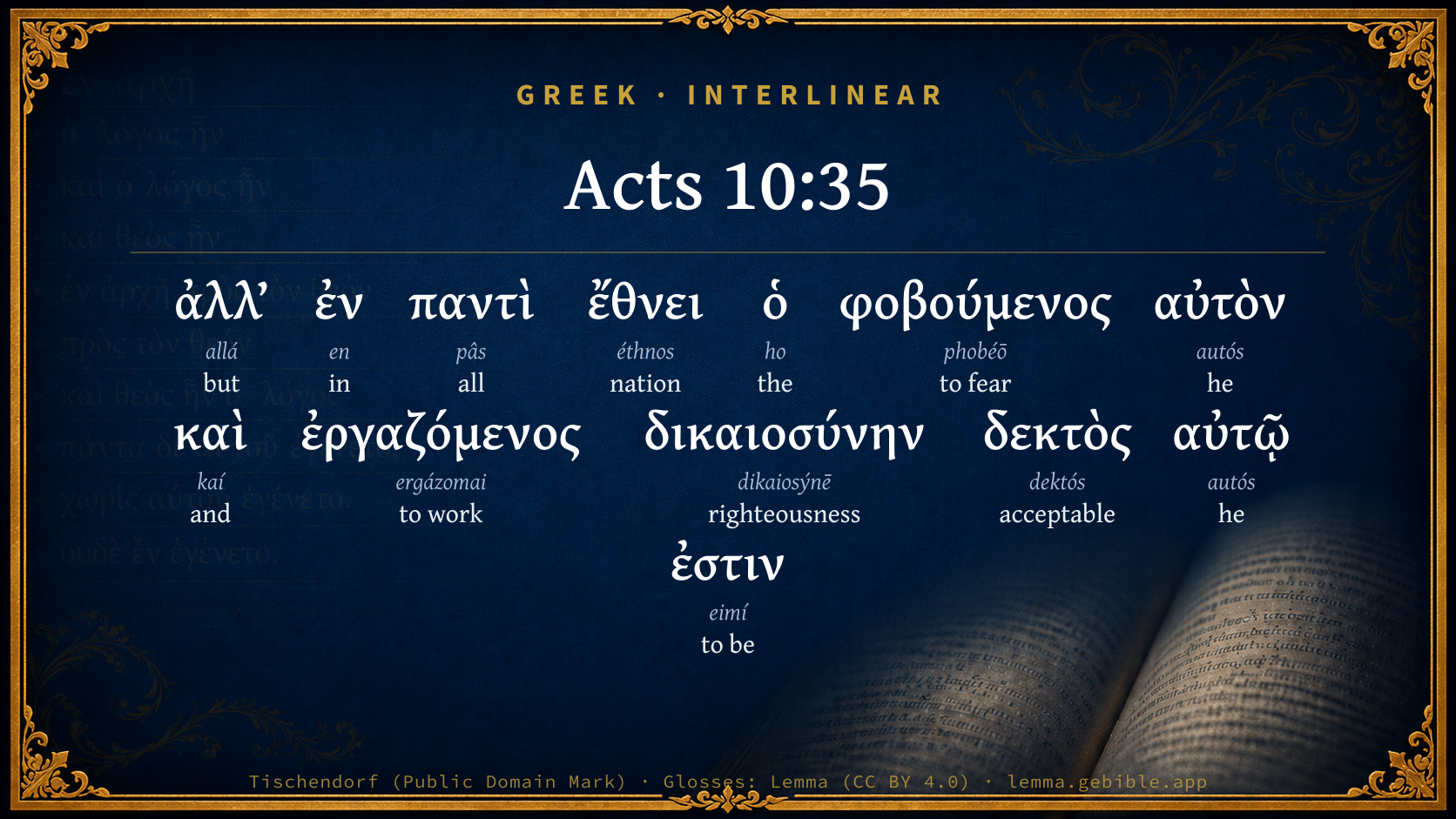
Greek (Tischendorf 8th ed.) Acts 10:35 appears in the Greek New Testament. The text above is from the Tischendorf 8th edition. Each word links to its Strong’s number and a concise gloss. Click any word for its full Thayer’s Greek Lexicon entry.
Download image
Cite this verse

Acts 10:35 (World English Bible). Public Domain. Lemma interlinear Bible study tool, https://lemma.gebible.app/v/acts/10/35.

Show BibTeX & RIS
BibTeX
RIS
English Translation
but in every nation he who fears him and works righteousness is acceptable to him.
World English Bible · Public Domain
Download a study sheet

One document with this verse’s original text, its word-by-word gloss line, the meaning frame, cross-references with their text, attributed commentary, and full source and license credits — printable, and it pastes into notes with its structure intact.

This verse Autodidact and up

Study sheet (.html) Plain text (.txt)

A passage Seminary Student

Up to 50 verses in one chapter. A passage sheet keeps up to 6 commentary sources and 12 cross-references per verse, in the order this page ranks them, and says so on the sheet whenever that leaves anything out. Ask for a single verse and you get the Autodidact verse sheet above.

Everything on this page stays free to read, with no account — the sheet is a download of what is already on screen, not access to it.

Want to remove ads? Support Godless Engineer
Compare translations 3

The same verse in 3 English versions, stacked beneath the original-language interlinear above. Click any original word for its lexicon entry.

Each is an independent rendering of the whole verse — the interlinear is not word-aligned to these translations.

Highlighted words mark where these versions differ — a whole-verse word diff, not a word-by-word alignment.

  • World English Bible Public Domain
    but in every nation he who fears him and works righteousness is acceptable to him.
  • King James Version Public Domain
    But in every nation he that feareth him, and worketh righteousness, is accepted with him.
  • unfoldingWord Literal Text CC BY-SA 4.0
    Instead, in every nation the one fearing him and working righteousness is acceptable to him.

unfoldingWord Literal Text — © unfoldingWord, licensed CC BY-SA 4.0. Word-aligned USFM3 via Door43 (git.door43.org/unfoldingWord/en_ult).

Versions to compare (up to 4)

3 of 4 selected

Show all 19 translations

Every available English version of this verse, each an independent rendering of the whole verse.

  • World English Bible Public Domain
    but in every nation he who fears him and works righteousness is acceptable to him.
  • Berean Standard Bible Public Domain
    but welcomes those from every nation who fear Him and do what is right.
  • Majority Standard Bible Public Domain
    but welcomes those from every nation who fear Him and do what is right.
  • King James Version Public Domain
    But in every nation he that feareth him, and worketh righteousness, is accepted with him.
  • American Standard Version (1901) Public Domain
    but in every nation he that feareth him, and worketh righteousness, is acceptable to him.
  • Revised Version (1885) Public Domain
    but in every nation he that feareth him, and worketh righteousness, is acceptable to him.
  • Geneva Bible (1599) Public Domain
    But in euery nation he that feareth him, and worketh righteousnesse, is accepted with him.
  • Douay-Rheims (1899) Public Domain
    But in every nation, he that feareth him, and worketh justice, is acceptable to him.
  • Young's Literal Translation Public Domain
    but in every nation he who is fearing Him, and is working righteousness, is acceptable to Him;
  • Literal Standard Version CC BY-SA 4.0
    but in every nation he who is fearing Him, and is working righteousness, is acceptable to Him;
  • Unlocked Literal Bible CC BY-SA 4.0
    Instead, in every nation anyone who worships and does righteous deeds is acceptable to him.
  • unfoldingWord Literal Text CC BY-SA 4.0
    Instead, in every nation the one fearing him and working righteousness is acceptable to him.
  • Darby Bible Public Domain
    but in every nation he that fears him and works righteousness is acceptable to him.
  • World Messianic Bible Public Domain
    but in every nation he who fears him and works righteousness is acceptable to him.
  • Webster's Bible Public Domain
    But in every nation he that feareth him, and worketh righteousness, is accepted with him.
  • Free Bible Version CC BY-SA 4.0
    In every nation God accepts those who respect him, and do what is good and right.
  • Bible in Basic English Public Domain
    But in every nation, the man who has fear of him and does righteousness is pleasing to him.
  • Text-Critical English NT CC BY 4.0
    but in every nation anyone who fears him and does what is right is acceptable to him.
  • Tyndale New Testament (1534) Public Domain
    but in all people he that feareth him and worketh rightewesnes is accepted with him.

Literal Standard Version (2020), Covenant Press — licensed CC BY-SA 4.0. Text via the HelloAO Bible API (eBible.org). Unlocked Literal Bible (unfoldingWord) — licensed CC BY-SA 4.0. Text via the HelloAO Bible API (eBible.org). unfoldingWord Literal Text — © unfoldingWord, licensed CC BY-SA 4.0. Word-aligned USFM3 via Door43 (git.door43.org/unfoldingWord/en_ult). Free Bible Version, Dr. Jonathan Gallagher — licensed CC BY-SA 4.0. Text via the HelloAO Bible API (eBible.org).

Word by word

More ways to search: Search by grammar → Find every occurrence → Compare this word →

Practice this passage: Drill this verse → Learn its vocabulary →

δεκτὸς
dektós
G1184
“acceptable”
Adjective, Nominative, Singular, Masculine
Part of Speech
Adjective
Case
Nominative
Number
Singular
Gender
Masculine
Full Thayer's Definition

Origin: from G1209

TDNT: 02:58,1

1. accepted, acceptable
  1. ἀλλ’ allá G235 “but” Conjunction
  2. ἐν en G1722 “in” Preposition
  3. παντὶ pâs G3956 “all” Adjective, Dative, Singular, Neuter
  4. ἔθνει éthnos G1484 “nation” Noun, Dative, Singular, Neuter
  5. ὁ ho G3588 “the” Article, Nominative, Singular, Masculine
  6. φοβούμενος phobéō G5399 “to fear” Verb, Present, Middle or Passive deponent, Participle, Nominative, Singular, Masculine
  7. αὐτὸν autós G846 “he” Personal pronoun, Accusative, Singular, Masculine
  8. καὶ kaí G2532 “and” Conjunction
  9. ἐργαζόμενος ergázomai G2038 “to work” Verb, Present, Middle or Passive deponent, Participle, Nominative, Singular, Masculine
  10. δικαιοσύνην dikaiosýnē G1343 “righteousness” Noun, Accusative, Singular, Feminine
  11. αὐτῷ autós G846 “he” Personal pronoun, Dative, Singular, Masculine
  12. ἐστιν eimí G1510 “to be” Verb, Present, Active, Indicative, 3rd person, Singular

About this verse

These counts appear in no published source. They are computed here, from the morphology-tagged text and Lemma’s own curated glosses. What Lemma adds →

13
words
12
distinct lemmas
Acts
section

Notable vocabulary

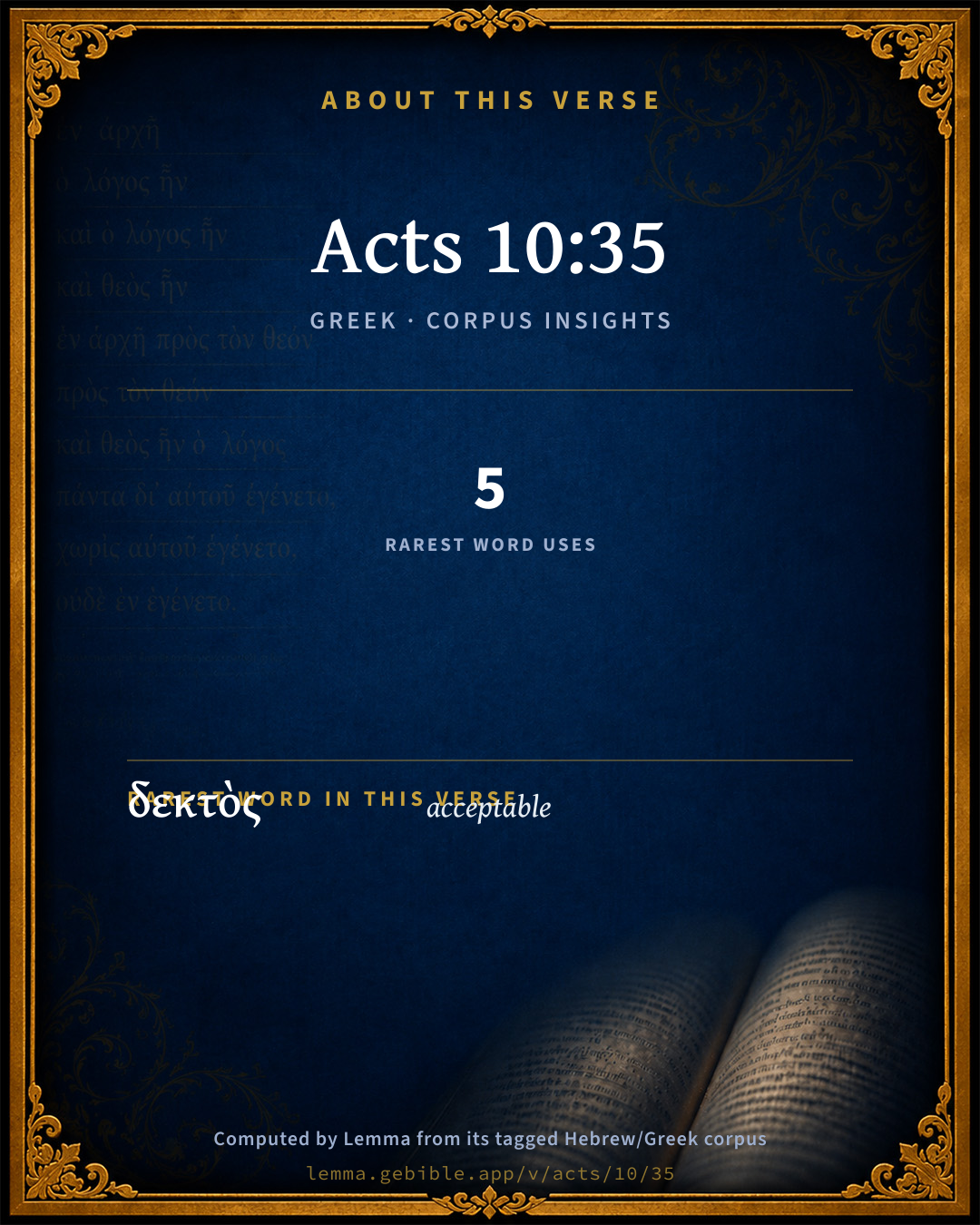
The rarest word here is δεκτὸς acceptable G1184 — appearing just 5 times in the whole Greek New Testament.

Shared distinctive vocabulary

δεκτὸς acceptable G1184 occurs in 5 verses of the Greek New Testament. Also found in:

Repetition

A word recurs within this verse:

  • αὐτὸν he G846 ×2

Cross-references

34

Topical passages linked to Acts 10:35 in the Treasury of Scripture Knowledge — connected by theme and wording, ordered by reader-vote popularity; previews shown in the World English Bible.

  • 1 John 2:29 If you know that he is righteous, you know that everyone who practices righteousness is born of him.
  • Acts 10:2 a devout man, and one who feared God with all his house, who gave gifts for the needy generously to the people, and always prayed to God.
  • Romans 10:12–13 For there is no distinction between Jew and Greek; for the same Lord is Lord of all, and is rich to all who call on him.
  • Acts 15:9 He made no distinction between us and them, cleansing their hearts by faith.
  • Colossians 3:11 where there can't be Greek and Jew, circumcision and uncircumcision, barbarian, Scythian, bondservant, freeman; but Christ is all, and in all.
  • Ecclesiastes 12:13 This is the end of the matter. All has been heard. Fear God, and keep his commandments; for this is the whole duty of man.
  • Isaiah 56:3–8 Neither let the foreigner, who has joined himself to Yahweh, speak, saying, Yahweh will surely separate me from his people; neither let the eunuch say, Behold, I am a dry tree.
  • 2 Corinthians 7:1 Having therefore these promises, beloved, let us cleanse ourselves from all defilement of flesh and spirit, perfecting holiness in the fear of God.
  • Psalms 85:9 Surely his salvation is near those who fear him, That glory may dwell in our land.
  • Proverbs 1:7 The fear of Yahweh is the beginning of knowledge; But the foolish despise wisdom and instruction.
  • Proverbs 16:6 By mercy and truth iniquity is atoned for. By the fear of Yahweh men depart from evil.
  • Hebrews 11:4–6 By faith, Abel offered to God a more excellent sacrifice than Cain, through which he had testimony given to him that he was righteous, God bearing witness with respect to his gifts; and through it he, being dead, still speaks.
  • Psalms 111:10 The fear of Yahweh is the beginning of wisdom. All those who do his work have a good understanding. His praise endures forever!
  • Acts 9:31 So the assemblies throughout all Judea and Galilee and Samaria had peace, and were built up. They were multiplied, walking in the fear of the Lord and in the comfort of the Holy Spirit.
  • Romans 3:29–30 Or is God the God of Jews only? Isn't he the God of Gentiles also? Yes, of Gentiles also,
  • Galatians 3:28 There is neither Jew nor Greek, there is neither slave nor free man, there is neither male nor female; for you are all one in Christ Jesus.
  • Ephesians 5:21 subjecting yourselves one to another in the fear of Christ.
  • Colossians 1:6 which has come to you; even as it is in all the world and is bearing fruit and growing, as it does in you also, since the day you heard and knew the grace of God in truth;
  • Colossians 1:23–27 if it is so that you continue in the faith, grounded and steadfast, and not moved away from the hope of the Gospel which you heard, which is being proclaimed in all creation under heaven; of which I, Paul, was made a servant.
  • Job 28:28 To man he said, 'Behold, the fear of the Lord, that is wisdom. To depart from evil is understanding.'"
  • Proverbs 2:5 Then you will understand the fear of Yahweh, And find the knowledge of God.
  • Proverbs 3:7 Don't be wise in your own eyes. Fear Yahweh, and depart from evil.
  • Hosea 8:13 As for the sacrifices of my offerings, they sacrifice flesh and eat it; But Yahweh doesn't accept them. Now he will remember their iniquity, And punish their sins. They will return to Egypt.
  • Luke 1:28 Having come in, the angel said to her, "Rejoice, you highly favored one! The Lord is with you. Blessed are you among women!"
  • Romans 2:13 For it isn't the hearers of the law who are righteous before God, but the doers of the law will be justified
  • Romans 2:25–29 For circumcision indeed profits, if you are a doer of the law, but if you are a transgressor of the law, your circumcision has become uncircumcision.
  • Romans 3:22 even the righteousness of God through faith in Jesus Christ to all and on all those who believe. For there is no distinction,
  • 1 Corinthians 12:13 For in one Spirit we were all baptized into one body, whether Jews or Greeks, whether bond or free; and were all given to drink into one Spirit.
  • Ephesians 1:6 to the praise of the glory of his grace, by which he freely bestowed favor on us in the Beloved,
  • Ephesians 2:13–18 But now in Christ Jesus you who once were far off are made near in the blood of Christ.
  • Ephesians 3:6–8 that the Gentiles are fellow heirs, and fellow members of the body, and fellow partakers of his promise in Christ Jesus through the Gospel,
  • Psalms 19:9 The fear of Yahweh is clean, enduring forever. Yahweh's ordinances are true, and righteous altogether.
  • Philippians 3:3 For we are the circumcision, who worship God in the Spirit, and rejoice in Christ Jesus, and have no confidence in the flesh;
  • Genesis 4:5–7 but he didn't respect Cain and his offering. Cain was very angry, and the expression on his face fell.

Cross-references courtesy of OpenBible.info (CC BY 4.0).

Commentary

Notes on Acts 10:35 from classic Christian and Jewish commentators (each source and its license shown beneath its notes). The classic Christian expositions comment on the surrounding passage and are grouped to its opening verse, so a note may address several verses; the Jewish commentaries on the Tanakh (Rashi and others) are per-verse, so they appear only where the commentator wrote on this verse.

Lemma curates 59 commentaries, every one of them public domain or Creative Commons licensed, each selected and text-cleaned for this edition rather than reprinted as found. About our sources →

Bengel's Gnomon

Johann Albrecht Bengel

Act 10:35. Ἐν παντὶ ἔθνει, in every nation) It is not an indifferentism of religions, but an indifferency (impartiality) as to the acceptance of nations, that is here asserted. This is even evident from the contrary opinion, viz. that as to the circumcised only being pleasing to GOD; the opinion which Peter confesses himself delivered from. Cornelius had not been utterly ignorant of the doctrine as to the Christ, and the report concerning Jesus Christ (following verses), although he had not received circumcision; GOD so ordering it in His providence. Wherefore Peter speaks with him very differently from the way in which Paul afterwards dealt with idolaters, as the Gospel advanced onwards to more remote nations. See ch. 14 and 17. Hence also in Act 10:43 he appeals generally to the prophets: which Paul, in the passages referred to, did not: nor does he, however, as he is wont everywhere to do in addressing the Jews, specially quote the testimony of the prophets.—ὁ φοβούμενος αὐτὸν καὶ ἐργαζόμενος δικαιοσύνην, he that feareth Him and worketh righteousness) According to the measure (standard) of primitive knowledge derived from the light of nature, and (or) rather from the revealed word. An indefinite description, suited to the matter in hand and its commencement (the exordium of his speech). Such men in various grades are elegantly described: for instance, ch. Act 17:4; Act 17:11-12.—αὐτὸν, Him) the true God.—δεκτὸς, acceptable) one to whom grace may be vouchsafed, even without circumcision. The verb λαβεῖν, to take (“out of the Gentiles a people for His name”), corresponds to this, ch. Act 15:14, where this very passage is had in view.

Bengel's Gnomon of the New Testament — English translation (T&T Clark, Edinburgh, 1860) — public domain. Text from a community e-Sword module.

Expositor's Greek Testament

ed. W. Robertson Nicoll

Act 10:35 . ἀλλʼ ἐν παντὶ ἔθνει κ . τ . λ . The words are taken by Ramsay to mean that Cornelius was regarded as a proselyte by Peter, and that only on that condition could he be admitted to the Christian Church, i.e. , through Judaism; so apparently St. Paul , pp. 42, 43. On the other hand the general expression ἐργαζ . δικαι . inclines Weiss to refer all the words to the piety attainable by a heathen, who need not be a proselyte. Bengel’s words should always be borne in mind: “non indifferentissimus religionum sed indifferentia nationum hic asseritur,” see also below, and Knabenbauer, p. 193. δεκτὸς : “acceptable to him,” R.V., and this is best, because it better expresses the thought that fearing God and working righteousness place a man in a state preparatory for the salvation received through Christ, a reception no longer conditioned by nationality, but by the disposition of the heart. St. Peter does not speak of each and every religion, but of each and every nation, and Act 10:43 plainly shows that he by no means loses sight of the higher blessedness of the man whose sin is forgiven through conscious belief in Christ; cf. the language of St Paul, Rom 10:9-14 . δεκτὸς only in Luke and Paul in N.T., in LXX frequently, and once in the recently discovered Sayings of Jesus , No. 6, which agrees remarkably with St.Luk 4:24 .

The Expositor's Greek Testament, edited by W. Robertson Nicoll (1897–1910) — public domain. Text from a community e-Sword module.

Geneva Bible (1599)

Geneva Bible translators

By the fear of God, the Hebrews understand the whole service of God: whereby we perceive that Cornelius was not void of faith, no more than they were which lived before Christ’s time: and therefore they deal foolishly, which build preparative works and free will upon this place.

Geneva Bible (1599) marginal notes — public domain. Text via Bolls.life.

Jamieson, Fausset & Brown

Robert Jamieson, A. R. Fausset & David Brown

But in every nation--not (observe), in every religion; according to a common distortion of these words.

he that feareth him, and worketh righteousness--This being the well-known phraseology of the Old Testament in describing the truly godly man, within the pale of revealed religion, it cannot be alleged that Peter meant it to denote a merely virtuous character, in the heathen sense; and as Peter had learned enough, from the messengers of Cornelius and from his own lips, to convince him that the whole religious character of this Roman officer had been moulded in the Jewish faith, there can be no doubt that the apostle intended to describe exactly such saintship--in its internal spirituality and external fruitfulness--as God had already pronounced to be genuine and approved. And since to such "He giveth more grace," according to the law of His Kingdom (Jam 4:6; Mat 25:29), He sends Peter, not to be the instrument of his conversion, as this is very frequently called, but simply to "show him the way of God more perfectly," as before to the devout Ethiopian eunuch.

Jamieson, Fausset & Brown — Commentary Critical and Explanatory on the Whole Bible (1871) — public domain (CC PDM 1.0). Text via the HelloAO Bible API.

Adam Clarke's Commentary

Verse 35. But in every nation he that feared him, c.] In every nation he who, according to his light and privileges, fears God, worships him alone, (for this is the true meaning of the word,) and worketh righteousness, abstains from all evil, gives to all their due, injures neither the body, soul, nor reputation of his neighbour, is accepted with him. It is not therefore the nation, kindred, profession, mode or form of worship, that the just God regards but the character, the state of heart, and the moral deportment. For what are professions, c., in the sight of that God who trieth spirits, and by whom actions are weighed! He looks for the grace he has given, the advantages he has afforded, and the improvement of all these. Let it be observed farther, that no man can be accepted with this just God who does not live up to the advantages of the state in which providence has placed him. Why was Cornelius accepted with God while thousands of his countrymen were passed by? Because he did not receive the grace of God in vain he watched, fasted, prayed, and gave alms, which they did not. Had he not done so, would he have been accepted? Certainly not; because it would then appear that he had received the grace of God in vain, and had not been a worker together with him. Many irreligious men, in order to get rid of the duties and obligations of Christianity, quote this verse in their own favour, while they reject all the Gospel besides; and roundly assert, as they think on the authority of this text, that they need neither believe in Jesus Christ, attend to his Gospel, nor use his ordinances; for, if they fear God and work righteousness, they shall be infallibly accepted with him. Let such know that if they had been born and still were living in a land where the light of the Gospel had never shone, and were there conscientiously following the glimmering ray of celestial light which God had granted, they might, with some show of reason, speak in this way; but, as they are born and live under the Gospel of Jesus Christ, God, the just Judge, will require that they fear him, and work righteousness, ACCORDING to the LIGHT afforded by that very GOSPEL. The sincerity, watching, praying, fastings and alms-giving of Cornelius will not be sufficient for them who, as it may be justly said, live in splendours of Christianity. In such a state, God requires that a man shall love him with all his heart, soul, mind, and strength; and his neighbour as himself. In the face of such a requisition as this, how will the poor heathen virtue of one born in the pale of Christianity appear? And if God requires all this, will not a man need all the grace that has been brought to light by the revelation of Jesus Christ to enable him to do it?

Adam Clarke's Commentary on the Bible (1810–1826) — public domain. Text from a community e-Sword/MySword module.

John Calvin's Commentaries

35. He which feareth God, and doth righteousness. In these two members is comprehended the integrity of all the whole life. For the fear of God is nothing else but godliness and religion; and righteousness is that equity which men use among themselves, taking heed lest they hurt any man, and studying to do good to all men. As the law of God consisteth upon [of] these two parts, (which is the rule of good life) so no man shall prove himself to God but he which shall refer and direct all his actions to this end, neither shall there be any sound thing in all offices, [duties,] unless the whole life be grounded in the fear of God. But it seemeth that this place doth attribute the cause of salvation unto the merits of works. For if works purchase favor for us with God, they do also win life for us which is placed in the love of God towards us. Some do also catch at the word righteousness, that they may prove that we are not justified freely by faith, but by works. But this latter thing is too frivolous. For I have already showed that it is not taken for the perfect and whole observing of the law, but is restrained unto the second table and the offices of love. Therefore it is not the universal righteousness whereby a man is judged just before God, but that honesty and innocency which respecteth men, when as that is given to every man which is his.

Therefore the question remaineth as yet, whether works win the favor of God for us? which that we may answer, we must first note that there is a double respect of God in loving men. For seeing we be born the children of wrath, (Ephesians 2:3,) God shall be so far from finding any thing in us which is worthy of his love, that all our whole nature causeth him rather to hate us; in which respect, Paul saith that all men are enemies to him until they be reconciled by Christ, (Romans 5:10.) Therefore the first accepting of God, whereby he receiveth us into favor, is altogether free; for there can as yet no respect of works be had, seeing all things are corrupt and wicked, and taste of [bespeak] their beginning. Now, whom God hath adopted to be his children, them doth he also regenerate by his Spirit, and reform in them his image: whence riseth that second respect. For God doth not find man bare and naked then, and void of all grace, but he knoweth his own work in him, yea, himself. Therefore, God accepteth the faithful, because they live godly and justly. And we do not deny that God accepteth the good works of the saints; but this is another question, whether man prevent the grace of God with his merits or no, and insinuate himself into his love, or whether he be beloved at the beginning, freely and without respect of works, forasmuch as he is worthy of nothing else but of hatred. Furthermore, forasmuch as man, left to his own nature, can bring nothing but matter of hatred, he must needs confess that he is truly beloved; whereupon, it followeth that God is to himself the cause that he loveth us, and that he is provoked [actuated] with his own mercy, and not with our merits. Secondly, we must note, that although the faithful please God after regeneration with good works, and their respects of works, yet that is not done with the merit of works. For the cleanliness of works is never so exact that they can please God without pardon; yea, forasmuch as they have always some corruption mixed with them, they are worthy to be refused. Therefore, the worthiness of the works doth not cause them to be had in estimation, but faith, which borroweth that of Christ which is wanting in works.

John Calvin's Commentaries (1540-1563) — public domain. Text from the Calvin Translation Society English edition (1840s-50s) via the Christian Classics Ethereal Library (ccel.org). Calvin's coverage is partial (roughly two-thirds of the Bible); uncommented books and verses are honest gaps, never fabricated. The 19th-century editor's footnotes and remarks are omitted so the notes are faithfully Calvin's own voice.

Ellicott's Commentary for English Readers

(35) In every nation he that feareth him.—The great truth which Peter thus proclaimed is obviously far-reaching in its range. It applies, not to those only who know the name of Christ and believe on Him when He is preached to them, but to all who in all ages and countries “fear God” according to the measure of their knowledge, and “work righteousness” according to their belief and opportunities. The good works in such a case, are, in their measure and degree, as “fruits of faith, and follow after justification” (Article XII.), justification having been, in such cases, objectively bestowed for the merits of Christ, and subjectively appropriated by the faith which, in the Providence of God, was possible under the conditions of the case. They do not come under the head of “works done before the grace of Christ and the inspiration of His Spirit” (Article XIII.), for Christ is “the true Light that lighteth every man that cometh into the world” (Joh_1:9), and the Spirit is to every man “the Lord, and giver of life,” and the works are done “as God hath willed and commanded them to be done.” What such men gain by conversion is a fuller knowledge of the Truth, and therefore a clearer faith, a fuller justification, and a higher blessedness, but as this history distinctly teaches, they are already accepted with God. They are saved, “not by the law or sect which they profess” (Article XVIII.), but, even though they know not the Name whereby they must be saved (Act_4:12), by Christ, who is the Saviour of all. The truth which St. Peter thus set forth proclaims at once the equity and the love of the Father, and sweeps away the narrowing dreams which confine the hope of salvation to the circumcised, as did the theology of the Rabbis; or to those who have received the outward ordinance of baptism, as did the theology of Augustine and the Mediaeval Church; or, as do some forms of Protestant dogmatism, to those who have heard and believed the story of the Cross of Christ. The language of St. Paul in Rom_10:9-14 should, however, be compared with this, as showing that the higher knowledge brings with it an incomparably higher blessedness, and that the man first tastes the full meaning of “salvation” when he consciously calls on the Lord by whom he has been saved.

A Bible Commentary for English Readers, edited by Charles John Ellicott (1878–1897) — public domain. Text from a community e-Sword module.

The Cambridge Bible for Schools and Colleges

gen. ed. J. J. S. Perowne

35. is accepted with him] i.e. is acceptable unto Him. God has no longer a chosen people, but calleth all men to repent, and will accept them.

The Cambridge Bible for Schools and Colleges (gen. ed. J. J. S. Perowne; Cambridge University Press, 1878–1918) — public domain. Text from a community e-Sword module.

John Gill's Exposition

But in every nation,.... In any Gentile nation in the Roman empire, and in any part, even in Scythia, or in the most uncultivated parts of the universe, as well as in Judea:

he that feareth him; God, not with a slavish fear, or with the fear of punishment to be inflicted by him, with a fear of hell and damnation, with which Cain, Pharaoh, Judas, and even the devils themselves have feared him; nor with an hypocritical fear; but with a godly filial fear; which is a new covenant blessing, springs from the love of God, is a grace implanted in the soul and regeneration, and includes all true religion, both external and internal; and faith among the rest, without which it is impossible to please God, or do works of righteousness acceptable in his sight, as it follows:

and worketh righteousness, is accepted with him; that is, he who from such principles, as the fear of the Lord; love to him, and faith in Christ, does works of righteousness, particularly alms, as Cornelius did, and which the Jews often call "righteousness"; See Gill on Mat 6:1, such an one is acceptable, or well pleasing to God, let him be of what nation he will: it should be observed, that though God accepts of such who fear him, and work righteousness from a right principle, and to a right end, without any regard to their being circumcised, or not circumcised, or to their being of this or the other nation, yet their fear of him, and working righteousness, are not the ground of their acceptance; but are to be considered as descriptive of the persons, who are accepted by him in Christ; for there is no acceptance of persons or services, but in Christ Jesus: the Jews themselves say, that

"the godly of the nations of the world shall have their part and portion in the world to come. (n)''

(n) Maimon. apud Shebet Juda. Ed. Gent. p. 282.

John Gill's Exposition of the Whole Bible (1746–1763) — public domain (CC PDM 1.0). Text via the HelloAO Bible API.

Trapp's Complete Commentary

John Trapp

35 But in every nation he that feareth him, and worketh righteousness, is accepted with him.

Ver. 35. He that feareth him and worketh righteousness] This is the whole duty of man, as Ecc 12:13. His duobus membris comprehenditur totius vitae integritas. (Calvin.)

John Trapp, A Commentary or Exposition upon All the Books of the Old and New Testament (1647–1656) — public domain. Text from a community e-Sword module.

Albert Barnes' Notes on the Bible

But in every nation ... - This is given as a reason for what Peter had just said, that God was no respecter of persons. The sense is, that he now perceived that the favors of God were not confined to the Jew, but might be extended to all others on the same principle. The remarkable circumstances here - the vision to him, and to Cornelius, and the declaration that the alms of Cornelius were accepted - now convinced him that the favors of God were no longer to be confined to the Jewish people, but might be extended to all. This was what the vision was designed to teach, and to communicate this knowledge to the apostles was an important step in their work of spreading the gospel.

In every nation - Among all people. Jews or Gentiles. Acceptance with God does not depend on the fact of being descended from Abraham, or of possessing external privileges, but on the state of the heart.

He that feareth him - This is put for piety toward God in general. See notes on Act 9:31. It means that he who honors God and keeps His Law; he who is a true worshipper of God, according to the light and privileges which he has, is approved by him, as giving evidence that he is his friend.

And worketh righteousness - Does what is right and just. This refers to his conduct toward man. He that discharges conscientiously his duty to his fellow-men, and evinces by his conduct that he is a righteous man. These two things comprehend the whole of religion, the sum of all the requirements of God - piety toward God, and justice toward people; and as Cornelius had showed these, he showed that, though a Gentile, he was actuated by true religion. We may observe here:

(1) That it is not said that Cornelius was accepted on accouter of his good works. Those works were simply an evidence of true piety in the heart; a proof that he feared and loved God, and not a meritorious ground of acceptance.

(2) He improved the light which he had.

(3) “he embraced the Saviour when he was offered to him.” This circumstance makes an essential difference between Cornelius and those who depend on their morality in Christian lands. They do not embrace the Lord Jesus, and they are, therefore, totally unlike the Roman centurion. His example should not be pled, therefore, by those who neglect the Saviour, for it furnishes no evidences that they will be accepted when they are totally unlike him.

Albert Barnes' Notes on the Bible (1834–1885) — public domain. Text from a community e-Sword/MySword module.

Haydock's Catholic Bible Commentary

In every nation, &c. That is to say, not only Jews, but Gentiles also, of what nation soever, are acceptable to God, if they fear him, and work justice. But then true faith is always to be presupposed, without which, (saith St. Paul, Hebrews xi. 6.) it is impossible to please God. Beware then of the error of those, who would infer from this passage, that men of all religions may be pleasing to God. For since none but the true religion can be from God, all other religions must be from the father of lies; and therefore highly displeasing to the God of truth. (Challoner) --- He that feareth him, and worketh justice. So he call the prayers, alms-deeds, and charitable works of this Gentile Cornelius. (Witham)

George Leo Haydock (1774–1849), Haydock's Catholic Family Bible and Commentary, 1859 edition — public domain. Excludes Psalms (Douay-Rheims chapter numbering differs from Protestant) and Deuterocanonical books (Catholic canon only).

Matthew Poole's English Annotations

In every nation; even though Romans or Italians, of which nation Cornelius was, and might probably be worse thought of by the Jews, because they supposed themselves to have been hardly used by them.

Feareth him, and worketh righteousness; these two particulars include the observation of both tables of the law: the fearing of God comprehends piety, that is, the true worship of the true God; and working righteousness, includes all the duties to our neighbour; and both describe a truly good and holy man, such as Cornelius was; unto whose case this is to be applied.

Matthew Poole's English Annotations on the Holy Bible (1683–1685) — public domain. Text from a community e-Sword/MySword module.

Whedon's Commentary on the Bible

Daniel D. Whedon

35. Feareth him, and worketh righteousness—In heathen lands this will appear in rectitude of life. In Christian lands it will appear in faith in Christ and obedience to his holy requirements. The unbelieving moralist who quotes this text to prove his acceptability with God shows by the very fact of his unbelief that he does not truly fear God. That Cornelius feared God and was a devout man truly appears from the fact that from the very moment Christ was announced to him he accepted Christ. And so there may be thousands who never heard of Christ, who have that spirit of faith which would heartily accept him were he truly known to them. [On this subject see the chapter on “Probational Advantages” in our work on “The Will.”]

Is accepted with him—”Through Christ, though he knows him not,” says Wesley most truly.

Accepted with him—Just as Cornelius was accepted even before the angel appeared to him; as he evinced by his ready and hearty faith in every syllable of Peter’s preaching.

Daniel D. Whedon (gen. ed.), Commentary on the Old and New Testaments (1874–1909) — public domain. Text from a community e-Sword module.

The Pulpit Commentary

Acceptable to for accepted with, A.V. As regards the truth that God is no respecter of persons, which the present incident had brought home so vividly to Peter"s apprehension, there can be no difficulty in understanding it. Cornelius was devout, he feared God, he was fruitful in prayer and almsgiving. God did not say to him, "All this would have been accepted in a Jew, but cannot be noticed in a Gentile." But, Gentile as he was, his prayers and alms went up for a memorial before God. If the things done were good in themselves, they were equally good whoever did them. God is no respecter of persons to accept or reject one or another, because of who he is, and not because of what he does. (Eph_6:8) The rule is glory, honor, and peace to every one that worketh good, to the Jew first and also to the Gentile, for there is no respect of persons with God (Rom_2:10, Rom_2:11) The word proswpolhpthv (respecter of persons) occurs only here at all; proswpolhptew (to accept or respect persons), once only, in Jam_2:9; proswpolhyi (respect of persons), Rom_2:11; Eph_6:9; Col_3:25; swpon Jam_2:1. The same idea is expressed by pro) lambanein, by which the LXX render the Hebrew acn and by proswpon qaumazein, by which they also render it and the kindred phrase, rdj. (see Lev_19:15; Deu_10:17, etc.) The first phrase occurs Luk_20:21 and Gal_2:6; the latter only inptwv Jud_1:16, where it is rightly rendered in the R.V., "showing respect of persons." Another phrase is ajproswpolh (without respect of persons), pein 1Pe_1:17, and ble eijv proswpon (to regard the person), Mat_22:16; Mar_12:14.

The Pulpit Commentary (1880–1919), ed. H.D.M. Spence-Jones & Joseph S. Exell — public domain. Text from a community e-Sword module.

John Wesley's Explanatory Notes

But in every nation he that feareth God and worketh righteousness - He that, first, reverences God, as great, wise, good, the cause, end, and governor of all things; and secondly, from this awful regard to him, not only avoids all known evil, but endeavours, according to the best light he has, to do all things well; is accepted of him - Through Christ, though he knows him not. The assertion is express, and admits of no exception. He is in the favour of God, whether enjoying his written word and ordinances or not. Nevertheless the addition of these is an unspeakable blessing to those who were before in some measure accepted. Otherwise God would never have sent an angel from heaven to direct Cornelius to St. Peter.

John Wesley, Explanatory Notes Upon the Whole Bible (1754–1765) — public domain. Text via the GEBible commentary corpus.

Scofield Reference Notes

C. I. Scofield

righteousness

(See Scofield "Rom 10:10").

The Scofield Reference Bible (1917 edition), notes by C. I. Scofield — public domain. Text from a community e-Sword module.

McGarvey & Pendleton's Commentaries

J. W. McGarvey

See notes on verse 34

J. W. McGarvey (with Philip Y. Pendleton), Commentaries on the New Testament (The Fourfold Gospel, 1914; Acts; and the epistles) — public domain. Text from a community e-Sword/MySword module.

Cambridge Greek Testament for Schools and Colleges

35. δεκτὸς αὐτῷ ἐστίν, is accepted with Him, i.e. is acceptable unto Him. God has no longer a chosen people, but calleth all men to repent, and will accept all penitents.

Cambridge Greek Testament for Schools and Colleges (Cambridge University Press, 1896; 21 vols, various authors incl. Carr, Maclear, Plummer, Farrar, Lumby, Moule, M. R. James, Simcox) — public domain. Text from a community e-Sword module.

Alford’s Greek Testament

Henry Alford

35.] ἀλλά gives the explanation,—what it is that Peter now fully apprehends: but as opposed to προσωπολήμπτης in its now apparent sense.

ἐν παντὶ ἔθνει κ.τ.λ.] It is very important that we should hold the right clue to guide us in understanding this saying. The question which recent events had solved in Peter’s mind, was that of the admissibility of men of all nations into the church of Christ. In this tense only, had he received any information as to the acceptableness of men of all nations before God. He saw, that in every nation, men who seek after God, who receive His witness of Himself without which He has left no man, and humbly follow His will as far as they know it,—these have no extraneous hindrance, such as uncircumcision, placed in their way to Christ, but are capable of being admitted into God’s church though Gentiles, and as Gentiles. That only such are spoken of, is agreeable to the nature of the case; for men who do not fear God, and work unrighteousness, are out of the question, not being likely to seek such admission. It is clearly unreasonable to suppose Peter to have meant, that each heathen’s natural light and moral purity would render him acceptable in the sight of God:—for, if so, why should he have proceeded to preach Christ to Cornelius, or indeed any more at all? And it is equally unreasonable to find any verbal or doctrinal difficulty in ἐργ. δικαιοσύνην, or to suppose that δικ. must be taken in its forensic sense, and therefore that he alludes to the state of men after becoming believers. He speaks popularly, and certainly not without reference to the character he had heard of Cornelius, which consisted of these very two parts, that he feared God, and abounded in good works.

The deeper truth, that the preparation of the heart itself in such men comes from God’s preventing grace, is not in question here, nor touched upon.

Henry Alford, The Greek Testament (1849–1861) — public domain. Text from a community e-Sword module.

Lesson kit

Teaching starters — assembled from the data on this page, not authored interpretation. Every prompt links to the verse data it draws on. Edit before teaching.

Acts, in the Acts, opens this verse with 13 words (12 distinct Greek lemmas). Its most distinctive word is dektós (“acceptable”). A historical commentator’s framing appears above. Read the whole chapter for the surrounding context.

Discussion questions

  1. How does “acceptable” (dektós) shape what this verse is saying?
  2. Luke 4:19 shares the word «acceptable» with this verse. How do the two illuminate each other?
  3. “he” occurs 2× in this one verse. What is the effect of the repetition?
  4. These translations render this verse differently. What is at stake in choosing one wording over another?
  5. Reading how Bengel's Gnomon and Expositor's Greek Testament read this verse, where do the two commentators agree and where do they part?

Things to notice

Reading settings

Reading text

Shown beneath each verse's original-language words.

Old Testament
Old Testament edition

Read the OT as the Masoretic Hebrew (MT) or the Greek Septuagint (LXX).

English shown for the Greek Septuagint (in the Hebrew ↔ Greek comparison).

Comparing translations? Open the Compare panel on any verse page to stack up to four side by side.