Numbers 13:28

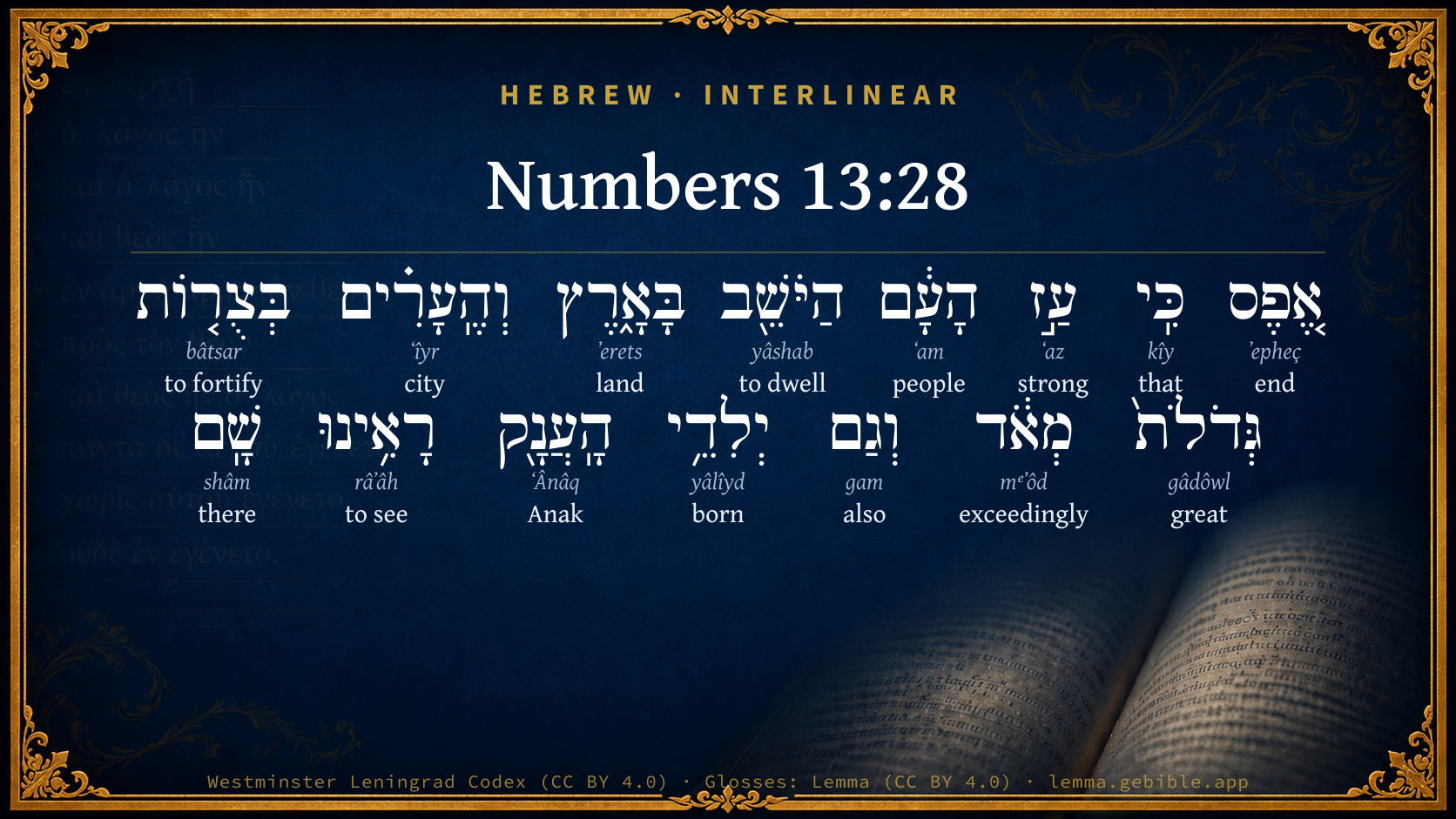
Hebrew (Westminster Leningrad Codex) Numbers 13:28 appears in the Hebrew Old Testament. The text above is from the Westminster Leningrad Codex. Each word links to its Strong’s number, a concise gloss, and parsing drawn from the Open Scriptures Hebrew Bible morphology. Click any word for its full Brown-Driver-Briggs (BDB) entry.
Download image
Cite this verse

Numbers 13:28 (World English Bible). Public Domain. Lemma interlinear Bible study tool, https://lemma.gebible.app/v/numbers/13/28.

Show BibTeX & RIS
BibTeX
RIS
English Translation
However the people who dwell in the land are strong, and the cities are fortified, [and] very great: and moreover we saw the children of Anak there.
World English Bible · Public Domain
Highlights
  • 1 first appearance in the Hebrew Bible
Full analysis ↓
Download a study sheet

One document with this verse’s original text, its word-by-word gloss line, the meaning frame, cross-references with their text, attributed commentary, and full source and license credits — printable, and it pastes into notes with its structure intact.

This verse Autodidact and up

Study sheet (.html) Plain text (.txt)

A passage Seminary Student

Up to 50 verses in one chapter. A passage sheet keeps up to 6 commentary sources and 12 cross-references per verse, in the order this page ranks them, and says so on the sheet whenever that leaves anything out. Ask for a single verse and you get the Autodidact verse sheet above.

Everything on this page stays free to read, with no account — the sheet is a download of what is already on screen, not access to it.

Want to remove ads? Support Godless Engineer
Compare translations 3

The same verse in 3 English versions, stacked beneath the original-language interlinear above. Click any original word for its lexicon entry.

Each is an independent rendering of the whole verse — the interlinear is not word-aligned to these translations.

Highlighted words mark where these versions differ — a whole-verse word diff, not a word-by-word alignment.

  • World English Bible Public Domain
    However the people who dwell in the land are strong, and the cities are fortified, [and] very great: and moreover we saw the children of Anak there.
  • King James Version Public Domain
    Nevertheless the people be strong that dwell in the land, and the cities are walled, and very great: and moreover we saw the children of Anak there.
  • unfoldingWord Literal Text CC BY-SA 4.0
    However, the people dwelling in the land strong, and the cities are fortified very great, and also we saw those born of the Anak there.

unfoldingWord Literal Text — © unfoldingWord, licensed CC BY-SA 4.0. Word-aligned USFM3 via Door43 (git.door43.org/unfoldingWord/en_ult).

Versions to compare (up to 4)

3 of 4 selected

Show all 18 translations

Every available English version of this verse, each an independent rendering of the whole verse.

  • World English Bible Public Domain
    However the people who dwell in the land are strong, and the cities are fortified, [and] very great: and moreover we saw the children of Anak there.
  • Berean Standard Bible Public Domain
    Nevertheless, the people living in the land are strong, and the cities are large and fortified. We even saw the descendants of Anak there.
  • Majority Standard Bible Public Domain
    Nevertheless, the people living in the land are strong, and the cities are large and fortified. We even saw the descendants of Anak there.
  • King James Version Public Domain
    Nevertheless the people be strong that dwell in the land, and the cities are walled, and very great: and moreover we saw the children of Anak there.
  • American Standard Version (1901) Public Domain
    Howbeit the people that dwell in the land are strong, and the cities are fortified, `and' very great: and moreover we saw the children of Anak there.
  • Revised Version (1885) Public Domain
    Howbeit the people that dwell in the land are strong, and the cities are fenced, and very great: and moreover we saw the children of Anak there.
  • Geneva Bible (1599) Public Domain
    And they tolde him, and saide, We came vnto the land whither thou hast sent vs, and surely it floweth with milke and honie: and here is of the fruite of it.
  • Douay-Rheims (1899) Public Domain
    And they related and said: We came into the land to which thou sentest us, which in very deed floweth with milk and honey as may be known by these fruits:
  • Young's Literal Translation Public Domain
    only, surely the people which is dwelling in the land `is' strong; and the cities are fenced, very great; and also children of Anak we have seen there.
  • Literal Standard Version CC BY-SA 4.0
    only, surely the people which is dwelling in the land [is] strong; and the cities are fortified [and] very great; and we have also seen children of Anak there.
  • Unlocked Literal Bible CC BY-SA 4.0
    However, the people who make their homes there are strong. The cities are fortified and very large. We also saw descendants of Anak there.
  • unfoldingWord Literal Text CC BY-SA 4.0
    However, the people dwelling in the land strong, and the cities are fortified very great, and also we saw those born of the Anak there.
  • Darby Bible Public Domain
    Only, the people are strong that dwell in the land, and the cities are walled, very great; moreover we saw the children of Anak there.
  • World Messianic Bible Public Domain
    However, the people who dwell in the land are strong, and the cities are fortified and very large. Moreover, we saw the children of Anak there.
  • Webster's Bible Public Domain
    Nevertheless, the people are strong that dwell in the land, and the cities are walled, and very great: and moreover, we saw the children of Anak there.
  • Free Bible Version CC BY-SA 4.0
    But the people living there are strong, and their towns are big and have defensive walls. We also saw some descendants of Anak there.
  • Bible in Basic English Public Domain
    But the people living in the land are strong, and the towns are walled and very great; further, we saw the children of Anak there.
  • JPS Tanakh (1917) Public Domain
    Howbeit the people that dwell in the land are fierce, and the cities are fortified, and very great; and moreover we saw the children of Anak there.

Literal Standard Version (2020), Covenant Press — licensed CC BY-SA 4.0. Text via the HelloAO Bible API (eBible.org). Unlocked Literal Bible (unfoldingWord) — licensed CC BY-SA 4.0. Text via the HelloAO Bible API (eBible.org). unfoldingWord Literal Text — © unfoldingWord, licensed CC BY-SA 4.0. Word-aligned USFM3 via Door43 (git.door43.org/unfoldingWord/en_ult). Free Bible Version, Dr. Jonathan Gallagher — licensed CC BY-SA 4.0. Text via the HelloAO Bible API (eBible.org).

Word by word

More ways to search: Search by grammar → Find every occurrence → Compare this word →

Practice this passage: Drill this verse → Learn its vocabulary →

הָֽעֲנָ֖ק
ʻÂnâq
H6061
“the · Anak”
Particle, Definite Article + Noun, Gentilic, Masculine, Singular, Absolute
Part of Speech
Particle + Noun
Type
Gentilic
Gender
Masculine
Number
Singular
State
Absolute
Full BDB Definition

Origin: the same as H6060

TWOT: None

Anak = "neck" - progenitor of a family, or tribe of the giant people in Canaan
  1. אֶ֚פֶס ʼepheç H657 “end” Noun, Common, Masculine, Singular, Absolute
  2. כִּֽי kîy H3588 “that” Conjunction
  3. עַ֣ז ʻaz H5794 “strong” Adjective, Adjective, Masculine, Singular, Absolute
  4. הָעָ֔ם ʻam H5971 “the · people” Particle, Definite Article + Noun, Common, Masculine, Singular, Absolute
  5. הַיֹּשֵׁ֖ב yâshab H3427 “the · dwelling” Particle, Definite Article + Verb, Qal, Participle Active, Masculine, Singular, Absolute
  6. בָּאָ֑רֶץ ʼerets H776 “in/at the · land” Preposition, Determined + Noun, Common, Both, Singular, Absolute
  7. וְהֶֽעָרִ֗ים ʻîyr H5892 “and · the · cities” Conjunction + Particle, Definite Article + Noun, Common, Feminine, Plural, Absolute
  8. בְּצֻר֤וֹת bâtsar H1219 “fortified” Adjective, Adjective, Feminine, Plural, Absolute
  9. גְּדֹלֹת֙ gâdôwl H1419 “great” Adjective, Adjective, Feminine, Plural, Absolute
  10. מְאֹ֔ד mᵉʼôd H3966 “exceedingly” Adverb
  11. וְגַם gam H1571 “and · also” Conjunction + Particle, Accusative
  12. יְלִדֵ֥י yâlîyd H3211 “those born of” Noun, Common, Masculine, Plural, Construct
  13. רָאִ֥ינוּ râʼâh H7200 “to see” Verb, Qal, Perfect, 1st Person, Common, Plural
  14. שָֽׁם shâm H8033 “there” Adverb

About this verse

These counts appear in no published source. They are computed here, from the morphology-tagged text and Lemma’s own curated glosses. What Lemma adds →

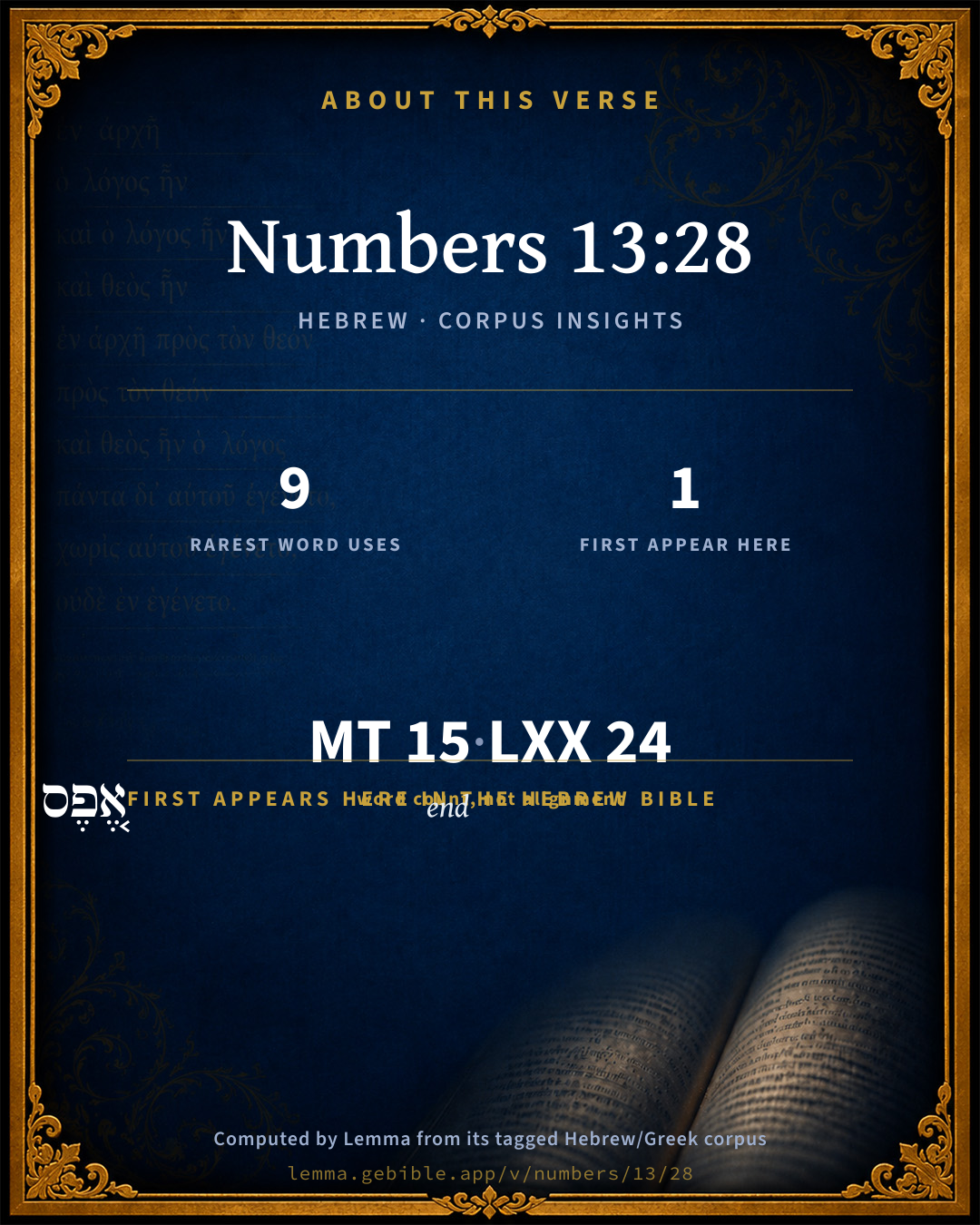
15
words
15
distinct lemmas
Pentateuch
section

Notable vocabulary

The rarest word here is הָֽעֲנָ֖ק Anak H6061 — appearing just 9 times in the whole Hebrew Bible.

First appearance in Scripture

This word makes its first canonical appearance in the Hebrew Bible here:

  • אֶ֚פֶס end H657

Shared distinctive vocabulary

הָֽעֲנָ֖ק Anak H6061 occurs in 8 verses of the Hebrew Bible. Also found in:

Grammatical profile

  • 2 verbs
  • 6 nouns
  • 3 adjectives
  • 1 conjunction
  • 2 adverbs
  • 1 particle

Verb forms

  • הַיֹּשֵׁ֖ב Qal · Participle Active
  • רָאִ֥ינוּ Qal · Perfect

Hebrew & Septuagint length

In English translation the verse runs 27 words from the Hebrew and 31 from the Septuagint (LXX English) — closely comparable.

A rough comparison of the two English renderings, which tokenize alike — not a word-level alignment.

Word counts can differ between the Hebrew and the Greek without any difference in meaning — e.g. the Hebrew direct-object marker אֵת has no separate Greek word, and Greek often adds the article ὁ.

In the original languages it is 15 Hebrew tokens and 24 Greek tokens — but the two are counted differently (Hebrew bundles its prefixes and suffixes into one token; the Greek is in lemma form), so that isn’t a like-for-like length.

Cross-references

10

Topical passages linked to Numbers 13:28 in the Treasury of Scripture Knowledge — connected by theme and wording, ordered by reader-vote popularity; previews shown in the World English Bible.

  • Deuteronomy 1:28 Where are we going up? our brothers have made our heart to melt, saying, The people are greater and taller than we; the cities are great and fortified up to the sky; and moreover we have seen the sons of the Anakim there.
  • Deuteronomy 9:1–2 Hear, Israel: you are to pass over the Jordan this day, to go in to dispossess nations greater and mightier than yourself, cities great and fortified up to the sky,
  • Numbers 13:33 There we saw the Nephilim, the sons of Anak, who come of the Nephilim: and we were in our own sight as grasshoppers, and so we were in their sight.
  • Joshua 11:22 There was none of the Anakim left in the land of the children of Israel: only in Gaza, in Gath, and in Ashdod, did some remain.
  • Deuteronomy 2:10–11 (The Emim lived therein before, a people great, and many, and tall, as the Anakim:
  • Deuteronomy 2:21 a people great, and many, and tall, as the Anakim; but Yahweh destroyed them before them; and they succeeded them, and lived in their place;
  • Deuteronomy 3:5 All these were cities fortified with high walls, gates, and bars; besides the unwalled towns a great many.
  • Joshua 15:14 Caleb drove out there the three sons of Anak: Sheshai, and Ahiman, and Talmai, the children of Anak.
  • Numbers 13:22–23 They went up by the South, and came to Hebron; and Ahiman, Sheshai, and Talmai, the children of Anak, were there. (Now Hebron was built seven years before Zoan in Egypt.)
  • Judges 1:20 They gave Hebron to Caleb, as Moses had spoken: and he drove out there the three sons of Anak.

Cross-references courtesy of OpenBible.info (CC BY 4.0).

Hebrew and Greek witnesses Masoretic Hebrew ↔ Greek Septuagint

The same verse in the two great witnesses to the Old Testament, shown verse-for-verse.

These are two independent witnesses, not word-aligned to each other, and the Septuagint is shown in lemma (dictionary) form.

Hebrew Numbers 13:28 Masoretic · Westminster Leningrad Codex

אֶ֚פֶס כִּֽי עַ֣ז הָעָ֔ם הַיֹּשֵׁ֖ב בָּאָ֑רֶץ וְהֶֽעָרִ֗ים בְּצֻר֤וֹת גְּדֹלֹת֙ מְאֹ֔ד וְגַם יְלִדֵ֥י הָֽעֲנָ֖ק רָאִ֥ינוּ שָֽׁם

However the people who dwell in the land are strong, and the cities are fortified, [and] very great: and moreover we saw the children of Anak there.

World English Bible · Public Domain

Greek LXX Numbers 13:28 Septuagint · lemma form

ἀλλά ἤ ὅτι θρασύς ὁ ἔθνος ὁ καταοἰκέω ἐπί αὐτός καί ὁ πόλις ὀχυρός τειχίζω καί μέγας σφόδρα καί ὁ γενεά εναχ ὁράω ἐκεῖ

and they reported to him, and said, We came into the land into which you sent us, a land flowing with milk and honey; and this is the fruit of it.

LXX2012 (modern English Septuagint) · Public Domain

On this verse, The Pulpit Commentary discusses the Septuagint’s reading. Read the note in Commentary ↓

Hebrew: Westminster Leningrad Codex (CC BY 4.0). Greek: Septuagint (public domain); English from LXX2012 (modern English Septuagint) (Public Domain). How the Septuagint differs from the Hebrew →

Targum (Aramaic paraphrase)

2

The Targum is the ancient Jewish Aramaic paraphrase of the Hebrew Scriptures — an interpretive translation, not the Hebrew text itself. Onkelos (literal) and Pseudo-Jonathan (expansive) render the Torah, and Jonathan the Prophets. Coverage is partial: where no permissively-licensed English translation exists for a verse, only the Aramaic is shown. This is verse-level text, not a word-by-word alignment to the Hebrew.

  1. Targum Onkelos Torah (Genesis–Deuteronomy)
    לְחוֹד אֲרֵי תַקִיף עַמָא דְיָתֵב בְּאַרְעָא וְקִרְוַיָא כְּרִיכָן רַבְרְבִין לַחֲדָא וְאַף בְּנֵי גִבָּרַיָא חֲזֵינָא תַמָן

    (no public-domain English translation for this verse)

    Targum Onkelos — Aramaic: “Onkelos Genesis” (public domain); “Onkelos Exodus” (public domain); “Onkelos Leviticus” (public domain); “Onkelos Numbers” (public domain); “Onkelos Deuteronomy” (public domain). English: “Sefaria Community Translation” (CC0 1.0 (public-domain dedication)); “J.W. Etheridge. The Targums of Onkelos and Jonathan Ben Uzziel on the Pentateuch. London: Longmans, Green, 1862” (public domain). Text via Sefaria.

  2. Targum Pseudo-Jonathan Torah (Genesis–Deuteronomy)
    לְחוֹד אֲרוּם תַּקִיף עַמָא דְיָתֵיב בְּאַרְעָא וְקִירְוַיָא כְּרִיכִין חַנְיָין רַבְרְבָן לַחֲדָא וְאוּף מַרְבְּיָנֵי דַעֲנָק גִבָּרָא חֲמֵינָא תַמָן

    But the people who inhabit the country are strong, and the fortified cities they inhabit very great; and we saw also there the sons of Anak the giant.

    Targum Pseudo-Jonathan — Aramaic: “Targum Jonathan on Genesis” (public domain); “Targum Jonathan on Exodus” (public domain); “Targum Jonathan on Leviticus” (public domain); “Targum Jonathan on Numbers” (public domain); “Targum Jonathan on Deuteronomy” (public domain). English: “The Targum of Jonathan ben Uzziel, trans. J. W. Etheridge, London, 1862” (public domain). Text via Sefaria.

Commentary

Notes on Numbers 13:28 from classic Christian and Jewish commentators (each source and its license shown beneath its notes). The classic Christian expositions comment on the surrounding passage and are grouped to its opening verse, so a note may address several verses; the Jewish commentaries on the Tanakh (Rashi and others) are per-verse, so they appear only where the commentator wrote on this verse.

Lemma curates 59 commentaries, every one of them public domain or Creative Commons licensed, each selected and text-cleaned for this edition rather than reprinted as found. About our sources →

Trapp's Complete Commentary

John Trapp

Num 13:28 Nevertheless the people [be] strong that dwell in the land, and the cities [are] walled, [and] very great: and moreover we saw the children of Anak there.

Ver. 28. Nevertheless the people be strong.] Thus many amongst us wish very well to heaven, speak glorious things of it, and could gladly go to it; but there is a lion in the way: they complain, with these malcontents, of the strength of the Anakims, and the impossibility of the conquest. It is a hard thing doubtless, to watch continually against a spiritual enemy, to keep up the banks against the sea of lusts and passions; to bear daily crosses without stooping; to carry the cup of prosperity without spilling; to climb the hill of good duties without fainting; to go against the crowd without sweating; to bear the reproach of Christ without buckling, &c. But hard though it be, should we be discouraged? The sweetness of the honey makes the bears break in upon the hives, contemning the stings. The merchant refuseth no adventure for hope of gain: the hunter shrinketh at no weather for love of game: the soldier declineth no danger for desire of spoil. The sweetness of God’s face, though to be seen only in the dark glass of the ceremonies, cheered up those good souls, in their hard and tedious travel to Zion. {Psa 84:6, &c.}

John Trapp, A Commentary or Exposition upon All the Books of the Old and New Testament (1647–1656) — public domain. Text from a community e-Sword module.

Geneva Bible (1599)

Geneva Bible translators

That is, Moses.

Geneva Bible (1599) marginal notes — public domain. Text via Bolls.life.

Ellicott's Commentary for English Readers

(28) Nevertheless the people be strong . . . —The spies adopted the words of Exo_3:8, “flowing with milk and honey,” as descriptive of the fertility of the land of Canaan, but at the same time they discouraged the hearts of their brethren by their description of the strength of the fortified cities and the gigantic stature of the inhabitants.

The children of Anak.—Better, of the Anakim. (See Num_13:22, and Note.)

A Bible Commentary for English Readers, edited by Charles John Ellicott (1878–1897) — public domain. Text from a community e-Sword module.

Matthew Poole's English Annotations

Strong; potent for the strength of their body, and the valour of their minds.

Matthew Poole's English Annotations on the Holy Bible (1683–1685) — public domain. Text from a community e-Sword/MySword module.

Whedon's Commentary on the Bible

Daniel D. Whedon

28. Nevertheless — This word introduces the godless majority report; godless because there is in it no reference to Jehovah. It is an infidel document; like those of some modern scientists, correct in its facts, but false and atheistic in its inferences. “Truly, the eye sees what it brings with it. They really went to look for dangers, and of course they found them.” The truth is told respecting the strength of the walled cities and the names of the Canaanitish tribes occupying different parts of the land. But the opinions expressed in Num_13:31 are glaringly disrespectful toward Him who had led Israel out of Egypt with his “stretched out arm,” and had promised to drive out all enemies from the promised land. Men are just as culpable for their opinions as for their acts, since opinions are the roots of conduct.

Cities… walled,… very great — “The eyes of weak faith or unbelief saw the towns really towering up ‘to heaven.’ Deu_1:28. Nor did the height appear less even to the eyes of faith, which does not hide the difficulties from itself, that it may not rob the Lord who helps it over them of any of the praise that is justly his due.” — Schultz.

Daniel D. Whedon (gen. ed.), Commentary on the Old and New Testaments (1874–1909) — public domain. Text from a community e-Sword module.

The Pulpit Commentary

Nevertheless. yKi spa. "Only that." Septuagint, all h oti . The people be strong. Moses himself had directed their attention to this point, and now they dwell on it to the exclusion of everything else.

Fatal answers to faithless prayers.

The faithless prayer was heard by God when the people murmured (verse 2). Now the answer comes to their own destruction. Apply to

1. Reckless transgressors, who brave the consequences of their sins. Illustration Jews, (Mat_27:25) who, however, soon, dreaded the answer. (Act_5:28; cf. Pro_1:31)

2. The discontented. E.g., Rachel; (Gen_30:1 Gen_35:19) Hebrews lusting for flesh, (Num_11:18-20) or desiring a king. (1Sa_8:6-22 Hos_13:11; cf. Pro_12:13)

3. Profane swearers imprecating damnation and receiving it. (Psa_59:12 Psa_64:8 Mat_12:36)

4. Distrustful servants of God, who, in haste, may proffer requests which, if granted, would leave a stain on their memories, if not actually fatal to their reputation. E.g., Moses; (Num_11:15) Elijah; (1Ki_19:4) Jonah. (Jon_4:3) What thanks are due to God that in his mercy he does not always answer our prayers, implied or expressed! And how much we need the teaching and the spirit of Christ, that we may pray thoughtfully and trustfully, and that he may not have to say to us, "Ye know not what ye ask". P. (Mar_10:35-40)

The Pulpit Commentary (1880–1919), ed. H.D.M. Spence-Jones & Joseph S. Exell — public domain. Text from a community e-Sword module.

Rashi

Rabbi Shlomo Yitzchaki (Rashi)

בצרות is an expression for strength. Its rendering in the Targum is כריכן, a term for circular fortresses, for in the Aramaic language כריך means round.

Rashi on the Tanakh — English translations: “The Judaica Press complete Tanach with Rashi, translated by A. J. Rosenberg” (CC BY 4.0); “Pentateuch with Rashi's commentary by M. Rosenbaum and A.M. Silbermann, 1929-1934” (public domain); “The Metsudah Tanach series, Lakewood, N.J” (CC BY 4.0); and “The Book of Joshua, Metsudah Publications, 1997” (CC BY 4.0). Text via Sefaria.

Lesson kit

Teaching starters — assembled from the data on this page, not authored interpretation. Every prompt links to the verse data it draws on. Edit before teaching.

Numbers, in the Pentateuch, opens this verse with 15 words (15 distinct Hebrew lemmas). Its most distinctive word is ʻÂnâq (“Anak”). A historical commentator’s framing appears above. Read the whole chapter for the surrounding context.

Discussion questions

  1. What does “Anak” (ʻÂnâq) contribute to the verse as a whole?
  2. The word “end” first appears here in Scripture. What is being introduced at this debut?
  3. Numbers 13:22 shares the word «Anak» with this verse. How do the two illuminate each other?
  4. The translations on this page render this verse differently — a whole-verse word diff, not a word-by-word alignment. What might account for the different wordings?
  5. The verb «הַיֹּשֵׁ֖ב» is Qal Participle Active. How does its form color the action?
  6. Reading how Trapp's Complete Commentary and Geneva Bible (1599) read this verse, where do the two commentators agree and where do they part?

Things to notice

Reading settings

Reading text

Shown beneath each verse's original-language words.

Old Testament
Old Testament edition

Read the OT as the Masoretic Hebrew (MT) or the Greek Septuagint (LXX).

English shown for the Greek Septuagint (in the Hebrew ↔ Greek comparison).

Comparing translations? Open the Compare panel on any verse page to stack up to four side by side.