

John 11:52
Greek (Tischendorf 8th ed.) John 11:52 appears in the Greek New Testament. The text above is from the Tischendorf 8th edition. Each word links to its Strong’s number and a concise gloss. Click any word for its full Thayer’s Greek Lexicon entry.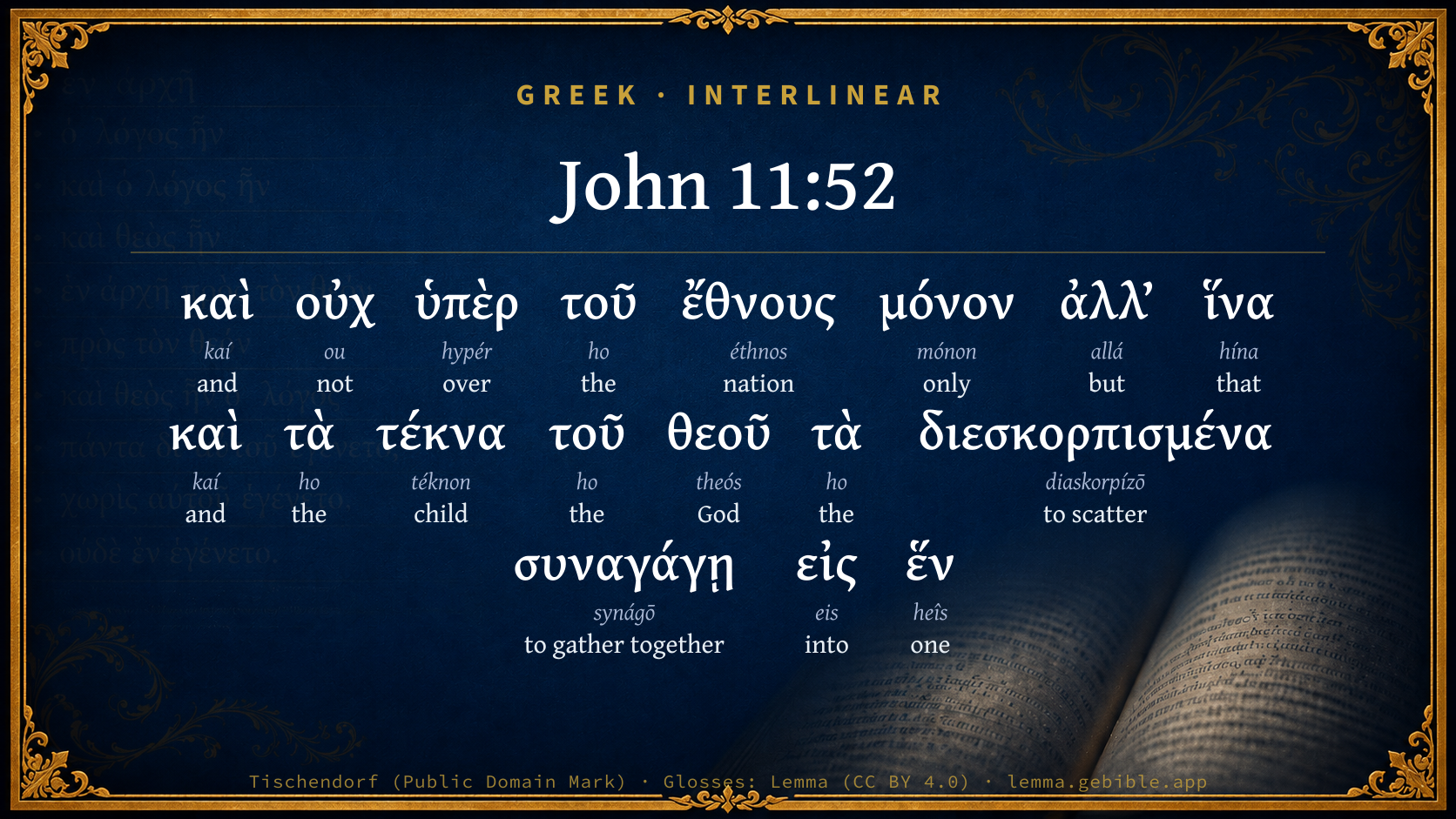
and not for the nation only, but that he might also gather together into one the children of God who are scattered abroad.
Download a study sheet
One document with this verse’s original text, its word-by-word gloss line, the meaning frame, cross-references with their text, attributed commentary, and full source and license credits — printable, and it pastes into notes with its structure intact.
This verse Autodidact and up
A passage Seminary Student
Up to 50 verses in one chapter. A passage sheet keeps up to 6 commentary sources and 12 cross-references per verse, in the order this page ranks them, and says so on the sheet whenever that leaves anything out. Ask for a single verse and you get the Autodidact verse sheet above.
Everything on this page stays free to read, with no account — the sheet is a download of what is already on screen, not access to it.
Compare translations 3
The same verse in 3 English versions, stacked beneath the original-language interlinear above. Click any original word for its lexicon entry.
Each is an independent rendering of the whole verse — the interlinear is not word-aligned to these translations.
Highlighted words mark where these versions differ — a whole-verse word diff, not a word-by-word alignment.
-
World English Bible Public Domain
and not for the nation only, but that he might also gather together into one the children of God who are scattered abroad.
-
King James Version Public Domain
And not for that nation only, but that also he should gather together in one the children of God that were scattered abroad.
-
unfoldingWord Literal Text CC BY-SA 4.0
and not only for the nation, but so that also the children of God having been scattered would be gathered together into one.)
unfoldingWord Literal Text — © unfoldingWord, licensed CC BY-SA 4.0. Word-aligned USFM3 via Door43 (git.door43.org/unfoldingWord/en_ult).
Show all 19 translations
Every available English version of this verse, each an independent rendering of the whole verse.
-
World English Bible Public Domain
and not for the nation only, but that he might also gather together into one the children of God who are scattered abroad.
-
Berean Standard Bible Public Domain
and not only for the nation, but also for the scattered children of God, to gather them together into one.
-
Majority Standard Bible Public Domain
and not only for the nation, but also for the scattered children of God, to gather them together into one.
-
King James Version Public Domain
And not for that nation only, but that also he should gather together in one the children of God that were scattered abroad.
-
American Standard Version (1901) Public Domain
and not for the nation only, but that he might also gather together into one the children of God that are scattered abroad.
-
Revised Version (1885) Public Domain
and not for the nation only, but that he might also gather together into one the children of God that are scattered abroad.
-
Geneva Bible (1599) Public Domain
And not for that nation onely, but that he shoulde gather together in one the children of God, which were scattered.
-
Douay-Rheims (1899) Public Domain
And not only for the nation, but to gather together in one the children of God, that were dispersed.
-
Young's Literal Translation Public Domain
and not for the nation only, but that also the children of God, who have been scattered abroad, he may gather together into one.
-
Literal Standard Version CC BY-SA 4.0
and not for the nation only, but that also the children of God, who have been scattered abroad, He may gather together into one.
-
Unlocked Literal Bible CC BY-SA 4.0
and not only for the nation, but so that the children of God who are scattered would be gathered together into one.
-
unfoldingWord Literal Text CC BY-SA 4.0
and not only for the nation, but so that also the children of God having been scattered would be gathered together into one.)
-
Darby Bible Public Domain
and not for the nation only, but that he should also gather together into one the children of God who were scattered abroad.
-
World Messianic Bible Public Domain
and not for the nation only, but that he might also gather together into one the children of God who are scattered abroad.
-
Webster's Bible Public Domain
And not for that nation only, but that also he should assemble in one the children of God that were scattered abroad.
-
Free Bible Version CC BY-SA 4.0
And this was not just for the Jewish nation, but for all the scattered children of God so that they might be gathered together and be made into one.
-
Bible in Basic English Public Domain
And not for that nation only, but for the purpose of uniting in one body the children of God all over the world.
-
Text-Critical English NT CC BY 4.0
and not only for the nation, but also to gather together and unite the children of God scattered abroad.)
-
Tyndale New Testament (1534) Public Domain
and not for the people only but that he shuld gader to geder in one the chyldren of God which were scattered abroode.
Literal Standard Version (2020), Covenant Press — licensed CC BY-SA 4.0. Text via the HelloAO Bible API (eBible.org). Unlocked Literal Bible (unfoldingWord) — licensed CC BY-SA 4.0. Text via the HelloAO Bible API (eBible.org). unfoldingWord Literal Text — © unfoldingWord, licensed CC BY-SA 4.0. Word-aligned USFM3 via Door43 (git.door43.org/unfoldingWord/en_ult). Free Bible Version, Dr. Jonathan Gallagher — licensed CC BY-SA 4.0. Text via the HelloAO Bible API (eBible.org).
Word by word
More ways to search: Search by grammar → Find every occurrence → Compare this word →
Practice this passage: Drill this verse → Learn its vocabulary →
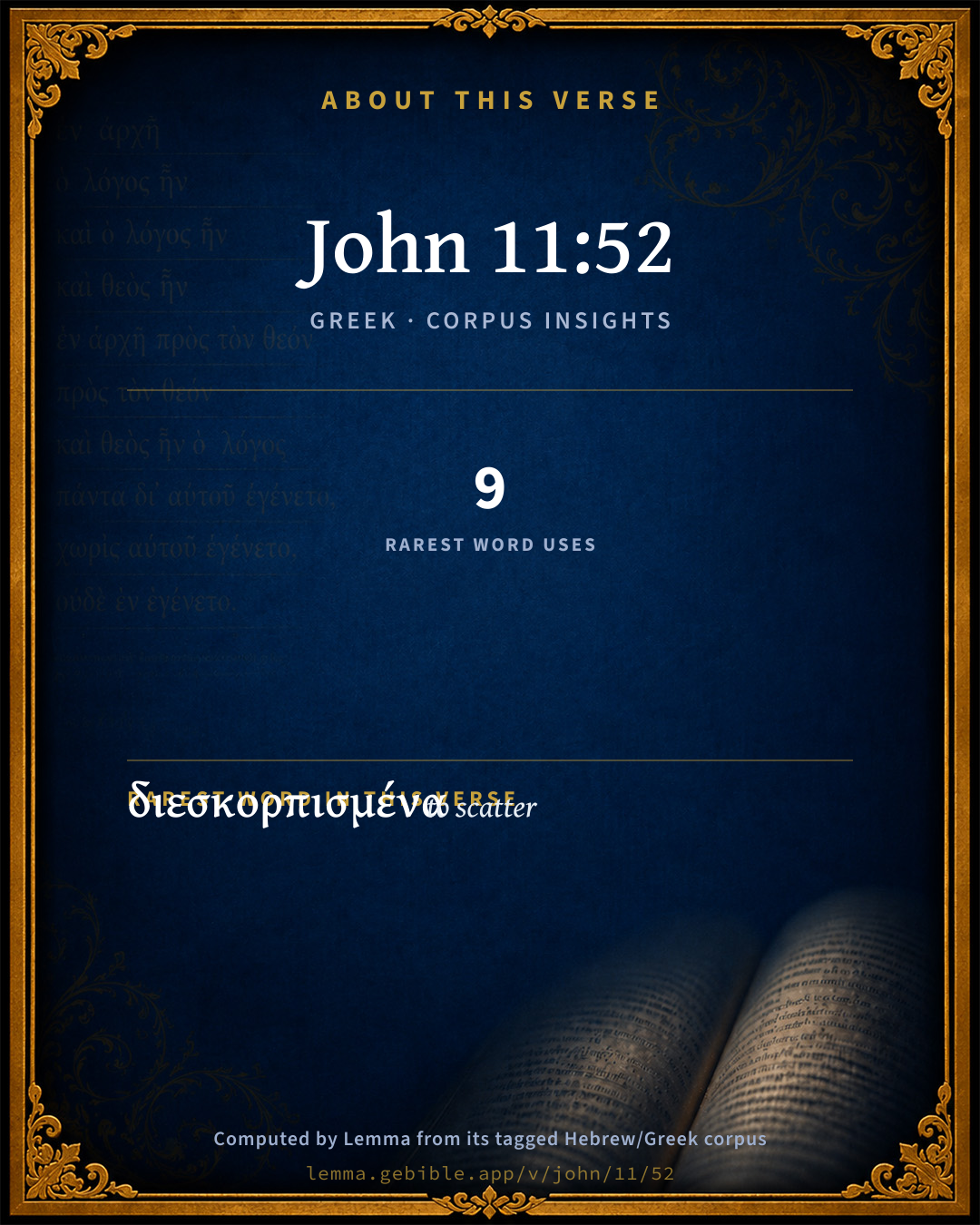
- Appears 9× in the Greek New Testament
- First appears at Matthew 25:24
- Part of Speech
- Verb
- Tense
- Perfect
- Voice
- Passive
- Mood
- Participle
- Case
- Accusative
- Number
- Plural
- Gender
- Neuter
Full Thayer's Definition
- καὶ kaí G2532 “and” Conjunction
- οὐχ ou G3756 “not” Particle, Negative
- ὑπὲρ hypér G5228 “over” Preposition
- τοῦ ho G3588 “the” Article, Genitive, Singular, Neuter
- ἔθνους éthnos G1484 “nation” Noun, Genitive, Singular, Neuter
- μόνον mónon G3440 “only” Adverb
- ἀλλ’ allá G235 “but” Conjunction
- ἵνα hína G2443 “that” Conjunction
- καὶ kaí G2532 “and” Conjunction
- τὰ ho G3588 “the” Article, Accusative, Plural, Neuter
- τέκνα téknon G5043 “child” Noun, Accusative, Plural, Neuter
- τοῦ ho G3588 “the” Article, Genitive, Singular, Masculine
- θεοῦ theós G2316 “God” Noun, Genitive, Singular, Masculine
- τὰ ho G3588 “the” Article, Accusative, Plural, Neuter
- διεσκορπισμένα diaskorpízō G1287 “to scatter” Verb, Perfect, Passive, Participle, Accusative, Plural, Neuter
- συναγάγῃ synágō G4863 “to gather together” Verb, Aorist, Active, Subjunctive, 3rd person, Singular
- εἰς eis G1519 “into” Preposition
- ἕν heîs G1520 “one” Adjective, Accusative, Singular, Neuter
About this verse
These counts appear in no published source. They are computed here, from the morphology-tagged text and Lemma’s own curated glosses. What Lemma adds →
- 18
- words
- 14
- distinct lemmas
- Gospels
- section
Cross-references
35Topical passages linked to John 11:52 in the Treasury of Scripture Knowledge — connected by theme and wording, ordered by reader-vote popularity; previews shown in the World English Bible.
- John 10:16 I have other sheep, which are not of this fold. I must bring them also, and they will hear my voice. They will become one flock with one shepherd.
- Isaiah 49:6 yes, he says, It is too light a thing that you should be my servant to raise up the tribes of Jacob, and to restore the preserved of Israel: I will also give you for a light to the Gentiles, that you may be my salvation to the end of the earth.
- 1 John 2:2 And he is the atoning sacrifice for our sins, and not for ours only, but also for the whole world.
- Ephesians 1:9–10 making known to us the mystery of his will, according to his good pleasure which he purposed in him
- 1 Peter 1:1 Peter, an apostle of Jesus Christ, to the chosen ones who are living as strangers in the Dispersion in Pontus, Galatia, Cappadocia, Asia, and Bithynia,
- Romans 9:25–26 As he says also in Hosea, "I will call them 'my people,' which were not my people; And her 'beloved,' who was not beloved."
- Ephesians 2:14–22 For he is our peace, who made both one, and broke down the middle wall of partition,
- Revelation 5:9 They sang a new song, saying, "You are worthy to take the book, And to open its seals: For you were killed, And bought us for God with your blood, Out of every tribe, language, people, and nation,
- Luke 2:32 A light for revelation to the Gentiles, And the glory of your people Israel."
- Romans 3:29 Or is God the God of Jews only? Isn't he the God of Gentiles also? Yes, of Gentiles also,
- Colossians 1:20–23 and through him to reconcile all things to himself, by him, whether things on the earth, or things in the heavens, having made peace through the blood of his cross.
- Revelation 7:9–10 After these things I looked, and behold, a great multitude, which no man could number, out of every nation and of all tribes, peoples, and languages, standing before the throne and before the Lamb, dressed in white robes, with palm branches in their hands.
- Genesis 49:10 The scepter will not depart from Judah, Nor the ruler's staff from between his feet, Until he comes to whom it belongs. To him will the obedience of the peoples be.
- Psalms 22:15 My strength is dried up like a potsherd. My tongue sticks to the roof of my mouth. You have brought me into the dust of death.
- Psalms 72:19 Blessed be his glorious name forever! Let the whole earth be filled with his glory! Amen and amen.
- Psalms 102:22–23 When the peoples are gathered together, The kingdoms, to serve Yahweh.
- Isaiah 11:10–12 It shall happen in that day, that the root of Jesse, who stands for an ensign of the peoples, to him shall the nations seek; and his resting-place shall be glorious.
- Isaiah 49:18 Lift up your eyes round about, and see: all these gather themselves together, and come to you. As I live, says Yahweh, you shall surely clothe you with them all as with an ornament, and gird yourself with them, like a bride.
- Isaiah 55:5 Behold, you shall call a nation that you don't know; and a nation that didn't know you shall run to you, because of Yahweh your God, and for the Holy One of Israel; for he has glorified you.
- Isaiah 56:8 The Lord Yahweh, who gathers the outcasts of Israel, says, Yet will I gather [others] to him, besides his own who are gathered.
- Isaiah 60:4 Lift up your eyes round about, and see: they all gather themselves together, they come to you; your sons shall come from far, and your daughters shall be carried in the arms.
- Ezekiel 11:16–17 Therefore say, Thus says the Lord Yahweh: Whereas I have removed them far off among the nations, and whereas I have scattered them among the countries, yet will I be to them a sanctuary for a little while in the countries where they are come.
- Ezekiel 34:12 As a shepherd seeks out his flock in the day that he is among his sheep that are scattered abroad, so will I seek out my sheep; and I will deliver them out of all places where they have been scattered in the cloudy and dark day.
- Hosea 1:10 Yet the number of the children of Israel will be as the sand of the sea, which can't be measured nor numbered; and it will come to pass that, in the place where it was said to them, 'You are not my people,' they will be called 'sons of the living God.'
- Matthew 25:31–34 "But when the Son of Man comes in his glory, and all the holy angels with him, then he will sit on the throne of his glory.
- John 1:29 The next day, he saw Jesus coming to him, and said, "Behold, the Lamb of God, who takes away the sin of the world!
- John 12:32 And I, if I am lifted up from the earth, will draw all people to myself."
- Acts 18:10 for I am with you, and no one will attack you to harm you, for I have many people in this city."
- Romans 4:17 As it is written, "I have made you a father of many nations." This is in the presence of him whom he believed: God, who gives life to the dead, and calls the things that are not, as though they were.
- Romans 8:29–30 For whom he foreknew, he also predestined to be conformed to the image of his Son, that he might be the firstborn among many brothers.
- Ephesians 1:5 having predestined us for adoption as children through Jesus Christ to himself, according to the good pleasure of his desire,
- Ephesians 3:11 according to the eternal purpose which he purposed in Christ Jesus our Lord;
- 2 Thessalonians 2:13–14 But we are bound to always give thanks to God for you, brothers loved by the Lord, because God chose you from the beginning for salvation through sanctification of the Spirit and belief in the truth;
- James 1:1 James, a servant of God and of the Lord Jesus Christ, to the twelve tribes which are in the Dispersion: Greetings.
- Psalms 22:27 All the ends of the earth shall remember and turn to Yahweh. All the relatives of the nations shall worship before you.
Cross-references courtesy of OpenBible.info (CC BY 4.0).
Lesson kit
Teaching starters — assembled from the data on this page, not authored interpretation. Every prompt links to the verse data it draws on. Edit before teaching.
John, in the Gospels, opens this verse with 18 words (14 distinct Greek lemmas). Its most distinctive word is diaskorpízō (“to scatter”). A historical commentator’s framing appears above. Read the whole chapter for the surrounding context.
Discussion questions
- How does “to scatter” (diaskorpízō) shape what this verse is saying?
- Matthew 25:24 shares the word «to scatter» with this verse. How do the two illuminate each other?
- “the” occurs 4× in this one verse. What is the effect of the repetition?
- These translations render this verse differently. What is at stake in choosing one wording over another?
- Reading how Tyndale Open Study Notes and Bengel's Gnomon read this verse, where do the two commentators agree and where do they part?
Things to notice
- These translations choose different wording for 10 words in this verse.
- “the” occurs 4× in this single verse.
- 14 distinct Greek lemmas span 18 words in this verse.
Commentary
Notes on John 11:52 from classic Christian and Jewish commentators (each source and its license shown beneath its notes). The classic Christian expositions comment on the surrounding passage and are grouped to its opening verse, so a note may address several verses; the Jewish commentaries on the Tanakh (Rashi and others) are per-verse, so they appear only where the commentator wrote on this verse.
Lemma curates 59 commentaries, every one of them public domain or Creative Commons licensed, each selected and text-cleaned for this edition rather than reprinted as found. About our sources →
Tyndale Open Study Notes
Tyndale Open Resources
Tyndale Open Study Notes — © Tyndale Open Resources, licensed CC BY-SA 4.0. Text via the HelloAO Bible API.
Bengel's Gnomon
Johann Albrecht Bengel
Bengel's Gnomon of the New Testament — English translation (T&T Clark, Edinburgh, 1860) — public domain. Text from a community e-Sword module.
Geneva Bible (1599)
Geneva Bible translators
Geneva Bible (1599) marginal notes — public domain. Text via Bolls.life.
Jamieson, Fausset & Brown
Robert Jamieson, A. R. Fausset & David Brown
Jamieson, Fausset & Brown — Commentary Critical and Explanatory on the Whole Bible (1871) — public domain (CC PDM 1.0). Text via the HelloAO Bible API.
Adam Clarke's Commentary
Adam Clarke's Commentary on the Bible (1810–1826) — public domain. Text from a community e-Sword/MySword module.
John Calvin's Commentaries
John Calvin's Commentaries (1540-1563) — public domain. Text from the Calvin Translation Society English edition (1840s-50s) via the Christian Classics Ethereal Library (ccel.org). Calvin's coverage is partial (roughly two-thirds of the Bible); uncommented books and verses are honest gaps, never fabricated. The 19th-century editor's footnotes and remarks are omitted so the notes are faithfully Calvin's own voice.
Ellicott's Commentary for English Readers
A Bible Commentary for English Readers, edited by Charles John Ellicott (1878–1897) — public domain. Text from a community e-Sword module.
The Cambridge Bible for Schools and Colleges
gen. ed. J. J. S. Perowne
The Cambridge Bible for Schools and Colleges (gen. ed. J. J. S. Perowne; Cambridge University Press, 1878–1918) — public domain. Text from a community e-Sword module.
John Gill's Exposition
John Gill's Exposition of the Whole Bible (1746–1763) — public domain (CC PDM 1.0). Text via the HelloAO Bible API.
Trapp's Complete Commentary
John Trapp
John Trapp, A Commentary or Exposition upon All the Books of the Old and New Testament (1647–1656) — public domain. Text from a community e-Sword module.
Albert Barnes' Notes on the Bible
Albert Barnes' Notes on the Bible (1834–1885) — public domain. Text from a community e-Sword/MySword module.
Matthew Poole's English Annotations
Matthew Poole's English Annotations on the Holy Bible (1683–1685) — public domain. Text from a community e-Sword/MySword module.
Whedon's Commentary on the Bible
Daniel D. Whedon
Daniel D. Whedon (gen. ed.), Commentary on the Old and New Testaments (1874–1909) — public domain. Text from a community e-Sword module.
John Wesley's Explanatory Notes
John Wesley, Explanatory Notes Upon the Whole Bible (1754–1765) — public domain. Text via the GEBible commentary corpus.
Cambridge Greek Testament for Schools and Colleges
Cambridge Greek Testament for Schools and Colleges (Cambridge University Press, 1896; 21 vols, various authors incl. Carr, Maclear, Plummer, Farrar, Lumby, Moule, M. R. James, Simcox) — public domain. Text from a community e-Sword module.
International Critical Commentary
International Critical Commentary — older volumes (1896–1929), various authors — public domain. Text from a community e-Sword module.
Vincent's Word Studies in the New Testament
Marvin R. Vincent
Marvin R. Vincent, Word Studies in the New Testament (1887–1900) — public domain. Text from a community e-Sword/MySword module.