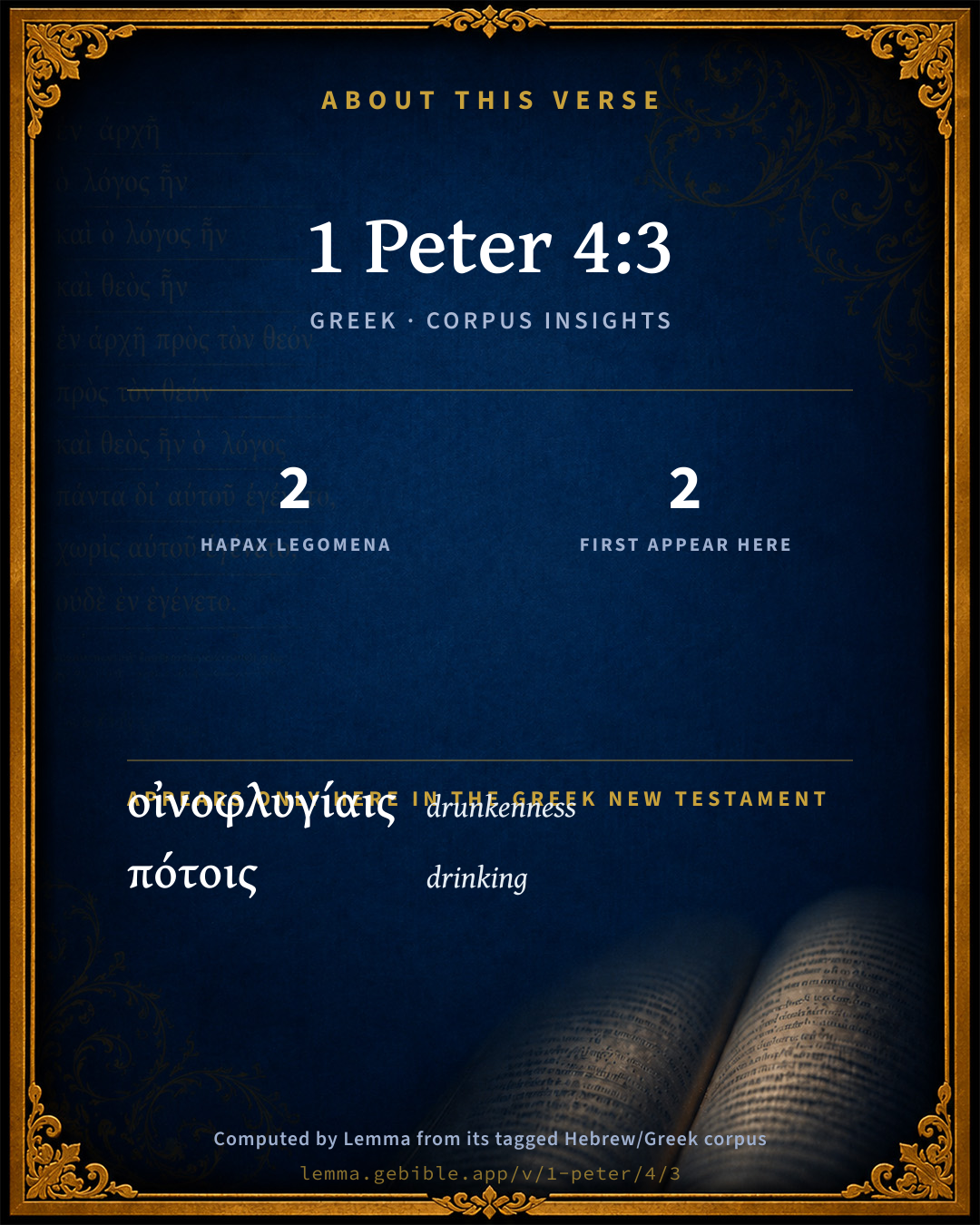
1 Peter 4:3

Greek (Tischendorf 8th ed.) 1 Peter 4:3 appears in the Greek New Testament. The text above is from the Tischendorf 8th edition. Each word links to its Strong’s number and a concise gloss. Click any word for its full Thayer’s Greek Lexicon entry.
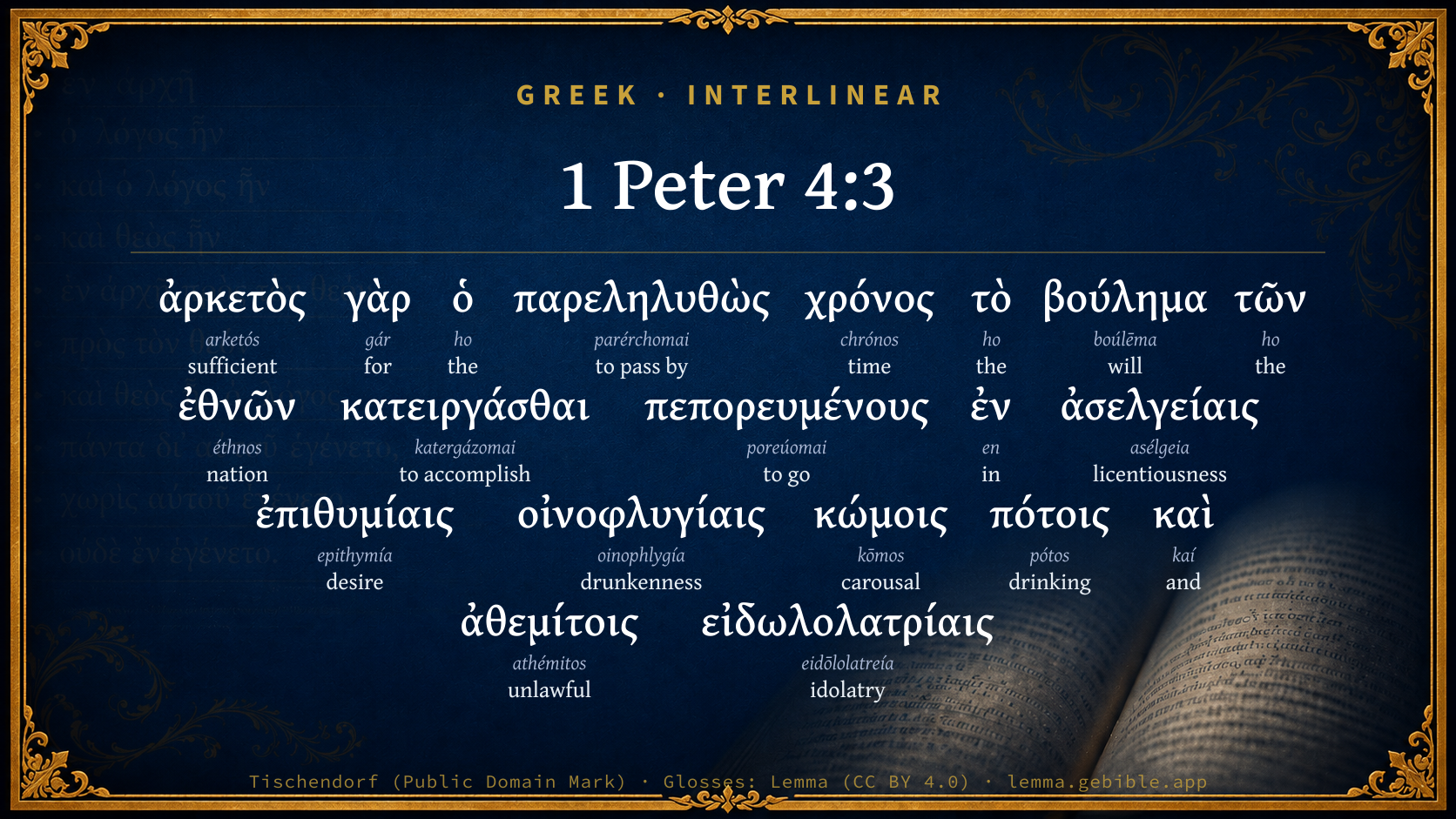
Download image
Cite this verse

1 Peter 4:3 (World English Bible). Public Domain. Lemma interlinear Bible study tool, https://lemma.gebible.app/v/1-peter/4/3.

Show BibTeX & RIS
BibTeX
RIS
English Translation
For we have spent enough of our past time doing the desire of the Gentiles, and having walked in lewdness, lusts, drunken binges, orgies, carousings, and abominable idolatries.
World English Bible · Public Domain
Highlights
  • 2 hapax legomena — only here in the Greek New Testament
  • 2 first appearances in the Greek New Testament
Full analysis ↓
Download a study sheet

One document with this verse’s original text, its word-by-word gloss line, the meaning frame, cross-references with their text, attributed commentary, and full source and license credits — printable, and it pastes into notes with its structure intact.

This verse Autodidact and up

Study sheet (.html) Plain text (.txt)

A passage Seminary Student

Up to 50 verses in one chapter. A passage sheet keeps up to 6 commentary sources and 12 cross-references per verse, in the order this page ranks them, and says so on the sheet whenever that leaves anything out. Ask for a single verse and you get the Autodidact verse sheet above.

Everything on this page stays free to read, with no account — the sheet is a download of what is already on screen, not access to it.

Want to remove ads? Support Godless Engineer
Compare translations 3

The same verse in 3 English versions, stacked beneath the original-language interlinear above. Click any original word for its lexicon entry.

Each is an independent rendering of the whole verse — the interlinear is not word-aligned to these translations.

Highlighted words mark where these versions differ — a whole-verse word diff, not a word-by-word alignment.

  • World English Bible Public Domain
    For we have spent enough of our past time doing the desire of the Gentiles, and having walked in lewdness, lusts, drunken binges, orgies, carousings, and abominable idolatries.
  • King James Version Public Domain
    For the time past of our life may suffice us to have wrought the will of the Gentiles, when we walked in lasciviousness, lusts, excess of wine, revellings, banquetings, and abominable idolatries:
  • unfoldingWord Literal Text CC BY-SA 4.0
    For the time having passed enough to accomplish the will of the Gentiles, having lived in licentiousness, lusts, drunkenness, carousing, drinking parties, and lawless idolatry,

unfoldingWord Literal Text — © unfoldingWord, licensed CC BY-SA 4.0. Word-aligned USFM3 via Door43 (git.door43.org/unfoldingWord/en_ult).

Versions to compare (up to 4)

3 of 4 selected

Show all 19 translations

Every available English version of this verse, each an independent rendering of the whole verse.

  • World English Bible Public Domain
    For we have spent enough of our past time doing the desire of the Gentiles, and having walked in lewdness, lusts, drunken binges, orgies, carousings, and abominable idolatries.
  • Berean Standard Bible Public Domain
    For you have spent enough time in the past carrying out the same desires as the Gentiles: living in debauchery, lust, drunkenness, orgies, carousing, and detestable idolatry.
  • Majority Standard Bible Public Domain
    For we have spent enough of our past lifetime carrying out the same desires as the Gentiles: living in debauchery, lust, drunkenness, orgies, carousing, and detestable idolatry.
  • King James Version Public Domain
    For the time past of our life may suffice us to have wrought the will of the Gentiles, when we walked in lasciviousness, lusts, excess of wine, revellings, banquetings, and abominable idolatries:
  • American Standard Version (1901) Public Domain
    For the time past may suffice to have wrought the desire of the Gentiles, and to have walked in lasciviousness, lusts, winebibbings, revellings, carousings, and abominable idolatries:
  • Revised Version (1885) Public Domain
    For the time past may suffice to have wrought the desire of the Gentiles, and to have walked in lasciviousness, lusts, winebibbings, revellings, carousings, and abominable idolatries:
  • Geneva Bible (1599) Public Domain
    For it is sufficient for vs that we haue spet the time past of ye life, after the lust of the Gentiles, walking in wantonnes, lustes, drunkennes, in gluttonie, drinkings, and in abominable idolatries.
  • Douay-Rheims (1899) Public Domain
    For the time past is sufficient to have fulfilled the will of the Gentiles, for them who have walked in riotousness, lusts, excess of wine, revellings, banquetings, and unlawful worshipping of idols.
  • Young's Literal Translation Public Domain
    for sufficient to us `is' the past time of life the will of the nations to have wrought, having walked in lasciviousnesses, desires, excesses of wines, revelings, drinking-bouts, and unlawful idolatries,
  • Literal Standard Version CC BY-SA 4.0
    for the time has sufficiently passed to have carried out the will of the nations, having walked in licentiousness, lusts, excesses of wines, revelings, drinking-bouts, and unlawful idolatries,
  • Unlocked Literal Bible CC BY-SA 4.0
    You have spent enough time doing what the Gentiles want to do, living in sensuality, passion, drunkenness, drunken celebrations, having wild parties, and committing disgusting acts of idolatry.
  • unfoldingWord Literal Text CC BY-SA 4.0
    For the time having passed enough to accomplish the will of the Gentiles, having lived in licentiousness, lusts, drunkenness, carousing, drinking parties, and lawless idolatry,
  • Darby Bible Public Domain
    For the time past [is] sufficient [for us] to have wrought the will of the Gentiles, walking in lasciviousness, lusts, wine-drinking, revels, drinkings, and unhallowed idolatries.
  • World Messianic Bible Public Domain
    For we have spent enough of our past time doing the desire of the Gentiles, and having walked in lewdness, lusts, drunken binges, orgies, carousings, and abominable idolatries.
  • Webster's Bible Public Domain
    For the time past of our life may suffice us to have wrought the will of the Gentiles, when we walked in lasciviousness, lusts, excess of wine, revelings, banquetings, and abominable idolatries:
  • Free Bible Version CC BY-SA 4.0
    In the past you've spent enough time following the ways of the world: immorality, sexual indulgence, drunken orgies, partying, binge drinking, and revolting idol-worship.
  • Bible in Basic English Public Domain
    Because for long enough, in times past, we have been living after the way of the Gentiles, given up to the desires of the flesh, to drinking and feasting and loose behaviour and unclean worship of images;
  • Text-Critical English NT CC BY 4.0
    For we have spent enough of our lives doing what the Gentiles like to do, walking in sensual indulgences, evil desires, excesses of wine, revelries, drinking bouts, and illicit idolatries.
  • Tyndale New Testament (1534) Public Domain
    For it is sufficient for vs that we have spent the tyme that is past of the lyfe after the will of the gentyls walkinge in wantannes lustes dronkennes in eatinge drinkinge and in abominable ydolatrie.

Literal Standard Version (2020), Covenant Press — licensed CC BY-SA 4.0. Text via the HelloAO Bible API (eBible.org). Unlocked Literal Bible (unfoldingWord) — licensed CC BY-SA 4.0. Text via the HelloAO Bible API (eBible.org). unfoldingWord Literal Text — © unfoldingWord, licensed CC BY-SA 4.0. Word-aligned USFM3 via Door43 (git.door43.org/unfoldingWord/en_ult). Free Bible Version, Dr. Jonathan Gallagher — licensed CC BY-SA 4.0. Text via the HelloAO Bible API (eBible.org).

Word by word

More ways to search: Search by grammar → Find every occurrence → Compare this word →

Practice this passage: Drill this verse → Learn its vocabulary →

οἰνοφλυγίαις
oinophlygía
G3632
“drunkenness”
Noun, Dative, Plural, Feminine
Part of Speech
Noun
Case
Dative
Number
Plural
Gender
Feminine
Full Thayer's Definition

Origin: from G3631 and a form of the base of G5397

TDNT: None

1. drunkenness
  1. ἀρκετὸς arketós G713 “sufficient” Adjective, Nominative, Singular, Masculine
  2. γὰρ gár G1063 “for” Conjunction
  3. ὁ ho G3588 “the” Article, Nominative, Singular, Masculine
  4. παρεληλυθὼς parérchomai G3928 “to pass by” Verb, Perfect, Active, Participle, Nominative, Singular, Masculine
  5. χρόνος chrónos G5550 “time” Noun, Nominative, Singular, Masculine
  6. τὸ ho G3588 “the” Article, Accusative, Singular, Neuter
  7. βούλημα boúlēma G1013 “will” Noun, Accusative, Singular, Neuter
  8. τῶν ho G3588 “the” Article, Genitive, Plural, Neuter
  9. ἐθνῶν éthnos G1484 “nation” Noun, Genitive, Plural, Neuter
  10. κατειργάσθαι katergázomai G2716 “to accomplish” Verb, Perfect, Middle or Passive deponent, Infinitive
  11. πεπορευμένους poreúomai G4198 “to go” Verb, Perfect, Middle or Passive deponent, Participle, Accusative, Plural, Masculine
  12. ἐν en G1722 “in” Preposition
  13. ἀσελγείαις asélgeia G766 “licentiousness” Noun, Dative, Plural, Feminine
  14. ἐπιθυμίαις epithymía G1939 “desire” Noun, Dative, Plural, Feminine
  15. κώμοις kōmos G2970 “carousal” Noun, Dative, Plural, Masculine
  16. πότοις pótos G4224 “drinking” Noun, Dative, Plural, Masculine
  17. καὶ kaí G2532 “and” Conjunction
  18. ἀθεμίτοις athémitos G111 “unlawful” Adjective, Dative, Plural, Feminine
  19. εἰδωλολατρίαις eidōlolatreía G1495 “idolatry” Noun, Dative, Plural, Feminine

About this verse

These counts appear in no published source. They are computed here, from the morphology-tagged text and Lemma’s own curated glosses. What Lemma adds →

20
words
18
distinct lemmas
General Epistles
section

Notable vocabulary

2 hapax legomena — words that appear only here in the entire Greek New Testament:

  • οἰνοφλυγίαις drunkenness G3632
  • πότοις drinking G4224

First appearance in Scripture

These words make their first canonical appearance in the Greek New Testament here:

  • οἰνοφλυγίαις drunkenness G3632
  • πότοις drinking G4224

Shared distinctive vocabulary

ἀθεμίτοις unlawful G111 occurs in 2 verses of the Greek New Testament. Also found in:

Repetition

A word recurs within this verse:

Cross-references

29

Topical passages linked to 1 Peter 4:3 in the Treasury of Scripture Knowledge — connected by theme and wording, ordered by reader-vote popularity; previews shown in the World English Bible.

  • 1 Corinthians 6:11 Such were some of you, but you were washed. But you were sanctified. But you were justified in the name of the Lord Jesus, and in the Spirit of our God.
  • Ephesians 5:18 Don't be drunken with wine, in which is dissipation, but be filled with the Spirit,
  • 1 Thessalonians 4:5 not in the passion of lust, even as the Gentiles who don't know God;
  • 1 Peter 1:14 as children of obedience, not conforming yourselves according to your former lusts as in your ignorance,
  • Ephesians 2:2–3 in which you once walked according to the course of this world, according to the prince of the powers of the air, the spirit who now works in the children of disobedience;
  • Ephesians 4:17–19 This I say therefore, and testify in the Lord, that you no longer walk as the rest of the Gentiles also walk, in the futility of their mind,
  • Galatians 5:21 envyings, murders, drunkenness, orgies, and things like these; of which I forewarn you, even as I also forewarned you, that those who practice such things will not inherit the Kingdom of God.
  • Ezekiel 45:9 Thus says the Lord Yahweh: Let it suffice you, princes of Israel: remove violence and spoil, and execute justice and righteousness; dispossessing my people, says the Lord Yahweh.
  • Galatians 5:19 Now the works of the flesh are obvious, which are: adultery, sexual immorality, uncleanness, lustfulness,
  • Revelation 17:4–5 The woman was dressed in purple and scarlet, and decked with gold and precious stones and pearls, having in her hand a golden cup full of abominations and the impurities of the sexual immorality of the earth.
  • Isaiah 28:7 Even these reel with wine, and stagger with strong drink; the priest and the prophet reel with strong drink, they are swallowed up of wine, they stagger with strong drink; they err in vision, they stumble in judgment.
  • Ezekiel 44:6 You shall tell the rebellious, even to the house of Israel, Thus says the Lord Yahweh: you house of Israel, let it suffice you of all your abominations,
  • Acts 17:30 The times of ignorance therefore God overlooked. But now he commands that all people everywhere should repent,
  • Romans 13:13 Let us walk properly, as in the day; not in reveling and drunkenness, not in sexual promiscuity and lustful acts, and not in strife and jealousy.
  • 1 Corinthians 12:2 You know that when you were heathen, you were led away to those mute idols, however you might be led.
  • Jude 1:4 For there are certain men who crept in secretly, even those who were long ago written about for this condemnation: ungodly men, turning the grace of our God into lasciviousness, and denying our only Master, God, and Lord, Jesus Christ.
  • Deuteronomy 12:30–31 take heed to yourself that you not be ensnared to follow them, after that they are destroyed from before you; and that you not inquire after their gods, saying, How do these nations serve their gods? even so will I do likewise.
  • 1 Kings 21:26 He did very abominably in following idols, according to all that the Amorites did, whom Yahweh cast out before the children of Israel.)
  • 2 Chronicles 15:8 When Asa heard these words, and the prophecy of Oded the prophet, he took courage, and put away the abominations out of all the land of Judah and Benjamin, and out of the cities which he had taken from the hill-country of Ephraim; and he renewed the altar of Yahweh, that was before the porch of Yahweh.
  • Proverbs 23:29–35 Who has woe? Who has sorrow? Who has strife? Who has complaints? Who has needless bruises? Who has bloodshot eyes?
  • Isaiah 5:11 Woe to those who rise up early in the morning, that they may follow strong drink; Who stay late into the night, until wine inflames them!
  • Isaiah 65:4 who sit among the graves, and lodge in the secret places; who eat pig's flesh, and broth of abominable things is in their vessels;
  • Jeremiah 16:18 First I will recompense their iniquity and their sin double, because they have polluted my land with the carcasses of their detestable things, and have filled my inheritance with their abominations.
  • Mark 7:22 covetings, wickedness, deceit, lustful desires, an evil eye, blasphemy, pride, and foolishness.
  • Romans 1:20–32 For the invisible things of him since the creation of the world are clearly seen, being perceived through the things that are made, even his everlasting power and divinity; that they may be without excuse.
  • Romans 8:12–13 So then, brothers, we are debtors, not to the flesh, to live after the flesh.
  • 2 Corinthians 12:21 that again when I come my God would humble me before you, and I would mourn for many of those who have sinned before now, and not repented of the uncleanness and sexual immorality and lustfulness which they committed.
  • Titus 3:3 For we were also once foolish, disobedient, deceived, serving various lusts and pleasures, living in malice and envy, hateful, and hating one another.
  • 2 Samuel 13:28 Absalom commanded his servants, saying, Mark you now, when Amnon's heart is merry with wine; and when I tell you, Smite Amnon, then kill him; don't be afraid; haven't I commanded you? be courageous, and be valiant.

Cross-references courtesy of OpenBible.info (CC BY 4.0).

Where the printed editions differ

2 variants

Places in this verse where the major printed Greek editions disagree on the wording in a way that affects the translation — a comparison of editions, not a manuscript-by-manuscript collation. The editions are the modern critical texts (Nestlé-Aland 28/27, SBL, Westcott-Hort, Tregelles, Tyndale House) and the traditional texts behind the KJV (the Textus Receptus and the Byzantine/Majority text). It is not a claim about which reading is original.

  1. Extra text
    ἡμῖν

    “to us”

    In TRByz Not in NA28NA27TynSBLWHTreg

    ἡμῖν (hēmin) 'to us' is only in traditional manuscripts (TR+Byz)

  2. Extra text
    τοῦ βίου

    “<the> of life”

    In TRByz Not in NA28NA27TynSBLWHTreg

    τοῦ βίου (tou biou) 'of life' is only in traditional manuscripts (TR+Byz)

Textual data: Translators Amalgamated Greek New Testament (STEPBible TAGNT) · CC BY 4.0.

Commentary

Notes on 1 Peter 4:3 from classic Christian and Jewish commentators (each source and its license shown beneath its notes). The classic Christian expositions comment on the surrounding passage and are grouped to its opening verse, so a note may address several verses; the Jewish commentaries on the Tanakh (Rashi and others) are per-verse, so they appear only where the commentator wrote on this verse.

Lemma curates 59 commentaries, every one of them public domain or Creative Commons licensed, each selected and text-cleaned for this edition rather than reprinted as found. About our sources →

The Biblical Illustrator

Joseph S. Exell

1Pe_4:3-5

The time past of our life may suffice us.

The consideration of misspent time an incentive to repentance

1. The time spent in sin, we know how much it is, but what is behind we know not. The devil is sure of his part, but what God shall have, whether half or a quarter, so much is uncertain. If we knew we should live twenty years more to serve God as we have done twenty years in sin, God should have but the half, but we know not whether we shall live twenty days. Should we then defer?

2. Time is very precious, above gold and silver, and hereof we have squandered a great part.

3. There is no time to be spent in sin, but we are to serve God in holiness and righteousness all the days of our life. Therefore, having robbed Him of some of His due, is it not well He will take this that remains?

4. Whatsoever time is spent till we return to God is all going out of the way; and if a man hath gone out of the way but till eight or nine oclock, assuredly that is more than enough.

5. Whatsoever time is spent that way is but doing that that must be undone again and repented of. Is not a little of this too much? Who will willingly so do his work that it must be ravelled out again?

6. All that is done this way is for the devil, our sworn enemy, for whom even the least is too much; for the flesh, to which we owe nothing; and for the world, which is our deadly enemy.

7. It is all done against God, to whom we owe all; and is it not then sufficient we have wronged Him so far?

8. And all is against our own souls; and have we not wounded them enough already? (John Rogers.)

Departed years

What is time? Without regard to philosophic niceties, I may say that it is limited duration, vouchsafed to man for moral purposes, through the mediation of Christ.

I. As a portion of probationary existence. Time past of our life. Take three views of the years that have departed.

1. Look at what they have given us.

2. Look at what they have taken away from us. The warm impulses and tender sensibilities of childhood and youth. Precious gifts are these! What friends are gone!

3. Look at what they have left us. They have left us life, reason, memory, religious privileges, augmented responsibility, wider memories, and greater power for good and evil. Many precious germs of blessedness.

II. As a course of wrong moral conduct. The apostle intimates that those to whom he wrote had, during the past years, wrought the will of the Gentiles. During the time past of their lives they had not been passive but active. What was this will of the Gentiles? The will of corrupt humanity. Nothing more, nothing less. Every wheel in its vast and complicated machinery is moved and ruled by this. It is true that this will works in different men with different instruments and under different phases of character. Its language in some is vulgar, in others classic; in some obscene, in others refined.

1. That this will is generally the ruling power in the first stages of mans history.

2. That there is a danger even of good men yielding to its influence.

III. As an argument for immediate improvement. For the time past of our life may suffice, etc. The urgency of this will appear from two considerations.

1. The will of God ought to have swayed with an absolute power from the commencement of our responsible life.

2. All the time that has been spent in neglect of this has been spent in contracting guilt and increasing our exposure to ruin. (D. Thomas, D. D.)

The voice of the past

Life! What mystery is wrapped up in life! How great the power needed to originate it! What transcendent worth be longs to human life! to-

I. Our life. Our life is redeemed life. It was great to speak a world from nought; greater to create moral life and fashion it after the Divine original; greatest to redeem.

II. The past of life. How little we know of the past-taking the word in its comprehensive relationship to the world! As question of history we know something of the worlds civilisation, science, art, human laws, etc. But what do we know of the individual experience of mankind-its joys and sorrows? But there is a past for which God holds us responsible-an individual past.

III. The time past of our life. Nothing that I have is my own. I belong to God, in body, soul, and spirit. I am, therefore, accountable to Him for my time. Life is Gods loan to man, and time mans life rent of the world. In the great day we are to stand before God to give an account of our stewardship. The life rent which the great Proprietor claims is service. He has put us into His beautiful world to make it more beautiful by adding moral to material beauty. If we fail to render this service we shall lose our life, in a sense which human language is not adequate to express. And now what have we to say with respect to this strange, solemn thing-Time?-that men do with it through life just what the apostles did for one precious irreparable hour of it in the garden of Gethsemane-they go to sleep! What opportunities have we lost! What privileges forfeited! What work for God neglected! The secret of all the failures which have been enumerated is expressed by the apostle in one word, self-will-the will of the Gentiles. Man doing his own will is the history of the worlds sin and woe. Adoption into the family of God does not exempt us from its insidious workings. The God and Father of our Lord Jesus Christ asks us to let the past suffice to have wrought the wilt of the Gentiles, to renew our early vows, our first love, to be henceforth inspired with the holy ambition to be conformed to the image of His Son. To attain unto this we must yield our wills to God. What are we living for?-for God or for self? (A London Suburban Minister.)

The old year and the new

Look at the qualities that are here forbidden. Lust, lasciviousness, drunkenness, carousings-all these are especially mentioned; and the apostle declares that the time past suffices. You have had experience enough in regard to those things; it is time to leave them. There are multitudes of men that are sacking their very constitution; for whatever may be the opinions of men as to the morality of lascivious conduct, there can be no doubt as to the folly of it. And what shall I say of the concurrent danger of drunkenness, or excessive indulgence of the appetite? Surely I need not point out how base the life of a man is whose whole being circles around about that carnal, animal appetite; upon whom the habit is growing, and, like a maelstrom, swings into its centre, destroying everything that is pure and beautiful that comes near it. It sacks and ransacks the whole nobility of a man. The time past is sufficient for such things. But then there are a great many men that do not consider themselves either lascivious or drunkards. Nevertheless, carousings are familiar to them. What an ignoble way of living to make the whole of life consist, not in building up, but in the commerce of the lower feelings, and the prostitution of the sanctities of friendship to make the friendship of the cup, in all that wild excitement which breeds no single new idea, cleanses no single passion, throws light upon no single element of beauty, but is pure buoyancy of the flesh and the enjoyment of animal life! Higher than these, but still under the ban, are all forms of life where feeling and endeavour are concentrated upon frivolous social enjoyments, with their very selfishness and vanity and pride. I would not restrict the enjoyment of the young, except it trenched upon higher and nobler obligations. I love elasticity of spirit, overflow of pleasantry. All these things I believe belong to life; and just as much under the gospel as outside of it-yea, more. Now in regard to these passions, and the lower forms of intense self-indulgence particularly, the apostle is speaking here, and says, The time past ought to suffice. All these wastes and degradations ought to cease absolutely. They shut out a mans reason. They shut out his best nature. They stand in the way of the accomplishment of the final ends of life. There are times when all these indulgences may be left. The time past gives men sufficient experience and knowledge, both of their uselessness and of their wastefulness, and also of their peril; and that is the time when men should stop and say, Well, I have had enough of that, now and forever. Time enough to bring the higher qualities of your mind to sit in judgment over the lower. The conscience is Chief Justice. Call up those criminal appetites. Let them hear the judge decide, and follow the decision. The time past is sufficient for knowledge and for judgment. That which is true of these lower passions and appetites is lust as true of the higher and inanimate one of a frivolous, self-indulgent, wasteful life that proposes nothing, but dances on from hour to hour, with no more purpose than the butterflies or the insects of a summer day have. The time past is sufficient. Now, allow me to ask you: Are there not in your life some things palpitating, fresh and warm in your bosom, that you know to be wrong in your career? Is it not time for a change? And if your faults are superficial, if they are simply faults of temper, or of balance in the development of your life outwardly, is there nothing in your home life, is there nothing in your friendship life, is there nothing in your business life, judged by the canons of morality, and still more judged by the higher forms of supreme duty, that needs to be changed? Are you the chief occupant of your own self? or are there vermin that dwell in the cracks and crevices and partitions of the soul house? And if there is something more than faults, if there is something that lies deeper, ought you not, above all, for this to make a solemn pause? Be manly, and take a nobler view of what a man is born for, and of what his duty is to himself, to his fellow men, to society, to God, and to eternity; and form a judgment of your self for the old year; and on that deliberate personal investigation of facts and dispositions in your own case put the question to yourself, Have not I carried this thing far enough? If you will do that, you will have taken one step; and will you follow that up by proposing to yourself a deliberate decision? Now, in all these changes that are going on in the human soul it is too often the case that a man says, I mean to try it; but I am not going to expose myself to ridicule, because I may not be able to carry this thing out; and if I dont, well, nobody will know it, and I will be no worse off than I was before. That is to say, you leave a door of retreat open for yourself. I would not give the turn of my hand for a mans purpose who says he is going to change, but leaves all the old influences at work, and all the means of escape from his resolution at command. It is an illusion, and it is the repetition of these things that discourages men finally, and makes them believe they cannot reform and cannot do what they ought to do. If you are going to make a decision, do it on business principles. As all resolutions are so fugitive, so unstable, and as experience has shown that they are so unless when a man wants to correct a habit, commit yourself. What is the effect of committing yourself? Your pride and your vanity now work toward you and for you, whereas otherwise they would work against you. It is going with the current, instead of against it; with the wind, instead of against the wind. Therefore, hedge yourself; trust in somebody. Now is the time for thought; now is the time for purpose; now is the time for declaring your purpose; now is the time to begin. Whatever changes are necessary, will you make them now? (H. W. Beecher.)

A sinner changed by grace

I. The walk of a natural man described. He works the will of the Gentiles, and lives in sin.

II. The great change that the grace of God makes in a natural man. The change we mean is far more than the mere reformation of a sinners life; it is an inward, supernatural change wrought by the Spirit of God, and by means of the gospel of Christ (Rom_1:16).

III. The reasonableness of this change.

1. Sin is a dreadful waste of precious time.

2. Sin is a useless thing.

3. Sin is extremely hurtful and dangerous to ourselves and others.

4. Sin is highly dishonourable to the blessed God.

5. A life of sin is directly contrary to our Christian profession.

IV. The usage which a changed person may expect to meet with from a wicked world. Now, here observe that where such a change as this takes place it is visible; for if the world did not see it, they could not hate it. The change cannot be hid. Carnal companions will be deserted; places of vain amusement forsaken. This will excite hatred. The carnal mind is enmity against God, and everything godly and Godlike (Rom_8:7). (G. Burder.)

Christian consistency

I. The world silently condemned by the Church. This is often done not so much positively as negatively. It is very peculiar, for they condemn them without saying a word, simply by not running into the same excess of riot; and this, it seems, is exceedingly well understood by the worldly party. Noah condemned the world by what he did, as well as by what he said; every stroke of his hammer was a sermon. The marked avoidance of the prevailing sins and follies of the world is often felt to be a powerful condemnation of them. But why should Christians thus refuse to mingle themselves up with the evil of the world?

1. Love to Christ requires it. Forasmuch, then, as Christ hath suffered for us in the flesh, arm yourselves, therefore, with the same mind.

2. The painful remembrance of the past prompts it. The time past may suffice to have wrought the will of the Gentiles. It is always a sad thought to the Christian to look back upon his past devotedness to the sins of the world.

3. Christian consistency requires it. Let every one depart from iniquity. A wicked life in a Christian is an indignity committed upon his Master in the disguise of a friend, and an outrage against the gospel. It seems to declare either that this religion tolerates immorality, or that it has not sufficient authority to enforce its own laws.

4. Your own highest interests demand it.

II. The Church censured by the world.

1. In their thoughts. They think it strange that ye run not into this excess of riot; but pardon me if I say they would think it stranger if you did. They may dislike you now, but they would certainly despise you then. They think it strange. Why? Because they know nothing of the high standard of excellence which Christians possess; nor of the elevated principles by which they are actuated; nor of the superior sources of pleasure which are open to them. The Christian and the worldly man have both reason to wonder at each other. The worldling wonders that the Christian loves Christ so much: the Christian wonders that the worldling loves Him so little.

2. In their speeches. They speak evil of you, and contemptuously, as precise, formal, unsocial, repulsive. The Jews spoke evil of the prophets; Ahab spoke evil of Micaiah: I hate him, for he always prophesies evil of me. The disciples were a sect everywhere spoken against.

3. In their writings. Pliny wrote to the Roman emperor to complain of the Christian converts, as addicted to a morose and severe superstition. Infidel and irreligious men have indited many a sarcasm against the Christian cause.

4. By their conduct. That is, towards Christians, whom they persecute in various ways.

III. The judgment of God concerning both. Who shall judge both quick and dead.

1. The certainty of the judgment. They shall give an account.

2. The speediness of the judgment. He is ready to judge.

3. The universality of the judgment. The quick and dead.

4. The consequences of the judgment. The awards of eternity are final, and they are extreme. (The Evangelist.)

Counteracting the good

Gods law is a guide which conducts surely to the goal. His precepts are nought but communications of free favour. But what does the blinded world see in these precepts, testimonies, and statutes? First, we are told, it surprises, seems unaccountable to them, that believers run not in their ways. They put on an air of astonishment when you decline doing so. Why then, they ask, do you refuse? Thousands upon thousands are on this side, and among them so many men of note, so many prominent members both in Church and State! But we are told they blaspheme all who are not moved from their stedfastness. Their blasphemy consists, first, in their accusing Gods true witnesses of blasphemy. They stand up and say, This man ceaseth not to speak blasphemous words against this holy place and the law; or, this is the man that teacheth all men everywhere against the people, and the law, and this place (Act_6:13; Act_21:28). They abide by the old slander, We have found this man a pestilent fellow, and a mover of sedition among all the Jews throughout the world, and a ringleader of the sect of the Nazarenes (Act_24:5). To the righteous acts of the pious man unworthy motives are attributed, and he is made a mark for the arrows of evil tongues, solely because he seeks the good of Israel all his life long. If he rest in the promises of God, even these are made the subject of mockery! But such blasphemy and pretended surprise is very painful to the righteous, and a real snare to their feet, out of which they do indeed need to be helped. How often are the weak, and even the apparently strong in faith, induced for a time to run with those who make either a mock or a sport of sin! Yes, verily, nothing short of almighty grace will suffice to enable a man calmly to take on himself the dishonour with which his Lord was dishonoured, and to bear with a chivalrous courage the contempt and shame which, for Christs names sake, the world heaps upon him! (H. F. Kohlbrugge, D. D.)

The pleasures of a holy life inexplicable to the ungodly

The Roman soldiers, at the sacking of Jerusalem, entered the temple, and went into the Sanctum Sanctorum; but seeing no images there, as they used to have in their own idolatrous temple, gave out in a jeer that the Jews worshipped the clouds. And thus because the pleasures of righteousness and holiness are not so gross as to come under the cognisance of the worlds carnal senses (as their brutish ones do), therefore they laugh at the saints, as if their joy were but the child of fancy, and they do but embrace a cloud instead of Juno herself, a fantastic pleasure for the true; but let such know that they carry in their bosom what will help them to think the pleasures of a holy life more real, and that the power of holiness is so far from depriving a man of the joy and pleasure of his life, that there are incomparable delights and pleasures peculiar to the holy life, which the gracious soul finds in the ways of righteousness. (J. Spencer.)

Excess of riot

A strong and expressive metaphor, especially in countries where, after violent rain, the gutters are suddenly swollen and pour their contents together with violence into a common sewer. Such is the apostolic figure of vicious companies rushing together in filthy confusion for reckless indulgence and effusion in sin. (C. Wordsworth.)

Amusements

to virtue are like breezes of air to the flame: gentle ones will fan it, but strong ones will put it out. (D. Thomas, D. D.)

Pleasure

must first have the warrant that it is without sin; and then the measure, that it is without excess. (T. Adams.)

The Biblical Illustrator, edited by Joseph S. Exell (c. 1880s–1900s) — public domain. Text from a community e-Sword module.

Joseph Benson's Commentary

1Pe 4:3-5. For the time past of our life may suffice us — Αρκετος ημιν, is sufficient for us; to have wrought the will of the Gentiles — The expression is soft, but conveys a very strong meaning, namely, that in no period of our lives ought we to have wrought the will of the Gentiles; and that whatever time we spent in so doing was too much. When we walked in lasciviousness — In various kinds and degrees of it; lusts — Inordinate desires; excess of wine — Οινοφλυγιαις, being inflamed with wine; revellings — Κωμοις, luxurious feastings; see on Rom 13:13; banquetings — Ποτοις, drunken entertainments; and abominable idolatries — With all the shameful vices connected therewith. Wherein they think it strange, &c. — The word ξενιζονται, thus rendered, was used by the Greeks to express that admiration and wonder with which a stranger is struck, who beholds anything uncommon or new. The meaning here is, On account of your former manner of life, they wonder that you now shun their company, and run not with them to the same excess of riot you formerly ran into; speaking evil of you — As proud, singular, silly, wicked, and the like; who shall give account — Of this as well as all their other ways; to him that is ready — So faith represents him now; to judge the quick and the dead — Those who are now alive, and those who shall be found alive at his coming to judgment.

Joseph Benson's Commentary on the Old and New Testaments (1811–1818) — public domain. Text from a community e-Sword module.

Tyndale Open Study Notes

Tyndale Open Resources

4:3 godless people (literally the Gentiles): Peter takes this term from his Jewish heritage to describe those who do not know God.

Tyndale Open Study Notes — © Tyndale Open Resources, licensed CC BY-SA 4.0. Text via the HelloAO Bible API.

Bengel's Gnomon

Johann Albrecht Bengel

1Pe 4:3. Ἀρκετὸς, sufficeth) A lowering of expression [MEIOSIS. See Append.]: for not even ought the past times to have been wasted in sins. At the same time a loathing of sin is expressed on the part of those who repent.—κατεργάσασθαι, to have wrought) namely, for you[36] to have wrought. This is shortly afterwards explained.—πεπορευμένους, when ye walked) advanced madly. The antithesis to this word is πορευθεὶς, He went and, is gone and, ch. 1Pe 3:19; 1Pe 3:22.—οἰνοφλυγίαις, κώμοις, πότοις, in excess of wine, revellings, and banquetings) Those before mentioned are practised by individuals, these by clubs.—ἀθεμίτοις, in abominations) by which the most sacred law of God is violated: Rom 1:23-24.—εἰδωλολατρείαις, idolatries) of various kinds. So, in the antithesis, the word manifold or various, 1Pe 4:10.

[36] Rec. Text reads ἡμῖν after ἀρκετὸς γάρ, with C alone of the oldest authorities But AB Vulg. and both Syr. omit ἡμῖν. So Beng. understands the “you.”—E.

Bengel's Gnomon of the New Testament — English translation (T&T Clark, Edinburgh, 1860) — public domain. Text from a community e-Sword module.

Meyer's Critical & Exegetical Commentary

Heinrich August Wilhelm Meyer

1Pe_4:3. A fuller explanation is now given of the thought expressed in the previous verse, that the Christians should no longer live after the lusts of men, but according to the will of God; hence γάρ.

ἀρκετός] Mat_6:34; Mat_10:25; correctly Wiesinger: the expression is here a μείωσις. Gerhard: in eo quod ait sufficit est quidam asterismus sive liptotes, qua mitigat Ap. exprobrationis asperitatem. Schott introduces a foreign application when he explains: in it you have enough to repent of and to make amends for. The construction as in Isocrates (in Panegyr.): ἱκανὸς γὰρ ὁ παρεληλυθὼς χρόνος, ἐν ᾧ τι τῶν δεινῶν οὐ γέγονε; comp. ἰκανούσθω, Eze_44:6; Eze_45:9. ἐστι simply is to be supplied, not, with Steiger, should be.

ὁ παρεληλυθὼς χρόνος] points back to μηκέτι; in contrast to τὸν ἐπίλοιπον … χρόνον.

τὸ βούλημα τῶν ἐθνῶν κατείργασθαι] The infinitive is, in free construction, dependent on ἀρκετός, as it also stands with ἀρκεῖ; cf. Winer, p. 298 f. [E. T. 401 ff.]. The inf. perf. is selected to designate the former life of sin, which has once for all been brought to a close (Schott).

τῶν ἐθνῶν] is not evidence that the epistle was addressed to aforetime Jews. When Jachmann says: the apostle could never say of the heathen, that they lived according to the will of the heathen, it must be observed, that if the readers were formerly heathen, the βούλημα τῶν ἐθνῶν was undoubtedly their own βούλημα, but that ἐθνῶν is explained by the fact, that they were now heathen no longer (as opposed to Weiss).

πεπορευμένους] must be referred to ὑμᾶς, to be supplied in thought to κατειργάσθαι. If the right reading be ἡμῖν after ἀρκετὸς γάρ, Peter would include himself, and ἡμὰς would have to be supplied. The Vulg. is indefinite: his qui ambulaverunt. Bezas view is inappropriate, that Peter refers here not only to the readers of the epistle (whom he considers to have been Jewish-Christians), but also to their ancestors, i.e. the former ten tribes of Israel. With πορεύεσθαι ἐν, cf. Luk_1:6; 2Pe_2:10.

ἀσελγείαις] excesses of every kind, embracing specially unchastity; cf. Rom_13:13; 2Co_12:21; Gal_5:19; 3Ma_2:26, etc.; Buddeus considers it to mean nothing else than: obscoenitas et stuprorum flagitiosa consuetudo; Lucian has the expression: ἀσελγέστεροι τῶν ὄνων.

ἐπιθυμίαις] in the plural denotes fleshly lusts in themselves; although not limited to sensual desires only, it yet includes these chiefly.

οἰνοφλυγίαις] ἅπ. λεγ. in the N. T.; the verb οἰνοφλυγεῖν, LXX. Deu_21:20, Heb. סָכָא; Luther: intoxication; better: drunkenness. Andronicus Rhodus, lib. περὶ παθῶν, p. 6: οἰνοφλυγία ἐστὶν ἐπιθυμία οἴνου ἄπληστος. Philo (V.M. 1, § 22) calls οἰνοφλυγία an ἀπλήρωτος ἐπιθυμία.

κώμοις] besides here, only in Rom_13:13, Gal_5:21, where, as here with πότοις, it is joined with μέθαι: commissationes, properly: carousals; cf. Pape, s.v.

πότοις] ἅπ. λεγ.; chiefly applied to social drinking at the banquet; Appian, B. C. I. p. 700: ὁ δὲ Σερτώριος … τὰ πολλὰ ἦν ἐπὶ τρυφῆς, γυναίξι καὶ κώμοις καὶ πότοις σχολάζων.

καὶ ἀθεμίτοις εἰδωλολατρείαις] designates heathen idolatrous practices specially. ἀθέμιτος, in the N. T. occurring, besides in this passage, only in Act_10:28, gives marked prominence to that in the nature of εἰδωλ. which is antagonistic to the divine law. Bengel: quibus sanctissimum Dei jus violatur.[235] This description is only applicable to such persons as were formerly heathen, not to the Jews; to the latter only in the days before the Assyrian and Babylonian captivities. Weiss (p. 113), in opposition to this, wrongly appeals to Rom_2:17 ff.; for the reproach there made against the Jews bears an impress entirely different from the description here given; nor is the ἱεροσυλεῖν in that passage identical with the practice of idolatry. It is altogether arbitrary to take the expression εἰδωλολατρείαι here in a wider sense, so as to exclude from it idolatry proper; and it is further opposed by the expression ἀθεμίτοις.

[235] Schott unjustifiably maintains that the εἰδωλολατρείαι are termed ἀθέμιτοι not in themselves, but on account of the immoral, voluptuous ceremonies connected with them. The adject. is added because they form an antithesis, in the strictest sense, to Gods holy prerogative. It is unwarrantable to assert that εἰδωλολατρεία could only be termed ἀθέμιτος when practised by the Jews, not when by the heathen.

Meyer — Critical and Exegetical Commentary on the New Testament — English translation by Peter Christie, edited by Frederick Crombie (T&T Clark, 1880) — public domain. Text from a community e-Sword module.

Expositor's Greek Testament

ed. W. Robertson Nicoll

1Pe 4:3 . The use of the rare ἀρκετός indicates the saying which St. Peter here applies, sufficient unto the day [that is past] its evil . Compare Eze 44:6 , ἱκανούσθω ὑμῖν ἀπὸ πασῶν τῶν ἀνομιῶν ὑμῶν . The detailed description of the evil follows the traditional redaction of the simple picture of absorption in the ordinary concerns of life which Jesus is content to repeat (Mat 24:37 , etc.). Eating, drinking, marrying were interpreted in the worst sense to account for the visitation and become gluttony, drunkenness and all conceivable perversions of marriage; see Sap. 14:21 27, followed by Rom 1:29 , etc. τὸ … πεπορευμένους , from 2Ki 17:8 , ἐπορεύθησαν τοῖς δικαιώμασιν τῶν ἐθνῶν . The construction is broken (for the will … to have been accomplishe … for you walking ) unless κατ . be taken as if middle to πεπορ . as subject. ἀσελγείαις , acts of licentiousness (as in Polybius); so Sap. 14:26. Earlier of wanton violence arising out of drunkenness (Demosthenes). οἰνοφλυγίαις , wine-bibbings , Deu 21:20 , οἰνοφλυγεῖ = סבא . Noun occurs in Philo coupled with ἀπλήρωτοι ἐπίθυμίαι . κώμοις , revellings associated with alien rites , Sap. 14:26. For πότοις cf. ποτήριον δαιμόνων , 1Co 10:14 ff. ἀθεμίτοις εἰδωλολατρίαις , a Jew’s description of current Pagan cults, which were often illicit according to Roman law. For ἀ . cf. Act 10:28 , it is unlawful for a Jew to associate with a foreigner , and Mal 4:5Mal 4:5 ; 2Ma 7:1 (of swine flesh).

The Expositor's Greek Testament, edited by W. Robertson Nicoll (1897–1910) — public domain. Text from a community e-Sword module.

Geneva Bible (1599)

Geneva Bible translators

By putting us in mind of the dishonesty of our former life led in the filth of sin, he calleth us to earnest repentance.

Wickedly and licentiously after the manner of the Gentiles.

Geneva Bible (1599) marginal notes — public domain. Text via Bolls.life.

Jamieson, Fausset & Brown

Robert Jamieson, A. R. Fausset & David Brown

may suffice--Greek, "is sufficient." Peter takes the lowest ground: for not even the past time ought to have been wasted in lust; but since you cannot recall it, at least lay out the future to better account.

us--omitted in oldest manuscripts.

wrought--Greek, "wrought out."

Gentiles--heathen: which many of you were.

when, &c.--"walking as ye have done [ALFORD] in lasciviousness"; the Greek means petulant, immodest, wantonness, unbridled conduct: not so much filthy lust.

excess of wine--"wine-bibbings" [ALFORD].

abominable--"nefarious," "lawless idolatries," violating God's most sacred law; not that all Peter's readers (see on Pe1 1:1) walked in these, but many, namely, the Gentile portion of them.

Jamieson, Fausset & Brown — Commentary Critical and Explanatory on the Whole Bible (1871) — public domain (CC PDM 1.0). Text via the HelloAO Bible API.

Adam Clarke's Commentary

Verse 3. The time past of our life] This is a complete epitome of the Gentile or heathen state, and a proof that those had been Gentiles to whom the apostle wrote.

1. They walked in lasciviousness, ενασελγειαις. every species of lechery, lewdness, and impurity.

2. In lusts, επιθυμιαις. strong irregular appetites, and desires of all kinds.

3. In excess of wine, οινοφλυγιαις. wine, and φλυω, to be hot, or to boil; to be inflamed with wine; they were in continual debauches.

4. In revellings, κωμοις. lascivious feastings, with drunken songs, c. See Clarke on Ro 13:13.

5. In banquetings, ποτοις. wine feasts, drinking matches, &c.

6. In abominable idolatries, αθεμιτοις ειδωλολατρειαις. that is, the abominations practised at their idol feasts, where they not only worshipped the idol, but did it with the most impure, obscene, and abominable rites. This was the general state of the Gentile world and with this monstrous wickedness Christianity had everywhere to struggle.

Adam Clarke's Commentary on the Bible (1810–1826) — public domain. Text from a community e-Sword/MySword module.

John Calvin's Commentaries

3 For the time past of our life may suffice Peter does not mean that we ought to be wearied with pleasures, as those are wont to be who are filled with them to satiety; but that on the contrary the memory of our past life ought to stimulate us to repentance. And doubtless it ought to be the sharpest goad to make us run on well, when we recollect that we have been wandering from the right way the greatest part of our life. And Peter reminds us, that it would be most unreasonable were we not to change the course of our life after having been enlightened by Christ. For he makes a distinction here between the time of ignorance and the time of faith, as though he had said that it was but right that they should become new and different men from the time that Christ had called them. But instead of the lusts or covetings of men, he now mentions the will of the Gentiles, by which he reproves the Jews for having mixed with the Gentiles in all their pollutions, though the Lord had separated them from the Gentiles.

In what follows he shews that those vices ought to be put off which prove men to be blind and ignorant of God. And there is a peculiar emphasis in the words, the time past of our life, for he intimates that we ought to persevere to the end, as when Paul says, that Christ was raised from the dead, to die no more. (Romans 6:6.) For we have been redeemed by the Lord for this end, that we may serve him all the days of our life.

In lasciviousness He does not give the whole catalogue of sins, but only mentions some of them, by which we may briefly learn what those things are which men, not renewed by God’s Spirit, desire and seek, and to which they are inclined. And he names the grosser vices, as it is usually done when examples are adduced. I shall not stop to explain the words, for there is no difficulty in them.

But here a question arises, that Peter seems to have done wrong to many, in making all men guilty of lasciviousness, dissipation, lusts, drunkenness, and revellings; for it is certain that all were not involved in these vices; nay, we know that some among the Gentiles lived honourably and without a spot of infamy. To this I reply, that Peter does not so ascribe these vices to the Gentiles, as though he charged every individual with all these, but that we are by nature inclined to all these evils, and not only so, but that we are so much under the power of depravity, that these fruits which he mentions necessarily proceed from it as from an evil root. There is indeed no one who has not within him the seed of all vices, but all do not germinate and grow up in every individual. Yet the contagion is so spread and diffused through the whole human race, that the whole community appears infected with innumerable evils, and that no member is free or pure from the common corruption.

The last clause may also suggest another question, for Peter addressed the Jews, and yet he says that they had been immersed in abominable idolatries; but the Jews then living in every part of the world carefully abstained from idols. A twofold answer may be adduced here, either that by mentioning the whole for a part, he declares of all what belonged to a few, (for there is no doubt but the Churches to which he wrote were made up of Gentiles as well as of Jews,) or that he calls those superstitions in which the Jews were then involved, idolatries; for though they professed to worship the God of Israel, yet we know that no part of divine worship was genuine among them. And how great must have been the confusion in barbarous countries and among a scattered people, when Jerusalem itself, from whose rays they borrowed their light, had fallen into extreme impiety! for we know that dotages of every kind prevailed with impunity, so that the high-priesthood, and the whole government of the Church, were in the power of the Sadducees.

John Calvin's Commentaries (1540-1563) — public domain. Text from the Calvin Translation Society English edition (1840s-50s) via the Christian Classics Ethereal Library (ccel.org). Calvin's coverage is partial (roughly two-thirds of the Bible); uncommented books and verses are honest gaps, never fabricated. The 19th-century editor's footnotes and remarks are omitted so the notes are faithfully Calvin's own voice.

Ellicott's Commentary for English Readers

(3) For the time past of our life.—There are two words in the English here which do not stand in the true text, and sadly impede the sense. They are “of our life,” and “us.” The first is added by some scribe to point the contrast with “the rest of his time.” The second—which should be “you,” if anything at all—is simply put to fill the gap after the word “suffice.” If “our life” and “us” were right, we should have St. Peter, quite unlike his wont, identifying himself with the bad life here described, as though he himself had shared in it.

May suffice.—It is the same word as in Mat_6:34; Mat_10:25, and would be, literally, For sufficient is the past. There is an irony in the word similar to that in 1Pe_3:17, “it is better.”

To have wrought.—Rather, to have perpetrated. The Greek word denotes the accomplishment of a criminal purpose, as in Rom_2:9; 1Co_5:3; and one passage more horrid still.

The will of the Gentiles.—Just as, in 1Pe_4:2, there was a contrast between man’s manifold and conflicting lusts and God’s unity of will, so there is a contrast now between God’s “will” and (for the Greek word is quite different) the heathen’s “wish.” “To have perpetrated the heathen’s wish” means to have done the bad things which the heathen wanted them to be guilty of. The heathen were fain to catch them at malpractices. (See Note on 1Pe_2:12, and the word “speaking evil” below.)

When we walked.—A participle in Greek, which gives no support to the use of “we,” but means simply having proceeded. Thus it does not directly state that they had so proceeded, for the participle explains the foregoing verb: “The past is sufficient to have done what the heathen want you to have done—viz., to have walked.”

Lasciviousness.—It should be plural, expressing the repeated acts of sin. The word in Greek means any outrageous debauchery, so that it may be said to include all the words that follow.

Excess of wine, in like manner, should be plural. It is a contemptuous word (wine-swillings), and differs from the word translated “banquetings”, below, because the latter is more refined, and also implies company, which the first need not. The “revellings” might mean any roystering parties, but contains more of the notion of making a pretext of a meal than “banquetings,” which consist solely of drinking.

Abominable idolatries.—It is not as idolatries that they are called abominable, but because of the abominable adjuncts of the idol-festivals. This clause is the main support of those who think that the Letter was written to converts from heathenism and not from Judaism. How, it is urged, could St. Peter have said to persons who had been brought up as Jews, “The time past is long enough for you to have proceeded in abominable idolatries”? The argument is most convincing as it stands. If they had been living in idolatry, it is incredible that they were of Hebrew race: if they were of Hebrew race, it is incredible that they should have lived in idolatry. But, as a matter of fact, St. Peter does not say that they ever had lived in those sins. Quite on the contrary, he says, in 1Pe_4:4, that the heathen found, to their surprise, that the Christians would not go with them in these things; and that, finding it to be so, they “blasphemed” or slandered them in this very respect. It may, perhaps, be answered that the Apostle is alluding to a period long past, and contrasting it with the present which so puzzled the Gentiles. But there is no ground for taking “the time past” to mean the time up to the date of their conversion to Christianity. It is simply “your past time” (i.e., the whole up to the date of the Letter), in contrast with “the rest of your time” (1Pe_4:2, literally, your remaining time), i.e., the whole subsequent to the date of the Letter; so that it cannot mean, “The heathen think it strange that you do not join their profligate courses as you used in old days,” in which case we should naturally have expected him to say, “They think it strange that ye no longer run with them.” Besides, it seems plain, from 1Pe_4:2, that. whatever may be meant by “perpetrating the wish of the Gentiles,” it was still a present danger when St. Peter wrote, or there would be little point in mentioning it at all. But if he means that, up to the date of the Letter, some of the recipients of it had been living in “abominable idolatries,” how could he continue that the Gentiles were astonished that they did not do so? for if the idolatries meant were the heathen’s own idolatries, the heathen would have been aware of their joining them, and it would have been no “slander” to say so. The conclusion is, that neither before nor after their conversion had they been really proceeding thus. St. Peter is, in fact, only putting in words the slander of the Gentiles, at which he had hinted in 1Pe_2:12-15; 1Pe_3:16. “For the future,” says he, “live to the will of God, not to the lusts of men. The past is long enough (without invading the future) to have perpetrated what the heathen want you to have perpetrated—viz., to have been proceeding in debaucheries and abominable idolatries—slandering you in that very point wherein they are puzzled if you do not run with them to the same excess of riot.” As an historical fact, these are the very calumnies which we find to have been brought against the early Christians—idolatries and all. The filthy idolatry ascribed to the Christians by the heathen may be found recorded in Tertullian’s Apology, and (so it is said) on the walls of Pompeii. But what, then, does St. Peter mean when he says that the past is sufficient to have perpetrated what the heathen wanted? It certainly implies that some of them had, even since their conversion, been doing what the malicious heathen would be glad to see them do. But we have already noticed that he is speaking ironically in using the word “sufficient,” and the irony continues through the rest of the clause. “Some of you have been living, up to the present time, more or less to human lusts (1Pe_4:2). You have done so quite long enough now. You have quite sufficiently gratified the Gentiles, who long to prove that you are no better than themselves.” The argument is like that which Nestor, in Homer, addresses to the wrangling Greek captains:—

“Sure Priam would rejoice, and Priam’s sons,

Could they but learn this feud betwixt you twain.”

We may observe, further, that all through the Epistle St. Peter appears to have dread of a doctrine which was fast beginning to rise among the Asiatic Christians—that such sins as fornication and idolatry, being but bodily, were venial, especially in time of persecution. (See 1Pe_1:4; 1Pe_1:15; 1Pe_2:11; 1Pe_5:8.) Such pernicious doctrine was probably founded on a “wresting” of St. Paul’s teaching (2Pe_3:16) on eating things offered to idols; from which it was concluded that the accompanying impurities were innocent likewise. This doctrine becomes very prominent in the Second Epistle; and in the Apocalypse there is even some reason to connect it specially with the Jewish element in the Church. (Comp. together 2Pe_2:15; Rev_2:6; Rev_2:14-15, with Rev_2:9.)

A Bible Commentary for English Readers, edited by Charles John Ellicott (1878–1897) — public domain. Text from a community e-Sword module.

The Cambridge Bible for Schools and Colleges

gen. ed. J. J. S. Perowne

3. For the time past of our life may suffice] The language is that of grave irony. Enough time, and more than enough, had been already given to the world. Was it not well to give some time now to God? The general line of thought runs parallel to that of Rom_13:11-12.

to have wrought the will of the Gentiles] The question meets us whether these words imply that the writer was, here at least, contemplating converts from heathenism, or still thinking only of the Jews of the dispersion. On the one hand, it may be said that it was more natural for a Jew writing to Jews to speak of “the heathen” or “the Gentiles.” If the reading “may suffice us” be the right one, the fact that the Apostle joins himself with those to whom he writes strengthens that conclusion. The better MSS., however, omit the pronoun. The “abominable idolatries,” on the other hand, may seem decisive in favour of the supposition that this part of the Epistle was intended for Gentile readers: but here also the word of warning would be as applicable to lax and licentious Jews, or to those who had been proselytes to Judaism, and who had not given up their attendance at idol-feasts or eating things sacrificed to idols (comp. 1Co_8:10, Rev_2:14; Rev_2:20).

lasciviousness] The Greek word is in the plural as expressing the manifold forms or acts of impurity. The word is always applied to the darker forms of evil (Mar_7:22; Rom_13:13; 2Pe_2:2; 2Pe_2:7; 2Pe_2:18).

excess of wine] The Greek word is found in the LXX. of Deu_21:20, Isa_56:12, but not elsewhere in the New Testament.

banquetings] Literally, drinking-parties. The word went naturally as in other Greek writers with “revellings.”

abominable idolatries] The Greek adjective means, as in Act_10:28, simply “unlawful:” but as in the Latin nefas, nefanda, nefarius, the idea of that which is at variance not merely with human but with natural law tends to pass into that of a guilt which makes men shudder. It has been suggested above that even here the Apostle may have present to his thoughts the lives of licentious Jews falling into heathen ways rather than of Gentiles pure and simple. The Books of Maccabees (1Ma_1:13-14; 2Ma_4:13-14) shew that there had been a strong drift to apostasy of this kind under the Syrian Monarchy. The Temples, Gymnasia and Theatres built by the Herods had recently shewed a like tendency. At the very time when St Peter wrote there were Jews hanging about the court of Nero and Poppæa, taking part as actors in the imperial orgies (Joseph. Life, c. 3). It has been suggested that St Peter may have meant to refer to the old worship of Baal and Moloch and Ashtoreth and the groves and the calves which had prevailed in the history of Israel and Judah, so that the words “the time past may suffice” call on them to turn over a new leaf in their national existence, but the explanation of the words just given seems more natural and adequate.

The Cambridge Bible for Schools and Colleges (gen. ed. J. J. S. Perowne; Cambridge University Press, 1878–1918) — public domain. Text from a community e-Sword module.

John Gill's Exposition

For the time past of our life may suffice us,.... The word "our" is left out in the Alexandrian copy, and in the Vulgate Latin and Syriac versions. The Arabic version reads, "the time of your past life"; and to the same purpose the Ethiopic version; and which seems to be the more agreeable reading, since it can hardly be thought that the apostle would put himself among the Jews dispersed among the Gentiles, who had walked with them in their unregeneracy, in all the sins hereafter mentioned, and best agrees with the following verse:

to have wrought the will of the Gentiles; or "when ye wrought", as the Syriac, Arabic, and Ethiopic versions;

when we walked, or "were walking in lasciviousness, lusts, excess of wine, revellings, banquetings, and abominable idolatries". These converted persons, in the past time of their life, before conversion, "walked" in sin; which denotes a series and course of sinning, a persisting and progress in it, with delight and pleasure, promising themselves security and impunity: the particular sins they walked in are reducible to these three heads, unchastity, intemperance, and idolatry:

in lasciviousness, lusts; which belong to the head of uncleanness, and take in all kinds of it; as fornication, adultery, incest, sodomy, and all unnatural lusts:

excess of wine, revellings, banquetings; which refer to intemperance of every sort, by eating or drinking: as gluttony, drunkenness, surfeitings, and all luxurious feasts and entertainments, attended with riotings, revellings, and obscene songs; and which are here mentioned in the Syriac and Arabic versions, and which lead to lasciviousness, and every unclean lust:

and abominable idolatries; which some understand of worshipping of angels; but they seem rather to intend the idolatries the Jews were led into by the feasts of the Gentiles, either at their own houses, or in the idol's temple; by which means they were gradually brought to idolatry, and to all the wickedness and abominations committed by them at such times: and it is easy to observe, that the two former, uncleanness and intemperance, often lead men into idolatry; see Exo 32:6. Now when they walked in these things, they "wrought the will of the Gentiles"; they did the things which the sinners of the Gentiles, the worst of men, that knew not God, took pleasure in, and what they would have others do; and therefore, since the past time of their life had been spent in such a way, it was sufficient, and more than sufficient; see Eze 44:6, for no time is allowable for sin; and therefore it became them for the future, and in the remaining part of life, to behave in another manner; not to do the will of the Gentiles, but the will of God; to which that grace of God obliged them, that had made a difference between what they were themselves formerly, and themselves now, and between themselves, and others.

John Gill's Exposition of the Whole Bible (1746–1763) — public domain (CC PDM 1.0). Text via the HelloAO Bible API.

Trapp's Complete Commentary

John Trapp

3 For the time past of our life may suffice us to have wrought the will of the Gentiles, when we walked in lasciviousness, lusts, excess of wine, revellings, banquetings, and abominable idolatries:

Ver. 3. For the time past of our life may suffice us] We may every one say with Austin, Nimis sero te amavi Domine. It should be a burden to our souls that we begin no sooner to love God.

In lasciviousness, lusts, &c.] The true picture of a pagan conversation, which yet is too common among those that call themselves Christians. The world is now grown perfectly profane, and can play on the Lord’s day without book; making it as Bacchus’ orgies, rather than God’s holy day, with piping, dancing, drinking, drabbing, &c. We may say as once Alsted of his Germans, that if the Sabbath Day should be named according to their observing of it, Daemoniacus potius quam Dominicus diceretur, it should be called not God’s day, but the devil’s.

Excess of wine] οινοφλυγιαις, or, red and rich faces, as they call them.

Revellings] κωμοις, stinks, saith the Syriac; drunkards are stinkards; as Luther called the Swenckfeldians, stink-feldians, from the ill savour of their opinions. Tacitus tells us that among the old Germans, it was no disgrace counted to continue drinking and spewing night and day, Diem noctemque continuare potando.

Banquetings] Gr. ποτοις, compotations, or good fellow meetings; some render it bibbings, sippings, tipplings, sitting long at it, though not to an alienation of the mind. How much more when they leave not till they have drank the three "outs" first; viz. Wit out of the head, money out of the purse, and ale out of the pot!

And abominable idolatries] Some idolatries then, say the Papists, are not abominable. A sweet inference. That all Papists are idolaters, Dr Reynolds hath plainly and plentifully proved in his learned work De idololatria Romana, never yet answered. Weston writeth that his head ached in reading it. But what a poor shift is that of Vasquez, expressly to maintain that the second commandment belonged to the Jews only; as holding it impossible to answer our arguments against their image worship? Other Popish writers utterly disannul the second commandment, making it a member of the first; and so, retaining the words, they destroy the sense and interpretation.

John Trapp, A Commentary or Exposition upon All the Books of the Old and New Testament (1647–1656) — public domain. Text from a community e-Sword module.

Albert Barnes' Notes on the Bible

For the time past of our life may suffice us - “We have spent sufficient time in indulging ourselves, and following our wicked propensities, and we should hereafter live in a different manner.” This does not mean that it was ever proper thus to live, but that, as we would say, “we have had enough of these things; we have tried them; there is no reason why we should indulge in them any more.” An expression quite similar to this occurs in Horace - Lusisti satis, edisti satis, atque bibisti. Tempus abire tibi est, etc. Epis. ii. 213.

To have wrought the will of the Gentiles - This does not mean to be subservient to their will, but to have done what they willed to do; that is, to live as they did. That the Gentiles or pagan lived in the manner immediately specified, see demonstrated in the notes at Rom 1:21-32.

When we walked in lasciviousness - When we lived in the indulgence of corrupt passions - the word walk being often used in the Scriptures to denote the manner of life. On the word “lasciviousness,” see the notes at Rom 13:13. The apostle says we, not as meaning that he himself had been addicted to these vices, but as speaking of those who were Christians in general. It is common to say that we lived so and so, when speaking of a collection of persons, without meaning that each one was guilty of all the practices enumerated. See the notes at 1Th 4:17, for a similar use of the word we. The use of the word we in this place would show that the apostle did not mean to set himself up as better than they were, but was willing to be identified with them.

Lusts - The indulgence of unlawful desires. See the notes at Rom 1:24.

Excess of wine - The word used here (οἰνοφλυγία oinophlugia) occurs nowhere else in the New Testament. It properly means “overflowing of wine,” (οἶνος oinos, “wine,” and φλύω phluō, “to overflow”;) then wine-drinking; drunkenness. That this was a common vice need not be proved. Multitudes of those who became Christians had been drunkards, for intemperance abounded in all the pagan world. Compare 1Co 6:9-11. It should not be inferred here from the English translation, “excess of wine,” that wine is improper only when used to excess, or that the moderate use of wine is proper. Whatever may be true on that point, nothing can be determined in regard to it from the use of this word. The apostle had his eye on one thing - on such a use of wine as led to intoxication; such as they had indulged in before their conversion. About the impropriety of that, there could be no doubt. Whether any use of wine, by Christians or other persons, was lawful, was another question. It should be added, moreover, that the phrase “excess of wine” does not precisely convey the meaning of the original. The word excess would naturally imply something more than was needful; or something beyond the proper limit or measure; but no such idea is in the original word. That refers merely to the abundance of wine, without any reference to the inquiry whether there was more than was proper or not. Tyndale renders it, somewhat better: “drunkenness.” So Luther, “Trunkenheit.”

Revellings - Rendered rioting in Rom 13:13. See the notes at that verse. The Greek word (κῶμος kōmos) occurs only here, and in Rom 13:13, and Gal 5:21. It means feasting, revel; “a carousing or merrymaking after supper, the guests often sallying into the streets, and going through the city with torches, music, and songs in honor of Bacchus,” etc. Robinson, Lexicon. The word would apply to all such noisy and boisterous processions now - scenes wholly inappropriate to the Christian.

Banquetings - The word used here (πότος potos) occurs nowhere else in the New Testament. It means properly drinking; an act of drinking; then a drinking bout; drinking together. The thing forbidden by it is an assembling together for the purpose of drinking. There is nothing in this word referring to eating, or to banqueting, as the term is now commonly employed. The idea in the passage is, that it is improper for Christians to meet together for the purpose of drinking - as wine, toasts, etc. The prohibition would apply to all those assemblages where this is understood to be the main object. It would forbid, therefore, an attendance on all those celebrations in which drinking toasts is understood to be an essential part of the festivities, and all those where hilarity and joyfulness are sought to be produced by the intoxicating bowl Such are not proper places for Christians.

And abominable idolatries - Literally, unlawful idolatries; that is, unlawful to the Jews, or forbidden by their laws. Then the expression is used in the sense of wicked, impious, since what is unlawful is impious and wrong. That the vices here referred to were practiced by the pagan world is well known. See the notes at Rom 1:26-31. That many who became Christians were guilty of them before their conversion is clear from this passage. The fact that they were thus converted shows the power of the gospel, and also that we should not despair in regard to those who are indulging in these vices now. They seem indeed almost to be hopeless, but we should remember that many who became Christians when the gospel was first preached, as well as since, were of this character. If they were reclaimed; if those who had been addicted to the gross and debasing vices referred to here, were brought into the kingdom of God, we should believe that those who are living in the same manner now may also be recovered. From the statement made in this verse, that “the time past of our lives may suffice to have worked the will of the Gentiles,” we may remark that the same may be said by all Christians of themselves; the same thing is true of all who are living in sin:

(1) It is true of all who are Christians, and they feel it, that they lived long enough in sin:

(a) They made a fair trial - many of them with ample opportunities; with abundant wealth; with all that the fashionable world can furnish; with all that can be derived from low and gross indulgences. Many who are now Christians had opportunities of living in splendor and ease; many moved in joyful and brilliant circles; many occupied stations of influence, or had brilliant prospects of distinction; many gave indulgence to gross propensities; many were the companions of the vile and the abandoned. Those who are now Christians, take the church at large, have had ample opportunity of making the fullest trial of what sin and the world can furnish.

(b) They all feel that the past is enough for this manner of living. It is “sufficient” to satisfy them that the world cannot furnish what the soul demands. They need a better portion; and they can now see that there is no reason why they should desire to continue the experiment in regard to what the world can furnish. On that unwise and wicked experiment they have expended time enough; and satisfied with that, they desire to return to it no more.

(2) The same thing is true of the wicked - of all who are living for the world. The time past should be regarded as sufficient to make an experiment in sinful indulgences; for:

(a)The experiment has been made by millions before them, and has always failed; and they can hope to find in sin only what has always been found - disappointment, mortification, and despair.

They have made a sufficient experiment. They have never found in those indulgences what they flattered themselves they would find, and they have seen enough to satisfy them that what the immortal soul needs can never be obtained there. They have spent sufficient time in this hopeless experiment. Life is short. Man has no time to waste. He may soon die - and at whatever period of life anyone may be who is living in sin, we may say to him that he has already wasted enough of life; he has thrown away enough of probation in a fruitless attempt to find happiness where it can never be found.

For any purpose whatever for which anyone could ever suppose it to be desirable to live in sin, the past should suffice. But why should it ever be deemed desirable at all? The fruits of sin are always disappointment, tears, death, despair.

Albert Barnes' Notes on the Bible (1834–1885) — public domain. Text from a community e-Sword/MySword module.

Haydock's Catholic Bible Commentary

For the time past is sufficient, &c. As if he said, you who were Gentiles, have already lived too long in vices before your conversion; so that they who are not yet converted, admire [1] at the change they see in you, make a jest of you, talk against you for your not running on with them in the same wicked and shameful disorders: but they shall render an exact account of all to the just Judge of the living and the dead. For as I told you before, in the last chap. (ver. 19.) for this cause (i.e. because Christ is judge of all) he descended to the place where the souls of the dead were, and preached to them, shewing himself, their Redeemer, who judgeth and condemneth those who had lived according to the flesh, but gave life to those who had lived well, or done penance according to the spirit of God. (Witham)

===============================

[BIBLIOGRAPHY]

In quo admirantur, Greek: xenizontai, from Greek: xenos, hospes, peregrinus. The same word is used ver. 12, nolite peregrinari in fervore, Greek: me xenizesthe te en umin purosei: in ustione, meaning the heat of persecutions.

George Leo Haydock (1774–1849), Haydock's Catholic Family Bible and Commentary, 1859 edition — public domain. Excludes Psalms (Douay-Rheims chapter numbering differs from Protestant) and Deuterocanonical books (Catholic canon only).

Matthew Poole's English Annotations

For the time past of our be may see: the apostle doth not mean by this expression merely that they should forbear their former lusts out of a satiety and weariness, as having had their fill of them, but to stir them up to holiness by minding them of their former sinful life; q.d. Ye are concerned to run well now, when ye have for so great a part of your time run wrong. It is a figure whereby he mitigates and lenifies the sharpness of his reproof for their former sinful life: see the like, Eze 44:6; 45:9; Mar 14:41.

Us; some copies read, ye, and that agrees with the following verse, where the second person is made use of: or if we read, according to our translation, us, it is a figure called anacoenosis, whereby Peter assumes to himself in common with them what yet, in his own person, he was never guilty of, as Isa 64:6,7; Da 9:5, &c.; or else it may be an analogy of the person, whereby the first is put for the second.

To have wrought the will of the Gentiles; viz. those that were profane and ignorant of God and Christ, and so it is the same as the lusts of men, 1Pe 4:2.

When we walked; had our conversation, as Eph 2:3, walking being taken for the course of man’s life; and sometimes in an evil way, as 2Pe 2:10; 3:3; Jud 1:16,18; and sometimes in a good, as Luk 1:6.

In lasciviousness; especially outward acts, here set in distinction from lusts, which implies those inward motions from which those outward defilements proceed.

Excess of wine, revellings; unseasonable and luxurious feasting, Rom 13:13; Gal 5:21.

Banquetings: compotations, or meetings for drinking, Pro 23:30; Isa 5:11,12.

And abominable idolatries:

Question. Why doth Peter charge the Jews with idolatry, who generally kept themselves from it after the Babylonish captivity?

Answer.

1. Though most did, yet all might not.

2. It is a sort of idolatry to eat things sacrificed to idols, which many of the Jews, being dispersed among the idolatrous Gentiles, and being invited by them to their idol feasts, might possibly do; and, being under the temptation of poverty, might too far conform themselves to the customs of the nations among which they were.

3. Probably this idolatry might be the worship of angels, frequent among the Gentiles, particularly the Colossians, inhabiting a city of Phrygia, which was a part of Asia where many Jews were, 1Pe 1:1.

4. The churches to which he wrote might be made up of Jews and Gentiles, and the apostle may, by a synecdoche, ascribe that to all in common, which yet is to be understood only of a part.

Matthew Poole's English Annotations on the Holy Bible (1683–1685) — public domain. Text from a community e-Sword/MySword module.

Whedon's Commentary on the Bible

Daniel D. Whedon

3. The will of the Gentiles—Βουλημα, in contrast with θελημα, will of God. The latter has more of authority, the former is here more expressive of strong desire, which the Gentiles would persuade Christians to follow again as before conversion. But the apostle tells them, sufficient is the time past to have wrought that which they would have you still do, and may try to compel you to do.

When we walked—The habitual Gentile conduct. The passage shows those addressed, even if Jews, had been liable to Gentile vices.

Lasciviousness—Unbridled conduct; a general term, with its particulars following.

Lusts—Sensual impurity.

Excess of wine—Swillings of wine; beastly drunkenness.

Revellings—Night carousals; going, after supper, into the streets with torches, frolic, and drunken songs.

Banquetings—Drinking bouts.

Abominable—Lawless. All idolatry is against God’s law; but in this connexion, doubtless, are included the obscene and filthy practices at many of the idol feasts.

Daniel D. Whedon (gen. ed.), Commentary on the Old and New Testaments (1874–1909) — public domain. Text from a community e-Sword module.

The Pulpit Commentary

For the time past of our life may suffice us to have wrought the will of the Gentiles; rather, as in the Revised Version, the time past may suffice. The words, "of our life" and "us," are not found in the best manuscripts. St. Peter could not include himself among those who wrought the will of the Gentiles. The Greek word for "will" here is, according to the best manuscripts, boulhma; in ver. 2 "the will of God" is qelhma. The general distinction is that qelw implies choice and purpose, boulomai merely inclination. (compare, in the Greek Phm_1:13, Phm_1:14) The change of word seems to point to such a distinction here. God"s will is a fixed, holy purpose; the will, or rather wish, of the Gentiles was uncertain inclination, turned this way or that way by changeful lusts. The perfect infinitive, "to have wrought," implies that that part of life ought to be regarded as a thing wholly past and gone. The whole sentence has a tone of solemn irony. "Fastidium peccati apud resipiscentes" (Bengel); comp. Rom_6:21. St. Peter is here addressing Gentile Christians. Fronm objection is peculiar: "Suppose that the readers of Peter"s Epistle had formerly been heathens, his reproaching them with having formerly done the will of the Gentiles would surely be singular." They had done the will of the Gentiles; they were now, as Christians, to do the will of God. When we walked in lasciviousness, lusts, excess of wine, revellings, banquetings, and abominable idolatries; better, as in the Revised Version, and to have walked. There is no pronoun. Lusts are the hidden sins of unclean thought, which lead to outbreaks of lasciviousness. The Greek word for "revellings" (kwmoi) is one often used of drunken youths parading the streets, or of festal processions in honor of Bacchus. The word translated "banquetings" means rather "drinking-bouts." The word for "abominable" is ajqemitoiv, unlawful, nefarious, contrary to the eternal principles of the Divine Law; "quibus sanctissimum Dei jus violatur" (Bengel). St. Peter is probably referring, not only to the sin of idolatry in itself, but also to the many licentious practices connected with it. After the persecution of Nero, in which St. Peter perished, Christianity was regarded by the state as a religio illicita. Christianity was condemned by the law of Rome; idolatry is opposed to the eternal Law of God. This verse could not have been addressed to Hebrew Christians.

HOMILIES BY J.R. THOMSON Ver. 3.

The time past," a sermon for the last day of the year.

Every day and every moment closes and commences a year; yet the artificial arrangement by which it is agreed that a year shall close at one certain fixed moment of a certain fixed day is an arrangement both convenient and contributive in many ways to our moral and religious advantage. The review of the closing year is a very proper, and may be a very profitable, exercise. The newspapers review the events of the year which are of political, financial, or commercial interest. Man has, however, higher interests those which are moral and spiritual. It is desirable that we should take a retrospect of "the time past," with a view of tracing God"s providential dealings with us, with a view of estimating our own spiritual progress, and of learning lessons of wisdom and of helpfulness.

I WHAT DOES REFLECTION SUGGEST TO US CONCERNING TIME PAST IN ITSELF?

1. Its passage has been rapid, yet it has been filled with events of great importance.

2. It is perfectly irrecoverable; we cannot live the expiring year over again.

3. It has left ineffaceable traces upon our character. We are all changed by its influences, its occupations, its lessons some for the better, some for the worse.

4. It is not forgotten by the Lord and Judge of all. In this sense he "requireth that which is past.

II IN WHAT SPIRIT SHOULD THE CHRISTIAN CONSIDER THE TIME PAST?

1. His first and most prominent thought should be of the mercy and loving-kindness of God revealed to him as the days and weeks have passed by.

2. Especially should he remember the long-suffering and forbearance which has been displayed towards him by his heavenly Father upon repeated occasions, when such consideration has been called for by failures in duty and by forgetfulness of Divine love.

3. He should remember with regret and repentance the opportunities of obedience and usefulness which he has neglected.

4. Nor should he lose sight of the discipline which he may have been called upon to endure, and which he should remember, not with a rebellious, but with a submissive spirit.

III IN WHAT SPIRIT SHOULD THE IRRELIGIOUS AND UNDECIDED REVIEW THE TIME PAST?

1. He should remember with humiliation and shame that he has broken the Law of God, and rejected the gospel of Christ.

2. He should reflect upon the evil influence which his example of religion has exercised over his fellow-men, especially over those within his family and social circle.

3. He should consider that he is the worse at the end of the year than at its beginning, because of his delay to repent and to commence by God"s grace a new and better life.

IV How SHOULD THE MEMORY OF THE TIME FAST AFFECT THE TIME TO COME?

1. We may be helped to realize the brevity of life, and the uncertainty and probable brevity especially of what of life yet remains.

2. We may be induced to turn away from the evil which has been indulged in during bygone years, and to enter upon the holier life and more consecrated service which our conscience approves and enjoins. The sands are fast falling; the tide is fast ebbing; the light is fast fading. Let the future see our vows fulfilled, our hopes realized, our aims achieved! J.R.T.

HOMILIES BY U.R. THOMAS

Vers. 3-6.

Living to the will of God.

We have seen that the apostle the large-hearted, sympathetic, experienced apostle is showing the scattered Christians he is addressing how to fortify themselves against the persecution that in stormful violence had fallen upon them here and there, before and since they became fugitives or exiles. This is part of a long paragraph beginning at the thirteenth verse of the last chapter, in which he is teaching that amid such persecution a good conscience is the only charm; that whatever befalls their circumstances or their bodily life, a consistent character will be as an asbestos robe enwrapping their spirits. Nothing can violate the charm of that good conscience, nothing burn or even singe the asbestos robe of that true character. Remember his defiant inquiry, "Who is he that can harm you, if ye be followers of that which is good?" This he has been showing in many verses; and the possession of that charm, the possession of that character is the burden of his exhortation here. The key-note of this chapter is Live to the will of God.

I LIVE TO THE WILL OF GOD. This is the lesson of man"s past evil life. St. Peter urges that "the time past may suffice to have wrought the desire of the Gentiles. " What was the desire of the Gentiles in time past? What they desired for themselves and others. The life of that century throughout the Roman empire, where these scattered Christians were, has never, perhaps, been equaled in the hideousness of its private and public vices. The names of the Emperors Tiberius, Gaius, and Claudius Nero are so many symbols of cruelty, lust, and buffoonery. The walls of Pompeii, the pages of the poets, the annals of the historian, all testify how voluptuous, how debased, how heinously immoral, were the desires of the Gentiles.

1. Lasciviousness; outrageous debauchery in general, including all that follow wine-swillings, roysterings, revels, and the filthy festivals of idolatry. So many forms alas! scarcely exaggerated of selfism prevalent in cultured and Christian England today. The apostle says, "The time past may suffice to have wrought the desire of the Gentiles." There is deep sadness in the irony here about time past. And yet there is deeper hope, for the past is past, and need not return.

2. Sadness. Enough sin! and such sin as we have been gazing at! Enough; for such time past hour, or day, or year, or years was simply

(1) A time of degradation to self. Men in such indulgences become coarse, vulgar, low, bestial.

(2) A time of imperiousness to others. Such a life was the breathing out of pollution into the social atmosphere; the opening up of fetid and poisonous fountains that pour forth disease and death.

(3) A time of rebellion. The human misery in scenes of riot and shame tell of Divine anger. Enough; let not the wheels of time bring back an hour of such life as that to you, my brother.

3. Hope. Time past may be left behind.

(1) There is forgiveness for time past. "Depths of the sea;" not shallow river, not near shore, where the tide may wash on to the beach.

(2) There is deliverance for time past. The charm of evil can be broken; the spell of wrong-doing can be dissolved. With all the energy you have, get away from that past time. The pirate bears down upon the vessel and captures her when her sails are down and she is making no headway. Oh, press on! "Escape for thy life!

Let the dead past bury its dead. Act, act in the living present Heart within, and God o"erhead.

II LIVE TO THE WILL OF GOD, NOTWITHSTANDING BAD MEN"S WONDER AT GOOD MEN"S CONDUCT. St. Peter said, nearly two thousand years ago, what can be truly said today, that worldly men, sinful men, sensual men, think it strange that Christian men do not run with them into the same excess of riot. Dissimilar characters often find it difficult to understand each other; the thoroughly corrupt man seems to find it impossible to understand the Christian.

1. He thinks his conduct strange, and so perhaps he ignores him altogether. He does not invite him to his carousals; he does not know him in society; still less is he on visiting or calling terms with him. He is an enigma he does not care to understand.

1. Or he thinks his conduct strange, and he is aggravated by it. He is contemptuous; he sneers; he tempts. He says about him, or to him, with

2. curled lip, as he declines the wine-party, or gaming-talkie, or clubs of voluptuous pleasure. "Oh, you are "green;" you are "soft;" you are "melancholy;" you"re not "half a man. And soon their irritation makes them scandal-mongers and slanderers, as were the pagan scandal-mongers and slanderers of -the early Christians.

3. Or, better far, he thinks his conduct strange, and it leads him to inquire. Wonder ends in respect, and respect in admiration, and admiration in imitation. Not a few of the men who have been reclaimed from lives of silly, not to say sensual, self-indulgence, began to climb the higher path and to breathe the purer air of Christian manhood because they saw a change come over some old companion that they at first thought strange, but soon found to be fascinating and ennobling. Who of you would not wish so to live that men should say, "We will go with you, for we have seen that God is with you"?

III LIVE TO THE WILL OF GOD, FOR BOTH CHRIST"S JUDGMENT AND CHRIST"S GOSPEL ARE FOR ALL. The point the apostle is here pressing is that these bad men these Gentiles and pagans of that day, who find their counterpart and succession in all worldly, sensual, selfish men of today will have to give account to him who will judge quick and dead. The last time he mentioned Christ it was as having ascended to the right hand of God; just before that, as having suffered and died and gone to Hades; now, as in the very order in which the Apostles" Creed enshrines the great biography, he mentions him as judging the quick and the dead. All the living and all the dead shall stand at that tribunal. "Every one of us shall give account of himself to God." But if all are to be judged, all must have the gospel preached to them; or the judgment would be partial, unjust, unrighteous. "Unto this end," that is, that all may be righteously judged, all have the gospel preached to them. The gates of mercy are as vast as the seat of judgment; the cross of Christ is as stupendous as the great white throne. Hence the good tidings had been preached "to the dead." "Spirits in prison" were visited by the Redeemer; to the dead Christ goes with his boundless gospel of righteousness and mercy. The myriads in the Roman empire in Peter"s day who died without a single note of the evangel falling on their ears died in gross corruption and bewildering superstitions of heathenism, are yet to be met with the offers of mercy, with the provisions of the gospel, and with the love of Jesus Christ. So that though according to the flesh their life on earth they were judged by men, and rightly judged, as evil and wicked men, they may, if they will yet receive the gospel preached to them, if they will read its blessed writing in the lurid light of the very flames of hell, yet be trophies of its unspeakable grace, and live to God in the spirit. Their life in the flesh was a ruin and a wreck, a scourge and a curse; so they are judged according to men. But, wondrous ray of hope! their life in the spirit may, after the purgings of those terrific fires, and through the influence of the gospel of our blessed Lord, yet become a life unto God.

That is the object and only sufficient end of the preaching of the good tidings of Christ anywhere and at any time now and here, or then and yonder. Has it led us to live unto God, as the flower lives to the sun, turning to it to paint its petals and to distil its odors and to nourish its exquisite life; as the subject lives to his sovereign, in unflinching and loyal fidelity; as the child lives unto his parent, in loving, watchful, eager obedience? Some men are alive to pleasure, or gain, or ambition, or friendship, and no more. Are we alive unto God? U.R.T.

The Pulpit Commentary (1880–1919), ed. H.D.M. Spence-Jones & Joseph S. Exell — public domain. Text from a community e-Sword module.

John Wesley's Explanatory Notes

Revellings, banquetings - Have these words any meaning now? They had, seventeen hundred years ago. Then the former meant, meetings to eat; meetings, the direct end of which was, to please the taste: the latter, meetings to drink: both of which Christians then ranked with abominable idolatries.

John Wesley, Explanatory Notes Upon the Whole Bible (1754–1765) — public domain. Text via the GEBible commentary corpus.

Burkitt's Expository Notes on the New Testament

William Burkitt

Observe here, 1. That this epistle was written and directed, not only to the Jewish natives, but to the Gentile proselytes and converts; this is evident from the apostle’s putting them in mind that there was a time, namely, before their conversion, when they wrought the will of the Gentiles.

Observe, 2. The black and dismal sins which the Gentiles were guilty of, and wallowed in, before their conversion to Christianity, namely, all manner of sensuality, uncleanness, excess in drinking, reveling, banquetings and idolatries, joined with the rest of their abominations. Lord, how endearing our obligations, who were sinners of the Gentiles, for calling us out of this darkness (worse than Egyptian) into marvelous light by the gospel.

Observe, 3. The argument used to excite them to quit and abandon the fore-mentioned sins now in their converted state, which they had before indulged themselves in the practice of, in their heathen state: the time past may suffice to have wrought the will of the Gentiles; as if he had said, "Surely you have had enough, enough of sin, and too much, in your unregenerate state; your lusts have taken up too much of your lives, and had too much of your love."

Learn hence, That the true penitent, and sincere convert, is one that has had enough of sin, yea, more than than enough: one moment’s service of sin is more service than we owe it: we can never serve Christ too long, and our lust too short a time.

Learn, 2. That this consideration, how long some of us served sin before conversion, should be a forcible argument to excite and quicken us unto greater measures and degrees of holiness in our regenerate and converted state.

Observe, 4. What usage such Christians must expect from the men of the world, who must come out from among them, and refuse to run any longer into the same excess of riot with them.

1. They think it strange; they admire and wonder at them, as we do at strangers that come out of another country.

And, 2. They speak evil of them, because they will not be as bad and as mad as themselves. They think it strange that you run not with them to the same excess of riot, speaking evil of you.

Learn hence, 1. That wicked men are excessively riotous, or that there is an excess of riot and sin, which wicked men upon all occasions run into.

Learn, 2. That such men wonder and think it very strange, that good men are not as excessively riotous as themselves.

3. That because they will not so run, therefore they speak evil of them.

Observe, lastly, The impartiality and severity of that account which the wicked men of the world must render to God, the universal Judge, for all their hard speeches which they have uttered against the righteous: Who shall give an account to him that is really to judge the quick and the dead.

Note here, 1. There must and shall be a day of account: there must be one, because there never yet was one; there shall be one, because God has made man an accountable creature: he can give, and therefore he shall give, an account of his actions; for he has a principle of reason to know what he does, and a liberty of choice to govern himself, and a rule to direct him what to choose, and what to refuse; and consequently the actions, proceeding from him, just and shall be accounted for by him.

Note, 2. That this account must be given to Christ, the supreme and universal Judge both of quick and dead; partly, as a fitting reward for his great humiliation and sufferings; and, partly, that the world may see what a great and excellent Person he was, who came to visit them in great humility; and partly, to give advantage to the future judgment, in that God has appointed a man for our judge, who is flesh of our flesh, and bone of our bone, one that is sensible of the follies, temptations, and infirmities, of mankind, and pities them, and will make favourable allowances for them; nay, one that is God as well as man, from whom we may expect all the goodness of a God, and all the tender compassion of a man, in their utmost perfection; so that no man need fear such a judge, who has not out-sinned the mercies of a God, and the tender compassions of a man: for if either God or man help us, we are safe in that day, when we shall give an account to him that is ready to judge the quick and the dead.

William Burkitt's Expository Notes on the New Testament (1700–1703) — public domain. Text from a community e-Sword module.

The People's New Testament

B. W. Johnson

3. The time past. That was enough time for sin. Have wrought the will of the Gentiles. Lived the unholy lives common among the heathen. To have walked. Peter describes the common sins, sins of the Gentile world, sins in which too many Jews imitated them. The first two are sins of uncleanness. Excess of wine. Drunkenness. Revellings. See Rom. 13:13, and Gal. 5:21. Riotous merry making is meant. Banquetings. Carousings, as in Revision.

B. W. Johnson's The People's New Testament with Notes (1889–1891) — public domain. Electronic text from the Christian Classics Ethereal Library (CCEL) ThML edition.

unfoldingWord translationNotes

Door43 World Missions Community

drunken celebrations, having wild parties

These terms refer to activities in which people gather to drink alcohol excessively and behave in a shameful manner.

floods of reckless behavior

These examples of wild, boundless sin are spoken of as if they were great floods of water that sweep over people.

reckless behavior

doing everything they can to satisfy the desires of their bodies

the one who is ready to judge

Possible meanings are 1) "God, who is ready to judge" or 2) "Christ, who is ready to judge"

the living and the dead

This means all people, whether they are still alive or have died. AT: "every person" (See: Merism)

the gospel was preached also to the dead

Possible meanings are 1) "the gospel was preached also to people who had already died" or 2) "the gospel was preached also to those who were alive but are now dead"

the gospel was preached

This can be stated in active form. Possible meanings are 1) Christ preached. AT: "Christ preached the gospel" or 2) men preached. AT: "men preached the gospel" (See: Active or Passive)

they have been judged in the flesh as humans

This can be stated in active form. Possible meanings are 1) God judged them in this life on earth. AT: "God judged them in their bodies as humans" or 2) men judged them according to human standards. AT: "men judged them in their bodies as humans" (See: Active or Passive)

judged in the flesh as humans

This is a reference to death as the ultimate form of judgment. (See: Euphemism)

live in the spirit the way God does

Possible meanings are 1) "live spiritually as God lives because the Holy Spirit will enable them to do so" or 2) "live according to God's standards by the power of the Holy Spirit"

translationWords

Gentile

drunk

false god

evil

judge

life

die

good news

preach

God

spirit

unfoldingWord translationNotes — © Distant Shores Media and the Door43 World Missions Community, licensed CC BY-SA 4.0. Source: git.door43.org/Door43/en_tn.

Cambridge Greek Testament for Schools and Colleges

3. ἀρκετὸς γάρ. The γάρ explains ἐπίλοιπον, I say “what remains of your life” for the sinful past has been all too long.

βούλημα τῶν ἐθνῶν. The T.R. reads θέλημα as in the previous verse of the will of God. The distinction between βούλημα and θέλημα, like that between βούλεσθαι and θέλειν, is somewhat disputed. θέλημα is much more common than βούλημα and is constantly used of the will of God, though it is also used of the will of men or of the flesh, while βούλημα is used of God in Rom 9:19 and βούλεσθαι (in Heb 6:17; Jas 1:18; 2Pe 3:9, while βουλή is several times used of God, and in Eph 1:11 we have κατὰ τὴν βουλὴν τοῦ θελήματος. The predominant N.T. usage seems to be that θέλειν denotes the will which proceeds from character or inclination, while βούλεσθαι denotes more deliberation. For the two words occurring together, see Mat 1:19, Ἰωσὴφ … μὴ θέλων αὐτὴν δειγματίσαι ἐβουλήθη λάθρᾳ ἀπολῦσαι αὐτήν, 1Ti 5:12; 1Ti 5:14, γαμεῖν θέλουσιν … βούλομαι οὖν, cf. also 2Pe 3:9 contrasted with 1Ti 2:4.

τῶν ἐθνῶν. Those who regard the Epistle as addressed to Jewish readers explain this as referring to their previous laxity in conforming to the customs of their heathen neighbours, but it is more natural if addressed to Gentiles, cf. Eph 4:17.

κατειργάσθαι, to have wrought, the word is coupled with ποιεῖν and πράσσειν in Rom 7:15 and means to put into execution or carry into effect.

πεπορευμένους, the perfect participle denotes walking as you have done until recently. The verb is generally used of a literal journey but of following a certain line of conduct here and in 2Pe 2:10; 2Pe 3:3; Jud 1:11; Jud 1:16; Jud 1:18; Luk 1:6; Act 9:31; Act 14:16.

ἀσελγείαις = wanton immorality, shameless acts etc., Mar 7:22; Jud 1:4; 2Pe 2:2; 2Pe 2:7; 2Co 12:21; Gal 5:19; Eph 4:19 and in the plural in Rom 13:13 where it is coupled with κώμοις καὶ μέθαις. οἰνοφλυγίαις, wine-bibbings, a classical word only found here in Biblical Greek though the verb occurs Deu 21:20; Isa 56:12. It denotes excessive drinking, debauch. κώμοις, revellings, cf. Rom 13:13; Gal 5:21. πότοις, carousings, drinking-parties, only here in the N.T. In the LXX. it is sometimes used of banquets, Gen 19:3; 2Sa 3:20; Est 6:14. ἀθεμίτοις, lit. contrary to law and justice. In the only other passage where it occurs in the N.T. it is used of intercourse with Gentiles as being unlawful for Jews, Act 10:28. So here those who regard the readers as Jews explain it to mean illegal for you to take part in, but more probably it means illicit, abominable deeds which are contrary to what is right (fas). It occurs in 2Ma 6:5; 2Ma 7:1; 2Ma 10:34.

εἰδωλολατρίαις. Of idol-worship in 1Co 10:14, but in Col 3:5 it is used as an explanation of covetousness, greed being regarded as the idolatry of Mammon, cf. Eph 5:5, 1Co 5:11. In Gal 5:20 it is included among the works of the flesh, but, though coupled with sins of drunkenness and immorality, should probably be understood literally of tampering with false gods, the word which follows being φαρμακεία, sorcery. Here the plural may denote various forms of idolatry, or the abominable vices which were so frequently connected with idolatry and which would be wrong for Gentiles to practise no less than for Jews.

Cambridge Greek Testament for Schools and Colleges (Cambridge University Press, 1896; 21 vols, various authors incl. Carr, Maclear, Plummer, Farrar, Lumby, Moule, M. R. James, Simcox) — public domain. Text from a community e-Sword module.

Alford’s Greek Testament

Henry Alford

3.] For (follows on τὸν ἐπίλοιπον χρόνον: “I say, the rest of the time, for the past time surely” &c.) sufficient is the past time (“μείωσις. Nam ne pristina quidem tempora debuere peccatis teri. Fastidium peccati apud resipiscentes.” Bengel) to have wrought out (κατεργάζομαι cannot always be pressed in the sense of “to work out to an end,” as distinguished from ἐργάζομαι: but this sense may fairly be insisted on here. The perf. implies that the course is closed and done, and looked back on as a standing and accomplished fact) the will of the Gentiles (that which the Gentiles βούλονται, would have you do. In ref. Rom. it is used of God. The N. T. line of demarcation between θέλω and βούλομαι appears to be but slender: and slenderer still that between their derivatives. We may perhaps say here, that the θέλημα, used of God, carries with it more of authority and “willing,” βούλημα, used of man, more of persuasion, and wishing (cf. 1Ti 6:9): so that the βούλημα is that which we may be overpersuaded into following, the θέλημα that which we are bound to obey. τῶν ἐθνῶν, used not of any national distinction, but of heathens as distinguished from Christians, shews that the majority of the readers of the Epistle had been Gentiles, among these ἔθνη, themselves. Cf. a very similar passage in Isocr. Panegyr. p. 75 d: ἄξιον δʼ ἐπὶ τῆς νῦν ἡλικίας ποιήσασθαι τὴν στρατείαν, ἵνʼ οἱ τῶν συμφορῶν κοινωνήσαντες, οὗτοι καὶ τῶν ἀγαθῶν ἀπολαύσωσι· καὶ μὴ πάντα τὸν χρόνον δυστυχοῦντες διαγάγωσιν. ἱκανὸς γὰρ ὁ παρεληλυθώς, ἐν ᾧ τί τῶν δεινῶν οὐ γέγονεν;), walking as ye have done (the perf. part. connects with κατειργάσθαι: the absence of the art. gives it the slight inferential force which justifies the former assertion) in lasciviousnesses (outbreaks of ἀσέλγεια), lusts (here perhaps not general, as in ver. 2, but particular, lusts of uncleanness), wine-bibbings (οἰνοφλυγία ἐστὶν ἐπιθυμία οἴνου ἄπληστος, Andronicus Rhodius, περὶ παθῶν, p. 6. But from the other examples of its use in Wetst., it seems to express not only the desire, but its indulgence), revellings (see for a full explanation of κῶμοι, the word in Palm and Rost), drinking-bouts (Appian says of Sertorius, Bell. Civ. i. p. 700 (Wetst.), τὰ πολλὰ ἦν ἐπὶ τρυφῆς, γυναιξὶ καὶ κώμοις καὶ πότοις σχολάζων. Suidas gives, ποτὸς τὸ πινόμενον, πότος δὲ τὸ συμπόσιον), and nefarious (“quibus sanctissimum Dei jus violatur,” Beng.) idolatries (I may remark as against the view that this Epistle was written to Jews, that this passage cannot be explained on that supposition. The Jews certainly never went so far into Gentile abominations as to justify its assertions):

Henry Alford, The Greek Testament (1849–1861) — public domain. Text from a community e-Sword module.

Vincent's Word Studies in the New Testament

Marvin R. Vincent

For the time past, etc. Compare Rom 13:13. Us [ημιν] . The best texts omit.

Of our life [του βιου] . The best texts omit.

Will (boulhma, the better reading for qelhma). Desire, inclination. See on Mt 1:19.

When we walked [πεπορευμενους] . Rev., rightly, ye walked. Construe with to have wrought. The time past may suffice for you to have wrought the desire, etc., walking as ye have done; the perfect participle having an inferential reference to a course of life now done with.

Lasciviousness [ασελγειας] . The following enumeration of vices is characteristic of Peter's style in its fulness and condensation. He enumerates six forms of sensuality, three personal and three social :

(1) 'Aselgeiaiv, wantonness. See on Mr 7:22. Excesses of all kinds, with possibly an emphasis on sins of uncleanness.

(2) 'Epiqumiaiv, lusts. See on Mr 4:19. Pointing especially to fleshly lusts, "the inner principles of licentiousness" (Cook).

(3) Oijnoflugiaiv, excess of wine. Only here in New Testament. The kindred verb occurs in the Septuagint, Deu 21:20; Isa 46:12. From oinov, wine, and flew or fluw, to teem with abundance; thence to boil over or bubble up, overflow. It is the excessive, insatiate desire for drink, form which comes the use of the word for the indulgence of the desire - debauch. So Rev., wine - bibbings. The remaining three are revellings, banquetings, and idolatries.

Revellings [κωμοις] . The word originally signifies merely a merry - making; most probably a village festival, from kwmh, a village. In the cities such entertainments grew into carouses, in which the party of revellers paraded the streets with torches, singing, dancing, and all kinds of frolics. These revels also entered into religious observances, especially in the worship of Bacchus, Demeter, and the Idaean Zeus in Crete. The fanatic and orgiastic rites of Egypt, Asia Minor, and Thrace became engrafted on the old religion. Socrates, in the introduction to "The Republic," pictures himself as having gone down to the Piraeus to see the celebration of the festival of Bendis, the Thracian Artemis (Diana); and as being told by one of his companions that, in the evening, there is to be a torch - race with horses in honor of the goddess. The rites grew furious and ecstatic. "Crowds of women, clothed with fawns' skins, and bearing the sanctified thyrsus (a staff wreathed with vine - leaves) flocked to the solitudes of Parnassus, Kithaeron, or Taygetus during the consecrated triennial period, and abandoned themselves to demonstrations of frantic excitement, and dancing and clamorous invocation of the God. They were said to tear animals limb from limb, to devour the raw flesh, and to cut themselves without feeling the wound. The men yielded to a similar impulse by noisy revels in the streets, sounding the cymbals and tambourine, and carrying the image of the God in procession" (Grote, " History of Greece "). Peter, in his introduction, addresses the sojourners in Galatia, where the Phrygian worship of Cybele, the great mother of the gods, prevailed, with its wild orgies and hideous mutilations. Lucretius thus describes the rites :

"With vigorous hand the clamorous drum they rouse, And wake the sounding cymbal; the hoarse horn Pours forth its threatening music, and the pipe, With Phrygian airs distracts the maddening mind, While arms of blood the fierce enthusiasts wield To fright the unrighteous crowds, and bend profound Their impious souls before the power divine. Thus moves the pompous idol through the streets, Scattering mute blessings, while the throngs devout Strew, in return, their silver and their brass, Loading the paths with presents, and o'ershade The heavenly form; and all th' attending train, With dulcet sprays of roses, pluct profuse, A band select before them, by the Greeks Curetes called, from Phrygian parents sprung, Sport with fantastic chains, the measured dance Weaving infuriate, charmed with human blood, And madly shaking their tremendous crests." De Rerum Natura, 2, 618 - 631.

Banquetings [ποτοις] . Lit., drinking - bouts. Rev., carousings.

Abominable [αθεμιτοις] . Only here, and by Peter in the Act 10:28. More literally, unlawful, emphasizing the idolatries as violations of divine law.

Marvin R. Vincent, Word Studies in the New Testament (1887–1900) — public domain. Text from a community e-Sword/MySword module.

Lesson kit

Teaching starters — assembled from the data on this page, not authored interpretation. Every prompt links to the verse data it draws on. Edit before teaching.

1 Peter, in the General Epistles, opens this verse with 20 words (18 distinct Greek lemmas). Its most distinctive word is oinophlygía (“drunkenness”). A historical commentator’s framing appears above. Read the whole chapter for the surrounding context.

Discussion questions

  1. The word oinophlygía carries the sense “drunkenness.” How does it shape the verse?
  2. This verse holds 2 words here found nowhere else in the Greek New Testament. What might the rare words draw attention to?
  3. 2 words here appear for the first time in Scripture. What is being introduced at this debut?
  4. Acts 10:28 shares the word «unlawful» with this verse. How do the two illuminate each other?
  5. “the” occurs 3× in this one verse. What is the effect of the repetition?
  6. The translations on this page render this verse differently — a whole-verse word diff, not a word-by-word alignment. What might account for the different wordings?
  7. Reading how The Biblical Illustrator and Joseph Benson's Commentary read this verse, where do the two commentators agree and where do they part?

Things to notice

  • 2 words in this verse appear nowhere else in the Greek New Testament.
  • 2 words make their first canonical appearance in Scripture here.
  • These translations choose different wording for 38 words in this verse.
  • “the” occurs 3× in this single verse.
  • 18 distinct Greek lemmas span 20 words in this verse.

Reading settings

Reading text

Shown beneath each verse's original-language words.

Old Testament
Old Testament edition

Read the OT as the Masoretic Hebrew (MT) or the Greek Septuagint (LXX).

English shown for the Greek Septuagint (in the Hebrew ↔ Greek comparison).

Comparing translations? Open the Compare panel on any verse page to stack up to four side by side.