

Revelation 15:4
Greek (Tischendorf 8th ed.) Revelation 15:4 appears in the Greek New Testament. The text above is from the Tischendorf 8th edition. Each word links to its Strong’s number and a concise gloss. Click any word for its full Thayer’s Greek Lexicon entry.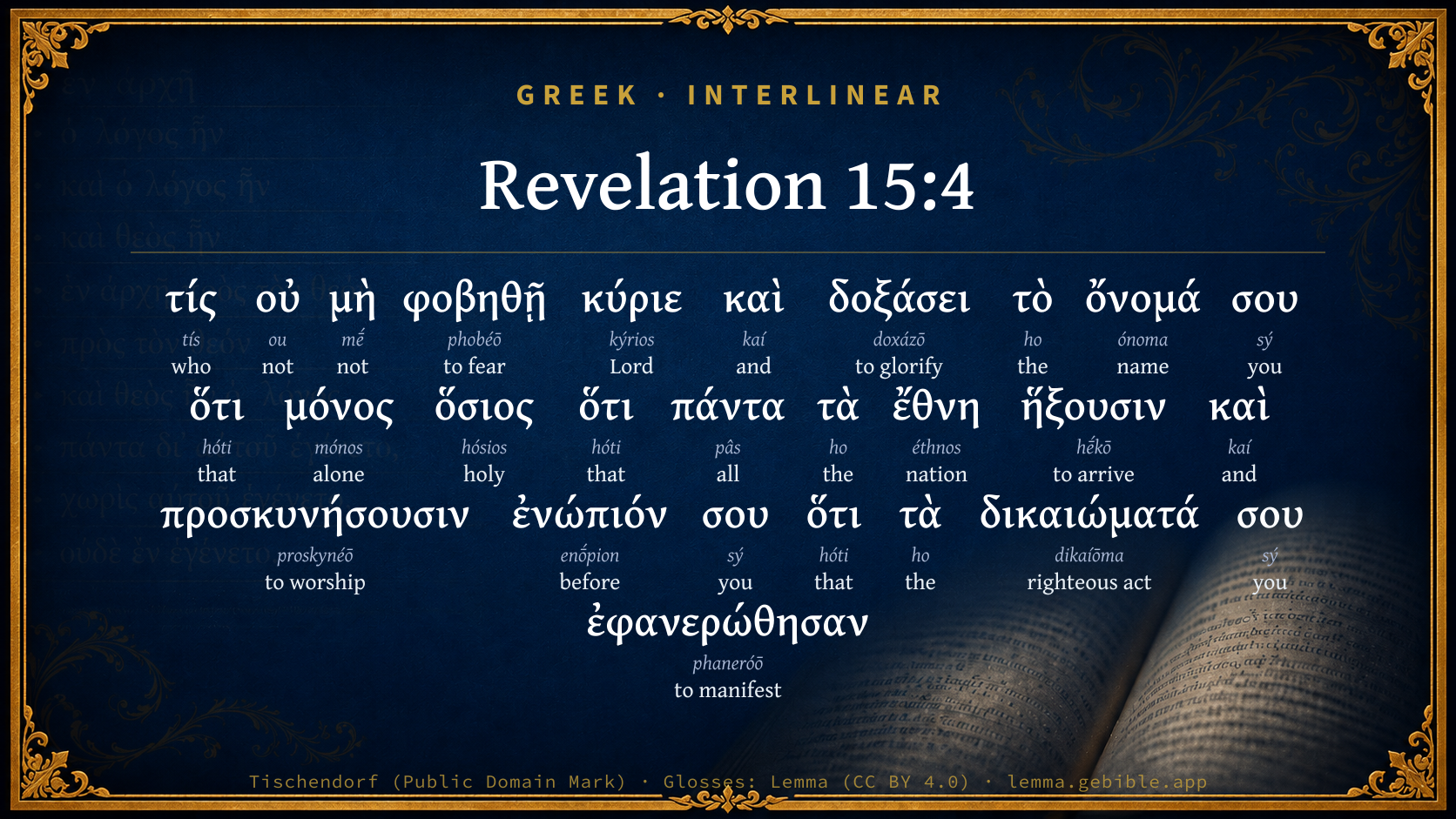
Who wouldn't fear you, Lord, And glorify your name? For you only are holy. For all the nations will come and worship before you. For your righteous acts have been revealed."
Download a study sheet
One document with this verse’s original text, its word-by-word gloss line, the meaning frame, cross-references with their text, attributed commentary, and full source and license credits — printable, and it pastes into notes with its structure intact.
This verse Autodidact and up
A passage Seminary Student
Up to 50 verses in one chapter. A passage sheet keeps up to 6 commentary sources and 12 cross-references per verse, in the order this page ranks them, and says so on the sheet whenever that leaves anything out. Ask for a single verse and you get the Autodidact verse sheet above.
Everything on this page stays free to read, with no account — the sheet is a download of what is already on screen, not access to it.
Compare translations 3
The same verse in 3 English versions, stacked beneath the original-language interlinear above. Click any original word for its lexicon entry.
Each is an independent rendering of the whole verse — the interlinear is not word-aligned to these translations.
Highlighted words mark where these versions differ — a whole-verse word diff, not a word-by-word alignment.
-
World English Bible Public Domain
Who wouldn't fear you, Lord, And glorify your name? For you only are holy. For all the nations will come and worship before you. For your righteous acts have been revealed."
-
King James Version Public Domain
Who shall not fear thee, O Lord, and glorify thy name? for thou only art holy: for all nations shall come and worship before thee; for thy judgments are made manifest.
-
unfoldingWord Literal Text CC BY-SA 4.0
Who will certainly not fear, Lord, and glorify your name? For alone holy. For all the nations will come and worship before you, because your righteous deeds have been manifested.”
unfoldingWord Literal Text — © unfoldingWord, licensed CC BY-SA 4.0. Word-aligned USFM3 via Door43 (git.door43.org/unfoldingWord/en_ult).
Show all 19 translations
Every available English version of this verse, each an independent rendering of the whole verse.
-
World English Bible Public Domain
Who wouldn't fear you, Lord, And glorify your name? For you only are holy. For all the nations will come and worship before you. For your righteous acts have been revealed."
-
Berean Standard Bible Public Domain
Who will not fear You, O Lord, and glorify Your name? For You alone are holy. All nations will come and worship before You, for Your righteous acts have been revealed.”
-
Majority Standard Bible Public Domain
Who will not fear You, O Lord, and glorify Your name? For You alone are holy. All nations will come and worship before You, for Your righteous acts have been revealed.”
-
King James Version Public Domain
Who shall not fear thee, O Lord, and glorify thy name? for thou only art holy: for all nations shall come and worship before thee; for thy judgments are made manifest.
-
American Standard Version (1901) Public Domain
Who shall not fear, O Lord, and glorify thy name? for thou only art holy; for all the nations shall come and worship before thee; for thy righteous acts have been made manifest.
-
Revised Version (1885) Public Domain
Who shall not fear, O Lord, and glorify thy name? for thou only art holy; for all the nations shall come and worship before thee; for thy righteous acts have been made manifest.
-
Geneva Bible (1599) Public Domain
Who shall not feare thee, O Lord, and glorifie thy Name! for thou onely art holy, and all nations shall come and worship before thee: for thy iudgements are made manifest.
-
Douay-Rheims (1899) Public Domain
Who shall not fear thee, O Lord, and magnify thy name? For thou only art holy: for all nations shall come, and shall adore in thy sight, because thy judgments are manifest.
-
Young's Literal Translation Public Domain
who may not fear Thee, O Lord, and glorify Thy name? because Thou alone `art' kind, because all the nations shall come and bow before Thee, because Thy righteous acts were manifested.'
-
Literal Standard Version CC BY-SA 4.0
Who may not fear You, O LORD, and glorify Your Name? Because You alone [are] holy, because all the nations will come and worship before You, because Your righteous acts were revealed.”
-
Unlocked Literal Bible CC BY-SA 4.0
Who will not fear you, Lord, and glorify your name? For you alone are holy. All nations will come and worship before you because your righteous deeds have been revealed.”
-
unfoldingWord Literal Text CC BY-SA 4.0
Who will certainly not fear, Lord, and glorify your name? For alone holy. For all the nations will come and worship before you, because your righteous deeds have been manifested.”
-
Darby Bible Public Domain
Who shall not fear [thee], O Lord, and glorify thy name? for [thou] only [art] holy; for all nations shall come and do homage before thee; for thy righteousnesses have been made manifest.
-
World Messianic Bible Public Domain
Who wouldn’t fear you, Lord, and glorify your name? For you only are holy. For all the nations will come and worship before you. For your righteous acts have been revealed.”
-
Webster's Bible Public Domain
Who shall not fear thee, O Lord, and glorify thy name? for thou only art holy: for all nations shall come and worship before thee; for thy judgments are made manifest.
-
Free Bible Version CC BY-SA 4.0
Who would not be in awe of you, Lord? Who would not glorify your name? For only you are holy. All nations will come and worship you because you have demonstrated by your actions that you do what is right!”
-
Bible in Basic English Public Domain
What man is there who will not have fear before you, O Lord, and give glory to your name? because you only are holy; for all the nations will come and give worship before you; for your righteousness has been made clear.
-
Text-Critical English NT CC BY 4.0
Who could not fear yoʋ, O Lord, and glorify yoʋr name? For yoʋ alone are holy. All will come and worship before yoʋ, for yoʋr righteous acts have been revealed.”
-
Tyndale New Testament (1534) Public Domain
Who shall not feare o lorde and gloryfy thy name? For thou only arte holy and all gentylls shall come and worshippe before the for thy iudgmentes are made manyfeste.
Literal Standard Version (2020), Covenant Press — licensed CC BY-SA 4.0. Text via the HelloAO Bible API (eBible.org). Unlocked Literal Bible (unfoldingWord) — licensed CC BY-SA 4.0. Text via the HelloAO Bible API (eBible.org). unfoldingWord Literal Text — © unfoldingWord, licensed CC BY-SA 4.0. Word-aligned USFM3 via Door43 (git.door43.org/unfoldingWord/en_ult). Free Bible Version, Dr. Jonathan Gallagher — licensed CC BY-SA 4.0. Text via the HelloAO Bible API (eBible.org).
Word by word
More ways to search: Search by grammar → Find every occurrence → Compare this word →
Practice this passage: Drill this verse → Learn its vocabulary →
- Appears 8× in the Greek New Testament
- First appears at Acts 2:27
- Part of Speech
- Adjective
- Case
- Nominative
- Number
- Singular
- Gender
- Masculine
Full Thayer's Definition
- τίς tís G5101 “who” Interrogative pronoun, Nominative, Singular, Masculine
- οὐ ou G3756 “not” Particle, Negative
- μὴ mḗ G3361 “not” Particle, Negative
- φοβηθῇ phobéō G5399 “to fear” Verb, Aorist, Passive deponent, Subjunctive, 3rd person, Singular
- κύριε kýrios G2962 “Lord” Noun, Vocative, Singular, Masculine
- καὶ kaí G2532 “and” Conjunction
- δοξάσει doxázō G1392 “to glorify” Verb, Future, Active, Indicative, 3rd person, Singular
- τὸ ho G3588 “the” Article, Accusative, Singular, Neuter
- ὄνομά ónoma G3686 “name” Noun, Accusative, Singular, Neuter
- σου sý G4771 “you” Personal pronoun, 2nd person, Genitive, Singular
- ὅτι hóti G3754 “that” Conjunction
- μόνος mónos G3441 “alone” Adjective, Nominative, Singular, Masculine
- ὅσιος hósios G3741 “holy” Adjective, Nominative, Singular, Masculine
- ὅτι hóti G3754 “that” Conjunction
- πάντα pâs G3956 “all” Adjective, Nominative, Plural, Neuter
- τὰ ho G3588 “the” Article, Nominative, Plural, Neuter
- ἔθνη éthnos G1484 “nation” Noun, Nominative, Plural, Neuter
- ἥξουσιν hḗkō G2240 “to arrive” Verb, Future, Active, Indicative, 3rd person, Plural
- καὶ kaí G2532 “and” Conjunction
- προσκυνήσουσιν proskynéō G4352 “to worship” Verb, Future, Active, Indicative, 3rd person, Plural
- ἐνώπιόν enṓpion G1799 “before” Adverb
- σου sý G4771 “you” Personal pronoun, 2nd person, Genitive, Singular
- ὅτι hóti G3754 “that” Conjunction
- τὰ ho G3588 “the” Article, Nominative, Plural, Neuter
- δικαιώματά dikaíōma G1345 “righteous act” Noun, Nominative, Plural, Neuter
- σου sý G4771 “you” Personal pronoun, 2nd person, Genitive, Singular
- ἐφανερώθησαν phaneróō G5319 “to manifest” Verb, Aorist, Passive, Indicative, 3rd person, Plural
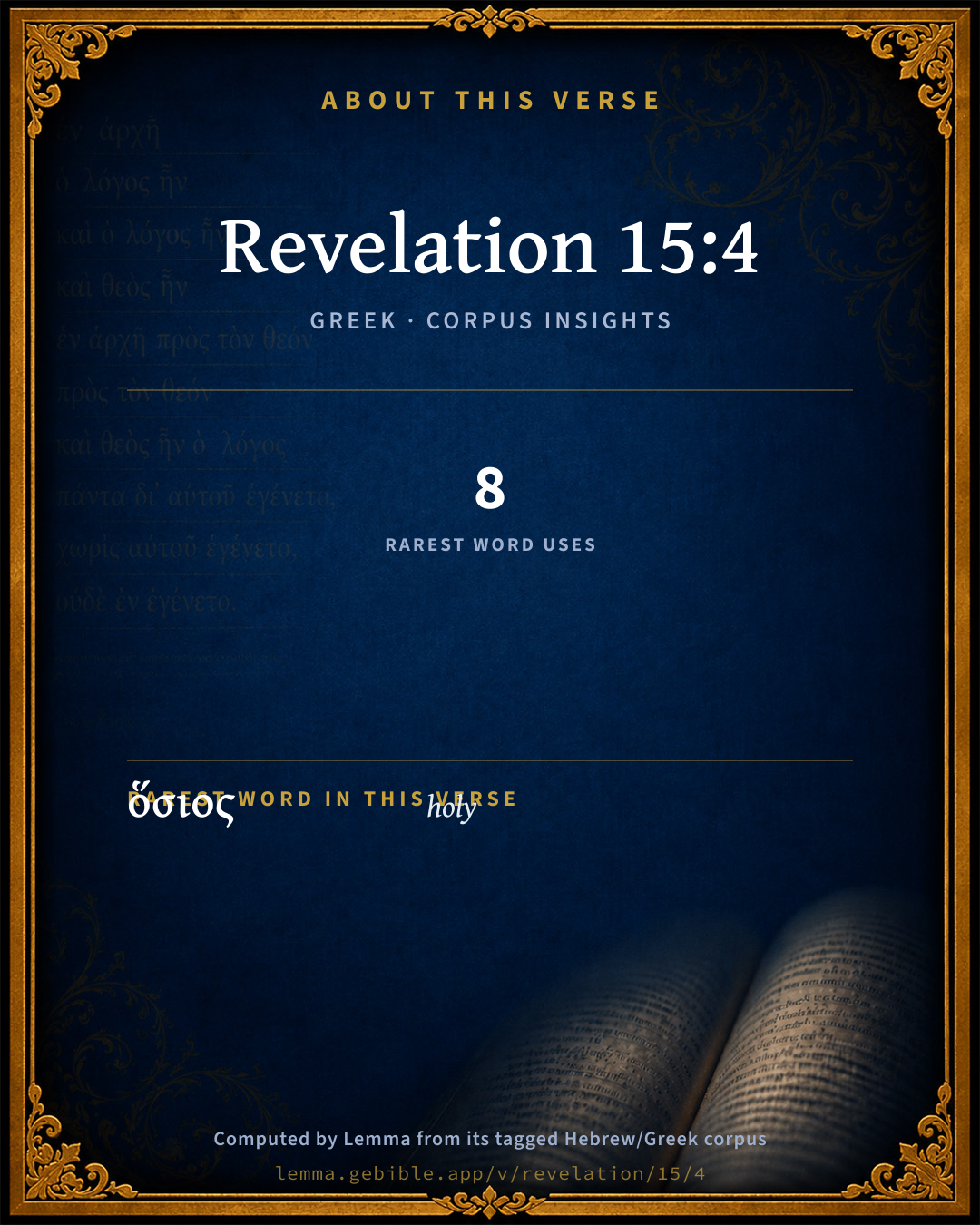
About this verse
These counts appear in no published source. They are computed here, from the morphology-tagged text and Lemma’s own curated glosses. What Lemma adds →
- 27
- words
- 20
- distinct lemmas
- Revelation
- section
Cross-references
42Topical passages linked to Revelation 15:4 in the Treasury of Scripture Knowledge — connected by theme and wording, ordered by reader-vote popularity; previews shown in the World English Bible.
- Psalms 86:9 All nations you have made will come and worship before you, Lord. They shall glorify your name.
- Jeremiah 10:7 Who should not fear you, King of the nations? for to you does it appertain; because among all the wise men of the nations, and in all their royal estate, there is none like you.
- Malachi 1:11 For from the rising of the sun even to the going down of the same, my name is great among the nations, and in every place incense will be offered to my name, and a pure offering: for my name is great among the nations," says Yahweh of Hosts.
- Psalms 22:27 All the ends of the earth shall remember and turn to Yahweh. All the relatives of the nations shall worship before you.
- Revelation 11:15 The seventh angel sounded, and great voices in heaven followed, saying, "The kingdom of the world has become the Kingdom of our Lord, and of his Christ. He will reign forever and ever!"
- Revelation 14:7 He said with a loud voice, "Fear the Lord, and give him glory; for the hour of his judgment has come. Worship him who made the heaven, the earth, the sea, and the springs of waters!"
- Isaiah 25:3 Therefore shall a strong people glorify you; a city of awesome nations shall fear you.
- Isaiah 45:23 By myself have I sworn, the word is gone forth from my mouth [in] righteousness, and shall not return, that to me every knee shall bow, every tongue shall swear.
- Isaiah 66:22–23 For as the new heavens and the new earth, which I will make, shall remain before me, says Yahweh, so shall your seed and your name remain.
- Zechariah 14:16 It will happen that everyone who is left of all the nations that came against Jerusalem will go up from year to year to worship the King, Yahweh of Hosts, and to keep the feast of tents.
- 1 Peter 1:16 because it is written, "You shall be holy; for I am holy."
- Revelation 4:8 The four living creatures, each one of them having six wings, are full of eyes around about and within. They have no rest day and night, saying, "Holy, holy, holy, holy, holy, holy, holy, holy, holy is the Lord God, the Almighty, who was and who is and who is to come!"
- Zechariah 2:11 Many nations shall join themselves to Yahweh in that day, and shall be my people; and I will dwell in the midst of you, and you shall know that Yahweh of Hosts has sent me to you.
- Revelation 16:7 I heard the altar saying, "Yes, Lord God, the Almighty, true and righteous are your judgments."
- Isaiah 26:9 With my soul have I desired you in the night; yes, with my spirit within me will I seek you earnestly: for when your judgments are in the earth, the inhabitants of the world learn righteousness.
- Isaiah 66:18–20 For I [know] their works and their thoughts: [the time] comes, that I will gather all nations and languages; and they shall come, and shall see my glory.
- Psalms 89:7 A very awesome God in the council of the holy ones, To be feared above all those who are around him?
- Revelation 19:2 for true and righteous are his judgments. For he has judged the great prostitute, who corrupted the earth with her sexual immorality, and he has avenged the blood of his servants at her hand."
- Psalms 117:1–2 Praise Yahweh, all you nations! Extol him, all you peoples!
- Isaiah 6:3 One called to another, and said, "Holy, holy, holy, is Yahweh of Hosts! The whole earth is full of his glory!"
- Hosea 3:5 Afterward the children of Israel shall return, and seek Yahweh their God, and David their king, and shall come with trembling to Yahweh and to his blessings in the last days.
- Romans 15:9 and that the Gentiles might glorify God for his mercy. As it is written, "Therefore will I give praise to you among the Gentiles, And sing to your name."
- Psalms 111:9 He has sent redemption to his people. He has ordained his covenant forever. His name is holy and awesome!
- Zechariah 8:20–23 Thus says Yahweh of Hosts: "Many peoples, and the inhabitants of many cities will yet come;
- Psalms 99:9 Exalt Yahweh, our God. Worship at his holy hill, For Yahweh, our God, is holy!
- Habakkuk 1:12 Aren't you from everlasting, Yahweh my God, my Holy One? We will not die. Yahweh, you have appointed him for judgment. You, Rock, have established him to punish.
- 2 Thessalonians 1:10–12 when he comes to be glorified in his saints, and to be admired among all those who have believed (because our testimony to you was believed) in that day.
- Revelation 3:7 "To the angel of the assembly in Philadelphia write: "He who is holy, he who is true, he who has the key of David, he who opens and no one can shut, and who shuts and no one opens, says these things:
- 1 Samuel 2:2 There is none holy as Yahweh; For there is none besides you, Neither is there any rock like our God.
- Psalms 22:3 But you are holy, You who inhabit the praises of Israel.
- Psalms 105:7 He is Yahweh, our God. His judgments are in all the earth.
- Revelation 6:10 They cried with a loud voice, saying, "How long, Master, the holy and true, until you judge and avenge our blood on those who dwell on the earth?"
- Isaiah 60:5 Then you shall see and be radiant, and your heart shall thrill and be enlarged; because the abundance of the sea shall be turned to you, the wealth of the nations shall come to you.
- Luke 12:4–5 "I tell you, my friends, don't be afraid of those who kill the body, and after that have no more that they can do.
- Psalms 22:23 You who fear Yahweh, praise him! All you descendants of Jacob, glorify him! Stand in awe of him, all you descendants of Israel!
- Psalms 99:5 Exalt Yahweh our God. Worship at his footstool. He is Holy!
- Psalms 97:8 Zion heard and was glad. The daughters of Judah rejoiced, Because of your judgments, Yahweh.
- Isaiah 24:15 Therefore glorify Yahweh in the east, even the name of Yahweh, the God of Israel, in the isles of the sea!
- Isaiah 57:15 For thus says the high and lofty One who inhabits eternity, whose name is Holy: I dwell in the high and holy place, with him also who is of a contrite and humble spirit, to revive the spirit of the humble, and to revive the heart of the contrite.
- Jeremiah 16:19 Yahweh, my strength, and my stronghold, and my refuge in the day of affliction, to you shall the nations come from the ends of the earth, and shall say, Our fathers have inherited nothing but lies, [even] vanity and things in which there is no profit.
- Jeremiah 5:22 Don't you fear me? says Yahweh: won't you tremble at my presence, who have placed the sand for the bound of the sea, by a perpetual decree, that it can't pass it? and though the waves of it toss themselves, yet they can't prevail; though they roar, yet they can't pass over it.
- Exodus 15:14–16 The peoples have heard. They tremble. Pangs have taken hold on the inhabitants of Philistia.
Cross-references courtesy of OpenBible.info (CC BY 4.0).
Lesson kit
Teaching starters — assembled from the data on this page, not authored interpretation. Every prompt links to the verse data it draws on. Edit before teaching.
Revelation, in the Revelation, opens this verse with 27 words (20 distinct Greek lemmas). Its most distinctive word is hósios (“holy”). A historical commentator’s framing appears above. Read the whole chapter for the surrounding context.
Discussion questions
- What does “holy” (hósios) contribute to the verse as a whole?
- How does Acts 2:27, which shares the word «holy», read alongside this verse?
- What does the repetition of “the” (3× in this one verse) do in this verse?
- These translations render this verse differently. What is at stake in choosing one wording over another?
- Compare how Tyndale Open Study Notes and Bengel's Gnomon read this verse. Where do they agree or differ?
Things to notice
- These translations choose different wording for 19 words in this verse.
- “the” occurs 3× in this single verse.
- 20 distinct Greek lemmas span 27 words in this verse.
Commentary
Notes on Revelation 15:4 from classic Christian and Jewish commentators (each source and its license shown beneath its notes). The classic Christian expositions comment on the surrounding passage and are grouped to its opening verse, so a note may address several verses; the Jewish commentaries on the Tanakh (Rashi and others) are per-verse, so they appear only where the commentator wrote on this verse.
Lemma curates 59 commentaries, every one of them public domain or Creative Commons licensed, each selected and text-cleaned for this edition rather than reprinted as found. About our sources →
Tyndale Open Study Notes
Tyndale Open Resources
Tyndale Open Study Notes — © Tyndale Open Resources, licensed CC BY-SA 4.0. Text via the HelloAO Bible API.
Bengel's Gnomon
Johann Albrecht Bengel
Bengel's Gnomon of the New Testament — English translation (T&T Clark, Edinburgh, 1860) — public domain. Text from a community e-Sword module.
Expositor's Greek Testament
ed. W. Robertson Nicoll
The Expositor's Greek Testament, edited by W. Robertson Nicoll (1897–1910) — public domain. Text from a community e-Sword module.
Jamieson, Fausset & Brown
Robert Jamieson, A. R. Fausset & David Brown
Jamieson, Fausset & Brown — Commentary Critical and Explanatory on the Whole Bible (1871) — public domain (CC PDM 1.0). Text via the HelloAO Bible API.
Adam Clarke's Commentary
Adam Clarke's Commentary on the Bible (1810–1826) — public domain. Text from a community e-Sword/MySword module.
Ellicott's Commentary for English Readers
A Bible Commentary for English Readers, edited by Charles John Ellicott (1878–1897) — public domain. Text from a community e-Sword module.
The Cambridge Bible for Schools and Colleges
gen. ed. J. J. S. Perowne
The Cambridge Bible for Schools and Colleges (gen. ed. J. J. S. Perowne; Cambridge University Press, 1878–1918) — public domain. Text from a community e-Sword module.
John Gill's Exposition
John Gill's Exposition of the Whole Bible (1746–1763) — public domain (CC PDM 1.0). Text via the HelloAO Bible API.
Trapp's Complete Commentary
John Trapp
John Trapp, A Commentary or Exposition upon All the Books of the Old and New Testament (1647–1656) — public domain. Text from a community e-Sword module.
Albert Barnes' Notes on the Bible
Albert Barnes' Notes on the Bible (1834–1885) — public domain. Text from a community e-Sword/MySword module.
Matthew Poole's English Annotations
Matthew Poole's English Annotations on the Holy Bible (1683–1685) — public domain. Text from a community e-Sword/MySword module.
Whedon's Commentary on the Bible
Daniel D. Whedon
Daniel D. Whedon (gen. ed.), Commentary on the Old and New Testaments (1874–1909) — public domain. Text from a community e-Sword module.
The Pulpit Commentary
The Pulpit Commentary (1880–1919), ed. H.D.M. Spence-Jones & Joseph S. Exell — public domain. Text from a community e-Sword module.
The People's New Testament
B. W. Johnson
B. W. Johnson's The People's New Testament with Notes (1889–1891) — public domain. Electronic text from the Christian Classics Ethereal Library (CCEL) ThML edition.
Cambridge Greek Testament for Schools and Colleges
Cambridge Greek Testament for Schools and Colleges (Cambridge University Press, 1896; 21 vols, various authors incl. Carr, Maclear, Plummer, Farrar, Lumby, Moule, M. R. James, Simcox) — public domain. Text from a community e-Sword module.
Vincent's Word Studies in the New Testament
Marvin R. Vincent
Marvin R. Vincent, Word Studies in the New Testament (1887–1900) — public domain. Text from a community e-Sword/MySword module.