Galatians 2:15

Greek (Tischendorf 8th ed.) Galatians 2:15 appears in the Greek New Testament. The text above is from the Tischendorf 8th edition. Each word links to its Strong’s number and a concise gloss. Click any word for its full Thayer’s Greek Lexicon entry.
Download image
Cite this verse

Galatians 2:15 (World English Bible). Public Domain. Lemma interlinear Bible study tool, https://lemma.gebible.app/v/galatians/2/15.

Show BibTeX & RIS
BibTeX
RIS
English Translation
"We, being Jews by nature, and not Gentile sinners,
World English Bible · Public Domain
Download a study sheet

One document with this verse’s original text, its word-by-word gloss line, the meaning frame, cross-references with their text, attributed commentary, and full source and license credits — printable, and it pastes into notes with its structure intact.

This verse Autodidact and up

Study sheet (.html) Plain text (.txt)

A passage Seminary Student

Up to 50 verses in one chapter. A passage sheet keeps up to 6 commentary sources and 12 cross-references per verse, in the order this page ranks them, and says so on the sheet whenever that leaves anything out. Ask for a single verse and you get the Autodidact verse sheet above.

Everything on this page stays free to read, with no account — the sheet is a download of what is already on screen, not access to it.

Want to remove ads? Support Godless Engineer
Compare translations 3

The same verse in 3 English versions, stacked beneath the original-language interlinear above. Click any original word for its lexicon entry.

Each is an independent rendering of the whole verse — the interlinear is not word-aligned to these translations.

Highlighted words mark where these versions differ — a whole-verse word diff, not a word-by-word alignment.

  • World English Bible Public Domain
    "We, being Jews by nature, and not Gentile sinners,
  • King James Version Public Domain
    We who are Jews by nature, and not sinners of the Gentiles,
  • unfoldingWord Literal Text CC BY-SA 4.0
    We Jews by birth, and not sinners from the Gentiles;

unfoldingWord Literal Text — © unfoldingWord, licensed CC BY-SA 4.0. Word-aligned USFM3 via Door43 (git.door43.org/unfoldingWord/en_ult).

Versions to compare (up to 4)

3 of 4 selected

Show all 19 translations

Every available English version of this verse, each an independent rendering of the whole verse.

  • World English Bible Public Domain
    "We, being Jews by nature, and not Gentile sinners,
  • Berean Standard Bible Public Domain
    We who are Jews by birth and not Gentile “sinners”
  • Majority Standard Bible Public Domain
    We who are Jews by birth and not Gentile “sinners”
  • King James Version Public Domain
    We who are Jews by nature, and not sinners of the Gentiles,
  • American Standard Version (1901) Public Domain
    We being Jews by nature, and not sinners of the Gentiles,
  • Revised Version (1885) Public Domain
    We being Jews by nature, and not sinners of the Gentiles,
  • Geneva Bible (1599) Public Domain
    We which are Iewes by nature, and not sinners of the Gentiles,
  • Douay-Rheims (1899) Public Domain
    We by nature are Jews, and not of the Gentiles sinners.
  • Young's Literal Translation Public Domain
    we by nature Jews, and not sinners of the nations,
  • Literal Standard Version CC BY-SA 4.0
    We by nature Jews, and not sinners of the nations,
  • Unlocked Literal Bible CC BY-SA 4.0
    We ourselves are Jews by birth and not Gentile sinners;
  • unfoldingWord Literal Text CC BY-SA 4.0
    We Jews by birth, and not sinners from the Gentiles;
  • Darby Bible Public Domain
    We, Jews by nature, and not sinners of [the] nations,
  • World Messianic Bible Public Domain
    “We, being Jews by birth and not Gentile sinners,
  • Webster's Bible Public Domain
    We who are Jews by nature, and not sinners of the Gentiles,
  • Free Bible Version CC BY-SA 4.0
    We may be Jews by birth, and not ‘sinners’ like the foreigners,
  • Bible in Basic English Public Domain
    We being Jews by birth, and not sinners of the Gentiles,
  • Text-Critical English NT CC BY 4.0
    We who are Jews by nature and not Gentile sinners
  • Tyndale New Testament (1534) Public Domain
    We which are Iewes by nature and not synners of the gentyls,

Literal Standard Version (2020), Covenant Press — licensed CC BY-SA 4.0. Text via the HelloAO Bible API (eBible.org). Unlocked Literal Bible (unfoldingWord) — licensed CC BY-SA 4.0. Text via the HelloAO Bible API (eBible.org). unfoldingWord Literal Text — © unfoldingWord, licensed CC BY-SA 4.0. Word-aligned USFM3 via Door43 (git.door43.org/unfoldingWord/en_ult). Free Bible Version, Dr. Jonathan Gallagher — licensed CC BY-SA 4.0. Text via the HelloAO Bible API (eBible.org).

Word by word

More ways to search: Search by grammar → Find every occurrence → Compare this word →

Practice this passage: Drill this verse → Learn its vocabulary →

φύσει
phýsis
G5449
“nature”
Noun, Dative, Singular, Feminine
Part of Speech
Noun
Case
Dative
Number
Singular
Gender
Feminine
Full Thayer's Definition

Origin: from G5453

TDNT: 13:11,1

1. nature a. the nature of things, the force, laws, order of nature b. as opposed to what is monstrous, abnormal, perverse c. as opposed what has been produced by the art of man: the natural branches, i.e. branches by the operation of nature d. birth, physical origin e. a mode of feeling and acting which by long habit has become nature f. the sum of innate properties and powers by which one person differs from others, distinctive native peculiarities, natural characteristics: the natural strength, ferocity, and intractability of beasts
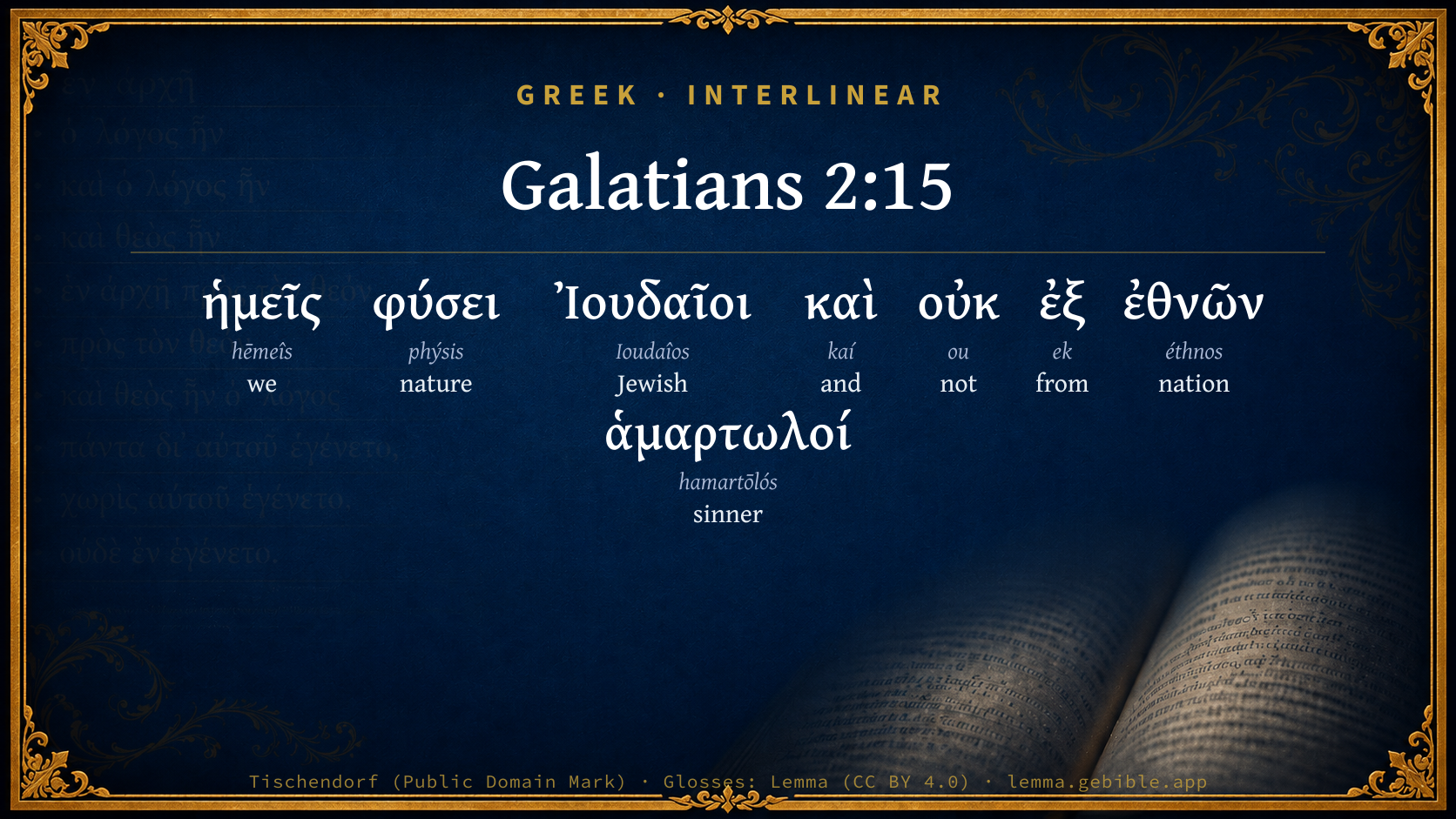
  1. ἡμεῖς hēmeîs G2249 “we” Personal pronoun, 1st person, Nominative, Plural
  2. Ἰουδαῖοι Ioudaîos G2453 “Jewish” Adjective, Nominative, Plural, Masculine
  3. καὶ kaí G2532 “and” Conjunction
  4. οὐκ ou G3756 “not” Particle, Negative
  5. ἐξ ek G1537 “from” Preposition
  6. ἐθνῶν éthnos G1484 “nation” Noun, Genitive, Plural, Neuter
  7. ἁμαρτωλοί hamartōlós G268 “sinner” Adjective, Nominative, Plural, Masculine

About this verse

These counts appear in no published source. They are computed here, from the morphology-tagged text and Lemma’s own curated glosses. What Lemma adds →

8
words
8
distinct lemmas
Pauline Epistles
section

Notable vocabulary

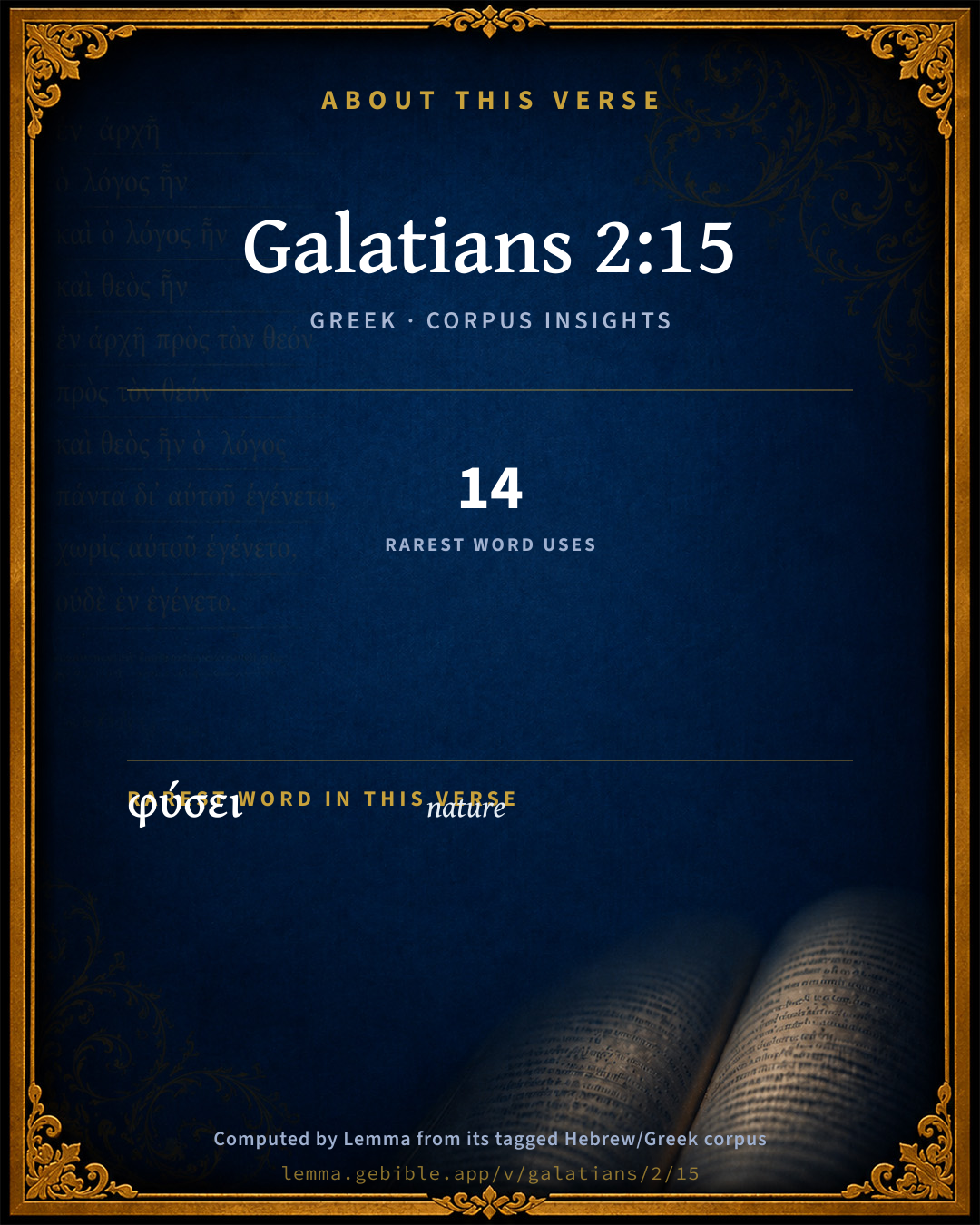
The rarest word here is φύσει nature G5449 — appearing just 14 times in the whole Greek New Testament.

Shared distinctive vocabulary

φύσει nature G5449 occurs in 11 verses of the Greek New Testament. Also found in:

Cross-references

12

Topical passages linked to Galatians 2:15 in the Treasury of Scripture Knowledge — connected by theme and wording, ordered by reader-vote popularity; previews shown in the World English Bible.

  • Ephesians 2:3 among whom we also all once lived in the lust of our flesh, doing the desires of the flesh and of the mind, and were by nature children of wrath, even as the rest.
  • Titus 3:3 For we were also once foolish, disobedient, deceived, serving various lusts and pleasures, living in malice and envy, hateful, and hating one another.
  • Romans 3:9 What then? Are we better than they? No, in no way. For we previously charged both Jews and Greeks, that they are all under sin.
  • Ephesians 2:11–12 Therefore remember that once you, the Gentiles in the flesh, who are called "uncircumcision" by that which is called "circumcision," (in the flesh, made by hands);
  • John 8:39–41 They answered him, "Our father is Abraham." Jesus said to them, "If you were Abraham's children, you would do the works of Abraham.
  • Romans 4:16 For this cause it is of faith, that it may be according to grace, to the end that the promise may be sure to all the seed, not to that only which is of the law, but to that also which is of the faith of Abraham, who is the father of us all.
  • Philippians 3:4 though I myself might have confidence even in the flesh. If any other man thinks that he has confidence in the flesh, I yet more:
  • 1 Samuel 15:18 and Yahweh sent you on a journey, and said, 'Go, and utterly destroy the sinners the Amalekites, and fight against them until they are consumed.'
  • Matthew 3:7–9 But when he saw many of the Pharisees and Sadducees coming for his baptism, he said to them, "You offspring of vipers, who warned you to flee from the wrath to come?
  • Matthew 9:11 When the Pharisees saw it, they said to his disciples, "Why does your teacher eat with tax collectors and sinners?"
  • Mark 7:26–28 Now the woman was a Greek, a Syrophoenician by race. She begged him that he would cast the demon out of her daughter.
  • Acts 22:21 "He said to me, 'Depart, for I will send you out far from here to the Gentiles.'"

Cross-references courtesy of OpenBible.info (CC BY 4.0).

Commentary

Notes on Galatians 2:15 from classic Christian and Jewish commentators (each source and its license shown beneath its notes). The classic Christian expositions comment on the surrounding passage and are grouped to its opening verse, so a note may address several verses; the Jewish commentaries on the Tanakh (Rashi and others) are per-verse, so they appear only where the commentator wrote on this verse.

Lemma curates 59 commentaries, every one of them public domain or Creative Commons licensed, each selected and text-cleaned for this edition rather than reprinted as found. About our sources →

Jamieson, Fausset & Brown

Robert Jamieson, A. R. Fausset & David Brown

Connect these verses together, and read with most of the oldest manuscripts "But" in the beginning of Gal 2:16 : "We (I and thou, Peter) by nature (not by proselytism), Jews, and not sinners as (Jewish language termed the Gentiles) from among the Gentiles, YET (literally, 'BUT') knowing that . . . even we (resuming the 'we' of Gal 2:15, 'we also,' as well as the Gentile sinners; casting away trust in the law), have believed," &c.

Jamieson, Fausset & Brown — Commentary Critical and Explanatory on the Whole Bible (1871) — public domain (CC PDM 1.0). Text via the HelloAO Bible API.

Ellicott's Commentary for English Readers

(15) Who are.—It will be seen that these words are in italics, and have to be supplied in the Greek. The Received text, which is followed in our version, also I omits a connecting particle, found in the best MSS., at the beginning of Gal_2:16. Restoring this, a better way of taking the whole passage appears to be to supply only the word “are” in the present verse, and make the next mark a certain opposition to it: “We are (indeed) by birth Jews . . . but” (or, and yet), “knowing as we did that the Law cannot justify any one, we believed on Christ.” The first clause is concessive: “We grant you that we were born Jews, and not Gentiles: members of the chosen race, and not sinners.” The next clause explains why it was that, with all these privileges, the Christian, though thus born a Jew, transferred his allegiance from the Law to Christ. The reason was that the Law failed in the one great object—to justify us or obtain our acquittal in the sight of God.

By nature—i.e., by birth. The privileges of the Jew belonged to all Jews alike, simply by the more fact that they were Jews.

Sinners.—The word was almost a synonym for “heathen” in the mouth of a strict Jew. Hence there is a slight irony in its use by St. Paul. “I grant you that from our lofty position we can look down upon those poor Gentiles, sinners by virtue of mere descent.”

Of the Gentiles.—”Of” in the sense of natural descent: “Of Gentile parentage (and therefore) sinners.”

(15-21) The section which follows is, in form at least, still a continuation of the rebuke addressed to St. Peter; but the Apostle soon drifts away from this, and begins imperceptibly a comment upon his own words, which is addressed directly to the Galatians. We are thus led, without any real break, from the historical and personal to the doctrinal portion of the Epistle. It is impossible to say exactly where the speech at Antioch ends and where the comment upon it begins; the Apostle glides from one to the other without any conscious division in his own mind. A similar mingling of narrative and comment is found in St. John’s Gospel: compare, e.g., Joh_3:14-21; Joh_3:31-36, the first of which sections formally belongs to the discourse with Nicodemus, and the second to the reply of John the Baptist, though it is clear that much after comment of the Evangelist’s is interwoven with them. If we are to draw a dividing line at all in the section before us, it might be said that Gal_2:15-16 were still most nearly a paraphrase of the words actually addressed to St. Peter; while from Gal_2:17 onwards the Apostle is giving the rein more freely to his own reflections. The sequence of the thought seems to be somewhat as follows:—

We belong by our birth to a privileged people. We are not of Gentile descent, and therefore abandoned to our sins. And yet, with all our privileges, we found that we could get no justification whatever from the Law; and this sent us to Christ. We thus abdicated our privileged position; we put ourselves on the same level as the Gentiles, and became (in the eye of the Law) sinners like them. Sinners? Must we then admit that all Christ has done for us is to make us sinners? Far be so irreverent a thought. Our sin consists not in quitting the Law, but in returning to that which has once been abandoned. The function of the Law was preparatory and transitional. The Law itself taught me to expect its own abrogation. It was a stage on the way to Christ. To Him have I given in a complete adhesion. In His death I am severed from ancient ties. In His death I ceased to have any life of my own. All the life I have, man as I am, I owe to Christ, my Saviour. Thus I accept and do not reject and frustrate the gift so freely offered me: whereas, by going back to the Law for justification, I should be practically declaring the death of Christ useless and unprofitable.

A Bible Commentary for English Readers, edited by Charles John Ellicott (1878–1897) — public domain. Text from a community e-Sword module.

Joseph Benson's Commentary

Gal 2:15-16. We — St. Paul, to spare St. Peter, drops the first person singular, and speaks in the plural number; Gal 2:18, he speaks in the first person singular again by a figure, and without a figure, Gal 2:19, &c. Who are Jews by nature — By birth, and not proselytes. As in the first part of his discourse, where the apostle speaks only of himself and Peter, he meant to speak of all the teachers of the gospel; so in this second part, where he describes his own state, he in effect describes the state of believers in general. And not sinners of the Gentiles — That is, not sinful Gentiles; not such gross, enormous, abandoned sinners as the heathen generally are. It is justly observed by Dr. Whitby here, that the word sinners in Scripture signifies great and habitual sinners; and that the Jews gave the Gentiles that appellation, on account of their idolatry and other vices. Accordingly, Mat 26:45, the clause, the Son of man is betrayed into the hands of sinners, means, is delivered into the hands of the Gentiles, as is evident from Mat 20:18-19. Knowing that a man is not justified by the works of the law — Not even of the moral law, much less of the ceremonial; but by the faith of Jesus Christ — The faith which Jesus Christ hath enjoined and requires as the means of men’s justification, namely, faith in the gospel, in its important truths and precious promises: or, rather, by faith in Jesus Christ, as the true Messiah, the Son of God, in whom alone there is salvation for guilty, depraved, weak, and wretched sinners; the faith whereby we make application to him, and rely on him for salvation, present and eternal: learn of him as a Teacher, depend on him as a Mediator, become subject to him as a Governor, and prepare to meet him as a Judge. See on Rom 3:28; Rom 4:1-25. Even we — And how much more must the Gentiles, who have still less pretence to depend on their own works? have believed in Jesus Christ — To this great purpose; that we might be justified — As has been said before; by faith in Christ — This is the method that we, who were brought up Jews, have taken, as being thoroughly sensible we could be justified and saved no other way: for by the works of the law, whether ceremonial or moral, shall no flesh living, whether Jew or Gentile, be justified — Since no human creature is capable of fully answering its demands, or can pretend to have paid a universal and unsinning obedience to it. Hitherto the apostle had been considering that single question, “Are Christians obliged to observe the ceremonial law?” But he here insensibly goes further, and by citing this passage, shows that what he spoke directly of the ceremonial, included also the moral law. For David undoubtedly did so, when he said, (Psa 143:2, the place here referred to,) In thy sight shall no man living be justified; which the apostle likewise explains, (Rom 3:19-20,) in such a manner as can agree only with the moral law.

Joseph Benson's Commentary on the Old and New Testaments (1811–1818) — public domain. Text from a community e-Sword module.

Tyndale Open Study Notes

Tyndale Open Resources

2:15 Gentiles were ‘sinners’ in that they did not have the law and could not obey God’s commands. Paul was using the categories of Jewish thinking (cp. Matt 15:21-28; 26:45; Luke 6:32-34; 18:9-14) with strong irony in light of the sinful condition of all people (Gal 2:16; Rom 3:23).

Tyndale Open Study Notes — © Tyndale Open Resources, licensed CC BY-SA 4.0. Text via the HelloAO Bible API.

Bengel's Gnomon

Johann Albrecht Bengel

Gal 2:15. Ἡμεῖς, we) Paul, sparing the person of Peter, dismisses the second person singular, and passes to the first person plural, then figuratively to the first person singular, Gal 2:18; lastly, I in its proper [literal] meaning, Gal 2:19-20. We, although Jews by nature, and not sinners of the Gentiles, viz., we have been: comp. the preterite knowing—we have believed. This we, after the reason[12] has been interposed in the way of parenthesis, is taken up again in the following verse with epitasis [an emphatic addition, viz., even we] and reaches to we have believed.—φύσει, by nature) not merely proselytes.—οὐκ ἐξ ἐθνῶν ἁμαρτωλοὶ, not sinners of the Gentiles) Paul openly declares it as a thing acknowledged, that the Gentiles, inasmuch as they did not even possess the law, are sinners, while the Jews, on the contrary, had the law or even works; Tit 3:5. Then by the way he grants, that it is only in Christ that the Jews can have communion with them; but he especially declares, as a thing acknowledged, the justification of the Gentiles by faith, and he also infers the same thing concerning the Jews. To this refers the expression sinners, Gal 2:17, note.[13]

[12] By ‘aetiologia.’ See Append.

[13] Sinners such as the Gentiles heretofore were justly regarded.—ED.

Bengel's Gnomon of the New Testament — English translation (T&T Clark, Edinburgh, 1860) — public domain. Text from a community e-Sword module.

Meyer's Critical & Exegetical Commentary

Heinrich August Wilhelm Meyer

Gal_2:15. A continuation of the address to Peter down to Gal_2:21. So Chrysostom, Theodoret, Jerome, Estius, Bengel, Rosenmüller, Tittmann (Opusc. p. 365), Knapp (Scr. var. arg. II. p. 452 f.), Flatt, Winer, Rückert, Schott, Baumgarten-Crusius, de Wette and Möller, Hilgenfeld, Ewald, Holsten. Others have looked upon Gal_2:15-21 as addressed to the Galatians (Theodore of Mopsuestia, Oecumenius, Calvin, Beza, Grotius, Semler, Koppe, Matthies, Hermann, Hofmann, Wieseler, Reithmayr); but to this view it may be objected, that Paul himself does not indicate the return to his readers until Gal_3:1, and that the bare, brief reproach in Gal_2:14 would neither correspond to the historical character of so important an event, nor stand in due relation with the purpose for which Paul narrates it (see on Gal_2:11); as indeed he himself has in Gal_2:11; Gal_2:14 so earnestly prepared the way for, and announced, his opposition, that the reader could not but expect something more than that mere questionso hurriedly thrown outof indignant surprise.[92] And how could he have written to his (for the most part) Gentile-Christian readers ἡμεῖς φύσει Ἰουδαῖοι κ.τ.λ., without telling them whom he meant thereby? Just as little can we assume that Paul again turns to the Galatians with καὶ ἡμεῖς in Gal_2:16 (Calovius, Paulus), or in Gal_2:17 (Luther, Calvin), or in Gal_2:18 (Cajetanus, Neander); or that he (Erasmus and Estius by way of suggestion, Usteri) has been imperceptibly led away from the thread of his historical statement, so that it is not possible to show how much belongs to the speech at Antioch. No, the whole of this discourse (Gal_2:15-21)thoroughly unfolding the truth from principles, and yet so vivid, and in fact annihilating his opponentharmonizes so fully with the importance of a public step against Peter, as well as with the object which Paul had in view in relating this occurrence to the Galatians especially (among whom indeed these very principles, against which Peter offended, were in great danger), that, up to its grave conclusion ἄρα Χριστὸς δωρεὰν ἀπέθανεν (Gal_2:21), it must be regarded as an unityas the effusion directed against Peter at Antioch; but, at the same time, it cannot be maintained that Paul spoke the words quite literally thus, as he here, after so long a lapse of time, quotes from lively recollection of the scene which he could not forget.

ἡμεῖς φύσει Ἰουδαῖοι, καὶ οὐκ ἐξ ἐθνῶν ἁμαρτ.] Paul begins his dogmatic explanation in regard to the reproach expressed in Gal_2:14 with a concession: We are Jews by birth, (in this Paul feels the whole advantage of belonging to the ancient holy people of God, Rom_3:1 f., Rom_9:1 ff.), and not sinners of the Gentiles (by Gentile descent). Gentiles as such, because they are ἄνομοι and ἄθεοι (Rom_2:12; 1Co_9:21; Eph_2:12), are to the Israelite consciousness ἁμαρτωλοί and ἄδικοι (1Sa_15:18; Tob_13:6; Wis_10:20 : comp. Luk_18:32; Luk_24:7; 1Co_6:1); and from thisthe theocraticalpoint of view Paul says ἐξ ἐθνῶν ἁμαρτωλοί, born Gentiles, and as such sinners, as all Gentiles are. Not as if he would look upon the Ἰουδαίους as not sinners; according to the sequel, indeed, they needed justification equally with the Gentiles (see Rom_2:3; Rom_2:22 f., Gal_5:12; Eph_2:2 f.). But the passage affirms that the Jewsas the possessors of the revelation and the law, of the ancient theocratic υἱοθεσία and the promises (Rom_9:4), and as belonging to the holy ἀπαρχή and root-stock of the theocracy (Rom_11:16)possessed as their own a religious consecration of life, whereby they stood on a certain stage of righteousness in virtue of which, although it was not that of the true δικαιοσύνη, they were nevertheless exalted far above the Gentiles in their natural state of sinfulness (Eph_2:12; Tit_3:5). Luther well says: Nos natura Judaei in legali justitia excedimus quidem gentes, qui peccatores sunt, si nobis conferantur, ut qui nec legem nec opera ejus habent; verum non in hoc justi sumus coram Deo, externa est ilia justitia nostra. If ἁμαρτωλοί had not been unduly understood according to the purely ethical idea (the opposite of sinlessness), the discourse would not have been so broken up as by Elsher, Er. Schmidt, and others: Nos natura Judaei, licet non ex gentibus, peccatores; comp. Paulus. Hofmanns view is also similar: that the apostle excluded from himself that sinfulness only, which was implied in Gentile descentcharacteristic of those not belonging naturally to the Jewish nationality; comp. his Schriftbew. I. p. 564, 610 (our sinfulness does not bear the characteristic Gentile shape). Paul wishes, not to affirm the different nature of the sinfulness of those born as Jews and Gentiles respectively, but to recall the theocratic advantage of the Jews over the sinners of Gentile descent; in spite of which advantage, however, etc. (Gal_2:16). The contrast lies in the idea of a theocratic sanctitas, peculiar to the born Jew, on the one hand;[93] and on the other, of a profane vitiositas, wherewith the Gentile descent is burdened.

ἡμεῖς] has the emphasis: We on our part (I and thou), μέν is not to be supplied here (Rückert, Schott); but the concession in Gal_2:15 stands by itself, and the contrast is added without preparation in Gal_2:16. Comp. Fritzsche, ad Rom. II. p. 423; Bremi, ad Isocr. Paneg. 105, quando altera pars per δέ sit evehenda. The contrast thus strikes one more vividly, and hence the absence of the μέν can afford no ground for calling in question (with Hofmann) the sense of a concession. Comp. also Kühner, ad Xen. Mem. i. 3. 15. On the difference between Ἰουδαῖοι (theocratic bond of union) and Ἑβραῖοι (nationality), see Wieseler, über d. Hebräerbrief 1861, II. p. 28.

[92] Indeed the practical renunciation (not mere denial) of the principle of Christian freedom required a renewed apology for, and vindication of, the latter; especially as Paul had called Peter to account before the assembled church, whereby the act assumed a solemnity to which the brief question in ver. 14 alone could in no way seem adequate, and least of all could it suffice to procure a duly proportionate satisfaction for the offence given to the church (ver. 11). He does not, however, demonstrate his explanation to Peter (Wieselers difficulty), but presents it in the most vivid and striking dialectic, compressing everything which would have afforded matter for a very copious demonstration sharply and sternly, towards the defeat of the great opponent who had been unfaithful to himself. Hofmann inconsiderately holds that, if Paul after the concession ἐθνικῶς ζῇς κ. οὐκ Ἰουδαΐκως had thus explained himself in a detailed statement to Peter, he would have acted absurdly. It would have been absurd, if Paul, in order to say the two or three words to Peter recorded in ver. 14, had brought the whole act of the κατὰ πρόσωπον αὐτῷ ἀντέστην before the assembled church.

[93] Calvin appropriately says: Quia autem promissio haereditariam benedictionem faciebat, ideo naturale vocatur hoc bonum.

Meyer — Critical and Exegetical Commentary on the New Testament — English translation by Peter Christie, edited by Frederick Crombie (T&T Clark, 1880) — public domain. Text from a community e-Sword module.

Expositor's Greek Testament

ed. W. Robertson Nicoll

Gal 2:15-21 . JEWS THEMSELVES WERE DRIVEN TO RESORT TO CHRIST AS SINNERS FOR PARDON BECAUSE THEY COULD NOT OBTAIN JUSTIFICATION BY PERFECT OBEDIENCE TO THE LAW NOT THAT THEY MIGHT THEREBY BECOME MORE FREE TO SIN, BUT FOR THE SAKE OF NEW LIFE IN CHRIST, EVEN AS PAUL HIMSELF ENDURED CRUCIFIXION WITH CHRIST, THAT CHRIST MIGHT LIVE IN HIM. Gal 2:15 . As the next verse opens, according to the Greek MSS., with εἰδότες δὲ , it is necessary to understand here a finite verb, We are Jews , etc.

The personal narrative breaks on abruptly at this point. Peter drops out of sight, and the Epistle passes from a protest against his vacillation into an elaborate argument against the doctrinal errors of the Pharisaic party, which forms too integral a portion of the whole Epistle to be detached from it. Yet the new strain of thought springs so directly out of the previous remonstrance that it might well have been addressed there and then to the Jewish Christians at Antioch. The outspoken protest against an insidious attempt to force on Gentiles the Jewish rule of life leads naturally to an enquiry what this rule has done for men who are Jews by birth. Did it justify them before God? We know that it did not: they had to turn to Christ for the peace with God which the Law could not give. In short, Gal 2:15-21 are connected at once with the preceding matter and the subsequent; and apparently reproduce in substance an argument which had already been addressed, viva voce , to the circumcision-party at Antioch, whom the Apostle identifies in spirit and policy with the subsequent agitators in Galatia. οὐκ ἐξ ἐθνῶν ἁμ . This clause expresses pointedly the insolent contempt of the Pharisaic party for Gentiles, who did not belong to the holy nation nor inherit the Law and the Covenants. Yet in spite of these arrogant pretensions to superior sanctity (it is added) they were driven by the verdict of their own conscience to embrace the faith of Christ because they knew that no flesh could possibly be so perfect in obedience to Law as to be thereby justified.

The Expositor's Greek Testament, edited by W. Robertson Nicoll (1897–1910) — public domain. Text from a community e-Sword module.

Cambridge Greek Testament for Schools and Colleges

15–21. His argument addressed to St Peter passes over into one addressed to the Galatians (vide infra). The transition was the easier because the temptation to which the Galatians were exposed was identical with that to which St Peter had temporarily yielded, i.e. the belief that observance of the Law was necessary for Gentile Christians

(Gal 2:15) We, you and I, with other Jewish Christians, who are by nature Jews, and not open sinners from amongst Gentiles, (Gal 2:16) but (in spite of our education as Jews), knowing that a man is not justified from works of the Law[83], not justified, I mean, save by faith on Christ Jesus, even we became believers on Christ Jesus, in order that we may be justified from faith in Christ, and not from works of the Law, because (as Scripture tells us) from works of the Law “no flesh shall be justified.” (Gal 2:17) It is not wrong to leave the Law for this purpose. But if when seeking to be justified in Christ we were found (in our own experience and conscience) to be as much sinners as Gentiles are—is this Christ’s fault, does He make us sinners? God forbid! (Gal 2:18) The sin would be to build up what one has pulled down, i.e. go back to the Law. Then indeed I should prove myself a transgressor (Gal 2:19) of even the Law that brought me to Christ. For indeed I myself by means of the Law died to the Law, that I might live to God. (Gal 2:20) Died! yes, with Christ I have been crucified. Live! yes, after all I live, yet it is no longer I that live, but Christ liveth in me. But as to my living now in the flesh, I live in faith, namely faith on the Son of God who loved me and gave Himself for me. (Gal 2:21) I do not set the free grace of God at nought. For if righteousness is by means of the Law (as St Peter said by his action, and as the Judaizers in Galatia tell you) then Christ died without cause.

[83] After much consideration it seems better to insert the article, as less likely to mislead the English reader. For St Paul, is not thinking of Law in general (as the Duke of Argyle wrote of the Reign of Law), but of the Mosaic Law, even though he is regarding that as law (see Appendix, Note E).

It is not certain where the transition between the words to St Peter and those to the Galatians actually takes place. W.H. make a division between Gal 2:14-15, and if a division must be made in print this is perhaps the best place to put it, for Gal 2:15 begins a sustained argument. But it is hard to think that Gal 2:15 was originally addressed to Gentile Christians such as the Galatians, though it is natural enough if spoken to St Peter. Perhaps the real transition, from the recapitulation of St Paul’s words to St Peter to the argument addressed directly to the Galatians, is near the end of Gal 2:16, before ὅτι ἐξ ἔργ. νόμ. But it may be between Gal 2:18-19.

15. ἡμεῖς, i.e. originally (vide supra) “You Peter and I Paul.” But perhaps as written in the epistle “I Paul and my fellow-Jewish Christians.” It is taken up in the ἡμεῖς of Gal 2:16.

φύσει (Eph 2:3; cf. c. Gal 4:8 infra) Ἰουδαῖοι κ. οὐκ ἐξ ἐθνῶν ἁμαρτωλοί. The common Jewish view (see Bousset, Religion des Judentums im N.T. Zeitalter, 1906, p. 489), fully shared by St Paul (Rom 1:18-32), is doubtless true. The Gentiles in fact were more sinful than Jews as regards gross sins, and are so still, in so far as they are not influenced by Christianity. St Paul calls them ἄνομοι (Rom 2:12) as well as ἄθεοι (Eph 2:12). Cf. 1Ma 1:34; 1Ma 2:44. Observe that he does not call them παραβάται, which would imply conscious resistance to a clearly perceived moral requirement (Gal 2:18), but ἁμαρτωλοί, i.e. men out of harmony with the moral ideal known or unknown (B. W. Bacon).

Cambridge Greek Testament for Schools and Colleges (Cambridge University Press, 1896; 21 vols, various authors incl. Carr, Maclear, Plummer, Farrar, Lumby, Moule, M. R. James, Simcox) — public domain. Text from a community e-Sword module.

Geneva Bible (1599)

Geneva Bible translators

Although we be Jews, yet we preach justification by faith because we know undoubtedly, that no man can be justified by the Law.

The second part of this Epistle, the state whereof is this: we are justified by faith in Christ Jesus without the works of the Law: which thing he propoundeth in such sort, that first of all he meeteth with an objection, (for I also saith he am a Jew, that no man may say against me, that I am an enemy to the Law) and afterward, he confirmeth it by the express witness of David.

So the Jews called the Gentiles, because they were strangers from God’s covenant.

Geneva Bible (1599) marginal notes — public domain. Text via Bolls.life.

Adam Clarke's Commentary

Verse 15. We who are Jews by nature] We who belong to the Jewish nation-who have been born, bred, and educated Jews.

And not sinners of the Gentiles] αμαρτωλοι. Not without the knowledge of God, as they have been. αμαρτωλος often signifies a heathen, merely one who had no knowledge of the true God. But among the nations or Gentiles many Jews sojourned; who in Scripture are known by the name of Hellenists, and these were distinguished from those who were termed εξ εθνων αμαρτωλοι, sinners of the Gentiles-heathens, in our common sense of the word; while the others, though living among them, were worshippers of the true God, and addicted to no species of idolatry. Some have translated this passage thus: We Jews, and not Gentiles, by nature sinners; for it is supposed that φυσει here refers to that natural corruption which every man brings into the world. Now, though the doctrine be true, (and the state of man, and universal experience confirm it,) yet it can neither be supported from this place, nor even from Eph 2:3. See Clarke on Ro 2:16. It appears, from the use of this word by some of the best Greek authors, that φυσει did not signify by nature, as we use the word, but expressed the natural birth, family, or nation of a man; to distinguish him from any other family or nation. I can give a few instances of this, which are brought to my hand in a small elegant pamphlet, written by Dr. Munter, the present bishop of Zealand, entitled Observationum ex marmoribus Graecis Sacrarum Specimen, and which has been lent to me by the right honourable Lord Teignmouth, to whose condescension, kindness, and learning, many of my studies have been laid under particular obligation.

The word in question is the xxviiith example in the above pamphlet, the substance of which is as follows: In an inscription on a Greek marble, given by Dr. Chandler, page 27, we find these words Ὁ γαμβρος μου Λεων Αρτεμεισιου, ὁ επικαλουμενος Ιασων, οικονει μεν Μειλησιος, φυσει δε Ιασευς· "My son-in-law, Leo, the son of Artemisius, who is called a Jasian, is of the house of Milesius, though by nature he is from Jaso." That is: Jaso being a town of Caria, this Leo is said to be φυσειιασευς, by nature a Jasian, although he sprang from the Milesian family. The following examples will place this in a clearer light. Josephus, Ant. Jud., lib. xi. cap. vi. sec. 5, speaking of Amanes, the Amalekite, says: Και γαρ φυσει τοις Ιουδαιοις απηχθανετο, ὁτι και το γενος των Αμαλεκιτων, εξ ὡν ην αυτος, ὑπ' αυτων διεφθαρτο· "For he was by nature incensed against the Jews, because the nation of the Amalekites, from whom he sprang, had been destroyed by them;" that is, he had a national prejudice or hatred to the Jewish people on the above account. The following example from Dio Chrysostom, Orat. xxxi., is also to the point: Οἱγε (Αθηναιοι) τον δεινα μεν Ολυμπιον κεκληκασι, ουδε φυσει πολιτην ἑαυτων· "For they (the Athenians) called this person an Olympian, though by nature he was not their citizen;" that is, he was called an Olympian, though he was not naturally of that city, or, in other words, he was not born there. From these examples, and the scope of the place, we may argue that the words, we who are Jews by nature, mean, we who were born in the land of Judea, and of Jewish parents. And hence the passage in Eph 2:3, which speaks most evidently of the heathens, "and were by nature the children of wrath, even as others," may be thus understood: Being Gentiles, and brought up in gross darkness, without any knowledge of God, abandoned to all sensual living, we were, from our very condition, and practical state, exposed to punishment. This sense is at least equally good with that given of the words in Ro 2:16, where it is proved that φυσει, in several connections, means truly, certainly, incontestably; "we were, beyond all controversy, exposed to punishment, because we had been born among idolaters, and have lived as they did. Here both senses of the word apply.

Adam Clarke's Commentary on the Bible (1810–1826) — public domain. Text from a community e-Sword/MySword module.

John Calvin's Commentaries

15. We who are Jews by nature. Some, I am aware, think that this is stated in the form of an objection, (ἀνθυποφορὰ,) anticipating what might be urged on the other side, that the Jews possessed higher privileges; not that they would boast of exemption from the law, (for it would have been highly absurd, that they to whom the Law was given should make this their boast,) but that there was a propriety in retaining some points of distinction between them and the Gentiles. I do not entirely reject, and yet, as will afterwards appear, I do not altogether adopt this view. Some, again, consider that it is Paul himself who uses this argument, “If you were to lay upon the Jews the burden of the law, it would be more reasonable, because it is theirs by inheritance.” But neither do I approve of this view.

He is now proceeding to the second part of his speech, which commences with an anticipation. The Gentiles differed from them in this respect, that they were “unholy and profane,” (1 Timothy 1:9;) while the Jews, being holy, so far as God had chosen them for his people, might contend for this superiority. Skilfully anticipating the objection, Paul turns it to the opposite conclusion. Since the Jews themselves, with all their advantages, were forced to betake themselves to the faith of Christ, how much more necessary was it that the Gentiles should look for salvation through faith? Paul’s meaning therefore is: “We, who appear to excel others, — we, who, by means of the covenant, have always enjoyed the privilege of being nigh to God, (Deuteronomy 4:7,) have found no method of obtaining salvation, but by believing in Christ: why, then, should we prescribe another method to the Gentiles? For, if the law were necessary or advantageous for salvation to those who observed its enactments, it must have been most of all advantageous to us to whom it was given; but if we relinquished it, and betook ourselves to Christ, much less ought compliance with it to be urged upon the Gentiles.”

The word sinner, signifies here, as in many other places, a “profane person,” (Hebrews 12:16,) or one who is lost and alienated from God. Such were the Gentiles, who had no intercourse with God; while the Jews were, by adoption, the children of God, and therefore set apart to holiness. By nature, does not mean that they were naturally free from the corruption of the human race; for David, who was a descendant of Abraham, acknowledges,

“Behold, I was shapen in iniquity, and in sin did my mother conceive me,” (Psalm 51:5,)

but the corruption of nature, to which they were liable, had been met by the remedy of sanctifying grace. Now, as the promise made the blessing hereditary, so this benefit is called natural; just as, in the Epistle to the Romans, he says, that they were sprung from a “holy root.” (Romans 11:16.)

When he says, we are Jews by nature, his meaning is, “We are born holy: not certainly by our own merit, but because God hath chosen us to be his people.” Well, then, we who were by nature Jews, what have we done? “We have believed in Jesus Christ.” What was the design of our believing? “That we might be justified by the faith of Christ.” For what reason? Because we “know that a man is not justified by the works of the law.” From the nature and effect of faith, he reasons that the Jews are in no degree justified by the law. For, as they who

“go about to establish their own righteousness have not submitted themselves to the righteousness of God,” (Romans 10:3,)

so, on the contrary, they who believe in Christ, confess that they are sinners, and renounce justification by works. This involves the main question, or rather, in this single proposition nearly the whole controversy is embodied. It is the more necessary to bestow some care on the examination of this passage.

The first thing to be noticed is, that we must seek justification by the faith of Christ, because we cannot be justified by works. Now, the question is, what is meant by the works of the law? The Papists, misled by Origen and Jerome, are of opinion, and lay it down as certain, that the dispute relates to shadows; and accordingly assert, that by “the works of the law” are meant ceremonies. As if Paul were not reasoning about the free justification which is bestowed on us by Christ. For they see no absurdity in maintaining that “no man is justified by the works of the law,” and yet that, by the merit of works, we are accounted righteous in the sight of God. In short, they hold that no mention is here made of the works of the moral law. But the context clearly proves that the moral law is also comprehended in these words; for almost everything which Paul afterwards advances belongs more properly to the moral than to the ceremonial law; and he is continually employed in contrasting the righteousness of the law with the free acceptance which God is pleased to bestow.

It is objected by our opponents, that the term “works” must have been employed without any addition, if Paul had not intended to limit it to a particular class. But I reply, there is the best of all reasons for this mode of expression; for, though a man were to excel all the angels in holiness, no reward is due to works, but on the footing of a Divine promise. Perfect obedience to the law is righteousness, and has a promise of eternal life annexed to it; but it derives this character from God, who declares that “they who have fulfilled them shall live.” (Leviticus 18:5.) On this point we shall afterwards treat more fully in its own place. Besides, the controversy with the Jews was about the law. Paul, therefore, chose rather to bring the matter to an issue, by meeting them at once on their own ground, than to adopt a more circuitous route, which might wear the aspect of evading the subject, or distrusting his cause. Accordingly he resolves to have a close debate about the law.

Their second objection is, that the whole question raised was about ceremonies, which we readily allow. Why then, say they, would the apostle pass suddenly from a particular department to the whole subject? This was the sole cause of the mistake into which Origen and Jerome were betrayed; for they did not think it natural that, while the false apostles were contending about ceremonies alone, Paul should take in a larger field. But they did not consider that the very reason for disputing so keenly was, that the doctrine led to more serious consequences than at first view appeared. It would not have given so much uneasiness to Paul that ceremonies should be observed, as that the confident hope and the glory of salvation should be made to rest on works; just as, in the dispute about forbidding flesh on certain days, we do not look so much to the importance of the prohibition itself, as to the snare which is laid for the consciences of men. Paul, therefore, does not wander from the subject, when he enters into a controversy about the whole law, although the arguments of the false apostles were confined wholly to ceremonies. Their object in pressing ceremonies was, that men might seek salvation by obedience to the law, which, they falsely maintained, was meritorious; and accordingly, Paul meets them, not with the moral law, but with the grace of Christ alone. And yet this extended discussion does not occupy the whole of the Epistle; he comes at length to the specific question of ceremonies: but as the most serious difficulty was, whether justification is to be obtained by works or by faith, it was proper that this should be first settled. As the Papists of the present day are uneasy when we extort from them the acknowledgment that men are justified by faith alone, they reluctantly admit that “the works of the law” include those of a moral nature. Many of them, however, by quoting Jerome’s gloss, imagine that they have made a good defense; but the context will show that the words relate also to the moral law.

John Calvin's Commentaries (1540-1563) — public domain. Text from the Calvin Translation Society English edition (1840s-50s) via the Christian Classics Ethereal Library (ccel.org). Calvin's coverage is partial (roughly two-thirds of the Bible); uncommented books and verses are honest gaps, never fabricated. The 19th-century editor's footnotes and remarks are omitted so the notes are faithfully Calvin's own voice.

The Cambridge Bible for Schools and Colleges

gen. ed. J. J. S. Perowne

15–18. Consider what is involved in our having embraced Christianity. We were Jews by birth, and not Gentiles, whom the Jews look down upon as ‘sinners’. We were convinced that man cannot be accounted righteous before God on the score of a perfect obedience to the law, but that he is so accounted for the merits’ sake of Christ through faith. We, I say, believed in Christ, that we might be justified as the result of such faith and not of obedience to the law. We had cast aside all trust in the law, and earnestly sought to be saved only by Christ through faith. If we were mistaken, if instead of being justified (i.e. perfectly righteous before God in the imputed righteousness of Christ), we were found to be unjustified and therefore ‘sinners’, like those Gentiles on whom we used to look down, Christ instead of being “the end of the law for righteousness,” would virtually be the minister of sin—all His work having failed to justify us, He would have ministered to a state of sin. But such a thought is not to be entertained for a moment. For to insist on the necessity of legal obedience for salvation is to build up an edifice which I formerly overthrew, and to reduce myself to the old position of a transgressor.

Jews by nature] by birth, not even proselytes.

sinners of the Gentiles] Rather, from among the Gentiles.

The Cambridge Bible for Schools and Colleges (gen. ed. J. J. S. Perowne; Cambridge University Press, 1878–1918) — public domain. Text from a community e-Sword module.

John Gill's Exposition

We who are Jews by nature,.... I Paul, and you Peter and Barnabas, and the rest of the Jews at Antioch. Some are Jews by grace, in a spiritual sense, as all are that are Christ's, that are true believers in him, that are born again, and have internal principles of grace formed in their souls, of whatsoever nation they be; see Rom 2:28. Others become Jews by being proselytes to the Jewish religion: such were the Jews, devout men, out of every nation under heaven, that were dwelling at Jerusalem, when the Spirit was poured down on the apostles on the day of Pentecost, Act 2:5, but these here spoken of were such as were Jews by birth; they were born so, were descended of Jewish parents, and from their infancy were brought up in the Jewish religion, and under the law of Moses, and in the observance of it:

and not sinners of the Gentiles: , "the wicked of the nations of the world", as the (l) Jews call them. Not but that the Jews also were sinners both by nature and practice, were involved in the guilt of sin, under the power of it, and defiled with it, as the apostle elsewhere most fully proves: nor is this said with regard to the vain opinion the Jews had of themselves, as very holy and righteous persons, who in their own apprehension needed neither repentance nor remission; and who looked upon the Gentiles as very unholy and unfit for conversation with them: but this more particularly respects that part of the character of the Heathens, that they were without the law, and were under no restraints, but lived in all manner of wickedness, without hope and God in the world, and so were notorious sinners, filled with all unrighteousness, profligate and abandoned to every evil work, and are therefore called emphatically "sinful men", Luk 24:7. And indeed the word Gentiles, among themselves is sometimes used for , "a certain most wicked part" of Gentiles in a city (m), and so may here design such who lived the most dissolute lives and conversations, to which the Jews are opposed, who had a written law, and were under a better regulation and discipline. The reason of this description, both in the positive and negative branch of it, is to observe, that since they, the apostles, and others, who were born Jews, and so under the law of Moses, and, until Christ came, were under obligation to observe it, but had now relinquished it, and wholly and alone believed in Christ for righteousness and life; then it was the most unreasonable thing in the world, by any means whatever, to lead the Gentiles, who never were under the law, to an observance of it.

(l) Mattanot Cehunah in Vajikra Rabba, fol. 164. 3. (m) Harpocratian. Lex. p. 93.

John Gill's Exposition of the Whole Bible (1746–1763) — public domain (CC PDM 1.0). Text via the HelloAO Bible API.

Albert Barnes' Notes on the Bible

We who are Jews by nature - It has long been a question whether this and the following verses are to be regarded as a part of the address of Paul to Peter, or the words of Paul as a part of the Epistle to the Galatians. A great variety of opinion has prevailed in regard to this. Grotius says, “Here the narrative of Paul being closed, he pursues his argument to the Galatians.” In this opinion Bloomfield and many others concur. Rosenmuller and many others suppose that the address to Peter is continued to Gal 2:21. Such seems to be the most obvious interpretation, as there is no break or change in the style, nor any vestige of a transfer of the argument to the Galatians. But, on the other hand, it may be urged:

(1) That Paul in his writings often changes his mode of address without indicating it - Bloomfield.

(2) That it is rather improbable that he should have gone into so long a discourse with Peter on the subject of justification. His purpose was answered by the reproof of Peter for his dissimulation; and there is something incongruous, it is said, in his instructing Peter at such length on the subject of man’s justification. Still it appears to me probable that this is to be regarded as a part of the discourse of Paul to Peter, to the close of Gal 2:21.

The following reasons seem to me to require this interpretation:

(1) It is the most natural and obvious - usually a safe rule of interpretation. The discourse proceeds as if it were an address to Peter.

(2) There is a change at the beginning of the next chapter, where Paul expressly addresses himself to the Galatians.

(3) As to the impropriety of Paul’s addressing Peter at length on the subject of justification, we are to bear in mind that he did not address him alone.

The reproof was addressed to Peter particularly, but it was “before them all” Gal 2:14; that is, before the assembled church, or before the persons who had been led astray by the conduct of Peter, and who were in danger of error on the subject of justification. Nothing, therefore, was more proper than for Paul to continue his discourse for their benefit, and to state to them fully the doctrine of justification. And nothing was more pertinent or proper for him now than to report this to the Galatians as a part of his argument to them, showing that he had always, since his conversion, held and defended the same doctrine on the subject of the way in which people are to be justified in the sight of God. It is, therefore, I apprehend, to be regarded as an address to Peter and the other Jews who were present. “We who were born Jews.”

By nature - By birth; or, we were born Jews. We were not born in the condition of the Gentiles.

And not sinners of the Gentiles - This cannot mean that Paul did not regard the Jews as sinners, for his views on that subject he has fully expressed in Rom. 2; 3. But it must mean that the Jews were not born under the disadvantages of the Gentiles in regard to the true knowledge of the way of salvation. They were not left wholly in ignorance about the way of justification, as the Gentiles were. They knew, or they might know, that men could not be saved by their own works. It was also true that they were under more restraint than the Gentiles were, and though they were sinners, yet they were not abandoned to so gross and open sensuality as was the pagan world. They were not idolaters, and wholly ignorant of the Law of God.

Albert Barnes' Notes on the Bible (1834–1885) — public domain. Text from a community e-Sword/MySword module.

Matthew Poole's English Annotations

Jews by nature; born Jews, not only proselyted to the Jewish religion, (and so under an obligation to the observation of the Jewish law), but of the seed of Abraham, and so under the covenant made with him and his seed, as he was the father of the Jewish nation.

Not sinners of the Gentiles: the Gentiles were ordinarily called by the Jews sinners; though it appeareth that there were divers of them worshippers of the true God, and came up to Jerusalem to worship; for whose sake there was a peculiar court allotted in the temple, called: The court of the Gentiles. Yet not being under the obligation of the Jewish law, they went under the denomination of sinners by the Jews; and the most of the Gentiles were really sinners, and that eminently, (for such the word here used ordinarily signifieth), as the apostle describeth their manners, Rom 1:29-31.

Matthew Poole's English Annotations on the Holy Bible (1683–1685) — public domain. Text from a community e-Sword/MySword module.

Whedon's Commentary on the Bible

Daniel D. Whedon

15. By nature—By birth.

Sinners—Unjustified, either by law or Christ.

Daniel D. Whedon (gen. ed.), Commentary on the Old and New Testaments (1874–1909) — public domain. Text from a community e-Sword module.

The Pulpit Commentary

We who are Jews by nature (hJmeiv fusei jIoudaioi); we being Jews by nature; or, we are Jews by nature. In point of construction, it may be observed that, after eijdotev in the next verse, recent editors concur in inserting de. With this correction of the text, we may either make this fifteenth verse a separate sentence, by supplying ejsmen, "we are Jews by nature," etc., and begin the next verse with the words, "but yet, knowing that even we believed," etc.; or we may supply in this verse" being," and, conjoining it with "knowing," take the two verses as forming one sentence; thus: "We being Jews... yet knowing that... even we believed," etc. For the general sense, it is quite immaterial which mode of construing we adopt. The Revisers have preferred the latter. The former makes the passage run more smoothly; but this, in construing St. Paul"s writings, is by no means a consideration of weight. "We," that is, "I Paul, and thou Cephas," rather than "I Paul, and thou Cephas, with those who are acting with thee;" for we read before, "I said unto Cephas," not" unto Cephas and the rest of the Jews." "By nature;" because we were Jews by birth. But the two expressions, "by nature" and "by birth," are not convertible terms, as is evident from Gal_4:8 and Rom_2:14; the former covers wider ground than the latter. The prerogatives attaching to the natural position of a born Jew were higher than those which appertained to a circumcised proselyte. This is why he adds," by nature." "Jews;" a term of honourable distinction, closely by its etymology connected in the mind of a Hebrew with the notion of "praise" (comp. Gen_9:8; Rom_2:29) a term, therefore, of theocratic vaunting. (Rom_2:17) And not sinners of the Gentiles (kai); and not of the Gentiles sinners. The word "sinners" must be here taken, not in that purely moral acceptation in which all are "sinners," but in that mixed sense in which moral disapproval was largely tinged with the bigoted disdain which the theocratic Israelite felt for "the uncircumcised;" the Levitically purist Jew for them who, having no" Law "(anomoi), wallowed in every kind of ceremonial pollution, "unclean," "dogs". (comp. Mat_15:37; Php_3:2; Act_2:23) As a notion correlative to that of "Jews," the word is used by our Lord himself when he spoke of his being delivered into the hands of "sinners" (Mat_26:45; comp. (Mat_20:19) As correlative to that of persons fit for the society of the righteous and Levitically holy, it is used by Christ and the evangelists in the phrase, "publicans and sinners," in which it is nearly equivalent to "outcasts." So the apostle uses it here. With an ironical mimesis of the tone of language which a self-righteous legalist loved to employ, he means in effect, "not come from among Gentiles, sinful outcasts." May not the apostle be imagined to have quite lately heard such phrases from the lips of some of those Pharisee-minded Christians to whom Cephas was unhappily now truckling? For the right appreciation of the train of thought which the apostle is now pursuing, it is important to observe that both Cephas and Paul had reason to regard themselves as having been, before they were justified, sinners in another sense of the deepest dye. St. Paul felt to the very end of his days that he had once been, and that therefore in himself he still was, a chief of sinners (ajmartwlouv w=n prwtov eijmi ejgw); and surely the wickedness into which Cephas precipitated himself on the morning of his Lord"s passion must have left ever alter in his mind too a similar consciousness.

Vers. 15, 16.

The true way of salvation.

The apostle then proceeds to show that the way of salvation is not by the works of the Law at all, but in a quite different way. t/is words to Peter imply

I THE NECESSITY OF JUSTIFICATION FOR BOTH JEWS AND GENTILES. "We being Jews by nature, and not sinners from among the Gentiles." He tells the Judaists the Jews had some advantage over the Gentiles. Yet, after all, the Jews themselves, such as Paul and Peter, were obliged to renounce trust in Judaism and to find their justification in Christ Jesus. The apostle shows the necessity of justification elsewhere in the case of both Jews and Gentiles. (Rom 1:, Rom_1:2) "All the world is found guilty before God". (Rom_3:19) The charge is abundantly proved, and the sentence has gone forth: "Cursed is every one that continueth not in all things written in the book of the Law to do them". (Gal_3:10)

II THE NATURE OF JUSTIFICATION. "Knowing that a man is not justified by the works of the Law, but by the faith of Christ." Its meaning is to declare a person to be just. It does not mean either to pardon or to make just. It is a strictly judicial act. Newman admits that it signifies, not "to make righteous," but" to pronounce righteous;" yet he says it includes the "making righteous" under its meaning. That is, the sense of the term is counting righteous, but the sense of the thing is "making righteous." This is to make nonsense of language. To say that it means "making righteous" is to make justification and sanctification the same thing. This Romish divines actually do; yet they regard sanctification, that is, infused or inherent righteousness, as the ground of justification. That is, sanctification is at once a part of justification and the ground of it. Can a thing be at once part of a thing, and at the same time the ground of a thing? The meaning of the term justification" is fixed by its opposite, "condemnation," which is, not to make wicked, but to pronounce guilty. "He that justifieth the wicked, and he that condemneth the just, even they both are abomination to the. (Pro_17:15) "If there be a controversy between men, and they come unto judgment, that the judge may judge them; then they shall justify the righteous, and condemn the wicked ". (Deu_25:1) "The judgment was by one to condemnation, but the free gift is of many offences unto justification of life". (Rom_5:16) The term is thus forensic. Justification includes more than pardon, because:

1. The very terms imply a difference. To pardon is to waive the execution of the penal sanction of the Law. To justify is to declare that the demands of the Law are satisfied, not waived. Pardon is a sovereign act; justification, a judicial act.

2. Pardon is remission of penalty, in the absence of a satisfaction. It is not an act of justice. But justification proceeds on the ground of a satisfaction. One is the remission of punishment; the other is a declaration that there is no ground for the infliction of punishment.

3. The apostle speaks of the blessedness of the man to whom the Lordimputeth righteousness without works". (Rom_4:6) To impute righteousness is to justify. To pardon a man is not to ascribe righteousness to him.

4. The terms of Scripture require this distinction. It would be unmeaning to say, "No flesh shall be pardoned by the works of the Law." Justification includes both pardon and acceptance with God. It includes a title to eternal life, and therefore is called "justification of life," and on account of it men are made heirs according to the hope of eternal life. (Tit_3:7) This is the "true grace of God in which we stand." God does more than pardon; he "imputeth righteousness without works." Christ is made "the righteousness of God" to us. We are "accepted in the Beloved." Yet the pardon and the acceptance are never separated. All who are pardoned are justified, and all who are justified are pardoned.

III THE GROUND OF JUSTIFICATION. "A man is not justified by the works of the Law, but by the faith of Christ.

1. It is not by the works of the Law.

(1) Of what Law? It is not the mere ceremonial law, though that was here prominently in question.

(a) It is the whole Law the Law in the sense in which the apostle"s readers would understand it, that Law whose violation brings in the whole world guilty before God. (Rom_3:19)

(b) The apostle never contrasts the works of the ceremonial with the works of the moral law, as if to imply that we cannot be justified by the first class, but may by the second. The opposition is always between works in general and faith.

(c) He excludes as inadequate to our justification those very "works of righteousness", (Tit_3:5) that is, according to Romish theology, works done after regeneration, which may be regarded as possessing the highest order of excellence. He even excludes the works of a good man like Abraham, the father of the faithful. (Rom_4:2)

(d) The objection of Rom_6:1, that if works are not the ground of our justification, we may live in sin, supposes that good works of every sort are excluded from the ground of our justification.

(2) The works, then, of the whole Law of God are excluded. Because Scripture repeatedly asserts the fact. We are not justified "by our own righteousness, which is of the Law". (Php_3:9)

(a) The Law demands perfect obedience, and no obedience at one time can atone for disobedience at another. (Gal_3:10, 21 5:3)

(b) If we are justified by works, Christ is dead in vain. There was no need for his death. (Gal_2:21 Gal_5:4)

(c) Our salvation would not in that case be of grace, but of debt. (Rom_11:6)

(d) It would give room for boasting, which is excluded by the law of faith. (Rom_3:27)

2. Our justification is by the faith of Christ. There are two facts here set forth faith and the object of faith. The faith that justifies is distinguished by its object, Jesus Christ. The two prepositions (ejk and dia), used in the passage are designed to mark, respectively, source or cause and instrument.

(1) Con sider the relation of faith to our justification. Strictly speaking, Scripture never says that faith justifies, but that we are justified by faith.

(a) Faith is not the ground of our justification. Yet it is said, "Abraham believed God, and it was counted to him for (eijv) righteousness". (Rom_4:3) This does not mean that faith is the graciously admitted ground of justification. For:

(a) We are never said to be justified on account of faith (diastin), but through (dia) faith or of (ejk) faith.

(b) This view of the relation of faith to justification is not consistentwith those passages which affirm that the ground of our justification is not anything in us or done by us; for faith is a work done by us, quite as much as prayer or repentance.

(c) It is not consistent with those passages which make Christ"smerits, his blood, his death, his cross, the ground of our acceptance. Faith cannot, therefore, be at once the ground and the instrument of our justification.

(d) We are saved by the righteousness of another, but thatrighteousness is always distinguished from the faith that apprehends (Rom_1:17; Php_3:8-11) Faith cannot, therefore, both be and not be that righteousness.

(e) The apostle, when he says that Abraham"s faith "was counted tohim for (eijv) righteousness" or "as righteousness," meant merely to say that faith, not works, secured his salvation.

The word eijv is used in two senses of" and "with a view to," and Ellicott is of opinion that the idea of destination is here blended with that of simple predication. Thus if Abraham"s faith is equivalent to righteousness in God"s account, it is because it is designed to secure that righteousness. "It was not the act of believing which was reckoned to him as a righteous act, or on account of which perfect righteousness was laid to his charge, but the fact of his trusting God to perform his promise introduced him to the blessing promised" (Alford).

(b) Faith is not the ground, but the instrument of our justification. It receives and apprehends Christ in his righteousness. We have proved that faith is merely the instrument of our justification when we have proved that the only ground of our acceptance with God is the finished work of Christ, and that the only grace by which we rely upon that work is faith. For there is a relation between justification and faith which does not exist between justification and every other grace.

(2) Consider Jesus Christ as the object of faith. The Saviour appears in this passage under three names Jesus Christ, Christ Jesus, and Christ; as if the apostle meant to emphasize at one time the loving humanity, at another the official work, at another simply the Saviour in whom Jew and Gentile alike have their meeting-place. The "faith of Christ" includes a reference alike to his person and his work. The emphatic phrase, "we believed upon Christ," shows that faith is not a mere intellectual belief, but an act of trust, in which the soul goes out to him as at once "Wisdom, Righteousness, Sanctification, and Redemption.

IV THE KNOWLEDGE OF OUR JUSTIFICATION. "Knowing that we are justified." There is a twofold aspect of this knowledge. It is:

1. Doctrinal. The apostles, both Peter and Paul, understood the true doctrine of a sinner"s justification, as we see by their discourses and their writings.

2. Experimental. They realized it in its blessed fruits. They had an assured sense of God"s favour, and of all the blessings involved in it.

V THE EFFECT OF OUR JUSTIFICATION. The only effect pertinent to the present discussion was the new relation of the justified sinner to the Law. In virtue of his union with Christ, he died to the Law. There was, therefore, no longer any question of his submission to legal observances, or to "the beggarly elements" of a forsaken Judaism.

The Pulpit Commentary (1880–1919), ed. H.D.M. Spence-Jones & Joseph S. Exell — public domain. Text from a community e-Sword module.

John Wesley's Explanatory Notes

We - St. Paul, to spare St. Peter, drops the first person singular, and speaks in the plural number. ver. 18, he speaks in the first person singular again by a figure; and without a figure, ver. 19, &c. Who are Jews by nature - By birth, not proselytes only. And not sinners of the gentiles - That is, not sinful Gentiles; not such gross, enormous, abandoned sinners, as the heathens generally were.

John Wesley, Explanatory Notes Upon the Whole Bible (1754–1765) — public domain. Text via the GEBible commentary corpus.

Luther on Galatians

Martin Luther

VERSE 15. We who are Jews by nature, and not sinners of the Gentiles.

"When we Jews compare ourselves with the Gentiles, we look pretty good. We have the Law, we have good works. Our rectitude dates from our birth, because the Jewish religion is natural to us. But all this does not make us righteous before God."

Peter and the others lived up to the requirements of the Law. They had circumcision, the covenant, the promises, the apostleship. But because of these advantages they were not to think themselves righteous before God. None of these prerogatives spell faith in Christ, which alone can justify a person. We do not mean to imply that the Law is bad. We do not condemn the Law, circumcision, etc., for their failure to justify us. Paul spoke disparagingly of these ordinances, because the false apostles asserted that mankind is saved by them without faith. Paul could not let this assertion stand, for without faith all things are deadly.

Martin Luther — Commentary on the Epistle to the Galatians (1535), English translation by Theodore Graebner (Zondervan, 1939) — public domain (U.S. copyright not renewed). Text from a community e-Sword module.

Scofield Reference Notes

C. I. Scofield

We who are

Paul here quotes from his words to Peter when he withstood him at Antioch to show the Galatians that, whatever the legalists may have pretended, Peter and he were in perfect accord doctrinally. Paul appealed to the common belief of Peter and himself as a rebuke of Peter’s inconsistent practice.

sinners Sin. (See Scofield "Rom 3:23").

The Scofield Reference Bible (1917 edition), notes by C. I. Scofield — public domain. Text from a community e-Sword module.

Kretzmann's Popular Commentary

Paul E. Kretzmann

The lessons drawn from this incident:

v. 15. We who are Jews by nature, and not sinners of the Gentiles,

v. 16. knowing that a man is not justified by the works of the Law, but by the faith of Jesus Christ, even we have believed in Jesus Christ, that we might be justified by the faith of Christ, and not by the works of the Law; for by the works of the Law shall no flesh be justified.

v. 17. But if, while we seek to be justified by Christ, we ourselves also are found sinners, is therefore Christ the minister of sin? God forbid!

v. 18. For if I build again the things which I destroyed, I make myself a transgressor.

v. 19. For I through the Law am dead to the Law that I might live unto God.

v. 20. I am crucified with Christ; nevertheless I live; yet not I, but Christ liveth in me; and the life which I now live in the flesh. I live by the faith of the Son of God, who loved me and gave Himself for me.

v. 21. I do not frustrate the grace of God; for if righteousness come by the Law, then Christ is dead in vain.

Whether these words belong to the reproof which Paul addressed to Peter at Antioch or are a further exposition of the principle involved in the incident, is immaterial; they show, at any rate, that Paul felt the very basis of Christian doctrine to be endangered by the conduct of Peter. His words, therefore, form an elaborate argument against the doctrinal errors of the Judaizing teachers: We, by nature Jews and not sinners out of the Gentiles, yet knowing that a man is not justified by the works of the Law, but only through faith of Christ Jesus, we also have put our faith in Christ Jesus, in order that we might be justified by faith in Christ and not by works of the Law; for by works of the Law shall all flesh find no justification. The apostle speaks here of those that are Jews by nationality, to whom he belonged, having been born a Jew and educated as a Jew. These all had the outward advantage of possessing the Word of God, and the true Israelites had forgiveness of sins through this Word, whereas the Gentiles as a class were sinners, outside of the pale of the Church in every sense of the word. But in spite of this fact which gave them an outward advantage over the Gentiles, since the latter had neither the Law nor the works of the Law, as Luther writes, the Jews were not in themselves righteous before God; they could at best point only to an outward righteousness.

But since there is no essential difference between Jews and Gentiles, Paul makes a very general statement, namely, that he and all Jewish Christians know that a man is not justified by the works of the Law, but only and alone by faith of and in Christ Jesus, by the faith which is wrought by Him and places its trust in Him. "We are righteous, he says, because we are by nature Jews, not sinners like the Gentiles, but we are righteous through the righteousness of the works of the Law by which nobody is justified before God. Therefore we also, even as the Gentiles, regard our righteousness as dirt and seek to be justified through faith in Christ; being sinners together with the Gentiles, we are justified together with the Gentiles, for God, as Peter says, Act 15:9, put no difference between us and them, purifying their hearts by faith. " This is not a matter of feeling, but of knowledge based upon the testimony of the Gospel. And upon this basis we have put our faith in Christ Jesus, not in works, not in merit, not in conduct of our own, for a sinful person cannot and does not perform such deeds as will make him pure and righteous in the sight of God. Justification can be obtained only in that way which is offered in God’s revelation, by placing one’s faith in Christ Jesus alone. And even then it is not the act of believing which merits salvation, but the act of believing is the manifestation of the life wrought by God, by which a person receives the righteousness of Christ. Everything that pertains to works, that has even the semblance of works, is ruled out, must be excluded absolutely; for there is no justification for all flesh through works of the Law, highly as they may be esteemed otherwise in the Christian’s sanctification, Psa 143:2; Rom 3:28. By faith the sins of the sinner are imputed to Christ, and the righteousness of Christ is imputed to the sinner; by faith the works that agree with the will of God in the Law are set aside as works that fulfill the Law, but incidentally that same faith, having accepted the justification offered by the grace of God through the merits of Christ, is found engaged in works which are well pleasing to Christ and our heavenly Father.

Paul now answers an objection which is often brought forward against the doctrine of justification, as stated by him in such an unequivocal manner: But if, while seeking to be justified in Christ, we ourselves are found sinners, is Christ, then, a servant of sin? By no means! For if those things which I destroyed I build again, I prove myself a transgressor. For I through the Law am dead to the Law, in order that I may live to God. We Christians know and freely acknowledge that our only chance at justification is through faith in Christ, just as Paul did, just as Peter did. But if we, at the same time, by attempting to fulfill the Law (which is impossible), ourselves are found sinners, place ourselves under the condemnation of transgression, is Christ, who lives in us by faith, therefore a minister of sin in us? Paul rejects the very thought with horror. And yet, this is the inevitable, logical consequence of such an action as that of which Peter was guilty: confessing himself to belong to the freedmen of the Lord, and yet, by a hypocritical attempt at fulfilling the ceremonial law, again placing himself, and therefore the Lord in him, under the dominion of sin. That this is the logical consequence, Paul shows by stating that he who rebuilds a house destroyed by himself thereby openly confesses himself to be the criminal. Even so Peter, by trying to foist upon the Christians the demands of the ceremonial law, declared as much as if he had been wrong in making use of his evangelical freedom, that rather the Law was to be observed in all particulars now as before. In opposition to this, Paul says that the true Christian through the Law is dead to the Law. He has found out, in many cases by bitter experience, that all his efforts at fulfilling the Law are ineffectual, that he cannot obtain complete righteousness by the works of the Law; his spiritual understanding of the Law shuts out the very possibility. And so he has died to the Law; the Law, which would have had dominion over him if he had lived and continued his attempts to fulfill it, now has lost its power over him, Rom 6:1-23. He that tries to keep the requirements of the Law becomes subject to death through the Law, for the Law will condemn him as a transgressor. But he that dies to the Law in Christ escapes its condemnation, and can thenceforth devote the new, spiritual life which he has obtained from Christ to the service of Christ. See Rom 8:7-13. The Christian, though, on account of, the Law, under a legal dispensation, owing to sin, was brought under the curse of the Law; but having undergone this, with and in the person of Christ, he has died to the Law in the fullest and deepest sense, being both free from its claims and having satisfied its curse.

This thought is brought out more fully in the last verses: With Christ I was crucified together. But it is no longer I that live, there lives rather in me Christ; but what I now live in the flesh, in faith live I it, namely, in the faith of the Son of God, who loved me and gave Himself for me. I frustrate not the grace of God; for if righteousness come through the Law, then Christ has died in vain. By faith every believer comes into fellowship with Christ’s death on the cross, thus becoming a partaker of all the blessings and benefits which the death of Christ has brought to men. The individuality, the person, of the believer is therefore submerged in Christ. It is not his own spiritual life, strictly speaking, which lives in this earthly body, but that of Christ, who has made His abode in him, Joh 15:1-27, l-6. And the spiritual life in this mortal body can be sustained only in that measure and degree in which it is nourished by faith. That is the believer’s confidence, that Christ, the Son of God, loved him, a fact which was established beyond the shadow of a doubt by Christ’s great sacrifice, when He gave Himself into death as the Substitute for all men. This faith is grounded in the Gospel, receiving new impetus and power out of the Word, and its life is shown day by day in the conduct of the soul united with Christ. Note that Paul applies the entire work of Christ to himself, to his own person, in a confession of justifying faith which may well serve as a model for every Christian.

The conclusion of the apostle with reference to his own life therefore is that he would not be so foolish as to attempt to live by the keeping of the Law, for such an action would render the death of Christ a useless sacrifice. For if righteousness had been in man’s reach by means of the Law, if there had been any chance of obtaining perfection before God in the legal environment, by letting one’s life be an outflow of the requirements of the Law, then there would have been no occasion for the death of Christ, it would have been a vain and superfluous sacrifice. Naturally we must conclude from the argument of the apostle: It is impossible to live in accordance with the Law of God; no observance of the Law and its demands can save us: therefore there was an absolute necessity for the death of Christ. Thus Paul’s argument based on the complete atonement through the redemption of Christ was the most effective reproof of the lapse of Peter and of the doctrines of the Judaizing teachers; and the same argument must be brought forward today whenever legalistic demands are made within the Church, whether by teachers or by hearers.

Summary

In further confirmation of his apostleship Paul refers to his stand against the false teachers in Antioch, the recognition of his preaching and ministry by the apostles and leaders in Jerusalem, and his reproof of Peter when the latter did not conduct himself according to the truth of the Gospel.

Paul E. Kretzmann, Popular Commentary of the Bible (1921–1924) — public domain. Text from a community e-Sword module.

Burkitt's Expository Notes on the New Testament

William Burkitt

St. Paul having fully vindicated his own authority as an apostle, from the imputations of the false apostles, he comes next to vindicate his doctrine, namely, the evangelical doctrine of justification by faith in Christ, which he had formerly preached to the Galatians, and which, in his absence, the false apostles had endeavoured to subvert and overthrow, urging the strict observation of the ceremonial law, as necessary to justification and salvation. Our apostle, therefore, to strike at the root of this dangerous error, excludes all works of our own from having any influence upon our justification.

Now, this he proveth, 1. Because they that were Jews by birth, and so federally the holy people of God, found it necessary to renounce the works of the law in point of justification, and to seek righteousness only through faith in Christ, as well as the profane idolatrous sinners, of the Gentiles, who were strangers to the covenant of God; For by the works of the law shall no flesh, neither Jew nor Gentile, be justified; that is, acquitted from the guilt of sin, and discharged from obnoxiousness to the wrath of God.

Now, no obedience of our scan obtain this, because of the great imperfection which cleaves to it, and because God will have all boasting excluded, By grace ye are saved, through faith: not of works, lest any man should boast; but that he that glorieth, should glory in the Lord. Eph 2:8

Observe here, that the doctrine of justification by faith, and not by works, was early, very early opposed by Satan and false teachers. It being articulus et cadentis ecclesiae, a fundamental article of our Christian faith, our comfort stands or fall with it; no wonder then it is strenuously opposed.

William Burkitt's Expository Notes on the New Testament (1700–1703) — public domain. Text from a community e-Sword module.

McGarvey & Pendleton's Commentaries

J. W. McGarvey

We being Jews by nature, and not sinners of the Gentiles

J. W. McGarvey (with Philip Y. Pendleton), Commentaries on the New Testament (The Fourfold Gospel, 1914; Acts; and the epistles) — public domain. Text from a community e-Sword/MySword module.

The People's New Testament

B. W. Johnson

15–21. We. You and I. Both Paul and Peter were Jews by birth, and not Gentiles sinners. As Jews were wont to call the Gentile heathen.

B. W. Johnson's The People's New Testament with Notes (1889–1891) — public domain. Electronic text from the Christian Classics Ethereal Library (CCEL) ThML edition.

unfoldingWord translationNotes

Door43 World Missions Community

Connecting Statement:

Paul tells the believers that Jews who know the law, as well as Gentiles who do not know the law, are saved only by faith in Christ and not by keeping the law.

not Gentile sinners

"not those whom the Jews call Gentile sinners"

We also came to faith in Christ Jesus

"We believed in Christ Jesus"

we

This probably refers to Paul and others but not to the Galatians, who were primarily Gentiles. (See: Exclusive and Inclusive "We")

no flesh

The word "flesh" is a synecdoche for the whole person. AT: "no person" (See: Synecdoche)

translationWords

Jew

Gentile

sin

just

works

law

faith

Jesus

in Christ

unfoldingWord translationNotes — © Distant Shores Media and the Door43 World Missions Community, licensed CC BY-SA 4.0. Source: git.door43.org/Door43/en_tn.

Alford’s Greek Testament

Henry Alford

15.] Some (Calv., Beza, Grot., Hermann, al.) think that the speech ends with ver. 14: Calov., al., with ver. 15: Luther, al., with ver. 16: Flatt, Neander, al., with ver. 18: Jowett, that the conversation gradually passes off into the general subject of the Epistle. “Ver. 14,” he says, “is the answer of St. Paul to St. Peter: what follows, is more like the Apostle musing or arguing with himself, with an indirect reference to the Galatians.” But it seems very unnatural to place any break before the end of the chapter. The Apostle recurs to the Galatians again with ὦ ἀνόητοι Γαλάται, ch. 3:1: and it is harsh in the extreme to suppose him to pass from his speech to Peter into an address to them with so little indication of the transition. I therefore regard the speech (which doubtless is freely reported, and gives rather the bearing of what was said, than the words themselves, as in Act_22 and 26) as continuing to the end of the chapter, as do Chr., Thdrt., Jer., Est., Beng., Rosenm., Winer, Rückert, Usteri, Olsh., B.-Crus., Meyer, De W.

We (thou and I) by nature (birth) Jews and not sinners from among the Gentiles (he is speaking to Peter from the common ground of their Judaism, and using (ironically?) Judaistic language, in which the Gentiles were ἄθεοι, ἄνομοι, ἄδικοι, ἁμαρτωλοί (reff.). The putting a comma after ἐθνῶν, and taking ἁμαρτωλοί with ἡμ. φύσ. Ἰουδ. (Prim. in Est., Elsner, Er.-Schmid, al.), ‘We, by birth Jews, and, though not from the Gentiles, yet sinners,’ is absurd), knowing nevertheless (this seems, against Ellic. Exo_2, the proper force of δέ here, and is the same in sense as his “but as we know,” but clearer) that a man is not justified by (as the ground of justification: see Ellic.’s note on the sense of ἐκ) the works of the law (not ‘by works of law,’ or ‘on the score of duty done’ (Peile): this, though following as an inference, and a generalization of the axiom, was not in question here. ‘The works of the law,’ just as ‘the faith of Jesus Christ;’ the genitives in both cases being objective—the works which have the law (ceremonial and moral) for their object,—which are wrought to fulfil the law: Meyer compares ἁμαρτήματα νόμου, Wisd. 2:12,—faith which has Jesus Christ for its object,—which is reposed in or on Him. On δικαιόω, see note, Rom 1:17),—(supply, nor is any man justified, and see reff.) except by (as the medium of justification. Ellic. observes that two constructions seem to be mixed—οὐ δικ. ἄνθ. ἐξ ἔργ. ν., and οὐ δικ. ἄνθ. ἐὰν μὴ διὰ π. Ἰ. χ. ἐὰν μή in this elliptical construction is not elsewhere found: but εἰ μή repeatedly (reff.). The ἐάν seems to remove further off the hypothesis, which arises in the mind, of the two being united) the faith of (see above) Jesus Christ,—we also (as well as the Gentile sinners, q. d., casting aside our legal trust) believed (reff.) on Christ Jesus (notice Ἰησ. χρ. above, χρ. Ἰησ. here. This is not arbitrary. In the general proposition above, Ἰησ. χρ., as the name of Him on whom faith is to be exercised: here, when Jews receive Him as their Messiah, χρ. Ἰησ., as bringing that Messiahship into prominence. Perhaps, however, such considerations are but precarious. For example, in this case, the readings are in some confusion. It may be remarked, that the Codex Sinaiticus agrees throughout with our text) that we might be justified by (this time, faith is the ground) the faith of Christ, and not by the works of the law: because (it is an axiom in our theology that) by the works of the law shall all flesh find no justification (Angl.: ‘shall no flesh be justified:’ our language not admitting of the logical form of the Greek: but by this transposition of the negative, the sense is not accurately rendered).

There is a difference between Commentators in the arrangement of the foregoing sentence. Meyer follows Lachmann in placing a period after χριστοῦ, and understanding ἐσμέν at Ἰουδ. or ἁμαρτωλοί. Beza, Hermann, Rückert, Usteri, Ellicott, al., begin a new sentence at εἰδότες δέ, also understanding ἐσμέν. But it seems much better, as above (with De W., al.), to carry on the sentence throughout. Meyer’s objection, that thus it would not represent the matter of fact, for Peter and Paul were not converted as εἰδότες κ.τ.λ., would apply equally to his own arrangement, for they were not converted ἵνα δικαιωθῶσιν κ.τ.λ.

Henry Alford, The Greek Testament (1849–1861) — public domain. Text from a community e-Sword module.

International Critical Commentary

15. Ἡμεῖς φύσει Ἰουδαῖοι καὶ οὐκ ἐξ ἐθνῶν ἁμαρτωλοί, “We though Jews by nature and not sinners of Gentile origin.” The clause is concessive in relation to καὶ ἡμεῖς … ἐπιστεύσαμεν, etc., below: though possessing by virtue of birth all the advantages of knowledge of law (cf. Rom 3:1, Rom 3:2), and hence of opportunity of obeying it and achieving righteousness through it (cf. Php 3:5, Php 3:6), and not men born outside the law, and hence in the natural course of events possessing none of the advantages of it.

On the use of φύσει, cf. Rom 2:27, Rom 11:21-24. ἐξ ἐθνῶν (note the omission of the article) is qualitative in force. The phrase is one of origin, exactly antithetical in thought, though not perfectly so in form to φύσει Ἰουδαῖοι. ἁμαρτωλοί is evidently used not in its strict sense denoting persons guilty of sin, not perfectly righteous (see detached note on Ἁμαρτία p. 436), but, as often in N. T., “persons (from the point of view of the speaker or from that which he for the moment adopts) pre-eminently sinful,” “sinners above others,” “habitual transgressors of law.” So of the publicans and other Jews, who at least from the Pharisaic point of view were guilty of specific violation of the law, Luk 7:34, Luk 7:37, Luk 7:15:1, Luk 7:2, etc., and of the Gentiles, like our word “heathen,” Mar 14:41, Luk 24:7; cf. 1 Mac. 1:34: καὶ ἔθηκαν ἐκεῖ ἔθνος ἁμαρτωλόν, ἄνδρας παρανόμους. Tob. 13:6: δεικνύω τὴν ἰσχὺν καὶ τὴν μεγαλωσύνην αὐτοῦ ἔθνει ἁμαρτωλῶν.

International Critical Commentary — older volumes (1896–1929), various authors — public domain. Text from a community e-Sword module.

Vincent's Word Studies in the New Testament

Marvin R. Vincent

We, etc. Continuation of Paul 's address; not the beginning of an address to the Galatians. Under we Paul includes himself, Peter, and the Jewish Christians of Antioch, in contrast with the Gentile Christians. The Galatians were mostly Gentiles.

Who are Jews, etc. The who is wrong. Render we are Jews. The expression is concessive. We are, I grant, Jews. There is an implied emphasis on the special prerogatives and privileges of the Jews as such. See Rom 3:1 f.; 9 1 ff.

Sinners of the Gentiles [εξ εθνων αμαρτωλοι] . Lit. sinners taken from the Gentiles, or sprung from. Sinners, in the conventional Jewish sense; born heathen, and as such sinners; not implying that Jews are not sinners. The Jew regarded the Gentile as impure, and styled him a dog (Mt 14:27). See Rom 2:12; 1Co 6:1; 1Co 9:21; Eph 2:12; Luk 18:32; Luk 24:7. Possibly Paul here cites the very words by which Peter sought to justify his separation from the Gentile Christians, and takes up these words in order to draw from them an opposite conclusion. This is quite according to Paul 's habit.

Marvin R. Vincent, Word Studies in the New Testament (1887–1900) — public domain. Text from a community e-Sword/MySword module.

Lesson kit

Teaching starters — assembled from the data on this page, not authored interpretation. Every prompt links to the verse data it draws on. Edit before teaching.

Galatians, in the Pauline Epistles, opens this verse with 8 words (8 distinct Greek lemmas). Its most distinctive word is phýsis (“nature”). A historical commentator’s framing appears above. Read the whole chapter for the surrounding context.

Discussion questions

  1. What does “nature” (phýsis) contribute to the verse as a whole?
  2. Romans 1:26 shares the word «nature» with this verse. How do the two illuminate each other?
  3. These translations render this verse differently; the difference is in the English rendering, not the original. What questions does that raise?
  4. Reading how Jamieson, Fausset & Brown and Ellicott's Commentary for English Readers read this verse, where do the two commentators agree and where do they part?

Things to notice

Reading settings

Reading text

Shown beneath each verse's original-language words.

Old Testament
Old Testament edition

Read the OT as the Masoretic Hebrew (MT) or the Greek Septuagint (LXX).

English shown for the Greek Septuagint (in the Hebrew ↔ Greek comparison).

Comparing translations? Open the Compare panel on any verse page to stack up to four side by side.