Revelation 12:5

Greek (Tischendorf 8th ed.) Revelation 12:5 appears in the Greek New Testament. The text above is from the Tischendorf 8th edition. Each word links to its Strong’s number and a concise gloss. Click any word for its full Thayer’s Greek Lexicon entry.
Download image
Cite this verse

Revelation 12:5 (World English Bible). Public Domain. Lemma interlinear Bible study tool, https://lemma.gebible.app/v/revelation/12/5.

Show BibTeX & RIS
BibTeX
RIS
English Translation
She gave birth to a son, a male child, who is to rule all the nations with a rod of iron. Her child was caught up to God, and to his throne.
World English Bible · Public Domain
Download a study sheet

One document with this verse’s original text, its word-by-word gloss line, the meaning frame, cross-references with their text, attributed commentary, and full source and license credits — printable, and it pastes into notes with its structure intact.

This verse Autodidact and up

Study sheet (.html) Plain text (.txt)

A passage Seminary Student

Up to 50 verses in one chapter. A passage sheet keeps up to 6 commentary sources and 12 cross-references per verse, in the order this page ranks them, and says so on the sheet whenever that leaves anything out. Ask for a single verse and you get the Autodidact verse sheet above.

Everything on this page stays free to read, with no account — the sheet is a download of what is already on screen, not access to it.

Want to remove ads? Support Godless Engineer
Compare translations 3

The same verse in 3 English versions, stacked beneath the original-language interlinear above. Click any original word for its lexicon entry.

Each is an independent rendering of the whole verse — the interlinear is not word-aligned to these translations.

Highlighted words mark where these versions differ — a whole-verse word diff, not a word-by-word alignment.

  • World English Bible Public Domain
    She gave birth to a son, a male child, who is to rule all the nations with a rod of iron. Her child was caught up to God, and to his throne.
  • King James Version Public Domain
    And she brought forth a man child, who was to rule all nations with a rod of iron: and her child was caught up unto God, and to his throne.
  • unfoldingWord Literal Text CC BY-SA 4.0
    And she gave birth to a son, a male, who is going to rule all the nations with an iron scepter. And her child was snatched away to God and to his throne,

unfoldingWord Literal Text — © unfoldingWord, licensed CC BY-SA 4.0. Word-aligned USFM3 via Door43 (git.door43.org/unfoldingWord/en_ult).

Versions to compare (up to 4)

3 of 4 selected

Show all 19 translations

Every available English version of this verse, each an independent rendering of the whole verse.

  • World English Bible Public Domain
    She gave birth to a son, a male child, who is to rule all the nations with a rod of iron. Her child was caught up to God, and to his throne.
  • Berean Standard Bible Public Domain
    And she gave birth to a son, a male child, who will rule all the nations with an iron scepter. And her child was caught up to God and to His throne.
  • Majority Standard Bible Public Domain
    And she gave birth to a son, a male child, who will rule all the nations with an iron scepter. And her child was caught up to God and to His throne.
  • King James Version Public Domain
    And she brought forth a man child, who was to rule all nations with a rod of iron: and her child was caught up unto God, and to his throne.
  • American Standard Version (1901) Public Domain
    And she was delivered of a son, a man child, who is to rule all the nations with a rod of iron: and her child was caught up unto God, and unto his throne.
  • Revised Version (1885) Public Domain
    And she was delivered of a son, a man child, who is to rule all the nations with a rod of iron: and her child was caught up unto God, and unto his throne.
  • Geneva Bible (1599) Public Domain
    So shee brought foorth a man childe, which should rule all nations with a rod of yron: and that her childe was taken vp vnto God and to his throne.
  • Douay-Rheims (1899) Public Domain
    And she brought forth a man child, who was to rule all nations with an iron rod: and her son was taken up to God, and to his throne.
  • Young's Literal Translation Public Domain
    and she brought forth a male child, who is about to rule all the nations with a rod of iron, and caught away was her child unto God and His throne,
  • Literal Standard Version CC BY-SA 4.0
    and she brought forth a male son, who is about to rule all the nations with a rod of iron, and her child was snatched up to God and to His throne,
  • Unlocked Literal Bible CC BY-SA 4.0
    She gave birth to a son, a male child, who would rule all the nations with an iron rod. Her child was snatched away to God and to his throne,
  • unfoldingWord Literal Text CC BY-SA 4.0
    And she gave birth to a son, a male, who is going to rule all the nations with an iron scepter. And her child was snatched away to God and to his throne,
  • Darby Bible Public Domain
    And she brought forth a male son, who shall shepherd all the nations with an iron rod; and her child was caught up to God and to his throne.
  • World Messianic Bible Public Domain
    She gave birth to a son, a male child, who is to rule all the nations with a rod of iron. Her child was caught up to God and to his throne.
  • Webster's Bible Public Domain
    And she brought forth a male child, who was to rule all nations with a rod of iron: and her child was caught up to God, and to his throne.
  • Free Bible Version CC BY-SA 4.0
    She gave birth to a son, a male child, who will rule all nations with an iron rod. Her son was snatched up to God and his throne.
  • Bible in Basic English Public Domain
    And she gave birth to a son, a male child, who was to have rule over all the nations with a rod of iron: and her child was taken up to God and to his high seat.
  • Text-Critical English NT CC BY 4.0
    She gave birth to a son, a male child, who was to rule all nations with a rod of iron, but her child was caught up to God and to his throne.
  • Tyndale New Testament (1534) Public Domain
    And she brought forth a man chylde which shulde rule all nacions with a rode of yron And her sonne was taken vp vnto God and to his seate.

Literal Standard Version (2020), Covenant Press — licensed CC BY-SA 4.0. Text via the HelloAO Bible API (eBible.org). Unlocked Literal Bible (unfoldingWord) — licensed CC BY-SA 4.0. Text via the HelloAO Bible API (eBible.org). unfoldingWord Literal Text — © unfoldingWord, licensed CC BY-SA 4.0. Word-aligned USFM3 via Door43 (git.door43.org/unfoldingWord/en_ult). Free Bible Version, Dr. Jonathan Gallagher — licensed CC BY-SA 4.0. Text via the HelloAO Bible API (eBible.org).

Word by word

More ways to search: Search by grammar → Find every occurrence → Compare this word →

Practice this passage: Drill this verse → Learn its vocabulary →

σιδηρᾷ
sidḗreos
G4603
“iron”
Adjective, Dative, Singular, Feminine
Part of Speech
Adjective
Case
Dative
Number
Singular
Gender
Feminine
Full Thayer's Definition

Origin: from G4604

TDNT: None

1. made of iron
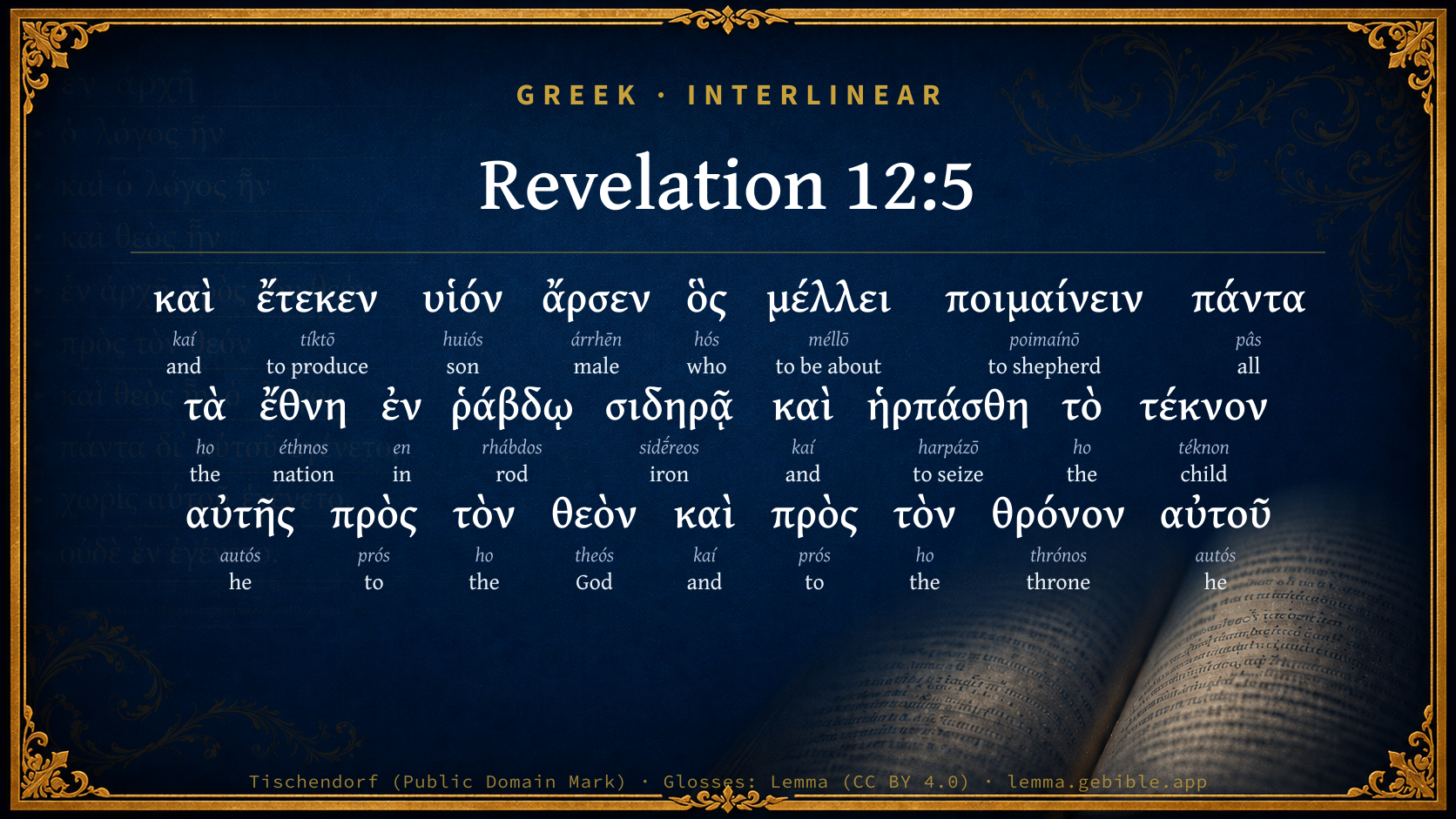
  1. καὶ kaí G2532 “and” Conjunction
  2. ἔτεκεν tíktō G5088 “to produce” Verb, Aorist, Active, Indicative, 3rd person, Singular
  3. υἱόν huiós G5207 “son” Noun, Accusative, Singular, Masculine
  4. ἄρσεν árrhēn G730 “male” Adjective, Accusative, Singular, Neuter
  5. ὃς hós G3739 “who” Relative pronoun, Nominative, Singular, Masculine
  6. μέλλει méllō G3195 “to be about” Verb, Present, Active, Indicative, 3rd person, Singular
  7. ποιμαίνειν poimaínō G4165 “to shepherd” Verb, Present, Active, Infinitive
  8. πάντα pâs G3956 “all” Adjective, Accusative, Plural, Neuter
  9. τὰ ho G3588 “the” Article, Accusative, Plural, Neuter
  10. ἔθνη éthnos G1484 “nation” Noun, Accusative, Plural, Neuter
  11. ἐν en G1722 “in” Preposition
  12. ῥάβδῳ rhábdos G4464 “rod” Noun, Dative, Singular, Feminine
  13. καὶ kaí G2532 “and” Conjunction
  14. ἡρπάσθη harpázō G726 “to seize” Verb, Aorist, Passive, Indicative, 3rd person, Singular
  15. τὸ ho G3588 “the” Article, Nominative, Singular, Neuter
  16. τέκνον téknon G5043 “child” Noun, Nominative, Singular, Neuter
  17. αὐτῆς autós G846 “he” Personal pronoun, Genitive, Singular, Feminine
  18. πρὸς prós G4314 “to” Preposition
  19. τὸν ho G3588 “the” Article, Accusative, Singular, Masculine
  20. θεὸν theós G2316 “God” Noun, Accusative, Singular, Masculine
  21. καὶ kaí G2532 “and” Conjunction
  22. πρὸς prós G4314 “to” Preposition
  23. τὸν ho G3588 “the” Article, Accusative, Singular, Masculine
  24. θρόνον thrónos G2362 “throne” Noun, Accusative, Singular, Masculine
  25. αὐτοῦ autós G846 “he” Personal pronoun, Genitive, Singular, Masculine

About this verse

These counts appear in no published source. They are computed here, from the morphology-tagged text and Lemma’s own curated glosses. What Lemma adds →

26
words
19
distinct lemmas
Revelation
section

Notable vocabulary

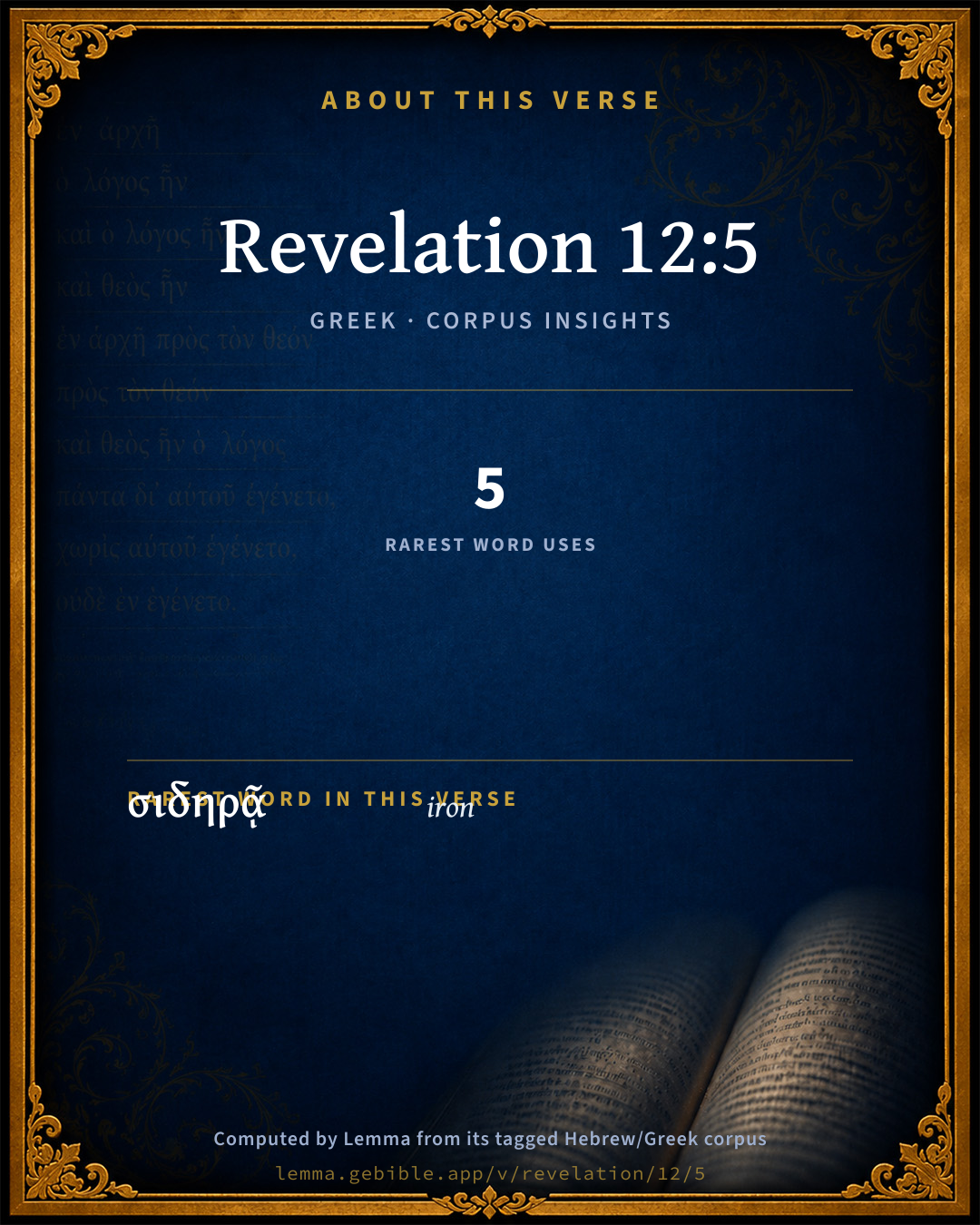
The rarest word here is σιδηρᾷ iron G4603 — appearing just 5 times in the whole Greek New Testament.

Shared distinctive vocabulary

σιδηρᾷ iron G4603 occurs in 5 verses of the Greek New Testament. Also found in:

Repetition

Words recur within this verse:

Cross-references

11

Topical passages linked to Revelation 12:5 in the Treasury of Scripture Knowledge — connected by theme and wording, ordered by reader-vote popularity; previews shown in the World English Bible.

  • Revelation 19:15 Out of his mouth proceeds a sharp, double-edged sword, that with it he should strike the nations. He will rule them with a rod of iron. He treads the winepress of the fierceness of the wrath of God, the Almighty.
  • Revelation 2:26–27 He who overcomes, and he who keeps my works to the end, to him I will give authority over the nations.
  • Psalms 2:9–10 You shall break them with a rod of iron. You shall dash them in pieces like a potter's vessel."
  • Revelation 12:2 She was with child. She cried out in pain, laboring to give birth.
  • Isaiah 7:14 Therefore the Lord himself will give you a sign. Behold, the virgin will conceive, and bear a son, and shall call his name Immanuel.
  • Micah 5:3 Therefore he will abandon them until the time that she who is in labor gives birth. Then the rest of his brothers will return to the children of Israel.
  • Matthew 1:25 and didn't know her sexually until she had brought forth her firstborn son. He named him Jesus.
  • Revelation 11:12 I heard a loud voice from heaven saying to them, "Come up here!" They went up into heaven in the cloud, and their enemies saw them.
  • Jeremiah 31:22 How long will you go here and there, you backsliding daughter? for Yahweh has created a new thing in the earth: a woman shall encompass a man.
  • Mark 16:19 So then the Lord Jesus, after he had spoken to them, was received up into heaven, and sat down at the right hand of God.
  • 2 Corinthians 12:2 I know a man in Christ, fourteen years ago (whether in the body, I don't know, or whether out of the body, I don't know; God knows), such a one caught up into the third heaven.

Cross-references courtesy of OpenBible.info (CC BY 4.0).

Commentary

Notes on Revelation 12:5 from classic Christian and Jewish commentators (each source and its license shown beneath its notes). The classic Christian expositions comment on the surrounding passage and are grouped to its opening verse, so a note may address several verses; the Jewish commentaries on the Tanakh (Rashi and others) are per-verse, so they appear only where the commentator wrote on this verse.

Lemma curates 59 commentaries, every one of them public domain or Creative Commons licensed, each selected and text-cleaned for this edition rather than reprinted as found. About our sources →

The Biblical Illustrator

Joseph S. Exell

Rev_12:5-6

She brought forth a man child.

The Church protected

1. The godly of the Christian Church brought forth by the pains of the apostles and their successors, are called but one man child: which teaches, that all the true members of Christs Church should be in a holy unity but as one man (Act_4:32); and of masculine courage for the truth (Jer_9:3) against all opposition.

2. Whereas that which is primely proper to Christ is in a secondary respect attributed to His Church, to rule all nations with a rod of iron; we learn the strict union that is between Christ and His Church (Act_9:4).

3. Whereas it is said that the man child was caught up to God and to His throne, we see--

(1) Satans disappointment in all his attempts against Christs Church (Psa_2:4).

(2) What happiness and high preferment abides Gods children at last, however they be troubled or despised here.

(3) How joyful may death be to them, who is justly called the king of terrors to others. (Wm. Guild, D. D.)

The Biblical Illustrator, edited by Joseph S. Exell (c. 1880s–1900s) — public domain. Text from a community e-Sword module.

Tyndale Open Study Notes

Tyndale Open Resources

12:5 Jesus was the son who was to rule all nations (see Luke 1:31-33; 2:30-32; cp. Ps 2:6-12). • Although Jesus was killed by agents of the devil, he was snatched away from the dragon and raised from the dead (Matt 28:6; Mark 10:33-34; 16:6; 1 Cor 15:3-4). Jesus’ entire life on earth, from his birth to his death and resurrection, is compressed into this scene. • caught up to God and to his throne: See Acts 1:9-11.

Tyndale Open Study Notes — © Tyndale Open Resources, licensed CC BY-SA 4.0. Text via the HelloAO Bible API.

Bengel's Gnomon

Johann Albrecht Bengel

Rev 12:5. Ἔτεκεν, brought forth) The Christian Church brought forth a male child, Christ, considered not personally, but in His kingdom. Vitringa interprets it of Constantine, when he gained possession of the empire; D. Lange weightily refutes him, in his Comm. upon the Apocalypse, f. 137, 141. Nor, however, as the same writer supposes, is the conversion of Israel here signified; for that nation does not bring forth, at its conversion, but is born: and the crown of twelve stars prefigures the conversion of the twelve tribes: comp. Gen 37:9. The birth here described has already long ago taken place; that conversion [of the twelve tribes] has not yet taken place. The woman brought forth, when in the ninth century, more nations than before, together with their princes, were, under the name of Slavonians, added to the assembly of the Christian name. Therefore almost the whole of this chapter has been fulfilled, although D. Lange refers it to the future, in the same place (see above), and in Epicr. p. 408. The very war of the dragon with the rest of the seed of the woman, Rev 12:17, precedes the rising of the beast out of the sea; but this took place in the eleventh century, as will presently be shown.—ὑιον ἄῤῥενα) Learned men have brought together to this place passages in Aristophanes and Alciphron, where a woman is said to have brought forth παιδίον ἄῤῥεν· but the cases differ; for παιδίον is generic, ὑιὸς specific. Nor, however, does John write ὑιὸν ἄῤῥενα without reason. For thus also Jer 20:15, it is said בן וכר, where in the Greek it is υἱὸς ἄρσην, or simply ἄρσην as in this passage. Primasius omitting the word son, says male, as Rev 12:13 has it.—ἐν ῥάβδῳ σιδηρᾷ, with a rod of iron) The rod is for long continued obstinacy, until they submit themselves to obedience.

Bengel's Gnomon of the New Testament — English translation (T&T Clark, Edinburgh, 1860) — public domain. Text from a community e-Sword module.

Meyer's Critical & Exegetical Commentary

Heinrich August Wilhelm Meyer

Rev_12:5-6. The child is born, but rescued; the woman also flees.

υἱὸν ἄρσεν. The expression, without regard to its peculiar incorrectness,[3062] reminds us of the בֵּז זָכָר, Jer_20:15,[3063] but is still more emphatic in the prominence given the male sex of the child, since the grammatical reason, rendering possible the harsh agreement of the masc. ΥἹΌΝ and the neut. ἌΡΣΕΝ, lies in the fact that the ἌΡΣΕΝ appears as a sort of apposition: a son, a male. The intention of this emphasis, which De Wette improperly denies, is not that of designating the child as victor over the dragon,[3064] but[3065] points to what is added concerning the child immediately afterwards; Ὃς ΜΈΛΛΕΙ ΠΟΙΜ., Κ.Τ.Λ. These words taken from Psa_2:9 (LXX.), which are referred also to Christ in Rev_19:15, make it indubitable that the child born of the woman is the Messiah;[3066] but the designation of Christ by these words of the Messianic Psalm is in this passage[3067] the most appropriate and significant, since the fact is made prominent that this child just born is the one who with irresistible power will visit in judgment the antichristian heathen. By the words of the Psalm, John, therefore, designates the Lord as the ἘΡΧΌΜΕΝΟΝ, who, as is especially kept in view by ch. 12, will also come with his iron rod upon the Gentile-Roman antichrist. As, therefore, John by the words of the Psalm designates the child in a way completely corresponding to the fundamental idea of the entire Apoc., and points to the ultimate end in the Messianic judgment, he at the same time discloses the reason why Satan lays snares chiefly for the child, and then also for the woman and believers; and why especially the Gentile-Roman empirewhose insignia the dragon wears, and which is the means of his wrathpersecutes believers in Christ in the manner depicted further in what follows.[3068] Thus the designation of the child shows the significance of the entire vision, ch. 12, in its relation to what follows. The result, however, is also that all the expositors who regard the child born of the woman as any thing else than the Messiah, and that, too, in his concrete personality, miss the surest standpoint for the exposition of the entire ch. 12, and with this the correct standpoint for the comprehension of ch. 13 sqq. This applies especially in opposition to all those who, however much they diverge in details, yet agree in the fundamental error that they regard the child as Christ, only in a certain metonymical sense, by understanding it properly, speaking of Christ living in believers, and thus of believers themselves. Thus Beda: The Church is always, though the dragon opposes, bringing forth Christ.The Church daily gives birth to a church, ruling in Christ the world. Cf. C. a Lap., Aret., Calov., who gives the more specific definition: The bearing of the woman refers to the profession of the Nicene faith, and the sons born to God by the Church in the midst of the persecutions of the Gentiles, Beng., Stern., etc. Grot., also: The dispersed from Judaea, among whom were Aquila and Apollos, instruments of the catholic Church, brought forth many of the Roman people unto Christ. Eichh., Heinr., Herd., etc., who regard the child as a symbol of the Christian Church, proceeding from the Jewish, belong here.

ΚΑῚ ἩΡΠΆΣΘΗ. The expression makes clear how, by a sudden withdrawal,[3069] the child is delivered from the immediately threatening danger.[3070]

ΠΡῸς ΤῸΝ ΘΕῸΝ ΚΑῚ ΠΡῸς ΤῸΝ ΘΡΌΝΟΝ ΑὐΤΟῦ. It is made emphatic not only that the child is drawn up to God for preservation, but also that this is the surest, and at the same time most exalted, place of refuge. The allegorical interpretation of the second half of Rev_12:5, by those who do not acknowledge in the child the Messiah himself, must have an entirely reverse result. N. de Lyra[3071] contents himself with the idea of the deliverance of the Church; even to him Bedas interpretation[3072] may have been too perplexing. The rationalistic expositors also, who share with these churchly expositors the fundamental error concerning the ΤΈΚΝΟΝ, uselessly amend one another.[3073] De Wette, Hengstenb., Ebrard, etc., have referred the ἩΡΠΆΣΘΗ, Κ.Τ.Λ., to the Lords ascension, and, according to this, understand by the persecution on the part of the dragon[3074] all that was done on the part of the Jews against Christ until his death,[3075] the entire state of humiliation, to which the state of exaltation even to Gods throne has succeeded.[3076] But the feeling concerning this, that this conception does not correspond with the character of the statement in the text, has asserted itself in Hengstenb. Before the ΚΑῚ ἩΡΠΆΣΘΗ, he says, it is to be remembered that the dragon continues his persecution, as, according to the gospel history, it has occurred from the temptation until the death on the cross.[3077] This addition is urged by Rev_12:4 : for how was the one, who, already before the birth, stood before the woman, in order to devour her child as soon as it was born, not to incessantly continue his persecution? and it is required by the and it was caught up. But neither this addition, nor the exposition based thereon, is allowable in accordance with the text; for the textual idea is that the child immediately after birth is caught up to Gods throne. This ideal representation is related to the actual history of Christ, just as the ideal allusion to the judgment impending upon Jerusalem, Rev_11:1 sqq., to the actually future fact; the fact as such is as little prophesied there, as in this passage the proper history of Christ and its precise epochs are mentioned,[3078] but in both cases the historical reality serves only for the firm concrete basis of the idea, which is the main point of consideration. No historical fact corresponds to the prophetical-ideal representation of the dragon, which watches for the birth of the Messiah, in order to immediately devour the child; but the snares on the part of Herod, and the murder of the infants at Bethlehem, may have given an occasion for the conception of the view, whereby John figuratively represents the mortal enmity of Satan to the Messiah. No fact in the history of Christ corresponds to the ἡρπάσθη τὸ τέκνον, κ.τ.λ.; but the fact of the Lords ascension offers, as it were, the colors with which to paint the ideas as to how inexpressibly glorious is the preservation of the child from Satan, and how completely the latter, with his persecutions, is confounded. Both subjects under consideration here, Satans mortal hatred to the Lord (and, therefore to his saints, Rev_12:17, Rev_13:1 sqq.), and, in connection with this, Satans inability to touch the Lord (and, accordingly, the final judgment on every thing antichristian, and the glorification of believers), are here placed in view.

[3062] See Critical Notes.

[3063] LXX.: ἄρσην, without υἱός.

[3064] Victor over the devil who had conquered the woman (Beda).

[3065] Cf. Beng., Hengstenb., etc.

[3066] De Wette, Rinck, Hengstenb., Ebrard, etc.

[3067] As also Rev_19:15.

[3068] Rev_12:17, Rev_13:1 sqq.

[3069] Act_23:10; Jud_1:23.

[3070] Vitr., Hengstenb.

[3071] Cf. Aret., C. a Lap., etc.

[3072] Godlessness cannot apprehend Christ spiritually born in the mind of hearers, for the reason that the same one reigns with the Father in heaven, who also has raised us, and made us sit in heavenly places with Christ.

[3073] Cf. Eichh.: The Christian Church having proceeded from Judaism received, under Gods protection, its growth and increase; with Grot.: Simon seduced so many at Rome that a Christian people no longer appeared there. They who do not appear with men are said to be with God.

[3074] Cf. Joh_14:30.

[3075] De Wette.

[3076] Hengstenb., Ebrard.

[3077] Cf. Luk_4:13 : ἄχρι καιροῦ, and Joh_14:30.

[3078] Against Auberlen, p. 277, etc.

What, after the withdrawal of the child, is further attempted on the part of the dragon, or what now possibly occurs with it itself (cf. Rev_12:7. sqq.), cannot be properly stated (Rev_12:7 sqq.) without giving an account first of the fate of the woman. This occurs in Rev_12:6, which briefly anticipates[3079] what is described more minutely in Rev_12:14, and that too on the basis of Rev_12:7 sqq.;[3080] for not until the dragon, with his wrath directed above all things against the child itself, is completely confounded, does he turn against the woman, Rev_12:13 sqq., and when she flees, then against the rest of her seed, Rev_12:17, in order to vent against them, as believers in Christ, that rage with which he could not reach the Lord himself and the woman. But what instruments the dragon employs, in order to attack believers with the hatred which is, in fact, directed against the Lord himself, is shown immediately afterwards in Rev_13:1 sqq.

[3079] Vitr., Ewald, De Wette, Hofm., Hengstenb., Auberlen.

[3080] Against Ebrard. See on Rev_12:14.

ὅπου

ἐκεῖ. Cf. Rev_12:14; Rev_3:8; Rev_7:2.

ἡτοιμασμένον ἀπο τ. θ., on the part of God, divinely. Cf. Winer, p. 347 sqq.

ἵνα ἐκεῖ τρέφωσιν αὐτὴν, κ.τ.λ. The final clause depends upon the ἡτοιμ. ἀπὸ τ. θ.; the ἐκεῖ refers, therefore, to the place in the wilderness; cf. the parallel words, Rev_12:14 (εἰς τ. τόπον αὐτης, ὅπου τρέφεται ἐκεῖ, κ.τ.λ.), where also the personally fixed τρέφεται (sc. ἡ γυνή) explains the meaning of the τρέφωσιν αὐτὴν taken without a definite subject.[3081] See, in general, also in reference to the schematic determination of time, on Rev_12:14.

[3081] Cf. Rev_10:11; Luk_12:20.

Meyer — Critical and Exegetical Commentary on the New Testament — English translation by Peter Christie, edited by Frederick Crombie (T&T Clark, 1880) — public domain. Text from a community e-Sword module.

Expositor's Greek Testament

ed. W. Robertson Nicoll

Rev 12:5 . In accordance with the rabbinic notion which withdrew messiah for a time, the infant, like a second Moses, is caught up out of harm’s way. He has no career on earth at all. This is intelligible enough in a Jewish tradition; but while no Christian prophet could have spontaneously depicted his messiah in such terms, even under the exigencies of apocalyptic fantasy, the further problem is to understand how he could have adopted so incongruous and inadequate an idea except as a pictorial detail. The clue lies in the popular messianic interpretation of passages like Psa 2 . where messiah’s birth is really his inauguration and enthronement. The early application of this to Jesus, though not antagonistic to an interest in his historic personality, tallied with the widespread feeling ( cf. note on Rev 1:7 ) that his final value lay in his return as messiah. Natiuitas quaedam eius ascensio : “The heavens must receive him” (Act 3:21 ) till the divine purpose was ripe enough for his second advent. This tendency of primitive Jewish Christianity serves to explain how John could refer in passing to his messiah in terms which described a messiah, as Sabatier remarks, sans la croix et sans la mort , and which even represented his ascension as an escape rather than a triumph. The absence of any allusion to the Father is not due so much to any reluctance on the prophet’s part to call Jesus by the name of Son of God ( cf. Rev 2:18 ), which pagan usage had profaned not only in such mythical connexion but in the vocabulary of the Imperial cultus, as to the fact that the mythical substratum always gave special prominence to the mother; the goddess-mother almost invariably displaced the father in popular interest, and indeed bulked more largely than even the child.

The Expositor's Greek Testament, edited by W. Robertson Nicoll (1897–1910) — public domain. Text from a community e-Sword module.

Geneva Bible (1599)

Geneva Bible translators

The second history of the Church delivered of child: in which first the consideration of the child born, and of the Mother is described in 2 verses: secondly the battle of the Dragon against the young child, and the victory obtained against him 3 verses following: last of all is sung a song of victory, unto verse 12. Now S. John in consideration of the child born, noteth two things: for he describeth him, and his station or place in this verse.

That is, Christ the head of the Church (the beginning, root and foundation whereof is the same Christ) endowed with kingly power, and taken up into heaven out of the jaws of Satan (who as a serpent did bite him upon the cross) that sitting upon the celestial throne he might reign over all.

Geneva Bible (1599) marginal notes — public domain. Text via Bolls.life.

Jamieson, Fausset & Brown

Robert Jamieson, A. R. Fausset & David Brown

man-child--Greek, "a son, a male." On the deep significance of this term, see on Rev 12:1-2.

rule--Greek, "poimainein," "tend as a shepherd"; (see on Rev 2:27).

rod of iron--A rod is for long-continued obstinacy until they submit themselves to obedience [BENGEL]: Rev 2:27; Psa 2:9, which passages prove the Lord Jesus to be meant. Any interpretation which ignores this must be wrong. The male son's birth cannot be the origin of the Christian state (Christianity triumphing over heathenism under Constantine), which was not a divine child of the woman, but had many impure worldly elements. In a secondary sense, the ascending of the witnesses up to heaven answers to Christ's own ascension, "caught up unto God, and unto His throne": as also His ruling the nations with a rod of iron is to be shared in by believers (Rev 2:27). What took place primarily in the case of the divine Son of the woman, shall take place also in the case of those who are one with Him, the sealed of Israel (Rev 7:1-8), and the elect of all nations, about to be translated and to reign with Him over the earth at His appearing.

Jamieson, Fausset & Brown — Commentary Critical and Explanatory on the Whole Bible (1871) — public domain (CC PDM 1.0). Text via the HelloAO Bible API.

Adam Clarke's Commentary

Verse 5. And her child was caught up unto God, and to his throne.] In Yalcut Rubeni are these words: "Rachael, the niece of Methusala, was pregnant, and ready to be delivered in Egypt. They trod upon her, and the child came out of her bowels, and lay under the bed; Michael descended, and took him up to the throne of glory. On that same night the first born of Egypt were destroyed."

NOTES ON CHAP. XII., BY J. E. C.

Ver. 5. And she brought forth a man child] The Christian Church, when her full time came, obtained a deliverer, who, in the course of the Divine providence, was destined:-

To rule all nations] The heathen Roman empire,

With a rod of iron] A strong figure to denote the very great restraint that should be put upon paganism, so that it should not be able longer to persecute the Christian Church. The man child mentioned in this verse is the dynasty of Christians emperors, beginning with Constantine's public acknowledgment of his belief in the divinity of the Christian religion, which happened in the latter part of A.D. 312, after the defeat of the Emperor Maxentius.

And her child was caught up unto God, and to his throne.] A succession of Christian emperors was raised up to the Church; for the Roman throne, as Bishop Newton observes, is here called the throne of God, because there is no power but of God: the powers that be are ordained of God.

Adam Clarke's Commentary on the Bible (1810–1826) — public domain. Text from a community e-Sword/MySword module.

Ellicott's Commentary for English Readers

(5) And she brought forth . . .—Translate, And she brought forth a man child, who is to shepherd all the nations with (it is, literally, in) a rod of iron. There can be no doubt that this man child is Christ. The combination of features is too distinct to admit of doubt, it is the one who will feed His flock like a shepherd (Isa_40:12), who is to have, not His own people, but all nations as His inheritance (Psa_2:7-9), and whose rule over them is to be supreme and irresistible. But the fact that this child is Christ must not cause us to limit the meaning of the vision to the efforts of the evil one to destroy the infant Jesus; for it is also the Christ in the Church which the wicked one hates: and wherever Christ dwells in any heart by faith, and wherever the preachers of the gospel in earnest travail for their Master, seek to lift up Christ, there will the foe be found, like the fowls of the air, ready to carry away the good seed. Though the basis of the vision is in the historical fact, the power of the vision reaches over a wider area, and forcibly reminds us that as there are irreconcilable principles at work in the world, so all these, when traced to their original forms, are the Spirit of Christ and the spirit of the devil.

And her child was caught up unto God, and to his throne.—The efforts of the evil one to destroy are thwarted; the child is snatched away and placed out of the range of the dragon’s power. The prince of this world might instigate Israel to take Jesus Christ and with wicked hands crucify and kill Him, but the eternal divine life of Him who had power to lay down His life and take it again, and whose years were for ever and ever, was beyond the reach of every hostile power; and after death and resurrection, Christ ascended up where He was before. But the vision is designed to assure us that, precisely because of this, so all life in Christ is beyond the power of the evil one, and that the forces hostile to good are powerless against that life which is hid with Christ in God. The Church may be as a weak, oppressed, and persecuted woman, but her faith rises up as a song from the lips of its members. “God hath raised us up together, and made us sit together in heavenly places in Christ Jesus.” The contest is between the man child and the dragon; and those who in heart and mind ascend to where Christ is know that the contest is not one of mere ideas, but a conflict between the Christ, who is with them always, though He has ascended, and all the powers of evil, which will be smitten down by the rod of His power.

A Bible Commentary for English Readers, edited by Charles John Ellicott (1878–1897) — public domain. Text from a community e-Sword module.

The Cambridge Bible for Schools and Colleges

gen. ed. J. J. S. Perowne

5. a man child] Lit. a son, a male, the latter word being neuter.

who was to rule] Lit. who is to rule. This designation of the Son proves beyond question who He is, see Rev_2:27 as proving, if there could be any doubt about it, how Psa_2:9 is understood in this book.

to God, and to his throne] Cf. Rev_3:21. In the vision, “He that sat on the throne” is still present, and no doubt St John saw the translation of the child to His side.

The Cambridge Bible for Schools and Colleges (gen. ed. J. J. S. Perowne; Cambridge University Press, 1878–1918) — public domain. Text from a community e-Sword module.

John Gill's Exposition

And she brought forth a man child,.... Not Christ, literally and personally considered, or Christ in his human nature, as made of a woman, and born of a virgin, which was a fact that had been years ago; but Christ mystically, or Christ in his members, who are called by his name, because he is formed in them, and they are the seed of the woman, the church; and many of these were brought forth to Christ by the church in the primitive times, who were a manly birth, hale, strong, and robust Christians; or rather this manly birth may design a more glorious appearing and breaking forth of the kingdom of Christ in the Roman empire; for though Christ came as a King, yet his kingdom was not with observation in the days of his flesh; and though, upon his ascension to heaven, he was made and declared Lord and Christ, and had a kingdom and interest in the world, and even in the Roman empire, during the first three centuries, yet this was attended with the cross and persecution; but now, towards the close of that period, Constantine, a Christian emperor, was born, under whose influence and encouragement the Gospel was spread, and the kingdom of Christ set up and established in the empire; and this seems to be the thing intended here, he being of a generous, heroic, and manly disposition:

who was to rule all nations with a rod of iron; this has a manifest reference to Psa 2:9; which psalm, and the passage referred to in it, evidently belong to Christ; and as this is represented as something future, what should be hereafter, and not what would immediately take place, it may regard the kingdom of Christ in the last times, of which the present breaking forth of it in Constantine's time was an emblem and pledge; and may denote the universality of it, it reaching to all the kingdoms of the world, and the manner which Christ will rule, especially over his enemies, antichrist and his followers, whom he will destroy with the breath of his mouth, and break in pieces with his rod of iron, and order all that would not have him to reign over them slain before him; and as this may be applied to Christ mystical, the seed of the church, and members of Christ, as it is in Rev 2:26; it may relate to their reign with Christ on earth, when they shall sit on thrones, and judge the world, when the kingdom and dominion, and the greatness of the kingdom under the whole heaven shall be given to there; but since this is expressly said of the man child in the text, it may be expressive even of the temporal government of Constantine, who was an heroic and victorious prince, and extended his dominions to the several parts of the world; as far as Britain to the west, and all Scythia to the north, Ethiopia to the south, and the remote parts of India to the east, even to the ultimate parts of the whole world, as Eusebius (h) affirms, making his kingdom to be three times larger than that of Alexander the great: and more especially it may describe the kingdom of Christ in his times; which was spread throughout all the nations of the empire; when Paganism was demolished, both in the continent and in the isles of the sea, and the strong holds Satan were pulled down, not by carnal, but spiritual weapons; when multitudes of souls were converted by the word, the rod of Christ's strength, and when the saints were guided, directed, fed, and comforted by it; for the allusion seems to be to the shepherd's rod, with which he leads and feeds his sheep; the same word signifies both to rule and feed:

and her child caught up unto God, and to his throne; which is to be understood not of Christ's ascent to heaven in human nature, when he was set down on the same throne with his Father; nor of Christ mystical, or of the saints being caught up into the air, to meet the Lord and be for ever with him, and sit down with him on the same throne; but rather of some glorious advance of the church and kingdom of Christ on earth; for as "to fall from heaven" is expressive of debasement and meanness, and of a low estate that a person is brought into, Isa 14:12; so an ascending up to heaven, as the two witnesses in the preceding chapter are said to do, denotes exaltation, or a rise to some more glorious state and condition, which was the case of the church in Constantine's time: and this may also take in the accession of Constantine himself to the imperial throne, which was the throne of God; for king's have their sceptres, thrones, and kingdoms from him, they his viceregents, and in some measure represent and are therefore called gods, and the children of the most high; yea, since Constantine, as advanced to the empire, was such an instrument in Christ's hand for the setting up and establishing his kingdom in it, Christ himself may be here represented as reigning over the Roman empire, as a presage and prelude of his reigning over all the earth another day.

(h) De Vita Constantini, l. 1. c. 8.

John Gill's Exposition of the Whole Bible (1746–1763) — public domain (CC PDM 1.0). Text via the HelloAO Bible API.

Trapp's Complete Commentary

John Trapp

5 And she brought forth a man child, who was to rule all nations with a rod of iron: and her child was caught up unto God, and to his throne.

Ver. 5. And she brought forth a man child] Constantine, the Christian Church’s first and chief champion.

Who was to rule all nations] The whole Roman empire, but especially to overrule and subdue the Church’s many and mighty enemies, as Constantine did most notably.

Caught up to God and to his throne] To rule in the Church next under God himself. And to this height of honour he was caught when the empire was cast upon him, not once thinking of it. Bonus Deus Constantinum magnum tantis terrenis implevit muneribus, quanta optare nullus auderet, saith Augustine. (De Civ. Dei, v. 25.)

John Trapp, A Commentary or Exposition upon All the Books of the Old and New Testament (1647–1656) — public domain. Text from a community e-Sword module.

Albert Barnes' Notes on the Bible

And she brought forth a man child - Representing, according to the view above taken, the church in its increase and prosperity - as if a child were born that was to rule over all nations. See the notes on Rev 12:2.

Who was to rule all nations - That is, according to this view, the church thus represented was destined to reign in all the earth, or all the earth was to become subject to its laws. Compare the notes on Dan 7:13-14.

With a rod of iron - The language used here is derived from Psa 2:9; “Thou shalt break them with a rod of iron.” The form of the expression here used, “who was to rule” - ὅς μέλλει ποιμαίνειν hos mellei poimainein - is derived from the Septuagint translation of the Psalm - ποιμαινεῖς poimaineis - “thou shalt rule them”; to wit, as a shepherd does his flock. The reference is to such control as a shepherd employs in relation to his flock - protecting, guarding, and defending them, with the idea that the flock is under his care; and, on the supposition that this refers to the church, it means that it would yet have the ascendency or the dominion over the earth. The meaning in the phrase, “with a red of iron,” is, that the dominion would be strong or irresistible - as an iron scepter is one that cannot be broken or resisted. The thoughts here expressed, therefore, are:

(a)That the church would become universal - or that the principles of truth and righteousness would prevail everywhere on the earth;

(b)That the ascendency of religion over the understandings and consciences of people would be irresistible - as firm as a government administered under a scepter of iron; yet,

(c)That it would be rather of a character of protection than of force or violence, like the sway which a shepherd wields over his flock.

I understand the “man child” here, therefore, to refer to the church in its increase under the Messiah, and the idea to be, that that church was, at the time referred to, about to be enlarged, and that, though its increase was opposed, yet it was destined ultimately to assert a mild sway over all the world. The time here referred to would seem to be some period in the early history of the church when religion was likely to be rapidly propagated, and when it was opposed and retarded by violent persecution - perhaps the last of the persecutions under the pagan Roman empire.

And her child was caught up unto God - This is evidently a symbolical representation. Some event was to occur, or some divine interposition was to take place, as if the child thus born were caught up from the earth to save it from death, and was rendered secure by being in the presence of God, and near his throne. It cannot be supposed that anything like this would “literally” occur. Any divine interposition to protect the church in its increase, or to save it from being destroyed by the dragon - the fierce pagan power - would be properly represented by this. Why may we not suppose the reference to be to the time of Constantine, when the church came under his protection; when it was effectually and finally saved from pagan persecution; when it was rendered safe from the enemy that waited to destroy it? On the supposition that this refers to an increasing but endangered church, in whose defense a civil power was raised up, exalting Christianity to the throne, and protecting it from danger, this would be well represented by the child caught up to heaven.

This view may derive confirmation from some well-known facts in history. The old pagan power was concentrated in Maximin, who was emperor from the Nile to the Bosphorus, and who raged against the gospel and the church “with Satanic enmity.” “Infuriate at the now imminent prospect of the Christian body attaining establishment in the empire, Maximin renewed the persecution against Christians within the limits of his own dominion; prohibiting their assemblies, and degrading, and even killing their bishops.” Compare Gibbon, 1:325, 326. The last struggle of pagan Rome to destroy the church by persecution, before the triumph of Constantine, and the public establishment of the Christian religion, might be well represented by the attempt of the dragon to destroy the child; and the safety of the church, and its complete deliverance from pagan persecution, by the symbol of a child caught up to heaven, and placed near the throne of God. The persecution under Maximin was the last struggle of paganism to retain the supremacy, and to crush Christianity in the empire. “Before the decisive battle,” says Milner, “Maximin vowed to Jupiter that, if victorious, he would abolish the Christian name. The contest between Yahweh and Jupiter was now at its height, and drawing to a crisis.”

The result was the defeat and death of Maximin, and the termination of the efforts of paganism to destroy Christianity by force. Respecting this event, Mr. Gibbon remarks, “The defeat and death of Maximin soon delivered the church from the last and most implacable of her enemies,” 1:326. Christianity was, after that, rendered safe from pagan persecution. Mr. Gibbon says, “The gratitude of the church has exalted the virtues of the generous patron who seated Christianity on the throne of the Roman world.” If, however, it should be regarded as a forced and fanciful interpretation to suppose that the passage before us refers to this specific event, yet the general circumstances of the times would furnish a fulfillment of what is here said:

The church would be well represented by the beautiful woman. The prospect of its increase and universal dominion would be well represented by the birth of the child. The furious opposing pagan power would be well represented by the dragon in its attempts to destroy the child. The safety of the church would be well represented by the symbol of the child caught up to God, and placed near his throne.

Albert Barnes' Notes on the Bible (1834–1885) — public domain. Text from a community e-Sword/MySword module.

Haydock's Catholic Bible Commentary

A man child; that is, a masculine race of Christians, willing to confess the name of the Lord, and to fight his battles; who, through the merits of Jesus Christ, should triumph over all the attempts of the world. (Calmet) --- Her son (or children) was taken up to heaven, guarded by the special favour of God. They always overcome the devil, and all their adversaries, by reason of the blood of the Lamb, by the merits of Christ. And they loved not the life of the body, so as to preserve it, by incurring the death of the soul. (Witham)

George Leo Haydock (1774–1849), Haydock's Catholic Family Bible and Commentary, 1859 edition — public domain. Excludes Psalms (Douay-Rheims chapter numbering differs from Protestant) and Deuterocanonical books (Catholic canon only).

Matthew Poole's English Annotations

By this man-child some understand Constantine the Great; others understand Christ mystical, or many children brought forth unto God. As the Jews multiplied, do Pharaoh what he could to destroy them, so the church increased, notwithstanding all the malice and rage of her enemies. Interpreters accordingly are divided concerning the person or persons here spoken of, that should

rule all nations with a rod of iron. It was prophesied of Christ, Psa 2:9, that he should break the nations with a rod of iron. It is applied to the servants of Christ, who overcome, and keep Christ’s words to the end, Rev 2:27. So as it is here applicable to believers, whom the church should bring forth, who shall judge the world, as the apostle tells us; and I had rather thus interpret it, than concerning Constantine the Great.

And her child was caught up unto God, and to his throne: these words are something hard to be interpreted. To interpret it of Christ’s being taken up into heaven, is to turn a mysterious prophecy into a plain relation, or history of things past. To interpret it concerning Constantine the Great, seemeth very hard; for how was he, more than any other Christians, caught up unto God, and to his throne? If we say, when he died; so are they: if we say the imperial throne is here understood by God’s throne, it seemeth to me very hard; for although of magistrates God saith, I have said, Ye are gods, yet their thrones are never called God’s throne. I had rather give this phrase a more general interpretation, viz. God took this offspring of the woman into his royal protection, so as the dragon could not devour it, it was out of his reach.

Matthew Poole's English Annotations on the Holy Bible (1683–1685) — public domain. Text from a community e-Sword/MySword module.

Whedon's Commentary on the Bible

Daniel D. Whedon

5. Rule… iron—A prediction taken from Psa_2:9, and vividly quoted as fulfilled in Rev_19:15.

Caught up… throne—The resurrection, as well as the birth, is given not as literal history, but as the basis of symbol. The infant Jesus is exalted to the divine throne to symbolize that infant Christianity is to triumph, not only over paganism, but over all other opposing powers. In his note on Act_1:1-2, Alford has beautifully shown (see our note there) that Christ’s ascension was an exaltation to rule as Head of the Church and Lord of the world. And the representative character herein of the man child is verified by Rev_2:26-27 : “He that overcometh, and keepeth my works unto the end, to him will I give power over the nations: and he shall rule them with a rod of iron; as the vessels of a potter shall they be broken to shivers: even as I received of my Father.” While it is extreme for Elliott or Newton to identify the man child as being Constantine, it is not too much to say that according to this promise the man child on the divine throne does represent the triumph of Christianity over Roman paganism, in which Constantine was a principal figure. And thus the symbolic exaltation of the man child, of the two witnesses, and of the emparadised “souls” of Rev_20:4, all signify the same thing—namely, the victory of the cause by them represented.

Daniel D. Whedon (gen. ed.), Commentary on the Old and New Testaments (1874–1909) — public domain. Text from a community e-Sword module.

The Pulpit Commentary

And she brought forth a man child, who was to rule all nations with a rod of iron; a son, a male the Greek uion, arsen , renders it emphaticwho is to rule, as in the Revised Version; to rule, or to govern as a shepherd. (cf. the verb in Mat_2:6) This reference Psa_2:9 leave no doubt as to the identification of the man child. It is Christ who is intended. The same expression is used of him in Re 19, where he is definitely called the "Word of God." And her child was caught up unto God, and to his throne. The sentence seems plainly to refer to the ascension of Christ and his subsequent abiding in heaven, from whence he rules all nations. The seer, perhaps, wishes to indicate at once the absolute immunity of Christ from any harm proceeding from the power of the devil, whose efforts are henceforth directly aimed only at the Church of Christ. Satan still hopes to injure Christ through his members. As remarked above (see on ver. 4), what is true of the personal history of Christ is often true of his Church and of his true members. And thus some have seen in this passage a picture of the woman, the Church, bringing forth members, to devour whom is Satan"s constant purpose, but who in God"s good time are taken to his throne to be near himself.

The Pulpit Commentary (1880–1919), ed. H.D.M. Spence-Jones & Joseph S. Exell — public domain. Text from a community e-Sword module.

John Wesley's Explanatory Notes

And she brought forth a man child - Even Christ, considered not in his person, but in his kingdom. In the ninth age, many nations with their princes were added to the Christian church. Who was to rule all nations - When his time is come. And her child - Which was already in heaven, as were the woman and the dragon. Was caught up to God - Taken utterly out of his reach.

John Wesley, Explanatory Notes Upon the Whole Bible (1754–1765) — public domain. Text via the GEBible commentary corpus.

The People's New Testament

B. W. Johnson

5. And she brought forth a man child. If the reader will turn to verse 17 he will learn that the remnant of the woman's seed is “those who keep the commandments of God, and have the testimony of Jesus Christ.” The offspring of the woman, the “woman's seed,” then refers to the saints. The man child is a symbol of the faithful members of the Church. But how shall they rule all nations with a rod of iron. The Greek says “rule as shepherds with a rod of iron.” This implies a firm and permanent, but tender and loving rule, not a stern rule. In 2:27 it is promised that whosoever overcometh shall rule the nations with a rod of iron. In 19:15 the same thing is stated of the Word of God. This is accomplished through the saints. They shall yet possess the earth. Every knee shall bow, and every tongue confess. The kingdoms of the earth shall become the kingdoms of the Lord and his Christ. The man child, the woman's seed, the saints, shall have a complete, an undisputed, a resistless dominion. And her child was caught up. This figure always means a glorious exaltation. It signifies that God will protect the saints and give them victory. This was probably fulfilled when Christianity triumphed over Paganism in the fourth century.

B. W. Johnson's The People's New Testament with Notes (1889–1891) — public domain. Electronic text from the Christian Classics Ethereal Library (CCEL) ThML edition.

unfoldingWord translationNotes

Door43 World Missions Community

rule all the nations with an iron rod

Ruling harshly is spoken of as ruling with an iron rod. See how you translated a similar phrase in Revelation 2:27. (See: Metaphor)

Her child was snatched away to God

This can be stated in active form. AT: "God quickly took her child to himself" (See: Active or Passive)

for 1,260 days

"for one thousand two hundred and sixty days" or "for twelve hundred and sixty days" (See: Numbers)

translationWords

son

children

rule

nation

rod

God

throne

desert

unfoldingWord translationNotes — © Distant Shores Media and the Door43 World Missions Community, licensed CC BY-SA 4.0. Source: git.door43.org/Door43/en_tn.

Cambridge Greek Testament for Schools and Colleges

5. ἔτεκεν υἱόν, ἄρσεν with AC; cf. Isa 66:7 ἐξέφυγε καὶ ἔτεκεν ἄρσεν; Text. Rec[402] reads ἔτ. νἱὸν ἄρρενα with אB21; P has ἄρσενα; Victorin. peperit filium, Primas[403] peperit masculum.

[402] Rec. Textus Receptus as printed by Scrivener.

[403] Primasius, edited by Haussleiter.

5. ἔτεκεν υἱόν, ἄρσεν. Cf. Isa 66:7, and crit. note.

ὃς μέλλει ποιμαίνειν. A periphrasis for the future. This designation of the Son proves beyond question who He is: see Rev 2:27 as proving, if there could be any doubt about it, how Psa 2:9 is understood in this book.

πρός τὸν θεὸν καὶ πρὸς τὸν θρόνον αὐτοῦ. Cf. Rev 3:21. In the vision, “He that sat on the throne” is still, it may be, present: if so, St John sees the translation of the child to His side.

Cambridge Greek Testament for Schools and Colleges (Cambridge University Press, 1896; 21 vols, various authors incl. Carr, Maclear, Plummer, Farrar, Lumby, Moule, M. R. James, Simcox) — public domain. Text from a community e-Sword module.

Vincent's Word Studies in the New Testament

Marvin R. Vincent

A man - child [υιον αρρενα] . Lit., a son, a male. The correct reading is arsen, the neuter, not agreeing with the masculine individual [υιον σον] but with the neuter of the genus. The object is to emphasize, not the sex, but the quality of Masculinity - power and vigor. Rev., a son, a man - child. Compare Joh 16:21; Jer 20:15.

To rule [ποιμαινειν] . Lit., to shepherd or tend. See on Mt 2:6. A rod of iron. Compare Psa 2:9, and see on ch. Rev 2:27.

Was caught up [ηρπασθη] . See on Mt 12:12. Compare Act 23:10; Jude 1:23.

Marvin R. Vincent, Word Studies in the New Testament (1887–1900) — public domain. Text from a community e-Sword/MySword module.

Lesson kit

Teaching starters — assembled from the data on this page, not authored interpretation. Every prompt links to the verse data it draws on. Edit before teaching.

Revelation, in the Revelation, opens this verse with 26 words (19 distinct Greek lemmas). Its most distinctive word is sidḗreos (“iron”). A historical commentator’s framing appears above. Read the whole chapter for the surrounding context.

Discussion questions

  1. The word sidḗreos carries the sense “iron.” How does it shape the verse?
  2. How does Acts 12:10, which shares the word «iron», read alongside this verse?
  3. What does the repetition of “the” (4× in this one verse) do in this verse?
  4. The translations on this page render this verse differently — a whole-verse word diff, not a word-by-word alignment. What might account for the different wordings?
  5. Compare how The Biblical Illustrator and Tyndale Open Study Notes read this verse. Where do they agree or differ?

Things to notice

Reading settings

Reading text

Shown beneath each verse's original-language words.

Old Testament
Old Testament edition

Read the OT as the Masoretic Hebrew (MT) or the Greek Septuagint (LXX).

English shown for the Greek Septuagint (in the Hebrew ↔ Greek comparison).

Comparing translations? Open the Compare panel on any verse page to stack up to four side by side.