
1 Timothy 3:16

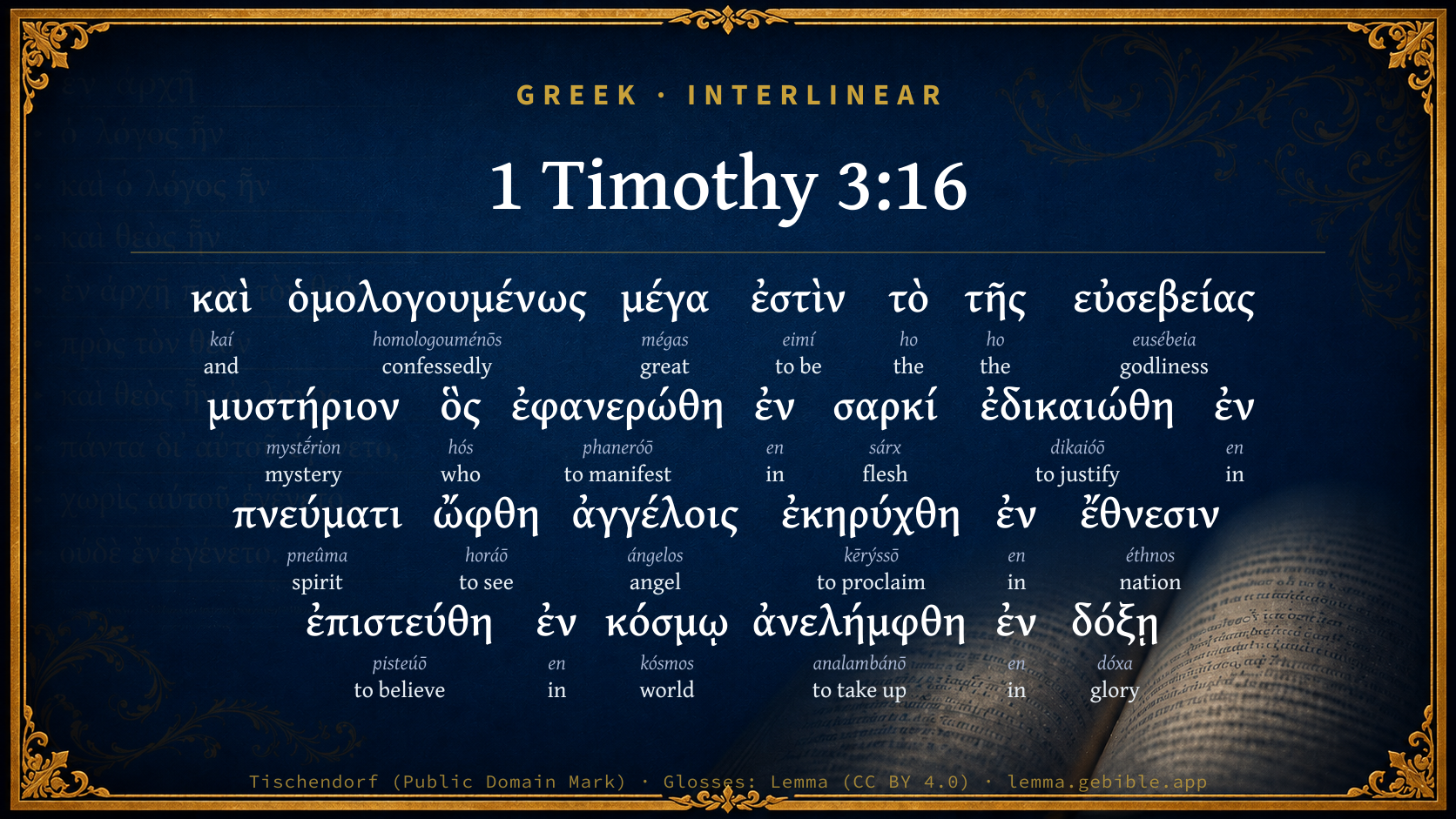
Greek (Tischendorf 8th ed.) 1 Timothy 3:16 appears in the Greek New Testament. The text above is from the Tischendorf 8th edition. Each word links to its Strong’s number and a concise gloss. Click any word for its full Thayer’s Greek Lexicon entry.
Download image
Cite this verse

1 Timothy 3:16 (World English Bible). Public Domain. Lemma interlinear Bible study tool, https://lemma.gebible.app/v/1-timothy/3/16.

Show BibTeX & RIS
BibTeX
RIS
English Translation
Without controversy, the mystery of godliness is great: God was revealed in the flesh, Justified in the spirit, Seen by angels, Preached among the nations, Believed on in the world, And received up in glory.
World English Bible · Public Domain
Highlights
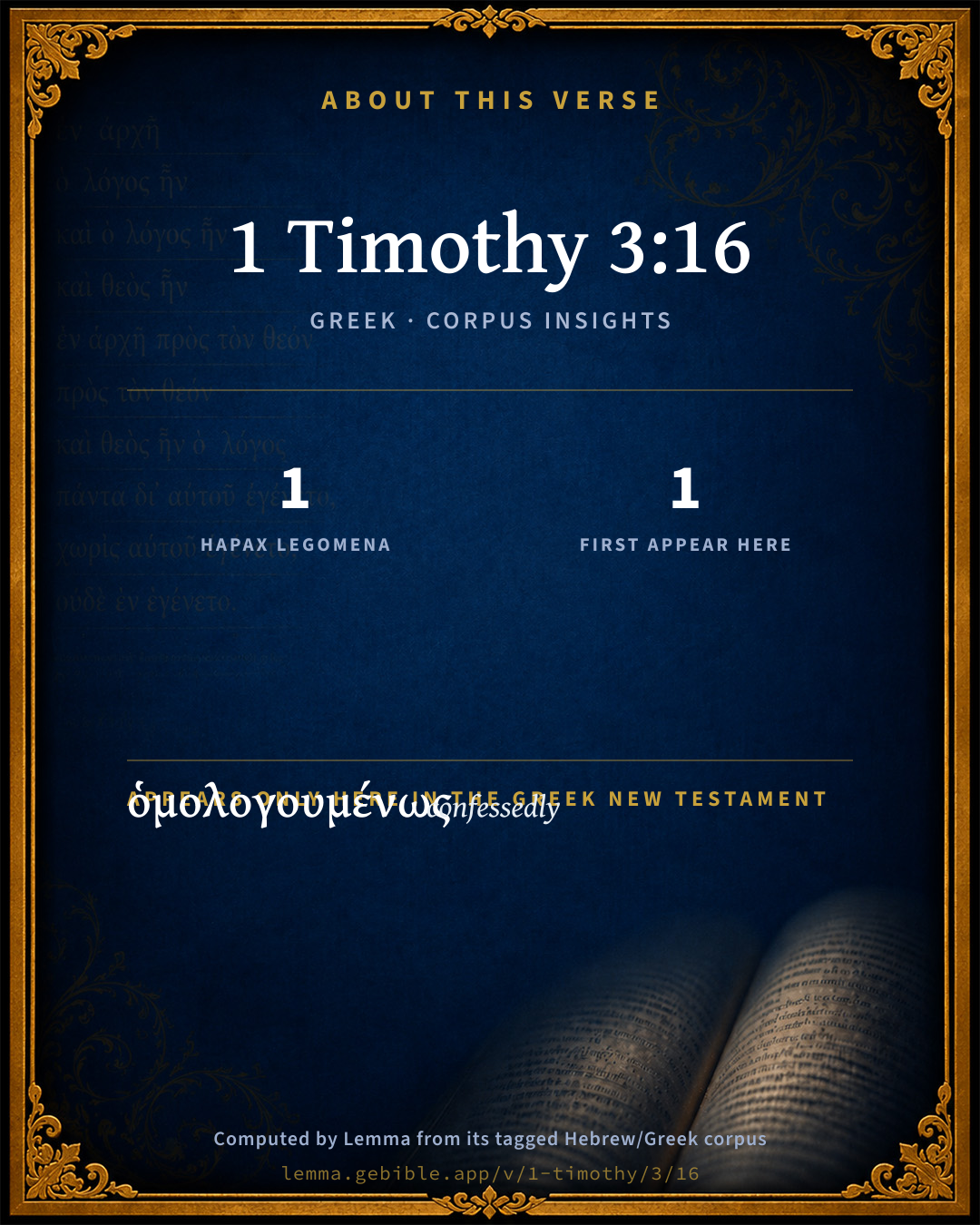
  • 1 hapax legomenon — only here in the Greek New Testament
  • 1 first appearance in the Greek New Testament
Full analysis ↓
Download a study sheet

One document with this verse’s original text, its word-by-word gloss line, the meaning frame, cross-references with their text, attributed commentary, and full source and license credits — printable, and it pastes into notes with its structure intact.

This verse Autodidact and up

Study sheet (.html) Plain text (.txt)

A passage Seminary Student

Up to 50 verses in one chapter. A passage sheet keeps up to 6 commentary sources and 12 cross-references per verse, in the order this page ranks them, and says so on the sheet whenever that leaves anything out. Ask for a single verse and you get the Autodidact verse sheet above.

Everything on this page stays free to read, with no account — the sheet is a download of what is already on screen, not access to it.

Want to remove ads? Support Godless Engineer
Compare translations 3

The same verse in 3 English versions, stacked beneath the original-language interlinear above. Click any original word for its lexicon entry.

Each is an independent rendering of the whole verse — the interlinear is not word-aligned to these translations.

Highlighted words mark where these versions differ — a whole-verse word diff, not a word-by-word alignment.

  • World English Bible Public Domain
    Without controversy, the mystery of godliness is great: God was revealed in the flesh, Justified in the spirit, Seen by angels, Preached among the nations, Believed on in the world, And received up in glory.
  • King James Version Public Domain
    And without controversy great is the mystery of godliness: God was manifest in the flesh, justified in the Spirit, seen of angels, preached unto the Gentiles, believed on in the world, received up into glory.
  • unfoldingWord Literal Text CC BY-SA 4.0
    And admittedly great is the mystery of godliness: “Who was revealed in flesh, was justified in the Spirit, was seen by angels, was proclaimed among the nations, was believed in the world, was taken up in glory.”

unfoldingWord Literal Text — © unfoldingWord, licensed CC BY-SA 4.0. Word-aligned USFM3 via Door43 (git.door43.org/unfoldingWord/en_ult).

Versions to compare (up to 4)

3 of 4 selected

Show all 19 translations

Every available English version of this verse, each an independent rendering of the whole verse.

  • World English Bible Public Domain
    Without controversy, the mystery of godliness is great: God was revealed in the flesh, Justified in the spirit, Seen by angels, Preached among the nations, Believed on in the world, And received up in glory.
  • Berean Standard Bible Public Domain
    By common confession, the mystery of godliness is great: He appeared in the flesh, was vindicated by the Spirit, was seen by angels, was proclaimed among the nations, was believed in throughout the world, was taken up in glory.
  • Majority Standard Bible Public Domain
    By common confession, the mystery of godliness is great: God appeared in the flesh, was vindicated by the Spirit, was seen by angels, was proclaimed among the nations, was believed in throughout the world, was taken up in glory.
  • King James Version Public Domain
    And without controversy great is the mystery of godliness: God was manifest in the flesh, justified in the Spirit, seen of angels, preached unto the Gentiles, believed on in the world, received up into glory.
  • American Standard Version (1901) Public Domain
    And without controversy great is the mystery of godliness; He who was manifested in the flesh, Justified in the spirit, Seen of angels, Preached among the nations, Believed on in the world, Received up in glory.
  • Revised Version (1885) Public Domain
    And without controversy great is the mystery of godliness; He who was manifested in the flesh, justified in the spirit, seen of angels, preached among the nations, believed on in the world, received up in glory.
  • Geneva Bible (1599) Public Domain
    And without controuersie, great is the mysterie of godlinesse, which is, God is manifested in the flesh, iustified in the Spirit, seene of Angels, preached vnto the Gentiles, beleeued on in the world, and receiued vp in glorie.
  • Douay-Rheims (1899) Public Domain
    And evidently great is the mystery of godliness, which was manifested in the flesh, was justified in the spirit, appeared unto angels, hath been preached unto the Gentiles, is believed in the world, is taken up in glory.
  • Young's Literal Translation Public Domain
    and, confessedly, great is the secret of piety -- God was manifested in flesh, declared righteous in spirit, seen by messengers, preached among nations, believed on in the world, taken up in glory!
  • Literal Standard Version CC BY-SA 4.0
    and confessedly, great is the secret of piety: who was revealed in flesh, declared righteous in [the] Spirit, seen by messengers, preached among nations, believed on in the world, taken up in glory!
  • Unlocked Literal Bible CC BY-SA 4.0
    It is undeniable that the revealed truth of godliness is great: “He appeared in the flesh, was justified by the Spirit, was seen by angels, was proclaimed among nations, was believed on in the world, and was taken up in glory.”
  • unfoldingWord Literal Text CC BY-SA 4.0
    And admittedly great is the mystery of godliness: “Who was revealed in flesh, was justified in the Spirit, was seen by angels, was proclaimed among the nations, was believed in the world, was taken up in glory.”
  • Darby Bible Public Domain
    And confessedly the mystery of piety is great. God has been manifested in flesh, has been justified in [the] Spirit, has appeared to angels, has been preached among [the] nations, has been believed on in [the] world, has been received up in glory.
  • World Messianic Bible Public Domain
    Without controversy, the mystery of godliness is great: God was revealed in the flesh, justified in the spirit, seen by angels, preached among the nations, believed on in the world, and received up in glory.
  • Webster's Bible Public Domain
    And without controversy, great is the mystery of godliness: God was manifest in the flesh, justified in the Spirit, seen by angels, preached to the Gentiles, believed on in the world, received up into glory.
  • Free Bible Version CC BY-SA 4.0
    There's no question about it: the revealed truth about God is amazing! He was made known to us in human form, he was vindicated by the Spirit, seen by angels, declared to the nations, trusted in by the world, and taken up in glory!
  • Bible in Basic English Public Domain
    And without argument, great is the secret of religion: He who was seen in the flesh, who was given God's approval in the spirit, was seen by the angels, of whom the good news was given among the nations, in whom the world had faith, who was taken up in glory.
  • Text-Critical English NT CC BY 4.0
    Beyond all question, great is the mystery of godliness: God was revealed in the flesh, vindicated by the Spirit, seen by angels, preached among nations, believed on in the world, and taken up in glory.
  • Tyndale New Testament (1534) Public Domain
    And with out naye great is that mistery of godlines: God was shewed in the flesshe was iustified in the sprete was sene of angels was preached vnto the gentyls was beleved on in erth and receaved vp in glory.

Literal Standard Version (2020), Covenant Press — licensed CC BY-SA 4.0. Text via the HelloAO Bible API (eBible.org). Unlocked Literal Bible (unfoldingWord) — licensed CC BY-SA 4.0. Text via the HelloAO Bible API (eBible.org). unfoldingWord Literal Text — © unfoldingWord, licensed CC BY-SA 4.0. Word-aligned USFM3 via Door43 (git.door43.org/unfoldingWord/en_ult). Free Bible Version, Dr. Jonathan Gallagher — licensed CC BY-SA 4.0. Text via the HelloAO Bible API (eBible.org).

Word by word

More ways to search: Search by grammar → Find every occurrence → Compare this word →

Practice this passage: Drill this verse → Learn its vocabulary →

ὁμολογουμένως
homologouménōs
G3672
“confessedly”
Adverb
Part of Speech
Adverb
Full Thayer's Definition

Origin: from present passive participle of G3670

TDNT: 08:19,7

1. by consent of all, confessedly, without controversy
  1. καὶ kaí G2532 “and” Conjunction
  2. μέγα mégas G3173 “great” Adjective, Nominative, Singular, Neuter
  3. ἐστὶν eimí G1510 “to be” Verb, Present, Active, Indicative, 3rd person, Singular
  4. τὸ ho G3588 “the” Article, Nominative, Singular, Neuter
  5. τῆς ho G3588 “the” Article, Genitive, Singular, Feminine
  6. εὐσεβείας eusébeia G2150 “godliness” Noun, Genitive, Singular, Feminine
  7. μυστήριον mystḗrion G3466 “mystery” Noun, Nominative, Singular, Neuter
  8. ὃς hós G3739 “who” Relative pronoun, Nominative, Singular, Masculine
  9. ἐφανερώθη phaneróō G5319 “to manifest” Verb, Aorist, Passive, Indicative, 3rd person, Singular
  10. ἐν en G1722 “in” Preposition
  11. σαρκί sárx G4561 “flesh” Noun, Dative, Singular, Feminine
  12. ἐδικαιώθη dikaióō G1344 “to justify” Verb, Aorist, Passive, Indicative, 3rd person, Singular
  13. ἐν en G1722 “in” Preposition
  14. πνεύματι pneûma G4151 “spirit” Noun, Dative, Singular, Neuter
  15. ὤφθη horáō G3708 “to see” Verb, Aorist, Passive, Indicative, 3rd person, Singular
  16. ἀγγέλοις ángelos G32 “angel” Noun, Dative, Plural, Masculine
  17. ἐκηρύχθη kērýssō G2784 “to proclaim” Verb, Aorist, Passive, Indicative, 3rd person, Singular
  18. ἐν en G1722 “in” Preposition
  19. ἔθνεσιν éthnos G1484 “nation” Noun, Dative, Plural, Neuter
  20. ἐπιστεύθη pisteúō G4100 “to believe” Verb, Aorist, Passive, Indicative, 3rd person, Singular
  21. ἐν en G1722 “in” Preposition
  22. κόσμῳ kósmos G2889 “world” Noun, Dative, Singular, Masculine
  23. ἀνελήμφθη analambánō G353 “to take up” Verb, Aorist, Passive, Indicative, 3rd person, Singular
  24. ἐν en G1722 “in” Preposition
  25. δόξῃ dóxa G1391 “glory” Noun, Dative, Singular, Feminine

About this verse

These counts appear in no published source. They are computed here, from the morphology-tagged text and Lemma’s own curated glosses. What Lemma adds →

26
words
21
distinct lemmas
Pauline Epistles
section

Notable vocabulary

1 hapax legomenon — a word that appears only here in the entire Greek New Testament:

  • ὁμολογουμένως confessedly G3672

First appearance in Scripture

This word makes its first canonical appearance in the Greek New Testament here:

  • ὁμολογουμένως confessedly G3672

Shared distinctive vocabulary

ἀνελήμφθη to take up G353 occurs in 13 verses of the Greek New Testament. Also found in:
Repetition

Words recur within this verse:

Cross-references

75

Topical passages linked to 1 Timothy 3:16 in the Treasury of Scripture Knowledge — connected by theme and wording, ordered by reader-vote popularity; previews shown in the World English Bible.

  • John 1:14 The Word became flesh, and lived among us. We saw his glory, such glory as of the one and only Son of the Father, full of grace and truth.
  • Hebrews 1:3 His Son is the radiance of his glory, the very image of his substance, and upholding all things by the word of his power, when he had by himself made purification for our sins, sat down on the right hand of the Majesty on high;
  • Mark 16:19 So then the Lord Jesus, after he had spoken to them, was received up into heaven, and sat down at the right hand of God.
  • Romans 16:25
  • 1 John 5:6–8 This is he who came by water and blood, Jesus Christ; not with the water only, but with the water and the blood. It is the Spirit who testifies, because the Spirit is the truth.
  • 1 John 1:2 (and the life was revealed, and we have seen, and testify, and declare to you the life, the eternal life, which was with the Father, and was revealed to us);
  • Luke 24:4 It happened, while they were greatly perplexed about this, behold, two men stood by them in dazzling clothing.
  • Philippians 2:6–8 who, existing in the form of God, didn't consider it robbery to be equal with God,
  • Colossians 1:23 if it is so that you continue in the faith, grounded and steadfast, and not moved away from the hope of the Gospel which you heard, which is being proclaimed in all creation under heaven; of which I, Paul, was made a servant.
  • Colossians 1:27 to whom God was pleased to make known what are the riches of the glory of this mystery among the Gentiles, which is Christ in you, the hope of glory;
  • Isaiah 9:6 For to us a child is born, to us a son is given; and the government shall be on his shoulder: and his name shall be called Wonderful, Counselor, Mighty God, Everlasting Father, Prince of Peace.
  • John 1:1–2 In the beginning was the Word, and the Word was with God, and the Word was God.
  • 1 Peter 1:12 To them it was revealed, that not to themselves, but to you, did they minister these things, which now have been announced to you through those who preached the Gospel to you by the Holy Spirit sent out from heaven; which things angels desire to look into.
  • 1 Peter 3:22 who is at the right hand of God, having gone into heaven, angels and authorities and powers being made subject to him.
  • Ephesians 3:3–10 how that by revelation the mystery was made known to me, as I wrote before in few words,
  • Colossians 2:2 that their hearts may be comforted, they being knit together in love, and gaining all riches of the full assurance of understanding, that they may know the mystery of God, both of the Father and of Christ,
  • 1 Corinthians 2:7 But we speak God's wisdom in a mystery, the wisdom that has been hidden, which God foreordained before the worlds for our glory,
  • Colossians 1:6 which has come to you; even as it is in all the world and is bearing fruit and growing, as it does in you also, since the day you heard and knew the grace of God in truth;
  • Revelation 1:17–18 When I saw him, I fell at his feet like a dead man. He laid his right hand on me, saying, "Don't be afraid. I am the first and the last,
  • Matthew 1:23 "Behold, the virgin shall be with child, And shall bring forth a son. They shall call his name Immanuel;" Which is, being interpreted, "God with us."
  • Matthew 3:16 Jesus, when he was baptized, went up directly from the water: and behold, the heavens were opened to him. He saw the Spirit of God descending as a dove, and coming on him.
  • Luke 22:43 An angel from heaven appeared to him, strengthening him.
  • Hebrews 12:2 looking to Jesus, the author and perfecter of faith, who for the joy that was set before him endured the cross, despising shame, and has sat down at the right hand of the throne of God.
  • John 20:12 and she saw two angels in white sitting, one at the head, and one at the feet, where the body of Jesus had lain.
  • Galatians 4:4 But when the fullness of the time came, God sent out his Son, born to a woman, born under the law,
  • Ephesians 1:9 making known to us the mystery of his will, according to his good pleasure which he purposed in him
  • Ephesians 6:19 on my behalf, that utterance may be given to me in opening my mouth, to make known with boldness the mystery of the Gospel,
  • Colossians 1:16–18 For by him were all things created, in the heavens and on the earth, things visible and things invisible, whether thrones or dominions or principalities or powers; all things have been created through him, and for him.
  • 1 Timothy 3:9 holding the mystery of the faith in a pure conscience.
  • Hebrews 2:9–13 But we see him who has been made a little lower than the angels, Jesus, because of the suffering of death crowned with glory and honor, that by the grace of God he should taste of death for everyone.
  • 1 Peter 1:20 who was foreknown indeed before the foundation of the world, but was revealed at the end of times for your sake,
  • 1 John 3:5 You know that he was revealed to take away our sins, and in him is no sin.
  • Acts 2:32–36 This Jesus God raised up, to which we all are witnesses.
  • Acts 20:28 Take heed, therefore, to yourselves, and to all the flock, in which the Holy Spirit has made you overseers, to shepherd the assembly of the Lord and God which he purchased with his own blood.
  • Romans 10:18 But I say, didn't they hear? Yes, most assuredly, "Their sound went out into all the earth, Their words to the ends of the world."
  • 1 Corinthians 15:47 The first man is of the earth, made of dust. The second man is the Lord from heaven.
  • Hebrews 7:7 But without any dispute the less is blessed by the better.
  • Revelation 7:9 After these things I looked, and behold, a great multitude, which no man could number, out of every nation and of all tribes, peoples, and languages, standing before the throne and before the Lamb, dressed in white robes, with palm branches in their hands.
  • Acts 10:34 Peter opened his mouth and said, "Truly I perceive that God doesn't show favoritism;
  • Romans 9:5 of whom are the fathers, and from whom is Christ as concerning the flesh, who is over all, God, blessed forever. Amen.
  • Galatians 2:8 (for he who appointed Peter to the apostleship of the circumcision appointed me also to the Gentiles);
  • Mark 1:13 He was there in the wilderness forty days tempted by Satan. He was with the wild animals; and the angels were ministering to him.
  • Luke 24:51 It happened, while he blessed them, that he withdrew from them, and was carried up into heaven.
  • John 13:3 Jesus, knowing that the Father had given all things into his hands, and that he came forth from God, and was going to God,
  • Acts 14:27 When they had arrived, and had gathered the assembly together, they reported all the things that God had done with them, and that he had opened a door of faith to the Gentiles.
  • Romans 8:3 For what the law couldn't do, in that it was weak through the flesh, God did, sending his own Son in the likeness of sinful flesh and for sin, he condemned sin in the flesh;
  • Ephesians 4:8–10 Therefore he says, "When he ascended on high, he led captivity captive, and gave gifts to men."
  • Psalms 68:17–18 The chariots of God are tens of thousands and thousands of thousands. The Lord is among them, from Sinai, into the sanctuary.
  • Isaiah 50:5–7 The Lord Yahweh has opened my ear, and I was not rebellious, neither turned away backward.
  • Matthew 4:11 Then the devil left him, and behold, angels came and ministered to him.
  • Matthew 13:11 He answered them, "To you it is given to know the mysteries of the Kingdom of Heaven, but it is not given to them.
  • Matthew 28:2 Behold, there was a great earthquake, for an angel of the Lord descended from the sky, and came and rolled away the stone from the door, and sat on it.
  • Mark 16:5 Entering into the tomb, they saw a young man sitting on the right side, dressed in a white robe, and they were amazed.
  • Luke 2:10–14 The angel said to them, "Don't be afraid, for behold, I bring you good news of great joy which will be to all the people.
  • Luke 2:32 A light for revelation to the Gentiles, And the glory of your people Israel."
  • John 1:32–33 John testified, saying, "I have seen the Spirit descending like a dove out of heaven, and it remained on him.
  • John 15:26 "When the Counselor has come, whom I will send to you from the Father, the Spirit of truth, who proceeds from the Father, he will testify about me.
  • John 16:8–9 When he has come, he will convict the world about sin, about righteousness, and about judgment;
  • John 16:28 I came out from the Father, and have come into the world. Again, I leave the world, and go to the Father."
  • John 17:5 Now, Father, glorify me with your own self with the glory which I had with you before the world existed.
  • Acts 1:19 It became known to everyone who lived in Jerusalem that in their language that field was called 'Akeldama,' that is, 'The field of blood.'
  • Acts 13:46–48 Paul and Barnabas spoke out boldly, and said, "It was necessary that God's word should be spoken to you first. Since indeed you thrust it from you, and judge yourselves unworthy of eternal life, behold, we turn to the Gentiles.
  • 2 Thessalonians 1:10 when he comes to be glorified in his saints, and to be admired among all those who have believed (because our testimony to you was believed) in that day.
  • Hebrews 8:1 Now in the things which we are saying, the main point is this. We have such a high priest, who sat down on the right hand of the throne of the Majesty in the heavens,
  • Revelation 17:5 And on her forehead a name was written, "MYSTERY, BABYLON THE GREAT, THE MOTHER OF THE PROSTITUTES AND OF THE ABOMINATIONS OF THE EARTH."
  • Revelation 17:7 The angel said to me, "Why do you wonder? I will tell you the mystery of the woman, and of the beast that carries her, which has the seven heads and the ten horns.
  • Isaiah 7:14 Therefore the Lord himself will give you a sign. Behold, the virgin will conceive, and bear a son, and shall call his name Immanuel.
  • Jeremiah 23:5–6 Behold, the days come, says Yahweh, that I will raise to David a righteous Branch, and he shall reign as king and deal wisely, and shall execute justice and righteousness in the land.
  • Micah 5:2 But you, Bethlehem Ephrathah, Being small among the clans of Judah, Out of you one will come forth to me that is to be ruler in Israel; Whose goings forth are from of old, from everlasting.
  • John 6:62 Then what if you would see the Son of Man ascending to where he was before?
  • Acts 1:1–11 The first book I wrote, Theophilus, concerned all that Jesus began both to do and to teach,
  • Romans 1:3–4 concerning his Son, who was born of the seed of David according to the flesh,
  • 2 Thessalonians 2:7 For the mystery of lawlessness already works. Only there is one who restrains now, until he is taken out of the way.
  • 1 Peter 3:18 Because Christ also suffered for sins once, the righteous for the unrighteous, that he might bring you to God; being put to death in the flesh, but made alive in the spirit;
  • Romans 10:12 For there is no distinction between Jew and Greek; for the same Lord is Lord of all, and is rich to all who call on him.

Cross-references courtesy of OpenBible.info (CC BY 4.0).

Where the printed editions differ

1 variant

Places in this verse where the major printed Greek editions disagree on the wording in a way that affects the translation — a comparison of editions, not a manuscript-by-manuscript collation. The editions are the modern critical texts (Nestlé-Aland 28/27, SBL, Westcott-Hort, Tregelles, Tyndale House) and the traditional texts behind the KJV (the Textus Receptus and the Byzantine/Majority text). It is not a claim about which reading is original.

  1. Different wording
    ὃς

    “Who”

    In NA28NA27TynSBLWHTreg Not in TRByz

    θεὸς (theos) 'God' occurs in traditional manuscripts (TR+Byz) instead of ὃς (hos) 'Who' in older manuscripts (NA28+NA27+Tyn+SBL+WH+Treg)

Textual data: Translators Amalgamated Greek New Testament (STEPBible TAGNT) · CC BY 4.0.

Commentary

Notes on 1 Timothy 3:16 from classic Christian and Jewish commentators (each source and its license shown beneath its notes). The classic Christian expositions comment on the surrounding passage and are grouped to its opening verse, so a note may address several verses; the Jewish commentaries on the Tanakh (Rashi and others) are per-verse, so they appear only where the commentator wrote on this verse.

Lemma curates 59 commentaries, every one of them public domain or Creative Commons licensed, each selected and text-cleaned for this edition rather than reprinted as found. About our sources →

Jamieson, Fausset & Brown

Robert Jamieson, A. R. Fausset & David Brown

And--following up Ti1 3:15 : The pillar of the truth is the Church in which thou art required to minister; "AND (that thou mayest know how grand is that truth which the Church so upholds) confessedly (so the Greek for 'without controversy') great is the mystery of godliness: (namely), HE WHO (so the oldest manuscripts and versions read for 'God') was manifested in (the) flesh (He who) was justified in the Spirit," &c. There is set before us the whole dignity of Christ's person. If He were not essentially superhuman (Tit 2:13), how could the apostle emphatically declare that He was manifested in (the) flesh? [TREGELLES, Printed Text of the Greek New Testament]. (Joh 1:14; Phi 2:7; Jo1 1:2; Jo1 4:2). Christ, in all His aspects, is Himself "the mystery of godliness." He who before was hidden "with God" was made manifest (Joh 1:1, Joh 1:14; Rom 16:25-26; Col 1:26; Ti2 1:10; Tit 2:11; Tit 3:4; Jo1 3:5, Jo1 3:8). "Confessedly," that is, by the universal confession of the members of "the Church," which is in this respect the "pillar" or upholder "of the truth."

the mystery--the divine scheme embodied in CHRIST (Col 1:27), once hidden from, but now revealed to, us who believe.

of godliness--rather, "piety"; a different Greek, expresses godliness (Ti1 2:10). In opposition to the ungodliness or impiety inseparable from error (departure from the faith: "doctrines of devils," "profane fables," Ti1 4:1, Ti1 4:7; compare Ti1 6:3). To the victims of such error, the "mystery of piety" (that is, Christ Himself) remains a mystery unrevealed (Ti1 4:2). It is accessible only to "piety" (Ti1 3:9): in relation to the pious it is termed a "mystery," though revealed (Co1 2:7-14), to imply the excellence of Him who is the surpassing essential subject of it, and who is Himself "wonderful" (Isa 9:6), surpassing knowledge (Eph 3:18-19); compare Eph 5:32. The apostle now proceeds to unfold this confessedly great mystery in its details. It is not unlikely that some formula of confession or hymn existed in the Church and was generally accepted, to which Paul alludes in the words "confessedly great is the mystery," &c. (to wit), "He who was manifested," &c. Such hymns were then used (compare Eph 5:19; Col 3:16). PLINY [1.10, Epistle, 97], "They are wont on a fixed day before dawn to meet and sing a hymn in alternate responses to Christ, as being God"; and EUSEBIUS [Ecclesiastical History, 5.28]. The short unconnected sentences with the words similarly arranged, and the number of syllables almost equal, and the ideas antithetically related, are characteristics of a Christian hymn. The clauses stand in parallelism; each two are connected as a pair, and form an antithesis turning on the opposition of heaven to earth; the order of this antithesis is reversed in each new pair of clauses: flesh and spirit, angels and Gentiles, world and glory; and there is a correspondence between the first and the last clause: "manifested in the flesh, received up into glory" [WIESINGER].

justified--that is, approved to be righteous [ALFORD]. Christ, while "in the flesh," seemed to be just such a one as men in the flesh, and in fact bore their sins; but by having died to sin, and having risen again, He gained for Himself and His people justifying righteousness (Isa 50:8; Joh 16:10; Act 22:14; Rom 4:25; Rom 6:7, Rom 6:10; Heb 9:28; Pe1 3:18; Pe1 4:1 Jo1 2:1) [BENGEL]; or rather, as the antithesis to "was manifest in the flesh" requires, He was justified in the Spirit at the same time that He was manifest in the flesh, that is, He was vindicated as divine "in His Spirit," that is, in His higher nature; in contrast to "in the flesh," His visible human nature. This contrasted opposition requires "in the Spirit" to be thus explained: not "by the Spirit," as ALFORD explains it. So Rom 1:3-4, "Made of the seed of David according to the flesh, and declared to be the Son of God with power, according to the Spirit of holiness, by the resurrection from the dead." So "justified" is used to mean vindicated in one's true character (Mat 11:19; Luk 7:35; Rom 3:4). His manifestation "in the flesh" exposed him to misapprehension, as though he were nothing more (Joh 6:41; Joh 7:27). His justification, or vindication, in respect to His Spirit or higher being, was effected by ALL that manifested that higher being, His words (Mat 7:29; Joh 7:46), His works (Joh 2:11; Joh 3:2), by His Father's testimony at His baptism (Mat 3:17), and at the transfiguration (Mat 17:5), and especially by His resurrection (Act 13:33; Rom 1:4), though not by this exclusively, as BENGEL limits it.

seen of angels--answering to "preached unto the Gentiles" (or rather "among the nations"; including the Jews), on the other hand (Mat 28:19; Rom 16:25-26). "Angels saw the Son of God with us, not having seen Him before" [CHRYSOSTOM].' "not even they had seen His divine nature, which is not visible to any creature, but they saw Him incarnate" [THEODORET] (Eph 3:8, Eph 3:10; Pe1 1:12; compare Col 1:16, Col 1:20). What angels came to know by seeing, the nations learned by preaching. He is a new message to the one class as well as to the other; in the wondrous union in His person of things most opposite, namely, heaven and earth, lies "the mystery" [WIESINGER]. If the English Version, "Gentiles," be retained, the antithesis will be between the angels who are so near the Son of God, the Lord of "angels," and the Gentiles who were so utterly "afar off" (Eph 2:17).

believed on in the world--which lieth in wickedness (Jo1 2:15; Jo1 5:19). Opposed to "glory" (Joh 3:16-17). This followed upon His being "preached" (Rom 10:14).

received up into glory--Greek, "in glory." However, English Version may be retained thus, "Received up (so as now to be) in glory," that is, into glory (Mar 16:19; Luk 24:51; Act 1:11). His reception in heaven answers to His reception on earth by being "believed on."

Next: 1 Timothy Chapter 4

Jamieson, Fausset & Brown — Commentary Critical and Explanatory on the Whole Bible (1871) — public domain (CC PDM 1.0). Text via the HelloAO Bible API.

Albert Barnes' Notes on the Bible

And, without controversy - Undeniably, certainly. The object of the apostle is to say that the truth which he was about to state admitted of no dispute.

Great is the mystery - On the meaning of the word “mystery,” see the notes on 1Co 2:7. The word means that which had been hidden or concealed. The meaning here is not that the proposition which he affirms was mysterious in the sense that it was unintelligible, or impossible to be understood; but that the doctrine respecting the incarnation and the work of the Messiah, which had been so long “kept hidden” from the world, was a subject of the deepest importance. This passage, therefore, should not be used to prove that there is anything unintelligible, or anything that surpasses human comprehension, in that doctrine, whatever may be the truth on that point; but that the doctrine which he now proceeds to state, and which had been so long concealed from mankind, was of the utmost consequence.

Of godliness - The word “godliness” means, properly, piety, reverence, or religiousness. It is used here, however, for the gospel scheme, to wit, that which the apostle proceeds to state. This “mystery,” which had “been hidden from ages and from generations, and which was now manifest” Col 1:26, was the great doctrine on which depended “religion” everywhere, or was that which constituted the Christian scheme.

God - Probably there is no passage in the New Testament which has excited so much discussion among critics as this, and none in reference to which it is so difficult to determine the true reading. It is the only one, it is believed, in which the microscope has been employed to determine the lines of the letters used in a manuscript; and, after all that has been done to ascertain the exact truth in regard to it, still the question remains undecided. It is not the object of these notes to enter into the examination of questions of this nature. A full investigation may be found in Wetstein. The question which has excited so much controversy is, whether the original Greek word was Θεὸς Theos, “God,” or whether it was ὅς hos, “who,” or ὁ ho, “which.” The controversy has turned, to a considerable degree, on the reading in the “Codex Alexandrinus;” and a remark or two on the method in which the manuscripts in the New Testament were written, will show the true nature of the controversy.

Greek manuscripts were formerly written entirely in capital letters, and without breaks or intervals between the words, and without accents; see a full description of the methods of writing the New Testament, in an article by Prof. Stuart in Dr. Robinson’s Biblotheca Sacra, No. 2, pp. 254ff The small, cursive Greek letters which are now used, were not commonly employed in transcribing the New Testament, if at all, until the ninth or tenth centuries. It was a common thing to abridge or contract words in the manuscript. Thus, πρ would be used for πατερ pater, “father;” κς for κυριος kurios, “Lord;” Θς for Θεος Theos, “God,” etc. The words thus contracted were designated by a faint line or dash over them. In this place, therefore, if the original uncials (capitals) were Θ¯C¯, standing for Θεὸς Theos, “God,” and the line in the Θ, and the faint line over it, were obliterated from any cause, it would easily be mistaken for OC - ὅς hos - “who.”

To ascertain which of these is the true reading, has been the great question; and it is with reference to this that the microscope has been resorted to in the examination of the Alexandrian manuscript. It is now generally admitted that the faint line “over” the word has been added by some later hand, though not improbably by one who found that the line was nearly obliterated, and who meant merely to restore it. Whether the letter O was originally written with a line within it, making the reading “God,” it is now said to be impossible to determine, in consequence of the manuscript at this place having become so much worn by frequent examination. The Vulgate and the Syriac read it: “who,” or “which.” The Vulgate is, “Great is the sacrament of piety which was manifested in the flesh.” The Syriac, “Great is the mystery of godliness, that he was manifested in the flesh.” The “probability” in regard to the correct reading here, as it seems to me, is, that the word, as originally written, was Θεός Theos - “God.” At the same time, however, the evidence is not so clear that it can be properly used in an argument. But the passage is not “necessary” to prove the doctrine which is affirmed, on the supposition that that is the correct reading. The same truth is abundantly taught elsewhere; compare Mat 1:23; Joh 1:14.

Was manifest - Margin, “Manifested.” The meaning is, “appeared” in the flesh.

In the flesh - In human nature; see this explained in the notes on Rom 1:3. The expression here looks as though the true reading of the much-disputed word was “God.” It could not have been, it would seem evident, ὁ ho, “which,” referring to “mystery;” for how could a mystery “be manifested in the flesh?” Nor could it it be ὅς hos, “who,” unless that should refer to one who was more than a man; for how absurd would it be to say that “a man was manifested, or appeared in the flesh!” How else could a man appear? The phrase here means that God appeared in human form, or with human nature; and this is declared to be the “great” truth so long concealed from human view, but now revealed as constituting the fundamental doctrine of the gospel. The expressions which follow in this verse refer to God “as” thus manifested in the flesh; to the Saviour as he appeared on earth, regarded as a divine and human being. It was the fact that he thus appeared and sustained this character, which made the things which are immediately specified so remarkable, and so worthy of attention.

Justified in the Spirit - That is, the incarnate person above referred to; the Redeemer, regarded as God and man. The word “Spirit,” here, it is evident, refers to the Holy Spirit, because:

(1) It is not possible to attach any intelligible idea to the phrase, “he was justified by his own spirit, or soul;”

(2) As the Holy Spirit performed so important a part in the work of Christ, it is natural to suppose there would be some allusion here to him; and,

(3) As the “angels” are mentioned here as having been with him, and as the Holy Spirit is often mentioned in connection with him, it is natural to suppose that there would be some allusion to Him here. The word “justified,” here, is not used in the sense in which it is when applied to Christians, but in its more common signification. It means to “vindicate,” and the sense is, that he was shown to be the Son of God by the agency of the Holy Spirit; he was thus vindicated from the charges alleged against him. The Holy Spirit furnished the evidence that he was the Son of God, or “justified” his claims. Thus he descended on him at his baptism, Mat 3:16; he was sent to convince the world of sin because it did not believe on him, Joh 16:8-9; the Saviour cast out devils by him, Mat 12:28; the Spirit was given to him without measure, Joh 3:34, and the Spirit was sent down in accordance with his promise, to convert the hearts of people; Act 2:33. All the manifestations of God to him; all the power of working miracles by his agency; all the influences imparted to the man Christ Jesus, endowing him with such wisdom as man never had before, may be regarded as an attestation of the Holy Spirit to the divine mission of the Lord Jesus, and of course as a vindication from all the charges against him. In like manner, the descent of the Holy Spirit on the day of Pentecost, and his agency in the conversion of every sinner, prove the same thing, and furnish the grand argument in vindication of the Redeemer that he was sent from God. To this the apostle refers as a part of the glorious truth of the Christian scheme now revealed - the “mystery of religion;” as a portion of the amazing records, the memory of which the church was to preserve as connected with the redemption of the world.

Seen of angels - They were attendants on his ministry, and came to him in times of distress, peril, and want; compare Luk 2:9-13; Luk 22:43; Luk 24:4; Heb 1:6; Mat 4:11. They felt an interest in him and his work, and they gladly came to him in his sorrows and troubles. The design of the apostle is to give an impressive view of the grandeur and glory of that work which attracted the attention of the heavenly hosts, and which drew them from the skies that they might proclaim his advent, sustain him in his temptations, witness his crucifixion, and watch over him in the tomb. The work of Christ, though despised by people, excited the deepest interest in heaven; compare notes on 1Pe 1:12.

Preached unto the Gentiles - This is placed by the apostle among the “great” things which constituted the “mystery” of religion. The meaning is, that it was a glorious truth that salvation might be, and should be, proclaimed to all mankind, and that this was a part of the important truths made known in the gospel. Elsewhere this is called, by way of eminence, “the mystery of the gospel;” that is, the grand truth which had not been known until the coming of the Saviour; see the Eph 6:19 note; Col 1:26-27; Col 4:3 notes. Before his coming, a wall of partition had divided the Jewish and Gentile world. The Jews regarded the rest of mankind as excluded from the covenant mercies of God, and it was one of the principal stumblingblocks in their way, in regard to the gospel, that it proclaimed that all the race was on a level, that that middle wall of partition was broken down, and that salvation might now be published to all people; compare Act 22:21; Eph 2:14-15; Rom 3:22; Rom 10:11-20.

The Jew had no special advantage for salvation by being a Jew; the Gentile was not excluded from the hope of salvation. The plan of redemption was adapted “to man” as such - without regard to his complexion, country, customs, or laws. The blood of Christ was shed for all, and wherever a human being could be found, salvation might be freely offered him. This “is” a glorious truth; and taken in all its bearings, and in reference to the views which then prevailed, and which have always more or less prevailed about the distinctions made among people by caste and rank, there is scarcely anymore glorious truth connected with the Christian revelation, or one which will exert a wider influence in promoting the welfare of man. It is a great privilege to be permitted to proclaim that all people, in one respect - and that the most important - are on a level; that they are all equally the objects of the divine compassion; that Christ died for one as really as for another; that birth, wealth, elevated rank, or beauty of complexion, contribute nothing to the salvation of one man; and that poverty, a darker skin, slavery, or a meaner rank, do nothing to exclude another from the favor of his Maker.

Believed on in the world - This also is mentioned among the “great” things which constitute the mystery of revealed religion. But why is this regarded as so remarkable as to be mentioned thus? In point of importance, how can it be mentioned in connection with the fact that God was manifest in the flesh; that he was vindicated by the Holy Spirit; that he was an object of intense interest to angelic hosts, and that his coming had broken down the walls which had separated the world, and placed them now on a level? I answer, perhaps the following circumstances may have induced the apostle to place this among the remarkable things evincing the greatness of this truth:

(1) The strong “improbability” arising from the greatness of the “mystery,” that the doctrines respecting the incarnate Deity would be believed. Such is the incomprehensible nature of many of the truths connected with the incarnation; so strange does it seem that God would become incarnate; so amazing that he should appear in human flesh and blood, and that the incarnate Son of God should die, that it might be regarded as a wonderful thing that such a doctrine had in fact obtained credence in the world. But it was a glorious truth that all the natural improbabilities in the case had been overcome, and that people had accredited the announcement.

(2) The strong improbability that his message would be believed, arising from the “wickedness of the human heart.” Man, in all his history, had shown a strong reluctance to believe any message from God, or any truth whatever revealed by him. The Jews had rejected his prophets and put them to death Matt. 23; Acts 7; and had at last put his own Son - their Messiah - to death. Man everywhere had shown his strong inclination to unbelief. There is in the human soul no elementary principle or germ of faith in God. Every man is an unbeliever by nature - an infidel first; a Christian afterward; an infidel as he comes into the world; a believer only as he is made so by grace. The apostle, therefore, regarded it as a glorious fact that the message respecting the Saviour “had been” believed in the world. It overcame such a strong and universal reluctance to confide in God, that it showed that there was more than human power in operation to overcome this reluctance.

(3) The extent to which this had been done may have been a reason why he thought it worthy of the place which he gives it here. It had been embraced, not by a few, but by thousands in all lands where the gospel had been published; and it was proof of the truth of the doctrine, and of the great power of God, that such high mysteries as those relating to redemption, and so much opposed to the natural feelings of the human heart, should have been embraced by so many. The same thing occurs now. The gospel makes its way against the native incredulity of the world, and every new convert is an additional demonstration that it is from God, and a new illustration of the greatness of this mystery.

Received up into glory - To heaven; compare Joh 17:5; see the notes on Act 1:9. This is mentioned as among the “great” or remarkable things pertaining to “godliness,” or the Christian revelation, because it was an event which had not elsewhere occurred, and was the crowning grandeur of the work of Christ. It was an event that was fitted to excite the deepest interest in heaven itself. No event of more importance has ever occurred in the universe, of which we have any knowledge, than the re-ascension of the triumphant Son of God to glory after having accomplished the redemption of a world.

In view of the instructions of this chapter, we may make the following remarks.

1. The word “bishop” in the New Testament never means what is now commonly understood by it - “a Prelate.” It does not denote here, or anywhere else in the Now Testament, one who has charge over a “diocese” composed of a certain district of country, embracing a number of churches with their clergy.

2. There are not “three orders” of clergy in the New Testament. The apostle Paul in this chapter expressly designates the characteristics of those who should have charge of the church, but mentions only two, “bishops” and “deacons.” The former are ministers of the word, having charge of the spiritual interests of the church; the other are deacons, of whom there is no evidence that they were appointed to preach. There is no “third” order. There is no allusion to anyone who was to be “superior” to the “bishops” and “deacons.” As the apostle Paul was expressly giving instructions in regard to the organization of the church, such an omission is unaccountable if he supposed there was to be an order of “prelates” in the church. Why is there no allusion to them? Why is there no mention of their qualifications? If Timothy was himself a prelate, was he to have nothing to do in transmitting the office to others? Were there no special qualifications required in such an order of people which it would be proper to mention? Would it not be “respectful,” at least, in Paul to have made some allusion to such an office, if Timothy himself held it?

3. There is only one order of preachers in the church. The qualifications of that order are specified with great minuteness and particularity, as well as beauty; 1Ti 3:2-7. No man really needs to know more of the qualifications for this office than could be learned from a prayerful study of this passage.

4. A man who enters the ministry “ought” to have high qualifications; 1Ti 3:2-7. No man “ought,” under any pretence, to be put into the ministry who has not the qualifications here specified. Nothing is gained in any department of human labor, by appointing incompetent persons to fill it. A farmer gains nothing by employing a man on his farm who has no proper qualifications for his business; a carpenter, a shoemaker, or a blacksmith, gains nothing by employing a man who knows nothing about his trade; and a neighborhood gains nothing by employing a man as a teacher of a school who has no qualifications to teach, or who has a bad character. Such a man would do more mischief on a farm, or in a workshop, or in a school, than all the good which he could do would compensate. And so it is in the ministry. The true object is not to increase the “number” of ministers, it is to increase the number of those who are “qualified” for their work, and if a man has not the qualifications laid down by the inspired apostle, he had better seek some other calling.

5. The church is the guardian of the truth; 1Ti 3:15. It is appointed to preserve it pure, and to transmit it to future ages. The world is dependent on it for any just views of truth. The church has the power, and is entrusted with the duty, of preserving on earth a just knowledge of God and of eternal things; of the way of salvation; of the requirements of pure morality: to keep up the knowledge of that truth which tends to elevate society and to save man. It is entrusted with the Bible, to preserve uncorrupted, and to transmit to distant ages and lands. It is bound to maintain and assert the truth in its creeds and confessions of faith. And it is to preserve the truth by the holy lives of its members, and to show in their walk what is the appropriate influence of truth on the soul. Whatever religious truth there is now on the earth, has been thus preserved and transmitted, and it still devolves on the church to bear the truth of God on to future times, and to diffuse it abroad to distant lands.

6. The closing verse of this chapter 1Ti 3:16 gives us a most elevated view of the plan of salvation. and of its grandeur and glory. It would be difficult, if not impossible, to condense more interesting and sublime thought into so narrow a compass as this. The great mystery of the incarnation; the interest of angelic beings in the events of redemption; the effect of the gospel on the pagan world; the tendency of the Christian religion to break down every barrier among people, and to place all the race on a level; its power in overcoming the unbelief of mankind; and the re-ascension of the Son of God to heaven, present a series of most wonderful facts to our contemplation. These things are found in no other system of religion, and these are worthy of the profound attention of every human being. The manifestation of God in the flesh! What a thought! It was worthy of the deepest interest among the angels, and it “claims” the attention of people, for it was for human beings and not for angels that he thus appeared in human form; compare notes on 1Pe 1:12.

7. How strange it is that “man” feels no more interest in these things! God was manifest in the flesh for his salvation, but he does not regard it Angels looked upon it with wonder: but man, for whom he came, feels little interest in his advent or his work! The Christian religion has broken down the barrier among nations, and has proclaimed that all people may be saved; yet the mass of people look on this with entire unconcern. The Redeemer ascended to heaven, having finished his great work; but how little interest do the mass of mankind feel in this! He will come again to judge the world; but the race moves on, regardless of this truth; unalarmed at the prospect of meeting him; feeling no interest in the assurance that he “has” come and died for sinners, and no apprehension in view of the fact that he will come again, and that they must stand at his bar. All heaven was moved with his first advent, and will be with his second; but the earth regards it with unconcern. Angelic beings look upon this with the deepest anxiety, though they have no personal interest in it; man, though all his great interests are concentrated on it, regards it as a fable, disbelieves it all, and treats it with contempt and scorn. Such is the difference between heaven and earth - angels and human beings!

Albert Barnes' Notes on the Bible (1834–1885) — public domain. Text from a community e-Sword/MySword module.

The Biblical Illustrator

Joseph S. Exell

1Ti_3:16

And without doubt great is the mystery of godliness.

Mystery

I shall deliver the nature of the thing itself in this definition, viz., that a mystery is truth revealed by God above the power of natural reason to find out or comprehend.

1. That it is a truth. By which we exclude everything from being a mystery that is absurd and contradictions, since a truth can by no means be so.

2. That it be revealed by God, viz., as to its existence, that there is such a thing. For otherwise, as to the nature of the thing itself, and several other respects in which it may be known, the revelation of it is not supposed to extend so far.

3. That it surpasses all the power of natural reason to discover or find it out.

4. That it be such a thing as bare natural reason (even after it is discovered) cannot comprehend. I say comprehend, that is, know it perfectly, and as far as it is capable of being known (1Co_13:12). That the mysteriousness of those matters of faith is most subservient to the great important ends of Religion, and that upon these following accounts.

I. Because religion, in the prime institution of it, was designed to make impressions of awe and reverential fear upon mens minds. Distance preserves respect, and we still imagine some transcendent worth in things above our reach. Moses was never more reverenced than when he wore his veil. Nay, the very sanctum sanctorum would not have had such veneration from the Jews had they been permitted to enter into it, and to gaze and stare upon it as often as they did upon the other parts of the Temple. The high priest himself, who alone was suffered to enter into it, yet was to do so but once a year, lest the frequency of the sight might insensibly lessen that adoration which so sacred a thing was still to maintain upon his thoughts. In all great respect, or honour shown, there is something of wonder; but a thing often seen (we know), be it never so excellent, yet ceasing thereby to be new, it ceases also to be wondered at. Forasmuch as it is not the worth or excellency, but the strangeness of the thing, which draws the eyes and admiration of men after it. For can anything in nature be imagined more glorious and beautiful than the sun shining in his full might? and yet how many more spectators and wonderers does the same sun find under an eclipse? But to pursue this notion and observation yet farther, I conceive it will not be amiss to consider how it has been the custom of all sober and wise nations of the world still to reserve the great rites of their religion in occulto. Thus how studiously did the Egyptians, those great masters of all learning, lock up their sacred things from all access and knowledge of the vulgar!

II. A second ground of the mysteriousness of religion (as it is delivered by God to mankind) is his most wise purpose thereby to humble the pride and haughtiness of mans reason. In short, man would be like God in knowledge, and so he fell; and now, if he will be like Him in happiness too, God will effect it in such a way as shall convince him to his face that he knows nothing. The whole course of his salvation shall be all riddle and mystery to him; he shall (as I may so express it) be carried up to heaven in a cloud. Instead of evidence springing from things themselves, and clear knowledge growing from such an evidence, his understanding must now be contented with the poor, dim light of faith, which guides only in the strength and light of anothers knowledge, and is properly a seeing with anothers eyes, as being otherwise wholly unable to inform us about the great things of our peace, by any immediate inspection of those things themselves. For as the primitive effect of knowledge was first to put up and then to throw down, so the contrary method of gram and faith is first to depress and then to advance. The difficulty and strangeness of some of the chief articles of our religion are notable instruments in the hand of God to keep the soul low and humble, and to check those self-complacencies which it is apt to grow into by an over-weening conceit of its own opinions more than by any other thing whatsoever. For man naturally is scarce so fond of the offspring of his body as of that of his soul. His notions are his darlings; so that neither children nor self are half so dear to him as the only begotten of his mind. And therefore in the dispensations of religion God will have this only begotten, this best beloved, this Isaac of our souls (above all other offerings that a man can bring Him) to be sacrificed and given up to Him.

III. God has been pleased to put a mysteriousness into the greatest articles of our religion, thereby to engage us in a closer and more diligent search into them. He would have them the objects of our study, and for that purpose has rendered them hard and difficult. For no man studies things plain and evident, and such as by their native clearness do even prevent our search, and of their own accord offer themselves to our understandings. The foundation of all inquiry is the obscurity as well as worth of the thing inquired after. And God has thought good to make the constitution and complexion of our religion such as may fit it to be our business and our task; to require and take up all our intellectual strength, and, in a word, to try the force of our best, our noblest, and most active faculties. For no man can outlive the reasons of inquiry so long as he carries any thing of ignorance about him. And that every man must, and shall do, while he is in this state of mortality. For he, who himself is but a part of nature, shall never compass or comprehend it all. Truth (we are told) dwells low, and in a bottom; and the most valued things of the creation are concealed and hidden by the great Creator of them, from the common view of the world. God and diamonds, with the most precious stones and metals, are couched and covered in the bowels of the earth; the very condition of their being giving them their burial too. So that violence must be done to nature before she will produce and bring them forth. And then, as to what concerns the mind of man, God has in His wise Providence cast things so as to make the business of men in this world improvement; that so the very work of their condition may still remind them of the imperfection of it. (R. South.)

The mystery of godliness

I. That the scheme of godliness is greatly mysterious with regard to its contrivance. Thus, how the case of mans fall was to be met, and how his salvation was to be wrought out in perfect harmony with all the Divine attributes, remained a profound secret, until God Himself was pleased to announce it to the world. Even angelic intelligence was inadequate to its contrivance.

II. That the scheme of Godliness is greatly mysterious with regard to its mode of development. That, in fact, its main and most important truths should have been so long concealed from the world, or only he darkly shadowed forth by types and figures; that their revelation should have been so gradual, and so late in reaching its consummation may well be reckoned a mystery. Why did He suffer so many millions of the race for whose benefit it was designed, and for whose salvation a knowledge of it seems necessary, to die without even having heard of it?

III. That the scheme of Godliness is greatly mysterious with regard to the nature and mode of its operations. We gather from the words of our Lord, that the operations by which the Holy Spirit regenerates men through the system of evangelical truth would be inscrutable. The wind bloweth where it listeth, etc. How, for instance, does this system of truth illuminate the mind, convey conviction to the judgment, awaken and alarm the conscience, gain the assent of the understanding, fill the sinner with penitence and godly sorrow, win his affections, subdue his whole soul to God, and transform him, a guilty and polluted spirit, into a new creature in Christ Jesus? What is the nature of those unseen, impalpable operations by which man is enlightened, pardoned, and born again? How is celestial light produced in the sin-darkened mind?

IV. That the scheme of Godliness is greatly mysterious with regard to its triumphs. The external means and agency by which these triumphs are secured may be plain and obvious enough as facts; but then they seem altogether inadequate to achieve them.

V. That the scheme of Godliness is greatly mysterious with regard to its consummation. Its character is thus uniform from the beginning to the end. This grand drama of truth and mercy was opened by the most mysterious resolutions and stupendous acts; it is sustained and carried on by the sublimest evolutions and agency; and it will close amid the most transcendent and ineffable scenes of grandeur and bliss. All the dead are to be raised. Men and devils are all to be arraigned before the judgment-seat of Christ. The old heavens and earth are to pass away. A new heaven and earth of surpassing beauty and holiness are to be created for the reception of the redeemed.

1. This subject teaches us the necessity of implicit faith in all the truths and doctrines which God has revealed in His Word. This, indeed, we shall often find to be necessary. Mysterious facts which baffle our reason, demand our faith. In His darkest utterances, God must be implicitly credited.

2. This subject teaches us the necessity of cherishing the spirit of patience and humility. This, too, we shall find to be all-important. We cannot anticipate the end, nor rush to its disclosures before the time appointed by the Father.

3. This subject teaches us that we ought most gratefully to receive the unspeakable and eternal benefits which this grand and mysterious scheme of godliness was designed to confer on redeemed men. To refuse them, or even to be unconcerned about them, is surely the blackest and most hateful ingratitude, and must form the very climax of rebellion and guilt! (S. Lucas.)

The mystery of godliness

I. A mystery is something kept secret, locked up from the view of men. This sense of it agrees to the doctrines of Christianity upon a threefold account.

1. As they were concealed from former ages.

2. As they are yet so from the greatest part of the world.

3. As they continue so in some degree to Gods own people.

The temple of God is not to be opened till we get to heaven, and there we shall see the ark of His covenant. Upon these accounts it may be said our gospel is hid; it was so to the Jews, it is so to those that are lost; and, in part, it is so to the believer him self; and therefore it may be called a mystery.

1. It is called a mystery from its importance.

2. It is called a mystery because it never could have been known but by revelation.

3. A mystery is something above the comprehension of our reason. The things of God knows no man, but the Spirit of God. And this leads me to--

II. Show that the mystery of any doctrine does not hinder it from being true.

1. The difficulty or easiness of a doctrine does not make it the matter of our faith, but we go entirely upon the sufficiency of the evidence.

2. This obtains in every part of life, and it is strange we should exclude it from religion.

3. It is no way unaccountable that the nature and the designs of God should be incomprehensible to us.

4. It is necessary that our understanding should honour the revelation of God by a subjection, as well as our wills by a compliance.

5. These are not mysteries of mans forging, but we have them in the Book of God.

6. They are not concealed by any party or tribe among us, but lie open to be seen and read of all men. Therefore--

7. The design of preaching them is not to set up the tyranny of priests, but to lead people to a veneration for their God, a dependence upon Him, and an application to Him.

III. What is the benefit of having mysteries in the Christian religion? Why could not our lawgiver have done as others did, only laid before us a set of rules, and distributed them under the several heads of practice, without ever engaging our faith in any speculations at all? When the law is established by faith, it gets a firmness and an influence that it could never have had any other way.

1. By the mysteries of the gospel we are led to an esteem for the salvation itself that God has given us, because thus we see that it was the contrivance of infinite wisdom.

2. We have the best arguments for our duty from the incarnation, satisfaction, and resurrection of Jesus Christ.

3. We have the noblest example of all practical holiness from Gods being manifest in the flesh.

4. We are in particular inclined and encouraged to the duty of prayer, by this new and living way that is consecrated for us through the veil, that is to say, His flesh. (Heb_10:20).

5. We have the best hope of succeeding in the whole work of our duty, from the redemption that is now established.

6. By these mysteries the principles of all practical religion are enlarged and encouraged. It is in a meditation upon these that we stir up the grace of God that is in us.

7. We are by this means kept low in our own eyes; as we find there are things above the reach of nature, and beyond the comprehension of faith.

8. This shows us the necessity of depending upon the Spirit for illumination, as well as upon Christ for acceptance.

9. This teaches a greater value for the revelation God has made of Himself.

10. This draws out our desires towards heaven, without which there can be neither the purity nor the comfort of religion. We long to be where the veil is taken off from the object, and the fetters from the faculty.

IV. When the apostle calls this a great mystery, i suppose He does it in a way of pre-eminence to what is contained in other religions, more especially these two.

1. The mysteries of the heathen.

2. There were mysteries in the Jewish religion. (Psa_111:4; Psa_48:9), in the midst of His temple, and He was terrible out of His holy places.

(1) The mystery of godliness is in this respect greater than any among the heathen in that we learn it at once. Here are no years thrown away in a tedious preparation. There is no keeping of people in a preparatory dulness.

(2) This mystery is about matters of more importance to our final happiness. This is life eternal, to know the only true God, and Jesus Christ whom He has sent. (Joh_17:3).

(3) These mysteries were given us by God Himself.

(4) These mysteries are to be diffused and made known.

2. There were undeniable mysteries among the Jews,

(1) Our mysteries are distinguished from those that God gave to the Jews by their continuance.

(2) Our mysteries refer us to themselves. The Jews had a respect to something else.

(3) Our mysteries come in a nobler way, in a method more agreeable to the lofty nature of a rational soul.

(4) This mystery is attended with a greater influence, both as to purity and peace. It is further said that this mystery is great without controversy.

1. It does not mean there should be no dispute about it. The natural man never did, and never will receive the things of the Spirit of God; they are foolishness to him.

2. This mystery is without controversy to all the ages of Gods people.

3. This mystery is without controversy to those whom the grace of God has brought from the darkness of infidelity.

4. This is a mystery without controversy, because it still continues to be a mystery after all the ways that men have taken to explain it.

A few practical directions about the use that should be made of mysteries in religion.

1. If you would treat Christianity or any particular article as a mystery, be careful to separate the doctrine from all the mixtures that curiosity or superstition have brought into it.

2. Read the Scriptures diligently, comparing spiritual things with spiritual.

3. Attend the ordinances of the gospel. He that walks with wise men shall be wise.

4. Pray for the Spirit.

5. Take care of quarrelling about these mysteries, and becoming vain in your imaginations.

6. Be more concerned about the improving of a mystery than the explaining it. (T. Bradbury.)

The mystery of godliness

I. Let us inquire what are the features of mystery which belong to the scheme of redemption.

1. It is a mystery if we consider the subjects of that redemption.

2. There is mystery in the mode of this redemption.

3. There is mystery in the magnitude of the accruing consequence of this redemption. The feud between heaven and earth has been adjusted by it.

4. It is a mystery, because no human wisdom could ever have devised it. It is a gem of grace dug from the deepest mine of the Divine intelligence, and lifted from the profoundest recess of the Divine compassion.

5. It was a mystery which baffled the malignant wit of devils to explain.

6. And if it passed the understandings of the dark confederacy of hell, it equally exceeded the capacity of angels to unravel its intent.

7. It is a mystery which will need eternity to explore it.

II. Observe the appropriateness of the phrase--the mystery of godliness.

1. It is so, because it reveals the only basis of godliness.

2. By a belief in this we become entitled to all the blessings of godliness.

3. By its influence on heart and life it leads to the practice of godliness.

4. Because the whole redounds to the honour and glory of God. From this mystery we may learn to raise our appreciation of the greatness and sublimity of the Christian revelation. (A. Mursell.)

The mystery of godliness

I. The mystery of Godliness itself.

1. The fact that God was manifest in the flesh.

(1) The manifestation affirmed is the manifestation of God. It is the manifestation of Jehovah--of the Creator, Preserver, and Lord of all--of Him to whom all worship is due, and all dominion and glory belong. This much lies upon the very surface of the text. Is there nothing more to tell? There is more. God is One. But the Persons of the Godhead are three. And this is not the manifestation of the First, or of the Third, Person of the Godhead, but of the Second. It is the manifestation of God the Son.

(2) As to the other question--the nature of this manifestation--we remark that it was personal. There are many manifestations of God--manifestations of Him in the world and in the Church, in His works, and in His Word. But these are manifestations of character and perfections. A manifestation of the Divine wisdom, and power, and holiness, and love, is a manifestation of God; but it is not a personal manifestation. It is a manifestation of the attributes and glory of God, and of the attributes and glory of the Persons in the Godhead; but it is not a manifestation of the Persons themselves. There is a manifestation of the Father in those who are His children; there is a manifestation of the Son in those whom He is not ashamed to call His brethren; and there is a manifestation of the Spirit in all whom He regenerates and sanctifies. Yea, doubtless, the Divine Persons are thus manifested. But, though the manifestation be a manifestation of Persons, it is not a personal manifestation of them. They are manifested mediately, not immediately--as the worker is manifested by his work. There is no immediate personal manifestation of God, which has been afforded to man, except that manifestation of Him which constitutes the mystery of godliness. We do not overlook the manifestations of God that were enjoyed by the patriarchs--such as that which Abraham had in the plains of Mature, and that which Jacob had at Peniel. These were foreshadowings of that mystery of godliness which the fulness of time disclosed. The personal manifestation of God is highly to be prized. We may judge of it by the desire which is felt to see the sage or philosopher who has enriched the stores of our knowledge by his speculations and discoveries. We may have read the great mans history again and again; we may be familiar with what he has achieved; we may have seen the fruits of his genius, his toil, his valour; we may possess his portrait too; but the effect of it all will be, not to diminish, but to increase, the desire to behold his person, and to see himself. Just so it is in the case before us. The knowledge of Gods ways and doings, the light east upon His character and glorious perfections by the teachings of Scripture and the experience of the Church, will never quench the desire for the vision of God Himself. We must further remark, with respect to the nature of this manifestation of God, that it was a manifestation in the flesh. God was manifest in the flesh. We read of the Holy Ghost coming down in a bodily form, like a dove. But the Holy Ghost was not a dove. He took, for the occasion, the visible form of a dove; but there was no real dove in the case, any more than there is in the image or likeness of a dove which the pencil of the artist may create. God the Son, however, was man. He was Man as truly and really as He was God. Had He come with no more than the figure or likeness of a man--that likeness being temporarily assumed--it could not so well be said that God was manifested. It may serve to open up still farther this manifestation of God in the flesh, if we explain a little, as we can, and as Scripture enables us, how the manifestation was brought about. This much we are in a condition to say--that God was manifested in the flesh by the assumption into His Person, on the part of the Son, of the human nature, as consisting of a true body and a reasonable soul. The Son assumed human nature into His Person. He assumed it into His Person so that God the Son and the man Christ Jesus were not two Persons, but one. It was not that a new Person was constituted out of two Persons previously existing. His human nature never existed by itself, or as a person; and the Person of the Son was eternal. Into that Person the human nature was taken, or assumed, as has been said--the identity of the Person remaining unchanged. There was no conversion of the Divine into the human nature. Had that been the case, He must have ceased to be God by becoming man. Nor was there any mixture of the natures. The two natures did not become one nature, combining their attributes. There was a union, however, between the two natures. But this union was not like other unions with which we may be acquainted. It was unlike the union between the soul and body of man. It was unlike it in this--that body and soul make but one nature between them. It was unlike the union between Christ and believers; for that is a union where distinct personality is preserved. And it was unlike the union among the Persons in the Godhead. The cases, indeed, are completely in contrast. There, we find distinct Persons, and one nature. Here, we find one Person, and distinct natures.

2. Passing now from the fact declared, that God was manifest in the flesh, we come to the reason of it. The reason was no other than the salvation of sinful man. A created nature was necessary, because a created nature alone could suffer, and on a created nature alone the stroke of wrath could fall. He took not, however, the nature of angels. The human nature was necessary, to connect Him more closely with our broken covenant, on the one hand, and with us who broke it, on the other. It was flesh that He took, because He was to be the second man, the last Adam; and, in that capacity, to magnify the law and make it honourable, and bruise the serpents head. But a finite nature must have failed by itself. It need not have failed in purpose, or for want of will; but it must have failed in sufficiency, and for want of strength.

II. The circumstances that commend the mystery of Godliness to our faith and admiration. (A. Gray.)

God was manifest in the flesh.--

The important mystery of the Incarnation

I. I am to illustrate the doctrine of God manifest in the flesh. It is an undoubted truth, that the perfections and glory of God the Father were manifested in the Incarnation, life and death of His only begotten Son. If these, in one respect, veiled the Divine glory, they gave, in another, a new and fuller view of its brightness. The Scripture conceals not the reasons why God was thus manifest in the flesh. Perhaps, some may inquire, how can it be said that God was manifest in the flesh? Did not the nature He assumed, and the purposes of humiliation and suffering for which He assumed it, obscure, rather than manifest, His Deity? If, however, some circumstances of Christs incarnation indicated meanness and abasement; in others, Divine majesty and greatness were manifested. Heaven and earth, angels and devils, kings and subjects, friends and enemies, unite to do honour to His birth. Let me now direct your attention to the practical improvement of this subject. Judge not the opinions or character of any man, or society of men, by their outward circumstances. Despise not, for His birth, His poverty, or mean appearance, the man who teaches an excellent doctrine, or who exhibits an eminently virtuous example. Just ideas, and a correspondent behaviour, not wealth or indigence, are the true tests of worth. Think how wretched and forlorn thy circumstances, which required so great and astonishing means of deliverance. Admire and improve this amazing condescension. Let the warmest gratitude inflame every breast while contemplating the love which gave rise to this condescension. Labour that He who was manifested in your nature may also be manifested in your persons: or, as Paul expresses it, That the life of Jesus may be made manifest in your body (2Co_4:10). Reflect how highly human nature is dignified and ennobled by the incarnation of the Son of God. Improve and exult in the foundation laid, by God manifest in the flesh, for the encouragement of faith. Sink not under thy doubts and fears; for to rescue sinners from destruction He, who was in the bosom of the Father, pledged His heart as their ransom that, as their Advocate, He might approach to God and successfully plead their cause.

II. Paul describes this doctrine as a mystery. The word mystery is borrowed from the secret religious rites and exercises among the heathen, to which only a few, after trial of their secrecy, were admitted by the Hierophant or Mystagogue. Hence, it is transferred to the incarnation of Christ, and its important causes and consequences, which could be discovered only by the Spirit, not by our senses, imagination, or intellectual powers. To men, who have no other guide than natures light, the wonders of redeeming love were wholly unknown: and unknown they must have for ever remained, had not the first stewards of the mysteries of God learned them by inspiration, and been authorized to teach them. Under the Old Testament the Jews had only dark types and obscure prophecies of those good things to come. The wisdom of God in a mystery was a hidden wisdom, which none of the princes of this world knew; for, had they known it, they would not have crucified the Lord of Glory. Again, the gospel is a mystery; for to few who enjoy the external dispensation of the gospel is its native beauty and Divine energy inwardly revealed. Saints alone are divinely enlightened to perceive its certainty and glory.

III. The doctrine of our Lords incarnation, and of its causes and consequences, is, without controversy, a great mystery. It has not only been confirmed by the fullest evidence; but it is without controversy to all to whom Jesus hath manifested the Fathers name. Well, too, may this doctrine be termed great. It exhibits truths in their own nature transcendently excellent. All this, however, wilt not excuse our stumbling at this wisdom of God in a mystery, or these deep things of God.

IV. The doctrine of our Lords incarnation is a mystery of Godliness. It is allowed that truths altogether unknown, and doctrines perfectly unintelligible, can be no motives to piety. But, notwithstanding this, motives to piety may be derived from that, in a mystery, which is known and understood. Though I cannot comprehend the doctrine of the Trinity, or the Divinity and Sonship of Christ, I may understand enough of the love of the Father, in sending His Son to be the Saviour of the world, and of redemption being purchased by His blood, to influence my temper and conduct. Articles of natural religion deeply affect us which yet are obscurely and imperfectly known. Now, all this was revealed that we might be sanctified through the truth. The view which it exhibits, both of the justice and goodness of God, affords the strongest motives to reverence of Gods authority, value for His favour, trust in His mercy and obedience to His laws.

V. The doctrine of the incarnation is the pillar and ground of the truth: not of truth, or even religious truth in general, but of the word of truth, the gospel of our salvation, in which that plan of redemption is published: which reason could never have discovered. The original word, rendered ground, occurs nowhere else in the sacred writings. But it evidently signifies that upon which anything firmly rests. Here, therefore, where it relates to a building, and is joined to the word pillar, it means foundation. A pillar only supports part of a fabric. A foundation bears the weight of the whole building. The metaphor intimates that the doctrine of the Person and Incarnation of Jesus is necessary to the support of the whole doctrine of redemption; and that, if the doctrine of the Incarnation were taken away, the whole doctrine of redemption would fall to the ground. Every other article of faith rests upon, and derives stability from, its connection with this. If the Son of God did not assume a true body and a reasonable soul, He was not the Lamb of God which taketh away the sins of the world. The first thing in a building is the laying the foundation; and the first thing peculiar to Christianity which the apostles taught was the incarnation of Jesus, and His redeeming us to God through His blood: though to pave the way for this truth being received, they also inculcated the principles and obligations of natural religion, and the evidences of Christianity, from prophecy and miracles (1Co_15:1-3). And now, what is the conclusion of the whole matter? Think it not strange that the gospel often meets with bad entertainment, that some pronounce the mysteries of its foolishness, and others account the godliness these mysteries tend to produce an insupportable yoke. Learn from this subject to distinguish true religion and genuine piety from counterfeit appearances. Heathenism and popery have their mysteries; but they are mysteries of iniquity. Entertain this doctrine in a manner suitable to its nature. It is a mystery. Affect not to be wise above what is written. Admire and adore what thou canst not fully comprehend. It is a mystery of godliness. By indulging ease and security, while profligate and immoral, act not as if it were a mystery of iniquity. Remember that mere speculative knowledge will condemn, not save thee. It is the pillar and ground of truth. Prize that gospel which has published to thee a doctrine so transcendently glorious and important. (J. Erskine, D. D.)

The Mystery of godliness

The greatness and importance of the truth which the Church was to maintain is given as a motive to fidelity on the part of Christians.

I. The contrast between flesh and spirit. He was manifested in the flesh, justified in the spirit. For it is not what appeals to our natural observation, to our sensuous nature, or to our purely intellectual faculties, which awakens the conviction that He is our Lord, but it is His Divine touch, felt upon heart and conscience, which leads us, like Thomas, to fall at His feet and say, My Lord and my God.

II. The second suggested contrast is between the angels and the nations. He was seen of angels and preached unto the Gentiles. These are again natural opposites. Angels are the blessed inhabitants of a higher sphere; Gentiles are the most corrupt and debased inhabitants of this lower world. And it is His glory that His claims have been admitted by opposing and divergent nationalities, by the most varied types of men, as rightful King of all the world.

III. The last contrast drawn here is between the earthly and the heavenly. He was believed on in the world, received up into glory. What a contrast between the celestial brightness and purity in which He is enshrined, and the disease, the death, and the sin prevailing in the world. I know not how we Christians could still work hopefully if it were not that Jesus, the Almighty purifier, the one Saviour, can be believed on, and is believed on by us in the world--as One able and willing to bring salvation to the lost and degraded. (A. Rowland, LL. B.)

The fountain opened; or, the mystery of godliness revealed

1. Godliness is either the principles of Christian religion, or the inward disposition of the soul towards them, the inward holy affection of the soul. The word implieth both: for godliness is not only the naked principles of religion, but likewise the Christian affection, the inward bent of the soul, suitable to Divine principles. There must be a godly disposition, carrying us to godly truths. These blessed truths of the gospel, they require and breed a godly disposition; the end of them is godliness; they frame the soul to godliness. Thus we see the truths themselves are godliness, carrying us to God and holiness.

Hence follows these other truths briefly.

1. First of all, that no truth breeds godliness and piety of life but Divine truths; for that is called godliness, because it breeds godliness. All the devices of men in the world cannot breed godliness.

2. Again, hence, in that Divine truth is called godliness, it shows us, if we would be godly we must be so from reasons of Christianity; not, us I said, by framing devices of our own, as graceless foolish men do. But if we will be godly, it must be by reasons and motives from Divine truth. That breeds godliness.

3. Again, hence we may fetch a rule of discerning when we are godly. What makes a true Christian? When he nakedly believes the grounds of Divine truth, the articles of the faith, when he can patter them over--doth that make a true Christian? No. But when these truths breed and work godliness. For religion is a truth according to godliness, not according to speculation only, and notion. Religious evangelical truth is wisdom; and wisdom is a knowledge of things directing to practice. A man is a wise man when he knows so as to practise what he knows. The gospel is a Divine wisdom, teaching practice as well as knowledge. It works godliness, or else a man hath but a human knowledge of Divine things. Therefore a Christian hath godly principles out of the gospel, and a godly carriage suitable to those principles. Now this godliness is a mystery. What is a mystery?

The word signifies a hidden thing.

1. A mystery is a secret, not only for the present, but that it was a secret, though it be now revealed; for the gospel is now discovered. It is called a mystery, not so much that it is secret, but that it was so before it was revealed.

2. In the second place, that is called a mystery in the Scripture which, howsoever it be clear for the manifestation of it, yet the reasons of it are hid. As the conversion of the Gentiles, that there should be such a thing, why God should be so merciful to them, it is called a mystery.

3. In the third place, a mystery in Scripture is taken for that that is a truth hid, and is conveyed by some outward thing. Marriage is a mystery, because it conveys the hidden spiritual marriage between Christ and His Church. So, then, the whole evangelical truth is a mystery.

For these reasons:--

1. First of all, because it was hid and concealed from all men, till God brought it out of His own bosom: first to Adam in paradise, after the Fall; and still more clearly afterwards to the Jews; and in Christs time more fully to Jews and Gentiles. It was hid in the breast of God. It was not a thing framed by angels or men. Christ brought it out of the bosom of His Father.

2. Again, it is a mystery; because when it was revealed, it was revealed but to few. It was revealed at the first but to the Jews--God is known in Jewry, etc. (Psa_48:3). It was wrapped in ceremonies and types, and in general promises, to them. It was quite hid from most part of the world.

3. Again, when Christ came, and was discovered to the Gentiles, yet it is a mystery even in the Church, to carnal men, that hear the gospel, and yet do not understand it, that have the veil over their hearts. It is hid to them that perish (2Co_4:3).

4. In the fourth place, it is a mystery, because though we see some part and parcel of it yet we see not the whole gospel. We see not all, nor wholly. We see but in part, and know but in part. (1Co_8:9.)

5. Yea, and it is mystery in regard of what we do not know, but shall hereafter know but is the doctrine of the gospel itself only a mystery? No. All the graces are mysteries, every grace. Let a man once know it, and he shall find that there is a mystery in faith; that the earthly soul of man should be carried above itself, to believe supernatural truths, and to depend upon that he sees not, to sway the life by reasons spiritual; that the heart of man should believe; that a man in trouble should carry himself quietly and patiently, from supernatural supports and grounds, it is a mystery. That the carriage of the soul should be turned universally another way; that the judgment and affections should be turned backward, as it were; that he that was proud before should now be humble; that he that was ambitious before should now despise the vain world; that he that was given to his lusts and vanities before should now, on the contrary, be serious and heavenly minded: here is a mystery indeed when all is turned backward. In Christ all is mystery: two natures, God and man, in one Person; mortal and immortal; greatness and baseness; infiniteness and finiteness, in one Person. The Church itself is a mystical thing. For under baseness, under the scorn of the world, what is hid?

A glorious people.

1. Is it so that religion is a mystery? Then, first of all, do not wonder that it is not known in the world: and that it is not only not known, but persecuted and hated. Alas! it is a hidden thing. Men know not the excellency of it.

2. Again, if it be a mystery, then it should teach us to carry ourselves suitable to it. Nature taught even the heathens to carry themselves reverently in their mysteries; Procul este profani, Away begone all profane. Let us carry ourselves therefore reverently toward the truth of God, towards all truths, though they be never so contrary to our reason.

3. Again, are these things mysteries, great mysteries? Let us bless God, that hath revealed them to us, for the glorious gospel. Oh, how doth St. Paul, in every Epistle, stir up people to be thankful for revealing these mysteries!

4. Again, it is a mystery, Therefore it should teach us likewise not to set upon the knowledge of it with any wits or parts of our own, to think to search into it merely by strength of wit and study of books, and all human helps that can be. It is a mystery, and it must be unveiled by God Himself, by His Spirit. We must not struggle with the difficulties of religion with natural parts. It is a mystery. Now, therefore it must have a double veil took off: a veil from the thing, and the yell from our eyes. It is a mystery in regard of the things themselves, and in regard of us. It is not sufficient that the things be light-some that are now revealed by the gospel, but there must be that taken from our hearts that hinders our sight.

5. Again, being a mystery, it cannot be raised out of the principles of nature, it cannot be raised from reasons. But hath reason no use, then, in the gospel? Yes. Sanctified reason hath to draw sanctified conclusions from sanctified principles. Thus far reason is of use in these mysteries, to shew that they are not opposite to reason, They are above reason, but they are not contrary to it, even as the light of the sun it is above the light of a candle, but it is not contrary to it. Here it is the greatest reason to yield reason to faith. Faith is the reason of reasons in these things, and the greatest reason is to yield to God that hath revealed them. Is not here the greatest reason in the world, to believe Him that is truth itself?

6. Again, seeing it is a mystery, let no man despair. It is not the pregnancy of the scholar here that carries it away. It is the excellency of the teacher. If Gods Spirit be the teacher, it is no matter how dull the scholar is.

7. It is a mystery, therefore take heed of slighting of Divine truths. The empty shallow heads of the world make great matters of trifles, and stand amazed at baubles and vanities, and think it a grace to slight Divine things. This great mystery of godliness they despise. How shall we come to know this mystery as we should, and to carry ourselves answerable? We must desire God to open our eyes, that as the light hath shined, as the apostle saith, The grace of God hath shined (Tit_2:11); as there is a lightsomeness in the mysteries, so there may be in our eye.

Now, the Spirit doth not only teach the truths of the gospel, but the application of those truths, that they are ours.

1. Again, if we would understand these mysteries, let us labour for humble spirits; for the Spirit works that disposition in the first place.

2. And bring withal a serious desire to know with a purpose to be moulded to what we know; to be delivered to the obedience of what we know; for then God will discover it to us. Wisdom is easy to him that will. Together with prayer and humility, let us but bring a purpose and desire to be taught, and we shall find Divine wisdom easy to him that will. None ever miscarry in the Church but those that have false hearts.

3. And take heed of passion and prejudice, of carnal affections that stir up passion; for they will make the soul that it cannot see mysteries that are plain in themselves. As we are strong in any passion, so we judge; and the heart, when it is given up to passion, it transforms the truth to its own self, as it were. Even as where there is a suffusion of the eye, as in the jaundice, or the like, it apprehends colours like itself; so when the taste is vitiated, it tastes things, not as they are in themselves, but as itself is. So the corrupt heart transforms this sacred mystery to its own self, and oft-times foreeth Scripture to defend its own sin, and the corrupt state it is in. It will believe what it list.

Therefore it is of great consequence to come with clean hearts and minds to the mysteries of God. Great mystery.

1. That is the adjunct. It is a great mystery And here I might be endless; for it is not only great as a mystery--that is, there is much of it concealed--but it is a great and excellent mystery, if we regard whence it came, from the bosom of God, from the wisdom of God.

2. If we regard the end of it, to bring together God and man--man that was fallen, to bring him back again to God, to bring him from the depth of misery to the height of all happiness; a great mystery in this respect.

3. Again, it is great, for the manifold wisdom that God discovered in the publishing of it, by certain degrees: first, in types, then after he came to truths; first, in promises, and then performances.

4. Again it is a great mystery, for that it works. For it is such a mystery as is not only a discovery of secrets, but it transforms those that know it and believe it. We are transformed by it to the likeness of Christ, of whom it is a mystery; to be as He is, full of grace. It hath a transforming, changing power.

5. If we consider any part of it--Christ, or His Church, or anything--it is a mystery, and a great mystery. It must needs be great, that the very angels desire to pry into (1Pe_1:12).

6. If we regard those that could not pry into it; as it is 1Co_2:6; 1Co_2:8 that the wise men of the world understood nothing of it.

7. Again, it is a great mystery, because it makes us great. It makes times great, and the persons great that live in those times. What made John Baptist greater than all the prophets and others in those times? Because he saw Christ come in the flesh. Let us take heed, therefore, that we set a higher price on religion. It is a mystery, and a great mystery; therefore it must have great esteem. It brings great comfort and great privileges.

8. Again, it is a great mystery, if compared to all other mysteries. Creation was a great mystery for all things to be made out of nothing, order out of confusion; for God to make man a glorious creature of the dust of the earth, it was a great matter.

But what is this in comparison for God to be made man?

1. First of all, learn hence from blessed St. Paul how to be affected when we speak and think of the glorious truth of God; that we should work upon our hearts, to have large thoughts and large expressions of it. St. Paul thought it not sufficient to call it a mystery, but a great mystery. He doth not only call it riches, but unsearchable riches. Out of the riches and treasure of the heart the mouth will speak.

(1) And that we may the better do this, let us labour to have as deep conceits in our understandings as we can of that mystery of sinfulness that is in us, and that mystery of misery.

(2) Again, if we would have large and sensible thoughts and apprehensions of these things, such as the blessed apostle, let us set some time apart to meditate of these things, till the heart be warmed; let us labour to fasten our thoughts, as much as we can, on them every day; to consider the excellency of this mystery of religion in itself, and the fruit of it in this world and in the world to come. It is a good employment; for from thence we shall wonder at nothing in the world besides. What is the reason that men are taken up with admiration of petty mysteries, of poor things? Because their thoughts were never raised up to higher considerations.

2. Let us bring great endeavours to learn it, and great respect towards it, and great love to God for it. Let everything in us be answerable to this great mystery, which is a great mystery. Without controversy. It is so under the broad seal of public confession, as the word in the general signifies; by the confession of all, it is great. It is a confessed truth, that the mystery of godliness is great. As if the apostle had said, I need not give you greater confirmation; it is, without question or controversy, a great mystery.

(1) First, in itself, it is not to be doubted of. It is a great grounded truth, as lightsome and clear as if the gospel were written with a sunbeam, as one saith. There is nothing clearer and more out of controversy than sacred evangelical truths.

(2) And as they are clear and light-some in themselves, so they are apprehended of all Gods people. However it be controverted by others, yet they are not considerable. All that are the children of the Church, that have their eyes open, they confess it to be so, and wonder at it as a great mystery. They without all doubt and controversy embrace it. Things are not so clear in the gospel that all that are sinful and rebellious may see whether they will or no.

1. I will only make that use of it that a great scholar in his time once did upon the point, a noble earl of Mirandula. If there be no calling these things into question, if they have been confirmed by so many miracles, as they have been in a strict sense, why then, how is it that men live as if they made no question of the falsehood of them? What kind of men are those that live as if it were without controversy, that Christian truths had no truth at all in them? Men live so carelessly and profanely, and slight and scorn these great mysteries, as if they made no question but they are false.

2. Again, in that he saith, without controversy, or confessedly, great is the mystery of godliness: here we may know, then, what truths are to be entertained as catholic universal truths, those that without question are received. Now we come to the particulars of this great mystery. God manifested in the flesh. This, and the other branches that follow, they are all spoken of Christ. Indeed, the mystery of godliness is nothing but Christ, and that which Christ did. Christ was manifested in the flesh, justified in the Spirit, seen of angels, preached to the Gentiles, believed on in the world, received up in glory. So that from the general we may observe this, that Christ is the scope of the Scripture. Christ is the pearl of that ring; Christ is the main, the centre wherein all those lines end. He begins here with this, God manifested in the flesh; not God taken essentially, but taken personally. God in the Second Person, was manifested. All actions are of persons. The Second Person was incarnate. The Three Persons are all God; yet they were not all incarnate, because it was a personal action of the Second Person.

And why in that Person?

1. Because He was the image of God. And none but the image of God could restore us to that image. He was the Son of God, and none but the natural Son could make us sons. By flesh, here, is meant human nature; the property of human nature, both body and soul. And by flesh also is usually understood the infirmities and weakness of man, the miserable condition of man. In that God, the Second Person, appeared in our nature, in our weak and tainted disgraced nature after the Fall; from hence comes--

1. First of all, the enriching of our nature with all graces in Christ, as it is in Col_2:3.

2. The ennobling of our nature. In that God appeared in our nature it is much ennobled.

3. In the third place, hence comes the enabling of our nature to the work of salvation that was wrought in our nature. It came from hence, God was in the flesh.

4. And hence comes this likewise, that whatsoever Christ did in our nature, God did it, for God appeared in our nature. He took not upon Him the person of any man, but the nature.

5. Hence comes also the union between Christ and us. Whence is it that we are sons of God? Because He was the Son of Man, God in our flesh. There are three unions: the union of natures, God to become man; the union of grace, that we are one with Christ; and the union of glory.

6. Hence likewise comes the sympathy between Christ and us; for Christ is said to suffer with us.

7. Hence likewise comes the efficacy of what Christ did, that the dying of one man should be sufficient for the whole world.

It was, that God was in the flesh. The apostle may well call this, God manifest in the flesh, a mystery, and place it in the first rank.

1. And shall we think that so great a mystery as this was for small purpose? that the great God should take upon Him a piece of earth? Oh what boldness have we now to go to God in our flesh!

2. Again, from this, that God was manifest in our flesh, let us take heed that we defile not this flesh of ours, this nature of ours. What? Is this flesh of mine taken into unity with the Second Person? Is this flesh of mine now in heaven, sitting at the right hand of God?

3. Likewise, it should teach us to stoop to any service of Christ or our brethren. What! Did the love of God draw him into the womb of the virgin? Did it draw Him to take my nature and flesh on Him? Take heed of pride. God Himself emptied Himself, and wilt thou be full of pride? He became of no reputation (Php_2:7), and wilt thou stand upon terms of credit?

4. Lastly, let us labour that Christ may be manifested in our particular flesh, in our persons. As He was God manifest in the flesh in regard of that blessed mass He took upon Him, so we would every one labour to have God manifest in our flesh. How is that? We must have Christ as it were born in us, formed in us, as the apostle speaks (Col_1:27). (R. Sibbes.)

The mystery of the incarnate God

The Christian system is a great and holy mystery, presenting an important function for the maintenance of Divine truth. Mystery may only be a secret, and comprise nothing difficult in itself. When broken the secret may be the plainest thing. The calling of the Gentiles was such a concealment. But there are many who deride this view, who speak of mystery as incompatible with the purport of a revelation. Now this objection surely goes too far and urges too much. For it would then be inconsistent for any religion to pretend a Divine authority. Religion must, in addressing us, though its information be most scant, tell us of Deity, insisting on spiritual relations and eternal issues. The poorest pretext of any religion must be a theism. Who can by searching find out God? So vainly empty is the adage, Where mystery begins, religion ends l Nor less light is the remark, that ere a proposition be believed all its terms must be appreciated. There is something in every term of knowledge which defies this rigid perception. Others diversify the objection by taking for granted that revelation can only be an appeal to our reason, and that it will therefore contain no mystery; nothing but what is intelligible to reason. We cheerfully subscribe that reason must judge its evidence, that reason must ascertain its scope. The mystery is no object of our faith apart from the testimony which avouches it, and from the fact in which it consists. The proper notion for us to form of a revelation is that its essentials shall entirely exceed our powers of discovery. The light of reason has become so common a phrase that it may seem hazardous to call its correctness in question. But it is unmeaning. Reason can boast no light. It is only a capacity to judge upon any subject presented to it. It finds a general analogy of its function in the bodily eye. That does not impart the elemental light, but receives it, together with the impression of those images which it unveils. It is nothing more than an organ to be exercised upon things without. Reason is no more the source of knowledge than corporeal vision is that of day. A moral sun and a spiritual world are as much needed by the one as the physical sun and material world are for the other.

1. The ancient mysteries were only affectations of the wonderfulness ascribed to them. They surrounded themselves with a purposed reserve. They included nothing which might not readily be apprehended. If there was difficulty, they contrived it. If the course of revelation was slow, they made it slow. If the curtain was laboriously raised, they had hung it heavily that so it might be raised. All was intended to excite curiosity, to produce impression, to strike the aspirant with artistic effects. It was the scenery of a theatre. Unlike this wilful perplexity, this ample drapery to cover nothing, the mystery of godliness was really transcendent. It muffled itself in no fold, it was abhorrent from all disguise. It spoke in no swelling words of vanity. It encircled itself with no seeming of doubt and amazement. The cloud which was upon it was of its own glory.

2. The effect which initiation in the ancient mysteries wrought upon the mind of the candidate was generally that of disappointment and aversion. The man of intelligence, though he came to them a believer, could not go forth from them with any assurance. Indignation at the banded impostors was his first feeling. Contempt of the mummeries, however splendid, practised upon him would quickly follow. They had spoken lies in hypocrisy. Their deceit was falsehood. If any particle of the truth was in their possession, they had held it in unrighteousness. But they who have knowledge in the mystery of Christ rise in every sentiment of gratitude and satisfaction with every step of that knowledge. Nothing has failed of their expectation. Nothing has sunk in their esteem. It is marvellous in our eyes!

3. Much delay attended the probation of those who sought enrolment among the enlightened in the ancient mysteries. Their trials were protracted. Before the profession was attained there was every harassing and tedious ceremonial. Lustration followed lustration, each power of endurance was tasked to the utmost, subterranean chambers reverberated to each other, there was a prison-house and escape from its horrors was not sure, panic congealed the stoutest frame, all extremes of sensation were combined, and the whole service was fenced round with every caution against eager impatience or inquisitive haste. But the mystery of godliness knows no such suspicious restrictions. Learn of Me is the language of its Founder. A docile temper is the exclusive condition. We haste and delay not.

4. The most awful vows of secrecy were exacted of those who received the supposed purgation of these mysteries. A universal execration fell orb the betrayer. We cannot but speak the things which we have seen and heard. We having the same spirit of faith, according as it is written, I believed, and therefore have I spoken; we also believe, and therefore speak. To make all men see what is the fellowship of the mystery. They used great plainness of speech.

5. The whole arrangement of this singular discipline was invidious. It looked unfavourably on the great mass of our race. Selfish in its aims, destitute of any noble philanthropy, it intended the perpetual thraldom of the multitude in ignorance and degradation. It was the most cruel and potent auxiliary of priestly device and political despotism. In contradistinction to this haughty insolence, this vile contempt, with which the Mystagogues spurned and branded the species, Christianity surveys our nature in its broadest features, its truest intimacies, its grandest generalities. If it be marked by a partiality, it is toward the poor. It says: How hardly shall they that have riches enter into the kingdom of God! It says: Let the brother of low degree rejoice in that he is exalted! Among its brightest; evidences, crowning all its miracles, is this attestation: To the poor is the gospel preached. Its mercies are unto all. We may suppose that the inspired writer of the text, in styling the mystery of God indubitably great, bore in mind the common separation of the less and the greater ceremonies through which the respective postulants were called to pass. These were deemed alone worthy of the epithet, and alone capable of justifying it. Now the greater mysteries of the Pagan world pretended to solve religious difficulty. They promised that a great portion of the popular credulity might be simplified. They construed facts into allegories. They stripped the fable of its accessories, and exposed the moral which was couched in it. But the mystery of godliness was a grand interpretation. It was a key to cyphers. It was the substance of shadows. It was the fulfilment of visions. It gave light and meaning to the dark sayings of old. Those greater mysteries boasted of a predominant doctrine. We do not with certainty know what that was. Whether the unity of the Divine nature or the immortality of the soul has been questioned, we think that we may conclude, with perfect confidence, that it was neither the one nor the other. Now, the mystery of godliness has its cardinal truth. It is the Incarnate Word. All connected with this manifestation is like itself. It is sin-offering and propitiatory sacrifice. We receive the atonement. A form of doctrine is declared to us. It is the glorious gospel of Christ. Those greater mysteries commanded a powerful influence. The chambers of imagery would not be soon forgotten, even if its import was explained. Terror sometimes prevailed, or it yielded to joy and repose. Some felt an immitigable dread, others a calm relief. The mystery of godliness is power. Christ dwells in the heart by faith. All the springs of our being are moved. His love constraineth us. Those greater mysteries claimed to impart an inward life. The spirit was supposed to emerge from a mystic death, to acquire new powers, and to occupy new relations. The regimen of its novitiate was called its birth. The man who had passed through these exercises was publicly hailed as endued with an existence higher than intellectual. He was of a privileged class. This new birth is to holiness. It is regeneration, a making of us again. It is renewing, a making of us afresh. With a marked description is this mystery announced; it is the mystery of godliness. This mystery is characterised by its attributes of purity and pious excellence. They belong to it. It has a tendency to inspire them. They are its ever-present glories and its invariable emanations. But here rebuke is dealt. Those arcana to which the mystery of holiness is opposed, were the scandal of the ages through which they survived. They were works of darkness. But the proposition of the text is not exhausted. It asserts a particular use which the mystery of godliness subserves in relation to the truth. How is the mystery of the Incarnation the pillar and ground of the gospel? Its importance to the whole scheme of redeeming mercy is thus declared, and that importance is easily vindicated. (R. W. Hamilton, D. D.)

The Incarnate God vindicated

I. The fact of a Divine incarnation in the person of Jesus Christ. The proposition is complex, and we will, in the first instance, reduce it to its parts.

1. The manhood of Messiah.

2. That Messiah always possessed the Divine nature while He has assumed our own. Though there may be none who argue from His Godhead against the reality of His Manhood, however it is to be feared that too many extenuate it, it is most common to argue from His Manhood against His Godhead.

(1) Titles of Divinity and Manhood are given to Him. He is the Son of God and the Son of Man.

(2) Attributes of infinity and limitation are ascribed to Him.

(3) Representations of self-sufficience and dependence are assigned to Him.

II. This great mystery of godliness, God the Son taking our nature, is entitled a manifestation. The light of the knowledge of the glory of God is in the face of Jesus Christ. To know the only true God is to know Jesus Christ, whom He hath sent. As we cannot understand God, who is a Spirit, God is manifest in the flesh. It is the sensible copy, the transparent mirror, by which He will be known. A manifestation is a making clear of that which is difficult and obscure. It is of frequent occurrence when the later Scriptures speak of Christ. The life was manifested, and we have seen it, and show unto you that eternal life which was with the Father and was manifested unto us. Now there were works which He was to do as well as revelations to unfold. Nor let us suppose that this manifestation was always unperceived and unappreciated. He was actually recognized. In the beginning of miracles He manifested forth His glory, and His disciples believed on Him. (R. W. Hamilton, D. D.)

The mystery of Godliness

1. It agrees to the main design of godliness.

2. It has a tendency to promote it.

3. It has the best influence upon it.

1. There is nothing in the mysteries of religion inconsistent with holiness to God, and beneficence to men.

2. The doctrines of Christianity have a tendency to promote all godliness.

3. The mysteries of religion have not only a tendency to promote godliness, but they give the best influence to it.

I. What is the godliness here mentioned? Looking into this will give us an argument for those doctrines that promote it.

1. One article of godliness, and indeed the chief of them is, that we should bow down, and worship, before the Lord our Maker.

2. Our likeness to God. Godliness is Gods likeness.

3. Godliness consists in a communion with God, which is the exchange of love between Him and us.

4. This same godliness takes into it our expectation from God.

5. Godliness takes into it our regard to the Divine institutions.

6. Godliness takes into it our love to godly people.

7. Our usefulness to those who are yet without, is no small part of religion.

II. We shall now inquire how this Godliness, as it comprehends our duty to God and our beneficence to man, is promoted by the mysteries of religion.

1. Were it not for these mysteries we could not have had an open way to the throne of grace.

2. Another principle of godliness which the mysteries of religion do improve, is a reverence of the Divine Majesty.

3. It is in the belief of these doctrines that we feel the principles of our love to God, which are but the rebound of His to us.

4. We find by experience that this makes the worship of God our delight and pleasure.

5. In this revelation we have the greatest and best examples of our duty.

6. By this they were inspired with hope.

7. This has given good people a principle of charity to those that differ from them, and the truest value for those for whom they are agreed.

I will close what you have heard with a short application.

1. If these are mysteries of godliness, then you see the true spring of the opposition that is made to them, not because they are above reason, but because they are against corruption, and hide pride from man.

2. Let us improve the doctrines of religion to this purpose, to make us better as well as wiser. (T. Bradbury.)

The mystery of godliness

I. Jesus Christ was flesh--a real man. This has been denied. Some have said that Jesus was a mere phantasm or phantom--that men felt they saw a body like our own, but it was a spectre, a vision--the eyes with which they beheld were the eyes of imagination. Others have said He was more than an airy appearance, but not flesh; that the nature of Christ was a special material manifestation, say, a cloud acted upon by Divine power and made to appear a human body. Some have said that the flesh was heavenly substance, and not of the earth earthy; something ethereal which ultimately became absorbed in the sun. Others, again, have held that in the body of Jesus there was no common principle of life and no human soul. Jesus Christ was flesh--real man--flesh--and bones and blood spirit and soul and body.

II. Jesus Christ was God manifest in flesh. In this one Being we may see real Man and true God. He is not a godly Man, but God-man. A double life--higher and lower is indicated by many circumstances. He is born of a woman and conceived by the Holy Ghost. From Bethlehem to Olivet, and from Olivet to the great white throne, God is manifest in Jesus Christs flesh.

III. That Jesus Christ is God manifest in flesh is a profound mystery. The fact is declared, but the explanation is withheld. The manifestation of God in Jesus is proclaimed--the mode is hidden. Christian philosophers have, through centuries, tried to penetrate this manifestation; it is mystery still.

IV. This mystery is great. Not a sham and a trick, not puerile and ridiculous, not useless and injurious as the mysteries of the ancient heathen and of corrupt churches, but real and magnificent, momentous, solemn, and blessed in intent. The incarnation does not exist for the mystery, but mystery necessarily enshrines the fact. And the fact, although great in wonderfulness, is equally great in wisdom and in power, in goodness and in love.

V. But this great mystery is the mystery of godliness. The mysterious fact, not the mysteriousness of the fact, is Gods means of working godliness in us, and our means of working godliness to ourselves. Knowledge of God is essential to godliness; and this mystery is God manifest. The reality of God, His positive existence, His independence, His truth, His might, His wisdom, His knowledge, all the attributes that constitute Him the true God, are shown forth by Christ. The grace of God, His affection for His children, His graciousness to the penitent, these are revealed by Christ. A true and merciful God is manifested by the God-man. Faith in God is essential to godliness. Submission to God is essential to godliness; and this the mysteriousness of the incarnation secures. Love to God is essential to godliness. And to this the great mystery especially appeals. So that Jesus Christ as God manifest in flesh is a means of our knowing God, of our believing in God, and submitting to God, and loving God. This leads to devotion, entire consecration to God. This produces piety, the performance of every duty to God. The foundation of true religion is hereby laid bare, the object of religion is hereby disclosed, the nature of pure religion is hereby taught, the blessedness of godliness is hereby revealed, and godliness is hereby actually produced.

VI. Great is the mystery of Godliness without controversy. That is, by the consent of all, God manifest in flesh is a great mystery. How many use the light of day without holding any theory as to its nature, or even knowing that theories have been formed! How many breathe the air in ignorance of its component parts and unable to comprehend the explanation which science can give! A knowledge of the chemistry of food and of the physiology of digestion is not essential to nutriment; and a man may live by his labour without having an idea of the philosophy of toil. Now here is spiritual light in which, mystery although it be, we may walk. And here is a moral atmosphere which, mystery though it be, we may breathe. And here is a sphere of godly life in which, mystery though it be, we may move and act. God manifest in flesh is the great mystery of godliness. The lessons hereby taught are these:--

1. To be godly we must respond to God-manifest. God cannot be correctly and adequately known except through Christ; and knowledge of God is essential to real religion.

2. To receive God-manifest we must bow to mystery.

3. If we have received this mystery let us do our duty by it. (S. Martin.)

God manifest in the flesh

I. The person that he speaks of is God.

II. The great mystery of godliness tells us that this God was manifested. The revelation he has made of Himself is the ground of all our religion.

1. One manifestation that God has made of Himself is in a character that gives us our most early concern with Him, that He is the former of all things.

2. He is manifested as the object of universal worship. This flows from the former as a practical inference.

3. Another manifestation that we have of God, and in which the gospel exceeds all that went before, is that He is a lawgiver.

4. The gospel gives us a manifestation of the great God under the character of a judge.

5. God is manifested to us as one whom we have dishonoured; the offended party.

6. When God manifests Himself, it is as the author of our reconciliation.

7. God is manifested to us as the author or contriver of that righteousness in which we are justified.

8. God is manifest as the author and fountain of those graces by which we are wrought into his image.

9. God has manifested Himself as the great example and pattern of all our holiness.

10. Another manifestation that we have of God is, as He is the author and giver of those joys that are laid up for us in another world.

III. We are now to consider that particular manifestation of God which the text has led us to, and this is said to be in the flesh.

1. He has manifested Himself in voices: He used to speak out to the world.

2. He manifested Himself by dreams and visions of the night (Job_33:15-16).

3. He used to manifest Himself by raising up eminent persons, either as prophets to teach His people, or as saviours to defend them.

4. He manifested Himself in miracles.

5. He manifested Himself in a written law.

6. He manifested Himself by several ordinances.

7. He also manifested Himself by appearing frequently to them. The angel of His presence saved them (Isa_63:9).

8. The last and greatest manifestation that we have of God is in the flesh.

(1) His being manifest in the flesh exceeds all the other manifestations that He gave of Himself, as it is more familiar.

(2) This manifestation of God is most certain and convincing. Many times they could not tell whether it was God who spake to them or no.

(3) This manifestation in the flesh is most expressive of our union to Him (Psa_68:20).

(4) This manifestation in the flesh was for the working out of a great atonement (Heb_2:17).

(5) By this manifestation in the flesh He gave the best instructions in the matter of our duty.

(6) This gives us the greatest assurance of our happiness, because He has carried His body up with Him to heaven: Thither Jesus our forerunner is for us entered (Heb_6:20).

(7) This shows the goodness of God our Saviour towards men (Joh_3:16).

IV. The noble character that is here given of it, as a mystery of godliness. Under this head there are two parts.

1. That it is a mystery.

(1) Is it not a mystery that He who dwells in that light to which none can approach became visible to us?

(2) Another thing mysterious in this doctrine is, that He who has prepared His throne in the heavens should dwell among men.

(3) Another part of the mystery is, that He who has derived no being from a man should be born of a woman.

(4) He who was Lord of all takes upon Him the form of a servant. This carries the wonder a little deeper.

(5) He who was eternally holy came in the likeness of sinful flesh.

(6) He whose kingdom rules over all is a man of sorrows and acquainted with grief.

(7) It is another mystery, that He who is blessed for ever should become a curse for His people.

(8) It is another part of this mystery that the Prince of Life should be obedient to the death of the cross.

V. This is a mystery of godliness, and has a happy influence upon all practical religion. People are the better for believing it.

1. This doctrine is a great argument of our duty to God.

2. The belief of Gods being manifest in the flesh is raised upon our value for the revelation He has given us; and denying it carries the most dangerous conclusion against the best dispensation that ever a people were under.

3. This doctrine is the chief ground of our hope, and without that I am sure there can be no religion.

4. This doctrine is apparently the concern of good men, such as work out their own salvation with fear and trembling.

5. There is no practical inconvenience in believing that God was manifest in the flesh; it does no harm to our seriousness in any one article of piety or comfort.

6. It is certainly a thing very desirable, and to be wished for, that He who was manifest in the flesh should be God.

(1) It will be easily owned that for a God to be manifest in the flesh is infinitely more kind and condescending than for the highest creature that ever was formed.

(2) In this we have a greater proof of the satisfaction that He has made.

(3) In this doctrine we have a better ground for our dependence upon Him.

Application:

1. Hence we see it is quite wrong to pretend any explication of this doctrine, because that is the way to destroy all the mystery. There are two glories in the article: First, that it is true; and secondly, that it is too great for the comprehension of human reason; and I am sure it is no service to the former if we are striving to lay aside the latter.

2. If it is a mystery there is no knowing it without the help of the Holy Spirit (1Co_2:10). (T. Bradbury.)

Christ, the manifestation of God

We have no faculty by which to obtain an immediate perception of the Great Supreme. The King eternal, immortal, invisible, is by all unseen; and in His existence, His perfections, His purposes, He is to all beings a profound secret, except as He voluntarily discloses Himself to them. With what angels may know of God, or with what devils may know of God, we are not now particularly concerned. The text speaks of a manifestation of God to man. Man was not created to eat, and drink, and die; to pass his earthly existence absorbed in carnal pursuits, and earthly cares, and transitory pleasures. He was made to have communion with God, to serve Him, to contribute to His glory. But a God unknown and unrevealed cannot be worshipped nor obeyed. God was manifest in the flesh. I do not feel it necessary to prove to you now that this actually took place at the incarnation of Jesus Christ. It is as plain as it can be upon the face of the passage, that this is the event to which the sacred writer refers. We wish to consider the Incarnation as a manifestation of God. It does appear as though God, whose it is to bring good out of evil, and to make the wrath of man to praise Him, had made the guilty trespass of man which needed the Incarnation in order to its atonement, the occasion of bringing Himself nearer to His creatures, and laying Himself more open to their astonished and admiring gaze, than He could have done, had not that which He abhors presented the occasion. We mean not to imply, of course, that God was wholly unknown in the world before the Incarnation, and that no other way existed or was possible than this, of arriving at a knowledge of His existence and attributes. There is a light in nature which reveals God, and there are lessons respecting Him spread out before the eyes of all men. But revelation has surpassed nature. We speak not now of its meeting those new necessities which the apostasy has introduced, and for which nature has not the semblance of a remedy; but of this one particular, which is now before us--the making known of God. Prophet and priest fulfilled each their course to teach the people knowledge; psalmists added their heaven-born strains; the Spirit of God, Himself the Author of these various lessons, taught them to the heart illumined by His grace. And here, again, if we knew not, from the actual fact, what was yet in reserve, we might be ready to ask what farther could be added to these teachings, so abundant, so comprehensive and so explicit of the Word of God, to make Jehovah better known? And yet, though the language of inspired communication may leave nothing untold which words can convey, and nothing farther to be desired, nothing even possible, in the way of description of the nature and perfections of the Most High; still it would introduce us to a nearer acquaintance with this dread Being if, instead of merely distantly hearing about Him, we should be made witnesses of His acts, and be permitted to gaze direct upon positive exhibitions of those attributes of power, and justice, and grace, of which we had been told. Here is another advance in the presentation of the knowledge of God. Thus, the fearful overthrow of Sodom, the plagues sent on hardened Pharaoh, the judgments on murmuring Israel, speak more impressively than any language, the holiness, the justice, and the dreadful vengeance of our God. So the various interpositions of God on behalf of His people, for their deliverance from danger and for their rescue from their foes, the magnificence of His descent on Sinai, the food He vouchsafed them in the desert, the guidance of the pillar of cloud and of fire, give a more vivid conception of God, and let us more into the beatings of His gracious heart, and show us more of the glory of His nature than any words can express. And now one might, with strong appearance of reason, conclude that the various modes of revealing God must be complete, and that nothing more can be imagined to be added to those already recited. And still the wisdom of God has shown us that it was not yet exhausted, that there was something yet possible, superior to them all. We would have pronounced it incredible had it not actually occurred. It is for the invisible God to make Himself visible, and assume a habitation among men, to be born, and live, and die. This, which was in appearance forbidden by His spirituality, His omnipresence, and His eternity, was nevertheless accomplished by God being manifested in the flesh. The unseen, eternal, omnipotent God dressed Himself in a human form, and gave Himself a local, temporal, tangible existence, so as to bring Himself within reach of our corporeal senses; He came down to dwell among us, not by a mere symbol of His presence, but really, personally, visibly. And thus He disclosed Himself to man, not at second hand, through the ministry of His servants, nor by occasional and momentary displays of His own dread power and magnificence, but by a life of intimate, uninterrupted converse in their midst. And now we ought, for the proper presentation of our subject, to go in some detail regarding the various perfections of the Divine nature, and show how, in respect to them all, our knowledge receives new confirmation and additional clearness by this manifestation of God in the flesh; and how, in the case of many, it receives large accessions above all that was previously known, or could, apart from the Incarnation, be known regarding them. And here be it observed, that we are not now speaking of Jesus as a teacher. The very existence of God receives new confirmation here. Indeed, some have referred to the miracles of Jesus as affording to their minds the only argument which was absolutely irrefragable, that there is an intelligible Being, the Author and the Lord of Nature. The unity of God is also freshly demonstrated both against the thousand deities of an idolatrous Paganism, and the two independent principles of good and evil of the Persian superstition, by the unlimited authority which Jesus freely exercised, commanding obedience in the kingdom of darkness as well as that of light. But we cannot delay on these and similar points. We pass to the holiness of God. This was set in a light by the Incarnation in which it never appeared before, and in which (without designing to limit the wisdom or power of God) we may say that, as far as we can judge, it could not have appeared without it. Our proof of this is drawn not from the fact, melancholy as it is, that the idea of holiness is entirely lost among the heathen, to whom God has not made Himself known. And thus it is with all the attributes of God. They all gather fresh lustre from the mystery of the Incarnation; and when they are viewed in the face of Jesus Christ, they appear with an impressiveness which they never before assumed. Where was the long-suffering of God ever so exhibited as we see it in Jesus? If He had given proofs before of His regard for the human race, what a nearness does this induce beyond anything else that is conceivable, that He should come and live among us and wear a human nature, become bone of our bone and flesh of our flesh, partake of our infirmities and weaknesses, that He might deliver us from them, and take our nature with Him to glory. We would like to have pointed out to you how the feelings of mans natural heart toward God were exhibited here likewise, in their treatment of God manifest in the flesh; how perfect goodness and celestial excellence raised against Him the malice which betrayed, condemned, and crucified Him; and how it is the same enmity of the natural heart still which leads so many to side with His persecutors, and if they do not madly cry, Away with Him! nevertheless to show by their lives as well as by their professions, that they will not have this Man to reign over them. (W. H. Green.)

The mystery of the incarnate God

I. In it we have distinctly announced the redeemers supreme and essential divinity. God was manifested in the flesh. This is affirmed of Christ, of the Son.

II. These words announce the redeemers perfect manhood. Flesh here means our common humanity. You need not be told that it does not mean corrupt human nature; nor yet does it mean the body as distinct from the spirit; but human nature in its entireness as distinct from the Divine nature. For both He that sanctifieth and they who are sanctified are all of one: for which cause He is not ashamed to call them brethren. He did not merely seem man, nor merely assume the human shape, as He did when He appeared to the patriarchs and prophets previous to His Incarnation; but He was really and truly man, having flesh and blood, and body and spirit, and every element and characteristic of our common humanity.

III. The third important doctrine announced in the text is, the union of two distinct and widely dissimilar natures in one person. God was manifest in the flesh. The doctrine of Scripture plainly is, that He is perfect God and perfect Man in one Person. The two natures were united, not blended: the human nature could not absorb the Divine, nor did the Divine absorb the human.

IV. The text affirms, that this mysterious procedure resulted in a special and peculiar display of the godhead. God was manifested in the flesh. It does not merely mean that Deity became incarnate in our nature; but that through this mysterious event and others which were consequent upon it, the will, nature, attributes, and character of Jehovah were especially unfolded to the world, and made palpable to human observation and intelligence. No man hath seen God at any time; the only begotten Son, which is in the bosom of the Father, He hath declared Him. He is the brightness of the Fathers glory, and the express image of His person. God was in Christ; and Christ is manifested God. The representation is accurate, full, perfect, and, in most condescending and attractive form, supplies the identical vision of paternal Deity. I and My Father are one. Nor is the manifestation confined to earth. In the person and work of the God-man, Jehovah stands forth revealed to angels as well as to men. The manifestation is made on a higher stage, on a wider theatre, and before intelligence more penetrating and lofty. What a wonderful and condescending method to teach us how to look on God!

V. The great objects which this mysterious event was designed to accomplish. They were doubtless such as call for these wonderful means, and as required and justified their adoption. The vast and mysterious display of condescension and love furnished by God manifest in the flesh would not be made to secure trifling ends, nor for purposes which might have been accomplished by means lest costly and extraordinary. The objects contemplated, in short, are infinitely important. God was manifested in the flesh to teach us the Divine will and character,--to furnish a perfect Example for our imitation; that He might die to make a full atonement for our sins; that He might make an ample provision for our pardon and sanctification; that He might become our faithful and merciful High Priest, our sympathizing Friend, and powerful Advocate with God: that He might destroy the works and power of the devil.

1. We learn from this subject, that the Saviour provided for us is pre-eminently suited to His office.

2. We learn from this subject how confidently we may commit ourselves to this Saviour, and trust in Him for acceptance and life. (S. Lucas.)

Why did God become incarnate?

I. God intended thereby to reveal himself more clearly and lovingly to man.

II. That He might unite created beings to Himself by the closest tie, and give the most affecting proof of His regard to created intelligences like ourselves.

III. That He might in our nature, and as one of ourselves, give the most disinterested and decisive testimonies that He was in the right.

IV. That He might thereby give the strongest evidence that the dignity and happiness of creatures was not only compatible with a state of subjection, but that it really consisted in an entire conformity to the divine will.

V. That God might show more hatred to sin by pardoning the transgressor than by punishing him.

VI. That He might afford the fullest security of His peoples salvation. (John Hall.)

The divinity of Christ

Like a coronation crown robbed of its jewels, so is the gospel divested of the divinity of Christ. It is true there is pure gold left in the moral teaching and the matchless precept, but gaping cavities show where once the chief glory shone. Nor is the gospel alone mutilated by denying the divinity of Jesus. The character of Jesus as a man is brought down from a calm, consistent teacher to a sincere, insane enthusiast. From divinity to insanity--that is an awful descent! But there is no alternative. Not only is the gospel and the character of Jesus mutilated by a denial of His divinity, but my relation to Him is desolated. I find that I cannot touch the divinity of Jesus without touching my respect for His person. I might respect Him if He were a prophet like Moses or Elijah, or if He were a hero like Charlemagne or Luther. But as one who made the claims that He made, as one who demands my whole heart and my adoration, I must give Him that or nothing--or at most a tear. Without Christs divinity my lifes light dims, my love chills, my hope fades, the sunlight dies out of the spiritual landscape, and all things lose their clearness in the universal shadow. (R. S. Barrett.)

The incarnation of God

Paganism is misplaced incarnation. Some of these fancied incarnations are very revolting, and some of them are really sublime. The Egyptians cat and crocodile are gross forms for God to take. The horrid fetiches of the Dark Continent are even worse. The Greek mythologies are classic and beautiful: There is something imposing in the fire-worship of the Parsecs, and the Indians river-god moving in majesty. But when God did really come to dwell among us, He came as a human child, an infant in its mothers arms. This is at once the most mysterious, the most beautiful, and the most universal form God could take, as far as we can think. The most mysterious, because Darwin and Huxley acknowledge no more baffling mystery than that of mother and child. The most beautiful, because Raphael and Murillo attempted to paint nothing more beautiful than a child in its mothers arms. The most universal, because the traveller who encircles the earth hears no voice which declares the brotherhood of man like the voice of an infant. It is a universal language, always the same, whether the plaintive cry come from the Indian papoose hanging from the bending bow, or from the Italian bambino among the sunny hills of Tuscany. The same one touch of nature, whether coming from Laplanders furs, or Hottentots booth, or Hindoos bungalow, or Turks kiosk, or Arabs tent, or the silken curtains of a palace, or the squalid poverty of a garret. Mysterious! Beautiful! Universal! (R. S. Barrett.)

Of Christs humiliation in His Incarnation

Why was Jesus Christ made flesh?

1. The especial and repulsive cause was free grace; it was love in God the Father to send Christ, and love in Christ that He came to be incarnate. Love was the intrinsical motive.

2. Christ took our flesh upon Him that He might take our sins upon Him. He took our flesh that He might take our sins, and so appease Gods wrath.

3. Christ took our flesh that He might make the human nature appear lovely to God, and the Divine nature appear lovely to man. As when the sun shines on the glass it casts a bright lustre, so Christ, being clad with our flesh, makes the human nature shine and appear amiable in Gods eyes. As Christ, being clothed with our flesh, makes the human nature appear lovely to God, so He makes the Divine nature appear lovely to man. Now we need not be afraid to look upon God, seeing Him through Christs human nature. It was a custom of old among the shepherds, they were wont to clothe themselves with sheep-skins to be more pleasing to the sheep; so Christ clothed himself with our flesh that the Divine nature may be more pleasing to us.

4. Jesus Christ united Himself to man that man might be drawn nearer to God. God before was an enemy to us by reason of sin; but Christ taking our flesh doth mediate for us, and bring us into favour with God. If Solomon did so wonder that God should dwell in the temple, which was enriched and hung with gold, how may we wonder that God should dwell in mans weak and frail nature? Behold here a secret riddle or paradox, God manifest in the flesh. The text calls it a mystery. That man should be made in Gods image was a wonder; but that God should be made in mans image is a greater wonder. From hence, God manifest in the flesh, Christ born of a virgin, a thing not only strange in nature, but impossible, learn that there are no impossibilities with God. He would not be our God if He could not do more than we can think. He can reconcile contraries. How apt are we to be discouraged with seeming impossibilities! How do our hearts die within us when things go cross to our sense and reason! What will it profit us, that Christ was born into the world, unless He be born into our hearts: that He was united to our nature, unless He be united to our persons? Be like Christ in grace. He was like us in having our flesh, let us be like Him in having His grace. (T. Watson.)

Justified in the spirit.

The Incarnate God vindicated

Flesh and spirit are opposed to each other as terms. The spirit is not made to stand for the human soul, for that is included in the word flesh; signifying all the constituents of humanity. Nor does the spirit intend the Third Person of the Trinity, for there is antithesis, and the contrast must be found in the same person respecting whom it is affirmed. God was manifest in the flesh, in His flesh: was justified in the spirit, in His spirit. Now, then, we proceed to inquire, Is the assurance of our Lords Divinity, its perfect evidence, the justification of all His acts and undertakings during His manifestation in flesh amongst us?

1. A manner of very original dignity and pre-eminent authority was assumed by Jesus Christ.

2. Jesus Christ was punished with death under the accusation of blasphemy.

3. Imposture was laid to the charge of Jesus Christ.

4. Jesus Christ undertook mediatorial suretyship and representation.

5. Jesus Christ bore the Imputation, and was subjected to the stigma, of human guilt.

6. The methods which the Saviour pursued for the accomplishment of His ends seemed unlikely and ineffective.

7. Certain promises were made by the Son of God to His people, which must always have tested His power to fulfil them.

8. The dispositions and exercises of mind which the Redeemer inculcated on His disciples in respect of Himself, may create a strange suspense. (R. W. Hamilton, D. D.)

Justified in the spirit

These words are added to answer an objection that may rise from the former. He was God manifest in the flesh. He veiled Himself. He could not have suffered else. He appeared to be nothing but a poor man, a debased, dejected man: a persecuted, slandered, disgraced man in the world. He was thought to be a trespasser. It is no matter what He appeared, when He was veiled with our flesh; He was justified in the spirit, to be the true Messiah; to be God as well as man. Justified. It implies two things in the phrase of Scripture: a freedom and clearing from false conceits and imputations, and declared to be truly what He was; to be otherwise than He was thought to be of the wicked world. In the spirit. That is, in His Godhead: that did show itself in His life and death, in His resurrection and ascension. He was justified in a double regard.

1. In regard of God, He was justified and cleared from our sins that He took upon Him. He bore our sins upon the tree, and bore them away, that they should never appear again to our discomfort. Now, the Spirit raising Him from the dead, showed that the debt was fully discharged, because our Surety was out of prison. All things are first in Christ and then in us. He was acquitted and justified from our sins, and then we.

2. And then He was justified by the Spirit from all imputations of men, from the misconceits that the world had of Him. They thought Him to be a mere man, or a sinful man. No. He was more than a mere man; nay, more than a holy man; He was God-man.

The reason why He justified Himself to be so.

1. It was the more to strengthen our faith. All His miracles were but so many sparkles of His Divine nature, so many expressions of His Divine power; and--

2. To stop the mouths of all impudent rebellious persons. Justified in the spirit.

Then first of all--

1. Christ will at length justify Himself. This is a ground of faith. However He be now as a sign set up that many speak against and contradict, yet the time will come when He will gloriously justify Himself to all the world. That is our comfort. Now, as it were, His offices are darkened: His kingly office is darkened and His prophetical office is darkened; but at length it will appear that He is King of the Church, and all kingdoms will be Christs. There are glorious times coming, especially the glorious day of the resurrection. Christ at length will be cleared, He will be justified. The sun at length will scatter all the clouds. Again, as Christ will justify Himself, so He will justify His Church and children, first or last, by His Spirit. His children are now accounted the offscouring of the world. Therefore in our eclipses and disgraces let us all comfort ourselves in this. How do we justify Christ?

(1) We justify Christ when, from an inward work of the Spirit, we feel and acknowledge Him to be such an one as He is: Christ is God.

(2) Those that have Christ illuminating their understandings, to conceive the mysteries of religion, they justify Christ to be the Prophet of His Church; because they feel Him enlightening their understandings.

(3) Those that find their consciences pacified, by the obedience and sacrifice of Christ, they justify Him to be their Priest; for they can oppose the blood of Christ sprinkled on their hearts, to all the temptations of Satan, and to the risings of their own doubting conscience.

(4) In a word, we justify and declare and make good that He is our King, and put a kingly crown upon His head, when we suffer Him to rule us and to subdue our spirits and our rebellions; when we cherish no contrary motions to His Spirit; when we rest in His word and not traditions, but stoop to the sceptre of Christs Word. In particular, we justify Him, that He rose from the dead when we believe that we are freed from our sins, our Surety being out of prison. In the next place, for our direction; as Christ justified Himself by His Spirit, by His Divine power, so let us know that it is our duty to justify ourselves, to justify our profession, justify all Divine truth. Let us make it good that we are the sons of God, that we are Christians indeed; not only to have the name, but the anointing of Christ; that we may clear our religion from false imputations; or else, instead of justifying our profession, we justify the slanders that are against it. How shall this be? The text saith, by the Spirit. For as Christ justified Himself, that is, declared Himself to be as He was by His Spirit, so every Christian hath the Spirit of Christ, or else He is none of His (Rom_8:9). (R. Sibbes.)

Justified in the spirit

There is in the words a twofold antithesis, or distinction from what went before.

1. The first is in the nature or kind of the revelation; in the flesh He was manifest, in the spirit He is justified. The former does not carry the discovery far enough for His whole glory; many saw that who were strangers to the latter.

2. The other distinction here is about the manner of the discovery. He was manifest in the flesh, He is justified in the spirit; which may be understood these three ways.

(1) He was justified in the spirit, i.e., the seat of this justification, the place where it is fixed, is the soul of man. That He was manifest in the flesh we could see with our eyes; but when He is justified, that lies all within; there the mind, the conscience, the affections, take in the argument. And this is the great work of the Holy Spirit; the thing that He has in charge.

(2) The nature of this justification is all spiritual. As it is delivered to the mind and conscience, so it impresses these in a way suitable to the spirit of man. His manifestation was in the flesh, by miracles, signs, and wonders, to show His power; by meekness, humility, and patience, to show his purity; by trouble, shame, and death, to declare His merit. These were external, the facts upon which He sustained His character were seen abroad, the thing was not done in a corner; but the manner of conveying this to the soul is different. The things of the Spirit of God are spiritually discerned (1Co_2:14).

(3) That the Spirit is the Author of this justification; it is He that works upon our souls in the manner that I have been describing.

I. We shall inquire into the sense of the words, that Christ Jesus was justified.

1. He had a Divine approbation, both to His character and to His actions. That He was the Messiah, the anointed of the Lord; and that what He did was right and good (Joh_8:29).

2. He was also praised and admired as another part of His justification (Rom_3:4).

II. On what heads is Christ thus justified?

1. As to His mission, that He was sent of God.

2. As to His personal glory.

3. As to His fitness for the undertaking.

4. As to the propriety of those methods that He used.

5. As to His claim of the great reward above.

6. As to His actual possession of it.

III. The scripture has furnished us with several particulars. Christ was justified in the spirit.

1. By the prophetical warnings that were given of Him.

2. By His personal furniture.

3. At the hour of His death and suffering.

4. More especially at His resurrection.

5. At the day of Pentecost.

6. In the conviction of sinners.

7. In the consolation of believers.

IV. He who is thus justified in the spirit is no other than the most high God.

V. That it is a mystery of godliness.

1. It is a thing mysterious in its own nature, that He who was manifest in the flesh should be justified in the spirit.

(1) One testimony given to our blessed Lord was concerning His death; and you may look upon it as a mystery that He should take such a way to carry on His design, as all mankind imagined would be fatal to it (1Co_1:25).

(2) It is a mystery that He should be owned by the Father at the same time that He thought Himself forsaken.

(3) Another mystery is this, that the very thing which seemed to hinder the faith of men should afterwards encourage it. I mean the death of our blessed Lord.

(4) It is still further a mystery that He who appeared at His death, as if He was entirely in the enemies hands, should soon after declare His own power at the resurrection.

(5) The manner of the Spirits justifying Christ in a soul that was filled with prejudice against Him is very mysterious. Application:

1. If the justification of Christ in the Spirit is such a mystery, it is no wonder that the honour of our Lord is so much struck at.

2. This shows us how vain all the ways of promoting the knowledge of Christ will be that are not agreeable to the Spirit.

VI. You will see that it is a mystery of godliness, by considering the influence it has upon the following principles.

1. By this we learn to approach with reverence to Him with whom we have to do.

2. If God is justified in our spirits it will fill us with a care to please Him.

3. This gives us humble thoughts of ourselves.

4. This inspires us with charity to others.

5. Another principle that the testimony of the Spirit has an influence upon is, that peace and hope that runs through the lives of believers.

6. It prepares him for a dying hour; he dare trust his soul to the care of a Redeemer at last. Lord Jesus receive my spirit. (T. Bradbury.)

Jesus justified in the spirit

I. Justifying is the absolving from a charge and pronouncing innocent. Thus, wisdom is justified of her children. They clear her from the accusations of her enemies, and declare their sentiments of her as excellent and lovely. But from what charge was He justified? It is an important truth that, by His glorious resurrection, and the consequent effusion of the Spirit, He was declared absolved from the sins which were laid upon Him as our Surety and Substitute.

1. He was justified by His Divine nature, or by those beams of Divinity which often broke forth, and brightly shone, in His darkest nights of humiliation and suffering. He did not display His royalty by a splendid equipage, by sumptuous entertainments, or by advancing His followers to worldly honours. But He displayed it more gloriously by giving, what no earthly prince could give, health to the diseased, life to the dead, virtue to the profligate, and pardon to the guilty. When He discovered the signs of human infirmity He also discovered the attributes of Divine glory and power.

2. Jesus was justified; and the charges of enthusiasm or imposture, which ignorance or malice brought against Him, were confuted by the Holy Ghost. The character of the Messiah, which inspired prophets had delineated, fully proved that Jesus was indeed the Christ. His Spirit that was in them testified, long before His appearance, the time, place, and manner of His birth; the circumstances of His life and death, His deep humiliation and abasement; and the glory which should follow. John, who was filled with the Holy Ghost from his mothers womb, pointed Him out as the Lamb of God which taketh away the sin of the world. In the meantime, let your temper and conduct justify those claims of Jesus, which others reject and condemn. Justify His claim of divinity. Did Jesus, by the Spirit, justify His claims? Under the influence of the Spirit, justify your pretensions to the character of Christians, and display the excellency of that character. (J. Erskine, D. D.)

The vindicated Saviour

I. The spirit vindicated the saviour by demonstrating the godhead which he professed. The evidence is spread over a wide field, but it is clear and decisive. The Spirit testified of Him in the prophets, foretelling His Divine character, as well as sufferings and subsequent glory. Amid His lowest forms of abasement and reproach the prophet seers recognise in Him the full majesty of the Godhead, and all the prerogatives of the Infinite. Not less clear and decisive are the inspired statements of the New Testament. His Godhead is announced without faltering or hesitation. And that nothing might be wanting to the demonstration, the Spirit raised Him from the dead.

II. The Spirit vindicated the Saviour by attesting His right to the claims which He put forth. These claims were of the most lofty character, embracing, in fact, the office of the Messiah, and all the prerogatives and perfections of the Most High God. He claimed to be the Light and Life of the world, the authorized Teacher of the will of God, the Head and Sovereign of the Church, and the Creator, Ruler, and Judge of all men. He challenged as His right the government and homage of the universe. These lofty claims the Spirit solemnly attested and justified.

III. The Spirit vindicated the Saviour by clearing Him from all the aspersions with which His enemies caluminiated His person and character.

IV. The Spirit vindicated the Saviour by completing the revelation which He Himself commenced. By new or fuller revelations He finished the Divine system of truth which had already been largely unfolded by the personal teaching and history of Christ.

V. The spirit has vindicated the Saviour by bestowing the blessings which He professed to have purchased. He not only revealed the truth which Christ left partially or wholly unrevealed: but also communicated the blessings which He claimed to have procured for man by His sufferings and death.

VI. The Spirit vindicated the Saviour by displaying His glory. He has lifted and removed the veil which shrouded him, and shown us the awful splendour of the August One who tabernacled in the likeness of sinful flesh in the person of Jesus of Nazareth. To unfold the Redeemers mantled glory was one great object of the revelation which the Spirit inspired. It illuminated the deepest depths of His humiliation and reproach, and shone through the darkest eclipse of His Divinity. The prophets saw the Redeemer as Jehovah of hosts, with His train of ineffable glory filling the temple, and shining through heaven and earth. The Spirit, in short, led them to a height of vision whence they saw eternity and immensity filled with the majesty of His infinite Being, and flaming with the brightness of His immeasurable perfections. Then again, how did the Spirit display the Redeemers glory through the stupendous miracles which He wrought! (S. Lucas.)

Seen of angels.--

Jesus seen of angels

I. For explaining this subject, I observe--

1. Angels were witnesses of the most important events which concerned the Redeemer.

2. The angels, who beheld this amazing scene, were honoured to minister to Jesus in these His sufferings. Thus, after our Lords temptation in the wilderness, we read, Then the devil leaveth Him, and behold angels come and minister unto Him (Mat_4:11).

3. Angels behold and pry into the grand designs, for which Infinite Wisdom ordained all this scene of condescension and suffering. They not only saw God manifest in the flesh, but they saw the purposes for which He was thus manifest, for which He lived, for which He died.

4. While beholding the love which prompted the Son of God thus to condescend and thus to suffer, angels learn to love, and willingly to attend upon, and minister to the meanest of those whom the Lord of angels loved, and for whose salvation He stooped so low.

5. Angels, who saw God manifest in the flesh, were the first publishers to man of some of the most important events which they witnessed. An angel acquainted Daniel that the Messiah should be cut off, though not for Himself. An angel was the first publisher of the Saviours birth.

II. And now to conclude with a few practical reflections.

(1) How shocking the folly and ingratitude of many! Angels desire to look into the mysteries of grace: and men, more nearly concerned in them, esteem it a disparagement to bestow upon them one serious thought. They shut their eyes, despise and scoff, while angels gaze, and wonder, and adore.

(2) Imitate angels. The sufferings and glory of the Redeemer are their favourite meditation. Let them also be yours. Count all things loss and dung for the excellency of the knowledge of Christ.

(3) Rejoice that He who was seen of angels was manifest in the flesh. Triumph, oh Christian, in that name Immanuel, God with us. In creation man was made a little lower than the angels. In redemption, the Son of God, by assuming our nature, has done infinitely greater honour to us than to them.

(4) Ask your hearts, Have we ever seen the Lord? You have heard of Him with the hearing of the ear. Have you, by the eye of faith, so seen Him as to abhor yourselves, and repent in dust and ashes? Doth beholding His glory remove prejudice against Him, captivate your hearts, and transform you to His image? (J. Erskine, D. D.)

Seen of angels

The word is not altogether so fitly translated, for it is more pregnant than it is here rendered, He was seen. It is true. But He was seen with admiration and wonderment of angels.

1. They saw Him with wonderment. For was it not a wonder that God should stoop so low as to be shut up in the straits of a virgins womb? It was matter of admiration to the angels to see the great God stoop so low, to be clothed in such a poor nature as mans, that is meaner than their own.

2. And because He was their Head, as the Second Person, and they were creatures to attend upon Christ, their sight and wonderment must tend to some practice suitable to their condition. Therefore they so see and wondered at Him, as that they attended upon Christ in nil the passages of His humiliation and exultation--in His life, in His death, in His resurrection and ascension.

3. They saw Him so as they were witnesses of Him to man. They gave testimony and witness of Him.

(1) Shall angels see and wonder at these things? at the love and mercy and wisdom of God in governing His Church, in joining together things irreconcilable to mans comprehension, infinite justice with infinite mercy in Christ, that Gods wrath and justice should be satisfied in Christ, and thereby infinite mercy showed to us? Shall they wonder at it, and joy and delight in it, and shall we slight those things that are the wonderment of angels? There are a company of profane spirits--I would there were not too many among us--that will scarce vouchsafe to look into these things, that have scarcely the book of God in their houses. They can wonder at a story, or a poem, or some frothy device; at base things net worthy to be reckoned of.

(2) Again, from hence, that Christ was seen and attended on and admired by angels, there is a great deal of comfort issueth to us. So we have a derivative comfort from the attendance of angels upon Christ. But surely, whatsoever they did to Him they do to us, because there is the same respect to Head and members. And hence we have the ground of the perpetuity of it, that they will for ever be attendants to us; because their love and respect to us is founded upon their love and respect to Christ. Likewise, it may comfort us in all our extremities whatsoever, in all our desertions. The time may come, beloved, that we may be deserted of the world, and deserted of our friends; we may be in such straits as we may have nobody in the world near us. Oh! but if a man be a true Christian, he hath God and angels about him alway. A Christian is a king; he is never without his guard, that invisible guard of angels. (R. Sibbes.)

God manifested to angels by the scheme of human redemption

I. In the depth of his condescension. It is probable that even angels cannot directly see God in the Person of the Father, and in His infinite essence. They see Him only in the displays of His glory. His condescension reaches to the lowest depth. They see Him reigning with the Father amid the ineffable glories of heaven, making Himself of no reputation, and taking upon Him the form of a servant, and humbling Himself to become obedient unto death, even the death of the Cross.

II. In the scheme of godliness, God was seen of angels in the mystery of His incarnation. This event, so strange and unparalleled in its character, would awaken their deepest interest, and largely engage their attention. They would learn something of it from the first promise, although it doubtless involved much more than they at first perceived. We are not to suppose, however, that the whole mystery of His incarnation was then made known to angels.

III. In the scheme of godliness God was seen of angels in the supreme wisdom of His councils. In its contrivance and execution, they saw a display of intelligence which had never before impressed them.

IV. In the scheme of godliness, God was seen of angels in the solemn majesty of His justice. Never had they seen this attribute stand out in such tremendous manifestation, as when they saw Christ made a propitiation to declare the righteousness of God for the remission of sins that are past.

V. In the scheme of godliness, God was seen of angels in the immense achievements of His power. They saw all power in heaven and in earth committed to the incarnate Son, and omnipotently wielded for the rescue of man, and for the overthrow of his enemies.

VI. In the scheme of godliness, God was seen of angels in the infinite tenderness of His love. Here they saw the fullest manifestation of this attribute, and gathered their loftiest conceptions of its depth and height. Here they first saw its peculiar mode, mercy. They had seen it developed as goodness, as infinite benignity before, but not its peculiar form, mercy. They required no sacrifice.

VII. In the mystery of godliness, God was seen of angels in the perfect harmony of His attributes.

VIII. In the scheme of godliness, God was seen of angels in the grandeur of His ultimate purposes. What a host of unparalleled events rush on their brightening view! Earth redeemed!--devils vanquished!--death destroyed!--angels established!--the universe conserved!--sin and ruin all confined to hell!--man saved!--Messiah enthroned, and crowned with all power and glory!--the whole Godhead illustrated!--the Father glorified!--and all the faithful host of God united into one great and rejoicing family for ever! What purposes are unfolded here! We thus learn that the scheme of our redemption deeply interests the whole universe. (S. Lucas.)

Seen of angels

I. What is it for that God who was manifest in the flesh and justified in the spirit to be seen of angels?

1. We may hence collect the esteem they had for the person of our Lord.

2. The esteem the angels had for our blessed Lord appears from their care to promote the design that He came about. Christ is seen and admired of the angels in His design as well as His person because it is their care to spread the gospel.

II. The next general head is to consider it as a mystery that our God should be seen of angels. Now this part of the story, that He was seen of angels, is wonderful.

1. This was a Saviour of whom they had no need, for they never sinned.

2. It farther enhances this wonder that they should pay so much regard to one who came down into a nature beneath their own.

III. I have no more to do upon this branch of the Christian religion than to show you how it is a mystery of godliness.

1. The belief of this gives life and soul to our duty.

2. Another act of our duty is a courageous profession of His name.

3. From His being seen of angels, in the way that I have described, we are encouraged in our dependence upon His grace, as that which is sufficient for us.

4. Here is an argument for your care and love to the people of a Redeemer.

Preached unto the Gentiles.--

Preached to the Gentiles

First of all, there must be a dispensation of Christ. See the equity of this even from things among men. It is not sufficient that physic be provided; but there must be an application of it. It is not sufficient that there is a treasure; but there must be a digging of it out. It is not sufficient that there be a candle or light; but there must be a holding out of the light for the good and use of others. It was not sufficient that there was a brazen serpent, but the brazen serpent must be lifted up that the people might see it. It is not sufficient that there be tapestry and glorious hangings, but there must be an unfolding of them. What it is to preach.

1. To preach is to open the mystery of Christ, to open whatsoever is in Christ; to break open the box that the savour may be perceived of all. To open Christs natures and person what it is; to open the offices of Christ. And likewise the states wherein He executed His office. First, the state of humiliation. But it is not sufficient to preach Christ, to lay open all this in the view of others; but in the opening of them there must be application of them to the use of Gods people, that they may see their interest in them; and there must be an alluring of them, for to preach is to woo. And because people are in a contrary state to Christ, to preach Christ is even to begin with the law, to discover to people their estate by nature. A man can never preach the gospel that makes not way for the gospel by showing and convincing people what they are out of Christ. This preaching is that whereby God dispenseth salvation and grace ordinarily. And God in wisdom sees it the fittest way to dispense His grace to men by men. Why?

(1) To try our obedience to the truth itself. He would have men regard the things spoken, not for the person that speaks them, but for the excellency of the things.

(2) And then God would knit man to man by bonds of love. Now there is a relation between pastor and people by this ordinance of God.

(3) And then it is more suitable to our condition. We could not hear God speak, or any more excellent creatures.

(4) And it is more proportionable to our weakness to have men that speak out of experience from themselves that preach the gospel, that they have felt the comfort of themselves. It works the more upon us. Let us therefore set a price upon Gods ordinance. There must be this dispensation. Christ must be preached. Preaching is the chariot that carries Christ up and down the world. But then, in the next place, this preaching it must be of Christ; Christ must be preached. But must nothing be preached but Christ? I answer, Nothing but Christ, or that that tends to Christ. The foundation of all these duties must be from Christ. The graces for these duties must be fetched from Christ; and the reasons and motives of a Christians conversation must be from Christ, and from the state that Christ hath advanced us unto. The prevailing reasons of a holy life are fetched from Christ. Now Christ must be preached wholly and only. we must not take anything from Christ, nor join anything to Christ. Christ must be preached; but to whom? To the Gentiles. Here lies the mystery, that Christ, who was manifest in the flesh, justified in the spirit, etc., should be preached to the Gentiles. But why did God suffer the Gentiles to walk in their own ways? (Act_14:16). Why did He neglect and over look the Gentiles, and suffer them to go on in their own ways, so many thousand years before Christ came? Were they not Gods creatures as well as the Jews? I answer, This is a mystery, that God should suffer those witty people, that were of excellent parts, to go on in their own ways. But there was matter enough in themselves. He need not call God to our bar to answer for Himself. They were malicious against the light they knew. They imprisoned the light of nature that they had, as it is Rom_1:21. They were unfaithful in that they had. It is Gods sovereignty. He must let God do what He will. Therefore we cannot be too much thankful for that wondrous favour which we have enjoyed so long time together under the glorious sunshine of the gospel. Hence we have a ground likewise of enlarging the gospel to all people, because the Gentiles now have interest in Christ; that merchants and those that give themselves to navigation, they may with good success carry the gospel to all people. There are none shut out now since Christ in this last age of the world; and certainly there is great hope of those western people. (R. Sibbes.)

Jesus preached unto the Gentiles

I. I am to represent in what manner Christ was preached to the gentiles.

1. The great truths which relate to Christ were declared and explained to them. Christ, therefore, was the chief, though not the only subject of the apostles sermons, and everything else was preached in reference to Him. What we are told of Pauls sermons at Corinth and Rome is equally true of the sermons of the rest of the apostles. What were the things concerning Christ which they taught it is impossible to say in one sermon. The undertaking of Christ in the covenant of redemption and the promises then made Him by the Father; His personal glory, both as the Equal and Fellow of the Almighty, and as anointed in His human nature with the Holy Ghost and with power; His fitness as God-man for redeeming lost mankind.

2. The apostles laid before their hearers sufficient evidence of the truths concerning Christ in which they were instructed. Thus Paul confounded the Jews which dwelt at Damascus, proving that Jesus is very Christ. At a synagogue in Thessalonica, as his manner was, he went in unto them, and three Sabbath days reasoned with them out of the Scriptures, opening and alleging that Christ must needs have suffered and risen again from the dead, and that Jesus is the Christ.

3. The apostles invited and commanded their hearers to believe on Christ, to receive Him, and to rest on Him alone for salvation. Christ and the blessings of His purchase were freely offered to all, and all were invited and enjoined to accept them.

II. I am next to show in what respect Christ preached to the gentiles is a mystery. It was mysterious that, for a long period, God suffered them to walk in their own ways, giving His statutes unto Jacob and His testimonies unto Israel, while He dealt not so with other nations. This, however, was a mystery of wisdom. Still, however, it remains a mystery that to the Gentiles Christ was preached when they were at the very worst. Search the inspired Epistles and tell me was Rome, Corinth, Ephesus, or Crete celebrated for sobriety, charity, justice, benevolence, and other humane and social virtues, when the apostles were sent to publish in their ears the religion of Jesus? Did they generally resemble a Socrates, an Aristides, a Fabricius, a Camillus? Alas! wisdom and goodness were far from them. What can we say to these things? How unsearchable are Gods judgments, and His ways past finding out! When offers of salvation were made in the amplest manner to a generation so enlightened and yet so profligate, does not this manifest that all, however vile and unworthy, are welcome of the Saviour? The confirmation of Christianity might be another end of this mysterious dispensation. The gospel was intended to subdue sinners to Christ. God, therefore, first sends it on that design, in an age where it was to meet with the greatest opposition, that its amazing conquests might manifest its Divine original. And this leads me to observe that the effects of the preaching of Christ to the Gentiles were mysterious and amazing. When the men of Cyprus and Cyrene spoke to the Grecians, preaching the Lord Jesus, the hand of the Lord was with them; and a great number believed and turned to the Lord. (J. Erskine, D. D.)

The proclaimed Saviour

I. He was preached unto the Gentiles as the Divine Son of God. Ii. The incarnate God was preached unto the Gentiles as having by His death on the cross presented an atoning sacrifice for the sins of the world.

III. Christ was preached unto the Gentiles as the high priest and days-man appointed to mediate between God and man, and to reconcile man to his offended creator.

IV. the incarnate God was preached unto the Gentiles as the grand centre and means of union to the whole Church of God.

V. Christ was preached to the Gentiles as the supreme and universal judge. (S. Lucas.)

Preached unto the Gentiles

I. I am to explain the thing itself that is here said of Christ Jesus, that the God who was manifested in the flesh, justified in the Spirit, and seen of angels, is now preached unto the Gentiles. What is the import of the expression that He was preached? The word signifies the office of a herald, or, as some think, of an ambassador.

1. To preach Christ is to declare that He is the only Mediator between God and man; and when this is preached among the Gentiles, it is to turn them from the error of their way, and the vile abominations they were got into.

2. When we preach Christ, we represent Him as sufficient to answer all the danger that our souls are in.

3. Preaching Christ is telling these things in the plainest and most open way we can.

4. We preach Christ as One who is willing to seek and save that which is lost.

5. Our preaching of Christ signifies the pains we are at in persuading people to come to Him.

6. We assert His authority over the whole creation, and especially over the Churches; that He has the government upon His shoulder; that all power is given to Him in heaven and in earth.

7. In this preaching of Christ we have an eye to that state where His glory shall be seen and ours complete.

II. The other part of the truth contained in this text is, that He was preached unto the Gentiles; by whom we are to understand all the rest of the world, who had been, by the providence of God, a long while distinguished from one particular people.

1. You will see, by going over some historical accounts, that until the gospel came to be preached in this last and best edition, religion confined and drew in itself by every new dispensation. As, for example--

(1) When God had revealed that promise, which was the blooming gospel, that the seed of the woman should break the serpents head, as it was delivered to our first parents, so it equally concerned all their posterity.

(2) After the flood, when our whole nature consisted of no more than what came out of the ark, Noah had three sons--Shem, Ham, and Japhet--and it is only the first of these among whom the true worship was maintained.

(3) Here is still a farther narrowing of the Divine interest; for though Abrahams whole family were taken into an external covenant during his own days, yet one-half of them are cut off afterwards.

(4) Here is a farther limitation; for though Isaac had the promise renewed to him--that in his seed should all the families of the earth be blessed--yet that is only to be understood of one-half.

(5) Jacobs whole family, indeed, remain possessed of the true religion, and all the twelve tribes are brought out of Egypt; but in Jeroboams time ten of them fall off both from their king and their God.

(6) Whether the ten tribes returned with the two or not--as to me it seems probable they did--yet you find in a little time they revive the old prejudice. The Samaritans were supposed by the Jews not to be of the stock of Israel; but it is plain they always claimed it.

(7) There seems to be a yet narrower distinction; for the people who lived at some distance from the temple, though there was no dispute of their lineal descent, are accounted afar off.

2. From that period the Divine mercy entered into other measures. You may then see how religion widened in pursuance of ancient prophecies.

(1) Our Saviour was a Minister of the circumcision, and only sent to the lost sheep of the house of Israel: but yet even then He gave a dawn of His being preached among the Gentiles.

(2) Accordingly, at His death, He took away all that which had kept up the distinction between Jew and Gentile, and so laid the foundation for their having the gospel.

(3) He gave orders to His disciples, soon after the resurrection, that they might be witnesses for Him in Jerusalem, Judaea, Samaria, and to the uttermost ends of the earth.

(4) For this He gives them qualifications. They are endued with power from on high; the Holy Ghost came upon them.

(5) He did it in accomplishment of His ancient prophecies. The Book of God is full to this purpose. Promises are made to those people who seemed the farthest off from mercy.

II. He who thus distinguished Himself by an honour that had not been known for many ages could be no other than the Most High God. Jehovah is to be King over all the earth; and in that day there shall be one Lord, and His name one.

1. We can preach no person to the Gentiles as the only Mediator between God and man, but one that is God as well as man.

2. In preaching Christ Jesus, we represent Him to the world as sufficient to answer all the necessities of their souls, both by way of atonement for them and of conquest over them; that He paid a full price, and that He is possessed of a complete fund. We durst not say of a creature, let him be never so glorious, that by one offering he has for ever perfected them that are sanctified.

3. I told you that in preaching Christ Jesus we are to make a public discovery of Him. We must not conceal His righteousness and His truth from the great congregation, and in that are to run all hazards; but this is more than we owe to a creature.

4. In preaching Christ Jesus we declare His willingness to save them that are lost.

5. Our preaching is persuading sinners to come to Him, that they may have life.

6. We proclaim Him as the great Head over all things unto His Church.

III. We are to consider this branch of our religion as a mystery.

1. It is mysterious that the Gentiles, who were neglected for so many ages, should have Christ Jesus preached among them.

2. These Gentiles were no way prepared to receive the news of a Saviour when He came to be preached among them (Act_14:16).

3. It is still more mysterious that the Jews should reject a Saviour who was to be preached among the Gentiles.

4. After His disgrace from the Jews, He is made the subject of our ministry.

5. That Christ should be preached to the Gentiles is what He Himself put a bar in the way of. He acted all along as a Jew, as a minister of the circumcision.

6. This was a thing never to be conceived of by the Jews.

7. It is what the apostles themselves came into very unwillingly; their thoughts were of a national cast as well as others; and this stuck by them a long time.

8. It is some part of the wonder that the preaching among the Gentiles should be put into such hands. Are not these men that speak Galileans? and how is it that we hear among them in our own tongues the wonderful works of God?

9. The persons He employed were no way prepared by education for that life of public service into which He called them (1Co_1:27-29).

10. It is still farther a mystery in the way that God took to spread this gospel among the Gentiles; that He should raise up these men to run all manner of dangers, who might have lived secure and protected (1Co_4:9-13).

11. The great wonder of all is, that they should be qualified with the gift of tongues.

12. He called most of them to seal this truth with their blood, which was the highest testimony that nature could give to what grace had taught.

IV. I am now to show you that this branch of Christianity enjoys the same beautiful character that is given of all the rest; that it is a mystery of godliness, and promotes a pure and undefiled religion before God and our Father.

1. That minister who preaches up the Divinity of Christ, and tells the world plainly that He is no other than the Most High God, is likely to promote religion among men, because he speaks out. We see, we know what he means.

2. They who preach up Christ as the Most High God do insist upon such an object of their ministry as deserves to be so.

3. When we preach Christ as God, it answers the demand of your duty to Him.

4. This agrees to the nature of your dependence upon Him. Our gospel tells us there is salvation in no other.

5. This provides for all the comfort that we can stand in need of. The application of this is what I have but little room for; I will therefore confine myself to these three particulars..

(1) If it is God whom we preach to the Gentiles--a God manifest in the flesh--then you may be very sure we have no reason to be ashamed of the testimony of our Lord.

(2) Let us, upon this account, recommend ourselves to your friendship and hearty prayers. (T. Bradbury.)

Believed on in the world.--

Believed on in the world

After preached to the Gentiles, he joins believed on in the world, to show that faith comes by hearing. Indeed, preaching is the ordinance of God, sanctified for the begetting of faith, for the opening of the understanding, for the drawing of the will and affections to Christ. Therefore the gospel unfolded is called the Word of faith, because it begets faith. God by it works faith; and it is called the ministry of reconciliation (2Co_5:18), because God by it publisheth reconciliation. As preaching goes before believing, so it is the blessed instrument, by reason of the Spirit accompanying of it, to work faith. We see the excellency and necessary use of this grace of faith. How is Christ to be believed on?

1. We must rest upon no other thing, either in ourselves or out of ourselves, but Christ only.

2. And whole Christ must be received. We see here Christ believed on in the world--the world that was opposite, that were enemies, that were under Satan. Who shall despair, then?

Now, I shall show how this is a mystery.

1. First, if we consider what the world was, an opposite and enemy to Christ; and under His enemy, being slaves to Satan, being idolaters, in love with their own inventions, which men naturally doat on; here was the wonder of Gods love and mercy, that he should vouchsafe it to such wretches. It was a mystery that the world should believe. If we consider, besides their greatness and wisdom, the inward malicious disposition of the world, being in the strong mans possession, for these men to believe the gospel, surely it must needs be a great mystery.

2. Again, if we consider the parties that carried the gospel, whereby the world was subdued--a company of weak men, unlearned men, none of the deepest for knowledge, only they had the Holy Ghost to teach and instruct, to strengthen and fortify them--which the world took no notice of--men of mean condition, of mean esteem, and few in number: and these men they came not with weapons, or outward defence, but merely with the Word, and with sufferings.

3. Again, if we consider the truth that they taught, being contrary to the nature of man, contrary to his affections; to enforce self-denial to men that naturally are full of self-love.

4. Again, if we consider another circumstance, it adds to the mystery; that is, the suddenness of the conquest.

5. Again, it is a wonder in respect of Christ, whom the world believed on. What was Christ? Indeed, He was the Son of God, but He appeared in abased flesh, in the form of a servant. He was crucified. And for the proud world to believe in a crucified Saviour, it was a mystery.

6. Lastly, it is a great mystery, especially in respect of faith itself, faith being so contrary to the nature of man. (R. Sibbes.)

Jesus believed on in the world

I. The import of Christ being believed on in the world. Doubtless Paul here speaks of saving faith. What that is we are told: Whosoever believeth that Jesus is the Christ, is born of God. Yet faith, though it views Jesus in all His mediatorial characters, in its first acts chiefly beholds Him as purchasing for us salvation by His meritorious sufferings. And hence, in many scriptures the death and sacrifice of Christ is represented as the peculiar object of faith.

II. The mysteriousness of Christ being believed on in the world.

1. It is a mystery that even under the most encouraging external circumstances, men savingly believe. Many are so immersed in business, or intoxicated with pleasure, that their attention is in vain courted to objects which strike not their senses. A humbled, self-condemning sinner, coming boldly to the throne of grace, for mercy to pardon, and grace to help, is indeed a wonderful spectacle. Faith is the gift of God; and no common inconsiderable gift.

2. In the apostolic age the multitude brought to believe was mysterious. (J. Erskine, D. D.)

The accepted Saviour

I. The success of the first preachers of the Gospel will appear mysterious when we consider the themes which they proclaimed.

II. The success of the first preachers of the Gospel appears greatly mysterious when we consider the human agency by which it was secured: an agency, humanly speaking, the most inadequate to such success, and the most unlikely to realize it.

III. The success of the first preachers of the Gospel appears mysterious when we consider the numerous and formidable obstacles arrayed against them, and which they had to surmount.

IV. The success of the first preachers of the Gospel appears greatly mysterious when we consider the mode in which it was achieved.

V. The success of the first preachers of the Gospel appears greatly mysterious when we consider its rapidity and extent.

1. We thus learn by whom all the past success of the gospel has been achieved. That success most clearly and distinctly announces the exertion of the power of God.

2. Hence we also learn from whom we are to expect all success in future. God giveth the increase. Our sufficiency is of God. It is the Spirit that quickeneth. God must be entirely depended upon, and must have all the glory.

3. We further learn, that no matter how weak the instruments are, if they are only called of God, and humbly depend upon Him, and plainly declare the truth as it is in Jesus, success will crown their efforts. But, we must ask, Have you believed in Christ? (S. Lucas.)

Believed on in the world

I. What it is for any people to believe on Christ.

1. I begin with that which seems to be the lowest act of faith: and that is receiving the testimony He has given of Himself; believing that His doctrine is of God, that it came from above.

2. They that believe on Christ look upon Him as the only Saviour of a lost world.

3. Believing in Christ is relying upon the righteousness, that He has brought in for our acceptance with God.

4. Believing in Christ is deriving from His fulness the principles of a new life. The satisfaction that He has made was with a view to this.

5. Believing in Christ is growing in the spiritual life.

6. When we believe in Christ, we regard Him as our great Comforter in every time of need.

7. They that believe in Christ are obedient to Him in all manner of conversation.

8. In particular, they that believe in Christ, live in the acts of religious worship to Him.

9. Believing in Christ is trusting Him for protection to the end of life.

10. Believing in Christ is looking to Him as the finisher of our faith; as one that is to give the completing stroke to His own work.

II. I am now to open this account that is given of Him, as an argument of His divinity; that He in whom the world are to believe, can be no other than the Most High God. In believing we look upon Him as the only Saviour of the world; and this cannot be affirmed of one that is not God.

III. As it is a mystery. The nature of the work.

1. Believing itself is a mystery; as it is acting without the direction of sense and reason, and very often against them, and therefore in opposition to the example and practice of others. So that it must proceed from something that we feel only in ourselves.

(1) Believing is acting without the direction of sense and reason; it is depending upon what we do not see, and admiring what we cannot understand.

(2) Believing is oftentimes acting against these two principles, by which we are to be conducted in other things.

(3) Believing is acting in opposition to the practice and example of others; and it is no easy matter to get thus high,

(4) This proceeds from something within ourselves.

IV. To what is said of believing in general, we may add the circumstance of place where men are to look for it, which leads us farther into the mystery.

1. You will observe the mystery of believing in Christ, if you regard it as a thing to be met with in this world, and not in heaven. Had it been said of Him now, that He is received up with glory, we could easily come into the report, because there He is revealed with a brightness unconfined: there is no veil upon His face, no limitation to their eyes.

2. It is mysterious that He is believed on in a world where He had been refused.

3. To this you may add another consideration, which heightens the wonder, that He is believed on in a world where the greatest evidence has already proved in vain (Joh_3:32).

4. He is thus believed on in a world where He appears no longer.

5. He is thus believed on in a world possessed of the greatest prejudice against Him (Joh_15:18).

6. It is farther strange that He is believed on in a world that is under the power of His most obstinate enemy.

7. It is strange that people should believe on Christ in a world when nothing is to be got by it. I do not affirm this in the strict sense of the words, for you know godliness has the promise of all things; but my meaning is, that the soul, in the recumbence of his faith upon Christ Jesus, looks above all riches, honours, and every endearment of life.

V. I am now to show, that for the world to believe in Christ Jesus as God who was manifest in the flesh, is a means of promoting that religion that ever was and ever will be the ornament of any profession. It is a mystery of godliness. This will appear if you do but consider what the great business of religion is, and to what purposes it is both recommended as a practice, and promised as a blessing. I take it to consist in these four things--

1. In subjection to Christs authority, and a conformity to His image; this may be called inward religion, and thus I shall consider it in the principle.

2. There arises from this a duty both to God and man, which is commanded in the two tables of the moral law.

3. It is a branch of this religion to make a profession of Christ, to own Him in the world, and show forth His praises.

4. The joys and satisfaction that Christ gives to His people who thus wait upon Him may come into the general notion that we have of godliness. Now all these are begun, advanced, and extended by the belief of those mysteries that we meet with in the faith, and in particular that He is a God who was manifest in the flesh.

Application: If it is part of the mystery of godliness that Christ is believed on in the world, then--

1. You see how both ministers and people do best fall in with the design of Christianity; the one by preaching up this faith, and the other by receiving it.

2. If that is one branch of religion, that Christ is believed on in the world, no wonder that Satan sets himself in opposition to it (2Co_4:4-5).

3. How great a wickedness must theirs be who would hinder the faith of Jesus in the world!

4. What need have we to be very earnest for that faith which is of the operation of God?

5. See that this end is answered upon your souls (Col_1:28).

6. Be sure that in believing on Him you regard all His perfections. (T. Bradbury.)

Received up to glory.--

Received up to glory

Glory implies three things. It is an exemption from that which is opposite, and a conquering over the contrary base condition. But where these three are--an exemption and freedom from all baseness, and all that may diminish reckoning and estimation, and when there is a foundation of true excellency, and likewise a shining, a declaring and breaking forth of that excellency--there is glory. It will not be altogether unuseful to speak of the circumstances of Christs being taken up to glory.

1. Whence was He taken? He was taken up to glory, from Mount Olivet, where He used to pray, and where He sweat water and blood, where He was humbled.

2. And when was He taken up to glory? Not before He had finished His work, as He saith, I have finished the work Thou gavest Me to do (Joh_17:4).

3. The witnesses of this were the angels. They proclaimed His incarnation with joy; and without doubt they were much more joyful at His ascending up to glory. Now this nature of ours in Christ, it is next to the nature of God in dignity; here is a mystery. Among many other respects it is a mystery for the greatness of it. We see after His ascension, when He appeared to Paul in glory, a glimpse of it struck Paul down; he could not endure it. In this glorious condition that Christ is received into, He fulfils all His offices in a most comfortable manner. He is a glorious Prophet, to send His Spirit now to teach and open the heart. He is a glorious Priest, to appear before God in the holy of holies, in heaven for us, for ever; and He is a King there for ever.

To come to some application.

1. First of all we must lay this for a ground and foundation of what follows, that Christ ascended as a public person. He must not be considered as a particular person, alone by Himself, but as the Second Adam.

2. In the second place, we must know that there is a wondrous nearness between Christ and us now; for before we can think of any comfort by the glory of Christ, we must be one with Him by faith, for He is the Saviour of His body.

3. Again, there is a causality, the force of a cause in this; because Christ, therefore we. Here is not only a priority of order, but a cause likewise; and there is great reason.

4. And then we must consider Christ not only as an efficient cause, but as a pattern and example how we shall be glorified. It is a comfort, in the hour of death, that we yield up our souls to Christ, who is gone before to provide a place for us. Likewise, in our sins and infirmities. When we have to deal with God the Father, whom we have offended with our sins, let us fetch comfort from hence. Christ is ascended into heaven, to appear before His Father as a Mediator for us; and, therefore, God turns away His wrath from us. Consider the wonderful love of Christ, that would suspend His glory so long. Hence, likewise, we have a ground of patience in all our sufferings from another reason, not from the order but from the certainty of glory. Shall we not patiently suffer, considering the glory that we shall certainly have? If we suffer with Him we shall be glorified with Him. (Rom_8:17). Again, the mystery of Christs glory tends to godliness in this respect, to stir us up to heavenly-mindedness. (Col_3:1). (R. Sibbes.)

Jesus received up into glory

Consider the glory into which Jesus is received as Mediator.

1. He is invested with the glorious office of interceding for lost sinners, and thus procuring their reconciliation and acceptance with God. Never was there a priest or advocate so truly glorious.

2. Jesus is invested with the high and honourable office of imparting saving light and life to the world by the influences of His Spirit and grace.

3. Jesus is advanced to the glory of universal dominion. To Him whom men despised; to Him whom the nation abhorred; to a Servant of rulers dominion and glory and a kingdom are given, that all people, nations and languages should serve Him.

4. Christ is received into glory as the Forerunner of His people, and the Pattern of their approaching bliss.

Conclusion:

1. Let our conversation and hearts be where our Lord is.

2. Let, O Christian, the majesty and greatness of thy Lord excite thee to a bold undisguised profession of thy regards to Him.

3. Debase not that nature which God hath thus exalted in the person of Christ. Our nature, in Him, is advanced above the angels, and is next in dignity to the nature of God.

4. How great the happiness of those who are admitted to heaven, and who there behold the glory of the Redeemer l (J. Erskine, D. D.)

Received up into glory

I. His glory may be considered--

1. As He is man, He has

(1) The imperfection of our nature.

(2) Complete rest from all His labours.

(3) A glory and reputation in His person.

(4) His soul is satisfied with joys.

(5) His body is independent on all supplies. Because it is a glorious body, it is received into an immortal life, and an eternal settlement.

2. He has the office of judge; but the greatest glory is--

(1) The union of the human nature to the Divine.

3. As He is mediator, His glory appears in--

(1) The stupendous union of the two natures.

(2) His separation to the work of a Saviour.

(3) His discharge of the trust.

(4) His acquittance from the Father.

(5) The union between the two natures is confirmed.

(6) In this union He receives the praises of heaven.

(7) He continues the mediation between God and man.

4. As He is God, He has the glories of the Deity.

II. Being received into this glory may be considered with reference to--

1. His human nature: A cloud received Him; angels attended Him; He abides in heaven; He has received the reward.

2. His mediatorial office in the union of natures: He is owned by the Father; recognized by saints and angels; declares His resolution to continue so; proceeds in this character through all His works, of nature, of grace, of providence; He rules the Church; He will judge the world.

3. His Divine nature; the glory of this appears in throwing off the veil that was upon it, and laying that aside for ever; a fresh exposing Himself to the worship of angels; speaking the language of a God in heaven, and thus revealing Himself on earth.

4. Therefore He will keep His glory, in His authority over the Church, in His full and proper Deity, and expects we should keep it.

III. Great is the mystery--God received into glory.

1. An account of mysteries in general, of this in particular. He who was destitute below has all fulness above. The object of Gods wrath lives in His favour. He was deserted of men and angels, and is now their head. A suffering nature is united with an eternal.

2. A vindication of this mystery.

IV. This is a doctrine of godliness. It promotes--

1. Faith, by which we rest on the bare word of God, we make an honest profession of Him, we live with duty to Him.

2. Hope, by owning His Deity, we rest upon His righteousness, we trust Him for protection, we resign to Him at death.

3. Charity, the several senses of the word. A belief of Christs divinity teaches forbearance of one another. Union in the faith the foundation of charity. (T. Bradbury.)

The exalted Saviour

I. The exaltation of Christ supplies demonstrative proof that He has finished the great work of expiation.

II. The exaltation of Christ supplies the fullest proof of the complacent acceptance of His sacrifice.

III. The text expresses the actual investiture of the redeemer with mediatorial power and glory. This it is both important and necessary to observe. Distinctions must be made. The glory up into which the Redeemer was received, was not, of course, the essential glory of His Godhead. This He always possessed, and could not indeed do otherwise without ceasing to be God, it being inseparable from His nature as a Divine person. We need not again remind you that, as God, the Redeemer was incapable of exaltation, or of an accession of glory. To suppose Him thus capable is to suppose Him not God, and thus implies a contradiction. But as Mediator He was, economically at least, inferior to the Father, and acted as His servant, finishing the work which He had given Him to do, and was thus capable of being honoured and glorified by Him.

IV. The statement includes the instrument of Christ in His intercessory office.

V. The exaltation of Christ supplies the surest pledge for the full accomplishment of all Jehovahs redeeming purposes.

VI. The exaltation of Christ supplies the highest guarantee for the universal spread of His kingdom. (S. Lucas.)

The Biblical Illustrator, edited by Joseph S. Exell (c. 1880s–1900s) — public domain. Text from a community e-Sword module.

Tyndale Open Study Notes

Tyndale Open Resources

3:16 The short hymn or creed in this verse shows the theological richness of early Christian worship. • Jesus Christ is the only source of godliness. • vindicated by the Spirit: Christ’s resurrection (Rom 1:4) answers the apparent weakness of his life and death as a human, and affirms his teaching. • seen by angels: This emphasizes Jesus’ sovereign rule in the heavenly realm (see also Eph 1:21; Phil 2:9-11; Heb 1:3-4; 1 Pet 3:22; Rev 5:8-14). • announced to the nations: Christ’s provision of salvation and sovereign rule must be proclaimed and accepted in the earthly realm as well (cp. 1 Tim 2:1-7). • believed in throughout the world: The mission to the nations is successful, but it does not guarantee universal acceptance. • Christ was taken to heaven (Luke 24:51; Acts 1:2, 11, 22) and was exalted in glory (cp. Acts 7:55-56). Christ’s saving work is crowned with success in the world and with glory in heaven.

Tyndale Open Study Notes — © Tyndale Open Resources, licensed CC BY-SA 4.0. Text via the HelloAO Bible API.

Bengel's Gnomon

Johann Albrecht Bengel

1Ti 3:16. Θεὸς, God) He had called Him Man, ch. 1Ti 2:5. He now compensates for what might there seem to have been derogatory to Him, calling Him here God.[26] (See however Apparat., p. 710, s.) [Ed. II., p. 400, seqq.]; for even the greatness of the mystery depends especially (even most of all) on the greatness of the subject, God. Paul, writing to Timothy and Titus, whose faith was greatly advanced, calls the Father Saviour, and in turn the Son God; and he subjoins three pairs of predicates, in which the whole economy of Christ, from His departure to His return or assumption, is summarily comprehended. The sum of these predicates, viz. He was taken up in (to) glory, is ascribed to the same Subject, God, in Psa 47:5-6; and this one place compensates for the ambiguity in the reading of Paul, if any such there be, in this passage.—ἐφανερώθη ἐν σαρκὶ, was manifested in the flesh) The same verb occurs, 1Jn 1:2; the same noun, Joh 1:14. This manifestation applies to the whole economy of Christ, who was at one time conspicuous (visible) to the eyes of mortal men.—ἐδικαιώθη ἐν πνεύματι, was justified in the spirit) Christ, while He was manifest in the flesh, walked among sinners and men subject to death. He was thought to be just such a one as any of themselves, and in reality bore their sins; but afterwards, by His death which He endured in the flesh, He abolished sin, that had been laid upon Him, and claimed for Himself and His people eternal righteousness, with the entire approbation of the Father, withdrawing from the sight of men, and entering into the spiritual and glorious state, which was suitable to His righteousness, by His resurrection and ascension. See respecting the notion of flesh and spirit, Rom 1:3-4; 1Pe 3:18, note.[27] He was in this sense justified in the spirit. At the most precious and actual moment of His death, He ceased to be mortal, and to be burdened with the sin of the world. Comp. on the righteousness and justification of Christ, Mat 3:15; Luk 7:35; Joh 19:30; Joh 16:10; Act 22:14; Rom 6:10; Rom 6:7; Heb 9:28; Isa 1:8; 1Jn 2:1. And He Himself, going in spirit to the spirits in prison, preached that righteousness, and from that time powerfully put it forth into exercise (operation): comp. Rom 4:25. This clause accords with the passage of Peter already quoted; as the expression, He was preached among the Gentiles, with 1Pe 4:6.—ὤφθη ἀγγέλοις) He was seen, chiefly after the resurrection, by angels, good or even bad; of whom the former were at the same time made acquainted with His dispensation [the plan of redemption by Him], the latter were struck with terror, Eph 3:10; in which passage the mention of angels, properly so called, is in consonance with this summary of Paul here.—ἐκηρύχθη, was preached) This elegantly follows. The angels enjoyed the most immediate admission to Christ (“the Lord of angels”); the Gentiles, in their admission, were the furthest removed (in the greatest degree (“afar off,” Eph 2:17). And the foundations of this preaching, and of the faith existing in the world, were laid before Christ was taken up (“received up”) into heaven; Joh 17:18. The preachers and first believers were as it were the seed of the rest.—ἐπιστεύθη) He was believed on.—ἐν κόσμῳ) in the world, i.e. the whole world. [A circumstance calculated to fill us with astonishment.—V. g.] The world, or globe, is opposed to heaven, into which He, being God, was taken up. He fills all things.—ἀνελήφθη ἐν δὁξῃ) was taken up in glory [“received up into glory,” Engl. Vers.]) Supply, And He is now in glory, and comes in glory. The first thing is, manifest in the flesh; the last, He was received up in glory. These things even, especially refer to the greatness of the mystery. Even this single expression, He was taken, or received up, confutes what Artemonius has on this passage, Pref. p. 27.

[26] Θεὸς of the Rec. Text has none of the oldest MSS. in its favour, no version as early as the seventh century; and as to the fathers, ex. gr. Cyril of Alex. and Chrysostom, quoted for Θεὸς, see Tregelles on the printed text of N. T., in which he shows these fathers are misquoted. Theodoret, however, does support it. Liberatus, Victor Tununensis (both of 6th cent.), affirm that Macedonius, under the Emperor Anastasius, changed ὃς into Θεός in order to support Nestorianism. AC corrected, G, read ὃς. So Memph. and Theb. The old Latin fg and Vulg. have quod, referring to μυοτἡριον, taken as a personal designation for the antecedent. The Syr. Peschito, and in fact all the versions older than the seventh cent., have the relative, not Θεὸς. D(Δ) corrected, alone of the uncials, favours ὃ. The silence of the fathers of the fourth cent., though Θεὸς would have furnished them with a strong argument, is conclusive against it.—ED.

[27] Flesh and Spirit do not denote strictly the human and divine nature of Christ respectively; but either of the two, according as it is His state of life among men, or as it is His glorified state with God.—ED.

—————

Bengel's Gnomon of the New Testament — English translation (T&T Clark, Edinburgh, 1860) — public domain. Text from a community e-Sword module.

Meyer's Critical & Exegetical Commentary

Heinrich August Wilhelm Meyer

1Ti_3:16. Καὶ ὁμολογουμένως μέγα ἐστὶ τὸ τῆς εὐσεβείας μυστήριον] καί connects what follows with the preceding words, and in such a way as to emphasize the following predicate.

ὁμολογουμένως] which only occurs here, means neither manifestly (Luther), nor according to the song of praise (Mack), nor even correspondingly (Hofmann[143]); but: as is acknowledged (comp. 4Ma_6:31; 4Ma_7:16; 4Ma_16:1; Josephus, Antiq. i. 10. 2, ii. 9. 6).

μέγα] comp. Eph_5:32 (ΚΑῚ ΤῸ ΜΥΣΤΉΡΙΟΝ ΤΟῦΤΟ ΜΈΓΑ ἘΣΤΊΝ), has the sense of important, significant.

The subject of the sentence: τὸ τῆς εὐσεβείας μυστήριον, is a paraphrase of the ἈΛΉΘΕΙΑ in the preceding verse. It is so called by the apostle, because, as the substance of the Christian fear of God, or piety, it is hidden from the world: the sense is the same, therefore, as that of ΤῸ ΜΥΣΤΉΡΙΟΝ Τῆς ΠΊΣΤΕΩς in 1Ti_3:9. It is wrong to translate it, as Luther does: the blessed secret, or to explain it: the doctrine which leads to godliness. Wiesinger is incorrect in explaining it: a secret accessible only to godliness; and Hofmann in saying: the truth which is of such a nature as to produce godliness where it finds acceptance.

The purporti.e. the christological purportis now given in the next clauses, Paul laying stress on it on account of the polemical tendency of the epistle against the heretics (chap. 4), whose theology and Christology were in contradiction with the gospel.

As to the construction of these clauses, there would be no difficulty with the reading Θεός. If Ὅ be read, it must relate to ΜΥΣΤΉΡΙΟΝ, which also might be the construction with Ὅς. According to the Vulgate (sacramentum quod manifestatum est), the latter is the construction adopted by the Latin Fathers who understood Christ to be the ΜΥΣΤΉΡΙΟΝ,[144]an interpretation quite unjustifiable and unsuitable to the general train of thought. Several expositors (Mangold, Hofmann, and others) assume the first clause: ὃς … σαρκί, to be the subject, and the other five clauses to form the predicate; but on account of the parallelism, that is not advisable (Winer, p. 519 [E. T. p. 736]). It is much more natural from their similar form to regard all six clauses as co-ordinate. Then the subject to which ὅς relates is not named; but, according to the purport of the various clauses, it can be none other than Christ. This curious omission may be thus accounted for; the sentence has been taken from a formula of confession, or better, from an old Christian hymn, as its metrical and euphonious character seems to indicate; comp. Rambachs Anthologie christl. Gesänge aus allen Jahrh. d. Kirche, I. 33, and Winer, p. 547 [E. T. p. 797]. This view is also adopted by Heydenreich, Mack, de Wette, Wiesinger, van Oosterzee, Plitt.

The opinion of Matthies is untenable, that the apostle does not name Christ expressly, in order to maintain the character of τὸ μυστήριον (in the sense: Acknowledged great, etc., … he who is revealed, etc.), and that this absolute use of the relative pronoun is found elsewhere in the N. T. In the passages quoted by him, Rom_2:23, 1Co_7:37, Joh_1:46; Joh_3:34, 1Jn_1:3, the pronoun has not the absolute meaning alleged by him. The first clause runs: ἐφανερώθη ἐν σαρκί] ἐφανερώθη is often used of Christs appearance on earth, of His becoming man, 1Jn_1:2; 1Jn_3:5; it presupposes a previous concealment,[145] and consequently the pre-existence of Christ as the eternal Logos.

Ἐν σαρκί] (comp. 1Jn_4:2 : ἐληλυθὼς ἐν σαρκί; Rom_8:3 : ἐν ὁμοιώματι σαρκὸς ἁμαρτίας) denotes the human nature in which Christ appeared; Joh_1:14 : ὁ λόγος σὰρξ ἐγένετο.

With this first clause the second stands in contrast: ἐδικαιώθη ἐν πνεύματι] means (as in Mat_11:19; Luk_7:35): to be shown to be such a one as He is in nature; here, therefore, the sense is: He was shown in His divine glory (as the Logos or eternal Son of God), which was veiled by the σάρξ. Ἐν πνεύματι is contrasted with ἐν σαρκί, the latter denoting the earthly, human manner of His appearing, the former the inner principle which formed the basis of His life. Though ἐν with πνεύματι has not entirely lost its proper meaning, yet it shades off into the idea of the means used, in so far as the spirit revealed in Him was the means of showing His true nature.[146] It would be wrong to separate here the ΠΝΕῦΜΑ from His person, and to understand by it the spirit proceeding from Him and imparted to His own; it is rather the living spiritual principle dwelling in Him and working out from Him (so, too, Plitt).

Chrysostom diverges from this exposition, and explains ἘΔΙΚΑΙΏΘΗ by: ΔΌΛΟΝ ΟὐΚ ἘΠΟΊΗΣΕΝ, ὍΠΕΡ Ὁ ΠΡΟΦΉΤΗς ΛΈΓΕΙ· Ὃς ἉΜΑΡΤΊΑΝ ΟὐΚ ἘΠΟΊΗΣΕ; and Bengel takes the meaning of the expression to be that Christ bore the sins of the world (peccata peccatorum tulit … et justitiam aeternam sibi suisque asseruit); but both views import ideas which are here out of place. The expression ἘΝ ΠΝΕΎΜΑΤΙ has also found very varying interpretations. Instead of ΠΝΕῦΜΑ being taken in its real sense, particular elements of it in the life of Christ, or particular modes of revealing the ΠΝΕῦΜΑ, have been fixed upon, or ΠΝΕῦΜΑ has been taken simply of the divine nature of Christ.[147]

ὬΦΘΗ ἈΓΓΈΛΟΙς] The right meaning of this third clause also can only be got from a faithful consideration of the words. The word ὬΦΘΗ is in the N. T. frequently joined with the dative, Mat_17:3; Luk_1:11; Act_7:2; 1Co_15:5-8; Heb_9:28, etc. In all these passages it is not the simple was seen, but was revealed or appeared; it always presupposes the activity of the thing seen.

From the analogy of these passages, we must think here of Christ going to those to whom He became visible, so that all explanations which take ὬΦΘΗ merely as was seen are to be rejected.

In the N. T. ἌΓΓΕΛΟΙ is especially applied to angels; in itself the word may also denote human messengers (comp. Jam_2:25). To take it here in this latter sense (which Hofmann does), as denoting the apostles to whom Christ appeared after His resurrection, is impossible, because nothing, not even the article, is used here to point to them in particular. If, then, ἌΓΓΕΛΟΙ can only mean angels, it is most natural to take ὬΦΘΗ ἈΓΓΈΛΟΙς of the ascension, by which Christas the Glorified Onewas made manifest to angels (so, too, Plitt). Still there is nothing here to lay stress on the ascension (as is done in the sixth clause); the point is, that He who was justified ἘΝ ΠΝΕΎΜΑΤΙ presented Himself to the angels in His glory.

Baur, indeed, in gnostic fashion interprets the passage of Christ as passing through the various series of aeons, but it is clear that the words neither demand nor even justify such a view. No less arbitrary is de Wettes opinion, that probably the ὨΦΘῆΝΑΙ ἈΓΓΈΛΟΙς relates to a supernatural scene differing from the ascension, and forming the antithesis to the descent into hell.

The very form of the expression shows that we are not to think of appearances of angels at various moments in the earthly life of Christ, as some expositors suppose. More noteworthy is an explanation given by Chrysostom and approved by some later expositors, especially by Matthies and Wiesinger. Chrysostom says: ὬΦΘΗ ἈΓΓΈΛΟΙς· ὭΣΤΕ ΚΑῚ ἌΓΓΕΛΟΙ ΜΕΘʼ ἩΜῶΝ ΕἾΔΟΝ ΤῸΝ ΥἹῸΝ ΤΟῦ ΘΕΟῦ, ΠΡΌΤΕΡΟΝ ΟὐΧ ὉΡῶΝΤΕς. Theodorets expression is still more pointed: ΤῊΝ ΓᾺΡ ἈΌΡΑΤΟΝ Τῆς ΘΕΌΤΗΤΟς ΦΎΣΙΝ ΟὐΔῈ ἘΚΕῖΝΟΙ ἙΏΡΩΝ, ΣΑΡΚΩΘΈΝΤΑ ΔῈ ἘΘΕΆΣΑΝΤΟ. Matthies appeals to passages which he thinks are elucidated by the words, passages where Christ is said to have been manifested as … head to all things in heaven and on earth, Eph_1:20 ff; Eph_3:10; Eph_4:8 ff.; Col_1:15 ff; Col_2:10; Col_2:15; Heb_1:6 ff. But, though Christs lordship over all is spoken of in such passages, it is not said that Christ was made manifest to the angels only by means of His incarnation. The only passage which might be quoted here is Eph_3:10, which, however, rather declares that to the angels the eternal decree of the divine love or of Gods wisdom was to be made known ΔΙᾺ Τῆς ἘΚΚΛΗΣΊΑς. But such cannot possibly be the meaning of ὤφθη ἀγγέλοις. Wiesinger simply explains it: the angels saw the ΣΑΡΚΩΘΈΝΤΑ on earth; but obviously the sentence is meant to express something which befell not men, but angels.

ἐκηρύχθη ἐν ἔθνεσιν] for ἘΚΗΡΎΧΘΗ, comp. Php_1:15; and for ἘΝ ἜΘΝΕΣΙΝ, Mat_28:19. There is no good reason for taking ἜΘΝΗ here as relating not to the nations in general, but, as Hofmann thinks, to the heathen exclusive of the Jews.[148]

ἐπιστεύθη ἐν κόσμῳ] ἐπιστεύθη is not, with some expositors, to be explained by ἐδικαιώθη: He has been testified (viz. by the miracles of the apostles), or by fidem sibi fecit (he gained belief for Himself); it is to be taken in its proper meaning. The word κόσμος has the same general meaning as the preceding ἔθνη; van Oosterzee is wrong in thinking that it ought to be taken here in an ethical sense.Jesus is personally the subject-matter of preaching and of faith (Hofmann).

ἀνελήφθη ἐν δόξῃ] Mar_16:19; Act_1:11 (Act_10:16), where the same verb joined with εἰς οὐρανόν is used of Christs ascension. This supports the opinion of most expositors, that the same fact is mentioned here.

ἐν δόξῃ] may be taken as an adverbial adjunct equivalent to ἐνδόξως (similarly 2Co_3:8; Col_3:4); but in that case the expression of this sixth clause would be quite out of keeping with the others. Wahl takes the expression per attractionem pro: ἀνελ. εἰς δόξαν καὶ ἐστὶν ἐν δόξῃ, which is the only right exposition.[149] The apostle did not write εἰς δόξαν, but ἐν δόξῃ, to show that Christ not only entered into glory, but abides for ever in it (so, too, Wiesinger, van Oosterzee). Still we cannot go so far as Matthies, who says that the result rather than the act of the transition is here mentioned; the expression with forcible brevity includes both points. De Wettes assertion, too, is quite arbitrary, that Paul is speaking here not of the historical ascension, but of a heavenly occurrence.

In what relation now do these six clauses stand towards each other?

We cannot help seeing that there is a definite order in their succession. It is beyond doubt chronological, since the second clause does not relate to the outpouring of the Holy Spirit, and the last points more to Christs life in glory than to the historical ascension. But, at the same time, we can recognise a close relation between the clauses. Matthies, de Wette, Wiesinger, and Hofmann have adopted three groups, each containing two clauses; but, though ἀγγέλοις and ἔθνεσιν are contrasted, still this arrangement would separate between the fourth and fifth clauses, whose connection Theodoret rightly points out: οὐκ ἐκηρύχθη μόνον, ἀλλὰ καὶ ἐπιστεύθη. Besides, in order to make the correspondence complete, ἐκηρύχθη ἐν ἔθνεσιν should have come before ὤφθη ἀγγέλοις. It is more correct, therefore, to divide the whole into two parts, each with three clauses, the two first in each case referring to what took place on earth, the third to what took place in heaven (so, too, Plitt[150]).

[143] Hofmann, without reason, takes objection to the sense given to the apostles remark, that believers acknowledged the secret of godliness to be great. But if this thought is meaningless here, not less is the one he substitutes: to the greatness of the house of God corresponds the greatness of the mystery of piety.

[144] Even Buttmann is of this opinion, as he quotes this passage (μυστήριον, ὃς ἐφανερώθη) under the rule (p. 242), that the relative agrees with the natural gender of the preceding substantive.

[145] Hence the same word is used also of the resurrection and second coming of Christ.

[146] Baur is wrong in explaining ἐν πνεύματι as spirit. This cannot be justified by exegesis, and hence Baur contents himself with the mere assertion that it is so.

[147] The older expositors take πνεῦμα to denote particularly Christs miracles (Theodoret: ἀπεδείχθη διὰ τῶν θαυμάτων καὶ ἀπεφάνθη, ὅτι Θεὸς ἀληθὴς καὶ Θεοῦ υἱός). Others apply it to the Spirit imparted to Him in baptism; others, to the outpouring of the Spirit at Pentecost; others, to Christs resurrection as the most glorious work of the Spirit (so Heydenreich in particular). Akin to this view is that of Hofmann, who says that πνεῦμα is that which quickens, makes alive, and deduces from this that spirit changed the existence of Christ in the flesh … into something that had its nature from the Spirit, and explains ἐδικ. ἐν πν. as relating to the justification He received through His resurrection. All these explanations fall to the ground when it is observed that the context contains no reference to any such special fact. Glassius explains it thus: Justus declaratus est et filius Dei comprobatus in Spiritu i. e. per deitatem suam, cujus vi miracula fecit.

[148] We cannot, in any case, see how the sentence is emptied of its meaning by regarding Israel as included in the idea of ἔθνη.

[149] Strange to say, Hofmann disputes this, on the ground that Jesus was not received into glory, hut into the celestial sphere. He appeals for this to Heb_1:3, which is utterly from the point.

[150] Baur maintains that in these six clauses every two form a contrast, the one being more gnostic, the other more anti-gnostic. But in that case the author of the epistle would, in the second part, have very strangely given up the order observable in the first. Besides, of all the clauses, the third has by far the most resemblance to Gnosticism.

Meyer — Critical and Exegetical Commentary on the New Testament — English translation by Peter Christie, edited by Frederick Crombie (T&T Clark, 1880) — public domain. Text from a community e-Sword module.

Expositor's Greek Testament

ed. W. Robertson Nicoll

1Ti 3:16 . The connexion of thought lies in a feeling that the lofty terms in which the Church has been just spoken of may demand a justification. The truth of which the Church is στύλος καὶ ἑδραίωμα is not a light thing nor an insubstantial fabric; the truth is, more expressly, τὸ τῆς εὐσεβείας μυστήριον , the revelation to man of practical religion ; and, beyond yea or nay, this truth, this revelation, is great. Whether you believe it or not, you cannot deny that the claims of Christianity are tremendous.

μέγας is rare in Paul: ( Rom 9:2 ; 1Co 9:11 ; 1Co 16:9 ; 2Co 11:15 ; Eph 5:32 ; 1Ti 6:6 ; 2Ti 2:20 ; Tit 2:13 ). The nearest parallel to the present passage is Eph 5:32 , τὸ μυστήριον τοῦτο μέγα ἐστίν . See note on 1Ti 3:9 . On εὐσέβεια , see chap. 1Ti 2:2 .

If we assume that ὅς is the right reading, it is difficult to avoid the conclusion that what follows is a quotation by St. Paul from a primitive creed or summary of the chief facts to be believed about Jesus Christ. And one is tempted to conjecture that another fragment of the same summary is quoted in 1Pe 3:18 , θανατωθεὶς μὲν σαρκὶ ζωοποιηθεὶς δὲ πνεύματι . ὅς , then, does not form part of the quotation at all; it is simply introductory, and relative to the subject, Jesus Christ, whose personality was, in some terms, expressed in an antecedent sentence which St. Paul has not quoted.

As the passage stands, there are three pairs of antithetic thoughts: (1) ( a ) the flesh and ( b ) the spirit of Christ, (2) ( a ) angels and ( b ) Gentiles the two extremes of the rational creation, (3) ( a ) the world and ( b ) glory. In another point of view, there is a connexion between 2 b and 3 a , and between 2 b and 3 a . Again, we may say that we have here set forth (1) the Incarnation in itself, (2) its manifestation, (3) its consequence or result, as affecting man and God.

The antithesis between the σάρξ and πνεῦμα of Christ is drawn, in addition to 1Pe 3:18 , also in Rom 1:3-4 . τοῦ γενομένου ἐκ σπέρματος Δαυεὶδ κατὰ σάρκα , τοῦ ὁρισθέντος υἱοῦ θεοῦ ἐν δυνάμει κατὰ πνεῦμα ἁγιωσύνης . We cannot leave out of account in discussing these passages the parallel in 1Pe 4:6 , εἰς τοῦτο γὰρ καὶ νεκροῖς εὐηγγελίσθη ἵνα κριθῶσι μὲν κατὰ ἀνθρώπους σαρκί ζῶσι δὲ κατὰ θεὸν πνεύματι . The πνεῦμα of Christ, as man, in these passages means His human spirit, the naturally permanent spiritual part of a human personality. See also 1Co 5:5 .

ἐφανερώθη ἐν σαρκί : He who had been from all eternity “in the form of God” became cognisable by the limited senses of human beings, ἐν ὁμοιώματι σαρκὸς ἁμαρτίας (Rom 8:3 ), became manifest in the flesh , σὰρξ ἐγένετο (Joh 1:14 ). φανεροῦν is used in connexion with Christ in four associations in the N.T.:

(1) as here, of the objective fact of the Incarnation: Joh 1:31 (?), Heb 9:26 , 1Pe 1:20 , 1Jn 1:2 (bis), 1Ti 3:5 ; 1Ti 3:8 .

(2) of the revelation involved in the Incarnation: Rom 16:26 , Col 1:26 ; Col 4:4 , 2Ti 1:10 , Tit 1:3 . N.B. in Rom. and Col. the verb is used of a μυστήριον .

(3) of the post-resurrection appearances of Christ, which were, in a sense, repetitions of the marvel of the Incarnation, as being manifestations of the unseen: Mar 16:12 ; Mar 16:14 , Joh 21:1 (bis), 14.

(4) of the Second Coming, which will be, as far as man can tell, His final manifestation: Col 3:4 , 1Pe 5:4 , 1Jn 2:28 ; 1Jn 3:2 .

ἐδικαιώθη ἐν πνεύματι : proved or pronounced to be righteous in His higher nature . The best parallel to this use of δικαιοῦν is Psa 50 (51):6, ὅπως ἂν δικαιωθῇς ἐν τοῖς λόγοις σου , also Mat 11:19 = Luk 7:35 . We are not entitled to assume that the ἐν has the same force before πνεύματι that it has before σαρκί ; the repetition of the preposition is due to a felt need of rhythmic effect. If we are asked, When did this δικαίωσις take place? we reply that it was on a review of the whole of the Incarnate Life. The heavenly voice, ἐν σοὶ εὐδόκησα , heard by human ears at the Baptism and at the Transfiguration, might have been heard at any moment during the course of those “sinless years”. He was emphatically ὁ δίκαιος (Act 3:14 ; Act 22:14 ; 1Jn 2:1 . See also Mat 3:15 ; Joh 16:10 .) It is enough to mention without discussion the opinions that πνεύματι refers ( a ) to the Holy Spirit, or ( b ) to the Divine Personality of Christ.

ὤφθη ἀγγέλοις : Ellicott points out that in these three pairs of clauses, the first member of each group points to earthly relations, the second to heavenly . So that these words ὤφθη ἀγγέλοις refer to the fact that the Incarnation was “a spectacle to angels” as well as “to men”; or rather, as Dean Bernard notes ( Comm. in loc .), ὤφθη and ἐκηρύχθη mark the difference in the communication of the Christian Revelation to angels the rational creatures nearest to God and to the Gentiles farthest from God. “The revelation to Gentiles is mediate , by preaching …; the revelation to the higher orders of created intelligences is immediate , by vision.” It was as much a source of wonderment to the latter as to the former. See 1Pe 1:12 . The angels who greeted the Birth (Luk 2:13 ), who ministered at the temptations (Mat 4:11 , Mar 1:13 ), strengthened Him in His agony (Luk 22:43 ), proclaimed His Resurrection and stood by at the Ascension, are only glimpses to us of “a cloud of witnesses” of whose presence Jesus was always conscious (Mat 26:53 ).

ὤφθη is usually used of the post-resurrection appearances of Christ to men . See reff.

ἐπιστεύθη ἐν κόσμῳ : This was in itself a miracle. See 2Th 1:10 , Joh 17:21 .

Winer-Moulton notes ( Grammar , p. 326) that ἐπιστεύθη cannot be referred to πιστεύειν Χῷ but presupposes the phrase πιστ . Χόν . Cf. 2Th 1:10 .

ἀνελήμφθη ἐν δόξη : This is the verb used of the Ascension. See reff. Cf. ἀνάλημψις Luk 9:51 .

ἐν δόξῃ : ἐν has, in this case, a pregnant sense, εἰς δόξαν καὶ ἐστὶν ἐν δόξῃ (Ell.). See also reff., in which ἐν δόξῃ is a personal attribute of the glory that surrounds and transfigures a glorified spiritual person; but in this place δόξα means the place or state of glory; cf. Luk 24:26 , ἔδει … τὸν Χριστόν … εἰσελθεῖν εἰς τὴν δόξαν αὐτοῦ .

The Expositor's Greek Testament, edited by W. Robertson Nicoll (1897–1910) — public domain. Text from a community e-Sword module.

Cambridge Greek Testament for Schools and Colleges

16. The important variants in this verse require close attention. θεός of the rec. text is found in CcD2cKLP and the vast majority of cursives; but it has no support from the versions, and the earliest fathers who have it, viz. Didymus of Alexandria and Gregory of Nyssa, date from the latter part of the fourth century. On the other hand ὅς is read in אA*C*G 17. 73.181, and the Egyptian versions, and is witnessed to by Origen (probably) and by Epiphanius, Theodore and Cyril of Alexandria (certainly). And again, the Western reading ὅ, found in D2*f g, the Vulgate and the Latin fathers generally, is a manifest corruption of ὅς, introduced because of the preceding τὸ μυστήριον. The Syriac versions have a relative pronoun, but it is not certain whether it is meant to render ὅς or ὅ, as in Syriac there is no neuter. Thus, on the whole, external authority is overwhelmingly on the side of ὅς. The variant θεός would readily arise from the true reading, as confusion of θ̅Ο̅ and OC would be easy; the similarity, indeed, being so great that the reading of A has long been matter of controversy. That it witnesses to ὅς and not to θεός is, however, the opinion of most of the experts who have recently inspected the manuscript, although competent persons who had access to it a hundred years ago, when it was in better condition, believed it to read θεός. For a full discussion of all the evidence, reference should be made to Tischendorf in loc. or to Westcott and Hort’s note (Notes on Select Readings, p. 133) or to Scrivener’s Introduction, II. 390.

16. THE SUBSTANCE OF THE FAITH

16. καὶ ὁμολογουμένως μέγα … And confessedly great &c.: ὁμολογουμένως (ἅπ. λεγ. in N.T.) is to be taken with μέγα. Compare τὸ μυστήριον τοῦτο μέγα ἐστίν of Eph 5:32, in both cases μέγα referring to the importance, not to the obscurity, of the μυστήριον. μυστήριον does not necessarily carry with it the idea of mysteriousness, in the modern sense of unintelligibility; it simply means a secret, into which some have been initiated (see on 1Ti 3:9).

τὸ τῆς εὐσεβείας μυστήριον. τῆς εὐσεβείας, like τῆς πίστεως in 1Ti 3:9, is a possessive genitive: the mystery of piety, i.e. the mystery which piety embraces, and on which it feeds. This mystery or secret is not an abstract doctrine; it is the Person of Christ Himself. Cp. Col 1:27 τὸ πλοῦτος τῆς δόξης τοῦ μυστηρίου τούτου ἐν τοῖς ἔθνεσιν, ὅ ἐστιν Χριστὸς ἐν ὑμῖν, ἡ ἐλπὶς τῆς δόξης; and see the note on εὐσέβεια at 1Ti 2:2.

ὃς ἐφανερώθη κ.τ.λ. The critical note gives a summary of the evidence as to the reading, once much disputed, but now hardly doubtful. It seems probable from the parallelism of the clauses and from the rhythmical arrangement that the words ὂς ἐφανερώθη … ἀνελήμφθη ἐν δόξη are a quotation from an early hymn on the Incarnation. Writing to the Churches of Asia Minor, St Paul speaks of Christian hymns (Eph 5:19; Col 3:16); and it has even been thought that Eph 5:14 is a fragment of one. At all events the familiar witness of Pliny (Ep. x. 97) is explicit; he reports that the Christians of Bithynia were wont “carmen Christo quasi Deo dicere secum invicem”; a description applying well enough to the verse before us, which was probably meant for antiphonal singing. If, then, it be the case that we are here dealing not with St Paul’s own words, but with an apposite quotation introduced by him, the abruptness of ὅς at once disappears. It is the relative to an antecedent not expressed in the quotation, but impossible to mistake.

The clauses fall into three contrasted pairs:

(i.) The revelation and its proofs

(a) ἐφανερώθη ἐν σαρκί. We need not assume any polemical reference to Gnosticism or Docetism, though there are very early traces of these false opinions (see 1Jn 4:2-3); a statement of the Incarnation is not necessarily controversial, and the tone of this fragment is one of triumphant thankfulness rather than of argument. Cp. Joh 1:4; Php 2:6; 1Jn 1:2. The verb φανερόω is common in St Paul’s writings (see Rom 3:21; 2Ti 1:10), as well as in St John, and it is to be observed that when used in the passive it implies the Pre-existence of the Person Who is the subject of the sentence. Thus, whether ὅς or θεός be read, the word ἐφανερώθη involves the superhuman nature of Him Who was manifested in the flesh. The nearest parallel in form in St Paul is Rom 8:3 ἐν ὁμοιώματι σαρκὸς ἁμαρτίας.

(b) ἐδικαιώθη ἐν πνεύματι, justified in the spirit. δικαιόω is not, of course, used here in the technical sense familiar in St Paul’s Epistles, but in its ordinary signification, as in Mat 11:19; Luk 7:35; Rom 3:4 (Psa 51:6). πνεύματι is in contrast to σαρκί (cf. 1Pe 3:18 θανατωθεὶς μὲν σαρκί, ζωοποιηθεὶς δὲ πνεύματι); ̔πνεῦμα signifies the higher principle of spiritual life, as distinguished at once from σάρξ, the flesh, and ψυχή, the physical life. The phrase, then, states that, as Christ was manifested in human flesh, so in His spiritual activities, words and works, He was proved to be what He claimed to be, Son of God no less than Son of man; His Personal claims were vindicated. So in Rom 1:3 we have: ὁρισθέντος υἱοῦ θεοῦ ἐν δυνάμει κατὰ πνεῦμα ἁγιωσύνης ἐξ ἀναστάσεως νεκρῶν, where πνεῦμα is to be taken, as here, of the human spirit of the Redeemer.

(ii.) Its extent and mode

ὤφθη ἀγγέλοις, ἐκηρύχθη ἐν ἔθνεσιν. The antithesis between ἄγγελοι and ἔθνη is emphatic. The revelation to angels, the rational creatures nearest to God, is of a different character from the revelation to the Gentiles, the heathen world (as opposed to Israel), and so farthest from God. A revelation which embraces these two extreme classes will take in all rational creation; the blessings of the Incarnation stretch beyond the sphere of human life. The revelation to Gentiles is mediate, by preaching, and it was this with which St Paul was specially entrusted (Eph 3:8; cp. Rom 16:26); the revelation to the higher orders of created intelligences is immediate, by vision (ὤφθη; cp. 1Co 15:6; 1Co 15:8). We are not to think here of any special manifestation to angels during the Lord’s earthly life, such as are recorded at Mat 4:11 and at Luk 22:43; but of the fuller knowledge of Christ’s Person which was opened out to the heavenly host by the Incarnation. Such things angels “desire to look into” (1Pe 1:12); and St Paul declares (Eph 3:10) that the preaching to the Gentiles was “to the intent that now unto the principalities and the powers in the heavenly places might be made known through the Church the manifold wisdom of God, according to the eternal purpose which He purposed in Christ Jesus our Lord.” Cp. also 1Co 4:9 θέατρον ἐγενήθημεν τῷ κοσμῷ καὶ ἀγγέλοις καὶ ἀνθρώποις.

(iii.) Its consummation on earth and in heaven

(a) ἐπιστεύθη ἐν κόσμῳ. κόσμος has no evil sense here; it is the world which God loved (Joh 3:16). The prayer of the Lord was ἵνα ὁ κόσμος πιστεύη ὅτι σύ με ἀπέστειλας. This is the consummation on earth of His Redemptive Work; from the heavenly side it is

(b) ἀνελήμφθη ἐν δόξῃ. This the distinctive word used of the Ascension in Mar 16:19, and in Act 1:2. He was received up [and is now] in glory; ἐν δόξῃ expresses the permanent condition of His being. Cp. 1Pe 1:11. Thus the sequence all through the verse is from the Incarnation to the Ascension, though it is a logical sequence rather than a historical one.

Cambridge Greek Testament for Schools and Colleges (Cambridge University Press, 1896; 21 vols, various authors incl. Carr, Maclear, Plummer, Farrar, Lumby, Moule, M. R. James, Simcox) — public domain. Text from a community e-Sword module.

Alford’s Greek Testament

Henry Alford

16.] And (follows on the preceding: it is indeed worth all thy care to conduct thyself worthily in this house of God—for that truth which is there conserved and upheld is great and glorious above all others, being (see below) none other in fact than the Lord Himself, in all His gracious manifestation and glorious triumph) confessedly (‘as is acknowledged on all hands:’ so Thucyd. vi. 90, Ἴθηρας καὶ ἄλλους τῶν ἐκεῖ ὁμολογουμένως νῦν βαρβάρων μαχιμωτάτους: Xen. Anab. ii. 6. 1, Κλέαρχος ὁμολογουμένως ἐκ πάντων τῶν ἐμπείρως αὐτοῦ ἐχόντων δόξας γενέσθαι ἀνὴρ καὶ πολεμικός, κ.τ.λ.: see other examples in Palm and Rost, Lex., and in Wetst. In this word there is a reference to the ἐκκλησία as the upholder of the truth: confessedly among the κλητοί. But we must not therefore take the word in n formal sense, ‘as we confess,’ and then in consequence regard the following words as a portion of a confession or song of praise (see below). The adverb is of too general signification for this special reference) great is the mystery (see ver. 9: that which was hidden from man until God revealed it, historically, in Redemption) of piety (see ch. 2:2, note: ‘of the religious life.’

In order to comprehend fully what follows, we must endeavour to realize the train of thought in the Apostle’s mind at the time. This ‘mystery’ of the life of God in man, is in fact the unfolding of Christ to and in him: the key-text to our passage being Col 1:27, οἷς ἠθέλησεν ὁ θεὸς γνωρίσαι τί τὸ πλοῦτος τῆς δόξης τοῦ μυστηρίου τούτου ἐν τοῖς ἔθνεσιν ὅ ἐστιν χριστὸς ἐν ὑμῖν, ἡ ἐλπὶς τῆς δόξας. This was the thought in St. Paul’s mind; that the great revelation of the religious life is, Christ. And in accordance with his practice in these Epistles, written as I believe, far on in his course, and after the figures and results of deep spiritual thoughts had been long familiar to him, he at once without explanation, or apology as beforetime in Col 1:27, or expression of the χριστός justifying the change of gender in the relative, joins the deep and latent thought with the superficial and obvious one, and without saying that the mystery is in fact Christ, passes from the mystery to the Person of Christ as being one and the same. Then, thus passing, he is naturally led to a summary of those particulars wherein Christ has been revealed as a ground for the εὐσεβεια of His Church. And, the idea of μυστήριον being prominent before him, he selects especially those events in and by which Christ was manifested forth—came forth from that secrecy in which he had beforetime been hidden in the counsels of God, and shone out to men and angels as the Lord of life and glory. Let me say in passing, that it should be noticed, in a question which now happily no longer depends on internal considerations, how completely the whole glorious sentence is marred and disjoined by the substitution of θεός. It is not the objective fact of God being manifested, of which the Apostle is speaking, but the life of God lived in the church,—the truth, of which the congregation of believers is the pillar and basement,—as identical (Joh 14:6) with Him who is its centre and heart and stock—as unfolded once for all in the unfolding of Him. The intimate and blessed link, furnished by the ὅς, assuring the Church that it is not they that live, but Christ that liveth in them, is lost if we understand μυστήριον merely as a fact, however important, historically revealed. There is hardly a passage in the N. T., in which I feel more deep personal thankfulness for the restoration of the true and wonderful connexion of the original text)—who (thus, and not ‘which,’ nor ‘He who,’ should we render, preserving the same transition, from the mystery, to Him of whom now all that follows is spoken. ὅς is, as stated in Ellicott, and of course implied here, “a relative to an omitted though easily recognized antecedent, viz. Christ”) was manifested in the flesh (it has been often maintained of late, e.g. by Mack, Winer, Huther, Wiesinger, Conyb., al., that these sentences, from their parallelism and concinnity, are taken from some hymn or confession of the ancient church. We cannot absolutely say that it may not have been so: but I should on all grounds regard it as very doubtful. I can see no reason why the same person who wrote the rhetorical passages, Rom 8:38, Rom 8:39; Rom 11:33-36; 1Co 13:4-7, and numerous others, might not, difference of time and modified mental characteristics being allowed for, have written this also. Once written, it would be sure to gain a place among the choice and treasured sayings of the Church, and might easily find its way into liturgical use: but I should be most inclined to think that we have here its first expression. The reason which some of the above Commentators adduce for their belief,—the abrupt insulation of the clauses disjoined from the thought in the context, has no weight with me: I on the other hand feel that so beautiful and majestic a sequence of thoughts springing directly from the context itself, can hardly be a fragment pieced in, but must present the free expansion of the mind of the writer in the treatment of his subject. On the sense of this clause, cf. Joh 1:14, ὁ λόγος σὰρξ ἐγένετο,—and 2Ti 1:10. This is put first in the rank, as being the preliminary to all the rest. It is followed by the next clause, because the assertion and assurance of Christ’s perfect unsinning righteousness was the aim of his manifestation in our flesh all those thirty years which preceded His public ministry: see below), was justified (i.e. approved to be righteous,—according to the uniform Pauline usage: not as De W., al., ‘proved to be what he was.’ The Apostle is following the historical order of events during the manifestation of our Lord on earth. That this is so, is manifest by the final clause being, ἀνελήμφθη ἐν δόξῃ. I take these events then in their order, and refer this to our Lord’s baptism and temptation, in which His righteousness was approved and proved) in the Spirit (He was dwelt on by the Spirit in His baptism—led up by the Spirit to His great trial, and ἐν πνεύματι, the Spirit of God being His Spirit (but cf. Ellicott’s note), that of which he said τὸ πνεῦμα μὲν πρόθυμον, ἡ δὲ σὰρξ ἀσθενής, He was proved to be righteous and spotless and separate from evil and its agent. See Rom 1:3, Rom 1:4, where another proof of this His spiritual perfection is given, viz. the great and crowning one of the Resurrection from the dead. Some have thought of that proof here also: others, of the continued course of His miracles, especially the Resurrection: Bengel of the Resurrection and Ascension, by which He entered into His glory: alii aliter. But I prefer keeping the historical order, though I would by no means limit the δικαίωσις to that time only: then it was chiefly and prominently manifested), was seen by angels (viz. by means of His Incarnation, and specifically, when they came and ministered to Him after His temptation. This seems to be regarded as the first, or at all events is the first recorded occasion on which they ministered to Him. And thus Chrys. and Thdrt.’s remark may apply: τὴν γὰρ ἀόρατον τῆς θεότητος φύσιν οὐδὲ ἐκεῖνοι ἑώρων σαρκωθέντα δὲ ἐθεάσαντο, Thdrt.:—μεθʼ ἡμῶν, as Chrys. This, one of the particulars of the glory and manifestation of the incarnate Saviour, is, though not immediately concerning the mystery of piety as upheld in the Church, cited as belonging to the unfolding of that mystery in Christ), was preached among the nations (that preaching commencing with the sending out of the Apostles, and though not then, in the strict technical sense, carried on ἐν ἔθνεσιν, yet being the beginning of that which waxed onward till it embraced all nations. See and compare Rom 16:26 (Eph 3:8). So that we are still proceeding with our Lord’s ministry, taking ἔθνεσιν in that wider sense in which the Jews themselves are numbered among them (so also Chrys., Huther), and the fact itself as the great commencement of the proclamation of Christ to men), was believed on in the world (including all that winning of faith first from His disciples (Joh 2:11), then from the Jews (ib. 23, 8:30), and Samaritans (4:41, 42): see also id. 10:42. Our clause boars with it a reminiscence of his own great saying, Joh 3:16 ff.,—οὕτως γὰρ ἠγάπησεν ὁ θεὸς τὸν κόσμον ὥστε τὸν υἱὸν αὐτοῦ τὸν μονογενῆ ἔδωκεν, ἵνα πᾶς ὁ πιστεύων εἰς αὐτὸν μὴ ἀπόληται ἀλλʼ ἔχῃ ζωὴν αἰώνιον. οὐ γὰρ ἀπέστειλεν ὁ θεὸς τὸν υἱὸν αὐτοῦ εἰς τὸν κόσμον ἵνα κρίνῃ τὸν κόσμον, ἀλλʼ ἵνα σωθῇ ὁ κόσμος διʼ αὐτοῦ. ὁ πιστεύων εἰς αὐτὸν οὐ κρίνεται· ὁ δὲ μὴ πιστεύων ἤδη κέκριται κ.τ.λ.), was received up in glory (at His Ascension (against De Wette, who understands it of celestial precedence (von einem himmlischen Vorgange): but qu. his meaning?): cf. reff.

ἐν δόξῃ is best taken as a pregnant construction—was taken up into, and reigns in, glory.

It is this distinct reference to the fact of our Lord’s personal Ascension, which in my mind rules the whole sentence and makes it, whatever further reference each clause may have, a chain of links of the divine manifestation of the Person of Christ, following in chronological order from His incarnation to His assumption into glory. The order and connexion of the clauses has been very variously understood, as may be Seen in Wolf, and in De Wette. The triple antithesis, so characteristic of St. Paul, can hardly escape any reader: ἐν σαρκί, ἐνπνεύματι,—ἀγγέλοις, ἔθνεσιν,—ἐν κόσμῳ, ἐν δόξῃ: but further it is hardly worth while to reproduce the distinctions which Some have drawn, or motives for arrangement which they have supposed).

Henry Alford, The Greek Testament (1849–1861) — public domain. Text from a community e-Sword module.

Geneva Bible (1599)

Geneva Bible translators

There is nothing more excellent than this truth, whereof the Church is the keeper and preserver here amongst men, the ministry of the word being appointed to that end and purpose: for it teacheth us the greatest matters that may be thought of, to wit, that God is become visible in the person of Christ by taking our nature upon him, whose Majesty notwithstanding in so great weakness was manifested many ways, insomuch that the sight of it pierced the very Angels: and to conclude, he being preached unto the Gentiles was received of them, and is now placed above in glory unspeakable.

The power of the Godhead showeth itself so marvelously in that weak flesh of Christ, that though he were a weak man, yet all the world knoweth he was, and is God.

Geneva Bible (1599) marginal notes — public domain. Text via Bolls.life.

Adam Clarke's Commentary

Verse 16. And, without controversy] Και ὁμολογουμενες· And confessedly, by general consent, it is a thing which no man can or ought to dispute; any phrase of this kind expresses the meaning of the original.

God was manifest in the flesh] If we take in the whole of the 14th, 15th, and 16th verses, 1Ti 3:14-16 we may make a consistent translation in the following manner, and the whole paragraph will stand thus: Hoping to see thee shortly; but should I tarry long, these things I now write unto thee, that thou mayest know how thou oughtest to behave thyself in the house of God, which is the Church of the living God. The mystery of godliness, which is the pillar and ground of the truth, is, without controversy, a great thing. And then he proceeds to show what this mystery of godliness is, which he sums up in the six following particulars:

1. God was manifest in the flesh;

2. Justified in the Spirit;

3. Seen of angels;

4. Preached unto the Gentiles;

5. Believed on in the world;

6. Received up into glory.

Though all this makes a very plain and consistent sense, yet we are perplexed by various readings on the first clause, θεος εφανερωθηενσαρκι, God was manifest in the flesh; for instead of θεος, God, several MSS., versions, and fathers, have ος or ο, who or which. And this is generally referred to the word mystery; Great is the mystery of godliness, WHICH was manifest in the flesh.

The insertion of, θεος for ος, or ος for θεος, may be easily accounted for. In ancient times the Greek was all written in capitals, for the common Greek character is comparatively of modern date. In these early times words of frequent recurrence were written contractedly, thus: for πατηρπρθεοςθςκυριος κςιησουςιης, c. This is very frequent in the oldest MSS., and is continually recurring in the Codex Bexae, and Codex Alexandrinus. If, therefore, the middle stroke of the θ, in θς, happened to be faint, or obliterated, and the dash above not very apparent, both of which I have observed in ancient MSS., then θς, the contraction for θεος, God, might be mistaken for ος, which or who and vice versa. This appears to have been the case in the Codex Alexandrinus, in this passage. To me there is ample reason to believe that the Codex Alexandrinus originally read θς, God, in this place; but the stroke becoming faint by length of time and injudicious handling, of which the MS. in this place has had a large proportion, some person has supplied the place, most reprehensibly, with a thick black line. This has destroyed the evidence of this MS., as now it can neither be quoted pro or con, though it is very likely that the person who supplied the ink line, did it from a conscientious conviction that θς was the original reading of this MS. I examined this MS. about thirty years ago, and this was the conviction that rested then on my mind. I have seen the MS. several times since, and have not changed my opinion. The enemies of the Deity of Christ have been at as much pains to destroy the evidence afforded by the common reading in support of this doctrine as if this text were the only one by which it can be supported; they must be aware that Joh 1:1, and Joh 1:14, proclaim the same truth; and that in those verses there is no authority to doubt the genuineness of the reading. We read, therefore, God was manifested in the flesh, and I cannot see what good sense can be taken out of, the GOSPEL was manifested in the flesh; or, the mystery of godliness was manifested in the flesh. After seriously considering this subject in every point of light, I hold with the reading in the commonly received text.

Justified in the Spirit] By the miracles which were wrought by the apostle in and through the name of Jesus; as well as by his resurrection from the dead, through the energy of the Holy Ghost, by which he was proved to be the Son of God with power. Christ was, justified from all the calumnies of the Jews, who crucified him as an impostor. All these miracles, being wrought by the power of God, were a full proof of his innocence; for, had he not been what he professed to be, God would not have borne such a decisive testimony to his Messiahship.

Seen of angels] By αγγελοι here, some understand not those celestial or infernal beings commonly called angels, but apostles and other persons who became messengers, to carry far and wide and attest the truth of his resurrection from the dead. If, however, we take the word seen, in its Jewish acceptation, for made known, we may here retain the term angels in its common acceptation; for it is certain that previously to our Lord's ascension to heaven, these holy beings could have little knowledge of the necessity, reasons, and economy of human salvation; nor of the nature of Christ as God and man. St. Peter informs us that the angels desire to look into these things, 1Pe 1:12. And St. Paul says the same thing, Eph 3:9-10, when speaking of the revelation of the Gospel plan of salvation, which he calls the mystery, which FROM the BEGINNING OF THE WORLD had been HID in God; and which was now published, that unto the PRINCIPALITIES and POWERS in heavenly places might be MADE KNOWN, by the Church, the manifold wisdom of God. Even those angelic beings have got an accession to their blessedness, by an increase of knowledge in the things which concern Jesus Christ, and the whole scheme of human salvation, through his incarnation, passion, death, resurrection, ascension, and glorification.

Preached unto the Gentiles] This was one grand part of the mystery which had been hidden in God, that the Gentiles should be made fellow heirs with the Jews, and be admitted into the kingdom of God. To the Gentiles, therefore, he was proclaimed as having pulled down the middle wall of partition between them and the Jews; that, through him, God had granted unto them repentance unto life; and that they also might have redemption in his blood, the forgiveness of sins.

Believed on in the world] Was received by mankind as the promised Messiah, the Anointed of God, and the only Saviour of fallen man. This is a most striking part of the mystery of godliness, that one who was crucified as a malefactor, and whose kingdom is not of this world, and whose doctrines are opposed to all the sinful propensities of the human heart, should, wherever his Gospel is preached, be acknowledged as the only Saviour of sinners, and the Judge of quick and dead! But some would restrict the meaning to the Jews, whose economy is often denominated עולם הזה olam hazzeh, this world, and which words both our Lord and the apostles often use in the same sense. Notwithstanding their prejudices, many even of the Jews believed on him; and a great company of the priests themselves, who were his crucifiers, became obedient to the faith. Ac 6:7. This was an additional proof of Christ's innocence.

Received up into glory.] Even that human nature which he took of the Virgin Mary was raised, not only from the grave, but taken up into glory, and this in the most visible and palpable manner. This is a part of the mystery of godliness which, while we have every reasonable evidence to believe, we have not powers to comprehend. His reception into glory is of the utmost consequence to the Christian faith; as, in consequence, Jesus Christ in his human nature ever appears before the throne as our sacrifice and as our Mediator.

1. THE directions given in this chapter concerning bishops and deacons should be carefully weighed by every branch of the Christian Church. Not only the offices which are of Divine appointment, such as bishop, presbyter, and deacon, should be most religiously preserved in the Church; but, that they may have their full effect, the persons exercising them should be such as the apostle prescribes. Religion will surely suffer, when religious order is either contemned or neglected; and even the words of God will be treated with contempt, if ministered by unholy persons. Let order, therefore, be duly observed; and let those who fill these orders be not only wholly irreprehensible in their conduct, but also able ministers of the new covenant. A wicked man can neither have, nor communicate, authority to dispense heavenly mysteries; and a fool, or a blockhead, can never teach others the way of salvation. The highest abilities are not too great for a preacher of the Gospel; nor is it possible that he can have too much human learning. But all is nothing unless he can bring the grace and Spirit of God into all his ministrations; and these will never accompany him unless he live in the spirit of prayer and humility, fearing and loving God, and hating covetousness.

2. It is well known that almost every Church supposes itself to be THE true Church; and some consider themselves the only Church, and deny salvation to all who are not of their communion. To such a Church the two last verses in this chapter have been confidently self-applied, as being the pillar and ground of the truth - the possessor and dispenser of all the mysteries of God. But, supposing that the words in verse 1Ti 3:15 are spoken of the Church, it is the Christian Church, as defined under article the third above, that must be meant; and we may see from this the vanity of applying the words to any particular Church, as if it had all the truth without error, and none else could pretend either to truth or ecclesiastical authority. The Christian Church is a widely different thing; it is the whole system of Christianity as laid down in the New Testament; it is built on the great foundation of prophets and apostles, Jesus Christ himself being the chief corner stone. It is composed of all who hold the doctrines of Christianity; who acknowledge Jesus as their Teacher, Redeemer, and only Advocate; of all who love God with all their heart, soul, mind, and strength, and their neighbour as themselves; or who are labouring after this conformity to the mind and command of their Creator. It is not known by any particular name; it is not distinguished by any particular form in its mode of worship; it is not exclusively here or there. It is the house of God - it is where God's Spirit dwells, where his precepts are obeyed, and where pure, unadulterated love to God and man prevails. It is not in the creed or religious confessions of any denomination of Christians; for, as all who hold the truth and live a holy life, acknowledging Jesus alone as the head of the Church and Saviour of the world, are members of his mystical body; (and such may be found in all sects and parties;) so the Church of Christ may be said to be everywhere, and to be confined nowhere; i.e. in whatever place Christianity is credited and acknowledged. The wicked of all sorts, no matter what their profession may be, and all persecutors of religious people, who differ from them, are without the pale of this Church. Essentially must their spirit and conduct be changed, before the living Head of this spiritual building can acknowledge them as members of the heavenly family.

This text, therefore, will never apply to the Romish Church, till that Church be, both in doctrine and discipline, what the Christian Church should be. When it is the established religion of any country it gives no toleration to those who differ from it; and in Protestant countries its cry for toleration and secular authority is loud and long. I wish its partisans the full and free exercise of their religion, even to its superstitions and nonsense; but how can they expect toleration who give none? The Protestant Church tolerates it fully; it persecutes the Protestants to bonds and death when it has power; which then is the true Church of Christ?

Adam Clarke's Commentary on the Bible (1810–1826) — public domain. Text from a community e-Sword/MySword module.

John Calvin's Commentaries

16 Great is the mystery of godliness Again, here is another enhancement. That the truth of God might not, through the ingratitude of men, be less esteemed than it ought, he extols its value, by stating that

“great is the secret of godliness;”

that is, because it does not treat of mean subjects, but of the revelation of the Son of God,

“in whom are hidden all the treasures of wisdom.” (Colossians 2:3.)

From the greatness and importance of such matters, pastors ought to judge of their office, that they may devote themselves to the discharge of it with greater conscientiousness and deeper reverence.

God manifested in the flesh The Vulgate’s translator, by leaving out the name of God, refers what follows to “the mystery,” but altogether unskillfully and inappropriately, as will clearly be seen on a bare perusal, though he has Erasmus on his side, who, however, destroys the authority of his own views, so that it is unnecessary for me to refute it. All the Greek copies undoubtedly agree in this rendering, “God manifested in the flesh.” But granting that Paul did not express the name of God, still any one who shall carefully examine the whole matter, will acknowledge that the name of Christ ought to be supplied. For my own part, I have no hesitation in following the reading which has been adopted in the Greek copies. In calling the manifestation of Christ, such as he afterwards describes it, a “great mystery,” the reason is obvious; for this is “the height, depth, and breadth of wisdom,” which he has elsewhere mentioned, (Ephesians 3:18,) by which all our senses must unavoidably be overwhelmed.

Let us now examine the various clauses in their order. He could not have spoken more appropriately about the person of Christ than in these words, “God manifested in the flesh.” First, we have here an express testimony of both natures; for he declares at the same time that Christ is true God and true man. Secondly, he points out the distinction between the two natures, when, on the one hand, he calls him God, and, on the other, expresses his “manifestation, in the flesh.” Thirdly, he asserts the unity of the person, when he declares, that it is one and the same who was God, and who has been manifested in the flesh.

Thus, by this single passage, the true and orthodox faith is powerfully defended against Arius, Marcion, Nestorius, and Eutyches. There is also great emphasis in the contrast of the two words, God in flesh How wide is the difference between God and man! And yet in Christ we behold the infinite glory of God united to our polluted flesh in such a manner that they become one.

Justified in the Spirit As the Son of God “emptied himself,” (Philippians 2:7,) by taking upon him our flesh, so there was displayed in him a spiritual power which testified that he is God. This passage has received various interpretations; but, for my own part, satisfied with having explained the Apostle’s real meaning, as far as I understand it, I shall add nothing more. First, justification here denotes an acknowledgment of divine power; as in Psalm 19:9, where it is said, that

“the judgments of God are justified,”

that is, are wonderfully and absolutely perfect; and in Psalm 51:5, that “God is justified,” meaning that the praise of his justice is illustriously displayed. So also, (Matthew 11:19, and Luke 7:35,) when Christ says, that

“Wisdom hath been justified by her children,”

he means that they have given honor unto her; and when Luke (Luke 7:29) relates that the publicans “justified God,” he means that they acknowledged, with due reverence and gratitude, the grace of God which they beheld in Christ. What we read here has, therefore, the same meaning as if Paul had said, that he who appeared clothed with human flesh was, at the same time, declared to be the Son of God, so that the weakness of the flesh made no diminution of his glory.

Under the word Spirit, he includes everything in Christ that was divine and superior to man; and he does so for two reasons: First, because he had been humbled in “the flesh,” the Apostle now, by exhibiting the illustration of his glory, contrasts “the Spirit” with “the flesh.” Secondly, that glory, worthy of the only-begotten Son of God, which John affirms to have been seen in Christ, (John 1:14,) did not consist in outward display, or in earthly splendor, but was almost wholly spiritual. The same form of expression is used by him, (Romans 1:3-4,)

“Who was made of the seed of David according to the flesh, and declared by the power of the Spirit to be the Son of God;”

but with this difference, that in that passage he mentions one kind of manifestation, namely, the resurrection.

Seen by angels, preached to the Gentiles All these statements are wonderful and astonishing; that God deigned to bestow on the Gentiles, who had hitherto wandered in the blindness of their minds, a revelation of his Son, which had been unknown even to the angels in heaven. When the Apostle says, that he was “seen by angels,” he means that the sight was such as drew the attention of angels, both by its novelty and by its excellence. How uncommon and extraordinary the calling of the Gentiles was, we have stated in the exposition of the second chapter of the Epistle to the Ephesians. Nor is it wonderful that it was a new spectacle to angels, who, though they knew about the redemption of mankind, yet did not at first understand the means by which it should be accomplished, and from whom it must have been concealed, in order that this remarkable display of the goodness of God might be beheld by them with greater admiration.

Obtained belief in the world It was above all things astonishing that God made the Gentiles, who were heathens, and the angels, who held uninterrupted possession of his kingdom, to be equally partakers of the same revelation. But this great efficacy of the preached gospel was no ordinary miracle, when Christ, overcoming all obstacles, subdued to the obedience of faith those who seemed to be altogether incapable of being tamed. Certainly nothing appeared to be less probable — so completely was every entrance closed and shut up. Yet faith vanquished, but by an incredible kind of victory.

Lastly, he says that he was received into glory; that is, from this mortal and wretched life. Accordingly, as in the world, so far as related to the obedience of faith, so also in the person of Christ, the change was wonderful, when, from the mean condition of a servant, he was exalted to the right hand of the Father, that every knee may bow to him.

John Calvin's Commentaries (1540-1563) — public domain. Text from the Calvin Translation Society English edition (1840s-50s) via the Christian Classics Ethereal Library (ccel.org). Calvin's coverage is partial (roughly two-thirds of the Bible); uncommented books and verses are honest gaps, never fabricated. The 19th-century editor's footnotes and remarks are omitted so the notes are faithfully Calvin's own voice.

Ellicott's Commentary for English Readers

(16) And without controversy great is the mystery of godliness.—“And is not simply copulative, but heightens the force of the predication, Yes, confessedly great is the mystery” (Ellicott)—for the glorious truth which the Church of God pillar-like upholds, is none other than that stupendous mystery, in other ages not made known, but then revealed—the mystery of Christ, in all His loving manifestations and glorious triumph. Yes, confessedly great—so great that the massive grandeur of the pillar is only in proportion to the truth it supports.

God was manifest in the flesh.—Here, in the most ancient authorities, the word “God” does not occur. We must, then, literally translate the Greek of the most famous and trustworthy MSS. as follows: He who was manifested in the flesh. In the later MSS., and in the great majority of the fathers who cite the passage, we certainly find Theos (“God”), as in the Received text. The substitution can be traced to no special doctrinal prejudice, but is owing, probably, to a well-meant correction of early scribes. At first sight, Theos (“God”) would be a reading easier to understand, and grammatically more exact; and in the original copies, the great similitude between ΘC (“God”)—the contracted form in which ΘEOC was written—and the relative ΘC (“He who”), would be likely to suggest to an officious scribe the very trifling alteration necessary for the easier and apparently more accurate word. Recent investigations have shown, however, beyond controversy that the oldest MSS., with scarcely an exception, contain the more difficult reading, ΘC (“He who”). The Greek pronoun thus rendered is simply a relative to an omitted but easily-inferred antecedent—viz., Christ. Possibly the difficulty in the construction is due to the fact of the whole verse being a fragment of an ancient Christian hymn, embodying a confession of faith, well known to, and perhaps often sung by, the faithful among the congregations of such cities as Ephesus, Corinth, and Rome—a confession embodying the grand facts of the Incarnation and the Resurrection, the preaching of the cross to, and its reception by, the Gentile world, and the present session of Christ in glory. In the original Greek the rhythmical, as well as the antithetical character, of the clauses is very striking. In the English translation they can hardly be reproduced:—

“Who was manifested in the flesh,

justified in the Spirit,

seen of angels,

was preached among the Gentiles,

believed on in the world,

taken up into glory.”

Fragments of similar hymns to Christ are found in 2Ti_2:11, and perhaps also in Eph_5:14.

Manifest in the flesh.—When the Son of God came forth from the Father “He was manifested in the flesh;” or, in other divine words, “the Word was made flesh and dwelt among us, and we beheld His glory, the glory as of the only-begotten of the Father” (Joh_1:14. Comp. also 2Ti_1:10). The men and women of the first days of Christianity who repeated or sang such words as these, must have accepted and firmly believed the dogma of the pre-existent glory of Christ.

Justified in the Spirit.—The truth of Jesus Christ’s own assertion respecting Himself, which seemed to be contradicted by His mortal liability to bodily weakness, and pain and suffering, and last of all to death, in the end was triumphantly vindicated or justified. Or, in other words, the claims of Jesus Christ to Divinity, put forth during His life of humiliation, were shown to be true. It was by His resurrection from the dead that Christ’s lofty claims to the Godhead were justified. The Spirit, to which reference is here made, was the higher principle of spiritual life within Him—not itself the Divinity, but intimately united and associated with it. In the power of this Spirit, which he had within himself, He did take His life which He had laid down, did re-unite His soul unto His body from which He separated it when He gave up the ghost, and so did quicken and revive Himself, and thus publicly proclaimed His divine nature, His awful dignity. (Comp. Pearson, On the Creed, Art. V.)

Seen of angels . . .—It has been suggested that “angels” mean here nothing more than His Apostles and His own chosen messengers, by whom Jesus Christ was seen after His claims to Supreme power had been justified in the Spirit which had raised Him from the dead. These saw Him first, and after that carried the glad message to the distant isles of the Gentiles. But in spite of the ingenuity of such an exposition, the plain, obvious meaning of the word “angels “must be maintained, for the invariable meaning of angelos in the New Testament (perhaps with the exception of the earlier chapters of the Apocalypse) is never “apostle,” but “angel.” He was “seen of angels”—that is, Jesus Christ, after His resurrection and return to the throne at the Father’s right hand, was, in His glorified humanity, visible to angels, who before had never looked on God. (Comp. Eph_3:10; Heb_1:6; 1Pe_1:12—each of which passages bears in some way on this mysterious subject.) Theodoret and St. Chrysostom have similarly commented on this statement respecting the angels’ share in the beatific vision.

Preached unto the Gentiles.—The angels now for the first time saw, and gazed on, and rejoiced in, the vision of the Godhead manifested in the glorified humanity of the Son; and what the angels gained in the beatific vision, the nations of the world obtained through the preaching of the gospel—viz., the knowledge of the endless love and the surpassing glory of Christ. This line of the ancient Christian hymn tells us that this early confession of faith was peculiarly the outcome of the Pauline churches; for in enumerating the six glories of the Redeemer God it tells us one of these glories consisted in the preaching of His gospel to those peoples who had hitherto sat in darkness and in the shadow of death. It was the splendid fulfilment of the Isaiah prophecy respecting the coming Messiah. “It is a light thing that thou shouldest be my servant to raise up the tribes of Jacob, and to restore the preserved of Israel: I will also give thee for a light to the Gentiles” (Isa_49:6).

Believed on in the world.—Different from Buddhism or even from Mahommedanism, Christianity has found acceptance among widely different nationalities. The religion of the Crucified alone among religions has a fair claim to the title of a world-religion. Its cradle was in the East, but it rapidly found a ready acceptance in the West, and in the present day it may be said not only to exist, but to exercise a vast and ever increasing influence in all the four quarters of the globe.

Received up into glory.—More accurately, received up in glory. These words refer evidently to the historical ascent of Christ into heaven—they declare the belief of these early churches in the fact of the Ascension as related in St. Luke’s Gospel.

This fragment of the triumph-song of the early churches embraces the leading facts of the Messianic story:—

(1) The Incarnation of the Son of God.

(2) The justification in His Resurrection of the lofty claims advanced by Him during the days of His humiliation.

(3) The Epiphany of the glorified Humanity of Christ.

(a) To angels in the beatific vision.

(b) To men in the preaching of the cross.

(4) The glorious results of the great sacrifice already visible in those first suffering, struggling days of the Church.

(5) The return to heaven, and the session in power at the right hand of God—closing the first part of the blessed resurrection mystery, and beginning the glorious reign of Christ over men from His throne in heaven.

A Bible Commentary for English Readers, edited by Charles John Ellicott (1878–1897) — public domain. Text from a community e-Sword module.

The Cambridge Bible for Schools and Colleges

gen. ed. J. J. S. Perowne

16. without controversy] We may render, And confessedly mighty is that holy truth revealed, the very grain and fibre of a reverent Christian life, which counts all as ‘holy ground,’ for Christ is ‘all in all.’

God was manifest in the flesh] The controversy is well known which has so long prevailed as to the original reading; whether the passage should begin ‘God’ or ‘who’: the Greek abbreviated form of writing ‘God’ being very like the Greek for ‘who,’ ΘΣ and οσ. Since the minute inspection of the Alexandrine ms. by Bps Lightfoot, Ellicott, and others, there is no doubt of its original reading being ‘who,’ as is also the reading of א, and all the Versions older than the 7th century, of Origen, Epiphanius, Jerome, Theodore, and Cyril. The neuter relative is indeed found in one uncial ms. (D1) in the It. and Vulg. and in all the Latin Fathers except Jerome, a correction apparently to make it agree with the neuter word mustêrion. The support of mss., Versions and Fathers is comparatively weak for ‘God’: while ‘it is a most significant fact that in the Arian controversy, no one of the Catholic champions except Gregory of Nyssa produces this passage, though it would have been their strong weapon.’ All the evidence preponderates in favour of a relative masc. or neut., and it seems incredible that θσ should have been altered into οσ because of the difficulty of the reading. Moreover it is difficult to understand how it could be said that God was justified in spirit or seen of angels or received up in glory. We take the reading ‘who’ unhesitatingly, and refer it to ‘an omitted though easily recognised antecedent, viz. Christ.’ The Person is implied in the Mystery. In Col_1:27, He is expressly called ‘this mystery among the Gentiles.’ In order to bring out the personal reference contained in the word ‘mystery’ as followed by the masculine relative, we must render in English with R.V. the mystery of godliness; He who. The abruptness and the rhythmical parallelism of the passage have been very probably accounted for by supposing it to be part of one of the earliest of the Christian creeds or hymns; as in Eph_5:14, ‘Wherefore he saith “Awake thou that sleepest” ’ where the words cannot be referred to any known passages of Holy Scripture. Westcott and Hort in their new critical edition of the Greek Testament have arranged the lines in both places according to this explanation; here in two divisions, the first two clauses in each pointing to earthly, the third to heavenly relation:—

‘He Who was manifested in the flesh,

Was justified in His spirit,

Was shewn to the angels,

Was proclaimed among the nations,

Was believed on in the world,

Was taken up in glory.’

The clauses have been however divided by Fairbairn and others into pairs; the first pair describing Christ’s human nature—in flesh manifested as true man, in spirit judged or approved as sinless man ‘fulfilling all righteousness’; the second pair recording the revelation of Himself by sight to the angels, by preaching to the Gentiles—the highest and the lowest of His subjects; the third pair closing with the acceptance of Himself by faith below, by ascension into glory above. We may shew something perhaps of the rhythmical effect thus for modern ears:

‘Who in flesh was manifested,

Pure in spirit was attested;

By angels’ vision witnessèd,

Among the nations heralded;

By faith accepted here,

Received in glory there!’

‘Manifested in the flesh’ is the first part of the statement of the Incarnation; ‘an historical appearance of One Who had previously existed but had been kept from the knowledge of the world’; the flesh, the material part of Christ’s human nature being the sphere of His manifestation. ‘Justified in the spirit’ is the second part; His spirit, the highest portion of the immaterial part of His human nature, is the sphere of His justification; the challenge which He made to the Jews, ‘Which of you convicteth Me of sin’ was one which He could make to His own conscience. He was justified when it spake and clear when it judged (Rom_3:4; Psa_51:4). See Dr Plummer, Pastoral Epistles, pp. 135 sqq.

On the perfection of Christ’s human nature, body, soul and spirit, see Appendix, A.

The Cambridge Bible for Schools and Colleges (gen. ed. J. J. S. Perowne; Cambridge University Press, 1878–1918) — public domain. Text from a community e-Sword module.

John Gill's Exposition

And without controversy great is the mystery of godliness,.... What follows is so, the incarnation of Christ, his birth of a virgin, the union of the two natures, divine and human, in his person; this is a mystery, which though revealed, and so to be believed, is not to be discerned nor accounted for, nor the modus of it to be comprehended by reason: and it is a great one, next, if not equal, to the doctrine of a trinity of persons in the divine essence; and is a mystery of godliness, which tends to encourage internal and external religion, powerful and practical godliness in all the parts and branches of it; and is so beyond all dispute and doubt.

God was manifest in the flesh; not God essentially considered, or Deity in the abstract, but personally; and not the first nor the third Person; for of neither of them can this or the following things be said; but the second Person, the Word, or Son of God; see Jo1 3:8 who existed as a divine Person, and as a distinct one from the Father and Spirit, before his incarnation; and which is a proof of his true and proper deity: the Son of God in his divine nature is equally invisible as the Father, but became manifest by the assumption of human nature in a corporeal way, so as to be seen, heard, and felt: and by "flesh" is meant, not that part of the body only, which bears that name, nor the whole body only, but the whole human nature, consisting of a true body and a reasonable soul; so called, partly to denote the frailty of it, and to show that it was not a person, but a nature, Christ assumed; and the clause is added, not so much to distinguish this manifestation of Christ from a spiritual manifestation of him to his people, as in distinction from all other manifestations of him in the Old Testament, in an human form for a time, and in the cloud, both in the tabernacle and temple. This clause is a very apt and full interpretation of the word "Moriah", the name of the mount in which Jehovah would manifest himself, and be seen, Gen 22:2.

Justified in the Spirit; either by the Spirit of God, making his human nature pure and holy, and preserving it from original sin and taint; and by descending on him at his baptism, thereby testifying that he was the Son of God; and by the miracles wrought by his power, which proved Jesus to be the Messiah against those that rejected him; and by his coming down upon the apostles at Pentecost; and who in their ministry vindicated him from all the aspersions cast upon him: or else it is to be understood of the divine nature of Christ, in distinction from his flesh or human nature; in the one he was manifest and put to death for the sins of his people, which were put upon him, and bore by him; and by the other he was quickened and declared to be the Son of God; and being raised from the dead, he was justified and acquitted from all the sins of his people, and they were justified in him; he having made full satisfaction to justice for them.

Seen of angels; meaning not ministers of the Gospel, and pastors of churches, who are sometimes so called; but the blessed spirits, the inhabitants of heaven: by these he was seen at his birth, who then descended and sung praise to God on that account; and in the wilderness, after he had been tempted by Satan, when they ministered unto him; and in the garden upon his agony and sweat there, when one appeared and strengthened him; and at his resurrection from the dead, who rolled away the stone from the sepulchre, and told the women he was risen from the dead; as also at his ascension to heaven, when they attended him thither in triumph; and now in heaven, where they wait upon him, and worship him, and are ministering spirits, sent forth by him to do his pleasure; and he is seen by them the ministry of the Gospel; into the truths of which they look with pleasure, and gaze upon with unutterable delight and admiration; especially those which respect the person and offices of Christ. Some copies read, "seen of men", but that is implied in the first clause:

preached unto the Gentiles; the worst of men, and that by the express orders of Christ himself; and which was foretold in the prophecies of the Old Testament, and yet was a mystery, hid from ages and generations past:

believed on in the world; among the Jews, and in the nations of the world, so that he was preached with success; and faith in Christ is the end of preaching; though this is not of a man's self, but is the gift of God, and the operation of his power: and it was a marvellous thing, considering the reproach and ignominy Christ lay under, through the scandal of the cross, that he should be believed on as he was. This can be ascribed to nothing else but to the power of God, which went along with the ministry of the word.

Received up into glory; he was raised from the dead, and had a glory put upon his risen body; he ascended in a glorious manner to heaven, in a cloud, and in chariots of angels, and was received there with a welcome by his Father; and is set down at his right hand, and crowned with glory and honour, and glorified with the glory he had with him before the world was.

Next: 1 Timothy Chapter 4

John Gill's Exposition of the Whole Bible (1746–1763) — public domain (CC PDM 1.0). Text via the HelloAO Bible API.

Trapp's Complete Commentary

John Trapp

16 And without controversy great is the mystery of godliness: God was manifest in the flesh, justified in the Spirit, seen of angels, preached unto the Gentiles, believed on in the world, received up into glory.

Ver. 16. And without controversy] Learned Cameron beginneth this verse at those words before, "The pillar and ground of truth, and confessedly great is that mystery of godliness, God manifested in the flesh," &c. It being a usual form of speech among the Jews (as he proveth out of Maimonides) to preface these very words, "The pillar and ground of truth," to any special doctrine touching religion. The word here rendered "without controversy," signifieth "confessedly," q.d. It is so under the broad seal of public confession.

Great is the mystery of godliness] A mystery, because above natural capacity. And a "mystery of godliness" the gospel is called, because, being believed, it transformeth men into the same image, and stirs up in them admirable affections of piety.

God manifested] Out of the bosom of his Father, out of the womb of his mother, out of the types of the law, &c.

In the flesh] Christ condescended to our rags, he put on a lousy suit of ours, induit sordes nostras, he took our flesh, when it was tainted with treason; our base nature, after it was fallen; which was a wonderful fruit of love: as if one should wear a man’s colours or livery after he is proclaimed traitor, it is a great grace to such a man; so here. (Dr Sibbs.)

Justified in the Spirit] Or, "by the Spirit," that is, by the divine nature, Rom 1:4, and by the Holy Ghost too; the second person raised up itself, but yet it was by the Holy Ghost too; which he used, not as an instrument, but as a common principle with himself, of equal dignity, only differing in order of persons. We shall also be justified and cleared of all false imputations at the resurrection, which shall be of names as well as of bodies. The sun shall scatter all the clouds, &c.

John Trapp, A Commentary or Exposition upon All the Books of the Old and New Testament (1647–1656) — public domain. Text from a community e-Sword module.

Haydock's Catholic Bible Commentary

Mystery of piety, meaning the mystery of the incarnation of the Son of God: and so in most Greek copies, and in St. John Chrysostom we read, God appeared in the flesh.[6] --- Taken up into glory, by Christ’s glorious ascension into heaven. (Witham) --- After having spoken of the grandeur and infallibility of the Church, the apostle takes occasion from it to extol the great mystery of love, the incarnation and redemption of man. By this mystery the Second Person of the blessed Trinity became manifested in the flesh, justifying or proving his divinity by the virtue of the Holy Spirit appearing in his miracles, made known to the Angels, who were his messengers to bear the tidings to man, or assisting spirits to wait upon him, as at the nativity, in the desert, the agony, &c. preached to the world, and at length consummated to the world by his ascension into glory. (Calmet and others)

===============================

[BIBLIOGRAPHY]

Quod manifestatum est; Greek: Theos ephanerothe en sarki. See St. John Chrysostom.

====================

George Leo Haydock (1774–1849), Haydock's Catholic Family Bible and Commentary, 1859 edition — public domain. Excludes Psalms (Douay-Rheims chapter numbering differs from Protestant) and Deuterocanonical books (Catholic canon only).

Matthew Poole's English Annotations

And without controversy great is the mystery of godliness: the various use of the particle και in the Greek, which we translate and, maketh it doubtful what is the force of it here, whether it relates to the truth mentioned in the latter part of the former verse, or shows another reason why Timothy should have a care how he behaved himself in the house of God. If to the former, it is exegetical, and opens what he meant by truth, viz.,

the mystery of godliness, by which he means the gospel, which is the doctrine of godliness, being that which teacheth how aright to worship God, and walk before him; this he first calls, then proves to be, a mystery, a great mystery. The word is derived from the heathens, who had mysteries of their superstition and idolatrous religion. A mystery signifies a thing sacred and secret. The heathens also had their greater and lesser gods, and their greater and lesser mysteries. Paul calls the gospel, the doctrine of godliness, a great mystery, and says it is confessedly so, or such without controversy; then he proveth it by telling us what it is, and giving us the sum of it. It teacheth us that he who was truly God: God over all, blessed for ever, ( as the apostle saith), was manifested in the flesh; Joh 1:14; The Word was made flesh. How an infinite nature could be personally united to a finite nature, so as to make one person, is a mystery, and a great mystery. And this God thus manifested in the flesh was

justified in the Spirit; either by his Divine nature, (which is here as some think called the Spirit), by virtue of which he in the flesh wrought many miraculous operations, and when he was buried he rose again from the dead, by which he was justified, that is, undoubtedly proved to be the Son of God. Or, by the Holy Spirit of God, (the Third Person in the holy Trinity), by whom he was conceived in the womb of the virgin, Luk 1:35.

Seen of angels, who declared his conception, Luk 1:32,33; sang and glorified God when he was born, Luk 2:10,11; ministered to him when he was tempted, Mat 4:11; who comforted him in his passion, declared his resurrection, Mat 28:1-20, and attended his ascension, Act 1:10.

Preached unto the Gentiles: Christ’s being preached to the Gentiles was also a mystery, so great, that Peter would not believe it to be the will of God, till he was confirmed in it by a vision, Act 10:1-48. This some think is spoken with some reference to the Gentile superstition, who also, (as was said before), had their greater and lesser mysteries, and to the former would admit no strangers.

Believed on in the world: that Christ should, upon the ministry of a few fishermen, and the report the world had received of what Christ did in Judea, be received and embraced by the world as their Saviour, was as great a mystery as any other, especially considering that the doctrine of Christ was as incomprehensible by human reason, as ungrateful to the propensions and inclinations of human nature.

Received up into glory: the resurrection of Christ is not mentioned, because necessarily supposed to his ascension, which he mentioneth as the last thing whereby Christ was declared to be

God manifested in the flesh.

Matthew Poole's English Annotations on the Holy Bible (1683–1685) — public domain. Text from a community e-Sword/MySword module.

Whedon's Commentary on the Bible

Daniel D. Whedon

16. And for this truth a powerful pillar is required, for without controversy, and confessedly, it must be conceded, even to the errorists, that its mystery is great. But that it is in no discouraged or apologizing tone that the apostle admits this mystery is clear, not only from the six luminous points through which he next traces the history of the incarnation, but from the inverted form of the proposition, Great is the mystery of godliness; a proposition far sublimer than that which he once heard rung through Ephesus, “Great is Diana of the Ephesians.”

Mystery—The same as mystery of the faith in 1Ti_3:9. That mystery in a divine religion arising from its transcendent supernaturalism. Of that mystery the incarnation in all its scenes and stages is the centre and sum.

As a mystery of truth it claims our faith and pervades our piety—the true rendering for godliness. And this mystery of godliness is the truth, of which the Church of Timothy, being truly its depositary and advocate, is the pillar and basis: its pillar, as a firm defender; its basis, as a true support.

God—Of this word, celebrated among scholars, there are in the Greek manuscripts three various readings: God, which, and who. The reading God would render the passage a strong proof-text of the supreme divinity of Christ. The reading which would make it refer to mystery as embracing Christ. But the reading who, has now the, perhaps, unanimous concurrence of scholars. It, then, is a relative pronoun wholly without any grammatical antecedent. To this conclusion commentators like Huther, Alford, Ellicott, Wordsworth, and Fairbairn, as well as critics like Lachmann, Tisehendorf, and Tregelles, are forced.

Connected with this reading is a very interesting history of the text of the Alexandrine MS. in the British Museum. (See our vol. iii, p. 7.) In the Greek the difference between the readings would be very slight to the eye. God and who would be respectively -ΘC and ΟC; the former being distinguished by two horizontal marks; the one within the letter, and part of it; the other, a sign of contraction above the letter. In the Alexandrine Codex some person (probably Patrick Young, librarian to King Charles I.) had made both the horizontal marks with a fresh pen; for which the reason was assigned that they were both very dim. By this the value of the Codex seemed destroyed as evidence for all future examiners. Dr. Clarke inspected the text, and adopted the conclusion that the new marks were truly a renewing of the old, and that the true reading was God. But in our day the letters have been subjected to a powerful magnifying lens, by Alford, by Wordsworth, and by Ellicott. Their decision is, that what Young may have mistaken for a horizontal mark was the glimmer through the leaf of part of a letter on the opposite page. Huther would account for the relative without an antecedent by supposing that the six rhythmical clauses are so many lines of a primitive Christian hymn. But Alford happily suggests the parallelism of Col_1:27, “this mystery, among the Gentiles; which is Christ,” etc. In the present passage the apostle thinks of the mystery as being impersonated in Christ, and so adds his who. The passage, therefore, can no longer be quoted in proof of the absolute deity of Christ; but, rather, as may appear, for his pre-existence.

Manifest in the flesh—So he was the eternal Word made flesh. Joh_1:14. And the same John pronounces him to be antichrist who denies that he has come in the flesh. 1Jn_4:2. This was the collision of the apostles with the heretics of 1Ti_3:4, “commanding to abstain from meats,” because they held matter to be intrinsically evil, and so denied that a perfect Christ could come in real flesh.

Justified in the Spirit—The article to be omitted.

Spirit—Christ’s highest nature antithetical to flesh, his lowest.

Justified—As the perfect second Adam, as the first was condemned.

Justified—As perfectly righteous personally; and as absolutely perfect in the discharge of his Messianic office. Negatively, he was pure from sin; positively, he fulfilled all righteousness. He was on earth the express image of God; showing how God would be and do if God were man.

Seen of angels—The whole scene of his incarnate history was transacted beneath the view of the higher intelligences. See our note on 1Co_11:10. This does not necessarily mean, as Chrysostom, that he had, as second person of the Trinity, been unseen by angels. It only affirms that his incarnate history was under the angelic contemplation. Not merely by glimpses, as we see them in the gospels announcing his birth, strengthening him in the garden, opening his tomb, and attesting his resurrection; but, as we do not see them though they see us, by permanent perception. The three clauses thus far present the incarnate as an observed manifestation; the next three contemplate his Messianic success.

Preached unto the Gentiles—Rather, unto the nations, irrespective of race. Such was his commission to his apostles. Mat_28:19. And so Paul is a teacher of the Gentiles. Chap. 1Ti_2:7.

Believed on in the world—So that his coming is the world’s great event. It is made a different world by his entering it.

Received up into glory—Rather, in glory. His ascension is fully expressed in received up; and at that point the in glory commences.

It is the incarnate Christ in the grandeur of such a history that Timothy is to maintain in Ephesus. It is a summary of the evangelical history, proving Paul to be in truth a fifth evangelist, fully confirming the other four. But against Timothy, and the Church, and this Incarnate, a direful apostasy is soon to muster its ranks, as the verses following will declare.

Daniel D. Whedon (gen. ed.), Commentary on the Old and New Testaments (1874–1909) — public domain. Text from a community e-Sword module.

The Pulpit Commentary

He who for God, A.V and T.R.; manifested for manifest, A.V; among the nations for unto the Gentiles, A.V; in for into, A.V Without controversy (oJmologoumenwv); only here in the New Testament, but used in the same sense in the LXX and in classical Greek, "confessedly," by common confession. Great is the mystery of godliness. This is said to enhance the glory of the Church just spoken of, to whom this mystery has been entrusted, and so still further to impress upon Timothy the vital necessity of a wise and holy walk in the Church. The mystery of godliness is all that truth which "in other ages was not made known unto the sons of men, as it is now revealed unto his holy apostles and prophets by the Spirit." Godliness (thv eujdebeiav); i.e. " the Christian faith;" what inan 1Ti_6:3 is called "The words of our Lord Jesus Christ, and the doctrine which is according to godliness (th kat aujsebei) didaskalia)," and in 2Ti_1:1, "The truth which is according to godliness." In ver. 9 it is "the mystery of the froth, where hj pistiv is equivalent to hJ aujsebeia. Bishop Ellicott, however, does not admit this objective sense of hJ pistiv or hJ aujsebeia but explains the genitive as "a pure possessive genitive," the mystery appertaining to, or the property of, subjective faith and godliness; but this is a use not borne out b-any passage in which the word "mystery" occurs. It is always mysteries (or mystery) of the kingdom of God, of Christ, of God, of the gospel, and the like. In the following passages the objective sense of hj pistiv is either necessary or by far the most natural: Act_3:7 Act_13:8 Act_14:22 Act_16:5; Gal_1:23; Eph_4:5; Php_1:27; Col_1:23 Col_2:7; 1Ti_1:19 1Ti_5:8 1Ti_6:10, 1Ti_6:21; 2Ti_4:7; Tit_1:13; Jam_2:1; Jud_1:3. Having thus exalted the "mystery of godliness," St. Paul goes on to expound it. He who (ov). This is generally adopted now as the true reading, instead of Qeov (OS, instead of QS). Bishop Ellicott satisfied himself, by most careful personal examination, that the original reading of the Cod. Alex. was OS, and that it had been altered by a later hand to QS. The Cod. Sinait certainly has ov, and to this all the older versions agree. The Vulgate has quod, agreeing with sacramentum and representing the Greek oJ Accepting this, then, as the true reading, we proceed to explain it. Ov, who, is a relative, and must, therefore, have an antecedent. But there is no expressed antecedent of the masculine gender for it to agree with. The antecedent, therefore, must be understood, and gathered from the preceding words, torion thv eujsebeiav. It can only be Christ. The mystery of the whole Old Testament, that which was wrapped in types and hidden under veils, was Christ. (Col_1:27) Moses spake of him, the Psalms speak of him, the prophets speak of him; but all of them spake darkly. But in the gospel "the mystery of Christ" (Col_4:3) is revealed. Christ is the Mystery of Christianity. It is, therefore, no difficult step to pass from "the mystery" to "Christ," and to supply the word "Christ" as the antecedent to "who." Was manifested (ejfanerwqh); a word frequently applied to Christ. (Joh_1:31; 1Jn_1:2 1Jn_3:5, 1Jn_3:8, etc.) The idea is the same in Joh_1:14. Justified in the spirit. This is rather an obscure expression. But it seems to describe our Lord"s spotless righteousness, perhaps with special reference to the declaration of it at his baptism, "This is my beloved Son, in whom I am well pleased." We have the same contrast between the flesh and the Spirit of Christ in 1Pe_3:18. And between the flesh and the spirit of a Christian man in Rom_8:10, "The body is dead because of sin, but the spirit is life because of righteousness." To this clause apparently the remark of Chrysostom applies, "God became man, and man became God." "The spirit" seems to mean the moral nature the inner man. Seen of angels. Perhaps the multitude of the heavenly host who welcomed the birth of Christ were permitted to see the new-born Babe, as he seems to have done who described him to the shepherds as "wrapped in swaddling clothes". (Luk_2:12-14) Angels ministered unto him after the temptation, (Mar_1:13) and in the Garden of Gethsemane, (Mat_22:43) where the word fqhw is used), and at his resurrection. (Mat_28:2) The special interest of angels in the great mystery" is referred to in 1Pe_1:12; cqh Heb_1:6. Preached among the nations (ejkhru ejn eqnesin). It would have been better to keep the rendering "Gentiles" here, to mark the identity of thought with Eph_3:6, Eph_3:8, where, in the apostle"s view, the preaching of the gospel to the Gentiles, that they might be fellow-heirs with the Jews of the promises of God, is one main feature of the mystery. (comp. 1Ti_2:7) Believed on in the world. The next step in this ascending scale is the acceptance of Christ in the world as the Savior thereof. The language here is not stronger than that of Col_1:5, Col_1:6, "The word of the truth of the gospel, which is come unto you; even as it is also in all the world, and beareth fruit." And in Col_1:23, "The gospel which was preached in all creation under heaven". (comp. Rom_1:8) The statement inxate Mar_16:15-20 might almost have been in St. Paul"s mind. Note the use there of the words khru ejkhruxan, tosmon oj pisteusav pisteusasi ajnelhfrh. Received up in glory. The change of "into" (A.V) into "in" is of very doubtful propriety. In New Testament Greek ejn, frequently follows verbs of motion, and means the same as eijv, like the Hebrew B. Our Lord is net said to have ascended in glory (as he appeared at the Transfiguration), but, as St. Mark has it, "He was received up into heaven, and there sat down at the right hand of God," fulfilling Joh_17:5. This grand burst of dogmatic teaching is somewhat like that in 1Ti_2:5-7. There is no adequate evidence of its being, as many commentators have thought, a portion of a hymn or creed used in the Church. It rather implies the same tension in the apostle"s mind which is apparent in other parts of the Epistle. (comp. 1Ti_6:11 and following verses)

The Pulpit Commentary (1880–1919), ed. H.D.M. Spence-Jones & Joseph S. Exell — public domain. Text from a community e-Sword module.

John Wesley's Explanatory Notes

The mystery of godliness - Afterwards specified in six articles, which sum up the whole economy of Christ upon earth. Is the pillar and ground - The foundation and support of all the truth taught in his church. God was manifest in the flesh - In the form of a servant, the fashion of a man, for three and thirty years. Justified by the Spirit - Publicly "declared to be the Son of God," by his resurrection from the dead. Seen - Chiefly after his resurrection. By angels - Both good and bad. Preached among the gentiles - This elegantly follows. The angels were the least, the gentiles the farthest, removed from him; and the foundation both of this preaching and of their faith was laid before his assumption. Was believed on in the world - Opposed to heaven, into which he was taken up. The first point is, He was manifested in the flesh; the last, He was taken up into glory.

John Wesley, Explanatory Notes Upon the Whole Bible (1754–1765) — public domain. Text via the GEBible commentary corpus.

Fairbairn on Ezekiel, Jonah & the Pastoral Epistles

Patrick Fairbairn

Ver. 16. The more immediate reason, obviously, which led the apostle to bring so prominently out the spiritual and elevated idea he had just presented of the church of Christ, was to impress upon the mind of Timothy the gravity and importance of the charge devolved on him, and the imperative duty of all who are called to fill in it offices of trust, acting in harmony with its sacred character; especially handling with a profound seriousness the testimony lodged with it concerning truth. For “how dreadful must be their condemnation, if by any fault of theirs that truth, which is the image of the divine glory, the light of the world, and the salvation of men, should go down! This condemnation may well, indeed, strike terror into ministers, not so as to dispirit them, but to quicken them to greater vigilance” (Calvin). And with the view of still further deepening this impression, the apostle goes on now to exhibit the glorious reality, about which both the church herself and the truth committed to her keeping, is chiefly conversant: And confessedly great is the mystery of godliness: who was manifested in the flesh, was justified in the Spirit, appeared to angels, was preached among the Gentiles, was believed on in the world, was received up in glory. The controversy so long waged about the correct text in this passage, whether after the mystery of godliness we should read Θεός, or ὅς, or ὅ, may now be regarded as virtually settled in favour of ὅς. (The greatest critical authorities are agreed in this, Lachmann, Tischendorf, Tregelles; also the more careful and exact commentators, Huther, Alford, Ellicott. It has decidedly the strongest support from ancient authorities—A (such, at least, seems the most probable view of its primary reading, the strokes converting OC into ΘC, being apparently from a later hand; see Ellicott’s testimony in his note, also Alford’s to the same effect), C, F, G, א; while for Θεός there are only two uncials, I, K, at first hand, though most of the later MSS. have this reading, and it is that also of Chrysostom, Theod., Euthalius, Damasc. , Theophyl., and Œcum. One uncial MS., D, has ὅ first hand; and both the Latin versions, and nearly all the Latin Fathers, have the corresponding quod. But this, as Ellicott notes, was only a Latinizing variation of ὅς; and as the Coptic, Sahidic, Gothic, as well as Syriac versions all represent ὅς, and the ancient Latin versions and Fathers at least a relative, ὅς must undoubtedly be regarded as the more probable reading. Literal considerations also favour it, as will be seen in the exposition.) It is, indeed, when closely considered, the fittest, indicating Him who in His person and work is the disclosing of that mystery, respecting the divine life in man, which had hitherto been hid in God. “This mystery of the life of God in man (as Alford well remarks) is, in fact, the unfolding of Christ to and in him; the key-text to our passage being Col 1:27, where God is said to have made known ‘what is the wealth of the glory τοῦ μυστηρίου τούτου ἐν τοῖς ἔθνεσιν, ὅ ἐστιν Χριστὸς ἐν ὑμῖν, ἡ ἐλπὶς τῆς δόξης.’ This was the thought in St. Paul’s mind, that the great revelation of the religious life is Christ. And in accordance with his practice in these epistles,—written, as I believe, far on his course, and after the figures and results of deep spiritual thoughts had been long familiar to him,—he at once, without explanation or apology, as beforetime in Col 1:27, or expression of the Χριστο/ς justifying the change of gender in the relative, joins the deep and latent thought with the superficial and obvious one, and without saying that the mystery is in fact Christ, passes from the mystery to the person of Christ, as being one and the same. Then, thus passing, he is naturally led to a summary of those particulars wherein Christ has been revealed as a ground for the godliness of His church. And the idea of μυστηρίον being prominent before him, he selects especially those events in and by which Christ was manifested forth—came forth from that secrecy in which He had beforetime been hidden in the counsels of God, and shone out to men and angels as the Lord of life and glory.”

I have no doubt this is the correct explanation; it quite naturally accounts for the substitution of ὅς for the Χριστός. There are not wanting even more abrupt and striking substitutions of a like kind in Scripture. Thus, Psalms 87 begins with, “His foundation is in the holy mountains.” Whose foundation? The Psalmist’s mind being full of his subject, he does not expressly name this, but proceeds at once to declare what he knew and thought concerning it. So also 3Jn 1:7, speaking of the believing strangers, represents them as (according to the proper text) “having for the name gone forth.” What name? This it was needless further to particularize. The ὅς here should therefore be taken simply as the relative, the proper antecedent being omitted, but easily supplied. Ellicott does well in rejecting other modes of explanation; such as considering it at once as demonstrative and relative, “He who,” or making it equivalent to ecce est qui. But I see no reason for supposing, with him, Huther, and others, that the passage introduced by the relative is part of an ancient hymn or confession adopted by the apostle. The natural supposition, I agree with Alford in thinking, would appear rather to lie the other way. It was more likely that such a passage—a passage so singularly profound and pregnant in meaning—should have been first penned by the apostle, and then possibly passed into some kind of hymnal or liturgical use (though of this we have no certain information), than that, from haying been so used, it should have been caught up by the apostle, and woven into his discourse. Its parallelistic structure is no argument against this; for in other parts of the apostle’s writings we find him, in his fervent utterances, falling into the same kind of parallelism—Rom 8:38-39, Rom 11:33-36; 1Co 15:55-57.

The substitution of ὅς for Θεός as the proper reading, by no means destroys the bearing of the passage on the divinity of Christ; for this is clearly implied in what follows—is, indeed, the ground-element of the whole series of declarations. There had been no proper mystery in the matter, unless the divine here mingled with the human. The first announcement alone may be held to be conclusive on the subject: was manifested in the flesh; for who would have dreamt of speaking thus of a simple man? It plainly implies that the person spoken of was something before, something so much greater and higher than man, that it was like the disclosure of a great secret when He manifested Himself in mortal flesh. It is the fact of the incarnation merely which is here mentioned; but this contemplated as embracing not simply the birth, but the whole of our Lord’s earthly existence and sojourn. The nearest parallel passages are Joh 1:14, 1Jn 1:1. The next expression is not quite so patent in meaning: was justified in spirit (ἐδικαιώθη ἐν πνεύματι). For the question naturally presents itself—What spirit? Is it the Holy Spirit? Or, the spirit in Christ’s person, viewed as a kind of antithesis to His flesh? According as the one or the other view of this is adopted, a corresponding difference will arise in the sense we necessarily put on the justifying. But as the whole discourse here is of Christ Himself, in His personal properties and marvellous history, the most natural light in which to view spirit must be to understand it of Christ’s spiritual nature, the seat of His divine life; and, as such, the counterpart of the flesh mentioned in the immediately preceding clause, which together made up His appearance and life among men. It is of that, also, we can best understand the justifying, which must be taken here, as elsewhere in St. Paul’s writings, in the sense of judged or approved as righteous. Christ was thus justified in spirit, because in His career on earth, from first to last. He fulfilled all righteousness, and once and again was proclaimed to be the Father’s beloved Son, in whom He was well pleased. There is, when so explained, both a contrast and a correspondence in the two predicates: manifested in flesh, justified in spirit;—flesh and spirit natural opposites, but the manifesting in the one corresponding to the justifying in the other; that indicating His real humanity, this His true holiness; on the one side actual manhood, on the other spiritual perfection.

There is the same sort of contrast and correspondence in the two succeeding pairs. And it is this, too much overlooked by commentators, which most readily helps us to the right exhibition of the meaning. Appeared—(ὤφθη, rather appeared than was seen; it is made Himself seen, for the verb is commonly used in the sense of self-exhibition, Act 7:26, Act 26:16, etc.)—appeared to angels, was preached among the Gentiles: angels and Gentiles, again natural opposites—the one the blessed occupants of a higher sphere, the other the more corrupt and debased inhabitants of this lower world. To the former, therefore. He appears as He is; they observe His progress, bring occasional supply to His wants, herald His resurrection, attend Him as guardian hosts to heaven, thereafter minister and serve before Him: to the latter, the Gentiles, He cannot thus render Himself manifest and familiar; but, what in a sense was better, He is preached among them for their salvation, so that through Him they may be raised out of their prostrate condition, and become allied to nobler spirits, even to “the innumerable company of angels and the church of the first-born, whose names are written in heaven.” Finally, Believed on in the world, received tip in glory: the world and glory, how far asunder, and in a sense antagonistic!—the one above, the other beneath; the one suggesting thoughts only of celestial brightness and purity, the other replete with numberless forms and appearances of evil—the region of sin, disease, and death. In this, therefore, Christ, as the perfected Redeemer, was incapable of residing, yet is spiritually present and believed on to the temporal and eternal good of His people; while Himself, as the fit inhabitant of a better region, received up in glory—the glory which He had with the Father before the world was. Thus not merely at the commencement, but throughout the series, there is the evolution of a mystery; an exhibition of contrasts, yet at the same time a preservation of what is fit and becoming in the several relations; a carrying out of what, in its diversified bearings, the scheme of God indispensably required. But I can see no advantage to the meaning, or even suitableness, in endeavouring, with Alford, to make the clauses consecutive—each as it follows taking up the history where the immediately preceding one had left it. It is impossible to work out a natural exposition on this plan; some of the expressions must have a measure of constraint or violence put upon them.

Patrick Fairbairn — An Exposition of Ezekiel (1851), Jonah (1849), and The Pastoral Epistles (1874) — public domain. Text from a community e-Sword module.

Scofield Reference Notes

C. I. Scofield

mystery (See Scofield "Mat 13:11").

angels (See Scofield "Heb 1:4").

world kosmos = mankind. (See Scofield "Mat 4:8").

The Scofield Reference Bible (1917 edition), notes by C. I. Scofield — public domain. Text from a community e-Sword module.

Burkitt's Expository Notes on the New Testament

William Burkitt

Our apostle having exhorted Timothy in the preceding verses to behave himself worthily in the church of God, and as a pillar, supporting, maintaining, and upholding the truths of God, in this verse he reckons up six principal heads of evangelical truth, which are to be asserted and defended by him; ushering them in with this preface, Without controversy, great is the mystery of godliness.

Learn, That our holy faith, our Christian religion, is a mystery, a great mystery, an unquestionable mystery, a mystery of godliness, a mystery hidden in God, Eph 3:2; hidden in Christ, Col 3:3; hidden in the scriptures, Rev 3:18 : hidden in and under the types and shadows of the ceremonial law; nay, hidden even in the gospel itself, for we know but in part; and if Christianity be a mystery, then the knowledge of it is the effect of divine revelation and supernatural discovery, not to be known by the light or benefit of nature, but God reveals it to us by his Spirit.

Farther, if it be a mystery, then the dispensation of it is a special favour, an arbitrary and voluntary discovery of it, to whom, when, and how far God himself pleases.

Finally, if it be a mystery, then it is to be apprehended by faith, and not to be fathomed by reason: faith looks at revelation, reason calls for a demonstration; faith embraces like Abraham, what reason laughs at like Sarah.

Without controversy, great is the mystery of godliness. This is St. Paul’s magnificent preface, which requires not only the assent, but challenges the obedience and adoration of our faith.

Observe next, The six principal heads of evangelical truth here reckoned up, for Timothy to study, to preach, and to defend.

1. God was manifested in the flesh; that is, the second person in the Godhead appeared in our human flesh and nature. Astonishing mystery! that the Creator of the world should become a creature, lodged in a stable, and cradled in a manger! The infinite Deity and finite flesh met in one person, and yet the Godhead not humanized, nor the humanity deified, but both invisibly conjoined; the human nature was united to the Godhead miraculously, assumed integrally, united inseparably.

2. Justified in or by the Spirit; that is, the Spirit was Christ’s witness that he was no imposter or deceiver, but the promised and expected Messias, working all his miracles by the power of the Spirit, raising himself from the dead, and thereby declaring himself to be the Son of God with power, by the Spirit of holiness; and by sending the Spirit, after his ascension into heaven, down upon his disciples here on earth; thus the Spirit justified Christ really and truly to be what to be what he professed himself to be, and sealed his doctrine to the world.

3.Seen of angels; they celebrated his birth, and gave notice of it to the world, ministered to him in the wilderness, succoured him in the garden, were present at his ressurrection, accompanied him in his ascension. Seen of angels. Lord! what a stupendous sight was this; for man to see an angel is wonderful, but for an angel to see God become man was soul-amazing; they sang their Gloris Patri at his birth, they beheld and applauded his happy victory over Satan in the desert. Oh! with what eyes did they look upon his bloody sweat in the garden! With what officiousness did they roll away the stone in the morning of the resurrection! And with what universal triumphs and acclamations did they accompany him to his celestial throne!

4. Preached to the Gentiles; the wall of separation between Jew and Gentile being broken down, Christ was by his commissioned apostles preached to the Gentile world: the Jews were once children, and we dogs; theirs was the bread, ours were the crumbs; but now we are fellow-commoners with them, heirs of the same grace, partakers of the same glory.

5. Believed on in the world; Christ came into the world in so despicable a manner, that he was disregarded by the world, who are allured and taken with outward pomp and outward magnificence: therefore that any should believe on him in the world, is a just wonder, and a mystery of godliness; though Christ be liberally preached, yet he is sparingly received, Who hath believed our report? Isa 53:1 Christ is believed on in the world, but, alas! comparatively but by few. Lord, enlarge the number of thy believers, and confirm that number in believing!

6. Received up into glory, where he sits in his glorified humanity, united in his glorious deity, with all that blood and gore wiped off with which he was besmeared in the day of his passion, and his body shining brighter than ten thousand suns. This body the heavens must contain till the restitution of all things, when he shall come from heaven, as he went into heaven, attended with glorious angels, summon the whole host of saints to meet him in the air, that so they may ever be with their Lord. O! strengthen our faith in this desirable happiness, and set our souls longing for the full fruition and final enjoyment of it. Amen.

William Burkitt's Expository Notes on the New Testament (1700–1703) — public domain. Text from a community e-Sword module.

The People's New Testament

B. W. Johnson

16. Without controversy. Undoubtedly. Great is the mystery of godliness. The mystery that God has revealed to us in the gospel in order to make men godly. The great things revealed in this mystery are next named, certainly wonderful things, well called great. God was manifest in the flesh. Was manifested in Jesus Christ. Justified in the Spirit. When, after his condemnation to death, the power of God raised him from the dead. Seen of angels. The angels were at the open tomb and told the women of his resurrection. Preached unto the Gentiles. A wonderful fact in the mind of a Jew like Paul, who had been trained to believe that the Gentiles were accursed. Received up into glory. At the Ascension. Six elements enter into this mystery of godliness, elements all of which were fully revealed in the gospel. The mystery is not something incomprehensible, but the hidden wisdom of God revealed in the gospel; a sense similar to that in which mystery is always used in the Scriptures. Compare Matt. 13:11; Rev. 1:20; Rev. 17:5, 7.

B. W. Johnson's The People's New Testament with Notes (1889–1891) — public domain. Electronic text from the Christian Classics Ethereal Library (CCEL) ThML edition.

unfoldingWord translationNotes

Door43 World Missions Community

It is undeniable

"No one can deny"

that the revealed truth of godliness is great

This can be stated in active form. AT: "that the truth which God revealed is great" (See: Active or Passive)

He appeared ... up in glory

This is most likely a song or poem that Paul is quoting. If your language has a way of indicating that this is poetry you could use it here. If not, you could translate this as regular prose rather than poetry. (See: Poetry)

He appeared

Here "He" is ambiguous. It could refers to "God" or to "Christ." It may be best to translate this as "He." If you must be more specific you could translate it as "Christ who is God" or "Christ."

in the flesh

Paul uses "flesh" here to mean a human being. AT: "as a true human being" (See: Metonymy)

was justified by the Spirit

This can be stated in active form. AT: "the Holy Spirit confirmed that he was who he said he was" (See: Active or Passive)

was seen by angels

This can be stated in active form. AT: "the angels saw him" (See: Active or Passive)

was proclaimed among nations

This can be stated in active form. AT: "people in many nations told others about him" (See: Active or Passive)

was believed on in the world

This can be stated in active form. AT: "people in many parts of the world believed in him" (See: Active or Passive)

was taken up in glory

This can be stated in active form. AT: "God the Father took him up to heaven in glory" (See: Active or Passive)

in glory

This means he received power from God the Father and he is worthy of honor.

translationWords

reveal

true

godly

flesh

just

Holy Spirit

angel

preach

nation

believe

glory

unfoldingWord translationNotes — © Distant Shores Media and the Door43 World Missions Community, licensed CC BY-SA 4.0. Source: git.door43.org/Door43/en_tn.

International Critical Commentary

16. Cf. Eph 5:32 τὸ μυστήριον τοῦτο μέγα ἐστίν.

ὁμολογουμένως] “By common agreement” (“manifeste,” Vulg.) i.e. of Christians, perhaps also including the impression made on the pagan world around; or perhaps “by common profession” (“omnium confessione,” Ambros.), hinting that the following words come from some Church hymn, and so equivalent to ὁμολογοῦμεν ὡς found in D* S (pal).

τὸ τῆς εὐσεβείας μυστήριον] The revealed secret of true religion, the mystery of Christianity, the Person of Christ: cf. Col 1:27 τὸ πλοῦτος τῆς δόξης τοῦ μυστηρίου τούτου ἐν τοῖς ἔθνεσιν ὅ ἐστι χριστὸς ἐν ὑμῖν, ἡ ἐλπὶς τῆς δόξης. The phrase is perhaps a deliberate contrast to τὸ μυστήριον τῆς ἀνομίας, 2Th 2:7, and cf. inf. 4:1, 2; also with implied contrast both to Judaism, cf. 1:8-11 and Ep. Diogn. c. 5, τὸ τῆς ἰδίας αὐτῶν θεοσεβείας μυστήριον (of the Christians as opposed to the Jews); and to the secrets of the heathen mysteries, cf. ἐν τοῖς ἔθνεσιν, Col 1:27, Col 1:2:18, Col 1:19.

τῆς εὐσεβείας may perhaps include the thought of doctrine as well as of life, “Christianity,” as it in later ecclesiastical Greek became the equivalent to orthodoxy: but the context here and the use of it as applied to the life of all Christians (2:2) and of Timothy himself (4:7, 8), shows that the main stress is here on moral life; cf. 2Ti 3:12 εὐσεβῶς ζῆν ἐν Χριστῷ Ἰησοῦ.

ὅς … ἐν δόξῃ] Source.—These words may be (i) the writer’s own, or (ii) a quotation. The latter is more likely because of its introduction with ὁμολογουμένως (contrast Eph 5:32), of the rhythmical form, of the use of words not found elsewhere in this writer (ἐφανερώθη, ἐπιστεύθη, ἀνελήφθη), of the fact that it goes beyond the statements required by the context, and of the writer’s fondness for quotation. If this is so, it will be from some well-known Christian hymn (cf. Eph 5:19), possibly from the same hymn as that quoted in Eph 5:14, in which case ὁ Χριστός will supply the antecedent to ὅς. It implies a wide preaching of Christianity, but such as might fall within St. Paul’s lifetime; cf. Col 1:6 ἐν πάντι τῷ κόσμῳ. There are reminiscences of it in Ep. Diogn. 11, ἀπέστειλε Λόγον ἵνα κόσμῳ φανῇ, ὅς . . . διὰ ἀποστόλων κηρυχθεὶς ὑπὸ ἐθνῶν ἐπιστεύθη: Ep. Barn. §§ 6, 9, 11; § 14, ἐν σαραὶ ἔμελλεν φανεροῦσθαι καὶ ἐν ἡμῖν κατοικεῖν. Resch (Paulinismus, p. 397) thinks that it may have influenced the author of Mar 16:9-19.

Structure. The arrangement is uncertain: it may be six parallel lines in groups of two, but this gives no clear correspondence of thought in the group: more probably it represents two stanzas of three lines, which balance each other, contrasting the Incarnate Lord with the Ascended Lord.

(i) The Life of the Incarnate—

(a) as seen on earth, ἐφανερώθη ἐν σαρκὶ ἐδικαιώθη ἐν πνεύματι.

(b) as watched from heaven, ὤφθη ἀγγέλοις.

(ii) The Life of the Ascended Lord—

(a) as preached on earth, ἐκηρύχθη ἐν ἔθνεσιν ἐπιστεύθη ἐν κόσμῳ.

(b) as lived in heaven, ἀνελήφθη ἐν δόξῃ.

The main thought, then, is that one who has really lived a perfect human life on earth has a message for the whole world, and lives to give his righteouness to all; cf. 1:11 τῆς δόξης: 2:4-7 ὑπὲρ πάντων . . . ἐθνῶν.

ὅς.] What is the antecedent? (a) ὁ Χριστός, either implied in εὐσεβ. μυστήριον (cf. Col 1:27, Col 2:2), or expressed in some previous verse of the hymn; cf. Eph 5:14. It can scarcely be θεός, to which ἐδικαίωθη would not be suitable, but might be θεοῦ υἱός; cf. Ep. Barn. c. 5, which seems reminiscent of the passage, ἐφανέρωσεν ἑαυτὸν εἶναι υἱὸν θεοῦ. (b) οὕτος to be supplied before line 4. He who so lived on earth has now been preached throughout the world (von Soden); but this lays almost too much stress on the last stanza, and is less suited to poetic style.

ἐφανερώθη ἐν σαρκί] Of the human life, as an unveiling of a previous existence, and perhaps including the manifestation after the Resurrection; but the stress on σάρξ is on its weakness, in the weak flesh that we share; cf. Rom 8:3, Gal 2:20. Neither word is used of Christ in the Pastorals: the first is Johannine, the second, both Johannine and Pauline.

ἐδικαιώθη ἐν πνέματι] Either “was made righteous in the spiritual sphere,” was kept sinless through the action of the Spirit upon His Spirit. ἄνθρωπος ὤφθη ἀναμάρτητος: Chrys. “justificatum et immaculatum factum virtute sancti spiritus”; Theod.-Mops.; cf. Herm. S. v. 7, τὴν σάρκα . . . φύλασσε καθαρὰν ἵνα τὸ πνεῦμα το κατοικοῦν ἐν αὐτῇ μαρτυρήσῃ αὐτῇ καὶ δικαιωθῆ σου ἡ σάρξ: or “was justified” in His claims to be the Christ in virtue of the Spirit which dwelt in Him, enabling Him to cast out devils (cf. Mat 12:28), to conquer all evil, and to rise from the grave; cf. Rom 1:3, Rom 1:4 ἐκ σπέρματος Δαυῒδ κατὰ σάρκα, τοῦ ὁρισθέντος υἱοῦ θεοῦ ἐν δυνάμει κατὰ πνεῦμα ἁγιωσύνης ἐξ ἀναστασέως νεκρῶν: cf. Mat 11:19, Luk 7:35, Joh 16:10.

ὤφθη ἀγγέλοις] Not (as Hofmann, Wohlenberg, etc.) “was seen by messengers,” i.e. by those who told the message of His Resurrection, though this would lead on naturally to ἐκηρύχθη, and would sum up the repeated ὤφθη of 1Co 15:5-8: the reference to the Resurrection, though included in ἐδικαιώθη, is scarcely explicit enough for this: but “was seen by angels,” who watched the earthly life, cf. Luk 2:13, Mar 1:3, Joh 1:51, Luk 24:23, and still watch His working from Heaven, Eph 3:10, Eph 3:1 P 1:12. Dibelius quotes the Ascension of Isaiah, c. 11, “all the angels of the firmament and Satan saw Him and adored Him.”

ἐκηρύχθη ἐν ἔθενσιν] Cf. 2:7 κήρυξ . . . διδάσκαλος ἐθνῶν.

ἐπιστεύθη ἐν κόσμῳ] The response to ἐκηρύχθη, universally, and perhaps with emphasis on the character of the κόσμος, in a world full of sinners (cf. 1:15) which needed reconciliation (2Co 5:19).

ἀνελήφθη (Act 1:2, Act 1:11, Act 1:22, Ps -Sol 4:20 with Ryle and James’ note: Apoc. Baruch, ed. Charles, p. 73) ἐν δόξῃ in an atmosphere of glory in which He remains, and communicates His glory to men; cf. 1:11 note.

For a somewhat similar reminiscence of a hymn about Christ’s Life, cf. 1 P 3:18-22.

M.M. The Vocabulary of the Greek Testament, by J. H. Moulton and G. Milligan, 1914-

Trench, Synonyms of the New Testament, by Archbishop Trench, 8th edition, 1876.

Const. Apost. Constitutiones Apostolorum, ed. P. A. de Lagarde, 1862.

I.G. Inscriptiones Græcæ Berlin, 1873-

International Critical Commentary — older volumes (1896–1929), various authors — public domain. Text from a community e-Sword module.

Vincent's Word Studies in the New Testament

Marvin R. Vincent

Without controversy [ομολογουμενως] . Lit. confessedly. N. T. o. The mystery of godliness [το της ευσεβειας μυστηριον] .

(a) The connection of thought is with the truth (ver. 15), and the words mystery of godliness are a paraphrase of that word. The church is the pillar and stay of the truth, and the truth constitutes the mystery of godliness.

(b) The contents of this truth or mystery is Christ, revealed in the gospel as the Savior from ungodliness, the norm and inspiration of godliness, the divine life in man, causing him to live unto God as Christ did and does (Rom 6:10). See ch. 1Ti 1:15; 1Ti 2:5; Col 1:26, 27. According to the Fourth Gospel, Christ is himself the truth (Joh 14:6). The mystery of godliness is the substance of piety = mystery of the faith (ver. 9).

(c) The truth is called a mystery because it was, historically, hidden, until revealed in the person and work of Christ; also because it is concealed from human wisdom, and apprehended only by faith in the revelation of God through Christ.

(d) The genitive, of godliness, is possessive. The mystery of godliness is the truth which pertains or belongs to godliness. It is not the property of worldly wisdom. Great [μεγα] means important, weighty, as Eph 5:32.

God [θεος] . But the correct reading is ov who. 108 The antecedent of this relative is not mystery, as if Christ were styled "the mystery," but the relative refers to Christ as an antecedent; and the abruptness of its introduction may be explained by the fact that it and the words which follow were probably taken from an ancient credal hymn. In the earlier Christian ages it was not unusual to employ verse or rhythm for theological teaching or statement. The heretics propounded their peculiar doctrines in psalms. Clement of Alexandria wrote a hymn in honor of Christ for the use of catechumens, and Arius embodied his heresy in his Thalia, which was sung in the streets and taverns of Alexandria. The Muratorian Canon was probably composed in verse. In the last quarter of the fourth century, there are two metrical lists of Scripture by Amphilochius and Gregory Nazianzen.

Was manifest [εφανερωθη] . More correctly, was manifested. The verb is used Joh 1:2; Heb 9:26; 1Pe 1:20; 1Jo 3:5, 8, of the historical manifestation of Christ; and of the future coming of Christ in Col 3:4; 1Pe 5:4; 1Jo 3:2.

In the flesh [εν σαρκι] . Comp. Joh 1:14; 1Jo 4:2; 2 John 7; Rom 1:3; Rom 8:3; Rom 9:5. Sarx flesh only here in Pastorals.

Justified in the Spirit [εδικαιωθη εν πνευματι] . The verb dikaioun, so familiar in Paul 's writings, is found in the Pastorals only here and Tit 3:7. Its application to Christ as the subject of justification does not appear in Paul. Its meaning here is vindicated, indorsed, as Mt 11:19; Luk 10:29. Concerning the whole phrase it is to be said :

(a) That the two clauses, manifested in the fesh, justified in the Spirit, exhibit a contrast between two aspects of the life of Christ

(b) That ejn in must have the same meaning in both clauses

(c) That meaning is not instrumental, by, nor purely modal, expressing the kind and manner of Christ 's justification, but rather local with a shade of modality.

It expresses in each case a peculiar condition which accompanied the justification; a sphere of life in which it was exhibited and which gave character to it. In the one condition or sphere (the flesh) he was hated, persecuted, and murdered. In the other (the Spirit) he was triumphantly vindicated. See further the additional note at the end of this chapter. Seen of angels [ωφθη αγγελοις] . Better, appeared unto or showed himself to, as Mt 17:3; Luk 1:11; Act 7:2; Heb 9:28. The same verb is used of the appearance of the risen Christ to different persons or parties (1Co 14:5 - 8). The reference of the words cannot be determined with certainty. They seem to imply some great, majestic occasion, rather than the angelic manifestations during Jesus ' earthly life. Besides, on these occasions, the angels appeared to him, not he to them. The reference is probably to his appearance in the heavenly world after his ascension, when the glorified Christ, having been triumphantly vindicated in his messianic work and trial, presented himself to the heavenly hosts. Comp. Phi 2:10; Eph 3:10, and, in the latter passage, note the connection with; "the mystery," ver. 9.

Was preached unto the Gentiles [εκηρυχθη εν εθνεσιν] . Better, among the nations., There is no intention of emphasising the distinction between the Jews and other nations.

Was believed on in the world [επιστευθη εν κοσμω] . For a similar construction see 2Th 1:10. With Christ as subject this use of ejpisteuqh is unique.

Was received up into glory [ανελημφθη εν δοξη] . Better, received or taken up in glory. Analambanein is the formal term to describe the ascension of Christ (see Act 1:2, 22), and the reference is most probably to that event. Comp. LXX, 2Ki 2:11, of Elijah, and Sir. 49 14, of Enoch. En doxh in glory : with attendant circumstances of pomp or majesty, as we say of a victorious general, the entered the city in triumph. " This usage is common in N. T. See Mt 16:27; Mt 25:31; Mr 8:38; Luk 9:31; Luk 12:27; 1Co 14:43; 2Co 3:7, 8, 11. 11 0

ADDITIONAL NOTE on 3 16

Christ 's existence before his incarnation was purely spiritual [εν πνευματι] . He was in the form of God (Phi 2:6) : He was the effulgence of God 's glory and the express image of his substance (Heb 1:3), and God is spirit (Joh 4:24).

From this condition he came into manifestation in the flesh [εν σαρκι] . He became man and entered into human conditions (Phi 2:7, 8). Under these human conditions the attributes of his essential spiritual personality were veiled. He did not appear to men what he really was. He was not recognised by them as he who "was in the beginning with God" (Joh 1:1, 2); as "the image of the invisible God" (Col 1:15); as one with God (Joh 10:30; Joh 14:9); as he who had all power in heaven and earth (Mt 28:18); who was "before all things and by whom all things consist" (Col 1:17); who was "the king of the ages" (1Ti 1:17). On the contrary, he was regarded as an impostor, a usurper, and a blasphemer. He was hated, persecuted, and finally murdered. He was poor, tempted, and tried, a man of sorrows.

The justification or vindication of what he really was did not therefore come out of the fleshly sphere. He was not justified in the flesh. It came out of the sphere of his spiritual being. Glimpses of this pneumatic life [εν πνευματι] flashed out during his life in the flesh. By his exalted and spotless character, by his works of love and power, by his words of authority, in his baptism and transfiguration, he was vindicated as being what he essentially was and what he openly claimed to be. These justifications were revelations, expressions, and witnesses of his original, essential spiritual and divine quality; of the native glory which he had with the Father before the world was. It was the Spirit that publicly indorsed him (Joh 1:32, 33) : the words which he spake were spirit and life (Joh 6:63) : he cast out demons in the Spirit of God (Mt 12:28) : his whole earthly manfestation was in demonstration of the Spirit. These various demonstrations decisively justified his claims in the eyes of many. His disciples confessed him as the Christ of God (Luk 9:20) some of the people said "this is the Christ" (Joh 7:41) : others suspected that he was such (Joh 4:29). Whether or not men acknowledged his claims, they felt the power of his unique personality. They were astonished at his teaching, for he taught them as one having authority (Mt 7:28, 29). Then followed the more decisive vindication in his resurrection from the dead. Here the work of the Spirit is distinctly recognised by Paul, Rom 1:4. See also Rom 8:11. In the period between his resurrection and ascension his pneumatic life came into clearer manifestation, and added to the vindication furnished in his life and resurrection. He seemed to live on the border - line between the natural and the spiritual world, and the powers of the spiritual world were continually crossing the line and revealing themselves in him.

In the apostolic preaching, the appeal to the vindication of Christ by the Spirit is clear and unequivocal. The spiritual nourishment of believers is "the supply of the Spirit of Jesus Christ" (Phi 1:19) : the Holy Spirit is called "the Spirit of Christ" (Rom 8:9; Gal 4:6) : Paul identifies Christ personally with the Spirit (2Co 3:17); and in Rom 8:9, 10, "Spirit of God," " Spirit of Christ, "and" Christ " are used as convertible terms. The indwelling of the Spirit of Christ is the test and vindication of belonging to Christ (Rom 8:9). Thus, though put to death in the flesh, in the Spirit Christ is vindicated as the Son of God, the Christ of God, the manifestation of God.

Marvin R. Vincent, Word Studies in the New Testament (1887–1900) — public domain. Text from a community e-Sword/MySword module.

Lesson kit

Teaching starters — assembled from the data on this page, not authored interpretation. Every prompt links to the verse data it draws on. Edit before teaching.

1 Timothy, in the Pauline Epistles, opens this verse with 26 words (21 distinct Greek lemmas). Its most distinctive word is homologouménōs (“confessedly”). A historical commentator’s framing appears above. Read the whole chapter for the surrounding context.

Discussion questions

  1. The word homologouménōs carries the sense “confessedly.” How does it shape the verse?
  2. 1 word here appears nowhere else in the Greek New Testament. Why might the author reach for such rare wording?
  3. This is the first place “confessedly” appears in Scripture (first appears here). What does its debut here establish?
  4. How does Mark 16:19, which shares the word «to take up», read alongside this verse?
  5. What does the repetition of “in” (5× in this one verse) do in this verse?
  6. The translations on this page render this verse differently — a whole-verse word diff, not a word-by-word alignment. What might account for the different wordings?
  7. Compare how Jamieson, Fausset & Brown and Albert Barnes' Notes on the Bible read this verse. Where do they agree or differ?

Things to notice

  • 1 word in this verse appears nowhere else in the Greek New Testament.
  • 1 word makes its first canonical appearance in Scripture here.
  • These translations choose different wording for 15 words in this verse.
  • “in” occurs 5× in this single verse.
  • 21 distinct Greek lemmas span 26 words in this verse.

Reading settings

Reading text

Shown beneath each verse's original-language words.

Old Testament
Old Testament edition

Read the OT as the Masoretic Hebrew (MT) or the Greek Septuagint (LXX).

English shown for the Greek Septuagint (in the Hebrew ↔ Greek comparison).

Comparing translations? Open the Compare panel on any verse page to stack up to four side by side.